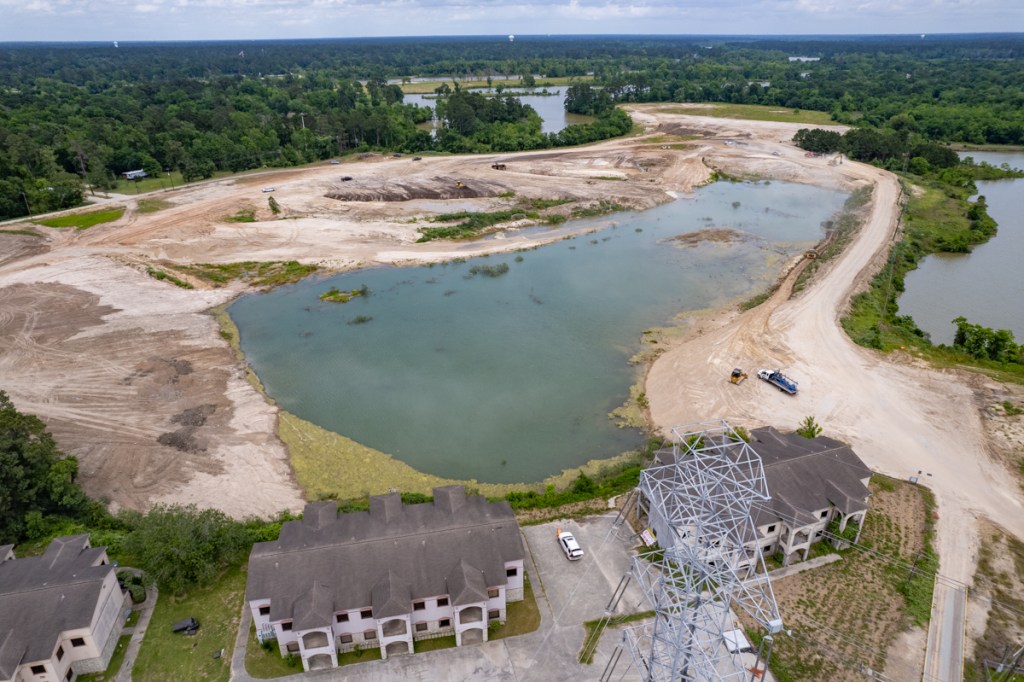
On September 26, 2022, Harris County Flood Control District (HCFCD) announced a $5.2 million channel restoration project on Garners Bayou, a tributary of Greens Bayou. Garners Bayou cuts through Humble after leaving the Bush Intercontinental airport area. I was driving by yesterday with a drone, so I thought I would check the status of the project.
Work started in the fall of 2022. The project was supposed to take 360 days. But from the photos below, it looks as though they may finish sooner.
Project Location
Garners covers a lot of territory. The project itself covers only about a mile out of more than 12 stream miles. See the two maps below.
Garners Bayou starts in the upper left and angles toward the very middle of this map before joining Greens Bayou in the lower center.This closer view shows the project extent between Mesa Drive and Wilson Road.
Construction equipment accesses the work via Mesa Drive. The five photos below show the major segments of the repairs.
Photos Taken on 5/7/2023
Looking east from over Mesa Drive. Note the low water crossings. HCFCD started downstream and worked its way up to here.Farther downstream, just past the low water crossing visible in the first photo above.Note the major repair underway on the left.Even farther downstream, note the off-channel stormwater detention basin on the left by the tank.That’s the Wilson Road Bridge in the distance and the Atascocita Landfill in the upper left.
Level of Service Being Restored
Periodically, channels such as these need clean-out. Sediment washes downstream and the banks slump in, reducing the carrying capacity. So, instead of water staying in the channel during heavy storms, it spills out into surrounding neighborhoods and floods homes.
HCFCD rates channels in terms of a “level of service.” By that, the District means, it can safely handle a 2-, 5-, 10-, 25-, 50- or 100-year rainfall event. The District rates every segment of every channel in the county.
Backing up from the starting point in the series above, you can see how sediment has clogged the area under the Mesa Avenue Bridge. This doesn’t look as though its within the project scope, but I hope they clean it out.
Looking east at the Mesa Drive Bridge over Garners Bayou. Note sediment reducing flow under bridge.
Posted by bob Rehak on 5/8/2023
2078 Days since Hurricane Harvey
https://i0.wp.com/reduceflooding.com/wp-content/uploads/2023/05/20230507-DJI_0745.jpg?fit=1200%2C799&ssl=17991200adminadmin2023-05-08 20:44:162023-05-08 23:40:28HCFCD Restoring Garners Bayou in Humble
Alan Black, P.E., formerly Director of Operations at Harris County Flood Control District (HCFCD), is now Vice President at Quiddity Engineering responsible for helping public agencies secure local, state and federal partnership funding.
While at HCFCD, Black oversaw planning, design and construction of all projects and managed applications to State and Federal agencies for flood-mitigation funding, bringing in more than $1 billion since Hurricane Harvey. Since leaving HCFCD, Black helps clients understand the labyrinth of funding opportunities and develop a long term, proactive strategy to secure funds. His comments below provide insights into Texas’ multi-year funding process for the Flood Infrastructure Fund (FIF) and how to improve it.
Alan Black, VP at Quiddity Engineering and former Director of Operations at HCFCD
Black: Yes. We started developing that when I was still at Flood Control. That list was submitted to the San Jacinto Regional Flood Planning Group for inclusion in the State Flood Plan. It includes everything on the radar for Flood Control that they would like to be eligible for State funds at some point in the future. The list includes Flood Management Evaluations, Strategies and Projects.
The labels can be a bit confusing, but Flood Management Projects (FMP’s) include design/construction; Evaluations include engineering studies, and strategies are things like flood warning systems. FMP’s involve the biggest dollars, but it takes a lot of upfront work to get there since TWDB requires a benefit-cost ratio (BCR).
Calculation of the BCR is no small task, so there aren’t a whole lot of construction projects on the Harris County list; many got relegated to FME’s because the feasibility studies didn’t have enough information yet.
It’s hard pulling together lists like that because of the level of detail required, the short time allotted, and the politics involved. Commissioners’ Court members, for instance, might say, “There aren’t enough projects in my precinct!”
Importance of Being in Flood Plan
Black: Even though state funding dollars aren’t available at this instant, you want every single project you’re contemplating to be on that list.
These projects will compete for whatever the state appropriates this year. And right now, that could be $400 to $700 million for the whole state depending on which bill you look at.
Houston Stronger has been advocating for $5 billion, but will consider themselves lucky if legislators appropriate $1 billion.
Rehak: Where did this all this start?
Black: After Harvey, voters approved a constitutional amendment that created the FIF, which the legislators can replenish periodically.
In 2019, the legislature appropriated $770 million out of its economic stabilization fund, – the rainy-day fund – to get things started.
The legislature is now modifying the flood-infrastructure fund rules so that dollars can only be spent on projects in the state flood plan.Alan Black
Need for More Frequent Plan Updates
Black: The flood plan is to be updated every five years. So, think about that for a second. If in the next five years you want to apply for FIF funding, the only way to be eligible is if you’re already in that plan.
Many have already urged the San Jacinto regional flood-planning group to establish more frequent updates – say once a year – because HCFCD by itself is constantly developing new initiatives.
Method for Prioritizing Projects is Changing
Rehak: With so many projects, how will they be prioritized?
Black: For now, look at the first round of applications on the TWDB website under the “flood intended use plan.” TWDB spelled out the scoring criteria. They received 285 submittals and ranked them using those criteria. Then they invited the top projects to submit final applications that used up the amount of money available.
Rehak: The benefit/cost ratio seems to be a sticking point for a lot of people. Tell me more about that.
Black: Buried in the original plan was a statement that said a benefit/cost ratio greater than one is “generally preferred.” At the time, we interpreted that as a green light. We thought, “Hallelujah! Somebody finally gets it. They’re not going to make go/no-go decisions based purely on a BCR.”
So, we intentionally submitted several projects with low BCRs because we thought we had a rare opening to get them funded. Unfortunately, TWDB rejected four of our applications – three in State Representative Armando Walle’s district alone – because of their low BCR.
Possible Change In Benefit/Cost Ratio Requirements
Rehak: Are people trying to change the rules for future funding?
Black: Yes. This session, Senator Creighton filed SB 2524 to prohibit the TWDB from requiring a benefit/cost ratio on applications.
How Memorandum of Understanding Requirements Complicate Projects
Black: Also, currently, TWDB requires “memorandums-of-understanding” (MOU) between jurisdictions for FIF projects. Say one MUD has a project that benefits the entire Cypress Creek watershed. Right now, that MUD must enter into an MOU with every other MUD in the entire watershed! Senator Creighton’s bill would remove that requirement.
New Ranking Criteria Not Yet Finalized
Black: To be fair, TWDB has stated they plan to adjust how they award future funding based on lessons learned. For example, to rank the projects in the State Flood Plan, the TWDB recently published draft ranking criteria and invited public comment.
TWDB has stated they don’t know yet how they will use that, but first and foremost, things will be narrowed down simply by who submits applications. If the state flood plan has 2,000 projects but only 300 submit full applications, that just filtered out 1700.
When New Funding Could Become Available
Rehak: When could we see flood infrastructure funding for projects on Flood Control’s list?
Alan Black: Fairly quickly, I hope. Fiscal Year 2024 for the state begins September 1, 2023. They’re likely already working on their draft future intended use plan. So ideally, they roll out the application window late this year or early next and start that process. It takes a couple of months to put the applications together, evaluate them, score them, and invite final applications. Actual money maybe starts flowing this time next year.
Benefit of Two-Step Applications
Rehak: Why the two-step process?
Alan Black: Two steps actually benefit local agencies because of the effort it takes to finish the final application. Abridged initial applications let you invest smaller amounts of time, money and resources. Why make people fill out full applications if TWDB knows it won’t have enough money to cover all of the projects?
Rehak: TWDB offers both loans and grants. Why?
Loans vs. Grants and the Local Funding Requirement
Black: Everybody wants grants because loans have to be paid back, but flood projects don’t generate revenue like water projects do. And the TWDB share of grant funding ends up the opposite of the way the Feds work. The Feds will say, look, you are going to have to have some local skin in the game, but we’ll cover 75% – 80% of the project.
The best grant percentage TWDB gave any Flood Control District project was 35%. All the rest had to come from local funds and they had to be truly local.
For example, FEMA lets you use HUD Community Development Block Grant funds to offset local match requirements. But TWDB won’t.
That’s going to greatly impact the number of applications in the future. People will say, “Oh, wait a minute, you’re only going to grant me 20% of my project? Well, I don’t have the other 80%. That’s why I was applying.” I hope they change that.
Barriers to Cooperation Among Jurisdictions
Rehak: There were many projects in the Region Six San Jacinto flood plan outside Harris County that affect flooding inside Harris County. Is Harris working with other counties?
Alan Black: The San Jacinto Regional Flood Planning Group represents eleven counties. But the Harris list comes from agencies within Harris boundaries. There was a tremendous outreach effort to other counties and municipalities. But many of them just never put two and two together. When I joined Quiddity, I asked one of our clients why they didn’t submit a project to the state flood plan. They said, “We didn’t even know about it.”
Fortunately, we got their project into the plan. But many smaller agencies just don’t realize the ramifications of not having projects in the plan. Getting their attention will be an uphill battle for several years.
Rehak: Why isn’t Harris County cooperating more with other counties?
Black: To be fair, they are somewhat. But first, there has recently been some reluctance at Commissioners Court to spend Harris dollars outside of the County.
Second, when Harris projects benefit other areas, we have to enter into an MOU with the adjacent agency or jurisdiction. It’s too complicated. People have other things to do. They have other, higher priorities closer to home. They just don’t have the time or the resources.
In a perfect world, it would be great if the development of the San Jacinto Regional Flood Plan included every single agency in the region, but getting them all together at the same table at the same time is too big of a lift.
Flood Infrastructure Funding “Only a Start”
Rehak: Will we ever have enough money to fill all our needs?
Black: Let’s just say for the sake of argument, the legislature appropriates $400 million. That’s across the whole state. Now, let’s assume they have a $30 billion plan. That $30 billion could easily be spent in Harris County alone and still not meet half the needs.
Pulling together this state flood plan is a great start, but we WILL need other sources of funding.
At Quiddity, I preach being proactive with funding pursuits. Pick the project you want to apply for a grant for in 2 or 3 years and start developing the information now!
Black’s Guiding Principles for Funding Applications
Black: And understand my three guiding principles for funding.
You have to spend some money to make money.
There’s no such thing as free money.
And your project will go slower with federal funds.
Guest Post by Alan Black, VP at Quiddity Engineering on 4/7/23
2077 Days since Hurricane Harvey
https://i0.wp.com/reduceflooding.com/wp-content/uploads/2023/05/20160421-Alan-Black.jpg?fit=1200%2C1090&ssl=110901200adminadmin2023-05-07 13:28:132023-05-07 14:15:37Ins and Outs of Texas Flood Infrastructure Funding
After three years of La Niña, signs point to the start of El Niño with cooler-than-normal temperatures off the Pacific Coast of North America. Jeff Lindner, Harris County’s meteorologist, says an El Niño could fully develop in the next few months. Here are El Niño implications for the Gulf Coast.
Cooler, Wetter, Fewer Hurricanes
In the south-central United States, major impacts during an El Niño event consist of:
above-normal precipitation, particularly during winter
below-normal temperatures, also during winter
a less active hurricane season, with fewer named storms
In general, stronger winds from the west during El Niño tend to inhibit development of storms trying to approach from the east. Meteorologists call that process “wind shear.” See red arrow in second map below.
While most organizations have expressed growing confidence in the development of an El Niño, a few have noted above-average ocean temperatures in the eastern Atlantic that introduce uncertainty and which could actually yield greater activity, particularly if a weaker El Niño event materializes. See below.
Note cooling sea surface temps off coast ofwestern U.S. and warming temps off coast of western South America and Africa. Source: NOAA SST Anomaly Charts.
South America has had cooler-than-normal waters off its west coast for the last three years, but now those same waters have warmed for the last 3-5 months. And the cooler waters have shifted north of the western coast of the U.S. and Canada.
Jeff Lindner, Harris County’s meteorologist says, “We need to see these conditions hold for a few months for the official declaration of El Niño. Lindner says conditions could likely intensify into a strong El Niño by late this summer or early fall.
El Niño Typically Brings Wetter Weather to Gulf Coast
He also notes that sea surface temperature anomalies of this magnitude can shift weather patterns across the globe.
Locally, Lindner says, “El Nino tends to support wetter and cooler conditions during our fall, winter, and spring months. There is less influence during summer.”
“The threat for heavy rainfall and flooding is generally higher during El Niño periods.”
Jeff Lindner, Harris County Meteorologist
According to Lindner, La Niña tends to correlate with the opposite influences – warmer, drier conditions for Texas or even drought…as many areas have experienced during the most recent La Niña event that started in early 2020.
Not all El Niño events are the same. Other global weather patterns can enhance or interfere with the effects of El Niño.
Lindner believes that the speed with which El Niño conditions form this summer will likely determine the fate of the Atlantic basin hurricane season. “A quicker onset would tend to significantly reduce Atlantic basin activity while an onset more toward early fall may allow a slightly busier and “front loaded” season,” he says.
El Niño patterns tend to favor reduced Caribbean hurricane activity and a higher chance of more sub-tropical development over the mid-Atlantic.
During El Niño years, says Lindner, tropical storms and hurricanes tend to form “in close” in the northern Gulf and off the southeast U.S. coast as tropical waves move into more favorable conditions.
Less Drought Likely
As El Nino develops this summer into the fall, it is likely that Texas and the southern plains will transition toward a wetter pattern. That should lessen or eliminate the ongoing drought across portions of Texas. Lindner expects to see significant improvements by late fall into the winter.
Posted by Bob Rehak on 5/4/2023based on a press release by Harris County Meteorologist Jeff Lindner
2074 Days since Hurricane Harvey
https://i0.wp.com/reduceflooding.com/wp-content/uploads/2023/05/ssta.daily_.current.png?fit=1787%2C1085&ssl=110851787adminadmin2023-05-04 16:11:532023-05-04 16:27:44El Niño Implications for Gulf Coast
The stormwater-detention basin at the Laurel Springs RV Resort is supposed to have, according to the construction permit plans, a dry bottom. However, the basin almost always retains water, despite the fact that it should empty within 48 hours of a 100-year rain. A 100-year rain is 17.3 inches in the Lake Houston Area.
The pond retains so much water for so long – after even minor rains – that the resort has posted “No Swimming” signs.
As a tribute to the presence of water, the pond has even attracted nesting ducks, which can be an aviation hazard so close to Bush Intercontinental Airport.
Reason for Dry-Bottom Requirement
The Resort falls within a defined radius of Houston Bush Intercontinental Airport and the City wants to discourage birds from nesting there, especially large birds that can damage aircraft. Hence the requirement on the permit plans. (See more below.)
A retired airline pilot, who lives nearby and knows the dangers of bird strikes all too well, sent me the two photos below. The first shows seven ducklings in the Resort pond. The next shows a “No Swimming” sign next to the walking trail around the pond.
Seven ducklings enjoying the waters of the Laurel Springs RV Resort. No adults seen at this time.Sign warning customers not to swim indicates permanence of water.
Construction Permit Plans Note Restriction
Because of this pond’s location near IAH, the FAA and City of Houston stipulate that the stormwater detention basin should have a dry bottom within 48 hours after a “design storm.” The requirement helps discourage birds, especially geese and other large waterfowl, from taking up residence close to the airport. That’s an important consideration, especially during the migration season, which we are in right now.
Reference to “design storm”means a 100-year event. In this location, that means 17.3 inches of rain in 24 hours.
A retired airline captain who lives near the RV resort keeps calling this to my attention.
I first posted about this in May of last year and was told that the Resort hadn’t hooked up electricity to its pumps yet. Six months later, the pumps still weren’t working.
Now, a full year later, we have a brood of ducklings in the pond and a no-swimming sign that shouldn’t be necessary if the drainage worked properly.
No Rain in Past 48 Hours, Little Rain in Past Week
It hasn’t rained in the last 48 hours, according to the official gage at US59 gage about a half mile from the basin.
And in the last week, we have received only .72 inches of rain. That occurred in two events more than 24 hours apart.
That’s about one sixth of a 1-year rain according to Atlas-14 standards below. It’s also less than one twenty-fourth of a 100-year rain stipulated by the FAA.
Atlas-14 Rainfall standards used as the basis for designing detention basins.
Here’s what the pond looked like today – five days after after the last rain – which could have been pumped out within hours.
Laurel Springs RV Resort Detention basin should be dry but obviously isn’t.
Two Bird Strikes Force United Flights Down at IAH Last Week
CNN reported last week that two bird strikes within 20 minutes of each other forced United flights to return to Intercontinental. CNN said that this year alone the FAA has already reported about 2,000 bird strikes, and 85% involved commercial airliners. Most bird strikes are waterfowl, although admittedly larger than the ducklings above.
Something to think about next time you fly.
Posted by Bob Rehak on 5/3/2023 based on pictures from a reader
2073 Days since Hurricane Harvey
The thoughts expressed in this post represent opinions on matters of public concern and safety. They are protected by the First Amendment of the US Constitution and the Anti-SLAPP Statute of the Great State of Texas.
https://i0.wp.com/reduceflooding.com/wp-content/uploads/2023/05/No-Swimming.jpg?fit=1200%2C822&ssl=18221200adminadmin2023-05-03 13:05:012023-05-03 14:06:45“No Swimming” in Dry-Bottom Pond!
Harris County Flood Control District’s (HCFCD) Woodridge Village Excavation and Removal contract with Sprint Sand & Clay continues progressing nicely. The volume excavated last month shows a continued rebound in activity after a dip last year when the housing market slowed.
As of the end of April, Sprint has completed approximately 23% of its 500,000-cubic-yard contract. More important, excavation could meet Atlas-14 detention requirements by the end of 2023.
Sprint excavated an estimated 11,000 cubic yards in April – more than double the monthly minimum. That brings the total to date to approximately 115,000 cubic yards.
Photos Reveal Excavation in New Direction
Here’s what the status of Woodridge Village excavation looked like on 5/1/2023. For the last year, Sprint has focused on lengthening the basin. Now it is focusing on widening it, too. Note the work taking place in the upper left quadrant of the photo below.
Looking northeast. Looking southwest toward Kingwood Park High School.Looking east at current area of excavation.
Typically, HCFCD gives E&R contractors some general boundaries and says, “Start digging.” Sprint makes its money by selling the dirt on the open market. There’s virtually no cost to taxpayers. And usually the bigger the hole in the ground, the better. So, according to a former flood control executive, if Sprint goes beyond 500,000 cubic yards, no one will complain. It reduces flood risk free of charge.
Partially as a result of insufficient stormwater detention capacity, up to 600 homes downstream in Kingwood flooded twice in 2019.
After HCFCD bought the property, it hired Sprint to get a head start on Woodridge Village excavation of additional detention capacity while it worked out exact plans for a regional detention basin and Taylor Gully.
Sprint has excavated approximately 71 acre feet so far. That brings the current detention capacity to 342 acre feet.
But HCFCD will ultimately need approximately 385 acre feet of stormwater detention capacity to meet Atlas-14 requirements and it hopes to build even more as a safety hedge against future needs should they increase.
If Sprint excavates the entire 500,000 cubic yards in its contract, that would bring the total stormwater detention capacity up to 580 acre feet. In tabular form, the steps look like this:
Acre Feetof Stormwater Detention
% of Ultimate
Site Had When Purchased from Perry Homes
271
47%
Has as of 5/1/23
342
59%
Atlas 14 Requires
385
66%
If Sprint Excavates All 500K Cubic Feet
580
100%
Calculations based on original construction plans, HCFCD monthly reports, Atlas-14 Requirements and Sprint contract.
Calculations in the last column assume that Sprint excavates all 500,000 cubic yards. But Sprint’s contract calls for excavating UP TO 500,000 cubic yards.
A lot of flexibility exists for both parties in an E&R contract. If the demand for dirt dries up and excavation slows, HCFCD and Sprint could modify the E&R contract to complete a smaller detention basin sooner. But I assume it would still meet Atlas 14 requirements at a minimum.
Based on April performance, Sprint is currently excavating approximately 6 acre feet per month.
If demand for dirt holds, excavation should reach Atlas-14 requirements near the end of 2023.
Still Much More Work to Do
But simply excavating the dirt isn’t the end of the job. Harris County still needs to slope the sides, plant grass, and tie the new basin into the site’s existing stormwater-detention-basin network.
An engineering team is currently working on drawing up final construction plans. Simultaneously, they are looking at how Woodridge Village excavation will impact Taylor Gully needs.
At the moment, no one knows exactly how this project will end. There are simply too many variables. The site could contain one giant stormwater detention basin or several smaller ones.
HCFCD often employs a phased approach with large projects, such as Woodridge/Taylor Gully. Consider for instance, Willow Water Hole on South Post Oak at Highway 90. Or the Lauder Basin on Greens Bayou south of Beltway 8 North.
A phased approach enables residents to start reaping partial benefits sooner, with an eye toward maximizing future risk reduction as circumstances and funding allow.
Posted by Bob Rehak on 5/2/2023
2072 Days since Hurricane Harveyand 1329 since Imelda
https://i0.wp.com/reduceflooding.com/wp-content/uploads/2023/05/20230501-DJI_0671.jpg?fit=1200%2C799&ssl=17991200adminadmin2023-05-02 15:13:082023-05-02 18:17:05Woodridge Village Excavation Approaching Atlas-14 Requirement
To kick off National Hurricane Preparedness week, the U.S. government sent two hurricane hunter aircraft to Ellington Field today. It was a rare opportunity for the public to interact with crews and support staff, and to tour some impressive displays of technology. See pics below.
Hurricane Hunter Aircraft on Display at Ellington Field
WP-3D – “Orion” by Lockheed. Introduced in 1976. the W stands for Weather.Operated by 53rd Weather Reconnaissance Squadron of the U.S. Air Force Reserves.
The versatile WP-3D – “Orion” turboprop aircraft is equipped with a variety of scientific instruments, radars, and recording systems for both in-situ and remote sensing measurements of the atmosphere, the earth, and its environment. Orion aircraft collects low-altitude data to fill gaps in data not available from ground-based radar or satellite imagery.
A crew member described the aircraft as a flying MRI machine that can see into the heart of storms.
The WC-130J is a high-wing, medium-range aircraft used in several weather reconnaissance missions throughout the year. The Air Force configured this plane to penetrate tropical disturbances and storms, hurricanes and winter storms. It is equipped with meteorological instruments and radar to obtain data on the current development, movement, size and intensity of these systems.
The aircraft carries a minimum crew of five: pilot, co-pilot, navigator, aerial reconnaissance weather officer and weather reconnaissance loadmaster. The crew collects and reports weather data as often as every minute.
Members of the public look at the impressive number of missions this hurricane hunter has flown.
Dropsonde Demo
Tube through which instrument sensors called “sondes” are dropped from WC130into hurricanes.
In flight, the aircraft drops sondes about every 15 minutes, according to one manufacturer. “Dropsondes play a very important role in the data collection during field projects. They provide data of a near-vertical profile of very remote regions that could otherwise not be be studied. The dropsonde provides actual readings of the atmosphere as it travels downward. Because the device is in contact with the medium that it is measuring, this type of sensing is also called in-situ sensing.” They measure temperature, wind speed, wind direction, moisture, location, atmospheric pressure and more.
Emergency Management Participants
Also present were representatives from NOAA, the National Hurricane Center, the National Weather Service, the Army Corps of Engineers, the Coast Guard, the US Air Force, Harris County Flood Control District, the City of Houston Mayor’s Office of Emergency Management, the Red Cross, USAA, and more.
They passed out everything from disaster preparedness guides to hurricane guides, emergency document bags, cloud charts, and stress balls! Good times and sunburns were had by all!
Additional Preparedness Resources
From Houston, the tour moves east to New Orleans, and Mississippi before making two stops in Florida.
Harris County Flood Warning System for current and historical rainfall at gages throughout the region, info about historical rainfall and floods, inundation mapping and more.
The last guide goes beyond hurricanes and covers everything from chemical spills to active shooter incidents.
They’re all worth exploring. But don’t wait until a hurricane is bearing down to explore them. The sites will likely be crowded, the internet down, and response times slow. Also keep in mind that in an emergency, you may need to conserve battery power in your mobile devices. After Hurricane Ike in 2008, parts of the Lake Houston Area lost power for weeks.
Posted by Bob Rehak on 5/1/2023
2071 Days since Hurricane Harvey
https://i0.wp.com/reduceflooding.com/wp-content/uploads/2023/05/20230501-RJR_1473.jpg?fit=1200%2C800&ssl=18001200adminadmin2023-05-01 17:47:532023-05-02 08:57:47Hurricane Hunter Expo at Ellington Draws Crowd
The time to stock up on emergency supplies is not when there’s a run on batteries, backups, and bottled water.
If you’re new to the Gulf Coast, it’s especially important to educate yourself. Storms can cut off evacuation routes, disrupt water and sewer, knock out electricity for weeks, create impossibly long lines at gas stations, and more.
Inland areas like Lake Houston don’t face much of a threat from storm surge. But we are susceptible to wind damage, fallen trees, riverine flooding, and street flooding.
Having interviewed dozens of flood victims, I can promise you. Invariably, the three things they most regret are NOT:
Preparing early enough.
Having flood insurance.
Putting valuables such as legal documents, family photo albums, and family bibles on high shelves.
If you’re new to the area, explore the links above and develop a checklist. Even if you’re a veteran of major storms, a little brushing up never hurts.
H.B. 1540 passed in the Texas House on Friday, April 28, 2023. The bill concerns recommendations from the Sunset Advisory Commission affecting the board of the SJRA.
However, Representative Will Metcalf from Conroe offered a last-minute amendment from the House floor that would effectively fire Jace Houston, the SJRA’s general manager, who reports to the board. The amendment has the potential to upset the delicate balance between upstream and downstream interests mandated by the Governor after Harvey.
The senate version of the bill does not include Metcalf’s amendment. So, this fight isn’t over yet.
Let me cover the bill, the amendment, and implications in that order.
Key Provisions of H.B. 1540
The House analysis summarizes key provisions of H.B. 1540. It revises provisions governing SJRA. It implements – across-the-board – all Sunset Advisory Commission policy recommendations relating to the following:
Gubernatorial designation of the presiding officer of SJRA’s board of directors;
Specific grounds for removal of a board member;
Board member training;
Separation of the board’s policy-making responsibilities and the staff’s management responsibilities;
Maintenance of complaint information; and
Public testimony at board meetings.
The bill also provides for the transition to the new training requirements for current board members. Significantly, it also adds an additional member to SJRA’s board of directors, decreases the length of a member’s term from six years to four years, and provides for the transition to this new membership and term length.
H.B. 1540 would require at least four of the seven SJRA board members to reside in Montgomery County.
H.B. 1540 requires SJRA’s board of directors to develop and implement a comprehensive policy that provides a structure for public engagement in advance of major actions and projects. The policy must include a clear and detailed description of how SJRA will seek to actively engage stakeholders, including the possible use of the following:
Advisory committees;
Community panels;
Town hall meetings;
Surveys;
Other strategies on a recurring basis.
General-Manager Amendment
After the bill was voted out of the House Natural Resources Committee, Representative Metcalf offered an amendment on the House floor that surprised Committee Chair Tracy King.
Rep. Metcalf from Conroe
The terse amendment requires that the board appoint a new SJRA General Manager within 30 days who hasn’t been employed by the SJRA as general manager within the last six months. It’s a dagger in Jace Houston’s back.
Chairman King spoke against the amendment, but in the end voted for the bill. King stated that the amendment tried to usurp the Governor’s authority. He pointed out that the Governor appoints the board and that the board hires the general manager. The legislature should not get in the middle of that, he said.
Why Try to Fire Houston?
During Metcalf’s testimony, he complained bitterly about SJRA’s:
Water rates
Groundwater reduction plan
Water treatment plant
Insistence that the City of Conroe uphold its SJRA contract
Seasonal-lowering policy of Lake Conroe that protects downstream residents
Battles with the Lonestar Groundwater Conservation District over subsidence.
As SJRA General Manager, Jace Houston has played a prominent role in all these controversies.
Chairman King raises a point of order against the amendment at 2:29:10. He says the amendment is not germane to the subject of the bill. Then there’s a long break in the action while they confer on the point of order.
At 2:41:10, discussion resumes. King has withdrawn his point of order and rises to speak in opposition to the amendment. Metcalf follows him. Then they hold a vote. The bill passes with the amendment.
At 2:47:50, discussion moves to the next bill.
Amended Bill Overwhelmingly Passes, But…
The House bill passed with 145 Yeas, 2 Nays, and 1 Present but not voting. However…
Four days earlier, on 4/24/23, the Senate passed S.B. 2586, an identical companion bill (minus the Metcalf amendment). It’s now in King’s House Natural Resources Committee.
That means the bill could go to a conference committee to iron out the difference and find a compromise. Then the House, Senate or both will have to vote on it again. Exactly one month remains in this session.
In the meantime, you can bet heavy-duty politicking will happen in Austin.
What’s Next?
Does the Senate have the appetite to engage in a local water war this late in session?
Will Jace Houston fight to stay? Or will he throw in the towel?
Is Metcalf trying to scare the SJRA into concessions?
Will the Governor weigh in? Stay tuned.
San Jacinto River Basin
The San Jacinto river basin encompasses more than 5,000 square miles and 6.4 million people in 11 counties.
Yet Representative Metcalf seems concerned with only a small portion of them. Montgomery County has a tenth of that population in only a 1,000 square miles. And Metcalf represents only part of Montgomery County and a third of its population. Yet Mr. Metcalf seems to want to manage the SJRA for the benefit of 1 out of every 30 people in the watershed.
The San Jacinto river basin is much larger than Conroe, Metcalf, and his district.
That point seems to have eluded everyone who voted for Metcalf’s amendment. I hope calmer minds prevail.
Had this vote happened after Harvey, I think few would have defended the SJRA or Jace Houston. But since then, I have seen a concerted effort to find balance between upstream and downstream interests, as the Governor directed.
Metcalf’s amendment could potentially tilt the balance back upstream, the way it was before Harvey. We just don’t know. The uncertainty worries me. Will we be saying goodbye to lake lowering and hello to more subsidence?
Posted by Bob Rehak on 4/29/2023
2069 Days since Hurricane Harvey
The thoughts expressed in this post represent opinions on matters of public concern and safety. They are protected by the First Amendment of the US Constitution and the Anti-SLAPP Statute of the Great State of Texas.
https://i0.wp.com/reduceflooding.com/wp-content/uploads/2023/04/Rep.Will-Metcalf-e1682815112490.jpg?fit=599%2C450&ssl=1450599adminadmin2023-04-29 19:47:282023-04-30 10:27:48Amendment to H.B. 1540 Could Force Changes in SJRA Management
On Tuesday, 4/25/23, Harris County Commissioners gave Harris County Flood Control District (HCFCD) approval to incorporate almost $3 billion worth of studies and projects into the first State Flood Plan. The approval will make the studies and projects eligible for future funding from the State Flood Infrastructure Fund.
The San Jacinto Region 6 Flood Planning Group will first incorporate the requests into its regional flood plan. The Texas Water Development Board (TWDB) will then compile a master list of projects throughout the state and rank order them.
TWDB is working toward a September 1, 2024, deadline
Being in the new state flood plan will now be a prerequisite for applying for Texas Flood Infrastructure Fund grants and loans. If you’re not in the plan, you will not even be eligible to submit an application until the next revision of the flood plan. That could take another five years. So this is a good and timely move by HCFCD.
Agenda Item 136 Contained 136 Requests
Harris County Commissioners Court Agenda Item #136 read, “Request for approval of the Flood Control District’s Flood Management Evaluations and Flood Mitigation Projects to be included in the Amended San Jacinto Regional Flood Plan, for incorporation into the Texas State Flood Plan.”
The backup states: “All identified FMEs and FMPs in the Regional Flood Plan will be incorporated into the State Flood Plan, which once adopted by the State of Texas, will enable the Flood Management Evaluations and Flood Mitigation Projects to become eligible for future TWDB Flood Infrastructure Funding.”
102 “evaluations” totaling $43,150,000. Flood Management Evaluations (FMEs) include such things as surveys, studies, preliminary engineering reports, etc.
34 projects totaling $2,928,966,000. Flood Management Projects (FMPs) include construction, which explains the much larger number.
All projects are technically in the San Jacinto watershed (see map below). However, Harris County breaks projects down even further by sub-watersheds. It calls one the San Jacinto, which creates some confusion. For clarity, HCFCD’s San Jacinto sub-watershed includes the East and West Forks, Lake Houston, and the main stem of the river down to Galveston Bay. HCFCD also recognizes 22 other sub-watersheds. All were included to some degree in the list of projects.
Of the 34 construction projects, HCFCD included two in the San Jacinto sub-watershed totaling $128.8 million out of the $2,928,966,000, or 4.4% of the total. They are the Kingwood Diversion Ditch ($82.3 million) and Taylor Gully ($46.5 million).
Deadlines Looming
The deadline for incorporating FMEs and FMPs into region flood plans is May 14, 2023. The 15 Regional Flood Planning Groups (RFPG) will submit their amended regional flood plans to TWDB by July 10, 2023. The TWDB must combine the approved regional flood plans into a single state flood plan and deliver it to the Legislature by September 1, 2024.
To keep with the bottom-up approach of the regional flood planning program, TWDB has elected to utilize only RFPG-reported data for ranking.
How TWDB Will Rank Items
TWDB has proposed a scoring matrix to rank FMEs and FMPs throughout the state. The criteria differ for the two categories. Proposed criteria in the:
FME category include flood-reduction benefits such as the number of structures, people, critical infrastructure, acres, miles of roadway removed from the floodplain, and cost projections.
FMP category also weighs factors such as social vulnerability; environmental benefits; flood severity; life and safety; and operations and maintenance costs.
Note, however, that the legislature may change the criteria. One flood expert said legislators are evaluating the fairness of the benefit/cost ratio, for instance.
The TWDB website contains this note. “While inclusion in the state flood plan is a requirement for eligibility for future FIF project funding, the associated rankings are not intended for allocating state funding. Future funding decisions will occur through a separate TWDB process if and when funds are appropriated by the Texas Legislature. How the state flood plan project ranking may be considered in future flood project funding prioritization and allocation processes remains to be determined although it is anticipated that the state flood plan ranking will be at least one of the considerations.”
Harris County’s prioritization framework includes many of the same factors proposed by TWDB. But the County’s weights vary radically. For instance, TWDB gives 2.5% weight to social vulnerability and Harris County gives social vulnerability 20% – eight times more. However, only TWDB criteria will affect the final statewide rankings.
Initial Funds No Longer Available
Texas initially funded the Flood Infrastructure Fund with $770 million after voters passed Proposition 8, a constitutional amendment, in 2019. All of that money has either been distributed or committed.
Future projects will require a new infusion of cash from the state legislature. TWDB declined to say what that might be. However, an interested “legislature watcher” said appropriations ranging from $300 to $700 million have been discussed to cover projects throughout the state. He suspects the final total will be a compromise somewhere in the middle of that range.
Alternative Sources of Funding
Obviously, $300 million statewide won’t cover a $3 billion ask from Harris County, not to mention projects elsewhere.
So I asked HCFCD if it was pursuing alternative sources of funding for some of these projects. HCFCD answered “yes.”
A spokesperson said, “The Flood Control District is actively working to identify funding opportunities through grants, loans and other funding mechanisms, including for some projects included on the Region 6 Regional Flood Planning Group list. Including these projects on the State Flood Plan list serves to demonstrate the need for flood mitigation projects in the region, as well as to allow for future funding opportunities.”
The list of projects submitted by Harris County focused overwhelmingly on projects inside Harris county, though a few do have components that spill over county lines.
HCFCD and the San Jacinto Regional Flood Planning Group have both tried to reach out to municipalities, neighboring counties and MUDs throughout the entire watershed. But many reportedly don’t have experts skilled in filling out the lengthy TWDB applications. Many also don’t have the seed money to attract matching funds for flood projects. Whether that disadvantages people at the edges of the county and beyond remains to be seen. It could take years to tell.
However, HCFCD says that at this time, “We are not aware of any major projects outside of Harris County that were not included on the State Flood Plan list. ”
Posted by Bob Rehak on 4/28/23
2068 Days since Hurricane Harvey
https://i0.wp.com/reduceflooding.com/wp-content/uploads/2023/04/20230428-Screenshot-2023-04-28-at-12.55.43-PM.jpg?fit=1040%2C1200&ssl=112001040adminadmin2023-04-28 15:50:072023-04-28 15:55:00HCFCD Incorporates $3 Billion of Studies, Projects into State Flood Plan
“Before” satellite photo from 2015. Note middle, greenish pond on right where road curves.File photo from February 2020 showing same pond, mostly filled. Townsendcurve in foreground.After dredging in 2021, the pond was completely filled.
A regular reader emailed me about a large volume of truck activity in the area recently. So I went there today to see what I could see. The pond was half empty again. The mystery deepened. Were they taking dirt out or putting it in?
Half empty pit photographed on 4/26/23.
Trucks Filling Pond Again, Not Emptying It
Closer inspection showed that dozens of dump trucks were depositing dirt. That deepened the mystery even more. How did the pond get half empty with trucks dumping more dirt into it?
Also photographed 4/26/23. Trucks offloading dirt and bulldozer spreading it into remainder of pond.
A gentleman drove up and engaged me in conversation as I was landing my drone. He introduced himself as the owner of the property and said that a private contractor bought the dirt left by the Corps, thus emptying the pit again.
No Intent to Build Here
I asked if he intended to build on the newly filled area and he said “no.” I also pumped him for information about where the dirt was coming from, but didn’t get anything definitive.
When I took these photos, it was the end of the workday. Trucks were scattering in all directions. The City did not immediately return calls or emails about next steps in its dredging program, if that’s where the dirt came from.
The good news for now: it appears we won’t have more building in the floodplain in this area. More news to follow when I get it.
Posted by Bob Rehak on 4/26/23with thanks for the heads up from Eric Hayes
2066 Days since Hurricane Harvey
https://i0.wp.com/reduceflooding.com/wp-content/uploads/2023/04/20230426-DJI_0652.jpg?fit=1200%2C799&ssl=17991200adminadmin2023-04-26 19:31:162023-04-27 17:30:39Placement Area #1 Gets New Life