At 2:00 PM EDT on 7/22/23, the National Hurricane Center announced that Tropical Storm Don became Hurricane Don, the first Atlantic storm to achieve hurricane-force winds this year. Not only did Don form earlier than usual, it formed farther north than usual – between New England and Europe. Hurricanes hardly ever form in that area this early in the Atlantic hurricane season.
Hurricane Don’s Current Location
Location of Hurricane Don on is parallel with New Jersey.NOAA gives the orange area a 60% chance of formation in the next 7 days.
Hurricane Don’s Expected Track
NHC expects Don to decrease in strength to a tropical storm on Sunday and a tropical depression on Monday as it turns toward Europe.
Higher than Normal Sea Surface Temps Contribute to Early Formation
Warmer than normal sea surface temperatures played a role in the intensification of Don. Note the dark brown to black areas off the coasts of New England and Newfoundland. Those colors indicate a whopping 4 to 5 degrees centigrade above normal. That equals 7-9 degrees Fahrenheit.
No Hurricanes Reported Forming That Far North This Early
NHC shows that in the 165 years between 1851 and 2015, no other hurricane formed as far north as Don during this 10-day period.
Don is no threat to the Houston area. But Don’s timing may give us a clue to the type of hurricane season this will be. Both Colorado State and NOAA predicted slightly above average hurricane seasons this year.
The fourth tropical storm of the year doesn’t usually happen until August 15. And the first hurricane doesn’t usually happen until August 11.
El Niño Not a Factor in Don’s Formation
It takes the alignment of seven ingredients to form tropical cyclone. NOAA lists warm seas as #2. And we certainly have that around the world this year year, as you can see in the anomaly map above.
Wind shear from El Niño would not play a factor in deterring hurricane formation as far north as Don OR this early in the season, says Harris County’s meteorologist Jeff Lindner. “El Nino has little to no influence on our weather during the summer months (June-September),” says Lindner.
“The majority of El Nino’s influence on southern plains and Texas weather is during the fall, winter, and spring (October-May). This time of year we tend to be controlled by the sub-tropical highs around 30º N and/or the influences of the tropics from the Gulf of Mexico. This particular year the Sonoran sub-tropical high over the SW US and northern MX had thus far been the main controlling factor in our weather and El Nino has little impact on that.”
Lindner concluded, “The wind shear associated with El Niño is mainly across the southern Gulf of Mexico, much of the Caribbean Sea, and the western deep tropical Atlantic. However, wind shear thus far this hurricane season has not been overly impressive for an El Nino summer and there are some suggestions that the very warm Atlantic waters may be lessening the impacts of El Nino and its wind shear in the Atlantic basin.”
We’re into uncharted territory, so to speak. This is where it gets interesting.
Posted by Bob Rehak on 7/23/2023
2155 Days since Hurricane Harvey
https://i0.wp.com/reduceflooding.com/wp-content/uploads/2023/07/two_atl_7d0-1.png?fit=900%2C665&ssl=1665900adminadmin2023-07-22 17:35:042023-07-22 22:29:23Don Becomes First Hurricane of 2023 Atlantic Season
This morning I visited the National Hurricane Center website to see the latest tropical developments. The Houston Area has nothing to worry about at the moment. But while I was on the NHC website, I stumbled on an incredible resource. It discussed – among other things – the necessary ingredients for a tropical cyclone. It’s called the Mariner’s Tropical Cyclone Guide, updated by Dylan Flynn in May 2023.
A Treasure Trove of Information about Tropical Systems
The title sells this electronic booklet short. It’s true that the last quarter of this 86 page booklet discusses how to navigate ships and boats near tropical cyclones. But the rest is a primer on tropical systems themselves. The booklet has four chapters:
Tropical Cyclone Basics
Climatology
Monitoring Tropical Cyclones
Tropical Cyclone Evasion
Although the book is targeted at Navy and Merchant Marine personnel, the general public will find the first three parts both informative and educational. The writing is clear, crisp, and concise. And the illustrations are illuminating. Overall, a quick read.
One of the most fascinating discussions started on page 12.
Necessary Ingredients for Development and Intensification
Flynn lists seven environmental conditions necessary for tropical cyclones to form and thrive. Eliminate one, says Flynn, and the whole system starts to break down.
A pre-existing surface disturbance with thunderstorms: Tropical cyclones rely on a build-up of heat energy above them to grow and develop. A thunderstorm complex acts as a vertical transport mechanism for heat, moisture, and the cyclonic turning of winds into the upper levels of the atmosphere. This vertical transport helps tropical cyclones develop.
Warm ocean: Tropical cyclones draw on the heat energy stored in the ocean. Sea surface temperatures of at least 80ºF are needed to support development and intensification. Evaporation of this warm water begins the process of energizing the atmospheric column. The warm seas should extend at least 60 m deep, as the strong winds of a tropical cyclone cause a turbulent sea that mixes the warm surface water with cooler, deeper water.
Low vertical wind shear: Tropical cyclones rely on a vertically stacked structure to grow or maintain intensity. The ideal tropical cyclone has its upper-level circulation directly above the low-level circulation. Changes in environmental wind speed or direction with height will tilt the vertical structure. This tilting inhibits growth and may cause the system to decay.
Unstable atmosphere: Rising air is needed to warm the tropical cyclone core, and an unstable atmosphere is necessary to support rising air.
High atmospheric moisture content: Cloud formation is limited if the atmospheric column is too dry. Rising air will cool but struggle to reach the low dew point. The environment is often stable for dry parcels of air but unstable for moist air.
Upper-level outflow: An exhaust mechanism is needed above a system to perpetuate the strong upward motion. This upper-level mass removal causes the pressure at the surface to drop. As a system develops, low-level cyclonic flow pulls mass toward the center. The flow then turns upward as intense vertical motion associated with thunderstorms. This process is known as “the in-up-and-out” circulation. Without a method to dispose of the mass above a tropical cyclone, low-level converging flow toward the center will halt as the system suffocates.
Adequate Coriolis force: Due to the earth’s rotation, the Coriolis force causes tropical cyclones to spin counter-clockwise in the northern hemisphere and clockwise in the southern hemisphere. This spin is a critical component for development and intensification. Tropical cyclones rarely develop within 5 degrees of the equator, where this force is weakest. See gap in illustration below.
Other Fascinating Discussions
This is just one of dozens of fascinating topics in Flynn’s booklet. Among other things, Flynn discusses:
The exact meaning of terms used by NOAA and the National Hurricane Center. For instance, do you know the difference between a potential tropical cyclone, tropical cyclone and tropical depression? See pages 7-8.
How tropical cyclones dissipate and transition into extratropical storms. Page 14.
The size of the impact area for tropical cyclones. Page 15.
What 50 foot waves look like to a sail drone from inside the eye of hurricane. Page 22.
How dangers differ in different areas around cyclones.
Seasonal variations and the influence of El Niño.
Environmental steering currents for cyclones.
How to interpret NOAA’s technical charts and tables, such as wave heights/intervals, wind forecasts, etc.
The general public and weather enthusiasts will find a boatload of useful information in this booklet, not just the necessary ingredients for a tropical cyclone.
Posted by Bob Rehak on 7/22/2023
2153 Days since Hurricane Harvey
https://i0.wp.com/reduceflooding.com/wp-content/uploads/2023/07/20230722-Screenshot-2023-07-22-at-10.33.09-AM-1.jpg?fit=1100%2C754&ssl=17541100adminadmin2023-07-22 11:56:142023-07-22 12:07:53Necessary Ingredients for a Tropical Cyclone
As I drove by Kingwood Middle School this afternoon, sprinklers were sprinkling, grass was growing and the construction equipment was gone. All that remained were two workmen from a landscaping crew packing up their equipment. There may be small jobs yet to do. For instance, will the athletic field have football goal posts?
But I think we can safely move this project into the win column. In three years, it has gone from “distant dream” to “architectural gem” and “community showcase.”
By the start of school in three weeks, Kingwood Middle School should be fully functional – including the athletic fields and new stormwater retention basins that it never had before. See below.
Looking NE from over Pine Terrace.Looking north. The giant “Cougars” emblem on the lobby sun screen is a new addition since my last report. Giant retention basins where main entry used to be should reduce flood risk in neighborhood.
For Photographic History of Project
For photos showing the progress of Kingwood Middle School demolition and re-construction, see below.
An article in the New York Times on July 14 listed insurance companies limiting coverage or pulling out of disaster prone states.
Farmers said it will limit coverage in Florida
Eight smaller insurers have gone bankrupt in Florida in the last two years.
State Farm and Allstate have stopped selling policies in California, and Farmers has limited them there.
Separately, a Washington Post investigation found that some Florida policyholders had their claims cut by more than 80 percent after Hurricane Ian last year. The headline screams, “Insurers slashed Hurricane Ian payouts far below damage estimates…”
Risks Vs. Rewards of Living Near Water
I’ve written before about how the love of living near water can outweigh the fear of consequences that sometimes accompanies it.
If you google “benefits of living near water,” you will quickly find 1.9 billion results. Many of them are from residential developers near rivers, lakes, streams and seashores. They make health and emotional claims such as:
Lowers stress and anxiety
Increases in well-being and happiness
Lowers heart and breathing rates
Healthier lifestyle.
Now google “disadvantages of living near water.” You get half that number of results. They tend to cluster around:
Flood damage
Pollution
Erosion
Increased maintenance and insurance costs
For Most People, Rewards Generally Outweigh Risks
It’s not that people don’t recognize the disadvantages of living near water. It’s just that most enjoy the benefits more. AND they figure that insurance companies will make them whole should disaster strike.
But now, at least in some states, insurance companies seem to be caught in a squeeze between shareholders and regulators. And they’re making some tough calls that will force policy holders to re-evaluate whether the rewards of living near water are worth the risks.
As I scrolled through my library of almost 50,000 flood-related images last week, I wondered how long it might be before Texans experienced the same insurance problems now facing Florida and California residents.
Our love of water, buoyed by the courageous, optimistic spirit of Texans, leads many to take risks that I personally would not take.
Bolivar Peninsula Denser than Before Ike
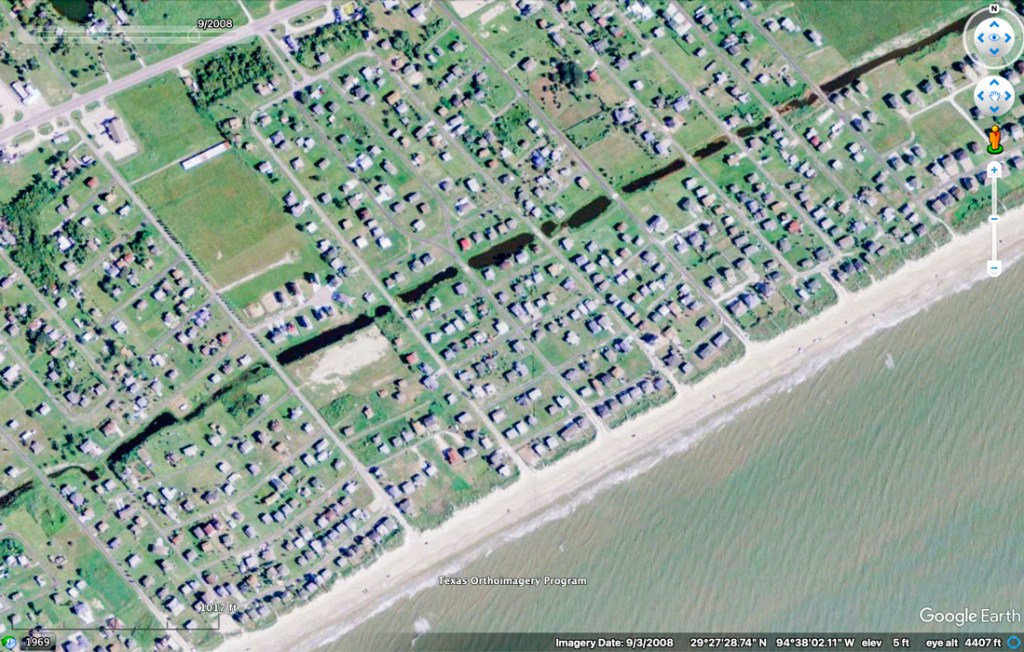
In that regard, I remember the Bolivar Peninsula after Hurricane Ike. Ike’s storm surge brought total destruction to 30,000 homes in 2008. See the images below these first three satellite images. The satellite images show the same area before, immediately after, and 15 years later on the Bolivar.
Google Earth image showing residential area on Bolivar Peninsula the week before Ike struck in September 2008.Note large, open undeveloped areas.Same area day after Ike. Total destruction. See ground-level shots below.
The Bolivar today has denser development than it did before Ike. Such is our collective love of water…that we quickly forget or overlook the destruction that happened just 15 years ago. Here’s what it looked like on the ground.
Destruction on Bolivar Peninsula After Hurricane IkeThis was an excellent opportunity to buy people out and turn this area into a national seashore. But that was politically unpalatable.Power not only went down. The entire power infrastructure was taken out.One of the few homes left standing.
We’ve spent the 15 years since Ike studying proposals to build an Ike Dike that could protect such properties. But in June 2023, the Houston Chronicle reported that it could be 2040 before construction completion of the $34 billion project.
Until then, it’s “swim at your own risk.”
Posted by Bob Rehak on 7/18/2023
2149 Days since Hurricane Harvey
https://i0.wp.com/reduceflooding.com/wp-content/uploads/2019/08/Hurricane-Ike-331-Version-3.jpg?fit=1500%2C490&ssl=14901500adminadmin2023-07-18 17:16:552023-07-21 08:44:21Insurance Companies Limit Exposure In Florida, California. Will Texas Be Next?
Citing the urgent need to spend half of a billion flood-mitigation dollars quickly, the Texas General Land Office (GLO) has made a common-sense suggestion to streamline flood mitigation in Harris County. It recommended making Harris County Flood Control District a “direct recipient” (rather than a “sub-recipient”) of the half billion dollars carved out of $750 million awarded to the County in 2021.
Harris County Commissioners put Community Services, not Flood Control, in charge of managing the $750 million award. But Flood Control is spending two thirds of the money.
The GLO suggestion would streamline working relationships, speed up mitigation, and give Harris County a fighting chance to spend the money before the deadline.
Following the Money
In May 2021, the GLO recommended allocating $750 million of U.S. Department of Housing and Urban Development (HUD) money to Harris County for Harvey mitigation and recovery. In March 2022, HUD approved the recommendation.
Later that year, Harris County Commissioners Court decided to have its Community Services Department (CSD) administer the funds rather than Harris County Flood Control District (HCFCD).
Since then, CSD recommended giving two-thirds of the money to HCFCD and distributing the rest to various entities within the county. But so far, CSD has only received one application from a potential partner. And six years after Harvey, none of the money has yet been spent moving dirt to reduce flood risk for Harris County residents.
Meanwhile, the county is under HUD deadlines to use the money quickly or lose it.
So, on June 20, 2023, Mark Havens, Deputy Commissioner of the GLO, asked County Judge Lina Hidalgo to make HCFCD a direct recipient. Hidalgo reportedly did not reply to the letter.
The change would shorten lines of communication and reduce layers of administration while speeding up mitigation, protecting residents, and hopefully beating the imminent HUD “use it or lose it” deadlines.
Going into the third year since the announcement of the $750 million flood-mitigation award, none of the money has yet been spent.
Commissioners Court Will Discuss Issue on Tuesday
After more than six months of deliberation, CSD eventually allocated $502.5 million to HCFCD from the $750 million. CSD was then going to allocate most of the rest to unspecified sub-recipients within the county after soliciting applications from potential partners.
However, on next Tuesday’s Commissioner Court agenda, Item 401 reveals…
CSD has found only one entity interested in applying for any of the remaining money in more than six months.
As of this morning, 7/16/23, CSD’s web page that solicits applications has not been updated for two months. It still talks about a May 4th meeting in the future tense.
Screen Capture from solicitation announcement page on 7/16/23.
It also contains some hysterical typos in the first line above. “Applicant’s Conference” singular? “Question” singular? They expected to have only one attendee and one question!?
Worse, it takes a lot of work to find the application web page. CSD’s home page has no direct link. The architecture of CSD’s site revolves around consumer issues such as rent relief and bus ridership, not applicants for mitigation projects.
To get to the $250 million pot of gold at the end of this rainbow from the CSD Home Page, one must click on:
Links
Harris Recovery (a separate web site)
CDBG-MIT
Not very intuitive! CSD blames the lack of response on a $20 million funding limit. That may be so. But the first rule of sales is, “Make it easy for the customer.” And that certainly didn’t happen here.
Projects Put on Hold While $250 Million Sits on Table
Management turnover has also plagued CSD. Under Lina Hidalgo, the department has had six different directors in 4.5 years.
Meanwhile HCFCD is still looking for money to complete projects in low-to-moderate income neighborhoods. Moreover, Harris County Engineering is putting subdivision drainage projects on hold for lack of funding. And all this is happening while a quarter of a billion dollars is still sitting on the table.
I hope Judge Hidalgo, Commissioner Garcia and Commissioner Ellis can connect those dots and streamline flood mitigation quickly.
Posted by Bob Rehak on 7/16/23
2147 Days since Hurricane Harvey
The thoughts expressed in this post represent opinions on matters of public concern and safety. They are protected by the First Amendment of the US Constitution and the Anti-SLAPP Statute of the Great State of Texas.
https://i0.wp.com/reduceflooding.com/wp-content/uploads/2023/07/Screenshot-2023-07-16-at-10.52.33-AM.png?fit=1196%2C754&ssl=17541196adminadmin2023-07-16 12:30:142023-07-16 21:15:48GLO Suggests Plan to Streamline Flood Mitigation in Harris County
Long after floods recede, the residue of toxic chemicals carried by the water can leave a lasting legacy of loss. It can remain in homes and yards, affecting the health of both homeowners and neighborhoods. During Hurricane Harvey, for instance, sewage contaminated the cleanups of both Kingwood College and Kingwood High School. Decontamination, cleanup and repairs took years in each case. But individual residents often don’t have the money to afford expensive decontamination.
Flooding Near Rail Yards and Creosote
One of the most heartbreaking cases in the City of Houston/Harris County has to do with a controversial, decades-long creosote/dioxin cleanup effort associated with the Union Pacific Railroad yard in the Fifth Ward. The Texas Department of Health Services has identified several cancer clusters in the area. And the types of cancers found near the former “Wood Preserving Works” at 4910 Liberty Road in Houston have been associated with the types of chemicals used on the site for decades.
Wood Treatment Facility was located at far end of this yard.FEMA flood map shows how tracks constrict the flow of floodwaters in Hunting Bayou. Water flows from upper left to lower right.Tan = 500 year floodplain. Aqua = 100 year.
Residents interviewed for this article discussed several pathways for possible contamination: airborne dust, groundwater, floodwater/runoff, and clothing of workers. Site runoff mixed with floodwater appears to be one of the most likely.
The map above and the photos below clearly show that the site is elevated compared to surrounding neighborhoods. And residents tell stories of multi-colored sheens on runoff channeled through their streets.
Dueling Studies
UP inherited the site in 1997 after a merger with Southern Pacific. Southern Pacific treated railroad ties with creosote at the site between 1899 and 1984. The creosote is a preservative that keeps ties from rotting and causing derailments.
Union Pacific says it has has found no relationship between the site and cancer clusters in surrounding neighborhoods after 30 years of study.
However, in 2020, the Texas Department of State Health Services published a study covering the years from 2000 to 2016. The study compared cancer rates in the area near the rail yards with those throughout Houston and Texas as the baseline. Researchers identified several cancer clusters in the Fifth Ward neighborhoods you see above.
But UP questions the validity of that study. The company claims that “The area also includes an industrial complex containing about 200 TCEQ-regulated cleanup sites and two superfund projects. The former Houston Wood Preserving Works site represents 33 acres, or less than .4 percent of the total cancer-cluster territory.”
Then yesterday, Houston Mayor Sylvester Turner held a press conference. He escalated the conflict. Turner, who has just five months left in office, says he supported the additional study but, “we have studied the problem enough. The time for action is now. Time is the enemy.”
Turner urged relocating people in the most contaminated areas closest to the site. He emphasized finding safer places in the same general area to reduce the impact of relocation.
“Let me emphasize this,” said Turner. “Time is the enemy of people living in the highly exposed and dangerous zone with limited means to do anything else. How many more people must be diagnosed with cancer? How many more people – and specifically, how many more children – must die? How many more families must be trapped in a known danger zone while we watch, test and litigate? The city cannot and will not continue to wait until we know every single thing.“
The Mayor continued, “We know enough. The cancer cluster is clear. The presence of creosote beneath homes at levels above cleanup standards is clear. The presence of elevated levels of cancer-causing dioxin detected at some homes through the city’s limited studies is clear. You simply can’t wait for the test to be completed, and watch and litigate it, and then start the process further down the road.”
Mayor Recommends Relocating Residents within 2-3 Block Radius of Site
“Today, I’m announcing a strike-force team composed of representatives of the city’s Health and Human Services, Housing and Community Development, Real-Estate Recovery, and legal teams, along with outside sources. They will begin work in earnest on a program to help relocate residents living above the creosote plume and in a 2 to 3 block radius around the site.”
If the results of the EPA’s Union-Pacific investigation reveal broader areas of impact, Turner says the program will be expanded to help those people, too.
Turner concluded with a personal anecdote that related to his own experience with cancer. He said that with cancer, “Time is your enemy.” That’s why he wanted to get people out of harm’s way who can’t fend for themselves.
Lasting Legacy of Loss – Case After Case of Cancer, Boarded Up Homes
When I flew over the UP site last year, I was astounded by its size. Ken Williams, chairman of the Harris County Community Resilience Flood Task Force who lives nearby, introduced me to some people in the neighborhood, including Keith Downey, the local Super-Neighborhood Council President.
They gave me a tour. It was one of my more gut-wrenching experiences since Harvey.
I also met a young lady, Sandra Edwards, who grew up across the street from the UP site. She walked us up and down the block, stopping in front of each house, to tell us the stories of the occupants. Within a half block, we counted about a dozen neighbors who had died or were dying from cancer.
Sandra Edwards, concerned neighbor turned activistEvery other home it seemed was abandoned. One that wasn’t abandoned had children’s play equipment in the front. But the EPA warns not to let kids play in the dirt because of soil contamination.Many of the homes had reportedly been victimizedby arson. Edwards talked of a developer trying to buy up properties to redevelop the neighborhood whose future is still in doubt.Edwards in front of former creosote site. Note slope. Water runs into neighborhood according to Edwards.Looking NNE across creosote site. Note Fleming Middle School five blocks north, left of center near top of frame.
I returned to the neighborhood several times between July and December to photograph the progress of cleanup.
In November, cleanup was still going strong.Note the covered dumpsters to keep excavated dirt from blowing out. Also note plastic liners under dumpsters to keep polluted rainwater from soaking back into soil.
Many of the people living here inherited homes that their parents or grandparents owned before there was an EPA and people knew about the dangers of substances such as creosote and dioxins.
This lasting legacy of loss has been developing for decades. It could be decades more before the parties find a mutually agreeable solution.
Check back for more news as it develops. For more information see this list of studies conducted by the Houston Health Department.
Posted by Bob Rehak on 7/14/23
2145 Days since Hurricane Harvey
The thoughts expressed in this post represent opinions on matters of public concern and safety. They are protected by the First Amendment of the US Constitution and the Anti-SLAPP Statute of the Great State of Texas.
https://i0.wp.com/reduceflooding.com/wp-content/uploads/2023/07/20221112-RJR_1077.jpg?fit=1100%2C733&ssl=17331100adminadmin2023-07-14 19:00:282023-07-15 09:50:05How Floods Can Leave a Lasting Legacy of Loss
New Montgomery County Precinct 4 Commissioner Matt Gray addressed a breakfast meeting of the Kingwood Executive Group today. Gray, who comes from the oil-and-gas industry, has a background in managing large maintenance/construction projects. Just six months into his new job, he has wasted no time in applying that expertise to Montgomery County.
The no-nonsense, get-it-done commissioner emphasized both service to constituents and action.
Balancing Development and Drainage
EPA research suggests that highly urbanized areas can increase stormwater runoff by 45% while reducing infiltration by 50%. And Matt Gray’s precinct is rapidly becoming urbanized. He began his talk with some alarming statistics about growth in his Precinct 4 which borders the Lake Houston Area.
Entergy, a worldwide power provider which also services Montgomery County, says the average growth rate for its network is 1.7%. But during the last three years, MoCo Precinct 4 has had an average growth rate between 5% and 7%.
Entergy claims they have installed more meters in Precinct 4 than they have in the states of Mississippi and Arkansas combined.
Matt Gray, MoCo Precinct 4 Commissioner
All that development is happening upstream from the Lake Houston Area. Moreover, the rest of Montgomery County drains through Precinct 4. So, simultaneously managing growth and drainage have become two of Matt Gray’s key concerns.
Gray talked about working with engineers revising/updating the Montgomery County drainage criteria manual and subdivision rules. He affirmed the need for stormwater detention requirements that will protect not only his own residents but those downstream as well.
Another huge issue: siltation that affects both roadside ditches and local streams. Gray has mobilized crews to make sure water can drain efficiently.
Since assuming office in January, Gray has launched an aggressive effort to clear ditches of accumulated sediment.
Road Improvements, Evacuation Routes
Mindful that many people in both Harris and Montgomery Counties use his roads as evacuation routes, Gray also addressed at length road improvement projects in southeast Montgomery County.
He’s focusing on arterial improvements.
Crews are already widening Ford Road.
He’s working with TxDoT to improve access between Highway 99 and other major arteries.
Northpark Drive widening and the construction of a Loop 494/Railroad overpass should begin any day now.
Such projects will improve key evacuation routes during storms as well as the everyday quality of life for residents and commerce for business owners.
Other Priorities, Wish List
Gray’s other priorities include:
Cleanup and beautification
Repaving/restriping roads
Improving park maintenance
Mosquito control
Construction of a recycling center which would include the handling of old appliances
This presentation catalogs Gray’s impressive list of accomplishments during his first six months as well as his wish list for the future.
Gray in the tan blazer, front row, surrounded by members of the Kingwood Executive Group.
Importance of Working Together
An interesting side note that underscores the importance of working across the county line! The meeting room this morning flooded to the top of the photo above. It cost the Kingwood Country Club more than $50 million to renovate the facility after Harvey. The renovation took almost exactly two years.
The club was just one of 3,300 businesses in the Lake Houston Area that flooded in that storm, which also damaged 16,000 homes.
I’ve written several stories recently about cut-throat politicians pursuing self-interest. So, it’s refreshing to see someone in Gray’s position, willing to work across jurisdictional boundaries for the benefit of all. Good luck, Matt Gray.
Posted by Bob Rehak on 7/12/2023
2173 Days since Hurricane Harvey
https://i0.wp.com/reduceflooding.com/wp-content/uploads/2023/07/20230712-Group-Shot-Screen-Res.jpg?fit=1100%2C351&ssl=13511100adminadmin2023-07-12 16:20:322023-07-12 17:09:09New MoCo Commissioner Matt Gray Discusses Development, Drainage Plans with Kingwood Group
Harris County has put 37 of 93 subdivision drainage projects associated with the $2.5 billion 2018 Flood Bond on hold.
Reasons include:
Lack of funding
Inflation
Shortfalls in expected partner contributions
Constructibility of some projects
Social-vulnerability scores within the County’s Equity Prioritization Framework.
Of the 37 projects whose funding was cut, 24 were in Precinct 3 – a whopping 65 percent.
Technically, the projects have not been “cancelled.” The county has just run out of money to do them. But it has set no deadline for revisiting the projects on hold; is diverting HCTRA backstop funding for other uses; has articulated no other plan for raising additional funds; and is submitting projects for HUD funding that weren’t in the flood bond.
Commissioners court cut funding for projects in all three tables.
Impact of SVI Threshold on Disproportionate Budget Cuts
The deciding factor in many cases was the area’s social vulnerability index (SVI), which measures English language fluency plus minority and ethnic concentrations.
Precinct 3 Commissioner Ramsey argued to lower the SVI requirement for these projects to 50%. That would have met HUD requirements and also meant fewer budget cuts for Precinct 3.
But his Democratic colleagues proceeded to set the threshold at 75%, resulting in the lopsided cuts. The chart below shows how dramatically that affected Equity Prioritization Index rankings in the tables above.
But according to this motion, they will be paused, put on hold, and have their funding cut.
Harris County Engineering, Flood Control, Daniel Ramos from the Office of Management and Budget and the Harris County Toll Road Authority all recommended the funding cuts on 2/21/23.
Their rationale: It will provide funding certainty for the highest ranked projects using the Equity Prioritization Index and free up the Toll Road Funds for other uses. The toll road funds were backstopping bond funds.
Unfortunately, six years after Harvey, no large pots of money remain out there dedicated to the storm. Ramsey has his work cut out for him against 4-1 odds.
Is Race-Based Funding Even Constitutional?
To justify the unequal cuts, the other three commissioners and county judge relied on complicated race-based formulas that favor minorities. Then they justified the funding cuts with the usual misleading “worst first” mantra when they aren’t even measuring actual flood damage.
The recent Supreme Court Ruling on Affirmative Action calls into question whether race-based funding is even constitutional.
I’m eager to hear from lawyers on the constitutionality of distributing billions of dollars on the basis of racial discriminators, such as SVI.
Posted by Bob Rehak on 7/11/23
2142 Days since Hurricane Harvey
The thoughts expressed in this post represent opinions on matters of public concern and safety. They are protected by the First Amendment of the US Constitution and the Anti-SLAPP Statute of the Great State of Texas.
https://i0.wp.com/reduceflooding.com/wp-content/uploads/2023/07/Screenshot-2023-07-11-at-4.11.55-PM.png?fit=988%2C1558&ssl=11558988adminadmin2023-07-11 20:09:502023-07-12 09:43:2665% of Harris County Flood-Bond Projects that Lost Funding Are in Precinct 3
The U.S. Department of Housing and Urban Development (HUD) has clouded the future of dozens of Texas flood-mitigation projects worth billions of dollars.
HUD has alleged racial discrimination by the Texas General Land Office (GLO), which distributes HUD money in Texas. HUD based its finding of discrimination on complaints by two advocacy groups. The complaints stem from a statewide competition – the firstof several rounds of HUD awards relating to Hurricane Harvey.
Now, deadlines for actually spending the money are fast approaching. But the uncertainty created by the racial discrimination allegations is causing entities that won HUD grants to question whether HUD will revoke funding and leave half-completed projects in limbo.
The GLO vehemently denies all allegations of discrimination and points out that:
HUD imposed the key rule governing competition for grants now in dispute
HUD approved the competition’s scoring criteria
More than two thirds of the beneficiaries of the funds are Black and Hispanic
100% of the mitigation projects benefitted communities with a majority of low-to-moderate income (LMI) residents, when only 50% was required
GLO and HUD ultimately awarded Houston-area entities about $1.5 billion.
Allegations by Texas Housers and Northeast Action Collective
According to the Houston Chronicle, two advocacy groups (Texas Housers and the Northeast Action Collective) filed charges of racial discrimination after the first round of Harvey grant awards in 2021. They allege that the Houston area got zero dollars and are standing by their accusations, despite all the money the area received at the time and since then. (See amounts in timeline below.)
When developing the competition for Harvey grants, HUD insisted that the GLO could not base awards on actual flood damage. Regardless, Texas Housers and the Northeast Action Collective complained that rural areas received the majority of funding even though Houston and Harris County had the majority of flood damage.
After results of the competition became apparent, GLO attempted to remedy the rural/urban disparity by recommending to HUD that $750 million in remaining Harvey competition funds should go to Harris County – without a second competition. HUD approved.
GLO also recommended increasing the amount going to the Houston-Galveston Area Council (H-GAC) from the Regional Mitigation Program. H-GAC’s allocation more than doubled from $209 million to $488 million – again without a second competition. And again, HUD approved.
Regardless, HUD’s “finding” of discrimination based on allegations by the two advocacy groups still stands. Moreover, HUD issued administrative subpoenas to depose GLO executives, even though the Department of Justice (DOJ) already reviewed the racial discrimination complaints and declined to pursue them.
This mess is like throwing trip wires in front of exhausted marathon contestants.
While GLO defended its actions with more than 1,000 pages of documentation, HUD has reportedly produced only a four-page letter laying out vague generalizations.
HUD has not responded to requests from the GLO or ReduceFlooding.com for specifics regarding the allegations.
Uncertainty, Fear of Clawbacks Slow Progress
After spending years and millions of dollars to win HUD grants, the award winners now face the specter of not having enough money to finish their projects should Texas Housers and the Northeast Action Collective succeed.
Imagine your bank rescinding a mortgage commitment after you bought a lot and began building a new home.
Worse, HUD could try to claw back the money that grantees have already spent. According to GLO, many of the smaller communities awarded grants don’t have the funds to pay back HUD should that happen.
Faced with that kind of uncertainty, some awardees are reluctant to start construction on their projects – even though they face two looming “use it or lose it” deadlines. The first is only three years away – barely enough time to complete many projects.
As a result, the GLO issued a scathing press release last week, accusing HUD of “destabilizing vital funding.”
Timeline: Who Got What, When?
Is all that chaos necessary? Not if you look at the final score as opposed to the first inning. Houston and Harris County received far more than “zero dollars.” See below.
On February 9, 2018, Congress approves mitigation funds for 2015 and 2016 floods as well as Harvey-eligible areas. Two months later, HUD allocated money to Texas.
2019: Federal Register Notice
On August 30, 2019, HUD finally published the Federal Register notice enabling the State of Texas to proceed in drafting an action plan for the CDBG-MIT funds. GLO then conducted a public outreach campaign and collected thousands of comments from 117 meetings and 936 individuals.
2020: HUD Approves Action Plan
HUD finally approved the GLO action plan which called for conducting a statewide competition for funding. The scoring criterion included in the state action plan for distribution of the funds was approved by HUD on March 27, 2020.
$502.5 million for 2018 Flood Control Bond Projects
$100 million for Partnership Projects, i.e., with City of Houston
$50 million for Other County Flood Mitigation Projects.
June 6, 2023: Third Award
GLO recently reallocated $322.5 million in unspent disaster relief funds from Harvey to Harris County Flood Control for mitigation projects. This is in addition to $222,519,672 Harris County received in infrastructure funding from the initial CDBG-DR allocation.
Still, the Chronicle article alleges that the GLO somehow ran afoul of of the Civil Rights Act and Fair Housing laws by giving the Houston area “zero.”
The DOJ took less than 48 hours to review and dismiss the claim. But the continued legal harassment by HUD is distracting the GLO from its vital mission as deadlines loom.
Could this be politically inspired? Two Houston-based politicians running for election next year have close ties to the groups making the claims. More on that in a future post.
Baseless Racial Discrimination Accusations Have Backfired
Despite the vast majority of Harris County flood-control spending since 2000 already going to LMI areas, the baseless charges of racial discrimination seem to have backfired on Texas Housers and Northeast Action Collective.
In one notable instance, the Northeast Action Collective brought more than a hundred members to a Commissioners Court meeting. They pushed the meeting into the wee hours of the next day, repeatedly demanding the resignations of key Harris County Flood Control executives. Since their resignations in 2021 and January 2022, flood control spending has steadily declined – exposing the constituents that the groups represent to more flood risk.
Data obtained from HCFCD via FOIA request. Covers 1/1/2000 through 3/31/2023.
And the effects are across Harris County. For instance, in the first quarter of this year compared to the fourth quarter of last year, spending was down in two thirds of the county’s 23 watersheds.
Data obtained from HCFCD via FOIA Request.Only significant increase was in Greens Bayou watershed.
The HUD/Houser/Collective accusations could produce a similar outcome across Texas – backfiring again.
HUD refuses to discuss its allegations of racial discrimination. HUD did not respond to a ReduceFlooding request for an interview, nor would it meet with GLO Commissioner Dawn Buckingham MD.
Posted by Bob Rehak on 7/8/23
2139 Days since Hurricane Harvey
The thoughts expressed in this post represent opinions on matters of public concern and safety. They are protected by the First Amendment of the US Constitution and the Anti-SLAPP Statute of the Great State of Texas.
https://i0.wp.com/reduceflooding.com/wp-content/uploads/2023/07/20211217-DJI_0079.jpg?fit=1100%2C733&ssl=17331100adminadmin2023-07-08 20:10:092023-07-09 19:09:54HUD Clouds Future of Flood-Mitigation Funding in Texas
NOAA’s National Hurricane Center issues a monthly Atlantic Tropical Weather Summary during hurricane season. For June 2023, it shows above normal tropical cyclone activity and and above normal accumulated cyclone energy (ACE) for the North Atlantic, Caribbean and Gulf of Mexico.
#4 for Year and Counting
Three named tropical storms (Arlene, Bret, and Cindy) formed in the basin during June. The report also shows an unnamed storm in January, that in retrospect appears to have been tropical in strength.
Bret brought tropical-storm-force winds to portions of the Lesser Antilles, while Arlene and Cindy remained over open water and did not impact land.
So far, seasonal activity has been above average based on the 30-year climatology (1991-2020), where a named storm typically forms about once every year in June.
Timing of hurricanes in the last hundred years shows peak at September 10.
In terms of Accumulated Cyclone Energy (ACE), which measures the strength and duration of tropical storms and hurricanes, activity in the basin so far in 2023 has also been above average compared to the long-term (1991-2020) mean.
* An unnamed subtropical storm formed in mid January. Exact dates and maximum winds will be provided once the post-storm analysis is complete.
As of this writing on 7/5/23, NHC predicts NO tropical storm activity anywhere in the Atlantic basin for the next seven days.
Predictions Vs. Actual
In May, both NHC and Colorado State University predicted that this tropical storm season would have about normal hurricane activity. Both sources cited conflicting trends as the basis for their predictions. We currently have above-normal sea-surface temperatures throughout most of the Atlantic basin. We also are now under the influence of an El Niño, which tends, in this latitude, to produce wind shear that discourages cyclone formation.
To improve predictions, NOAA has made a number of changes in reporting at the National Hurricane Center. They include new, improved models for hurricane forecasts and storm surge, longer-range hurricane outlooks, an excessive rainfall outlook, inundation mapping down to the street level, and improved data-collection technologies.
Posted by Bob Rehak on 7/5/2023
2136 Days since Hurricane Harvey
https://i0.wp.com/reduceflooding.com/wp-content/uploads/2020/09/peakofseason.gif?fit=831%2C546&ssl=1546831adminadmin2023-07-05 10:32:132023-07-05 10:32:14Hurricane Season Above Average So Far