5/17/25 – Contractors have finally started boring under UnionPacific Railroad (UPRR) tracks to connect Northpark drainage east and west of Loop 494. That crucial connection is a key to beginning many other parts of the Northpark expansion project.
Lake Houston Redevelopment Authority first contacted UPRR about running Northpark drainage under their tracks ten years ago. And for those keeping track, it was eight years ago that the two parties signed their first contract.
Fifth Contract is the Charm
If you’re wondering why it’s taken so long, the two parties are now working on their fifth contract. But all that is in the past. So are the special UPRR training sessions that contractors and LHRA staff had to attend. So is the years-long wait for UPRR to weld single 200-foot-long sections of track into place across the ten lanes of Northpark.
All energies are positive now and the project is moving forward.
Looking W along Northpark across Loop 494 toward US59. Location of starting point for bore circled. This and all pictures below taken on Friday, May 16, 2025.
One Pole Blocking Bore Must Move
Note, however, a CenterPoint pole is still in the way. See below.
Energized electric lines must be moved to adjacent pole on right.
CenterPoint needs to transfer the energized lines from the existing wood poles on each side of Northpark to the newly installed and adjacent fiberglass poles. Those are designed to route the electricity underground at that location – out of the way of the bridge. Once electricity is rerouted, the old pole blocking progress can be removed.
Yesterday, I received word from City Councilman Fred Flickinger’s District E office that CenterPoint and UPRR are close to signing a contract that will let CenterPoint enter UPRR’s right of way to move the pole. Good news!
A steel frame and steel plates locked together by those giant timbers in the foreground will protect the operation.
Steel, Not Concrete Pipe Needed
After completing the bore pit, contractors will run six-foot steel pipes under the tracks. The tolerance is exceedingly tight. The tracks cannot move more than one-quarter inch despite the weight and vibration of mile-long trains carrying heavy loads. Hence the steel.
Pipes that will eventually bore under tracks are being stockpiled for now on S side of Northpark.
Bore Pit Built Like Underground Fortress
From the ground, construction of the bore pit looked like this.
Steel I-beams and steel frame form perimeter of pit.Then giant steel plates were slotted between the I-beams.Looking E from over Loop 494. Steel pipe will connect to a giant junction box in the dirt area (bottom center).
Junction Boxes Will Tie Drainage Together
When this operation is complete, we will have two junction boxes on either side of the tracks.
Some time ago, a third junction box was placed underground near the Shell station on the opposite side of Loop 494. Before contractors paved the new southbound lanes on Loop 494, they already connected giant 8’x8′ reinforced concrete pipe under the paving. So now, all they have to do is connect that to the center junction box west of the tracks (foreground above).
Contingent Operations
Many subsequent operations rely on the successful completion of the bore under the tracks. They include:
5/16/2025 – Harris County Flood Control District (HCFCD) made several announcements about projects recently that will affect Kingwood and areas upstream.
Two Stormwater Detention Basins Now on Bid List
The District expects two major detention basin projects to go out for bids soon. The:
East TC Jester Basin on Cypress Creek will bid in the third quarter this year.
Woodridge Village Basin on Taylor Gully will bid in the first quarter next year.
The clearcutting of the Woodridge Village flooded hundreds of homes in Elm Grove, Sherwood Trails and Mills Branch twice in 2019. HCFCD started excavating an additional detention basin in 2021 to help address the risk of downstream flooding. But they were forced to discontinue the excavation in 2023 when they applied for a HUD grant to finish the project.
HCFCD also announced 10 more maintenance projects on area channels. They expect to start eight this year.
What Will Happen Where
The map below shows the location of the projects. It’s keyed to the numbers above in the first column.
The maintenance will help ensure the continued effectiveness of the area’s flood control systems.
HCFCD will repair or replace…
Existing damaged concrete channel linings
Slope paving
Outfall pipes
…for the following channels
G103-38-02-X005 (Kingwood Diversion Ditch)
G103-80-01-X012(Green Tree Ditch)
G103-41-00-X014 (Sand Branch)
G103-33-03-X003 (Hidden Pines to Bens Branch)
G103-38-01-X015 (Chestnut Ridge Rd. to Kingwood Diversion Ditch)
G103-38-01-X016 (Chestnut Ridge Rd. to Kingwood Diversion Ditch)
HCFCD will also remove sediment from:
G103-80-01-X013 (Green Tree Ditch)
G103-33-04-X007 (Kings Crossing Ditch)
G103-41-00-X013 (Sand Branch)
They will repair erosion on:
G103-33-01-X007 (North Park Dr. to Bens Branch)
G103-80-03.1-X037 (Taylor Gully)
Finally, HCFCD will reshape side channels on:
G103-33-04-X007 (Kings Crossing Ditch)
G103-41-00-X014 (Sand Branch)
During this time, residents in work areas may notice crews with large trucks and heavy equipment such as excavators and bulldozers. Stay well clear of the equipment.
HCFCD estimates it will complete all this work by early 2026. The District and Precinct 3 Commissioner Tom Ramsey who helped arrange the work stated that each specific effort will move on its own timeline.
5/15/25 – According to a new study by researchers at Columbia University, on average, Houston is subsiding faster than any major city in America. The study looked at the 28 most populous cities in America. Satellite measurements collected between 2015 and 2021 showed all are sinking to some degree. However, the sinking is not uniform.
Parts of Area Sinking at Different Rates
More than 40% of Houston’s area is subsiding more than 5 millimeters (about 1/5 inch) per year. 12% is sinking at twice that rate, according to the study.
“Subsidence-induced infrastructure damage can occur even with minor changes in land motion,” the study’s authors wrote in the journal Nature Cities on May 8, 2025. “One of the most harmful yet less visible effects of urban land subsidence is the potential damage to buildings, foundations and infrastructure, primarily caused by differential land motion,” they say.
Damage Caused by Subsidence
Imagine underground pipes, for instance, that reach the limit of the flexibility and then get pushed beyond it.
The Columbia study also showed high levels of subsidence elsewhere in Texas, including Dallas, Austin, San Antonio and Fort Worth.
Subsidence Linked to Groundwater Extraction Due to Growth
The primary cause: ground water extraction related to rapid growth. The study found that about 80% of all subsidence relates to groundwater extraction.
As if on cue, the Census Bureau released today updated population statistics. They showed that from 2023 to 2024, Houston gained more people than any other major city in America with the exception of New York.
The new census data also shows that Fulshear on Houston’s west side had the second highest percentage gain in population of any city in America in 2023. Fulshear, on Houston’s west side, grew an astonishing 26.9% from 2023 to 2024.
Subsidence Hotspots in Houston Area
Coincidentally, the Harris-Galveston Subsidence District released its 2024 Annual Groundwater Report today and an updated interactive subsidence map. They showed that the highest rate of subsidence in the Houston region was near Fulshear. That area is subsiding at a rate of 1.3 inches/year – more than a foot per decade!
One of the most visible signs of subsidence is cracks in pavement and parking lots.
The Subsidence District’s latest groundwater report shows that their efforts have almost halted subsidence where they have succeeded in shifting areas from ground to surface water. Those are the areas where the Subsidence District first started regulating groundwater 50 years ago.
However, the relentless growth of Houston, especially on the north and west sides, has created a belt of subsidence where new areas have largely not yet converted to surface water. See below.
Average annual subsidence from 2020 to 2024. Green = <.5 cm/yr. Dark red = > 2 cm/yr.
More on that in coming days. I’ll also discuss how differential subsidence can create bowls in the landscape that exacerbate flooding. And I’ll cover the largest water infrastructure project in the country. It will bring more surface water to those fast subsiding areas above.
Being the fastest subsiding city in America is one claim that I am sure Houston would be happy to relinquish.
Posted by Bob Rehak on 5/15/25
2816 Days since Hurricane Harvey
https://i0.wp.com/reduceflooding.com/wp-content/uploads/2025/05/20250515-Subsidence-Belt.jpg?fit=1100%2C822&ssl=18221100adminadmin2025-05-15 18:43:522025-05-15 20:32:30New Study Finds Houston Is Fastest Subsiding City in Country
5/14/25 – This morning, I gave a presentation that compared the pace of downstream flood mitigation with the pace of upstream development. Are we gaining or losing ground in the Lake Houston Area?
Presentation Connects Many Dots
Answering that question requires connecting many dots. Here are the slides from the presentation with my narrative.
As new upstream development adds impervious cover (roads and roofs) that can increase and accelerate runoff, building flood peaks higher and faster. And that can erode the safety of downstream residents. Managing flood risk becomes a struggle between competing forces.
MoCo One of Fastest Growing Counties in Country
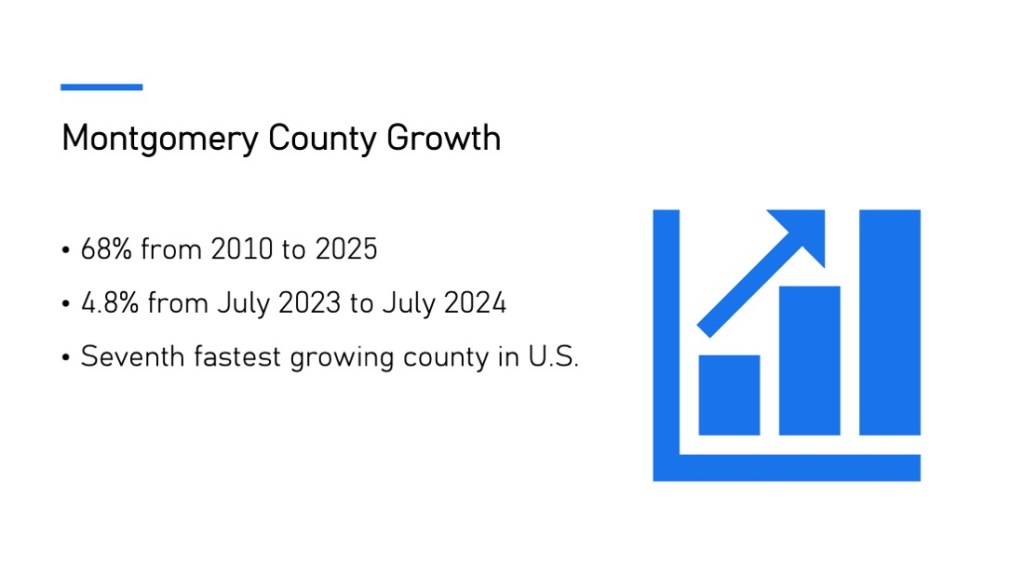
The Lake Houston Area lies downstream from one of the fastest growing counties in the country. Montgomery County (MoCo) grew 68% in the last 15 years and 4.8% in 12 months recently. MoCo is currently the seventh fastest growing county in the entire country.
Ryko Exemplifies Danger of Upstream Development
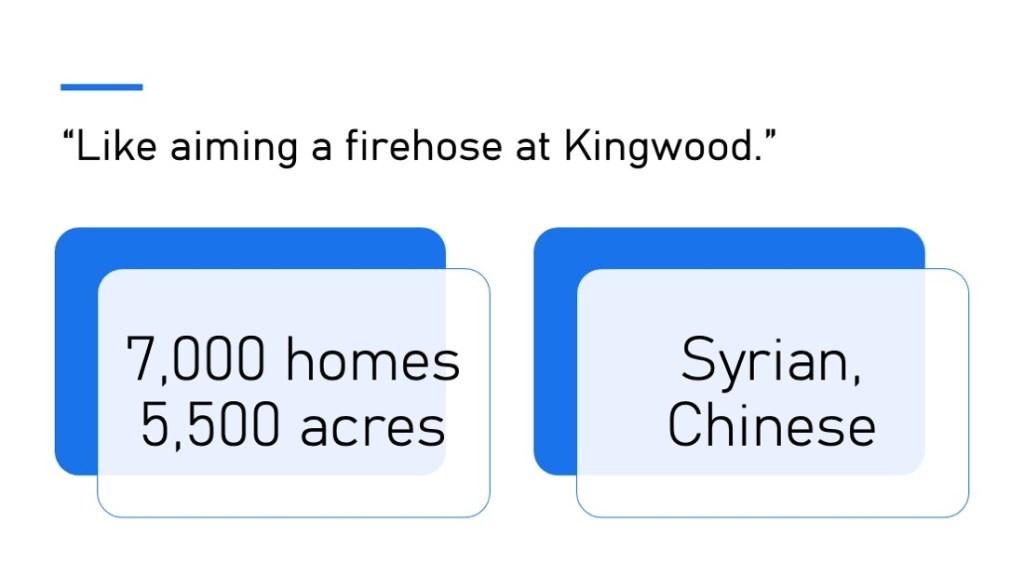
Let’s look at a proposed MoCo development in the headwaters of Lake Houston. A company named Ryko bought 5,500 acres about a quarter mile west of Kingwood. It’s in the southern part of a triangle formed by Spring Creek, the San Jacinto West Fork and the Grand Parkway.
US59 Bridge in foreground by the confluence of the Sand Jacinto West Fork and Spring Creek.
“Like Aiming a Firehose At Kingwood”
Ryko, which is a Syrian-owned company, is reportedly working with Wan Bridge, a Chinese company, to develop 7,000 homes on the property. One of the leading hydrologists in the area told me that developing this property would be “like aiming a firehose at Kingwood.”
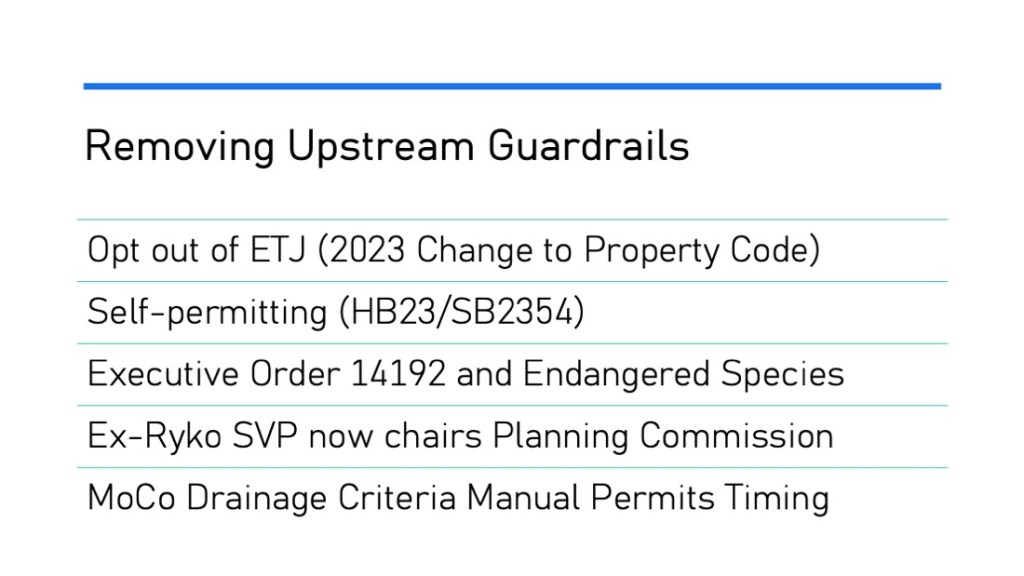
Many “Guardrails” Being Removed
Government has established many guardrails over time to protect people from insufficiently mitigated upstream development. But many of the guardrails are being removed. Or people are trying to remove them.
In this case:
A change to the state property code in 2023 gave developers the right to opt out of a city’s extra territorial jurisdiction (ETJ). ETJs lay the groundwork for future annexation by ensuring new infrastructure meets the standards of areas that might annex them someday. But if developments are not in an ETJ, they could change plats without approval.
Two bills pending in the legislature, HB23 and its companion SB2354, would essentially let developers “self-permit” by hiring engineering firms that replace government oversight.
The Endangered Species Act (ESA) constrains development in areas inhabited by threatened or endangered species. But Executive Order 14192 could change that. The US Fish and Wildlife Service has proposed a change under the order that means Ryko would no longer have to work around endangered species on its property.
An ex-Senior VP of Ryko for 21 years is now chair of the Houston Planning Commission. She still reportedly represents the company as an independent consultant,
The Montgomery County Drainage Criteria Manual hasn’t had a serious update for 40 years. The County still allows controversial practices, such as hydrologic timing surveys, to “prove” that upstream developments have no adverse impact on downstream residents.
Let’s take a closer look at the Ryko property with these issues in mind.
Upstream Development Almost Entirely in Floodplains
With that as a backdrop, what’s going on with the Ryko land? The map in the background for this next slide comes from Ryko’s Drainage Impact Analysis. It shows that their property (outlined in red) lies at the confluence of four major streams. All that blue represents floodplains and floodways.
Property outline and stream names enhanced for readability.
How Bad Is Ryko’s Flood Risk?
FEMA’s base-flood-elevation viewer shows that at the southern end of Ryko’s property, any homes would be under 25 feet of water in a 500-year flood (18.7 feet in a 100-year flood). Even at the higher elevations farther north, homes would be under 7 feet of water in a major flood.
Frequent Bald Eagle Sightings
Homeowners father north report frequent sightings of bald eagles. They believe the eagles live on Ryko’s property which is currently wilderness. One resident sent me a video of two eagles that landed in a tree right outside her living room window.
The Texas Water Code contains a rule that states upstream development can have “No Adverse Impact” on downstream neighbors. To prove no adverse impact, engineers compare estimated pre- and post-development runoff.
If post-development estimates are less than or equal to pre-development, they satisfy the requirement.
Estimates Based on Hydrologic Timing Not Always Accurate
But how accurate are those estimates? Montgomery County’s antiquated drainage criteria manual still lets engineers use hydrologic timing surveys, a practice now prohibited by the City of Houston and Harris County for several reasons.
Timing studies let developers avoid building detention basins if they can show that their development’s stormwater “beats the peak” of a flood. The theory: they aren’t adding to the peak.
Not building detention basins saves developers money and adds to the number of salable lots. But “beat the peak” studies have serious limitations and can often mislead.
They assume, for instance, a uniform storm across an entire watershed. But that rarely happens. Imagine the case of a storm like Harvey, which approaches from the south as developers to the north rush to get their water to the river. God help the people caught in the middle.
Timing surveys, in the case of Montgomery County, are also based on decades old data that ignores the cumulative impacts of other developments over time.
How Avoiding Detention Can Add to Flood Peaks
What often happens in reality is that you get higher peaks than if you had built detention. This graph shows three lines. The two at the bottom show typical pre- and post-development runoff rates where/when hydrologic timing studies are prohibited.
Not building detention often leads to earlier, higher peaks.
The height difference could be the difference between flooding or not flooding.
MoCo Still Doesn’t Require More Reliable Method
In short, building stormwater detention is a sure thing. Hydrologic timing is not.
Banning hydrologic timing studies would force developers to design systems that TRULY detain and slow runoff. But Montgomery County still permits timing studies. The County’s new Drainage Criteria Manual that prohibits them has been sitting on the shelf for more than a year.
Downstream Mitigation Slowing
Now, let’s look at what downstream residents are doing to offset the impacts of upstream development.
More floodgates on Lake Houston to speed up output
Upstream detention to reduce input.
Dredging is Highlight to Date…
Dredging continues. We’ve spent approximately $200 million to date and that total is still increasing.
Images shot current West Fork dredging plan, location of dredge by FM1960, and spoils placement area by Luce Bayou.
…But More Sediment Keeps Coming
After the Army Corps finished its emergency West Fork Dredging Project, they recommended regular maintenance dredging to ensure our rivers had sufficient conveyance and our drainage ditches were not blocked. State Representative Charles Cunningham authored HB1532 to create a dredging district for the Lake Houston Area.
HB1532 passed overwhelmingly in the House and is now waiting to be heard by Senator Paul Bettencourt’s Local Government committee in the Senate.
But this legislative session ends in two weeks. Any bill not out of committee by this Friday is effectively dead. And Bettencourt has not yet scheduled Cunningham’s bill for a hearing.
Construction on More Floodgates Not Likely Before 2027
The additional floodgates on Lake Houston have been delayed repeatedly for various reasons. Simultaneously, the Coastal Water Authority (CWA) is looking at the costs of repairing the dam and replacing it altogether. The 70+ year old dam is near the end of its useful life.
CWA board member Dan Huberty stated that engineering for additional gates should be complete by 2027. At that time, the project will go out for bids.
The CWA won’t receive preliminary reports on dam repairs and replacement until at least July of this year.
No Progress on Upstream Detention, None Likely Anytime Soon
Meanwhile, virtually nothing has happened yet in terms of upstream detention. The San Jacinto River Authority identified 16 areas for upstream detention basins/lakes in its River Basin Master Drainage Study.
SJRA has no construction funds. So many of the projects were incorporated into the state flood plan. But the state’s Flood Infrastructure Fund does not have a committed revenue stream.
The Texas Water Development Board has about a billion dollars currently available to build $54 billion worth of requests in the flood plan.
So keep the pressure on elected representatives who can protect your family.
Posted by Bob Rehak on 5/14/25
2815 Days since Hurricane Harvey
https://i0.wp.com/reduceflooding.com/wp-content/uploads/2025/05/DOTS-Slide17.jpeg?fit=1100%2C619&ssl=16191100adminadmin2025-05-14 17:49:322025-05-14 17:49:33Is Downstream Flood Mitigation Keeping Pace with Upstream Development?
5/12/25 – This post contains a guide compiled with the help of ChatGPT that describes how to reduce your flood risk when buying a home.
A major flood occurs somewhere in Southeast Texas on average once every 2.5 years, according to data compiled by Harris County Flood Control District. Flooding is THE NUMBER ONE THREAT to Houston area home owners no matter whether you consider frequency, damage potential, or financial impact.
Home and heirlooms flooded during Hurricane Harvey
Why Does Houston Flood So Much?
The main factors that increase flood risk fall into four categories:
Natural and Geographic Factors
Topography: Houston has many low-lying or flat areas drain slowly and accumulate water easily.
Soil type: Our clay-heavy and compacted soils absorb less water, increasing runoff.
Proximity to water bodies: Many rivers, bayous, and streams converge near the coast, making us more vulnerable to riverine and coastal flooding.
Rainfall intensity: The area receives intense and prolonged rainfalls.
Subsidence caused by excessive groundwater withdrawals can create bowls in the landscape and alter the gradient of streams.
Land Use and Development
Urbanization: Houston has grown rapidly, replacing vegetation with impervious surfaces (e.g., pavement, roofs). That drastically increases stormwater runoff.
Building in floodplains: Encroachment into natural flood zones has reduced flood storage capacity and exposed structures to damage.
Loss of wetlands and forests: Natural systems that absorb and slow runoff have been diminished.
Compacted or altered terrain: Grading and clearing land have disrupted natural drainage patterns.
Drainage and Infrastructure Deficiencies
Undersized storm drains or culverts built in decades ago often cannot handle large storm volumes.
Aging or poorly maintained systems: Blocked drains, eroded ditches, or failing levees increase risk.
Inadequate detention/retentionupstream: If runoff is not slowed or held temporarily, downstream flooding worsens.
Lack of regional coordination: Piecemeal or inconsistent regulations across the region complicate drainage problems.
Climate and Weather Patterns
More intense rainfall events: Houston’s warm atmosphere, proximity to the Gulf, complex weather patterns cause legendary downpours.
Rising sea levels: Increases the extent and impact of storm surge in coastal areas.
Back-to-back storms: Frequent rainfalls can saturate soils and fill channels, reducing capacity to absorb new runoff.
Houston Home Buyer’s Guide to Reducing Flood Risk
So what’s a newcomer to the region supposed to do? Or even a long-time resident who is relocating within the area?
I asked ChatGPT to help me put together a home-buyer’s guide for those who wish to reduce flood risk. It compiled a comprehensive guide almost 9,000 words long, specifically geared to the Houston region. However, it contains valuable information for other areas, too.
The guide covers what to look for during a property visit, online tools to assess flood risk, reviewing a home’s flood history, understanding elevation certificates, local floodplain regulations, and flood insurance considerations.
Major sections include:
Identifying the floodplain and flood-zone designations
Locations near waterways or reservoirs
Property elevation
Drainage infrastructure and proximity to drains
Neighborhood flood history
Lot grading and slopes
Signs of water pooling and poor drainage
Nearby bayous, ditches and low areas
House elevation and foundation design
Gutters, downspouts and drainage features
Evidence of past flooding and water damage
Tools and websites for evaluating flood risk (FEMA, Harris County Flood Education Mapping Tool, First Street Foundation)
Reviewing a property’s flood history
Seller’s disclosure notices
CLUE report (Comprehensive Loss Underwriting Exchange), an insurance claims history
Elevation Certificates and Base Flood Elevations
The impact of elevation on insurance premiums
Floodplain regulations and permits
How floodplain regulations could impact improvements you might want to make to an older home
It’s filled with valuable advice and reflects many of the themes I have posted about since Harvey.
Buyers Must Exercise More Caution than Ever
One last piece of advice. With FEMA and HUD under fire from DOGE and with the future of flood-mitigation funding in doubt, buyers must exercise more caution than ever. It’s also highly recommended reading for real estate agents.
Don’t expect the government to come to your rescue after a future flood. During Harvey:
154,170 homes across the county flooded in Harvey.
That’s eight one-hundredths of one percent. You can find far better odds playing the Texas Lottery.
Posted by Bob Rehak on 5/12/25
2813 Days since Hurricane Harvey
https://i0.wp.com/reduceflooding.com/wp-content/uploads/2020/01/IMG-3142-scaled-e1747098548322.jpg?fit=1100%2C825&ssl=18251100adminadmin2025-05-12 20:30:192025-05-12 20:38:35How to Reduce Your Flood Risk When Buying a Home
5/11/25 – A study published in the November 2024 edition of the Journal of Applied Meteorology and Climatology by researchers from Louisiana State University and Texas A&M examined stalling and rapidly intensifying tropical cyclones.
After analyzing 1,274 storms going back to 1900, they found one of the primary areas for such storms to strike is along the central Gulf Coast. They also found that, the estimated annual frequency of stalls significantly increased from 1966 – 2020 – by 1.5% year.
Lead author of the study, called Stalling North Atlantic Tropical Cyclones, is Jill C. Trepanier of LSU. Others include: John Nielsen-Gammon of Texas A&M; and Vincent Brown, Derek Thompson and Barry Keim, all of LSU.
Stalling Storms More Damaging
The authors found that, “Storms that stall tend to have a longer average duration than those that do not stall in all categories.” By that they mean levels of intensity (Cat 1 through 5).
They say stalling storms increase rainfall rates, storm surge heights and exposure to high winds including tornado activity. “Storms that slow down or stall can increase total damage by prolonging the exposure time to intense conditions,” they say.
Stalling Storms Clustered in Central Gulf, Late in Season
They also found that stalls tend to cluster in certain places. Those include, but are not limited to the central Gulf Coast.
And they happen more often late in the season during September and October.
“Stalls tend to occur in similar places over time and happen more frequently later in the hurricane season (October) when compared to the middle (August). Emergency managers can use this information to identify the likely location and timing for stalls throughout the North Atlantic tropical cyclone season,” say the authors.
Definition of Stalling
The researchers define a stalling cyclone as one that moves less than 200 km in 72 hours. “Potentially most devastating are those stalls within 200 km of the coast, but even more so, those that stall over or partially over land.”
“This is important for emergency managers to realize,” they say, “as those stalling near the coast will have a higher potential to inflict more damage to a population.” And storms that also rapidly intensify also give:
Emergency managers less time to evacuate people.
Residents less time to prepare.
The researchers also found that Category 3+ storms such as Hurricane Harvey persist longer than weaker tropical cyclones, providing more stall opportunities. Harvey, they say, dumped more rain than any stalling storm in recorded history. They examined the historical record going back to 1899.
Harvey track in 2017. Notice how dots get closer together as storm stalled over Texas.Each dot represents 6 hours.
Rapidly Intensifying Storms Also Becoming More Frequent
These studies suggest that rapidly intensifying storms have become more frequent and are occurring closer to the coast in recent years. Rapidly intensifying storms make evacuations more difficult. More people must move in less time and with less warning.
Coastal Areas More Densely Populated
According to NOAA, coastal areas are notably more densely populated than inland regions. For instance, coastal shoreline counties have a population density more than five times greater than the U.S. average.
Approximately 39% of the U.S. population lives in coastal shoreline counties, which comprise less than 10% of the nation’s land area (excluding Alaska).
Additional Research
Before concluding, the authors called for more research on the rainfall recurrence intervals associated with stalling cyclones. They also say future analysis should include a deeper dive on rapid intensification.
Individuals Should Research Preparation
In the meantime, the best thing people living in coastal areas can do is prepare. Forecasters predict an above-average hurricane season, which starts in about two weeks. The National Hurricane Center has produced an excellent series of videos to help you protect your family and property.
5/9/2025 – Houston has 3,900 miles of storm sewers and 2,500 miles of roadside ditches. When it comes to reducing flooding, roadside ditches and storm sewers each have their pros and cons. But before looking at the strengths and limitations of each, let’s consider some basic capacity and performance differences.
Capacity and Performance
A typical grass ditch 3.5 feet deep and 1,000 feet long can hold 325,000 gallons of runoff before overtopping – more than ten times the volume than that of a 24-inch storm sewer of equal length. In essence, the ditch itself acts as a long, linear detention basin, reducing flood peaks downstream.
While open ditches by themselves may have more storage capacity than storm sewers, streets with storm sewers are often depressed. Thus, the streets themselves can provide additional temporary storage until the storm sewers drain. Even if the street floods for a period of time, the street may provide enough extra capacity to keep homes from flooding.
Plus, storm sewers move water faster because of their smoothness. They offer less friction. And that offsets the capacity of ditches somewhat. But speed can also have a downside. Water can rush all at once to an already swollen bayou.
Open ditches also provide infiltration and filtration opportunities, improving water quality before reaching waterways. For this reason, the U.S. Environmental Protection Agency has noted that well-designed vegetated swales can improve stormwater quality.
The natural processes in a ditch – absorption by soil, uptake by plants, evaporation – can mitigate flooding and provide environmental co-benefits that storm sewers lack. But…
Maintenance Challenges with Ditches
To maintain their effectiveness, ditches require frequent maintenance including regrading, de-silting, unblocking, and flushing driveway culverts. Few homeowners can handle such tasks. Thus, lack of routine maintenance has been a major limitation of open ditch systems in Houston.
Many older suburban neighborhoods with ditches have seen capacity decline over time due to infrequent maintenance, leading residents to complain of street flooding from what should be a fixable drainage issue.
Quickly funneling runoff to bayous can contribute to higher downstream flood peaks. If not mitigated, they trade street flood risk for potentially greater flooding in waterways.
Blocked roadside ditches in several north Houston neighborhoods.
Strengths and Limitations of Each
Below is a summary of the strengths and limitations of storm sewers and ditches.
Storm Sewers – Strengths:
Space Efficiency: Underground pipes free up surface space for roads, sidewalks, and landscaping, crucial in dense areas.
Urban Compatibility: Curb and gutter streets are better for traffic and pedestrian safety in cities.
Rapid Drainage: Can quickly carry water away during and after small to moderate storms, clearing streets faster once rain ends.
Low Profile Maintenance: No open water at surface so safer for children. No marshy ditches in front yards. No need for mowing or weed control.
Less Obstruction: Less prone to large debris blockage (covered inlets keep out big trash, though they can clog with litter/leaves).
Storm Sewers – Limitations:
Limited Capacity/Volume: Pipes have restricted diameter; they carry less water volume than an equivalent open channel. In heavy rain, they fill up quickly, then excess water floods the street.
High Cost: Expensive to install and upgrade. Retrofitting a larger pipe is a major construction project. Economics may limit their size (designers balance capacity vs. cost, often resulting in designs that handle only smaller storms).
Out-of-Sight Failures: Problems (sediment buildup, collapse, clogs) are hidden underground. Maintenance requires specialized crews and equipment (vacuum trucks, confined-space entry). Issues may go unnoticed until flooding occurs.
Fast Runoff Discharge: Quickly funneling runoff to bayous can contribute to higher downstream floods.
Dependency on Outfalls: If the receiving channel is high (e.g., bayou at flood stage), storm sewers can’t drain and may even backflow. They have little resiliency in such conditions.
Open Drainage Ditches – Strengths:
Large Capacity & Storage: Can convey and hold significantly more water than buried pipes for the same length. Acts as built-in detention, reducing peak flow and helping attenuate floods.
Cost-Effective Installation: Cheaper to construct initially – essentially just grading earth – making them feasible in new lower-density developments or where budgets constrain.
Natural Drainage Benefits: Encourages infiltration and evaporation, uptake by grasses. Vegetation filters pollutants, improving water quality.
Easy Problem Identification: Problems like blockages or erosion are visible and simple to fix without heavy, expensive underground work and ripping up streets.
Flood Mitigation Role: By slowing runoff, they reduce the likelihood of sudden flash flooding. Streets with roadside swales often avoid deep inundation in moderate storms.
Open Drainage Ditches – Limitations:
Land Use and Aesthetics: Require wider rights-of-way and reduce useable yard space. Some consider them unsightly or “rural-looking.” They complicate driveway design (need culverts) and can be obstacles for pedestrians (few sidewalks in ditch neighborhoods).
High Maintenance Demand: Must be kept clear of silt, trash, and overgrowth to function. Neglected ditches lose capacity and can cause flooding worse than if a proper sewer were in place. Maintenance is continuous (mowing, dredging every few years), which can be a burden on residents or cash-strapped city programs.
Slower Drainage & Standing Water: Water may stand for days in flat areas. Poorly graded ditches can have sections that never fully drain. Standing ditch water is a common complaint.
Limited Applicability in Dense Areas: Not suitable for high-density urban neighborhoods. Physically impractical on narrow streets or where buildings are close to the road.
Potential Safety Hazards: Open water and drop-offs pose risks – vehicles can end up in ditches during accidents or flooding. Also, eroded ditches can undermine road edges if not fixed.
Which is Better?
There is no one-size-fits-all; Houston’s vast size means both systems will continue to be used.
In low-density residential areas of Houston, enhanced and well-maintained drainage ditches are often better suited to reduce street and property flooding (thanks to their storage capacity and slower release of stormwater).
However, in high-density areas, storm sewers with curbs are more appropriate despite their limits, as they fit the space and usage needs, such as on-street parking.
We should use the volume capacity of open ditches AND the efficient conveyance of storm sewers as complementary pieces of Houston’s complex drainage puzzle.
For More Information
See this illuminating, footnoted and annotated 7,000 word deep dive into ditches and storm sewers by ChatGPT 40. I borrowed heavily from it for this post.
Posted by Bob Rehak on 5/9/25
2810 Days since Hurricane Harvey
https://i0.wp.com/reduceflooding.com/wp-content/uploads/2021/06/MultiBlockages.jpg?fit=1440%2C960&ssl=19601440adminadmin2025-05-09 19:05:382025-05-10 16:58:53Are Ditches or Storm Sewers More Effective at Reducing Flooding?
5/8/25 – Several crucial operations that are part of the Northpark expansion project should soon begin in the quest to create the first all-weather evacuation route from Kingwood. Contractors are about to begin:
Boring under the the UnionPacific Railroad (UPRR) tracks to connect the drainage on either side
Installing two junction boxes west of Loop 494 on the south side of Northpark to convey stormwater to the north side.
Relocating an electrical distribution box next to Exxon at US59.
Modifying the Exxon station itself.
Separately, contractors have already started clearing surface lanes on the south side of Northpark between Loop 494 and Marco’s Pizza. The lanes will carry traffic next to the bridge going over 494 and the UPRR tracks.
This post will also discuss utility-related delays to date and the timetable for completing project components. Those include Phase II, a new detention basin, and widening of the northernmost portion of the Kingwood Diversion ditch.
Prep for Bore Under Tracks Started Today
Preparation for the bore under the tracks started today. An auger started drilling holes that will define the edges of the bore pit.
Auger drilling first hole.
The pit will contain a steel framework to protect contractors from cave-ins as they work.
See line of holes dug by auger and covered by boards.
Junction Boxes for Drainage West of Loop 494
The Northpark expansion plan calls for two junction boxes to link culverts on both sides of Northpark – one by Sonic, the other by the dry cleaners on the corner of Loop 494.
Looking west toward 59. The junction boxes will collect stormwater from the south (left) side of Northpark and convey it under the street to the north side.
Contractors will build the junction boxes first. Then they will link 6′ x 6′ reinforced concrete culverts by digging trenches across Northpark in stages. Each stage will disrupt traffic on one side of the road while traffic is routed to the other.
Changes near Exxon Station
There are two major operations closer to 59 in the Northpark expansion plan. First, Entergy must move an electrical junction box out of the right of way near the Exxon station.
Second, Exxon will lose part of its canopy and one pump island. Both encroach on the right of way.
Electrical box is circled. Dotted line shows approximateright-of-way.Setback appears wider in the foreground because of wide-angle-lens distortion.
Surface Lanes East of 494 on South Side of Northpark
In the last few days, contractors have begun clearing underbrush for what will become two surface lanes on the south side of the bridge over 494 and the railroad tracks. See below.
The tall pine trees are too large to move and will likely go to a sawmill.
Perhaps for the first time, one can truly appreciate how wide Northpark expansion will be compared to the four lanes we had. See below.
Looking E. A six-lane bridge will taper down to ground level through this area with two surface lanes on each side.Reverse angle.Looking W toward 59.
This road will move some traffic!
194 Days of Delays to Date
Due to multiple utility-related delays, the Phase I Northpark expansion project has slipped 194 days to date. The Lake Houston Redevelopment Authority/TIRZ 10 board reviewed that this morning.
The screen capture below shows the financial impact of LHRA/TIRZ 10 projects on the City of Houston’s Capital Improvement Plan.
It also shows expected completion dates. Phase I should wrap up next year.
Phase II should finish in 2028. It includes the portion of Northpark expansion that extends past Woodland Hills.
A detention basin, previously part of Phase II has become its own project to accelerate it. That will reduce flood risk sooner for residents along Bens Branch and the Diversion Ditch.
The detention basin project includes widening of the northernmost portion of the diversion ditch. It should start next year and finish in 2027.
https://i0.wp.com/reduceflooding.com/wp-content/uploads/2025/05/20250508-DJI_20250508123557_0485_D.jpg?fit=1100%2C619&ssl=16191100adminadmin2025-05-08 19:08:102025-05-09 09:17:58Crucial Operations Begin In Northpark Expansion
5/7/25 – A developer named Ryko has announced plans to build 7000 homes on floodplain land that could be inundated with 7 to 25 feet of floodwater in the next 0.2% annual chance storm. The Houston area has had four such storms in the last 10 years.
From a public policy perspective, that raises three questions:
Could homeowners on Ryko land survive a major flood?
Would evacuating them put first responders at risk?
Is there a better use for the land?
Developer’s Entire Property Likely Under Water During Harvey
Benders Landing Estates (BLE) is currently the southern extent of development in the triangle bounded by Spring Creek, the San Jacinto West Fork and the Grand Parkway. Several of the southernmost homes in BLE flooded during Harvey.
From there, the Ryko land drops 30 feet in elevation to the confluence of Spring Creek and the West Fork. So, it stands to reason that virtually everything on Ryko’s land flooded, too.
Flood height above land near confluence of Spring Creek and West Fork. From FEMA Base Flood Elevation Viewer.
Would Such Flooding Be Survivable?
At the deeper end of Ryko’s property, such a flood might not be survivable. Look at what that much water did to the townhomes in Forest Cove a little more than a mile downstream from Ryko.
Townhomes cut in half by Harvey’s floodwaters. Photo: September 14, 2017.
Close up, the damage looked like this.
Forest Cove Townhome destroyed by Harvey.
Of course, damage at the higher elevations on Ryko’s land would not be as severe. Whether Ryko’s residents could survive would depend on how deep in the floodplain they lived and whether they could evacuate before floodwaters rose.
One resident of Benders Landing Estates told me of helicopter rescues during Harvey.
Comments on this social media post during Harvey went on for five pages.
If BLE residents had to be rescued by helicopter, imagine the logistics of rescuing thousands more deeper in the floodplain.
Assuming an average population density of about 2.5 people per household, Ryko’s 7,000 homes could hold 17,500 people.
Rescuing that many residents by helicopter would be an air traffic control nightmare…especially in heavy weather with limited visibility.
Putting First Responders at Risk
Harvey’s floodwaters rose at night as people were sleeping…without warning or time to evacuate. A few miles downstream, a dozen people died as a result of injuries sustained during evacuation by boat. A first responder told me that HFD estimated the West Fork water speed at 22 MPH. That’s dangerous!
Clearly, there are no good ways to rescue that many people when floodwaters rise that high next time.
Is There a Better Use for the Land?
Yes. This land would make an ideal park. And we already have an ideal model in the nearby Lake Houston Wilderness Park. Both areas:
If wilderness floods, it won’t endanger people or property. When water recedes, life goes back to normal without:
Presidential disaster declarations
Congressional appropriations
Bankrupting the national flood insurance program
Decades of flood-mitigation grants and rebuilding efforts.
To end on a positive note, parks enhance home values for humans. Multiple studies have shown that proximity to parks enhances the value of homes.
Perhaps it’s time for Ryko to recognize that developing this land is too risky. Doing so would open themselves up to multi-million dollar lawsuits if people died in a flood…especially after they were warned by Montgomery County that developing the land was unsafe.
In my opinion, Ryko should put a reasonable price on the property that lets the State, County and/or City turn the land into a park. Then everyone could win and walk away whole.
Posted by Bob Rehak on 5/7/25
2808 Days since Hurricane Harvey
The thoughts expressed in this post represent opinions on matters of public concern and safety. They are protected by the First Amendment of the US Constitution and the Anti-SLAPP Statute of the Great State of Texas.
https://i0.wp.com/reduceflooding.com/wp-content/uploads/2025/05/20250507-Ryko-Confluence-BFE-Viewer-25-ft.jpg?fit=1100%2C633&ssl=16331100adminadmin2025-05-07 17:14:112025-12-14 18:30:03Is It Safe to Build 7,000 Homes on Ryko Land?
5/6/25 – ReduceFlooding has obtained an uncharacteristically blunt letter via a Freedom of Information Act request to Montgomery County’s Engineering Department. The letter blasts Ryko’s Drainage Study for its proposed 5,500-acre development deep in the floodplains near the confluence of four major streams across US59 from Kingwood.
Base map from Ryko Drainage Study. Emphasis added to property boundary (red) and stream names for readability. Shades of blue show floodways and floodplains.
Overview of Drainage Study Objections
The letter, which brims with frustration, strongly objects to Ryko’s Preliminary Drainage Impact Study based on safety concerns. It then lectures Ryko’s engineers about their responsibility to protect the public and goes on to address seven specific concerns.
The author of the letter has since left the Montgomery County Engineering Department after James Noack, who was Montgomery County Precinct 3 Commissioner at the time, reportedly objected to the letter’s objections.
Letter Later Rescinded
A month later, Montgomery County’s Director of Engineering Services sent a second letter to Ryko’s engineers. The terse, three-sentence letter rescinded the first letter and said that the head county engineer would re-review the drainage study.
Montgomery County did not supply any additional details regarding the re-review. Nor did it supply the drainage study submitted by Ryko (although I separately received a copy from Harris County).
Noack was voted out of office last year and replaced by a new Precinct 3 Commissioner, Ritch Wheeler. In a town hall meeting last month, Wheeler said he tried to buy the land from Ryko, but the company wanted an outrageous sum of money for it – more than four times the appraised value. Harris County also reportedly tried to buy the land, but could not afford Ryko’s price either.
Litany of Safety Objections
The first letter to Ryko’s engineers is a classic for its lack of ambiguity. It states that the deceased County Engineer, Dan Wilds, “provided a considerable amount of objection to this development over the years.”
“The most obvious objection,” it continues, “being that that this proposed development is located at the confluence of four major streams: Turkey Creek and Cypress Creek, Cypress Creek and Spring Creek, and finally Spring Creek and the West Fork of the San Jacinto River.”
“Given both the history of this development and a sincere concern for the safety of the public, I can in no way approve this preliminary drainage study nor should anyone as the risk is too high.”
Red and underlined emphasis was in original letter.
The letter then reminds the two engineers for Ryko of their responsibilities under Section 137.55 of the Texas Board of Professional Engineers and Land Surveyors (TBPELS). The regulations outline the duty of engineers to protect the public by ensuring their work does not endanger health, safety, property, or welfare. This includes preventing unsafe practices.
The letter concludes with a litany of concerns about the drainage impact study and the proposed development. The last concern states, “The County Engineer’s office believes that any development in the subject area, at the confluence of Spring Creek and the San Jacinto River, will be at a higher risk of flooding during extreme events and thus should be avoided.”
To See the Original Letters
For a printable PDF of the first letter, click here. For the second letter rescinding the first letter, click here.
Posted by Bob Rehak on 5/6/25
2807 Days since Hurricane Harvey
The thoughts expressed in this post represent opinions on matters of public concern and safety. They are protected by the First Amendment of the US Constitution and the Anti-SLAPP Statute of the Great State of Texas.
If any responsible parties have opposing or additional points of view on this subject, I will be happy to publish them.
https://i0.wp.com/reduceflooding.com/wp-content/uploads/2025/05/Ryko-Floodplains-Streams.jpg?fit=1100%2C723&ssl=17231100adminadmin2025-05-06 16:57:292025-05-06 21:05:20Montgomery County Engineering Letter Blasts Ryko’s Drainage Study