Correction: 6/6/25 @ 10:25 PM. The traffic switch scheduled for tonight has been delayed without explanation. It’s not yet clear when it will occur.
6/6/25 – A major Northpark traffic switch is scheduled to begin tonight at 9 PM on the westbound lanes between Loop 494 and US59, according to Ralph De Leon, project manager. Traffic will be rerouted from the center of the project to the recently completed new concrete on the north side of the thoroughfare.
The old center lanes will then be closed off for demolition, installation of new drainage and repaving.
De Leon did not say how long it would take to implement the NorthPark traffic switch. However, he did say that work in the center lanes should last about six months.
Map supplied by De Leon, project manager for Lake Houston Redevelopment Authority.
This shot taken at a lower angle today may help readers visualize the Northpark traffic switch. I’ve highlighted the new route for westbound traffic in red.
Crews have already placed temporary asphalt pavement for switch.
As traffic approaches 59, the detour will widen to three lanes, with one used for turning right. It only appears to narrow because of the distance.
In other Northpark news today…
Boring Under Tracks Starts
Crews started pushing the first of the steel pipes under the railroad tracks. The pipes will convey stormwater from the area west of 59 east to the Kingwood Diversion Ditch.
Tracks that hold boring machine are anchored to pit floor. The machine then forces steel pipe (rust colored) through a temporary hole in the pit wall.Wider shot shows the beginning of the receiving pit near Loop 494 on the other side of the tracks.Workers will weld additional sections of pipe onto the previous section(s) and push them through until they reach the receiving pit.
Then they will start over again and push a second parallel pipe under the tracks to create the needed drainage capacity.
Estimated duration for the bore operation is approximately 4 weeks.
Elsewhere on Northpark Today
Contractors placed more rebar for future concrete pours. With utility conflicts in the rear view mirror, the project should start to look more like an assembly line operation.
I have received no news yet from Montgomery County Precinct 4 about the engineering review of the Enclave Detention basin. More news to follow. At noon today, culvert work appeared to have stopped short of the basin. The issue had to do with a notation on construction plans showing the basin potentially overflowing into the evacuation route for 78,000 people during extreme storms.
For More Information
See this look-ahead schedule on the Lake Houston Redevelopment Authority Project website. Major activities scheduled for the next two weeks include:
Twin 60″ bores under the railroad tracks
Parking lot drainage tie-ins
Culvert and inlet installation from the Kolache Factory to Public Storage
Prepping the sub-grade and pouring concrete in the same area
Posted by Bob Rehak on 6/6/25
2838 Days since Hurricane Harvey
The thoughts expressed in this post represent opinions on matters of public concern and safety. They are protected by the First Amendment of the US Constitution and the Anti-SLAPP Statute of the Great State of Texas.
https://i0.wp.com/reduceflooding.com/wp-content/uploads/2025/06/20250606-DJI_20250606123423_0104_D-copy.jpg?fit=1100%2C619&ssl=16191100adminadmin2025-06-06 16:57:322025-06-06 22:40:15Northpark Traffic Switch Starts Friday at 9
6/5/25 – Harris County Flood Control District (HCFCD) is seeking to negotiate an agreement with the University of Oklahoma to help enhance the county’s Gauge Adjusted Radar Rainfall system. See Item 103 on the 6/12/25 agenda.
The system tells how much rain has fallen over a specific area during a certain period, thus providing input for the county’s flood forecasting model. Upgrades will:
Make it significantly easier to evaluate rainfall data using a more intuitive and interactive platform.
Provide a cloud-based data archive to overcome limitations in current workflows.
Enable “nowcasting” with rainfall estimates updated as frequently as every 10 minutes.
What is Gauge Adjusted Radar Rainfall?
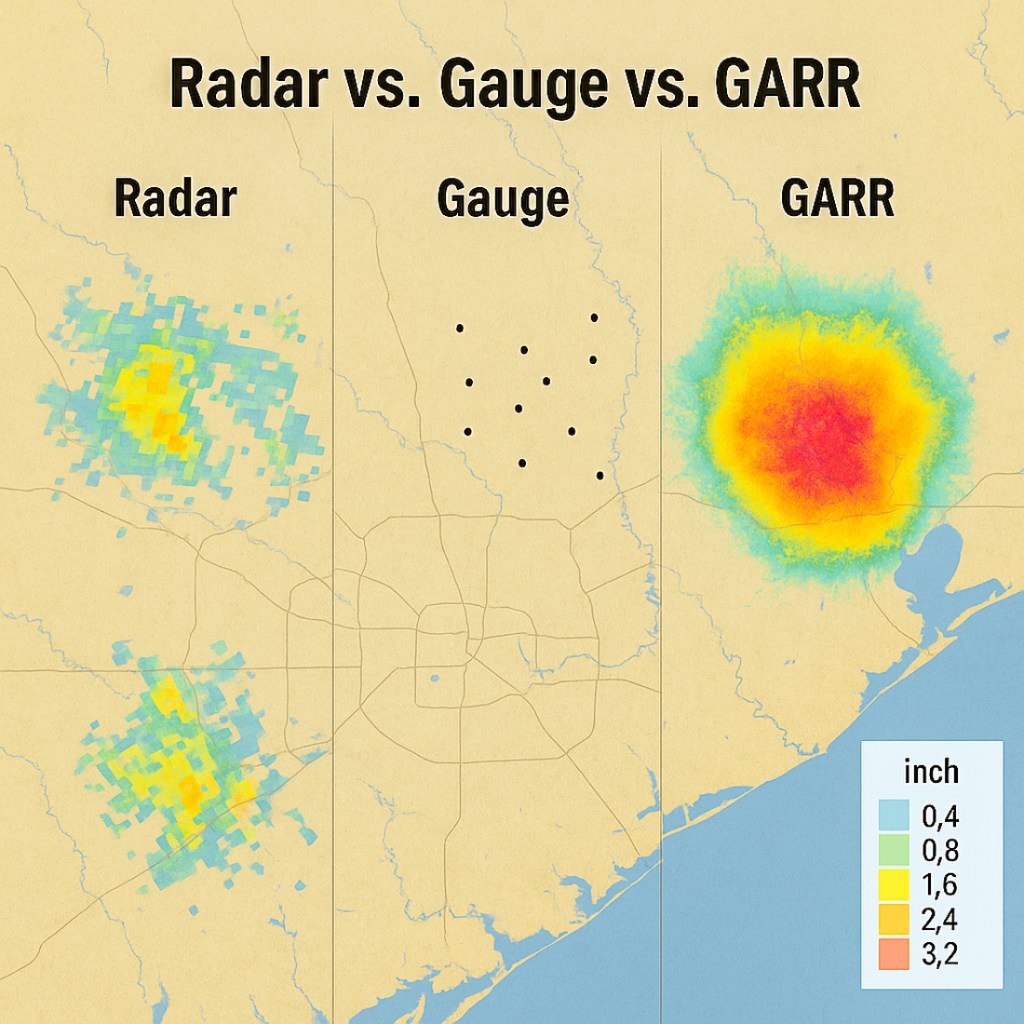
Gauge Adjusted Radar Rainfall (GARR) systems estimate rainfall by combining radar-based precipitation estimates with ground-based rain-gauge measurements. The two together produce more accurate rainfall data over wider areas.
Radar can provide rainfall data over large areas with high frequency (e.g., every 5 minutes), but it’s prone to errors due to beam blockage, calibration issues, or interpreting non-rain targets (such as birds or dust) as rain.
Rain gauges give point-accurate rainfall measurements, but huge distances/gaps exist between gages. And rainfall is rarely uniform across wide areas.
Hypothetical image created by ChatGPT. Demonstrates differences in technologies.
Gauge adjusted radar rainfall systems blend both types of data. They use the broad coverage of radar but “correct” or adjusts the radar estimates using actual gauge readings. Great advances in the systems have been made in recent years.
Is It Good?
Yes. GARR is generally considered superior to using radar or gauges alone. It is widely used by agencies like the National Weather Service, USGS, and local flood control districts (e.g., HCFCD).
According to ChatGPT, the systems offer multiple benefits.
Benefits of Gauge Adjusted Radar Rainfall
Benefit
Explanation
Improved Accuracy
Combines radar’s spatial resolution with gauge accuracy, reducing biases in radar-only estimates.
Better Coverage
Provides rainfall estimates across areas with few or no gauges
Real-Time Utility
Enables near real-time rainfall mapping, critical for flood forecasting and emergency response.
Hydrologic Modeling
Offers high-resolution inputs for stormwater modeling, floodplain mapping, and watershed management.
Event Verification
Allows engineers and flood managers to verify how much rain actually fell over an entire basin during a storm.
How is GARR Used?
GARR data is often used in:
Post-storm analysis
Designing detention basins
Flood alert systems
Atlas 14 and extreme rainfall calibration
GARR systems are widely used for both real-time monitoring and hydrologic planning. And they are particularly valuable in flood-prone areas.
Success Stories
Harris County Flood Control
During Hurricane Harvey in 2017, GARR data provided near real-time insight into rainfall distribution — helping emergency managers prioritize rescues, issue flood alerts, and allocate resources.
Post-storm, GARR helped analyze where detention basins were effective and where flooding exceeded expected design thresholds.
HCFCD reportedly credits GARR with saving lives and informing infrastructure improvements after Harvey.
San Antonio River Authority (SARA)
SARA integrated GARR into its real-time models to monitor stormwater flow in the river basin. It:
Improved rainfall inputs to models that simulate flooding during storms
Enabled automated forecasts of creek levels and road closures
Reduced false positives/negatives from radar-only systems.
They used it to improve public safety, automated alerts and floodgate operations.
North Carolina
Mecklenburg County (Charlotte) uses GARR to fill data gaps across watersheds and create real-time flood forecasts with more accurate rainfall inputs.
They credit GARR systems with improved warning lead times and better informed design updates for critical infrastructure like culverts and detention ponds.
Recent Advances in GARR
HCFCD hopes to improve accuracy and operational capabilities that support improved flood forecasting. The District did not elaborate with more specifics, but GARR technology has improved greatly in recent years. Advances include:
1. Integration of AI and Machine Learning
Artificial intelligence (AI) and machine learning techniques are improving GARR system accuracy. For instance, deep learning models have been employed to enhance precipitation “nowcasting” for emergency response.
2. Enhanced Data Assimilation Techniques
Advances in data assimilation now allow seamless integration of GARR data into hydrological models for more accurate flood forecasting.
3. Development of High-Resolution GARR Products
Companies like AEM have developed GARR products with resolutions as fine as 1 km² and temporal resolutions of 5 minutes. Such resolution is essential for urban planning, infrastructure design, and real-time flood monitoring.
4. Application in Urban Flood Management
During the unprecedented rainfall event in the United Arab Emirates in April 2024, GARR data played a crucial role in analyzing the hydrologic and flood impacts.
5. Expansion of Historical Data Archives
Organizations like OneRain have expanded their historical radar data archives, providing GARR data back to 1993. This helps planners analyze trends and infrastructure resilience to develop disaster risk reduction strategies.
HCFCD Request and Rationale
HCFCD hopes to provide an enhanced Gage Adjusted Radar Rainfall (GARR) Multi-Radar Multi-Sensor (MRMS) product that improves flood forecasting in Harris County.
This project expands the initial agreement between HCFCD and the National Severe Storms Laboratory (NSSL). That agreement established a limited Multi-Radar Multi-Sensor (MRMS) domain over Harris County using HCFCD’s dense rain gauge network.
The new agreement should enhance the accuracy and operational capability of HCFCD’s GARR MRMS system. It will integrate verification tools, cloud-based processing, and sub-hourly nowcasting capabilities. These improvements should lead to better spatial representation of rainfall, improved short-term forecasting, and ultimately strengthen flood risk prediction and response efforts across Harris County.
Looking for a summer science project for your student? Here it is.
Posted by Bob Rehak on 6/5/25and updated on 6/6/25
2837 Days since Hurricane Harvey
https://i0.wp.com/reduceflooding.com/wp-content/uploads/2025/06/20250605-ChatGPT-Image-Jun-5-2025-at-09_16_21-PM.jpg?fit=1100%2C1100&ssl=111001100adminadmin2025-06-05 21:40:322025-06-06 10:01:07HCFCD Seeks to Enhance its Gauge Adjusted Radar Rainfall System
6/5/25 – The Northpark Drive Expansion Project has been a beehive of activity recently.
A major traffic switch will happen Friday.
Crews have paved several blocks of new westbound lanes and are working their way toward the railroad tracks.
They have finished the first pit for boring under the UnionPacific tracks and are getting ready to place the boring machine into it. They have also started excavating the receiving pit on the west side of the tracks.
Contractors at the Northpark Enclave continue to work even as Montgomery County Precinct 4 is trying to set up a meeting between Montgomery County Engineering, City of Houston, EHRA (the Enclave’s engineering company), and HNTB (the Lake Houston Redevelopment Authority’s engineering company). The purpose: to discuss concerns about potential overflow from the development’s retention pond during extreme weather events into the evacuation route for 78,000 people.
Lane Switch
Westbound traffic between Loop 494 and US59 will be routed to recently paved lanes on the north side of Northpark starting Friday, June 6.
According to Ralph De Leon, Northpark Expansion project manager, “Beginning June 6th at 9pm, Harper Brothers Construction will shift westbound Northpark Drive traffic to the newly constructed westbound lanes.”
The contractor will then install new storm sewer pipes and construct new concrete roadway between the eastbound and westbound lanes. This shift should last approximately 6 months. And no additional lane changes will take place during that time in that area.
De Leon provided this map to help motorists understand Friday’s change.
Beginning 6.6.25 at 9 PM
That same area looks like this from a lower angle.
Crews will reroute traffic to the lanes on the right with the orange traffic cones.
Westbound traffic now in the middle will move to the right and crews will begin work in the middle.
Paving
During the last few months, work on the north side of Northpark east of the railroad tracks has focused mainly on utility relocations and drainage installation. Now, crews are starting to pave that area working from east to west – toward the tracks.
Note the fresh concrete on the left below.
Looking East along Northpark DriveReverse angle. Looking W from same location. Crews are working on pavement prep work, i.e., rebar placement.
Boring Under Union Pacific Tracks
Steel pipe previously stockpiled south (left) of Northpark has been moved to the north side in preparation for the bore.Workers have completed the steel frame for the boring operation and poured a concrete floor for the bore pit.
They have also placed a section of railroad tracks into the pit. The boring machine will later be placed on the tracks.
On the far side of the tracks, you can see them starting to excavate the receiving pit.
Two steel pipes will run under the tracks side by side to convey storm water toward the Diversion Ditch from the area on the west side of Loop 494. As crews push each section in, they will weld a new section on.
Enclave Construction
Contrary to earlier reports, construction at the Enclave has not stopped during a peer review of the subdivision’s drainage.
Photo taken 6/4/25 at approximately 2 PMshowed activity throughout the site.
Victoria Bryant, Montgomery County Precinct 4 Project Coordinator says that she is trying to set up a meeting between the engineering companies, MoCo Engineering and the City of Houston.
Pictures below show activity on the site.
Culvert installation almost reached the development’s detention basinat 2PM on 6/4/25.More drainage being installed on 6/3/25Pipes going in the ground.Also on 6/3/25.
Drainage Concerns
Meanwhile, construction plans show that the detention basin could overflow into the only evacuation route for 78,000 people during extreme rainfall events.
Enlarged and cropped detail from construction plans.
But it doesn’t take a 100-year rainfall to create a 100-year flood in the Kingwood Diversion Ditch.
The photo below taken by Kingwood flood activist Chris Bloch during the May 2024 flood shows runoff in the Kingwood Diversion Ditch reaching above the bottom of the Northpark Drive Bridge, which was above the predicted 100-year flood level.
But the closest Harris County Flood Control rain gage showed that the May 2024 event that caused water to reach that high was approximately a 5-year rainfall by today’s Atlas-14 standard.
Photo courtesy of Chris Bloch
But there’s more. Plans for the bridge show that the bottom is at 75.76 feet.
About a half mile downstream, drainage from the Enclave and the rest of Kings Mill crosses under Russell Palmer Road and enters into the Diversion Ditch.
Water in the Diversion Ditch at the bridge was higher than the crown of Russell Palmer Road at the detention basin.
When water in a receiving ditch is higher than water in a connected detention basin, it creates back-pressure on the water in the basin. Water can actually flow into the basin from the ditch.
At a minimum, higher water in the Diversion Ditch would slow the water coming out of Kings Mill and the Enclave. That raises the height of stormwater in the detention basin(s) and keeps it there longer.
Also, note that the outfall pipe for the Kings Mills Detention Basins is at the BOTTOM of the Diversion Ditch. (See below.) That exacerbates the back-pressure issue.
Route of stormwater from Kings Mill Detention Basin (right) to Kingwood Diversion Ditch (left)
Conclusion: Mismatch Between Regulations and Reality
The Diversion Ditch has become seriously overburdened with runoff from subdivisions that were developed when the rainfall probability estimates used by Montgomery County were 40% lower than they are for this area today.
That may or may not cause the Enclave detention basin to overflow into Northpark during a REAL 100-year event. It will be interesting to see what the engineers determine. Only they can tell how high, how far, and how long the water will back up.
Chances are small that the Enclave detention basin will overflow into Northpark during an evacuation. But the stakes are huge.
Posted by Bob Rehak on 6/4/25
2836 Days since Hurricane Harvey
The thoughts expressed in this post represent opinions on matters of public concern and safety. They are protected by the First Amendment of the US Constitution and the Anti-SLAPP Statute of the Great State of Texas.
https://i0.wp.com/reduceflooding.com/wp-content/uploads/2025/06/20250604-NorthPark-Traffic-Switch-06-06-2025R.jpg?fit=1100%2C712&ssl=17121100adminadmin2025-06-04 20:17:332025-06-05 13:46:02Northpark Update: Lane Switch, Paving, Tunneling, Enclave
6/3/25 – The new 1,056-page Texas state budget includes more than $200 million for Houston-area flood mitigation projects and dredging.
The legislature allocated $50 million for Lake Houston dredging through the Texas Water Development Board and another $150 million for Houston/Harris County Area flood-mitigation projects.
That’s out of a total $581 million appropriated to TWDB for funding infrastructure, flood, wastewater and water-supply projects.
List of Other Local Flood-Mitigation Projects
Other Houston/Harris County flood-related projects include:
$54 million for the Cypress Ditch Regional Flood Mitigation Project
$2.5 million for Greens Bayou Watershed Channel Improvements
For the Lake Houston dredging district (HB1532) to succeed long term, the operation must make business sense. The legislation that formed the district stipulates it cannot impose taxes or fees. So operations must generate a funding stream from the sale of spoils for beneficial uses such as roads, development, and the Ike Dike.
However, in the near term, the dredging money allocated by the legislature could be used to help purchase dredging equipment and set up operations.
Many decisions lie ahead re: equipment, staging areas, staffing, sales of the spoils, maintenance, trucking, and more.
Frankly, I thought we might have to wait until the next session of the legislature in two years before we had a chance at seed money to launch the dredging district.
So, seeing the money in this state budget is a very pleasant surprise…as is the additional $150+ million for other flood-mitigation projects coming to the Houston region!
For More Information
To see the entire 1068-page state budget, click here. (Warning: 10 meg download.)
For the two pages relating to TWDB and flood mitigation projects, click here.
Posted by Bob Rehak on 6/3/2025
2885 Days since Hurricane Harvey
https://i0.wp.com/reduceflooding.com/wp-content/uploads/2025/01/20250114-DJI_20250114091626_0721_D.jpg?fit=1100%2C619&ssl=16191100adminadmin2025-06-03 19:12:472025-06-03 19:12:48New State Budget Includes $200 Million for Area Flood Projects, Dredging
6/4/25 Update: Construction has not yet stopped and it may not. It continues as City and County Authorities try to set up a meeting to review drainage plans with engineers.
6/2/25 – Construction has stopped, at least temporarily, at the Enclave, a new 11-acre residential development adjacent to the Northpark expansion project in Montgomery County.
Both Montgomery County and the City of Houston have asked engineers to review the drainage plans, which showed the development’s detention basin overflowing into the only evacuation route for 78,000 people during extreme weather events.
HNTB, the engineer for the Northpark Expansion project, is going to conduct a peer review of EHRA plans for the Enclave’s drainage. They need to hurry.
Detention Basin Already Dug Out
Photographs taken between 5/31 and 6/2/25 show that construction crews have already excavated the proposed detention basin. And they are starting to install pipes and junction boxes for drainage.
Looking E. Northpark on left. Detention Basin, partially filled with water from last week’s rains, is already excavated.
However, I have received word that both the City and Montgomery County have asked for construction to be paused for a new independent peer review of the development’s drainage plans.
Partial Update to Outdated Drainage Plans
The new development is technically part of Kings Mill, which had its drainage plans approved in 2012. But after Harvey in 2018, Montgomery County and the City of Houston both adopted Atlas 14 rainfall probability statistics, which are 33% higher than those used to design virtually all of Kings Mill’s infrastructure.
That means Kings Mill – which is 20 times larger than the Northpark Enclave – funnels much more stormwater toward the Kingwood Diversion Ditch than it was designed to handle.
Yet Enclave engineers designed its detention basin to hold only the difference between the old and new rainfall statistics. And only for 11 acres, not all 240.
Concerns about Capacity, Its Impact and Inconsistencies
Several other things have happened since approval of the 2012 drainage study.
The Northpark Expansion project started. A major goal: to create an all-weather evacuation route when Hamblen Road, Kingwood Drive and Mills Branch Road are cut off by high water.
The developer’s plans raised concerns about where Enclave overflow will go during an extreme event. (See construction diagram above.)
Construction plans showed inconsistencies between the initial drainage impact analysis and today, including the size of the Enclave.
The developer claims it can build ten homes to the acre with only 55% impervious cover, an extremely ambitious goal.
Photos Show Drainage Route to Kingwood Diversion Ditch
Photos below show the new Northpark Enclave development and the path that stormwater will take on its way to the Kingwood Diversion Ditch, which already has capacity problems of its own.
Hundreds of homes have flooded because of the ditch’s diminishing capacity as insufficiently mitigated new subdivisions began draining into it.
Harris County Flood Control District (HCFCD) has completed its preliminary engineering review of the Diversion Ditch. HCFCD is now in the process of selecting an engineering company to make final recommendations for improving the ditch. But it could take years to find the money to construct any recommendations that come out of the study.
So, MoCo and the City want to make sure they get this right. The photos below show how all the drainage will connect.
Looking SE over the intersection of Loop 494 and Northpark Drive at construction of the Northpark Enclave.Still looking SE. From the new development, stormwater will move to the giant detention basin in the upper center of frame.Contractors are already starting to install culverts that will carry runoff to the main Kings Mill Detention Basin.From the Kings Mill Detention Basin, stormwater will flow into the ditch that angles toward top and then makes a left turn toward Russell-Palmer Road in the upper left corner of the frame.Stormwater runoff goes a half mile east toward Russell-Palmer Road. Kings Mill’s drainage on left. Kings Manor’s on right.Looking S along Kingwood Diversion Ditch and Russell-Palmer Road. Kings Mill Ditch on lower right. Kings Manor Ditch above it. Both outfall under the road into the Diversion Ditch. Bridge at top of frame by water tower is Kingwood Drive.
Once contractors have drain pipes and culverts in the ground and start pouring concrete, it will be very difficult to make any changes. So, it’s good that construction has been paused now for peer review.
Posted by Bob Rehak on 6/2/2025
2834 Days since Hurricane Harvey
The thoughts expressed in this post represent opinions on matters of public concern and safety. They are protected by the First Amendment of the US Constitution and the Anti-SLAPP Statute of the Great State of Texas.
https://i0.wp.com/reduceflooding.com/wp-content/uploads/2025/06/20250601-DJI_20250601114737_0637_D.jpg?fit=1100%2C619&ssl=16191100adminadmin2025-06-02 19:50:342025-06-04 20:18:09Enclave Construction Stopped While Engineers Review Drainage
6/1/25 – Harris County Flood Control District has performed maintenance excavation and regrading of the Kings Crossing Ditch that runs from behind the Memorial Hermann Convenient Care Center to Kingwood Drive.
See #9.
Here’s what that area looks like in a satellite view. Note the Kingwood Park N Ride at the top left and H-E-B below it. This short ditch drains more than 50 acres of concrete by my estimate.
NE quadrant of Kingwood Town Center with Kings Crossing Ditch (G103-33-04-X007)highlighted.
A resident alerted me to the maintenance. He said, “The ditch was already in decent shape and depth, but this looks to have deepened the ditch and sharpened the toe.” He estimates HCFCD removed at least 15-20 cubic yards of sediment. Workers have already removed the sediment.
Not only does the bottom of the ditch collect silt, it is the first to fill and the last to drain. So keeping it clear and properly graded is critical to reducing flood risk.
Protecting the Commercial Center of Kingwood
The northeast quadrant of Kingwood Town Center contains numerous essential services from the area’s largest grocery store to 24-hour emergency room and advanced medical imaging services, not to mention more than a dozen restaurants.
Unfortunately, the area is low lying and prone to flooding. A flood in May of 2024 had the parking lots underwater. It also forced closure of the Memorial Hermann facility.
May 4, 2024, as floodwaters receded. High water had forced the cancellation of appointments at the Convenient Care Center in upper left.Note ditch in top center.Also note barricades by front door under canopy.
Pictures of Maintenance Repairs
I took the pictures below on May 31 and June 1, 2025. Here’s what the ditch looked like after the operation. First from high up.
Kings Crossing Ditch Maintenance. H-E-B at top of frame.Kings Crossing Ditch Maintenance. Memorial Hermann at top of this frame.
And then from a lower angle…
It wasn’t the largest HCFCD effort ever, but flooding is often a matter of inches. One inch in a building can mean major repair bills.
The merchants of Kings Crossing and all the people who depend on them appreciate the effort.
If you see other HCFCD operations in progress, please alert me through the contact form of this website so I can photograph them.
5/31/25 – The 2025 Hurricane Season starts tomorrow, 6/1/25. But ironically, despite predictions of an above-average season, the federal agencies that help forecast hurricanes, issue warnings, and provide disaster relief are struggling with significant funding, staff and program cuts.
Poignant Letter in New York Times
Michael Lowry, who served as a senior scientist at the National Hurricane Center (NHC), a planning chief at FEMA, and a hurricane expert at the Weather Channel, wrote a poignant letter published in the New York Times today under the headline “A Hurricane Season Like No Other.”
The letter began with an anecdote about data collection from inside Hurricane Milton last year by a Hurricane Hunter crew. The data they collected about “vortex alignment” heralded rapid intensification of the storm. Within 24 hours, it had become the strongest hurricane in 20 years with 180 MPH winds.
Milton as it began intensifying and heading toward the Florida Coast
But there was no surprise on the Florida coast. The forecasts gave “enough time for people in the highest-risk areas to safely evacuate and businesses to prepare for the worst.”
Lowry then segues to budget, staff and program cuts at FEMA, NOAA, NHC, the National Weather Service (NWS), Hurricane Hunters, and more. Some examples:
NWS offices that have lost 60 percent of their staff members, including entire management teams.
Nearly half of NWS local forecast offices are understaffed, with vacancy rates of 20 percent or higher.
Weather balloon launches are down 15 to 20 percent nationwide. The balloons increase forecast confidence and let evacuation orders be made sooner.
New budget documents released Friday propose eliminating NOAA’s research wing, the Office of Oceanic and Atmospheric Research, which lends mission-critical support to the hurricane hunters.
Along the way, Lowry points out that “The National Weather Service costs the average American $4 per year in today’s inflated dollars — about the same as a gallon of milk — and offers an 8,000 percent annual return on investment, according to 2024 estimates.”
“Without the arsenal of tools from NOAA and its 6.3 billion observations sourced each day, the routinely detected hurricanes of today could become the deadly surprise hurricanes of tomorrow,” he says.
Bottom line: Lowry says we’re jeopardizing decades of progress that have increased forecast accuracy and warning times. And that will put more people at risk.
Dizzying Days for FEMA: Cuts and More Cuts
Andrew Rumbach, a Senior Fellow with the Urban Land Institute writes about policies for disaster risk reduction. He wrote a Substack post in early May called “100 Dizzying Days for FEMA.” It details the dismantling of disaster-relief and flood-mitigation capabilities including:
Disbanding key advisory councils that guide FEMA’s work, despite them being established in law. They include the National Advisory Council, the Technical Mapping Advisory Council, and the National Dam Safety Review Board.
A Notice of Funding Opportunity for the Flood Mitigation Assistance (FMA) program for 2025-2026, another major source of funding, was removed.
The administration quietly stopped approving new allocations of funding from the Hazard Mitigation Grant Program (HMGP).
FEMA has withdrawn its participation in the International Code Council (ICC) update process. It provided resources and expertise to help develop building codes that would better protect against floods.
An executive order titled “Achieving Efficiency Through State and Local Preparedness” describes a policy that “State and local governments and individuals play a more active and significant role in national resilience and preparedness.”
Could States Do What FEMA Does?
An article in the June 9 issue of Time Magazine addresses whether states could do what FEMA does. The consensus: it makes more sense to manage disaster response at the federal level. Why? It’s more efficient. If you spread disaster responsibilities among 50 states, you will have a lot of people sitting around a long time between disasters. FEMA can shift people from state to state, disaster to disaster, and keep them busier.
Experts cite the need for reform. But getting rid of the system without a meaningful replacement is likely to cause harm.
My takeaway from the article: Surgeons experience better outcomes with scalpels than cannons.
Erosion of Safety Margins
We live in a time of uncertainty. I’m not sure which is scarier: major hurricanes, a reduction in forecasting capabilities, or the loss of disaster-relief and flood-mitigation assistance.
These cuts will erode safety margins. Sixty million Americans reportedly live in areas regularly impacted by hurricanes.
If you haven’t already completed preparations for hurricane season, check out this NWS page on Hurricane Safety Tips and Preparations. Before someone takes it down to save a buck.
Posted by Bob Rehak on 5/31/25
2832 Days since Hurricane Harvey
https://i0.wp.com/reduceflooding.com/wp-content/uploads/2024/10/Milton.jpg?fit=1000%2C740&ssl=17401000adminadmin2025-05-31 23:17:492025-06-01 10:17:28On Eve of Hurricane Season, NOAA, NWS, NHC, FEMA Struggle with Cuts
5/30/25 – The Northpark Enclave detention basin may be undersized and the developer plans to dump overflow stormwater during extreme events into the only all-weather evacuation route for 78,000 people. That’s according to construction documents and drainage plans obtained from Montgomery County under the Freedom of Information Act.
The last thing you need during a mass evacuation is street flooding.
EHRA, the developer’s engineering company, told Ralph De Leon, project manager for the Northpark expansion project, that all drainage for the new subdivision would be routed south to the Kings Mill Stormwater Detention Basin and then via an outfall channel to the Kingwood Diversion Ditch near the County Line. But the construction drawing above indicates otherwise.
Technically a part of Kings Mill, this 11-acre strip bordering Northpark is just now being developed for single-family residential. Most of Kings Mill was built in phases between 2004 and 2018. And therein lies a huge problem.
Old Plans Use Antiquated Rainfall Statistics
Some of the drainage analyses/plans for the Enclave detention basin date back to 2002 – almost 25 years ago.
Back then, assumptions about “probable maximum rainfall” were very different from today’s. Montgomery County defined a 100-year rainfall then as 12.1 inches in 24 hours.
However, today, MoCo defines a 100-year/24-hour rainfall as 16.1 inches – a 33% increase. But for this development’s location, NOAA defines one as 17.1 inches – a 41% increase. Why the difference?
MoCo adopted Atlas 14 rainfall statistics in 2019. But NOAA fine-tunes its statistics for individual locations. And MoCo regulations use Conroe’s statistics for the entire county. Rainfall decreases as you go farther inland and Conroe is 40 miles north of this location. But that’s not all.
Confusing Documents Don’t Match
It’s not clear how engineers have updated the old drainage analyses in the new plans. MoCo did not provide an updated drainage analysis in response to my FOIA request.
Yet within the construction plans, it appears that EHRA may have tried to mitigate for higher rainfall standards in the development of this tract within Kings Mill.
Calculations on page 9 of Construction Plans Part 2 reference 2023 City of Houston Regulations for detention volume. They show the size (line 3 below) as 11 acres.
Plans do not provide a narrative explaining how all the pieces of this jigsaw puzzle fit together. And trying to track the pieces back through documents dating back almost 20 years is confusing.
15.6 acres in 2012 magically became 11 acres in 2025.
At the very least, it’s safe to say that unexplained differences like these make one question the quality and consistency of calculations in the plans.
55% Impervious Cover?
And they never do explain how they can put 100 homes on 10 acres (minus one acre for the detention basin) and get only 55% impervious cover. Experience suggests that more realistic estimates for that much density would range from 65% to 85% depending on the size of homes and garages.
Only two things became clear after struggling to understand these documents:
There should be a statute of limitations on “grandfathering” permits based on when someone first applied for them.
Someone should have required a new drainage analysis for this project.
More news to follow.
Posted by Bob Rehak on 5/30/25
2831 Days since Harvey
The thoughts expressed in this post represent opinions on matters of public concern and safety. They are protected by the First Amendment of the US Constitution and the Anti-SLAPP Statute of the Great State of Texas.
https://i0.wp.com/reduceflooding.com/wp-content/uploads/2025/05/20250530-Detention-Overflow-copy.jpg?fit=1100%2C694&ssl=16941100adminadmin2025-05-30 22:13:292025-05-31 20:22:02Enclave Detention Basin Will Overflow into Kingwood Evacuation Route
5/29/25 – On 5/16/25, Harris County Flood Control District (HCFCD) announced a series of maintenance repairs in Kingwood. One was on a tributary of Bens Branch that runs down the west side of West Lake Houston Parkway toward Kingwood Town Center. Yesterday, I received a report from Chris Bloch, a flood activist in Kingwood, that they had started.
HCFCD is making repairs to a ditch romantically named G103-33-01-X007. See #10 in the center of the map below.
Photos Taken on 5/29/25
Below are several pictures taken today at the start of the project. I’m sure it will look better when they finish.
Bens Branch Tributary Repairs near Rustic Woods in Kingwood Town CenterCloser shot shows extent of slide slope and back slope repairs.
Swales behind the side slopes intercept water draining toward the ditch. In the lower right above, you can see a cement structure that helps convey water through a pipe from that swale to the bottom of the ditch. That helps prevent erosion to the side slopes.
Closer shot of same general area.Looking S toward Kingwood Drive at top of frame behind the old HEB shopping center Looking N from Rustic Woods at current extent of repairs. Note the difference in the width of the ditch above and below where the pipe enters near the center of the frame.
More News to Follow
I’ll post more pictures as the project progresses. It’s important to maintain the conveyance of ditches as the flooded merchants in the shopping center above can attest. It still hasn’t completely recovered from Harvey flooding almost eight years ago. This should be very welcome news for them.
Maintenance is a never-ending challenge for HCFCD. They have more than 2500 miles of ditches to maintain. If you see them working near you, please give me a heads up through the contact page of this website.
Posted by Bob Rehak on 5/29/25
2830 Days since Hurricane Harvey
https://i0.wp.com/reduceflooding.com/wp-content/uploads/2025/05/20250529-DJI_20250529184404_0546_D.jpg?fit=1100%2C619&ssl=16191100adminadmin2025-05-29 20:48:352025-05-29 20:50:39HCFCD Begins Repairs to Bens Branch Tributary
“My first thought after I saw this passed was that it was a victory for Kingwood,” said Representative Charles Cunningham who pushed the idea of a dredging district relentlessly for years.
Today is the last day of the legislative session that the Senate considers bills. So it was do-or-die time. And Senator Brandon Creighton teed the bill up perfectly with the help of Senator Paul Bettencourt who shepherded the bill through his Local Government Committee.
Now, it’s on to the Governor’s desk. The good news: shortly after Harvey, Governor Abbott visited Kingwood. He flew up and down the West Fork. He personally saw the mouth bar and other sediment buildups in our rivers and streams.
Thank you to all those who wrote letters, testified in Austin, and never gave up hope for a dredging district. It was a true team effort between residents who never forgot the pain of flooding and leaders who never forgot those they represented. Together, we will make a difference for future generations and the future of the area.
I would be remiss if I didn’t also thank former State Rep. Dan Huberty; former Mayor Pro Tem Dave Martin; City Council Members Fred Flickinger and Twila Carter; and the Army Corps of Engineers. They started this ball rolling years ago. \
And thank you, too, Houston Mayor John Whitmire. Former City Flood Czar Stephen Costello. The architects of the 2018 Flood Bond. Congressman Dan Crenshaw. Harris County Commissioner Tom Ramsey. And Bill McCabe and Dianne Lansden, who kept the Lake Houston Area Flood Prevention Initiation going for years.
My apologies to anyone I overlooked. So many contributed! They all had one thing in common. They put the safety of each other above partisan politics. And it showed in tonight’s unanimous vote.
Beating the Odds
Between “dream” and “done” in the Texas legislature, there’s a lot of hard work.
I came across this table today on the Texas Legislature Online website. It shows the success rate of various types of legislation to date.
Of all the bills introduced in both the House and Senate to date, only about 1 in 12 made it this far.
These numbers will change tomorrow because of additional bills passed today in both the House and Senate.
Here’s what each of those acronyms above stands for:
HB – House Bill
A proposed law originating in the House of Representatives.
If passed by both chambers and signed by the Governor (or allowed to become law), it becomes part of Texas statute.
Used for substantive changes to law (e.g., criminal statutes, environmental rules, etc.).
SB – Senate Bill
A proposed law originating in the Senate.
Same process and purpose as an HB, just introduced in the Senate instead of the House.
HJR – House Joint Resolution
Proposes an amendment to the Texas Constitution or requests Congress to call a constitutional convention.
Does not require the Governor’s signature.
If it’s a proposed constitutional amendment, it must be approved by voters in a statewide election.
Originates in the House.
SJR – Senate Joint Resolution
Same as HJR, but introduced in the Senate.
HCR – House Concurrent Resolution
Expresses the will of the House and Senate together but does not have the force of law.
Often used to make requests of federal government, authorize ceremonial recognitions, or approve internal legislative matters (e.g., adjournment).
Requires approval by both chambers, but not the Governor’s signature.
SCR – Senate Concurrent Resolution
Same as HCR, but introduced in the Senate.
HR – House Resolution
Used for internal House matters or to express one chamber’s opinion or recognition.
Examples: honoring a constituent, changing House rules.
https://i0.wp.com/reduceflooding.com/wp-content/uploads/2018/07/Mouth-Bar-Cropped.jpg?fit=2000%2C859&ssl=18592000adminadmin2025-05-28 22:34:562025-05-30 08:46:01Dredging District Bill Passes Unanimously in Senate