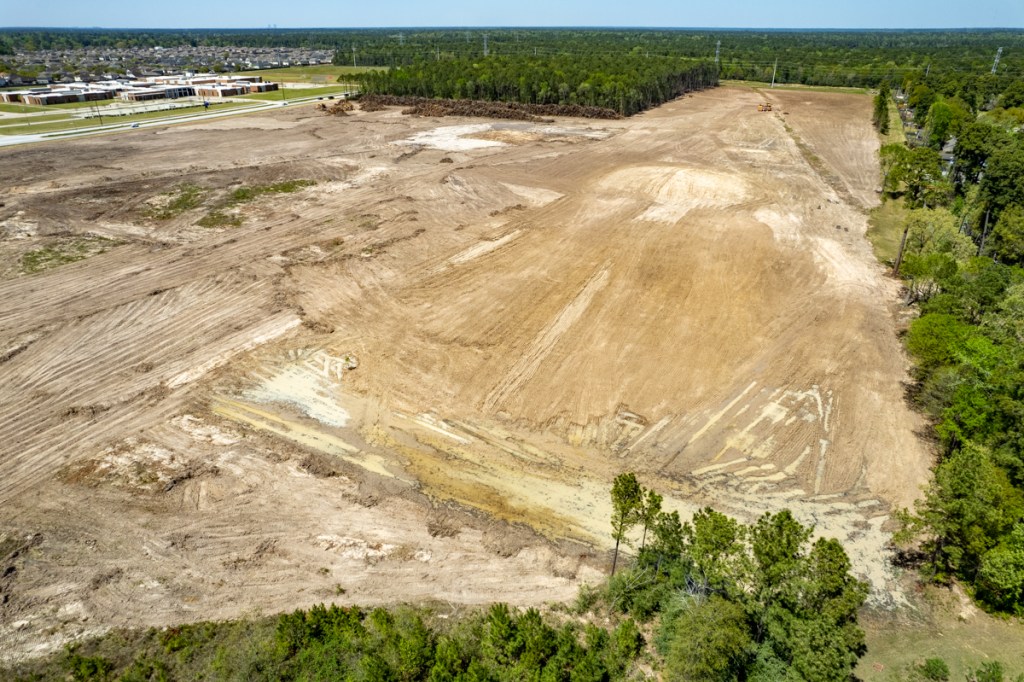
While driving home from Humble this afternoon along Townsend Blvd. north of FM1960, I passed near a clearing so large and with trees piled so high that my jaw dropped into my lap.
I pulled over into the Aldine ISD school’s parking lot and put up a drone. The piles of downed trees looked about 30 to 40 feet tall. According to HCAD, several residential developers own the property in question. According to the US Fish and Wildlife Service (USFWS), the property contained wetlands. And according to FEMA, the property sits right on the edge of the 500-year floodplain. But FEMA’s map dates to 2014. This sits just west of Costco where Harris County Flood Control District took all those signature shots of Harvey flooding.
Photos Taken 4/3/2022
I took the pictures below this afternoon.
Looking NW from over Sam’s rear parking lot for trucks.
Panning left from first shot.Looking W toward Townsend Blvd. That’s Walmart in the upper left and Aldine ISD’s Jones Middle School in the upper right.
Looking SE from over Townsend toward Humble Deerbrook Mall in upper left and Sam’s in upper right. FM1960 is out of sight beyond Sams. Note wet area above leftmost trees and see Wetlands Map below.
Drone was at about 35 feet for this photo. Note how you cannot see roof of middle school. And some points in log piles appear higher than camera.
Fallen trees on cleared land in Humble.
Trees are almost as tall lying down as they were standing up.
Location Relative to Floodplains
Location of floodplains relative to property circled in red. Background map is from FEMA’s National Flood Hazard Layer Viewer. Note the flood map is based on 2014, pre-Harvey data and is currently being revised. Floodplains may expand.
Because no one lived on these parcels during Harvey, I’m not sure whether they flooded. Perhaps someone who lives nearby can tell me.
Property Had Some Wetlands
The large green spot in the center of the red circle appears to roughly correspond to the wet spot in the third photo from the top. From USFWS National Wetlands Inventory.
Plans for Property Not Yet Clear
The parcels of land in Harris County Appraisal District’s Map don’t exactly match what you see cleared in the photos above. Three residential developers appear to own all parcels in the vicinity. They include Hannover Estates, Townsen Landing LLC, and Headway Estates LTD. I saw no signage on the site indicating a name for a future development.
Altogether the parcels of land total more than 3.1 million square feet or about 71 acres.
I have not yet obtained construction plans or a drainage analysis for this land.
Posted by Bob Rehak on 4/3/2022
1678 Days since Hurricane Harvey
The thoughts expressed in this post represent opinions on matters of public concern and safety. They are protected by the First Amendment of the US Constitution and the Anti-SLAPP Statute of the Great State of Texas.
https://i0.wp.com/reduceflooding.com/wp-content/uploads/2022/04/20220403-DJI_0215.jpg?fit=1200%2C799&ssl=17991200adminadmin2022-04-03 17:04:362022-04-05 08:18:05All Clear: New Development in Humble Near Floodplain
Vidal G. Martinez began his career in 1978 as an Assistant U.S. Attorney in Houston. Since 1981, he has been engaged in private practice as Managing Partner of Martinez Partners LLP. Martinez has been chairman of the State Bar of Texas. And was appointed by former Texas Governor Bill Clements to the University of Houston Board of Regents where he also served as Vice Chairman. During decades of public service, he has helped lead more than three dozen organizations such as the Greater Houston Community Foundation, Greater Houston Convention and Visitors Bureau, Houston Housing Authority, Houston Port Authority, Houston Proud, Salvation Army, Texas Children’s Hospital, and Methodist Hospital (where he has been a director for 30 years).
Vidal Martinez, Republican candidate for Harris County Judge in May runoff election.
Rehak: Thank you for your great history of public service. Today, I’d like to talk to you about flooding: specifically, partner funding; what our neighbors are doing upstream; growth; and your priorities for flood control. Let’s start with partner funding. How do we get more?
Leveraging Relationships to Accelerate Partner Funding
Martinez: When I was a port commissioner, we always had to chase about $600 to $700 million every five years for the widening and deepening of the port. So, we worked closely with our congressional delegation to put pressure on the Administration. We were in direct contact. We had the whole business community, the Greater Houston Partnership, and leaders, all touching base on their areas of influence and pushing things forward. That was a formula that worked, and it didn’t matter which party was in power. My years on the Port Commission had Clinton and George W. Bush in the Oval Office. You go to different leaders that influence that administration but the principle is the same.
That’s the way we did it before. And that’s the way I would approach partner funding.
This is something our community deserves right now. I’m not willing to wait till January. We need to start putting pressure on right now.
Rehak: You’re aware of this flood resilience trust Commissioners Court created using money diverted from the toll road authority and other parts of the county budget to start projects where we have not yet confirmed partner funding. Do you think that’s a wise thing? To decouple partner funding from the starts of projects? Or should we wait until we get a definitive answer on the partner funding?
Martinez: We should wait until we get a definitive answer. You can do more projects that way.
Working More Effectively With Neighboring Counties
Rehak: Let’s move on to upstream neighbors. On the outskirts of Harris county, we see a push by neighboring counties to attract development by lowering flood regulations or not enforcing them. They say, “It’s going to be cheaper here for you. Your profit margins will be better.” How can we work with those counties so they don’t make things worse as we spend money to make them better?
Martinez: It’s best to get the federal government involved. Ergo, you go to congressional representatives who cover those areas, like Dan Crenshaw and Morgan Luttrell. Luttrell is running for Kevin Brady’s seat now that Brady is retiring. I’m friends with both.
You start out by going back to the wallet. The people who affect that wallet the most are your congressional representatives. Nobody is a stand-alone when it comes to funding. They need that federal money.
You start with a distinct conversation with these communities that say there are “no rules.” You explain how it affects your water and flooding downstream. And you say, “You can’t do that.” You start at the political level. And then you go back again to funding mechanisms. That usually helps people clearly see what their options are going forward.
Rehak: Is there anything else that can be done in that regard? Would you favor, for instance, the formation of a regional flood control district?
Martinez: Yes, I would. And I pushed for that.
Need for Regional Planning to Sustain Growth
Rehak: Let’s talk about growth now. How can we strike a better balance between development and flooding? I mentioned that Montgomery County has this “beat the peak” methodology that they use to let developers avoid building detention ponds. So, flood peaks build faster and higher. There are lots of technical issues like that.
Martinez: Well, you’re going to have to school me on what you think needs to be done.
Rehak: People need to deal with their own run off. Three words. “Retain your rain.” If everybody did that, nobody would flood.
Martinez: Ed Emmett said that all the time. He said, “We can take care of our own water. We can’t take care of everyone else’s water.”
I’m willing to learn, listen and prepare a plan that makes sense for Harris, Montgomery County, Liberty and other counties. We need to talk to the political leaders and stop the war. Let’s figure out a regional plan that works.
Need for More Fairness in Setting Priorities
Rehak: How would you set priorities? You’ve heard of the County’s equity prioritization framework. Some commissioners are now talking about fixing 500-year flooding inside the Beltway before fixing two-year flooding outside the Beltway. They’re using “equity” as an excuse to shift ever greater sums of money from outlying areas.
Martinez: I’m against this phenomenal reversal. There will be a new start in January 2023. A 3-2 difference means we can stop this. We must treat everyone fairly.
Rehak: Any last thoughts?
Martinez: Get ready for January 3rd. Things are going to start to change.
Posted by Bob Rehak based on an interview with Vidal Martinez
1677 Days after Hurricane Harvey
https://i0.wp.com/reduceflooding.com/wp-content/uploads/2022/04/20220317-Vidal-Martinez.jpg?fit=1200%2C900&ssl=19001200adminadmin2022-04-02 15:48:112022-04-02 16:25:45Interview With Vidal Martinez, Republican Candidate for County Judge in May Runoff
Alexandra Mealer is one of two candidates in the Republican runoff election for Harris County Judge. Mealer is a West Point graduate who retired from active duty as a Captain after ten years of service in the US and Afghanistan. She returned to graduate school where she earned MBA and JD degrees from Harvard before pursuing a career in energy finance. She worked on billion-dollar mergers, acquisitions, and financing projects for public and private energy companies as a VP for one of the nation’s largest banks.
Flood Bond: A Promise to Taxpayers
Rehak: I’d like to discuss flooding in Harris County and what you would do differently to improve flood control.
Mealer: The county judge wants to talk about everything but governance. That’s my big takeaway. She isn’t interested in doing the hard work. And that’s showing up. When I’ve been at Commissioners Court, they’ll talk for hours about a football team.
In Flood control, the flood bond was a promise to taxpayers. We have an obligation to complete those projects. Voters approved just under 200. So, I would ask, “Why isn’t Lina Hidalgo actually attending some of her own flood task force meetings?”
Rehak: That’s a good question.
Mealer toured the Forest Cove Townhomes destroyed during Harvey to get a first-hand feeling for what the Lake Houston area faces.
Mealer’s Priorities
Mealer: One of my highest flood-related priorities is to make sure we’re budgeted to cover maintenance, instead of deferring it.
After that, a lot of my time will go towards making sure we are getting outside dollars if we’re going to do more mitigation projects. Hopefully they’re going to do this tunnel system. Tunnels alone could cost another $5 billion. But that’s just fixing one area of the county when we’re shifting money from other departments to help pay for current projects.
We know we need a lot more. But Hidalgo isn’t really focusing on the budget. Or spending the time on flood control that it deserves. That’s where I can make a difference. I just got back from Cypress Creek. You need to understand all these different areas because this is probably the most complicated topic of any governance issue the county faces right now. Hidalgo just hasn’t shown the time commitment at that basic level. And there’s no excuse for that. Time is the one thing you CAN control. Instead, she seems to be focusing on patronage jobs.
The best thing about my background is that all these backroom deals disgust me, to be frank.
Proposed Solutions for Next-Level Flood-Control Funding
Rehak: What solutions would you propose. Your website talks about a bipartisan state delegation and bipartisan federal delegation to help with funding; and establishing a technical task force. And you gave yourself a 90-day timetable to put all that together and get that plan rolling. You also said fixing flooding must be above politics. Regarding the last point, how does your military experience relate?
Mealer: At the highest levels, military decisions, of course, are political. But the closer you are to boots on the ground, they become more mission driven.
Rehak: I’m assuming that you would try and keep flood-control priorities on a mission level as opposed to a political level.
Mealer: Yes. I’m very data driven, too. To say “Kingwood gets all the money”…that was unfair. Just look at the dollars! That doesn’t need to be political. You can just look and see where dollars were spent and rebuff that assertion.
Mealer’s Definition of “Worst First”
Beyond that, I don’t hear anyone saying much of anything except “worst first.” We need define that and go beyond it.
I’m looking at a) the most impacted areas and b) what’s shovel ready. If you told voters you’d do X, that’s your obligation when you’re using their money. And that’s why we need such a strong focus on partner funding. We made promises. And they will require partner funding to fulfill them.
But Lina isn’t upholding those promises. It’d be different if she’d exhausted all options. But there are tons of state delegates and congressional reps that we’ve never even spoken to. I want to hold quarterly meetings with those delegations. And I’ll be the first to compliment anyone who brings home flood-control dollars. We need to throw our weight around until people act on this.
Start blocking and tackling those roadblocks. Don’t just move on when someone gives you bad news.
Improving Upstream/Downstream Cooperation
Rehak: Down by the West Fork San Jacinto, we had some condos swept off their foundations by the 240,000 cubic feet per second coming downstream from outside the county. What can we do to get our neighbors to the north to be more sensitive to the amount of floodwater that they’re sending downstream?
Mealer: We can offer our staff to advise them on regulations and help institute them.
Obviously, they’ll have some builders who won’t want to see higher retention pond requirements. But flooding is not good for economic vitality.
We need to get all community leaders to recognize that. And be very vocal about it to exert pressure on the outliers.
We also need ways to catch bad plans and mobilize people downstream before the plans go forward. That’s a problem. Neighbors don’t catch onto them until permits are being pulled and the project is well underway.
Some counties are not living with consequences. It’s easier to send floodwater downstream. And that’s where I think you can use more of governments’ full weight and power. Having good regulations downstream while those upstream get a free pass…that doesn’t work.
“Every Citizen Should Be Terrified when a Politician Says Equity”
Rehak: What are your priorities? Would you fix 500-year flooding in a poor area before two-year flooding in an affluent area?
Mealer: I’d attack the worst first. And then within that, “Who’s the most shovel ready?”
When I say “worst first,” I mean government should mitigate the most harm for the most people. It’s all based on risk and damage.
Alexandra Mealer
Every citizen should be terrified when a politician says “equity.” You should have clear standards.
Lina Hidalgo doesn’t really mean “worst first.” She means “worst first plus equity.” But equity means whatever she wants it to mean today. It’s changed three or four times already.
Rehak: Does worst mean “when the poorest area floods” or does it mean “areas that had the most damaged structures”?
Mealer: Damage. But even that’s not clear because somebody who floods every two years should be higher on the priority list than someone in the 500-year floodplain who would only flood in a mega-storm.
Getting It Done Faster
We’re confined by what voters approved. All flood-bond projects are underway. We need to keep pushing the ball forward where and when we can. I would not hold money up for a project that won’t move forward for six months if there’s something we can build with that money now. The whole point is to fund all the projects. I’m not changing approved projects that we promised voters.
More About Mealer’s Background: From Bomb-Squad Operations to Billion-Dollar Boardroom Deals
Rehak: Your primary runoff opponent touts his local experience. Tell me about your background.
Mealer: I was born in Sacramento, California, and recruited by colleges on both coasts as a tennis player. Then 911 happened. At 18, I went to West Point. Then, I spent the next ten years living in eight different states and overseas.
In 2012, when I got out of the Army, my husband and I decided to move to Houston. We both wanted to work in oil and gas, so we did summer internships here while going to grad school. We officially moved here full time in 2016.
My primary runoff opponent and I are very different. He’s got 40 years of experience in politics and a lot of good relationships. But sometimes coming in with a fresh slate is good, too.
I also have a lot of executive emergency-management experience. I spent years working in a bomb-squad operation center. That high-pressure experience is a very transferable to hurricanes. The skills you use – the decision-making criteria – are very similar to when I had to do an all-nighter in a tactical operations center. You’re trying to quickly make decisions and allocate resources…with little margin for error. So, I know the battle drill.
I wanted this job because it’s so heavy on the budget/financial side. That’s where I spent my last six years. I’ve had true executive experience, building organizations.
A Boots-on-the-Ground Leader: “I’m About Shoe Leather”
How you run a campaign is, I think, a reflection of how you will govern. I have a lean staff and a grassroots campaign. I try to be very “boots on the ground.” I’m about shoe leather. That reflects my personality.
I’m not satisfied to just have somebody tell me the answer. I want to dig in and make sure I understand it. I have that curiosity, which I think is important, especially in flood control.
We need somebody who’s going to get out there and not just be holed up in the office.
https://i0.wp.com/reduceflooding.com/wp-content/uploads/2022/04/20220314-RJR_9298.jpg?fit=1200%2C800&ssl=18001200adminadmin2022-04-01 19:37:032022-04-02 16:50:15Interview with Alexandra Mealer, One of Two Candidates in Republican Runoff for Harris County Judge
This post is a case study in how insufficiently mitigated upstream development can result in taxation without representation on downstream residents.
Last week, I photographed Ben’s Branch from the Tree Lane Bridge after a two inch rain. Last night, I saw a presentation about urban channel evolution. The photos (with some taken earlier at the same location) perfectly illustrated the points in the presentation by Carolyn White of the Harris County Infrastructure Resilience Team.
White’s presentation followed another by Maryanne Piacentini of the Katie Prairie Conservancy and Lisa Gonzalez of the Houston Audubon Society. All three talked about the importance of nature-based strategies in reducing flooding. White’s presentation and my photos show what happens when you ignore the kind of solutions Piacentini and Gonzalez discussed: riparian buffers, natural channel design, conservation easements, wetland preservation, low impact development and more. As the photos below will show, insufficiently mitigated upstream development creates taxation without representation on downstream residents.
White’s Presentation on Urban Channel Evolution
The following three slides from White’s presentation illustrate the process of stream downcutting.
Upstream urban development creates faster, more frequent runoff resulting in erosion and downcutting.
As the stream deepens, banks become stressed and the bottom degrades, through a process called incision.
Eventually, the banks collapse. As slabs fall off, riparian vegetation collapses into the stream. Excessive erosion impairs water quality. The stream and surrounding infrastructure become harder or even impossible to maintain.
MoCo Developments Along Bens Branch Illustrate Principles
I’ve lived near Bens Branch for almost 40 years. For most of its length from Woodland Hills Drive to Kingwood Drive, it meanders through an 800-foot wide heavily forested greenbelt. That greenbelt provided a natural buffer from flooding. The trees also provided friction for floodwater that reduced its velocity and therefore its erosive power.
Upper Ben’s Branch watershed in 1985. Large parts of Kingwood (left and right) were still under construction. Note the large green spaces in the upper left (headwaters of Bens Branch). Ben’s Branch cuts diagonally from upper left to lower right.
Same area in December 2021.The MoCo/Harris County Line cuts diagonally through the photo above from near the upper right to the lower left.
Brooklyn Trails on Bens Branch Tributary
As the upper watershed developed, developers took less care to protect those trees. They practiced clearcutting. And each promised the MoCo county engineer that there would be “no adverse impact” – a condition for obtaining building permits.
Brooklyn Trails was one of those. You can see it in the satellite photo above at the top of the frame next to the railroad tracks a block east of US59.
The developer of Brooklyn Trails understated detention pond requirements by 30%. And claimed there were no wetlands on the site. But this development is certainly not the only one affecting Bens Branch.
Preserve at Woodridge Forest: 11+ Homes to Acre
A little farther east, between Kingwood Park High School and St. Martha Catholic Church, Gueffen is building 11+ homes to an acre on a 17 acre site. Some are as large as 660 square feet and less than five feet from their neighbors.
Preserve at Woodridge with rentable homes as large as 660 square feet.
The Preserve at Woodridge is still under constructionalong this ditch that feeds into Bens Branch one block south.
On the other side of St. Martha Catholic Church, Woodridge Forest continues its relentless growth west along Bens Branch. Detention ponds in that area are less than optimal. In fact, the one below is sub-functional.
This detention pond was blown out during Harvey and hasn’t been fixed since.The outfall is wider than the inlet.Water flows both around and straight through the pond.
Downstream in Harris County, Your Tax Dollars at Work … Again and Again.
A little farther downstream in Harris County, Bens Branch crosses under Tree Lane near an elementary school. Due to excessive erosion, the City undertook major repairs on the bridge substructure exactly two years ago. Here’s what it looked like before the repairs.
Bens Branch undercutting supports for bridge at Tree Lane. Photo taken December 2019.
Excavation of Bens Branch under Kingwood Drive by COH, August 2021.
The Hidden Tax of Insufficiently Mitigated Development
These pictures dramatize the points made in the first three images above. Especially the one about “limited ability to maintain.” Insufficiently mitigated upstream development imposes maintenance and repair costs that increase taxes on downstream residents. This is why we need a regional approach to flood mitigation. And why we need to harmonize regulations across county lines. Until we do, insufficiently mitigated upstream development will result in taxation without representation on downstream residents.
Posted by Bob Rehak on 3/31/2022
1675 Days since Hurricane Harvey
The thoughts expressed in this post represent opinions on matters of public concern and safety. They are protected by the First Amendment of the US Constitution and the Anti-SLAPP Statute of the Great State of Texas.
https://i0.wp.com/reduceflooding.com/wp-content/uploads/2022/03/20220322-RJR_9303.jpg?fit=1200%2C800&ssl=18001200adminadmin2022-03-31 22:26:212022-04-01 08:12:48How Insufficiently Mitigated Upstream Development Imposes Taxation without Representation on Downstream Residents
A February update by Harris County Flood Control District (HCFCD) on the status of the 2018 Flood Bond showed that 35% of the way into the program (42 out of 120 months), 19.4% of the funds from all sources (including grants and partnerships) had been spent. That percentage was based on $967 million spent out of $5 billion projected.
Cost of Studies vs. Construction
While one percentage seems to lag the other by a factor of almost 2X, HCFCD estimates it is virtually on schedule. That’s because studies conducted up front cost far less than construction. And only 44 of 181 Bond program projects have entered construction at this point (24%). As more projects enter the construction phase, the pace of spending should accelerate.
From High-Level Summary to Nitty-Gritty Detail
The 13-page update features three major sections:
Summary statistics for the entire bond program
Project flow charts showing status of all projects
Watershed maps showing the amount spent to date; funded to date; and the values of all active maintenance and capital projects.
Spending by watershed on HCFCD flood bond projects through the end of February 2022.
Skewed Distribution of Capital Improvement Projects
Out of 75 active capital improvement projects, I counted only 13 in Precincts 3 and 4 which have Republican commissioners. Those contracts totaled only about $82 million out of about $249 million. That’s a testament to how thoroughly the Democrat-controlled Commissioners Court has relentlessly tweaked the Equity Prioritization Framework. For instance…
In northeastern Harris County, the update shows only two active capital projects valued at a whopping $1,000 each.
Of the 13 active capital projects in Precincts 3 and 4, six are E&R contracts valued at just $6,125 altogether. See page 13. The report lists no E&R contracts in Precincts 1 and 2.
Excavation and removal contracts let contractors sell dirt they remove from a site as a way of making back their normal profit margin. They’re a good deal for taxpayers as long as the demand for fill dirt remains high. But if demand slows, excavation progress could stall. In other words, they come with uncertainty attached.
Breakdown of San Jacinto Watershed Projects
Of ten bond projects listed in the San Jacinto Watershed, schedules show:
The February report did not address a method of distribution for $750 million allocated by HUD and the GLO for flood mitigation to Harris County. The award happened on March 18, 2022 and will likely be covered next month.
Posted by Bob Rehak on 3/30/2022
1674 Days since Hurricane Harvey
https://i0.wp.com/reduceflooding.com/wp-content/uploads/2022/03/Screen-Shot-2022-03-30-at-5.22.09-PM.png?fit=1844%2C1402&ssl=114021844adminadmin2022-03-30 17:55:032022-03-30 21:57:58Flood Bond Progress: 35% Time Elapsed, 19.4% Money Spent
In the rush to mitigate flooding after Hurricane Harvey, most people agreed that we should attack the areas with the worst flooding first. While almost everyone agreed with the “worst first” mantra, no one defined it – until after the flood bond passed.
Alternative Ways to Define “Worst First”
How would you define the “worst” flooding? The area with the:
Most flooded homes?
Most frequent flooding?
Most damage in dollar terms?
Largest population living in a 100-year floodplain?
Most low-to-moderate income residents who can least afford to fix their homes?
Largest minority populations?
Highest Social Vulnerability Index (SVI)?
Most damage to infrastructure (bridges, hospitals, grocery stores, schools, sewage treatment plants, etc.)?
Highest water above the tops of banks in a widespread storm like Harvey?
You could make valid arguments for each. And people have – almost from the day the flood bond passed – as they fought for more funding for their watersheds.
Yesterday, as I reviewed a doctoral thesis from a student at the Colorado School of Mines, I saw a graph that compared the height of the Harvey flood at the San Jacinto West Fork and US59 to other rivers/streams in the region. The West Fork flood towered above the others. So it made me wonder. How did the flood at that location compare to other streams and bayous in Harris County?
Click on the “For more information” link in the pop-up box.
On the new page (dedicated to historical information about that gage), click on the stream elevation tab.
Note the “flooding likely” elevation. This roughly coincides with the top of bank, though banks can vary slightly.
Scroll down to the bottom of the page and note the elevation of the flood at that location during Hurricane Harvey.
Subtract the “flooding likely” level from the Harvey level, to determine the feet above flood stage in Harvey.
Click on the drop-down box with the gage information to compare the same stats for additional gages.
North Harris County Had Highest Floods
This morning, I compiled the data for 33 gages. The chart below shows what I found. Of the gages I sampled, the four highest floods all occurred in the upper San Jacinto River Basin: West Fork at 59, Spring Creek at 45, Cypress Creek at Cypresswood, and West Fork at 99. Also note the preponderance of high water along Greens Bayou at numerous locations.
“Feet above Flood Stage” by itself won’t tell you which area had the worst flooding during Harvey. It’s just one measure. You must consider other factors, too, such as those listed above.
One must also acknowledge the role that topography plays in a chart, such as this. A narrow floodplain with steep banks can force water higher. A wider floodplain through a flat area allows water to spread out, lowering the height of floodwaters.
Variations in rainfall across an area can also skew results.
And finally, I didn’t click on every gage in the region. There are hundreds. You wouldn’t have been able to read the chart because the type would have been so small. So investigate on your own and let me know what you find.
Need for Active Discussion/Debate in Upcoming Elections
The Harris County Community Flood Resilience Task Force just voted to change the way “worst first” is calculated – again! The highest correlation between funding and all of the other factors I have evaluated is now with low-to-moderate-income population. It’s not with damaged structures, dollar damage, watershed size, or population density.
If you want to ensure that outlying areas get their fair share of flood mitigation dollars in the future, you need to demand them when you go to the polls this fall.
Posted by Bob Rehak on 3/29/2022
1673 Days since Hurricane Harvey
The thoughts expressed in this post represent opinions on matters of public concern and safety. They are protected by the First Amendment of the US Constitution and the Anti-SLAPP Statute of the Great State of Texas.
https://i0.wp.com/reduceflooding.com/wp-content/uploads/2022/03/Feet-Above-Flood-Stage-in-Harvey-e1699502224912.png?fit=1100%2C729&ssl=17291100adminadmin2022-03-29 15:57:372022-03-30 10:13:01How Do You Define “Worst First”?
Since my last post on the Laurel Springs RV Resort, contractors have erected approximately 2000 feet of chain link fence, much of it within feet of Laurel Springs Lane. Exxon Land Development Commercial Development Guidelines generally prohibited chain link fencing except in rare instances where the fence was “not visible from the street or adjacent property.” See Section II-9-3 Screen Walls and Fencing and the pictures below.
Chain link fence along Laurel Springs Lane. Looking north. Photo taken 2/26.
Chain link fence between Edgewater Park and RV Park.
Because Exxon never owned this property, it was not subject to the deed restrictions that apply to Kingwood. So I’m not alleging anything illegal. However, the developer has disregarded community norms. Those deed restrictions give the Kingwood Area its distinctive character. Disregarding them has not endeared the developer to neighbors.
Other “Improvements”
The developer also made several other “improvements” in the last few days. He has:
Removed more trees
Brought in more dirt to raise the property even higher above Lakewood Cove
Approximately doubled the area covered by concrete
Finally erected a silt fence on the west side by the utility corridor, five months into construction
Hydroseeded the south bank of the detention pond and northern part of Edgewater Park where they cut down trees…after severe erosion caused Harris County to threaten a lawsuit.
However, there still appears to be no effort to replant the trees they cut in Edgewater Park. Nor have they placed permanent pumps to drain the retention pond; they’re still attempting to do that with portable pumps.
Photos Taken 3/28/2022
Here’s how the site looked tonight.
The amount of concrete virtually doubled. They poured the dark gray area in the foreground last Saturday.A swimming pool will go between the concrete and the building under construction.
More downed trees litter the northern part of the property. Trucks have been bringing in more dirt to fill in low spots which became apparent after last week’s 2″ rain.
Looking E toward Lakewood Cove and Laurel Springs Laneas crews finish spraying for the day.
The hydroseeding crews were pulling silty water from the detention pond to mix with their material, even as portable pumps attempt to drain the pond before the next rainarrives tomorrow night.
More about Hydroseeding
Contractors use hydroseeding to stabilize slopes and accelerate the germination of grass which can reduce erosion. Water, seed, and nutrients are mixed into a gelatinous material and sprayed onto the ground. The gelatin adheres to slopes and retains just enough moisture to help the seed take root. We should see grass start to grow within 5-10 days. Crews add colored dye to the mix to make it easier to see. That helps them spray it evenly.
Thankfully, at least the chain link fence does not have razor wire on top of it. Regardless, it has all the charm of the prison in Huntsville.
While you review the Commercial Development Guidelines on fencing, scan the rest of the guidelines, too. Especially the ones that talk about setbacks, construction fencing, parking, tree preservation and more. They will give you a greater appreciation for the care taken by thousands who came before the Laurel Springs RV Resort.
Posted by Bob Rehak on 3/28/2022
1672 Days since Hurricane Harvey
The thoughts expressed in this post represent opinions on matters of public concern and safety. They are protected by the First Amendment of the US Constitution and the Anti-SLAPP Statute of the Great State of Texas.
https://i0.wp.com/reduceflooding.com/wp-content/uploads/2022/03/20220326-RJR_9317.jpg?fit=1200%2C800&ssl=18001200adminadmin2022-03-28 22:38:492022-03-31 12:11:25Chain Link Fencing at Laurel Springs RV Resort Would Not Meet Exxon Land Development Commercial Guidelines
The San Jacinto River Authority (SJRA) recently completed a 246-page conceptual design study, in partnership with the Harris County Flood Control District, that explored the feasibility of implementing sediment trapping facilities (“sand traps”). The purpose: to remove sediment from the West or East Fork of the San Jacinto River. The results and findings of this study have been documented in an engineering report entitled “San Jacinto River and Tributaries Sediment Removal and Sand Trap Development.”
Prior to proceeding to preliminary engineering design and any subsequent project phases, SJRA is seeking public input on the proposed project alternatives detailed in the report. The full report, as well as a brief summary document, are located on SJRA’s Flood Management Division website.
Caution: The full study is dated 1/7/22. But the “brief summary” is dated 3/9/22. Make sure you at least read the executive study of the full report as well as the brief summary. There are important differences.
Overview/Purpose
SJRA says the purpose of the sediment trap study was to assess the feasibility of implementing a pilot project to trap and remove sediment from the West OR East Fork of the San Jacinto. The study only assessed locations where one or more Aggregate Production Operations (APOs) could partner with the the SJRA. They restricted the study this way to reduce costs; the SJRA does not have a source of funding to clean out sand traps and would rely on sand miners.
Initial Concerns
The decisions to:
Define the study objective as sediment reduction, not damage reduction and…
Only consider locations near sand mines…
…give me mixed emotions about this project.
Pros
On one hand, I look at this and say, “It’s a pilot project. Try it and see if there’s a benefit.” Sediment IS a problem and they believe they can remove up to 100% of the annual sediment load (from the West Fork).
Cons
On the other hand, the study authors, Freese & Nichols (F&N) claimed (in the San Jacinto River Basin Master Drainage Study) that of all the sediment coming into Lake Houston, two thirds comes from Spring and Cypress Creeks while only 13% comes from the West Fork upstream of US59.
Perhaps that’s because they’re using model inputs from a sediment gage at I-45 located 8.5 miles upstream from most of the large West Fork sand mines (page 34, paragraph 3 of full study).
The “Mouth Bar,” a giant sand bar that blocked the West Fork of the San Jacinto, backing the river up into Kingwood and Humble. Thousands of homes and businesses flooded behind this blockage. The above-water portion has since been removed, but most of the underwater portion remains.
In the entire 246-page F&N study and the three-page summary, the word “damage” occurs only once…in relation to erosion damage, NOT flood damage.
It appears that F&N did not even look at creating sand traps where they were most needed, in the headwaters of Lake Houston, because of cost and logistical considerations. Yet the Army Corps, City of Houston, and State of Texas are spending $200 million to dredge that area. One wonders whether SJRA should have looked harder for partners to clean out the traps.
Finally, if sediment traps only work financially near sand mines, the “solution” will not work on other tributaries that F&N alleges contribute 5X more sediment than the West Fork. They just don’t have the sand mines that the West Fork has.
Nature of Proposed Solution
Five years after Harvey, we have a conceptual design and a recommended location: rock-lined channels cut through one or two point bars at the West Fork Hallett mine.
The shot below shows the same area in real life. To put the magnitude of the proposed solution into perspective, the solution would cover a little more than an acre. But sand mines like Hallett cover 20 square miles on the banks of the West Fork between US59 and I-45.
2021 photo of sand bar outsde Hallett mine that would have a narrow channel cut through it to trap sand.
My Biggest Fears
My biggest fears with the proposed pilot study are that it:
Asks people to chose from a limited menu.
Could divert attention from better solutions that would reduce flood risk faster in the headwaters of Lake Houston.
Might make the public think the problem is solved.
Could open the door to river mining and further destabilize the riverine environment.
Is not a transferrable solution.
For a pilot study, that last point is troubling.
Also, F&N worries that removing too much sediment from the West Fork could create a “hungry-water” effect that increases erosion downstream. But they have no way of directly measuring how much sediment the West Fork transports. Or what percentage they would remove. That’s because they’re relying on a sediment gage upstream from the sand mines. This introduces an element of risk in the pilot study.
Recommendations Should Be Based on a Holistic Examination of Alternatives
Note lack of vegetation on this steep-sided, eroding bank of Hallett mine on West Fork in foreground.
Before moving forward with the pilot study, I suggest a more holistic examination of additional alternatives that might have a greater impact on reducing flood damage, not just sedimentation. Examples include, but are not limited to:
More on the sand trap proposal in coming days. In the meantime, please review the SJRA’s sediment trap proposal and forward your comments to the SJRA. I will also print thoughtful letters, both pro and con, from responsible parties. Send them to: https://reduceflooding.com/contact-us/.
Posted by Bob Rehak on March 27, 2022
1671 Days since Hurricane Harvey
The thoughts expressed in this post represent opinions on matters of public concern and safety. They are protected by the First Amendment of the US Constitution and the Anti-SLAPP Statute of the Great State of Texas.
https://i0.wp.com/reduceflooding.com/wp-content/uploads/2022/03/20210303-RJR_5381.jpg?fit=1200%2C800&ssl=18001200adminadmin2022-03-27 21:14:502022-03-28 01:10:10SJRA Seeks Public Input on Sediment Trap Proposal
After an unannounced investigation of the Laurel Springs RV Resort construction site on February 2, 2022, the Texas Commission on Environmental Quality (TCEQ) issued a Notice of Enforcement (NOE) Letter to the contractor, Higbie Ventures of Texas, Inc. The TCEQ investigation found Higbie:
Failed to maintain Best Management Practices in effective operation condition
Had not maintained the construction site entrance
Did not protect stormwater inlets
Damaged erosion controls
Improperly installed erosion controls
Did not install erosion controls as prescribed in the Stormwater Pollution Prevention Plan along the southern and western perimeters
Let sediment accumulations travel offsite unimpeded onto neighboring property for approximately 158 yards
Trenched the southern berm of its detention pond, letting stormwater escape onto neighboring property, a non-compliant discharge
Violated requirements of their Construction General Permit
Failed to remove sediment accumulations often enough to minimize further negative effect
The investigator felt the non-compliant discharge in late January warranted enforcement action. The TCEQ then issued a Notice of Enforcement Letter (NOE) to “facilitate” compliance.
64-Page Report Brims With Photos Showing Violations
The TCEQ investigator, Kyle Linville, required documentation showing the contractor had remedied all violations by February 7. But on February 14, Linville noted that several violations remained outstanding, including failure to:
Maintain Best Management Practices in effective operating condition
Install sediment controls on the southern boundary of the site
Remove sediment accumulations often enough to minimize further negative effects.
Linville’s observations largely match mine and those of nearby residents who have communicated with me re: issues at the controversial construction site. Strangely, a City of Houston investigation found no problem, triggering two more investigations, but the City has not yet released the results of those.
Contractor Apparently Still Not Fully in Compliance
Since the TCEQ issued its notice of enforcement letter, most but not all of the violations have been corrected. However, Higbie still has not installed silt fencing along the western perimeter. And when I went by there today, trucks had once again turned Laurel Springs Lane into a muddy mess.
Photo taken on 2/2/22 from TCEQ report showing erosion of southern wall of detention pond.Sediment eroded into Edgewater Park for approximately 158 yards.Another photo from TCEQ report.More sediment farther into park.Another photo from TCEQ report.Note lack of silt fencing along western perimeter (right), which had been mentioned in TCEQ complaint dated 2/2/22. Photo taken 3/24/22, six weeks after compliance deadline.
Contractor Claims Re: Unauthorized Discharge
The contractor admitted that he discharged stormwater into Edgewater Park without authorization. However, he claimed that it was necessary to begin installing pumps that would discharge stormwater into the Lakewood Cove Storm Sewer System. The contractor claimed that standing water in the detention pond had infiltrated the soil in the pond wall. That made the pond wall so unstable that heavy equipment could not operate safely on the wall, said the contractor, in his response to the TCEQ.
However, photos taken on the day of the trenching, 1/29/22, show heavy equipment already operating on the wall and the pump housing already partially installed.
Photo taken 1/29/22 shows contractor draining pond as heavy equipment operates elsewhere on pond wall.
On page 54 of the report, the contractor claims he dug the trench on 1/30/22, not 1/29.
He also admits that he placed 8″ pipe in the wall, but claims he removed it “the next day” on “1/31/21.” That would have been 10 months before the site was even cleared. But assuming he meant 1/31/22, the claim doesn’t match what I photographed that day. I photographed the contractor covering up pipe, not removing it. See below.
One photo from a sequence taken on 1/31/2022 that shows contractor pulling dirt into trench and spreading it over pipes.
Is he claiming that he filled in the whole trench only to redig it on the same day and remove the pipe? That would have been amazingly inefficient. However, it would help explain some of the contractor’s failures. In the last 20 years, eight of Higbie’s 13 entities in Texas have gone out of business. He lost six of the eight to tax forfeitures.
Trust But Verify
Mr. Linville produced an excellent and thorough report of his investigation. But I hope he explores some of Higbie’s claims further without just taking Higbie’s word that he complied. As auditors say, “Trust but verify.” Did the contractor really remove the pipe? Did he install invisible silt fence on the western perimeter? Why is Higbie still pumping water out of the pond with portable pumps almost two months after installing the housing for permanent pumps.
We should never forget how excess sedimentation contributed to the flooding of thousands of homes along the West Fork during Harvey.
Posted by Bob Rehak on 3/26/22
1670 Days since Hurricane Harvey
The thoughts expressed in this post represent opinions on matters of public concern and safety. They are protected by the First Amendment of the US Constitution and the Anti-SLAPP Statute of the Great State of Texas.
00adminadmin2022-03-26 17:52:282022-03-26 18:02:05TCEQ Issues Notice of Enforcement to Laurel Springs RV Resort
Rachel Tolbert Kimbro, a professor of sociology at Rice, has produced the rarest of commodities: an easily readable book, rich with academic value. In Too Deep: Class and Mothering in a Flooded Community is the story of 36 upper middle-class mothers on Houston’s southwest side before, during, and after Hurricane Harvey. It’s about:
Why they chose the neighborhood they live in – despite knowledge of prior floods
Their struggle to survive during Harvey
The fight to recover after the storm – financially, physically and psychologically – while holding their families together
Why most chose to stay instead of move, despite repeated floods.
Common Themes
Professor Rachel Tolbert Kimbro, Rice University Photo.
Professor Kimbro interviewed the women extensively over the course of several years and found common themes between their stories. Among them: the struggle to protect their children, neighborhood, school, and friendships. The values they found in their neighborhood – affordability, diversity, walkability, a good school, safety, and a supportive network of neighbors – brought them together. And fear of losing those values after the flood kept them from moving elsewhere. Sound familiar? You could substitute “proximity to nature” for “proximity to museums” and understand why so many flood victims chose to stay in the Lake Houston Area after Harvey.
Qualitative Research Yields Insights
For In Too Deep, Kimbro used structured qualitative research, not quantitative. The result is a moving narrative, replete with insight and pathos. It mirrors, in a different part of Houston, many of the interviews I have done in the Lake Houston Area since Harvey.
Those who flooded will find painful memories and, ultimately, a sense of kinship that comes from a recognition of their shared struggles. Kimbro’s description of rescues by kayak; of several families crowding into one upstairs room with their pets; of struggles with contractors and adjusters; and of families sleeping on air mattresses for more than a year will bring many people to tears.
Policy makers will gain insights into what makes buyouts so difficult despite such difficulties. The book explains why many people in this neighborhood wanted to stay put after Harvey despite prior, severe flooding during the Tax and Memorial Day storms.
Kimbro’s editorial decision to focus only on women in one area and from one social class limits her research somewhat. But what it loses in breadth, it gains in depth. There is little academic research into how upper middle-class moms cope with disasters. Most research on flooding focuses on less affluent, communities of color.
Spoiler Alert
Professor Kimbro recreated the Harvey experience completely and faithfully from the standpoint of her interviewees. Women in the Lake Houston Area will likely identify with the struggles Kimbro’s subjects faced. Spoiler alert: keep a box of tissues handy when you read this book.
Kimbro changed women’s names and even the name of their neighborhood to protect their privacy and confidentiality. Many of the women felt almost violated from having neighbors and contractors traipse through the private spaces in their homes (bedrooms, bathrooms, etc.) to rip out wallboard, tile, and carpet. I just wish she had mentioned the fictitious neighborhood name in the introduction, not at the end.
Throughout the book, she refers to the neighborhood as “Bayou Oaks” and the school that the children go to as “Bayou Oaks Elementary.”
I wanted so much to photograph this neighborhood that I Googled the names to find their locations. I also tried to look them up in multiple map apps and Google Earth. No joy! There is no Bayou Oaks Elementary in the Houston ISD. And there is no Bayou Oaks where she described it.
As a consequence, at times I wondered how real In Too Deep was. But it is very real.
Suggestion for Future Research
One thing struck me as odd though. Unless I missed it on first reading, none of the women focused on political action (lobbying for flood mitigation) as a solution to their flood woes. None of these mothers turned into political activists lobbying for flood mitigation dollars – despite their fear of future floods.
In contrast, less affluent, predominantly minority communities seize headlines and more dollars every week. Why the difference? Is it financial desperation? Lack of alternatives? Or something cultural?
This is certainly an area for future investigation. And I hope Kimbro takes it up. She’s both a talented researcher and storyteller. We have a lot to learn from her.
In Too Deep comes in paperback, hardbound and digital editions. I purchased the Kindle edition from Amazon. I highly recommend it.
Posted by Bob Rehak on 3/25/2022
1669 Days since Hurricane Harvey
https://i0.wp.com/reduceflooding.com/wp-content/uploads/2022/03/kimbro20141.jpg?fit=300%2C300&ssl=1300300adminadmin2022-03-25 12:21:372022-03-25 16:49:16Review: In Too Deep – Class and Mothering in a Flooded Community