Update: Flash Flood Watch Extended until 8:00 PM or until cancelled.
For the second time in five days, the National Weather Service issued flash flood warnings. This means more street flooding. Move your vehicles to high ground.
Flash Flood Warning till 8:00 or Until Canceled
The National Weather Service has issued a Flash Flood Warning for portions of northeast Houston. It includes Lake Houston, Kingwood and northeastern Bush Intercontinental Airport, until 8:00 p.m.
Area of Flash Flood Warning
Early this afternoon, Doppler radar and automated rain gauges indicated nearly stationary thunderstorms producing heavy rain across the warned area. By 1 PM, three to almost five inches of rain had fallen and worse was yet to come. By 5PM, storm totals were approaching 10 inches with one station near FM1485 reporting 11 inches. The good news: as of 6PM, although it is still raining, the storm appears to be moving east and lessening.
Stunning Accumulations for Day That Was Supposed to be Light
Just hours ago, I posted a City of Houston alert warning of 7-10 inches of rain possible this WEEK. We have already gotten more than that today and it’s not over! And this was supposed to be the lightest day this week! Here’s what it looked like on the streets this afternoon.
Video courtesy of Josh Alberson showing the land being cleared next to HEB for retail expansion along Kingwood Drive. Someone needs to rethink that idea!New retail center called “The Docks” already under water. Photo courtesy of Josh Alberson.Taylor Gully also coming out of its banks at the end of Dunham Road. Video courtesy of Josh Alberson.This video shows the south end of Woodland Hills Drive near the soccer field road and Romerica property. It shows tree and water blocking the road/evacuation route. Courtesy of Mohamad-Khaled Chaouki Jrab.Kings Forest Pool House on Woods Estates Drive. Neighbor across the street reported more than 6″ on his rain gage.
House on Royal Circle in Kings Forest not far from pool house above. Photo courtesy of Cyndy Brown.
Elsewhere:
Kingwood College closed. Water was intruding through drains and windows. No power.
The creek by Deerwood Country Club is almost over Kingwood Drive.
8″ to 9″ standing water reported in Memorial Hermann lot in HEB Center. See below.
Street by Strawbridge Methodist Church. Video courtesy of Josh Alberson.
Storm Total Accumulations
Here’s what the storm total accumulations looked like as of 5:15.
Bright purple area in center equals 8.5 inch accumulations; darker blue areas within it show 10 inch accumulations during the course of the afternoon.
River Report and Protective Actions
The San Jacinto river is forecasted to rise above flood stage by this evening and continue to rise to near 49.6 feet by tonight. The river will fall below flood stage by after midnight WEDNESDAY.
At 49.3 feet, minor lowland flooding begins in the vicinity of the gage; the north side turnaround at US 59 begins to flood; and low points on Thelma Road, Aqua Vista Drive, and Riverview Drive begin to flood.
River Flooding Watch Area
People in the area should avoid the river as it rises. Residents near the river should make preparations in the event they are not able to leave their homes due to high water.
Turn Around, Don’t Drown®: Do not drive through flooded areas. If you see water covering the road, do not attempt to cross it. Only takes a few inches of water to float a vehicle . If you find yourself in a dangerous situation where your vehicle is taking on water, get out of the vehicle, get to a higher position, and call 911.
Monitor Official Sources for Current Information: Harris County Flood Warning System (harriscountyfws.org), Houston TranStar (houstontranstar.org), the National Weather Service Houston/Galveston Forecast Office (weather.gov/hgx), and the National Weather Service West Gulf River Forecast Center (weather.gov/wgcrfc).
Posted by Bob Rehak on May 7, 2019 at 2PM and update at 4PM and 6pm
616 Days since Hurricane Harvey
https://i0.wp.com/reduceflooding.com/wp-content/uploads/2019/05/KingsForestPool_01.jpg?fit=1500%2C1000&ssl=110001500adminadmin2019-05-07 14:06:422019-05-07 18:18:59Flash Flood Warning Extended Again! Up to 10 Inches Already Today with More on Way
Note: I posted this this morning before a surprise storm dumped up to 10 inches of rain on the Lake Houston Area this afternoon. Now the river is expected to flood … despite the pre-release. At 7PM on Tuesday, the floodgates on Lake Houston remain wide open. As the river rises past flood stage, any thoughts of being land locked are now moot.
Houston City Council Member Dave Martin issued a press release this morning warning Lake Houston property owners to prepare for lower lake levels. Houston Public Works and the Coastal Water Authority are monitoring forecasts calling for substantial rainfall over the next several days.
Lower Lake Levels Heading Lower
Lake Houston is currently at 42.11 feet and still receiving water from weekend storms. But that’s a half inch down in the last 12 hours.
Lake Houston has a normal pool elevation of 42.5 feet. All four gates on the existing dam structure are open and will remain open with a goal of lowering the lake to 41.5 feet before the next round of rainfall. Property owners are encouraged to secure property along the shoreline.
Lake-Lowering Policy
Lake Houston is lowered if the National Weather Service predicts greater than 3 inches of rain within a 48-hour period. To monitor Lake Houston and the forecasted rain, click here.
6-day precipitation forecast: 7 inches across the Houston Metro Area
Posted by Bob Rehak on 5/7/2019
616 Days since Hurricane Harvey
https://i0.wp.com/reduceflooding.com/wp-content/uploads/2019/05/Houston-Map-Lake.png?fit=800%2C509&ssl=1509800adminadmin2019-05-07 11:56:232019-05-07 18:44:06Lake Houston Property Owners Should Prepare for Lower Lake Levels (or Not)
With major rainfall expected this week, here is a pre-storm report on lake and river levels.
Lake Conroe Pre-Storm
Even though Lake Conroe has released water continuously since April 1, the SJRA has not succeeded in reducing the lake level to their seasonal target of 200 feet. They were close at one point, but recent rains have elevated the lake back to its normal pool level. As of this writing, the lake is at 200.87 feet. Normal level is 201 mean feet above sea level. Thus Lake Conroe is only down about one tenth of an inch despite the fact that the SJRA continues to release water at the rate of 522 cubic feet per second.
Lake Conroe levels for the last week. On May 1, the SJRA increased the release rate from about 350 cfs to 522 cfs. Despite that, the lake has risen back to its normal level because of recent rains.
Here’s a picture of the massive gates at Lake Conroe. Compare them to…
The gates at Lake Conroe can release water at up too 150,000 CFS but are currently releasing at only 522 CFS to avoid flooding downstream areas.
Lake Houston Pre-Storm
Lake Houston has its gates wide open. At that setting, they can release 10,000 CFS. But the recent rains are also refilling Lake Houston as fast as its draining. Normal pool level is 42.5 feet and the lake is presently. at 42.6 feet. This is why we need more gates!
Gates on Lake Houston can release a maximum of 10,000 cubic feet per second, one fifteenth the rate of Lake Conroe.
To summarize, both Lake Conroe and Lake Houston are within a tenth of an inch of normal levels. Both are releasing water. Lake Houston is releasing water as fast as it can. Lake Conroe cannot release any faster without flooding the Humble/Kingwood area, especially with more rain on the way.
With rivers already highly elevated and some at or above flood stage, additional widespread heavy rainfall will only aggravate ongoing flooding or result in worsening flooding especially along the Trinity and Brazos basins.
San Jacinto River:
No flooding is currently impacting the basin, but forecasts for this week indicate significant rainfall potential over the basin. If accurate, the rainfall would result in significant rises on the system.
Trinity River:
Flooding is in progress both upstream of Lake Livingston and downstream of the lake in Liberty County. Flooding will continue through the end of the week and likely into next week. Liberty may approach major flood levels by the end of the week depending on releases from Lake Livingston.
Navasota River:
Minor flooding is in progress as upstream releases from Lake Limestone are maintained. River is in recession and may fall back below flood stage by the middle of the week.
Colorado River:
Upstream weekend flood wave is moving downstream and is at Columbus and will near approaching Wharton in the next 24-36 hours. No flooding is currently expected on the Colorado basin.
Brazos River:
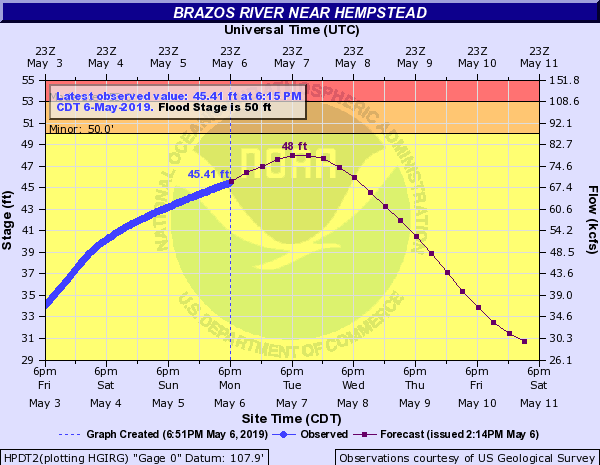
Flood wave is passing Bryan and heading for Hempstead. Minor flooding is forecasted for Richmond and moderate flooding at Rosharon. These three charts tell the story.
Brazos River at Hempstead:
Brazos River at Richmond:
Brazos River at Rosharon:
Unlike street flooding which is fast and local, river flooding is delayed and regional. As you can see from these charts, it can take days for upstream rains to create downstream floods.
Please Help
Rains later this week could be intense. Some forecasters are predicting up to 10 inches. Make sure the storm drains on your street are clear. If you can’t remove accumulated debris yourself, please call 3-1-1. The last thing we need is for all the downed tree branches, twigs, and leaf litter from last week to clog drains with 10 more inches on the way.
Posted by Bob Rehak on 5/6/2019
615 Days since Hurricane Harvey
https://i0.wp.com/reduceflooding.com/wp-content/uploads/2019/05/Screen-Shot-2019-05-06-at-7.25.15-PM.png?fit=2330%2C1132&ssl=111322330adminadmin2019-05-06 20:05:002019-05-06 20:05:26Pre-Storm Lake- and River-Level Report
After receiving 727 public comments, Kingwood Marina developer, Romerica Investments, LLC, asked Corps regulators on April 24, to “temporarily suspend an Individual Permit Application (SWG-2016-00384).”
Romercia’s environmental consultants said in a letter to Corps regulators, they made the request based on the large volume of comments provided by the U.S. Army Corps of Engineers (USACE) on March 28.
The request acknowledged, “It will take several months to conduct the surveys and studies needed to respond fully to these comments.”
Interview withCorps’ Chief of Evaluation Branch
Last week, I spoke with Janet Botello, Chief of the Evaluation Branch of the U.S. Army Corps of Engineers/Galveston District. We talked about what comes next for Romerica after its permit application for the proposed high-rise development in Kingwood was withdrawn by the Corps. Bottom line: if they reapply, we would likely have another public comment period.
In this satellite image taken on 2/23/19, you can see the West Fork San Jacinto at the bottom, River Grove Park at the left, Kingwood Country Club on the right and the Barrington at the top. Romerica hopes to build multiple 25-50 high rises between the little lake in the center and the golf course fairways below the Barrington.
Difference: Suspension vs. Withdrawal
Rehak: “Romerica requested a suspension of their permit application. The Army Corps withdrew it. What’s the difference? Is there any legal significance?”
Botello: “The correct wording in this case is “withdrawal.” There IS a legal difference. There is a provision within our regulations for suspending a permit. But that only occurs when a permit has actually been issued. In this case, the permit was not issued; there was only an application. We never made a final decision. So the pending application was withdrawn.”
Another Public Comment Period Likely
Rehak: “If they reapply, would there be another public comment period during the evaluation of new application?”
Botello: “I am comfortable in saying that there probably will be another public comment period based on the number of public interest factors and concerns that were raised and potential changes that could occur. But we won’t know for sure until we get the revised packet of information.”
Rehak: “How frequently does this happen?”
Botello: “It’s common. If a significant number of comments are raised during the public comment period and applicants aren’t prepared to address them within 30 days, we withdraw it. Then they go back and try to answer the concerns that were raised or revise their plans. Conversely, if they can answer and fully address concerns within 30 days, we keep evaluating the permit and we go ahead with the next step. If not, we withdraw it and give them time on their own to address the public concerns.”
Next Steps If Romerica Reapplies
Rehak: “What will be the next steps if Romerica reapplies?”
Botello: “First, we will evaluate the new submittal internally for a review of the Corps’ concerns. Then we will draft a public notice for public review – to gather public concerns. Then typically, we gather up the comments and concerns raised after that 30-day period, and forward them again to the applicant. They will have to respond within 30 days and then we will gather their responses and determine what steps are appropriate.”
Where We Are At
Romerica has not returned phone calls to discuss their intentions. If other agencies had concerns as serious as the TCEQ’s, this project could die quietly. If Romerica reapplies, which they have said they will do, the developer will likely have to significantly revise plans, and start over with a lengthy permitting process including a new public comment period.
Posted by Bob Rehak on 5/6/2019
615 Days since Hurricane Harvey
https://i0.wp.com/reduceflooding.com/wp-content/uploads/2019/05/HighRiseHell.jpg?fit=1500%2C936&ssl=19361500adminadmin2019-05-06 16:40:492019-05-06 16:41:17Interview with Corps’ Chief of Evaluation: What’s Next for Romerica?
Note: I have created several posts about SB 2126, a bill proposed by Senator Brandon Creighton. While I support the Senator’s efforts and objectives, I feel the bill’s language could open the door to river mining. Senator Creighton disagrees and offers following.
After Harvey, fresh sand deposits several feet thick lined both shores of the west fork of the San Jacinto. The issue: What’s the best way to keep sand from migrating downriver where it can accumulate and contribute to flooding?
To the Editor
First off, I would like to thank Mr. Rehak and ReduceFlooding.com for being a leader in our communities on all aspects of flooding. Your efforts represent the sort of grassroots organizations that impact government and the community. Reduceflooding.com also serves as a useful resource for residents to educate themselves on flooding, policy initiatives and upcoming events.
Background
Since Harvey made landfall, we have worked tirelessly with one another to do what is best for the Lake Houston area. We have been on tours together with statewide officials and we have been in dozens of roundtables in Austin and in Kingwood. These meetings included state agencies such as the GLO and TCEQ, local representatives like Council Member Dave Martin, myself and Representative Dan Huberty, Commissioner Cagle, Congressional members such as Ted Poe and Dan Crenshaw, and most importantly, members of the community. Our meetings resulted in helpful policy recommendations on what needed to be done back then, and a vision for the long-term. And now, the long-term is here and we must act this session.
The Bigger Picture
One of the biggest actions taken thus far was the Senate’s passage of hurricane preparedness and response packages, S.B. 6, S.B. 7, and S.B. 8. My bill, Senate Bill 7, creates the Texas Infrastructure Resiliency Fund, a new fund that will provide unprecedented state funding to cover the nonfederal, local match resulting from Hurricane Harvey as well as provide funding for future mitigation projects that will include upgrading the water gates on the Lake Houston Dam. The state playing the nonfederal role will bring billions of your tax dollars back to Texas from D.C. and will finally result in the feds helping Texas as we have stepped up to assist other states time and again.
Aggregate Related Proposals
We also filed bills to increase the enforcement of sand mining along the San Jacinto River basin. Senate Bills 2123, 2124, and 2125 were discussed in our roundtable meetings and were generally supported. These bills increase penalties, direct funds to enforce penalties for illegal sand mining, increase the frequency of mandatory sand inspections from every three years to every two, and creates a best practices guide for aggregate producers to follow.
Where SB 2126 Fits In
Senate Bill 2126 was the next step. This bill passed the entire Senate this week and heads to the House of Representatives. This approach was one of the many discussed at these roundtables and I appreciate you acknowledging the good intentions of this bill. I hear your concerns, and I respect your point of view, however I believe this program will yield many benefits for the community.
How Safeguards Would Be Implemented
I want it to be clear, this bill will not open up unbridled sand mining in the San Jacinto River basin, and there are many precautions in place to ensure the river basin is protected. Rather than prescribing arbitrary guidelines in the bill, we will depend on the San Jacinto River Authority and Harris County flood control district expertise to formally and publicly adopt rules, controls, best practices and other safeguards.
Alternative to Repetitive Dredging
This solution is an outside-the-box approach to a problem identified by the U.S. Army Corps of Engineers. While we have worked hard to expedite and fund the current dredging project underway in the River, it is inefficient and impractical to come back every 10 years to dredge in the River. There must be a long-term solution, and I think this legislation can play a role.
Oversight Authority
SB 2126 will allow the San Jacinto River Authority and the Harris County Flood Control District to place traps in the River. These are stationary traps that will capture sand that naturally deposits in undesirable locations. This does not allow for sand mining to continuously occur in the River or on the banks. We are delegating this authority to these public entities because they are accountable to you. They are entrusted with carrying out many other important duties to protect the resources of all Texans and this is one more way for them to play that role.
Offsetting Costs Through Sale of Sand
Kaaren Cambio, a newly appointed SJRA board member from Kingwood recently said, “A long term maintenance plan for the San Jacinto River is key to protecting the adjacent communities. We must have many options available to make this plan effective and financially feasible. Public-private partnerships are critical to achieving this goal. SB 2126 gives the SJRA the opportunity to have specific areas dredged and the cost of the dredging is offset by the sale of the sand.”
Council Member Martin’s Endorsement
Houston City Council Member Dave Martin, who has been an invaluable voice as we address flood mitigation expressed the following sentiment, “Senate Bill 2126 is a key legislation item that will allow aggregate production operators to be part of the sand remediation solution by giving them the ability to introduce sand traps into the West Fork of San Jacinto River. The ability to use sand traps on the West Fork will allow for sediment to fall out of an otherwise sediment rich body of water, thus reducing sediment deposits downstream which can clog up the river and lake. As the Houston Council Member who represents Lake Houston, this bill will help our area avoid additional mouth/sand bars and sediment buildup. I hope this piece of legislation serves as a pilot study the rest of the State can learn from.”
Support of Game Wardens
You noted that Texas Parks and Wildlife testified as a resource for the bill. State agencies remain neutral on legislation because they are agents of the State, but the Texas Game Wardens Peace Officers Association did support the bill at the hearing. They recognize the problem we have and how SB 2126 can be a practical solution.
Plea to Continue Working Together
Recent floods, and especially Hurricane Harvey exposed serious weaknesses, and I hope that this bill and other components of our legislative flood solution package will serve as effective solutions for Kingwood, Lake Houston and surrounding areas. If we identify any problems down the road, I hope that you will be a partner and advocate for getting projects back on track. I know we will continue to work together to ensure the best mitigation efforts are followed.
Again, I am so appreciative of the work you and all the community leaders have done to make the Lake Houston area a better place to work, live, and raise a family. I look forward to our continued collaboration to achieve that goal. Please feel free to reach out to me and my staff if we can ever be of assistance. We have made some incredible progress – see my newsletter here – and hopefully these policy initiatives will pass during the legislative session and improve our readiness for future storms ahead.
(Signed) Senator Brandon Creighton State Senator District 4
Senator Creighton’s letter posted by Bob Rehak on 5/6/19
616 Days since Hurricane Harvey
https://i0.wp.com/reduceflooding.com/wp-content/uploads/2018/03/Harvey-SanJac_8-e1557107349254.jpg?fit=1500%2C1000&ssl=110001500adminadmin2019-05-05 20:57:302019-05-06 19:09:54Senator Creighton Responds to Concerns About SB 2126
Kingwood, Harris: Straight line winds of 65-70mph produced a swath of damage across a portion of Kingwood including damage to some roofs as well as trees and power lines.
Woodland Hills between River Grove Park and Romerica Property. Brief rainfall on 5/3/19 exceeded capacity of drainage ditches and culverts, forcing part of the water to divert down greenbelt trail toward wetlands in River Grove Park. Video courtesy of Mohamad-Khaled Chaouki Jrab.
Lake Houston, Harris: public video of waterspout over Lake Houston just north of the FM 1960 bridge and near the eastern shore of Lake Houston
Storm Report for Surrounding Areas
LaGrange, Fayette: Tornado ***EF-2** * 120mph winds. 2.48 miles long and 75 yards wide.
Tornado began south of the airport where heavy tree damage occurred and then approached HWY 71 where heavy damage occurred to a business where vehicles were overturned. A 90,000 pound piece of machinery was shifted and overturned…rated EF 2 at this location. The tornado continued north and crossed HWY 71 destroying a metal building and heavily damaging a church. The tornado dissipated just south of the Colorado River.
Eagle Lake, Colorado: Tornado ***EF-0*** 65-85mph. Spotter, fire department, and emergency management officials reported and recorded on video a couple of weak tornado touchdown in open rural farm land SW and S of Eagle Lake. Damage was confined to trees over open land.
4SW Monaville, Waller: wind damage to trees….possible tornado. Public cell phone video near the time of the report and radar data showing a velocity couplet supports a brief and weak tornado touchdown. This was the start of the supercell cell that would produce wind damage across N Harris County and another tornado near Tomball.
Tomball, Harris: Tornado ***EF-0*** 65-85mph. Trained storm spotter recorded a large funnel cloud west of Tomball that appeared to have at least one portion of the funnel reach the ground. Wind damage occurred near FM 2920 and Telge Rd, which was near the video of the funnel cloud. Additional wind damage occurred north of FM 2920 and north of Tomball along Hufsmith Rd.
Spring, Harris: wind damage including a large pine tree onto a house.
Matagorda, Matagorda: 46mph wind gust recorded by Weatherflow site
Santa Fe, Galveston: roof and damage to a home on Gamble Rd from straight line winds
San Leon, Galveston: 62mph wind gust recorded by Eagle Point PORTS site
Galveston, Galveston: 45mph wind recorded near Fort Crockett
Posted by Bob Rehak on May 5, 2019
614 Days after Hurricane Harvey
https://i0.wp.com/reduceflooding.com/wp-content/uploads/2019/05/Screen-Shot-2019-05-05-at-5.38.49-PM-copy.jpg?fit=1500%2C798&ssl=17981500adminadmin2019-05-05 17:42:042019-05-05 17:42:29Harris County Flood Control Issues Storm Report for Last Friday, Saturday: Here’s What Hit Us
Keep your eye on the sky for more severe-weather threats this week. Harris County Flood Control Meteorologist Jeff Linder warns that the coming week could bring us 5-7 inches of rain, and higher totals in places. He says the upper level trough setting up over the southwestern US will send us one storm after another. Linder compared the current pattern to those in the springs of 2015 and 2016. We saw multiple floods across Texas in both of those years.
Rainfall total forecast for May 5 through 12.
Monday Night/Tuesday: Saturating Soils
A strong disturbance will move into southeast Texas on Monday night and Tuesday with widespread showers and thunderstorms. Heavy rainfall of 1-2 inches with higher isolated totals will be possible along with a slight severe weather threat. Lindner thinks “most of the area will be able to handle this round of rainfall as long as there is no sustained cell training that develops and the overall forward progression of the system remains fast enough to prevent rainfall totals from piling up.” What this system will likely accomplish is further saturation of the soil over the area. Lindner calls it a “primer” event for more sustained heavy rainfall toward the end of the week.
Thursday-Saturday: Flood, Severe Weather Threats
Another strong storm system will approach toward the end of the week along with a slow moving and stalling surface frontal boundary. An extremely moist air mass along with the overall slow eastward progression of the storm system moving out of Mexico are significant heavy-rainfall signals during this period. Lindner expects several inches as several rounds of slow-moving thunderstorms impact the region. Flooding and severe weather will be possible during this period.
Rainfall Totals and Flood Risk
Rainfall totals over the next 5 days should average 4-5 inches over much of southeast Texas and there will almost certainly be higher isolated totals. The widespread nature of the incoming weather this week on top of increasingly saturated grounds, and already swollen rivers, creek, and bayous increases the flooding threat. Main concern will be the Brazos, Trinity, and San Jacinto River basins and toward the end of the week the Harris County bayous and creeks if the current forecast holds.
Exact timing of the rainfall and storms as well as amounts and locations of the higher totals will be in flux over the next 5 days.
The Tax and Memorial Day Floods in 2015 and 2016 did as much damage as many hurricanes. So it would be good to prepare an evacuation kit, just in case. Here are some tips.
https://i0.wp.com/reduceflooding.com/wp-content/uploads/2019/05/image001-1.gif?fit=750%2C562&ssl=1562750adminadmin2019-05-05 15:53:362019-05-05 16:15:56Severe Weather, Heavy Rainfall Threats Return for Much of This Week
Storms during the last two days were traumatic for virtually everyone in the Kingwood area. Tragically, one person lost her life when her car hit a downed tree.
Others lost vehicles, trees, and sleep.
Torrential rains for a brief period – at the rate of 4-5 inches in an hour – flooded streets and vehicles.
They also brought water near or into homes.
Parents picking children up from school waited in rising waters as their students sheltered in place.
A small tornado may have briefly touched down near Town Center.
Kingwood Drive was shut down for hours during the Friday afternoon rush hour.
People traumatized by Harvey were re-traumatized.
People without power waited and wondered for hours about what was going on around them.
Lake Conroe: One Less Worry This Time
Despite all that, we did NOT have to worry about one thing: Lake Conroe opening its flood gates again during this storm. The seasonal lowering policy established last year worked.
The SJRA board voted to lower the lake’s level one foot to 200 mean feet above sea level (MSL) from April 1 to May 31.
That action may have saved the Lake Houston area from additional flooding in the last round of storms.
Releasing Water Continuously At Low Rate Created Extra Capacity
Lake Conroe had released water continuously since April 1 at a slow, controlled rate of 350 to 550 cubic feet per second. However, because of spring rains, Lake Conroe had only dropped about a half foot from 201 to 200.66 feet MSL. Had the releases not happened, the lake would have been an estimated 1-1.5 feet higher, according to Mark Micheletti, an SJRA board member from Kingwood. That means the lake level would have been approaching 202 feet, the level at which the SJRA automatically begins releasing water, when the storm hit. That would have forced the SJRA to release water at a higher rate that could have overloaded the downstream watershed.
Buffer Against Downstream Flooding Worked
In other words, the policy worked. The seasonal lowering provided a buffer against downstream flooding. NOAA shows a double crest on the San Jacinto West Fork at US59 during the last two days that coincided with two waves of storms. At peak flow, the river came within about two feet of going out of its banks.
An additional foot of water released from Lake Conroe would have added two feet to Lake Houston and created flooding.
About a mile downstream at River Grove Park, the water was up, but still within its banks.
Despite torrential rains last night and early this morning, the West Fork remained in its banks. The river was up, but no homes flooded from the river.
Success: No Rivers or Streams Out of Banks
At this hour, neither NOAA, the SJRA, nor Harris County Flood Control, predicts any flooding from yesterday’s storms. In fact, all streams and bayous seem to be receding at this time. That’s one less thing to worry about as we clean up from the latest storm. The SJRA’s seasonal lowering DID help.
Remember, Lake Conroe is almost twice as big as Lake Houston (33 sq. mi. vs 18.5 sq. mi.). So one foot released there translates into almost two feet here. And two feet would likely have forced the San Jacinto out of its banks for the fifth time in a year.
Kudos to the SJRA board, the City of Houston, and the TCEQ for enabling this policy. That, in conjunction with the City’s pre-release policy for Lake Houston, have made a difference.
Posted by Bob Rehak on 5/5/2019
614 Days since Hurricane Harvey
https://i0.wp.com/reduceflooding.com/wp-content/uploads/2019/05/hmmt2_hg-1.png?fit=600%2C465&ssl=1465600adminadmin2019-05-04 22:51:322020-01-17 08:59:15One Less Thing to Worry About in Latest Storm: How Seasonal Lowering of Lake Conroe Helped
During Harvey, most of the damage in Kingwood happened from river flooding. Yesterday, it happened from street flooding. What are the respective causes? Differences? Fixes?
River Grove Park the morning after the street flooding during the previous day and night. The river was still well within its banks and is not predicted to come out.
River Flooding Overview
River flooding happens when heavy rainfall exceeds the conveyance capacity of a river. In other words, the river comes up and out of its banks. This happened to the San Jacinto during Harvey. The river, normally a couple hundred feet wide, became three to four miles wide, inundating miles from the main current.
River flooding can be caused by heavy rain, upstream snow melt, dam/levee breaks, dam releases, and more. Most commonly, it takes hours to days for water to work its way through a river system and affect people downstream.
River Flooding Remedies
Fixes for river flooding include things like:
Building dams upstream to reduce the flow downstream.
Increasing the conveyance of the river through widening, deepening or dredging
Removing blockages such as the mouth bar on the West Fork of the San Jacinto
Increasing the outflow capacity, for instance by adding gates to dam
Building levees
Diverting water to tunnels.
Street Flooding Overview
Street flooding, on the other hand, is often much more local and happens over shorter periods of time. It is often referred to as flash flooding because it comes up quickly and goes down quickly. That’s what the Lake Houston Area experienced yesterday. The San Jacinto, its tributaries and drainage ditches were and still are well within their banks.
Flash flooding occurs when the rainfall RATE temporarily exceeds the drainage capacity of storm drains, sewers, swales, and ditches that lead to rivers.
Yesterday, we received 1/20th the amount of rainfall that we did during Harvey, but many people reported the water coming up higher. That’s because storm sewers could not handle the intense rainfall that happened during approximately a one hour period.
Drains on Valley Manor could not handle the sudden surge.
Streets Designed as Part of Flood Retention System
The streets in Kingwood (and most cities) are actually designed to be part of the flood retention system. When developers excavate streets, they often use the fill to build up homesites. By increasing the elevation difference between street level and your foundation, they reduce the chances that you will flood.
They size the sewers so as not to make drainage ditches overflow. Rainfall rates like we experienced yesterday don’t happen for very long. The storm passes. The water in the street goes down and life returns to normal. You just don’t want to be caught out on the road in your car when it happens. Nor do you want to have your car parked on the street!
Street Flooding Remedies
The Greater Houston Flood Mitigation Consortiums’ report on Harvey contains an extensive discussion of the different types of flooding. Their discussion of street flooding starts on page 14. Page 15 identifies solutions, including:
Communicate the role of streets in the drainage system. Many residents may not be aware that roads are intended to act as a secondary short-term storage system and/or conveyance pathway for water. This can lead to severe property damage and loss of life when residents do not move property out of harm’s way. For example, recent street flooding has caused severe flooding of cars, which are frequently parked in the street. It is also important to note that 12 inches of water can float a sedan and 18-24 inches can float a larger vehicle, creating hazardous road conditions during extreme events. It is critical to develop a strategy to communicate to the public that streets are designed to be a secondary short-term storage system so that people can take action to prevent loss of property and life.
Address debris in streets and waterways. Maintaining clear openings to storm sewer inlets is a great way to help reduce street flooding. Flooding in many neighborhoods can be made worse by debris and floating trashcans that clog inlets. Additional city, county and MUD maintenance, or organized community efforts may be required.
Ensure that developers have sufficient “upstream” information. Land development engineers typically focus on mitigating the runoff generated by their development project, and as such, flows entering onto their site from other sources may not be considered in their design analysis. Examining strategies to share information about upstream conditions with developers during the design analysis phase could help maximize site-based mitigation.
Maximize on-site retention. Green infrastructure may provide a viable alternative for managing stormwater and reducing nuisance flooding through implementing on-site retention or by providing additional in-line storage capacity within the street (examples include Cottage Grove and Bagby Street).
Identify & target high-risk areas. Determining the neighborhoods most vulnerable to flooding from local drainage challenges would be a pivotal step to targeting public education and mitigation strategies.
For More Information
The flooding yesterday happened so quickly that it scared people. For many, it brought back vividly the trauma of Harvey and the pain that followed. One person even died when her car ran into a downed tree that fell across Kingwood Drive.
The most damage happened, not to homes, but to vehicles caught in high water on flooded streets – streets DESIGNED to hold water. There’s a simple answer to that. Unfortunately many people did not get the warnings that could have kept them off the streets.
For more information on different types of flooding, see the first part of this FloodWarn Training Seminar that Katie Landry-Guyton of the National Weather Service presented last year at Kingwood College.
Posted by Bob Rehak on 5/4/19
613 Days since Hurricane Harvey
https://i0.wp.com/reduceflooding.com/wp-content/uploads/2019/05/5.3.19-rain.jpg?fit=1500%2C2000&ssl=120001500adminadmin2019-05-04 12:23:012019-05-04 12:23:24Street Flooding vs. River Flooding
A strong line of thunderstorms with high winds, torrential rains and possible tornadoes swept through the Lake Houston area this afternoon. It left widespread power outages, snarled traffic, flooded streets, and swollen creeks and ditches. People still suffering PTSD from Harvey were re-traumatized by the sound of news helicopters and water creeping up their front steps. More heavy rains tonight will add to the area’s woes, even as people are still cleaning up from this afternoon’s flooding.
Examples of Damage Reported
Among the damage reported:
Several flooded homes in Bear Branch and Woodland Hills near creeks or ditches
Flooded locker rooms at Kingwood High School
Trees down and blocking Kingwood Drive at rush hour
Power lines down on Kingwood Drive
Knee-high water on Kingwood Drive at Town Center
Kingwood Drive traffic rerouted up Valley Manor
New pad sites for the retail expansion of the HEB center under water
Street flooding from one end of Kingwood to the other
Streets Designed as Part of Flood Retention System
Note: the streets in Kingwood are DESIGNED as part of the flood retention system. When rainfall rates exceed what creeks, ditches and bayous can handle, water backs up into streets. and drainage swales.
The amount of rain we received today was not great. But the intensity was off the charts. In about a half hour at my house, we received almost two inches. That’s between 3 and 4 inches per hour. Here’s an example: the swale beside my house.
Valley Manor just north of Kingwood Drive at 4PM on 5.3.19. Two neighbors across the street reports water on their front steps. One said water started to come through her front door. The family is still repairing from Harvey. Her entire family is traumatized.This is the ditch adjacent to the retail expansion of the H-E-B center. Photo courtesy of Mark Micheletti.Kingwood Drive west of Town Center. Photo courtesy of Clay Crawford.Kingwood Drive at Town Center.Photo courtesy of Clay Crawford.I heard that the entrance to Fosters Mill was also under water.Video of street in Riverchase by John Knoerzer.
Rainfall Totals for Friday Storm
Rainfall totals for last 24 hours as of 10PM 5.3.19. Note higher totals upstream from Lake Houston area.
River Report: Minor Flooding Possible on West Fork
Harris County Flood Warning System’s Real Time Inundation Mapping shows most streams within their banks. But note the warning for Humble at US59. While the river is 2 feet below the top of bank as of 10PM, it could easily go out of bank tonight.
More Storms on Way
As of 9PM a severe thunderstorm watch is still in effect for much of southeast Texas until 3PM Saturday..A large line of strong to severe thunderstorms has developed from E of Austin to NW of San Antonio and is moving ESE/SE at 15-20mph. Expect an average 1-2 inches with the line passage. Isolated total up to 3 inches be common. Creeks and bayous should be able to handle that amount of rainfall, according to Jeff Lindner of Harris County Flood Control.
NOAA forecast clearly shows the line of strong thunderstorms that should hit us overnight.
Here is an updated radar image as of 12:01 AM Saturday morning.
Image courtesy of RadarScope, an amazing app!
Expect minor flooding at 59 and River Grove Park, that could be exacerbated by the mouth bar and other sediment still in the river.
This does not account for any local effects to the mouth bar.
Hoping you stay dry!
Posted by Bob Rehak on 5/3/19 around midnight
613 Days since Hurricane Harvey
https://i0.wp.com/reduceflooding.com/wp-content/uploads/2019/05/KWD-TC.jpg?fit=1500%2C1125&ssl=111251500adminadmin2019-05-03 23:19:552019-05-04 00:47:07Overnight Rains Could Add to This Afternoon’s Woes