After a year of dredging, the Army Corps and its contractors are gone. Even though they didn’t get all of the West Fork Mouth Bar, they made dramatic conveyance improvements on the West Fork as these before/after photos show.
Sand Island Before Dredging
The first was a blockage that dredging contractors nicknamed “Sand Island.” It sat in the middle of the river just downstream from River Grove Park in Kingwood. According to the Corps, it blocked 90% of the river.
Sand Island formed during Hurricane Harvey. Boats that drew 18 inches of water could not navigate upstream past this giant sandbar.Photo taken 9/14/2019.
Sand Island After Dredging
Sand Island is now Gone Island.Photo taken 12/3/2019.
The Corps removed approximately 15 feet of sand over a 15 acre area that was 566.7 feet wide at its widest point. An acre is about the size of a football field. So this would be like stacking sand on a football field 225 feet high (15×15)! And that doesn’t even include the sand they removed from the channels on either side of the island in the background.
Sand Island Dredging Profile.
Diversion Ditch Bar Before Dredging
A second huge sand bar deposited by Harvey blocked the Kingwood Diversion Ditch, also at River Grove Park. The Diversion Ditch empties the western third of Kingwood. Approximately 600 homes flooded above this one blockage. They were in Barrington, Kingwood Cove, Trailwood, Kingwood Lakes and Kings Forest.
Diversion Ditch (center left) was virtually closed off by a new sandbar deposited by Harvey.Photo taken 9/14/2017.
Army Corps measurements show that at its highest point this bar measured 10 feet about the water surface. It forced water coming out of the ditch to make a 90 degree left turn where it then hit another downstream blockage.
Diversion Ditch Bar After Dredging
Photo taken 10/2/2019 after dredging opened up the channel and reduced the downstream bar.Photo of same area taken on 11/4/2019, but looking upstream.
The Corps dredged a channel 150 feet wide through this bar to a depth of 35 feet above sea level. That’s about 7.5 feet below the normal water surface elevation of the Lake. The channel narrowed to 50 feet wide where it meets the mouth of the ditch.
From the highest point on the bar to the target depth, the Corps removed 17.5 vertical feet of sand. From the mouth of the channel to the outer edge of the bar measured 750 feet.
Comparison in Satellite Images from Google Earth
Here’s how this section of the river looked from a satellite BEFORE dredging. The numbers refer to the discussions above.
Here’s how it looked AFTER. (Note this image was taken on 2/23/19 and the dredge was still removing sand island.
Altogether, the Corps removed approximately 2.3 million cubic yards of sediment. Even if the Corps didn’t finish the mouth bar, that’s a lot to be grateful for. Thank you, FEMA, Army Corps, Great Lakes Dredge and Dock and Callan Marine.
Have a merry Christmas!
Posted by Bob Rehak on 12/24/2019
847 Days after Hurricane Harvey
https://i0.wp.com/reduceflooding.com/wp-content/uploads/2019/12/BeforeAfter.jpg?fit=1200%2C1600&ssl=116001200adminadmin2019-12-24 11:44:182019-12-24 12:10:24San Jacinto West Fork Before-After Photos Show Dramatic Conveyance Improvements from Dredging
Just in time for Christmas, East End Park is back and beautifully restored. KSA has resurfaced the entire trail network with crushed granite; repaired the boardwalks; repainted or power-washed the benches and picnic tables; restored the parking lot; and improved the entry.
Contractors mowed the meadows earlier in the fall and the tall grass has returned with a bumper crop of seed. The seed has attracted wintering birds. And deer abound…especially early and late in the day.
The park has not looked this good since KSA built out the trail network a decade ago (see poster below).
I walked for an hour and a half there this afternoon. It felt serene, tranquil, and rejuvenating. The low winter sun wrapped colorful leaves in golden sunlight. At one point, I met a father pulling his daughter in a wagon. They had stopped to watch a doe grazing in the woods. It all felt…so…perfect.
Father and daughter spotted a doe grazing in the woods at East End Park.Photo taken today.
Back from the Brink
Three major storms destroyed East End Park three times in rapid succession. Hurricane Harvey, the May floods this year, and then Tropical Storm Imelda each took a heavy toll. Harvey buried Eagle Point under 15 feet of sand. And Imelda added even more, but over a much wider area.
Because of repeated and costly damage to Eagle Point and the difficulty of building trails over loose sand, KSA intends to leave that trail natural for now. KSA may consider building an alternative trail on higher ground next year. If you venture into that part of the park, heed the warning signs. And above all, stay back from the shoreline. Imelda undercut it badly. Cave-ins have happened at several points. Imelda also severed a small portion of the Overlook Trail where 50 feet of the shoreline eroded overnight. Walk-arounds exist in both cases.
The Most Beautiful Part of the Most Beautiful Part of Houston
Bring the family out for a walk on Christmas Eve or Christmas Day. In my humble opinion, East End Park is the most beautiful part of the most beautiful part of Houston – Kingwood. It’s hard to believe that a natural area this beautiful could exist inside the nation’s fourth largest city. But it does. Make it a part of your family’s holidays.
KSA has restored East End Park trails and boardwalks to their pre-Harvey, pre-May 7th, pre-Imelda state. Nature is restoring the rest.
Posted by Bob Rehak on December 24, 2019 with thanks to Dee Price, Chris Manthei, Mary Ann Fortson, KAM, Ira Guel, Bruce Casto and the entire KSA Parks Committee for their tireless support
847 Days since Hurricane Harvey and 96 since Imelda
https://i0.wp.com/reduceflooding.com/wp-content/uploads/2019/12/Father-Daughter-Wagon-EEP-copy.jpg?fit=1200%2C871&ssl=18711200adminadmin2019-12-23 20:36:592019-12-23 20:45:07KSA’s Christmas Present to Kingwood: A Beautifully Restored East End Park
In the last legislative session, State Representative Dan Huberty sponsored an amendment to Senate Bill 500. The amendment earmarked a $30 million grant for additional dredging at the confluence of the San Jacinto River and Lake Houston. Last week, Harris County approved the grant application to the Texas Water Development Board. That will actually transfer the money so that it can be put to work.
How $30 Million Grant Would Be Spent
County Engineer John Blount explains how the money would be spent in his cover letter that accompanied the request to Commissioners.
“The approach to completing work under the grant,” says Blount, “would be for the County to receive the grant funds, make the City of Houston a subrecipient to start immediate dredging, and to develop a long-term plan for keeping the region’s raw water supply viable with adequate reservoir capacity. The County would be reimbursed from the grant for administrative and other related expenses incurred.”
County Plays Central Role In Coordinating Effort
Blount concludes, “If authorized, the County will work with the Flood Control District, Budget Office, County Attorney, City of Houston, and the State of Texas, to advance all necessary applications and agreements needed to initiate the dredging activities funded in the 2019 legislative session. Grant awards, if made, will be presented to Commissioners Court for consideration at a future date.”
Commissioners Court approved the motion unanimously in its Tuesday, December 17th meeting. And by Friday, the actual grant application had been sent to the TWDB, according to Matt Zeve, Deputy Executive Director of Harris County Flood Control. The TWDB board should consider the request at its first board meeting in January, tentatively scheduled for the 10th. Huberty expects quick approval because the Legislature earmarked the money specifically for this purpose.
As a result of sediment deposited during Harvey and Imelda, the East Fork Mouth Bar grew southward 4000 feet and now has almost reached the point where Luce Bayou and water from the Trinity River will enter Lake Houston.Photo taken 12/3/2019. Water flows from left to right.
West Fork Also Plays Role in Water Transfer
That’s also why the West Fork must remain clear. It brings water, when needed, from Lake Conroe.
Looking south across the mouth bar of the San Jacinto West Fork toward Lake Houston. Photo taken 12/3/2019.Reverse angle. Looking northwest toward the San Jacinto River and the West Lake Houston Parkway Bridge. Note the submerged sand about to break through the water surface around the mouth bar.Photo taken 12/3/2019.Kayaker RD Kissling standing in less-than-knee-deep water 700 yards south of the West Fork Mouth Bar.Photo taken November, 2019.
Like icebergs, sand bars mostly exist below the surface. What you see above water is a small percentage of what exists below water.
These photos illustrate why more dredging is essential. The mouth bars form dams behind the dam that block the free flow of water and decrease reservoir capacity.
Exploring Most Cost-Effective Options for Future
Between June when the Legislature approved the money and now, the City, County and State have explored ways to work together to ensure they spend the money cost-effectively. The county hired a consultant to explore the merits of do-it-yourself dredging vs. hiring a contractor. At the moment, the partners lean toward the contractor approach. It offers long-term flexibility as they explore future needs around the lake.
In addition to the $30 million from the State, the City of Houston allocated $6 million from money left over from Harvey disaster recovery funds. The County also allocated $10 million in its flood bond for dredging.
Initial Disposal Site Already Approved
The Army Corps approved Barry Madden’s property as a disposal site for the spoils. Madden’s property is opposite River Grove Park. That puts it miles closer to the Mouth Bar than previous placement areas used by the Corps. That should reduce costs by reducing the need for booster pumps and fuel.
The pieces of the puzzle are starting to come together.
Posted by Bob Rehak on 12/23/2019
846 Days since Hurricane Harvey and 95 since Imelda
https://i0.wp.com/reduceflooding.com/wp-content/uploads/2019/12/East-Fork-Mouth-Bar-at-Luce.jpg?fit=1200%2C800&ssl=18001200adminadmin2019-12-23 13:24:352019-12-23 13:24:52Harris County Approves TWDB $30 Million Grant Application for Dredging at Confluence of San Jacinto and Lake Houston
If you boat between the San Jacinto East Fork and Lake Houston, perhaps you’ve noticed it’s a little harder getting from A to B lately. The San Jacinto East Fork Mouth Bar has grown approximately four fifths of a mile during the last two storms and the channel depth has decreased 6X.
These three pictures tell the story dramatically.
I took the first after Hurricane Harvey and the second after Tropical Storm Imelda. The third comes from Google Earth BEFORE Harvey.
East Fork Mouth Bar After Harvey
Looking north toward Kings Point from the East Fork of the San Jacinto River after Harvey. Note fresh sand several feet deep everywhere. Photo taken 9/14/2017, two weeks after Harvey.
East Fork Mouth Bar After Imelda
Extent of East Fork Mouth Bar After Imelda. Photo taken 12/3/2019.Note in this photo how much closer the sandy bottom is to the surface throughout the entire area.
Pre-Harvey to Post-Imelda Growth
Satellite image from January 2017 BEFORE Harvey. Yellow line represents approximate growth in East Fork Mouth bar between then and today – about four fifths of a mile.For alignment purposes, note the tip of the Royal Shores Lake in the first aerial photo and Royal Shores in the second.
Boater Josh Alberson says the maximum channel depth in this area decreased from 18 feet after Harvey to 3 feet after Imelda.
Geologic Change on a Human Time Scale
Note how the leading edge of this growing bar is now almost even with the entrance to Luce Bayou. When we get another storm like Imelda, the East Fork Mouth Bar could block the Interbasin Transfer Project from delivering water to Lake Houston.
Changes like these usually happen on a geologic time scale. They happen so slowly, humans can barely perceive them during the course of a life time. However, Harvey and Imelda produced this change in two years. They provide us with a rare glimpse of a living planet in our own backyard.
If you have children, grandchildren or students, please share these photos with them. They make valuable life lessons about the power of moving water and respect for Mother Nature. They may also stimulate curiosity in Earth sciences and engineering.
Posted by Bob Rehak on 12/23/2019with depth soundings from Josh Alberson
846 Days since Hurricane Harvey and 95 since Imelda
https://i0.wp.com/reduceflooding.com/wp-content/uploads/2019/12/20191203-RJR_5829.jpg?fit=1200%2C800&ssl=18001200adminadmin2019-12-22 21:30:592019-12-23 08:11:42East Fork Mouth Bar Grows 4000 Feet During Harvey and Imelda
Instead of accelerating completion of detention ponds on Woodridge Village as Perry Homes promised, the company appears to have pulled all excavation equipment from the site. Contractors who were supposed to have been working on detention pond N-1 have gone…BEFORE they finished S2 and BEFORE they finished a berm sealing off the southern portion of the site at Fair Grove Drive.
Equipment Left Site Instead of Beginning On Next Pond
Perry Homes had promised in its letter to accelerate construction, but this will slow it down – if they ever return. The only work being done Friday? Removal of some dead tree piles on the northern portion of the site.
Jeff Miller took all the pictures and videos below on Friday and Saturday. He also monitored work on the site and provided this scouting report.
Looking south toward Taylor Gully and the Harris County Line along the eastern embankment of the S2 detention pond.The channel along the eastern portion of Taylor Gully is now lined with concrete. The spillway into the S2 detention pond has been widened and smoothed. The S2 detention pond is behind the camera position. Looking East.Looking west across S2 detention pond. The dirt that eroded into the pond has been scooped back up onto the banks and compacted.Still no grass on the banks, however, so it could all wash back in with the next big rain.Looking north. The grassy area in the background was supposed to have contained the N3 detention pond. However, contractors have simply excavated a channel from the northern section directly into Taylor Gully so now runoff can accumulate even more quickly.Contractors widened and concreted the Taylor Gully channel along the eastern side of Woodridge Village. But they left the most vulnerable part of the channel without concrete. At the end corner by the telephone poles, water comes from the left. But no concrete protects the area where the water makes a sharp 120 degree turn. Expect water to erode behind the concrete and peel it away in the next big rain.
Woodridge Village Section One Now a Virtual “Ghost Town”
This weekend, Woodridge Village Section One looked like a ghost town, not a bustling construction site with people working against a deadline.
Heavy construction equipment used to be parked by dumpster in the background. Now it’s nowhere on the property. Looking south. Another view of the same area that held construction equipment. It’s all gone and the berm sealing the site off from Fair Grove Drive is missing.
Still Removing Dead Trees/Mulch on Northern Section
On Friday, only smaller equipment turning tree piles into mulch remained.
Perry Homes Intentions Now a Mystery
As of Sunday morning 12/22/2019, no equipment actually working on construction could be seen on the site. The excavators and dump trucks parked at Fair Grove for months have been removed.
Perry Homes is NOT accelerating completion of detention ponds as it promised the City of Houston.
Instead, Perry Homes has thrown a curtain of silence around this job. It’s hard to know what their intentions are. At this point, Perry Homes’ lawyer J. Carey Gray has as much mud on his face as Elm Grove residents had in their homes.
The only thing we can say with certainty: Lowering flood risk for the people of Elm Grove does not seem high on Perry Homes’ priority list.
For Sale And For Lease Signs Serve as Christmas Yard Decorations
Meanwhile, a drive down Shady Maple or Village Springs, the two streets that border Taylor Gully, revealed residents’ attempts to salvage Christmas from the chaos of floodwaters. Dumpsters and debris still line the streets. Some people still live in trailers in their driveways. No apple cider around the hearth for them. They’ll be lucky to find space for a table top Christmas tree. For Sale and For Lease signs outnumber Christmas yard decorations ten to one.
On a street called Right Way in North Kingwood Forest, I found nine For Lease signs in a row. Sad reminders of Imelda and Perry Homes.Only three months ago, these homes were filled with families who flooded for the second time.
Kathy Perry Britton just added another credit to her resume, “The CEO Who Stole Christmas.”
Posted by Bob Rehak on 12/22/2019with reporting and images by Jeff Miller
845 Days since Hurricane Harvey and 94 since Imelda
The thoughts expressed in this post represent opinions on matters of public concern and safety. They are protected by the First Amendment of the US Constitution and the Anti-SLAPP Statute of the Great State of Texas.
https://i0.wp.com/reduceflooding.com/wp-content/uploads/2019/12/IMG_0679.jpg?fit=1200%2C900&ssl=19001200adminadmin2019-12-22 12:09:152019-12-22 12:58:38Perry Homes Pulls Excavation Equipment From Woodridge Village Before Finishing Detention Ponds
The attorney general has had production at the Triple PG mine on Caney Creek shut down and the breaches in the mine’s dikes closed since early November. Also, the Texas Concrete mine in Plum Grove on the East Fork closed. And the TCEQ is forcing them to fix breaches and replant exposed areas before abandoning the mine. It could just be a coincidence, but water clarity on the East Fork and Caney Creek have improved to a shocking degree with both of the major mines out of action. See below. Said Kingwood resident John Knoerzer, “This is the clearest I’ve ever seen the East Fork.”
Photo taken by John Knoerzer on East Fork at East End Park on 12/20/2019.
It’s not Cozumel, but it’s far better than the opaque brown liquid we had.
Return of Eagles
Resident Josh Alberson reports that he’s seen cormorants, pelicans and bald eagles return to the East Fork and Caney Creek. “They were feasting on the white bass.” Says Alberson, “Last Sunday, we saw more birds than we had every seen working. It was National Geographic worthy, but I couldn’t get close enough to get any quality pics or video.” He attributes all the birds to both the bass and the clarity of the water. “It helps the birds spot the prey,” he says.
Only problem: there’s so much sand in Caney Creek that it’s hard to boat upstream. Josh Alberson informs me that his jet boat got stuck on a giant sand bar immediately downstream from the Triple PG mine. Boats with propellers can’t get through at all, he says.
Please Help Document Wildlife and Water Clarity
It seems to me that this change, if it is permanent, is important to document. Any boaters or jet skiers who can make it upstream, please send pics through the submissions page on this web site.
Posted by Bob Rehak on 12/21/2019
844 Days after Hurricane Harvey and 93 since Imelda
The thoughts expressed in this post represent opinions on matters of public concern and safety. They are protected by the First Amendment of the US Constitution and the Anti-SLAPP Statute of the Great State of Texas.
https://i0.wp.com/reduceflooding.com/wp-content/uploads/2019/12/Clear-Water.jpg?fit=1200%2C900&ssl=19001200adminadmin2019-12-21 15:53:042019-12-22 07:49:16East Fork Water Shockingly Clear with Mines Closed
As we enter 2020, keep your eyes on these stories.
Elm Grove Lawsuits and Mitigation
In 2019, Elm Grove flooded twice with runoff from the Perry Homes/Woodridge Village development in Montgomery County. Hundreds of homeowners sued Perry Homes’ subsidiaries (PSWA and Figure Four Partners) and their contractors.
On 12/17/19, attorney’s for the plaintiffs filed a fourth amended petition. Since the original filing, plaintiffs have named Double Oak Construction and Texasite LLC as additional defendants.
The judge set a jury trial date for July 13, 2020. To date, Perry Homes has done nothing to reduce the threat of flooding from their job site.
The 268-acres clear-cut acres that contributed to Elm Grove Flooding.
That brings us to the subject of mitigation.
What can be done to restore the safety of residents?
Perry Homes has demonstrated no interest in reducing the threat to downstream flood victims.
Protecting homeowners will require massive intervention from an outside source. But who? And how?
I recently learned of two new developments in the Ben’s Branch watershed.
A developer intends to build 18 acres of apartments where the woods adjacent to the new St. Martha Church now stand.
Another developer intends to build hundreds of homes on tiny lots on an 80-acre site just north of St. Martha’s.
These two projects represent dozens of others gobbling up farm and forest land in southeast Montgomery County.
This drainage ditch feeds into Ben’s Branch at Northpark Drive. The 18 acres of trees on the other side of the ditch could soon become apartments.
Businesses such as the St. Martha School and Kids in Action already flooded twice this year. So did dozens of homes along Ben’s Branch.
Additional upstream development has the potential to make flooding even worse. This is like death by a thousand cuts. Residents just don’t have the time or energy to monitor each development to ensure that owners follow rules and regulations for wetlands, floodplains, drainage, etc. Neither evidently does Montgomery County. Which brings us to…
Montgomery County Standards and Enforcement
Montgomery County competes for development by touting its lack of regulations. That’s a huge problem for downstream residents.
Montgomery County still bases flood maps on data from the 1980s.
Large parts of the county remain unmapped for flood hazards.
The County last updated its Drainage Criteria Manual in 1989.
Developers ignore many provisions within it.
County Commissioners voted to leave loopholes open that allow developers to avoid building detention ponds.
The County even paid an engineering company to investigate itself for its role in the Elm Grove Disaster.
You get the idea. If you thought some benign government entity watched over new developments to protect downstream residents, think again. Below you can see the 80-acre site I mentioned above.
Source: USGS National Wetlands Inventory.
Note how it was covered in wetlands. Developers did not ask permission from the Corps to remove them. They just decided on their own that they didn’t need to ask.
Below, you can see how virtually half the site is in a flood zone or floodway.
Here’s how it looks in Google Earth. Developers have already cleared the site.
Developers intend to build high-density homes in the floodplains. They will also build their detention pond in the floodway. Those hazard areas will likely expand when and if the County incorporates new Atlas-14 data into their flood maps.
Layout for Brooklyn Trails development in Montgomery County
None of this seems to bother the leadership of Montgomery County. And that’s a bigger problem than any one development.
In 2020, expect more focus on the decision-making process and decision makers who have created a permissive culture of indifference to flooding problems.
Sand Mines
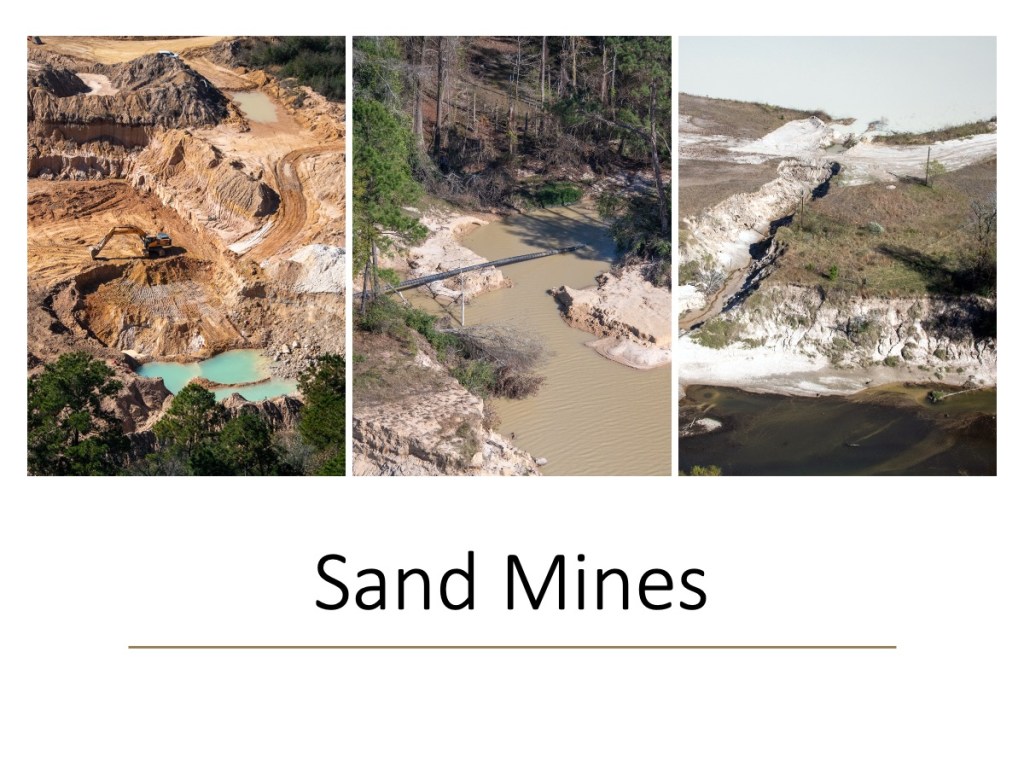
Sand mines operate so closely to the San Jacinto that their walls frequently break and pour polluted process water into the drinking water for 2 million people. If they get caught, they pay a small fine and continue operating with impunity.
Left: Liberty Materials Mine in Conroe that undercut five pipelines carrying highly volatile liquids. Center: Triple PG mine in Porter where erosion during Imelda exposed one natural gas line and threatens 5 more HVL pipelines. Right: Another Liberty Materials mine that allegedly dumped 56 million gallons of white goop into the West Fork.
Upstream Detention
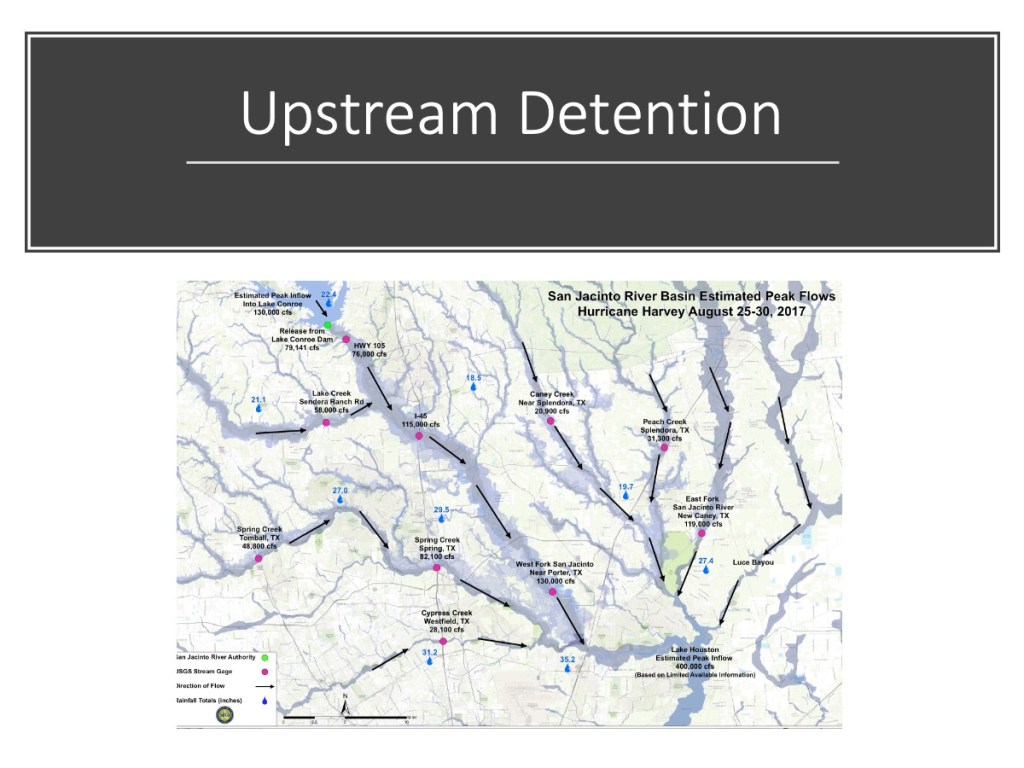
During Harvey, the release of 80,000 cubic feet per second from Lake Conroe added to downstream flooding. The goal: to find enough upstream detention capacity to help offset future releases. The San Jacinto River Basin Study will examine that possibility. It’s unlikely that one reservoir will provide enough capacity. However, multiple smaller reservoirs may.
Luckily, State Representative Dan Huberty sponsored legislation that allocated another $30 million. The Harris County Flood Bond allocated $10 million. The City of Houston allocated $6 million. Plus two more grant requests are still pending that could increase the total even more. And a disposal site for the material has already been permitted.
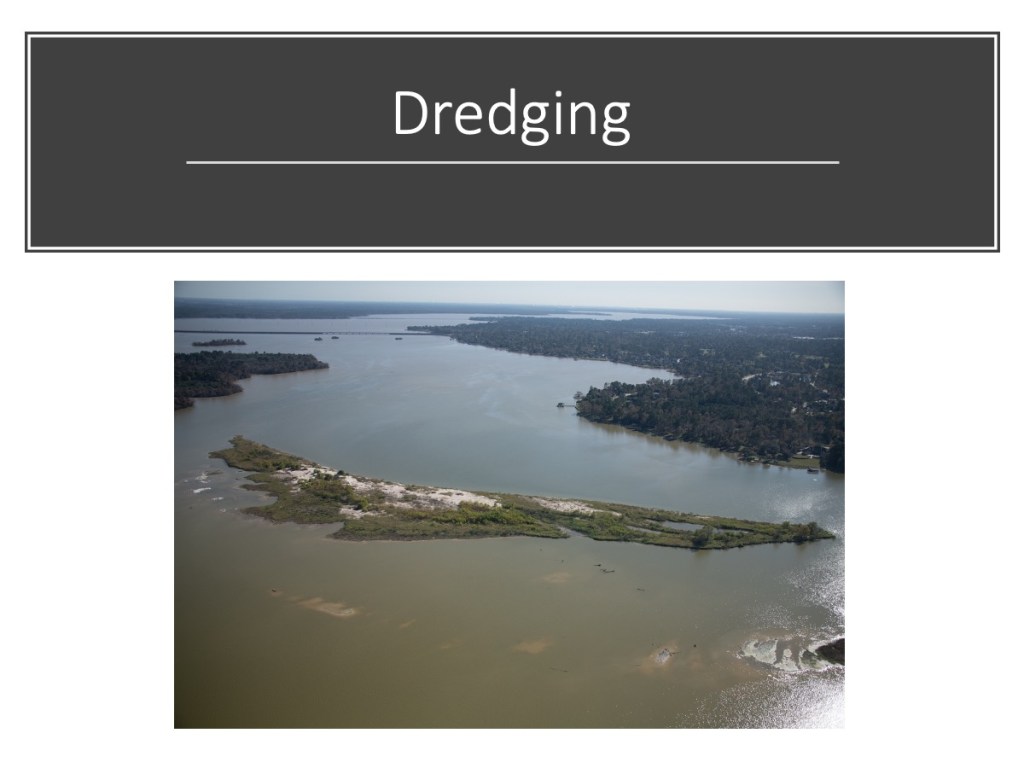
Mouth Bar of the West Fork. Photo taken 12/3/2019.
Last week, Harris County commissioners voted to proceed with additional dredging. Project managers are studying the most cost effective ways to proceed. We should see more dredging soon.
This money could also be used on the growing mouth bar of the East Fork.
State Highway 99 Extension
The extension of the Grand Parkway (State Highway 99) east and south to I-10 will open up vast new expanses of forest and farmland to high density development. The biggest threat will be to the East Fork watershed as construction moves through southeast Montgomery County and the northeast tip of Harris County into Liberty County.
Eastward clearing for SH99 has reached Caney Creek near Lake Houston Park.
Those are my predictions for the biggest stories of 2020. There’s a lot of good news in the forecast and much to remain vigilant about. Life seems to be a constant struggle between those who would increase and decrease our margin of safety when it comes to flooding.
Posted on 12/21/2019 by Bob Rehak
844 Days after Hurricane Harvey
The thoughts expressed in this post represent opinions on matters of public concern and safety. They are protected by the First Amendment of the US Constitution and the Anti-SLAPP Statute of the Great State of Texas.
https://i0.wp.com/reduceflooding.com/wp-content/uploads/2019/12/Slide14.jpeg?fit=1200%2C900&ssl=19001200adminadmin2019-12-21 12:30:522019-12-21 14:37:12Big Stories to Watch in 2020
Tuesday, at the open house in Kingwood to review work to date on the San Jacinto River Basin Master Drainage Plan, the Plan task force members showed two very interesting posters. Together, they show where the water came from during Harvey and the extent of inundation. They also show the amount of rainfall in different areas throughout the watershed.
When you put these two maps together, one high-level message screams through:
1.5 to 3.5 feet of rain fell over 2,885 square miles. That’s an area bigger than Delaware. And it all drained toward Lake Houston.
Watersheds Within River Basin
Looking at these posters gives you an appreciation for how complex flood forecasting can be, especially for areas like Kingwood where so many watersheds converge. The river basin map below shows the number of square miles drained by each of the major tributaries. The upper right corner inset map shows the same tributaries mapped over the major roads, counties and cities in the region to help you place the streams.
The second poster shows the extent of inundation along each of those major tributaries during Harvey. The upper right inset map shows rainfall across the region. Note how the rainfall was heavier toward the lower and eastern parts of the river basin. As water came downstream and the rain kept falling in those areas, the floodwater just kept building higher and higher.
How Local Factors and Channel Hydraulics Come Into Play
The maps also reveal much about smaller areas within the watershed.
Matt Zeve, Deputy Executive Director of Harris County Flood Control, has studied channel hydraulics for more than 20 years. He emphasized flooding in The Woodlands and Cypress did NOT flood because of water backing all the way up from Lake Houston. Lowering water in Lake Houston faster will not prevent flooding that far upstream, he says. A wide variety of local conditions govern upstream flooding, such as:
Rainfall rate, volume and location
Time of accumulation
Channel width/depth
Gradient
Flatness of terrain
Blockages
Rate and timing of runoff
Time of year
Amount of vegetation vs. impermeable cover
Soil type
Ground saturation and more.
This rainfall and inundation map clearly shows the effect of some of these factors. Notice, for instance, the three pockets of heavy flooding at the west end of Cypress Creek on the left. Also notice how the flooding narrows downstream toward the right. There are a several things going on here, according to Zeve.
The area that flooded so badly was extremely flat. The area used to contain rice paddies. Farmers made the land even flatter.
That area also received more rainfall. Note the small pocket of orange on the rainfall inset map over the area that flooded so badly on Cypress Creek.
As you move east on Cypress Creek, the flooded area gets less wide. That’s because the channel gradient increases. The creek therefore creates a deeper channel and the floodplain narrows.
Rice fields surrounded the headwaters of Cypress Creek in 1989.
As you look at these maps, apply your knowledge of local conditions to see if you can explain similar anomalies.
For Future Reference
These maps still exist in draft form. The river basin survey is only half complete. The maps may change before completion of the study.
For easy reference in the future, I will post the high-res PDFs under the Hurricane Harvey tab in the Reports page.
Posted by Bob Rehak on 12/20/2019
843 Days since Hurricane Harvey
https://i0.wp.com/reduceflooding.com/wp-content/uploads/2019/12/EX03_HarveyCalibration-copy.jpg?fit=1200%2C1200&ssl=112001200adminadmin2019-12-20 16:21:242019-12-20 18:30:29Where the Water Came From During Harvey and Extent of Inundation
With 2019 almost behind us, we should look back to see what we accomplished on flood mitigation. Tomorrow, I’ll take a look at the stories that will likely define 2020.
Limited Dredging
In 2018, FEMA and the Army Corps announced that they would dredge 2.1 miles of the San Jacinto West Fork when they were given authority to dredge 8 miles. Questions immediately started to swirl about why they were not dredging all the way to Lake Houston. The answer was “part of the mouth bar was there before Harvey and we can only spend disaster relief funds on what Harvey deposited.”
The mouth bar as it existed shortly after Hurricane Harvey. Photo taken 9/14/2017.
Regardless, they left the biggest blockage in the river. Imelda washed a tremendous amount of sediment downriver. In mid-October, RD Kissling sent me a photo from his kayak. He as standing in water less than knee deep 700 yards south of the mouth bar. It’s important to understand that sand bars are like ice bergs. You only see the tip above water. Most of the bar exists below water. And much of this mouth bar remains to be removed.
To learn more about this controversy, search this site using the key words “mouth bar.”
Flood Mitigation Legislation: A Big Win
No one budgets for disasters, such as Hurricane Harvey. So after the disaster, cities and counties had to scramble for grant money to even qualify for matching funds from the Federal government. More than two and a half years after the event, money is finally starting to trickle down to the areas that need it to implement flood mitigation projects. That’s thanks in large part to Senator Brandon Creighton who authored Senate Bill 7.
SB7 creates dedicated Texas Infrastructure and Texas Infrastructure Resiliency Funds for flood control planning and the funding of flood planning, mitigation, and infrastructure projects. The Texas Water Development Board is finalizing rules for the distribution of those funds right now. SB500, a supplemental appropriations bill, includes funding for SB7 and an amendment that would dedicate $30 million for dredging at the confluence of the San Jacinto and Lake Houston. State Representative Dan Huberty authored the amendment to SB500 that provides the $30 million.
For more information about legislation affecting this area, see the Legislation page of this web site or search using the key words “SB7” or “SB500.”
Sand Mining Legislation: One Small Gain, Some Big Losses
Activists statewide pushed for legislation to reign in the excesses of an out-of-control aggregate industry. Here in the Houston area, State Representative Dan Huberty introduced HB 907. It passed and doubles the penalties for not registering a sand mining operation. It also increases the frequency of inspection from every three years to two years and established a registry of active sand mines.
Picture of the West Fork of the San Jacinto the day it turned white (11/4/2019). The TCEQ later issued a notice of enforcement to the Liberty Materials mine upstream for dumping 56 million gallons of white goopy pollution into the West Fork.Water samples indicated 25 times the normal amount of suspended solids.
That was the only bill that the high powered lobbyists of TACA (the Texas Aggregate and Concrete Association) would allow to pass. That’s mostly because their members are already registered.
However, other important bills died in committee due to the lobbying power of TACA.
HB 908 would have provided for penalties up to $50,000 for water code violations and every-other-year inspections.
HB 909 would have created best management practices for sand mines.
HB 1671 would have extended water quality protections to the West Fork of the San Jacinto currently enjoyed by the John Graves District on the Brazos and attached penalties for non-compliance with best practices defined under HB909.
HB 2871. Would require sand mines and other aggregate production operations to acquire a reclamation permit and to file a performance bond ensuring reclamation.
For more information about sand mining in the Lake Houston area, see the Sand Mining page of this web site. You can also search on the key words “sand mining, TACA, Triple PG, TCEQ, breach, Liberty, and white water.”
Artist’s conceptual drawing of a high-rise development called The Herons: Kingwood.
The tallest buildings would have been 500 feet and located on the edge of the current floodway. That floodway will almost certainly expand in light of new Atlas-14 rainfall data. The developers also announced a marina that would have held 640 40-foot boats and 200 jet skis. There were no evacuation routes that would have remained above water in the event of a flood.
The developer’s web site now says the project is on hold, pending improvements to the West Fork and Lake Houston.
For more information on this development, see the High Rises page of this web site or search for the key words “Romerica, high rises, eagle, or The Herons.”
The $2.5 Billion Flood Bond Equity Flap
When the wording for Harris County’s historic $2.5 billion flood bond offering was worked out in early 2018, leaders from the Humble/Kingwood area in Precinct 4 argued to include the notion of an equitable distribution of funds. Why? Historically the Flood Control District had focused more on projects in other parts of the county, especially Precinct 1, that Precinct 4.
In one meeting after another, Ellis’ ringers showed up in commissioners court to complain about discrimination in the distribution of funds for buyouts, construction spending, and more. Yet in every category, Ellis’ precinct already had the lion’s share of funding.
This is an on-going controversy that affects everyone in the Lake Houston area. Ellis is looting transportation dollars from Precinct 4. You have to hand it to Ellis. Even if he doesn’t know what equity means, he knows how to work the system.
For more information on this topic, search this site using the key words “equity or Ellis.”
Meanwhile, the Supreme Court of Texas ruled that the language in the summary of the referendum on the ballot was misleading. It failed to disclose that the money would be raised through a new tax. So the Court ordered a revote.
In 2018, the Mayor “resold” the fee by saying, “If you want a lockbox around the money, vote FOR Proposition A. If you don’t want a lockbox around the money, vote AGAINST it.”
It was another artful dodge. There was nothing in the language of the bill to create a lockbox. The language in Prop A was almost identical to the original bill. But the funding formula was even looser!
Unaware voters once again approved the fee. And the Mayor continued to divert money from the fund. These diversions became a central element in the Mayoral campaign this year after thousands of people flooded in May and again during Imelda.
Nevertheless, the Mayor won re-election.
To learn more about this topic, search this site using the key word “Proposition A.”
10 New Gates for Lake Houston
The flood gates on Lake Conroe can release water 15 times faster than the gates on Lake Houston. During Harvey, that bottleneck contributed to the flooding of thousands of homes. A study showed that additional gates would have lowered the water level by almost two feet in the event of another Harvey. During smaller storms, the gates would also help pre-release water faster to create a buffer against possible flooding.
Lake Houston can shed water at 10,000 cubic feet per second. Lake Conroe can shed it at 150,000 cubic feet per second.
The City of Houston applied for a grant from FEMA and the Texas Division of Emergency Management to add ten new gates. FEMA approved the project. It’s happening in two phases. The first includes design and an environmental survey. The second includes construction. Each will take 18 months. We’re now six months into Phase One.
Details of dam improvement project.
For more information on this topic, search this site using the key word “gates.”
Temporary Seasonal Lowering of Lake Conroe
After Harvey, people in the Lake Houston area started pleading for more upstream detention, dredging and gates. Dredging started immediately. The project to add more gates to the Lake Houston spillway has also started. Upstream detention is still years way. The San Jacinto Watershed Study is only now beginning to identify possible locations.
Many lakefront property owners on Lake Conroe, however, claim the lowering hurts their property values and damages their bulkheads. Buses full of protesters showed up at the December SJRA Board meeting wearing red shirts that say, “Stop the Drop.” So many came that two busloads full of people had to be turned away.
Angry Lake Conroe residents showed up at the last SJRA board meeting in busloads.
Net: the policy to lower Lake Conroe temporarily is under assault. The SJRA will likely vote on whether to continue the policy in February. The SJRA will hold two additional meetings at the Lonestar Convention and Conference Center in January and February to give everyone who wants to provide input a chance to do so.
For more information on this topic, search this site using the key words “lake lowering.”
This is another issue that will carry over into 2020.
For more information on this topic, search this site using the keywords “Perry Homes, Woodridge Village, Figure Four Development, PSWA, Elm Grove, Spurlock, cease and desist, detention, what went wrong, North Kingwood Forest, or drainage criteria.”
There’s your digest of the biggest stories of 2019. 2020 to follow.
Posted by Bob Rehak on December 19, 2019
842 Days after Hurricane Harvey and 92 since Imelda
The thoughts expressed in this post represent opinions on matters of public concern and safety. They are protected by the First Amendment of the US Constitution and the Anti-SLAPP Statute of the Great State of Texas.
https://i0.wp.com/reduceflooding.com/wp-content/uploads/2019/12/Slide11.jpeg?fit=1200%2C900&ssl=19001200adminadmin2019-12-19 11:45:402019-12-19 12:01:13The Biggest Stories of 2019
Natural Disasters: Examining the Impact from 1953 to 2018
Who is affected? By what type of threat? When? Where? Why? And above all, how? How much did the disasters cost? In dollars? In lives? In property damage? This is an illuminating work of scholarship and well worth the ten minutes it takes to read. When you’re done, you’ll be able to amaze family and friends around the Christmas dinner table. For example, which state leads the nation in disaster declarations for …
… each 1000 square miles? New Jersey
… wildfires, droughts and hurricanes? Texas
… freezing? Florida
… flooding? Iowa
… tornadoes? Georgia
Timing, Type, Location and Impact of Natural Disasters
Which year had the highest number of fatalities? 2005 with Hurricanes Katrina, Dennis and Wilma, California wildfires, etc.
Which year had the highest damage costs in dollars? 2017 with $312.7 billion
Fatalities and Damage Costs by Year from 2003 to 2017.Source: ADT
What type of natural disaster is most likely to damage the nation’s economy? Tropical storms. One-third of the gross domestic product is produced in states along the Gulf and Atlantic coastlines, which are especially vulnerable to hurricane damage.
What’s the most likely type of natural disaster in Texas? Hurricanes.
Top types of natural disaster declarations by state. Source: ADT.
What’s the most likely type of natural disaster in California? Flooding. (But wildfires also rank high).
Who has the most severe storm declarations? Missouri with more than 1200 during the study period.
You’ll be pleased to know that NO county in Texas made the top 20 counties in the nation for FEMA natural disaster declarations. Who was the highest? Balmy Los Angeles County.
Some Results Counterintuitive
Some of these results are obvious and some counterintuitive. The counterintuitive ones (freezing in Florida?) have to do with the lack of disaster preparedness. Other states expect freezing weather and prepare for it.
All in all, ADT produced a fascinating study of natural disasters illustrated with revealing graphics. There’s more. Much more. I have just scratched the surface in this review. It’s well worth the time to read the entire report. Check it out.
Posted by Bob Rehak on 12/19/2019with help from Jacque Havelka
842 Days since Hurricane Harvey an 91 since Imelda
https://i0.wp.com/reduceflooding.com/wp-content/uploads/2019/12/A01.png?fit=800%2C907&ssl=1907800adminadmin2019-12-19 06:14:052019-12-19 06:34:37The Who, What, When, Where, Why, and How of Natural Disasters