Pit Capture on Caney Creek: What Happens When A Sand Mine Builds Flimsy Dikes in Floodways

This story illustrates on of the dangers of pit capture in sand mining. During the peak of Imelda, 42,000 cubic feet of floodwater per second came down Caney Creek. However, early the morning of September 19th, residents south of the Triple PG Sand Mine on Hueni Road in Porter started seeing water coming from the mine before it came up from the creek.

Escaping with Only a Minute to Spare

They started evacuating their families and animals. One Walden Woods resident told me that the water came up so fast, it covered an entire SUV within an hour. Another told me that had she waited one more minute to evacuate, she and her family would have had no way out. The force of the rushing water undermined the house and garage of a third. Farther south of the mine, residents of Dogwood Lane, Woodstream Village, Dunnam Road, and Riverchase felt the same panic.

Caney Creek Captures Triple PG Sand Pits

So what happened? A review of aerial photographs below taken on 10.2.19, almost two weeks after Imelda, showed a massive breach in the northern dike of the mine. Erosion patterns suggest the water then rushed through the mine in a north to south direction.

  • Trees laid down in a southerly direction at the entry point
  • Sand waves orient along the north-to-south direction of flow
  • East/west roads separating the ponds were blown out, by water flowing north to south
  • The mines main stockpile shows massive erosion along its western edge in a north-to-south direction
  • Sand is piled up against the mine’s main building along the northern side only (where the water came from)

Photo Tour of the Aftermath

All the photographic evidence suggests a classic case of pit capture. Peach Creek joins Caney Creek just north of this entry point.

Where water entered the mine from the north. Looking northwest from inside the mine and past the northern dike. Note the trees pushed into the mine by the force of the water, indicated the direction of flow.
Reverse shot. Looking south into the Triple PG Sand Mine.
A closer view of the same scene shows clear evidence of erosion within the mine from rushing floodwaters. The water came from directly behind the camera position. The road in the middle was blown out, but reconstructed by the time I shot this photo two weeks after Imelda. The TCEQ said they could not safely reach this part of the mine because of damaged roads.

You can see from the shot above that water barreled through this mine as if shot from a water cannon.

Close up of repairs to damaged road. Looking southwest. Sand patterns show water moving north to south.
Note the sand pushed up against the north-facing back of this building.
The eastern side of this stockpile was eroded from the bottom by water side-swiping it from a north-to-south direction.

No Effective Dike at Southern End of Mine

There really is no dike at the southern end of the pit, just a road around the perimeter. The ground level in the neighborhood to the south is virtually even with the level of the road. After water flowed through the pit, it flowed through neighborhood(s) to the south and damaged homes. It’s easy to see the damage immediately south of the pit and imagine the pit capture as the cause of the damage. The damage faces the mine, not Caney Creek to the east.

Floodwaters from the Triple PG mine partially knocked this home off its foundation. The owner had to jack it up and re-level it. The back of the house faces the mine and is not more than a hundred feet from it.
The same homeowner’s garage. Floodwaters from the mine scoured under it. Again, the back of the garage faces the mine and is not more than a 100 feet from it.

Reasons for Pit Capture

What is pit capture? It’s when a river or stream cuts through the pit of a nearby sand/gravel mine instead of following its normal course.

How does it happen? Water starts to overtop or penetrate the dike. It creates a fissure that rapidly widens and opens a hole. Pretty soon the dike collapses and the water rushes in. The water moves from areas of high pressure and elevation to areas of low pressure and elevation. After the water moves into into the pit, it fills the pit up and needs to find a way out on the other end. Like a water ballon attached to a faucet, sooner or later dikes on the other side burst.

Why does this happen?

  • The mine was built in the floodway of Caney Creek on a point bar
  • Dikes made out of sand could not withstand the force of the water
  • Dikes had previously failed in the same places and left “weak points”
  • When the water came up, it took the path of least resistance
  • Texas has no minimum setbacks from rivers for mines
  • Texas enforces no best management practices for mines

What Next for the Triple PG Mine?

The Texas Attorney General is currently suing the mine for allowing its process water to pollute Lake Houston. The mine left its dikes open for weeks after multiple breaches in multiple storms. The TCEQ also found that the mine was breached from east to west between White Oak and Caney Creeks.

Potential fines could reach well past a million dollars. That raises the question, “What can be done with this mine to protect residents below the mine and to protect the City of Houston’s water supply?”

Over the years, Triple PG’s owners have removed 800 acres of forest and an unknown volume of sand from the mine. The risk of pit capture is greatest were mines are deeper than the adjacent river bed and close to the river/stream. Both conditions apply in this case.

The dike between Caney Creek and the Triple PG pit is a narrow strip of unvegetated dirt, just wide enough to support a vehicle…and not compacted very well as you can see below.

This shows repairs to an exit breach to Caney Creek farther south. No geotextile fabrics or rip rap are holding the repair together. Photo courtesy of Josh Alberson. Taken 11.2.2019.
This closer shot shows the same breach filled with sand and clay. You can see how flimsy the repair is. The uncompacted and unprotected soil is already eroding after two inches of rain last week. Photo courtesy of Josh Alberson. Taken on 11.2.2019.

It will be interesting to see whether a professional engineer will certify this repair, as a restraining order demands.

If the courts should shut this mine down, sealing it off permanently will be difficult and costly.

Posted by Bob Rehak on 11.3.2019 with images from Josh Alberson

796 Days since Hurricane Harvey and 45 since Imelda

The thoughts in this post reflect my opinions on matters of public concern and safety. They are protected by the First Amendment of the US Constitution and the Anti-SLAPP Statute of the Great State of Texas.
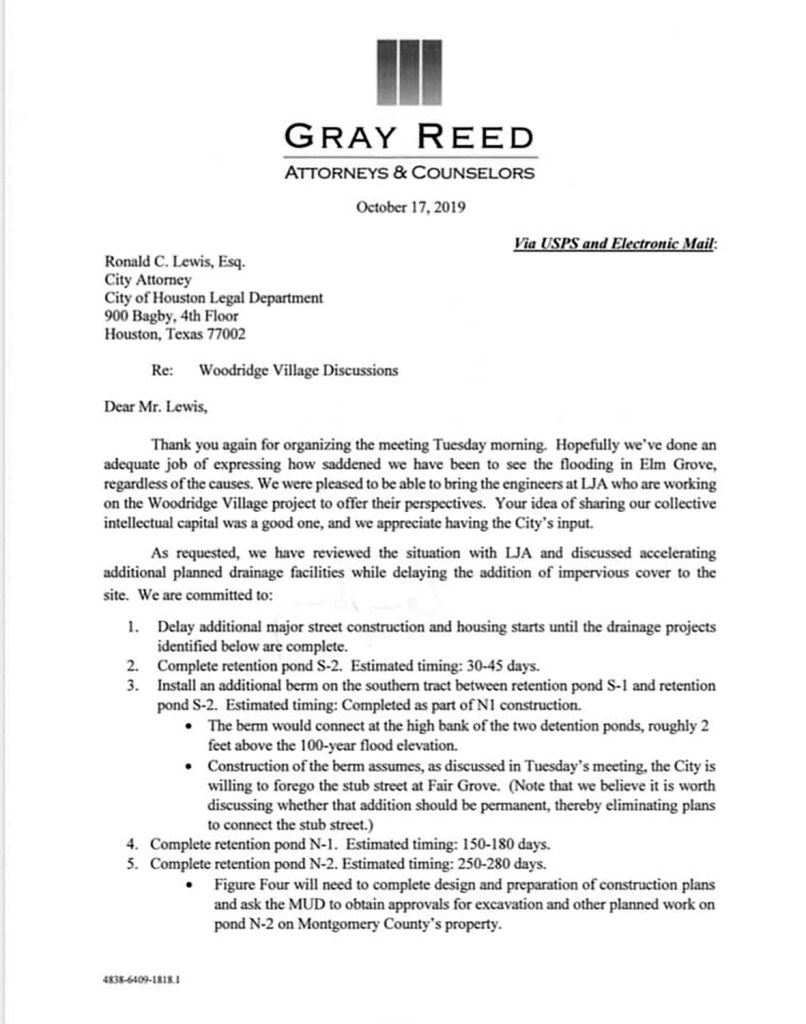
Woodridge Village Detention Calculations Off by More Than 40% According to New Standard

Developers in Montgomery County try to avoid building detention ponds by beating the peak. They also have attempted to minimize the amount of detention ponds they must build by beating the clock.

Woodridge Plans Approved One Month Before NOAA Updates Flood Data

A year to the day after the peak of Hurricane Harvey on August 28, LJA Engineering submitted a hydrology report to Montgomery County. A table buried on page 32 of the PDF shows that they based their analysis on a 100-year storm that dropped 12.17 inches of rain in 24 hours.

From Page 2.1 of LJA Hydrology Report Addendum, 8/28/2018 (page 32 of pdf.)

Two weeks earlier, USGS had issued its report on peak streamflows and high water marks for Hurricane Harvey.

At this point, the world knew that flood maps would soon change radically. But the LJA report contains no mention of Harvey, USGS, or NOAA’s new Atlas 14 data. And in fact…

Less than one month after the LJA Engineering hydrology report, on September 27, NOAA issued new rainfall frequency values for Texas. Called Atlas 14, the NOAA analysis established significantly higher rainfall frequency values for this part of Texas.

New updated NOAA Atlas 14 data shows that a hundred-year rain for the Lake Houston area is now defined as 17.3 inches in 24 hours, up from 12.17 inches by the old standards.

NOAA redefined the amount of rainfall it takes to qualify as a 100-year or 1000-year event. They defined the new 100-year rain as 17.3 inches in 24-hours – a 42% increase. That means that to meet new 100-year standards, Perry would have had to increase its detention capacity by 42%. Instead of 271 acre feet, it would have needed 385.

Using Atlas 14 would have reduced the number of salable lots and the economic projections for the development to a substantial degree.

The one flood map in the 59-page LJA Engineering hydrology report shows flood plains magically stopping at the county line.

The one flood map that the LJA hydrology report does include (page 51 of PDF and above) shows flood zones stopping at the county line (the black diagonal) and the boundary of the Perry property (the maroon-bordered polygons). Pretty odd for a site partially covered by wetlands!

National Wetlands Inventory Map shows both sections of Woodridge Village contain wetlands.

Woodridge Plans Approved Even Before LJA Submitted Hydrology Report

Now here’s where it gets even more interesting. City of Houston approved the detention plans on 8/12/18 – two weeks BEFORE the LJA hydrology report on 8/28/18 and only a month BEFORE NOAA released the new Atlas 14 data. Hmmmm! Think they were in a hurry to get these approved? (Note: The approval date for MoCo is unreadable).

Signature block for City of Houston from Woodridge Village detention plans.

Perry Homes played a game of beat the clock and was winning … until May 7, 2019.

Future Flood Risk Remains Even with Planned Detention Ponds

Until now, I have been posting about the lack of detention ponds. Closer analysis reveals that this is only part of the problem. Even if Perry builds the remainder of the detention ponds as planned, they will be insufficient to meet the new NOAA standards and will pose a flood risk to people downstream.

After contributing to two floods in Elm Grove and North Kingwood Forest, the engineers and owners of Woodridge Village surely must realize how dangerous trying to Beat the Clock was.

Forty-two percent of a 100-year flood as defined by the new Atlas-14 data will overflow the banks of the detention ponds and add to the load on Taylor Gully or go into the streets of Elm Grove and North Kingwood Forest.

Facing west. This panoramic drone image by Chris Betz takes in most of the Woodridge Village constructions site. Note the ponding water 3.5 days after a two-inch rain.

This image taken Friday night at Sunset shows how impervious the Woodridge soil is. Water is still ponding three and a half days after a two-inch rain (October 28, 2019).

I wonder if the LJA engineers calculated the runoff coefficient accurately. Given some of the other problems in this report, perhaps an engineer would care to comment on their calculations.

Posted by Bob Rehak on 11/2/2019

795 Days after Hurricane Harvey and 45 after Imelda

The thoughts expressed in this post represent my opinions on matters of public policy and safety. They are protected by the First Amendment of the US Constitution and the Anti-SLAPP Statute of the great State of Texas.

Q&A with HCFCD on Ben’s Branch Flooding Issues

After St. Martha’s Catholic School and Kids in Action almost flooded on a two inch rain earlier this week, I asked Harris County Flood Control a series of questions about Ben’s Branch. The questions covered a variety of topics. They included the Kingwood Drainage Assessment; flood mitigation alternatives along the creek; preservation of natural amenities; a maintenance agreement with Friendswood and Bear Branch Trail Association; timing for all of the above; and more.

St. Martha’s school on Tuesday after two inches of rain

Harris County Flood Control District continues to be a paragon of openness and transparency. Below: detailed answers to the questions people have been asking.

Q. Ben’s Branch is included in the Kingwood Drainage Assessment. When will that study be complete?

A. Our consultant is scheduled to submit the Draft Feasibility Report for HCFCD review in May 2020. We plan to hold a public meeting by early 2020 to present preliminary results and then a second meeting to present final results and recommendations for future actions.

Q. Will the consultant report findings on creeks “as they go” (one by one) or deliver one summary report at the end? (The concern: that they could sit on recommendations for months that might prevent flooding in the interim.)

A. We do not envision the alternative analysis to be completed on a creek by creek basis, but we are working to identify some initial projects that could be recommended for implementation prior to completion of the report.

This assessment is to determine level of service and make recommendations for projects to move into preliminary engineering once this assessment has concluded. Some projects might require partnerships to implement.

Q. I understand that you are close to reaching a maintenance agreement with Friendswood for the natural portion of Ben’s Branch between North Park and Kingwood Drive. Can you send me a copy of the proposed maintenance agreement or, as a backup, summarize the key features?

We are seeking an easement from the Bear Branch Trail Association, with a waiver from Friendswood Development Company, to perform desnag activities for stormwater conveyance purposes on the portion of Bens Branch between Woodland Hills and Kingwood Drive where we currently have no property rights; that is, from approximately 1,500 feet downstream of Woodland Hills to approximately 3,000 feet upstream of Kingwood Drive. Please go to the Interactive Maps of Kingwood Assessment Area on our website and look at the fuchsia line along Bens Branch on the “Channel Right-of-Way in the Kingwood Area” map.

We will share the easement language once it has been finalized.

Q. How long have you been working on this easement?

Since October 24, 2018.

Q. How will this easement differ from your normal easements?

We are obtaining this easement to perform desnag activities to allow the free flow of stormwater. For information about our desnag operations, please visit our website https://www.hcfcd.org/hurricane-harvey/kingwood-information/hcfcd-vegetation-management-activities/.

When Friendswood Development Company granted fee ownership of this portion of Bens Branch to the Bear Branch Trail Association, they retained certain rights and set specific restrictions on the property that would make it impossible for HCFCD to perform its necessary flood control responsibilities.

This agreement is different because the Friendswood Development Company wants to restrict HCFCD’s rights to “widen, deepen, enlarge, straighten, or smooth the channel in such a way as to increase channel capacity.” 

HCFCD has been working to negotiate the right to enter this property and complete channel maintenance operations for drainage purposes, while still maintaining the aesthetics that are important to both the Friendswood Development Company and the Bear Branch Trail Association. HCFCD will request the right to review plans for future improvements placed within the channel (e.g., bridges and low water crossings).

HCFCD cannot allow activities that could increase the risk of flooding where we spend public dollars.

Q. What were Friendswood’s concerns?

They wanted no alteration of the channel geometry and to retain the ability to add trails, bridges, and other structures without obtaining permits from HCFCD.

Q. Will the maintenance described in the agreement be enough to restore conveyance of Ben’s Branch so that it doesn’t flood surrounding homes and businesses?

We plan to perform desnag operations to remove obstructions so that stormwater can be conveyed efficiently.  HCFCD can’t guarantee that flooding won’t occur in surrounding homes and businesses.  HCFCD can selectively remove vegetation along the banks and other debris in the channel to increase the capacity of the channel to convey stormwater downstream.

Q. What will it take to avoid flooding? Said another way, what obstacles do you face in restoring conveyance?

Before we can perform these activities, we need to have property rights and the ability to safely access the site.

Q. What would Harris County Flood Control prescribe for Ben’s Branch to protect people from flooding?

We have not formally begun our process to identify alternatives; however, we expect to explore these alternatives for the Bens Branch channel:

  • Expanding the Kingwood diversion ditch from 150 feet to approximately 300 to use more of the right of way. Because the Kingwood diversion channel diverts water from the Montgomery County portion of the upper Bens Branch watershed, and there appears to be available capacity in the diversion channel, we will look into whether diverting more flow down the diversion channel would result in reduced flows along Bens Branch. Please note that we anticipate that this option would require a stormwater detention basin along the lower limits of the diversion channel.
  • Effectiveness of building stormwater detention basins in the upper Bens Branch watershed (Montgomery County side). This will only be feasible if large undeveloped tracts are identified for possible future basins.
  • Evaluation of channel conveyance improvement needs along the entirety of Bens Branch. Some improvements may need to be considered on portions of the channel within which HCFCD has no legal authority to work.  If this is the case, HCFCD would coordinate with the property owners to determine what improvements could be completed.

Q. Are there compromises that would provide protection from flooding without destruction of the natural amenities which residents also value? I realize this may involve a discussion of degrees of protection.

As part of this study, HCFCD will be identifying alternatives to provide 100-year level of protection within the channels, using the rainfall rates from the newly adopted Atlas 14. These alternatives will identify the magnitude of improvements necessary to handle approximately 18 inches of rainfall runoff in a 24 hour period.

There are times that flood risk reduction competes with natural and public amenities; when that occurs, HCFCD works to minimize impacts to natural amenities. Once alternatives are identified, Kingwood Area residents will have a chance to voice their opinions and concerns with our alternatives. Please note that at some point it might become necessary for the Kingwood community to decide between higher levels of flood protection and maintenance of existing amenities.

Q. Do you have any idea yet why St. Martha’s and Kids in Action almost flooded on a one year rain? What has changed in your opinion?

We do not have any formal findings as to the potential causes for the excessive ponding along Bens Branch near the Kids in Action / St. Martha’s area. The intensity of the rainfall contributed to the ponding; inlets are typically designed to handle approximately 1” per hour, and when the rainfall intensity exceeds this, there is ponding in streets and parking lots.

It also appears that there may be a downstream blockage since extremely slow velocities were seen in the water in this area and there are much lower water surface elevations in the Bens Branch channel sections further downstream. HCFCD has contacted the Bear Branch Trail Association to ask them to assess their channel and remove any blockages.  

Posted by Bob Rehak on 11/1/2019 with help from Beth Walters of HCFCD

794 Days since Hurricane Harvey and 43 since Imelda

Perry Homes: Trick or Treat?

In the spirit of Halloween, it’s only fair to ask, “Is Perry Homes tricking or treating when it talks about Woodridge Village?” What Perry Homes says and what Perry does seem to contradict each other in a scary, horror-movie, Stephen-King, Cujo-on-steroids sort of way.

The Cujo analogy actually fits; man’s best friend turns into something not so nice. Woodridge Village is the 262-acre area that Perry contractors clear cut and then left before finishing the detention ponds. This contributed to the flooding of hundreds of homes in Elm Grove and North Kingwood Forest – twice so far this year.

Words vs. Actions

What do I mean by contradictions? A dozen examples:

  1. They said Elm Grove flooding had absolutely nothing to do with Woodridge Village … when they had just clear-cut hundreds of acres.
  2. Their consultant, LJA, promised the Montgomery County engineer that Woodridge would have no adverse impact on downstream flooding … then 200 homes flooded.
  3. They claimed the May 7th flooding was God’s fault … when they had only 7% of the detention built.
  4. After May 7th, they claimed they had “many” detention ponds COMPLETE … when they really only had one (S1).
  5. Perry promised the City of Houston and Montgomery County five detention ponds, but built only two… and they comprise less than 25% of the volume.
  6. They say they want to accelerate work on new detention, but haven’t done any new excavation work since August.
  7. Perry blamed construction delays on wet weather … as people were choking on clouds of dust.
  8. As a concession to wary flood victims, they promised not to build additional impervious cover … on hard-packed clay that was already largely impervious.
  9. The company said it is researching events that led up to flooding … while the construction site is a ghost town.
  10. Perry said how saddened it was to see the flooding in Elm Grove Village … as workers and equipment left the community unprotected.
  11. Perry claims they need “approvals” to build additional detention. How did they start the job without approvals?
  12. They said their hearts went out to flooded homeowners, right before suing them.

A Moving Experience

Last week, I wrote about how they hadn’t moved the equipment on their job site for a month. The day after the post, they parked the equipment in new places. But still no new excavation work.

Equipment parked on the northern side of the site for a month moved to the western side but still is not working.

How could anyone take Perry Homes at its word any longer? They certainly aren’t a treat and they’re not tricking anyone. The courts need to put an end to the Nightmare Near Elm Grove.

Posted by Bob Rehak on Halloween, 10/31/2019, with that to Jeff Miller

793 Days since Hurricane Harvey and 42 days after Imelda

The thoughts expressed in this post are my opinions on matters of public policy and concern. They are protected by the First Amendment of the US Constitution and the Anti-SLAPP Statute of the Great State of Texas.

Triple PG Sand Mine Agrees to Terms of Restraining Order

The Triple PG Sand Mine in Porter has agreed to the terms of a restraining order. The order will force the mine owner to build dikes that can withstand the force of future rains and that can prevent future discharges of process wastewater into the City of Houston’s drinking water.

Repeated breach in dike of Triple PG Sand Mine that allowed process water to mingle with water in Caney Creek (lower left).

Certification by Licensed Professional Engineer Required

Furthermore, according to the agreement, a licensed, professional engineer must certify that the dikes can withstand the force of future rains. No more building dikes out of sand. Given where the mine is located – at the confluence of two floodways – it’s not clear whether future breaches are 100% avoidable. It’s also unclear whether a professional engineer would put his or her reputation on the line with such a promise given this particular mine’s history and location.

Southern Perimeter Lacks Effective Dikes

The entire southern perimeter of the mine is flush with the land south of the mine. There appear to be no dikes. So this could be a massive construction job. Dozens of homes south of the mine flooded during Imelda. Debris and damage patterns suggest that floodwaters entered their homes directly from the mine, not from White Oak or Caney Creeks.

The back of Tom Gill’s garage above faces the Triple PG mine. Scouring from the direction of the mine indicates which direction floodwaters came from.
Debris washed away from mine in Walden Woods subdivision south of it.

Background of Case

In May and again in September, the Texas Commission on Environmental Quality (TCEQ) reported that multiple breaches in dikes at the Triple PG Sand Mine on Caney Creek led to the escape of process water and sediment into the City of Houston’s drinking water supply. The TCEQ had previously cited the mine for similar environmental violations in 2015.

As a result of leaving the breaches open for prolonged periods, the Texas Attorney General sued the mine earlier this month. If the suit is successful, Triple PG could be liable for penalties exceeding $1 million.

Goals of Attorney General

Two weeks ago, I described what the original petition involved. The AG wants to force the mine to stop alleged pollution of the drinking water of the nation’s fourth largest city.

Both the injunction and restraining orders seek the same things: to get the mine to fix breaches so it stops allegedly emitting process water. The initial focus: sealing the mine off so that process water stops intermingling with drinking water. In the long term, however, the state wants to force the mine to build dikes sufficient to withstand the force of future floodwaters.

Requirements of Restraining Order

The agreed temporary restraining order requires the defendant to:

  • Not engage in any operations at its dredge facility that discharge process wastewater from the defendant’s property
  • Not PRODUCE any process wastewater that must be discharged
  • Immediately begin repairing damaged or breached berms
  • Hydraulically isolate any industrial waste within the mine
  • Halt the influx of water from creeks
  • Halt the outflow of waste from pits
  • Construct the repairs to prevent discharges from pits during future rain events
  • Cease and prevent all discharges of any industrial waste and or process wastewater from the mine into waters of the state
  • Within 14 days, hire a professional engineer to assess whether the berms can permanently prevent future discharges
  • Not destroy records
  • Certify all efforts at compliance, also within 14 days

The amended restraining order reset the date for the hearing on a temporary injunction from October 24 to 28th. The last order again resets the hearing date to November 12th.

So why the restraining orders when the original suit asked for an injunction? Generally, restraining orders are sought as a form of immediate relief while a plaintiff pursues a more permanent injunction, although injunctions can also be temporary.

Full Text of Legal Filings to Date

Below are links to the full text of documents filed to date in the case. I obtained them from the Travis County District Clerk in Austin.

For one PDF that contains all the docs above, click here.

Explanation of “Agreed Order”

Notice the word “agreed” in many of the document titles above. An Agreed Order refers to a written agreement submitted by both parties to a case resolving issues between them.

After rendering decisions, courts will often command counsel for both parties to see if they can come up with wording of an order satisfactory to both. If they can, it becomes an “agreed order,” which the court will then enter. (If not, the judge will formulate his/her own order.

Turning the Tide on the East Fork?

If this sticks, it could change the way Triple PG does business forever. It could also improve life on the East Fork of the San Jacinto for residents who have complained about sediment buildups, flooding, polluted water, loss of riparian vegetation, destruction of wetlands, fish kills, and more.

Posted by Bob Rehak on 10/31/2019

793 Days after Hurricane Harvey and 42 since Imelda

Two Inches of Rain Should Never Have Caused This

Today, we got two inches of rain between 1:30 and 3:20. That’s according to the closest official gage at US59 and the West Fork. See the graph below. Ben’s Branch came out of its banks almost immediately and nearly flooded St. Martha’s Catholic School and Kids in Action again.

Today’s Rainfall in 10-minute Increments

The closest gage at the West Fork and US59 registered a total of 2.08 inches for the event. In ten-minute increments, it looked like this. Source: HarrisCountyFWS.org.

The Result

St. Martha’s School after two inches of rain in a two hour period. This is what the parking lot of the school looked like 1.5 hours after the rain ended. The floodwaters came from Ben’s Branch which was at a virtual standstill in this area. Water under the Woodland Hills Bridge just south of Northpark Drive barely moved.

St. Martha’s has not yet finished repairs from Imelda. No floodwater actually got in the school today, but it came dangerously close for a rain that was not unusual for this area. The school is at least two feet above the hundred year flood plain and this was a one-year rain at best (see table below).

Across the creek, Heather Jensen at Kids In Action wrote, “We’re currently rebuilding Kids In Action for the second time since May. Can’t stomach a third.” Many people would agree with that!

Expect a Rainfall This Intense at Least Annually

The latest NOAA Atlas-14 rainfall chart for this area shows that we can expect a two-inch rain in two hours at least once a year. If you measure the 10-minute peak, it also works out to a one-year event. Which we’ve had several of this year.

I have lived in Kingwood for 35 years and used to own commercial property near St. Martha’s for twenty years. I have never seen Ben’s Branch do this on a rain like we had today.

During those 35 years, not much has changed along the creek. With few exceptions, the bridges, homes and businesses along this portion of Ben’s Branch have been there the entire time.

New Upstream Development is Major Change

However, new upstream development could be adding to the peaks. The City of Houston confirmed after Imelda that the western tail of Woodridge Village empties into the City storm drains. See two images below.

Photo taken 9/25/2019, looking east. North is left; south is right. The area labeled Woodridge Village in the middle of the shot drains into Ben’s Branch which is out of frame to the right (south).

The storm drains, which also empty Sherwood, in turn empty into Ben’s Branch. See image below.

Looking north along Woodland Hills Drive toward Kingwood Park High School, Sherwood Trails and Woodridge Village. The City says this drain helps empty Woodridge Village.

The shot above is looking north, parallel to Woodland Hills Drive. Below, you can see the reverse angle, looking south. The shot was taken from the second floor of Kids in Action on the north side of the creek. Notice how water from that drain is shooting across the creek, creating more turbulence than the flood itself.

Photo by Heather Jensen of Kids In Action just north of St. Martha’s.

Below St. Martha’s, A Different World

Compare the width of the Ben’s Branch channel in the photos above to the width in the photos below, where the stream goes through a natural area.

Upstream from St. Martha’s, Ben’s Branch is a wide channel. Downstream, shown here, it turns into a narrow, twisting, turning creek. Photo from 9/25/2019, courtesy of St. Martha’s.
Photo from 9/25/2019. Courtesy of St. Martha’s, showing trees encroaching on Ben’s Branch.
In the foreground, you can clearly see evidence of erosion from Imelda. This shot was taken on 9/25/2019. Note the fallen tree in the background. Such blockages create “beaver dams” during heavy rains when other debris catches on them. Photo courtesy of St. Martha’s.

Such obstructions, turns, tangles and narrow beds slow the velocity of the water, causing it to back up. No doubt, these factors play a role in the repetitive flooding, as does upstream development.

Political and Legal Obstructions Complicate Matters

Maintenance responsibilities for this portion of Ben’s Branch are in flux. That may be the kindest way to say it. Nothing has really changed since Harvey.

The Bear Branch Trail Association owns the property according to this deed and the Harris County Appraisal District.

However, from reading the deed, you can see that Friendswood still exercises deed restrictions on the property, especially those applying to drainage. When it comes to saying yea or nay to major changes that affect the character of the greenbelt on either side of Ben’s Branch, Friendswood appears to be in control to this day.

Major Friendswood deed restrictions include:

  • Friendswood reserves for itself multiple easements for drainage. (sec. 3)
  • BBTA must keep the area “healthful” (sec. 8)
  • BBTA may not remove any trees except those that are dead or dying (sec. 8)
  • BBTA may not transfer the land (with a few exceptions that don’t apply to this discussion) (sec. 9)
  • The deed restrictions do not have an expiration date like those for many HOAs.

What Next for Ben’s Branch

Last year, the City reportedly agreed with Harris County Flood Control to assume responsibility for all underground drainage in the county would assume responsibility for all above ground drainage. Since then, the two have been trying to sort out responsibilities.

Harris County Flood Control has sought an easement at least since January from Friendswood and Bear Branch Trail Association. Reportedly, they want to remove some trees, and widen and straighten the channel. However, according to a frustrated Houston City Council Member Dave Martin, no agreement has been reached.

Meanwhile the school for more than 500 children almost flooded for the third time in six months. It’s hard to imagine Kingwood without its largest parochial school or one of its most popular day care/after school facilities. It’s time for

Harris County Flood Control should be concluding a major study of all Kingwood drainage soon…including Ben’s Branch. Let’s hope that helps wake Friendswood up to some new realities.

Posted by Bob Rehak on 10/29/2019

792 Days since Hurricane Harvey and 40 since Imelda

Is Flood Frequency Really Increasing?

By Debbie Z. Harwell, PhD, Editor of Houston History Magazine

Many claims have been made about increasing local flood frequency. They raise the question, “How accurate are those statements?” The report “Significant Houston Area Floods” by Jill F. Hasling, CCM, offers an interesting list for analysis that ranges from April 1837 through February 2019 (two more floods have since occurred in May and September 2019). 

Increase in Flood Frequency

Our first flood took place in April 1837, just eight months after Houston was founded at the confluence of Buffalo and White Oak Bayous. Six months later another flood found Main Street under four feet of water. But Houstonians persisted…and so did the flooding.

In the first 100 years following Houston’s founding, it experienced 36 floods, in the next 82 years, it has seen an additional 146 floods, or four times as many as in the first century.

Broken down into 30-year periods, the trend looks like this. Note that only 3 years exist in the last column so far and it already has more floods than each of the first two 30-year periods.

Note: Last column contains only three years and already has more floods than each of the first two thirty-year periods.

Percentage of Tropical Vs. Non-Tropical Floods

One might think that our location along the Gulf Coast and the tropical systems that come ashore are to blame for this phenomenon, but tropical systems account for only 15% (27) of these events. The other 85% (155) were caused by rain that either fell in large quantities in a short period of time or lingered in the area for multiple days; this includes 22 winter storms.

Early Flood Mitigation Efforts

With the exception of the 1900 Storm, which hit Galveston but also caused fatalities and flooding on the mainland, the worst of Houston’s early floods occurred in 1929 and 1935 (watch video), causing multiple deaths and wiping out homes, businesses, bridges, and the main water plant. With two back to back floods of this magnitude it was time to take action.

In the midst of the New Deal, the federal government put the Army Corps of Engineers in the flood control business. Houston benefited with funding for the Barker and Addicks Reservoirs, completed in 1946 and 1948 respectively, after a delay during World War II. Although creation of two proposed drainage channels north and south of Buffalo Bayou to relieve flooding did not come to fruition, the reservoirs brought some relief along Buffalo Bayou.  

Influence of Urban Growth on Flooding

As Houston grew, so did it’s flooding problem, going beyond Buffalo and White Oak Bayous to include the other 22 Harris County watersheds. By 1983, Houston floods regularly saw the number of inundated homes reach into the thousands. In 1994, ninety subdivisions, including 3,400 homes, flooded. This flood was considered the benchmark for many Kingwood residents to determine the probability that their home might flood in the future. As a result, many did not have flood insurance when Harvey hit because they believed they were safe since their home did not have water in 1994. 

Today some people point fingers at others, saying their flooding problem is of their own making because they built or bought a house in the floodplain, when in fact the area where their homes are located did not have a flooding problem years earlier. Rather, development around them or upstream created issues. (View Kinder Institute’s interactive map of Houston development.)

This has been documented in Meyerland in the last four years, and the most recent floods in Kingwood’s Elm Grove in May and September 2019 also make a  similar case. The Elm Grove homes had never flooded and did not flood in Harvey, but now they have flooded twice in four months with the water levels increasing. Although a definitive cause for the May flood is in litigation, homeowners believe development north of them created the flooding problem. Sadly some of these residents also did not have flood insurance because they figured they were safe after Harvey.

How Quickly We Forget!

Increasingly, these rain events leave our infrastructure overtaxed, whether trying to handle street runoff or rising water in our bayous, streams, and rivers. It seems, though, that many people have let flooding fall off their radar if they were not personally impacted or time has passed, putting flooding out of sight, out of mind.

When the Kinder Institute asked Houstonians in its annual survey what they thought was the “biggest problem in Houston” prior to Harvey but after the Memorial Day 2015 and Tax Day 2016 floods, only 1% spontaneously replied “flooding.” That number grew to 15% in 2018 when asked post-Harvey. But when surveyed in 2019, with only street flooding the year before, the number who identified flooding as our biggest problem dropped down to 7%. Traffic was the leader, going from 24% in 2017 to 36% in 2019. 

The list of Houston area floods clearly shows that Houston has experienced more frequent flooding of an increasingly serious nature. Everyone thought Tropical Storm Allison was “off the charts” until Harvey hit. Imelda was not as bad as Harvey, but in just two short days it managed to be the seventh leading rain event in the nation.

Need for New Ways to Address Flooding

Major floods in four of the last five years demonstrate that the old ways of addressing flooding a little at a time, or doing nothing at all, are not adequate to protect our families, homes, and businesses and maintain our quality of life in Houston.

  • Debbie Z. Harwell, Ph.D.
  • Editor, Houston History
  • Instructional Assistant Faculty
  • University of Houston

Posted on 10/28/2019 by Debbie Z. Harwell, PhD with help from Bob Rehak

790 Days since Hurricane Harvey and 39 since Imelda


How to Get Help from FEMA and SBA

Disaster Recovery Centers Open in Harris, Montgomery Counties to Help Imelda Survivors

Joint state/federal Disaster Recovery Centers (DRC) opened earlier this month in Harris, Montgomery and certain other southeast Texas counties to help disaster survivors affected by Tropical Storm Imelda.

Recovery specialists from the Federal Emergency Management Agency (FEMA), the U.S. Small Business Administration (SBA), local and state agencies will staff the centers. They can answer questions about disaster assistance and low-interest disaster loans. They can also help survivors apply for federal disaster assistance. The closest centers to the Lake Houston Area are at the following locations:

  • Harris County Social Services Building
  • 9418 Jensen Drive
  • Houston, TX 77093
  • May County Center
  • 2100 Wolf Road
  • Huffman, TX 77336
  • Montgomery County Disaster Recovery Center
  • Bullas Sallas Park – Fair Association Building
  • 21675 McCleskey Road
  • New Cany, TX 77359
  • Jack Hartel Bld.
  • 318 San Jacinto Street
  • Liberty, TX 77575

Seven Days a Week (Until Further Notice)

DRCs help state and local officials maximize their reach to as many affected areas and survivors as possible. The centers offer in-person support to Texas homeowners, renters and business owners who sustained damage or losses during Tropical Storm Imelda.

Individual Assistance

Texas homeowners, renters and business owners in Chambers, Harris, Jefferson, Liberty, Montgomery and Orange counties that were included in the major disaster declaration for Individual Assistance may apply for uninsured and underinsured damage and losses incurred from Sept. 17 – 23, 2019.

Individual Assistance for homeowners and renters may be eligible for grants to help pay for temporary housing, home repairs and other serious disaster-related expenses not met by insurance or other assistance programs. 

Disaster survivors must meet the following criteria qualify for assistance through the Individuals and Households Program:

  • Disaster losses are in a presidentially-declared disaster area.
  • The damage to the home must have been caused by the declared disaster.
  • The homeowner must provide proof of ownership.
  • Both renters and homeowners may also be eligible for Other Needs Assistance (ONA) through FEMA. ONA helps survivors with uninsured or underinsured necessary expenses and serious needs caused by the disaster.
  • A member of the household must be a United States citizen, a non-citizen national, or a qualified alien.
  • The damaged home is where the applicant lives the majority of the year.
  • The applicant must have maintained flood insurance if assisted by FEMA in a previous disaster.
  • The damaged home is inaccessible or not livable due to the disaster.
  • The disaster survivor has necessary expenses or serious needs as a result of the disaster that are not covered by insurance or any othersource.

How to Register Online

To register, go online to DisasterAssistance.gov or call the FEMA helpline at 800-621-3362. Help is available in most languages and phone lines are open 7 a.m. to 10 p.m. seven days a week until further notice.

What to Bring if You Go to a DRC

Survivors who plan to register with FEMA at a DRC should have the following information:

  • Social Security number
  • Address of the damaged primary residence
  • Description of the damage
  • Information about insurance coverage
  • A current contact telephone number
  • An address where they can receive mail
  • Bank account and routing numbers for direct deposit of funds

Other Types of Assistance Available

Low-interest disaster loans from SBA are also available to businesses, private nonprofit organizations, homeowners and renters to cover residential and business losses as a result of the disaster. Applicants can visit a DRC for one-on-one assistance, visit www.SBA.gov/disasteror call SBA’s Customer Service Center at 800-659-2955

Here is an SBA Loan Fact sheet.

It explains the three different types of available disaster loans:

  • Business Physical Disaster Loans
  • Economic Injury
  • Home Disaster

The fact sheet also describes:

  • Loan terms
  • Loan limits
  • Interest rates
  • Restrictions on eligibility.
  • Funding of mitigation improvements
  • Refinancing
  • Relocation

This flowchart explains the three-step SBA Loan Application Process – application, verification, loan – much like any other loan.

Finally, this fact sheet discusses the three ways to register and apply: online, in person or by mail.

Difference Between SBA Loan and Individual Assistance

Many people I talk to have been wiped out financially by back-to floods. They fear they may not have the ability to repay an SBA loan. Therefore, they don’t want to apply for one. If you fall into that category, understand that being turned down for an SBA loan may qualify you for Individual Assistance. To get IA, you need to apply for an SBA loan first.

Group Flood Insurance

If you had Individual or Other Needs Assistance from a previous flood, you may already have GROUP flood insurance and not even know it. As part of the effort to reduce future expenses from floods, FEMA directly purchases Group Flood Insurance Policy (GFIP) certificates on behalf of applicants who are required to buy and maintain flood insurance BUT who may not otherwise be able to purchase a policy. FEMA may pay $600 under Other Needs Assistance (ONA) for three years of flood insurance for eligible ONA recipients. So if you flooded during Harvey and again on May 7th or during Imelda, check this out. Here is a factsheet on group flood insurance and a previous post on the subject.

For People with Disabilities

Disaster recovery centers are accessible to people with disabilities. American Sign Language interpreters may be available to assist at a DRC.

FEMA Disaster survivors who are deaf, hard of hearing or have a speech disability and use a TTY may call 800-462-7585 to register. Those who use 711 or VRS (Video Relay Service) or require accommodations while visiting a center may call 800-621-3362. All disaster recovery centers are accessible and equipped with tools to accommodate disaster survivors who need disability-related communication aids.

Posted by Bob Rehak on 10/27/2019

789 Days after Hurricane Harvey

Crenshaw, Brady, Cruz and Cornyn Ask FEMA to Dredge More of West Fork Mouth Bar

On October 24, 2019, Congressman Dan Crenshaw, along with Texas Senators John Cornyn and Ted Cruz and Representative Kevin Brady (TX-08), sent a letter to Acting FEMA Administrator Peter Gaynor. The letter requested FEMA’s swift approval of the City of Houston’s new plan to dredge more of the San Jacinto river mouth bar.

Letter in Response to New Request Filed by City

The letter came in response to the most recent request from the City for FEMA aid on or about October 11, 2019.

While FEMA has already completed its initial 500,000 cubic-yard debris-removal mission, sediment brought by Hurricane Harvey still exists in the San Jacinto river mouth-bar. To protect Houston, Kingwood, and Humble residents from future flooding, it is imperative that the remaining debris is removed, said Congressman Dan Crenshaw.

“The City of Houston recently filed a Project Worksheet (PW) for debris removal as Category A work under the Public Assistance program,” the group of legislators wrote. “We urge you to use any and all necessary FEMA resources to expeditiously review and approve the city’s PW. Delay will only increase costs and prevent FEMA from fully leveraging presently available dredging assets.”

To see the complete letter, click here.

Great Lakes Packing Up

Great Lakes Dredge and Dock has finished its Army Corps assignment at the mouth bar. I photographed workers continuing to dismantle the company’s dredge this afternoon.

Packing it in. Great Lakes Dismantles its dredge after a little more than a year on the West Fork. Photo taken 10/26/2019.
The command post opposite Marina Drive in Forest Cove was a behind of activity this afternoon.
Note the sections of dredge pipe stacked up in the background. It is no longer connected to the dredge.
Crew and survey boats, cranes and other heavy equipment still remain to support a future dredging effort…but not for long.

The last line of the letter (“leveraging presently available dredging assets”) refers to assets other than the dredge itself. Such assets include the command post opposite Forest Cove, a second launch point in Atascocita, pipe, cranes, and other assets that could soon be removed. See photos above.

TDEM to Forward Request to FEMA

As of yesterday, according to Houston City Council Member Dave Martin, TDEM still had not forwarded the request to FEMA. However, this reportedly falls within TDEM’s normal processing time for such requests. I wouldn’t read too much into it yet. But let’s hope they hustle up. Those crews at the command site were working late into Saturday night. I’m guessing that represents overtime.

You can clearly see from the pictures above how much equipment it takes to support a dredging operation. And remember, each 40-section of dredge pipe weighs 4,000 pounds and there are about 10 miles of it! This request should not be taken lightly.

Posted by Bob Rehak on 10/26/2019

788 Days since Hurricane Harvey

Bill King Has Best Plan to Address Flooding By Far

Houston is at an existential crossroads. We’ve had five major floods in the last five years. If we can’t reduce flooding, people will no longer want to live here or move here.

With that in mind, I believe flooding is the number one issue a new mayor must address. That’s not to say we don’t have other important issues. But if we don’t address flooding, we’re sunk.

So which of the candidates has the best plan? Bill King…by far.

Comparing Candidates’ Plans

Bill King

King has by far the most developed and comprehensive plan. He has laid out a clear, concise, well researched, actionable statement of objectives, strategies, and financing in seven parts:

These plans have been vetted by dozens of experts throughout the Houston region from both the government and private sectors.

Stopping the diversion of drainage fees will give Houston more cash to put into flood mitigation. This will allow Houston to solicit matching funds quickly and accelerate the development of mitigation projects.

Regional cooperation is also critical, especially for places like the Lake Houston Area. Other counties and cities surround us. As we have seen in Elm Grove, if Montgomery County allows worst practices for new developments, we pay the consequences.

Bill King, candidate for Mayor of Houston, spent the day after Imelda visiting with Elm Grove residents and analyzing the causes.

But we currently have no influence in MoCo, which seems to have a development-at-any-cost-even-if-it-floods-people mentality. Until this problem is fixed, we are all looking down the barrel of a water cannon.

King’s seven white papers contain many great thoughts. King clearly understands flooding issues throughout the city. He is extremely articulate and lays out a compelling plan. I believe he can lead voters and the City to solutions.

Tony Buzbee

Tony Buzbee has flood information on at least two different web sites. His campaign site lists flooding as the number one issue. It has a great discussion of Kingwood. That links to a third-party site that features his vision for flood control. After discussing different types of flooding and their causes, he has three suggestions:

  • Include flood abatement credits as part of the permitting process. They would be good for credits against drainage fees in the first year after construction.
  • Identify projects where flood abatement constitutes at least 15% of the total project cost and move those to the front of the line for permit approval.
  • Publicly recognize a different business each month that replaces concrete with natural surfaces.

Those represent good market-driven proposals. Buzbee says he has many other ideas and that, “My campaign will roll them out once our comprehensive white paper is complete.” It’s getting to be about time for that. Voting has already started.

Sylvester Turner

Sylvester Turner doesn’t seem to have a flood plan that I can find online. His campaign site has a list of his accomplishments while Mayor after Harvey. He also has a blog post called Getting Ready for the Next Big Storm. In it he mostly talks about partnering with other entities that have money to spend on flood mitigation.

But that post, dated August 19, also contains claims that did not come true. For instance, “The City has won permission from FEMA for the Corps of Engineers to include the removal of the mouth bar in the San Jacinto River…” Unfortunately, FEMA and the Corps only scratched the surface of the area around the mouth bar. That’s a big problem when you rely on OPM (other people’s money).

Mayor Turner also lists, “Creating and operating Neighborhood Recovery Centers … through which victims could apply for federal housing repair aid.” Mayor Turner said in a debate that the City had received $1.3 billion for home repair and recovery. However, the State recently took that program over because more than 2 years after Harvey, only 15 people had received aid.

Under Turner’s watch, he did make some changes to building codes. He also created Stormwater Action Teams, a $17 million program actually funded by the City to address hundreds of … you guessed it … deferred maintenance issues.

And after selling Proposition A last year as a way to create a lockbox around the drainage fund, he diverted $44 million from it this year to cover other costs. That’s on top of another quarter billion worth of diversions in previous years. No wonder it takes so long to get things done. One wonders how much of that mouth bar could have been dredged with a tiny portion of that money.

By the City’s own admission, we’re not much better off today than we were the day after Harvey.

Other Reasons I’m Voting for King

King also has experience as a mayor. While Kemah isn’t Houston, it’s a start.

Bill King has prepped for the Mayor’s job since the last campaign. He has studied every city budget and every audit of every budget since then. He’s been involved in Houston politics for decades and knows most of the players. He’s ready to walk into office on Day 1 and start doing the job.

He has the common sense of a business man who understands the importance of a dollar and delivering results NOW, or losing business tomorrow.

King has the integrity and experience to promise what he’s going to deliver and deliver what he promises.

That’s not a comment about Buzbee. I have met both King and Buzbee on multiple occasions and like them both. I just feel that at this point in time, King has more experience in the political arena and a better plan to address flooding.

King first approached me shortly after I started this web site and long before he announced his run for mayor. He asked me to show him the flooding issues in Kingwood. We’ve met more than a dozen times since then.

We have visited every part of the community. We’ve slogged through sand and mud together, slapping mosquitoes, so that he could see the flooding issues firsthand. I’ve seen him crawl under fences to get a better look at how Woodridge Village flooded homes in Elm Grove and North Kingwood Forest. He’s waded through ankle-deep mud on Village Springs.

He’s seen the heartbreak of people whose homes flooded on multiple occasions. He understands this problem on both an intellectual and emotional level. He knows this cannot continue. And that’s why I’m voting for Bill King.

Posted by Bob Rehak on 10/25/2019

787 Days since Hurricane Harvey and 36 since Imelda