Move by Dems Could Mean Flood-Bond Projects in Outlying Neighborhoods Never Get Built

Harris County Commissioners Court considered a motion today by the County Administrator to change the prioritization of flood-bond projects for the fourth time. By a 3-2 party-line vote, they approved a proposal that could soon lead to depriving outlying neighborhoods of flood bond funding. The vote today was preliminary. Before they take a final vote, they will submit the proposal to the Community Flood Resilience Task Force (CFRTF) for input, then take a final vote in 60 days. Based on past experience, the CFRTF will likely rubber stamp the three recommendations in the proposal:

  • Exclusion of partner funding
  • Inclusion of street flooding in 500 year floodplain
  • Counting people not structures when measuring benefits

Exclusion of Partner Funding

The exclusion of partner funding will mean that 90% match grants from the US Department of Housing and Urban Development (HUD) will no longer be available to anyone. Inner city neighborhoods will use flood-bond money to complete their projects instead of HUD money. And more affluent, outlying neighborhoods do not qualify for HUD grants.

County Judge Lina Hidalgo, Precinct 1 Commissioner Rodney Ellis, and Precinct 2 Commissioner Adrian Garcia all admitted during debate that there wasn’t enough money to complete all the bond projects. But they voted to consider the allocation changes regardless.

Precinct 4 Commissioner Jack Cagle and Precinct 3 Commissioner Tom Ramsey also agreed there wasn’t enough money to complete all bond projects. However, they voted against the proposal.

The 3-2 vote will send the proposal to the CFRTF for input. To date, the CFRTF has rubber stamped everything proposed by Democrats that benefits low-to-moderate income (LMI), inner-city neighborhoods at the expensive of outlying neighborhoods.

That means construction funds may not be available for outlying projects by the time inner city neighborhoods complete theirs.

Those who compiled the list of bond projects were counting on approximately $2.5 billion in partner funding. The Flood Control District has already secured more than a billion just three years into a ten year bond. But this move could now jeopardize a large portion of the remaining partner funding.

Inclusion of Street Flooding

Not one project in the flood bond addressed street flooding. That is not within HCFCD’s scope of responsibility.

Regardless, Commissioner Garcia said, “People don’t care where they flood from. They just want it fixed.” He never addressed the budget issue or who was responsible for cleaning out those roadside ditches – Garcia, Ellis, Turner and other City mayors!

Expanding the scope of the bond and eliminating partner funding will mean even fewer dollars left over to address flooding in outlying neighborhoods.

I have photographed hundreds of clogged roadside ditches like these in watersheds inside Beltway 8. Dems now want to use what’s left of your flood bond money to clean them out even though the flood bond never mentioned them.

Counting People Not Structures

Typically, the objective of flood-mitigation projects is to remove structures, not people, from a flood plain. By counting people, not structures, in an evaluation matrix, you push funding toward more densely populated neighborhoods. Normally, helping more people is good. But what if the density is vertical, not horizontal?

Let me give you an example. Consider an apartment building with a hundred residents. But none lives on the ground floor.

Now consider 25 single family homes each with three people. All live on the ground floor.

Project A could take a 100 people out of the flood plain whose apartments would not flood. Project B would take 75 people out of the floodplain and prevent damage to 25 structures that would flood. Should A or B get the flood-mitigation project?

This provision would also drive funding away from outlying neighborhoods which generally have fewer apartments.

The People Spoke and Are Being Ignored

The People – with a Capital P – voted on the flood-bond and approved it overwhelmingly. Now its being repeatedly changed by a few individuals to push ever more funding to inner-city neighborhoods which already get the lion’s share. These latest moves could deprive outlying neighborhoods of construction dollars needed to complete projects.

Seems to me that the three Dems and their proxies are depriving half the county of their votes and taxes.

The two Republicans on Commissioners Court, Precinct 4 Commissioner Jack Cagle and Precinct 3 Commission Tom Ramsey, argued against the changes.

Commissioner Cagle argued that “We must do what we say. We must work on projects in the bond.” He went on, “Changing the projects included in the 2018 flood bond is a bad idea. The promises we made to voters in 2018 are sacred. While I support the concept of asking to finance more flood mitigation projects in the future, the public has to know that we can be trusted to keep our word.”

Top 4 LMI Watersheds Receive 53% of All Funding since 2000

However, when you look at spending to date and the ever-changing “equity” guidelines, we’re far from approaching anything that resembles equity. And we’re getting farther from it with each round of changes to the so-called “equity” guidelines.

Four LMI watersheds out of 23 (Greens, Sims, Brays and White Oak) have received 53% of ALL funding since 2000, yet their representatives complain about historical prejudice and demand more.

Analysis of HCFCD Spending Data from 1/1/2000 through Q3 2021 obtained via FOIA request

For the record, that’s $1.6 billion out of $3.1 billion during the period of comparison.

Top LMI Watersheds Get More than Twice as Much as Top NON-LMI Watersheds

Comparing those 4 LMI watersheds with the most dollars to the four NON-LMI watersheds with the most, we can see that LMI watersheds have received more than two dollars for every dollar received by a non-LMI watershed.

Pie represents total dollars spent among top four LMI and NON-LMI watersheds. An LMI watershed is one where more than half the residents earn below the average annual income for the region.

The four LMI watersheds receiving the most money included Brays, Greens, Sims, and White Oak Bayous.

The four NON-LMI watersheds receiving the most included Cypress Creek, Addicks, San Jacinto and Buffalo.

All dollars include HCFCD and partner spending from 1/1/2000 through Sept. 30, 2021.

Bottom 4 LMI Watersheds Get 3X More than Bottom 4 NON-LMI

At the opposite end of the spectrum, the four LMI watersheds receiving the least money have received 3X more dollars than the four lowest NON-LMI watersheds since 2000.

Comparison of total dollars spent in the four lowest LMI and NON-LMI watersheds since 2000 through the end of Q3 2021.

There are only 8 LMI watersheds hence the comparison of groups of four.

  • The four LMI receiving the least dollars since 2000 include Halls, Hunting, Goose Creek/Spring Gully, and Vince.
  • The four NON-LMI watersheds receiving the least include Luce, Galveston, Jackson and Carpenters.

But what about those other NON-LMI watersheds in the middle of the spending pack? Simple. Altogether, the scale is already so tilted, they can’t tilt the balance back much. See comparison below of ALL LMI and NON-LMI watersheds.

LMI vs. Non-LMI flood-mitigation funding
LMI vs. Non-LMI flood-mitigation funding through Q3 2021 for ALL watersheds. Note Non-LMI watersheds outnumber LMI watersheds almost 2:1, yet have gotten only a little more than a third of total funding.

Partner Funding Also Favors LMI Watersheds, Not Affluent Ones

Anyone who doubts the percentages above can check my calculations. Here’s the raw spending data for each watershed with percentages of low-to-moderate income residents – including pre- and post-Harvey spending.

I’ve also included partnership funding since 2000 for each watershed. Because the dollars involved vary widely and because Non-LMI watersheds outnumber LMI watersheds 2:1, the fairest way to compare partner funding is by looking at it as a percentage of total funding for each watershed since 2000.

Watersheds with a high percentage of LMI residents are not disadvantaged in total spending or partner funding. LMI watersheds are those with a percent of LMI residents above 50%.

During that period, 26% of all flood mitigation funding in Harris County has come from partners, such as FEMA, HUD, the Army Corps, TWDB or cities. However, LMI watersheds have attracted a higher percentage of partner spending: 30%.

While that’s not a huge advantage, it shows conclusively that LMI watersheds, as a rule, are not disadvantaged when it comes to partnership funding.

The correlation between total dollars and partnership dollars spent in all watersheds is not a perfect (1.0), but very high at .79.

In fact, the two highest partner percentages both belong to LMI watersheds (Sims at 55% of the watershed total and White Oak at 33%). The two lowest partner percentages belong to two of the most affluent watersheds (Willow Creek at 6% and and Barker at 3%).

This debunks another myth frequently heard in commissioners court, i.e., that partner dollars always go to the watersheds with the highest home values.

Conclusion: Organize, Protest

Outlying communities must organize and protest en masse before commissioners take a final vote on shifting even more dollars to LMI communities based on bad information. If they change the deal on this flood bond, they’ll do it again on the next.

Fool me once, shame on you. Fool me twice, shame on me.

Posted by Bob Rehak on 12/14/2020

1568 Days since Hurricane Harvey

The thoughts expressed in this post represent opinions on matters of public concern and safety. They are protected by the First Amendment of the US Constitution and the Anti-SLAPP Statute of the Great State of Texas.

Should Already Lopsided Flood-Mitigation Spending Tilt Even More Toward LMI Neighborhoods?

Tomorrow, Harris County Commissioners Court will consider a proposal that could shift even more flood-mitigation dollars toward Low-to-Moderate Income (LMI) neighborhoods. Harris County has 23 watersheds. Eight have a majority of LMI residents; the other 15 have a minority.

For years now, certain Commissioners have argued that poorer watersheds should get more help because their residents are financially less able to recover from floods. But none has ever said what a fair split should be. They just incorrectly assert that rich neighborhoods like Kingwood get all the money to justify shifting even more money toward poorer neighborhoods.

Where Money Really Goes

So let’s look at where the money is really going. Via a Freedom of Information Act (FOIA) request, I obtained Harris County Flood Control District (HCFCD) spending data by watershed dating back to 2000. The numbers below go through the end of the third quarter this year.

LMI Watersheds Already Receive 61% of All Spending

Because of damage patterns during floods and “equity guidelines” established by Commissioner’s Court, eight LMI watersheds have received 61% of all flood-mitigation spending since 2000. Fifteen other watersheds cover twice as much area but receive only 39%.

LMI = residents earning less than half of average income for region. An LMI watershed is one where more than half the residents qualify as LMI.

But the lopsided spending is even more dramatic when you look at the distribution within the LMI category. Just four watersheds have received more than half of all spending since 2000.

Spending by watershed since 2000. Includes HCFCD plus partners.

The top four LMI watersheds alone (Brays, White Oak, Sims and Greens) have received 53% of all flood-mitigation spending since 2000 even though they comprise just one quarter of the square mileage in the county.

HCFCD spending data through end of q3 2021.

Proposed Changes in Allocation Formula Could Accelerate Spending in LMI Watersheds

In June, commissioners voted to eliminate flood risk reduction as a “weighting factor” in the allocation of flood-bond funds.

The changes being considered tomorrow would let projects in poorer neighborhoods move forward immediately before the status of $750 million in HUD funding becomes clear – reportedly in January. They would also let flood-bond money be used to cover street flooding, something never contemplated in the flood-bond project list and something that is not part of HCFCD’s charter.

These changes could ultimately leave projects in more affluent watersheds without enough money to complete them. For a fuller discussion of the impacts, see this post. What’s Fair?

As certain commissioners seek to increase spending in LMI neighborhoods even more, the question arises: “Are others getting their equitable share?” I’ve asked that question many times and can never get an answer. I’m always met with silence. Regardless, tomorrow, certain commissioners will try to tilt the scales even further. I’ll be watching to see how they try to justify it.

You can watch the meeting live at https://www.harriscountytx.gov/Government/Court-Agenda/Court-Videos.

To comment on the proposal (Item 17 on the agenda), you must sign up to speak before 10:00 a.m. on Tuesday, December 14, if you attend the meeting in person. If you attend virtually, you must sign up to speak no later than 8:00 a.m. at https://appearancerequest.harriscountytx.gov/. If you sign up to speak, you will be placed in a queue and called when it is your turn.

Posted by Bob Rehak on 12/13/2021

1567 Days since Hurricane Harvey

The thoughts expressed in this post represent opinions on matters of public concern and safety. They are protected by the First Amendment of the US Constitution and the Anti-SLAPP Statute of the Great State of Texas.

Mitigation Spending Correlates Even More Strongly with LMI Population than Damage

12/11/2021 – Data obtained via a Freedom of Information Act Request shows that four Harris County watersheds – those with the highest low-to-moderate income (LMI) populations – have received more flood mitigation spending than all other 19 watersheds combined since 2000.

Recent Harris County Flood Control District (HCFCD) figures show that the size of an LMI population in a watershed correlates more highly with mitigation spending than even damaged structures. Previously, I coined the phrase “funding flows to damage.” That’s still true, but the number of LMI residents in a watershed now correlates even more strongly.

The latest spending data through the third quarter of 2021 also debunks the myth that flood mitigation projects always go to neighborhoods with the highest home values.

How Correlation Works

Correlation is not causation. A coefficient of correlation indicates the strength of a relationship between two variables. In a perfect correlation (1.0), every unit of change in one variable produces a proportional amount of change in a second variable. Variables move together by the same percentage and direction 100% of the time. But in real life, one rarely finds perfect correlations. However, these come close. Statisticians consider them very strong.

Funding Correlates Strongly with Both LMI Population and Damage

Dollars spent on mitigation have the following coefficients of correlation:

  • .93 for LMI population by watershed
  • .84 for structures damaged in five major storms

The storms included Allison, Tax Day, Memorial Day, Harvey and Imelda. Spending included HCFCD and partner dollars from 1/1/2000 through 9/30/2021.

You would expect mitigation spending to correlate highly with damage. After all, no one spends money to fix areas that didn’t flood. And the most attention would be focused on areas that flooded the worst. So they vary closely in the same direction.

But why does flood mitigation spending correlate so strongly with LMI population? That’s less expected.

Hypothesis to Explain High LMI Correlation

Observation suggests that LMI households tend to be in older neighborhoods often built to lower standards. For instance, homes tend to be closer to street level.

Moreover, in Houston, these neighborhoods tend to have roadside ditches rather than storm sewers. And those drainage ditches tend to fill in with silt over time, trapping water in neighborhoods.

Population density is also literally twice as high in LMI watersheds compared to affluent ones (3,947.11 people per square mile for watersheds above 50% LMI vs. 1,831.52 for watersheds below 50% LMI). So homes tend to be closer together, have a higher percentage of impervious cover, and crowd floodplains. Said another way, more people live in harm’s way.

Brays Bayou is a good example. It has the largest LMI population, the highest density and the most damage. It has received the most flood mitigation money since 2000 – $544 million or $158 million more than any other watershed.

At the opposite end of the spectrum, Luce Bayou has the smallest population and suffered the least damage. It received the least flood mitigation spending – only about 1% of Brays’ total.

LMI neighborhoods also tend to be in areas (inside the Beltway) surrounded by more upstream development. When developers built those older neighborhoods, they probably weren’t expecting the Houston Metro Area to explode from 700,000 people in 1950 to almost 7 million today.

We also didn’t know as much about flood mitigation in 1950. We didn’t force upstream developers to build detention ponds and didn’t reserve rights of way for future channel expansion. (Or at least not as much as we needed.)

Buying that additional right of way typically costs almost as much as construction – even more in densely populated areas. White Oak Bayou, for instance, has the third highest population and the fourth highest population density. Out of the $386 million it has received since 2000, a whopping 61% has gone toward right-of-way acquisition and 20% toward construction.

As a result of all these complex historical factors and dependencies, LMI population, damage and flood-mitigation spending tend to co-vary. That’s the best explanation I can offer.

In Harris County, Mitigation Spending Favors Low-, Not High-Income Areas

The narrative often heard in commissioners court is that higher home values increase the benefit cost ratio (BCR) for flood mitigation projects and that FEMA favors the highest BCRs. Those, in turn, theoretically favor mitigation projects in affluent communities. But that argument ignores:

For proof positive, see the charts below.

Brays, White Oak, Sims and Greens all have the highest LMI populations. And all have received the most flood-mitigation dollars since 2000. In fact, those four LMI watersheds alone received more money than all other 19 watersheds combined.

Watersheds with large low-income populations tend to cluster on the left; those with high-income on the right with a few exceptions.
Spending since 2000 for each Harris County Watershed shown with watershed’s LMI Population

To me, this debunks the myth that having less-expensive housing disadvantages some areas. In Harris County, density, public policy and other factors more than compensate for any influence home values exert on BCRs and the allocation of flood-mitigation dollars.

Posted by Bob Rehak on 12/11/2021

1565 Days since Hurricane Harvey

The thoughts expressed in this post represent opinions on matters of public concern and safety. They are protected by the First Amendment of the US Constitution and the Anti-SLAPP Statute of the Great State of Texas.

New County Administrator Moves to Modify Formula for Allocating Flood–Bond Spending – Again

The new county administrator, David Berry, put an item on the Commissioners Court Agenda for next Tuesday that would modify the formula for allocating flood-bond spending among watersheds – again. Item #21-6881 (17th on the agenda) reads: “Request for discussion and possible action to modify the previously adopted “Prioritization Framework for the Implementation of the Harris County Flood Control District 2018 Bond Program” (Prioritization Framework).”

First Change in Flood-Bond Spending Priorities

Commissioners adopted the “Equity Prioritization Framework” in 2019, a year after the flood bond passed. That was the first change.

At the time, Judge Lina Hidalgo and Commissioner Adrian Garcia swore that the guidelines would only affect the ORDER in which Harris County Flood Control District (HCFCD) initiated bond projects and that they would cancel no bond projects.

Second Change in Priorities

Then in June this year, Commissioner’s Court changed the “weight” given to elements in the flood-bond spending formula when they created the Flood Resilience Trust. They created the Trust with money from other departments, such as engineering and toll roads, so that low-income watersheds wouldn’t have to wait on HUD funding (which isn’t guaranteed).

Changes included eliminating flood-risk reduction from consideration (formerly 25% in original formula). They also eliminated “existing conditions” as a weighting factor (formerly 20%). So for instance, if a creek near you flooded every other year and someone else lived near a creek that only flooded every 25 years, that risk would be eliminated from comparison for funding purposes.

Third Change in Priorities Attempted

Later, in October, as part of the redistricting process, Adrian Garcia attempted to shift money from part of his old district to a new area that he would inherit. The switch would have deprived Cedar Bayou of $191 million in previously allocated flood-bond funds. Luckily Commissioner Cagle reminded Judge Hidalgo of her promise and she voted with Republicans on that issue to defeat it.

Although Garcia lost that particular motion, before the debate ended, he made a demand – that HCFCD address flooding in the 500-year flood plain, not just the 100-year. This is a complex issue. Usually, homes flooding OUTSIDE the 100-year floodplain – on less than 100-year rains – indicates local (street) drainage systems are deficient.

Such flooding is a common complaint in large parts of Northeast Houston. See the reason why below.

I photographed hundreds of ditches like these while driving around NE Houston for an entire day in June this year.

HCFCD doesn’t build or maintain street drainage systems. That is the job of cities and precinct commissioners. Flood-bond spending was never intended to cover such repairs. So now, if flood bond money is forced to stretch to cover them, something else must give.

Garcia’s demand was really a veiled attempt to have flood-bond spending cover part of his budget. And in fact, that demand showed up in the…

Fourth Potential Change in Priorities

In my opinion, this latest proposal has the potential to cancel projects and shift money between watersheds. However, Berry’s office does not address either of those possibilities in backup materials provided to Commissioners and the public.

Here is the entire text of the proposal sent to commissioners by Berry. And here is some backup documentation.

Berry says of the changes to the equity framework, “We are proposing a number of modifications to improve the Framework to more effectively and more equitably allocate money from the Flood Resilience Trust, as well as to help prioritize new projects not included in the 2018 Bond Program.”

Key changes include:

  • Placing greater emphasis on the number of people that a project benefits.
  • Excluding partnership funding
  • Addressing flooding both inside and outside of the mapped 100-year floodplain

Here’s my take on these.

Number of People

While it’s always good to help the greatest number of people possible, in Harris County, most people live inside Beltway 8. That places areas outside Beltway 8 at a disadvantage – especially those in rapidly growing areas, for instance near the Grand Parkway.

It also places emphasis on flood mitigation at the expense of flood prevention. In that sense, it emphasizes short-term as opposed to long-term gains.

As the Grand Parkway builds around to the east, we have only to look at flooding on the west side to see the future on the east. This measure, if adopted, would be like a doctor who only treats disease and ignores disease prevention. Both are important.

Harris County’s Frontier program is currently buying up land on the periphery of the county in the Little Cypress Creek watershed in an attempt to prevent rapidly developing areas from inundating current residents downstream. We could use more of that! It’s much less expensive and more humane in the long run than waiting until after people flood to do something.

Excluding Partnership Funding

Approximately half of total flood-bond spending relied on Partnership Funding from sources such as FEMA, HUD and the Texas Water Development Board.

Voters actually only approved $2.5 billion in flood bonds. Officials at the time counted on another $2,389,261,250 in partner funds (grants) to complete the list of flood-bond projects. However, if this motion passes, we will no longer consider potential HUD funding. We’ll just pay cash out of the flood bond or flood resilience trust for projects in low-income neighborhoods, some of which have a 90% match for a 10% local share. Then, when the $2.5 billion runs out, the people with uncompleted projects (those that started last) won’t even be eligible for HUD funding, because they don’t live in low-to-moderate income neighborhoods with a high social-vulnerability index.

Basically, Berry’s proposal could increase out-of-pocket costs up to 9X for a large portion of the flood bond.

Inside AND Outside 100-year Floodplain

As previously mentioned, there’s not enough money in the flood bond to shift responsibility for street flooding to HCFCD, Even with the flood-resilience trust. Something has to give.

That something will likely be projects that are still in the study phase where right-of-way acquisition and construction have not yet started. Hmmm. Guess who that is!

Where Will Extra Money Come From?

Berry maintains at the end of his proposal that all of the projects in the bond have already started. True dat! But he also says that the new guidelines will determine how the flood resilience trust is used, without mentioning the potential shortfall in that.

A spokeswoman for the GLO said she expects HUD to rule on $750 million in grants to Harris County in January. That could make all of this juggling a tempest in a teapot. So why the rush?

Belly Laugh of Day

Mr Berry also proposed a new “Open Data Policy” for the County under the guise of providing more transparency (Agenda Item #20).

He provides three pieces of backup to explain it:

Legislation Text – which doesn’t contain the text of the proposed motion.

Legislation Details WITH Text – a duplicate of the file above.

Legislation Details – a blank page. See below.

Text of new County Administrator’s proposed legislation on “open data,” AKA transparency.

As if to underscore Mr. Berry’s commitment to transparency, he has placed yet another item on the Agenda – #119. It would take $20 million out of the flood resilience trust for engineering studies for projects that he considers high priorities. But he never describes what the projects are. Nor does he disclose who would get the $20 million.

So much for transparency!

Posted by Bob Rehak on 12/10/2021 based on the agenda for the next Harris County Commissioners Court meeting.

1164 Days since Hurricane Harvey

The thoughts expressed in this post represent opinions on matters of public concern and safety. They are protected by the First Amendment of the US Constitution and the Anti-SLAPP Statute of the Great State of Texas.

HCFCD Accelerating Spending on Mitigation Projects

Harris County Flood Control District (HCFCD) is accelerating its spending on flood mitigation projects. I compiled the chart below with data from a FOIA Request. This request parallels an earlier request at the end of the first quarter and includes spending through the end of the third quarter. In the 3.5 years since the flood bond, HCFCD has completed many preliminary studies and engineering designs. Now many projects are moving into the capital-intensive phases: Right-of-Way Acquisition and Construction.

Current Spending Rate is 8X over pre-Harvey Rate

Comparing the periods before and after Harvey, spending per month tripled. And comparing the last six months to the post-Harvey period, you can see that the pace accelerated another 2.75X. The average for the last six months is up a whopping 8X compared to the pre-Harvey period.

HCFCD Flood Mitigation spending is rapidly accelerating.

That’s good news.

Where/When Spending Occurred

The chart below shows where HCFCD has spent that money. It ranks watersheds by total spending. But within that, you can see tremendous variability between the pre- and post-Harvey eras. In some watersheds, such as Sims, HCFCD largely completed projects with its partners, before Harvey. In other watersheds, such as Little Cypress, you see the opposite. HCFCD accelerated spending on land acquisition as part of its Frontier Program to help prevent, rather than remediate flooding.

Looking at spending before and after Harvey shows the most watersheds ramping up spending as a few taper off.

Four Watersheds Have Received 53% of All Spending since 2000

The flood bond prioritization framework helps shape the curve above. It gives priority to low-income, socially vulnerable neighborhoods. Those projects started first while others wait.

Thus, most of projects in low-income watersheds cluster toward the left. Likewise, with a few exceptions, more affluent watersheds tend to cluster toward the right.

In the years ahead, as HCFCD completes more projects on the left and begins more projects on the right, the slope of the curve may change.

Spending continues to be concentrated in a handful of watersheds. Four have received more than half of all dollars since 2000.

In the meantime, however, looking at subsets of this data, reveals much about priorities. Only five watersheds out of 23 have been allocated significant dollars above the average.

If you took Cypress Creek out of that mix, four other watersheds would be at the average. And fourteen would be below it.

But the top four watersheds alone comprise 53% of all spending since 2000.

Additional Analysis to Follow

In the next few days, I will examine other aspects of spending and what drives it. Those other aspects will include, but are not limited to:

  • Where the most damage has occurred
  • Population density
  • Watershed size
  • Percent of low-to-moderate income residents
  • Partnership funding

More news to follow.

Posted by Bob Rehak on 12/9/2021

1563 Days since Hurricane Harvey

The thoughts expressed in this post represent opinions on matters of public concern and safety. They are protected by the First Amendment of the US Constitution and the Anti-SLAPP Statute of the Great State of Texas.

City Defends RV Park Permit Despite Deficiencies

The City of Houston defended its permitting of the Kingwood Area’s first RV Park despite deficiencies in the process. The City claims the Laurel Springs RV resort meets old “grandfathered” standards. But concerned Lakewood Cove residents worry that the development does not meet current needs. They expressed concerns that:

  • The developer filed false information
  • Is building a detention pond that will only hold half the volume of current requirements
  • Did not document the impact of overflow from that undersized pond in a two paragraph drainage impact analysis
  • Said that overflow from the undersized pond would be funneled toward Lakewood Cove despite a regulation requiring that excess stormwater not cross adjoining private property lines.
  • Is building 226 RV pads with a permit that allows 182.
  • The amount of impervious cover in the plans did not change despite the addition of 25 percent more spaces.
  • The volume of the detention pond decreased during the review process.
  • The plans were not reviewed by a professional engineer (PE).

Below, read a summary of the City’s responses to each of these alleged deficiencies. To verify my summary, I’ve also included a PDF of the City’s entire response.

Filed False Info

The City did not really address this concern except to say that false information was filed by an agent who had no hand in the engineering. Apparently, filing false information under penalty of perjury is not an issue if you hire an agent.

Half the Detention Volume of Current Requirements

Despite getting the plans approved in October 2021, after detention requirements increased, the developer only had to meet 2020 requirements under a grandfathering clause based on the submission date (not the approval date) of the plans. So plans comply with the old requirements but not the current ones. Despite building a half-sized detention pond, the City still insists overflow won’t be a problem – except in a 100-year storm. The City ignores the fact that the pond is designed to hold a 100-year rain under older, lower standards.

Several of the 380 Elm Grove homes that flooded on May 7, 2019, and a City High Water Rescue Vehicle.

This is the same problem that happened in Woodridge Village, Elm Grove and North Kingwood Forest in 2019.

On May 7, 2019, Woodridge received 7.9 inches of rainfall – less than half of Atlas 14 expectations. Still 380 structures in Elm Grove and North Kingwood Forest flooded according to HCFCD.

In that case, the plans also met old requirements that had not increased to meet current rainfall expectations. The same Public Works Department that approved the drainage plans for Woodridge Village approved the Laurel Springs RV Resort plans.

Sketchy Drainage Impact Analysis

I’ve requested the full drainage impact analysis on three occasions. The City alludes to one, but still has not produced it. Instead, the City points to a two paragraph summary and seems satisfied with it. The City focuses primarily on the volume of water pumped into Lakewood Cove’s storm sewer system. It claims that if water overflows into people’s homes that will be due to a deficiency in how the Lakewood Cove lots were graded.

Where Will Overflow Go

The developer says that overflow from the undersized detention pond will go east toward Lakewood Cove (left in picture below) and then down a hill into Lakewood Cove’s detention pond near Hamblen Road. But the City says the opposite. It claims overflow will go west toward the Union Pacific railroad tracks (right in picture below). From there, sheet flow would go down into the County’s new Edgewater Park. The City did not express any concern about erosion of the track bed. But one wonders whether erosion could destabilize the railroad tracks which carry toxic chemicals.

Laurel Springs RV Resort next to UP Railroad tracks and Utility Easement. City says overflow from pond at far end of clearing will be funneled toward tracks, even though developer says the opposite.
Woodridge Village erosion caused by half of the estimated amount of a current 100-year rain.

Increase in RV Spaces

The developer changed the plans from 182 to 226 RV pads. The City approved with no further explanation. Nor did the City address the issue of a potential conflict with the permit.

No Increase in Impervious Cover

The City claims that when the number of spaces increased 25%, impervious cover did not and that calculations are still accurate. Public Works did not explain the apparent contradiction.

Decrease in Volume of Detention Pond

According to the City, the original detention-pond volume approved by the City must have been an “approximation” by the developer’s engineer. Even though the number decreased in final versions of the plans as the number of RV pads increased 25%, the City claims the developers still exceed the minimum detention requirements under the grandfathered 2020 regulations. They never address what will happen if rainfall exceeds 2020 assumptions, as it certainly will.

No Review by Professional Engineer

The City says reviewers work under the supervision of a professional engineer (PE), but PE’s do not actually review plans.

Summary

In summary, the City claims it didn’t make any mistakes. If homes flood, homeowners will be at fault because their sites must not be graded properly.

I wrote the City weeks ago about the potential erosion of the Union Pacific railroad tracks and still have not received a reply.

This seems to be a case of bureaucrats reviewing plans for literal compliance and ignoring the dangers of real-world deficiencies. If the higher requirements in 2021 regulations are not important, why did the City adopt them?

Here is the entire text of the letter sent by Lakewood Cove residents and the City’s responses, embedded in colored type.

Posted by Bob Rehak on 12/8/2021

1562 Days since Hurricane Harvey

The thoughts expressed in this post represent opinions on matters of public concern and safety. They are protected by the First Amendment of the US Constitution and the Anti-SLAPP Statute of the Great State of Texas.

How to Save on Flood Mitigation

Since 2000, flood-mitigation spending in Harris County has topped $3 billion dollars. That’s through the end of the third quarter this year. Right of way (ROW) acquisition and construction represent the two largest components of that cost. ROW by itself consumed more than $1 billion and cost almost as much as construction. With saner building codes and floodplain regulations, we could have saved much of that for additional projects.

At the end of Q1, I made a Freedom of Information Act (FOIA) request to Harris County Flood Control District (HCFCD) for more than 20 years of financial records. I wanted to see how much we spent, where we spent it and what we spent it on. You can find the results on the funding page of this web site. I recently requested updated numbers through the end of the third quarter. While I haven’t finished analyzing the latest numbers yet, one thing leaped out at me immediately.

ROW Costs Virtually as Much as Construction

I knew the acquisition of property for large detention basins or channel expansions was expensive. However…

I had no idea that right-of-way acquisition cost HCFCD almost as much as construction of mitigation projects.

As you can see from the chart below, 36 percent of all HCFCD spending on mitigation projects goes toward the acquisition of Rights of Way (ROW). Forty percent goes toward construction. And 24 percent goes toward “all other.”

Based on data provided by HCFCD in response to a FOIA Request. Covers all capital improvement spending from 1/1/2000 through end of third quarter 2021.

What are Right-of-Way Costs?

Right-of-way costs represent the purchase of land on which HCFCD builds its projects. HCFCD can’t just build projects on someone else’s land. They need to acquire the land first. ROW acquisition can take years. Often people don’t want to leave homes and neighborhoods they may have grown up in…despite the flood risk.

Even with willing sellers, HCFCD must appraise the property, locate the owner, negotiate a price, close the sale, and demolish the property before doing anything.

Four and a half years after Harvey, about half of the Forest Cove Townhomes on Marina Drive remain standing but uninhabitable. They must all be torn down before HCFCD can revert the property to green space.

Buyouts of some properties elsewhere have taken a decade or longer.

Factors Affecting Percentages

Several factors affect the ROW percentage above.

When Projects Started

Projects that started recently may show a higher percentage of ROW costs, simply because construction may not have even started yet. Conversely, some projects that started in the 1990’s did not even have any ROW costs included in these numbers because they fell outside the period (2000 to 2021) of investigation.

Population Density

Population density also affects ROW acquisition costs. It’s more expensive to purchase land after development than before. For example, inner city land with apartments and high rises costs more than rural land. See below.

Brays Bayou at South Main near Texas Medical Center shows difficulty of expanding channels in developed areas. Photo May, 2021.
Type and Location of Density

Areas where people have built right next to the edge of bayous increase the cost of mitigation. They also increase the time it takes to complete projects. HCFCD had to buy out whole subdivisions along Halls Bayou in order to build the two giant detention ponds at US59 and Parker. The buyouts took three to five times longer than construction.

Note heaviest concentration of damage inside Beltway 8

Frontier Program

Counterbalancing that, HCFCD sometimes purchases large tracts of undeveloped land in rural areas as part of its Frontier Program. That enables HCFCD to build large regional flood mitigation projects in optimal locations at a lower cost per acre without the cost or delays of buyouts. HCFCD later resells detention pond capacity to developers to make its money back. The emphasis in the Frontier Program is on preventing flooding, rather than fixing it. That requires upfront investment. But it’s also a more humane approach because people aren’t flooding multiple times before HCFCD can acquire matching grants and take action.

Opportunity for Savings

If we could get developers to leave larger easements next to creeks and bayous, it could reduce ROW-acquisition costs in the long run. It could also enhance safety for residents and the reputation of developers. Wider ROW could be marketed as greenbelts and jogging trails – salable amenities. And people are usually willing to pay a premium for flood-safe homes. So this isn’t asking developers to be totally altruistic.

Would we save a billion dollars? No.

If you look at flood damage maps of Harris County, most flooding in the last 20 years has happened inside Beltway 8. We still need to fix much of that.

But going forward, the opportunity exists to reduce that 36% gradually to something more reasonable.

How much depends on whether you can make people in surrounding counties see the floods in their future if they don’t take action now. Flooding is already a significant issue in large parts of Montgomery and Liberty Counties. Perhaps that will motivate upstream interests to cooperate with downstream interests.

Posted by Bob Rehak on 12/7/2021 with grateful thanks to all the men and woman who fought at Pearl Harbor

1561 Days since Hurricane Harvey

“…Care Will Be Taken to Protect All Vegetation…”

This is a story about implying you will do one thing and then doing the opposite. Like saying you will “take care to protect all vegetation” when you really intend to remove it all.

From the Stormwater Pollution Prevention Plan for the Laurel Springs RV Resort approved by the City of Houston.
Laurel Springs RV Resort as of 12/5/2021

Weasel Words as Getaway Vehicles

To pull off this feat of verbal legerdemain, some developers and engineers use “weasel words,” which are their “getaway vehicles.”

“Weasel words” are qualifiers that help to create a legal defense.

The developers of the Laurel Springs RV Park promised Houston Public Works that they would take care to protect natural vegetation, but attached two dependent clauses:

  • “Where practical…”
  • “…that does not need to be removed for construction purposes.”

Then they removed every tree, shrub and blade of grass on the site.

A Deceitful Charade

Developers all over Houston use this deceitful charade. And it’s time it stopped. If a developer has no intention of preserving any natural vegetation, the focus of stormwater pollution prevention plans should shift to other measures.

These developers DID promise to use silt fencing. And they actually installed some, but only on one side of the site.

So what’s to stop sediment carried by overland sheet flow from washing downhill into the beautiful cypress ponds that represent the signature feature of Harris County Precinct 4’s new Edgewater Park?

Laurel Springs RV Resort. “Look out below.”

Becoming Rule Rather than Exception

Developments like this have turned into the rule rather than the exception.

“The Preserve at Woodridge” in the Ben’s Branch Watershed.
Woodridge Village sheet flow contributed to flooding Elm Grove and North Kingwood Forest twice in 2019. In the Taylor Gully Watershed.

This is death by a thousand clearcuts.

Not one of these developments would be fatal by itself. But taken together, we’re sowing the seeds of the next big flood. Trees consume rainwater and also slow runoff, reducing flood risk.

Posted by Bob Rehak on 12/6/21

1560 Days since Hurricane Harvey

The thoughts expressed in this post represent opinions on matters of public concern and safety. They are protected by the First Amendment of the US Constitution and the Anti-SLAPP Statute of the Great State of Texas.

December Update: Kingwood Middle School Being “Glassed In”

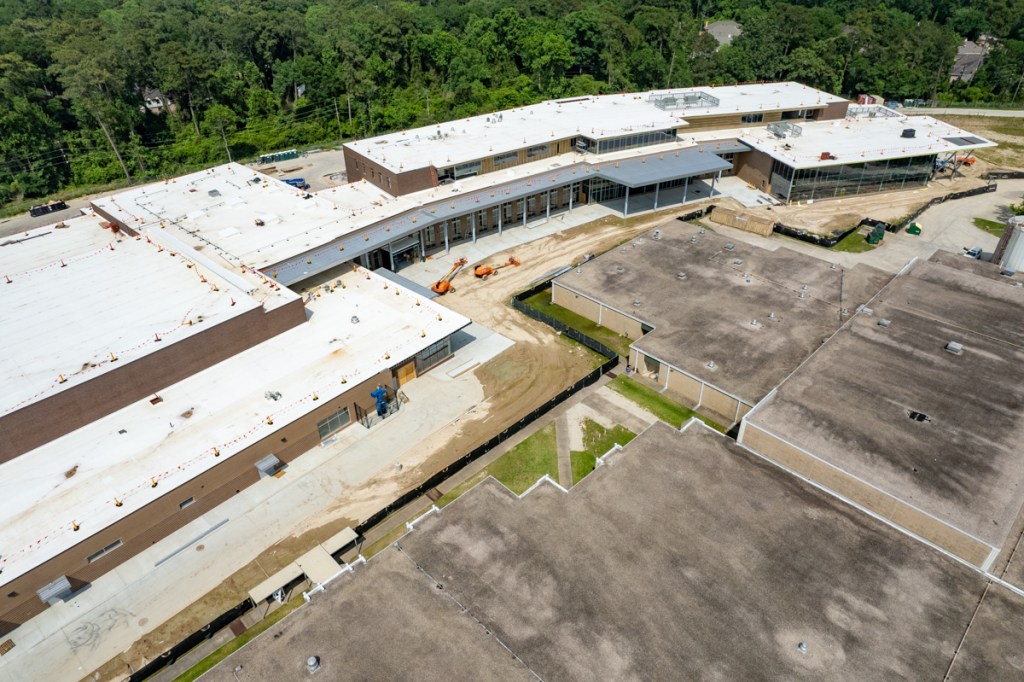
The new Kingwood Middle School is now being “glassed in,” at least the portions that are not brick. The glass will seal the interior from the weather outside and let new sets of contractors begin their work. Those include interior trades such as electricians, plumbers, painters, drywall, flooring and ceiling specialists. Since my last update on November 10, the contractors have made much progress. According to Humble ISD, the new school should open next August.

Once contractors have sealed the structure, the schedule no longer depends on weather and they can move much more quickly.

Multiple trades can work simultaneously in different parts of the building.

Progress in Photos

Here are pictures taken on 12/5/2021 that show the current status.

Approximately half of the exterior that will receive glass is already glassed in.
One of the entries. Exterior on right has not yet begun.
New Kingwood Middle School from over Woodland Hills Drive. The old school, right, will be torn down after this school year finishes.
Brickwork and roofing on the western portion of the building are almost complete. Some scaffolding remains for stonemasons on the opposite side of the building.
Construction moved from west to east. The eastern portions of the exteriors and roofing (right) are less finished.
Looking north to south. Once the old school is demolished (top of frame), athletic fields will be re-established in that area along with a permanent detention pond.
Looking SE at new Kingwood Middle School construction
The southeastern portion of the new Kingwood Middle School on Cedar Knolls still has a long way to go.

To compare previous monthly updates, search for “Kingwood Middle School”.

It was only a year ago that this site was nothing more than dirt and a dream.

To see architectural renderings of the new building when complete, see this page on Humble ISD’s web site.

Posted by Bob Rehak on December 5, 2021

1559 Days since Hurricane Harvey

Grand Parkway Extension is Getting There

TxDOT’s Grand Parkway extension (a.k.a. State Highway 99) is rapidly moving east and south toward I-10. As it arcs around the northeast quadrant of the Houston Metro Area, it will open up vast new areas to development. Below is a map showing several already under development.

New Developments Already Under Way

New developments that will take advantage of mobility improvements brought about by the Grand Parkway extension. From City of Houston Plat Tracker. Gray area is City’s Extra-Territorial Jurisdiction (ETJ).

East Fork Crossing: Tale of Two Bridges

Yesterday, as I was photographing different areas near Huffman and New Caney near the San Jacinto East Fork, I captured these shots of the Grand Parkway extension and FM1485. The Grand Parkway is still under construction in this area, but it’s rapidly getting there.

SH99 and FM 1485, looking northeast toward Colony Ridge and Liberty County.
SH 99 and FM 1485 looking north with San Jacinto East Fork running through middle of frame from top to bottom.
SH 99 and FM 1485 Looking east over San Jacinto East Fork

In March, this Grand Parkway in this area was nothing but dirt. By June, they were clearing land down to the Luce Bayou InterBasin Transfer Canal. Now it’s concrete as far as the eye can see. At least from the East Fork.

I’ve taken shots of this area before and am fascinated by the difference in the spans of the bridges. Part of what you’re seeing is the difference between standards for Farm-to-Market Roads and State Highways. But you’re also looking at the consequence of an increase in expected rainfall rates, more upstream development, and learning from experience. FM1485 frequently goes under water nowadays.

Detention Pond under Bridge: Permanent?

One of the curious things I noticed yesterday was a large detention or sediment retention pond under the bridge. TxDOT has rerouted the East Fork around it as you can see in the first and second photos. I wonder if they will keep it as a large detention pond under the freeway when they complete construction. Or whether they will return the river to its normal course and plant trees between the two roads as you see in the distance.

Stay Away During Construction

Traffic detours through this area are a nightmare. Stay away if you can. It took me an hour to get from here to Kingwood yesterday via 1485, 494 and US59 at 2:30 pm. The distance: only 7 miles as the crow flies.

Posted by Bob Rehak on 12/4/2021

1558 Days since Hurricane Harvey and 776 since Imelda