Willow Creek Widening and Stormwater Detention Basins Improving Tomball Drainage

Harris County Flood Control District (HCFCD) has a large active construction project underway in Tomball. Phase I of the project stretches about two-thirds of a mile from SH249 to FM2920 on a tributary of Willow Creek as it arcs around a major shopping center near downtown Tomball and Lone Star College/Tomball. The project includes channel widening and deepening; dry and wet stormwater detention basins; and opportunities for recreational trails.

Limits of Phase 1 are within red oval. Additional improvements (M124-00-00-E002) will extend further south to Willow Creek itself as additional money becomes available.

Willow Creek: A Study in Contrasts

The Willow Creek watershed is located in northwest Harris County. It drains about half of the City of Tomball. The tributary highlighted above flows through densely developed shopping and medical center areas on the northern end to agricultural and oil and gas interests on the lower end.

Looking SW at southern limit of construction toward agricultural and rural areas beyond. FM2920 leads into distance.
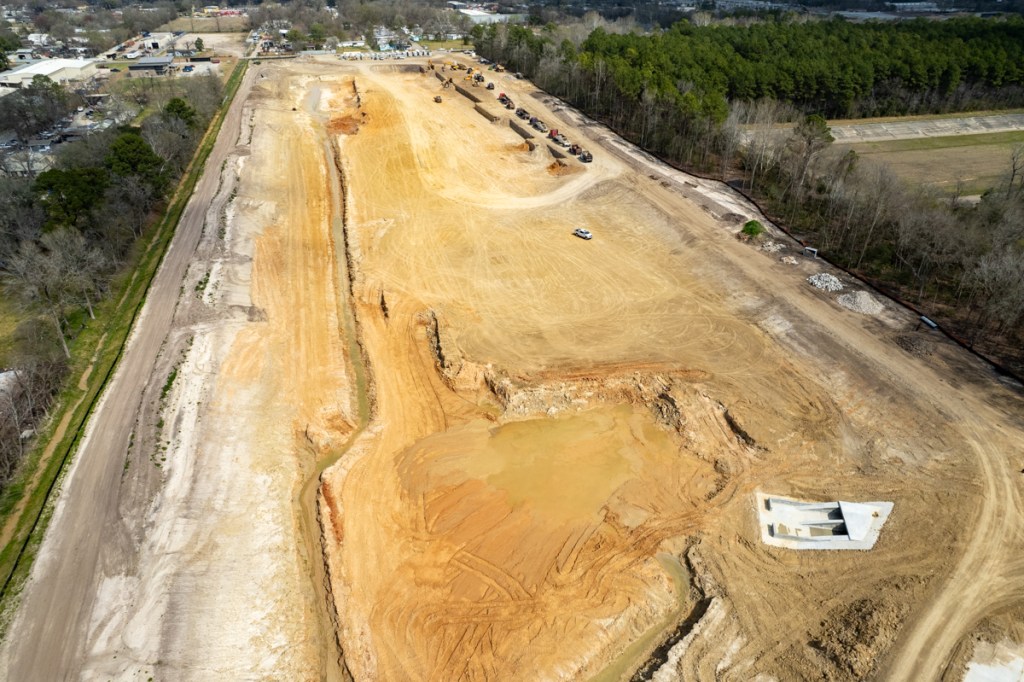
Looking NE in opposite direction toward area of channel widening and detention basins. SH249 cuts left to right across top of frame. FM2920 cuts through upper right corner. Tomball in upper right.
HCFCD contractors were hard at work on Christmas Eve afternoon when I took these shots.
Closer shot of detention ponds north of shopping center out of frame on the right.

Willow Creek: Present and Future

Willow Creek flows into Spring Creek just upstream of where Spring Creek crosses under I-45. The Willow Creek watershed covers about 54 square miles. The downstream end of the watershed is within the floodplain of Spring Creek.

Willow Creek Watershed and current HCFCD projects in various stages of completion. This post is about the one near the top center of the frame ending in E001.

Willow Creek watershed is mostly undeveloped. Significant development is limited to the City of Tomball and a few residential subdivisions in the lower end. The development rate has not been very rapid. However, officials expect it to increase as the City of Tomball continues to expand and urbanization from Houston stretches northwest.

This project will directly benefit mostly areas on the northwest side of the county. However, it may provide some downstream benefit by holding back water in major floods.

Goal: Contain Runoff from 100-Year Event

Phase 1 of this project began construction activities in January 2021. As funding becomes available, future phases of the M124-00-00 project will continue channel conveyance improvements and construct several more stormwater detention basins from F.M. 2920 to the confluence with Willow Creek. Phase II will also deepen the channel improvements from Phase 1 that you see above.

The overall goal of the M124-00-00 project is to enable the channel to contain the 1-percent (100-year) storm event within the channel banks based on existing watershed conditions.

HCFCD

The total project focuses on conveyance improvements of stormwater in the area, as well as reducing flood risk through construction of stormwater detention basins. Stormwater detention basins reduce flooding risks by taking in and temporarily storing stormwater during heavy rain events and releasing the water back into the waterways when the threat of flooding has passed.

Multiple new detention basins along the M124-00-00 channel will add approximately 390 million gallons of storage capacity (an approximate 2,164 percent increase in current storage capacity) to benefit the Willow Creek watershed. That’s enough to contain a foot of water falling on 1200 acres.

Posted by Bob Rehak on 12/26/2021 based on info from HCFCD.org

1579 Days since Hurricane Harvey

Emergency Petition Filed with Texas Supreme Court to Stop Ellis-3 Redistricting Plan

On 12/23/21, a group of petitioners trying to stop implementation of the Ellis-3 redistricting plan for Harris County took their case to the Texas Supreme Court.

Precinct 4 Commissioner Jack Cagle, Precinct 3 commissioner Tom Ramsey and their supporters filed their original lawsuit in District Court last November. They claimed the Ellis-3 redistricting plan was unconstitutional. They say it disenfranchised 1.1 million people of their right to vote for the commissioner of their choice in next year’s county election.

District Court Judge Brittanye Morris denied the plaintiffs a temporary restraining order on November 29. Judge Dedra Davis dismissed the entire case on Wednesday, December 22. Neither explained why.

Goal of Petition for Writ of Mandamus

Then on Thursday, December 23, 2021, Cagle, Ramsey and their supporters filed an emergency petition for a “writ of mandamus” with the Texas Supreme Court.

The petition, if granted, would compel Harris County Judge Lina Hidalgo, Precinct 1 Commissioner Rodney Ellis, and Precinct 2 Commissioner Adrian Garcia “to cease implementation of the illegal and unconstitutional Ellis 3 Plan for the upcoming election cycle” and pay all costs of the suit.

A writ of mandamus is literally a judicial command. It orders an official to perform a statutory duty.

The legal combatants: Cagle and Ramsey on the left, Hidalgo, Garcia and Ellis on the right, listen to people testifying at the 12/14/2021 Commissioners Court meeting about changing flood-bond priorities for third time in 2.5 years.

Elements of Petition

The 47-page petition petition for a writ of mandamus to the Texas Supreme Court begins by recapping the basis for the original lawsuit.

  • The 2020 census revealed population changes among districts that required redistricting.
  • It was possible to comply with the “one man, one vote” rule by transferring 4% of the county’s population.
  • But Hidalgo, Ellis and Garcia chose a plan that moved 48% and overstepped their authority.
  • That plan will deprive 1.1 million people of their right to vote for commissioner in the next election and likely tip the result from Republican to Democrat in one precinct, creating a 4-1 supermajority for Democrats.

The petition then recites more facts in the case, elements of the redistricting plan, legal precedents, issues and arguments.

The petition basically restates elements of the original District Court petition. However, for the Texas Supreme Court, it also lists precedents for writs of mandamus. Those were not an element of the original case.

Writs of mandamus compel lower court judges or government officials to perform the duties of their job. In this case, the petition was targeted at three local officials – Hidalgo, Ellis and Garcia.

Request to Expedite Petition

The petitioners also filed a 4-page request to expedite the case, citing the nearness of the next election.

The urgency explains why Cagle, Ramsey and their supporters skipped the normal intermediate step of filing an appeal. Because of the need to print ballots early in the year, time was simply not available. A writ of mandamus represents the only legal remedy they have available at this point.

Tik tok. Tik tok.

Posted by Bob Rehak on 12/24/2021

1578 Days since Hurricane Harvey

Redistricting Lawsuit Dismissed by Ellis-Backed Judge

A lawsuit by Harris County Precinct 3 Commissioner Tom Ramsey, Precinct 4 Commissioner Jack Cagle and their supporters that sought to overturn a redistricting plan devised by Precinct 1 Commissioner Rodney Ellis has been dismissed by an Ellis-backed judge, Dedra Davis.

How Ellis-3 Redistricting plan affects Lake Houston Area
In the Ellis-3 Redistricting plan, almost all of the Lake Houston Area including Kingwood, Humble, Atascocita, Huffman and Crosby will change from Precinct 4 to Precinct 3. Tom Ramsey will remain the Commissioner of Precinct 3, and will not be up for re-election in 2022.

Details of Redistricting Plan

The Ellis redistricting plan swapped the numbers of Precincts 3 and 4. It also redrew the boundaries of Precincts 3 and 4 so that Ramsey’s home and Cagle’s home changed precincts. The Ellis plan has two immediate effects.

  • It forces Cagle and Ramsey, both Republicans, to run in each others’ precincts because commissioners must live in the precincts they represent.
  • The number swap will deny voters in the new precinct 3 the right to vote for commissioner in the next election. That’s because only even-numbered precincts will vote in the next election cycle for commissioners. So the Lake Houston Area will not be able to vote for commissioners next year as it normally would have.

In addition, the plan redraws boundaries of the new Precinct 4 so that it becomes more Democratic. That jeopardizes Cagle’s chances of re-election and could shift the balance of power in Commissioners Court. Four Democrats could create a super-majority, enabling them to raise taxes at will.

A supermajority could also have far reaching consequences for flood mitigation by enabling Democrats to shift funds between watersheds as Adrian Garcia already tried to do.

TRO Denied, Then Lawsuit Dismissed on Plea to Jurisdiction

The plaintiffs sought a temporary restraining order (TRO) to block preparations for redistricting until the lawsuit could be resolved.

Judge Brittanye Morris (acting as an ancillary judge for Davis) denied the TRO on November 29 without explanation.

Hidalgo then filed a Plea to the Jurisdiction on December 13. In it, she pled that:

  • Plaintiffs lacked standing to bring the claims
  • She enjoyed sovereign (governmental) immunity
  • Plaintiffs did not plead a constitutionally valid claim
  • She was acting within her powers.

Yesterday, December 22, 2021, Judge Dedra Davis of the 270th District Court upheld Hidalgo’s plea to the jurisdiction and dismissed the lawsuit.

Judge Davis, who was supported in her election bid by Rodney Ellis, a key player in this drama, did not recuse herself. Nor did she cite any reasons for dismissing the case in her terse ruling.

Rodney Ellis and Judge Dedra Davis
Rodney Ellis and Judge Dedra Davis during her election bid.

Stage Set for Appeal

A spokesperson for Commissioner Jack Cagle’s office responded that the plaintiffs intend to file an appeal. However, because of the holidays, no other details were immediately available.

Posted by Bob Rehak on 12/23/2021

1577 Days since Hurricane Harvey

Regional Flood-Planning Group Seeks Small-Business Member

The San Jacinto Regional Flood-Planning Group is soliciting nominations for a voting member position in the Small Business Category. The primary responsibility: to assist in the development of a regional flood plan for the San Jacinto Watershed.

The San Jacinto Regional Flood Planning Group meets monthly and is one of 15 such groups in Texas.

Nominees who have a strong affiliation or interest with small businesses are encouraged to apply. As the Small Business voting-member, this individual will represent all small businesses within the San Jacinto Flood Planning Group region, and act in their best interests.

Fifteen regional flood-planning groups representing each of the major watersheds in Texas were formed after Hurricane Harvey to develop flood plans by January 2023. Jenna Armstrong, former president of the Lake Houston Area Chamber was the first small business representative to the Region 6 Flood-Planning group. She resigned her position with the Chamber last month to take a position with Waste Management.

How to Submit an Application/Nomination

Nominations may be made to the Region 6 – San Jacinto Regional Flood Planning Group Sponsor, Harris County Engineering Department, until Jan. 3, 2022 by 5:00 p.m.

Find the solicitation and application form on the SJRFPG website or at the link below:

Small Business Voting Member Solicitation and Application Form

Please complete the nomination form and email it to SanJacFldPG@eng.hctx.net or mail to the Harris County Engineering Department to:

ATTN: SJRFPG – Fatima Berrios

10555 Northwest Fwy, Suite 120

Houston, TX 77092.

For further information, please email SanJacFldPG@eng.hctx.net or call Fatima Berrios at (713)-274-3914.

Posted By Bob Rehak on December 22, 2021

1576 Days since Hurricane Harvey

Flood-Bond Update through End of November 2021

At the last meeting of Harris County Commissioners Court, Harris County Flood Control District (HCFCD) released a flood-bond update that shows spending through the end of November 2021. It provides a quick and easy way to see what your money is being spent on and where it is going. This differs from data reported recently from my FOIA Request. That data goes back to 2000 and looks at data pre- and post-Harvey, not just the start of the flood bond.

November Highlights

Below, some of the highlights from the November spending update:

  • Professional services invoices paid to date total $296 million. In November, payments totaled $338 thousand. Three quarters of that amount went to minority- or women-owned businesses.
  • HCFCD has awarded $354 million in construction contracts. Five more were awarded last month totaling $335 thousand.
  • Total spending since the approval of the flood bond through the end of November totaled $885 million. Of that, $447 million came directly from bond funds. Another $321 million came from grants. Other local funds totaled $117 million.
  • Three years into a ten year bond program, we’ve expended 17.9% of the anticipated total.
  • Home buyouts continue to drag out. HCFCD has completed 676, but 613 remain in the pipeline.

GANNT Charts Show Progress in All Watersheds

The San Jacinto River Basin has 10 active projects in various stages of development. Cypress Creek has 10. And Spring Creek has 4. To see what stage they are at, see the GANNT Charts on Pages 4 through 9.

Brays Leads Dollar Derby By Wide Margin

Brays Bayou still leads the dollar derby by a factor of two compared to the next three contenders. Brays has received $162 million flood-bond dollars to date. Cypress Creek, Addicks, and Greens Bayou have each received approximately half that. Then there are all others.

Where your flood-bond dollars have gone through the end of Nov 21..

This report PDF also contains maps that show:

  • Dollars spent in each watershed through the end of November.
  • Dollars funded in each watershed through the end of November.
  • Active maintenance projects and their values in December.
  • Active capital projects and their values in December.

The visual nature of this report makes it easy to see where your money is going at a glance.

Posted by Bob Rehak on 12/20/2021

1574 Days since Hurricane Harvey

Widening of Hunting Bayou Kicks into High Gear

Widening of Hunting Bayou, one of the poorest and most flood-damaged watersheds in the county, is kicking into high gear.

Annual Rate of Spending Almost Quadruples since Harvey

According to data obtained as part of a Freedom of Information Act (FOIA) request, Harris County Flood Control District and its partners (mainly the Army Corps and City of Houston), spent $44 million on flood mitigation in the Hunting Bayou watershed between 1/1/2000 and Hurricane Harvey.

That averaged $2.4 million per year for those 18 years. However, in the 4 years since Harvey, HCFCD has spent $37 million – more than $9 million per year.

That rate of spending averages 3.75X higher after Harvey than before.

HCFCD Spending Data Obtained via FOIA Request

Here’s a breakdown.

From FOIA Request. Hunting Bayou flood-mitigation expenditures by time period and category since 1/1/2000 through end of third quarter 2021.

Focus of Current Construction Activities

The upstream portion of Hunting Bayou parallels the south side of Loop 610 for most of its length. Where North Loop 610 turns south, Hunting cuts under it between McCarty and Wallisville Roads. From there it continues east. It then turns southeast at San Pedro Street and eventually joins Buffalo Bayou and the Ship Channel.

Note width of floodplains in red box. HCFCD is now widening Hunting between the left and right boundaries of the box. From Harris County Flood Education Mapping Tool. Blue = 100-year. Green = 500-year floodplain.

Poor, Industrial, Flat, Flood Prone

The Hunting Bayou watershed has the second highest percentage of low-to-moderate income (LMI) residents in the county (69%) after Halls Bayou (71%) immediately to the north.

Hunting also is heavily industrialized with rail yards, tank farms, manufacturing, and shipping companies. The highest points of land are the railroad tracks. Within the red box above, you can see how they affect the flood plain.

After driving around the neighborhoods along Hunting Bayou for an entire day, it appears that the worst storm damage is in the red box above. Many homes are boarded up and abandoned in this area. Others have been elevated. Some have been renovated and are waiting for the next flood.

Current Construction Photos of Bayou Widening Efforts

HCFCD bayou-widening efforts focus on this area right now. They extend from US59 on the west to approximately Wayside Drive on the east. Bayou widening may be an understatement. HCFCD appears to be creating a long series of connected detention basins, some more than 450 feet wide and several city blocks long that narrow at bridges.

This should help drain water from nearby neighborhoods during heavy storms. See pictures below all taken on Sunday, 12/19/2021. They generally trend from west to east, starting at US59 and heading downstream.

Looking east at first of numerous ponds along channel of Hunting Bayou. Photographed from over US59. Loop 610 is in upper left.
Looking east over Hunting Street. Loop 610 on left. Note new hike and bike trails in this and other pictures below.
Looking east from Kashmere Street at a previously excavated area now covered with grass and newly excavated areas beyond it.
Looking east from over Wipprecht Street at work in progress.
Looking east toward Lockwood from Pickfair Street and one of the constrictions mentioned above.
Closer shot of constriction at Lockwood.
Looking east from Hutcheson Park
Opposite angle. Looking west over expanse of Hutcheson Park. Loop 610 on right.
Looking NE from the eastern end of Hutcheson Park, where Hunting cuts under 610.
Looking NE from over Loop 610 toward Homestead Detention Pond in background. Kelly Street cuts left to right through top of frame.s
Looking east from over Homestead at limit of current downstream work.

Funding Flows to Damage

Altogether, the current excavation work stretches 3.33 miles.

In the last five major storms (Allison, Tax Day, Memorial Day, Harvey, Imelda), 15,763 structures have flooded along Hunting Bayou. That ranks 7th among all Harris County Watersheds. But one must remember, that Hunting, comprises only 31 square miles. That ranks it 19th in size out of 23 watersheds. The damage per square mile ranked #2 (508.5 structures).

Another reason spending has accelerated here is political policy – namely the Equity Prioritization Framework implemented a year after the flood bond passed.

As with other watersheds, such as Halls, Greens, Brays and White Oak, it’s virtually impossible to grasp the scope of construction from the ground. That’s one reason why people in these watersheds complain they get no help from HCFCD when they are.

To learn more about this and other flood-mitigation projects in the Hunting Bayou watershed, visit this HCFCD page and click on the projects in the left hand column.

Posted by Bob Rehak on 12/19, 2021

1573 Days since Hurricane Harvey

White Oak Bayou Gets A Makeover…Again

Since 2000, White Oak Bayou has received $386.8 million in Harris County Flood Control (HCFCD), federal, and local partner funding. That ranks it #2 in dollars received among all 23 Harris County Watersheds, second only to Brays Bayou at $544.5 million. Data received via a Freedom of Information Act (FOIA) request, showed that these two watersheds alone have received close to a billion dollars out of $3 billion spent between 1/1/2000 and the end of the third quarter this year. Said another way…

Two watersheds out of 23 received about a third of all HCFCD flood-mitigation spending in the last 22 years.

Analysis of Data from FOIA Request

I flew over Brays Bayou earlier this year and documented all the construction there. Friday, I droned White Oak Bayou from FM1960 to south of West Little York, a distance of more than 11 miles.

White Oak is difficult to photograph. As with Brays, homes and apartments back up to White Oak almost the entire way. They largely conceal most of it from public view except near bridges. Those homes and apartments also conceal the magnitude of construction from public view.

A Low-to-Moderate Income Watershed

Within the watershed, White Oak has slightly more low-to-moderate income (LMI) residents (51%) than those who earn above the average for the region. Other interesting stats:

  • It comprises 111.1 square miles. That ranks #6 among all watersheds.
  • White Oak has 468,214 people. That ranks #3 among all watersheds.
  • White Oak ranks #3 in total damage and #5 in damage per square mile.

Continuous Improvement for Decades

Money has poured into the White Oak watershed – as it has for Brays – because of the large number of flooded structures and associated damage. White Oak has had almost 26,000 structures flooded in the last five major storms – Allison, Tax Day, Memorial Day, Harvey and Imelda. That ranks it #3 in total damage among all 23 Harris County Watersheds.

And as we have seen repeatedly, funding flows to damage.

The 2018 Bipartisan Budget Act helped fund the latest round of construction shown below on White Oak as well as Hunting and Brays Bayous. All three started more than 20 years ago and advance sporadically as more money becomes available.

Fighting Constrictions of Development to Make Room for More Floodwater

The photos below show HCFCD’s and the Army Corps’ commitment to completing a number of major projects along White Oak. Residential and commercial developments pressing against the bayou along its length make that difficult. They leave little room for widening to accommodate more floodwater. As a consequence, HCFCD is forced to buy out whole subdivisions to make room for detention basins.

Regardless, I photographed an impressive amount of construction along the length of White Oak between FM1960 and West Little York. Below are 10 out of more than 120 photographs. I took them all on 12/17/2021.

White Oak Bayou widening and deepening. Photographed from Kari Court.

Note how close houses are to the channel. Making more “room for the river,” as the Dutch say, would require buying out many of the homes you see below. 

White Oak Bayou photographed from over Lewis Street.
Looking upstream at White Oak from Gessner
Looking downstream from Gessner. Another example of not leaving “room for the river.” t
Looking SW across large detention basin. White Oak cuts through top of frame from left to right. Fairbanks North Houston cuts through top of frame on right.
Looking NE from over Fairbanks North Houston. White Oak cuts through center of frame. Note Greenspoint on horizon, right of center.
White Oak near Antoine, looking S toward downtown and Galleria on horizon.
White Oak from Tall Pines Drive looking SE.
White Oak from Deep Forest Drive looking downstream.

Many Project Along Bayou Still Pending Buyouts

HCFCD currently has $45 million in ACTIVE construction projects underway in White Oak Bayou. But many more construction projects along the bayou are still pending buyouts to make way for more detention basins.

Of the $386 million spent on White Oak in the last 23 years, $235 million has gone to buyouts and right-of-way acquisition compared to $90 million so far for construction. White Oak buyouts have cost 2.6X more than construction. Normally, buyout and construction costs differ by only a few percentage points.

That tells you how how many homes and businesses are overcrowding the flood plain!

And that brings to mind my grandmother’s favorite saying, “An ounce of prevention is worth a pound of cure.”

The 2018 Flood Bond allocated more than $490 million for 16 projects in the White Oak Watershed. However, only $88 million has been spent since Harvey. So, White Oak will receive another $402 million before bond projects are completed. Eventually, White Oak conveyance improvements between 2000 and the end of the bond fund will total $788 million!

But at this point, we’re less than halfway there.

To learn more about HCFCD’s active projects in the White Oak Watershed, visit this page.

Posted by Bob Rehak on 12/18/2021

1672 Days since Hurricane Harvey

Strong to Severe Storms Could Bring 2 – 3 Inches Saturday

Jeff, Lindner, Harris County’s meteorologist, predicts strong to severe storms Saturday that could bring heavy rains. He says most locations will receive .50 to 1.5 inches of rain. But some isolated areas could see 2- 3 inches.

File photo: storms build when warm, moist air collides with cooler air. Rapid cooling turns the moisture into precipitation. And we could see a 40 degree drop tonight.

Near Record Warmth Again with Moist, Onshore Flow

According to Lindner, record and near record warmth will continue for one more day across the area before a cold front arrives on Saturday bringing temperatures back to near normal.

The combination of moist onshore flow and a warm start to today should elevate temperatures into the low 80s this afternoon. That will be at or near record highs again.

“Records have fallen at local climate sites nearly each day this week as the incredibly warm December continues,” says Lindner.

Colliding Cold Front from North

As a cold front from north Texas moves south tonight and into Saturday, widespread showers and thunderstorms will develop along and ahead of it. The very moist air ahead of the front will cause instability when it arrives. A few of the storms on Saturday could become strong to severe.

Heavy rainfall will be possible with the stronger storms. It currently appears that most locations will receive anywhere from .50-1.5 inches with some isolated totals of 2-3 inches. 

Jeff Lindner, Harris County Meteorologist

The front should move out into the Gulf by Saturday evening and temperatures will fall into the 40s, says Lindner.

Second Disturbance Arriving Sunday from Mexico

Yet another disturbance moving northeastward out of Mexico on Sunday will increase cloud cover and bring more light rains. But Lindner thinks most of the heavy rains will remain offshore. He predicts drizzle for much of the region on Sunday and Monday with temperatures holding in the forties and fifties. After that temperatures should increase again.

The current forecast for Christmas looks warm.

La Niña Likely Affecting Current Weather

Daily temperature records continue to fall at several climate sites both for highs and “warm” lows. This December is among the top five warmest Decembers at all local climate monitoring stations. And this is THE warmest December ever at Galveston.

Many records also fell on Wednesday across the central plains and Midwest. Wisconsin had the warmest December temperature ever recorded in modern times at 72.

The powerful storms that swept across the plains on Wednesday also brought the first ever recorded tornadoes in the month of December to Minnesota and Wisconsin.

The cyclical La Niña weather pattern that we are now in likely contributes to the record temperatures. La Niñas are typically warmer than El Niño patterns. The two alternate in the Pacific and influence patterns of the jet stream. NOAA and the National Weather service predict the current La Niña will continue through spring next year.

Posted by Bob Rehak on December 17, 2021, based on a report by Harris County Meteorologist Jeff Lindner

1672 Days since Hurricane Harvey

Biden Orders Simplification of Disaster Relief

On December 13 – 1567 days after Hurricane Harvey – President Biden issued an executive order to improve disaster relief by the federal government. The order covers a range of other government services, too. It aims to improve service service to citizens with the ultimate goals of improving customer satisfaction and restoring trust in government.

The White House says 25 million individuals, families, and small businesses live through a Federally recognized natural disaster each year. This should be great news for all of them. In the last four years, I have posted about the disaster called disaster relief more than once.

FEMA Mandate: Streamline Applications and Rules Re: Documentation

Specifically, the order states that theDepartment of Homeland Security’s Federal Emergency Management Agency (FEMA) shall “design and deliver a streamlined, online disaster assistance application. It also requires FEMA to “work with States to proactively update existing rules and policies on supporting documentation needed for disaster assistance processes to reduce burden and increase accessibility.”

Forest Cove Townhome destroyed by Harvey. What happens when 240,000 cubic feet per second roar through your home. When residents evacuated, survival was uppermost on their minds, not finding documents they might need for disaster-relief applications. FEMA chose this location to film a video about the destructiveness of Harvey.

HUD Required to Inventory Ways to Improve Customer Service

Unfortunately, the Order only mentions Housing and Urban Development (HUD) once and doesn’t offer many specifics. It requires HUD to submit a report to the Office of Management and Budget that assesses improvements needed in the department’s customer experience management and service design capabilities to comply with the order. The report must also prioritize improvements within available and budgeted resources.

Types of improvements mentioned throughout the order include:

  • Streamlining and improving accessibility
  • Improving digital experiences
  • Eliminating unnecessary administrative burdens on customers
  • Ensuring accessibility for those with disabilities
  • Ensuring access for those with limited English proficiency
  • Coordinating between agencies to reduce the need for customers to interact separately with multiple agencies.
  • Callback systems for those on hold
  • Enrollment assistance for benefits, etc.
  • Improving compliance with the Plain Writing Act.

Goal: Help People Focus on Recovery

This fact sheet prepared by the White House staff elaborates on disasters.

“After a disaster,” it says, “more survivors will be able to focus on helping their families, businesses, and communities because of streamlined assistance processes, rather than having to navigate a complex Government bureaucracy to get the help they need.”

“Disaster survivors will no longer need to navigate multiple assistance forms across multiple agencies to get the help they need, saving time and energy to allow them to focus on their recovery and well-being.”

“Survivors will have access to more flexible mechanisms to provide supporting documentation, such as virtual inspections and submitting photos of disaster damage from a mobile phone.”

The press release concludes: “The Government’s primary mission is to serve. By placing people at the center of everything we do, the Government will be able to deliver timely, modern, and secure services to you – the people. We will rebuild trust in our Government, ensure no one is left behind, and inspire others to join us in serving future generations of Americans.”

President Clinton had similar ambitions in the early days of the digital revolution. His plan helped transform government, but there’s still a long way to go. This sounds like a good deal if it works. But it will be a massive undertaking that takes place in stages over years, not overnight.

Posted by Bob Rehak on 12/16/2021

1570 Days since Hurricane Harvey

TCEQ Approves New Best Management Practices for San Jacinto Sand Mining

This morning, the TCEQ approved new Best Management Practices (BMPs) for Sand Mining in the San Jacinto Watershed. The effort to inventory, establish and publish BMPs for sand mining began shortly after Harvey. This web site contains thousands of pictures and 210 posts about area sand mine operations.

But the real credit for today’s agreement goes to:

  • The Lake Houston Area Flood Prevention Initiative (FPI)
  • Bill McCabe and Dave Feille (now deceased), two FPI steering committee members
  • Dianne Lansden, FPI founder
  • The Bayou Land Conservancy
  • Bill Dupre, professor emeritus in Geology from the University of Houston
  • State Representative Dan Huberty.

Others, too numerous to mention also picked up the baton and worked tirelessly for years to reach an agreement with the sand miners.

West Fork Sand Mine that will be affected by new best management practices. Photographed in August

McCabe composed the short article below that describes the significance of today’s events.


History of Project

The Lake Houston Grassroots Flood Prevention Initiative (FPI) formed shortly after Hurricane Harvey, led by a group of citizens concerned with the area’s future.  Its goal: to seek out and remedy issues that made Harvey’s flooding more devastating than expected. Early on, one issue became evident as a major area of concern for future floods —the effect of sand mining on sediment and pollution in the San Jacinto Watershed.

We had looked at litigation, legislation and negotiation solutions as ways to address this situation. Other groups were already pursuing Litigation and Legislation. So, we decided to address the future through negotiation with the sand-mining industry.  

Negotiation with TACA

We contacted the Texas Aggregates and Concrete Association (TACA), the industry representative for sand miners, and began negotiations on Best Management Practices (BMPs).  

Starting with a blueprint of Best Management Practices for sand mining developed by other states, we re-formulated them to fit the Texas situation. For several months FPI, TACA, and other groups and individuals worked on a document we could present to the Texas Commission on Environmental Quality (TCEQ).  Many individuals, including Representative Dan Huberty, Jill Boullion with the Bayou Land Conservancy, and former City officials from Humble and Kingwood, worked with us to fine tune a document for presentation.

Because TACA and FPI could not fully agree on the requirements for sand mining BMPs in the San Jacinto River Watershed, we presented separate Petitions to TCEQ. TACA presented its on June 12, 2020. FPI presented its a week later.  

Scope of Petitions

Although they differed in several key areas, both Petitions followed the same basic pattern. We focused on a three part approach: Pre-mining, Mining and Post mining.  

Following submittal, TCEQ conducted a series of stakeholder meetings and public input requests. The Commission fine-tuned our proposals and developed its own Rules and Guidance Documents.  

View the original Petitions and subsequent modifications on the TCEQ website. See Rulemaking: Best Management Practices for Sand Mining in the San Jacinto River Watershed – Texas Commission on Environmental Quality – www.tceq.texas.gov.

Final Approval, a Good First Step

On December 15th, TCEQ Commissioners approved the new BMP Rules document. It will become effective early next year. Although we did not get everything we would have wished for, this is a very good start and will help to hold sand miners to an accountable standard in the future.  

Between the Rules Document (Subchapter J, Best Management Practices for Sand Mining Facility Operations Within the San Jacinto River Basin, Sections 311.101 – 311.103 of 30 TAC Chapter 311, Watershed Protection) and the associated Guidance Document developed by TCEQ, we now have a comprehensive standard for the sand-mining industry to follow.

By Bill McCabe on 12/15/2021

1569 Days after Hurricane Harvey