Tag Archive for: HCFCD

How Stormwater Detention Basins Work

Stormwater detention basins work by storing excess stormwater temporarily until channels can safely carry it away. Water enters the basin quickly during heavy downpours. But the basin releases it slowly at a steady rate that channels are designed to carry. This helps reduce the risk of flooding.

Harris County is so flat that dams are not often options. Therefore, virtually all of our stormwater storage has to be excavated.

Harris County Flood Control District

Willow Water Hole Example

The Harris County Flood Control District (HCFCD) detention basins typically cover several hundred acres and service regions. Willow Water Hole just outside the southwest corner of Loop 610 on a tributary of Brays Bayou is an excellent example.

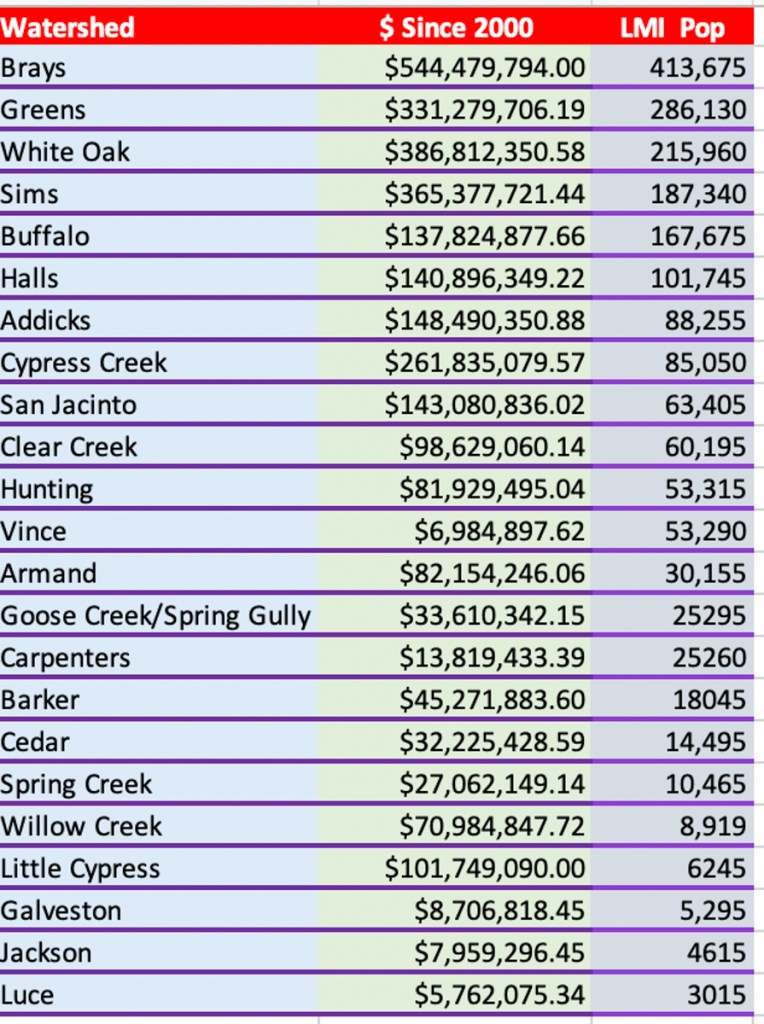
The 279-acre Willow Waterhole has six compartments. Willow is part of the Brays Bayou Federal Flood Damage Reduction Project (Project Brays), a multi-year, $550 million project that substantially reduces flooding risk in the Brays Bayou watershed. The project is a cooperative effort between the Harris County Flood Control District and the U.S. Army Corps of Engineers. 

Willow Waterhole Detention Basin Complex in SW Houston has six compartments.

Why the Need?

As areas develop, buildings and concrete cover up soil, so stormwater can’t sink into the ground. Water runs off concrete faster than it does from native grasslands. When that water all hits channels, streams and bayous simultaneously from different directions, it exceeds the carrying capacity of the channel. And homes flood.

Many, but not all, new developments use stormwater detention basins to offset that negative effect.

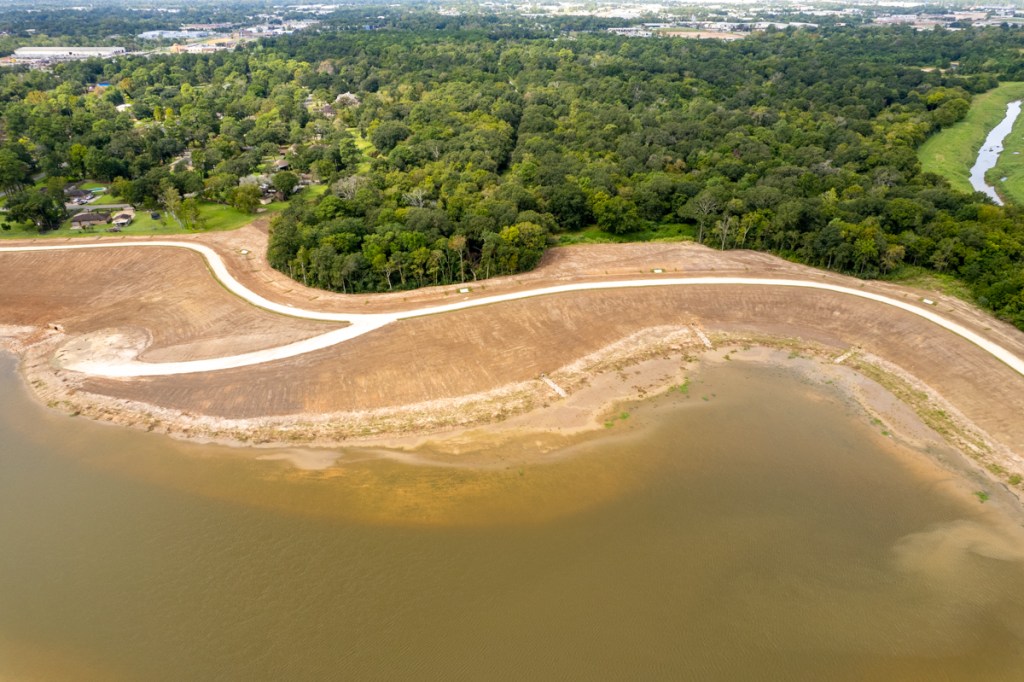
When full, detention basins often resemble lakes. When dry, detention basins look like large excavated open space areas. The Willow Water Hole is normally dry. Yesterday, however, it contained water from recent rains and the low (seasonal rate of evaporation).

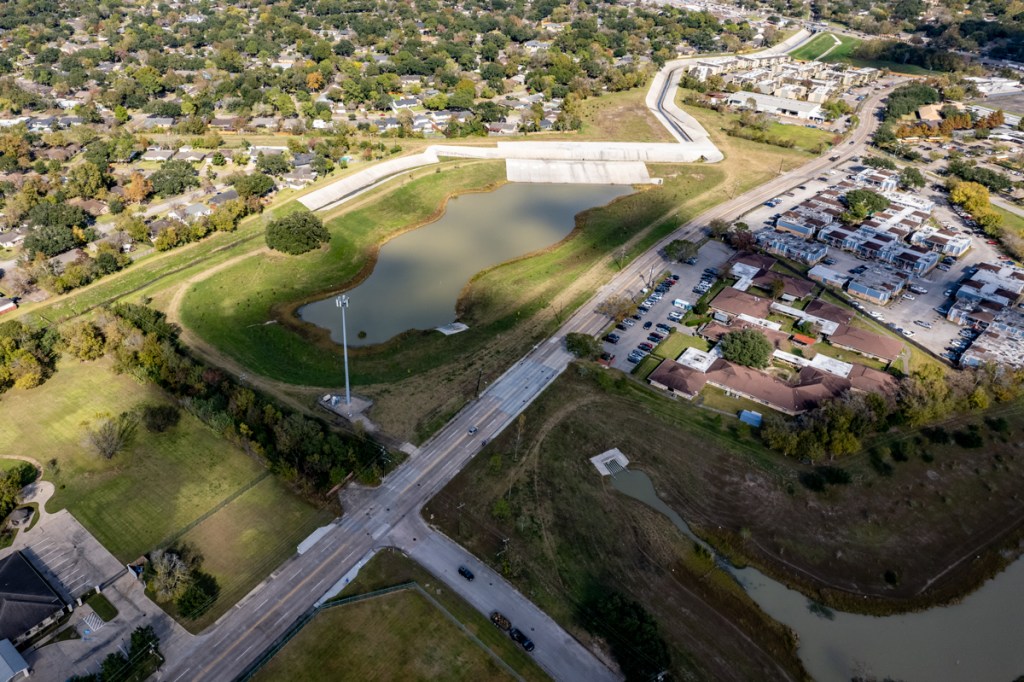
Two of the compartments bracket South Willow Drive. See location above.
Note the weir (discussed below) leading to the channel.

Some systems have water in them permanently, so they resemble small lakes. These provide flood storage between the normal surface of the lake and the top of the bank. See the difference in the photograph below.

Willow Water Hole southwestern pond. Note extra capacity between the top of the water and the top of the banks.

Detention? Retention? Which is It?

A detention basin normally has a dry bottom. It holds excess stormwater temporarily.

A retention basin always has a wet bottom. It stores water indefinitely. Retention basis normally have no outlet. Evaporation and infiltration usually keep the lake levels manageable.

The Harris County Flood Control District always builds and uses detention basins. Developers more likely will use retention ponds and market the resulting “lakes” as residential amenities.

HCFCD owns approximately 70 large regional detention basin sites throughout Harris County. They supplement hundreds of smaller developer-built basins. Countywide, these basins hold billions of gallons of stormwater during heavy rainstorms. 

Two northeastern retention ponds within Willow Water Hole complex on either side of South Post Oak Road.

How Water Gets In

Sometimes HCFCD designs stormwater detention basins with a weir (visible in the first and second drone photos above). The weir, or low dam, lets stormwater rising in the channel spill into the detention basin when it reaches a certain height. Other detention basins have no weirs. They are simply open to a channel. In this case, stormwater fills the basin as it rises in the channel.

But there’s also a third alternative for stormwater detention basins, i.e., those not near a channel. Storm sewers and/or sheet flow fill these detention basins. “Big pipes in – little pipes out” is the rule in this instance. The basin gets the water away from streets and homes quickly. Then lets it drain off slowly.

How Water Gets Out

HCFCD typically designs detention basins to drain by gravity, as opposed to using pumps. This lets basins function when power goes out, a frequent occurrence during floods.

In ponds that drain by gravity, depth of the drain (outfall) is dictated by the depth of the receiving channel. The rate at which stormwater drains depends on the stormwater level in the receiving channel. Typically, stormwater drains out of the detention basin after channel levels recede.

Complex engineering calculations determine the volume of stormwater that a detention basin must hold to protect surrounding homes and businesses. That volume, usually measured in acre-feet, determines the width, length and depth of a basin. The amount of time stormwater stays in a basin depends on levels in the receiving channel and how full the basin got. In Harris County, detention time is usually measured in hours, not days.

How the Process Works

Normal Flow

When there is normal flow in a bayou or channel, the detention basin is generally empty.

Initial Storm Effects

Basins begin to fill as bayous or channels rise, or as surrounding developments drain into them through storm sewers.

Capturing the Flow of a Heavy Storm

As water continues to fill the detention basin, it spreads out into the excavated area. Often culverts connect multiple “compartments” within a larger basin, as above.

Detaining the Flow

By holding water in the detention basin, it does not flood homes and businesses downstream.

Draining Detained Water

As the level of the channel recedes, the channel water level drops and lets the basin drain, but only as fast as the channel can handle it.

Back to Normal Flow

With the water level in the channel normal, the basin is once again empty and ready for the next rainstorm.

End Result

Often, HCFCD partners with local groups, such as the Houston Parks Board, to build trails around these ponds that provide a retreat from busy city life. Areas such as Willow Water Hole also provide habitat for birds. People out for a stroll or a jog may think they are in a beautiful park and not even realize the role it plays in reducing flood risk.

Posted by Bob Rehak on 12/2/2021 based on information provided by HCFCD

1556 Days since Hurricane Harvey

HCFCD Continues Relentless Expansion of Cutten Basin on Greens Bayou

Where Greens Bayou cuts across the northwest corner of Beltway 8 and 249, Harris County Flood Control District is expanding its Cutten Regional Stormwater Detention Basin.

Location of HCFCD’s Cutten Floodwater Detention Basin
The basin includes 5 separate Basin Compartments (BCs). One is on the north side of the Bayou (BC5) and four are on the south side (BC1-4).

The $16.2 million expansion will add 866 acre-feet of stormwater storage capacity to the previous 677 acre-feet. That’s enough to lower the water surface elevation by .36 feet throughout the surrounding floodplain.

When complete, the 235-acre complex will have enough capacity to hold a foot of stormwater falling over 2.4 square miles.

Photos Taken 10/15/2021 Show Current Construction Status

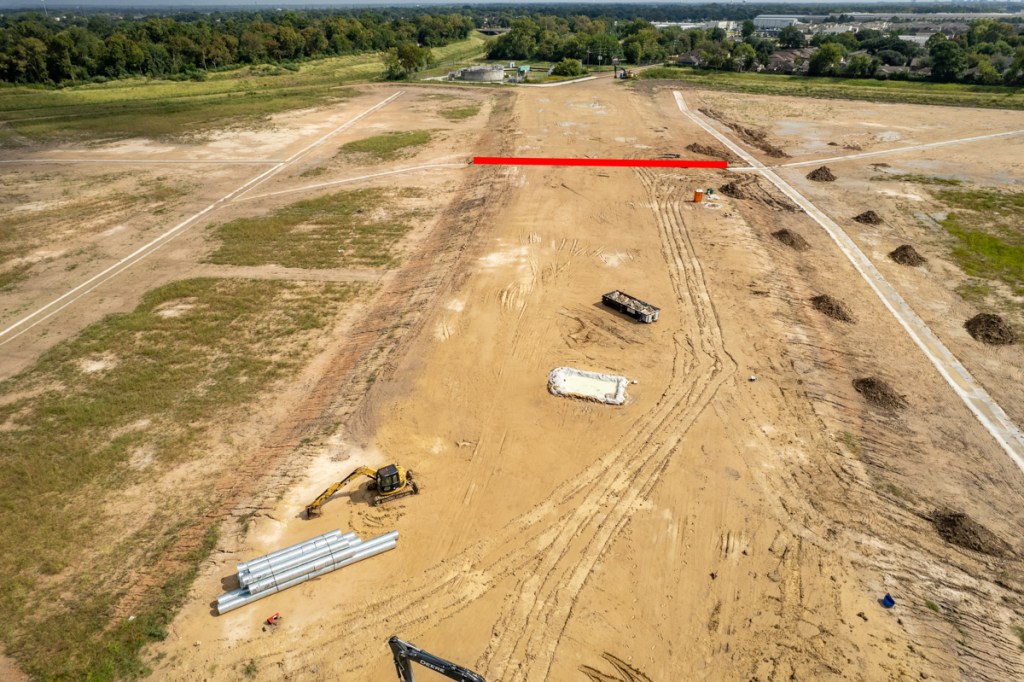
Looking E at the extension of Greens Road between BC3 (right) and BC4 (left). Red line indicates path of culvert under roadbed.
Looking W in opposite direction. Greens Bayou is on right. Greens Road (coming from top of frame) will be extended south along ridge that bisects BC3 and BC4 in foreground. BC1 and BC2 are in background on either side of Greens Road. Hollister cuts through the frame from left to right.
Looking NW across Hollister toward yet another detention pond, BC5.
Looking SW across the intersection of Hollister (left) and Greens Road (right). Excavation of BC1 still has a way to go. On Friday, muddy conditions were slowing down the work, but if you look closely, you can still see heavy equipment working in the distance.

How Ponds Will Work with Bayou, Surrounding Developments

These ponds will function two ways. They will take stormwater:

  • Out of Greens Bayou when it starts to overflow.
  • Directly from surrounding subdivisions before it gets into the bayou.

This presentation describes more about the Cutten Basin.

It’s important to understand that County/Municipal neighborhood drainage and HCFCD infrastructure often pre-date current building and development codes, as they do in this area.

As cities and precincts re-grade and reconstruct streets with more and bigger storm sewers that get water out of neighborhoods faster, that water needs a place to go – without flooding others downstream.

In this area, these ponds will be that place. Everything has to work together. The very first sentence of the Texas Water Code Section 11.086 states, “No person may divert … surface waters in this state … in a manner that damages the property of another…”

Stormwater detention basins like these also provide greenspace and recreational opportunities, such as public parks.

HCFCD expects to complete the Cutten Project in the summer of 2022.

Cutten Basin Size in Perspective

To put the size of this basin in perspective, it roughly equals the size of Woodridge Village. Woodridge is the aborted Perry Homes development in Montgomery County. HCFCD purchased it earlier this year to build a regional Stormwater Detention Basin on Taylor Gully in the Porter/Kingwood area.

The Woodridge site already contains five small detention ponds and HCFCD has room in the center to add more. Perhaps the Woodridge site will look somewhat like this one before things are all over.

Cutten is one of six detention basins (Cutten, Antoine, Kuykendahl, Glen Forest, Aldine-Westfield, Lauder) either recently constructed or almost constructed by the Army Corps and HCFCD in the mid and upper reaches of Greens Bayou. HCFCD is also studying a number of flood mitigation projects on the lower reaches of Greens.

Posted by Bob Rehak on 10/16/2021

1509 Days after Hurricane Harvey and 758 since Imelda

Aldine-Westfield Detention Basin Phase 2 Construction Starting Along Greens Bayou

In April this year, I posted about Harris County Flood Control District’s (HCFCD) completion of the Aldine-Westfield Detention Basin Phase 1 along Greens Bayou. Now construction of Phase 2 is starting. It’s currently in the clearing phase.

The basin sits east of Aldine-Westfield Road at Beltway 8 North just south of Bush Intercontinental Airport.

Aldine Westfield Basin layout
Aldine-Westfield Basin location

Photos from April and October

Here’s how that looks from the air.

Looking NE from over Beltway 8 and Aldine-Westfield Road in a helicopter in May. Phase 1 in foreground had just been completed. Red rectangle indicates approximate location of Phase 2 which had not yet started. Note airport in background and Greens Bayou in foreground.

I didn’t have a helicopter this morning and I wasn’t able to safely launch a drone because of air traffic. However, I did manage to grab some ground-level shots from the entrance to the Phase 2 construction site on Aldine-Westfield road.

Photo taken on 10/15/2021 from Aldine-Westfield Road shows that clearing of Phase 2 has begun. The site is currently in the clearing phase.

The photo above was actually stitched together from seven shots in Photoshop. In person, the area cleared looks much larger than it does above. Here’s another shot of the area taken from the air back in April that better shows its size.

Photo of Phase 2 area (right) taken in April this near. Note the pipeline corridor (left of center) that bisects the property.

About HCFCD’s Excavation and Removal Program

HCFCD has owned both portions of this site for years. They have been part of the District’s Excavation & Removal Program since 2005. The program lets contractors take and use dirt from the site for other projects outside of the floodplain – at no cost to the District or taxpayers.

Now, however, the Aldine-Westfield project is kicking into higher gear thanks to 2018 flood-bond dollars.

Details About Aldine Westfield Project

This two-phase stormwater detention basin will reduce the risk of flooding in the mid-reach stretch of Greens Bayou by taking in excess stormwater during heavy rain events and then releasing it slowly back to the channel when the threat of flooding has passed.

Phase 1 holds approximately 667 acre-feet of stormwater and Phase II will hold another 600 acre-feet. Two 5’x4′ reinforced concrete boxes will connect the two phases and outfalls into Greens Bayou.

Together, the two basins will have enough capacity to hold a foot of rain falling over 2 square miles.

Phase 1 cost $7.4 million and Phase 2 will cost $12.2 million, for a total of almost $20 million.

Part of Larger Greens Bayou Plan

The Aldine Westfield Stormwater Detention Basin is part of a comprehensive flood risk reduction plan for the mid-reach stretch of Greens Bayou. That plan includes construction of 11 miles of channel conveyance improvements and four stormwater detention basins:

This presentation, created a little more than a year ago, describes how the improvements discussed above will work in conjunction with several other subdivision and bayou drainage improvements.

The subdivision drainage improvements will be handled by the Harris County Engineering Department. They include increasing the capacity of storm sewers and curb inlets, repairing outfall pipes, and reconstructing roadside ditches. In the Humble area, subdivisions scheduled for the improvements include Fountainview Sections 1 & 2, Humble Road Place, and Parkland Estates. These subdivisions are just south of Beltway 8 near US59.

Areas Removed from 10- and 25-Year Floodplains

This community presentation from 2019 explains more about the benefits. It includes the two maps below.

The light blue shows areas that will be REMOVED from the 10-year floodplain. The dark blue shows areas that will remain in it.
Likewise, light blue represents areas REMOVED from the 25-year floodplain.

Posted by Bob Rehak on 10/15/2021

1508 days since Hurricane Harvey and 757 since Imelda

Phase I of Giant Lauder Detention Basin on Greens Bayou Nears Completion

Phase I of the giant Lauder Detention Basin on Greens Bayou is nearing completion. The 90-acre Phase I of the project will cost approximately $18 million when complete. Excavation and grading are now finished but landscaping still remains on the to-do list for most of the site. It’s come a long way since I photographed this project in July.

Harris County Flood Control District gave this project the name C34. It’s project ID is P500-06-00-E005. These alpha-numeric descriptions do little to communicate the beauty of this massive pond complex. See below.

Phase I Lauder Basin Photos Taken 10/12/21

Looking south from over Greens Bayou (right). HCFCD contractors have begun to plant grass, but much still remains to plant including trees. Also, the ponds will have aquatic plants that improve water quality.
Looking north from north pond. Culverts will convey stormwater at a controlled rate from ponds to Greens Bayou at top of frame. The cut through the tree line by the bayou appears to be an overflow spillway.
Water flows from one pond into another within the 90-acre complex.
Looking south toward Lauder from north end of pond. That’s JFK Blvd. in the upper left.
Looking south from the Lauder Road entrance to the pond complex in Phase 1. That’s Aldine ISD’s Mead Middle School in the background. Note the drainage ditch running off into the distance and read the caption below.
Looking north from Lauder Road. Notice how water from the ditch above (P138-01-01 in map below) is channeled into ponds now at the lower left instead of going directly to Greens Bayou. Also note excavation equipment being loaded on flatbed trucks for removal.

The Flood Control District has received an $11.5 million grant from the U.S. Natural Resources Conservation Service to help construct these ponds.

Phase II Still Being Designed

The detention basin shown above was purchased by the Flood Control District as undeveloped land in 2000. However, Phase II required buyouts.

Looking west from over Phase I. Phase II when complete will occupy the wooded area in the upper right.
Phase 1 is on right (E005), Phase 2 on left (E006). Phase 1 is in its final stages. Phase 2 is still in the design phase. Notice how each pond detains water from long channels before releasing it into Greens Bayou.

Phase II is immediately west of Phase I. It will be located on the property of the former Castlewood Subdivision, Sections 1 and 2. HCFCD completed preliminary engineering for Phase 2 in January 2021. The project is now in the design phase. It is budgeted for $20.5 million and scheduled to start construction in the summer of 2022.

Castlewood was built in the early 1960s in the Greens Bayou floodplain. It was also built in a former floodway of Greens Bayou before the bayou was rerouted and straightened circa the 1950s. Development occurred many years before the advent of Harris County’s first floodplain maps and associated development regulations in the 1980s. Since the late 1970s, there have been more than a dozen recorded flood events in the area.

Artist’s rendering of pond layouts from HCFCD community presentation. When complete, these basins will offer healthy recreational opportunities for area residents.

Together, Phases 1 & 2 comprise more than 200 acres – an area about 25% larger than Kingwood’s largest park – East End Park.

When complete, the ponds in both phases will have enough capacity to hold a foot of water falling across a two-square mile area. That’s water that won’t be going into Greens Bayou immediately during a big storm.

Posted by Bob Rehak on 10/14/2021

1507 Days since Hurricane Harvey

TWDB To Vote on Accepting $63.6 million in FEMA Flood Mitigation Assistance Grants

In its October 7, 2021, board meeting, Texas Water Development Board members will vote on whether to accept $63.6 million in FEMA Flood Mitigation Assistance Grants. The federal funding comes with some strings attached: a $10.23 million local match.

For this round of funding, the TWDB selected 19 sub-applications from local government entities. After screening, FEMA eliminated 6 and identified 13 “for further review.”

Here’s a summary from the TWDB of what they will vote on.

From TWDB Agenda for October 7, 2021

What are Flood Mitigation Assistance Grants?

FEMA’s Flood Mitigation Assistance Program provides competitive grants to local governments for projects that reduce or eliminate the risk of repetitive flood damage to buildings insured by the National Flood Insurance Program.

FEMA chooses recipients in part based on cost-effectiveness (benefit/cost ratio).

Often, local governments, such as cities or counties, bundle individual applications as MoCo did to buy out Tammy and Ronnie Gunnel’s home and dozens of others as we saw in yesterday’s post. That home flooded 13 times in 11 years and cost NFIP at least three quarters of a million dollars.

In a sense, most of these grants are designed to cut FEMA’s losses.

Summary of Each Local Application

Attachment B to the agenda gives a rundown on each of the projects under consideration. See below.

Harris County Drainage Project in Bear Creek Village

Bear Creek Village is located on the west side of the Addicks reservoir near Highway 6. This is an $11.3 million project of which the federal government would pay $8.5 million.

The Harris County project would mitigate 1,421 structures. The current storm sewer system is designed for a 3-year event and is inadequate to collect and drain extreme event runoff. The proposed drainage improvements are intended to provide an additional flow path, so that excess storm water is contained within street right-of-way to an outfall. The project will incorporate a combination of channel construction, street regrading, and enhancement of outfalls. The project has a positive Benefit-Cost Ratio of 1.09.

Harris County Flood Control District Single-Family Home Acquisitions

Total cost = $16.7 million with federal government paying $14.7 million.

Harris County Flood District seeks to mitigate 61 structures: 23 Severe Repetitive Loss structures, 17 Repetitive Loss structures, and 21 at risk of continual future flooding. HCFCD would acquire and demolish structures, then convert the land to open green space. The project has a positive Benefit-Cost Ratio of 1.09.

Harris County Flood Control District Commercial Acquisition

This is a $3.7 million buyout with the federal government picking up the whole tab.

Harris County Flood Control District wants to buy out a hotel on the east freeway with a severe repetitive loss history. HCFCD would demolish the property and convert the land to open green space. The project has a positive Benefit-Cost Ratio of 1.84. The grant application notes that since 1979, FEMA has paid out $8 million in NFIP claims on this property.

City of Houston Single-Family-Home Elevation Project

Total Cost $1.5 million (all paid by federal government) to elevate 5 severe-repetitive-loss homes ($300,000 each). All would be elevated at least 2 feet above the 500-year floodplain. That would hopefully reduce or eliminate future NFIP claims. The project has a positive Benefit-Cost Ratio of 1.1.

Jersey Village Single-Family-Home Elevation Project

Total Cost $4.9 million with federal government covering $400,000.

Jersey Village seeks elevate 16 structures: 10 are Severe Repetitive Loss, five Repetitive Loss and one at risk of continual future flooding. Elevation will raise structures one-foot above Base Flood Elevation per the City’s freeboard requirements. The project has a positive Benefit-Cost Ratio of 1.32.

Montgomery County Single-Family-Home Acquisition and Demolition

Total Cost = $12.6 million with federal share of $12.4 million.

Montgomery County seeks to mitigate 40 flood prone structures (31 Severe Repetitive Loss and 9 Repetitive Loss structures) by acquisition, demolition, and the conversion of land to open green space. The project has a positive Benefit-Cost Ratio of 1.36.

Tammy Gunnels’ Home in Porter is an example of a Severe Repetitive Loss Home. It flooded like this 13 times in 11 years and was bought out yesterday as part of another Montgomery County grant. Before the buyout, it cost FEMA more than 3 times its fair market value and would have continued flooding had nothing been done.
Pearland Single-Family-Home Elevation Project

Total Cost $500,000, all covered by federal government.

The City of Pearland seeks to mitigate two Severe Repetitive Loss structures by elevation one-foot above the Base Flood Elevation per the City’s freeboard requirements. The project has a positive Benefit-Cost Ratio of 1.08.

Taylor Lake Village Single-Family-Home Elevation Project

Total Cost $2.77 million with federal government covering $2.75 million.

Taylor Lake Village wants to elevate eight Severe Repetitive Loss structures and one Repetitive Loss structure one foot above the 100-year flood level. The project has a positive Benefit-Cost Ratio of 3.1.

In each of the projects above, the owners have all voluntarily committed to the elevation or demolition of the structures.

Recommendation of TWDB Staff

The Executive Administrator of the TWDB recommends that his board approve all these grants. This program meets the agency’s objectives of providing financial assistance to communities to reduce or eliminate the long-term risk of flood damage and to become more flood resilient.

Meeting Details

The Board meeting will be held on Thursday, October 7, at 9:30 a.m. via GoToWebinar  If you wish to address the Board, please fill out the visitor registration form and send it to Cheryl.Arredondo@twdb.texas.gov no later than 8:00 a.m. on October 7. For more information, please visit the TWDB’s website.

Posted By Bob Rehak on October 7, 2021

1495 Days since Hurricane Harvey

CoH Public Works Asking for More Details on Kingwood Cove Golf Course Conversion

The City of Houston Planning Commission was to have considered plat approval on September 30th for redevelopment of the old Kingwood Cove Golf Course acquired by Ron Holley and his FLOG Partners. However, I learned late today from District E Councilman Dave Martin’s office that Planning Commission staff is recommending postponing the public hearing until at least the next regularly scheduled meeting on October 14th.

The Planning Department Staff met with Houston Public Works staff. Reportedly, the applicant has not yet provided all the information necessary for Publics Works to review the application.

Drainage Study Reportedly Not Detailed Enough

According to Martin’s office, Holley’s people submitted a drainage study for the Kingwood Cove development. However…

“Public Works indicated that it needed a more detailed analysis.”

Spokesperson for District E Council Member Dave Martin

Therefore, Planning Department Staff will reportedly recommend to the Planning Commission that Commissioners postpone the public hearing. This will likely happen in the meeting itself when the agenda item is called. But a delay is not automatically guaranteed.

As of this afternoon, approval of the Kingwood Cove plats was still on the agenda.

If Delayed, October 14 Next Possible Date

If the applicant were to provide all required information immediately so that staff could review and provide recommendations, the earliest date for reconsideration would be October 14th (the next meeting following September 30).

The Planning Commission posted Holley’s current plans in two places:

  • A 24-page abbreviated version as part of the agenda
  • The 238-page full submission at a special link.

Holley’s plans are #133 on the Agenda. I’ve extracted the 24 relevant pages to make file size manageable (2.5 megs).

The full submission is much larger but I compressed the file size from 75 megs to 50 megs. It includes the drainage analysis.

I haven’t had time to review the entire set of plans yet, so I’m including them all here for you to review. However, I did note several items that may explain why Public Works raised questions.

No HCFCD Check Off Yet

Apparently, no one from Harris County Flood Control District (HCFCD) has reviewed or signed the drainage plans yet. Note how the signature blocks are empty.

No Public Works Check Off Yet

Also note empty signature blocks on Page 58 of 238 page PDF.

Beat-the-Peak Method Employed in Flood Calculations

The Kingwood Cove engineers apparently used the beat-the-peak hydrologic-timing method to support their claim of “no adverse impact.” They also based their calculations on profiles developed from 2001 LIDAR data and a 2012 model of the river basin.

Harris County and City of Houston have been urging upstream counties to abandon the beat-the-peak methodology for years now, in part because it does not take into account upstream developments since the last models were developed. It also allows developers to understate the amount of runoff subject to detention requirements.

Wrong Detention Ratios Apparently Used

The project engineers say on page 52 of the 238-page PDF that they based their conclusion of “no adverse impact” on a floodwater detention ratio of .55 acre feet of detention per acre. But the City requires .65 acre feet per acre. So does HCFCD. Thus, the capacity of the detention pond appears to be understated.

Detention Pond Just 2.5 Feet Above Normal River Level

All the detention is located next to the floodway, where it could quickly become overwhelmed by rising floodwaters.

According to the Kingwood Cove plans (page 47 of full set) the water surface of the detention pond would be at 47 feet. That’s just 2.5 feet above the normal river level and six feet below the parking lot for the golf course (according to the USGS National Map elevation profiler). It’s also 2.3 feet below the level where West Fork flooding becomes likely, according to the gage data at US59.

Floodway Boundary Will Likely Soon Change

FEMA’s National Flood Hazard Layer Viewer indicates that the boundary of the floodway shown above dates to 2008. Harris County Flood Control’s MAAPNext effort, however, is revising the flood maps. Floodways all over the county are expanding into the 100-year floodplain. So some or all of this detention pond could soon find itself within the floodway.

No Adverse Impact?

The Kingwood Cove engineers claim the detention pond would protect downstream residents in a 500-year storm, but the Harris County Flood Warning System shows, the pond would be under 9.5 feet of water in a 10-year storm. And 22 feet of water in a 500-year storm! I fail to see how the pond would be holding anything back in such situations.

Photo taken from helicopter on June 16, 2020 shows area in middle where Kingwood Cove detention pond would go. Looking SW.

A Grandfathering Play?

Note that Halff engineers submitted their Kingwood Cove drainage analysis on March 17, 2021, and the City implemented its .65 acre feet of detention per acre on March 31, 2021. Holley is just now seeking approval.

If he’s expecting to get a pass because he submitted the plans before a change in regulations, I would submit that we saw how dangerous that can be in the case of Woodridge Village and Elm Grove. Woodridge Village engineers calculated detention requirements based on pre-Atlas 14 data and got it grandfathered by MoCo even though everyone knew the requirements were changing.

There’s certainly lots to think about in these plans. They deserve more close scrutiny.

Posted by Bob Rehak on 9/27/2021 based on documents downloaded from the City Planning Commission website.

1490 Days since Hurricane Harvey

The thoughts expressed in this post represent opinions on matters of public concern and safety. They are protected by the First Amendment of the US Constitution and the Anti-SLAPP Statute of the Great State of Texas.

Tropical Cyclone Formation Likely over Gulf

According to the National Hurricane Center, a large area of disorganized showers and thunderstorms centered around the Yucatan has a 70% chance of turning into a tropical cyclone in the next two days. NHC gives it an 80% chance of formation within five days.

Environment Becoming Conducive for Development

Although upper-level winds are not currently conducive for tropical cyclone development. However, they should become more favorable during the next day or so. A tropical depression is likely to form on Sunday or Monday while the disturbance moves northwestward and then northward near the coast of northeastern Mexico. Further development will be possible through the middle of next week if it remains over water. However, because the storm has no organized center at this time, where it will make landfall is hard to predict.

As of 7am CDT Saturday, September 11, 2021

“Global forecast models agree that a surface low will form, but where exactly remains in question,” says Jeff Lindner, Harris County Meteorologist.

The majority of the models predict the storm will focus on the western Gulf coastline. However, some models bring the storm closer to the Houston area.

Regardless, counter-clockwise rotation around any tropical cyclone should put Houston on the dirty side.

Heavy Rains Could Produce Flash and Urban Flooding

People along the western and northwestern Gulf coast should monitor the progress of this system. This disturbance should produce heavy rain across portions of Central America and the Yucatan Peninsula through today which may lead to flash flooding and mudslides.

According to Lindner, “By late this weekend, heavy rain will likely reach portions of the western Gulf coast. Expect rain over most of coastal Texas and Louisiana through the middle of next week. Localized significant rainfall amounts will be possible, potentially resulting in areas of flash and urban flooding.”

“Significant rainfall will be possible from Monday through Wednesday with excessive short-term rainfall rates of 2-4 inches per hour under any banding, training, or clustering of stronger cells.”

Jeff Lindner, Harris County Meteorologist

Expect very wet days early next week, especially near the coast. How far inland the heavy rains extend will depend on the degree of tropical cyclone development and the track of the storm. At this time, with high uncertainty, forecasters expect the heaviest rains near the coast with lower amounts inland.

Widespread rainfall amounts of 2-4 inches will be common over much of the area with much higher totals of 5-10 inches near the coast. Isolated totals in certain areas could exceed 10 inches.

While grounds are generally dry over the area, the magnitude of the rainfall in a short period of time could result in significant run-off generation especially over urban areas. Flooding concerns will increase as grounds become saturated early next week.

Winds/Seas/Tides

The high degree of uncertainty on where where any tropical cyclone will strike also affects winds, seas, and tides. But at the present, Lindner predicts easterly and southeasterly winds today into Sunday. He sees them increasing into the 20-30 mph range with seas building 6-10ft offshore by late Sunday into Monday.

Larger swells moving onto the coast will likely lead to some wave run-up and minor coastal flooding during high tides from late Sunday into early next week. 

Posted by Bob Rehak on 9/11/2021 based on information from NHC and HCFCD

1474 Days since Hurricane Harvey

Izzy Hedges Bets; Applies for Flood Control Exec Director Job, Too

Yesterday, my weird nephew Izzy informed me that he was applying for the job of Harris County Deputy County Administrator for Infrastructure and Resilience. Nothing I said could deter him. What the kid lacks in common sense, he makes up for with stupidity.

The job description for the new Harris County Flood Control District Executive Director does not require an engineering degree. That’s why nephew Izzy is applying for this job too.

Backup Plan for Deputy County Administrator Job

But this morning, he called again. “Hey, Uncle Bob. Got me a backup plan.”

Maybe I was wrong about him. “Glad you didn’t quit your night job down at the Crystal Pistol, Izzy.”

“My thoughts, presactly,” he said. “Momma done told me, ‘Always get a new job before you quit your old one.'”

“Smart woman, that Yolanda Rae. So what’s your backup plan? Wal-Mart?”

“No Uncle Bob. Executive Director of the Harris County Flood Control District.”

Izzy Has Great Expectations

“Gotta hand it to you, Izzy. You set your sights high!”

“Got to Uncle Bob. One of the dancers down at the Crystal Pistol started flirting with me. She might be the one.”

“THIS time,” I mumbled. Izzy has already been married three times at age 32.

“I’m serious. She makes me want to settle down. I need to find a job that pays more than $8 per hour. And I need more than bar mix and beer nuts for fringe benefits.”

“I didn’t think beer nuts were your main benefit down at the Crystal Pistol.”

Izzy Meets Qualifications For This Job, Too

“Well, you got me there, Uncle Bob. But these dancers…they don’t take you seriously when you show up for a date on your bicycle.”

“What makes you think you’re qualified for this job, Izzy?” I asked as I quickly looked up the requirements for this new job online.

“First off, I only need a bachelor’s degree, which I got.”

“True, but I see many more requirements.

“And I got a driver’s license. That’s another big skill they want. I just ain’t got a car.”

“That’s true, too,” I say. “But it says here, ‘Excellent communication skills needed.'”

Izzy shot back. “You ever had to keep the orders straight for 20 drunks?”

He had me there. “No Izzy, I imagine that takes some skill. And then there’s the experience in ‘end-to-end program design.’ You have that?”

“Yeah, I put together our first chorus line down at the club…in my spare time. Just like the Rockettes. It was so popular, the manager, he laid a $10 bonus on me.”

“But what about this “experience in working with government agency personnel?”

“Hell, who do you think our customers are? We got one back room reserved for City Hall and another for the County crew.”

Izzy Has Answer for Everything

“But Izzy, you’d be responsible for managing more than 350 employees.”

“Simple. Get a time clock to track ’em. If I have to punch one, they can, too.”

“And you’d be responsible for managing hundreds of contractors.”

“I imagine they got plenty of good swag! Frankly, I could use some more coffee mugs. I haven’t washed dishes in two months.”

“Izzy, I don’t think you get it. You’d be responsible for managing $5 billion.”

“That’s the big attraction, Uncle Bob. I really need the money.”

“You don’t get to keep it all for yourself, Izzy. You have to pay it to other people.”

“That sounds un-American to me, Uncle Bob. I’d have to look into that. It just don’t sound right.”

Trying to Recalibrate Izzy’s Expectations

“Izzy, why don’t you look for something more in tune with your assets and abilities?”

“What assets, Uncle Bob?” He had me there.

“Did you ever think of becoming say…a party planner? You’d be good at that.”

“That’s kinda how I see this whole Harris County deal. They got billions of dollars from the Feds, the State and taxes rolling in, Uncle Bob. With that kind of bank, we can keep the party going for years.”

Or until the next election. Look Izzy, a typical executive search takes 4-8 months. They’re doing this in a month. That should tell you something. Don’t you think they wrote the job specs to fit someone they already have in mind? They’re probably looking for someone who can help them solve political problems more than technical problems.”

“Ya think, Uncle Bob?”

“Why else would they hire someone with only a bachelor’s, but no engineering degree, to supervise hundreds of engineers?”

Uncle Bob

Maybe Izzy has a real shot at this job after all.

Here are the full specs if you would like to apply or read them after Harris County has taken the listing down.

Posted by Bob Rehak on 9/2/2021

1465 Days since Hurricane Harvey

The thoughts expressed in this post represent opinions on matters of public concern and safety. They are protected by the First Amendment of the US Constitution and the Anti-SLAPP Statute of the Great State of Texas.

TD9 Dumping Up to 20 Inches on Caymans, Hurricane Likely in Gulf by Sunday

As of this 11 a.m this morning, the National Hurricane Center (NHC) says that Invest 99L has turned into Tropical Depression 9 (TD9). Satellite imagery now shows circulation in the area of low pressure over the west-central Caribbean which I posted about yesterday. Cuba and the Caymans have already issued tropical-storm warnings. Extremely heavy rainfall is expected there. And the storm should strengthen into a hurricane by Sunday. Yet the effects on the Houston region will like be felt offshore and in coastal areas.

Center of circulation starting to form. NOAA Satellite image as of 9:50 a.m. CDT on August 26, 2021.

TD9 Current Intensity and Location

The initial intensity of TD9 as of 11 a.m. Houston time is approximately 35 mph with gusts to 40. An Air Force Reserve reconnaissance aircraft is scheduled to be in the system later this afternoon to provide more information on the system’s structure and intensity.

TD9, now located just south of Grand Cayman, is moving northwestward at 13 mph. The National Hurricane Center (NHC) indicates the system should move steadily northwestward. That would bring the center near or over western Cuba late Friday, over the southeastern Gulf of Mexico on Saturday, and approaching the US Central Gulf coast on Sunday.

Models are in relatively good agreement regarding the track forecast for TD9. However, error at Day 4 is around 175 miles, so don’t focus on details of the long-range track forecast. Some shifts in the track are likely until the system consolidates and becomes better defined, according to the NHC.

The cone of uncertainty for TD9 at this point stretches all the way from Houston to Mississippi. Every point within the cone has an equal chance of being hit.

TD9 will move over warm waters of the northwestern Caribbean during the next 24-36 hours. This, in combination with low vertical wind shear and a moist environment, should allow for steady strengthening.

Rapid Intensification Likely in Next 48 to 72 Hours

NHC forecasts TD9 to become a tropical storm later today or tonight. It could approach hurricane strength as it passes western Cuba.

Once the system moves into the Gulf of Mexico, conditions support additional strengthening. The NHC forecast explicitly shows rapid intensification between 48 and 72 hours for now.

The NHC intensity forecast brings the system near major hurricane strength when it approaches the northern Gulf coast on Sunday.

NATIONAL HURRICANE CENTER

Most global models show significant intensification of TD9 over the Gulf of Mexico. As a result, there is higher-than-normal confidence that a strengthening tropical cyclone will be moving over the Gulf this weekend.

Key Messages

1. Tropical storm conditions are likely in the Cayman Islands tonight and western Cuba Friday, with dangerous storm surge possible in western Cuba.

2. The system will likely produce life-threatening heavy rains, flash flooding and mudslides across Jamaica, the Cayman Islands, western Cuba, and portions of the Yucatan Peninsula.

3. This system should approach the northern Gulf Coast at or near major hurricane intensity on Sunday, although the forecast uncertainty is larger than usual since the system is just forming. There is a risk of life-threatening storm surge, damaging hurricane-force winds, and heavy rainfall Sunday and Monday along the northern Gulf Coast from the Florida Panhandle to the upper Texas coast, with the greatest risk along the coast of Louisiana. Interests in these areas should closely monitor the progress of this system and ensure they have their hurricane plan in place.

Most of the Houston area has a 30-40% chance of experiencing tropical-storm-force winds from this storm.
Tropical-storm-force winds could arrive by early Sunday morning.

Likely Hazards in Islands and Mainland

The main hazards associated with TD9 as it passes Cuba and the Caymans will be:

STORM SURGE:

2 to 4 feet above normal tide levels in areas with onshore flow. Near the coast, the surge will be accompanied by large and destructive waves.

WIND:

Tropical storm conditions are expected in the Cayman Islands tonight and Cuba on Friday.

RAINFALL:

The depression is expected to produce total rainfall accumulations of 6 to 10 inches with maximum totals of 15 inches across Jamaica. Rainfall totals of 8 to 12 inches with isolated maximum amounts of 20 inches are expected across the Cayman Islands, western Cuba, and the northeast Yucatan Peninsula. These rainfall amounts may produce life-threatening flash floods and mudslides. Rainfall from this system is likely to begin impacting portions of the central U.S. Gulf Coast by early Sunday.

SURF:

Swells generated by this system will begin affecting Jamaica, the Cayman Islands and Cuba tonight and Friday. These swells are likely to cause life-threatening surf and rip current conditions.

Lindner Cautiously Optimistic At This Point

Jeff Lindner, Harris County meteorologist believes, “Impacts along the upper TX coast will likely be increasing swells and minor coastal flooding at high tide late this weekend into early next week.”

Monitor forecasts closely in case things change and be prepared for anything. We still won’t reach the peak of hurricane season until mid-September.

Statistical peak of Hurricane Season is September 10.

Posted by Bob Rehak at noon on 8/26/2021 based on information from NHC and HCFCD

1458 Days after Hurricane Harvey

So Far, 99L Headed Toward Gulf Along Same Track as Harvey

Jeff Lindner, Harris County’s meteorologist, forecasts a potential hurricane threat for the western and northwestern Gulf of Mexico early next week. And it’s following the same track as Harvey – almost four years later to the day.

Current Location of 99L in South-Central Caribbean

A tropical wave currently designated 99L and moving westward in the Caribbean off the coast of Columbia still has no center of circulation. However, global models indicate that it will continue to develop over the western Caribbean Sea either Friday or Saturday and move into the south-central Gulf of Mexico over the weekend.

Area of Investigation 99L is that large blob between the eastern tip of Cuba and the northern coast of Colombia.
99L on left should reach the southern Gulf by this weekend.

Still a Wide Range of Potential Tracks for 99L

There has been a significant shift during the last 24 hours to the right (east). The majority of the models now show 99L heading in the direction of the northwest Gulf of Mexico. However, models also show a wide range of potential tracks from northern Mexico to the Mississippi coast. 

The black line is the most likely track but uncertainty remains high.

So, a fair amount of uncertainty exists in the forecast, especially since there is such spread in the ensemble guidance. The lack of a defined surface center at the moment increases that uncertainty. 

Hurricane Harvey’s track in 2017. Note the similarity in area of origin and projected paths. Also note where Harvey intensified.

This weekend will be the fourth anniversary of Harvey. It’s eerie to note the similarities between that storm and this one.

Intensification Very Likely

Conditions over the Gulf of Mexico appear to be favorable for intensification. 

Nearly all global models see 99L turning into a hurricane. Some see it turning into an intense hurricane in the Gulf by early next week.

Lindner warns that It is too early to start discussing impacts because of the uncertainty on the track. However, he does see increasing tides and 10-15 foot waves from Sunday into Monday. Rain chances will increase starting today and remain high into the weekend. 

“Obviously,” says Lindner, “the forecast and potential impacts will have significant changes as the track become more clear in the coming days.”

Residents and interest along the TX and LA coast should review hurricane plans and make sure hurricane supplies are fully stocked. Monitor forecasts closely and frequently.

Posted by Bob Rehak on 8/25/2021 based on information from HCFCD, NOAA, NHC and Tropical Tidbits

1457 Days since Hurricane Harvey