Tag Archive for: HCFCD

City Starting to Excavate Bottlenecks Under Kingwood Drive

For more than a year, HCFCD has excavated Ben’s Branch in four different phases. However, significant sediment remained under the Kingwood Drive Bridge. That’s property owned and maintained by the City of Houston. And now they are excavating that to eliminate a bottleneck. Such bottlenecks can back water up, damaging homes and businesses.

Photographs by Stan Sarman on 8/24/2021. Taken along Ben’s Branch looking north toward Kingwood Drive.
The excavation also affected the area between the two halves of Kingwood Drive.
Sediment will drain and dry before being removed from the banks.

According to Sarman, who talked with the construction manager, after the crew completes work here, it will remove sediment from the bottleneck at the Kingwood Diversion Ditch next to the fire station on Kingwood Drive.

These are little things that make a big difference to people who previously flooded. And there were plenty of them along Ben’s Branch, especially in the Town Center Area. Some businesses still haven’t recovered. The shopping center north of these photos is still largely vacant thanks to catastrophic flooding during Harvey and a ditch whose conveyance was severely reduced, in part, by bottlenecks like this one.

Thanks go to Mayor Pro Tem Dave Martin and his staff at the District E council office.

Posted by Bob Rehak on 8/24/2021 with photos from Stan Sarman

1456 Days since Hurricane Harvey

HCFCD Issues Update on Bond Spending In Advance of Harvey’s Fourth Anniversary

Last Friday, Harris County Flood Control District (HCFCD) issued a 37-page report detailing spending on 2018 flood-bond projects to date. It was attached to the agenda for the Harris County Commissioner’s Court meeting on Tuesday, August 24, 2021.

Total spent by watershed from all sources as part of HCFCD bond program. One of ten similar maps in the report.

Background

Late this week and early next will be the fourth anniversary of Harvey’s four day rampage through the Houston area. The storm broke so many records that NOAA retired its name. A year later, still reeling from the storm’s effects, Harris County voters approved a $2.5 billion bond issue to catch up with decades of chronic underfunding for HCFCD.

Since then, the rate of spending on flood mitigation projects has more than doubled. And the rate will accelerate even more as more projects move from engineering to construction.

High-Level Findings

Three years into a 10-year bond, HCFCD has spent slightly more than 30% of the money. That puts them exactly on track time-wise.

Among other things, the full report released last Friday shows that:

  • 175 of 181 bond projects have been initiated
  • $251 million in contracts have been awarded to engineering companies
  • $552 million in contracts have been awarded for construction of capital improvements and repairs.
  • 27 projects have completed, removing 11,000 homes from 100-year floodplains
  • Another 660 buyouts have been completed with another 662 in process.

Back in 2018, the Harris County Flood Control District (HCFCD) vowed to be open and transparent with bond funds. This report shows how, when, and where it spent the public’s money.

Accurate Snapshot of Progress

Until now, HCFCD’s website was the primary means for communicating with the public. But information was scattered across hundreds of pages and updates took place incrementally. That meant information on some watersheds was current and others could be months old. That made it difficult to get an accurate snapshot of progress.

To rectify this problem, HCFCD last week released the first in a series of new monthly reports. It gives everybody in every watershed information about what’s happening that affects them…at a glance.

Types of Information Included

The first report is 37 pages and tracks spending through the end of July 2021.

It’s broken down into a series of sections that include:

  • An introduction that summarizes active bond projects, grants, local partner funding, buyouts, contracts awarded, projects completed, community engagement, floodplain preservation, selective clearing and turf establishment
  • A visual timeline that tracks the progress of projects by month and year
  • Key performance metrics
  • Recent news
  • A GANNT chart showing the stages and progress of every single project approved by voters
  • Eight maps showing cumulative spending from different sources of funding
  • Two maps showing the location and spending to date on all active construction and maintenance projects in the county.

The Ultimate Go-To Doc on Where Your Money Has Gone

This is the ultimate go-to document for everyone who wants to know what’s happening near them. And HCFCD vows to update it monthly.

If you compare this to articles I previously published on funding, keep in mind that this data includes:

  • Four more months of spending
  • Only spending starting August 2018 (approval of the bond fund).

So numbers may vary from posts you see on ReduceFlooding’s Funding page. I also included historical spending going back to 2000 to help put the current spending in context.

Replacing Fear with Facts

All in all, HCFCD’s monthly spending reports will advance the public dialog. It will be good to have discussions based on facts, not just fear.

Flooding is one of the most terrible things that can happen to someone. It produces lasting trauma and alters the trajectory of lives.

To complicate matters, not many people understand what a flood control project is. They may see a jogging trail in a park and not realize it is a massive flood detention basin. They may not realize that a channel through their neighborhood has been widened. And they likely don’t know how to track historical gage data to see if their neighborhoods are flooding from bayous or streets.

This report won’t solve all those problems. But it will go a long way toward helping people understand they have not been forgotten.

Posted by Bob Rehak on 8/22/2021

1454 Days since Hurricane Harvey

FEMA Awards Nearly $250 Million to HCFCD for Sediment Removal

This morning, Harris County Flood Control District (HCFCD) announced an award of nearly $250 million from the Federal Emergency Management Agency (FEMA) to remove accumulated sediment from eight watersheds. They include:

  • Willow Creek
  • White Oak Bayou
  • Spring Creek
  • Little Cypress Creek
  • Greens Bayou
  • Cypress Creek
  • Barker Reservoir
  • Addicks Reservoir
Cypress Creek erosion near TC Jester. Photographed on 7/24/2021.

Removing More than 2 Million Cubic Yards Deposited by Harvey

Extreme flooding from Hurricane Harvey deposited the sediment when banks eroded and in some cases collapsed.

“This award allows us to continue the huge task of removing sediment from Flood Control District channels. It is estimated that more than 2.13 million cubic yards of sediment accumulated in multiple watersheds during the storm – enough to fill 213,000 dump trucks,” said Alan Black, Harris County Flood Control District Interim Executive Director. 

$6.25 Million Leverages Almost a Quarter Billion

“It will take several years to complete construction, but this award will allow us to make repairs to the drainage system and to restore the facility back to pre-disaster design, capacity and function. The federal cost share for this project is 90 percent, which allows our local taxpayer dollars to go further. We are extremely thankful to FEMA and TDEM (Texas Division of Emergency Management),” he continued.

The Flood Control District will be responsible for the remaining 10 percent of the project cost.  However, thanks to legislation passed by the Texas State Legislature in 2019, which established the Texas Infrastructure Resiliency Fund – Hurricane Harvey Account, the State of Texas is expected to reimburse up to 75 percent of that local share, bringing the total cost to the Flood Control District down to approximately $6.25 million.  

Construction to Start in Late 2022

According to Black, the cutting edge methods used by the Flood Control District team have rarely, if ever, been used on such a scale and took several years of close collaboration with TDEM and FEMA to receive approval.

As we have seen with other projects since Harvey, this is a complex process involving multiple steps. The money first has to work its way down from Washington. Then HCFCD must get it from TDEM. After that come preliminary engineering, final engineering, permitting, bidding, and approvals.

HCFCD expects first construction to start sometime in late 2022.

Posted by Bob Rehak on 8/9/2021

1441 Days since Hurricane Harvey

Lauder Basin: Another Flood-Mitigation Project that Doesn’t Exist According to Some

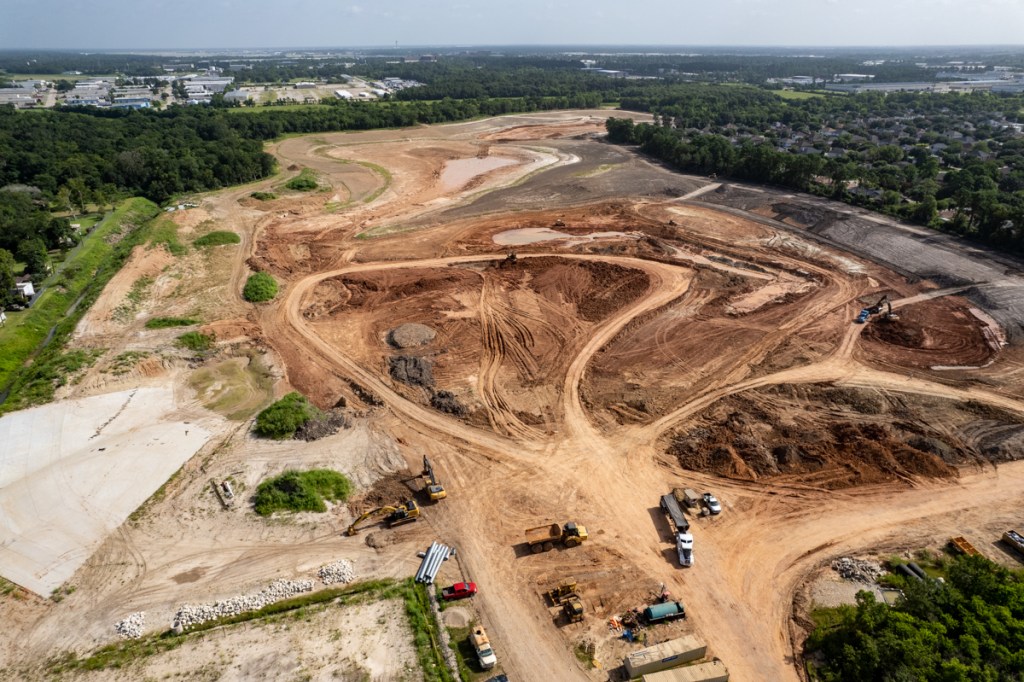
On Lauder Road west of JFK, Harris County Flood Control District (HCFCD) has been building a detention basin next to Greens Bayou. This is another one of those detention basins that doesn’t exist, according to some politicians and community activists. Even though the politicians voted to fund the projects, and the projects are well underway, those same politicians claim that all of the flood-bond money is going to richer watersheds because of the higher home values.

Watershed with Second Most Funding Since Harvey Allegedly has None

In reality, the Greens Bayou watershed has received almost $300 million in funding since 2000. Half of that ($156.8 million) has come since Harvey.

Only one other watershed has received more HCFCD funding since Harvey.

Data Obtained Via FOIA Request from Harris County.

$38.5 Million Going to Lauder Basin

By the time Phases I and II are complete, the detention ponds will hold 1,600 acre-feet of of stormwater. That’s enough to hold a foot of rain falling across two and a half square miles.

According to HCFCD’s website, construction on Phase I should finish by the end of this year. Phase II should start next year. The two projects have a combined budget of $38.5 million.

If you don’t believe the Flood Control District website, check out Google Earth, or the satellite views in Google Maps and Apple Maps. This project is so big, you can see it from outer space.

Satellite image from Google Earth taken on 11/16/2000. Phase I construction has advanced considerably since then. See below.

The following photos were all taken on Sunday, 7/25/2021, around noon.

HCFCD Lauder Detention Basin Phase I. Looking north across Lauder towards Greens Bayou in background and Bush Intercontinental Airport in distance.
NE corner of HCFCD Phase I Lauder Detention Basin, looking east towards JFK Blvd, just south of Greens Bayou.
Looking south from over Greens Bayou toward Lauder and the Aldine ISD Mead Middle School in distance.
HCFCD Lauder Detention Basin on Greens Bayou. Excavation is now focusing on the pond closest to Lauder in the distance. When I last photographed this basin in April, the area for that last pond was being cleared.
Phase II will be built in the wooded area beyond the current Phase I construction.

Still Don’t Believe the Project Exists?

Think the photos are some kind of Photoshop trick? Visit the site yourself. Construction is bustling. On Sunday, around noon, I watched dozens of trucks coming and going while I took the photos above. Here’s how to get there.

Lauder Detention Basin location

Counterfeiting the Currency of Communication

The bizarre thing about this project is that the politicians who say it doesn’t exist are the ones who funded it. Go figure. Such is the sad, sorry state of politics in America today.

I’ve even talked to professors, professional engineers, MBAs, and PhDs in engineering who claim this and similar projects in Halls and Greens Watersheds don’t exist!

Worse yet, they refuse to look at the pictures, go to the construction site, review Flood Control’s website, or trust audited county spending data.

Language is the currency of communication. It’s how we cooperate. How we get things done. It’s one thing to disagree over project priorities. But another to claim projects don’t even exist when they do.

As a consequence, public policy has become divorced from reality. This is worse than being duped by misinformation. It’s the unwillingness of people, even including some journalists, to review available information that helps the public make informed decisions. And it doesn’t bode well for your region.

Posted by Bob Rehak on 7/28/2021

1427 Days since Hurricane Harvey

Reality Check: Easy Way to Learn About Flood-Mitigation Projects in Your Area

It’s time for a reality check, folks. I meet regularly with Harris County residents from almost every watershed. Virtually all of them have one thing in common. Rich and poor alike see NO Harris County Flood Control District (HCFCD) projects in their watersheds. Yet as of the end of the first quarter, out of 181 total 2018 Bond Projects, 19 were completed, 141 were active, and only 21 had not been initiated.

Gap Between Perception, Reality

So what accounts for the gap between perception and reality?

  • Most projects are practically invisible from streets. They’re “hidden” behind fence lines, tree lines, gates, or often, under forest canopies.
  • They’re scattered over dozens to hundreds of square miles. Often, they happen outside of residents’ normal traffic patterns in unfamiliar neighborhoods.
  • Most people have only a sketchy idea of which watershed they live in.
  • People could drive by projects and not realize they were flood-control construction as opposed to some other kind.
  • The projects are often disguised as parks, wetlands or natural areas when finished.

I lunched last week with three people from Cypress Creek who swore that nothing was happening in their 205-square-mile watershed. But actually, within the watershed, HCFCD has spent:

  • $260 million since 2000, the fourth most of any watershed in Harris County.
  • $169 million since Harvey – more than any other watershed – period – since Harvey.

Simple, Three-Step Reality Check

So where did all the money go? Here’s an easy, three-step way to learn…that applies to any watershed in Harris County:

  1. Go to www.HCFCD.org
  2. If you know your watershed, select it from the list. If not, type your address in the search bar just above the list.
  3. You’ll be taken to a page that lists recent, current and planned projects in your watershed. Click through them and start digging down several levels to learn more about the status of each.

Want to verify the information? Make a list and get in your car. I did that this morning and checked out four Cypress Creek projects between the Katy Prairie and I-45.

It took an hour of planning, three hours of driving, and another 3 hours for drone photography. The hardest part was finding favorable drone launch sites near the projects. But sure enough, all the projects existed. Here’s what I found.

Katy-Hockley Wetlands Mitigation Bank

The Katy-Hockley Wetlands Mitigation Bank. 152 acres that will be part of a 440-acre tract set aside for wetlands mitigation. Note additional wetlands in the upper right and below.
Detail from upper left of first photo. At same site.

The property will remain protected under a conservation easement with the Katy Prairie Conservancy. The wetlands may be used in the future to offset unavoidable wetland impacts caused by other federally permitted projects.

T.C. Jester Stormwater Detention Basin

South of Cypresswood Drive, HCFCD has 171.5 acres of land split by T.C. Jester. Eventually, this whole area could become one large detention pond. The east side of TC Jester is still undergoing a preliminary engineering review, but excavation has already started on the west side.

East of T.C. Jester at Cypress Creek (foreground).
West side of T.C. Jester where excavation has already begun.
Start of excavation on west side of T.C. Jester.

The purpose of these projects: to construct stormwater detention on the main stem of Cypress Creek, which will work to reduce flood risks and damages during heavy rains.

A regional drainage study for the watershed found that flooding along tributaries of Cypress Creek is predominately caused by stormwater from a rising Cypress Creek backing up into tributaries. Stormwater detention basins could reduce that backwater.

The study recommends nearly 25,000 acre-feet of additional stormwater detention in the watershed. This one area could go a long way toward meeting that goal.

Cypress Creek Tributary K-163 Conveyance Improvements

At Timberlake Drive and Cypress North Houston Road, HCFCD is replacing a shallow, silted-in ditch with 8’x6′ reinforced concrete box culverts. Depending on the location along Timberlake, there are either two or three such box culverts side by side.

The project is replacing a portion of an existing earthen channel with 4,750 linear feet of boxed culverts, including inlets, junction boxes and tie-ins with subdivision outfalls.

This ditch was down to a two-year level of service and had flooded neighborhoods on both sides on multiple occasions.

The project will also include the installation of approximately 1,200 linear feet of erosion control for the channel downstream nearer the confluence with Cypress Creek in the distance.

Ridge Top Channel Improvements

Another ditch (K129-00-00) farther east parallels Ridge Top Drive in the Ponderosa Forest area of northwest Harris County.

Here, HCFCD replaced the concrete lining in the entire channel. That included about 3,800 linear feet from Saddlecreek Drive to Cypress Creek. The project also repaired multiple sinkholes or voids that had developed in some areas as a result of stormwater undermining the original channel lining. 

Major Maintenance by HCFCD on K129, a Cypress Creek Tributary
Early stages in the design of this project took place prior to the 2018 Bond Election. Construction began in October 2018 and was completed in January 2020.

More than Cypress Creek Projects in the Works

Altogether, I counted more than 20 projects in Cypress Creek at various stages of development. They included:

  • Swales for extreme rainfall events
  • Right-of-way acquisitions and floodplain preservation
  • Buyouts
  • Neighborhood projects
  • Stormwater detention basins in various stages of planning and construction
  • Channel conveyance restorations
  • Major maintenance projects

Knowing that improvements are happening sure beats living in fear that they aren’t. So do a reality check of the watershed around you.

Posted by Bob Rehak on 7/24/2021

1425 Days since Hurricane Harvey

The thoughts expressed in this post represent opinions on matters of public concern and safety. They are protected by the First Amendment of the US Constitution and the Anti-SLAPP Statute of the Great State of Texas.

Commissioners Approve Excavation Contract for Regional Detention Pond on Taylor Gully

In yesterday’s Harris County Commissioners Court meeting, commissioners unanimously approved a contract with Spring Sand & Clay LLC for excavation of a regional detention pond on Taylor Gully in Montgomery County at the Woodridge Village site.

Preliminary Engineering Began in Early July

Earlier this year, Harris County purchased Woodridge Village from Perry Homes for this purpose. Currently, engineers are examining several Taylor Gully alternatives.

Woodridge Village
Looking north across Woodridge Village toward Porter from over the Harris/Montgomery County line. The abandoned development currently has five detention ponds that will hold about 60% of the rain in an Atlas-14 100-year storm.

Currently, Idcus, Inc., an engineering company, has been contracted to look at:

  1. Whether existing detention and proposed channel improvements would suffice to mitigate flooding
  2. Whether expanding existing detention would eliminate the need for channel improvements
  3. A combination of the two scenarios above – determining the amount of additional detention and channel improvements necessary to ensure no adverse impact all the way to Lake Houston.
  4. Out-of-the-box alternatives that ensure no adverse impact while maximizing flood mitigation and minimizing construction costs.

The Idcus contract calls for the company to deliver channel and basin layouts for Taylor Gully no later than 300 days from the notice to proceed, which presumably was given in early July. However, excavation could start much sooner than that. (See below.)

Pieces of Puzzle Falling into Place

The no-cost contract with Sprint lets them set their own timetable as long as they complete improvements within three years. Sprint’s timetable will be driven by the company’s ability to sell the material they excavate; that forms their compensation.

The next step is for Harris County Flood Control District (HCFCD) to provide a grading plan to the contractor. While that will not happen tomorrow, the good news is that it won’t require waiting 300 days.

HCFCD can start excavating the retention pond before plans are finalized. After all, it’s not a problem if a detention pond holds more than the minimum required. It’s only a problem if it holds less. Engineers and contractors can adjust plans if necessary after excavation starts. This approach should minimize flood risk for worried Elm Grove and North Kingwood Forest residents.

All the pieces of the puzzle are starting to fall into place.

Posted by Bob Rehak on 7/21/2021

1422 Days since Hurricane Harvey

Commissioners Vote Tuesday on Contract for Woodridge Village Detention Pond Excavation

Tuesday, 7.20.21, Harris County Commissioners will vote on a contract with Sprint Sand & Clay for excavation of a Woodridge Village detention basin. Item #21-3394 on the agenda is only for $1000, but it gives the contractor the right to enter the site and begin removing up to 500,000 cubic yards of dirt (at no cost to HCFCD) which it can then sell.

Backup provided to commissioners states that “This benefits the District because excavation and removal is always the highest cost of any stormwater detention basin that is constructed.”

Details of Proposed Contract

Here is the full text of the proposed agreement. Highlights include:

  • Amount of excavation TBD – somewhere between 20,000 and 500,000 cubic yards, depending on plans that HCFCD will deliver to the contractor based on the outcome on an engineering study currently underway.
  • The contractor must properly dispose of the spoils, which it is allowed to sell to make its money on the contract.
  • Contractor is liable for any materials that are disposed of improperly, i.e., within Base Flood Elevation or the 500-year flood plain and must identify all disposal locations.
  • Time allowed: 3 years.
  • Termination of contract possible if contractor fails to excavate a minimum average of 5,000 cubic yards every month.
  • Contractor responsible for environmental mitigation if necessary, excluding wetlands.
  • The contractor must provide an approved Stormwater Pollution Prevention Plan and abide by it.

The contract outline contains the map above but does not specify the exact size, depth or location of the proposed work within the outlined area – just that it will occur in Montgomery County. Engineers will supply additional details at a later date.

Making up for the 60% Solution

Assuming commissioners approve this, it is good news for the people who live who live in Elm Grove and North Kingwood Forest – indeed, for everyone who lives along Taylor Gully. The detention ponds installed by Perry Homes before they sold the land to Harris County were based on old rainfall statistics and will only hold about 60% of a new 100-year rain defined in Atlas-14.

Looking SE across Woodridge Village toward Elm Grove and North Kingwood Forest, areas where hundreds of homes flooded badly in 2019 twice. Photo taken May 26, 2021.

Sprint Sand and Clay is a regular contractor for HCFCD. Currently, the company is excavating the massive Cutten Detention Basin near 290, Beltway 8 and Cutten Road.

Posted by Bob Rehak on 7/20/21

1421 Days since Hurricane Harvey

HCFCD’s “Frontier Program”: A Collaborative Model for Future Flood Mitigation

Harris County Flood Control District’s (HCFCD) Frontier Program is an effort to avoid the problems of past development in newly developing areas. In the past, making developers solely responsible for flood mitigation on the land they owned likely resulted in small, expensive and suboptimal projects. Often, by the time shortcomings of their efforts became apparent, it was too late to do anything. Sometimes, to make room for effective flood-mitigation projects, whole subdivisions had to be bought out – after years of repetitive flooding. See two images below.

Halls Bayou next to the Fiesta on US59 north in 2002. Note the subdivisions on either side of the freeway and compare this shot to the one below.
To create the detention ponds on either side of the freeway, HCFCD had to buy out entire subdivisions, an effort that took more than a decade. The buyouts took 4-5 times longer than construction of the ponds.

Frontier Program Offers a Different Paradigm

The Frontier Program is an organized effort to plan for regional drainage infrastructure in advance of future land development.

Program managers work with developers and landowners to identify large-scale, mutually beneficial projects for drainage that cost-effectively maximize stormwater mitigation and water quality. Plans also include opportunities for public recreation and open space.

Basically, instead of forcing all the responsibility for floodwater detention onto developers, the developers buy detention capacity from HCFCD. But the detention capacity is in larger, more efficient ponds in optimal locations – large enough to accommodate future growth.

Currently HCFCD district has frontier programs operating in two watersheds: Little Cypress Creek and Langham Creek, both in northwest Harris County.

Little Cypress Creek Frontier Program

Little Cypress Creek’s watershed is 52-square-miles, but it has fewer than 30,000 residents. However, Little Cypress Creek is experiencing rapid development with construction of the Grand Parkway and lacks sufficient natural drainage to accommodate expected growth.

Little Cypress Creek Watershed

The Little Cypress Creek Frontier Program includes nine stormwater detention basins and stormwater conveyance improvements along the creek and its tributaries. The detention basins will hold more than 20,000 acre feet of stormwater. Together with conveyance improvements, flooding should be reduced 5-7 feet. This video, featuring Alan Black, HCFCD’s new acting director who lives in the area, explains how the collaborative effort with developers works.

The 2018 flood-bond funded the watershed’s Master Drainage Plan, as well as stormwater conveyance improvements on Little Cypress Creek from Cypress Rosehill to the confluence with Cypress Creek.

This innovative approach is in contrast to typical efforts in which individual land owners and developers install drainage infrastructure that serves their sites alone, resulting in smaller, isolated stormwater detention basins and minimum-width channels for stormwater management. By taking a regional approach, the Frontier Program protects existing developments and provides proper drainage for newly developing properties. 

Developers participate in the Frontier Program by paying a $4,000-per-acre fee to develop in the watershed service area. Developers also participate by excavating a portion of regional drainage facilities and by dedicating property for right-of-way. The Little Cypress Creek Frontier Program will use impact fees primarily to acquire additional right-of-way along the channel and for stormwater detention basins. 

Bottom line: the program calls for stricter stormwater detention requirements to mitigate runoff from new developments.

Upper Langham Creek Frontier Program

HCFCD operates another Frontier Program on Upper Langham Creek in its 16 square-mile watershed.

Major elements include, but are not limited to: 

  • The 190-acre Greenhouse Stormwater Detention Basin in Harris County Precinct 3. The basin ultimately will provide approximately 860 acre-feet of detention storage. 
  • Another 865-acre basin site at Precinct 3’s John Paul’s Landing Park. It will provide 2,360 acre-feet of detention storage.
  • A six-mile, 700-foot-wide, 14-foot-deep floodplain and stream corridor encompassing Langham Creek between the two basins. The variable-width, undulating corridor design features wide flood terraces (or benches), gentle side slopes and in-line detention storage volume for the mitigation of stormwater flows. Within the corridor, Langham Creek will be redesigned as a natural stable stream, with adjacent forested borders, native grasses, and stormwater quality mitigation features.
Here, developers pay a per-acre impact fee of $3,100.

Pay Now or Pay Later

Some residents have complained about spending HCFCD funds in areas where people do not yet live when they flood now.

But this is truly a case of “You can pay me now or pay me later.” And if you pay later, the cost is almost certain to be exponentially higher and take much longer…after a lot of heartbreak, misery and human suffering.

Analogy: think about a doctor who’s so busy dealing with critical care, she has no time to deal with preventive care.

Posted by Bob Rehak on 7/13/2021

1414 Days since Hurricane Harvey

Harris County Creates Trust To Fully Fund Flood Mitigation Projects Without Partner Assistance For At Least Next Six Years

On Tuesday, 6/29/21, Harris County commissioners voted unanimously to shift Harris County Toll Road Authority and other county funds into a trust designed to help bridge potential shortfalls in partnership funding. The amount would be $40 million per year. As a result, construction of Flood Bond Projects can continue without interruption or delay for at least the next six years. If more partnership funding materializes during that time, funds deposited in the trust could help cover non-bond projects farther into the future.

The issue of a potential shortfall in bond funding boiled into headlines back in March. Precinct One Commissioner Rodney Ellis demanded to know where the money would come from to finish construction projects in Halls and Brays Bayou Watersheds if partnership funds did not materialize as planned. He gave Budget Management and the Flood Control District three months to develop a plan for backstop funding.

As of June 2021, HCFCD Needed to Find Additional $951 Million

When considering all flood-bond projects – not just those in Halls and Greens watersheds – the situation looks like this as of the end of June. See explanation of chart below.

As of 6/28/21, without any additional partnership funding, the potential need could be $951 million.

In 2018, voters approved a $2.5 billion flood bond that included $5 billion worth of projects (first column). Part of the $2.5 billion voters approved (third column) was designed to help attract another $2.5 billion in partnership funding. But only $1.25 billion has materialized so far (fourth column). With other transfers already made (fifth, sixth and seventh columns), that leaves a need of $951 million.

Commissioners wanted to know where that money could come from. Especially after HCFCD received nothing in a statewide competition for $1.1 billion in US Department of Housing and Urban Development (HUD) hazard mitigation funds. General Land Office Commissioner Bush later requested a direct allocation of $750 million for Harris County, but that could take years – if it comes.

Trust Not a Substitute for Partnership Funding

The county intends to step up the search for partner funding. But if that funding does not materialize, it has also created a Flood Resilience Trust. The Trust would:

  • Backstop the 2018 Bond Program
  • Mitigate risks of increased construction costs
  • Potentially fund future flood risk reduction projects beyond the 2018 Bond Program

The Trust does not eliminate the need for partner funding. If partner funds materialize as hoped, HCFCD can use any excess money in the trust to construct future flood mitigation projects beyond the bond program.

The graphic below shows that $489 million has already been identified and allocated to the trust from various sources. The new element added on Tuesday (column six) includes $343 million in HCTRA funds. With rounding and other funds, that would help create a proposed Flood Resilience trust of $833 million to help cover the $951 need.

$40 Million Transfer Per Year from Toll Road Funds

Approximately $40 million per year would be transferred into the trust (red line in chart below). That should cover any unsecured spending through about 2027. By then, hopefully, HCFCD will have identified more partnership funds.

Commissioners spent a considerable amount of time debating the legality of transferring toll road funds to flood mitigation projects. The consensus: toll road development has impacted flooding in Harris County. Flood Control identified a $15 billion need to mitigate increased stormwater runoff caused by historical development of roadways. So, it should not be hard to find a transportation connection to most flood control projects that would satisfy auditors.

Equity Prioritization Framework Will Apply to Trust

The pie chart below shows the weights that will be given to various factors when deciding which projects to develop first with the additional funds.

Weighting in new prioritization framework

This differs slightly from the original equity prioritization framework. Compare the table below.

Weighting in 2019 Equity Prioritization Framework

They seem substantially similar, but the names of some factors have changed. For instance:

  • “Cost per structure” has replaced “project efficiency.”
  • “Flooding Frequency” has replaced “Existing Conditions/Drainage Level of Service.”
  • “Structures Benefitted” has replaced “Flood Risk Reduction.”

Cost per structure is not home value. It is the cost of the project divided by the number of homes benefitted.

“Structures Benefitted” counts the number of structures only, not the the value of those structures.

Thus, this factor gives more weight to densely developed urban areas.

Commissioners Ellis and Garcia have complained bitterly and repeatedly that FEMA Benefit/Cost Ratios for flood mitigation projects include a weighting factor for home value that theoretically gives higher preference to affluent neighborhoods. But that’s only one of many factors that FEMA considers.

This report from William & Mary’s law school explains that “impoverished communities may receive a Federal cost share of up to 90 percent of the total amount approved under the Federal award to implement eligible approved activities in accordance with the Stafford Act, but these communities must meet stringent criteria to receive funding.”

Regardless, I see no weight given to more valuable homes in Harris County’s prioritization guidelines. In fact, the density factor and social vulnerability combine for 45% of a project’s total score.

The biggest problem with this framework is that it doesn’t differentiate between street flooding and bayou flooding. Additional flood control projects for the bayous may not help homes that flood due to water collecting in streets.

For More Information

Here’s the full presentation made by the Flood Control District’s new acting director, Alan Black. And here’s a high-level summary prepared by the Harris County Budget Management Department.

Posted by Bob Rehak on 7/1/2021 based on information provided by Harris County Flood Control and Budget Management departments

1402 Days after Hurricane Harvey
Flood-Mitigation Funding Flows to Damage, Not High-Income Neighborhoods

Last in an eight part series on flood-mitigation funding in Harris County

For two years, Precinct 1 Commissioner Rodney Ellis and Precinct 2 Commissioner Adrian Garcia have alleged that rich watersheds get all the flood-mitigation funding, while poor and minority watersheds get none. But data suggests that is far from the truth.

Three months ago, the din from Ellis and Garcia reached a crescendo. I became so alarmed about the allegations of racism in flood-mitigation funding, that I submitted a Freedom of Information Act (FOIA) Request to Harris County Flood Control District (HCFCD) for historical funding data by watershed. I also requested related data such as watershed size, damaged structures, the number of low-to-moderate-income (LMI) residents, and more.

Data Contradicts Ellis/Garcia Narrative

My analysis contradicted the carefully crafted Ellis/Garcia narrative. I found the exact opposite of what they claimed.

The most dollars flow to low-income watersheds which, coincidentally, have the most flood damage.

The strongest correlation I found with flood-mitigation “funding” since 2000 was “damaged structures.” And the percentage of low-to-moderate income residents in a neighborhood correlates very strongly to damage per square mile.

When you think about this, it makes sense. We put the most flood-control dollars in areas that flood the most.

Damage Per-Square Mile Correlates Highly with LMI %

To understand patterns in the data, one must start by evaluating damage “per square mile.” That’s because high- and low-income watersheds differ radically in size and number.

  • Harris County has only eight low-to-moderate income watersheds, but 15-high income watersheds.
  • The low-income watersheds are half the total size – 600 square miles vs. 1176 square miles.

When looking at damage on a per square mile basis, the highest concentrations occur in low-income neighborhoods.

LMI percentage and damaged structures per square mile have a 0.82 coefficient of correlation. Mathematicians consider that very strong. 1.0 is the highest you can get, a perfect correlation.

Damage includes structures flooded in four major storms since 2000 (Allison, Tax Day, Memorial Day and Harvey).

Low-income watersheds cluster on the left and high-income watersheds on the right because of “Damage,” not racial discrimination in mitigation funding. Mitigation dollars already overwhelming flow to minority and low-income neighborhoods as they have for decades.

Flood-Control Dollars Flow to Damage

There’s also a strong relationship between total funding and total damage. Notice how the shape of the curves align closely with a few exceptions.

Total funding since 2000 and the number of damaged structures show a 0.84 coefficient of correlation. Mathematicians consider that very strong.

You can see a general downward trend in both blue and orange, indicating a strong correlation. This relationship supports other statistical analyses in this series. (See links to previous articles listed below.)

At the highest level, when you look at the data from multiple perspectives, one thing stands out: 

Dollars flow to damage, not affluent watersheds.

Possible Causal Links Between LMI Percentage, Damage and Funding

Touring lower income watersheds by car or helicopter helps explain why those watersheds have so much more damage and consequently receive so much more funding. In general, they:

  • Are much more densely packed with buildings, a consequence of more than twice the population density (3,900 residents/square mile compared to 1,600).
  • Have more impervious cover, so water can’t soak in as quickly or as much
  • Tend to crowd floodways and floodplains, which have expanded over time with upstream development
  • Are downstream from rapidly growing areas.
  • Are 70 to 80 years old and therefore built to lower development standards
  • Have many homes that sit almost at street level instead of being elevated above it.
  • Have many clogged roadside ditches and storm drains, due to poor maintenance by county precinct crews and the City of Houston’s Public Works Department. (Water has a hard time getting out of neighborhoods.)
  • Have more structures per acre.

Re: the last point, in Kashmere Gardens (an LMI neighborhood), I found six homes on a third of an acre worth more than my house on a full acre in Kingwood. The density can offset higher home values in suburban neighborhoods when calculating Benefit/Cost Ratios for FEMA or HUD.

Flood-Mitigation Funding by Watershed Since 2000

Here’s how much money each watershed received for capital improvement projects since 2000. No maintenance dollars or dollars committed to complete projects are included – only dollars “out the door” as of the end of March 2021.

The graph above dramatizes two things: 

  • The wide variation from high to low. Luce Bayou received only $4.5 million while Brays received $510 million. That’s 113 to 1.
  • few watersheds received multiples of the average and median, while far more received a small fraction.

Funding Data Disproves Racist Allegations

Remember that the next time you hear the allegations of racial discrimination from Ellis and Garcia. This discussion shouldn’t be about race. It should be about fixing flooding problems.

The government is not funding flood-control projects in rich areas that didn’t experience flood damage. It funds them in areas that had the MOST damage. Those just happen to be in minority and low-income neighborhoods. And it is critical that people focus on WHY those structures flooded if we are to find solutions. 

Implying that they flooded because of racial bias is misdirection. The racial allegations divide and distract people. They also keep HCFCD, from focusing on real solutions to our flooding problems. That harms all voters in Harris County.

If commissioners continue to focus on race, it will prove they care more about political gamesmanship than fixing drainage.

While that may win them re-election, we all lose.

For More Information

For more information, see: 

Posted by Bob Rehak on 6/28/2021

1399 Days since Hurricane Harvey

The thoughts expressed in this post represent opinions on matters of public concern and safety. They are protected by the First Amendment of the US Constitution and the Anti-SLAPP Statute of the Great State of Texas.