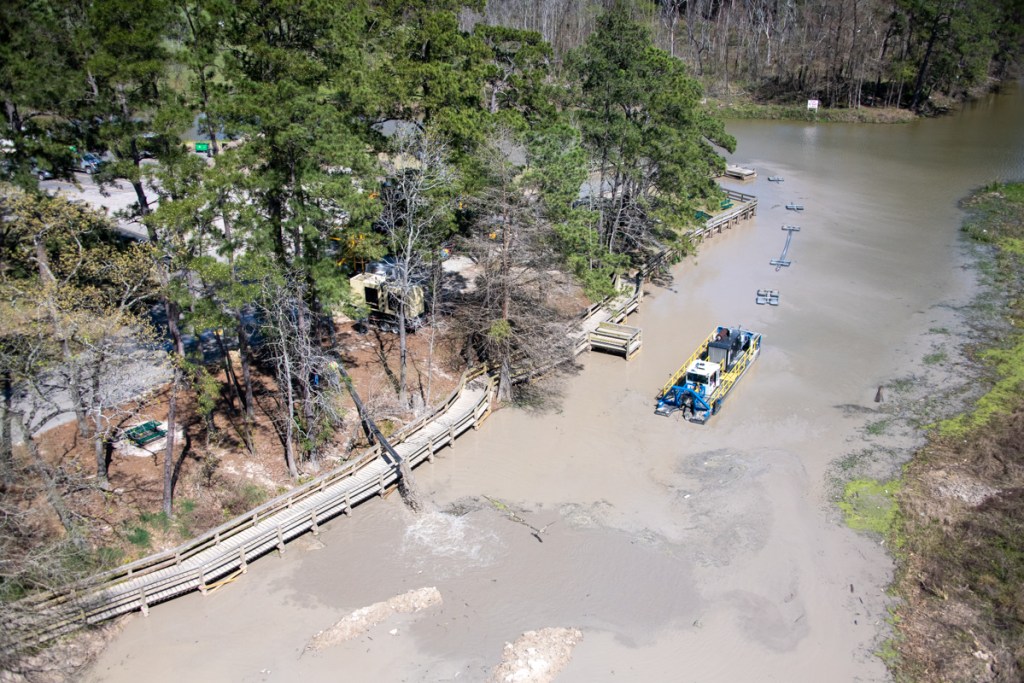
In January, the City hired DRC Emergency Services, LLC (DRC) to begin mechanical dredging of the San Jacinto West Fork Mouth Bar. I’ve provided periodic updates on that. According to Houston Mayor Pro Tem Dave Martin, DRC has now officially completed 60% of that project.
In the meantime, other related dredging projects, including East Fork dredging and long-term Lake Houston maintenance dredging are reportedly taking shape. Here’s how pieces of the puzzle fit together. But one piece is still missing – long-term funding to pay for the maintenance dredging.
Two-Phase Program
DRC’s scope of work has two distinct phases:
Phase One will remove accumulated materials near and at the mouth bar on the West Fork of the San Jacinto River.
Phase Two will remove accumulated materials in the East Fork of the San Jacinto River AND other locations in Lake Houston.
West Fork Mouth Bar as of late June 2020.
During Phase One, 400,000 cubic yards of material will be removed over twelve months. To date, DRC has removed approximately 240,080 cubic yards of material. (See photo above.) That’s 60% in approximately 60% of the allotted time, so that part of the project is on schedule.
East Fork Mouth Bar as of May 2020. This areas went from 18 to 3 feet deep during Imelda, according to boater Josh Alberson. The above-water portion of this sand bar has grown three quarters of a mile since Harvey.
Phase Two of the project will consist of:
Hydrographic surveys of the West Fork of the San Jacinto River, the East Fork of the San Jacinto River, and Lake Houston to determine dredge material volumes
City of Houston advertising and awarding a dredging contract to the lowest responsive bidder
Phase Two will run simultaneously with Phase One to expedite dredging.
Dave Martin, Houston Mayor Pro Tem
Mayor Pro Tem Martin did not provide an update on where Phase Two currently stands. But residents have reported seeing survey boats on Lake Houston, and the East and West Forks of the San Jacinto.
Mouth bar forming at Rogers Gully on Lake Houston. Example of kind of projects being considered for Phase 2.Photo late June, 2020.
Long-Term Dredging Plan in Development
Additionally, during Phase Two, City of Houston and its partners will develop a long-term dredging plan for Lake Houston. City of Houston or the Coastal Water Authority will execute the plan.
The intention: to fund dredging operations in perpetuity.
This phased approach will obligate the full grant funding before the 87th legislative session in 2021. This grant funding was made possible thanks to State Representative Dan Huberty (District 127) through the passage of Senate Bill 500.
Mayor Pro Tem Martin credits Huberty for his dedication to the long-term maintenance dredging activities on Lake Houston. “Representative Huberty has been a champion for his residents and a great ally in seeing these additional dredging efforts come to fruition,” said Martin.
$40 Million Project
The total project is valued at $40 million (except for the perpetuity part). Funding for the immediate dredging projects comes through a combination of:
City of Houston Harvey Disaster dollars provided by Governor Greg Abbott
Grant dollars from the Texas Water Development Board (TWDB)
Harris County Flood Control District (HCFCD) Bond Program.
Long Term Funding – Still A Missing Piece of Puzzle
Lake Houston, a City of Houston asset, is losing capacity. Everyone has recognized that fact for decades. But as silt filled the rivers, inlets and lake, maintenance was deferred, reportedly for budgetary reasons. In 2017, during Harvey, the problem became so big that no one could ignore it anymore. Flooding was the immediate problem. But loss of water capacity is an even bigger, longer-term problem.
It’s one thing to have a long-term maintenance dredging plan and another to put it into action. But where will the money come from?
A tax on sand mines? Won’t work. Most aren’t in the City. Or even in Harris County.
Some have suggested creating a taxing district for lakefront homeowners. That won’t work either. Not enough of them. And it would create a stampede for the Oklahoma border. Moreover, it hardly seems fair; the lake is part of a City system that provides water to two million people and generates revenue.
The logical solution seems to be increasing the cost of water. Adding just a fraction of a penny per 1000 gallons should do it. Dredging isn’t just about reducing flooding. Or preserving views for lakefront homeowners. It helps preserve the lake’s capacity. And that benefits everyone.
As we develop a long-term dredging plan for the lake, we also need to consider a sustainable source of financing.
Posted by Bob Rehak on 8/12/2020based, in part, on a release by Houston Mayor Pro Tem Dave Martin
1079 Days after Hurricane Harvey
https://i0.wp.com/reduceflooding.com/wp-content/uploads/2020/08/20200306-RJR_9786.jpg?fit=1200%2C800&ssl=18001200adminadmin2020-08-12 13:45:302020-08-12 16:03:12Long-Term Lake Houston Dredging Plan in Development; West Fork Mouth-Bar 60 Percent Completed
Ever since Harvey filled up the lagoon next to the River Grove boardwalk, Kingwood residents have clamored to restore the area. This week they got their wish. Kayden Industries has removed its two dredges and the giant “shaker” that separated sand from water. This morning, all that remained of the operation was a front-end loader, a giant pile of sand, and dump trucks rapidly carrying it away. They should be done with the operation this week.
Damage Due to Harvey
Here’s the story in pictures starting with Harvey.
The lagoon next to the popular boardwalk at Kingwood’s River Grove Park has totally filled in with sand deposited by Hurricane Harvey.Harvey also left a 10-foot high sandbar that blocked the drainage ditch that runs through River Grove.
Remove up to five feet of sand covering the parking lot and areas near the boardwalk
Restore soccer fields also covered in sand
Repave access roads and parking lots undermined by churning floodwaters
Inspect the boardwalk to ensure it was structurally sound.
Draw up a dredging plan for the lagoon with an engineer.
Identify a suitable place to put the spoils.
Bid the job.
Approve the plan and expenditure.
Note height of sand in River Grove parking lot relative to parking sign in background.
It was a monumental effort. Dee Price, KSA President and steward of River Grove Park, and Bruce Casto, KSA’s maintenance man, deserve kudos for spearheading the effort and saving this park.
Between Harvey and the end of 2019, vegetation had grown up over the sand deposited in the lagoon.Step one in the dredging: Remove the vegetation that had grown on the sand.Then, Kayden Industries mobilized a mini dredge. The dredging took seven weeks.
Drying the Spoils Before Trucking
Kayden also brought in this giant machine to separate sand from water. It works like an oilfield shaker used to separate drilling cuttings from drilling mud.
Last Week, Demobilization Began
Almost two months after it started, Kayden began demobilizing. Resident Josh Alberson captured the image below with his drone.
Last week, Kayden Industries started demobilizing their equipment. Here we see one of the two dredges getting ready for removal from the water. Kayden brought in a smaller dredge when the City lowered the level of the lake suddenly. The first dredge is up on blocks behind the pile of sand.Photo courtesy of Josh Alberson.This morning, where the shaker once stood, nothing but some sand remains.A giant pile of sand still blocks the boat dock.But dump trucks were lining up to receive the sand and carry it to a placement area in Humble out of the flood plain.The finished job: a beautifully restored lagoon, complete with some marshes to attract birds.
Water along the boardwalk is 3-5 feet deep, so don’t let kids play in it. That could be dangerous.
Some Repaving Left to Do
All the heavy traffic has taken a toll on park roads. “Everyone needs to understand that the paving problems on the road between the gate and the first stop sign were there long before we started trucking dirt,” said Dee Price, KSA President. “We have patched that area numerous times in the past.” Price said KSA needs to mill and re-pave that piece of road as the group did with the soccer road. Price plans to put that project in the next fiscal-year budget. But for now, she says, “We need to patch it again until we can do the major improvement next year.”
Posted by Bob Rehak on April 14, 2020 with thanks to Josh Alberson for the drone imagery
958 Days since Hurricane Harvey
https://i0.wp.com/reduceflooding.com/wp-content/uploads/2020/04/20200413-RJR_0511.jpg?fit=1200%2C800&ssl=18001200adminadmin2020-04-13 13:20:592024-03-12 18:38:56River Grove Dredging Done, Only Cleanup Left
Triple P.G. Sand Development LLC appears to have violated provisions of an injunction by dredging before its trail and flooding neighboring properties with industrial waste water.
In part, the injunction stipulated that the defendant shall:
Not conduct any dredging operations at the Facility.
Not engage in any operations at its Facility that discharge process wastewater, nor shall Defendant engage in any operations at the Facility that produce process wastewater that must be discharged off Defendant’s property without express prior approval from TCEQ.
Immediately and permanently cease and prevent all discharges of any Industrial Waste and/or Process Wastewater from the Facility into or adjacent to waters in the state.
Not allow any discharge of water that is in or has ever been in the Facility’s Dredge Ponds without the express prior approval of TCEQ.
Aerial Photos Show Potential Violations
The aerial photos below show that within eight days of agreeing to the injunction, the mine started pumping process wastewater OVER BERMS into a pit that then overflowed onto the property of adjoining landowners and lands adjacent to White Oak Creek.
Before showing you the photos, let me show you a satellite image that helps illustrate the relationship between the different elements of this report.
Overview of mine, area drainage and adjoining properties in Montgomery County. Note the location of the mine’s stockpile in the satellite photo above for orientation when viewing the photos below. Brownish creek to right of mine is Caney Creek. Blue line shows approximate path of White Oak Creek through forest. Red oval shows adjoining properties in area of interest. Solid red line shows ditch around perimeter of mine. Green lines show approximate locations of breaches in Attorney General’s lawsuit.
Water pumped out of the mine’s wastewater pond is now flooding neighboring properties within the red oval that he does not own. The mine also dug a ditch around the perimeter of its property (solid red line) through dense forest that channels the process wastewater toward White Oak Creek (solid blue line) and the wetlands along it. It’s not clear, though, whether the wastewater has actually entered the creek yet; the forest canopy limits visibility. Regardless, the injunction says they can’t discharge waste adjacent to waters of the state.
No Flooding That Lasted Months of Adjoining Properties Until Injunction
None of the historical satellite images in Google Earth dating back to 1989 show flooding in the red oval. Some of the properties in the red oval lie in the 100-year flood plain. However, there has been no widespread flooding in this area since Imelda on September 19, 2019.
Nor has there been prolonged flooding as far as I can determine. Photos taken of this exact location on 9/27/2019, ten days after Imelda, show no flooding of the adjacent properties. Likewise, the property was not flooded on 9/14/2017, two weeks after Harvey. I can find no evidence that this area has ever flooded for months before.
Looking south toward stockpile in background. Properties in the forested strip do not belong to Guniganti. On 9/27/2019, ten days after Imelda, they showed no flooding.
For months, I’ve been watching waste water build higher and higher in the area above until it overflowed the pit and invaded neighboring properties. That made me curious and prompted a review of thousands of aerial photos. Here’s what I found.
Photos Taken In November Before Injunction Show Neighboring Land Still Not Flooded
The neighboring properties were NOT flooded on November 4, 2019 (before the injunction). Notice the level of water in the foreground pit – higher than after Imelda, but still waaaay short of overflowing.
Think of the November 4th photo below as the “before” shot. Compare it with other photos below taken from December through March 2020.
Properties in the red oval are between the pit in the foreground and stockpile in background. Note level of water in pit.Photo taken November 4, 2019, looking south.The mine’s process waste water enters the pit immediately to the left of the trees.
After Injunction, Mine Starts PUMPING Waste Water OVER Dike
Eight days AFTER the injunction, on December 3, 2019, I flew over the mine again. I noticed that the mine was pumping water out of its main waste water pond and into the pit in the photo above. But the pit had not yet overflowed. Here’s how the pumping looked. (Note: You can even see the pumping from outer space if you zoom in on this area within Google Earth and look at the Dec. 1 satellite image.)
Close up of pump taken on 12/3/2019. The pumping operation can also be seen in Google Earth satellite photo dated 12/1/19.
On January 20, Pumping Continues From Different Location
I flew over the mine again on January 20, 2020; the pumping from and into the same pits continued – but from a different location.
Looking West. Notice the line running from the arc in the wastewater pond (diagonally from center to lower right).Looking south. The same line dumps water into the trench (bottom left). The trench then carries the water south (toward the top of the frame) to fill the pond next to the stockpile and flood adjoining properties with waste water.Looking SE. Here’s what it looked like closer up. Notice the waste water extending into the tree line and ending at the stockpile (upper right). The same pond that had plenty of excess capacity in September and November was now overflowing.Looking south. This wider shot shows the flooding wastewater curled around the stockpile and headed south into the woods where White Oak Creek flows toward the mine.Looking SE. Close up of the waste water turning the corner around the stockpile.
From where you lose visibility of the ditch under the forest canopy to White Oak Creek is about 80 yards according to Google Earth.
Floodwaters Even Higher on February 13
On my February 13, 2020, overflight, I captured the following images. They show the floodwater had risen even higher and backed up farther.
Looking SW. On February 13th, the flooding wastewater appeared even higher.Looking SE.It still curled down the ditch on the west (right) side of the mine and flowed into the woodstoward White Oak Creek
Water backed up so far, it even flowed into the utility corridor at the north end of the mine.
Looking East.Water in utility corridor at north end of mineon February 13, 2020
In March, Possible Dredging Observed, Still Flooding Neighboring Properties
In March, one of the first things I noticed was the dredge. The cutterhead, which had been elevated for months, was now DOWN. That usually indicates the dredge is working. And that’s something the injunction prohibited.
Dredge with its cutter head down usually means active dredging.
The pond next to the waste water pit overflowed onto neighboring properties even more. It came right up to the road. Note the huge difference between the levels of the two ponds below.
Note how high the water level is in the pond at the top of the frame compared to the waste pit at the bottom. Looking SW. Floodwaters stretch into adjoining properties. Stockpile is behind trees in upper left.Looking SE. Floodwater still fills the ditch running south along west side of stockpile.Looking NW at wastewater flooding adjoining properties.Stockpile is in lower left.Looking SE. Adjoining properties are in tree strip in front of stockpile. Notice waste water among the trees.Looking north from over stockpile toward vast areaflooded with waste water.Looking west. Even more of utility corridor is flooded in March.
Water In, Water Out
Miners use water to clean silt out of the sand before shipment. Note the damp sand coming off the conveyor belts.Looking south. A river of waste water is seen leaving the processing equipment on March 6, 2020.Looking NW. The silt-laden waste water even forms a delta in the waste pit. Flooded properties are on the other side of the road that cuts diagonally through the frame from middle left to upper right.
So water is leaving the processing equipment and going into the waste pit. It has to come in from somewhere. But where? As you can see from the photos below, the supply lines for the processing equipment come from the dredge pond.
Looking west. Water goes into the processing equipment from the dredge pond.Looking North. Wide shot showing dredge with cutterhead down and discharge pipe leading back to shore.
In the shot above, you can see that the lowest pond in the whole operation is the pond receiving ALL the waste water. Why is that?
The Big Questions and Some Possible Answers
So it appears that the mine is pumping water out of the dredge pit, into the waste pit, and finally into the surrounding forest. The big questions are these.
Why is the mine keeping the level of the water in the waste pit so low?
Why is the mine flooding the surrounding forest and neighboring properties with industrial waste water?
Is the waste water polluting White Oak Creek?
To hypothesize some answers to those questions, let’s look at two pictures: the first from February and the second from March.
Looking south. February 20, 2020. Miners have been removing sand from area with all the tracks in the center and the big pond at the lower left.
From this one photo, we can see that to avoid dredging (per the injunction), the miners have started surface mining. But the level of mining is getting down to a) the water table, and b) the level of the waste pit.
Looking NW. March 6, 2020. Three weeks later, mining is now BELOW level of water in the waste pit.
Note the differing levels of water in the forest (top) and waste pit (middle). Also note that the level of the surface mining has now gone far below the level of sediment in the waste pond.
From this photo (and others in the series) we can conjecture what happened. Please note: I have no proof of this. It is only conjecture.
Theory for the Discharge
I suspect that the mine realized that if it were to continue filling orders while it waited for trial on June 22, 2020, it would need to start surface mining AND mine below the level of water in the waste pit. So, I’m guessing they started lowering the level of the pond to keep mining as long as possible.
I’m also guessing that the terms of the injunction and heightened scrutiny by the TCEQ meant they could no longer make excuses about discharging water into the creek. So they discharged into the forest instead…most of which Guniganti owns except for that strip north of the stockpile. If the discharge drained into White Oak Creek deep in the forest, at least it wouldn’t be visible.
Is Discharge Reaching White Oak Creek?
Is the waste-water pollution reaching White Oak Creek? Because of the dense forest canopy, that’s impossible to determine from the air. One could only tell from the ground. And because Guniganti owns all the land around the mine (except for the properties in the red circle), the only way to determine that would be by trespassing. That makes it impossible for ordinary citizens to spot any illegal discharge, such as Tony Buzbee did when he was running for Mayor of Houston. Fortunately, the TCEQ has the right to inspect the property from the ground if it suspects a violation of the restraining order. And they are investigating this.
Summary of Potential Violations
This whole affair once again raises questions about whether sand mines should be permitted in floodways. This mine actually sits at the confluence of TWO. Which is part of the reason why it was sued by the attorney general in the first place. Both Caney and White Oak Creeks captured the pit last year and the TCEQ estimates millions of gallons of process waste water were discharged without a permit into the headwaters of Lake Houston.
Meanwhile, Triple PG appears to be discharging again without the benefit of storms to blame the behavior on. They also appear to be violating terms of their injunction by:
Dredging
Discharging process wastewater
Producing process wastewater that had to be discharged off their property.
Discharging water that had been in the Facility’s Dredge Ponds.
Discharging Industrial Waste and/or Process Wastewater adjacent to waters of the state (White Oak Creek)
I have contacted the TCEQ twice already about whether they permitted any of these activities. They have not responded yet, citing the ongoing investigation. However, I must believe that had they permitted the activities, they would not be investigating and would have replied immediately. They visited the site yesterday.
Posted by Bob Rehak on March 13, 2020
927 Days after Hurricane Harvey and 176 since Imelda
The thoughts expressed in this post represent opinions on matters of public concern and safety. They are protected by the First Amendment of the US Constitution and the Anti-SLAPP Statute of the Great State of Texas.
https://i0.wp.com/reduceflooding.com/wp-content/uploads/2020/03/20200306-RJR_0052.jpg?fit=1200%2C800&ssl=18001200adminadmin2020-03-13 20:13:412020-03-14 10:49:56Triple PG Mine Appears to Violate Injunction
The State of Texas, Harris County and the City of Houston are whittling down the mouth bar of the San Jacinto West Fork – teaspoon by teaspoon. Just kidding; it only feels that way.
At the planned rate, the partners will remove approximately one third to one half of the planned 400,000 cubic yards of sediment by the start of hurricane season. But after waiting two and a half years since Hurricane Harvey, any and all progress is welcome! I’m not complaining.
The Mouth Bar Immediately After Harvey
Harvey deposited massive amounts of sediment in the area where the San Jacinto meets Lake Houston.
The mouth bar two weeks after Hurricane Harvey. With the exception of the treed areas on the extreme right, Harvey deposited virtually all the sand you see here plus more that you can’t see underwater.
The mouth bar formed where it did because the river water slows down when it meets the lake. The lower velocity causes sediment to drop out of suspension and accumulate faster.
While the Corps used hydraulic dredging to remove 500,000 cubic yards from the mouth bar in three months, the current phase uses mechanical dredging. Partners hope to remove another 400,000 cubic yards in 12 months. The process resembles whittling in that workers remove small chunks at a time.
Big Machines Dwarfed by Size of Job
Mechanical dredging uses large excavators. They load the sediment on pontoons. Tugs then push the pontoons upriver to a placement area. There, skid loaders remove the sediment and put it in trucks. The trucks cart it inland.
The excavators are currently nibbling away at the southern edge of the bar. I took all photos below on 3/6/2020.
Excavators are nibbling row after row, like from an ear of corn. This shot shows the immensity of the task.They load one pontoon while another waits. The West Fork now has its own shuttle service.Unfortunately, round trip is still more than two hours.These double pontoons can carry an estimated 160 cubic yards. Project goal: 400,000 cubic yards. That’s about 2,500 round trips for the pontoons.Keeping the pontoon balanced requires coordination.Tugs then push the pontoons upstream.Dock of the placement area on Berry Madden’s property south of the West Fork, opposite River Grove Park boat dock on north shore.From there, trucks haul the sediment inland out of the floodway, about a mile from the river. And the cycle repeats itself.
Mechanical vs. Hydraulic Dredging
The whole process resembles a five-mile long conveyor belt. It involves excavators, pontoons, tugs, trucks and more. Both mechanical and hydraulic dredging have advantages and disadvantages. Hydraulic dredging takes more time to mobilize, but re-suspends less sediment, and costs less per cubic yard of sediment removed. Mechanical dredging, on the other hand, can mobilize much faster.
At this point, returning to hydraulic dredging feels like a distant dream. No one is commenting on the possibility. But this picture speaks volumes.
Former Army Corps command post for West Fork Emergency Dredging project
It shows the once-bustling, but now-empty Army Corps command post. Just three months ago, it was filled with dredge pipe, spare parts, construction trailers, pontoons, booster pumps, survey boats, and more. Getting all that equipment back will be difficult.
Posted by Bob Rehak on 3/12/2020
926 Days since Hurricane Harvey
https://i0.wp.com/reduceflooding.com/wp-content/uploads/2020/03/20200306-RJR_9728.jpg?fit=1200%2C800&ssl=18001200adminadmin2020-03-12 15:32:312020-03-12 15:34:58Whittling Down the San Jacinto West Fork Mouth Bar
Since Hurricane Harvey, KSA has worked diligently to restore the damage to River Grove Park. It has been a massive job. Harvey filled in the lagoon in front of the boardwalk; left five feet of sand in the parking lot, disc golf course, and playing fields; and deposited a sand bar more than a quarter mile long and 12 feet high in front of the boat dock.
River Grove Waterfront on 9/14/2017, two weeks after Harvey. Lagoon filled in, five feet of sand filled the parking lot, and a 1400-foot, 12-foot-high sandbar blocked off the drainage ditch that empties the western third of Kingwood.
Army Corps Restored River Access
The Army Corps cut a channel through the sand bar that blocked the drainage ditch that empties the western third of Kingwood. That was a huge sigh of relief for a large part of Kingwood. But much work remained to restore the park itself. Among the last items on the agenda: restoring the lagoon and boat ramp access.
It’s hard to capture the scope of dredging operations from the ground – especially with access restricted for safety reasons. But last week, I did a flyover and captured these pics from a helicopter.
Looking west toward the River Grove Boat Ramp and Lagoon. Photo taken March 5, 2020. The dredge started by the boat dock and is working upstream now in the lagoon. Note the dewatering plant in the parking lot and the growing pile of spoils waiting for removal on the right.
In the photo above, you can see the 50-foot strip where Kayden removed vegetation. That will be the limit of dredging. KSA plans to remove 4-5 feet of sand from this area. The area still covered with grasses will remain wetlands. It will provide cover, habitat and food for birds and other species. That should help make River Grove a destination for birders again.
Harvey deposited sand several feet deep on the peninsula that defines the River Grove lagoon. That unfortunately killed many of the trees there. The wetlands remaining in the lagoon are now more important than ever. Eagles nest in the trees in the upper right of this photo on Romerica property.The dredge started in the area in front of the boat dock and is working its way upstream in the lagoon. Water from the dredge goes through a floating pipe to a dewatering plant in the parking lot. Water is then returned to the lake in a closed-loop process.
A Bit of the Oil Field Comes to River Grove
The dewatering plant separates sand and sediment from the water before returning the water to the river.This is the same type of equipment used in oilfields to separate drilling cuttings from drilling mud, before recycling the mud.
Expected Finish By End of March
KSA expects the dredging project to finish by the end of March, weather permitting. However, the boat ramp may not open immediately. The heavy equipment has damaged the asphalt in the parking lot. Repairs and restriping may take a few weeks more.
Originally, KSA expected to remove 10,000 cubic yards of sediment. The contractor now predicts they will remove 11,000 to12,000 cubic yards to complete the scope of work.
Other Park Improvements
The good news: When all of this is done, River Grove Park should be back and better than ever. During repairs, KSA decided to:
Convert several of the soccer fields from “league fields” to “public fields.” Residents have long requested that change.
Change the speed bumps to milder speed humps in the traffic circle. Boaters have long requested that.
Posted by Bob Rehak on 3/9/2020
923 Days since Hurricane Harvey
https://i0.wp.com/reduceflooding.com/wp-content/uploads/2020/03/20200306-RJR_9605.jpg?fit=1200%2C800&ssl=18001200adminadmin2020-03-09 15:54:072020-03-09 15:57:09New Aerial Photos of River Grove Park Show Extent of Dredging Project
River Grove dredging has finally begun. Silt and sand deposited by Hurricane Harvey 2.5 years ago is being removed from two areas: the boat launch and boardwalk. KSA obtained a final permit from the City of Houston and equipment arrived yesterday.
Boardwalk First Priority
As you can see from these pictures, the contractor wasted no time. Equipment has already started removing silt from in front of the boardwalk.
Mechanical dredging equipment excavates area near boardwalk.
Additional equipment is being staged from the parking lot.
Contractors closed off the parking lot adjacent to the boat launch for public safety.
Contractors have already started removing the top layer of vegetation adjacent to the boardwalkthat sprouted since Harvey.
Pictures From Immediately After Harvey
A huge sandbar deposited by Hurricane Harvey blocked the Kingwood Diversion Ditch which drains the western third of Kingwood.Note sand covering the parking lot. It was 5 feet deep in places.Taken 9/14/2017.
The lagoon in front of the boardwalk was badly silted in.Taken 9/14/2017.
Pictures Taken February 2020 Before Start of Dredging
Photo taken 2/13/2020 shows how vegetation grew up on silt in lagoon.Aerial photo of boat launch area taken on 1/20/2020 shows that Army Corps opened up the drainage channel to the river. However, the area near the boat launch remains too shallow for most boats to launch safely.
Dredging and cleanup should take about 6 weeks. Completion will make eager boaters and park visitors very happy. River Grove has long been one of the most popular parks in Kingwood.
Posted by Bob Rehak on 2/18/2020
903 Days after Hurricane Harvey
https://i0.wp.com/reduceflooding.com/wp-content/uploads/2020/02/IMG_0480-rotated.jpg?fit=1512%2C2016&ssl=120161512adminadmin2020-02-18 13:05:072020-02-18 13:06:01River Grove Dredging Begins
On January 10, Mayor Sylvester Turner wrote the SJRA Board to support continued lowering of Lake Conroe. “This temporary measure,” said the Mayor, “will help mitigate against future flooding until permanent flood gates can be installed and dredging of the San Jacinto’s West Fork can be completed.”
Reminding LCA Who Owns the Water
The Mayor also reminded the Lake Conroe Association (LCA) that the City of Houston owns two thirds of the water in Lake Conroe.
Changing the LCA Narrative
Turner also addressed an LCA narrative that claims Lake Conroe was not built for flood control. It was built for drinking water, they say. But the letter changes that narrative. It says, “While the lake was originally constructed as a reservoir for drinking water, the Houston region has become increasingly prone to flooding due to population growth, development and more frequent storms with record rainfall. Both the City of Houston and the State of Texas recognize that flood control must be a consideration. The proactive release water is an effective measure until more permanent solutions can be completed.” See the full text of the Mayor’s letter below.
I have not always agreed with Mayor Turner, but I support him wholeheartedly on this.
Clash of Political Titans
Tuesday, Montgomery County Commissioners will vote on a resolution recommending to END the seasonal lowering of Lake Conroe.
I suspect Harris County Commissioners and the governor may enter this fray before the final vote.
Posted by Bob Rehak on 1/14/2019
868 Days after Hurricane Harvey
https://i0.wp.com/reduceflooding.com/wp-content/uploads/2020/01/1.10.2020-Lake-Conroe-Water-Level-NA.doc.jpg?fit=1700%2C2200&ssl=122001700adminadmin2020-01-13 23:31:352020-01-17 08:54:29Houston Mayor Sylvester Turner Supports Continuing to Lower Lake Conroe Seasonally to Help Mitigate Flooding
On December 30, 2019, the City of Houston issued a Notice To Proceed (NTP) for debris removal services. Specifically, that means the large silt deposit at the confluence of the West Fork of the San Jacinto River and Lake Houston. The area is commonly known as the “mouth bar.” See below.
Mouth Bar of the San Jacinto West Fork looking upstream. Picture from 12/3/2019.
Mechanical, Not Hydraulic Dredging
The City hired DRC Emergency Services, LLC (DRC) under an existing contract to begin mechanical dredging of the mouth bar “this week,” according to Houston Mayor Pro Tem Dave Martin.
Mechanical dredging differs from hydraulic dredging. With hydraulic dredging, contractors continuouslypump sediment from the river to a placement area onshore via long pipelines. With mechanical dredging, they scoop it out of the river and dump it on barges. Then they ferry the barges to the placement area where trucks transport the sediment to its final location.
Hydraulic dredging takes less time once started, but the prep can take months. Mechanical dredging takes longer, but can start immediately.
The City will begin the hydraulic dredging with $6 million of FEMA money left over from Hurricane Harvey debris removal funds. The Texas Division of Emergency Management and Governor Greg Abbott allocated that money specifically for Lake Houston and approved the remaining funds for mouth-bar dredging.
The grant application proposes removing sediment in two distinct phases:
Near and at the mouth bar on the West Fork of the San Jacinto River
In the East Fork of the San Jacinto River AND other locations in Lake Houston.
Mouth Bar on East Fork San Jacinto grew 4,000 feet since Harvey.
Phase-One Funding and Objectives
To complete Phase 1, Harris County proposed taking $10 million of the $30 million to provide a total $16 million for DRC dredging operations.
Phase 1 should remove a minimum of 400,000 cubic yards (CY) of material in eight to twelve months. The Army Corps of Engineers previously removed 500,000 cubic yards from the West Fork Mouth Bar for $17 million in about three months.
During Phase 1, the County will begin some activities for Phase 2. They include:
Hydrographic surveys of the West and East Forks, and Lake Houston
Development of plans and specifications
Identification and permitting of additional disposal sites
Competitive bidding
Since the TWDB grant money can only be used for dredging, Harris County will pay for the activities above out of the 2018 HCFCD Bond Program. The fund allocated $10 million for dredging in Lake Houston.
Phase-2 Funding and Objectives
The remaining $20 million from the $30 million TWDB grant will go toward Phase 2 dredging.
During Phase 2, Harris County, City of Houston (COH), HCFCD, SJRA, and Coastal Water Authority (CWA) will develop and execute a plan for the COH or CWA to assume all long-term dredging operations on Lake Houston.
The County does not intend to assume long-term responsibility for maintenance dredging of a City property, i.e., Lake Houston.
TWDB Meets Next Week to Approve Grant
The Texas Water Development Board (TWDB) will meet on Thursday, January 16, 2020, to approve the $30 million grant. “We are in the final stages of agency approval to continue dredging the lake and river,” said State Representative Dan Huberty. His amendment to SB500 last year dedicated the money for dredging this area. “By approving this amount, the legislature as a whole made a clear and concise statement that Lake Houston and the San Jacinto River are vital resources for the entire region and must be maintained.”
“Due to the urgency of this issue, multiple entities worked together to craft a plan that could be executed immediately, allowing the first phase to begin as soon as possible,” said Huberty.
Kudos Go To…
“I would like to thank everyone who has worked to create the final grant program under the supplemental funds we received from the Legislature,” said Huberty. “It would have not been possible without Governor Greg Abbott, Lieutenant Governor Dan Patrick, Speaker Dennis Bonnen, former Appropriations Chairman John Zerwas, Senate Finance Chairwoman Jane Nelson, State Senator Brandon Creighton, Chief Nim Kidd, Mayor Sylvester Turner, Chief Recovery Officer Stephen Costello, Harris County Commissioner’s Court, Harris County Engineer John Blount, Harris County Flood Control District Executive Director Russell Poppe, Harris County Flood Control District Deputy Director Matt Zeve, Houston Mayor Pro Tem Dave Martin and many more.”
To View TWDB Board Meeting Live
Tune in to the live TWDB Board Meeting next Thursday, January 16, 2020 at 9:30 AM by visiting: http://texasadmin.com/tx/twdb/.
Posted by Bob Rehak on 1/8/2019
863 Days since Hurricane Harvey and 111 since Imelda
https://i0.wp.com/reduceflooding.com/wp-content/uploads/2018/03/15.NewSandBarAtEntrytoLkHouston.jpg?fit=2000%2C1333&ssl=113332000adminadmin2020-01-09 22:37:222020-01-09 22:37:33West Fork Mouth Bar Dredging Set to Start As TWDB Considers Grant to Extend Program
People believed the lie. They started putting up web sites and YouTube videos to spread the word. Soon, the lie took on a life of its own. And it became impossible for the LCA to stamp it out – even if they were so inclined, which they aren’t.
Residents started writing their state reps. And soon Will Metcalf who represents the Lake Conroe Area took up the cry. See the letter below dated Jan. 6.
State Senator Robert Nichols wound up with the same omelette on his face.
Whole Series of Lies, Half-Lies and Logical Fallacies Spread by LCA
The LCA fueled this whole sad, sorry food fight that embarrassed their own representatives with an entire a SERIES of lies, half-lies and logical fallacies that it fed to unknowing people.
For instance, in addition to “the dredging is done”, I see and hear these comments constantly:
Because the East Fork flooded during Imelda and Lake Conroe didn’t release water, that proves we don’t need to keep lowering Lake Conroe.
The Lake Conroe release during Harvey comprised only 5% of the water going through Lake Houston.
All of Kingwood was built in a flood plain. Kingwood people should just move to higher ground.
Kingwood’s flooding problems come from upstream developers.
No scientific study supports the lowering policy.
Lake Houston wants to make the lowering of Lake Conroe permanent.
They should lower Lake Houston.
For the Record…
To set the record straight:
West Fork dredging is NOT done. Just the portion FEMA paid for.
The East Fork and West Fork are in different watersheds. Imelda affected the East Fork, but not the West. Plum Grove got 33 inches of rain while Lake Conroe got two.
The Lake Conroe release during Harvey comprised ONE THIRD of the water coming down the West Fork where approximately 80-90% of all the damage occurred in the Humble/Kingwood area.
All of Kingwood was not built in a flood plain. For instance, 110 out of 250 of my neighbors in Kings Forest were not in a flood plain yet still flooded. We live more than TWO MILES from the river.
Some of Kingwood’s flooding problems come from upstream developers. But that’s a separate issue; they have nothing to do with West Fork flooding due to Lake Conroe releases.
The SJRA did commission an engineering study that supported lowering Lake Conroe.
Lake Houston IS and HAS BEEN lowered…longer than Lake Conroe.
No responsible/knowledgeable person that I know in the Lake Houston area is talking about making the lowering of Lake Conroe permanent.
To correct some of these misperceptions, I met the president of the LCA last year for a whole day. More recently, I spent an hour on the phone with him. I thought I had corrected these misperceptions. But they keep recurring. This is NO accident; this is intentional.
Posted by Bob Rehak on 1/8/2020
862 Days after Hurricane Harvey and 111 since Imelda
The thoughts expressed in this post represent opinions on matters of public concern and safety. They are protected by the First Amendment of the US Constitution and the Anti-SLAPP Statute of the Great State of Texas.
https://i0.wp.com/reduceflooding.com/wp-content/uploads/2020/01/image-1.png?fit=697%2C903&ssl=1903697adminadmin2020-01-08 18:43:272020-01-17 10:11:32Lake Conroe Association Misleads Area’s Own State Representative and Senator
After a year of dredging, the Army Corps and its contractors are gone. Even though they didn’t get all of the West Fork Mouth Bar, they made dramatic conveyance improvements on the West Fork as these before/after photos show.
Sand Island Before Dredging
The first was a blockage that dredging contractors nicknamed “Sand Island.” It sat in the middle of the river just downstream from River Grove Park in Kingwood. According to the Corps, it blocked 90% of the river.
Sand Island formed during Hurricane Harvey. Boats that drew 18 inches of water could not navigate upstream past this giant sandbar.Photo taken 9/14/2019.
Sand Island After Dredging
Sand Island is now Gone Island.Photo taken 12/3/2019.
The Corps removed approximately 15 feet of sand over a 15 acre area that was 566.7 feet wide at its widest point. An acre is about the size of a football field. So this would be like stacking sand on a football field 225 feet high (15×15)! And that doesn’t even include the sand they removed from the channels on either side of the island in the background.
Sand Island Dredging Profile.
Diversion Ditch Bar Before Dredging
A second huge sand bar deposited by Harvey blocked the Kingwood Diversion Ditch, also at River Grove Park. The Diversion Ditch empties the western third of Kingwood. Approximately 600 homes flooded above this one blockage. They were in Barrington, Kingwood Cove, Trailwood, Kingwood Lakes and Kings Forest.
Diversion Ditch (center left) was virtually closed off by a new sandbar deposited by Harvey.Photo taken 9/14/2017.
Army Corps measurements show that at its highest point this bar measured 10 feet about the water surface. It forced water coming out of the ditch to make a 90 degree left turn where it then hit another downstream blockage.
Diversion Ditch Bar After Dredging
Photo taken 10/2/2019 after dredging opened up the channel and reduced the downstream bar.Photo of same area taken on 11/4/2019, but looking upstream.
The Corps dredged a channel 150 feet wide through this bar to a depth of 35 feet above sea level. That’s about 7.5 feet below the normal water surface elevation of the Lake. The channel narrowed to 50 feet wide where it meets the mouth of the ditch.
From the highest point on the bar to the target depth, the Corps removed 17.5 vertical feet of sand. From the mouth of the channel to the outer edge of the bar measured 750 feet.
Comparison in Satellite Images from Google Earth
Here’s how this section of the river looked from a satellite BEFORE dredging. The numbers refer to the discussions above.
Here’s how it looked AFTER. (Note this image was taken on 2/23/19 and the dredge was still removing sand island.
Altogether, the Corps removed approximately 2.3 million cubic yards of sediment. Even if the Corps didn’t finish the mouth bar, that’s a lot to be grateful for. Thank you, FEMA, Army Corps, Great Lakes Dredge and Dock and Callan Marine.
Have a merry Christmas!
Posted by Bob Rehak on 12/24/2019
847 Days after Hurricane Harvey
https://i0.wp.com/reduceflooding.com/wp-content/uploads/2019/12/BeforeAfter.jpg?fit=1200%2C1600&ssl=116001200adminadmin2019-12-24 11:44:182019-12-24 12:10:24San Jacinto West Fork Before-After Photos Show Dramatic Conveyance Improvements from Dredging