Tag Archive for: dredging

Plans For Next Phase of Dredging Announced

Behind-the-scenes work for the next phase of dredging has already started. The City, County and State are working together on a $30 million grant application for submission this month. The legislature earmarked the money for dredging at the confluence of the San Jacinto and Lake Houston. However, the money must go through the Texas Water Development Board (TWDB) to Harris County and then the Harris County Flood Control District.

Circuitous Route for Funding

The supplemental appropriations bill, SB500, that the legislature approved dictates the circuitous route for funding. See the exact text from SB500 below.

“Out of funds appropriated in Subsection (1), $30 million is dedicated to the Texas Water Development Board to provide a grant to Harris County for the purchase and operation of equipment to remove accumulated siltation and sediment deposits located at the confluence of the San Jacinto River and Lake Houston.”

DIY vs. Outsourcing

State Representative Dan Huberty, who authored the SB500 amendment, has worked closely with all parties involved to explore the most cost-effective and timely solutions. For instance, Flood Control explored how much it would cost to hire an outside company for dredging versus buying the equipment and doing it themselves. Said Huberty, “In my discussion with the TWDB last week, they have agreed we can buy equipment if we need to, which is the direction we are pushing for at this time.” However, that option would take longer to implement and the money must be spent within the current bi-annum – by law.

Long Term vs. Immediate Needs

Meanwhile, the East and West Forks of the San Jacinto have urgent, immediate dredging needs, too. So the partners could break the work up and pursue both DIY and outsourcing options.

Said Huberty, “I met with DRC (Disaster Recovery Corporation) a week ago. DRC has an ongoing contract with both the City and County for debris removal from Lake Houston and they are still removing debris from the lake. So they might be an option that would let us deploy faster.” 

DRC is the parent company of Callan Marine, a subcontractor during the Army Corps’ Emergency West Fork Dredging project after Hurricane Harvey.

The dredges are gone but the pipe is not. The quarter-mile long sections of pipe used in the initial Emergency West Fork Dredging Project have been broken down into smaller sections for transport, but much of it remains on the West Fork. Photo taken 12/3/2019.

Additional Sources of Funding

Huberty also said that, “In addition to the $30 million, the Houston Mayor Sylvester Turner and Council Member Dave Martin committed last weekend to help us fund this in partnership with Harris County Flood Control.” The City committed approximately $6 million, according to Huberty.

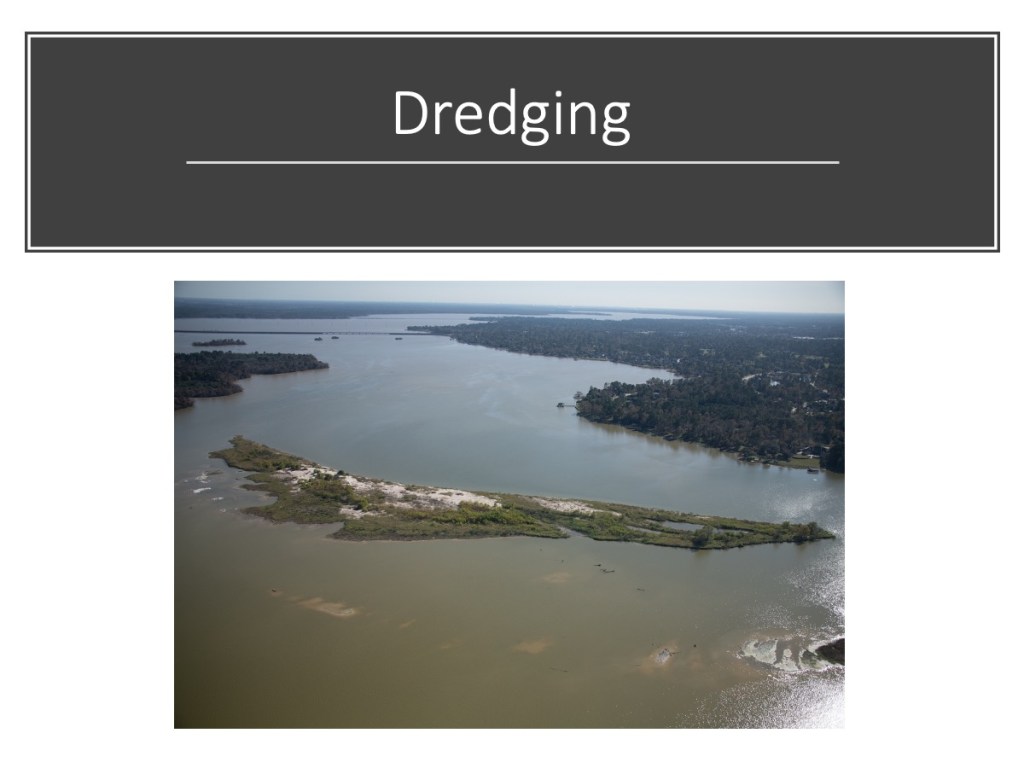
The ever-growing mouth bar on the San Jacinto West Fork. Imelda wiped out many of the gains from the Corps’ supplemental dredging program that ended on Labor Day and removed 500,000 cubic yards. Photo taken on 12/3/2019.
The growing mouth bar on the East Fork of the San Jacinto near the entrance to Luce Bayou and the Interbasin Transfer Project.
The Inter-Basin Transfer canal empties into the lower reaches of Luce Bayou, which flows into the northeastern corner of Lake Houston, near the emerging mouth bar. The project costs $351 million and will provide water to the Northeast Purification Plant. Photo taken 12/3/2019.

“In addition,” says Huberty, “I spoke to the Governor’s staff this weekend. We still have money left over from Harvey debris removal. That’s approximately another $16 million. They told us we can spend the money on the river and lake, but not for other purposes. This will let us complete the mouth bar dredging and get mechanical dredging done in areas like Huffman and Atascocita. The scope of the project is expanding, which is very good news. We’ll be able to help more people.” 

Smaller mouth bars have set up around the lake at the entrance to drainage ditches, like this one in Atascocita near Walden. Photo taken on 10/4/2019. Such blockages can force water up, out and over the banks into neighborhoods during large rains.

Next Step: Commissioners’ Court Needs to Approve Grant Request

The ball, at this moment, is in Flood Control’s court. Commissioners’ Court must approve all grant requests made by any part of the County. Says Huberty, “There will be an item on the December 17th Commissioners Court agenda requesting permission from the Court to submit the grant application to TWDB. All parties involved have already had discussions with the TWDB staff and are working on the grant application paperwork.”

Early next week Huberty plans to meet with John Blount, the Harris County Engineer; Stephen Costello, the Mayor’s Flood Czar; and John Sullivan, President of DRC.

Constant Dredging for Foreseeable Future

“In my discussions with all interested parties,” said Huberty, “we should have the application submitted by year end. We have been pushing to get it awarded quickly. It is a formality. We need to spend this money quickly which works to our advantage. We can always go back to the legislature for more after that.”

“All of these initiatives will ensure we can have constant, permanent dredging on the Lake for the foreseeable future,” said Huberty. “I am very pleased with the result and look forward to getting this project started.”   

Posted By Bob Rehak on 12/4/2019

827 Days after Hurricane Harvey and 76 since Imelda

KSA Parks Committee Votes to Dredge River Grove Park Boat Ramp and Boardwalk

At its November meeting, the Kingwood Service Association (KSA) Parks Committee voted to dredge the boardwalk and boat ramp areas of River Grove Park. The work, when done, will finally restore the park to full function.

Harvey Nearly Destroyed Park

Hurricane Harvey nearly destroyed River Grove Park. Thanks to KSA, the park has made a remarkable comeback. Harvey deposited sand five feet high in the parking lot. It left a wall of sand 12 feet high and a quarter mile long that blocked the drainage ditch that runs through the park and empties the western third of Kingwood. In the process, it also blocked the park’s boat ramp, only one on the West Fork. Finally, the storm deposited sand in the lagoon by the boardwalk and across the southern end of the soccer fields.

By the time the park is fully restored, repairs will have taken more than two and a half years.

Boat Ramp After Harvey

The Army Corps spent weeks opening up the drainage ditch that contains the boat ramp. Contractors dredged a 250-foot wide opening in the bar. Here’s how that area looked then and now from a satellite and helicopter.

Google Earth image from October 2017 shows the massive sand bar blocking the boat ramp and drainage ditch that empties the western third of Kingwood.
How the sandbar looked from a helicopter two weeks after Harvey.

Sand Bar After Dredging

Image from 2/2019.
Boats can now get through the bar, but the area immediately in front of the boat ramp is still filled with sediment. Photo taken October 2, 2019.

Even though boats can get by the sand bar now, they can’t get in and out of the water. Sediment remains around the ramp area and must be dredged. The Corps dredge was too big to maneuver in the tight space around the dock.

The Corps asked KSA not to open its boat docks in the name of safety while dredgers were still working the West Fork. Now, with dredging done and all the dredge pipe removed, KSA can work on reopening the dock.

Lagoon Also Filled with Sediment

The lagoon opposite the boardwalk filled with sediment during Harvey, too. Here’s what it looked like two weeks after Harvey.

The lagoon next to the boardwalk totally filled in with sand deposited by Hurricane Harvey. Photo also taken two weeks after Harvey.

Since then, vegetation has grown on the sand.

River Grove boardwalk area two years later.

Timetable for Dredging

KSA is now applying for a permit to remove the sediment from both the boat dock and boardwalk areas. KSA will use mechanical rather than hydraulic dredges.

The Association has already located a placement area for the spoils far from the river and any flood plain.

If permitted, removal of the sediment around the dock and boardwalk would begin in January.

Removal should take 6-8 weeks. Sediment will be placed on the parking lot to drain and dry. Then it will be trucked to the placement area in Humble.

The park could be fully functional again as early as March next year.

Public Soccer Fields Now Available

While working to prepare this project, KSA also restored the soccer fields which had been covered with sand several feet thick. All fields are now playable and KSA has designated two as public fields.

All in all, it’s been a remarkable comeback for a park that Harvey all but destroyed.

Posted by Bob Rehak on 11/19/2019, with grateful thanks to Dee Price and KSA

812 Days since Hurricane Harvey

A Brief History of Lake Houston, the West Fork Mouth Bar and Attempts to Mobilize Dredging of It

Tim Garfield and RD Kissling, two of the world’s top geoscientists, happen to live in the Lake Houston Area. Both spent careers as highly placed executives for one of the world’s largest oil companies. Together, they have led the charge to raise awareness of the growing mouth bar on the West Fork of the San Jacinto where it meets Lake Houston. They have also lobbied long and hard with local leaders and the Army Corps to mobilize an effort to dredge the mouth bar.

On October 2, Garfield gave a presentation to the University of Houston Honors College. Debbie Z. Harwell, PhD, a history instructor at the college and editor of Houston History Magazine, organized the talk. Garfield summarized the history of Lake Houston, the West Fork Mouth Bar and attempts to mobilize a dredging program to remove the bar. The presentation is thoroughly researched and highly interesting. It focuses on the intersection of geologic and human history. Anyone interested in geology, flooding, history or politics should find it informative, fascinating and stimulating.

If you really want to learn what’s happening in the river and why, this is a must read.

You can download the entire 69-page presentation here. It’s titled “A Brief History of Lake Houston and the Hurricane Harvey Flood: The Combined Effects of Record Rain, Human Error and Predictable Geomorphic Processes.”

An Advancing Delta at Your Doorstep

The mouth bar is not just a giant sand bar at the mouth of the river. It’s part of an advancing delta system within the river and now the lake. Garfield and Kissling made careers out of studying deltas like this around the world. They point out that the delta’s growth is inevitable and the result of predictable geomorphic processes. All the more reason to take it seriously and plan for regular dredging to keep that channel open.

Yet attempts to remove the threat have largely been unsuccessful and largely for political reasons. The Corps did mount a nominal dredging program in July and August. But it was largely symbolic. They removed about 20-25% of what it would take to extend the upstream dredging channel through the mouth bar.

A post dredging survey shows that the Corps created an underwater box canyon that continues to slow down water and accelerate the deposition of sediment.

In fact, they left far more sediment behind than they dredged. Why? Was there some science to the decision to leave most of it in place? Have they made public a model for peer review that shows this was a good idea? In a word, NO!

Lack of Coherent Dredging Plan

Kissling and Garfield lament the lack of holistic understanding and a coherent dredging plan. I experienced this problem first hand. Before the Corps started dredging the mouth bar area, I requested their plans. The response I got shocked me. “Plans? What do you mean by plans?” That question came on the day of the deadline for processing my Freedom of Information Act request. I replied, “You know…plans…like the ones you shared for the first phase of dredging. Start points. Stop points. Channel widths. Depths. Objectives.” Twenty-three days later, they sent me a CD with 800 pages of uncatalogued information. Not one page dealt with plans. When I complained, they invited me to submit another FOIA request, saying that the first one had been closed out already. I declined their offer.

Clearly, they didn’t have a plan. Except to force the City to assume responsibility for dredging. The Corps and FEMA felt that if the City had done maintenance dredging years ago, the problem would not have become acute.

Since October of last year, the two sides (City and Corps/FEMA) have been playing a political ping pong match, each trying to get the other to dredge.

Post Script: Dredging Update

When contractors finished dredging 500,000 cubic yards from the mouth bar around Labor Day this year, they waited patiently for local authorities to come up with their own plan. Callan Marine got tired of waiting first. Their dredge was last seen weeks ago heading south on 59 in pieces on flatbed trucks.

Great Lakes Dredge and Dock had a dredge anchored at the mouth bar for six weeks. However, today, their dredge and booster pumps have been pulled back to the West Lake Houston Parkway Bridge.

A crane is dismantling the dredge enough to get it under the bridge and back to the command post. Great Lakes is demobilizing. That will leave no dredging equipment in the river.

As of Friday afternoon, according to Stephen Costello, the City filed another request with FEMA. The request was reportedly to allow the City to apply $9 million left over from its debris clean up budget from Harvey to additional debris removal. Unfortunately, going by past experience, remobilizing a dredging effort will cost far more than that.

Ironically, this latest development comes almost a year to the day after the so-called “Everybody-but-Trump” meeting in Austin. At that meeting, according to Houston City Council Member Dave Martin, both sides reached an agreement in principle to dredge the mouth bar.

Learn More at Town Hall Meeting This Thursday

It will be interesting to see what the City announces at its October Town Hall Meeting at the Kingwood Community Center this Thursday.

Be there. 6:30 PM. On the agenda:

  • Mayor Turner
  • Council Member Dave Martin
  • Stephen Costello, the City’s flood czar, to talk about dredging and dam improvements
  • SJRA’s Chuck Gilman to talk about status of the regional watershed study
  • Public Works and Coastal Water Authority to talk about dam repairs and lower lake levels for the next year
  • Houston Parks Board to talk about an extension of their Bayou Greenways Program south of Hamblen
  • And more

Posted by Bob Rehak on 10/14/2019, with thanks to Tim Garfield and RD Kissling

776 Days since Hurricane Harvey

Army Corps Now 70% Complete with Its Portion of Mouth Bar Dredging

The Army Corps has released a new summary of its progress on dredging the mouth bar. The report indicates that Great Lakes, the contractor is now 70% complete. They have dredged 350,000 out of 500,000 cubic yards.

Great Lakes started dredging the mouth bar on June 25th, 2019, as part of a $17,085,861 extension of the original contract (FEMA mission assignment SWD-30).

Current area of operation is the blue area on the far right. Sediment removed from that area is being pumped 10 miles back upstream to Placement Area #2, a sand mine near Kingwood College, on the far left.

Between the start of mouth bar dredging and August 12, Great Lakes dredged an average of 6,363 cubic yards per day. If they can keep that pace up, they should be done by approximately Labor Day – three months ahead of schedule. That’s HALF the predicted time.

Remainder of Project Still Not Decided

What comes next? That still has not been finalized. City, County and State officials have been meeting in the background to determine that. The Army Corps still has not accepted or rejected Berry Madden’s property as a third placement area. And the $30 million appropriated by the State for mouth bar dredging won’t even become available until September 1st.

Meanwhile, Callan Marine, the subcontractor from the original West Fork Emergency Dredging job has pulled its equipment back to the dock opposite Forest Cove. However, Callan has not yet started disassembling its equipment and removing it from the river. According to Houston City Councilman Dave Martin, Callan has agreed to stay temporarily while officials attempt to work out details for the next phase of dredging.

RD Kissling and Tim Garfield, two local geologists who first brought the mouth bar issue to the public’s attention, estimate that 500,000 cubic yards is about one-fourth of the total sediment that must be removed to fully restore conveyance of the West Fork.

How Shallow is It?

The Corps has not yet released (or even developed) plans for mouth bar dredging. We do know the volume they intend to remove, and the general area they intend to remove it from. However, they have refused to divulge how much of a dent their efforts will make in solving the problem.

This photo of a Kings River resident wading across the river shows how shallow it is near the orange channel marker. This resident says boats “beach” behind his property almost every day. Note: Deeper pockets may exist, especially near dredging equipment. The risk of drowning is real. Do not let children attempt this. Photo taken Sunday, August 10, 2019.
The resident made it almost to the channel marker without getting his shorts wet. Shot taken with 6X telephoto lens.
The lake/river within this area averages two to three feet deep. 500,000 cubic yards would lower the average level by another three feet as this calculation shows.

Problem With Stopping after 500,000 CY

The problem with stopping after the Corps finishes its 500,000 cubic yards is that the river behind this area is much deeper. Where the Corps stopped dredging just past Kings Harbor, the river is now 25-30 feet deep. And places are even deeper according to fishermen. That means water coming downriver will be forced to flow uphill in this area. That will force it to slow down and more sediment will rapidly drop out of suspension. Some experts have suggested dredging a deep channel through this area to help restore full conveyance of the river. However, the Army Corps intends to stop after 500,000 cubic yards.

How Army Corps Sees its Role

The Army Corps has prepared a series of FAQs that represent its position on the remainder of mouth bar dredging. Among them:

Q: What is USACE Galveston District’s plan for the rest of the mouth bar?

A. There is no additional work planned for the mouth bar. The current plan for the modification addressing material near the mouth bar can be found on the placemat. USACE Galveston District has no authority to conduct any additional work in the West Fork of the San Jacinto River or Lake Houston. The San Jacinto River is not an authorized federal waterway, the Corps of Engineers dredging operations are currently limited to dredging Harvey-related material. The ongoing work under the contract modification will remove the remainder of material attributable directly to Hurricane Harvey. The sedimentation from recurring annual flows are not within USACE Galveston District’s mission assignment from FEMA. Water flows on the West Fork of San Jacinto River were restored to pre-Harvey levels in December 2018.”

Q: Who can the public contact for additional concerns with the maintenance of the San Jacinto River?

A. For concerns with the maintenance of the San Jacinto River, please contact Harris County Flood Control District, the San Jacinto River Authority and the City of Houston.”

Punt!

Meanwhile the City is still arguing with the Corps about how they arrived at 500,000 cubic yards. More on that later. I have obtained the Corps’ estimate through a FOIA request to the City of Houston. It raises many questions that I am still trying to sort through. More on that later.

Posted by Bob Rehak on August 14, 2019

715 Days since Hurricane Harvey

Government Gone Wild: Army Corp Refuses to Release Dredging Documents that Explain Decisions, Delays

The Army Corps has refused to release documents that explain key decisions, delays and plans related to West Fork mouth bar dredging, and a potential placement area for the spoils. At issue are the Corps’ decisions to dredge only 500,000 cubic yards from the area of the mouth bar and to delay approval of the City’s proposed placement area for long-term dredging.

As a result of a Freedom of Information Act (FOIA) request related to these decisions, I also learned that the Corps:

  • Is dredging near the mouth bar without a plan
  • Is almost done with the mouth bar project and hopes to have a plan before it finishes
  • Has repeatedly delayed a decision on a new placement area that could have saved millions of tax dollars.

Meanwhile, the Corps continues sending sediment to a mine that leaks it back into the river. That mine – in the floodway – has a dubious environmental record at best. This seems to be a case of Government Gone Wild.

Dueling Studies Offer Different Opinions of Harvey-related Mouth Bar Volume

The City of Houston and Army Corps have reportedly argued for a year or more about how much sediment Harvey deposited in the mouth bar. Late last year, FEMA required the City to perform a core-sample study using something called the Stockton Protocol. The City hired Tetra Tech to do it. And Tetra Tech concluded Harvey deposited 1.4 million cubic yards. Here is their study.

The Corps, however, evidently did not buy the results. The Corps conducted another study for FEMA using a different protocol. It concluded Harvey deposited 500,000 cubic yards.

The Corps, however, refused to release the results of that study for public review.

FEMA and the Corps went ahead and hired Great Lakes to dredge that volume from the mouth bar. That job is now more than half complete.

As part of their refusal to release their study, they cited the need to keep “pre-decision” information confidential so that inter- and intra-agency personnel could debate the merits of proposals freely. I get that. What I don’t get is how they justify this as “pre-decision.” The job is almost complete!

Dredging Without a Plan

While inventorying the documents that the Corps DID send me, I also discovered that they are now dredging the mouth bar area – without a plan. I know this because I requested the plan and they did not supply it. A Corps representative then explained that they are still working on the plan. They hope to have it done before they complete the $17 million job.

Wasteful Spending?

The Corps could be saving much of that money by using Berry Madden’s property near Kings Lake Estates as a disposal site. That’s because they need more than 5,000 gallons of diesel per day and two extra boosters (plus their crews) to pump sediment 10 miles upriver to an old West Fork sand mine in the floodway.

At the current price of diesel (about $3/gallon), that’s about $15,000 per day for fuel alone. More than $100,000 per week. And more than $400,000 per month. Waaaaay more than the limit on my gas cards. So what does the Corps get for all that?

Dike Breaches of Placement Area in Floodway

Minor floods last December breached the dike of that sand mine at least three times. Sediment continues to sweep out of the mine.

Placement Area #2 near Kingwood College on West Fork. This image is from February, but it is the same mine, whose dikes were breached in December.

It has caused additional shoaling (see below) that will need to be removed some day near the I-69 bridge. It even buried Great Lakes pipes, causing cost overruns for Phase 1.

Shoaling has become so bad through this reach of the river that it buried Great Lakes pipeline, resulting in cost overruns.

A year ago, this same mine was caught on camera deliberately sending its process water straight into the West Fork.

Video provided to ReduceFlooding.Com. Source wishes to remain anonymous.

Yet, while approving this site, the Corps reportedly has environmental concerns over a much closer disposal site that would require less fuel and fewer boosters. It’s also on higher ground and out of the floodway. It’s Berry Madden’s property in Humble immediately west of Kings Lake Estates between the West Fork and 1960.

Five different proposed placement areas on Madden property avoid wetlands (the cross-hatched areas).

The Corps may or may not have good reasons for disliking the property, but they won’t reveal them whatever they are.

After more than a year of environmental and archeological studies costing Madden more than $100,000, the Corps still has not approved or rejected his property. Nor have they explained delays in approving or rejecting it. The documents that the Corps DID supply show that they are throwing one obstacle after another in Madden’s path. Despite the fact that he’s on higher ground and farther from the river than the current placement area.

Meanwhile, the Corps subsidizes the sub-optimal sand mine/placement area above. Go figure!

Potential Setback for Future Dredging

One of the consequences of NOT having an approved site to store additional spoils is that it could delay future phases of dredging. Those potentially include:

  • Additional mouth bar dredging
  • 59 to River Grove Park
  • Maintenance dredging
  • Mouths of ditches such as Ben’s Branch

FOIA Scorecard

I filed my Freedom of Information Act (FOIA) request with the Army Corps 50 days ago. I requested:

  • Their plans for mouth-bar dredging
  • Conference reports of meetings where the mouth bar was discussed
  • Documents relating to the approval of Berry Madden’s property in Humble as a potential storage site.

About a month ago, they requested a clarification. “What do you mean by ‘plans’?” Seriously! The U.S. Army Corps of Engineers needed to have the concept of plans explained????!!!

After more delays and excuses, five days ago, I received a compact disk in the mail with approximately 800 total pages of material. The Corps:

  • OMITTED any mouth-bar plans.
  • OMITTED the Corps study that contradicted the Tetra Tech study.
  • WITHHELD 118 pages of material that could have explained their decision.
  • REDACTED key correspondence relating to Madden’s property.
  • SUBSTITUTED dredging status reports from contractor meetings for conference reports of meetings among City, State and Federal officials where decisions about the mouth bar were considered.

Government Gone Wild

After several phone calls in which I tried to cajole them into supplying the Corps’ study, I received another email from the Corps. It said that they considered my original FOIA request closed. They then asked me to submit another one for the same material that I requested in June. They seem to be treating this as a national-security issue, not a public-safety issue. Why?

Here’s the explanation from the Corps. The letter claims that they need to keep pre-decision information secret in order to foster free discussion between its employees and other government agencies and to avoid confusing the public.

Unfortunately, that does not allow informed discussion among the public, whose safety is at stake. Nor does it recognize the fact that they have already made a decision, i.e, to dredge 500,000 cubic yards and have half-completed the project. So how does this qualify as “pre-decisional”?

You’ll have to ask the man who signed this letter.

He has the title “Initial Denial Authority.” How many levels are there?

In my opinion, this is clearly a government agency out of control. The Corps has made a decision to dredge only 500,000 cubic yards – despite scientific evidence supporting a higher volume of 1.4 million cubic yards. And that scientific evidence was acquired using a protocol that the CORPS AND FEMA DEMANDED.

Who Will Pick Up the Pieces?

That leaves the State, County, City and the public in the lurch. Maybe a Congressional investigation could sort this out. That’s what it will take.

At this point, it’s not clear how, when or if the mouth-bar job will be finished. Five hundred thousand cubic yards is a small fraction of what needs to be removed to restore conveyance to the river.

It’s also not clear how many more hurdles the Corps will put in the way of a placement area farther from the river on higher ground. Or why.

A curtain of secrecy has descended upon this job. I will continue to follow the story. The public has a right to know.

Open Offer to Corps to Rebut Criticisms

If the Corps feels I have criticized it unjustly, I invite a spokesperson to explain the Corps point of view. I promise to reprint the rebuttal verbatim.

Posted by Bob Rehak on 8/9/2019

710 Days since Hurricane Harvey

The thoughts in this post represent my opinions on matters of public interest and safety. They are protected by the First Amendment of the U.S. Constitution and the Anti-SLAPP Statute of the Great State of Texas.

Weekly Mouth Bar Dredging Update with Images from Carolyn Daniel, Kendall Taft, Franz Willette of BCAeronautics, and the Army Corps

We learned a little bit more this week about the next phase of dredging. Several graphics (below) released by the Corps summarize modifications to the Emergency West Fork Debris Removal Project.

What We Confirmed and Learned

We confirmed that:

  • Great Lakes, the prime contractor on the original job, will be the only contractor on the Corps portion of the contract extension
  • Great Lakes will pump sediment all the way upstream to Placement Area 2
  • The Corps intends to dredge 500,000 cubic yards in the area of the mouth bar.

We learned that:

  • The original contract contingency allotment of approximately $3.5 million was used up, most likely by additional sediment washed downstream during floods in December, January, February, May and June.
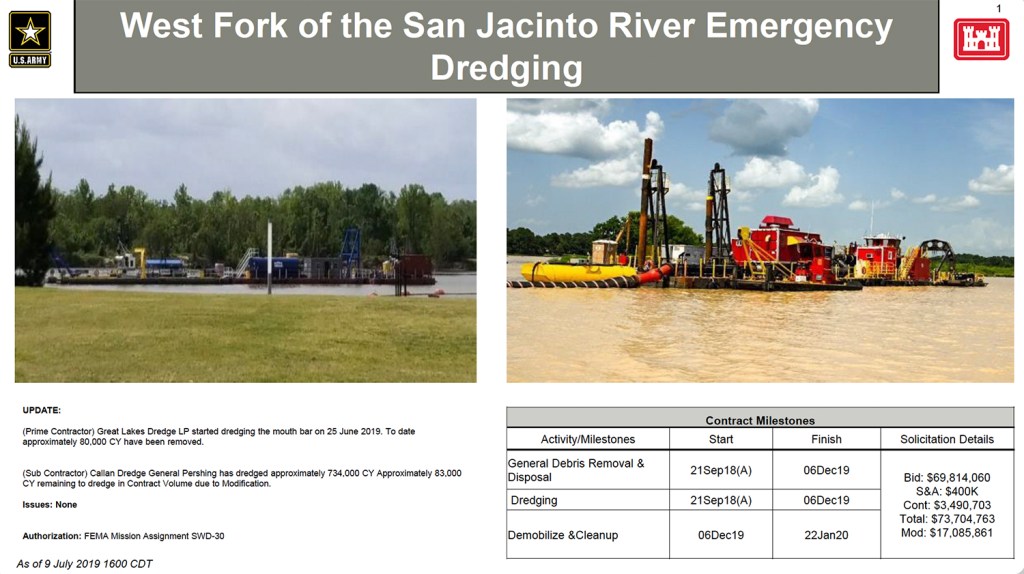
  • Callan, the subcontractor for phase one, has approximately 83,000 cubic yards to dredge due to modification of the original contract.
  • Dredging an additional 500,000 cubic yards will cost another $17,085,861
  • The FEMA/Corps portion of the dredging should finish by December 6, 2019
  • Demobilization and cleanup will take until Jan. 22, 2020
  • This is FEMA mission assignment SWD-30
  • Great Lakes started dredging the mouth bar on June 25th
  • Great Lakes will dredge a wide area but not go all the way to the FM1960 bridge.

Corps Releases Summary of Project and Extension(s)

I compiled the information above from a PDF developed by The Army Corps. They released it on July 9.

First page of a 2-page PDF released by the Corps on July 9.
Second page of a 2-page PDF. Army Corps summary of Emergency West Fork Dredging project. For a high-resolution PDF, click here.

To calculate the depth of dredging in that blue area to the right, I simulated the outline in Google Earth and found that it roughly equals 500,000 square yards. That means if they dredge this whole area, they will reduce the river bed by approximately 3 feet. The area already averages 2-3 feet deep. That means the river will be roughly 6 feet deep through this reach when the Corps finishes its portion of the job.

The area outlined by Corps is approximately 500,000 square yards.
Where Callan will finish dredging near Kings Harbor, the depth will be approximately 22.5 feet.

However, upstream, Callan is dredging to a depth of 22.5 feet. Thus, creating a continuous gradient along the river bottom would require dredging approximately another 16 feet deeper in the same area…and that wouldn’t even get you to the FM1960 bridge. Also, note the gap in the graphic between where Callan will finish its portion of Phase One and Great Lakes will start mouth bar dredging.

Unknowns

It is unclear at this point who will dredge the rest of the material that needs to be removed to restore conveyance of the West Fork. Neither the City, County, nor State have yet announced their plans. We don’t know:

  • Where they will dredge
  • How deep they will go
  • Where they will place the material
  • How much it will all cost, or
  • When they plan to do it.

In the meantime, here are two dramatic sequences of photos plus a video submitted by readers this week. They show what the start of mouth bar dredging looked like from the air and water.

Carolyn Daniel Mouth Bar Shots from Airplane Landing at IAH

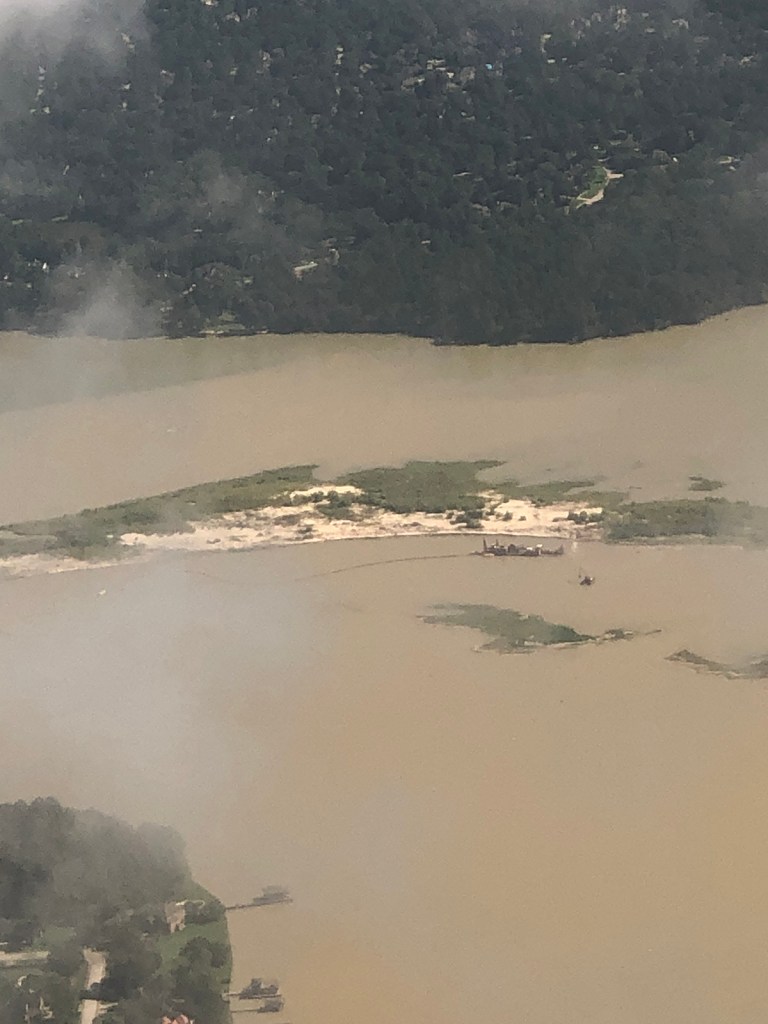
Carolyn Daniel submitted these shots of the mouth bar and dredging activity taken from her airplane window while on a landing approach to Bush Intercontinental Airport.

On approach to IAH. FM 1960 at bottom of frame. East Fork of San Jacinto upper right and West Fork on the left. Kings Point and Royal Shores between them. Image courtesy of Carolyn Daniel.
Can you spot East End Park? Kingwood Drive? Town Center? All are visible in this shot by Carolyn Daniel.
Mouth bar of west fork with dredge. Photo courtesy of Carolyn Daniel. Note the large Triple-P sand mine near the top of the frame in Porter.
Mouth bar of San Jacinto West Fork with Great Lakes Dredge. Image courtesy of Carolyn Daniel.
Mouth bar of West Fork with dredge. Atascocita Point on left in foreground. Fosters Mill and Kings Point in background. Photo Courtesy of Carolyn Daniel.
Through the clouds. While landing at Bush Intercontinental Airport. Mouth bar of San Jacinto West Fork with Great Lakes Dredge. Image courtesy of Carolyn Daniel.

Franz Willett Drone Shots Courtesy of BCAeronautics

Franz Willette runs a company called BCAeronautics that uses drones in mapping, inspections, roofing analyses, site surveys, and 3D modeling. He did not have clouds to contend with and could shoot safely from a much lower elevation. Willette is FAA certified.

West Fork Mouth Bar with Great Lakes Dredge. Drone image courtesy of Franz Willette, BCAeronautics.
West Fork Mouth Bar with Great Lakes Dredge. Drone image courtesy of Franz Willette, BCAeronautics. Great Lakes should dredge those two small islands in the background.
West Fork Mouth Bar with Great Lakes Dredge. Looking south toward the FM1960 Bridge. Drone image courtesy of Franz Willette, BCAeronautics.
West Fork Mouth Bar with Great Lakes Dredge. Drone image courtesy of Franz Willette, BCAeronautics.

Kendall Taft Video

Video courtesy of Kendall Taft. Shot from south of mouth bar looking north.
Shows how shallow the water is and how vast the expanse is.

I hope to post updates weekly on this project. So readers, please help. Submit your images through the submissions page of this web site. My thanks to Carolyn Daniel, Franz Willette, BCAeronautics and Kendall Taft.

Posted by Bob Rehak on 7/13/2019 with help from Carolyn Daniel, Franz Willette, BCAeronautics and Kendall Taft.

683 Days since Hurricane Harvey

Army Corps Moving Forward with Partial Mouth Bar Dredging to Reduce Flood Risk

The Army Corps announced Monday that it will begin dredging approximately 500,000 cubic yards of the giant sand bar at the mouth of the San Jacinto West Fork. It has been linked to flooding in the Humble-Kingwood-Atascocita area. However, previous estimates put the total volume at close to 2 million cubic yards, with the volume due to Harvey at 1.4 million cubic yards.


Text of Press Release

GALVESTON, Texas (June 10, 2019) – The U.S. Army Corps of Engineers Galveston District staff executed a modification to the West Fork San Jacinto River Emergency Debris Removal contract June 7, 2019, to dredge an additional 497,400 cubic yards of material that was deposited in the mouth of the San Jacinto River from Hurricane Harvey.

“This contract modification will ensure a decrease in threats to critical infrastructure and lower the risk to potential loss of life,” said Charles Wheeler, USACE Galveston District project manager. “This is an ongoing contract that is part of a Federal Emergency Management Agency mission assignment.”

According to USACE Galveston District officials, the dredged material will be placed at the existing location referred to as Placement Area 2, which is located approximately 10 miles upriver. The additional dredging is scheduled to be completed by the end of 2019, with the demobilization of the equipment completed by early 2020.


No Mention of Other Partners

The press release does not mention the City of Houston, Harris County, the State of Texas, or Congressman Dan Crenshaw’s office. Most had been negotiating with FEMA and the Corps as late as last Friday.

On two previous occasions, the City announced agreements in principle with FEMA and the Corps. However, the two sides still had many details to work out relating to volume, storage, permitting and cost. The City and FEMA have tried to reach agreement on the volume of sediment deposited by Harvey since last October – eight months.

In February, the City, hired Tetra Tech to collect and analyze core samples from the mouth bar. In late April, Tetra Tech estimated, through a protocol recommended by FEMA, that Harvey deposited 1.4 million cubic yards of sediment at the mouth of the river.

Two Sides Far Apart in Negotiating Volume

The Corps’ announcement reveals just how far apart the two sides were in their volume estimates – about 900,000 cubic yards. That difference means much of the mouth bar area will remain undredged – at least for now.

With approval to remove only about 500,000 cubic yards, the dredgers will have to cut a channel around the mouth bar, most likely on the deeper Atascocita side. Ironically, that would mean leaving behind sand deposited above water by Harvey – a decision that could confuse the public.

Great Lakes Dredge Moving into Position

Great Lakes finished dredging its half of Phase One on April 12, exactly two months ago. The company has waited patiently ever since for the decision that finally came last Friday.

Today, the Great Lakes dredge has anchored near Kings Harbor. Judging by the weeds and logs in the pictures below, it appears that they will have to dredge their way TO the mouth bar. That could use up some of the precious approved volume. It could also take several weeks to position and calibrate all the equipment necessary to pump sediment 10 miles upriver.

Great Lakes Dredge has moved downriver east of West Lake Houston Parkway. It is anchored in front of Raffa’s in Kings Harbor.
Wider shot taken from the pier in Kings Harbor facing west toward the Great Lakes Dredge and the West Lake Houston Parkway bridge.
Callan dredge operating on the other side of the pier. Dredgers are responsible only for work in the channel, not tidying up the shoreline. While taking this shot this morning, I noticed that workers were finally starting to renovate Sharkey’s, one of the most popular restaurants in Kings Harbor before Harvey.

What Comes Next?

Pumping sediment from the mouth bar to PA-2 will require the horsepower of the larger Great Lakes dredge. It will also require several extra booster pumps and miles of additional 24 inch pipeline. The Great Lakes dredge has now moved downstream and is anchored east of the West Lake Houston Parkway bridge near Kings Harbor.

Last week, dredge pipe re-appeared under the 59 bridge after being gone for two months. That fueled rumors that the two sides had finally worked out some kind of deal. At this hour, the mystery is where does the Corps’ decision leave all the other parties in this process? More important, where does it leave the remainder of the mouth bar?

Other Money Available

The state approved an additional $30 million for dredging the mouth bar last week. The county also allocated $10 million in the flood bond approved by voters last year (see item CI-61). That $40 million along with another $18 million committed by the City of Houston would add up to $58 million. In addition to the unspecified sum FEMA is fronting now, that might be enough to remove the entire mouth bar. That could happen one of two ways:

  • The City, Corps, FEMA and TDEM would have to increase the approved volume after the next phase starts or…
  • The City, County and TDEM would have to remove the rest without FEMA and the Corps.

However, money is just part of the problem. The second option might require permitting another placement area. Permitting could delay the project. But permitting a closer placement area might also save money. It gets complicated.

PA 1 is filling up rapidly as the pictures below show. And PA-2 is so far upriver from the mouth bar that would cost extra millions of dollars to use.

Tail end of the Callan dredge pipe empties sediment into an old sand pit off Townsend in Humble.
Several months ago, this was all water. The owner of the pit is now selling sand to an asphalt company and the pit is still filling rapidly.

Easy Way to Save Money

Shortening the distance between the mouth bar and the placement area could reduce the amount of diesel and manpower needed to run the booster bumps. Each booster uses more than one thousand gallons of diesel per day. So costs add up rapidly. That’s why the Corps is still considering other placement areas.

Berry Madden owns several thousand acres south of River Grove Park between the river and FM1960. According to Madden, using his property could save the government $5.5 million in pumping costs. And that’s just on the first 500,000 cubic yards. If 2 million cubic yards is an accurate estimate for the total mouth bar, using Madden’s property could save $22 million. That’s even more than the remobilization costs we were trying to save.

I hope we don’t stretch this out too much longer or make it any more difficult. My truck needs some repairs and I’m afraid, as a taxpayer, that I may not be able to afford them!

Posted by Bob Rehak on 6/12/19

652 Days after Hurricane Harvey

Passage of SB 7 and SB 500 Should Speed Up Flood Mitigation Projects

Six hundred and thirty-seven days after Hurricane Harvey, the Texas Legislature finally passed and funded a massive flood-relief bill, Senate Bill #7 (SB 7), sponsored by State Senator Brandon Creighton. The lengthy delay between Harvey and the bill’s passage underscores the need for Creighton’s bill. 

Need for Faster Mitigation

Few government entities, it seems, budget for emergencies. So when a tragedy like Harvey happens, cities and counties scurry around looking for small grants. They use those to hire consultants to apply for other small grants that provide matching funds for even bigger grants from FEMA. 

There’s even a two-step process to get on the list for grant consideration at the Federal level. You don’t just apply to FEMA or HUD. First, you have to file an application with the TDEM (Texas Division of Emergency Management, a part of DPS) before you can file an application with FEMA.

Most of the begging goes on behind the scenes, out of sight to the average citizen. The fact that the City or County has applied for a grant falls below the threshold of newsworthiness in most cases and so remains invisible to all but insiders. Once someone approves the grants, lengthy permitting processes further delay construction. It take years for a mitigation project to get to the construction phase. That’s when a project becomes newsworthy again.

Changing a Frustrating Process

This is why, to the average citizen, the pace of flood mitigation appears maddeningly and frighteningly slow. Important projects, such as additional dredging, gates for Lake Houston, and upstream detention, seem perpetually mired in government red tape.

The passage of Senate Bill (SB) 7 and SB 500 could help change that. The Senate and House have passed both bills, which are on their way to Governor Abbott’s desk. State Representative Dan Huberty says the governor supports both bills and that his signature is certain.

Here’s what they do:

  • SB 7 sets up several different funds that will make it easier to launch flood mitigation projects.
  • SB 500 appropriates the money for the funds in SB 7.

Provisions in SB 7

SB 7 relates to flood planning, mitigation and infrastructure projects.

  • Article 1 in SB 7 provides money for: flood control planning;  preparation of applications for regulatory approvals; and development of engineering plans/specifications for flood mitigation and drainage projects. 
  • Article 2 establishes a special flood infrastructure fund to make loans (at or below market interest rates) for flood projects. It can also provide grants that provide matching funds to poorer political subdivisions that make them eligible to participate in federal programs.
  • Article 3 amends the state Water Code relating to the Texas Infrastructure Resiliency Fund by establishing special accounts for Floodplain Management, Hurricane Harvey, Federal Matching projects, and Flood Plan Implementation.

Provisions in SB 7 encourage cooperative planning and financing of projects across political boundaries. Those provisions support regional flood mitigation projects through the Flood Infrastructure Fund. That should be especially helpful in the Lake Houston area where mitigation projects affect multiple counties and cities.

SB 500 Provides the Funding

SB 500 is an appropriations bill. It provides funding SB 7 and other items. It appropriates out of the state’s economic stabilization (rainy day) fund:

  • $273 million to provide matching funds for Hazard Mitigations Grants administered by FEMA.
  • $365 million to provide matching funds for Public Assistance Grants administered by FEMA.

Out of those two sums, it also appropriates $30 million that may only be used to provide a grant to Harris County to remove accumulated silt and sediment at the confluence of the San Jacinto River and Lake Houston, i.e., The Mouth Bar! That came from an amendment to SB 7 proposed by State Representative Dan Huberty when the House considered the Senate Bill.

It also provides, among many other things:

  • $47 million for community assistance
  • $793 million for flood infrastructure projects (drainage, flood mitigation and flood control projects)
  • $857 million for the Texas infrastructure resiliency fund
  • $13 million to the Lone Star College system for expenses related to Hurricane Harvey.

Rep. Dan Huberty says that since SB 500 is a supplemental appropriations bill, money from it should be available immediately, as soon as the Governor signs it.

A Big Thank You to Creighton and Huberty

The 85th legislature adjourned less than three months before Harvey inundated South Texas. That delayed legislative action two years. As a result, ever since Harvey, local officials have scrambled to organize and fund flood mitigation projects. The passage of these two bills should speed that process up by providing seed money for planning, grant writing, and matching funds. Thanks go to Senator Brandon Creighton and his staff for responding to the need and pushing these bills through the legislature. Thanks also go to Representative Dan Huberty for earmarking money for mouth bar dredging.

SB 500, a supplemental appropriations bill approved last weekend contains $30 million to help dredge the mouth bar on the West Fork of the San Jacinto.

With West Fork Phase One dredging rapidly winding down, hopefully the addition of $30 million to any money contributed by the City and FEMA will enable dredgers to restore conveyance of the West Fork.

Finally, we should give a big thank you to all of you who wrote letters in support of these two important pieces of legislation.

Posted by Bob Rehak on 5/28/2019

637 days since Hurricane Harvey

What 470 Cubic Yards of Muck Per Hour Looks Like at 1/8000th of a Second

I visited Placement Area 1 this morning . Muck was shooting out of the “diffuser pipe” at 470 cubic yards per hour. That’s enough to fill up 47 dump trucks every hour! A truly impressive sight. So I grabbed my Nikon D5 and started clicking. Only after downloading the images did I realize that I had the shutter set to 1/8000th of a second.

Liquid Looks Like Glass at 1/8000th

Normally, when shooting flowing water, you want to use shutter speeds in the range of 1/8th to 1/60th of a second. Slower speeds blur the liquid and create a sense of motion. The faster speed, however, froze the motion and made the liquid look like glass.

In photography, sometimes mistakes make the shot. This may have been one of those times. As I stared at the effluent, I became transfixed by the thousands of bursting bubbles within it. You can also see how the further the “spray” gets from the pipe, the bursting bubbles begin to reform into smaller droplets.

Effect of Diffusion Pipe

Dredgers call this a diffusion pipe because of those rings on the end of it. They allow the dredger to control the spread of the effluent. By adjusting the spread, they can make it shoot out far like a fire hose or spread out wide.

In this case, they had it set to “wide” so that it would be more controllable.

Diffuser pipe at Placement Area #1 shooting out effluent at 470 cubic yards per minute. Shot with a Nikon D5 at 1/8000th of a second.
A slightly wider shot shows sand piling up. All the water in the effluent finds its way back into the river after sediment drops out of suspension and it is filtered by gravity.
This shot shows three separate activities: a) the pit being filled, b) an excavator moving sand out of the flow, and c) loading a sand truck which will haul it away.

Now Selling Sand from Placement Area #1

A worker told me that early last week, the pit owner started selling sand from the site to an asphalt company. At the present rate, they are hauling it away about half as fast as the pit is being filled. This will help create extra storage area in the pit should the US Army Corps of Engineers choose to use it for the next phase of dredging – the mouth bar.

Max Flow Rates

As impressive as this flow is, I’m told it can go even higher – up to about 1,000 cubic yards per hour. The rate depends on factors such as the density and hardness of the spoils, as well as the distance they are pumped.

Details Still Being Worked Out on Mouth Bar

Still no official word yet on details of Phase 2 – the mouth bar project. The Corps is still evaluating placement areas. It could be that they need to permit more than one to contain the entire mouth bar. However, they also need to move quickly to make sure the dredgers don’t move on to another job.

Because of the lengthy amount of time permitting a placement area can take, the Corps may try to buy time by directing spoils to one or both of the current placement areas which are already permitted.

The more sand that pit owners can sell, the more capacity they will have, and the faster phase two of West Fork dredging can start.

FEMA will not pay to remove the entire mouth bar. FEMA has been working with the Corps and the City of Houston to determine how much of the mouth bar was due to Harvey. By statute, that’s all FEMA can pay to remove.

Variables Complicate Decisions

The City, State and Harris County will have to pay to remove the rest. That’s part of the contingency planning at this point. No details have yet been released about how all the pieces of this jigsaw puzzle will fit together.

Planners are now trying to optimize for at least ten variables that I have heard discussed.

  • Volume due to Harvey
  • Time required to dredge it
  • Available storage in existing placement areas
  • Additional cost to move it to those placement areas (pipe, booster pumps, fuel, etc.)
  • Productivity loss due to additional distance from mouth bar
  • Cost versus amount funded by FEMA
  • Placement areas and cost for any volume FEMA does not fund
  • Time required to permit new placement area(s)
  • Where money will come from to cover what FEMA does not cover
  • When additional funds will be available

Not simple! We can only wish that they could make the decision in 1/8000th of a second.

Posted by Bob Rehak on 5/2/2019

611 Days since Hurricane Harvey

Army Corps Updates Dredging Status

As of April 15, almost all of the Emergency West Fork Dredging Project was complete. The map below shows the current status. As of April 15, the Corps and its contractors have dredged a total of 1,564,000 cubic yards of sediment.
The Great Lakes dredge has completed its segment (shown in red) and returned to dock where it is undergoing maintenance. Great Lakes has not yet demobilized. It is awaiting a decision from FEMA and the Army Corps on whether they will approve dredging of the mouth bar.

For a full-resolution pdf, click here.

Callan Marine, a subcontractor to Great Lakes, is shown in blue. They are currently dredging just downstream from Kings Harbor. They have about 400 yards to go on the northern half of the channel. Callan should complete its segment around the end of the month.

Great Lakes Dredge has completed its segment and is docked, undergoing maintenance.
Callan still has a short distance to dredge. See the unfilled rectangles in the map above.

Next step: FEMA and the Army Corps need to make a decision on the mouth bar. They have not yet indicated when that might be.

Posted by Bob Rehak on April 17, 2019

596 Days since Hurricane Harvey