Tag Archive for: Army Corps

U.S. Fish & Wildlife Service Urged Corps to Deny Romerica Permit

The U.S. Fish & Wildlife Serivice (USFWS) has urged the Army Corps of Engineers to deny outright Romerica’s application to build high rises and a marina in the floodplain and floodway of the San Jacinto.

Bald eaglets photographed by Emily Murphy within a protection zone relative to most of the Romerica development. The USFWS criticized the Romerica application for an inadequate bald eagle survey.

From the date on the USFWS letter, February 28, it appears that USFWS arrived at its recommendation even before the close of the public comment period on March 1.

Read the full text of the five-page letter here or the summary below.

Summary of USFWS Concerns

The letter states that:

  • The applicant understated the likely impact on waters and wetlands resulting from fill material, raised buildings, infrastructure development and construction activities. They called the applicant’s proposal “misleading.”
  • USFWS expressed concerns about:
  • Bird strikes and mortalities associated with the high-rise buildings
  • The loss of highly functioning forested wetlands
  • Significant reduction in biological functions, particularly those related to fish and wildlife habitat
  • Water quality issues
  • A marina district built entirely within the floodway
  • The absence of appropriate stormwater management
  • Failure to fully disclose impacts on wetlands and surrounding properties
  • Inconsistencies in access road descriptions
  • Failure to fully disclose the project’s footprint impacts
  • Failure to provide an analysis of practicable alternatives to the proposed wetland and stream fill
  • Failure to demonstrate that the project meets the requirements of the EPA’s CWA 404(b)(1) guidelines
  • An incomplete compensatory mitigation plan
  • Improper assessment of the high level of functions of the onsite aquatic resources and surrounding upland habitats
  • An inadequate bald eagle survey
  • Disturbance and loss of bald eagle habitat.

Conclusion and Recommendation of USFWS

The USFWS recommended “permit denial due to the application’s deficiencies.”

Reaction

I’m happy that a government agency validated the concerns of residents, especially the numerous deficiencies that became so glaringly obvious during the public comment period. Example: when I asked one of the engineers at the March 18th public meeting where all the fill would be put, he couldn’t tell me. It seemed like a simple, but important question. Turns out it was.

Jill Boullion, Executive Director of the Bayou Land Conservancy said, “The Bayou Land Conservancy is gratified that US Fish & Wildlife service has confirmed our opinion that the Romerica project site is ecologically rich and diverse.  It is, in its natural state, already providing the community immeasurable services. We believe the highest good for the community is to preserve this valuable resource, not develop it.” 

Romerica’s spokesperson, Leah Howard Manlove, contacted me earlier this week to say that the Romerica team would meet next week to discuss their options and a plan of action. At this point, Romerica has two options: answer all the questions and concerns raised during the public comment period or quietly let the project die.

Posted by Bob Rehak on May 10, 2019

619 Days since Hurricane Harvey

The thoughts expressed in this post represent my opinions on matters of public policy and are protected under the First Amendment of the US Constitution and the Anti-SLAPP statute of the Great State of Texas.

What 470 Cubic Yards of Muck Per Hour Looks Like at 1/8000th of a Second

I visited Placement Area 1 this morning . Muck was shooting out of the “diffuser pipe” at 470 cubic yards per hour. That’s enough to fill up 47 dump trucks every hour! A truly impressive sight. So I grabbed my Nikon D5 and started clicking. Only after downloading the images did I realize that I had the shutter set to 1/8000th of a second.

Liquid Looks Like Glass at 1/8000th

Normally, when shooting flowing water, you want to use shutter speeds in the range of 1/8th to 1/60th of a second. Slower speeds blur the liquid and create a sense of motion. The faster speed, however, froze the motion and made the liquid look like glass.

In photography, sometimes mistakes make the shot. This may have been one of those times. As I stared at the effluent, I became transfixed by the thousands of bursting bubbles within it. You can also see how the further the “spray” gets from the pipe, the bursting bubbles begin to reform into smaller droplets.

Effect of Diffusion Pipe

Dredgers call this a diffusion pipe because of those rings on the end of it. They allow the dredger to control the spread of the effluent. By adjusting the spread, they can make it shoot out far like a fire hose or spread out wide.

In this case, they had it set to “wide” so that it would be more controllable.

Diffuser pipe at Placement Area #1 shooting out effluent at 470 cubic yards per minute. Shot with a Nikon D5 at 1/8000th of a second.
A slightly wider shot shows sand piling up. All the water in the effluent finds its way back into the river after sediment drops out of suspension and it is filtered by gravity.
This shot shows three separate activities: a) the pit being filled, b) an excavator moving sand out of the flow, and c) loading a sand truck which will haul it away.

Now Selling Sand from Placement Area #1

A worker told me that early last week, the pit owner started selling sand from the site to an asphalt company. At the present rate, they are hauling it away about half as fast as the pit is being filled. This will help create extra storage area in the pit should the US Army Corps of Engineers choose to use it for the next phase of dredging – the mouth bar.

Max Flow Rates

As impressive as this flow is, I’m told it can go even higher – up to about 1,000 cubic yards per hour. The rate depends on factors such as the density and hardness of the spoils, as well as the distance they are pumped.

Details Still Being Worked Out on Mouth Bar

Still no official word yet on details of Phase 2 – the mouth bar project. The Corps is still evaluating placement areas. It could be that they need to permit more than one to contain the entire mouth bar. However, they also need to move quickly to make sure the dredgers don’t move on to another job.

Because of the lengthy amount of time permitting a placement area can take, the Corps may try to buy time by directing spoils to one or both of the current placement areas which are already permitted.

The more sand that pit owners can sell, the more capacity they will have, and the faster phase two of West Fork dredging can start.

FEMA will not pay to remove the entire mouth bar. FEMA has been working with the Corps and the City of Houston to determine how much of the mouth bar was due to Harvey. By statute, that’s all FEMA can pay to remove.

Variables Complicate Decisions

The City, State and Harris County will have to pay to remove the rest. That’s part of the contingency planning at this point. No details have yet been released about how all the pieces of this jigsaw puzzle will fit together.

Planners are now trying to optimize for at least ten variables that I have heard discussed.

  • Volume due to Harvey
  • Time required to dredge it
  • Available storage in existing placement areas
  • Additional cost to move it to those placement areas (pipe, booster pumps, fuel, etc.)
  • Productivity loss due to additional distance from mouth bar
  • Cost versus amount funded by FEMA
  • Placement areas and cost for any volume FEMA does not fund
  • Time required to permit new placement area(s)
  • Where money will come from to cover what FEMA does not cover
  • When additional funds will be available

Not simple! We can only wish that they could make the decision in 1/8000th of a second.

Posted by Bob Rehak on 5/2/2019

611 Days since Hurricane Harvey

High-Rise Permit Application Withdrawn by Corps

The U.S. Army Corps of Engineers Galveston District announced today that it has withdrawn Romerica’s permit application. Romerica had applied to deposit fill in the floodplain of the San Jacinto River for their proposed high-rise development in Kingwood.

Artists rendering of several towers near the proposed marina with the Barrington in the background.

Romerica Could Not Meet Deadline

In a letter dated April 24, SWCA, Romerica’s environmental consultant, requested a “suspension” of the permit application. They said they needed more time to answer issues raised in 727 letters of protest. SWCA also said they would have to conduct additional surveys and field work requiring more than the 30 days allowed for them to respond. The official deadline for filing responses was April 27.

Withdrawal “Without Prejudice”

Instead of suspending the permit, the Corps “withdrew it without prejudice.” The Corps invited SWCA and Romerica to reapply at some future time when they had completed answers to the issues raised by concerned residents and environmental groups.

The Corps’ letter is dated today, April 30. For the full text, click here.

Romerica Not Available for Comment

Leah Howard of Manlove Marketing and Communications, Romerica’s official point of contact for the application, was not available for comment at press time. However, a third party who talked to her earlier in the day said that their team wanted “to do a good and complete job with citizens’ questions, and that 30 days just wasn’t enough time.”

Another third party source quoted her as saying, “Due to Harvey, Romerica will complete several new studies and surveys for due diligence which will shed more light on the larger issue Lake Houston faces. After completion of the necessary work, Romerica and the USACE will reactivate the permit and more information will be provided at that time.”

Issues Still to Be Clarified

It is unclear at this time whether a new application would obligate Romerica to go through an additional public comment period. However the letter sent from the Corps to the developer states, “Resultant project modifications may require additional coordination.”

While many questions remain, today’s letter DOES answer one. Romerica did NOT meet the Corps’ deadline for filing responses to citizen complaints. For a history of the controversy surrounding this development, see the High Rises page.

Posted by Bob Rehak on 4/30/2019

609 Days since Hurricane Harvey

Army Corps Updates Dredging Status

As of April 15, almost all of the Emergency West Fork Dredging Project was complete. The map below shows the current status. As of April 15, the Corps and its contractors have dredged a total of 1,564,000 cubic yards of sediment.

The Great Lakes dredge has completed its segment (shown in red) and returned to dock where it is undergoing maintenance. Great Lakes has not yet demobilized. It is awaiting a decision from FEMA and the Army Corps on whether they will approve dredging of the mouth bar.

For a full-resolution pdf, click here.

Callan Marine, a subcontractor to Great Lakes, is shown in blue. They are currently dredging just downstream from Kings Harbor. They have about 400 yards to go on the northern half of the channel. Callan should complete its segment around the end of the month.

Great Lakes Dredge has completed its segment and is docked, undergoing maintenance.
Callan still has a short distance to dredge. See the unfilled rectangles in the map above.

Next step: FEMA and the Army Corps need to make a decision on the mouth bar. They have not yet indicated when that might be.

Posted by Bob Rehak on April 17, 2019

596 Days since Hurricane Harvey

Army Corps Releases New Video of West Fork Dredging Highlights

Two minute video that looks back on the Emergency West Fork Dredging Project. Project should be completed within the next three weeks.

Last week I reported that Great Lakes finished dredging its segment of the San Jacinto West Fork. Their dredge is currently docked, but is not yet undergoing demobilization.

Callan Marine, a subcontractor to Great Lakes on the job is still hard at work clearing the Kings Harbor area. Over the next 30 days, the Army Corps forecasts that Callan will remove an additional 125,000 cubic yards of material from the West Fork,” said Alton Meyer, Corps Project Manager.

Callan Marine Dredge still hard at work in Kings Harbor area.

Unless FEMA, Army Corps, City of Houston, Harris County and State of Texas can strike a deal to remove the giant sand bar at the mouth of the West Fork, demobilization will begin in early May, roughly two weeks from now. For now, Great Lakes is standing by, waiting for that decision.

Dredging Highlights To Date

The video above shows some of the highlights of the current project. The Army Corps produced it.

As of April 11, 2019, the Corps and contractors had removed 652 tons of woody debris and 1,547,000 cubic yards of sand from the river.

The Corps estimates that by the completion date, 720 tons of woody debris and 1,684,000 cubic yards of sand will be removed from this 2-mile stretch of the San Jacinto.

The project began September 20, 2018, and should finish by the end of May, 2019.

Mouth-Bar Considerations

Planners now need to determine whether to extend the project by dredging the mouth bar. That would keep the crew and equipment working. And that could save, at least in theory, approximately $18 million in remobilization fees compared to pulling out now and coming back later.

Planners are evaluating:

  • How much sediment Harvey deposited in the mouth bar area
  • The cost to remove it
  • Where to place it.

All three variables affect each other. That makes costing the alternatives complex. For instance, the further upriver you pump the sand, the higher the cost for any given volume. That’s because you need additional pipeline, booster pumps, fuel, pontoons and crew.

Of the three variables, decidingwhere to place the sediment is the most time consuming. By Federal law, permitting the placement site requires two mandatory 30-day public-comment periods.

Great Lakes’ early finish pressured planners to evaluate Placement Area #2 (south of Kingwood College on Sorters Road) as an alternative placement area. Because it is already permitted, it would not require the lengthy public comment periods. And because the land owner is selling the sediment placed there, it is not filling up as quickly as Placement Area #1.

Thus, it may be technically possible to keep the equipment working and save remobilization fees – if FEMA can make a decision quickly enough.

A third possibility: using a combination of two placement areas, as in the current project.

While FEMA and the Corps weigh their options and costs, Great Lakes is repairing its equipment and inspecting pipeline. Mouth-bar dredging already has support of the City of Houston, Harris County and the State.

A decision could come in the next week or two.

Posted by Bob Rehak on 4/15/19

594 Days since Hurricane Harvey

A Dirty Job, But Someone Has To Do It: Life of a Dredger on the West Fork

Since last September, the Army Corps of Engineers has had two contractors, each with approximately 30 people, working 24/7 on the the West Fork of the San Jacinto.

Moving 1.9 Million Cubic Yards of Earth

Together, they’re removing approximately 1.9 million cubic yards of sediment left behind by Hurricane Harvey that is blocking the conveyance of the river. It’s hard to move that much sand and silt without getting your hands dirty, as these pictures by the Army Corps clearly demonstrate.

One crew started at River Grove and is working downstream toward the mid-point of a 2.1 mile stretch of the West Fork. The other started at the mid-point and is working downstream toward where Ben’s Branch enters the river, just past Kings Harbor.

The Corps uses approximately 10 miles of 22- and 24-inch pipeline weighing more than 5 million pounds to pump sediment from the river back upstream to two placement areas. One is south of Kingwood College off Sorters Road, shown below. The other is off Townsend in Humble.
The pipe floating in the foreground is rubber and designed to float. This gives the dredge room to maneuver. The pipe in the background with the orange flotation collars is rubber and bends a little. The steel pipe above does not bend.
Farm Boy is helping to anchor the dredge while a service boat transfers crew.
Looking toward the rear of the dredge. The blue part is the pump. The red containers in the background house electric motors. Cables tie the dredge to a CenterPoint substation in Forest Cove.
Before dredging, this giant dune almost completely blocked the West Fork about a half mile downstream from River Grove Park. The Great Lakes Dredge and Dock crew is still working to remove it. While it looks like all sand from the air, beneath the surface, crews are encountering dead trees and roots that get caught in cutter baskets on the dredge. (Photo by Bob Rehak)
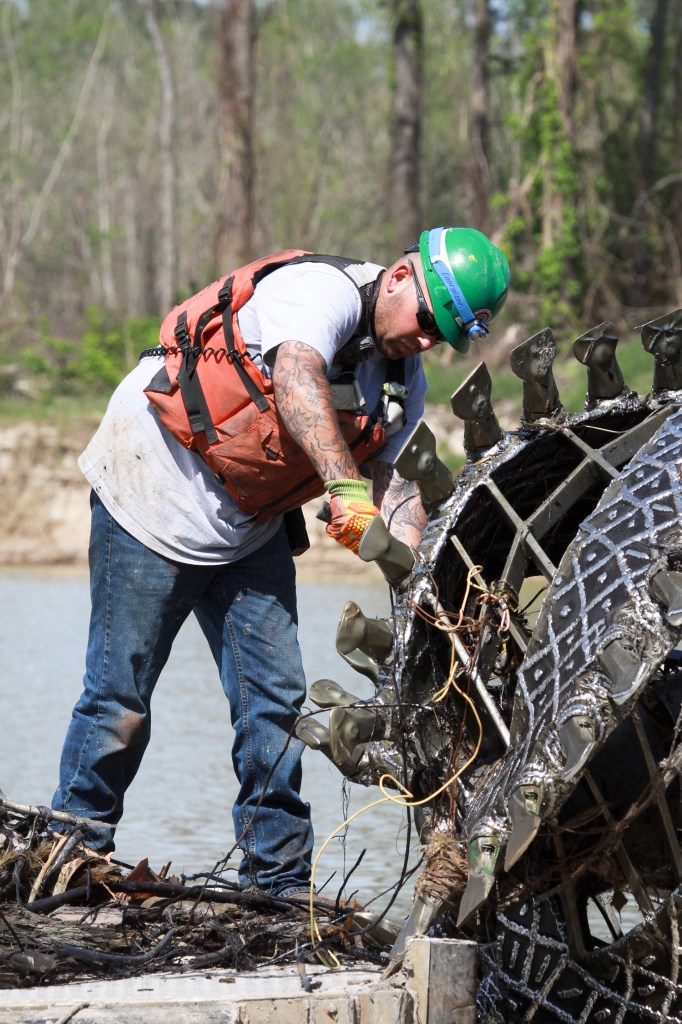
When that happens, productivity slows and crews must manually pick the material from the chisels on the dredge.
Note the pile of roots and sticks growing the men.
Here you get a better idea of how the roots and vines can clog the intakes on the cutter head. Dredging needs to stop many times each day to remove this material.
The “chisels” on the cutter head break up sand which the “cutter basket” then sweeps up. Pumps inside the steel cage suck the sand into the pipe and pump it back upstream to placement areas.
Once the dredge starts pumping again, the flow must be calibrated with three booster pumps attached to each line. At least one crew member mans each booster pump to coordinate with the others. They must avoid over- or under-pressure situations.
This shows a close up of one of the three booster pumps used by Great Lakes, the Army Corps’ lead contractor on the job. Callan Marine is a subcontractor to Great Lakes and also has three booster pumps.
This shot gives you an idea of how massive these pipelines are…
…and how much sediment they can pump per minute. There’s enough sediment moving here to fill up a dump truck in less than a minute.
The Eagle Sorters Mine is dredging this pit even as Army Corp contractors fill it up. Sand and silt recovered from the river may wind up in roadbeds or be used for mortar in the construction trades.

1.4 Million Cubic Yards Recovered to Date

Corps Engineers said that since Sept. 20, 2018, approximately 1.4 million cubic yards of Hurricane Harvey silt and debris have been pumped into the two placement areas. Ultimately, they expect to pump approximately 1.8 -1.9 million cubic yards to meet FEMA requirements, restore the river to pre-Harvey conditions, and to reduce flood risks.

Safety Warning

These images illustrate why boaters should stay away from the West Fork for now. It’s not safe. The FEMA funded emergency flood action should complete in early May, 2019.

Posted by Bob Rehak on 4/3/2019 with images courtesy of the Army Corps of Engineers

582 Days since Hurricane Harvey


Placement Area #1 Filling Up Quickly

As dredging on the West Fork of the San Jacinto gets closer and closer to completion, placement area #1 (PA1) is filling up quickly. Callan Marine, the company operating the dredge near Kings Harbor, is pumping its spoils to PA1. PA1 is an old sand pit off Townsend in Humble near North Houston Avenue.

Pipe Big Enough to Hold Two Basketballs Side by Side

I photographed the tail end of their pipeline this morning. The outflow was impressive. Callan uses 20 inch pipe. To put that in perspective, a basketball has a diameter of about 9.5 inches. So two basketballs could go through this pipe side by side with an inch to spare.

Equivalent of Filling Dump Truck Every Minute or Two

Dredgers measure output in cubic yards per hour. The output varies constantly depending on dredging location and conditions. Callan averages between 280 and 600 cy/hr. If the average dump truck holds about 10 cubic yards, that means this pipe could fill up about 30 to 60 dump trucks per hour, or one every minute or two. That explains why they pump via pipeline instead of using dump trucks.

Close up of 20 inch pipeline spewing sand, silt and clay into old sand pit near Townsend and North Houston Avenue in Humble.
Wide shot of same pit shows a little room left for storage near the perimeter in background.

Mouth Bar Update

The Corps expects dredging to complete around May 4. By contract the dredgers then have 30 days to remove their equipment (dredges, pipeline, booster pumps, pontoons, crew boats, etc.) from the river.

That means the deadline is fast approaching to do something about the mouth bar if we want to avoid a remobilization charges for a second job.

This week, according to Houston City Council Member Dave Martin, the City submitted its coring analysis of the mouth bar to FEMA and a storage permit application to the Corps. FEMA and the Corps have not yet approved either.

Mouth bar of the West Fork of the San Jacinto creates a backwater effect that contributes to flooding.

The City reportedly has talked to the dredging companies about delaying demobilization if the City cannot get approval of FEMA funding and a storage permit before the end of dredging.

Posted by Bob Rehak on 3/29/2019

577 Days since Hurricane Harvey

Yes, They Really Are Moving Sand Out of the River

At a community meeting last night, someone asked whether the Army Corps was REALLY taking sand out of the river. They didn’t see any dump trucks and they were concerned that the project was just a big hoax, on the order of Roswell, aliens and UFOs.

You have no idea how often I hear comments like this! Where are they putting all the sand? How does it get there?

Yes, they really are moving sand out of the river. But it’s not with trucks. Two dredges are pumping it though 24-inch pipe and six booster pumps miles upstream. One dredge is south of the Kingwood Country Club. The other is just east of Kings Harbor.

The first dredge is pumping sand back to an abandoned sand pit south of Kingwood College on Sorters Road. The second dredge is pumping it back to a pit on Townsend Boulevard in Humble. Here’s what it looked like today at the Townsend Pit.

Placement Area #1 on Townsend in Humble just east of North Houston Avenue. The old sand pit is nearly full.
Keeping the sand evenly dispersed is a challenge. Bulldozers keep it from building up near the pipe on the left.
Placement Area #1 is almost filled.

After the sediment drops out of suspension and settles to the bottom of the pit, sediment-free water returns to the river through this drain.

Picture of pit taken in October 2018 as dredging was beginning. The pit is now almost completely filled.
It takes six booster pumps and five miles of pipeline to get the sand where it’s going.
Before the job is done, the Army Corps will have picked up a volume of sand equivalent to the Astrodome and moved it five miles.

Posted by Bob Rehak on 3/12/2019

660 Days After Harvey

Now or Never: Friday is Last Day to Protest High-Rise Development in Floodplain Near River Grove Park

Only five more days remain to protest the proposed high-rise development near River Grove Park. The deadline for public comments? Friday, March 1.

About the High-Rise Development

Two developers from Mexico have bought up land east of Woodland Hills between Kingwood Lakes and the San Jacinto River. They hope to build 5000 condos, a retail mail, parking for 8,800 vehicles (some below ground), commercial high-rises, residential high-rises, a 50-story hotel, and a marina for 640 boats and 200 jet-skis.

Altogether, they plan to build more than 3 million square feet of residential, commercial and retail space around the Barrington. To put that in perspective, it’s roughly three times the size of Deerbrook Mall … at the end of a dead end street … four miles from the nearest highway. On the edge of the floodway. In an old meander of the San Jacinto. Without any consideration for the traffic it would add to Kingwood Drive. Or dedicating any land for additional school facilities.

What Corps and TCEQ are Considering

The Army Corps of Engineers and TCEQ are currently reviewing the developer’s proposal. The Corps is evaluating the impact of adding up to 12 feet of fill to wetlands and streams in the area against the need for the project. They also review more than a dozen other “public interest” factors, such as safety, environmental impact, navigation on the San Jacinto, sedimentation, and potential to worsen flooding. The TCEQ is evaluating water-quality issues only.

For More Information

To read more about the controversy swirling around this project, review the “High-Rises” Page of this web site. On it, you will find links to the Army Corps’ Public Notice describing the project as well as sample letters that other groups and individuals have already written. You will also find a series of posts that I have written to give you more background about the proposal and the people behind it.

The developers refused multiple requests for a public meeting to answer questions about the project, such as how they intended to get around “single family residential” deed restrictions and height requirements in Kingwood’s commercial development guidelines.

Instead, to communicate their vision, they are relying on a series of promotional websites with information that often conflicts with the Public Notice and ignore the public’s concerns. (See VTRUSA.com, RomericaGroup.com, AmericanVisionEB5.com, Torrisi-Procopio.com, YouTube, and TheHeronsKingwood.com).

If you have concerns about this development, please register them NOW with the TCEQ and Army Corps.

It May Be Now or Never!

Dave Martin, Houston City Council Member for District E, has stated that the City has no power to stop this development. In fact, the City has already issued a permit to begin excavation of the marina. So the Army Corps may be your best hope to stop this project.

Please send this post to all your friends, neighbors, relatives, kids, etc. Have them write letters, too. If you have already submitted a letter and have thought of new concerns, you may submit an additional letter.

Email Preferred to Snail Mail

Make sure you include the project number in the subject line of your email. It’s the same for either group: SWG-2016-00384.

Army Corps

swg_public_notice@usace.army.mil

TCEQ

401certs@tceq.texas.gov

As always, the thoughts in these posts represent my opinions on matters of public policy. They are protected by the First Amendment of the U.S. Constitution and the Anti-SLAPP statute of the great State of Texas.

Posted by Bob Rehak on February 25, 2019

545 Days since Hurricane Harvey

Bayou Land Conservancy Protests High-Rise Development in Kingwood

The Bayou Land Conservancy (BLC) has joined the ranks of those protesting the proposed high-rise development in Kingwood. The cutoff for submitting letters to the Army Corps of Engineers and the Texas Commission on Environmental Quality is March 1. Nine days remain.

The Bayou Land Conservancy letter runs 10 pages with another 12 pages of addenda. But don’t let the length deter you. The letter is both compelling and educational. For me, the education happened on two levels. First, I learned a tremendous amount of new information about an area I have lived in for 35 years. Second, I learned a lot about how to write a protest letter.

Meticulously detailed, it contains well documented references to violations or probable violations of numerous laws and regulations. It makes its points quietly without over- or understating. It also contains a graphic that telegraphs at a glance the danger of this development.

Bayou Land Conservancy Map showing the proposed development in relation to nearby structures that flooded during Harvey.

Among other things, the letter discusses insufficiencies in the developers’ documentation for:

  • Avoidance and minimization, two factors the Corps looks at before requiring mitigation.
  • Mitigation – The applicant has not provided enough documentation to determine whether mitigation was avoidable, and if not what types are required where to offset any unavoidable losses.
  • Dangers to threatened or endangered species.
  • Impact on streams and surrounding drainage

Bayou Land Conservancy also details several public interest factors relating to flood hazards:

  • Flood Hazards, such as insufficient elevation and location in a floodplain that will likely soon be reclassified as a floodway.
  • Floodplain Values – specifically that the cumulative impact on flood moderation, water quality, and living resources has not been considered.
  • Shore Erosion and Accretion – “The West Fork San Jacinto River currently suffers from excessive introduction and dispersal of sediments, and this project fails to address this significant local water quality problem. The environmental impacts of increased erosion and accretion, include the following: loss of important or sensitive aquatic habitat, decrease in fishery resources, loss of recreation attributes, human health concerns, loss of wetlands, nutrient balance changes, circulation changes, increases in turbidity, and loss of submerged vegetation.”
  • Water Quality – “…permit should be evaluated to determine the nature and degree of effect that the proposed discharge will have individually and cumulatively on water quality. Consideration should be given to water chemistry, salinity, clarity, color, odor, taste, dissolved gas levels, temperature, nutrients, and eutrophication. This portion of West Fork San Jacinto River is listed as impaired by the Texas Commission on Environmental Quality for not meeting pH standards. This segment is also listed for state concerns for nitrate and phosphorus based on screening levels.” Additionally BLC cites the location of the project near the major source of drinking water for the City of Houston.
  • Aesthetics – The lack of consistency with surrounding forest and incompatibility with local architecture.
  • Traffic – Concerns include both vehicular and air traffic. “This project proposes to add to the residential and commercial growth, without regard for traffic congestion.

Conclusion

Bayou Land Conservancy believes that the Public Notice lacks the information necessary to adequately consider the totality of impacts that will result from the proposed development. The environmental information provided in the Public Notice is substantially deficient, failing to meet regulations for permitting dredge and fill activities.

“BLC requests additional information and studies related to the issuance of a permit for this project be made publicly available and a public hearing…”

“The potential risks this project poses to the life, health, and safety of area residents, have not been evaluated. BLC believes the project is contrary to the public interests of protecting wetlands, floodplain functionality, water quality, and wildlife and fisheries habitat.”


For those wishing to send protest letters to additional agencies, such as US Fish & Wildlife, EPA, Texas Parks and Wildlife, Senators Cruz and Cornyn, and Congressman Crenshaw, the letter also includes addresses on page 10.

If you’re considering sending a letter, don’t wait. Time is running out. Remember, anyone can send a letter. You don’t need to be a registered voter. You just need to care.

Posted by Bob Rehak on 2/20/2019

540 Days since Hurricane Harvey