“The Developers Are Coming! The Developers Are Coming!”

Actually, the developers are already here and licking their chops over the extension of the Grand Parkway (SH 99).

My riff on Paul Revere’s famous line is not meant so much as a statement of impending doom as about the need for caution.

Certainly, there are many honorable developers who try to build high-quality communities for people without adversely affecting downstream residents. I don’t wish to malign a whole profession. Nor do I want to fail to acknowledge the many wonderful communities they have built in this area.

But there are also some developers who put profit before people. They try to cut corners wherever they can and hope that nobody will notice. Especially regarding flood control. It’s expensive and easy because most people don’t understand it.

Grand Parkway Coming Soon To Wetlands Near You

The construction of State Highway 99, aka the Grand Parkway, has opened up vast new areas on the outskirts of Houston to developers. Many of those areas consist of wetlands and forests.

TxDoT is currently prepping land for Section H of the Grand Parkway almost all the way to FM 1960 on the east from US59.
From USGS. Wetlands near the path of Grand Parkway extension. Compare with maps above and below.

Visible Difference in Development Density Where SH99 Completed

The map below shows permit applications in the north Houston area. Compare the density of projects around sections of the Grand Parkway that have already been completed (left) with the areas on the east where the concrete has not yet reached.

This map shows permit applications in the northeast Houston area, both within the City and its ETJ (extra territorial jurisdiction. The Colony Ridge development featured below is outside the ETJ (green area) in the upper right of the map above.

Developers have even more projects underway outside the City’s ETJ (not shown on the map above).

How Development Can Affect Flooding

Kingwood residents have seen how one developer can contribute to flooding hundreds of homes. Last year, Perry Homes clearcut 268 acres north of Elm Grove before installing detention ponds. Hundreds of Elm Grove homes then flooded on May 7 and again on September 19, during Tropical Storm Imelda.

Below are recent photos of a massive 10,000 acre development in Liberty County near Plum Grove. It is about to become a 15,000 development now, thanks in part to Grand Parkway access. And yet it has only one small traditional detention pond.

Detention ponds slow down the rate of runoff to compensate for the loss of trees, wetlands and ground cover that have been replaced by streets and rooftops.

Their goal: to prevent downstream flooding.

Colony Ridge Accounts for All Growth in Liberty County In Last Decade

Colony Ridge can account for all the growth in Liberty County in the last decade. Below are some photos of Colony Ridge and its expansion near Plum Grove. The approach of SH99 will make it more accessible and therefore more attractive (at least from one point of view).

All aerial photos below were taken on 6/126/2020.

Looking north across the Grand Parkway extension toward Colony Ridge in Liberty County near Plum Grove.
Just north of the Grand Parkway (upper left), you can see roads going in that will accommodate even more manufactured homes, aka trailer homes.
The developer puts in roads, ditches, water and sewer. Fire hydrants? Forget it.

Developer’s Marketing Strategy

The developer tries to pass as many costs along to lot buyers as he can to maximize profit. He targets Hispanics. Residents tell me that sometimes two or three families may live in one of the homes you see here.

Nobody knows the real population of Colony Ridge because many residents are reportedly undocumented and uncounted.

Site work before parking a home is the responsibility of site buyers, many of whom openly burn brush to clear their lots. Like the developer, they’re trying to cut costs.

Land of Fire and the Forgotten

Resident burning brush on his property last Sunday afternoon. Residents aren’t the only ones burning.
That smoke you see on the horizon is from dozens of brush fires set by the developer as he continues to clear land.
Here’s one still smoldering.
At this point, a major storm would bring the potential for uncontrolled erosion, just as it did in Woodridge Village in Montgomery County, above Elm Grove.
As dry as it has been lately, the developer is burning brush piles next to woodlands. That increases fire risk. The barren surface also accelerates runoff and erosion, increasing flood risk.
Note the haze and plums of smoke on the horizon and the vast expanse of exposed, packed dirt.
The smoke is coming from burning piles of brush, such as these. If a fire spread into surrounding woods, local volunteer fire departments would be overwhelmed.
No fire hydrants anywhere in sight.

If this were Houston, hydrants would be spaced at a minimum of every 500 feet. A firefighter told me that the spacing often depends of home values and population. Based on population alone, he believes this area should have hydrants.

One Small Detention Pond for 15,000 Acres

The developer has one detention pond (center) for the entire 15,000 acres. He relies on less efficient, in-ditch detention for additional capacity. Note the proximity to SH99 in the upper right.
There are no detention ponds anywhere in the new areas being cleared. This is reminiscent of Woodridge Village which contributed to the flooding of hundreds of homes in Elm Grove. But Woodridge was only 268 acres.
The developer relies on this and other drainage ditches to double as detention ponds in storms. But at the far end of this ditch…
…FM 1010 washed out during Harvey and destroyed one of the two major access roads into the development. The in-ditch detention failed. So has the county. The road has been out now for 1025 days, increasing the commute time for residents and the response time for firefighters.

Endless Loop of Construction and Destruction

State Highway 99 represents more than just a third loop around the City of Houston.

SH 99 will bring more developers and more people eager to escape downstream flooding issues.

Tapayer funded roads such as these create endless loops of construction and destruction. They are like a perpetual motion machine. Building one area floods another, causing people to move farther out and the cycle to repeat itself.

No one will admit it’s intentional, of course. The flooding is just a byproduct of greed. Cut a detention pond here. Substitute in-line detention there. Don’t bother planting grass to reduce erosion. Send your problems downstream. Let someone else worry about them.

One Chance

Do all developers think that way? Of course not. Many have principles and wonderful communities to show for them.

That notwithstanding, as one Splendora resident said, “They really only have one chance to get this right. If they screw this up, it will be almost impossible to fix and they will argue over who is going to pay for it for centuries.”

We are at that inflection point now.

Posted by Bob Rehak on 6/19/2020

1025 Days since Hurricane Harvey

The thoughts expressed in this post represent opinions on matters of public concern and safety. They are protected by the First Amendment of the US Constitution and the Anti-SLAPP Statute of the Great State of Texas.

Grand Parkway Construction Now Within 4.5 Miles of FM1960

Construction of State Highway 99, also known as the Grand Parkway, has turned south. It is now approximately 4.5 miles from FM1960, but more than 20 miles from reaching its goal of I-10. In the image below, taken on 6/16/2020, you can see it crossing the Luce Bayou Inter-Basin Transfer project and then heading through open farm land.

Looking southeast. Grand Parkway construction has now passed the Luce Bayou Inter-Basin Transfer Project.
Approximately 4.5 miles remains before construction reaches FM1960 to the south.

The Grand Parkway will open up vast areas in Montgomery, Harris and Liberty counties for development. All of that will put pressure on Lake Houston, shown in the lower left of the satellite image below (which was taken seven months ago.

Now, more than ever, it’s important for these counties to work together to reduce the risk of flooding for downstream residents in Houston, which is the economic center of the region.

Without a vital, safe center, growth in the entire region could falter.

Posted by Bob Rehak on 6/18/2020

1024 Days after Hurricane Harvey

Development Watchlist: New Caney ISD Prepping Land for High School #3 in Kingwood

New Caney ISD is planning to build a new comprehensive high school on a roughly 50-acre site between US59 and Sorters-McClellan Road, where a par-3 golf course used to be. The land is south of HCA Kingwood Medical Center and behind several car dealerships that face US59.

At the moment, this is the largest active development in the Kingwood area. Luckily for residents downstream, plans call for a large retention pond on the site

New Caney ISD High School #3, still unnamed, will be built where the par 3 golf course used to be in the center of the image above.

Photos of Site and Layout

The site for this high school is roughly 5-acres larger than Kingwood High School’s site. Clearing and grading of the land has already started. See pictures below.

Looking NE. Land for Future New Caney ISD High School #3
Looking East.
Looking South. Detention pond will go at the far end of this part of the site.

Importance of Detention Pond

A Bid Bulletin described the total project as a 337,000 square-foot, 3-story building with tilt-wall construction and a detention pond.

A building that large, with parking lots, and rubber grass on its playing fields would make make detention ponds critical.

Site Plan for New Caney HS #3 shows detention pond on south side of property (right) and taking up approximately 10% of the property. For a higher resolution PDF, click here.

Plans show that the retention pond will be located along the southern border of the property. The land naturally slopes to there.

Although width and length are not noted on this drawing, it appears to take up about ten percent of the site and have a depth of 6.66 feet. If those are accurate assumptions, that would mean the pond provides 33.3 acre feet of detention for a 50 acre site.

That equals .666 acre feet of detention per acre. The City of Houston requires .5 feet per acre for sites of this size.

But a white paper by the Greater Houston Flood Mitigation Consortium points out that many factors can influence the amount of detention needed to offset development. Those factors include the amount of impervious cover, the soil type and more. They can change the rate needed for protection of downstream residents more than 10X. There is not one-size-fits-all.

Until we learn more about the specifics of this site and project, we can’t know whether this plan provides enough detention. But this certainly is an encouraging start.

Now that the site is cleared though, New Caney ISD should expedite construction of the detention pond. The peak of hurricane season is two months away. Elm Grove showed us what can happen between clearing and the installation of detention ponds.

More About the High School

Community Impact newspaper reported earlier this year that the high school will open in August, 2022. The project will be built in two phases.

Artists renderings of the campus show a sleek, modern, open, light-filled design.

Aerial image shows high school will be built around an open courtyard giving more classrooms access to more sunlight. Rendering from New Caney ISD.
Artists rendering of lobby of New Caney HS #3 from New Caney ISD.
Front Elevation of the new high school from New Caney ISD.

For those new to the area, two independent school districts serve the Kingwood area. The Humble ISD serves the vast majority of the area. The New Caney ISD serves the parts outside of Harris County on the north and west.

Posted by Bob Rehak on 6/17/2020

1023 Days after Hurricane Harvey

Toxic Waste Next to Little League Fields Since Hurricane Harvey

Harvey inundated many old oil and gas properties in Humble and Kingwood, including many old stripper wells and storage tanks. Nowhere is the problem more apparent than in the abandoned well site next to the Forest Cove little league fields.

Proximity of Abandoned Site and Little League Fields

Harvey floodwaters toppled and rusted tanks which are now leaking onto the soil around them. The wells and equipment have been abandoned. All within range of a long fly ball.

Noxxe Oil & Gas, LLC used to list the abandoned property as its headquarters in Forest Cove until Harvey.
Photo taken from helicopter on 6/16/2020, 1022 days after Harvey.

A home run and you’re out! Ain’t no one going over that fence for the long ball.

Closer shot shows three wells, 16 tanks, a truck and a trailer on the site.
Sign at entrance to property indicates the Railroad Commission has seized the property and equipment. The TRCC will plug the wells and auction the equipment.
This will be a major cleanup.
It looks like one wellhead has been removed already. Tanks are ruptured and leaking. One tank has embedded itself in the ground.

Economics of Stripper Wells

As oil fields mature and well production declines, thinly capitalized operators often buy up old “stripper” wells. They hope they can still turn a profit because of their lower overhead compared to majors. But when a disaster like Harvey strikes, it exposes the flaw in that formula.

Foul!

It won’t take a major flood to cause more problems on this site and surrounding properties. Even a minor flood could spread this foul mess around.

Posted by Bob Rehak on 6/16/2020

1022 Days since Hurricane Harvey

World’s Largest Trailer Park Has Only a Handful of Fire Hydrants

The world’s largest trailer park in Liberty County, Colony Ridge, currently covers more than 10,000 acres and has only a handful of fire hydrants. This may sound unrelated to flooding, but it shows the general quality – or lack thereof – of development practices. That same lack of quality in other practices contributes to flooding, which I will discuss later in this post.

Three Hydrants Spotted in 8,400 Acre Portion of Development

In four hours of driving through Colony Ridge, I saw only three hydrants. Two were at a school under construction and behind fences. The Plum Grove Volunteer Fire Department directed me to the third. It services an 8,400 acre portion of the development.

When I got there, a pumper truck from the Cleveland Fire Department (10 miles to the north) was filling its water tank. I followed it to a fire almost two miles away.

Member of Cleveland, TX, fire department re-filling his pumper to fight a fire almost two miles away.

At the fire, it joined four other pieces of equipment fighting the same fire.

Firefighters from Porter, Cleveland and Plum Grove responded to a brush fire that threatened several homes.

Brush Fires Common Threat

The Cleveland firefighter told me that brush fires were the most common call they received from Colony Ridge. In fact, while driving around, I saw a dozen brush fires that people deliberately started to help clear their property. Most fires were contained, but on a windy day, the risk soars with the embers. The risk above got out of control.

Another brush fire near the one that got out of control. Residents commonly burn brush cleared from their property.

It felt as though homes on every block had brush piles near them. Burning reduces disposal costs but also creates a high fire risk and air pollution. Therefore, most areas forbid such burning. But it is a common practice in Liberty County, especially in Colony Ridge.

Note brush pile on left behind house.

What Happens When There’s No Water Near the Fire

Pumper trucks are one of the most common pieces of fire fighting equipment, especially in rural areas. They bring water to a fire when hydrants are not available. But Colony Ridge is far from rural at this point. It covers an area almost as large as Kingwood. Kingwood has four fire stations. It also has hydrants every few hundred feet.

This area is big enough and densely populated enough that it should have its own fire station. Plus fire hydrants on every block. Instead, firefighters must shuttle pumpers.

Ten Minutes of Water Per Load

The firefighter from Cleveland told me that most of their pumper trucks hold 1,000 gallons of water. Some hold 2,000. But fighting a fire requires 100 gallons a minute, he said. That means they usually run out of water within 10 minutes. And that means they must shuttle multiple pumper trucks to a fire.

Because firefighters can’t directly hook into a hydrant for a continuous supply of water, some must fill tanks while others fight the fire. He also said, it usually takes at least 5,000 gallons of water to put out a house fire of the size they usually encounter in Colony Ridge.

“In a water-shuttling operation, you’ll have someone dumping, someone refilling and someone on the way to refill. It’s a continuous operation and very labor intensive,” said a fire expert in this Houston Chronicle article.

Fighting Other Obstacles on Way to Fires

Just getting to a fire in Colony Ridge can take valuable time. With washed out roads, limited access, heavy traffic and firefighters coming from up to 10 miles away, fires can consume homes before units even arrive.

The Challenge of Multiple Fires

I wondered, “What would happen if there were multiple fires?” When I got home, I learned that there WERE multiple fires on Sunday afternoon. While I was photographing one, a second grass fire occurred in another part of the development. Two firefighters monitored it to make sure it didn’t spread. Luckily, it was in an area where homes had not yet been built.

Such are the joys of living in a development where fire hydrants are virtually non-existent.

Drone photo showing grass fire on Sunday 6/14/2020 in an as-yet-undeveloped portion of Colony Ridge.

Colony Ridge No Longer Rural

In rural areas, pumper trucks may be the only cost-effective alternative. Stretching water lines from ranch to ranch just is not financially feasible. But in urban areas, it’s a different story. Firefighters prefer hooking up to a hydrant so they can pump water continuously. Colony Ridge turned from rural to urban overnight.

The infrastructure no longer supports the new reality of the development.

In a development designed for tens of thousands of people, you would think county authorities would require hydrants.

In the not too distant future, thousands of additional residents will crowd into this area. With the one fire hydrant by the Dollar-General store miles away, residents will face big risks.

Cost of Adding Fire Hydrants

Ironically, the water supplier for this area, Quadvest, already runs water to all the properties.

Letter from Quadvest to resident. Rancho San Vicente is one of the subdivisions within Colony Ridge.

It would be easy to add hydrants, but they cost money. How much?

A 2011 Houston Chronicle article about the cost of installing fire hydrants said it cost about $1,500 to $2,000 to purchase and install one in The Woodlands at the time. There, developers pay for the cost of the hydrant and are reimbursed by the municipal utility districts, who own the hydrants.

Recommended spacing for hydrants is every 500 feet in most urban areas. If hydrants were installed in Colony Ridge at that spacing, it would cost millions of dollars. Neither Quadvest nor the developer has yet seen fit to make that investment and Liberty County has not required it.

Same Story with Ditches

Here’s where the story comes back to flooding.

This same cut-rate approach permeates other facets of development such as drainage.

Harris County requires the banks of ditches to be planted in grass. But that requires seeding and mowing. In Colony Ridge, they avoid those costs, but pay a price in erosion.

Heavily eroded drainage ditch in Colony Ridge sends sediment downstream. Water from this ditch blew out FM1010 (Plum Grove Road) during Harvey and it has not yet been fixed.

Where roads cross the ditch in the photo above, small pipes constrict the outflow. However, the water under pressure in those pipes starts jetting. Turbulence on the downstream side further erodes the beds and banks of such ditches. Eventually, they will collapse and require extensive maintenance.

Water flows right to left. Notice erosion downstream of bridge from turbulence caused by water jetting through pipes.

This is a common hazard of inline detention.

Ditch using small check dams or weirs for detention in Montgomery County. Note how the weirs cause downstream turbulence and erosion. Water flows from the bottom to the top of the photo.

As one flood expert said, “These homeowners may wake up someday to find the ditch in their backyards.” Such ditches will also be in rivers and streams.

Harris County discourages inline detention, such as you see in the photos above for another reason. First, offline detention is more efficient. It can capture more water, hold it until after a flood, then release it slowly.

Developers tend to like inline detention, though, because it lets them sell more lots. Meanwhile, others downstream pay the price.

Posted by Bob Rehak on 6/15/2020

1021 Days since Hurricane Harvey and 270 since Imelda

The thoughts expressed in this post represent opinions on matters of public concern and safety. They are protected by the First Amendment of the US Constitution and the Anti-SLAPP Statute of the Great State of Texas.

Rapid Runoff from World’s Largest Trailer Park Wipes Out Plum Grove Road in Liberty County and More

Rapid runoff from Colony Ridge, perhaps the world’s largest trailer park, in Liberty County contributed to a washout of FM1010. Nearby residents in Plum Grove say it also contributed to the flooding of their homes. Moreover, erosion from the development has contributed to the buildup of sedimentation in the East Fork.

Nine years ago, this area was mostly forested wetlands. Today, it’s mostly mobil homes, many on barren lots, stretching mile after mile.

World’s Largest Trailer Park?

There is no definitive source ranking the size of trailer parks, but multiple references to Sun Valley in Nevada come up when you Google “world’s largest trailer park.” That development is one third the size of this one!

Nine years ago, Colony Ridge didn’t exist.

Satellite image from 2011. The land that would become Colony Ridge was covered with forests, wetlands and rice fields. Paper companies owned most of this land for decades and periodically harvested timber.
Colony Ridge today. This is just the southern section. Two more sections are out of frame on the north.

By the end of 2019, Colony Ridge had grown to cover approximately 10,000 acres and it’s still expanding. It has transformed the landscape massively, and it’s not clear whether the development has provided sufficient detention to keep runoff at its predevelopment rate. Judging by the frequency of flood damage to surrounding homes and roads since Colony Ridge was developed, many local residents believe the answer is no.

Documentation about the design and effectiveness of the drainage systems is hard to come by. Authorities in Liberty County have not returned emails or phone calls. And the information is not posted online.

Entire Population Growth of Liberty County in Last Decade

Colony Ridge alone can account for all of the population growth in Liberty County in the last decade. The U.S. Census Bureau officially estimates that Liberty County’s population grew from 75,000 to 88,000 between 2010 and 2019. Unofficially, one local politician estimates the population of Colony Ridge to be about 20,000. Firm numbers are difficult to come by because many residents are undocumented and uncounted.

Contributing to Flooding?

Thousands of acres of trailer homes with open-ditch drainage and no deed restrictions.
Typical landscape in Colony Ridge is highly susceptible to erosion and rapid runoff.

The lack of deed restrictions means many have not planted grass. That accelerates runoff.

Also consider that the developer created many of the lots by filling in wetlands and clearing trees that used to retain water in storms. The absence of wetlands and trees also accelerates runoff.

Wetlands drained by Colony Ridge from USGS National Wetlands Inventory.

Contributing to Road Blow Out

FM1010 lies in the path of a drainage ditch more than 2.5 miles long and 60 yards wide in places. It cuts like a butcher knife through the heart of Colony Ridge.

Satellite image shows massive erosion in straight-line drainage ditch that stretches for 2.5 miles toward Plum Grove Road, out of frame on the left.

The straight line nature of such ditches accelerates water and erosion even more. During Harvey, a combination of factors (population growth, lack of ground cover and deed restrictions, design of drainage, loss of forests and wetlands, impervious cover and extreme rainfall) all contributed to washing out FM1010. (See images below.)

Acceleration of runoff also shortens the time of accumulation during floods which heightens flood peaks.

Effect of Urbanization on Peak Stream Flows” by Dr. William Dupre, professor emeritus from the University of Houston.

One Person’s Dream Turns into Another’s Nightmare

The developer of Colony Ridge had an attractive vision for a niche market: to provide affordable plots of land without deed restrictions (at least in the early stages) to low-income families trying to escape the City. He marketed mainly to Hispanics who dreamed of owning their own land in America. The result may be a dream for some, but it’s turning into a nightmare for others.

A low-altitude shot looking west toward Plum Grove Road (concealed in tree line in distance).

Unintended Consequences or Foreseeable Tragedy

The giant ditch shown above leads directly to where FM1010 washed out. Along the way, there’s little to slow water down. The developer has installed twin culverts under a road that crosses the ditch. They may help. But judging by the results, they’re not working very well.

Cropped and enlarged from wide image above of Colony ditch.

From the bridge above, the elevation drops more than 27 feet in three quarters of a mile before stormwater goes into a strip of woods between FM1010 and the development. There, it gathered the momentum to blow out the road.

In the last part of its journey across Colony Ridge to the East Fork (left), water drops 27 feet with only a strip of woods to slow it down before it reaches the part of Plum Grove Road that washed out.
FM1010, Plum Grove Road has been impassible since Hurricane Harvey 1020 days ago.
Looking upstream toward Colony Ridge out of frame in the background (upper left)
Looking downstream toward the East Fork about 200 yards to the east.

Detours and Delays

More than 2.5 years after Harvey, this road has yet to be repaired.

The loss of FM1010 makes northbound traffic detour through Colony Ridge or up US59 and then back east. As a result, residents say that it can now take an hour during rush hour to go the five miles from US59 to Plum Grove on FM 2090. But that’s not the only problem.

Rapid Sedimentation Downstream

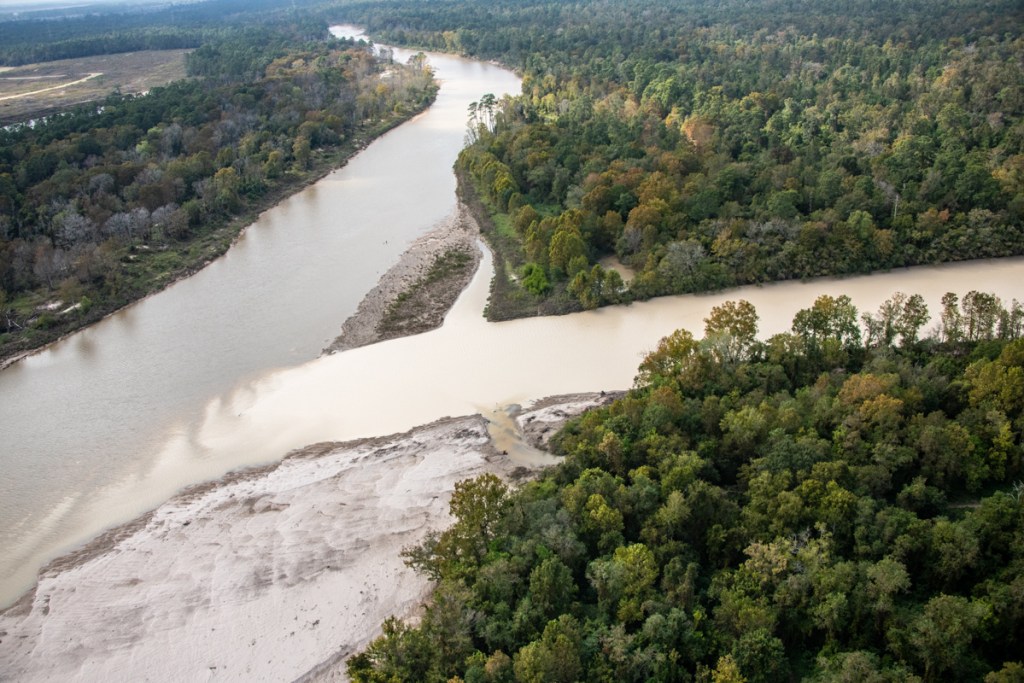
Downstream from Colony Ridge, we’re now getting rapid sand build ups on the East Fork, much like we have on the West Fork from sand mines. According to boaters, the area shown below was 18 feet deep before Imelda. The deepest point in the channel when this picture was taken last December was 3 feet.

Growing East Fork Mouth Bar

A massive development, such as Colony Ridge, without appropriate safeguards against erosion, contributes to this buildup. They certainly aren’t the only contributors. Sand mines that provided the aggregate for the roads in Colony Ridge have certainly helped.

Posted by Bob Rehak on 6/14/2020

1020 Days since Hurricane Harvey and 269 since Imelda

The thoughts expressed in this post represent opinions on matters of public concern and safety. They are protected by the First Amendment of the US Constitution and the Anti-SLAPP Statute of the Great State of Texas.

SJRA Sunset Review Now Underway

Almost a year ago, I posted about an upcoming sunset review for the San Jacinto River Authority (SJRA). That process is now underway. The SJRA submitted a self-evaluation last September and the Sunset Review Commission is now accepting public comments.

The Commission will hold one public meeting on December 9th and 10th, before it makes a final decision about the SJRA on January 13.

The SJRA’s 131-page self-evaluation contains a wealth of information about how the SJRA perceives its performance. It will also give you insight into the challenges they face and how they are responding. I have limited discussion below to SJRA’s flood management division, because that is the focus of this website. The bottom of the post contains information about how to make a public comment if you wish.

Surprising Flood Management Objective

Interestingly, the SJRA does not list Flood Management under its Mission, Principles, or Objectives. It does list Flood Management as a Key Function. However, when asked “Do your key functions continue to serve a clear and ongoing objective,” the SJRA had an interesting response.

“In 2018, SJRA created the Flood Management Division to actively seek federal, state, regional, and local partnerships to coordinate flood management activities across the entire San Jacinto River basin, including Harris County. Flood planning and management activities are typically carried out and funded by local taxing entities since the purpose is to protect life and property.”

SJRA Self-Evaluation Report to Sunset Commission, Page 9, September 2019, emphasis added

They see themselves more as a coordinator than doer. The report then goes on to say, “SJRA did not have taxing authority and therefore was limited in its ability to implement large regional flood management projects….”

Two years after the governor told the SJRA to get into the flood management business and identify sources of funding, the SJRA still has not found the golden goose. In eleven separate places in the document, the SJRA cites a lack of taxing authority as the problem. It also makes several references to the failed initiative to establish a Montgomery County Flood Control District. The proposition failed by a vote of 1,222 “For” and 2,714 “Against” … IN 1985 … 35 years ago!

Biggest Opportunities for Improvement

SJRA says it is constantly looking to improve its operations. “At this time, there are four areas in which we are focusing our efforts in order to improve operations and administration: (i) expanding use of technology and social media, (ii) public communications and engagement, (iii) comprehensive and uniform complaint resolution, and (iv) accessibility of historically under-utilized businesses.”

Flood management is not one of the opportunities for improvement.

Expenditures by Goal

Right now, the SJRA is paying salaries for flood management out of water revenues. The River Authority spent roughly $150,000 in 2018 and budgeted $180,000 for 2019. That was roughly 0.14% of the SJRA’s total budget. And less than most people spent to repair their homes.

Flood management has 0.84 FTEs (less than one full-time employee). That’s because they split their time with other divisions.

Page 32

For fiscal years 2019 and 2020, the Flood Management Division continues to be funded via SJRA Raw Water Enterprise revenues. The total budget for FY 2019 for the Division is $776,748.

Objective of Flood Management Division

The SJRA’s Flood Management Division describes following major activities:

  • Developing short-term and long-term regional flood management strategies within the Authority’s portion of the San Jacinto River Basin
  • Building partnerships with federal, state, and local government entities
  • Identifying funding sources and opportunities
  • Coordinating, collaborating, and potentially partnering with other entities throughout the entire San Jacinto River basin.

“The Flood Management Division oversees the partnership and implementation of planned and funded projects, including the transfer of operations and maintenance of completed projects to partnering entities,” the report says.

Evidence of Effectiveness and Efficiency of Flood Management

The SJRA says that evidence of its Flood Management success can be seen in applying for a flood protection grant in 2018, receiving it, and beginning the associated project in 2019.

Another example: Participation as a funding and technical partner in the Upper San Jacinto Regional Watershed Master Drainage Plan study being managed by the Harris County Flood Control District (HCFCD).

Additionally, SJRA cites a “Know Your Watershed” campaign that will help provide the public with a better understanding of the watersheds they live in, as well as the sources of stormwater (i.e. rivers/streams, upstream watersheds, etc.) for those watersheds. The campaign consists of two tools: an online watershed viewer and an interactive story map that will give viewers an educational digital “tour” of the West Fork of the San Jacinto River.

SJRA also provided Senator Brandon Creighton with draft language for a bill that would allow the Authority to take a more active role in sedimentation management in the San Jacinto River basin. That language is included in House Bill 1824 of the 2019 Texas Legislative Session.

Finally, SJRA has been involved in a variety of other flood management related activities, including participation in various stakeholder groups, task forces, etc.

SJRA currently does not participate in any floodplain administration activities, nor does it have the authority to enact or enforce drainage infrastructure criteria or adopt development standards.

Major Issues for Flood Management

Funding. “Since Hurricane Harvey, SJRA has sought partners to fund feasibility studies in the hopes that federal and state funding could be matched with local and regional partners to develop flood management projects to help upstream and downstream land owners.”

Possible Solutions

“The recent passage of Senate Bills 7 and 8 and House Bill 26, along with a few other bills that were passed during the 86th Legislature, could lead to increased opportunities to create the necessary coordination to achieve meaningful, regional flood management strategies.”

They do not yet know what studies and/or projects will be funded. “It is also not yet known if and how local and regional partnerships will develop for flood management projects. However, it can be assumed that without more collaboration of regional flood management strategies and coordination of solutions, the region will continue to face flooding risks.”

Another potential solution: creation of tax-funded, regional entities that cover entire, or large portions, of major river basins. For example, the Harris County Flood Control District has the necessary legal authority and funding mechanism to implement flood mitigation projects, however, it covers less than half of the San Jacinto River basin. This solution would require legislation to implement.

Montgomery County leadership reportedly has little interest in flood control. Most see it as an expense to their taxpayers that benefits residents of other counties.

Pending Lawsuits

SJRA acknowledges that it faces multiple lawsuits associated with flooding that occurred during Hurricane Harvey in 2017.

Regarding those, it says, “The City of Houston is a two-thirds partner in the construction and operation of Lake Conroe and is therefore responsible for two thirds of the costs associated with the lawsuits. While current case law related to the liability of reservoir operators for downstream flooding is favorable, the ongoing costs of litigation is a significant burden related to the operations of the Lake Conroe Division.”

How to Comment by When

To review the entire self-evaluation report, click here.

To provide comments and suggestions to Sunset staff:

  • Send an email to sunset@sunset.texas.gov
  • Submit comments online at www.sunset.texas.gov
  • Send a letter to Sunset Advisory Commission, Attn: SJRA, P.O. Box 13066, Austin, Texas 78711
  • Call (512) 463-1300 and ask to speak to Alan Leonard, project manager of the SJRA review

Please provide your comments by July 31, 2020 to ensure Sunset staff can fully consider your input while conducting their review.  Comments submitted before the staff report is published in November 2020 will remain confidential.

Stay informed!  Visit www.sunset.texas.gov to sign up for email alerts on the Sunset staff report and the Sunset Commission’s public meetings on SJRA.

Posted by Bob Rehak on 6/11/2020

1019 Days after Hurricane Harvey

What Happened Downstream During Harvey as Lake Conroe Released 79,000 CFS

Last night, I posted some statistics about Lake Conroe levels after the SJRA started the release during Hurricane Harvey. Tim Garfield and R.D. Kissling, two top geologists, now retired from one of the world’s largest oil companies, have looked at the release from a downstream perspective. Last year, they put everything they learned into this 69-page presentation delivered to the University of Houston Honors Program.

From “A Brief History of Lake Houston and the Hurricane Harvey Flood,” by Tim Garfield and RD Kissling with help from Bob Rehak, 2019.

Recap of Key Points About Lake Conroe Release

To recap several key points:

  • The SJRA never did let Lake Conroe rise to its allowable flowage easement. The water level in Lake Conroe peaked at 7 a.m., August 28, 2017, at 206.23 feet. The SJRA’s flowage easement is 207 feet.
  • Outflow exceeded inflow by 8:30 a.m. on the 28th and stayed that way for the duration of the storm. As the lake level declined, the lake had up to 3 available feet of storage capacity.
  • Yet the SJRA kept releasing, on average, 2X – 10X more water than it was taking in. At one point, the ratio exceeded 100:1.

Tracking the Release Down West Fork

Garfield notes that the discharge ramp up that began the evening of the 27th reached a peak discharge rate of more than 79,000 cubic feet per second (cfs) just before noon on the 28th. The discharge rate didn’t dip below 70,000 cfs until 4 a.m. on the 29th – more than 16 hours later.

Following in lockstep with the Conroe release, flow rates at downstream gauges ramped up, in lockstep. By lining up the peaks of gages downriver, you can literally see the water surging down the West Fork all the way to Lake Houston. (See left side of image above.)

Significantly, Garfield says, these gauges all showed flattening flow-rate curves before the release ramp up. Those curves then turned and steepened upward as the Conroe release pulse arrived at those gauges.


Timing and Impact of Release in Lake Houston Area

Peak flow at the Humble gauge was reached shortly after noon on the 29th, roughly 24 hours after peak discharge was reached at the dam and roughly 30 hours after the high-rate release ramp up began.

Water started creeping under the doors of Kingwood Village Estates, a senior living center in Kingwood Town Center about 1.4 miles from the West Fork, at 3 a.m., on August 29th, 2017. It kept rising all morning and finally stopped another mile further inland. Water entered the last (highest) house to flood in Kings Point (the Kingwood subdivision closest to the main body of Lake Houston) at 2 p.m. that same day, according to Elise Whitney Bishop.

Residents trying to escape as Harvey's floodwaters rose
Kingwood Village Estates residents trying to escape as Harvey’s floodwaters rose. Twelve later died.

The level of upper Lake Houston, as measured at US59, rose an additional 7 feet during this period.

Significant additional flooding of Kingwood homes can be tied to this same period of increased discharge.

Flow rates measured at the Grand Parkway gauge and calculated at the Humble gage indicate a flow rate increase in this period of between 70,000 to 80,000 cfs, corresponding closely to the 79,000+ peak flow rate added by the Conroe dam discharge.

“The data from the affidavits further supports several key conclusions from the Harvey Flood Fundamentals section of our University of Houston talk,” said Garfield. Those include:

  • The large sustained release from Lake Conroe made West Fork flooding worse. The extra 80,000 cfs increased the West Fork flow 50%.
  • The release occurred as the storm was abating. It significantly increased flood damage in the Lake Houston area.
More than 4,400 structures flooded in Humble and Kingwood along the West Fork. Source: HCFCD.

The list of damages ran well over a billion dollars.

The SJRA Argument

The SJRA maintains to this day that Lake Conroe is a water-supply reservoir, not a flood-control reservoir. See the affidavits of Hector Olmos and Chuck Gilman. Olmos is a consultant who helped design the operations manual for the gates at Lake Conroe. Gilman is the SJRA’s Director of Flood Management, hired the year after Harvey.

They are basically claiming, “We don’t have the right tool to prevent downstream flooding.”

Editorial Opinion

Editorial opinion: That excuse has always sounded hollow to me. It attempts to curtail discussion of whether the SJRA waited too long to start releasing water, released too much at the peak, and then kept on releasing too much for days.

That discussion is a matter of public concern that could save lives and property in the future. We need to have it.

Sadly, it will take the courts to figure this out. In the meantime, the SJRA has hired some of the highest priced lawyers in the country and now appears to be angling for legislative immunity by hinting at higher water prices “statewide” if liability can’t be controlled.

It all smacks of similar arguments in other industries. If you’ve lived long enough, you’ve heard them all before, such as car companies that would be driven out of business if forced to install seat belts and other safety features. Well, that prediction didn’t quite work out! Luckily, for General Motors, the addition of safety features helped fuel its resurgence.

Posted by Bob Rehak on 6/12/2020 with thanks to Tim Garfield and RD Kissling

1018 Days after Hurricane Harvey

The thoughts expressed in this post represent opinions on matters of public concern and safety. They are protected by the First Amendment of the US Constitution and the Anti-SLAPP Statute of the Great State of Texas.


Operational Statistics from Lake Conroe Dam During Harvey Raise Troubling Questions

Two affidavits in a lawsuit filed against the SJRA for flooding downstream residents during Harvey contain statistics that raise several troubling questions about the operation of gates during the storm.

  • Did the SJRA wait too long to begin releasing water in significant volumes?
  • As a consequence, did it create an unnecessarily high peak discharge?
  • Did it maintain high discharge rates longer than it needed?
  • As lake levels declined, why did the SJRA continue releasing 2X to 10X more water than it was taking on when it had up to 3 feet of storage capacity in the Lake Conroe?
  • Why did it never let the level of Lake Conroe reach its flowage easement max?
  • Could different procedures have reduced downstream flooding?
Part of one page of seven pages of gate operation statistics in affidavits.

Affidavits of Gilman and Olmos Contain Insights

The first affidavit comes from Chuck Gilman, the SJRA’s Director of Flood Management. It contains a gold mine of statistics. Tables at the end of the affidavit show the date, time, average lake level, total inflow, and total discharge (cubic feet per second), and the exact time of gate changes. The statistics start August 26, 2017 at 10 p.m. They end three days later at the same time. The seven pages of statistics capture a snapshot of the storm and the SJRA’s response hour by hour during Harvey. At the peak, the SJRA recorded changes every 15 minutes.

The second affidavit comes from Hector Olmos, a Principal and Vice President of consulting firm Freese and Nichols, Inc. Olmos helped develop the gate operations policy for at Lake Conroe for the SJRA. The Olmos affidavit contains the same statistical information in Gilman’s. However, it also contains more details of the Gate Operations Policy in place at the time of Harvey. And the two affidavits assert different facts.

Download Gilman Affidavit

Download Olmos Affidavit

Inflow Vs. Outflow and Flowage Easement Max

In the summary that follows, outflow vs. inflow rates are significant. Gilman swore in his affidavit that the gate operation “…policy is programmed so that even in the most extreme situations, peak outflow will never exceed 70% of inflow.” “Peak” is the key word there. Olmos swore in his affidavit that 80% was the limit. However, statistics show that it never significantly exceeded 60%.

As you review the following, keep in mind another key point. SJRA had the ability and authority to increase the lake level to 207, but stopped short at 206.23 for some reason that the affidavits don’t explain.

Summary of Key Statistics and Actions

Key statistics show that:

  • Lake Conroe started to rise at 11:30 p.m. on August 26, 2017 in response to 1,722 cfs flowing into the lake.
  • After the lake level reached 201.04 feet at 12:15 a.m. on August 27, SJRA first opened its gates at 12:25 a.m. and started releasing 529 cfs.
  • After that, inflow generally increased for the next 24.5 hours, though the increases were not a straight line. Inflow fluctuated up and down, likely in response to feeder bands passing over the watershed or variations in readings due to wave and wind action.
  • More than 24 hours after the start of the storm, at 1 a.m. on August 28, inflow peaked at 129,065 cfs. By then, the lake level had reached 205.65 feet and the SJRA was releasing 62,082 cfs, less than half of the inflow.
  • From that point on, the inflow generally declined, but not in a straight line.
  • The water level in Lake Conroe peaked six hours later at 7 a.m., August 28, at 206.23 feet. That’s roughly three-quarters of a foot BELOW the SJRA’s flowage easement.
  • After that, water continued to go down for the duration of the storm, but the SJRA continued increasing its release rate for five more hours, until 12 noon on the 28th. The water level was 206.17 feet, almost a foot below its flowage easement. Inflow was 63,986 cfs (less than half the peak), yet discharge peaked at 79,141. So the lake level and inflow were going down, but the discharge rate kept increasing when the lake had room to spare.
  • SJRA kept the release rate above 70,000 cfs until 4:15 a.m. the morning of the 29th, more than 16 hours. By then, the lake level had gone down to 204.58. And the discharge rate was still three times higher than the inflow (71,538 cfs discharge vs 20,287 inflow).
  • For the rest of the storm, lake level, inflow rates and discharge rates all continued to decline. The table ends at 10 p.m., August 29th. Lake level equaled 203.44, discharge 22,033, and inflow 6,579.

Turning Points in the Storm

During the entire day of August 27th, outflow fluctuated roughly from 16% to 50% of inflow as the inflow kept building relentlessly.

Outflow exceeded inflow by 8:30 a.m. on the 28th and stayed that way for the duration of the storm even though the lake had up to 3 available feet of storage capacity.

By the morning of the 29th, downstream areas were flooding badly. The SJRA had roughly three feet of extra storage capacity in Lake Conroe within its flowage easement. Yet it kept releasing, on average, 2 – 10X more water than it was taking in. At one point the ratio exceeded 100:1.

Could the SJRA have used more of Lake Conroe’s available storage capacity as lake levels declined to help reduce downstream flooding?

Neither Mr. Gilman’s, nor Mr. Olmos’ affidavits shed light on these issues.

Please Note

Chuck Gilman inherited this problem. The SJRA did not hire him until well after Harvey.

Also note that conditions during an emergency can be chaotic. Keyboard quarterbacking after the fact is much easier.

If the SJRA wishes to respond to this post, I will print its position verbatim.

Posted by Bob Rehak on 6/11/2020

1017 Days after Hurricane Harvey

The thoughts expressed in this post represent opinions on matters of public concern and safety. They are protected by the First Amendment of the US Constitution and the Anti-SLAPP Statute of the Great State of Texas.

Region H Water Plan May Ask Legislature To Clarify Potential Flood Liability of Dam Operators

The current draft of the Region H Statewide Water Plan contains a recommendation that many of those who flooded during Harvey may take issue with.

On page 18 of the executive summary, there’s an overview of the recommendation. It requests that “… the State consider legislation clarifying the liability exposure of reservoir operators for passing storm flows through water supply reservoirs.”

Sounds innocent enough. However, the explanation for the recommendation on page 1,411 of the appendices is a little more ominous. I reprinted it verbatim below, but italicized some phrases for the discussion that follows.


Explanation for Recommendation

The explanation says, “Flood control reservoirs are generally drawn down at the beginning of the annual wet season so that when large rain events occur, the runoff may be captured and later released more slowly into the receiving stream. These reservoirs therefore reduce downstream flood levels and prevent inundation in low areas. In contrast, water supply reservoirs are operated to capture and retain as much stream flow as allowable under their permits in order to have supply available during periods of high demand.”

“This practice results in less available storage volume to capture runoff during major storms. When a major storm event occurs upstream or above a water supply reservoir, the reservoir operator must sometimes release flood flows during and after the event to prevent flooding upstream of the reservoir or to prevent damage to the dam and other facilities associated with the reservoir.

“Although this flood flow can contribute to downstream flooding, most reservoirs actually reduce the amount of flooding which could have occurred had the reservoir not been constructed.

“In recent years, plaintiffs with property in the downstream floodplains have brought multiple lawsuits against major water supply reservoir operators. Some recent court decisions have held the operators liable for damages to the downstream properties.

“If this trend is allowed to continue, it will increase insurance rates for these entities and will force operational changes to occur that may result in less available water supply for periods of need. The net effect to water users will be an increase in the cost of surface water throughout the state.”

During Harvey, the SJRA released more than 79,000 cubic feet per second from Lake Conroe.

Sounds Like SJRA

The SJRA has hammered these themes since Harvey.

The text of the explanation sounds as though it is paving the way for a declaration of legislative immunity for Water Authority actions during floods.

Concerns About Recommendation and Explanation

On the surface and in the abstract, the individual claims in the explanation sound reasonable. However, on deeper inspection, they contain logical fallacies, generalizations, false choices, contradictions and questionable assumptions.

  1. The explanation draws a distinction between flood control and water supply reservoirs – as if we have a choice. This area is too flat to allow the construction of classical flood-control reservoirs, such as those described in the text. So our reservoirs must do double duty.
  2. Their rationale only allows the possibility of releasing water during and after the event. It makes no mention of before.
  3. “…most reservoirs actually reduce the amount of flooding…” Hmmm. Is this admitting that they do have a dual purpose? Flood prevention was one of the objectives in the SJRA’s enabling legislation.
  4. “Some recent court decisions have held the operators liable for damages to the downstream properties.” Aren’t courts the proper venues for such decisions? How can the legislature possibly foresee the actions of every operator in response to every storm?
  5. “If this trend continues…” What trend? Aren’t we talking about one event? Sounds like a plea for “legislative immunity” even if the recommendation itself doesn’t use those words.
  6. “…force operational changes to occur that may result in less available water supply for periods of need.” True, but with proper controls in place, might they not also strike a balance between water supply and flood reduction?
  7. “…increase the cost of surface water throughout the state.” If a court finds the actions of one operator deficient, how does that affect the insurance of every other operator in the state?

Real Question

No doubt, low lying properties were doomed to flooding during Harvey by the nature of the storm itself.

But did the SJRA have to open Lake Conroe’s gates when they did, as wide as they did, for as long as they did? Could an earlier, smaller, shorter release have avoided some of the flood damage?

I, for one, would feel much more comfortable having a judge answer questions like that after the fact rather than the having the legislature limit liability beforehand in a blanket fashion. Limiting liability also limits accountability.

Such recommendations buried in a statewide water plan on page 1,411 of an appendix show why the public REALLY DOES need to review this plan and give input.

Once approved in October, all recommendations will carry the weight of a state agency. The legislature rarely acts against such recommendations, especially when heavily lobbied behind the scenes. If you have the same concerns I do, the time to speak up is now.

How to Register Concerns about Water Plan

Here’s how to make your voice heard on this or any other issue in the Water Plan. You need to go through the SJRA.

The Region H Water Planning Group (RHWPG) will accept written comments until 5:00 p.m. June 28, 2020. Written comments should be provided to: Hon. Mark Evans, Chair, RHWPG c/o San Jacinto River Authority P.O. Box 329, Conroe, Texas 77305-0329

Written comments about the water plan without attachments also may be emailed to info@regionhwater.org. Comments will be documented in the summary of public comments in the 2021 Region H Water Plan.

Questions or requests for additional information may be submitted to: Jace Houston, General Manager, San Jacinto River Authority, P.O. Box 329, Conroe, TX 77305-0329, telephone 936-588-3111. The San Jacinto River Authority is the Administrator for the RHWPG.

Posted by Bob Rehak on 6/10/2020

1016 Days after Hurricane Harvey