At approximately 1:30 AM on January 9, 2022, a tornado swept through Kingwood. Hard hit areas included Forest Cove and Trailwood Villages. The supercells that spawned the EF-1 Tornado also dumped approximately 5 inches of rain that morning. When the rain stopped, I ventured out and found cleanup crews already clogging the streets. I drove through the same areas today to gage the progress of repairs.
Tornado Aftermath Remains
Many homes have been fixed, re-roofed and re-painted. But many blue tarps still remain. Roofers will not soon run out of business.
And I saw two empty foundations where it looked like homeowners decided to start over.
The scenes were a testament to the power of nature and the determination of humankind.
Among the memorable scenes that remain, these two stand out.
Top of tree has hung upside down on utility wire for a month.Home devastated by January tornado in Forest Cove.
Tornado, Like Harvey, a Defining Moment
To me, the first shot symbolizes the chaotic and capricious nature of a tornado.
And the second symbolizes the overwhelming heartbreak. A home sawed in half by a fallen tree. Torrential rains streaming through the breach. Ceilings caving in, destroying contents. Mangled garage door. Fallen timber. Sawed, but not removed. This was an ordeal that would have tested the strongest among us.
It reminds me of Harvey’s aftermath. As I drive around Kingwood, I still see reminders. Vacant homes. Ongoing repairs. Shops that remain empty. Businesses struggling to recover. Still.
Physical Vs. Emotional Recovery
The repairs may be over for most. But the financial and emotional scars will last a lifetime. Trials such as these become defining moments. For people. And for communities. They represent a fork in the tree of life. They can build character. Or destroy futures.
The temptation after making physical repairs is to repress the pain of the past and move on with life. But I hope we never forget those who still struggle.
Posted by Bob Rehak on February 10, 2022
1626 Days since Hurricane Harvey and 31 since the January Tornado
https://i0.wp.com/reduceflooding.com/wp-content/uploads/2022/02/20220210-RJR_9212-2.jpg?fit=1200%2C800&ssl=18001200adminadmin2022-02-10 14:04:272022-02-10 14:04:31Tornado Gone But Not Forgotten
Sprint Sand & Clay, the company hired by Harris County Flood Control to excavate 500,000 cubic yards of dirt from Woodridge Village, began hauling some of it to the controversial Laurel Springs RV Resort near Lakewood Cove this morning.
Wake-Up Calls
My phone started blowing up before breakfast with dozens of complaints about Sprint truck traffic. So, I began investigating. I first went to the Woodridge Village site. Drone photos and on-the-ground observations revealed that Sprint was indeed hauling dirt from the Woodridge Village excavation site.
SW corner of Woodridge Village taken Wednesday 2.9.22. Sprint trucks line up to haul off dirt.
I followed one of the trucks all the way to Laurel Springs Lane where I observed it dumping its load. Along the way and at each end, I saw many more Sprint trucks – up to four at a time. There was a veritable parade of dump trucks making round trips along Woodland Hills Drive, Kingwood Drive, Chestnut Ridge, and Laurel Springs Lane.
Orange truck from above enters RV site several minutes later and turns toward detention pond.The orange truck dumps its load just north of the pond near an area marked as the 500-year floodplain. Other equipment spreads it out.
Will Storm Drains Be Adequate?
Sprint trucks had also dumped dirt near a new “north entrance” to the site.
In the shot above, note the ponding water from 0.2 inches of rain more than a week ago. The contractor’s Stormwater Pollution Prevention Plan describes this soil as “silty sand” to a depth of 18 inches (Page 18).
They may want to recheck that before installing more storm drains.
Other Issues Noted Today
Most trucks that I observed used what has now become the “south” entrance. The fresh load of bullrock laid down days ago has already been covered with mud. That accounts for all the dirt tracked into the street. While the storm sewers were still unprotected from dirt, at least a street sweeper was onsite today.Another unprotected storm sewer and contractor taking water from City fire hydrant. Photo courtesy of Robin Seydewitz.All the dump trucks I observed were this large size, not the kind that holds 10 cubic yards.
Good News/Bad News
The start of serious excavation at Woodridge Village comes as welcome news to the people of Elm Grove and North Kingwood Forest who flooded twice in 2019. However, it’s equally worrisome to the people of Forest Cove and Lakewood Cove. Many expressed concerns about potential flooding.
Risks from Building Up Land
Should existing residents be concerned about that? Yes, was the answer I got from one respected hydrologist who spoke on condition of anonymity. He likened the built-up area to a berm and said that “You don’t want a berm to stop overland sheet flow.”
The elevation survey shown below comes from the RV park’s Stormwater Pollution Prevention Plan. It shows that the land naturally slopes from northeast to southwest. Building up the RV property would definitely prevent water from the NE from flowing in that direction. Sheet flow would divert south along Laurel Springs and put an evacuation route at risk.
Survey shown in developer’s Stormwater Pollution Prevention Plan shows elevation going from 83.1 in the NE to 61.4 in the SW, a difference of more than 20 feet.
East to west along the southern boundary, the elevation drops from 67 feet at Laurel Springs to 61 feet near the railroad tracks.
Another risk is that sheet flow with nowhere else to go could back up Lakewood Cove storm sewers at the same time that the RV park is trying to pump water into them to compensate for its undersized detention pond.
If someone sustains water damage on their property due to a neighbor’s property, questions as to who may be liable may arise. Surface water runoff — most often caused by excess rainwater — is the common culprit. Texas law holds landowners responsible for damage to neighboring property due to diversion of surface water.
I received a copy of the RV Park’s SWPPP plan today from the TCEQ. Parts of it made me laugh out loud. For instance, the section about “Receiving Waters, Wetlands and Special Aquatic Sites” said:
“No existing wetlands or other special aquatic sites have been identified at or near this site [Emphasis added].”
Page 18 of Laurel Springs RV Park SWPPP prepared by Construction Eco Services
Obviously, they didn’t glance across the southern property line or consult the National Wetlands Database. I can’t wait to read the rest of this plan to uncover more gems.
From US Fish & Wildlife Service National Wetlands Inventory Mapper. The RV Park is going in just above the large green area labelled PF01A Future Edgewater Park.
Posted by Bob Rehak on 2/9/22
1625 Days since Hurricane Harvey
https://i0.wp.com/reduceflooding.com/wp-content/uploads/2022/02/20220209-DJI_0838-e1644458655903.jpg?fit=1200%2C799&ssl=17991200adminadmin2022-02-09 20:26:572022-02-09 23:01:35Dirt Excavated from Woodridge Being Used to Build Up Laurel Springs RV Resort
Tonight, members of the Harris County Community Flood Resilience Task Force will vote whether and/or how to recommend changes to the equity funding formula for the third time in three years. On the table for discussion: partnership dollars.
One of the proposals under consideration is NOT to consider potential partnership funding. Said another way, taxpayers would pay for projects out of pocket rather than wait for federal and state dollars to filter down to the county level.
The main argument FOR this? Low-to-moderate income neighborhoods would not have to wait for HUD or FEMA dollars to begin construction.
The main argument AGAINST? Partnership dollars have funded roughly one-third of all flood-mitigation projects in Harris County since 2000.
So saying that you’ll bypass partnership dollars could eliminate one third of all flood-mitigation funding unless you want to increase taxes.
A highly publicized setback in the Texas GLO competition for HUD funds last year delayed a recommended $750 million award to Harris County. The delay hurt, but there’s still hope. HUD did not reject the GLO application. They just said they needed additional documentation. The two agencies have met several times since. GLO has already started reformulating its proposal and expects a decision as early as next month.
Should We Turn Our Back on Hundreds of Millions?
So should the plan now be to turn our noses up at the $1.15 billion that the county has received in partnership dollars since 2000. Should we say, “Let’s go it alone!” from now on? Should we stand by while that money goes to other areas that need it less?
LMI Neighborhoods Would Be Hurt the Most
Another argument proposed for ignoring the partnership funding: it disadvantages LMI neighborhoods because affluent neighborhoods have higher home values and therefore get higher Benefit Cost Ratios.
$797.4 million out of $1.149 billion in total partnership funds went to LMI watersheds. Percentages just happen to equal those in graph above.
While the logic sounds plausible, the only problem is that the eight LMI watersheds in Harris County (those where a majority of residents make below the average income for the region) actually receive 69% of all grants. Since 2000, they have received $797 million out of $1,149 million. So one third of the watersheds received more than two-thirds of all partnership funding.
That closely reflects the percentage of all spending (local + partnership) since 2000. The eight LMI watersheds received $2.3 billion out of $3.7 billion – 62%. Harris County has 23 watersheds in total.
The data clearly does not support discrimination against LMI neighborhoods in either partnership or overall spending. Greens Bayou for instance has received more money overall ($436 million) than all but three other watersheds since 2000. It also ranks #3 in partnership funding with $200 million. Partner dollars paid for 46% of the projects there.
Placing a Third of All Projects in Jeopardy
Eliminating partnership funds and relying on local funds will disadvantage Harris County taxpayers everywhere or cause a third of projects to be eliminated.
Date of Damage Assessments, Mitigation Also Crucial
Partnership funds can make a huge difference in watersheds in terms of flood reduction. Sims Bayou was the only bayou in Harris County that didn’t flood during Harvey. Of the $201 million it received in partnership funds since 2000, $198 million came before Harvey.
Sims also illustrates the problem with another proposal on the table tonight – using flood data going back to 1977 to determine who deserves more money. That will artificially disadvantage outlying neighborhoods which didn’t even exist in 1977. And it will funnel money into a watershed that has already largely been remediated.
When people come at these decisions from an ideological perspective without looking at data, it hurts everyone…sometimes even themselves.
My personal opinion is that when people talk about partnership funding, the debate should be, “When do you go it alone?” not “Should we go it alone?”
Students represent our future. What we teach them and how well we teach them affects the quality of our communities for the next generation. I closed yesterday’s post with a note about a detention pond at the new Kingwood Middle School. Their simple little pond can provide so many opportunities for learning.
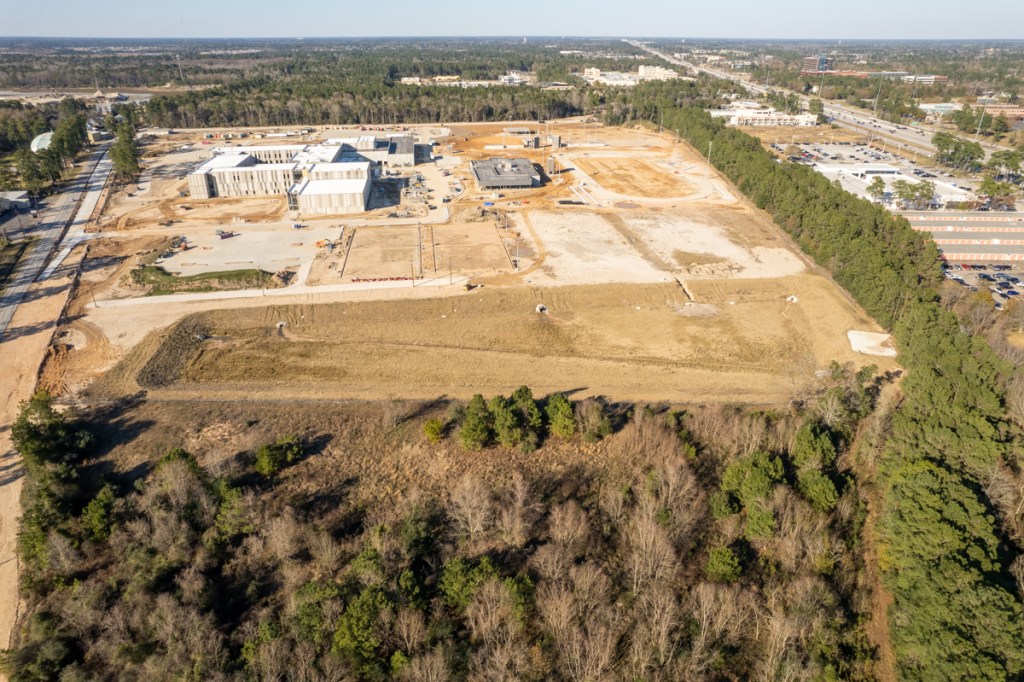
The same is true of New Caney ISD’s West Fork High School, now under construction on Sorters-McClellan Road south of Kingwood Drive. Perhaps this provides even more opportunities for learning because it’s so much closer to a major source of flooding.
Here are pictures taken last week that show the location and status of construction. I begin with an unusual choice: the campus detention pond. The reason why will become clear below.
Photos Taken 1/29/22
This giant detention pond was the first thing built on the site. Notice the 59 Bridge over the San Jacinto West Fork in the upper right. Also notice the expansion of Sorters-McClellan road to handle the expected traffic.A shot from slightly higher and a little down the road clearly shows wetlands, ponds, the West Fork and its confluence with Spring Creek.Looking S at the confluence of West Fork (bottom) and Spring Creek (right). That large island first appears in Google Earth Pro as a tiny sliver of sand at the end of 2018. It has grown to its present size since then.Looking north at entire 50-acre campus. The detention pond comprises about 10% of that. Athletic facilities at West Fork High School including field house. Note US59, Insperity and Kingwood HCA Medical Center in upper right.Looking NW toward Sorters-McClellan Road and several West Fork Sand mines in background. Kingwood Place Drive has been extended south to provide another way to get into and out of the campus.Looking SW.The campus is built around a large central courtyard that will become its signature feature. But I wonder how 17 inches of rain will get out of there in a 100-year storm.Main entrance on Sorters-McClellan Road.Looking SE.
Lessons to Be Learned
Students always have more interest in learning things that relate to their personal lives. They explore those things deeper, learn them faster and retain them longer. Flooding has impacted thousands of students in this area. If they weren’t directly flooded during Harvey, chances are they know someone who was.
Right outside the high school, teachers now have real-world classroom to teach students about flooding.
How do compaction and impervious cover affect the rate of rainfall infiltration?
How does that affect the time of concentration of runoff?
How does that affect flood height?
What’s the mathematical relationship between the size of the pond and the amount of impervious cover added to the campus?
How do detention ponds work and how does that affect the time of concentration?
How will the campus detention pond affect people downstream?
Why doesn’t every new development have detention ponds?
What State, County and Local regulations affect the development of detention ponds and their capacity?
What is meant by externalizing a business’ costs?
How would downstream taxpayers be affected if this detention pond were not built?
What would happen to their flood insurance costs?
What is flood insurance?
Who should get flood insurance and why?
Does the cost of flood insurance affect low-income families more than high-income families?
Is that fair?
Should we have a state law or regional flood-control district mandating detention pond capacity requirements?
How do we change laws?
What does caveat emptor mean?
This can not only be a math lesson, it can be a civics/government lesson, a geography lesson, a science lesson, an engineering lesson, an environmental lesson and more.
Why So Important?
Susanne Kite, a reader of yesterday’s post, commented, “Kids and young people should learn these things so they can make smart choices in life!! And so they won’t be surprised when they start growing web feet.” I would add, “So they won’t be surprised when they buy a home!”
After kids explore answers to all the questions above, they need to find answers to an even bigger question. “How can we all live together?”
Posted by Bob Rehak on 2/7/22
1623 Days since Hurricane Harvey
https://i0.wp.com/reduceflooding.com/wp-content/uploads/2022/02/20220129-DJI_0635.jpg?fit=1200%2C799&ssl=17991200adminadmin2022-02-07 15:07:552022-02-07 16:50:31West Fork High School: Another Opportunity for Learning
Aerial photos taken last week show a beautiful new Kingwood Middle School with an open, airy design taking shape.
Pictures Taken on 1/29/22
Glass enclosed atrium will look out over athletic fields where existing school now is.Existing school, bottom left, will be torn down to make room for athletic fields.Overhangs (not yet with roofs) will help provide protection from direct sun.View of entire school from over Woodland Hills Drive, looking NE.Looking E from over Woodland Hills Drive.Looking W from over Cedar Knolls Drive reveals drop off/pickup driveway behind school.
A permanent detention pond near the semi-circular drive in front of old Kingwood Middle School will eventually replace the temporary pond in the lower left of the image above. It’s exciting to see the Humble ISD making flood reduction a part of its plans for the future. That sends an important message to students and provides an opportunity for learning.
As they said in Poltergeist II, “They’re baa-aaack!” Contractors were hard at work again today at the Laurel Springs RV construction site near Lakewood Cove. The site had been virtually shut down for two days as city, county and state authorities launched investigations into alleged unauthorized stormwater discharges and other violations of the Stormwater Pollution Prevention Plan (SWPPP).
Poltergeist Flashback
However, at noon today, I counted 11 contractor vehicles parked on the street and, and saw heavy equipment digging trenches and laying pipe throughout the site.
Workers’ vehicles lined up at entrance. Several more vehicles were parked out of frame on lower right.
It did not escape my notice that all this construction activity happened on a weekend when few inspectors pay surprise visits. The massive discharge of stormwater into Edgewater Park also happened on a Saturday.
Stormwater Discharge into Edgewater Park
The most serious allegations by far involve the discharge of the silty contents of the resort’s detention pond into the wetlands of Edgewater Park during the last two weeks. At first contractors tried to pump water over the pond wall.
Laurel Springs RV Resort pumping stormwater into Edgewater Park on Jan. 18, 2022.
Sediment-laden water in wetlands of Edgewater Park today, 2/5/22, still had a “coffee with cream” color to it.
Track-Out Issue
One of the SWPPP violations was lack of bullrock at the entrance. Bullrock knocks mud from truck tires before they leave the site. That keeps the mud from getting into streets where it can clog storm sewers.
Yesterday, I photographed one bulldozer at the entrance making room for bullrock.
Entrance to Laurel Springs RV Resort Construction Site on 2/4/22.Note: barely any bullrock at entrance.
At noon today, 2/5/22, I found fresh bullrock at the entrance.
Fresh bullrock at entrance of Laurel Springs RV Resort construction site.
One other curious thing: the bullrock did not extend very far past the curb…approximately 10 feet. Assuming 4-foot tall tires on dump trucks, it would take more than 12 feet for tires to make one full rotation on bullrock (π x diameter).
These folks spare no expense to protect the public.
Posted by Bob Rehak on 2/5/22
1621 Days since Hurricane Harvey
The thoughts expressed in this post represent opinions on matters of public concern and safety. They are protected by the First Amendment of the US Constitution and the Anti-SLAPP Statute of the Great State of Texas.
As of this morning (2/4/22), construction activity at the Laurel Springs RV Resort site was virtually shut down for a second day. Only one man was working on a bulldozer at the entrance. It appeared that he was making room for a new load of bullrock at the site’s main entrance. Harris County investigators asked the contractor to clean up the site and make it compliant with Stormwater Pollution Prevention Plan (SWPPP) requirements. That involves spreading bullrock at the entrances.
Purpose of Bullrock
Bullrock comes in many shapes and sizes and can be made from natural rock or crushed concrete. Think of very large gravel ranging from 2-5 inches. You often see it used in landscaping and French drains.
However, over time, even the large spaces between bullrocks can become clogged with sediment. So periodically, contractors must replace the rock. It appears that the man on the bulldozer below was excavating and compacting dirt at the construction site entrance to make room for more or new bullrock.
Laurel Springs RV Resort contractor on bulldozer working at entrance. Photo taken 2/4/22.
What SWPPP Requires
The SWPPP template is a real eye opener. For neighbors monitoring construction, it alerts you to potential violations. Requirements cover many items besides sediment track-out. They include:
Natural buffers
Perimeter controls
Stockpiled sediment
Dust
Soil compaction
Storm drain inlets
Site stabilization and more.
For instance, Section 4.9 (Storm Drain Inlets) on pages 26/27 states that storm sewer inlets must be protected. But those on Laurel Springs Lane adjacent to the RV site are not. In fact, residents have caught contractors pumping sediment-laden water directly into storm sewers.
Video of Laurel Springs RV Resort construction practices by Szymon Balicki, Lakewood Cove HOA president.
If you’re concerned about deficiencies in construction practices at the Laurel Springs RV Resort site, read the SWPPP template so you know what to look for.
I have requested the Resort’s own SWPPP plan, but have not yet received it.
How many other practices did the investigators from the City, County and State identify? Time will tell.
Posted by Bob Rehak on 2/4/22
1620 Days since Hurricane Harvey
https://i0.wp.com/reduceflooding.com/wp-content/uploads/2022/02/20220204-RJR_9179.jpg?fit=1200%2C800&ssl=18001200adminadmin2022-02-04 15:36:062022-02-04 15:44:27Laurel Springs RV Resort Construction Site Quiet Again for Second Day
Construction at the controversial Laurel Springs RV Resort was shut down today as four investigations at the State, County and City levels swirled around construction practices there. The Texas Commission on Environmental Quality has one. Harris County has one. And the City of Houston has two – one around construction practices, the other around permits.
Weather May Have Contributed to Shutdown
It’s unclear whether the construction shut down was due to weather or complaints from one of the investigating bodies. All declined comment, citing ongoing investigations.
Photographs taken at the site on Thursday afternoon, 2/03/22, showed only one truck emptying Porta-potties.
Photos Taken Thursday 2/3/22
The investigations follow four recent posts documenting dubious construction and environmental practices.
Looking north. An empty construction site at approximately 2:30 pm on a Thursday afternoon is unusual, weather or not.
The silt fence that surrounded the inlet of the drain pipe that led from the stormwater detention pond into the County’s Edgewater Park had been removed.
Where there was a silt fence on Tuesday, on Thursday there appeared to be only a pile of dirt.Red circles indicate approximate inlet and outfall locations for drain pipe.
There was no silt fence at either the inlet or outfall. Nor was there a silt fence leading into the woods on the left that represent the northern boundary of Edgewater Park.
Another angle shows fresh dirt and tire tracks between the inlet and outfall. Did they just cover up the pipe?Approved construction plans show pipe should not have been installed at this location.Where the pipe should have gone. But as of Thursday afternoon, there was still no pipe from the pond leading to the circular pump housing in the corner.
And there’s still plenty of silty water in the woods of Edgewater Park, although, granted, it’s not as murky as on Tuesday.
Drainage from RV Resort in Edgewater Park. Laurel Spring Lane on left.
Troubled Present and Past
So what do we know?
Local, state and county governments have launched investigations.
The contractor has covered up the inlet and outlet to the pipe.
Silt fence appears removed or buried at one location and is still missing from the southern boundary of the site.
Silty water is still ponding in Edgewater Park.
We should know more in coming days about the status of the investigations.
The thoughts expressed in this post represent opinions on matters of public concern and safety. They are protected by the First Amendment of the US Constitution and the Anti-SLAPP Statute of the Great State of Texas.
https://i0.wp.com/reduceflooding.com/wp-content/uploads/2022/02/20220203-DJI_0746.jpg?fit=1200%2C799&ssl=17991200adminadmin2022-02-03 20:07:012022-02-04 08:05:04Laurel Springs RV Resort Construction Shut Down as Four Investigations Swirl
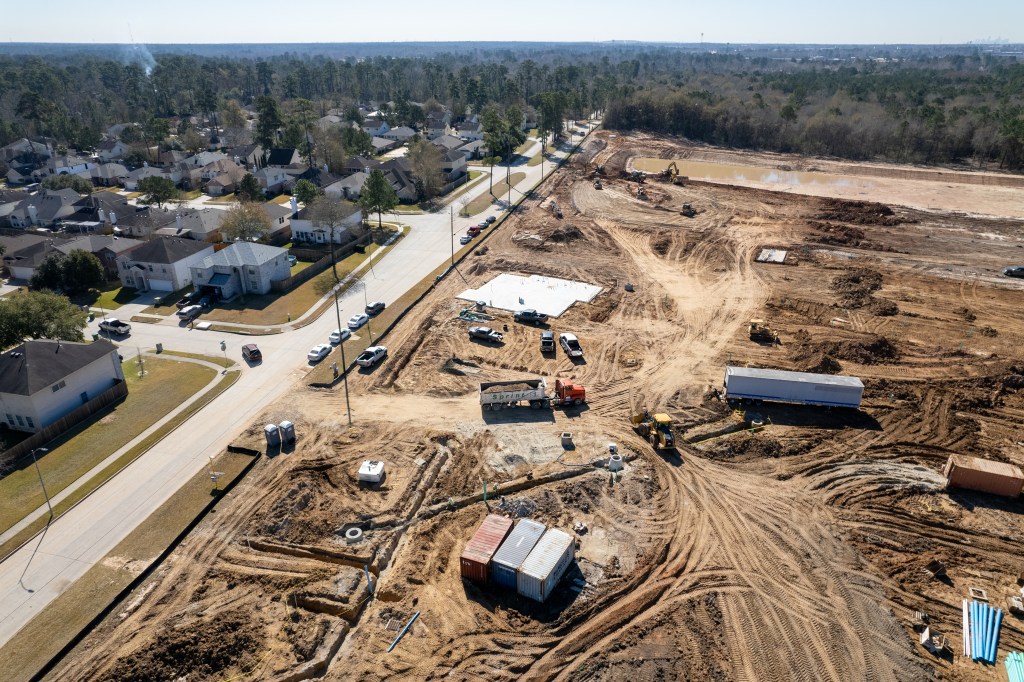
Harris County Flood Control District (HCFCD) contractor Sprint Sand & Clay has started laying out, clearing and excavating a large, new detention pond that will more than double capacity on Woodridge Village. Woodridge contributed to flooding hundreds of homes along Taylor Gully twice in 2019.
When the developer clearcut approximately 270 acres, the loss of forests and wetlands decreased natural detention capacity on the land. This should help restore it.
Project Outline Becoming Visible
Last week, Sprint started building a construction road into the site. This week it appears that they also dug a shallow trench outlining the perimeter of the pond and started clearing brush within it.
Photograph taken looking NE from SW corner of Woodridge Village. New detention pond will go in foreground. The shallow trench may be the outline of the new basin. Contractor appears to be staying “inside the lines.”Earth-moving equipment worked Saturday and was back at it Monday morning, 1/31/2022.
How the Math Works Out
Sprint will ultimately excavate approximately 500,000 cubic yards of fill which translates to 310 acre feet. When Perry left the site, it had constructed 271 acre feet of detention. The site needed another 108.4 acre feet of detention pond capacity to meet Atlas-14 requirements, but will get 310 (the number of acre feet in 500,000 cubic yards). That almost triples the required additional volume and more than doubles the current capacity…all for $1000.
The $1000 is the out of pocket cost to taxpayers. Under the terms of it’s E&R contract, Sprint will make its profit by selling the dirt it excavates to third parties out of the floodplain. Their contract obligates them to excavate at least 5000 cubic yards per month. There is no monthly max.
In case you have kids or grandkids who like playing with dump trucks, 500,000 cubic yards works out to 50,000 loads. That equals the number of fingers and toes on 2,500 kids. And that’s way more than all the students in Kingwood Park High School!
Turn this into a learning exercise!
About E&R Agreements
E&R agreements provide an opportunity for making progress in advance of future basin construction. These agreements essentially provide a head start in the excavation process before the detention basin is fully designed and constructed.
Residents should beware of heavy equipment entering and leaving the site. The site will remain fenced through the completion of construction.
HCFCD expects to hold public meetings beginning in April to discuss other possible uses, i.e, recreation, restoration, etc., on the site. More news to follow.
Posted by Bob Rehak on 2/2/22, repeating digit day.
1618 Days since Hurricane Harvey
https://i0.wp.com/reduceflooding.com/wp-content/uploads/2022/02/20220131-DJI_0675-2.jpg?fit=1200%2C799&ssl=17991200adminadmin2022-02-02 21:47:482022-02-02 21:47:51Woodridge Village Detention Basin Capacity Doubling
After photos showed clear construction permit violations at the Laurel Springs RV Resort, a City inspector said he found no problems there. Then, 311 closed the case. But Mayor Pro Tem Dave Martin’s office said another group was investigating. Martin’s chief of staff did not elaborate.
RV Park Drains its construction pond into Harris County Precinct 4’s new Edgewater Park in background.
This violated the terms of the developer’s construction permit. The trees behind the trench belong to Harris County Precinct 4 Park System. And the construction permit clearly states that “stormwater runoff shall not cross property line.”
Contractors covering up pipe that will convey future discharges. Photographed yesterday.
So I filed a complaint with the City’s 311 system at the request of Mayor Pro Tem Dave Martin’s District E staff.
Finally, today (Tuesday morning), I tried to photograph the drain/trench again. But contractors had covered it up and repaired the dike. If you hadn’t seen the previous pictures, you would never suspect a drainpipe was there (except for some black silt fencing around the intake which will be taken down).
By Tuesday morning, contractors had repaired the pond wall. Area circled in red is the outfall, covered with water.
Extent of Silty Runoff
The silty stormwater ran almost all the way down to Hamblen Road.
Water should have gone under Laurel Springs Lane and into the detention pond above via COH storm sewer. However, the contractor discharged it into the park instead. Note sediment-laden water in foreground.A large portion of the park appears to be inundated with silty discharge.Looking north toward detention pond on RV site from over Edgewater Park. Note silty water in foreground.
City Inspector Found No Violations
As I reviewed Tuesday’s images, I received an email from 311 saying the inspector found no problems and that 311 had closed the case. Obviously, the 311 operator didn’t clearly communicate the nature of my complaint. It was about stormwater runoff and construction-permit violations, not a fence line encroachment.
And clearly, the inspector didn’t:
Look at the approved drainage plan that showed the outfall should be going into the City storm sewer under Laurel Springs Lane.
Understand that draining water onto neighbor’s property violates the construction permit and state regulations.
Know the trees below the construction site belong to the County Park. He thought they belonged to the contractor. (See below.)
Response from 311 to complaint about construction stormwater violations.No pictures were attached despite text of email.
Inspector Felt Discharging into County Park Was Best Management Practice
To add insult to injury, the inspector characterized discharging into Edgewater Park’s vegetation as a contractor best management practice (BMP). Obviously, he thought the trees belonged to the contractor. He didn’t bother to explore who owned the land below the construction site or how far south the discharge had traveled.
Responses like this give the City a black eye.
I immediately emailed Mayor Pro Tem Dave Martin’s office about the 311 response. Jessica Beemer, his chief of staff, responded that the case wasn’t really closed. She said a different group had been assigned to investigate the complaint. But, as of this writing, she did not elaborate.
The TCEQ hopes to respond to a separate complaint by tomorrow. And I met several Harris County employees investigating the construction this morning in response to other complaints.
Stay tuned. More news to follow. This isn’t over yet.
Posted by Bob Rehak on 2/1/2022
1617 Days since Hurricane Harvey
The thoughts expressed in this post represent opinions on matters of public concern and safety. They are protected by the First Amendment of the US Constitution and the Anti-SLAPP Statute of the Great State of Texas.
https://i0.wp.com/reduceflooding.com/wp-content/uploads/2022/02/20220201-DJI_0728-2-copy.jpg?fit=1200%2C799&ssl=17991200adminadmin2022-02-01 19:44:112022-02-01 20:49:24City Inspector Finds No Problems At RV Park. 311 Says “Case Closed.” Martin’s Office Says “Not So Fast.”