On Sunday morning, Jeff Miller, an Elm Grove resident who lives near Woodridge Village, reported 5.5 inches in his rain gage. That compares to a 6.24 inch rain that fell on Woodridge on May 7, 2019, when hundreds of homes in Elm Grove and North Kingwood Forest flooded. Also, Woodridge falls about 40% short of current Atlas-14 standards required to hold back floodwater from a 100-year storm.
Other important factors came into play last weekend that should relieve some of residents’ anxiety and help explain what happened.
First, remember that on May 7, 2019, Perry Homes’ contractors had clearcut 268 acres, but had barely begun work on detention ponds. Only one of five was complete.
Second, the intensity of the May 7, 2019 rain was higher than last weekend’s. On May 7, 6.24 inches fell in 5 hours. Last weekend, 5.5 inches fell in 9 hours.
Third, in 2019, the S2 detention area had been partially excavated but didn’t have any outflow control restrictions installed yet. So it didn’t really function as a detention pond.
Fourth, contractors had destroyed a berm between Elm Grove and Woodridge, and filled in a natural stream on Woodridge. Both have since been replaced.
I took the photos below Sunday morning between periodic sprinkles, several hours after heavy rain stopped. They show how the current Woodridge Village detention handled the storm. All ponds were well within their banks. One was empty.
The triangular pond on the left is N2. N1 is out of sight above it. The two ponds on the right are S1 (foreground) and S2 beyond it. N3 is out of sight at the top of the frame.
S2 was about halfway to two-thirds full.
The tail of S2 is already silting in but had plenty of room to spare.
N3 Pond on eastern edge of property was supposed to have had an outflow control device but never got one.
The Junction where water from all five ponds comes together before flowing into Taylor Gully. N3 is at top of frame.
Reverse angle shot of the Junction with Taylor Gully in the background. Note how high the detention ponds are compared to the gully.The areas that flooded so badly in 2019 are just beyond the ponds.
Water coming from the big trianglar N2 pond now has to go through these twin culverts which were almost completely inundated.
Wider shot shows volume of water backed up in N2.
Only N1 in the NW corner of Woodridge was totally dry. The outflow capacity is much greater than the inflow. So this pond provides no detention benefit whatsoever. Local resident Jeff Miller says he has NEVER seen standing water in this pond.
The thoughts expressed in this post represent opinions on matters of public concern and safety. They are protected by the First Amendment of the US Constitution and the Anti-SLAPP Statute of the Great State of Texas.
https://i0.wp.com/reduceflooding.com/wp-content/uploads/2022/01/20220109-DJI_0370-2.jpg?fit=1200%2C799&ssl=17991200adminadmin2022-01-11 16:46:412022-01-11 17:14:16Woodridge Village Detention Ponds Passed Sunday Test, But…
To compensate for the potential shortfall, Commissioners established a flood-resilience trust with money from other Harris County departments and changed equity guidelines in June.
To help you follow this story, I make quarterly FOIA requests for Harris County Flood Control District spending and post the analyses on a dedicated funding page.
Sand-Mining Best Management Practices
Activists led by the Lake Houston Area Flood Prevention Initiative and the Bayou Land Conservancy petitioned the Texas Commission on Environmental Quality (TCEQ) to establish best management practices for sand mines in the San Jacinto watershed. We didn’t get everything we wanted, but we got a vast improvement over what we had. And the new BMPs may help reduce erosion that contributes to future floods in this area.
West Fork Sand Mine illustrates need for vegetative controls to reduce erosion.
May 9, 2021, was 1349 days after Hurricane Harvey ravaged Texas and the Gulf Coast. That’s the number of days it took the US and its allies to win World War II. But during that time we’ve had few victories in the fight against future flooding in the Lake Houston Area with the exception of dredging, So far, we’ve mainly completed studies. And many of those are still in the works.
For instance, the City of Houston has been studying ways to increase the release capacity of the Lake Houston Dam. Right now, the release capacity is one-fifteenth that of the gates on Lake Conroe. That makes it difficult to shed water quickly before and during floods. FEMA gave the City money to study the problem, but is still finalizing recommendations. The City hopes to make an announcement in January.
The Texas Attorney General is still suing the Triple PG Sand Mine in Porter on behalf of the TCEQ. There has been little movement on the case in the last 18 months. The mine’s owner changed legal counsel in July 2020. A TCEQ representative says the AG has not given up. The two sides are still in discovery.
Approximately 1700 homeowners in the Lake Houston Area sued sand mines for contributing to flooding during Harvey. The cases were consolidated in the 281st Harris County District Court under Judge Sylvia Matthews. She recently set deadlines in the first half of next year for motions, depositions, joinder, expert witness testimony and more. The case is known as “Harvey Sand Litigation.”
Various lawsuits against the SJRA for flooding during Harvey are still working their way through the legal system.
Kingwood residents reached a settlement with Perry Homes, its subsidiaries and contractors this year over two floods that damaged hundreds of homes in Elm Grove and North Kingwood Forest during 2019. The incidents had to do with development of Woodridge Village, just across the Harris/Montgomery County line.
East Fork Dredging. Photographed in early December between Huffman and Royal Shores in Kingwood.Looking south toward Lake Houston.
Bens Branch and Taylor Gully Cleanouts
In Kingwood, HCFCD finished excavating both Bens Branch and Taylor Gully to help restore their conveyance. Through gradual sediment built up, both had been gradually reduced to a 2-year level of service in places. That means they would come out of their banks after a 2-year rain.
Final phase of Bens Branch maintenance between Kingwood Drive and Rocky Woods. Note Kingwood High School in upper right.
GMA-14 will take a final vote on January 5 on the final DFCs. You still have time to protest.
Posted by Bob Rehak on 12/31/2021
1585 Days since Hurricane Harvey
https://i0.wp.com/reduceflooding.com/wp-content/uploads/2021/06/20210303-RJR_5778.jpg?fit=1200%2C800&ssl=18001200adminadmin2021-12-31 10:48:382021-12-31 11:09:51Top Stories of 2021 in Review
The City of Houston defended its permitting of the Kingwood Area’s first RV Park despite deficiencies in the process. The City claims the Laurel Springs RV resort meets old “grandfathered” standards. But concerned Lakewood Cove residents worry that the development does not meet current needs. They expressed concerns that:
Did not document the impact of overflow from that undersized pond in a two paragraph drainage impact analysis
Said that overflow from the undersized pond would be funneled toward Lakewood Cove despite a regulation requiring that excess stormwater not cross adjoining private property lines.
The amount of impervious cover in the plans did not change despite the addition of 25 percent more spaces.
The volume of the detention pond decreased during the review process.
The plans were not reviewed by a professional engineer (PE).
Below, read a summary of the City’s responses to each of these alleged deficiencies. To verify my summary, I’ve also included a PDF of the City’s entire response.
Filed False Info
The City did not really address this concern except to say that false information was filed by an agent who had no hand in the engineering. Apparently, filing false information under penalty of perjury is not an issue if you hire an agent.
Half the Detention Volume of Current Requirements
Despite getting the plans approved in October 2021, after detention requirements increased, the developer only had to meet 2020 requirements under a grandfathering clause based on the submission date (not the approval date) of the plans. So plans comply with the old requirements but not the current ones. Despite building a half-sized detention pond, the City still insists overflow won’t be a problem – except in a 100-year storm. The City ignores the fact that the pond is designed to hold a 100-year rain under older, lower standards.
Several of the 380 Elm Grove homes that flooded on May 7, 2019, and a City High Water Rescue Vehicle.
This is the same problem that happened in Woodridge Village, Elm Grove and North Kingwood Forest in 2019.
I’ve requested the full drainage impact analysis on three occasions. The City alludes to one, but still has not produced it. Instead, the City points to a two paragraph summary and seems satisfied with it. The City focuses primarily on the volume of water pumped into Lakewood Cove’s storm sewer system. It claims that if water overflows into people’s homes that will be due to a deficiency in how the Lakewood Cove lots were graded.
Where Will Overflow Go
The developer says that overflow from the undersized detention pond will go east toward Lakewood Cove (left in picture below) and then down a hill into Lakewood Cove’s detention pond near Hamblen Road. But the City says the opposite. It claims overflow will go west toward the Union Pacific railroad tracks (right in picture below). From there, sheet flow would go down into the County’s new Edgewater Park. The City did not express any concern about erosion of the track bed. But one wonders whether erosion could destabilize the railroad tracks which carry toxic chemicals.
Laurel Springs RV Resort next to UP Railroad tracks and Utility Easement. City says overflow from pond at far end of clearing will be funneled toward tracks, even though developer says the opposite.
Woodridge Village erosion caused by half of the estimated amount of a current 100-year rain.
Increase in RV Spaces
The developer changed the plans from 182 to 226 RV pads. The City approved with no further explanation. Nor did the City address the issue of a potential conflict with the permit.
No Increase in Impervious Cover
The City claims that when the number of spaces increased 25%, impervious cover did not and that calculations are still accurate. Public Works did not explain the apparent contradiction.
Decrease in Volume of Detention Pond
According to the City, the original detention-pond volume approved by the City must have been an “approximation” by the developer’s engineer. Even though the number decreased in final versions of the plans as the number of RV pads increased 25%, the City claims the developers still exceed the minimum detention requirements under the grandfathered 2020 regulations. They never address what will happen if rainfall exceeds 2020 assumptions, as it certainly will.
No Review by Professional Engineer
The City says reviewers work under the supervision of a professional engineer (PE), but PE’s do not actually review plans.
Summary
In summary, the City claims it didn’t make any mistakes. If homes flood, homeowners will be at fault because their sites must not be graded properly.
I wrote the City weeks ago about the potential erosion of the Union Pacific railroad tracks and still have not received a reply.
This seems to be a case of bureaucrats reviewing plans for literal compliance and ignoring the dangers of real-world deficiencies. If the higher requirements in 2021 regulations are not important, why did the City adopt them?
The thoughts expressed in this post represent opinions on matters of public concern and safety. They are protected by the First Amendment of the US Constitution and the Anti-SLAPP Statute of the Great State of Texas.
https://i0.wp.com/reduceflooding.com/wp-content/uploads/2021/12/20211205-DJI_0009-2.jpg?fit=1200%2C799&ssl=17991200adminadmin2021-12-08 13:13:182021-12-08 14:19:55City Defends RV Park Permit Despite Deficiencies
This is Part II in a series about how to find and verify flood-related information. Yesterday’s post focused on finding good information about flood vulnerabilities. This second part will focus on reviewing developers’ plans. The second can compound the first.
The very first sentence of the Texas Water Code § 11.086 begins with a warning not to flood your neighbors. It says, “No person may divert or impound the natural flow of surface waters in this state, or permit a diversion or impounding by him to continue, in a manner that damages the property of another by the overflow of the water diverted or impounded.”
The second sentence declares that a person injured by diverted water may sue to recover damages. Of course, at that point the damage has already been done. Lawsuits are expensive and take years. And the defendant, usually a developer, will always point to plans prepared by a professional engineer and approved by a government body. Suing them will require expert witnesses. And the defendant will likely claim that you wouldn’t have flooded except for an Act of God.
Lawsuits are tall, expensive mountains to climb. So concerned residents near new developments are better off closely scrutinizing plans before they’re built and closely monitoring construction to ensure developers follow the plans.
You can’t stop development. But you can ensure developers play by the rules.
But how do you find and verify their plans?
Need to Find and Verify Info
If you notice a large piece of property for sale near you, monitor it closely. Check with the listing agent. Also check Houston’s Plat Tracker website. It’s updated before every meeting of the Planning Commission and shows items on their agenda. Houston also maintains a map-based website that shows projects in various stages of approval throughout the City and its extra-territorial jurisdiction.
Leap into action if you find a potential cause for concern near you. The next step is to obtain the development’s plans, the drainage impact analysis and soil tests. The developer must prove “no adverse impact” to people and properties downstream.
How you obtain those plans and studies depends on the development’s location. If inside a municipality, check with your city council representative. If you live outside a municipality, your best starting point will probably be your county engineer or precinct commissioner.
The plans are public information and must be provided in response to Freedom of Information Act (FOIA) Requests.
Signed, Stamped, Approved and So Obviously Wrong
In every case I reviewed during the last four years where someone flooded because of a new development, something jumped out of the plans that should have raised concerns for reviewers, but didn’t.
For instance, after Colony Ridge engineers apparently mischaracterized soil types, Plum Grove flooded repeatedly. The engineer said soils would let more water soak in than actually could. That meant the developer didn’t have to build as many detention ponds and could sell more lots. But it also contributed to flooding homes downstream.
Concerned citizens must learn how to obtain and review such plans for potential problems or hire a consulting engineer.
Here are some things I’ve learned to look for.
Soil Tests
Are they accurate? Were the samples taken at representative points? Or did they conveniently ignore wetlands? Permeability of the soils will affect the amount of detention needed. The level of the water table could affect the amount of detention provided.
If plans call for a ten-foot deep detention pond, but the soil test encounters a shallower water table, that will compromise the pond’s capacity. Capacity should be calculated from the top of standing water, not the bottom of the pond. If the pond is already half full, that half shouldn’t count.
Floodplain maps in Harris County are currently being revised. That may not be the case in surrounding counties. The lack of updated flood maps endangers current residents, by letting developers build to old and ineffective standards.
Developers often try to beat the implementation of new requirements. This happened in the case of Woodridge Village. It’s also happening in the case of the Laurel Springs RV Park and Northpark South along Sorters-McClellan Road. The entrance to the Northpark development sits in a bowl. A quick check of the elevation profile on the USGS National Map confirmed that. During Harvey, local residents tell me that not even high-water rescue vehicles could get through that intersection. Put the Cajun Navy on standby now.
Wetland Issues
Filling wetlands requires an Army Corps permit for some, but not all wetlands. Whether they fall under the Corps’ jurisdiction depends on how far up in the branching structure of a watershed they are. Those near the main stem are jurisdictional. Three levels up may not be.
The US Fish and Wildlife service has thoroughly documented wetlands in this area. Check their National Wetlands Database and appeal to the Corps if you find a problem. At a minimum, the developer may be forced to buy mitigation credits somewhere nearby, which could help reduce flooding.
Drainage Issues
Is a new development’s detention pond capacity adequate? Is it based on the right percentage of impermeable cover? If the pond(s) fill up, where will the water go?
Calculating detention capacity requires math skills most people don’t have. But you can check the basis for the calculations. Are plans based on new Atlas-14 requirements? Are plans meeting current Houston and Harris County requirements?
Current City of Houston and Harris County Requirements for Detention Pond Capacity
Also see where they’re routing excess water in case of an overflow.
In the case of the Laurel Springs RV Park, the developer said they would route the water to a detention pond near Hamblen and Laurel Springs in anything greater than a two year rain. See below.
Screen Capture from Laurel Springs RV Resort Drainage Impact Report shows that in anything greater than a 2-year rain, overflow water will could threaten homes in Lakewood Cove.
RV Park Site Outlined in White. Overflow described above would presumably follow red path.
Laurel Springs RV Park as of 11/29/21. Detention pond will go in foreground, but overflow will go into pond at top of frame according to text above.
Missing Details from Drainage Impact Analysis
I have requested additional details three times from the City but still have not received them. I suspect they may not exist. All other plan requests have been filled.
So what happens when the Lakewood Cove detention pond fills up? Or gets covered up in a flood? Overflow from the RV park will contribute to flooding someone downstream.
The developer also said excess capacity would get to the Lakewood Cove pond by overland sheet flow. That could threaten homes on the southwest corner of Lakewood Cove – visible in the middle of shot above.
But a City engineer reviewing the plans said overflow would follow the railroad tracks on the western side of the RV park. Hmmmm. Two engineers – one who developed the plans and another who approved them – 180 degrees apart. What’s a concerned citizen to do?
If the engineers who develop and review such plans were always right, no one would ever flood. But we do. So always find and verify those plans.
The thoughts expressed in this post represent opinions on matters of public concern and safety. They are protected by the First Amendment of the US Constitution and the Anti-SLAPP Statute of the Great State of Texas.
https://i0.wp.com/reduceflooding.com/wp-content/uploads/2021/11/20211129-DJI_0877-2.jpg?fit=1200%2C799&ssl=17991200adminadmin2021-11-29 19:09:202021-12-08 15:51:19How to Find and Verify Flood-Related Information: Part II
Humble ISD’s North Transportation Center adjacent to Woodridge Village on Ford Road is now complete. And the District’s new Ag Barn should be completed by the start of next year.
Humble ISD’s press office confirmed today that the project is now totally complete and operational.
The property, located at 24755 Ford Road, encompasses about 12 acres. The new center will save an estimated $2 million in operating costs due to shorter routes and improved response times.
(Looking north) Note the bus exiting the facility toward Ford Road on left.This large detention pond on the north side of the transportation center will reduce the risk of flooding caused by rapid runoff from all that concrete.Looking south. The project was completed so recently, that silt fencing from the construction still has not been removed.
Ag Barn Construction Could Finish by Early Next Year
While I had the drone up, I also took several pics of Humble ISD’s new ag barn about a block south. Note the cell tower in the photo above. It’s the same one in the photo below.
According to an Humble ISD spokesman, the contractor has finished exterior construction and is now focusing on interior buildout.
Looking north toward Humble ISD’s new ag barn in Porter. Ford Road in upper left. Transportation center in upper right.Looking south toward smaller, triangular detention pond next to Mills Branch Road (upper right) and North Kingwood Forest (also upper right).
Wider shot showing location of new ag barn, where Ford Road (right) turns into Mills Branch Road (top) across from entrance to North Kingwood Forest.
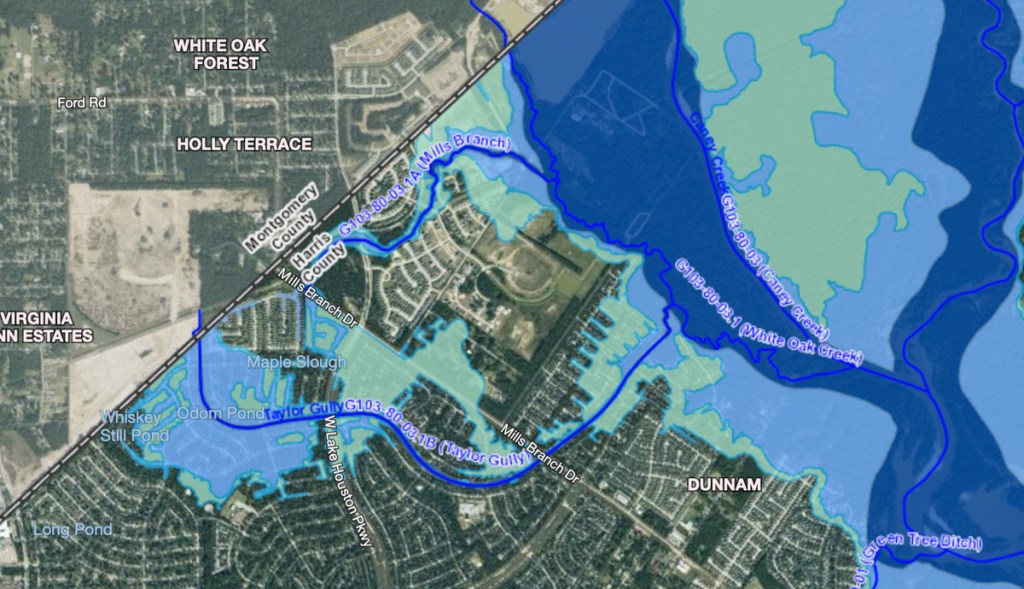
Mills Branch (the creek) originates in the woods in the upper left. Mills Branch then goes through Woodstream Forest and Royal Brook before joining White Oak Creek and Caney Creek.
https://i0.wp.com/reduceflooding.com/wp-content/uploads/2021/09/20210921-DJI_0465-2.jpg?fit=1200%2C800&ssl=18001200adminadmin2021-09-21 16:56:392021-09-21 17:05:28Humble ISD North Transportation Center Now Complete, New Ag Barn Getting There
Looking north across Woodridge Village toward Porter from over the Harris/Montgomery County line. The abandoned development currently has five detention ponds that will hold about 60% of the rain in an Atlas-14 100-year storm.
Currently, Idcus, Inc., an engineering company, has been contracted to look at:
Whether existing detention and proposed channel improvements would suffice to mitigate flooding
Whether expanding existing detention would eliminate the need for channel improvements
A combination of the two scenarios above – determining the amount of additional detention and channel improvements necessary to ensure no adverse impact all the way to Lake Houston.
Out-of-the-box alternatives that ensure no adverse impact while maximizing flood mitigation and minimizing construction costs.
The Idcus contract calls for the company to deliver channel and basin layouts for Taylor Gully no later than 300 days from the notice to proceed, which presumably was given in early July. However, excavation could start much sooner than that. (See below.)
Pieces of Puzzle Falling into Place
The no-cost contract with Sprint lets them set their own timetable as long as they complete improvements within three years. Sprint’s timetable will be driven by the company’s ability to sell the material they excavate; that forms their compensation.
The next step is for Harris County Flood Control District (HCFCD) to provide a grading plan to the contractor. While that will not happen tomorrow, the good news is that it won’t require waiting 300 days.
HCFCD can start excavating the retention pond before plans are finalized. After all, it’s not a problem if a detention pond holds more than the minimum required. It’s only a problem if it holds less. Engineers and contractors can adjust plans if necessary after excavation starts. This approach should minimize flood risk for worried Elm Grove and North Kingwood Forest residents.
All the pieces of the puzzle are starting to fall into place.
Posted by Bob Rehak on 7/21/2021
1422 Days since Hurricane Harvey
00adminadmin2021-07-21 12:14:542021-07-21 15:11:21Commissioners Approve Excavation Contract for Regional Detention Pond on Taylor Gully
Tuesday, 7.20.21, Harris County Commissioners will vote on a contract with Sprint Sand & Clay for excavation of a Woodridge Village detention basin. Item #21-3394 on the agenda is only for $1000, but it gives the contractor the right to enter the site and begin removing up to 500,000 cubic yards of dirt (at no cost to HCFCD) which it can then sell.
Backup provided to commissioners states that “This benefits the District because excavation and removal is always the highest cost of any stormwater detention basin that is constructed.”
Amount of excavation TBD – somewhere between 20,000 and 500,000 cubic yards, depending on plans that HCFCD will deliver to the contractor based on the outcome on an engineering study currently underway.
The contractor must properly dispose of the spoils, which it is allowed to sell to make its money on the contract.
Contractor is liable for any materials that are disposed of improperly, i.e., within Base Flood Elevation or the 500-year flood plain and must identify all disposal locations.
Time allowed: 3 years.
Termination of contract possible if contractor fails to excavate a minimum average of 5,000 cubic yards every month.
Contractor responsible for environmental mitigation if necessary, excluding wetlands.
The contractor must provide an approved Stormwater Pollution Prevention Plan and abide by it.
The contract outline contains the map above but does not specify the exact size, depth or location of the proposed work within the outlined area – just that it will occur in Montgomery County. Engineers will supply additional details at a later date.
Looking SE across Woodridge Village toward Elm Grove and North Kingwood Forest, areas where hundreds of homes flooded badly in 2019 – twice. Photo taken May 26, 2021.
Sprint Sand and Clay is a regular contractor for HCFCD. Currently, the company is excavating the massive Cutten Detention Basin near 290, Beltway 8 and Cutten Road.
Posted by Bob Rehak on 7/20/21
1421 Days since Hurricane Harvey
https://i0.wp.com/reduceflooding.com/wp-content/uploads/2021/07/20210526-RJR_8313.jpg?fit=1200%2C800&ssl=18001200adminadmin2021-07-19 21:34:452021-07-19 21:41:04Commissioners Vote Tuesday on Contract for Woodridge Village Detention Pond Excavation
When Harris County and the City of Houston closed on the purchase of Woodridge Village, flood victims in Elm Grove, North Kingwood Forest and along Taylor Gully were elated. Harris County purchased the land to create a regional floodwater detention basin. That immediately raised questions about what comes next and when?
The first will occur early in the development of the Preliminary Engineering Report (PER). The goals: to inform the community of each project’s purpose and receive community input during preliminary engineering.
A second meeting will occur once the final draft of the preliminary engineering report is complete. Its purpose: to present the results to community.
HCFCD will also communicate with local groups such as homeowner associations and the Kingwood Service Association in regularly scheduled virtual meetings as needed. Those will provide project updates and information about other Flood Control District efforts (e.g., buyouts, maintenance projects, smaller capital projects) in the Kingwood area throughout the PER process.
The Flood Control District will also identify opportunities to participate in regularly scheduled meetings and develop project-specific presentations to convey project information and proposed project features.
First Engineering Firm Already Selected
The engineering firm elected to develop the Preliminary Engineering Report for Taylor Gully improvements, IDCUS, will also consider Woodridge Village within its scope of work. IDCUS will consider what detention volume can be achieved on the Woodridge Village property and how that would affect the Taylor Gully project.
The Flood Control District plans to set up a separate project with a different consultant team to provide the detailed design services for the proposed detention basin.
Role of Rustling Elms Bridge in Flooding to Be Examined
Many residents have observed that the bridge over Taylor Gully at Rustling Elms seems to be a choke point that backs water up into surrounding homes. HCFCD will examine the role of the bridge in flooding. But, said Matt Zeve, Deputy Executive Director of HCFCD, “I cannot guarantee that the recommended plan will include any modifications to Rustling Elms.”
Looking downstream at the Rustling Elms Bridge over Taylor Gully during peak of May 7, 2019 flood. Note how water downstream from the bridge is within banks, but water upstream is overflowing.
The different heights of water above and below the bridge relate its design. See below.
Looking upstream at same bridge at later date, you can see how the twin-culvert design severely restricts flow.
However, retaining more water upstream might eliminate the need to make any costly changes to the bridge. Everything works together. It’s just too early to tell.
Other Changes Being Considered
The Flood Control District is considering a regional stormwater detention basin for the Woodridge Village site. A portion of the property will be owned by the City of Houston for a future wastewater treatment plant.
Looking south across the main portion of Woodridge Village toward homes that flooded twice in 2019. HCFCD will have the southern two thirds of this property (toward the top of the photo) to use for a regional detention basin.
Other amenities could be considered for the site, but would require a partner to construct and maintain those amenities. “The Flood Control District does not design, construct, or maintain amenities such as dog parks, trails, playgrounds, or sports fields,” said Zeve. However, HCFCD expressed a willingness to meet and work with community groups to discuss potential partnerships and make sure that input is included in design considerations.
Atlas 14 Will Form Basis of Design
Perry Homes sized detention ponds currently on the site to meet pre-Atlas-14 requirements. That means their detention capacity will fall about 30-40% short of Atlas-14 requirements. Montgomery County’s Atlas-14 requirements are lower than Harris County’s. When asked about this, Zeve responded, “HCFCD will use Atlas 14 rainfall rates for our designs even if the watershed area is not in Harris County.” That should provide some extra capacity that provides a buffer against additional upstream growth in the watershed.
Could Excavation Start Before Hurricane Season?
The Flood Control District will sometimes starts excavation on sites before final design plans are completed. HCFCD uses this program frequently to get a head start on excavation for large stormwater detention basins. “The District may not have enough time to get that program up and running by June 1, 2021, but we can certainly provide updates on this effort via our website,” said Zeve.
Posted by Bob Rehak on 3/11/2021
1290 Days since Hurricane Harvey
https://i0.wp.com/reduceflooding.com/wp-content/uploads/2019/05/Taylor-Gully-at-Peak-e1728600738227.jpg?fit=1100%2C327&ssl=13271100adminadmin2021-03-11 14:38:492021-03-11 14:38:55What Next for Woodridge Village, Taylor Gully
Today, almost two years after Perry Homes’ Woodridge Village development first contributed to flooding Elm Grove Village and North Kingwood Forest in Kingwood, Harris County and the City of Houston finally purchased the aborted, ill-conceived development.
Current plans are for the City of Houston to build a wastewater treatment plant on the northern portion. Harris County Flood Control District will use the southern portion to build a regional floodwater detention center. The latter should alleviate flooding problems adjacent to the development as well as other areas farther downstream on Taylor Gully.
Exact Plans for Additional Detention Capacity Not Yet Developed
A press release issued today by Harris County Flood Control said, “The next step is to undergo an engineering analysis to maximize stormwater detention volume, quantify the benefit to the community and determine project cost and funding. Additional community engagement will be scheduled to gather input from area residents on the proposed project and to present project alternatives.”
History of Flooding
The flooding problems began on May 7, 2019 when approximately 200 homes flooded from sheet flow coming from the development. Two to three times that number of homes flooded on September 19th, 2019 during Imelda.
Eventually, Perry Homes, its subsidiaries and contractors managed to build five detention ponds, but their capacity still fell about 40% short of Atlas-14 requirements. Thus, the development would have posed a risk forever after had Harris County and the City not stepped in.
Photos of Property Just Purchased
Here are pictures of Woodridge Village taken on 3/3/2021 from several different angles.
Woodridge Village looking SW from the NE corner of the property in Montgomery County. The diagonal near the top of the frame and the detention pond is the Harris/Montgomery County line. Ford Road is on left.
Looking SE from the NW corner over Webb Street in Porter. The land slopes from the corner in the foreground to the detention pond in the background. Taylor Gully starts just beyond the detention pond.
Looking west along the northern boundary. The City portion of the property will border the tree line on the left and extend into the small area at the top.
Looking east along the southern border.Camera position was over Kingwood Park High School.
Looking NE from the southern border over Sherwood Trails Village in Kingwood.
Looking north up Village Springs Drive in Elm Grove. Taylor Gully starts on the right at the county line just below the concrete junction.
Looking NW from over North Kingwood Forest. Taylor Gully is on bottom right. The land slopes toward the camera position.
More About the Sale
All of the 267.35 cleared acres fall within Montgomery County. But a provision within the 2018 Flood Bond allows Harris County to purchase land in other counties if it helps control flooding in Harris.
The Harris County Flood Control District and the City of Houston jointly purchased the property for approximately $14 million. The Flood Control District is using funds from the 2018 Bond Program (Bond ID Z-02) to acquire the land. The City of Houston contributed approximately $3.8 million dollars for the use and ownership of 73 acres on the northern part of the property.
Reaction from Government Officials
“This is a great example of government doing what government is supposed to do – listening to the people who live in those neighborhoods and working to protect them from future flooding,” said Harris County Precinct 4 Commissioner R. Jack Cagle, who pushed this project through against opposition in Commissioner’s Court.
Houston Mayor Pro Tem Dave Martin also worked tirelessly to make the deal happen. It involved trading City land to the County for flood control projects and getting the City to adopt the County’s flood control standards. “This purchase is integral for investment in the future of the Kingwood area as well as many homes along the county line. Collaboration like this is essential in providing a sense of security to residents who have endured so much uncertainty these last few years,” said Mayor Pro Tem Dave Martin.
Congressman Dan Crenshaw lauded Cagle, Martin, and community support. “This is an important step forward in building a more resilient community,” he said.
State Senator Brandon Creighton said, “This type of partnership and investment will make Kingwood and surrounding areas better protected.”
State Representative Dan Huberty complimented the City and County for working together. “This is a great example of different areas of government working together to achieve the best outcomes for local residents,” he said.
Additional detention ponds are not yet built, but this is a huge step forward. A big “thank you” and “whew” to all involved.
Posted by Bob Rehak on 3/3/2021
1283 Days since Hurricane Harvey and 532 since Imelda
https://i0.wp.com/reduceflooding.com/wp-content/uploads/2021/03/20210303-RJR_6236.jpg?fit=1200%2C800&ssl=18001200adminadmin2021-03-04 13:06:272021-03-04 13:11:27Harris County, City of Houston Finally Close on Purchase of Woodridge Village Property
Preliminary engineering and final design services for improvements to:
Taylor Gully
Kingwood Diversion Ditch
Purchase of Woodridge Village to build a stormwater detention basin in Montgomery County.
In case you plan to watch the meeting, all three items fall under Harris County Flood Control District (HCFCD). Unless commissioners take items out of order, HCFCD projects usually come second on the agenda after Engineering. Below: exact text of each agenda item.
Agenda Item Text
Item 79:
Recommendation that the Harris County Flood Control District be authorized to negotiate an agreement for engineering services with IDCUS Inc. to provide preliminary engineering and final design services for improvements to Taylor Gully on HCFCD Unit G103-80-03.1. (San Jacinto River Watershed, Bond ID F-14, Project ID G103-80-03.1-E001, Precinct 4).
Item 82:
Recommendation that the Harris County Flood Control District be authorized to negotiate an agreement for engineering services with Neel-Schaffer, Inc. to provide preliminary engineering and final design services for improvements to the Kingwood Diversion Channel on HCFCD Unit G103-38-00. (San Jacinto River Watershed, Bond ID F-14, Project ID G103-38-00-E001, Precinct 4).
If purchased from Perry Homes, HCFCD will swap part of Woodridge Village – the northern 77 acres of the 268 total – with the City of Houston. The City wants to build a wastewater treatment plant there and has negotiated with the County to swap land elsewhere in the City that HCFCD can use to reduce the cost of flood mitigation projects. The land reportedly includes parcels along Halls and Greens Bayous. This swap represents a win/win that helps protect more people throughout the City and County.
Looking north, at most of the 268-acre Woodridge Village Property. Road connects to Woodland Hills Drive new Kingwood Park High School out of frame on left. City is interested in portion at top of frame. Flood Control would use the rest for mitigation.
Scope of Engineering Studies Still Unclear
Contracts for the engineering studies have not yet been negotiated. However, we do have clues in the Kingwood Area Drainage Assessment final report about what these projects might include. Last October, HCFCD talked about:
Widening and deepening Taylor Gully to increase conveyance and/or building the detention pond in Woodridge Village, which empties into Taylor Gully. So Woodridge and Taylor Gully are related; what happens with one will affect the other.
Widening the Kingwood Diversion Ditch all the way from St. Martha’s Catholic Church at the county line to the San Jacinto West Fork. The Diversion Ditch project also included building a detention pond to ensure no adverse downstream impacts. Finally, the Drainage Assessment recommended splitting the ditch near Deer Ridge Park. The split would convey part of the floodwaters straight to the West Fork instead of routing all through River Grove Park via a circuitous route that takes them under Woodland Hills Drive which has washed out in the past.
Red line is Bens Branch. White Line is Kingwood Diversion Ditch. Green line shows where Kingwood Area Drainage Assessment recommended splitting flow as it approached West Fork at bottom of frame. Detention pond location not yet finalized.
No Recommendations Certain Yet
Nothing is certain yet. Commissioners Court deferred the Woodridge Village purchase five times last year – in April, May, July, August and September.
And as for the engineering work, a close reading of the text above shows that HCFCD has not yet negotiated contracts. HCFCD simply wants permissionto negotiate the agreements. “Once we receive authorization to negotiate the agreements from Commissioners Court, we can meet with the consultants and develop the scope, schedule, and budget,” said Matt Zeve, Deputy Executive Director of HCFCD.
Regardless, this is good news and welcome progress for flood-weary Kingwood residents still struggling with recovery. These projects put us three steps closer to solutions.
1256 Days after Hurricane Harvey and 505 After Imelda
https://i0.wp.com/reduceflooding.com/wp-content/uploads/2020/09/20200911-RJR_1153.jpg?fit=1200%2C800&ssl=18001200adminadmin2021-02-05 11:17:142021-02-09 11:11:52Three Kingwood Flood-Mitigation Projects on Harris County Commissioners Court Agenda Next Tuesday