Tag Archive for: NHC

Average But Unusual 2025 Hurricane Season Ends Today

11/30/2025 – Today marks the end of the 2025 hurricane season. It was average in terms of the number of storms, but unusual in terms of where they tracked. These three screen captures from the National Hurricane Center tell the story.

2025 Named-Storm Tracks. Only one named storm hit the mainland U.S. – Chantal in early July. And none hit the US Gulf Coast.

This table shows the strength and timing of each.

And this table compares the 2025 season to a 30-year average (1991-2020).

So, the Atlantic basin had one less named storm, two fewer hurricanes, and one more major hurricane than in an average year. But for the most part, they stayed away from the U.S.

Actual Vs. Predicted

For those keeping track, in April, Colorado State University researchers predicted an above-average season with

  • 17 named storms
  • 9 hurricanes
  • 4 major hurricanes (Category 3 or higher).

Then in May, NOAA also predicted an above-average season with:

  • 13 – 19 named storms
  • 6 – 10 hurricanes
  • 3 – 5 major hurricanes

CSU also predicted the probability of where storms would make landfall. Texas residents, they said, had a 19% chance of being within 50 miles of a major hurricane landfall this season. Those chances increased to 44% for a hurricane and 70% for a named storm. Oops.

All in, I’d say NOAA’s National Hurricane Center predictions came closer to the actual numbers, though neither was very far off.

Actual Vs. Averages

But how did the 2025 season compare to the long-term averages?

So, the Gulf had far less activity than in an average year. However, basin wide, we came close to the average.

How Unusual Was Gulf This Year?

How unusual is it for the Gulf to have no hurricanes? Over the long term, the probability is about 20%. So it’s unusual, but far from unprecedented. There are multiple historical examples of No-Gulf-Hurricane seasons.

The longest recorded “Gulf hurricane drought” on record lasted 1,080 days (≈ 3 years), from September 2013 until September 2016 — during that period, no hurricanes entered or developed in the Gulf, according to The Weather Channel.

Why does that happen occasionally? It usually reflects unfavorable conditions for storm formation or strengthening in our sub-basin (e.g., upper-level wind shear, atmospheric stability, unfavorable steering currents). But as the map above shows, that does not mean the overall Atlantic or Caribbean is quiet. Storms may still form and even become major hurricanes, but track elsewhere, as Melissa did.

Plan for Worst, Hope for Best

The variability — including periods of many storms — argues for resilience and planning, even if some seasons are quiet. The recent cyclones that struck Sri Lanka and Indonesia make good cases in point.

Deadly floods and landslides in Sri Lanka left at least 153 people dead with hundreds more still missing at this point. According to Reuters, more than 78,000 people have been displaced.

Another cyclone struck Indonesia and killed 435 people. It destroyed tens of thousands of homes and displaced more than 200,000 people. And the cascading effects are just starting. Flooding and landslides disrupt not only homes, but agriculture, transport, and supply chains — with ripple effects on food security, local economies, and displacement.

Posted by Bob Rehak on 11/30/25

3015 Days since Hurricane Harvey

On Eve of Hurricane Season, NOAA, NWS, NHC, FEMA Struggle with Cuts

5/31/25 – The 2025 Hurricane Season starts tomorrow, 6/1/25. But ironically, despite predictions of an above-average season, the federal agencies that help forecast hurricanes, issue warnings, and provide disaster relief are struggling with significant funding, staff and program cuts.

Poignant Letter in New York Times

Michael Lowry, who served as a senior scientist at the National Hurricane Center (NHC), a planning chief at FEMA, and a hurricane expert at the Weather Channel, wrote a poignant letter published in the New York Times today under the headline “A Hurricane Season Like No Other.”

The letter began with an anecdote about data collection from inside Hurricane Milton last year by a Hurricane Hunter crew. The data they collected about “vortex alignment” heralded rapid intensification of the storm. Within 24 hours, it had become the strongest hurricane in 20 years with 180 MPH winds.

Milton satellite
Milton as it began intensifying and heading toward the Florida Coast

But there was no surprise on the Florida coast. The forecasts gave “enough time for people in the highest-risk areas to safely evacuate and businesses to prepare for the worst.”

Lowry then segues to budget, staff and program cuts at FEMA, NOAA, NHC, the National Weather Service (NWS), Hurricane Hunters, and more. Some examples:

  • NWS offices that have lost 60 percent of their staff members, including entire management teams.
  • Nearly half of NWS local forecast offices are understaffed, with vacancy rates of 20 percent or higher.
  • Weather balloon launches are down 15 to 20 percent nationwide. The balloons increase forecast confidence and let evacuation orders be made sooner. 
  • New budget documents released Friday propose eliminating NOAA’s research wing, the Office of Oceanic and Atmospheric Research, which lends mission-critical support to the hurricane hunters.

Along the way, Lowry points out that “The National Weather Service costs the average American $4 per year in today’s inflated dollars — about the same as a gallon of milk — and offers an 8,000 percent annual return on investment, according to 2024 estimates.”

“Without the arsenal of tools from NOAA and its 6.3 billion observations sourced each day, the routinely detected hurricanes of today could become the deadly surprise hurricanes of tomorrow,” he says.

Bottom line: Lowry says we’re jeopardizing decades of progress that have increased forecast accuracy and warning times. And that will put more people at risk.

Dizzying Days for FEMA: Cuts and More Cuts

Andrew Rumbach, a Senior Fellow with the Urban Land Institute writes about policies for disaster risk reduction. He wrote a Substack post in early May called “100 Dizzying Days for FEMA.” It details the dismantling of disaster-relief and flood-mitigation capabilities including:

Could States Do What FEMA Does?

An article in the June 9 issue of Time Magazine addresses whether states could do what FEMA does. The consensus: it makes more sense to manage disaster response at the federal level. Why? It’s more efficient. If you spread disaster responsibilities among 50 states, you will have a lot of people sitting around a long time between disasters. FEMA can shift people from state to state, disaster to disaster, and keep them busier.

Experts cite the need for reform. But getting rid of the system without a meaningful replacement is likely to cause harm.

My takeaway from the article: Surgeons experience better outcomes with scalpels than cannons.

Erosion of Safety Margins

We live in a time of uncertainty. I’m not sure which is scarier: major hurricanes, a reduction in forecasting capabilities, or the loss of disaster-relief and flood-mitigation assistance.

These cuts will erode safety margins. Sixty million Americans reportedly live in areas regularly impacted by hurricanes.

If you haven’t already completed preparations for hurricane season, check out this NWS page on Hurricane Safety Tips and Preparations. Before someone takes it down to save a buck.

Posted by Bob Rehak on 5/31/25

2832 Days since Hurricane Harvey

Looking Back at the 2024 Hurricane Season

12/1/24 – The 2024 Atlantic Hurricane Season ended yesterday. The season predicted to be “extreme” turned out to be “above average,” according to the National Hurricane Center (NHC).

The Atlantic basin, which includes the Caribbean and Gulf of Mexico, saw 18 named storms in 2024.

Of the 18, 11 became hurricanes and five became major hurricanes.

Comparison of 2024 to 30-Year Average

Each of these numbers is greater than the average for the 30-year period from 1991-2020. See table below.

 1991-2020 Average2024
Named Storms (39 mph or greater)1418
Hurricanes (74 mph or greater)711
Major Hurricanes (111 or greater)35
Source: National Hurricane Center

Landfalls in U.S.

According to NHC, five hurricanes made landfall in the continental U.S. Significantly, two of those storms made landfall as major hurricanes.

Comparison to Predictions

The Atlantic seasonal activity fell within the predicted ranges for named storms and hurricanes issued by NOAA’s Climate Prediction Center in the 2024 August Hurricane Season Outlook. 

Atypical Season Took Dip Where Peak Should Have Been

But 2024 was an atypical season. It started with a bang, fell into a lull, and then ended with a record.

Hurricane Beryl was the earliest Atlantic basin Category-5 hurricane on record. It caused significant storm surge flooding across parts of Texas and Louisiana after making landfall near Matagorda, Texas, as a Category-1 storm. People on my street are still cleaning up from Beryl!

However, later in the year, Mother Nature hit the pause button on tropical formation. Matthew Rosencrans, lead hurricane forecaster at NOAA’s Climate Prediction Center, a division of NOAA’s National Weather Service said, “Several possible factors contributed to the peak season lull in the Atlantic region. The particularly intense winds and rains over Western Africa created an environment that was less hospitable for storm development.”

But, strangely, at the time tropical activity should have been tapering off, we saw record-setting activity.

“Twelve named storms formed after the climatological peak of the season in early September. Seven hurricanes formed in the Atlantic since September 25 — the most on record for this period,” said the NHC.

Record Setters

Hurricane Beryl was the earliest Cat 5 storm on record for the Atlantic Basin.

Cat 4 Helene became the deadliest since Katrina in 2005. It caused more than 150 direct fatalities, mostly in North and South Carolina. Helene was also the strongest hurricane ever to make landfall in Florida’s Big Bend region.

In late September, Hurricane Helene also marked the first time ever that NOAA’s National Hurricane Center (NHC) forecasted a system to become a major hurricane before it became a tropical depression or tropical storm.

Hurricane Milton’s rate of rapid intensification was among the highest ever observed, with a 90-mile-per-hour increase in wind speed during the 24-hour period from early October 6 to early October 7. 

Milton’s central pressure dropped to 897 millibars – the lowest pressure for an Atlantic Hurricane since Wilma in 2005.

Storm-By-Storm Summary

The table below shows the dates and maximum winds of each named storm in the Atlantic basin during 2024.

NameDatesMax Wind (mph)
TS Alberto19-20 June50
MH Beryl28 June – 9 July165
TS Chris30 June – 1 July45
H Debbie3-9 August80
H Ernesto12-20 August100
H Francine9-12 September100
TS Gordon11-17 September45
MH Helene24-27 September140
H Isaac26-30 September105
TS Joyce27 September – 1 October50
MH Kirk29 September – 7 October145
H Leslie2-12 October105
MH Milton5-10 October180
TS Nadine19-20 October60
H Oscar19-22 October85
TS Patty2-4 November65
MH Rafael4-10 November120
TS Sara14-18 November50
Source: NOAA. TS = Tropical Storm, H = Hurricane, MH = major hurricane.

While the Atlantic hurricane season officially ended on November 30, NOAA satellites continue to keep watch for any developing storms.

NHC reminds us that hurricanes can and do form during any month of the year.

Posted by Bob Rehak on 12/1/2024

2651 Days since Hurricane Harvey


Milton Could Be One of Most Destructive Hurricanes On Record

10/8/24 4 PM – As if the pictures of Helene’s aftermath weren’t enough, the National Hurricane Center (NHC) says that “Milton has the potential to be one of the most destructive hurricanes on record for west-central Florida.”

Milton weakened to a Category 4 overnight during an eye wall replacement cycle and is now regaining strength as it expands into a larger storm. At 4 PM, it had a 10-mile-wide eye and was turning northeast, moving at 9 MPH.

NHC also reported that Milton regained Cat 5 strength and had sustained winds of 165 MPH.

Milton
Milton was north of the Yucatan at 3PM CDT.

Typically, Cat 5 storms destroy a high percentage of framed homes, with total roof failure and wall collapse. NHC warns that “fallen trees and power poles will isolate residential areas. Power outages will likely last for weeks to possibly months. Most of the area will be uninhabitable for weeks or months.”

Ironically, much of the area that Milton will hit was already heavily damaged by Helene two weeks ago. Cleanup from Helene is not yet complete. The high winds could create a blizzard of debris and airborne projectiles.

Authorities are urging residents in evacuation zones to get out today as there may not be enough time if they wait until tomorrow.

Highly Populated Area in Crosshairs

The National Hurricane Center’s (NHC) forecast track currently puts the Tampa Bay Area in the crosshairs with landfall tomorrow.

However, NHC cautions that, this far in advance, their forecasts typically contain 60-70 miles of error.

The outer winds could reach the Florida coast tomorrow. And the hurricane should make landfall early Thursday, crossing the Florida Peninsula, emerging into the Atlantic Ocean on Friday.

NHC says that preparations to protect life and property, and to be ready for long-duration power outages, should be complete by tonight. By tomorrow, conditions will deteriorate and it may not be safe to work outside.


Wind Field, Storm Surge Will Affect Much of Florida

NHC also says that “Milton’s wind field is expected to expand as it approaches Florida. In fact, the official forecast shows the hurricane and tropical-storm-force winds roughly doubling in size by the time it makes landfall. Therefore, damaging winds, life-threatening storm surge, and heavy rainfall will extend well outside the forecast cone.”

At 1 PM, hurricane-force winds extended outward up to 30 miles from the center and tropical-storm-force winds extended outward up to 140 miles.

Storm surge in the Tampa area could reach 15 feet above dry ground. Surge warnings affect the entire western coast of Florida, the Florida Keys and Dry Tortugas. Note below that NHC has also posted surge warnings for most of Florida’s eastern coast up through Georgia and South Carolina.

Heavy Rains and Flooding

NHC predicts 5 to 12 inches of rainfall, with localized totals up to 18 inches, across central to northern Florida through Thursday.

This rainfall will bring the risk of life-threatening flash and urban flooding, along with
moderate to major river flooding, according to NHC.

For a complete depiction of forecast rainfall associated with Hurricane Milton, see the National Weather Service Storm Total Rainfall Graphic, available at hurricanes.gov/graphics_at4.shtml?rainqpf and the Flash Flood Risk
graphic at hurricanes.gov/graphics_at4.shtml?ero
.

Posted by Bob Rehak at 3:30 PM, 10/8/24

2597 Days since Hurricane Harvey and 13 since Helene

Helene Will Be One of Largest Hurricanes in Decades

9/26/24 5:20 PM CDT Update – Helene has become a Category 4 storm with 130 MPH sustained winds.

According to the National Hurricane Center (NHC), Helene is rapidly becoming one of the “largest hurricanes in decades.” Comparing Helene to previous hurricanes in the Gulf of Mexico, they say, “Helene is at the upper bound in terms of size.”

Widespread Impacts, “Immense Human Suffering”

Helene’s hurricane-force winds extend outward up to 60 miles from the center. And tropical-storm-force winds extend outward up to 345 miles.

“As a result , storm surge, wind, and rainfall impacts will extend far away from the center and well outside the forecast cone, particularly on the east side,” they say.

“In addition, the fast forward speed when Helene moves inland will result in a far inland penetration of strong winds. That includes strong gusts over higher terrain of the southern Appalachians.”

Jeff Lindner, Harris County’s meteorologist, characterized Helene as “extremely dangerous.” He said, “Widespread and significant impacts will produce immense human suffering by modern standards.”

Large parts of the SE US will have a greater than 50% chance of tropical-storm-force or higher winds from Helene.

Already High End of Category 2 at 10 AM

As of 10AM, maximum sustained winds had increased to near 105 MPH with higher gusts. That puts Helene just five miles per hour from becoming a major category three hurricane.

Helene was moving toward the Big Bend area of the Florida Panhandle at 14 MPH and will make landfall this evening. After landfall, Helene should turn northwestward and slow down over the Tennessee Valley on Friday and Saturday.

The minimum central pressure has plummeted to 947 mb.

Additionally, water level rise along the west coast of Florida has begun and will quickly worsen through the day. Catastrophic storm surge will reach up to 15-20 feet above normally dry ground.

Over portions of the Southeastern U.S. into the Southern Appalachians, Helene is expected to produce total rain accumulations of 6 to 12 inches, with isolated totals around 20 inches.

This rainfall will likely result in catastrophic and potentially life-threatening flash and urban flooding, along with significant river flooding. Numerous significant landslides are expected in steep terrain across the southern Appalachians.

Key Messages

  1. A catastrophic and deadly storm surge is likely along portions of the Florida Big Bend coast, where inundation could reach as high as 20 feet above ground level, along with destructive waves.  There is also a danger of life-threatening storm surge along the remainder of the west coast of the Florida Peninsula. 
  2. Potentially catastrophic hurricane-force winds are expected within the eyewall of Helene when it makes landfall in the Florida Big Bend region this evening. Damaging and life-threatening hurricane-force winds, especially in gusts, will penetrate well inland.  Strong wind gusts are also likely farther north across portions of northern Georgia and the Carolinas, particularly over the higher terrain of the southern Appalachians.
  3. Catastrophic and life-threatening flash and urban flooding, including numerous significant landslides, is expected across portions of the southern Appalachians through Friday. Widespread significant river flooding and isolated major river flooding are likely.

Helene in Historical Perspective

All indications at this point suggest Helene will have a huge impact on the southeastern US.

Helene at 10 AM Central Daylight Time
Wider shot taken at 5:30 PM CDT slightly before landfall.

“This is likely to be the worst hurricane event for this area in over a generation. Conditions near the coast will not be survivable.”

Jeff Lindner, Harris County Meteorologist

Lindner continued, “Since 1851 there are no records of storms of this magnitude in Apalachee Bay. All coastal structures/infrastructure lower than 15 ft will be completely destroyed. Older slab built structures in this area will suffer catastrophic damage and likely be washed away. Water levels will almost certainly rise to the second floors of elevated structures and some of these will face total collapse. All available efforts should be utilized to evacuate these areas.”

Posted by Bob Rehak on 9/26/24 at 11 AM based on information from NHC and Harris County

2585 Days since Hurricane Harvey

TS Helene Pushing North, Intensifying, Expanding

9/24/24 at 1 PM – This morning, Potential Tropical Cyclone 9 became Tropical Storm Helene when satellite images and Hurricane Hunter aircraft data noted a well-defined center of circulation and sustained winds of 45 MPH with higher gusts.

Helene is moving toward the northwest near 12 mph and will likely continue to do so through early Wednesday. The National Hurricane Center expects northward to north-northeastward motion at a faster forward speed on Wednesday and Thursday.  

On the forecast track, the center of Helene will move across the far northwestern Caribbean Sea through tonight, and then move across the eastern Gulf of Mexico Wednesday and Thursday, potentially reaching the Gulf coast of Florida late Thursday. 

Additional strengthening is forecast. Helene should become a hurricane on Wednesday and could become a major hurricane on Thursday. 

A major factor in the forecast of hazards is the size of the storm. Currently, tropical-storm-force winds extend outward up to 140 miles to the east of the center. Helene’s forecast radii are at the 90th percentile of hurricane size at similar latitudes. If accurate, that means only 10% of hurricanes will exceed its size.

Due to the forecast large size of this system, storm surge, wind, and rainfall impacts will extend well away from the center, particularly on the east side.  

Hazards Affecting Land

Rainfall

Heads up if you have friends, family or travel plans in the southeast this week. Helene should produce total rain accumulations of 4 to 8 inches with isolated totals around 12 inches. This rainfall will likely result in areas of considerable flash and urban flooding, with minor to moderate river flooding likely, and isolated major river flooding possible.

For the latest forecast rainfall associated with Helene, see the National Weather Service at hurricanes.gov/graphicsat4.shtml?rainqpf.
Flash-Flood Risk

Most of the Florida Panhandle and Georgia have a moderate (40-70%) chance of flash flooding.

 For the latest flash-flood risk updates see: hurricanes.gov/graphics_at4.shtml?ero
Storm Surge

The combination of a dangerous storm surge and high tide will cause normally dry areas near the coast to flood. The water could reach 10-15 feet above ground between Ochlockonee River, FL and Chassahowitzka. For other areas see the map below.

For the latest storm surge estimates , see the NWS at hurricanes.gov/graphics_at4.shtml?peakSurge
Wind

Hurricane conditions are possible within the U.S. watch areas Wednesday night and early Thursday. 

Tropical storm conditions should hit the Lower Florida Keys beginning Wednesday, and are possible in the watch area in the Middle Florida Keys beginning late Wednesday. 

Helene should make landfall in the Panhandle Thursday morning and reach Atlanta by Thursday evening or Friday morning.

Compared to yesterday’s forecast, the chance of damaging winds now extends much farther north, well into Georgia.

The fast forward speed of the storm when it crosses the coast will likely result in inland penetration of strong winds over parts of the southeastern United States well after landfall. 

Surf

Swells will spread northward toward the west coast of Florida and the northeastern Gulf Coast on Wednesday and Thursday. These swells are likely to cause life-threatening surf and rip current conditions.  

Intensification

Several factors suggest rapid intensification of Helene:

  • Shear over the system will decrease. Model guidance continues to show relatively low to moderate shear for the next 48 hours or so.  
  • Oceanic heat content values are very high.
  • The system will move through an environment of upper-level divergence. 

Therefore, NHC anticipates significant strengthening. NHC’s intensity forecast shows the system reaching a peak intensity around 100 kt (116 MPH) in 48 hours while over the eastern Gulf of Mexico. 

Given the system’s large size, it might only weaken slowly even if it encounters sheer near the Panhandle. As a result, there is still a risk that the system could reach the coast as a major hurricane. 

Key Messages

1. Helene will be near hurricane strength early Wednesday when it shoots the gap between the Yucatan and Cuba.

2. Helene should rapidly intensify over the eastern Gulf and become a major Category 3 hurricane as it approaches the coast on Thursday. The risk of life-threatening storm surge and damaging hurricane-force winds continues to increase along the coast of the Florida Panhandle and Florida’s west coast. Hurricane and Storm Surge Watches are in effect for much of that area. Residents should follow advice given by local officials. 

3. Helene will bring heavy rain which will likely result in locally considerable flash and urban flooding across portions of Florida, with isolated flash and urban flooding possible across the Southeast, Southern Appalachians, and the Tennessee Valley Wednesday through Friday. Minor to isolated moderate river flooding will also be possible. 

Here’s what Helene looked like this morning from space.

Helene as of 10AM 9/24/24 CDT circled in red.

Posted by Bob Rehak at 1 PM on 9/24/24

2584 Days since Harvey

NHC Issues Advisory on Potential Tropical Cyclone 9

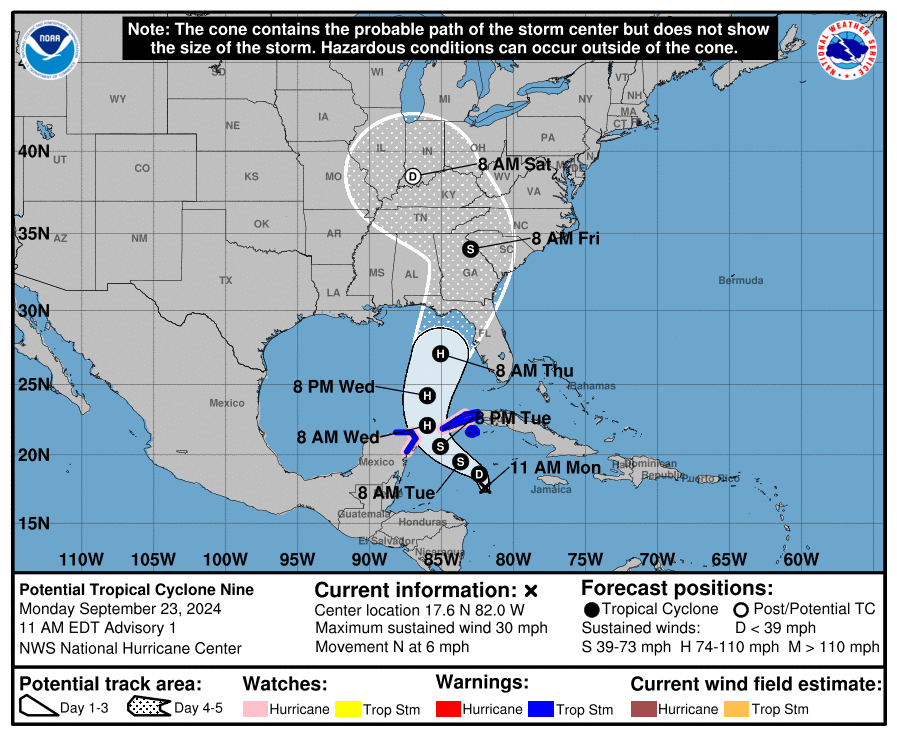
9/23/24 at 12 PM – The National Hurricane Center has designated a disturbance in the northwestern Caribbean as Potential Tropical Cyclone 9. Currently, NHC gives the storm a 90% chance of development in the next two days.

According to Harris County Meteorologist Jeff Lindner, models indicate it will likely escalate into a Category 4 hurricane as it heads north over the warm waters of the Gulf.

However, it will likely make landfall along the Florida Panhandle. Current forecasts indicate no threat to Texas. Overnight, the projected track of the storm shifted farther east.

Projections as of Noon Monday

I’m posting this because Houston residents may have friends, relatives or travel plans in affected areas. See below.

Center of storm has equal change of tracking anywhere within cone. Cone does not indicate width of storm.

Tropical storm force winds associated with Potential Tropical Cyclone 9 should arrive in the big bend area of the Florida panhandle sometime between Wednesday night and Thursday morning.

NHC predicts a 50:50 chance for tropical storm force winds extending north into Georgia.

The National Weather Service has this to say for people in the Panhandle and southern Georgia, “There is a potential for significant storm surge; heavy rainfall and flooding; and strong winds across the north and eastern Gulf Coast.”

“Impacts could begin as early as Wednesday night and last into Friday,” says NWS. “More detailed and specific impacts will be highly dependent on future track/intensity and we’ll be including those in future updates in the next day or two.”

Winds have a 95 percent chance of a 75 MPH increase during the next 72 hours.

National Hurricane Center

Frequency of Major Hurricanes

When/if the Potential Tropical Cyclone 9 reaches 39 MPH, NHC will dub it Helene.

We’ve already had one major hurricane in the Gulf this year – Beryl. The second major hurricane usually develops in the Atlantic Basin by September 19. So, even though this season has fewer than normal named storms, it will have an average number of major hurricanes for this part of the season if Helene becomes a Category 3 or higher.

Average hurricane season stats
From NHC’s Climatology Page

Current Status

At present, NHC says the area of concern in the northwestern Caribbean between Honduras and Cuba continues to produce disorganized showers and thunderstorms. Some mid-level rotation is evident in visible satellite images.

A  gradual turn toward the northwest is expected during the next day or so. Models agree that the center of the system should reach the northeast Gulf on Thursday.

Since the disturbance currently lacks a  well-defined center, future track adjustments may be required. Given the large size of the  tropical-storm-force wind field and fast forward speed that is forecast, storm surge, wind, and rainfall impacts will likely extend well away from the center, particularly to the east of the system.  

While the system is currently broad and not well organized, the  models suggest a more well-defined center should develop during the  next day or so.

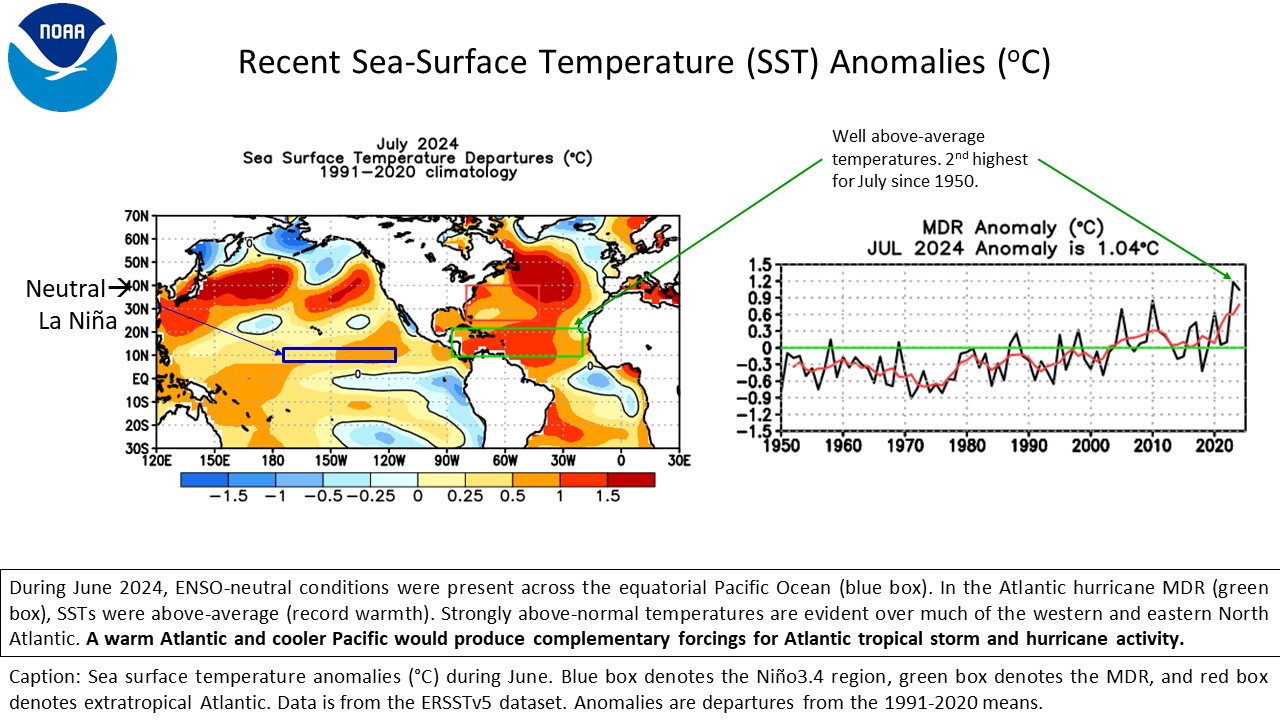
Once the system becomes better organized and develops an inner core, the environmental and oceanic conditions appear favorable for significant strengthening. The sea surface temperature anomaly chart below shows that temperatures in the Caribbean and Gulf are up to 8 degrees Fahrenheit warmer than average for this time of year.


An Air Force Reserve reconnaissance aircraft will investigate the system this afternoon.

Tropical Storm Warnings and Hurricane Watches have already been issued for portions of western Cuba and the Yucatan  Peninsula of Mexico.

Key Messages

  • The disturbance will strengthen and be near hurricane strength when it reaches the far northwestern Caribbean Sea Tuesday night.
  • The system will intensify and could become a major hurricane when it reaches the northeastern Gulf Coast on Thursday.
  • There is an  increasing risk of life-threatening storm surge and damaging  hurricane-force winds along portions of the northern and  northeastern Gulf Coast, including the Florida Panhandle and  portions of the Florida west coast. But it is too soon to  specify the exact location and magnitude of impacts.
  • Potential Tropical Cyclone Nine will bring heavy rain to portions of the western Caribbean. That may lead to flooding and possible  mudslides in western Cuba.  
  • Potential Tropical Cyclone Nine will likely produce total rain accumulations of 4 to 8 inches over western Cuba and the Cayman Islands with isolated totals around 12 inches.
  • Heavy rainfall will spread into the Southeast U.S. starting on Wednesday and continuing through Friday, bringing a risk of flash and river flooding.  
For the latest rainfall forecasts associated with Potential Tropical Cyclone Nine, see the National Weather Service Storm Total Rainfall Graphics.

Posted by Bob Rehak on 9/23/24

2582 Days since Hurricane Harvey 

Latest NHC Forecasts Show Francine Aiming for Louisiana

9/10/24 – Update: At 7 PM, the National Hurricane Center announced that Francine became a hurricane with sustained winds of 75 MPH and higher gusts. By 10:20, hurricane hunter aircraft found sustained winds of 85 MPH with central pressure of 979 mb. Hurricane-force winds extend outward up to 35 miles from the center and tropical-storm-force winds extend outward up to 115 miles. Other details have not changed much since 4PM. See below.

The National Hurricane Center’s (NHC) 4 PM update shows Tropical Storm Francine taking aim for Louisiana. Its impacts will likely diminish in the Houston area. However, tropical storm warnings and watches now extend past Louisiana into Mississippi and Alabama, as the forecast track shifts farther east.

Francine at 3:46 PM CDT, 9/10/24

Francine Winds and Forward Speed

At 4 PM, Francine still packed 65 MPH winds with higher gusts. But NHC expects it to reach hurricane strength tonight. By convention, storms become hurricanes at 74 MPH.

A Hurricane Warning is in effect from Sabine Pass eastward to Grand Isle. NHC forecasts that Francine could reach 80 knots/92 MPH at landfall in central Louisiana. If accurate, that would put it just shy of a Category 2 hurricane.

Hurricane hunter aircraft found that pressure in the central core had dropped to 987 mb. The storm has become better organized with increased banding.

Tropical-storm-force winds extend outward up to 140 miles (220 km) from the center. To put that in perspective, Beaumont is 175 miles from Baton Rouge, which is in central Louisiana.

Two NHC graphics depict the probability of damaging winds reaching the Houston area. The first shows the north Houston area has a 5-10 percent chance of experiencing tropical-storm-force winds.

The second shows we have a zero percent chance of experiencing hurricane force winds.

Track

According to NHC, Francine has made a turn toward the northeast and increased its forward motion to 10+ MPH. It should reach the central Louisiana coast sometime Wednesday afternoon or evening. A continued northeastward motion and a faster forward speed are expected tonight and Wednesday.

Surge

We still can expect storm surge in coast areas all the way from Freeport to the Florida Panhandle.

With that comes the associated risk of rip currents.

Rainfall

Francine is expected to bring storm total rainfall of 4 to 8 inches, with local amounts to 12 inches across eastern Louisiana, Mississippi, far southern Alabama and the western Florida Panhandle through Friday morning. This rainfall could lead
to considerable flash and urban flooding in those locations.

However, Jeff Linder, Harris County’s meteorologist less than an inch of rain in the Lake Houston Area.

We barely have a chance for flash flooding. And significant rainfall accumulations will be concentrated east of Texas.

5-Day Accumulated Rainfall Predictions from the National Weather Service

While the Lake Houston Area may be spared the storm’s worst effects, the Mississippi Valley won’t. NHC predicts significant flooding for that area.

Today Is Statistical Peak of Hurricane Season

Today is the statistical peak of hurricane season and Francine makes our sixth named storm in the Atlantic Basin.

To put that in perspective, during the last 30 years, we usually have had 10 named storms by September 4 and 11 by September 14. So despite early dire warnings, this season has been less severe than normal.

The 2017 hurricane season should remind us all that it only takes one storm to change lives forever. Pray for our neighbors to the east. And remain vigilant.

Posted by Bob Rehak on 9/10/24

2569 Days since Hurricane Harvey and 69 since Beryl


TS Francine Will Now Likely Strike East of Houston

9/9/24 – 7 PM update – Francine is strengthening faster than expected. Current sustained winds are 65 MPH and NHC predicts the storm will be a Category 2 hurricane at landfall. The post below was written at 2PM this afternoon.

This morning Potential Tropical Cyclone 6 intensified and formed a center of circulation. With winds currently at 60 MPH, the National Hurricane Center (NHC) named it Tropical Storm Francine. NHC expects it to intensify into a hurricane tomorrow. Francine’s current predicted track will take it inland over Louisiana.

At the moment, models suggest the worst of the storm will miss Houston to the south and the east.

At 1 PM CDT, TS Francine was still between Brownsville, TX and the Yucatan.

Watches and Warnings Now In Effect

As of Monday at 2 PM CDT, NHC had issued the following watches and warnings:

A Storm Surge Watch is in effect for…

  • High Island Texas to the Mississippi/Alabama Border
  • Vermilion Bay
  • Lake Maurepas
  • Lake Pontchartrain

A Hurricane Watch is in effect for…

  • The Louisiana coast from Cameron eastward to Grand Isle

A Tropical Storm Watch is in effect for…

  • Barra del Tordo to the Mouth of the Rio Grande
  • Mouth of the Rio Grande to Port Mansfield
  • East of High Island Texas to Cameron Louisiana
  • East of Grand Isle to Mouth of the Pearl River
  • Lake Pontchartrain
  • Lake Maurepas

Likely Track

The western edge of the cone of uncertainty extends westward to far east Texas.

Note, however, that the cone does not indicate the width of the storm. It simply means that the center of the storm has an equal chance of passing over every point within the cone. Because the storm is currently 160 miles wide, if Francine made landfall toward the western edge of the cone, the Houston area could see significant impacts.

Still, models agree that the storm will likely make landfall in Louisiana.

Storm Surge

The combination of a dangerous storm surge and the tide will cause normally dry areas near the coast to flood from
rising waters moving inland from the shoreline. The water could reach the following heights above ground somewhere in the indicated areas if the peak surge occurs at the time of high tide…

  • Cameron, LA to Port Fourchon, LA…5-10 ft
  • Vermilion Bay…5-10 ft
  • Port Fourchon, LA to Mouth of the Mississippi River, LA…4-7 ft
  • High Island, TX to Cameron, LA…3-5 ft

The deepest water will occur along the immediate coast near and to the east of the landfall location, where the surge will be
accompanied by large and dangerous waves. Surge-related flooding depends on the relative timing of the surge and the tidal cycle, and can vary greatly over short distances. Storm surge is not expected to pose a threat to the risk-reduction system levees. However, there may be some overtopping of local levees.

Winds Approaching 86 MPH

Francine is moving at 5 MPH. NHC expects winds to peak at 75 knots (86 MPH) within 48 hours. That would make Francine a Category 1 Hurricane. Cat 1 ranges from 74 to 95 MPH.

The highest winds will likely focus on southern Louisiana.

Tropical storm force winds could be felt in the Houston area as early as late tomorrow afternoon into evening.

However, the most likely arrival times will be approximately 12 hours earlier.

Jeff Lindner, Harris County’s meteorologist, feels, “There is a 30-50% chance of TS force winds on Wednesday along the upper Texas coast and a 10-20% chance of tropical-storm-force winds across the metro-Houston area.”

“Squalls and bands of rain will begin to move into the outer coastal waters on Tuesday and spread toward the coast. Some of the activity is likely to impact the coastal counties Tuesday night into Wednesday depending on the exact track.”

“Hurricane conditions may graze our outer coastal waters Wednesday afternoon, but at this time the probability of sustained hurricane force winds along the upper Texas coast is generally 5-10% from roughly Freeport to Sabine Pass,” said Lindner.

Rainfall and Flooding

According to NHC, Francine will bring heavy rainfall and the risk of considerable flash flooding to portions of the southernmost Texas coast, the Upper Texas Coast, southern Louisiana, and southern Mississippi into Thursday morning.
A risk of flash and urban flooding exists across portions of the Mid-South from Wednesday into Friday morning.

Lindner predicts, “Rainfall amounts over SE TX have generally been pulled back some with the eastward track shifts and it is likely the core of heaviest rainfall will remain offshore. Rainfall amounts of 1-3 inches can be expected along the coast with amounts of generally less than an inch inland of US 59.”

Whew. Keep your fingers crossed and hope that Francine stays south of us. We haven’t even finished cleanup from Beryl yet.

Posted by Bob Rehak on 9/9/24 at 2PM

2568 Days since Hurricane Harvey and 63 since Beryl

2024 Hurricane Season Update, PTC 5 Status and Learning Resources

8/12/24 – An August 8 update to NOAA’s 2024 Atlantic Hurricane Season Outlook still calls for an extremely active hurricane season with 17-24 named storms, including four so far with a fifth brewing in the Atlantic. The main difference between this and NOAA’s May predictions? A higher confidence level.

The main factors that affect the latest predictions for the 2024 hurricane season include:

  • Sea surface temperatures remain near record highs in the Atlantic main development region
  • Weaker-than-normal trade winds
  • Near record-low vertical wind sheer
  • Above-normal West African monsoon rains
  • No El Niño is expected to develop this year.
  • We are in the warm phase of the Atlantic Multi-decadal Oscillation (AMO)
  • Development to date, including Beryl and Debbie and an impending Ernesto, puts us ahead of the 30-year running average.

For more on the science behind the outlook, visit NOAA’s Climate Prediction Center.

#5 in the Hurricane Season About to Form

As of 2PM EDT, NHC indicated that sustained winds from Potential Tropical Cyclone (PTC) 5 averaged 35 MPH. That puts it just 4 MPH from becoming the fifth named storm of the year, Ernesto. Here’s what it looks like this afternoon.

PTC 5 as of 8/12/24 Noon CDT.

NHC gives PTC 5 a 100% chance of formation. It should intensify into a tropical storm later today and a hurricane by Thursday. However, it will curve northward into the open Atlantic and does not pose a threat to the Gulf Coast.

We normally don’t get a fifth named storm in the Atlantic until August 22. After that, we normally get a named storm every 7-10 days through October 11. This year, they will likely be more frequent.

Teach Your Family about Hurricanes

The National Hurricane Center website provides an almost bottomless well of free, educational resources. Today, I clicked on Outreach Resources and found presentations and publications geared to all age and professional levels.

Learning Opportunities for K-12 Students (Resources for Teachers) includes:

Hurricane Readiness for Coastal Communities

  1. Hurricane Basics (14 MB)
  2. NWS Products (15 MB)
  3. Forecast Uncertainty (23 MB)
  4. Making Better Decisions (10 MB)
  5. Student Guide (42 MB)

The guide (#5) contains a narrative embellishes the slides in the first four presentations.

Hurricane Readiness for Inland Communities

  1. Tropical Cyclone Basics (36 MB)
  2. National Weather Service Products (26 MB)
  3. Understanding Forecast Uncertainty (7.5 MB)
  4. Inland Hurricane Preparation in Practice (23 MB)
  5. Student Manual (30 MB)

Again, #5 contains additional explanation when slide graphics in presentations 1-4 may not be totally intuitive.

Information that Saves Lives

FEMA geared the presentations in the second two groups to adults, both in an out of government. The coastal presentations contain more emphasis on storm surge. The inland presentations emphasize riverine flooding from the heavy rains that often accompany hurricanes.

The information in both groups can benefit teachers, parents, first responders, emergency managers, and government leaders.

They explain various tools, terms and graphics used by NOAA, NHC, NWS, and NHP to help everyone make informed decisions when planning for and responding to hurricane threats.

For instance, I found the discussion on inundation mapping that involved forecasts and “nowcasts” very illuminating. Ditto for the discussion about how NHC determines the timing and probabilities in its graphics. How much water it takes to make cars float and lose traction. How emergency planners work together. And more. Much more.

Posted by Bob Rehak on 8/12/24

2540 Days since Hurricane Harvey