Tag Archive for: Kingwood Diversion Ditch

How Soon We Forget!

How soon we forget. Hurricane Harvey was just 4.5 years ago. Since then I have documented dozens, if not hundreds of questionable practices that erode margins of flood safety.

It Didn’t Have to Be That Bad

Harvey was the largest rainfall event in the history of North America. However, with better regulations and construction practices, it didn’t have to be as destructive as it was.

  • Lax regulations;
  • Willful blindness;
  • Development and construction practices that pushed the safety envelope;
  • Relentless destruction of forests and wetlands near rivers and streams;
  • And homebuyers who didn’t realize their true flood risk…

…made Harvey’s destruction worse than it otherwise would have been.

No one factor by itself would explain Harvey’s destruction. But put them all together, and it’s like “death of a thousand cuts.”

The sheer volume of material – more than 1,000,000 words on this site – makes it difficult for people to see the big picture sometimes. To put 1,000,000 words into perspective, the average novel contains only about 100,000. So I’m condensing the website into a book that includes the themes below.

No One Wins Arguments with Mother Nature

During an interview with Milan Saunders and his daughter Lori, Milan said, “No one wins arguments with Mother Nature.” How profound! It doesn’t matter how many surveys, studies and engineer stamps you have on your home’s title. If you don’t:

  • Respect the rivers.
  • Give them room to roam.
  • Protect wetlands.
  • Allow plenty of margin for safety…

…you will flood.

Thought courtesy of Milan Saunders, Chairman/CEO of Plains State Bank. That’s his daughter Lori’s house during Harvey.

Understanding the Causes of Flooding

Excess sedimentation is one of them. Sediment pollution is the single most common source of pollution in U.S. waters. Approximately 30% is caused by natural erosion, and the remaining 70% is caused by human activity.

Large islands built up during Harvey blocked both drainage ditches and rivers. Below, you can see a large sand island (top) built up at the confluence of the Kingwood Diversion Ditch where it reaches the San Jacinto West Fork at River Grove Park. This sand bar reached 10-12 feet in height above the waterline and helped back water up into Trailwood, the Barrington and Kingwood Lakes and Kings Forest. Before the Army Corps dredged this island, River Grove flooded five times in six months. It hasn’t flooded since.

The Kingwood Diversion Ditch and West Fork San Jacinto were almost totally blocked by sediment dams deposited during Harvey.

The second photo above was taken a few hundred yards downstream on the West Fork from the first. It shows “Sand Island” – so nicknamed by the Army Corps. It took the Corps months to dredge this island which they say had blocked the West Fork by 90%.

A certain amount of this sedimentation can be explained by natural erosion. But mankind also contributed to the sheer volume by other practices which I will discuss below.

Respect the Rivers

The red polygons in the satellite image below surround 20-square miles of sand mines on the West Fork of the San Jacinto in a 20 mile reach of river between I-45 and I-69. That exposes a mile-wide swath of sediment to erosion during floods and increases the potential for erosion by 33x compared the river’s normal width.

Even without floods, mines sometimes flush their waste into the rivers. The shot below on the top right shows the day the West Fork turned white. The TCEQ found the source of the pollution upstream: a sand mine that had flushed 56 million gallons of sludge into the West Fork (bottom right).

Influence of sand mines of West Fork San Jacinto water quality.

End the War on Wetlands

Wetlands are nature’s detention ponds. During storms, they hold water back so it won’t flood people downstream. But we seem to want to eradicate wetlands. The images below show the Colony Ridge development in Liberty County. Wetlands (right) are being cleared (left) to make way for the world’s largest trailer park. The acceleration of runoff wiped out FM1010 during Harvey. The road still has not been repaired.

Colony Ridge in Liberty County.

Conservation Costs Much Less than Mitigation

Halls Bayou at I-69 near Fiesta. Image on left shows whole subdivisions that that to be bought out before detention ponds on right could be built.

All across Harris County, especially in older areas inside Beltway 8, apartment complexes, homes and businesses are built right next to bayous and channels. This makes it difficult to enlarge streams or build detention ponds when necessary. One study showed that preservation of floodplains is 5X more cost effective than mitigation after homes flood. Yet private developers keep crowding bayous and residents keep demanding public solutions.

Respecting Individuals’ Property Rights While Protecting Others’

In Texas, it sometimes feels that an individual’s right to do what he/she wants with property trumps others’ rights NOT to flood. You may think you’re protected by all those public servants reviewing and approving plans. But what happens when developers and contractors decide to ignore the approved plans? Here’s a prime example: the Laurel Springs RV Resort near Lakewood Cove.

The approved plans said that “Stormwater runoff shall not cross property lines.” So what did the contractors do? They pumped their stormwater over the development’s detention pond wall. When that took too long, they dug a trench through the wall. Then they laid pipes through the wall to permanently empty the sludge into the wetlands of Harris County’s new Edgewater Park.

This apparently violated the developer’s City of Houston permit, the Texas Water Code, TCEQ’s construction permit and the developer’s stormwater pollution prevention plan. Four investigations are currently swirling around this development. The contractor also cut down approximately 50 feet of trees in Edgewater Park along the entire boundary line and received a cease-and-desist letter from the Harris County Attorney. But the damage is done.

Balance Upstream and Downstream Interests

About 10% of all the water coming down the West Fork at the peak of Harvey came from Crystal Creek in Montgomery County. But the wetlands near the headwaters of Crystal Creek are currently under development. And the developer is avoiding building detention ponds with a “beat-the-peak” survey. This loophole allowed by Montgomery County says that if you get your stormwater to the river faster than the peak of a flood arrives, then you’re not adding to the peak of a flood and you don’t have to build detention ponds. So developers conduct timing surveys to reduce costs and maximize salable land.

What happens when upstream areas develop without consideration for the impact on downstream property owners.

Of course, speeding up the flow of water in a flood is the opposite of what you want to do. To reduce flooding, you should hold back as much water as possible.

The slide above shows part of a new development called Mavera at SH242 and FM1314 being built on wetlands near Crystal Creek.

The graph on the right shows what happened on Brays Bayou without suitable detention upstream. Floodwaters peak higher, sooner. Harris County has spent more than $700 million in the last 20 years to remediate flooding problems along Brays.

How much will we need to spend when more areas like Mavera get built upstream on the West Fork?

How Quickly We Forget!

FEMA’s Base-Flood-Elevation Viewer shows that in that same area, developers have already built homes that could go under 1-5 feet of water in a 100-year flood. These homes are actually in a ten-year flood zone. And yet more homes are being built nearby. On even more marginal land!

In recent years, the price of land as a percent of a new home’s cost has risen from a historical average of 25% to approximately 40% today. This puts pressure on developers to seek out cheaper land in floodplains, reduce costs by avoiding detention pond requirements, pave over wetlands, and reduce lot sizes resulting in more impervious cover. All contribute to flooding.

Of course, smart homebuyers would not make such risky investments. But few lack the expertise to gauge flood risk. Educating such homebuyers will be one of the major objectives of the book I hope to write.

Posted by Bob Rehak on 2/23/2022

1639 Days since Hurricane Harvey

The thoughts expressed in this post represent opinions on matters of public concern and safety. They are protected by the First Amendment of the US Constitution and the Anti-SLAPP Statute of the Great State of Texas.
Pics of Tornado Damage in Kingwood/Forest Cove

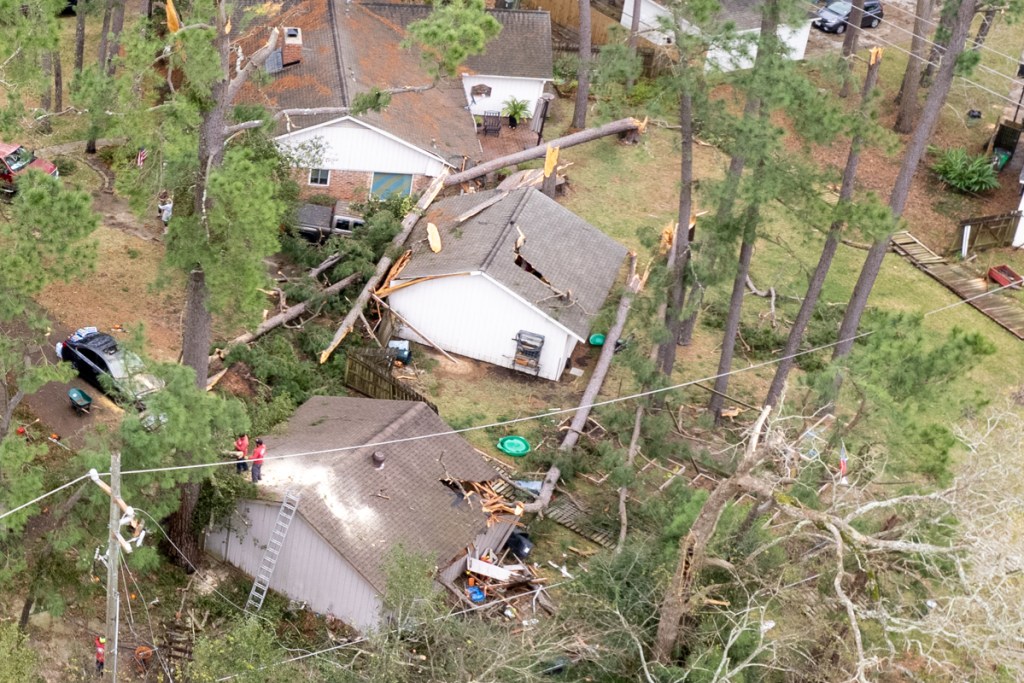
Early Sunday morning on January 9, 2022, an EF-1 tornado touched down along the Kingwood Diversion Ditch between Hamblen and Kingwood Drive. It damaged trees and homes on both sides of the ditch for several blocks. By early afternoon, tree crews were swarming over the area, making the streets barely passable.

Tornado or Just Strong Winds?

I asked one of the crews if they were sure a tornado caused the damage. They said yes, based on the type of damage they saw. The tops of trees had been twisted off like screw caps. See photos below taken on Sunday afternoon after the storm cleared out.

Note two garages and corner of one home damaged by toppled trees east of ditch.

While some trees were uprooted, the vast majority of the damage involved “topped trees.” Had straight line winds been the cause, you would see more uprooted trees. The damage would have been more widespread. And the trees would have been pushed down in a uniform direction rather than scattered like pick-up sticks.

Looking south along Kingwood Diversion Ditch. Note eight topped trees left of the ditch and one of the tops hanging from a wire over the ditch.
West of ditch on Forest Cove side. Note damaged garages, back corner of home, and trees still hanging from wires.
Close up of topped tree and blown-over fence.
Portion of fallen tree thrown through fence by winds.
Forlorn homeowner on crushed gable. “Where do I go from here?”

ABC-13 confirmed the strength of the tornado on its evening news tonight. According to ABC, the tornado came through at approximately 1:30 AM. According to residents I spoke to, the noise was deafening and pets started acting nervous about that time.

Dogs Knew Before You Did

This article from Psychology Today explains that dogs’ hearing is four times more sensitive than humans’. That means they can hear things four times farther away – sooner than we can. Canine hearing also picks up higher pitched sounds. If the noise sounds deafening to you, think how painful it must be for your pooch.

I live near Kingwood High School two miles away. At precisely 1:30, my dog started whimpering, trembling, and tried to jump in bed with me.

Storm Totals Compared to Record and Climate Norm

For the record, the storm that started Saturday afternoon and ended early Sunday morning dumped about 4.96 inches in my rain gage. Jeff Miller, an Elm Grove resident said he had 5.5 inches in his.

These are unusually high amounts for January. The all time record for January 8 was 5.89 inches, set in 1891, 130 years ago! Houston usually receives 3.4 inches for the whole month of January. Plum Grove on the East Fork received 6.88 inches in this storm – more than double the monthly average for the Houston area. Luce Bayou on 321 in Liberty County received an incredible 8.56 inches in the storm. Had either of those locations been the official recording station, this storm would have gone down in history.

Posted by Bob Rehak on 1/9/2022

1594 Days since Hurricane Harvey

Kingwood Diversion Ditch and Taylor Gully Preliminary Engineering Projects Begin

On June 29, 2021, Harris County Commissioners approved two contracts for preliminary engineering on the Kingwood Diversion Ditch and Taylor Gully Projects. This week, I’ve been getting reports of boots on the ground. So I grabbed my camera and went looking for activity this morning. I found a soil survey truck at Kingwood Drive next to the Diversion Ditch. I also found regular surveyors on Taylor Gully about a block south of Woodridge Village.

Both activities are among the first steps in preliminary engineering. And both are among the first steps in finding flood-mitigation solutions for a huge percentage of Kingwood’s population.

This drone shot shows the surveying crew a little more than one block south of Woodridge Village on Taylor Gully.
Looking downstream in opposite direction toward Rustic Elm Bridge out of sight around bend.
The surveyors were capturing elevations of the banks, slopes, ditch bottom, and backslope swales of Taylor Gully.

Taylor Gully Objectives and Scope

HCFCD has asked Idcus, Inc. to develop up to five conceptual alternative scenarios for modifying Taylor Gully. Alternative scenarios may include:

  • Expanding Detention On Woodridge Village Site so that no channel improvements are necessary.
  • Determining amount of detention and channel improvements necessary to ensure no adverse impact all the way to Lake Houston.
  • Finding the optimum balance between maximum flood protection and minimum construction costs.
Deliverables include:
  • Channel and basin layouts
  • Estimates of benefits for various levels of storms (100-year, etc.)
  • Right-of-way requirements
  • Cost estimates for right-of-way acquisition, engineering and construction management.
  • Performance metrics, i.e., estimated acreage of land inundation, number of structures in floodplain, number of structures flooded and miles of inundated roadway.
  • A scoring matrix to rank alternatives.
Scope of Taylor Gully Project includes the two halves of Woodridge Village outlined in gold above the ditch.

Kingwood Diversion Ditch Objectives and Scope

HCFCD hired Neel-Schaffer, Inc. for preliminary Kingwood Diversion Ditch engineering. They must:

  • Evaluate existing site conditions, previous studies, other projects that could affect this one, topography, rights-of-way, utilities, and soil surveys.
  • Evaluate existing bridges
  • Conduct and H&H analysis to assess existing and proposed conditions (from 2-year to 500-year storms).
  • Analyze Channel Improvements including the:
    • Impact of TIRZ #10’s latest design to replace the Northpark Bridge
    • Diversion structure at the confluence of Bens Branch and the Diversion Channel
    • Drop structures in lieu of a concrete lined channel to minimize high velocities due to the steep grade between 
      Walnut Lane and Deer Ridge Estates Blvd.
  • Develop phased construction plans based on available funding, potential impacts and benefits.
  • Conduct two public engagement meetings and coordinate with community groups.

Deliverables include:

  • Surveys
  • Geotechnical investigations, i.e., bridge borings
  • Environmental assessment
  • “Jurisdictional” determination. Does this channel fall under the jurisdiction of the Army Corps as it nears the West Fork? If so, channel design may need to be altered.
  • Determination of detention pond requirements
  • Exploration for subsurface utilities
  • Obtaining permits from the Corps
  • Landscape architect services
Scope of Diversion Ditch Project runs from St. Martha Catholic Church in Montgomery County to the San Jacinto West Fork at River Grove Park. This is the ditch that runs past the fire station on Kingwood Drive.

Why These Two Projects First?

Both of these projects evolved from the Kingwood Drainage Analysis finalized late last year. That study identified nine channels that needed improvement. These two were recommended for immediate help because:

  • They help the largest number of people.
  • HCFCD already owns land to expand and deepen the Diversion Ditch.
  • Diversion Ditch enhancement will immediately take pressure off Ben’s Branch, and help flooding there.

Note that Ben’s Branch has already gone through a four-phase major maintenance project designed to restore its original conveyance.

Here is Harris County Flood Control District’s Summary of Results from the 600-page Kingwood Area Drainage Analysis.

A Good Sign

Both of these projects go far beyond maintenance, which portions of both of these ditches have already received. While we’re still far from construction, the work that kicked off this week will improve flood safety for a large part of Kingwood.

Posted by Bob Rehak on 8/4/2021

1436 Days since Hurricane Harvey

Preliminary Engineering Contracts Approved for Two Kingwood Drainage Improvements

On June 29, 2021, Harris County Commissioners approved two contracts for preliminary engineering on Taylor Gully and the Kingwood Diversion Ditch. The Taylor Gully project includes looking at Woodridge Village in Montgomery County to possibly expand detention-pond capacity there. See more below.

Taylor Gully Project

Harris County Flood Control District (HCFCD) awarded Idcus, Inc. a $180,555 preliminary engineering contract to develop up to five conceptual alternative scenarios for modifying Taylor Gully. HCFCD and Idcus will then select three scenarios for more detailed analysis. Idcus must perform the work within 300 days of the Notice to Proceed.

The alternative modeling scenarios may include:

  1. Preferred Channel Alternative: This would look at improving the slope, width and lining of channel in conjunction with the existing detention on the Woodridge Village site. This purpose: to determine if the existing detention and proposed channel improvements suffice to mitigate flooding.
  2. Expanded Detention: This would look at expanding the existing stormwater detention on the Woodridge Village site so that no channel improvements are necessary.
  3. Alternative Channel/Detention: This would look at a combination of the two scenarios above. It would determine the amount of additional detention and channel improvements necessary to ensure no adverse impact all the way to Lake Houston.
  4. Optimization Alternative: Building on the alternatives above, this effort would examine additional alternatives to produce a no-adverse-impact solution while maximizing the flood mitigation and minimizing construction costs.
Deliverables for the alternatives include:
  • Channel and basin layouts
  • Estimates of benefits for various levels of storms (100-year, etc.)
  • Right-of-way requirements
  • Cost estimates for right-of-way acquisition, engineering and construction management.
  • Performance metrics, i.e., estimated acreage of land inundation, number of structures in floodplain, number of structures flooded and miles of inundated roadway.
  • A scoring matrix to rank the alternatives.

The scope also includes, when necessary:

  • Hydrologic and hydraulic analysis
  • Surveying
  • Soil sampling
  • Environmental site assessment
  • Subsurface utility exploration
  • Landscape architecture

Finally, Idcus will hold two public engagement meetings near the beginning and end of the project and consult with community groups such as KSA.

Geographic scope includes the Woodridge Village property in MoCo plus the Taylor Gully channel in Harris County.

Kingwood Diversion Ditch

HCFCD entered into a contract with Neel-Schaffer, Inc. for $437,685 for preliminary engineering on the Kingwood Diversion Ditch. Within 300 days,Neel-Schaffer must:

  • Evaluate existing site conditions, previous studies, other projects that could affect this one, topography, rights-of-way, utilities, and soil surveys.
  • Evaluate existing bridges
  • Conduct and H&H analysis to assess existing and proposed conditions (from 2-year to 500-year storms).
  • Analyze Channel Improvements including the:
    • Impact of TIRZ #10’s latest design to replace the Northpark Bridge
    • Diversion structure at the confluence of Bens Branch and the Diversion Channel
    • Drop structures in lieu of a concrete lined channel to minimize high velocities due to the steep grade between
      Walnut Lane and Deer Ridge Estates Blvd.
  • Develop phased construction plans based on available funding, potential impacts and benefits.
  • Conduct two public engagement meetings and coordinate with community groups.

HCFCD may also require Neel-Schaffer to provide addition services when necessary, such as:

  • Surveys
  • Geotechnical investigations, i.e., bridge borings
  • Environmental assessment
  • “Jurisdictional” determination. Does this channel fall under the jurisdiction of the Army Corps? If so, channel design may need to be altered.
  • Determination of detention pond requirements
  • Exploration for subsurface utilities
  • Obtaining permits from the Corps
  • Providing Landscape Architect services
Extent of Kingwood Diversion Ditch. It runs from the new St. Martha Catholic Church north of Northpark to the fire station on Kingwood Drive. Then it runs down to Deer Ridge Park where it makes a turn and enters the West Fork at River Grove Park.

For Complete Text of Contracts…

The first half of each link below contains contract details such as compensation. The second half contains the scope of work.

They were items 146 and 147 respectively on the agenda for the 6/29/21 Commissioner’s Court meeting.

Next Steps

In general, the critical path for each of these projects will follow the project-lifecycle pattern of all HCFCD projects.

Typical steps for new projects constructed under the 2018 bond program.

HCFCD will:

  • Conduct public meeting
  • Develop, review and prioritize alternative designs
  • Commissioner’s court reviews and votes on recommendation
  • Move to final design of selected alternative with same company
  • Engineering company develops construction specs
  • Bid
  • Award
  • Build

These were two of many such contracts approved in the last Commissioners Court meeting.

Both came out of the Kingwood Drainage analysis. More on projects affecting other parts of the Lake Houston Area in future posts.

Posted by Bob Rehak on 7/3/2021

1404 Days after Hurricane Harvey

Three Kingwood Flood-Mitigation Projects on Harris County Commissioners Court Agenda Next Tuesday

Harris County Commissioners posted their agenda for next Tuesday and it has three Kingwood flood-mitigation projects on it.

  • Preliminary engineering and final design services for improvements to:
    • Taylor Gully
    • Kingwood Diversion Ditch
  • Purchase of Woodridge Village to build a stormwater detention basin in Montgomery County.

In case you plan to watch the meeting, all three items fall under Harris County Flood Control District (HCFCD). Unless commissioners take items out of order, HCFCD projects usually come second on the agenda after Engineering. Below: exact text of each agenda item.

Agenda Item Text

Item 79:

Recommendation that the Harris County Flood Control District be authorized to negotiate an agreement for engineering services with IDCUS Inc. to provide preliminary engineering and final design services for improvements to Taylor Gully on HCFCD Unit G103-80-03.1. (San Jacinto River Watershed, Bond ID F-14, Project ID G103-80-03.1-E001, Precinct 4).

Item 82:

Recommendation that the Harris County Flood Control District be authorized to negotiate an agreement for engineering services with Neel-Schaffer, Inc. to provide preliminary engineering and final design services for improvements to the Kingwood Diversion Channel on HCFCD Unit G103-38-00. (San Jacinto River Watershed, Bond ID F-14, Project ID G103-38-00-E001, Precinct 4).

Item 92:

Recommendation that the Harris County Flood Control (District) be given authorization to decree that this District project serve a public purpose and public necessity require that the Harris County Real Property Division be directed to acquire two (2) fee simple tracts for the public project known as Woodridge Village Stormwater Detention Basin on behalf of the District, for the purpose of stormwater detention, in Montgomery County.

Woodridge Village Plan

If purchased from Perry Homes, HCFCD will swap part of Woodridge Village – the northern 77 acres of the 268 total – with the City of Houston. The City wants to build a wastewater treatment plant there and has negotiated with the County to swap land elsewhere in the City that HCFCD can use to reduce the cost of flood mitigation projects. The land reportedly includes parcels along Halls and Greens Bayous. This swap represents a win/win that helps protect more people throughout the City and County.

Woodridge Village
Looking north, at most of the 268-acre Woodridge Village Property. Road connects to Woodland Hills Drive new Kingwood Park High School out of frame on left. City is interested in portion at top of frame. Flood Control would use the rest for mitigation.

Scope of Engineering Studies Still Unclear

Contracts for the engineering studies have not yet been negotiated. However, we do have clues in the Kingwood Area Drainage Assessment final report about what these projects might include. Last October, HCFCD talked about:

  • Widening and deepening Taylor Gully to increase conveyance and/or building the detention pond in Woodridge Village, which empties into Taylor Gully. So Woodridge and Taylor Gully are related; what happens with one will affect the other.
  • Widening the Kingwood Diversion Ditch all the way from St. Martha’s Catholic Church at the county line to the San Jacinto West Fork. The Diversion Ditch project also included building a detention pond to ensure no adverse downstream impacts. Finally, the Drainage Assessment recommended splitting the ditch near Deer Ridge Park. The split would convey part of the floodwaters straight to the West Fork instead of routing all through River Grove Park via a circuitous route that takes them under Woodland Hills Drive which has washed out in the past.
Red line is Bens Branch. White Line is Kingwood Diversion Ditch. Green line shows where Kingwood Area Drainage Assessment recommended splitting flow as it approached West Fork at bottom of frame. Detention pond location not yet finalized.

No Recommendations Certain Yet

Nothing is certain yet. Commissioners Court deferred the Woodridge Village purchase five times last year – in April, May, July, August and September.

And as for the engineering work, a close reading of the text above shows that HCFCD has not yet negotiated contracts. HCFCD simply wants permission to negotiate the agreements. “Once we receive authorization to negotiate the agreements from Commissioners Court, we can meet with the consultants and develop the scope, schedule, and budget,” said Matt Zeve, Deputy Executive Director of HCFCD.

Regardless, this is good news and welcome progress for flood-weary Kingwood residents still struggling with recovery. These projects put us three steps closer to solutions.

For the full agenda, click here.

Posted by Bob Rehak on 2/5/2021

1256 Days after Hurricane Harvey and 505 After Imelda

Sneak Peak at Results of Kingwood Area Drainage Analysis; Review Before Meeting Tuesday Night

The Harris County Flood Control District has released a Report Summary of results from the 600-page Kingwood Area Drainage Analysis. HCFCD will hold an online community meeting Tuesday night to discuss the results. It may help to review this summary or HCFCD’s before the meeting.

Objective: Protect Homes/Businesses from Bigger Rains

The objective of the Kingwood Area Drainage Analysis: to provide the knowledge needed to protect homes and businesses from flooding in a 100-year (1% chance) rain as defined by the new, higher Atlas-14 Rainfall Probability Statistics. Said another way, the engineers want to make sure that if you bought a home outside the 100-year flood plain, that you STILL won’t be flooded in a 100-year rain. Engineers call that “the 100-year Level of Service (LOS).”

Steams, ditches and channels evaluated as part of the Kingwood Area Drainage Analysis. Please note ditch numbers for any comments you make as the flood control district identifies them by that number. It will help communication.

What Study Included

To accomplish their objectives, engineers:

  • Evaluated historical floods and mapped flood damage
  • Created hydrologic and hydraulic models to quantify flooding risks along streams, channels and open ditches
  • Identified drainage issues associated with storm sewers and streets
  • Performed an overland flow analysis
  • Used LiDAR, record drawings, previous surveys and data collected in the field
  • Incorporated the impact of potential storm sewer improvements on channel capacity
  • Quantified detention capacity needed to prevent increasing flows into Lake Houston
  • Determined how many structures would benefit from each improvement (or planned future improvement)
  • Researched rights-of-way and flowage easements
  • Recommended channel-capacity improvements
  • Recommended bridge and culvert improvements
  • Developed preliminary cost estimates
  • Recommended construction sequencing

In places where ditches provide less than a 100-year level of service, storm sewers cannot empty into them during a 100-year rain. When that happens, water backs up into streets and can flood homes. So engineers are looking at the performance of the drainage system from end to end in conjunction with the City of Houston.

Limitations: What Study Does NOT Include

The study does NOT:

  • Include new topographic surveys
  • Evaluate improvements for greater than 100-year events
  • Examine Montgomery County issues except for North Park Drive
  • Identify sites for detention basins
  • Duplicate the San Jacinto River Basin Master Drainage Plan or associated sedimentation and sand trap studies

No construction is included as part of this project. This project will only lay the groundwork for subsequent construction projects.

Study Identified Nine Channels That Need Improvement

Not surprisingly, the Kingwood Area Drainage Analysis found that many channels do not need improvements. Said another way, they already provide the required level of service. However, engineers identified nine channels that DO need improvement to protect homes and businesses.

Six of those nine have rights-of-way controlled by HCFCD. They include:

  1. Bens Branch – G-103-33-00
  2. Kings Crossing Ditch – G103-33-04
  3. Kingwood Diversion Ditch – G103-38-00
  4. No Name – G103-38-01
  5. No Name – G103-38-01.1
  6. Taylor Gully – G-103-80-03.1

Other entities control the rights-of-way for the three remaining ditches/streams that need improvements:

  1. Bear Branch – G103-36–00
  2. No Name – G103-36-03
  3. No Name – G103-46-01

For summary sheets of each recommended Kingwood Area Drainage Analysis project, click on the associated links. The Taylor Gully project will need to be re-analyzed if the Woodridge Village purchase goes through; that area could turn into a regional detention facility.

This table contains a summary of streams, channel types, ownership, current level of service, improvements, rights of way needed, cost estimates and detention estimates for all the projects considered in the Kingwood area.

Two Projects Recommended Immediately

Based on the results of the Kingwood Area Drainage Analysis, HCFCD recommends two projects: G103-38-00 (Kingwood Diversion Ditch) and G103-80-03.1B (Taylor Gully) move to the next phase: engineering design. Additionally, HCFCD recommends the Taylor Gully project be reanalyzed to determine how the use of Woodridge Village for detention could modify the recommended plan.

These two projects were chosen because:

  • They help the largest number of people.
  • HCFCD owns land to expand and deepen the Diversion Ditch.
  • Diversion Ditch enhancement will immediately take pressure off Ben’s Branch, and help flooding there.

Thus, these two projects address the three biggest needs. The remainder will have to wait for Capital Improvement funds.

First Step of Many

The Kingwood Area Drainage Analysis is a feasibility study that helped identify the problem areas. As you can see from the lifecycle diagram below, it represents the first step of several. The Flood Control District included $10 million in the bond fund (See F14) for Kingwood projects. That can be local-match seed money for attracting state and federal grants.

Source: Harris County Flood Control. After completion of the feasibility study comes preliminary engineering.

Online Meeting Details Tuesday Night

HCFCD will hold an online meeting Tuesday night. Engineers will describe the project and recommendations in more detail. You will also have a chance to interact with team members, make suggestions, and ask questions.

Tuesday, October 20, 2020

6:30 p.m. to 7:30 p.m.

 Join online at PublicInput.com/Kingwood

Or by phone at 855-925-2801 with Meeting Code: 9541

Please login a few minutes early. The Flood Control District has a brief survey on the login page that will help them track your concerns.

What the Flood Control District Needs from You

The Flood Control District needs to know about local issues that they may NOT have identified near you.

For example, culverts under Kingwood Drive for a ditch near me are almost totally blocked by sediment. That could have affected their analysis. And the stream may have correctable issues that could easily prevent future flooding.

Another example. The recommendations include taking out the low water crossing near Bear Branch Elementary School. Many kids use that to walk or bicycle to school. Removal without replacement would create a major inconvenience. It might also negatively affect downstream bridges damaged in previous storms.

A final example: the study did not recommend any changes to the bridge over Taylor Gully at Rustling Elms. However, many Elm Grove residents identified that as a major issue in two floods last year.

The Rustling Elms Bridge is a road over twin culverts, not a true open bridge like the one farther downstream in the background.

Please join the meeting Tuesday night and be prepared to discuss such issues. Volunteer your local knowledge. Speak up now or live with the results.

Credits

The Kingwood Area Drainage analysis cost $700,000. Funds from the 2018 Harris County Flood Bond and TIRZ 10 paid for this study.

Posted by Bob Rehak on 10/19/2020

1147 Days since Hurricane Harvey

HCFCD About to Start Next Phase of Kingwood Diversion Ditch Repairs

On Monday, July 13, Harris County Flood Control District (HCFCD) plans to begin more repairs to the Kingwood Diversion Ditch. In June, HCFCD repaired severe erosion near Walnut Lane between Trailwood and Forest Cove. The new repairs will begin farther down the ditch between Forest Cove and Deer Ridge Estates, just north of Deer Springs Drive. See map below.

Area of new repairs outlined in red. For reference, Kingwood’s Deer Ridge Park is in upper right. The outlined area shows where trees will be removed and is approximate.

Ditch To Be Straightened, Erosion Repaired

HCFCD plans to straighten the ditch and repair erosion. That will require the removal of trees which have grown up in the ditch and along its banks. See below.

In the area to be repaired, erosion and vegetation have made the ditch deviate from its normal course over time. The red line indicates the original path. The purple line indicates the current patch. Source: HCFCD.
Severe erosion threatens trails, safety and homes on both sides of the ditch.
Trees have grown up in the ditch, reducing its conveyance and blocking floodwaters.
To repair erosion and restore ditch, trees will need to be removed.

Bird Survey Finds No Nests Impacted

HCFCD has not specified the number of trees it will remove. However, the District has conducted a Bird Survey to ensure repairs will not impact any active nests near the portion of the Kingwood Diversion Ditch undergoing repair.

Protecting Homes from Future Erosion

“We will work to minimize the impacts to trees and nature, but we need to be able to get our equipment in to make repairs,” said Beth Walters, a spokesperson for HCFCD. “We do not know exactly how many trees will need to be removed. Unfortunately, it will be noticeable, but the repair will protect fences and homes from future erosion.”

Property threatened by diversion ditch erosion. Photo from January 2019.

Posted by Bob Rehak on 7/8/2020

1044 Days since Hurricane Harvey

HCFCD Finishes Repair of Kingwood Diversion Ditch At Walnut Lane

Harris County Flood Control District (HCFCD) has finished construction work on the repair of erosion in the the Kingwood Diversion Ditch near Walnut Lane between Forest Cove and Trailwood. HCFCD still has to plant grass, but the heavy lifting is done.

Before, During and After Photos

The pictures below show the way the ditch near Walnut Lane was and how it looks today.

Kingwood Diversion Ditch south of Walnut Lane in 2009. Giant slabs of the slope were starting to break way and were swept downstream. It got worse after that. Notice distance to power lines in background and compare with last photo.
HCFCD Diversion Ditch repairs in Kingwood in early June 2020.
The “after shot.” How it looked on 6/27/2020
And here’s how it looks from the air. Walnut Lane Bridge on left. Photo taken 6/16/2020. Compare how much closer the erosion eventually got to the power lines in this photo with the first photo above.

Posted by Bob Rehak on 6/29/2020

1035 Days since Hurricane Harvey