Tag Archive for: Harris County Flood Control

GLO’s Bush Requests Direct Funding from HUD for Harris County Flood Mitigation

5/26/21 – Tonight, Texas General Land Office (GLO) announced that it would support a direct allocation to Harris County from HUD Mitigation funds for $750 million.

On May 21, the GLO announced winners of US Department of Housing and Urban Development (HUD) grants totaling more than a billion dollars for Hurricane Harvey flood mitigation. Only problem: little went to Harris County Flood Control or the City of Houston despite the fact that we experienced half of the statewide damage in Harvey. Only $90.4 million went to small cities in Harris County. (See below)

Harvey at Peak Intensity

Ever since GLO’s announcement, Harris County Commissioners have been scrambling, trying to figure out how to fill a funding shortfall. That’s because they were counting on attracting matching grants that didn’t materialize. Without the grants, some of the projects could be delayed – especially those in low-to-moderate income neighborhoods, which HUD targets – until alternative sources of funding can be identified.

Yesterday’s Harris County Commissioner’s Court Meeting spent more than four hours on the dilemma. Commissioners arranged for angry residents to call in and each testify for 3 minutes. At the end of their allotted time, they were thanked and asked to call the Texas General Land Office (GLO).

The phones must have rung off the hook at the GLO today, because by the end of the day, GLO Commissioner George P. Bush punted the decision for the next round of funding to HUD.

Below is the full text of a GLO press release sent out at 6:28 PM this evening.


GLO Press Release

“Today, Texas Land Commissioner George P. Bush announced his request to the U.S. Department of Housing and Urban Development (HUD) for Harris County to receive a direct allocation of $750 million for mitigation efforts.”   

“I have heard the overwhelming concerns of Harris County regarding the mitigation funding competition,” said Commissioner Bush. “The federal government’s red tape requirements and complex regulations are a hallmark of President Biden’s administration. I am no stranger to standing with the people of Texas as we fight against the federal government. As such, I have directed the GLO to work around the federal government’s regulations and allocate $750 million for mitigation efforts in Harris County.”  

“An amendment to the state action plan regarding the administration of Community Development Block Grants for Mitigation (CDBG-MIT) in the State of Texas will be submitted to HUD by the General Land Office to implement these changes. A final mitigation competition will be held for the other 48 eligible counties at a later date.”  

“Although Hurricane Harvey made landfall in August 2017 and Congress appropriated these mitigation funds several months thereafter, the GLO’s hands were tied waiting for HUD to publish the rules regulating the use of these funds until they were published in a Federal Register notice, which did not happen until August 30, 2019 – two years after the storm and 19 months after the appropriation. The scoring criterion required by HUD to be included in the state action plan for distribution of the funds was approved by HUD on March 27, 2020.”


Flood Mitigation Should be Non-Partisan

I don’t want to get in the middle of the cross-fire on this. One of my biggest concerns is that flood mitigation remain non-partisan.

So rather than speculate about people’s motives and try to decipher where things went awry, I will simply post the following documents:

Regarding the last item, the copy is from a draft circulated before the meeting. However, reportedly, Commissioners made no changes. They approved it (or something very close to it) unanimously.

Before the end of the meeting, Commissioners had also resolved to meet with the Governor, HUD, President Biden, Congressmen, Senators and the tooth fairy. One thing is certain. Harris County is not taking this lying down.

One strange thing that several people have commented on: approximately a quarter of all the grants awarded went to improve water and sewage treatment plants – not flood mitigation projects. As one Congressional aid said today, “Separate grants are available for those. That took a lot of money out of circulation.”

Projects Awarded within Harris County but Not to HCFCD

In fact, three of the four projects awarded to cities in Harris County fell into that category.

  • City of Pasadena: Flood Mitigation Project – $47,278,951.21 LMI Percentage: 65.37%
  • Jacinto City: Wastewater Treatment Plant Improvements Project – $5,319,717 LMI Percentage: 78.45%
  • City of Baytown: East District Wastewater Treatment Plant Phase II – $32,394,113.86 LMI Percentage: 52.29%
  • City of Galena Park: Water Plant Improvements Project – $5,482,123 LMI Percentage: 60.22%

Almost as much is going to water and wastewater plant improvements as flood mitigation.

Posted by Bob Rehak on May 26, 2021

1366 days after Hurricane Harvey

TWDB Approves $10.1 Million to Widen, Deepen Taylor Gully

At its first May board meeting this morning, the Texas Water Development Board (TWDB) approved a $10.1 million loan to the City of Houston to widen and deepen Taylor Gully.

Removing 400 Homes from Harm’s Way

The project should help alleviate flooding in Kingwood subdivisions such as Elm Grove, North Kingwood Forest, Mills Branch and Woodstream Forest. Residents in each village experienced disastrous flooding, not once, but twice in 2019. Widening and deepening the gully will increase its conveyance and take more than 400 homes out of harm’s way.

Connected Issues

However, the increased conveyance could also create the need for more more detention capacity to reduce the risk of flooding elsewhere.

This graph of Brays Bayou during the last century shows how runoff accelerates with development. Instead of floodwaters being stored in wetlands and forests, storm drains rush the water to the bayou. That results in higher, faster rises during storms.

Rapid upstream development has put pressure that never existed before on downstream homes. That development decreases the time of accumulation for floodwaters. Without more detention ponds to hold some water back, widening, deepening Taylor Gully could solve a problem in one place and create a problem in another. It could result in faster, higher flood peaks downstream.

Woodridge Village Could Be Part of Taylor Gully Solution

The logical place to put the extra floodwater detention would be on the Woodridge Village property that Harris County just acquired from Perry Homes. Currently, the property is about 40% short of the detention pond capacity needed to absorb a 100-year rainfall under new Atlas-14 requirements. And it has more than 170 acres available to meet that need.

Woodridge Village and headwaters of Taylor Gully (upper left) as they existed in January of 2020

The City loan which will be matched by money from the Harris County Flood Bond and, hopefully the federal government, can be used to address both conveyance and detention issues.

Delicate Dance Between Political, Project Leaders

Thanks to the TWDB, the bulk of construction money is now committed to the project through the City of Houston. That means the lead partner on this project, HCFCD, can tell its engineering contractor to accelerate planning.

Development of such projects is often like a dance between political and project leadership. Neither side can get out of step with the other for long.

At this hour, many details have yet to be worked out on the engineering and cost estimating side. But some of the political and funding clouds are parting enough to see a clear path to completion. However, one thing is perfectly clear.

As watersheds develop, it’s important to set aside room for detention pond capacity. Once a watershed is fully developed, homes and businesses must be bought out to create those ponds.

The buyouts increase the time and cost of projects exponentially.

For the minutes of today’s TWDB board meeting, click here and view Item #6.

Posted by Bob Rehak on 5/6/2021

1346 Days since Hurricane Harvey and 595 since Imelda

Three More Major Projects on Greens Bayou Completed Recently by HCFCD, Army Corps

Tuesday, I posted about three Harris County Flood Control District (HCFCD) floodwater-detention projects in construction on Greens Bayou. But HCFCD and the Army Corps recently completed three more. All three in the latter category started in 2015 – before the flood bond.

Magnitude of Recent Mitigation Investment on Greens

Looking at all six (in construction + recently completed) helps one understand the magnitude of investment in this watershed during the last six years.

The combined cost of all six projects totals more than $222 million.

HCFCD.org

The map below shows the locations of the recently completed projects in black; those still in construction are red. This post will focus on #4, #5 and #6 below.

#4, #5 and #6 represent three projects started in 2015 and recently completed.

#4: Greens Bayou Federal Flood Risk Management Project

The Greens Bayou Federal Flood Risk Management Project, also known as the Antoine Stormwater Detention Basin, lies just east of the Cutten Basin, discussed Tuesday. The U.S. Army Corps of Engineers Galveston District (Corps) and Harris County Flood Control District broke ground in 2015. Phase I cost $58 million. Phase II cost $21.4 million. And channel improvements cost $5.7.

Location of stormwater basin shown in yellow. Cutten basin is to left. Orange brackets show scope of channel improvements.

Phase I included approximately 3.7 miles of channel conveyance improvements from Cutten Road to Veterans Memorial Drive and approximately 108 acres of stormwater detention storage near the intersection of Antoine Drive and Beltway 8.

Phase II construction began in late 2016. It included completion of the north cell of the basin, located north of West Greens Road and excavation of the south cell, which is located south of West Greens Road.

From Google Earth Pro. Most recent satellite image is from 2/11/2019. For more recent construction shots, see below.

The Corps designed and built the project. It also planted trees, shrubs, and grasses on disturbed areas. These features will improve stormwater quality, support wildlife and provide opportunities for recreational benefits.

West Greens Drive bisects the Antoine basin, dividing it into two parts. However, box culverts connect them and they function as a single detention pond. The completed basin holds approximately 1,650 acre-feet, or 538 million gallons of stormwater. To put that in perspective, it holds a foot of rain falling over a 2.5 square mile area, or half a foot falling across 5 square miles!

Looking SW at the Antoine Stormwater Basin on Greens Bayou. Greens Drive bisects the project. Beltway 8 North is in background. Greens Bayou flows diagonally through the frame from right to left. Photographed on 4/22/2021

As part of a cost sharing arrangement, the Flood Control District purchased the 138-acre detention basin site. HCFCD also acquired other property and easements, and relocated utilities. The District will maintain the basin and channel in perpetuity.

#5: Kuykendahl Stormwater Detention Basin

Kuykendahl Stormwater Detention Basin sits on a 288-acre property near Kuykendahl Road and Ella Boulevard along an unnamed tributary of Greens Bayou.

The Kuykendahl Basin is the top purple area.

Contractors removed 3.61 million cubic yards of soil from the site. It holds 2,325 acre-feet, or 757.6 million gallons of stormwater. That’s a foot of rain falling across 3.6 square miles, or half a foot falling across 7.2.

2019 satellite image from Google Earth Pro of Kuykendahl Basin still under construction.

Following construction, contractors planted 22.19 acres of native tree and shrubs, and 12.79 acres of stormwater quality-treatment wetlands. They also created 14.04 acres of other wetlands to replace those impacted by construction.

What the Kuykendahl Basin looks like today, complete with picnic area.

Native, woody, riparian vegetation stabilizes banks, shades water, and creates habitat for birds.

FEMA awarded $39.2 million to the Harris County Flood Control District, under the Hurricane Ike Hazard Mitigation Grant Program (HMGP), for construction of this and another stormwater detention basin (see #6 below). The Flood Control District contributed matching funds for both projects. 

Ceres Environmental Services Inc. constructed the two basins for $63.7 million. Combined, they were the largest construction contract ever managed by the Flood Control District up to that time. The two basins reduced or removed flooding risks and damages from more than 1,100 structures along Greens Bayou. “Avoided damage” exceeds $90 million in every flood. 

Both projects (#5 and #6) are part of Progress Greens, a suite of flood damage reduction projects in the Greens Bayou watershed. All projects under the Progress Greens umbrella will function together to reduce flooding risks and damages for residents and businesses within the 213 square miles of the Greens Bayou watershed.

#6: Glen Forest Stormwater Detention Basin

The Glen Forest Stormwater Detention Basin lies southeast of the Kuykendahl Basin on a 160-acre site east of Interstate 45 and slightly north of Beltway 8. See P500-08-00 in the map below.

The Glen Forest project is at the purple location on the right.

The Glen Forest Basin project removed approximately 2.15 million cubic yards of soil in three connected cells. The completed basin holds approximately 894 acre-feet, or 291.3 million gallons of stormwater. That’s 1.4 square miles one foot deep or 2.8 square miles a half foot deep.

2019 satellite image from Google Earth Pro of Glen Forest Detention Basin at Beltway 8 North and 45 while still under construction.

Basin design included 2.75 acres of native tree and shrub plantings and 0.81 acres of stormwater quality treatment wetlands. 

Natural-channel design features, such as those in #5 above, provide environmental and water-quality enhancement.

The finished project today. Looking WNW from Imperial Valley Drive and Greens Road toward I-45 in background.

Regulation Vs. Mitigation

Areas both up and downstream from these ponds have extremely high-density commercial, industrial and residential development. Drive up Kuykendahl or Imperial Valley, for instance, and you will find mile after mile of apartment complexes. There’s little room for water to soak in during rainstorms.

More sensible development regulations that mandated onsite detention ponds when this area was being built might have prevented a lot of flood damage and heartbreak. Mitigating flood issues is always far more expensive, difficult and time consuming than preventing them. And many times, mitigating them after the fact is not even possible because of the shortage of land.

Value of Coalitions and Cooperation

Projects like the three above don’t happen without the combined efforts of elected representatives at the county, city, state and federal levels, plus community groups such as the Greens Bayou Coalition (GBC).

According to Jill Boullion, former director of the GBC, “The GBC advocated for $55 million in USACE funding from 2009 to 2015 for the Antoine Basin (Project #4) alone. We made many trips to DC, Galveston and Dallas to meet with elected officials, US Army Corps, Office of Management and Budget, and others. The Obama administration finally approved the funding! That was my first advocacy project and, boy, did I learn a LOT!!!”

The moral of that story: never underestimate the value of coalitions and cooperation in moving these projects forward.

Posted by Bob Rehak on 4/22/21

1332 Days since Hurricane Harvey

Is There a Shortfall in Harris County Flood Bond Money? Yes. No. Maybe. It Depends.

The 3/9/2021 meeting of Harris County Commissioners Court started with a presentation by the Harris County Budget Management Director David Berry on the County’s Capital Improvement Plan. Mr. Berry asserted early in the meeting that the County had a shortfall of approximately $900 million to $1.35 billion needed to complete projects in the Flood Bond passed by voters in 2018. Is there really a shortfall? It depends on the exact way you phrase any number of possible questions.

Confusing, Unexplained Map Triggers Almost 2 Hours of Discussion

Near the start of the meeting, Mr. Berry put up a very confusing map (below) that frequently heated the next 100 minutes of discussion to the boiling point. The discussion made every front page in town and many of the TV news shows.

  • The map showed the projected funding shortfalls by watershed as a percentage of the total funding allocated to each in the 2018 flood bond.
  • The stories featured sensational quotes by Precinct One Commissioner Rodney Ellis (We will have blood on our hands if this stands.) and Precinct 2 Commissioner Garcia (I feel like someone hit me across the back with a baseball bat.)

The map implied that construction had started on projects that the County did not have enough money to finish, especially the ones in yellow and red below.

Map from Page 16 of Harris County CIP Budget for Fiscal Year 2021/2022.

Was Flood Control Not Following Equity Guidelines?

To add more context to this discussion, understand that Halls and Greens Bayous rank among the poorest in the county. That they seemed so far behind more affluent watersheds in funding rankled Ellis and Garcia. The two had argued to prioritize flood bond spending by a “social equity” formula that addressed the poorest neighborhoods first. To say that the map above was like waving a red flag in front of two bulls would understate its effect.

So What’s Really Going on Here?

Did prices of flood-bond projects suddenly escalate, causing the shortfall? No.

Did Flood Control underestimate costs? No.

The reason has to do with the delayed arrival of long-awaited federal matching funds.

But Berry did not make that apparent in his setup. Commissioners Garcia and Ellis then peppered Russ Poppe, head of the Flood Control District, with angry, accusatory questions for more than 40 minutes. At one point, they asked 11 questions in a row before they gave Poppe a chance to answer one.

Poppe then explained that Flood Control relies on matching funds from the U.S. Department of Housing and Urban Development (HUD) for low-income areas. Why? Unlike FEMA which requires a positive benefit/cost ratio, HUD does not. Flood Control is currently waiting for answers on HUD grant applications totaling almost half a billion dollars for mitigation work in the Halls and Greens Bayou watersheds.

Commissioners Court then spent another 40 minutes trying to understand the chances of getting those grants. They also crafted a motion directing the Flood Control District to develop a backup plan in case grant money didn’t arrive by June 30.

Text Of Motion

The motion reads as follows: “To direct the Flood Control District to work with Budget Management in developing a plan by June 30, 2021 to address the funding gap in flood mitigation projects under the 2018 bond while maintaining an equitable approach to the expenditure of funds, including plans to lobby federal, state, and local partners for funding, identification of alternative funding options, a description of projects that are currently stalled due to incomplete funding and how that affects timing of project completion, and a potential timeline for a future potential bond election regarding the funding of current and future flood control projects. If the County is unable to secure funding to complete all proposed projects, the plan should address how the County should prioritize the investment of existing resources to ensure equitable flood protection and comply with the prioritization framework adopted by Harris County.”

The motion eventually passed unanimously at 1 hour and 32 minutes into the meeting.

Answers to Questions About “Underfunding”

Is construction money in Halls or Greens Bayous invested so far at risk?

No. Money spent so far, according to Poppe, has only been for land acquisition and preliminary engineering studies. The County will need both regardless of how it pays for construction. So the County didn’t waste a penny of flood-bond money invested to date. Construction can start later when a path to funding becomes clear.

Did Flood Control try to hide a shortfall?

No.  The partial reliance on partner funding now characterized as a “shortfall” was shown in the Bond Program from Day One. The projected shortfall was never greater than on the day voters approved the flood bond. At that point we had secured no partnership funding for those watersheds or any others. We still haven’t for Halls and Greens.

Have we found partnership funding faster in other watersheds?

Yes. Especially in watersheds where the U.S. Army Corps of Engineers plays a leadership role in construction or where partners could demonstrate a positive benefit/cost ratio for FEMA. In 2018, Poppe estimated Harris County Flood Control could find $2.3 to $2.4 billion in matching funds based on $872 million allocated for seed money in the Flood Bond. But Berry estimates the budget shortfall at $900 million to $1.35 billion. Subtracting one estimate from the other indicates Flood Control has already found a billion dollars or more in matching funds for other watersheds. That’s great work. And that accounts for the differences in colors on the map.

Can Harris County count on the HUD money?

No. The Texas General Land Office (GLO) is still reviewing Flood Control’s grant applications to HUD. We could get some, all, or none of the requested grants.

When will we know how much HUD money, if any, we get?

Initial indications were that we would get answers by late April or early May. Today, I learned from an independent source who requested anonymity that the answer may not come until October.

If the money doesn’t come from HUD, where will it come from?

It depends. Commissioners floated several ideas in the meeting. They included self-funding with another Flood Bond and shifting money from existing sources within Harris County, such as the Toll Road Authority. They could have mentioned Texas Senate Bill 7 (from 2019), but didn’t. Among other things, SB7 provided partial reimbursement for local matching funds for federal grants. The motion approved by Commissioners Court today requires Flood Control and the Budget office to explore all the possibilities and lay out options for consideration.

Another flood bond? Seriously?

Yes and no. According to former Judge Ed Emmett, the $2.5 billion approved by voters in 2018 was always pitched as a “down payment.” Even with partnership funding potentially doubling the size of that, it still would not be likely to solve all of Harris County’s flood woes. So what’s the real total? During the meeting, the Judge and Commissioners tossed out figures ranging from $10-$40 billion. But no one believes another bond is politically feasible. Especially at this time. First, COVID has siphoned off valuable funds. And some of the commissioners have seen fit to redefine equity in the bond language in a way that benefits their constituents at the expense of all others. Now, they may not be able to deliver for their constituents. And they’ve managed to honk off everyone else. Everyone believes the likelihood of passing another bond is zero at this point.

Why is HUD taking so long?

It depends (on whom you talk to). Reportedly, the GLO and HUD have had concerns about the City of Houston and Harris County administering flood-disaster-relief funds to homeowners (separate from mitigation money for flood control projects). Even though Harris County Flood Control wasn’t involved in that program, HUD decided to have the Texas General Land Office (GLO) administer/oversee a giant pot of mitigation money for the entire state instead of sending a portion of it directly to Harris County. That created an extra step. And Harris County must compete with the rest of the state, a process that has inevitably delayed announcements.

Is it worth waiting for a half billion dollars?

Again, it depends. On whom you ask. If your home is flooding and you can get someone else to foot the bill, hell no. If your home is not flooding and there’s still a chance that HUD could come through, why hurry?

Partnership funding maximizes the amount of projects Flood Control can develop, but it can also delay some projects. This is a glass-half-full debate.

Shouldn’t we be captains of our own fate?

It depends on when you ask. When the flood bond passed in 2018, Flood Control was applauded for aggressively chasing all of the Federal funding it could. Yet during Tuesday’s Court meeting, some commissioners criticized Flood Control for going after any partner funds – a complete 180 from just two and a half years ago. 

Will funding shortfalls discussed above affect additional gates for the Lake Houston Dam?

No. At least not if the City can prove up its initial benefit/cost ratio. FEMA has already provisionally allocated funds for gate construction.

For More Information

See these links to:

The entire 358-page Capital Improvement Plan

Video of the Commissioners Court Meeting. Click on Departments (Part 1 of 4) and start about 7:36 in.

The final Prioritization Framework for the Flood Bond projects according to “social equity” criteria.

Posted by Bob Rehak on 3/10/2021

1289 Days since Hurricane Harvey

Harris County Commissioners Approve Two Projects That Could Benefit Humble-Kingwood Area

Harris County Commissioners Court unanimously approved two items on today’s agenda that could eventually benefit the Humble/Kingwood Area.

  • #60 Recommendation to execute a Partnership Agreement with TXDoT for preliminary engineering and environmental review for a railroad grade separation on Hamblen Road, from Loop 494 to Laurel Springs Lane.
  • #83 Authorization to negotiate an interlocal agreement for a partnership project with the SJRA, Humble, and five utility districts for a feasibility study and conceptual design on the Spring Creek Watershed Flood Control Reservoirs.

Consideration of the projects was originally scheduled for last Friday. But visits by President Biden and Governor Abbott delayed that part of the meeting until today.

More About the Projects

The first item will formally establish a partnership with TXDoT to study the feasibility of rerouting Hamblen Road north to meet up with a bridge over US59 at Sorters-McClellan Road. The project, is key to managing traffic in Harris County’s new 90-acre Precinct 4 Edgewater Park. The preliminary engineering study will also look at building a bridge over the Union Pacific Railroad tracks. The latter is important because UP has announced its intention to start running longer trains. If one derailed, it could theoretically block every exit to Kingwood.

Site of Precinct 4’s new Edgewater Park. Hamblen Road (center) could be re-routed north to connect with the bridge over 59 at Sorters-McClellan road (top center). The project could also create a railroad bridge over the Union Pacific tracks (right).

The second item will further explore the feasibility of one or more Flood Control Reservoirs upstream from the Lake Houston Area along Spring Creek. This could reduce the amount of inbound water during future floods. In that regard, it is worth noting that the amount of water coming down Spring Creek during Harvey almost exactly equaled the amount of the SJRA’s release from Lake Conroe. Thus, such a project could partially offset future Lake Conroe releases during floods.

San Jacinto River Watershed Flow Rates
Where Water Came From During Harvey. Source: SJRA.

Next Steps

Neither of these projects involves approval to begin construction. They simply will study the feasibility, locations, costs, and nature of construction. Commissioners would have to approve construction after studying the results of the studies. But first the engineering department and Flood Control District must solicit bidders to conduct the studies.

Posted by Bob Rehak on 3/1/2021

1280 Days since Hurricane Harvey

HCFCD Taylor Gully Repair Project Approximately One-Third Complete

On January 19, I posted about Harris County Flood Control District’s (HCFCD) second major repair project on Taylor Gully since 2019. Thirty-nine days later, HCFCD has completed about one third of the project. They have now started on the downstream side of the Maple Bend Bridge in Kingwood’s Woodstream Village.

Pictures of Work to Date

Here are pictures of the Taylor Gully repairs taken today, 2/28/2021.

Looking upstream from Maple Bend Bridge at completed portion. Compare how this looks to a little more than a month ago.
Reverse angle, looking downstream from start of repairs toward Maple Bend Bridge.
Look at the size of that new storm drain. That should get water to the ditch in a hurry.
There’s another new, huge pipe downstream from the bridge. Compare the size of the old one on the opposite side of the creek.

Purpose of Project

The purpose of the project: to repair erosion and side-slope failures; repair or replace outfalls; rectify flowlines; and rehabilitate existing backslope swale systems. 

  • Erosion repairs include the placement of fill material, placement of 3″x5″ granular fill and the placement of grade #1 riprap. 
  • Channel cross sections will be restored to the original design where feasible. 
  • The oldest recorded drawing on file is for the proposed channels from Elm Grove Village to White Oak Creek completed in March 1982. Record drawings typically show a 6-foot wide channel bottom with 3:1 side slopes.

Separate From Preliminary Engineering Study Approved on 2/5

Before HCFCD leaves a project, they will establish grass on the side slopes to prevent erosion and more downstream sedimentation.

This project is separate from a Taylor Gully preliminary engineering study for capital improvements that was approved by Harris County Commissioner’s Court at its last meeting. The capital improvements could include more upstream detention on the Perry Homes Woodridge Village Property, which is still pending purchase 1.5 years after Imelda.

A previous study, the Kingwood Area Drainage Analysis, proposed improvements to Taylor Gully in October 2020.

Posted by Bob Rehak on 2/28/2021

1279 Days since Hurricane Harvey

Three Kingwood Flood-Mitigation Projects on Harris County Commissioners Court Agenda Next Tuesday

Harris County Commissioners posted their agenda for next Tuesday and it has three Kingwood flood-mitigation projects on it.

  • Preliminary engineering and final design services for improvements to:
    • Taylor Gully
    • Kingwood Diversion Ditch
  • Purchase of Woodridge Village to build a stormwater detention basin in Montgomery County.

In case you plan to watch the meeting, all three items fall under Harris County Flood Control District (HCFCD). Unless commissioners take items out of order, HCFCD projects usually come second on the agenda after Engineering. Below: exact text of each agenda item.

Agenda Item Text

Item 79:

Recommendation that the Harris County Flood Control District be authorized to negotiate an agreement for engineering services with IDCUS Inc. to provide preliminary engineering and final design services for improvements to Taylor Gully on HCFCD Unit G103-80-03.1. (San Jacinto River Watershed, Bond ID F-14, Project ID G103-80-03.1-E001, Precinct 4).

Item 82:

Recommendation that the Harris County Flood Control District be authorized to negotiate an agreement for engineering services with Neel-Schaffer, Inc. to provide preliminary engineering and final design services for improvements to the Kingwood Diversion Channel on HCFCD Unit G103-38-00. (San Jacinto River Watershed, Bond ID F-14, Project ID G103-38-00-E001, Precinct 4).

Item 92:

Recommendation that the Harris County Flood Control (District) be given authorization to decree that this District project serve a public purpose and public necessity require that the Harris County Real Property Division be directed to acquire two (2) fee simple tracts for the public project known as Woodridge Village Stormwater Detention Basin on behalf of the District, for the purpose of stormwater detention, in Montgomery County.

Woodridge Village Plan

If purchased from Perry Homes, HCFCD will swap part of Woodridge Village – the northern 77 acres of the 268 total – with the City of Houston. The City wants to build a wastewater treatment plant there and has negotiated with the County to swap land elsewhere in the City that HCFCD can use to reduce the cost of flood mitigation projects. The land reportedly includes parcels along Halls and Greens Bayous. This swap represents a win/win that helps protect more people throughout the City and County.

Woodridge Village
Looking north, at most of the 268-acre Woodridge Village Property. Road connects to Woodland Hills Drive new Kingwood Park High School out of frame on left. City is interested in portion at top of frame. Flood Control would use the rest for mitigation.

Scope of Engineering Studies Still Unclear

Contracts for the engineering studies have not yet been negotiated. However, we do have clues in the Kingwood Area Drainage Assessment final report about what these projects might include. Last October, HCFCD talked about:

  • Widening and deepening Taylor Gully to increase conveyance and/or building the detention pond in Woodridge Village, which empties into Taylor Gully. So Woodridge and Taylor Gully are related; what happens with one will affect the other.
  • Widening the Kingwood Diversion Ditch all the way from St. Martha’s Catholic Church at the county line to the San Jacinto West Fork. The Diversion Ditch project also included building a detention pond to ensure no adverse downstream impacts. Finally, the Drainage Assessment recommended splitting the ditch near Deer Ridge Park. The split would convey part of the floodwaters straight to the West Fork instead of routing all through River Grove Park via a circuitous route that takes them under Woodland Hills Drive which has washed out in the past.
Red line is Bens Branch. White Line is Kingwood Diversion Ditch. Green line shows where Kingwood Area Drainage Assessment recommended splitting flow as it approached West Fork at bottom of frame. Detention pond location not yet finalized.

No Recommendations Certain Yet

Nothing is certain yet. Commissioners Court deferred the Woodridge Village purchase five times last year – in April, May, July, August and September.

And as for the engineering work, a close reading of the text above shows that HCFCD has not yet negotiated contracts. HCFCD simply wants permission to negotiate the agreements. “Once we receive authorization to negotiate the agreements from Commissioners Court, we can meet with the consultants and develop the scope, schedule, and budget,” said Matt Zeve, Deputy Executive Director of HCFCD.

Regardless, this is good news and welcome progress for flood-weary Kingwood residents still struggling with recovery. These projects put us three steps closer to solutions.

For the full agenda, click here.

Posted by Bob Rehak on 2/5/2021

1256 Days after Hurricane Harvey and 505 After Imelda

HCFCD Starts More Repairs on Taylor Gully

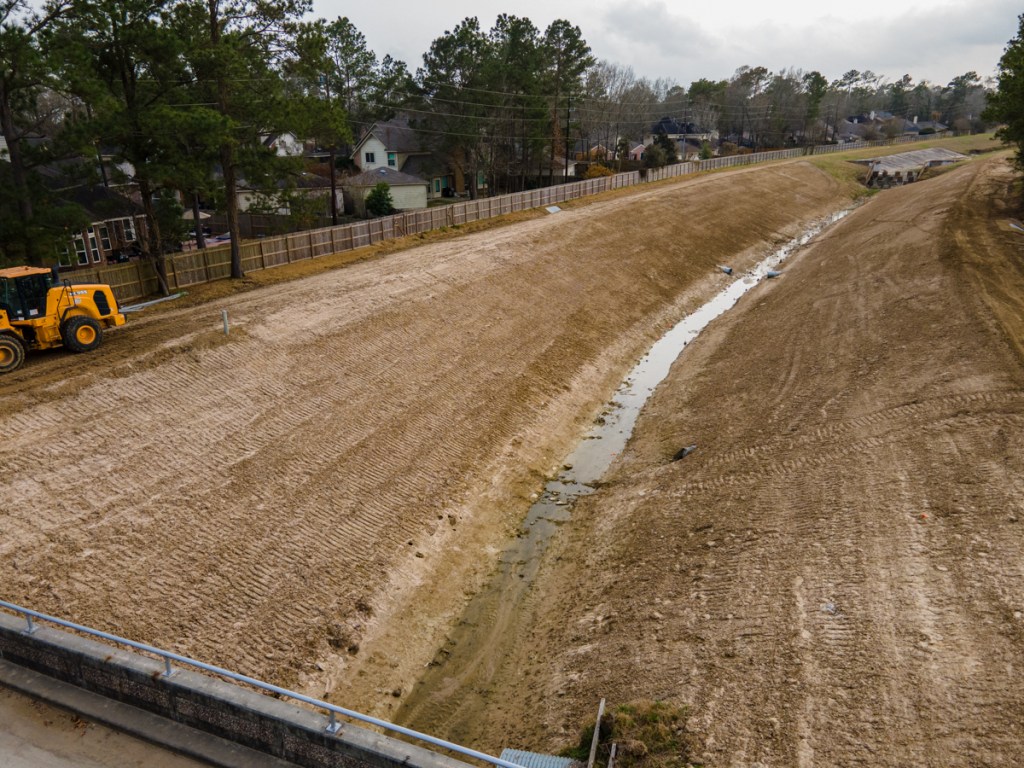
Harris County Flood Control District (HCFCD) has begun a three-month repair project on Taylor Gully near Maple Bend Drive in Kingwood’s Woodstream Forest. The repairs will extend 750 feet upstream and 1500 feet downstream of Maple Bend. The entire length of the project lies within a man-made channel and does NOT extend into the natural area on the northeast. See below.

Orange line indicates approximate extent of repair project. Image courtesy of Google Earth. Water flows toward the upper right.

This work activity will have no effect on wetlands; threatened or endangered species or their habitats; cultural or historic resources; or rookeries.

Looking upstream from Maple Bend. Photo taken 1/19/2021.
Looking downstream across Maple Bend bridge toward next phase of project, which will stop before the woods. Note outfall replacement pipe stored on right bank in distance. Photo taken 1/19/2021.

Purpose of Project

The purpose: to repair erosion and side-slope failures; repair or replace outfalls; rectify flowlines; and rehabilitate existing backslope swale systems.

  • Erosion repairs include the placement of fill material, placement of 3″x5″ granular fill and the placement of grade #1 riprap.
  • Channel cross sections will be restored to the original design where feasible.
  • The oldest recorded drawing on file is for the proposed channels from Elm Grove Village to White Oak Creek completed in March 1982. Record drawings typically show a 6-foot wide channel bottom with 3:1 side slopes.

Several homes in this neighborhood flooded during Imelda when water backed up into streets. While the rainfall amounts exceeded the capacity of storm drains, damaged outfalls could also have contributed to such backups. So restoring damaged outfalls will help reduce flood risk.

The earthwork will consist of installation of granular fill and Grade 1 riprap below the ordinary high-water mark. Sediment will be excavated to contour channel side slopes and bottom dimensions to match previously rectified conditions.

Start of side slope repairs. Photo taken 1/19/2021.

Previous Repair History

HCFCD record drawings show a general repair project on G103-80-03.1 in July 2012. According to HCFCD records, an emergency repair on the baffle structure on G103-80-03.1 was completed in October of 2019.

Baffle previously repaired after Imelda. Photo taken 1/19/2021. The structure required an emergency repair due to significant erosion and a rip-rap dam that had formed, severely blocking flow.

Such baffles slow the flow of stormwater to enable the channel downstream of the structure to drain efficiently, according to Beth Walters, a spokesperson for HCFCD.

Taylor Gully was twice severely damaged by excessive flow from Woodridge Village upstream at the Montgomery County Line in 2019. The new development flooded severely on May 7 and September 19 when sheet flow from heavy rains poured into the gully before Woodridge Village’s detention ponds were completed. This is the second major repair project since then. The first extended from the county line to near West Lake Houston Parkway.

Taylor Gully repairs from Maple Bend Bridge on 1/19/2021

Utility Crossings

Utilities along this reach of Taylor Gully (G103-80-03.1) include natural gas, telecommunication, electric, sanitary sewer and water. The CenterPoint gas line, telephone line, and water line all cross the channel at Maple Bend Drive. A 10” sanitary sewer line crosses the channel at the downstream end of the project.

Posted by Bob Rehak on 1/19/2021 with thanks to Beth Walters, Harris County Flood Control District

1239 Days since Hurricane Harvey and 488 since Imelda

HCFCD Will Begin More Work on Ben’s Branch Starting January 19

Harris County Flood Control District (HCFCD) will begin repairing the next section of Ben’s Branch on January 19. The repairs will take place in the channel between Kingwood Drive and the natural portion of Ben’s Branch at the end of Rocky Woods Drive.

Project limits for next phase of Ben’s Branch clean out. Kingwood High School in lower center of frame.

Project Purpose

Jose Predraza of Stuart Consulting is coordinating the project. He said, “The purpose of this project is to restore the conveyance of Ben’s Branch. It has been reduced over the years due to erosion and sedimentation. The project will include implementing erosion repairs, repairing side slope failures, repairing or replacing outfalls, rectifying flow lines, and removing excess sediment.”

Contractors will remove approximately 22,000 cubic yards of sediment deposited by floods over the years.

Continual cycles of deposition and erosion have clogged, deformed and narrowed the creek.

The Kingwood Area Drainage Analysis showed that Ben’s Branch had been reduced to a 2-year level of service in places. That means, it will flood in a 2-year rain.

The analysis did not specify whether this was one of those places, but outside the natural portion of the stream, this is currently the most constricted part. Other parts of the channel have already been restored, i.e., from Woodland Hills Drive to Northpark Drive and south of Kingwood Drive to the YMCA.

Red lines represent approximate outlines of original high banks near Rocky Woods. Area between red lines has filled with sediment and then the creek has eroded down through it again repeatedly. Photo 1/8/2021.

“Erosion repairs include the placement of fill material, placement of 3”x5” granular fill, and the placement of grade #1 riprap,” continued Pedraza. “Channel cross sections will be reconstructed with a maximum 5:1 (H:V) slope where necessary. This project will be conducted wholly within the existing channel right-of-way.”

Schedule

Pedraza estimates construction will last 145 days – not quite five months. If weather cooperates, contractors should complete the work in early June.

The project originally was scheduled to start in October 2020. But several delays occurred.

  • Initially, rain delayed completion of the survey.
  • Then, geotechnical investigations led to additional design time.
  • Finally, getting approval to cross CenterPoint’s power-line easement took additional time.

Access Routes

Trucks do not have enough room to turn around within the work area, so one-way traffic will be the rule. Trucks will enter the work area by coming up Woods Estates Drive to Cedar Knolls and entering the greenbelt from there. They will then follow the Centerpoint easement to the work area. Finally, they will exit by going south toward Kingwood Drive, cutting across the ditch, and coming out behind the old H-E-B.

Contractors will then haul the excavated dirt to nearby TCEQ-approved landfill sites outside of the .02% annual chance (500-year) flood plain.

Daily schedules are being coordinated with Kingwood High School start/stop times to reduce traffic congestion and improve safety.

Benefitting Residents, Schools and Businesses

When complete, the creek will be able to handle much more water than before without coming out of its banks…as much as it could when Friendswood originally excavated it.

This will be a vast improvement, especially for those who live near the creek in Kings Forest and Bear Branch, many of whom flooded during Harvey.

The work should reduce the flood risk for Kingwood High School also. The school first flooded in 1994. During Harvey, the building flooded to the second floor. It suffered $67 million dollars in damages and lost another $10 million in contents. The Humble ISD had to close Kingwood High for seven months and bus kids to another high school where they alternated “shifts” with the students from that high school.

Kingwood High also flooded during Imelda, but had less damage.

Finally, the work will also benefit the shopping center on the northwest corner of Kingwood Drive and West Lake Houston Parkway. Every store in the center flooded badly during Harvey. Many businesses still have not returned. The center nearly flooded again during Imelda. Water flowed through the parking lot and was inches from coming into stores.

Paths along the high banks represent the original edges of the channel. Everything between them has filled in over time, reducing conveyance. Photo 1/8/2021.

Funding

The Ben’s Branch project will be funded through the HCFCD maintenance budget and a grant from USDA Natural Resources Conservation Service (NRCS).

Posted by Bob Rehak on 1/9/2021

1229 Days since Hurricane Harvey

Woodridge Village Purchase on Wednesday’s Houston City Council Agenda

Houston City Council will consider two items Wednesday that could ultimately pave the way for the purchase of Woodridge Village from Perry Homes. Woodridge Village twice contributed to the flooding of hundreds of homes in Kingwood’s Elm Grove Village last year. For more than a year, the City, Harris County Flood Control and Perry Homes’ subsidiary Figure Four Partners, LTD have discussed purchasing the property and turning it into a regional flood-control detention basin.

268 acres currently owned by Perry Homes could be turned into a regional floodwater detention basin if the purchase is approved by Houston City Council tomorrow and Harris County Commissioners Court on December 15.

If successful, the City and HCFCD would work together to reduce the volume of water flowing out of the headwaters of Taylor Gully.

$4 Million in Cash from City Plus Land

The two agenda items are #59 and #65. They call for an interlocal agreement between the City and HCFCD to jointly purchase the property. According to an article in the Houston Chronicle, the purchase price would total approximately $14 million. The City would pay approximately $4 million of that in cash. However, in the past, the City has also discussed the contribution of land to make up its 50% of the purchase price.

The City has also said in the past that it hopes to acquire a portion of the site outright in order to consolidate several wastewater treatment facilities in Kingwood outside of the San Jacinto floodplain. Presumably, the City’s cash would go toward the purchase of that part of the site. Both sides previously agreed to share equally in the purchase, operation, development, and maintenance of the rest of the 268 acres.

Requirements Imposed by Draft ILA from May

Earlier this year, I obtained a draft copy of the interlocal agreement by a FOIA request, which the State Attorney General partially redacted. In May, the City provisionally agreed to:

  • Adopt Atlas-14 precipitation frequency tables
  • Require a minimum detention rate of 0.55 acre-feet per acre of detention for any new development on tracts one acre or larger in size
  • Prohibit the use of hydrographic timing (flood-routing studies) as a substitute for any detention requirements, unless the project emptied directly into Galveston Bay.
  • Enforce these provisions both within the City and its extraterritorial jurisdiction.

The volume of detention ponds currently on Woodridge Village is about 40% short of what the new higher Atlas-14 requirements dictate. The current detention was approved and construction started before Atlas 14 became effective in Montgomery County.

The use of flood-routing studies in Montgomery County to avoid building detention ponds has long been a controversial practice that downstream residents have fought.

Next Steps in Terms of Flood Mitigation

If Council approves the money and ILA tomorrow for the Woodridge Village purchase, Harris County Commissioners would take up the issue at their next meeting on December 15. Approval by both bodies certainly would make Christmas much merrier and more hopeful for hundreds of Kingwood families devastated by flooding last year.

Kudos to Mayor Pro Tem Dave Martin for pushing this forward.

The outcome of the votes could affect projects considered in the Kingwood Area Drainage Analysis. If the purchase goes through, it could reduce or eliminate the need for widening and deepening Taylor Gully itself. It is not immediately clear whether the City and County have set deadlines for the design and construction of the detention basin.

Posted by Bob Rehak on 12/8/2020

1197 Days since Hurricane Harvey and 446 since Imelda

The thoughts expressed in this post represent opinions on matters of public concern and safety. They are protected by the First Amendment of the US Constitution and the Anti-SLAPP Statute of the Great State of Texas.