The San Jacinto River Authority (SJRA) began slowly releasing water yesterday afternoon to lower the level of Lake Conroe to 200 feet per the temporary seasonal release policy adopted more than a year ago. When the seasonal release began, the lake stood at 201.01 feet – its normal target level. By noon today, the level stood at 200.94 feet.
Screen capture of SJRA dashboard as of 4:50PM yesterday.
Community Impact claims the release started at 4:20PM on 4/1/2020.
These pictures show the release.
Start of SJRA spring release. What 450 cubic feet per second looks like.
The slow release is designed to help protect downstream interests.
Looking back toward Lake Conroe.
Lake Lowering Policy by the Numbers
In the spring, SJRA lowers the lake one foot, starting April 1 and begins recapturing water on June 1.
In the summer and fall, it’s a little more complicated. On August 1, SJRA releases water again to reduce the lake level back to 200. Beginning Sept. 1, they take the water down another six inches. But the City of Houston may call for it to be lowered another six inches (to 199) if a named storm is predicted in the Gulf.
Downstream residents love the policy. They saw their communities destroyed during Harvey when the SJRA started releasing 80,000 cubic feet per second. Many Lake Conroe residents who flooded during Harvey also love the policy.
But some Lake Conroe residents feel inconvenienced and persuaded the Lake Conroe Association to file a lawsuit requesting a temporary restraining order to stop the lake lowering. A Montgomery County judge scheduled arguments in the lawsuit for April 16th, two weeks from now.
One resident who joined the suit claims the lower lake levels forced her to repair her bulkhead at a cost of $2000. And a bait shop owner claims he was driven out of business in 2018 when people couldn’t get their boats in the water.
The thoughts expressed in this post represent opinions on matters of public concern and safety. They are protected by the First Amendment of the US Constitution and the Anti-SLAPP Statute of the Great State of Texas.
https://i0.wp.com/reduceflooding.com/wp-content/uploads/2021/04/20210402-IMG_1643.jpg?fit=1200%2C900&ssl=19001200adminadmin2021-04-02 14:05:442021-04-02 14:18:01SJRA Began Spring Seasonal Release on April 1
If you live in the City of Houston or within its extra-territorial jurisdiction (ETJ), the City provides an easy way for you to track the progress of new developments near you.
Step One: Go To the Plat-Tracker Map
The City provides an interactive map based on geographic information system (GIS) technology. In your browser, go to a website called Houston Plat Tracker Plats. GIS maps translate database information into a familiar map format.
Houston Plat Tracker Map as of 3/17/2021. Look at the size of those two proposed subdivisions northeast of Lake Houston!
After navigating to the site, scroll and zoom to your area of interest.
Select a base map to suit your taste. Choose from satellite views, street maps, topographic maps and more. Do this by clicking on the four squares in the upper left hand corner.
Turn on the layers that interest you. Choose from City Limits, Council Districts, Management Districts, TIRZs (tax increment reinvestment zones), ETJ, historical districts, and more. Do this by clicking on the layers icon next to the base map icon.
With the tools in the upper right corner, you can draw on the map, measure distance and direction, print, bookmark and share.
By now, the map should be populated with a mass of color-coded outlines.
Click on any colored area to find background information about it, such as the developer and the application number. At the bottom of the informational pop-up box, there’s an interactive link to the City’s Planning Department website where you can learn more about the project.
Step Two: Look Up More on the City Planning Department Website
The City Planning Department website offers much more information about projects that may concern you, especially if they are coming up for a vote in the Planning Commission. Here you’ll find interactive and PDF spreadsheets that list which projects will be considered in the next meeting of the Planning Commission. The site also lists the:
Subdivision plat name
Application Number
When the developer submitted files
Subdivision Plat type
Whether a variance request exists
The location of the issue on the agenda
County, City, Council District, Precinct
Key Map code
Census Tract
Zip Code
School District
Address of the development.
TIRZ, Management District, Historic Districts if applicable
Super Neighborhood Council
Park Sector
Proposed Land Use
Property Size
Number of Lots
Appraisal District ID
Developer
Applicant Company
Applicant’s Name
Applicants Phone
Subdivision Plat with flood zones, if any, superimposed
The Houston Plat Tracker Plats website contains future and past agendas, the planning commission calendar, and development regulations. It also contains a design manual and a host of other tools in case you feel something is amiss.
Finally, it lets you set up an account so you can get notifications of what future meetings will consider.
Possible Step 3
If you find something disturbing, sign up to express your concerns at the Planning Commission, or call your city council person’s office.
You can also request copies of the drainage analysis and construction plans at a certain point in the project.
Informed citizens keep everyone conscientious. No one cares about your home like you! So keep your eyes open for new projects in your neighborhood or upstream.
To learn more about 15 other GIS maps that the City makes available online, visit this start page. You can find fascinating information about land use, demographics, flood hazards and more. Good luck.
Posted by Bob Rehak on 3/17/2021
1296 Days since Hurricane Harvey
https://i0.wp.com/reduceflooding.com/wp-content/uploads/2021/03/Screen-Shot-2021-03-17-at-1.29.44-PM.jpg?fit=1200%2C669&ssl=16691200adminadmin2021-03-17 19:55:452021-03-17 20:05:53Easy Way to Track New Developments Near You
Today, at 5:52PM, Harris County Commissioners Court unanimously approved three flood-control measures affecting Kingwood. The measures included approval to negotiate engineering contracts for improvements to the Kingwood Diversion Ditch and Taylor Gully. The third approval involved purchase of Woodridge Village from Perry Homes to build a regional floodwater detention facility in Montgomery County.
The City of Houston will purchase 77 acres of the property outright for a wastewater treatment facility. The City will then pay for its half of the remaining Woodridge property by trading land that the Flood Control District can use to reduce the cost of flood mitigation projects elsewhere.
Neither the City nor County have yet announced a closing date for the Woodridge purchase.
Seventeen months after Imelda, families in Elm Grove and North Kingwood Village will sleep easier tonight, knowing they are one HUGE step closer to safety.
https://i0.wp.com/reduceflooding.com/wp-content/uploads/2021/02/20200911-RJR_1118.jpg?fit=1200%2C800&ssl=18001200adminadmin2021-02-09 18:07:582021-02-09 18:09:46Woodridge Village Purchase and Two More Kingwood Flood Control Measures APPROVED by Harris County Commissioners Today
The Texas General Land Office (GLO) announced last week that it has successfully completed its Reimbursement Program from Hurricane Harvey. It was a first-of-its-kind program and concluded after providing nearly $86 million to almost 3,000 Texas homeowners. The GLO also announced that it had reconstructed its 2,500th home under its Harvey Homeowner Assistance Program.
Two Major Milestones Reached in Same Week
The two GLO disaster recovery programs are helping Texans across 48 counties (outside of Harris County and the city of Houston) whose homes were damaged or destroyed by Hurricane Harvey. The two programs have now helped nearly 5,500 Texas homeowners recover from Harvey.
The GLO’s reimbursement program concluded after assisting 2,961 Texans with a total of $85,989,042 in reimbursements for out-of-pocket home repair expenses. In the same week, the GLO reached another milestone – reconstruction of 2,500 homes damaged during Harvey.
Texas General Land Office
“Every day at the General Land Office we work to help improve the lives of Texans,” said Commissioner Bush. “The GLO is proud to be setting a record pace in disaster recovery while helping thousands of Texas families rebuild their lives and their homes. The GLO continues to leverage federal dollars efficiently and effectively to help Texas families and communities rebuild and mitigate against future storms.”
This week the Texas General Land Office completed its Homeowner Reimbursement Program (HRP) when it approved the final reimbursements for eligible homeowners.
The HRP program provided reimbursements up to $50,000 for Hurricane Harvey-impacted homeowners who used their life savings or other personal funds to pay out-of-pocket for disaster recovery repairs. The program’s efficiency yielded an additional $3 million in costs savings, which enabled the program to provide reimbursements for all applicants eligible under U.S. Department of Housing and Urban Development’s (HUD) rules for the available Community Development Block Grant for Disaster Recovery (CDBG-DR) funding.
Homeowner Assistance Program Details
In the same week that the GLO successfully completed its Reimbursement Program, the GLO handed keys to a fully rebuilt home to the 2,500th Homeowner Assistance Program (HOAP) recipient. So far, approximately 4,300 HOAP applicants have been approved for assistance by the GLO. Of those, about 1,400 applications are in pre-construction (awaiting applicant approval of final design plans and permits). Four hundred more homes are currently under construction in addition to those already completed.
Before the HOAP program concludes, GLO anticipates that it will help rebuild more than 6,000 homes. It will do so using more than $1.3 billion in available Community Development Block Grants for Disaster Recovery (CDBG-DR). The GLO will also use an additional $500 million in Community Development Block Grants for Mitigation (CDBG-MIT) funds from the U.S. Department of Housing and Urban Development (HUD).
City of Houston Housing and Community Development Department statistics as of 1.20.21
During the period that the GLO reimbursed 2961 homeowners, Houston reimbursed 119. And while the GLO reconstructed 2500 homes, the City reconstructed only 117.
Thus, the GLO was 20-25X more effective in finding and helping applicants than the City of Houston. And the GLO covered a 48-county area.
Possible Reasons for Huge Disparity
The GLO reviews City applications before forwarding them to HUD for final approval and funding. In trying to explain possible reasons for the disparity in results, a GLO spokesperson pointed to the needlessly complex structure of the City’s program.
The City set up a two-tier application process in which people filled out a screening survey before filling out an application.
Then the City divided survey respondents into six priority groups, trying to exhaust possibilities in one before inviting applications from the next.
The City of Houston’s Housing and Community Development Department still has not responded to multiple requests for comment.
Posted by Bob Rehak on 1/24/2021 based on data published by the Texas GLO and Houston Housing and Community Development
1244 Days after Hurricane Harvey
https://i0.wp.com/reduceflooding.com/wp-content/uploads/2021/01/Screen-Shot-2021-01-24-at-12.13.35-PM.jpg?fit=1200%2C670&ssl=16701200adminadmin2021-01-24 13:06:192021-01-24 13:49:59GLO Reimbursement Program Helped Rebuild 2961 Homes While Houston’s Helped Only 119
As a December 31st deadline expired, approximately $162 million – allocated by HUD to reimburse homeowners in the City of Houston for repairs they made after Harvey – remained unused. The City had worked on the reimbursement program for TWO years. Yet in all that time, the City’s Department of Housing and Community Development successfully processed only 120 applications for reimbursement of repairs. Grants awarded to those 120 families totaled a mere $2,024,000 out of the $164 million allocated – just 1.2% of available funds.
Desperate Families Needlessly Left Empty Handed
Meanwhile, flooded families:
Never received applications, despite repeated calls and emails from potential applicants
Received an application only hours before the deadline expired on the New Year’s weekend
Received incomplete and misleading information.
Regarding the last point, an email sent to residents at the 11th hour failed to inform them that they just needed to start the application and sign it before January 1st. Instead, residents were told that they needed to complete the application before December 31 (i.e., before the end of the day on December 30).
A two-step application process, engineered by the City, complicated and delayed aid. Residents first had to fill out a survey to qualify to fill out an application. The City then tried to sort the survey respondents into priority groups. This increased the workload, created management complexity, and delayed the filing of formal applications for years while the deadline passed.
Had everyone just been invited to fill out an application early on, no one would have missed the deadline.
As the final deadline loomed, it became apparent that the City wasn’t coming close to meeting its performance goals and that aid would not reach people who needed it. As a last resort to help flood victims, the GLO tried to terminate its contract with the City and take over the City’s Harvey-aid program. But the City sued the GLO to prevent the takeover. That cost even more precious time.
Before the final deadline, the GLO notified the City that it should alert all potential applicants and the media so that they, in turn, could spread the word about the impending deadline. The GLO even provided a sample press release that the City could tweak for local media. Instead, the City posted a notice on Twitter and social media. That severely limited the reach of the message.
Confusion Reigned
To this day, lawsuit settlement talks between the City and GLO continue. Meanwhile, the GLO provided the City of Houston with funds for the Homeowner Assistance Program (HoAP), which included its reimbursement program.
But according to Jennifer Coulter, a would-be applicant who called the City, the City swore the GLO had taken control. The resident then called the GLO. GLO correctly said, “No, the City has it.” The back-and-forth continued until she was told the deadline passed.
The Coulter family lived in a trailer in their driveway for almost two years as they repaired their home.
Resident Chris Johnsen flooded 4 feet during Harvey. After waiting 3.5 years for help, he received an email from Housing and Community Development minutes before the close of business on December 30. It erroneously told him he needed to complete and sign the application before December 31.
He was out of town when the application arrived at 4:08 PM on December 30th, but submitted it after he returned. The City rejected his application. When he complained, the City told him, “Unfortunately we are not able to accept the application because it is past the deadline of 12/31/2020.”
Adding Insult to Injury
Being flooded during Harvey and financially devastated during reconstruction were bad enough. But being denied aid through the City’s bureaucratic bungling added insult to injury. Ironically, the City requested and received a nearly $30 million increase in the amount of aid available for reimbursements part way through the program…and didn’t make a dent in it. The amount increased from $135,691,299 to $164,117,633.
Meanwhile, people are moving on with their lives and giving up. But maybe that’s the City’s intention.
The Big Question: Why?
The Department of Housing and Community Development’s avowed goal with Harvey relief is to focus on those “most in need and most at risk.” People who can afford to repair their own homes and then seek reimbursement generally do not fall into that category. By law, at least 70% of HUD reimbursement funds must go to LMI (low-to-moderate income) households.
However, the 70% requirement does not apply to eachindividual program within Houston’s total aid allocation. It’s an average requirement across all programs. So the entire $164 million allocated for reimbursements could have gone to non-LMI households without jeopardizing the City’s LMI requirement.
This has all the hallmarks of a conscious decision to limit reimbursement aid after requesting more. Why?
One observer suggested that spending less on reimbursements will let the City funnel those funds into multifamily housing instead.
This brings to a sad, sorry end one of the darkest chapters in Houston’s history. The end of the program means the death of hope for families desperate for assistance. Many cashed in retirement savings and their children’s college funds to rebuild their homes after Harvey.
The City claims hundreds of additional families filed applications before the end of the year for reimbursements. But the GLO has not yet confirmed those.
The City is allowed to process applications received before January 1. But the City can no longer accept applications.
Reimbursements: A Small Part of a Much Bigger Problem
On January 4, the City updated its HUD-compliance website. It showed that out of approximately $1.28 billion dollars that HUD set aside for City of Houston residents, the City still had not submitted applications for almost $800 million dollars (62.5% of the total). Said another way, the City could not achieve almost two thirds of its aid-distribution goals in two years.
The City has not returned calls, texts and emails from ReduceFlooding.com requesting comment and the City’s perspective.
Posted by Bob Rehak on 1/13/2021
1233 Days since Hurricane Harvey
https://i0.wp.com/reduceflooding.com/wp-content/uploads/2021/01/Screen-Shot-2021-01-13-at-12.35.56-PM.jpg?fit=1200%2C692&ssl=16921200adminadmin2021-01-13 13:34:382021-01-13 16:05:55City of Houston Couldn’t Even Give Away Harvey Aid Due to Bureaucratic Bungling
2 Zip Archives of Existing Conditions Models in HEC-RAS, an engineering program (Appendix L)
That’s more than 3,600 pages, EXCLUDING the zipped materials.
Executive Summary Summarized
The executive summary includes a heat map of historically flooded areas, estimated structural damage costs in the next 50 years, and projected population growth during the same period. Not surprisingly, the three fasted growing areas (West Fork, Spring Creek and Cypress Creek) also show the most projected damage.
The summary then proceeds to flood-damage-reduction strategies. They include:
Detention Basins
Channel Improvements
Floodplain Preservation
Buyouts
Flood Warning Improvements
Floodplain Re-mapping
Policy updates
Formation of a vision group
Flood Response Improvements (Evacuation planning, protection of critical facilities such as hospitals, etc.)
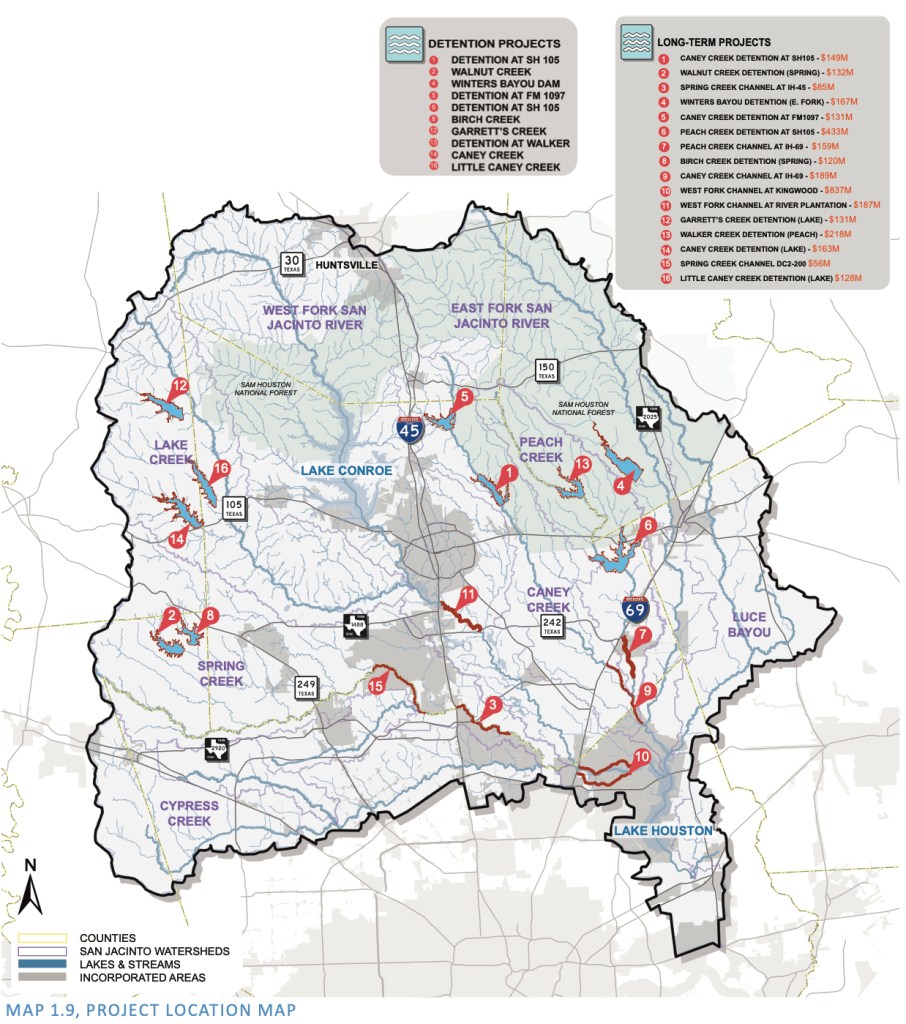
The exec summary also lists the top sixteen project priorities, estimates their costs, outlines possible sources of funding, and lays out next steps.
Project Location Map
Project rankings.Note: Rankings do not necessarily coincide with numbers on map above.
The proposed projects will provide tangible benefits, including reduction in the number of at-risk structures for a range of storms as shown in Figure 1.10 below.
With these projects in place, the level of a 100-year flood at I-69 and the West Fork could be reduced by 5.94 feet, Likewise, where Caney Creek meets the East Fork, the 100-year flood would be reduced by 2.82 feet.
Next Steps
That’s good news indeed for everyone who lives in the San Jacinto Watershed. With this information now in hand, we now can quantify the benefits of projects, priorities them, and get on with the hard work of actual mitigation.
More news to follow.
Posted by Bob Rehak on 12/30/2020
1219 Days since Hurricane Harvey
https://i0.wp.com/reduceflooding.com/wp-content/uploads/2020/12/Screen-Shot-2020-12-30-at-2.06.17-PM.png?fit=1024%2C356&ssl=13561024adminadmin2020-12-30 14:51:422021-01-01 07:17:03Final San Jacinto River Basin Master Drainage Study Released Today, Recommendations Revealed
The two parties will co-own, co-develop and co-maintain the rest of the property to be used for stormwater detention and parks.
The parties will split the cost of the remaining property 50:50 which will be jointly owned, developed, operated and maintained.
For its portion of the remaining cost, the City will donate property worth approximately $5,150,000 to HCFCD that the County can then use for flood control projects in areas of the City that flood.
The City will also, at a minimum, match Harris County’s detention and fill mitigation requirements.
The City will adopt and enforce NOAA’s new higher Atlas-14 Precipitation Frequency standards within the City and in the City’s extra-territorial jurisdiction.
The City agreed to require a minimum detention rate of 0.55 acre-feet per acre.
All this must happen within 120 days.
If the sale falls through, nothing in the terms of the agreement obligates the seller to perform additional flood mitigation.
County Must Now Approve on December 15
Harris County Commissioners Court must still approve the Interlocal Agreement in its December 15 meeting before it becomes effective.
Nothing in the terms of the sale or interlocal agreement mentions the hundreds of lawsuits that arose out of that flooding. They should not be affected.
Pace of Development To Depend on Speed of Funding
The Parties (City and County) agreed to jointly fund the cost of designing and constructing flood mitigation facilities on the Land and to work cooperatively to secure funding. They targeted completion of the project within five years.
Both Parties agree the Land can stay in its current condition until funds are jointly secured to build the project, which may be built in phases based upon available funding.
Any Project on the Land will involve gravity detention. In other words, no pumps will be involved. Perry Homes has already constructed approximately 60% of the required detention.
Stormwater Detention To Be Based on Current Needs
The amount of the Stormwater Detention allotted to each Party will be based on its pro rata share of costs contributed to the Project. The Parties agree that the Stormwater Detention shall only be used for mitigation of existing flood risks, and not to mitigate the flooding risks of any new developments that arise after the execution of this Agreement.
Martin Thanks Turner for Being Mayor for “All the People”
Mayor Pro Tem Dave Martin sponsored the ordinance that council approved this morning and worked to align support. Mayor Turner supported the agreement despite the fact that the majority of Kingwood voted for his opponent in the last mayoral election. In his presentation, Martin specifically commented on that and thanked the Mayor. He said that Turner promised after the election that he wanted to be mayor for all the people. Martin said this was proof that he was good to his word.
Posted by Bob Rehak on 12/9/2020
1198 Days since Hurricane Harvey and 447 since Imelda
The thoughts expressed in this post represent opinions on matters of public concern and safety. They are protected by the First Amendment of the US Constitution and the Anti-SLAPP Statute of the Great State of Texas.
https://i0.wp.com/reduceflooding.com/wp-content/uploads/2020/12/20201207-Aerial-Dec-2020_424.jpg?fit=1200%2C556&ssl=15561200adminadmin2020-12-09 12:16:172020-12-09 23:01:43Houston City Council Unanimously Approves Motion to Purchase Woodridge Village from Perry Homes
Chris Bloch, an engineer and Kingwood resident, has become a flood-control activist in his retirement. I often run into Chris inspecting ditches, streams and culverts for blockages and collapsed outfalls. Chris also works with the Bear Branch Trail Association which owns property along many of the channels and streams cutting through Kings Forest, Bear Branch, and Hunters Ridge.
Activist Extraordinaire
For the last several months, Chris has focused intensely on blocked channels that contributed to the flooding of 110 homes in Kings Forest during Harvey. Where the channels cross under Kingwood Drive, three had become almost totally blocked by vegetation and silt. That contributed to backing water up into homes. See below.
Ditch at Shady Run and Kingwood Drive before clean-out.Photo courtesy of Chris Bloch.
Chris meticulously photographed the problems, began researching which entities were responsible for which portions of the channels, and in the case above, contacted the City of Houston. The City has responsibility for the medians and sides of Kingwood Drive and other streets. His persistence paid off.
In October, the City began cleaning out the ditch near Shady Run and Kingwood Drive.
Vacuum truck photographed at same location on 10/3/2020
Here’s what that part of the channel looks like today.
Same ditch after clean-out. Photo courtesy of Chris Bloch.
End-to-End Inspections
Chris is tenacious, tireless, and wide ranging. He looks at ditches from end to end. In this case, he’s also trying to get the Flood Control District to escalate clean-out of the ditch south of Kingwood Drive. Reduced conveyance through that reach could also have contributed to flooding in Kingwood Lakes.
Bloch says he has also identified twenty storm-drain outfalls that need repair. “It doesn’t make any difference if the storm sewers are clear if the water in them can’t get to ditches and streams,” he says.
You Be an Activist, Too
Activists like Chris make Kingwood the great place it is. They help identify local problems for government and make the case for addressing them.
As you hike through our greenbelts and along channels, keep your eyes open for developing problems:
Collapsed outfalls into ditches
Eroded banks
Vegetation and silt blocking culverts
Developing sinkholes
Fallen trees damming streams
Be an activist like Chris. Take pictures and report them to the appropriate authorities. That will usually be the City or Flood Control.
You, too, can make a difference.
Posted by Bob Rehak on 11/15/2020
1174 Days since Hurricane Harvey
https://i0.wp.com/reduceflooding.com/wp-content/uploads/2020/11/Shady-Run-Ditch-After.jpg?fit=1200%2C838&ssl=18381200adminadmin2020-11-15 14:56:562020-11-15 14:57:00City Quietly Cleaning Out Culverts Under Kingwood Drive Thanks to Local Activist
George P. Bush, Commissioner of the Texas General Land Office (GLO), announced a 30-day extension of a deadline for renegotiating its contract with the City of Houston for a variety of Harvey Recovery Programs. The new contract would let the City keep some of the programs it had been working on while returning others to the GLO.
By tag-teaming remaining work, GLO hopes to expend all available funds before HUD pulls back unspent money out of the $1.3 billion it allocated for aid within the City.
GLO worries about the slow rate of City’s progress and whether the City can meet HUD deadlines.
The City, on the other hand, keeps insisting it is about to speed up as it falls farther behind.
When HUD attempted to pull the programs away from the City, the City filed a lawsuit to prevent that. At stake: millions in management fees for the City and hundreds of millions in aid for Harvey victims.
Last month, Mayor Pro Tem Dave Martin hinted that changes could be in the wind, but refused to release details until HUD and the GLO approved them.
Homeowners Worry About Cloud Over Programs
Meanwhile the cloud hanging over the programs worries thousands of homeowners who:
Qualified for aid but were not invited to submit an application
Have not been notified of their application’s status
Can’t get phone calls or emails returned from the City.
As of November 3, 2020, the City reports $776 million in available funds not yet committed for projects.
Three years after Harvey, the City reports it has issued only 82 reimbursement checks to homeowners for a total of $1.4 million. Either that number has not changed or the City has not updated it since October 23rd when I last posted on this subject. Neither has City updated the number of applications in its “pipeline” since August 31, 2020.
The GLO/CoH contract extension will let both sides work out a new plan that doesn’t leave disaster victims in limbo.
Statement from GLO Commissioner Bush
Commissioner Bush said: “The GLO has preliminarily agreed on the framework of an agreement with the City of Houston in the effort to help Houstonians recover from the worst natural disaster in our state’s history. The GLO has agreed to extend the current deadline for termination of the existing contract to better facilitate completion of this new agreement.”
Bush added, “The GLO’s focus continues to be making significant progress in putting federal dollars to work for the people of Houston. The GLO remains committed to helping Houston residents who are still in need of assistance with repair or reconstruction as well as moving other programs forward to successful completion within HUD’s mandatory timeline.”
GLO Still Taking Applications for Homeowner Assistance Program
In the meantime, the GLO will continue to operate the Homeowner Assistance Program to rebuild single family homes for Houston homeowners still needing assistance related to damage from Hurricane Harvey. Houston homeowners with a remaining Hurricane Harvey Housing need may find more information and apply at recovery.texas.gov/hap/houston.
Photo by Camille Pagel. Her children helped gut the kitchen instead of going to school after the Harvey flood.
GLO established the site above to help Harvey victims who have not yet submitted applications. Those who previously submitted applications which have become lost in space should call the numbers listed on the GLO site to determine their best course of action.
Note: the extension above affects contract negotiations between the City and GLO. It does not affect program deadlines.
Full Text of Interim Operations Agreement Between City, GLO
https://i0.wp.com/reduceflooding.com/wp-content/uploads/2020/01/Camille-Pagel-1.jpg?fit=800%2C1067&ssl=11067800adminadmin2020-11-04 17:58:102020-11-04 18:31:00GLO, City of Houston Agree to 30-Day Extension While They Work Out New Contract for Harvey Relief
After Harvey, the US Department of Housing and Urban Development (HUD) made $1.3 billion in disaster recovery funds available for housing assistance to the City of Houston through the Texas General Land Office (GLO). The City kicked off several disaster recovery programs with great fanfare in January of 2019. However, in almost two years, the City has only helped 1.4% of eligible applicants for assistance and an estimated 0.5% of those who flooded without insurance. The second figure includes flooded homeowners who could have applied, but didn’t.
City of Houston Housing and Community Development on January 14, 2019. Mayor Turner said, “Thousands of Houstonians who were affected by Hurricane Harvey have been waiting for this day.” Most are still waiting.
Programs Announced in January 2019 Quickly Fall Behind Schedule
The programs were primarily designed to repair and reconstruct single- and multi-family homes, and to reimburse owners for repairs they made. However, almost from the outset, the program failed to reach its own goals and has fallen progressively farther behind.
A HUD audit in November of 2019 panned the City for failure to staff the program adequately. It also expressed concerns about the City’s lack of transparency, not posting plan documents online, not bidding contracts competitively, failure to follow HUD rules, and failure to meet objectives.
GLO Attempts to Help Rebuffed by City
The GLO, which is responsible for overseeing the program and ultimately for the money itself, sent a “strike force” to assist the City, train employees and get the programs back on track. However, the Director of the City’s Housing and Community Development Department, which conducts these programs, told the GLO’s strike team they were not welcome and told them to leave the Department’s office, according to Brittany Eck, a GLO spokesperson.
As the City fell further behind schedule in 2020, the GLO tried to take over some of the programs. Eck says GLO wanted to help the City focus on those where it had more success. However, the City also rebuffed those efforts. The City filed a lawsuit to prevent the GLO from taking back the programs. Ultimately, HUD stepped in and approved an “Action Plan Amendment” that resulted in cancelation of the City’s contract.
Other programs for reconstruction, repair and rehab expire in 2024. But it takes time to design, permit, bid and construct homes. And it takes even more time to get approvals through the City, GLO and HUD. So…
According to the GLO, even the 2024 deadline is in jeopardy at this time.
Reimbursement Program May Come Back to City
The GLO reportedly may give the reimbursement program back to the City. With only two months left before the deadline, GLO doesn’t have time to get program changes approved through HUD, transfer files, and still reimburse flood victims who paid out of pocket for reconstruction.
But it’s unclear whether the City will commit to meeting all of the GLO’s performance benchmarks and deadlines. No one at the City will comment publicly. Eck said no commitments had yet been made, but might come as early as the end of today.
Reasons for Clawback of Some Programs
We’ve all heard the news reports about the City’s performance or lack thereof. But aside from the small number of homes completed, reports don’t go into much detail. Eck, the GLO’s spokesperson, spent hours explaining the complexities behind published numbers.
First, let me say, it’s difficult to compare the State’s numbers with the City’s. The two entities refer to programs differently. And they sometimes reflect different time periods or different stages of completion.
Plus, the City generally reports numbers for itself that are higher than the GLO’s numbers for the City. However, the differences are so small in the grand scheme of things that they get lost in rounding. So to eliminate charges of political bias, I have simply accepted the City’s numbers in almost all cases for the analysis below, except where the City does not supply numbers.
High-Level Findings
The deeper you dig, the more several things become clear:
1151 days after Hurricane Harvey, less than 1.5% of eligible recipients in Houston have received help so far. And that may be a generous overstatement.
Houston has repeatedly failed to meet its own projections.
Let’s address the first point and cover the others in later posts.
Application Process Started with Pre-qualification Survey
First, you need to understand the two-step application process. First, the City conducted a survey to screen applicants. Second, those who appeared to qualify were invited to apply for aid.
21,156 households took the survey. Of those, the City estimated 16,651 qualified for some kind of aid. See the screen capture below taken from the City’s website.
Many Still Waiting for Invite to Submit Application
Many families who qualified are still waiting to be invited to submit an application. The last “situation and pipeline” report posted on the City’s website shows 6,541 households “Pending invitation” as of 8/31/2020 (see page 6).
On the right side of the diagram above, the City also says that it sent out “Notices to Proceed with Construction” for another 149 homeowners. Those notices covered almost another $32 million. Those average $214,765 per household. But construction has not yet finished on all of those.
So that’s roughly 100,000 homes without flood insurance (a major qualification for HUD grants).
The City has half the population of the county. So, let’s assume that approximately 50,000 householdsflooded in the City that could have theoretically applied for assistance. But according to the City graphic above, only 21,000 households took the survey. And the City says 16,651 of those were eligible (about a third of flooded homes without insurance).
But regardless, if you accept the City numbers, they have helped 231 families so far (82 + 149) out of 16,651 eligible survey respondents. And that doesn’t even include another 30,000 families that didn’t take the survey!
So, in almost two years, the City has only helped 1.4% of eligible survey respondents. And roughly 0.5% of those who flooded without insurance.
Calculated from data supplied by City of Houston and Harris County Flood Control District
$800 Million in Disaster Relief Remains Uncommitted At This Point
When you add in the number of projects in the pipeline (identified and under contract), the percentages look somewhat better. However, that cannot obscure the fact that the reimbursement program will expire in two months, and almost $800 million remains uncommitted (see circle diagram below). Now the City did not allocate all of that for reimbursing people who fixed their own homes. But they did allocate more than $400 million for homeowner assistance (see table on right below).
By the City’s own projections at the time, it should have expended $261 million by now ($1.275 billion minus $1.014 billion). However, the GLO says the City has only drawn down $24.6 million, according to Eck. That’s less than 10% of the projection the City made 16 months ago.
STATE ACTION PLAN, PAGE 254
The GLO says that the City has pushed deadlines back month after month, always using the excuse that they’re right on the cusp of turning over a large number of applications for approval.
Future Aid At Stake
Sources familiar with how HUD works indicate that non-performance on this contract could jeopardize future HUD aid to the City.
Meanwhile, I know one applicant for reimbursement who completed the City’s survey the very first day it was available. Her application still has not been processed. But, she says, the City hopes to work on it soon! That’s better than the 6,541 people still waiting for the City to invite them to submit an application.
Posted by Bob Rehak on 10/23/2020
1151 Days after Hurricane Harvey
The thoughts expressed in this post represent opinions on matters of public concern and safety. They are protected by the First Amendment of the US Constitution and the Anti-SLAPP Statute of the Great State of Texas.
https://i0.wp.com/reduceflooding.com/wp-content/uploads/2020/10/Screen-Shot-2020-10-21-at-4.25.48-PM.png?fit=1654%2C904&ssl=19041654adminadmin2020-10-23 11:57:302020-10-23 12:11:51Disaster Recovery Disaster: Part 1