Today, September 10 is the statistical peak of hurricane season.
NOAA calculates the peak by looking at the number of storms per day in the last hundred years. And September 10th takes the prize with approximately 95 named storms. That’s almost one per year on this date. You would have about a 5% chance of NOT having a named storm in the Atlantic Basin on September 10th, according to this data.
And true to form, today, the Atlantic has two named storms, Lee and Margot, as I write this. However, neither is anywhere near the Caribbean or Gulf of Mexico.
NOAA hasn’t really been collecting hurricane data back 100 years. The chart above is based on 77 years of data, but “normalized” to 100 years to make the frame of reference more intuitive.
The 77-year period extends from 1944 to 2020, starting at the beginning of the aircraft reconnaissance era.
So Far This Year Vs. Average Season
Usually, by September 9, we’ve had eight named storms in the Atlantic Basin. That would be the H storm. However, this year, we’re already on the M storm. That puts us five storms ahead of the average year.
But wait! This year we also had a bonus storm in January. Only after re-analysis did the National Hurricane Center realize that it should have named the storm. But it didn’t. So, we’re really six storms ahead of the average season so far. And that’s far above the average.
Only two named storms in the Gulf so far this year. Neither has come close to Houston.
The chart above is updated monthly and does not include the two named storms now in the Atlantic.
Forecast vs. Actual to Date
So, at the mid-point, how does this season compare to predictions? If the second half of the season is anything like the first, we could easily have more named storms and more major hurricanes than predicted by NOAA in its August 10 seasonal update.
Earlier this year, forecasters increased their predictions from a normal season to an above normal season. They predicted 14-21 named storms (winds of 39 mph or greater). We’ve already had 14.
Of those, NOAA said 6-11 could become hurricanes (winds of 74 mph or greater). We’ve had 4 so far (Don, Franklin, Idalia and Lee).
And of those, forecasters said 2-5 could become major hurricanes (winds of 111 mph or greater). We’ve had 3 of those so far (Franklin, Idalia and Lee). Franklin and Idalia reached Category 4 strength. Lee briefly exploded into a Cat 5.
Forecasters have linked storm intensity to sea surface temperatures. When average storms hit very warm waters, they can intensify quickly. And that is exactly what has happened this year.
Here’s a look at sea surface temperature anomalies (departure from normal) around the world.
Virtually everything between Africa and Houston is 1-3 degrees Celsius above normal (1.8 to 5.4 degrees Fahrenheit). Sea surface temperature data is current as of Sept. 9, 2023…just one day before the peak of hurricane season.
Posted by Bob Rehak on September 10, 2023 based on information from NHC.
2203 Days since Hurricane Harvey
https://i0.wp.com/reduceflooding.com/wp-content/uploads/2020/09/peakofseason.gif?fit=831%2C546&ssl=1546831adminadmin2023-09-10 17:25:282023-09-10 17:31:15Peak of Hurricane Season is Today!
Damn the downstream consequences, including sediment pollution, increased flood risk and monstrous dredging costs. Colony Ridge, the controversial 30+ square-mile, Liberty County development that markets to Hispanics – while flaunting drainage,environmental and fire regulations – is clearing and paving thousands of additional acres.
Not even Google Earth can keep up with the developer’s relentless expansion. On 8/12/23, I flew over Colony Ridge in a helicopter and found huge areas where 3-week-old satellite imagery was already hopelessly out of date.
Google Earth image from 7/18/23. Red/yellow highlighted areas changed radically within three weeks.
With the exception of areas protected by the Houston-Conroe and Tarkington Bayou Mitigation Banks, the highlighted areas above have largely been cleared and/or paved.
The RED area now has paving not visible in the satellite image. The YELLOW area was being cleared and paving was just starting even though the image shows none of that. So what do these areas look like from a few hundred feet?
Pictures Taken 8/12/23 over Red Area
I shot the four pictures below on 8/12/23. They represent dozens of others. The red area already has most streets, but no fire hydrants.
Pictures Taken over Yellow Area
The two pictures below show some of the development activity taking pace in the yellow area.
Looking west across newly cleared area.Looking N at part of Colony Ridge expansion.
What kind of homes will go here? To predict the future, look to the past.
Homes on Parade
Colony Ridge is the world’s largest trailer park. One Plum Grove resident who lives near a northern entrance to Colony Ridge says she routinely sees up to seven mobile homes per day going into the development – seven days per week.
It’s hard to know exactly how many new homes arrive each day, because there are other entrances. But if you assume the max for this one entrance, 50 homes a week times 52 weeks makes up to 2600 homes per year.
Manufactured home making its way through the main commercial area of Colony Ridge.Room with a view…of severe erosion.
Note the erosion in photos above and below. It will make its way downstream into the East Fork San Jacinto. These ditches are typical of Colony Ridge. The eroded sediment will reduce conveyance of the river and contribute to flooding.
Poverty: The Mother of Pollution
Ghandi once said, “Poverty is the mother of pollution.” That’s certainly the case here. But I would modify the saying. While poverty may be the mother of pollution; greed is the father.
The poverty of the residents doesn’t cause sediment pollution. But a business plan built on high-interest-rate, owner financing that targets impoverished people with few options does.
The developer seems to have found a target market that is less concerned with their environment than survival.
It’s a market ripe for exploitation where corners can be cut. Residents have few options and can’t complain.
And the developer shows little interest in changing a business model that fuels relentless expansion and growth. Damn the downstream consequences.
Colony Ridge drainage ditch.Working drainage is a luxury.
The poverty in Colony Ridge is crushing. I’ve seen people sleeping in tents trying to save enough money to buy a camper to live in.
No bathroom in sight.Do Liberty County health codes really allow this?Christmas dinner. Enlargement of this photo from Christmas 2020 shows food on the table in the foreground.One small part of Colony Ridge.The market for a piece of the American dream stretches endlessly in Liberty County.
The estimated population of Colony Ridge is now greater than the three largest cities in Liberty County (Cleveland, Dayton, and Liberty) put together. No one knows what the population is with certainty because of the large number of undocumented aliens who did not participate in the last census.
And the Colony Ridge developer is expanding into Harris and Montgomery Counties. ReduceFlooding will monitor progress of those areas to see if they, too, contribute to sediment accumulation, dredging costs, and flooding.
Posted by Bob Rehak on 9/9/23
Posted by Bob Rehak 2202 Days since Hurricane Harvey
The thoughts expressed in this post represent opinions on matters of public concern and safety. They are protected by the First Amendment of the US Constitution and the Anti-SLAPP Statute of the Great State of Texas.
Compared to July, Woodridge Village excavation activity almost doubled in August.
As of close of business on September 6, 2023, Harris County Flood Control District (HCFCD) contractor Sprint Sand and Clay has excavated 146,104 cubic yards of material to expand the stormwater detention basin capacity on Woodridge Village.
At the end of July, Sprint had excavated 135, 751 cubic yards. That means the company excavated another 10, 353 cubic yards in August, or 6.4 acre feet.
And that brought the total excavated to date up to 361.6 acre feet, or 94% of the Atlas 14 requirement.
Stepping Up Stormwater Detention Capacity
When Perry Homes sold the site to HCFCD and City of Houston, the site had five detention basins totaling 271 acre feet. The new basin has the potential to more than double that volume.
Think of the expansion of Woodridge Village stormwater-detention-basin capacity in four stages:
The starting point, i.e., what the site had when purchased from Perry Homes.
An additional amount that Sprint has excavated to date.
The Atlas-14 requirement.
The contract max (500,000 cubic yards).
Here’s how the various stages look in a table.
Acre Feetof Stormwater Detention
% of Atlas-14 Requirement
% of Ultimate
Site Had When Purchased from Perry Homes
271
70%
47%
Has as of 9/6/23
361.6
94%
62.3%
Atlas 14 Requires
385
100%
66%
If Sprint Excavates All 500K Cubic Feet
580
150%
100%
As of 9/6/23.
I based all calculations on original construction plans, HCFCD monthly reports, Atlas-14 Requirements and Sprint’s contract.
Photos Taken 9/7/2023
Here’s how Woodridge Village excavation activity looks on the ground.
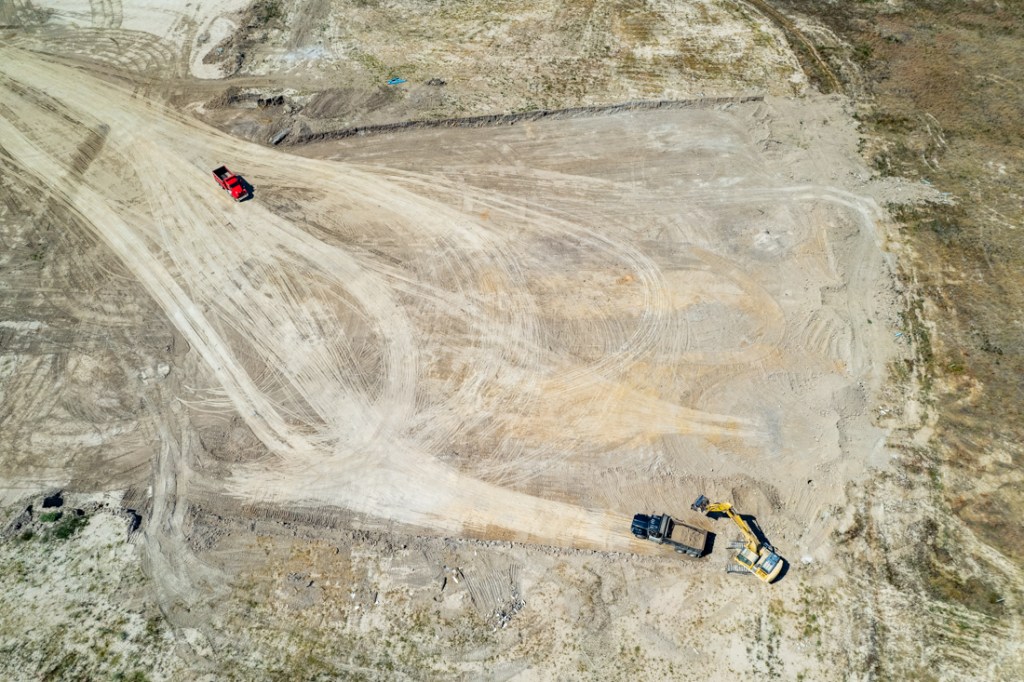
The site was busier today last month. Trucks constantly shuttled in and out.Looking NE across the new basin and the main part of Woodridge VillageLooking SW toward site entrance, Kingwood Park HS and Woodland Hills DriveMain thrust of work during August appears to be toward the east.An excavator loaded several trucks while I watched.
Sprint can take material wherever it wants, but must excavate from within the red boundary line.
Sprint will make only $1,000 from its Woodridge Village excavation contract with HCFCD, but will make its profit by selling the dirt at market rates. An engineer familiar with HCFCD operations estimates that if HCFCD had to pay market rates to have that 146,000 cubic yards moved, it would have cost taxpayers between $1.46 million and $2.9 million. He based those numbers on recent bids.
So, the Sprint contract is a good deal for taxpayers, but it carries some uncertainty with it.
If the demand for dirt dries up, excavation could slow or stop.
Next Steps
But simply excavating the dirt isn’t the end of the job. Harris County still needs to slope the sides, plant grass, and tie the new basin into the site’s existing stormwater-detention-basin network.
HCFCD awarded the engineering project for all that to Halff, based on the company’s qualifications. HCFCD is currently negotiating the scope of the project with Halff.
At the current rate of excavation, Sprint could reach Atlas 14 requirements by the end of the year. But the contractor is still less than a third of the way through its contract maximum of 500,000 cubic yards.
Construction of Taylor Gully conveyance improvements cannot move forward until the appropriate stormwater mitigation on Woodridge Village is in place first. Only one thing is certain at this point. That could still be awhile.
But there is good news. In the meantime, the extra Woodridge Village detention basin capacity will go a long way toward reducing flood risk for people downstream.
Posted by Bob Rehak on 9/7/23
2200 Days since Hurricane Harvey
https://i0.wp.com/reduceflooding.com/wp-content/uploads/2023/09/20230907-DJI_0444-2.jpg?fit=1100%2C733&ssl=17331100adminadmin2023-09-07 14:59:392023-09-09 11:56:30Woodridge Village Excavation Activity Almost Doubles
On August 28, 2023, Harris County Flood Control District (HCFCD) published two lists of projects that it will advertise in the next year. The first contains upcoming HCFCD projects going out for construction bids. The second contains requests for qualifications and proposals (RFQs and RFPs) for engineering designs and studies.
Of the 50 total projects on the two lists, only one pertains to the Lake Houston Area, a request for qualifications (RFQ) on the Kingwood Diversion Ditch design.
Another is for Barrett Station Drainage Improvements, but Barrett Station is about 5 miles south of the Lake Houston dam near Highway 90 and FM2100.
There were no upcoming construction projects listed anywhere in the Kingwood/Lake Houston area.
In fact, only one construction project out of 24 even pertains to Precinct 3, a TC Jester stormwater detention basin.
Construction Projects Going Out for Bid
Virtually all projects on both lists pertain to precincts led by Democratic commissioners. Given how long it takes to get projects into construction, it could take years before the Kingwood Diversion Ditch project moves into construction.
Upcoming construction projects going out for bids in the next year.
It normally takes 3-4 months from the time HCFCD advertises a construction project before a shovel goes in the ground.
Engineering/Design Studies Being Advertised
From the time an engineering study goes out for bid, it normally takes 12-18 months until shovels turn, but the time can vary widely depending on the nature of the project. Here’s the most recent list of engineering jobs being advertised.
For printable lists of both types of projects in PDF format, click here.
Precinct 3 Commissioner Tom Ramsey also pointed out that he hopes to move forward with several Lake Houston Area drainage projects using his own budget, not HCFCD’s. So the picture isn’t quite as bleak as the lists above make it look. However, his team is not yet ready to talk about those projects.
The Taylor Gully and Woodridge Village engineering project(s) were previously advertised. “HCFCD awarded design to Halff based on qualifications,” said HCFCD spokesperson Beth Walters. “This effort will include both Taylor Gully and Woodridge, as the channel conveyance improvements on Taylor Gully cannot be constructed without having the appropriate stormwater mitigation in place first.”
Walters added, “We are currently negotiating scope items with Halff (the normal first step of the process once the consultant has been selected).”
After design completion, HCFCD will advertise for construction. Construction does not show up on these lists because it will be more than 12 months out.
Lake Houston Gates Being Handled by City of Houston
The City of Houston is handling the Lake Houston Gates project. So, it wouldn’t show up on the HCFCD lists either.
Mayor Pro Tem Dave Martin had this to say about the status of the gates project. “We are presently in ‘final design’ on the eleven gate structure, in the earthen embankment area, east of the existing Lake Houston Spillway Dam.”
New gates will go to the right of the existing gates in the earthen portion of the dam.
“Estimated start of construction, pending permits, environmental studies, etc. will be 2025 Q1 or Q2,” said Martin. “Our money from the 2023 State legislative session should arrive by December 2023. We also have money from the 2021 state legislature which they will allow us to reappropriate from dredging to the gates if necessary.”
Martin also pointed to two dredging projects handled by the City. Canal dredging in Huffman is already underway. And “Within the next 2-3 weeks, we will start a FEMA funded project, south of the West Fork mouth bar, near Atascocita Shores,”said Martin. “This will remove approximately one million additional yards of sediment.”
Posted by Bob Rehak on 9/6/2023
2199 Days since Hurricane Harvey
https://i0.wp.com/reduceflooding.com/wp-content/uploads/2023/09/Screenshot-2023-09-06-at-12.26.59-PM.png?fit=1506%2C882&ssl=18821506adminadmin2023-09-06 20:13:432023-09-06 20:20:49Upcoming HCFCD Projects Scarce in Precinct 3
NOAA’s new Atlas 15 precipitation-frequency estimates will soon replace recently introduced Atlas 14 estimates – even before the Atlas 14 estimates have been fully adopted and integrated into local regulations.
About Precipitation-Frequency Estimates
Engineers use precipitation-frequency estimates to design, plan and manage infrastructure under Federal, State and local regulations. For instance, to ensure homes are built X feet above the 100-year floodplain, engineers must “know” how much rain will fall in a 100-year storm. Predicting that is one of NOAA’s jobs.
However, haphazard adoption of the new estimates has created a patchwork quilt of regulations across Texas and the U.S. One of the dirty, little secrets in the flood mitigation business is that many jurisdictions fail to adopt the new estimates and update their regulations accordingly. It’s costly, time-consuming, and raises the bar for developers.
So, many jurisdictions continue to use lower estimates to help attract development.
But designing infrastructure around artificially low rainfall estimates can lead to insufficient mitigation that increases flood risk for everyone.
Some Estimates Now in Effect Go Back 60 Years
In 2018, NOAA introduced Atlas 14 precipitation-frequency estimates for Texas. They replaced earlier estimates published by NOAA as early as the 1960s. Some parts of the Houston region still use those earlier estimates today.
Atlas 14 estimates superseded those published in:
Weather Bureau Technical Paper No. 40, Rainfall Frequency Atlas of the United States for Durations from 30 Minutes to 24 Hours and Return Periods from 1 to 100 Years (Hershfield, 1961)
Weather Bureau Technical Paper No. 49, Two- to Ten-Day Precipitation for Return Periods of 2 to 100 Years in the Contiguous United States (Miller, 1964).
Newest Estimates Will Incorporate Climate Change
Compared to those, Atlas 14 estimates are more accurate. They incorporate data from newer technologies and more data collected over longer periods. Atlas 14 totals increased 30-40% for the Lake Houston Area.
The Atlas 15 estimates are just getting underway and have not yet been developed. NOAA expects to release them in 2027.
NOAA claims its Atlas-15 update will improve precipitation-frequency estimates by leveraging non-stationary climate estimates. Previous estimates, such as Atlas 14, have assumed a stationary climate.
In statistics, “non-stationary” means the underlying environment changes, say due to some strong trend or seasonality. Many people believe climate is changing and hence the desire to build that into the new precipitation-frequency estimates.
National Funding, New Updates Every 10 Years
Historically, NOAA precipitation-frequency estimates have been funded by states and other users, on a cost-reimbursable basis. However, that is changing.
Moving forward, the Federal government will fund precipitation-frequency updates. Under the Floods Act, signed into law in December 2022, NOAA will update precipitation-frequency estimates every 10 years.
Goals include:
Updating standards
Incorporating climate change
For the entire country.
Voluntary, Local Participation
But there’s a dirty little secret that not many people know about. Nothing forces individual cities, counties or states to adopt the estimates and work them into their regulations.
That’s a big job. And an expensive one. So, not all jurisdictions do it. Many areas surrounding Houston still plan infrastructure using data developed 60 years ago.
If you plan on less rain, channels can be narrower and stormwater-detention basins smaller. But residents are not protected as much as they should be.
Posted by Bob Rehak on 9/5/2023 based on information from NOAA.
2198 Days since Hurricane Harvey
https://i0.wp.com/reduceflooding.com/wp-content/uploads/2023/09/Screenshot-2023-09-05-at-3.14.21-PM.png?fit=1686%2C846&ssl=18461686adminadmin2023-09-05 16:12:162023-09-05 16:12:17Here Come New Precipitation-Frequency Estimates…Again
It’s easy to forget flooding in the middle of a drought. But we should never forget that Texas ranks #2 in states with the most flood damage. This and other statistics below demonstrate why we shouldn’t become complacent.
Debris pile from Imelda flood in Elm Grove Village (Kingwood).
Different Measures, Similar Rankings
Many ways exist to rank flood-prone areas and Texas ranks high on most of them.
Most hurricanes? Out of the 300 hurricanes that made landfall in the US since 1851, Texas ranks #2 after Florida with 66 hitting the Lone Star state – 22% of the U.S. total.
Percentage of state’s total population living in floodplains? Texas ties for 10th according to a 2017 study. But a 2023 TWDB study shows that 20% of Texans now live in floodplains; that would tie us for 3rd if nothing else changed.
Most disaster declarations? Texas ranks #2 when considering all types.
Flood deaths? Texas ranks #1. Two hundred people died between 2010 and 2022. Over a longer period of time, 1959-2014, the state had over 850 flood deaths.
As bad as the Texas statistics are, Harris County’s are even worse.
Between 1978 and 2021, Harris County led all counties in the the entire countryfor NFIP claims filed (171,300), about 44% of the total claims for all of Texas.
It’s important to look at many different measures, because no one measure conveys the full picture. For instance:
Number of hurricanes also reflects miles of subtropical shoreline.
The sheer size and population of Texas make it rank high on many measures. Said another way, we are a big target.
The high clay content of our soils discourages infiltration and encourages runoff of rainfall.
Dollar losses may depend as much as on affluence or population density in floodplains as the severity of flooding.
Dollar losses in Texas also reflect old building codes in many locations.
And then there’s the huge number of mobile homes in Texas. They are notoriously susceptible to high winds, like those often associated with hurricanes.
Their placement also makes them more vulnerable to flooding than other types of housing. A study by Headwaters Economics found that one in seven mobile homes is located in an area with high flood risk, compared to one in 10 for all other housing types.
Texas, a Leader in…
Texas leads the nation in many things: oil, gas, cotton, job creation, economic expansion and more. Unfortunately, we’re also a leader in flooding.
That’s enough to make a dent in the state’s budget, but not the problem. Perhaps we need to re-examine our priorities.
Posted by Bob Rehak on September 4, 2023, Labor Day
2197 Days since Hurricane Harvey
https://i0.wp.com/reduceflooding.com/wp-content/uploads/2019/09/Elm-Grove-9.19_71.jpg?fit=1500%2C1000&ssl=110001500adminadmin2023-09-04 17:02:452023-09-04 17:02:47Texas Ranks #2 in States with Most Flood Damage
When looking at buying property, your flood risk depends on at least ten factors. Unfortunately, people rarely consider most of them. Even if they do, they may not now how to assess them.
Harvey Flood. Photo by Sally Geis.
So, here’s a list of key factors that can increase or decrease your flood risk. I’ve also included examples and ways to explore their impact on your property or the property you’re considering buying:
Geography and Topography: The natural landscape of an area plays a significant role in its flood susceptibility. Flat, low-lying areas, river valleys, coastal regions, and areas near lakes or other bodies of water are more prone to flooding because water naturally collects in these locations. To investigate a particular area, check out resources such as the USGS National Map and FEMA’s National Flood Hazard Layer Viewer.
Proximity to Water Bodies: Areas near rivers, lakes, oceans, and other water bodies are at a higher risk of flooding. Riverine flooding, coastal flooding, and flash flooding can all occur in these regions. See any map or web sites such as RiskFactor.com.
Rainfall and Precipitation Patterns: Areas that receive heavy or prolonged rainfall are more likely to experience flooding. Rainfall can lead to flash floods, riverine flooding, and urban flooding when drainage systems are overwhelmed. In Texas, generally the farther east and closer to the coast you go, the more rainfall increases. To see the likelihood of precipitation in any given area, check out NOAA’s Atlas-14 site then investigate local infrastructure standards to see if they meet Atlas-14 standards or something less (prior). Also understand that NOAA is revising Atlas-14 already to incorporate impacts of climate change (see Atlas-15).
Climate and Weather Events: Areas prone to hurricanes, tropical storms, or other severe weather events are at risk of storm surges, heavy rainfall, and coastal flooding. Here are several sites that can help you find reliable climate data.
Human Development: Urbanization and land development can increase flood risk. Paved surfaces and buildings can reduce natural drainage and increase runoff, overwhelming drainage systems. Harris County has proposed minimum drainage standards for areas draining into Harris County, but not all surrounding areas have adopted these standards yet.
Deforestation and Land Use Changes: Changes in land use, such as deforestation or the construction of roads and buildings, can alter natural water flow patterns and increase flood risk. Think you’re protected? Unfortunately for homeowners, many wetlands are now being destroyed. The EPA and Army Corps amended the definition of protected “waters of the United States” in light of the decision in Sackett v. EPA in May. It narrowed the scope of the Clean Water Act and the EPA’s power to regulate waterways and wetlands.
Infrastructure and Drainage Systems: The condition and capacity of drainage systems, including stormwater sewers and levees, can affect an area’s flood vulnerability. Inadequate or poorly maintained infrastructure can lead to flooding. After Harvey, Harris County Flood Control embarked on an ambitious expansion of flood-mitigation infrastructure, but recently spending has fallen. More in some areas than others. So stay alert to what’s happening in your area.
Historical Flooding: Areas with a history of flooding are often at continued risk, as past floods can indicate a region’s susceptibility to future events. In Harris County, MAAPnext provides an excellent series of historical flood maps to help you understand your flood risk.
Land-Use Planning and Floodplain Management: Effective land-use planning, zoning regulations, and floodplain management can help mitigate flood risk by restricting construction in flood-prone areas and implementing flood control measures. There’s no zoning in Houston and little in surrounding areas. We do have floodplain management regulations. When purchasing property, always look upstream to see if those regulations are effectively enforced.
Few things affect a property’s value more dramatically than flooding.
Yet flood risk can change over time – for better or worse. So buyer beware. Or buyer be wet.
Posted by Bob Rehak on 9/3/2023 with some help from ChatGPT
2196 Days since Hurricane Harvey
The thoughts expressed in this post represent opinions on matters of public concern and safety. They are protected by the First Amendment of the US Constitution and the Anti-SLAPP Statute of the Great State of Texas.
https://i0.wp.com/reduceflooding.com/wp-content/uploads/2021/09/20170829-IMG_5756.jpg?fit=1200%2C800&ssl=18001200adminadmin2023-09-03 13:37:262023-09-03 13:39:18Factors that Affect Flood Risk and How to Assess Them
Harper Brothers Construction has encountered another unexpected problem in the Northpark Drive expansion project. While attempting to place 5’x7′ culvert in the median, it uncovered a water line much closer to the surface than it should have been. While developing a solution with the City of Houston, crews will continue to focus on other areas of the project so as not to create excessive delays.
Those areas include:
A new water main near 494 and the UP railroad tracks
Clearing land for the new Northpark entry to Kingwood at 59.
For background detail and photos, see below.
Pics of Water-Line Conflict
This week, Harper Brothers discovered a water main where it should not have been. The contractor proposed water-line workarounds to the City, but the City has not yet agreed to a solution. The issue has to do with a water main running under Northpark to the new Parkwood Baptist Church east of Russell-Palmer. See the pictures below, courtesy of the Lake Houston Redevelopment Authority (LHRA).
Workers discover a surprise. Water line under Northpark not where it was supposed to be.Water line should have been buried several feet deeper.One workaround could require burying a parallel line deep enough to allow placement of culvert over the top of it.
Harper Brothers Construction suggested another workaround – splicing in a U-shaped pipe that would leave enough room for the culvert it is burying in the median.
But until the City and LHRA agree on a solution Harper Brothers may have to skip past the obstruction and then go back at a later date to fill in the gap.
Second New Water Main Farther West
In the meantime, crews have already started prepping for placement of another water line that parallels Northpark closer to Loop 494. See picture below near Public Storage.
Looking SE. Note area being cleared in foreground for new water main and feeder roads next to bridge.
While Northpark will expand inward for most of its length, the feeder road next to the new bridge over 494 and the railroad tracks will expand outward. And because the City doesn’t like to run water mains under a roadway, contractors must also relocate this water main. It’s a much bigger job because it feeds numerous businesses, not just one church.
LHRA actually had to purchase additional land for this portion of the project – enough to accommodate a two-lane feeder road on each side of the bridge.
In the photo above, you can see Harper Brothers prepping land for the new water main and feeder lanes.
Plans for New Entry
The contractor will also soon start clearing the triangular area on the north side of Northpark at 59. Note construction materials stockpiled in the foreground of the photo below. Most, but not all of this area, will become a decorative pond that’s actually a stormwater detention basin in disguise. The pond will hold approximately 11 acre feet of stormwater in the space between the top of the permanent water level and ground level.
A second pond on the south side of Northpark will provide a similar amount of stormwater storage to compensate for the increase in impervious cover caused by road widening.
But not all the trees will go away. TxDoT requires that any trees removed must be replaced with trees of an identical diameter.
Site of first detention pond. Pond will be framed by trees that remain between Northpark and shopping center on right.Some trees will be relocated to the open areacurrently behind the grove.
Other trees will be relocated nearby, for instance, around the south pond which is more sparsely populated with trees.
South pond will have more room for transplanted trees around it.
In addition, the ponds when complete will have sidewalks and landscaping around them. TxDoT, LHRA and the Kingwood Service Association worked collaboratively on the designs for two years. A well will serve the area and feed an irrigation system to help ensure new plantings survive and thrive.
Here’s what the finished ponds and landscaping should look like.
CenterPoint Promises to Stake Out Problems Week of 9/3/23
Last week, we talked about 11 conflicts with CenterPoint along the Northpark Drive expansion project. CenterPoint has promised LHRA that it will send crews to “stake out” the problems next week. That is the first step in resolving conflicts.
Some of the CenterPoint conflictsthat have culvert placement stalled.
It’s always something in construction! Stay tuned for next week’s exciting episode of “As Northpark Expands.”
For a look ahead at the next three weeks of construction activity, click here.
Posted by Bob Rehak on 9/2/23
2195 Days since Hurricane Harveyand 10 days before the peak of hurricane season
https://i0.wp.com/reduceflooding.com/wp-content/uploads/2023/09/Pond-Video.jpg?fit=1100%2C617&ssl=16171100adminadmin2023-09-02 07:17:372023-09-02 07:20:33New Design for Northpark Entry, Construction Schedule Update
As I passed the beautiful new Kingwood Middle School (KMS) last weekend, it struck me. Despite many heavy rains during construction that lasted almost three years, neighbors never reported flooding.
Too often, I hear of construction projects that alter drainage and flood neighbors. But Humble ISD seemed to consider that problem from the start and took appropriate measures to prevent it. The District even built a temporary stormwater detention basin before tearing down the old KMS. It protected the neighborhood during demolition and construction before the new permanent basin was completed.
The result is a magnificent architectural gem – a showcase for the entire community – without drama, stress or destruction.
Pictures Taken 8/27/23
Main entrance of new KMSThe KMS building now occupies the space of the old athletic fields and the athletic fields occupy the space of the old building.Note grass on the sides of the stormwater retention basin. The basin will reduce the risk of street flooding in the surrounding neighborhood.
The current drought has the football-field grass struggling. But somehow, the grass on the sides of the detention basin seems well established. The vegetation on the slopes reduces erosion which could clog the inflow/outflow pipes.
For Photographic History of Project
For photos showing the history of Kingwood Middle School demolition and re-construction, see below.
Thanks to the Humble ISD, its board and contractors for a job well done.
Posted by Bob Rehak on 9/1/23
2194 days since Hurricane Harvey
https://i0.wp.com/reduceflooding.com/wp-content/uploads/2023/09/20230827-DJI_0415.jpg?fit=1100%2C733&ssl=17331100adminadmin2023-09-01 09:32:212023-09-01 09:33:14Celebrating Completion of new KMS Without Flooding
August 30, 2023 – Yesterday evening, multiple news organizations reported wildfires burning near Colony Ridge in Liberty County.
Yet large parts of Colony Ridge, the fastest growing part of the county, have few fire hydrants. Some areas have none at all. And in the areas that have them, fire hydrant spacing is 2-5X greater than codes specify, while pressure is reportedly half of what codes require. And according to some sources interviewed for this article, many hydrants allegedly don’t work.
All this increases residents’ fire risk and insurance rates – if they can even get fire insurance. Some say they can’t.
Former Plum Grove Mayor, LeeAnn Penton-Walker says she and Colony Ridge residents have been trying to alert the county judge, commissioners, engineer and fire marshal to the dangers since 2015.
Fire Safety Top of Mind as Drought Deepens
Meanwhile, fire safety is at the top of everyone’s mind as the current drought deepens amid relentless heat. A burn ban remains in effect across the region. The National Weather Service has posted red-flag warnings for today. A combination of very dry vegetation, low humidity and gusty winds could easily spark fires.
Note critical fire danger in Liberty County (center).
Jeff Lindner, Harris County’s meteorologist, says that numerous fires started around the region yesterday and we have similar conditions today. “Fires especially in pine canopies continue to exhibit extensive growth rates and fast forward motion with long lasting crown runs. Increasingly larger fires are requiring large amounts of resources for an extended period of time,” says Lindner.
Recent Pictures Show Vast Areas with Apparently No Hydrants
On August 12, as I flew over Colony Ridge in Liberty County, the scarcity of fire hydrants struck me. I did not see any. However, the Liberty County fire marshal told me that the developer was trying to bring the development up to code. I knew the development had at least a handful of hydrants from a story I did three years ago. But Colony Ridge has virtually doubled in size since then.
Below are four pictures from areas recently built out. Many lots in these areas have already been sold and occupied. So you should see fire hydrants. But I couldn’t, even when magnifying high-res versions of the images on a large screen.
These photos are representative of thousands of shots I have taken from helicopters over Colony Ridge.
Areas With Fire Hydrants Do Not Meet Code Requirement
I asked the county fire marshal for a list of hydrant locations, but he could not supply me with one. So I spent a full day criss-crossing the area and burning a tank of gasoline looking for them. I located 59. See the satellite images below.
In the first, note how hydrants are clustered in rows and columns. Also note how large parts of the development have none. That verifies what I saw from the air.
Southern part of Colony Ridge. Yellow pins mark location of hydrants.
In the satellite image above, for instance, note the:
Broad empty swath across the bottom
Another broad swath on the east running north to south
An empty area in the middle
Another empty area at the top.
The next satellite image shows eight fire hydrants in the most populated portion of the northern part of Colony Ridge.
Portion of the northern part of Colony Ridge
Altogether, Colony Ridge covers more than 30 square miles. It has almost doubled in size in the last two years. If my count is accurate, it now has only about two fire hydrants per square mile.
What Fire Codes Require
Even though the Liberty County Fire Marshal’s web page does not list a fire code, Bill Hergemueller, the fire marshal, said that the county follows 2018 IFC (International Fire Code) regulations. That code specifies maximum spacing of 500 feet, but Hergemueller said the county allows 600 feet. However…
On any given east-west street above, the fire hydrant spacing averaged more than 3000 feet. That’s more than half a mile!
Measurements taken in Google Earth
Fire hydrants on north-south streets have an average spacing of 1300 feet.
So considering both directions, the average spacing exceeds code requirements by 2-5X.
But again, most streets have absolutely no fire hydrants. That makes the distances to fire hydrants far greater! A Houston fire captain told me that his trucks carried at most 500 feet of fire hose.
To service areas such as Colony Ridge, volunteer fire departments use tanker trucks. They fill their tanks at a hydrant and then shuttle to the fire until it is extinguished.
In fairness, Hergemueller also pointed out that parts of the development are still expanding and that the IFC regs were adopted after Colony Ridge started developing in 2013.
Codes Largely Agree
Most national standards call for one fire hydrant every 200-500 feet depending on the type of development.
The 2018 IFC regulations used by Liberty County specify 200- to 500-foot spacing between fire hydrants, with a few exceptions, i.e., in areas where buildings have sprinkler systems.
National Fire Protection Association standards specify that for detached one- and two-family dwellings “fire hydrants shall be within five hundred (500′) feet… The maximum distance between fire hydrants shall not exceed 800 ft.”
Texas’ Local Government Code 233.061-C gives Liberty County the right to enforce its fire code retroactively. In other words, the county could force the developer to upgrade his infrastructure to meet current code requirements.
In addition to violating fire-hydrant spacing requirements, Colony Ridge has another problem: existing water mains may not have enough pressure to douse fires before they get out of control.
The IFC code requires a minimum 1000 gallons per minute. But Colony Ridge water mains reportedly only deliver 500 gallons per minute.
Alternatives to Hydrants Also Missing
A “fire-code standards” expert I talked to in another county said that in rural areas, the alternatives to hydrants include on-site infrastructure such as water storage tanks and ponds that firefighters could use as sources of water. However, Colony Ridge does not appear to have those. In fact, the developer has drained many of the ponds to build homes over them.
So volunteers fill a tanker truck at one of the working hydrants, drive to the fire, pump their water, and refill as necessary until a blaze is extinguished. The standards expert told me that is a common practice in rural areas.
But Colony Ridge is rapidly becoming “un-rural.” In fact, Colony Ridge is likely larger than the three largest cities in Liberty County put together, though it is difficult to say for sure because of the large number of undocumented aliens.
Colony Ridge now occupies an area that is one-third of the area inside Houston’s 610 loop. Can you imagine an area that size with only 59 fire hydrants? To put that number in perspective, I live in the City of Houston and have 9 hydrants – on my block!
Problems Retrofitting Older Areas with Hydrants
An engineer consulted for this article said that once streets are in, it’s difficult retrofitting neighborhoods with hydrants and larger water mains. Not impossible, but difficult. It requires tunneling under streets and driveways, and that rapidly becomes expensive. That’s why most developers put utilities in before they pave.
Who Will Pay for Water?
During my hydrant inventory, I noticed that most Colony Ridge fire hydrants contained this sign. It says, “Fire hydrant use requires registered meter with Quadvest. For emergencies, usage must be reported to Quadvest. Unlawful use prohibited and punishable by law.” Then it lists Quadvest’s address and phone number.
This fire hydrant gets so much use, they leave the covers off.Or is that a signal it doesn’t work?
It appears that someone will be charged for the water coming out of this hydrant. However, it’s not clear whether that will be fire victims, volunteer fire fighters, the municipal utility district or water-rate payers. At press time, sources had not returned phone calls to clarify who would pay.
Calls for Service Up as Colony Ridge Expands in Drought
By August 21, according to a Facebook Post, the Plum Grove VFD had already received 855 calls for service compared to 1,111 in all of last year. So, three per day last year. And so far, 3.7 per day this year. That’s a lot of demand on volunteers! One wonders how it affects their regular jobs.
Growth has no doubt played a role in the increase. So has the drought and an increase in wildfires.
Without hydrant spacing that meets fire codes, unsuspecting residents face extra risk and higher insurance costs – if they can even get insurance.
Burned to the ground in Colony Ridge. Remnants of an American dream.
If any responsible parties would like to respond to this post, I will make space available.
Posted by Bob Rehak on 8/28/2023
2189 Days since Hurricane Harvey
The thoughts expressed in this post represent opinions on matters of public concern and safety. They are protected by the First Amendment of the US Constitution and the Anti-SLAPP Statute of the Great State of Texas.
https://i0.wp.com/reduceflooding.com/wp-content/uploads/2023/08/20230828-Screenshot-2023-08-28-at-9.50.25-AM.jpg?fit=1100%2C780&ssl=17801100adminadmin2023-08-30 15:02:052023-08-31 10:33:38As Wildfire Weather Sets In, Fastest Growing Area in Liberty County Fails to Meet Fire-Code Requirements