11/23/24 – Callan Marine now has a dredge in place to begin the City of Houston’s latest dredging operation. Last month, the City said it hoped its latest Lake Houston dredging program would start in December and now it looks like it will.
Callan’s dredge, the General Pershing, is currently anchored on the West Fork San Jacinto south of where the previous Mouth Bar dredging program ended. And this morning, I spotted a tug pulling lengths of dredge pipe into position.
Program First Announced in 2023
The City of Houston first announced its new Lake Houston dredging program last year. The focus: between Kings Point and FM1960 where the East and West Forks of the San Jacinto come together.
For months, Callan’s General Pershing dredge, was anchored south of the Forest Cove Pool on the West Fork San Jacinto at the old Army Corps mobilization site. Yesterday, Callan moved the General Pershing and its dredge pipe downriver to the starting point of the dredging program.
See the photos below taken this morning with the exception of the last one, which I shot last night.
Start of 2024 dredging between Kings Point (right) and Atascocita Point (left). Looking upstream toward West Lake Houston Parkway Bridge in far upper left.Looking downstream toward FM1960 bridge and Lake Houston Dam in distance.Tug pulling sections of dredge pipe into positionfor use.Reverse angle showing pipe and dredge.Only two or three sections of pipe remained upstream last night at the mobilization site south of the Forest Cove Pool.Area between FM1960 and Kings Point currently has one of the largest sediment build-upson the lake.
The dredge program was first announced in October 2023 at former City Council Member Dave Martin’s last town hall meeting.
Former City Flood Czar Stephen Costello outlined the program at that time. East of Atascocita and south of the convergence of the East and West Forks, the City plans to spend another $34 million to remove almost 900,000 cubic yards of sediment.
At the time, Costello said the City hoped to recoup some of its costs by reselling sand that it recovers from “hilltops” in the lake. Dredging will target areas that have sand which can be used for concrete, agriculture and other beneficial uses. At one point, the City reportedly also considered using spoils in the Ike Dike.
Costello showed the heat map above. Notice the heavy sediment concentrations in the lake’s headwaters. This is because sediment drops out of suspension where rivers slow down as they meet standing bodies of water.
Increasing Water Supply Capacity, Reducing Flood Risk
In addition to reducing the water storage capacity of Lake Houston, the sediment increases flood risk. It reduces conveyance of the rivers and lake forcing water up and out during floods.
According to a City of Houston source, the contractor will reportedly pipe the spoils south and east to an area near Spanish Cove. See map below.
The new disposal site (bottom right) is closer to the dredging than another site south of River Grove Park previously used for disposing of the spoils. That should reduce pumping costs.Location is approximate.
Since its construction in the mid-1950s, Lake Houston has lost nearly 20% of its capacity due to sedimentation. The City estimates it currently loses another 360 to 460 acre-feet per year.
This dredging program will help restore some of that capacity and create more room for floodwaters.
Answer a few simple questions about the construction of your home, i.e., “Is it slab on grade?”
Tell it how much coverage you want
Select a deductible
Press a button to get your quote.
The entire process took me less than two minutes. I found that I could get the maximum coverage ($250,000) with the minimum deductible for $887.
How to Act on the Quote
Of course, you don’t buy flood insurance directly from FEMA. You buy it from a flood insurance agent. So before you leave, the tool gives you the option of emailing the FEMA quote to an independent agent through a variety of channels. See below.
Everything You Wanted to Know About Flood Insurance in One Place
This new quote tool is amazingly easy to use. It’s also integrated with other useful information about flooding, ways to reduce your flood risk and obtain insurance. For instance, linked pages contain information about:
Each of the links above has additional links that help you drill down through information and explore ways to save. For instance, the page on Elevation Certificates above has a link to a fact sheet on Why First Floor Height is Important?; how you can modify your property to lower insurance costs; and a checklist about “Ways to Protect Your Home and Pay Less.”
Benefits of Tool and Site
I can see many benefits for FEMA’s new flood-insurance tool and its FloodSmart site. It:
Makes consumers smarter about risk and buying decisions
Saves buyers’ time
Saves agents’ time
Acts as a cross-check against possible mistakes by new agents
Encourages people to buy flood insurance even when they think they may not need it.
To that last point, note that during Hurricane Harvey, more than 154,000 homes in Harris County alone flooded. Of those, 70,370 were outside of the 1% (100-yr) and .2% (500-yr) floodplains. That’s almost half!
Flooded Sculptures, Car, Home during Harvey by Julie Yandell
And that’s not all that unusual. One of the FAQs on FEMA’s site points out that “…from 2014 to 2018, policyholders outside of areas required to carry flood insurance filed over 40 percent of all NFIP flood insurance claims.”
Posted by Bob Rehak on 11/22/24
2642 Days since Hurricane Harvey
https://i0.wp.com/reduceflooding.com/wp-content/uploads/2019/02/IMG_0034-e1732307050812.jpg?fit=1100%2C825&ssl=18251100adminadmin2024-11-22 14:29:162024-11-22 14:29:17FEMA Launches New Online Flood-Insurance Quote Tool
11/21/24 – Last week, the Harris-Galveston Subsidence District published a request for qualifications (RFQ) for consultants interested in conducting an alternative water supply feasibility study for Northeast Harris County.
Mike Turco, the District’s general manager, said he is specifically focused on the area east of Lake Houston, which is experiencing tremendous growth. The completion of the Grand Parkway has triggered much of that growth. And with it will come increased water demand, which has the potential to trigger subsidence.
“Alternative Water” Reduces Effects of Subsidence
The District defines “an alternative water supply” as a source that does not trigger subsidence. That most often means a source other than groundwater. Subsidence frequently results from excessive groundwater extraction. That can cause compaction of the earth and a whole range of consequences.
Subsidence can also cause bowls in the landscape that trap water and increase flood risk Subsidence can even change the gradient of streams, slowing water down and backing it up.
An SMU study found that subsidence can cause faulting and damage structures such as homes, roads, pipelines, storm sewers, sanitary sewers and more.
Differential subsidence can create another set of problems altogether. For instance, the rate of subsidence at the Harris/Montgomery county line is much greater than the rate at the Lake Houston Dam.
That has the potential to tilt the lake toward its headwaters. And that could reduce the freeboard factor (feet above flood level) for homes in northern Harris County.
But alternative water sources can reduce all those impacts.
Examples of Alternative Water
In this region, surface water, i.e., from Lake Houston, is the most common “alternative water source,” according to the District’s definition. Lake Houston provides water for more than 2 million people without causing any subsidence.
One example of an alternative water source. Lake Houston from Kingwood’s East End Park. By Dr. Charles Campbell.
So if we already have the major source of water in the area, why look at other alternatives? The planning horizon for water projects is typically 50 years. The RFQ specifically mentions recommendations to meet demand through 2070.
Given expected population growth during that period, the region may need more than Lake Houston. So it behooves us to look at all available alternatives.
According to Turco, right now, the City is already aggressively expanding water distribution from Lake Houston to areas like Spring, which has experienced some of the worst subsidence in the region – 30.5 centimeters, slightly more than a foot since 2007. See below.
Subsidence is widely considered to be irreversible. It’s comforting to know that people are already planning for the welfare of our grandchildren.
Posted by Bob Rehak on 11/21/24
2641 Days since Hurricane Harvey
https://i0.wp.com/reduceflooding.com/wp-content/uploads/2018/12/Campbell-sunrise-12_3_18-small.jpg?fit=1500%2C1114&ssl=111141500adminadmin2024-11-21 19:58:482024-11-22 11:16:39Subsidence District to Study Alternative Water Supply for NE Harris County
11/20/2024 – The Texas General Land Office (GLO) confirmed funding approval from the U.S. Department of Housing and Urban Development (HUD) for seven Harris County Flood Control District (HCFCD) projects.
In June of last year, HCFCD submitted two projects lists to GLO for $825 million in HUD Community Development Block Grant disaster relief (CDBG-DR) funding and flood mitigation (CDBG-MIT) funding.
Since then, HCFCD has worked with GLO to finalize the HUD applications. HCFCD presented an update to Commissioner’s Court in early October, 2024. Today, GLO provided an update to the update.
CDBG-DR Projects
According to an email from GLO spokesperson Brittany Eck received today, seven DR projects have received funding approvals to date. They include:
Eck also said that five more CDBG-DR projects are under final quality-control review. “We are making sure the project submissions are complete and meet all federal eligibility requirements so that there are not issues or concerns down the road.”
Disaster Relief projects have the tightest deadlines. So, all parties focused on those first.
CDBG-MIT Funding Still Under Review
“Seventeen CDBG-mitigation projects are still in various stages of preliminary review,” said Eck.
“We are working back and forth on requests for more information required by HUD on many of the projects,” said Eck. “We continue to work very closely with the HCFCD team to make sure they have all available resources needed to complete the applications. Overall our team is very pleased with the progress being made and the relationship continues to be strong.”
Only two mitigation projects have not yet been submitted for preliminary review.
Channel Conveyance Improvements (C147-00-00-E002) in the Sims Bayou Watershed.
Tremendous Progress
“HCFCD has made tremendous progress on these funds,” said Eck. “However, the rate of approval may not yet demonstrate the progress being made behind the scenes.”
She added, “This process, especially considering the amount funds being administered is an extremely lengthy federal process. Additionally HCFCD has needed to combine projects due to functionality and the GLO is working closely with them to ensure eligibility in the most efficient timeframe imaginable.”
Kingwood Projects Not Mentioned in This Update
Eck did not comment on the status of two Kingwood projects. I can only assume they are still under review. She did not mention any that had been eliminated.
Two additional stormwater detention basins upstream from Taylor Gully on Woodridge Village property acquired by HCFCD and the City of Houston.
Woodridge Village detention basin photographed on 10/25/24. Project paused pending outcome of HUD financing approval.
In its October update to Commissioners Court, HCFCD said the Woodridge Stormwater Detention Basins were originally below the funding line for CDBG-DR.
“The original engineering analysis indicated that only Woodridge Basin Compartment 1 was needed for the Taylor Gully mitigation,” said the update. “As the analysis has progressed it indicates that Compartment 2 (or a portion of it) may also be needed. Due to other projects potentially reducing in budget from the initial estimates, there may be funding available to include the Woodridge basin in the Taylor Gully project.”
That word “may” in the last sentence worries me.
HCFCD did not propose the Kingwood Diversion Ditch project for HUD consideration. HCFCD called the diversion ditch one of the two most important projects in Kingwood. That funding will have to come from somewhere else.
Posted by Bob Rehak on 11/20/24
2640 Days since Hurricane Harvey
https://i0.wp.com/reduceflooding.com/wp-content/uploads/2024/11/20241025-DJI_20241025151115_0018_D.jpg?fit=1100%2C619&ssl=16191100adminadmin2024-11-20 18:32:292024-11-20 18:32:31GLO, HUD Funding Approved for 7 HCFCD Projects So Far
11/19/2024 – The time to fully complete half of all FEMA-funded buyouts takes more than five years from disaster to closeout.
The screen capture below was taken from a presentation earlier this month to the Harris County Community Flood Resilience Task Force by Thao Costis, head of Harris County’s Housing and Community Development Department.
Hazard Mitigation Grant Program (HMGP) steps as shown to Harris County Flood Task Force on 11/6/24. For higher res PDF, click here.
The slide compares the time it takes to pay off an insurance claim (lower left) to the time it takes to complete a buyout (upper right).
The median is the midpoint of a frequency distribution. That means there is an equal probability of any given transaction falling above it or below it.
The thirteen steps involved in the buyout process as federal state and local governments pass information up and down the ladder to each other and homeowners can take more than six years at times. Meanwhile, insurance payouts usually take six months.
80% of Buyouts Go to Those Making Less than Median Income for Region
Sadly, buyouts affect the most vulnerable among us the most often. Approximately half of all buyouts in Harris County go to homeowners that fall into the bottom quartile of the CDC’s Social Vulnerability Index.
The bottom two quartiles (those making less than the median income for the region) account for a whopping 80% of all buyouts.
Typically, government agencies buy out homes that flood repetitively. That’s because insurance payouts after multiple floods can easily exceed the cost of a home.
But FEMA doesn’t make it easy. This 68-page PDF details all the procedures involved in a FEMA buyout.
Low-income homeowners generally are the least able to afford insurance and often have higher flood risk.
The higher flood risk can stem from living in older homes, built when less stringent building regulations were in place and when flood risk (or our estimates of it) were lower.
The Case for Business Process Re-Engineering
Regardless of the reason, buyout candidates have few good choices if they don’t have insurance. They may not be able to afford to move or afford fix up their homes. And staying put may entail health risks.
Buyout candidates may also not have the time, skills and financial resources to understand their options, navigate the application process, and wait out bureaucracies.
Buyout flow chart. Where the money comes from, how it gets to homeowners and different types of grants that are available.
Five years is a long time to wait with black mold growing in the walls.
https://i0.wp.com/reduceflooding.com/wp-content/uploads/2024/11/FEMA-Buyout-Process.jpg?fit=1100%2C611&ssl=16111100adminadmin2024-11-19 17:51:492024-11-22 14:17:53Half of FEMA-Funded Buyouts Take More Than 5 Years
The article begins, “The Flood Insurance Rate Maps (FIRMs) used by FEMA are based on antiquated data and obsolete models.”
Kingwood Town Center during Harvey
Flood Maps Fail to Predict True Flood Risk
Landau then examines a number of storms and locations where FEMA rate maps failed to predict flood damage. She says, “The FIRM maps have extensive problems” from the data they include and exclude “to the limited assumptions around how the maps would be used.”
She quotes Susan Crawford, a senior fellow for sustainability and climate at the Carnegie Endowment for International Peace, as saying “millions of homes should be labeled as high flood risks but aren’t.”
Beyond Climate Change
Landau’s analysis of flood risk goes far beyond climate change – the usual bogeyman.
She tracks the history of FIRMs back to the 1960s and their original objective: to encourage home ownership. Landau examines the data that FIRMs are based on and their built-in sampling bias. She says the location of flood gages near major rivers was expedient at the time. However, basing flood maps on those locations ignores flooding from other sources. Those sources include:
Smaller waterways such as streams, creeks and tributaries
Insufficient drainage infrastructure and mitigation
I touched on all these sources and more in a post titled “Why Do We Flood?”
Landau also touches on political pushback. She told a poignant story about a community that fought new flood risk maps because political leaders feared it would reduce the tax base. Because of this and other complexities that many people remain unaware of, they buy homes without understanding their true flood risk.
Sources Indicate 3X More Homes at Risk than FEMA Shows
Landau quotes Sam Brody, a professor at Texas A&M, who is developing a different approach to modeling with the Texas Division of Emergency Management.
Rather than focus on historical flooding, Brody incorporates these other factors in his models.
High flood risk areas flagged by the Texas system are termed “damage plains rather than flood plains, and they extend for many miles beyond FEMA’s hazard zones,” says Landau. “In fact, the new model determined that three times more structures in the Texas Gulf Coast are actually at high risk of getting inundated.”
So what’s a prospective home buyer to do? Check a variety of sources, starting with FEMA. If you’re going to bet your life savings on a new home, check a variety of sources:
Visit the Institute for a Disaster Resilient Texas “Buyers Aware” website, a cooperative venture of Texas A&M and the Texas Division of Emergency Management. It covers 41 counties in SE Texas including all those in the Houston area.
Flood Risk Reports on My House Varied Radically
When I checked my address, I found radically different estimates of my flood risk.
FEMA showed me far outside of the 500-year floodplain
First Street showed me outside of the danger zone, but not quite as far away. It said I had “mild” flood risk.
Buyers Aware rated my flood risk as “moderate high.”
Flooding three blocks past Kingwood Drive during Harvey, more than 2 miles from the San Jacinto West Fork
Buyers Aware said, “…based on the flood risk variables outlined below, our analysis ranks this site as having a moderate-high flood risk. This is near the top of the highest risk categories included in our model. We strongly encourage you to purchase flood insurance and explore other actions to mitigate your flood risk.”
While this property may not be in the FEMA regulatory floodplain (sometimes referred to as the “100-year floodplain”) our analysis indicates that flood risks may be higher than what is currently measured by the regulatory maps.”
In the National Geographic article, Landau says, “Since the 1990s, over 50% of flood loss in Texas has occurred in areas outside of SFHAs [FEMA’s Special Flood-Hazard Areas].”
Buyers Aware factors in:
Land elevation
Distance to coastline
Distance to streams
Imperviousness
Soil Characteristrics
Height above nearest drainage
Buyers Aware also showed me a map of the neighborhood and told me that within the area shown, “$22,813,736 of flood insurance claims have been paid in the last 10 years.”
That total reflected only properties with active NFIP policies in place. I know people nearby who had five- and six-figure damage during Harvey. But they didn’t have flood insurance policies because they thought they were beyond the 500-year flood zone.
Other Interesting Data that “Buyers Aware” Includes
Buyers Aware also told me that FEMA has 3890 active NFIP policies in my area.
Next they informed me about a 7% increase in impervious surface upstream from me.
Buyers Aware also recommended I buy flood insurance and told me where I could find more information about it. They also listed several flood mitigation strategies such as:
Improving drainage
Retrofitting
Flood barriers
Property elevation
For the Record
For the record, I live 2.1 miles from the San Jacinto West Fork. During Harvey, floodwaters stopped at our driveway. And that’s the main reason I write about flooding in my retirement.
Also for the record, FEMA has set a goal to update all of its FIRMS every ten years and to include climate change in the analysis.
Finally, Harris County Flood Control District’s MAAPnext effort (not yet fully vetted by FEMA) addresses many of the issues addressed by National Geographic and Landau.
But local pushback will always be a problem everywhere. Montgomery County announced an ambitious effort to update its drainage criteria manual after Harvey, but has yet to officially adopt the changes it considered.
Posted by Bob Rehak on 11/18/24
2638 Days since Hurricane Harvey
https://i0.wp.com/reduceflooding.com/wp-content/uploads/2019/03/IMG_0617-e1617916649512.jpeg?fit=1200%2C856&ssl=18561200adminadmin2024-11-18 17:29:552024-11-19 14:33:19Do You Know Your Home’s True Flood Risk?
11/17/2024 – According to a National Hurricane Center report at 6 AM this morning, slow-moving Tropical Storm Sara has produced around 40 inches of rain in northern Honduras. To put that amount in perspective, it meets or exceeds most Hurricane Harvey totals reported in Harris County during a similar 4-day period.
Harvey 4-Day Totals
Rainfall can vary widely over areas. Harris County Flood Control District’s (HCFCD) final report on Hurricane Harvey shows total Harvey rainfall amounts ranged from 26 to 47 inches across the county during a 4-day period. The lowest totals occurred over the northwest and northeast part of the county with the highest totals focused across the southeast part.
Clear Creek at I-45 saw the maximum 47.4 inches.
San Jacinto at US59 saw 32.7 inches.
Spring Creek at I-45 saw 29.4 inches.
Cypress Creek at Cypresswood Drive saw 34.9 inches
Luce Bayou at FM2100 saw 31.8 inches.
Most places in Harris County reported 4-day totals in the 30-40 inch range. Some were slightly lower, some slightly higher. Clear Creek was the statistical outlier.
Harvey in Historical Perspective
Hurricane Harvey struck the Gulf Coast in August 2017. It was one of the most significant and devastating tropical storms in U.S. history, primarily due to the sheer volume of rainfall it produced.
Harvey’s rainfall ranked among the heaviest ever recorded in the continental United States from a tropical system. The highest peak occurred in Nederland, about 85 miles east of Lake Houston. It still holds the official U.S. record for a single-location rainfall from a tropical storm – 60.58 inches.
Harvey’s rainfall was not only extreme in terms of totals but also in how long the rain persisted. The storm’s slow-moving nature allowed the moisture to be dumped over the same areas for four days, contributing to catastrophic flooding, especially in Houston.
Update on TS Sara
Four days also matches the amount of time Sara has dumped rain over northern Honduras.
Location and size of TS Sara at 7 AM CST
Sara’s heavy rains are now spreading westward across portions of Belize, Guatemala, and the Yucatan Peninsula.
Sara should hold steady in strength with tropical-storm-force winds of around 40 MPH until it moves inland later today. NHC warns that it will likely cause “significant and life-threatening flash flooding and mudslides” across Belize, El Salvador, eastern Guatemala, western Nicaragua, and the Mexican State of Quintana Roo.
Sara is no threat to Houston, but could cause heavy rainfall in Florida later this week after it crosses into the Gulf as a tropical depression.
In mountainous regions, such as northern Honduras, the volume of rain is not the only danger. So is the speed of the runoff as we saw earlier this year when Helene hit North Carolina.
Posted by Bob Rehak on 11/17/24
2637 Days since Hurricane Harvey
https://i0.wp.com/reduceflooding.com/wp-content/uploads/2024/11/Sara-2024-11-17.jpg?fit=1100%2C748&ssl=17481100adminadmin2024-11-17 08:45:332024-11-17 08:53:06TS Sara Rainfall Totals Meeting, Exceeding Hurricane Harvey’s
11/16/24 – When Houston City Council Member Fred Flickinger announced a “Median Madness” event, I must admit I was skeptical. But within the first hour, I began to see significant progress and the power of people working together.
The objective was vine control along Kingwood Drive. This story has nothing to do with flooding. But it was inspiring.
Dozens of volunteers turned out to help members from the City’s Park’s Department push back vines. As the number of volunteers swelled into a small army, a line of yellow T-shirts stretched for blocks.
The group deployed quickly, powered by anger at the vines that were pushing past the curbs and endangering traffic.
Since Beryl, the sense of frustration in the community over the vine problem has become palpable. Today, people did something about it. They turned out en masse to battle the vines. Cutting. Chopping. Sawing. Tugging. Piling. Grinding.
Photos of Event
Below are some pictures of City Council Members, bank presidents, doctors, retirees and community activists working together side by side to improve both aesthetics and safety for the entire community.
Initial briefing at 8:30 AM. City Council Member Fred Flickinger is in black shirt (center).The volunteers spread out, chopping and tugging at vines, then piling them.As more joined the group, the small army stretched for blocks.The problem looked insurmountable. But the volunteers were undeterred.Soon the Parks Department was grinding the piles of vines and hauling them away.The only thing missing was a cheer-leading squad chanting “Push ’em back. Waaaay back!”Members of Houston Public Works and the Parks and Recreation Department joined the volunteers.The latest fitness craze. A tug-of-war workout.Soon, volunteers had the vines a safe, comfortable distance from traffic.District E staff circulated with water to keep the volunteers hydrated.Watch your step. Tripping over vines was a constant threat, although I didn’t see anyone fall.Visible signs of success and satisfaction.City Council Member Twila Carter wasted no time pitching in. Can you spot her facing the camera on the right?Council Member Fred Flickinger working side by side with volunteers.At-Large City Council Member Sally Alcorn (blue shirt) joined in the funTaking out the trash. Car bumpers and patio umbrellas were among the archeological discoveries in the vine jungle.Despite the hard work, everyone kept smiling. They were seeing progress!
After the divisiveness of the recent election, it was refreshing to see so many people working together for a common cause.
Thanks to all who participated. And for those who missed it, please turn out next time.
This will be the first event of several, according to a District E spokesperson. And it will be combined with periodic mowing to help improve aesthetics and safety by keeping the vines down.
Posted by Bob Rehak on 11/16/24
2636 Days since Hurricane Harvey
https://i0.wp.com/reduceflooding.com/wp-content/uploads/2024/11/20241116-DSC_1380.jpg?fit=1100%2C733&ssl=17331100adminadmin2024-11-16 12:44:192024-11-16 12:47:53The Power of People Working Together
11/15/24 – The Lake Houston Redevelopment Authority/TIRZ 10 Board met yesterday to discuss Northpark expansion, including:
The progress of the project, designed to create the first all-weather evacuation route from Kingwood
Railroad crossing signal work by Union Pacific
Scope changes for Phase 2
Debt capacity and cash flow
Another $48 million in short- and long-term financing.
Two Meetings in One
On a somewhat funny note, the board covered the first half of the agenda while standing in front of a locked Kingwood Community Center.
Lake Houston Redevelopment Authority/TIRZ 10 Board Meeting began outside at 8 AM in blinding sunlight.
After the keymaster finally arrived…
The meeting concluded indoors, much to the relief of everyone’s dermatologists.
Here is the agenda. And here is a link to the 342-page board packet (warning 27.5 mb download).
Upcoming Railroad Signal Work Influencing Construction Focus for Next Month
The UnionPacific (UP) Railroad will start installing new crossing signals in the area beginning in January. Their crew will start at Knox Road north of Northpark and work their way south. The exact date for Northpark is unknown because it’s not clear how long the Knox intersection will take.
As trains come down the tracks, they communicate sequentially with signals. All signals must communicate with each other as well as trains. So, it’s a big job. UP has only one crew to handle this type of work in 26 states.
They want to come here once and handle Knox and Northpark at the same time. If they can’t, it could delay Northpark construction for an undetermined amount of time.
So contractors for the TIRZ and utilities are putting on a full-court press to prep work near the railroad. They are racing to finish:
Soil tests and environmental approvals
Boring under both Northpark and Loop 494
Relocation of water mains and other utilities such as gas, electric and telecommunications
Drainage
Dirt work for all surface lanes both north and south of where the bridge will eventually go.
Change Orders for Phase 2
The board also approved two change orders for Phase 2 – the portion of the project that stretches from about a 1000 feet east of Russell Palmer Road to just past Woodland Hills Drive.
The first change order had to do with an expansion of scope to accommodate new TXDoT requirements for sound, air quality, environmental, and archaeological studies.
A second change order dealt with evaluating additional detention pond sites and updating the drainage report for submittal to TXDoT.
The project team is currently planning to build a 90-acre-foot detention basin to reduce flooding on Ben’s Branch downstream from Northpark Drive.
Additional Debt Capacity
The most complicated discussion of the meeting had to do with a cash flow analysis and additional debt capacity.
Taken together, they show that when Phase 1 is ramping down and Phase 2 is ramping up, expenses would exceed cash flow, so additional borrowing will be needed. The analyses also showed that there is sufficient debt capacity to do so.
To be clear, this is not an increase in the cost of the project. It’s just an increase in borrowing authority to cover a temporary spike in the cost. The analysis shows that future cash flows after project completion will easily pay back the debt.
It is not clear yet what form the debt will take, i.e., whether its short-term borrowing from a bank or the issuance of longer-term bonds. Those details have yet to be worked out.
Because federal funding is involved in Phase 2, the project must be fully funded before construction starts. A revised cash-flow analysis showing the debt-capacity increase will show the federal government that the TIRZ has what it takes to complete the project.
11/15/24 Pictures of Construction Progress
I took the pictures below this morning.
Looking NW at Corner of Northpark and Loop 494. Note two new southbound lanes.Same intersection but looking southboundSame intersection again, but looking westbound. Some drainage and dirt work must still be completed before crews can begin paving the north side of Northpark.
At the board meeting, De Leon also discussed a change in ownership of the Exxon Station at US59. The owner reportedly anticipates rebuilding the station farther back to accommodate road expansion to the south.
The Exxon station will likely move where the car wash now is in the upper left.Looking E from Loop 494. Note crews working on both sides of Northpark just beyond tracks.
In the last shot, the crews are burying electrical lines. They will be encased in RED concrete as a warning to anyone excavating near them in the future.
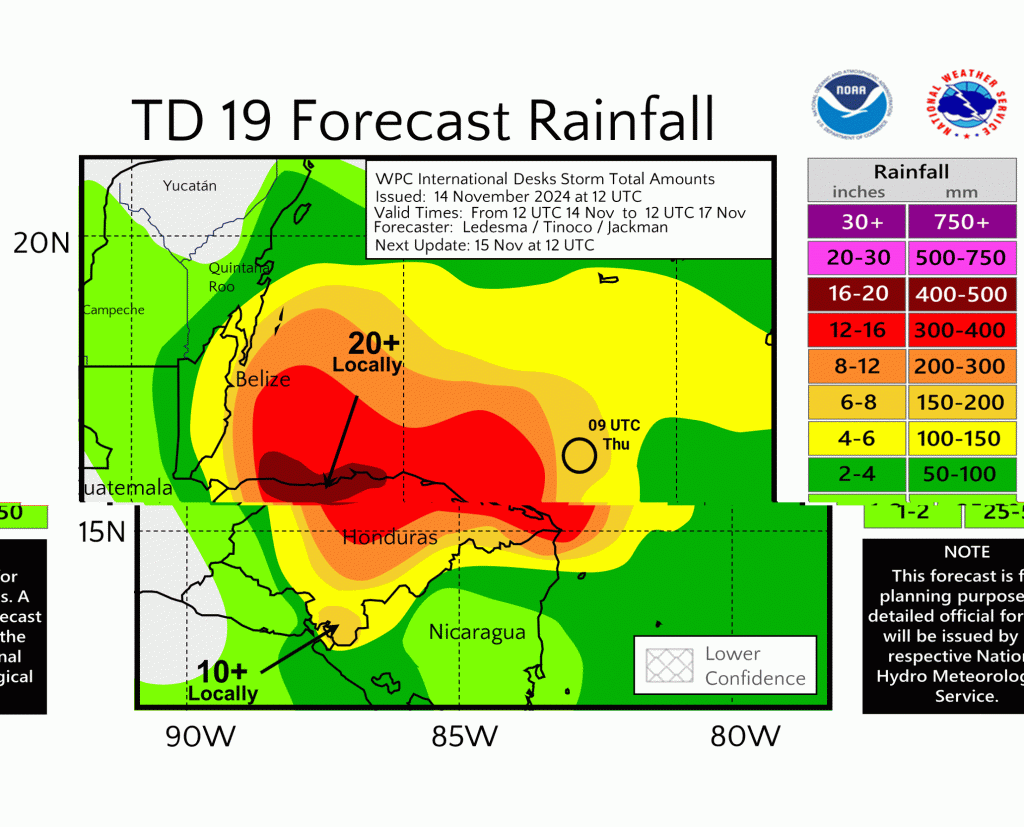
11/14/25 – At 1 PM EST, the National Hurricane Center (NHC) began issuing advisories on Tropical Storm Sara, the 19th named storm of the Atlantic Hurricane season. It formed in the western Caribbean near the border between Nicaragua and Honduras.
TS Sara in center. Satellite image taken at 10:40AM Houston time on 11.14.24.
Circulation and banding appeared on satellite images taken this morning. The storm currently has sustained winds of 40 MPH and a forward speed of 12 MPH. Some strengthening is possible if the storm remains over water.
Life-Threatening Flash Flooding and Mudslides
Be aware in case you have relatives in Central America or travel planned there.
NHC predicts life-threatening and potentially catastrophic flash flooding and mudslides through the weekend.
National Hurricane Center
The system will likely meander in the Bay of Honduras for the next several days, dropping 10-20″ inches of rain, with isolated totals up to 30″.
Mountains border that northern coast of Honduras where the heaviest rain will fall.
Simultaneously, storm surge and large, destructive waves will rake the northern coast of Honduras for several days.
Track Still Uncertain
The track and intensity for Tropical Storm Sara are still somewhat uncertain. That big, empty area in the satellite photo above is a high-pressure ridge, much like the one that protected Houston from Rafael earlier this month.
But the high pressure will break down early next week ahead of an approaching low-pressure system. That could turn Tropical Storm Sara northwest and north-northwest into the southern Gulf of Mexico.
In the meantime, land interaction could also weaken the system.
According to Harris County Meteorologist Jeff Lindner, “It is possible that the system moves inland over portions of central America or the Yucatan and dissipates.”
Intensity Forecasts Lowered
While Tropical Storm Sara will encounter favorable conditions over water, the interaction with Honduras will likely limit the upper-end potential of the storm over the next 4-5 days, says Lindner.
Should Sara reach the southern Gulf of Mexico, a powerful frontal system moving off the Texas coast early next week will likely produce wind sheer that weakens the storm further.
“No Threat to Texas Coast”
Lindner concluded, “With a strong, deep-layer trough and front moving into the southern plains early next week, this system poses no threat to the Texas coast.”
However, NHC warns Gulf Coast residents to regularly monitor updates through mid-week next week.
At present, main wind threat will be to northern coast of Honduras.
On a personal note, I used to scuba dive regularly in Honduras. The country is beautiful. But the terrain along the northern coast is steep and rugged. And building codes are not up to U.S. standards.
Twenty inches of rain could easily devastate the area. So, keep the folks there in your prayers.
Posted by Bob Rehak on 11/14/24
2634 Days since Hurricane Harvey
https://i0.wp.com/reduceflooding.com/wp-content/uploads/2024/11/TD19-11.14.24.jpg?fit=1100%2C640&ssl=16401100adminadmin2024-11-14 12:27:452024-11-14 12:30:01Tropical Storm Sara Forms Near Honduras