Editorial: Are Engineering Laws and Regulations Routinely Ignored in Montgomery County?

This is an editorial about engineering laws and regulations that seem to be routinely ignored in Montgomery County. It is based on previous reporting about flooding in the Lake Houston Area.

I don’t wish to demonize engineering, one of the most honorable professions around. If you’re one of the vast majority of honest, ethical professional engineers who strive daily to serve clients and protect the public, thank you. You can stop reading here. This editorial is not about you. It IS for the few who ignore their professional code of ethics, Texas laws and regulations.

Job #1 of Professional Engineers: To Protect the Public

The law in Texas says that the highest obligation of Professional Engineers is to protect the public. Yet consider these stories I reported on in the last year. Together, they illustrate a pattern that speaks of other priorities.

A Culture of Collusion and Willful Blindness

Examples like these abound. They erode public safety. And in fact, in many cases, homes have flooded. Hundreds. Perhaps thousands. These represent only the stories I have documented.

If these were isolated incidents, you could blame them on occasional human error or bad judgment.

But they happen over and over again – in Montgomery County. In my search to answer the question “Why,” I have concluded that a culture of collusion based on willful blindness exists.

Lack of Checks and Balances

The collusion is between three groups that should provide checks and balances on each other, but do not.

  • County commissioners eager to attract growth.
  • Developers eager to cash in on that growth.
  • Engineering firms willing to turn a blind eye to grow their businesses.

As one engineer told me, “You don’t grow by telling clients they can’t do something. Word spreads quickly. Clients go elsewhere.”

Pretty soon a numbness sets in. Ethical excursions stretch a little further with each project. Engineers become accustomed to a permissive environment of lax regulation and even laxer enforcement. Standards fall. “This won’t make THAT big of a difference.” “Everybody’s doing it.” “If we get caught, we’ll just pay the fine.” Then along comes Tax Day. Memorial Day. Harvey. May 7th. Or Imelda.

Willful blindness may work well in the short term. All three parties above celebrate record growth. But soon, the corner-cutting catches up. People flood. In Montgomery County AND in downstream communities. Over and over again.

Stealing the Future

When the repeat flooding can no longer credibly be blamed on Acts of God, constituents look for answers elsewhere. But no good answers exist. Because we’ve built infrastructure that won’t support the future and it’s too expensive to change. When everyone wakes up to that, Montgomery County will be another one of those places to avoid. Those who stole its future will move elsewhere and repeat the process. Those left behind and those downstream will pay the price.

Montgomery County Not Alone

Certainly, these same problems exist in other counties. Here in Harris County and the City of Houston, we actually had one project this year for which engineers recommended building underground parking in a floodplain … and erecting multiple high-rise towers on the edge of a floodway … where the San Jacinto river migrated 900 feet toward the tower sites in one storm … and no safe evacuation route existed. And that project got permitted! Only massive public protests managed to stall that one.

But counting on protests for every project to ensure everyone follows the rules is neither realistic nor desirable.

We need a rededication to common good that balances growth and safety.

My apologies, if I have offended anyone with generalizations that don’t apply. To the few who may need reminders, may I suggest rereading the laws and regulations governing professional engineers in the State of Texas.

Start with §137.55 ENGINEERS SHALL PROTECT THE PUBLIC. And don’t forget: §137.57 ENGINEERS SHALL BE OBJECTIVE AND TRUTHFUL.

Each new year represents a time for self-appraisal. It’s time we all looked at ourselves in the mirror and start asking why we permit lapses like these to continue.

Posted by Bob Rehak on 12/30/2019

853 Days since Hurricane Harvey and 101 since Imelda

As always, I welcome opposing points of view. If you disagree with something in this editorial, submit a letter to the editor via the contact page of this site.

The thoughts expressed in this post represent opinions on matters of public concern and safety. They are protected by the First Amendment of the US Constitution and the Anti-SLAPP Statute of the Great State of Texas.

Another Treeless MoCo Development: 83 Acres of Idyllic Floodplains, Floodway and Wetlands Sandwiched between Railroad Tracks and a Sewage Treatment Plant

Where once 83 acres of dense trees, natural wetlands, flood plains, and floodways stood, now we have a massive gash in the landscape. Below: several pictures of the new MoCo development called Brooklyn Trails, all taken on 12/27/2019.

The grand entrance to Brooklyn Trails lies next the railroad tracks that parallel Loop 494.
Contractors moving dirt to fill in the low spots. Note the elevation difference between the road and the land to the right.
Those damp spots are the remnants of wetlands.
The almost lunar landscape of Brooklyn Trails. None of this dirt work was visible in an aerial photo taken on 9/21/2019. See last photo below.

Before Clearcutting

Note how dense the forests were on this property before the developer cleared them in 2018. This map also shows the extent of floodplains and floodways wrapping around the property.

Cross-hatched area = floodway of Bens Branch Tributary #1. Aqua = 1% annual chance floodplain. Brown = .02% annual chance floodplain. Tributary #2 of Bens Branch is shown at far left. Source: FEMA Flood Hazard Layer Viewer.

Another View of the Floodplains

This shows the proximity to two unnamed tributaries of Bens Branch.

Brooklyn Trails lies inside the U formed by Ben’s Branch Tributaries #1 and #2, approximately where the letter C is and to its right.

Sandwiched Between Railroad Tracks and a Sewage Plant

Downstream areas experienced increased flooding this year after clearcutting.

Brooklyn LTD clearcut this land in 2018. Was there a link to the unusual downstream flooding on Bens Branch experienced in 2019?

2/23/2019 satellite image from Google Earth

Riddled with Wetlands

From the US Fish and Wildlife Service National Inventory of Wetlands.

Replaced with High-Density Development

Despite all the pictures, maps and overlays, you still only have half the picture. Here’s what the developer intends to do with Section One of the property, the northern part above the bisecting road.

They intend to put 207 single-family residential homes on roughly 40 acres, along with streets with lofty names, such as Porter Mountain Drive and Cascade Mountain Drive.

A retention pond will go in the floodplain and, it appears, the floodway on the southern section of land. Plans for the rest of the southern section have not yet been released.

First half of section one. Extention in next image below lines up along the “matchline” indicated at right.
Second half of section one. Again, it lines up with matchline for first diagram. A neighbor who wishes to remain anonymous says work on the detention pond was not finished as of early December of 2019, about a year after land was first cleared.

Convoluted Trail of Ownership

Three partners formed Brooklyn Trails, LTD in the months following Hurricane Harvey. The Texas Secretary of State shows it to be one of almost two dozen real estate ventures owned by a company called Camcorp Management Inc.

The name Jenni Trapolino at 10410 Windermere Lakes Blvd. Houston, TX 77065 USA, appears as president, Vice President, registered agent, assistant manager, member, director or general partner of 23 of those. One is Benchmark Acquisitions, the company that bought the land from Hendricks and then resold it to Brooklyn Trails.

The names Mark Tolleffsrud and Scott Bauer show as other VPs of Campcorp Management at the same address. However, neither of those names is affiliated with any other business entities in Texas, according to the Texas SOS Direct database.

Ms. Trapolino must be quite the real-estate mogul, even though she reportedly is trying to retire. Searching on variations of her name yields additional companies and partnerships. Under Jennie or Jennie R Trapolino, Texas SoS Direct shows 29 related entities. Her name also shows up as VP of land acquisition for Legend Homes and Academy Development. Legend Homes has the same corporate address as most of Ms. Trapolino’s other interests on Windermere Lakes.

Interesting Timing: One Week After Harvey

Interesting that Benchmark Acquisitions bought the property from Hendricks less than a week after Harvey.

Two weeks later, Jennie Trapolino filed a certificate of formation for the Brooklyn Trails limited partnership, listing Lauren C. Sullivan, the President of Legend Homes as the registered agent.

Were they looking to pick up a bargain on flooded property? If so…

Price Per Acre Five Times Higher than Woodridge

Compared to the nearby Perry Homes’ Woodridge Village property, Brooklyn Trails overpaid. Perry paid roughly a million dollars for 268 acres. That’s roughly $3,731 per acre.

Assuming the MCAD market value shown above reflects the purchase price, Trapolino paid $19,771 per acre.

That’s 5X more! Granted you’re closer to US59. But you still have to contend with floodways, floodplains, railroad horns, a sewage treatment plant, and homes built over soggy wetlands. Hope springs eternal. I guess if you’re in the development business, pessimism just isn’t in your gene pool.

Timing of Detention Vs. Flooding

In Woodridge Village, Perry Homes clearcut the entire site before starting excavation work on development. That proved to be a costly miscalculation when Elm Grove Flooded twice this year.

Likewise, Brooklyn Trails clearcut this property in 2018, but only recently started dirt work. A neighbor who wishes to remain anonymous shared pictures showing that the detention pond still was not complete a year later. Could there be a relationship between that and downstream flooding along Northpark Drive and Ben’s Branch in May and September? The photo below was taken AFTER Imelda.

Clearcutting all the land before installing detention may have contributed to flooding in both locations. This is a practice that Montgomery County should prohibit.

Traces of wetlands still remained on Brooklyn Trails Section One as of 9/21/2019 when I took this aerial photo.

There’s much more to talk about with this development. For instance, as with Woodridge Village, Brooklyn Trails appeared to be playing a game of beat the clock. By filing for permits when they did, they ensured that the detention pond did not have to comply with the new NOAA Atlas 14 rainfall norms. And as with Woodridge Village, that means any detention built here will fall 40% short of the real need. That’s something else MoCo should prohibit. It’s like licensing planes that you know will crash.

Stay tuned in coming weeks for more on Brooklyn Trails.

Posted by Bob Rehak on 12/28/2019

851 Days after Hurricane Harvey and 100 after Imelda

The thoughts expressed in this post represent opinions on matters of public concern and safety. They are protected by the First Amendment of the US Constitution and the Anti-SLAPP Statute of the Great State of Texas.

Perry Homes’ Departure Leaves Future of Sherwood-Elm Grove Trail in Doubt

Perry Homes left the future of a popular Kingwood trail in doubt when it abruptly removed its excavation equipment from Woodridge Village before Christmas. The trail, owned by the Sherwood/Elm Grove Trail Association (SEGTA) runs along the northern border of Kingwood, parallel to Woodridge Village. Hundreds of students used it to get to Kingwood Park High School via foot and bicycle. And residents used it to get to shopping in the Northpark Place Commercial District. But not now. Perry Home’s contractors destroyed a section about 500 feet long. And with their construction equipment now gone, only warning signs remain.

Approximate Location of Destroyed Trail

The map below shows the approximate location of the portion of the trail that Perry Homes destroyed. Hikers and bikers must now detour through streets – none of which have sidewalks. That poses a safety hazard.

How Could This Happen?

According to Ethel McCormick of Kingwood Association Management, Friendswood initially built the trail then gave it to SEGTA. However, part of it wandered onto property that Friendswood also owned but did not give to SEGTA. They later sold that adjacent property to Lennar. No one developed the property through seven changes of ownership. Then in 2018, it became Woodridge Village.

Friendswood sold the parcel of land to Lennar in 1994. 24 years later, the wandering trail finally got in the way of Perry Homes/Figure Four Partners plans..

When Perry Home started the new development, surveyors found that the part of the trail was not on SEGTA land but belonged to Perry Homes’ subsidiary, Figure Four Partners. The developer destroyed that part.

However, they intended to reconnect it later when they became part of the Kingwood network. But with Perry Homes apparently abandoning plans to finish the development, the trail’s fate is now in limbo.

The SEGTA Board does not have any information about what will happen at this time, according to McCormick. But it was a major topic of discussion at SEGTA’s last board meeting. 

Perry Homes left abruptly before Christmas without restoring the missing part, removing warning signs or taking down construction fencing.

In the meantime, residents and their children do not have use of the remaining trail on Association property. And they must detour several blocks on streets around the interruption below.

Looking west from a point about a hundred feet west of Fair Grove.
Looking east from a point several hundred feet east of Friarwood Trail toward Fair Grove.

Options for Association

At this point, it appears the Sherwood-Elm Grove Trail association has three options.

  • Move the trail back onto its own property.
  • Abandon it.
  • Hope that Perry Homes or whoever buys this property reconnects it to an expanded trail network.

As of this morning, Perry Homes still had no construction equipment on either the southern or northern sections of Woodridge Village. They only had tree mulching equipment working on the northern portion of the site. With Perry Homes’ intentions unclear, option three could take years.

Posted by Bob Rehak on 12/27/2019

850 Days after Hurricane Harvey and 89 after Imelda

Study Shows It’s Cheaper to Preserve Floodplains Than Buy Out Properties After They Flood

A scientific study published in the journal Nature Sustainability on December 9th claims flooding is the costliest form of natural disaster. It also claims that those costs should increase due to new developments built in floodplains. Overall, the study found that for large areas, avoided damages exceed land acquisition costs by a factor of at least five to one. “Strategic conservation of floodplains would avoid unnecessarily increasing the economic and human costs of flooding while simultaneously providing multiple ecosystem services,” says the study.

Avoided Damages Can Exceed Land Acquisition Costs Up to 5:1

The new study by The Nature Conservancy (TNC), the University of Bristol (United Kingdom) and flood analytics company Fathom seeks to answer an important question related to flooding in the United States: What would save American taxpayers more? Protecting undeveloped flood-prone areas now or allowing development and paying for flood damages when they inevitably occur?

“A dollar invested in floodplain protection today returns at least $5 in savings from avoided flood damages in the future,” says Kris Johnson, PhD, The Nature Conservancy’s North America Deputy Director of Agriculture and one of the study’s authors.

High-density starter homes in Northpark Woods near West Fork San Jacinto flood plain. Photo taken 10/4/2019.

Flooding Costliest Form of Natural Disaster

TNC points out that “Flooding is among the most common of natural disasters. And it is the costliest. Average flood losses in the U.S. have increased steadily to nearly $10 billion annually. Meanwhile, the American taxpayer-backed National Flood Insurance Program is in record debt at nearly $25 billion.”

Would It Work in Houston?

Houston Chronicle reporter R.A. Schuetz interviewed several people at Harris County Flood Control about whether the national benefits found in the study translated to Harris County.

The Chronicle quoted Robert Lazaro, a communication officer with Flood Control. Lazoro agreed that buying land likely to flood plays an important role in minimizing future damages. “We’ve found that an ounce of prevention is definitely worth a pound of cure down the road,” Lazaro said.

However, Lazaro also felt the national analysis may not take into account regional regulations and other considerations, such as elevation requirements. Regardless, he hoped that it would inspire local policymakers to consider measures to reduce future flood damages.

Buy Low Before Population Arrives

The trick, it seems is getting to areas before they become highly populated and the price of housing is pushed up by the limited availability of land.

Net: the findings of this article may make more sense in rural counties surrounding major metropolitan areas, such as Chambers, Walker, Grimes, Liberty, Waller and Chambers.

Applying the Principle to the Elm Grove Disaster

The people in Elm Grove and North Kingwood Forest sure wish the community had gotten together and purchased the Woodridge Village land for preservation. It sold to Perry Homes’ for about a million dollars, and had it been left in its natural state might have prevented an estimated $100 million in property damage.

Good market research has a knack of clarifying the obvious. This study did that. It quantified once again that an ounce of prevention is worth a pound of cure.

Posted by Bob Rehak on 12/26/2019

849 Days after Hurricane Harvey and 98 after Imelda

Elm Grove Says Merry Christmas to Perry Homes and Kathy Perry Britton in Strange and Wonderful Ways

Numerous people have sent ReduceFlooding.com stories about how Perry Homes and Kathy Perry Britton changed their Christmas. Some are real and some are just expressions of anger.

Adaptations Reported by Residents This Christmas

Stringing Christmas tree lights three feet up from the floor for safety.

Converting Christmas yard decorations to blow up plastic types that float.

Monitoring radar screens for storms instead of Santa.

Instead of toys, kids get interior doors, Home Depot gift cards, wallboard and wet vacs.

Ornamental reindeer on the roof equipped with scuba gear.

Decorating the dumpster in the front yard.

Isabelle Fleernor’s Vision of a Merry Perry Christmas

Letters to Santa Express Christmas Wishes

Several folks have also shared their letters to Santa:

Dear Santa,
All I want for Christmas is for you to get Perry Homes to finish the job they started so we can be safe.

Dear Santa,

Our elderly neighbors and the children are suffering. So please make Kathy Perry Britton admit her mistakes, apologize and go away.

Dear Santa,

Perry Homes has done nothing to stop flooding since May. Imelda proved that. We need someone who knows what they’re doing to step in and fix things.

CEO Deprived Thousands of Christmas

Yep. You get the idea. The Grinch has nothing on Kathy Perry Britton. The new “Queen of Mean” has already taken homes, Thanksgiving and Christmas from thousands of kids. Ms. Britton could soon take Easter, too. She:

And yet her highly paid PR staff positions her as a business leader. Only in Houston!

This is the stuff of legend. Or delusion. Perhaps we buy her a one-way Greyhound ticket to Guatemala.

No. On second thought, Guatemala is too nice. Other ideas gratefully accepted.

Posted by Bob Rehak on 12/25/2019 with input from Jeff Miller, Isabelle Fleenor and the community

848 Days after Hurricane Harvey and 95 since Imelda

San Jacinto West Fork Before-After Photos Show Dramatic Conveyance Improvements from Dredging

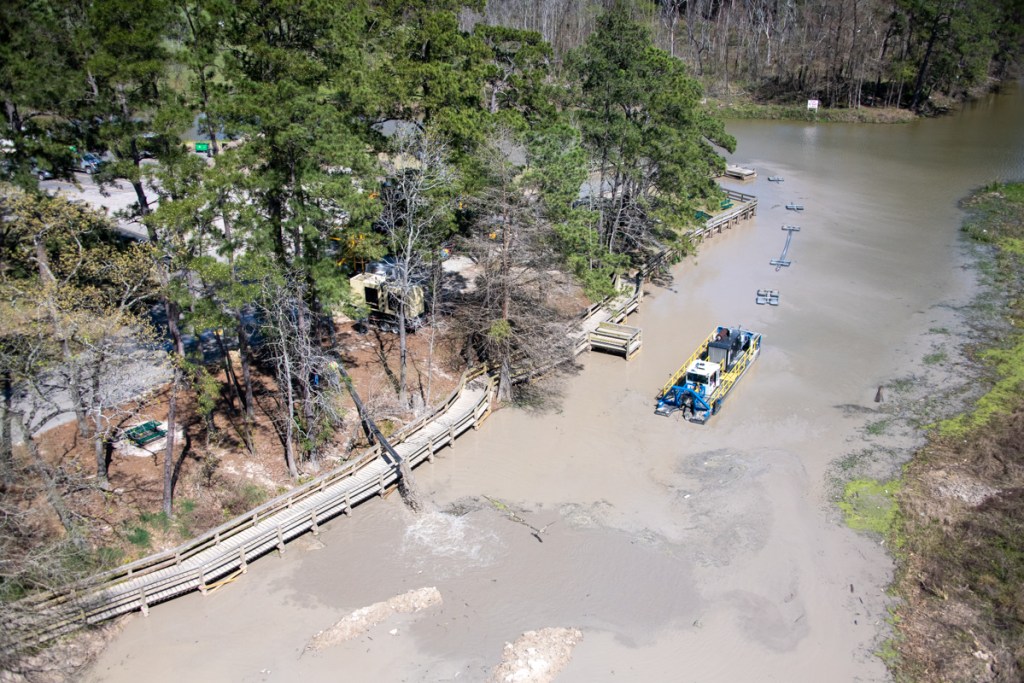
After a year of dredging, the Army Corps and its contractors are gone. Even though they didn’t get all of the West Fork Mouth Bar, they made dramatic conveyance improvements on the West Fork as these before/after photos show.

Sand Island Before Dredging

The first was a blockage that dredging contractors nicknamed “Sand Island.” It sat in the middle of the river just downstream from River Grove Park in Kingwood. According to the Corps, it blocked 90% of the river.

Sand Island formed during Hurricane Harvey. Boats that drew 18 inches of water could not navigate upstream past this giant sandbar. Photo taken 9/14/2019.

Sand Island After Dredging

Sand Island is now Gone Island. Photo taken 12/3/2019.

The Corps removed approximately 15 feet of sand over a 15 acre area that was 566.7 feet wide at its widest point. An acre is about the size of a football field. So this would be like stacking sand on a football field 225 feet high (15×15)! And that doesn’t even include the sand they removed from the channels on either side of the island in the background.

Sand Island Dredging Profile.

Diversion Ditch Bar Before Dredging

A second huge sand bar deposited by Harvey blocked the Kingwood Diversion Ditch, also at River Grove Park. The Diversion Ditch empties the western third of Kingwood. Approximately 600 homes flooded above this one blockage. They were in Barrington, Kingwood Cove, Trailwood, Kingwood Lakes and Kings Forest.

Diversion Ditch (center left) was virtually closed off by a new sandbar deposited by Harvey. Photo taken 9/14/2017.

Army Corps measurements show that at its highest point this bar measured 10 feet about the water surface. It forced water coming out of the ditch to make a 90 degree left turn where it then hit another downstream blockage.

Diversion Ditch Bar After Dredging

Photo taken 10/2/2019 after dredging opened up the channel and reduced the downstream bar.
Photo of same area taken on 11/4/2019, but looking upstream.

The Corps dredged a channel 150 feet wide through this bar to a depth of 35 feet above sea level. That’s about 7.5 feet below the normal water surface elevation of the Lake. The channel narrowed to 50 feet wide where it meets the mouth of the ditch.

From the highest point on the bar to the target depth, the Corps removed 17.5 vertical feet of sand. From the mouth of the channel to the outer edge of the bar measured 750 feet.

Comparison in Satellite Images from Google Earth

Here’s how this section of the river looked from a satellite BEFORE dredging. The numbers refer to the discussions above.

Here’s how it looked AFTER. (Note this image was taken on 2/23/19 and the dredge was still removing sand island.

Altogether, the Corps removed approximately 2.3 million cubic yards of sediment. Even if the Corps didn’t finish the mouth bar, that’s a lot to be grateful for. Thank you, FEMA, Army Corps, Great Lakes Dredge and Dock and Callan Marine.

Have a merry Christmas!

Posted by Bob Rehak on 12/24/2019

847 Days after Hurricane Harvey

KSA’s Christmas Present to Kingwood: A Beautifully Restored East End Park

Just in time for Christmas, East End Park is back and beautifully restored. KSA has resurfaced the entire trail network with crushed granite; repaired the boardwalks; repainted or power-washed the benches and picnic tables; restored the parking lot; and improved the entry.

Contractors mowed the meadows earlier in the fall and the tall grass has returned with a bumper crop of seed. The seed has attracted wintering birds. And deer abound…especially early and late in the day.

The park has not looked this good since KSA built out the trail network a decade ago (see poster below).

I walked for an hour and a half there this afternoon. It felt serene, tranquil, and rejuvenating. The low winter sun wrapped colorful leaves in golden sunlight. At one point, I met a father pulling his daughter in a wagon. They had stopped to watch a doe grazing in the woods. It all felt…so…perfect.

Father and daughter spotted a doe grazing in the woods at East End Park. Photo taken today.

Back from the Brink

Three major storms destroyed East End Park three times in rapid succession. Hurricane Harvey, the May floods this year, and then Tropical Storm Imelda each took a heavy toll. Harvey buried Eagle Point under 15 feet of sand. And Imelda added even more, but over a much wider area.

Because of repeated and costly damage to Eagle Point and the difficulty of building trails over loose sand, KSA intends to leave that trail natural for now. KSA may consider building an alternative trail on higher ground next year. If you venture into that part of the park, heed the warning signs. And above all, stay back from the shoreline. Imelda undercut it badly. Cave-ins have happened at several points. Imelda also severed a small portion of the Overlook Trail where 50 feet of the shoreline eroded overnight. Walk-arounds exist in both cases.

The Most Beautiful Part of the Most Beautiful Part of Houston

Bring the family out for a walk on Christmas Eve or Christmas Day. In my humble opinion, East End Park is the most beautiful part of the most beautiful part of Houston – Kingwood. It’s hard to believe that a natural area this beautiful could exist inside the nation’s fourth largest city. But it does. Make it a part of your family’s holidays.

KSA has restored East End Park trails and boardwalks to their pre-Harvey, pre-May 7th, pre-Imelda state. Nature is restoring the rest.

Posted by Bob Rehak on December 24, 2019 with thanks to Dee Price, Chris Manthei, Mary Ann Fortson, KAM, Ira Guel, Bruce Casto and the entire KSA Parks Committee for their tireless support

847 Days since Hurricane Harvey and 96 since Imelda

Harris County Approves TWDB $30 Million Grant Application for Dredging at Confluence of San Jacinto and Lake Houston

In the last legislative session, State Representative Dan Huberty sponsored an amendment to Senate Bill 500. The amendment earmarked a $30 million grant for additional dredging at the confluence of the San Jacinto River and Lake Houston. Last week, Harris County approved the grant application to the Texas Water Development Board. That will actually transfer the money so that it can be put to work.

How $30 Million Grant Would Be Spent

County Engineer John Blount explains how the money would be spent in his cover letter that accompanied the request to Commissioners.

“The approach to completing work under the grant,” says Blount, “would be for the County to receive the grant funds, make the City of Houston a subrecipient to start immediate dredging, and to develop a long-term plan for keeping the region’s raw water supply viable with adequate reservoir capacity. The County would be reimbursed from the grant for administrative and other related expenses incurred.”

County Plays Central Role In Coordinating Effort

Blount concludes, “If authorized, the County will work with the Flood Control District, Budget Office, County Attorney, City of Houston, and the State of Texas, to advance all necessary applications and agreements needed to initiate the dredging activities funded in the 2019 legislative session. Grant awards, if made, will be presented to Commissioners Court for consideration at a future date.”

Commissioners Court approved the motion unanimously in its Tuesday, December 17th meeting. And by Friday, the actual grant application had been sent to the TWDB, according to Matt Zeve, Deputy Executive Director of Harris County Flood Control. The TWDB board should consider the request at its first board meeting in January, tentatively scheduled for the 10th. Huberty expects quick approval because the Legislature earmarked the money specifically for this purpose.

Water Supply, Not Just Flood Mitigation, An Issue

Dredging affects more than flood mitigation. It also affects water capacity for Lake Houston. The lake supplies drinking water for 2 million people. The Interbasin Transfer Project will soon bring 500,000 gallons per day from the Trinity River. But a growing East Fork mouth bar could soon block Luce Bayou. That’s where the water will enter the lake to be used by the Northeast Water Purification Plant.

As a result of sediment deposited during Harvey and Imelda, the East Fork Mouth Bar grew southward 4000 feet and now has almost reached the point where Luce Bayou and water from the Trinity River will enter Lake Houston. Photo taken 12/3/2019. Water flows from left to right.

West Fork Also Plays Role in Water Transfer

That’s also why the West Fork must remain clear. It brings water, when needed, from Lake Conroe.

Looking south across the mouth bar of the San Jacinto West Fork toward Lake Houston. Photo taken 12/3/2019.
Reverse angle. Looking northwest toward the San Jacinto River and the West Lake Houston Parkway Bridge. Note the submerged sand about to break through the water surface around the mouth bar. Photo taken 12/3/2019.
Kayaker RD Kissling standing in less-than-knee-deep water 700 yards south of the West Fork Mouth Bar. Photo taken November, 2019.

Like icebergs, sand bars mostly exist below the surface. What you see above water is a small percentage of what exists below water.

These photos illustrate why more dredging is essential. The mouth bars form dams behind the dam that block the free flow of water and decrease reservoir capacity.

Exploring Most Cost-Effective Options for Future

Between June when the Legislature approved the money and now, the City, County and State have explored ways to work together to ensure they spend the money cost-effectively. The county hired a consultant to explore the merits of do-it-yourself dredging vs. hiring a contractor. At the moment, the partners lean toward the contractor approach. It offers long-term flexibility as they explore future needs around the lake.

In addition to the $30 million from the State, the City of Houston allocated $6 million from money left over from Harvey disaster recovery funds. The County also allocated $10 million in its flood bond for dredging.

Initial Disposal Site Already Approved

The Army Corps approved Barry Madden’s property as a disposal site for the spoils. Madden’s property is opposite River Grove Park. That puts it miles closer to the Mouth Bar than previous placement areas used by the Corps. That should reduce costs by reducing the need for booster pumps and fuel.

The pieces of the puzzle are starting to come together.

Posted by Bob Rehak on 12/23/2019

846 Days since Hurricane Harvey and 95 since Imelda

East Fork Mouth Bar Grows 4000 Feet During Harvey and Imelda

If you boat between the San Jacinto East Fork and Lake Houston, perhaps you’ve noticed it’s a little harder getting from A to B lately. The San Jacinto East Fork Mouth Bar has grown approximately four fifths of a mile during the last two storms and the channel depth has decreased 6X.

These three pictures tell the story dramatically.

I took the first after Hurricane Harvey and the second after Tropical Storm Imelda. The third comes from Google Earth BEFORE Harvey.

East Fork Mouth Bar After Harvey

Looking north toward Kings Point from the East Fork of the San Jacinto River after Harvey. Note fresh sand several feet deep everywhere. Photo taken 9/14/2017, two weeks after Harvey.

East Fork Mouth Bar After Imelda

Extent of East Fork Mouth Bar After Imelda. Photo taken 12/3/2019. Note in this photo how much closer the sandy bottom is to the surface throughout the entire area.

Pre-Harvey to Post-Imelda Growth

Satellite image from January 2017 BEFORE Harvey. Yellow line represents approximate growth in East Fork Mouth bar between then and today – about four fifths of a mile. For alignment purposes, note the tip of the Royal Shores Lake in the first aerial photo and Royal Shores in the second.

Boater Josh Alberson says the maximum channel depth in this area decreased from 18 feet after Harvey to 3 feet after Imelda.

Geologic Change on a Human Time Scale

Note how the leading edge of this growing bar is now almost even with the entrance to Luce Bayou. When we get another storm like Imelda, the East Fork Mouth Bar could block the Interbasin Transfer Project from delivering water to Lake Houston.

Changes like these usually happen on a geologic time scale. They happen so slowly, humans can barely perceive them during the course of a life time. However, Harvey and Imelda produced this change in two years. They provide us with a rare glimpse of a living planet in our own backyard.

If you have children, grandchildren or students, please share these photos with them. They make valuable life lessons about the power of moving water and respect for Mother Nature. They may also stimulate curiosity in Earth sciences and engineering.

Posted by Bob Rehak on 12/23/2019 with depth soundings from Josh Alberson

846 Days since Hurricane Harvey and 95 since Imelda

Perry Homes Pulls Excavation Equipment From Woodridge Village Before Finishing Detention Ponds

Instead of accelerating completion of detention ponds on Woodridge Village as Perry Homes promised, the company appears to have pulled all excavation equipment from the site. Contractors who were supposed to have been working on detention pond N-1 have gone…BEFORE they finished S2 and BEFORE they finished a berm sealing off the southern portion of the site at Fair Grove Drive.

S2 Pond Still Not Complete; Does Not Meet Regs

On October 17th, a lawyer for Perry Homes’ subsidiaries sent a letter to the City of Houston Attorney promising that the company would “accelerate” completion of detention ponds. Even though Perry Homes had already substantially completed Detention Pond S2, it took Perry 63 days to restore it to its pre-Imelda condition. Worse, contractors left before the pond met the regulations in Montgomery County’s Drainage Criteria Manual. It still doesn’t have fencing, service roads around its entire perimeter, or grass on its banks. Finally, it holds water when regulations call for a dry bottom.

Equipment Left Site Instead of Beginning On Next Pond

Perry Homes had promised in its letter to accelerate construction, but this will slow it down – if they ever return. The only work being done Friday? Removal of some dead tree piles on the northern portion of the site.

Jeff Miller took all the pictures and videos below on Friday and Saturday. He also monitored work on the site and provided this scouting report.

Looking south toward Taylor Gully and the Harris County Line along the eastern embankment of the S2 detention pond.
The channel along the eastern portion of Taylor Gully is now lined with concrete. The spillway into the S2 detention pond has been widened and smoothed. The S2 detention pond is behind the camera position. Looking East.
Looking west across S2 detention pond. The dirt that eroded into the pond has been scooped back up onto the banks and compacted. Still no grass on the banks, however, so it could all wash back in with the next big rain.
Looking north. The grassy area in the background was supposed to have contained the N3 detention pond. However, contractors have simply excavated a channel from the northern section directly into Taylor Gully so now runoff can accumulate even more quickly.
Contractors widened and concreted the Taylor Gully channel along the eastern side of Woodridge Village. But they left the most vulnerable part of the channel without concrete. At the end corner by the telephone poles, water comes from the left. But no concrete protects the area where the water makes a sharp 120 degree turn. Expect water to erode behind the concrete and peel it away in the next big rain.

Woodridge Village Section One Now a Virtual “Ghost Town”

This weekend, Woodridge Village Section One looked like a ghost town, not a bustling construction site with people working against a deadline.

Heavy construction equipment used to be parked by dumpster in the background. Now it’s nowhere on the property.
Looking south. Another view of the same area that held construction equipment. It’s all gone and the berm sealing the site off from Fair Grove Drive is missing.

Still Removing Dead Trees/Mulch on Northern Section

On Friday, only smaller equipment turning tree piles into mulch remained.

Perry Homes Intentions Now a Mystery

As of Sunday morning 12/22/2019, no equipment actually working on construction could be seen on the site. The excavators and dump trucks parked at Fair Grove for months have been removed.

Perry Homes is NOT accelerating completion of detention ponds as it promised the City of Houston.

Instead, Perry Homes has thrown a curtain of silence around this job. It’s hard to know what their intentions are. At this point, Perry Homes’ lawyer J. Carey Gray has as much mud on his face as Elm Grove residents had in their homes.

The only thing we can say with certainty: Lowering flood risk for the people of Elm Grove does not seem high on Perry Homes’ priority list.

For Sale And For Lease Signs Serve as Christmas Yard Decorations

Meanwhile, a drive down Shady Maple or Village Springs, the two streets that border Taylor Gully, revealed residents’ attempts to salvage Christmas from the chaos of floodwaters. Dumpsters and debris still line the streets. Some people still live in trailers in their driveways. No apple cider around the hearth for them. They’ll be lucky to find space for a table top Christmas tree. For Sale and For Lease signs outnumber Christmas yard decorations ten to one.

On a street called Right Way in North Kingwood Forest, I found nine For Lease signs in a row. Sad reminders of Imelda and Perry Homes. Only three months ago, these homes were filled with families who flooded for the second time.

Kathy Perry Britton just added another credit to her resume, “The CEO Who Stole Christmas.”

Posted by Bob Rehak on 12/22/2019 with reporting and images by Jeff Miller

845 Days since Hurricane Harvey and 94 since Imelda

The thoughts expressed in this post represent opinions on matters of public concern and safety. They are protected by the First Amendment of the US Constitution and the Anti-SLAPP Statute of the Great State of Texas.