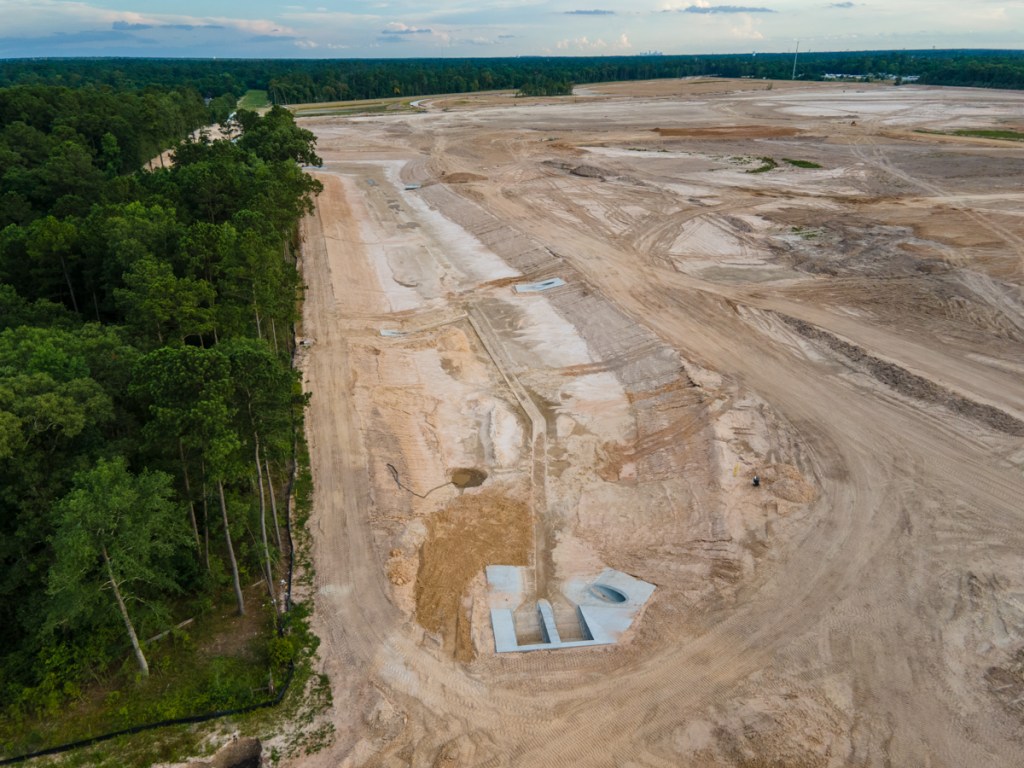
More recent independent laboratory testing has verified fecal contamination in at least two drainage ditches in Colony Ridge. Moreover, residents claim they have found fecal contamination in other Colony Ridge ditches and streams, too. It’s not clear whether those additional spills have been tested.
During heavy rains, fecal contamination can quickly wash downstream and eventually wind up in Lake Houston.
A major concern of residents is the frequency of sewage leaks.
Results of TCEQ Investigation
Maple Branch Creek carried black water into the East Fork.
TCEQ cited Quadvest L.P., the sewage and water provider for Colony Ridge, for “unauthorized discharge of wastewater which resulted in a documented serious impact to the environment.”
A month after TCEQ documented this discharge, 33 inches of rain fell on nearby Plum Grove during TS Imelda.
Here are results of the first test and pictures of the sewage.
The first site on a ditch next to County Road 5023 showed 3090 and 3130 units of fecal coliform, with none detected in the control sample. Maria Acevedo photographed this problem on June 4, 2020.
Photo on June 4, 2020 by Maria Acevedo on CR 5023 where Eastex took samples.
Sludge oozing down same ditch.
Second Eastex Report Shows VERY STRONG Fecal Contamination
Samples collected and analyzed by Eastex Environmental Labs, eliminating chain of custody issues.
The lab told Acevedo that they found “very strong fecal contamination.”
Maria acevedo
Residents who wish to remain anonymous for fear of retaliation, contacted me about this site a week before Eastex sampled it.
Location of Second Sample Photographed on 6/12/2020
I photographed that ditch on Friday, 6/12/2020. It’s on the southeast corner of Colony Ridge. While there, I photographed cloudy water bubbling up out of the ground and running down a ditch toward Tarkington Bayou (see photos below).
Foul water and trail of greenish-brown sludge (left) bubbling up through ground……then flowed into ditch toward Tarkington Bayou at bottom of hill.Close up of water/sludge in ditch.Silt fence in ditch was propped up, ensuring foul water could ooze under it.Farther down the ditch, contaminated water was pooling, and turning green and black.In places, it had dried due to extreme heat. Temp was in 90’s.
Photos Taken Two Days Later Show Attempted Coverup
I came back two days later on 6/14 to explore the same area some more. The foul water still bubbled up, but someone with a bulldozer attempted to cover up the evidence in the ditch.
Sludge and contaminated water bubbled up from same hole on 6/14/2020.However, the evidence in the ditch near the road had been freshly covered up by a bulldozer.
The Leaks Go On
If the incidents above were isolated, one might dismiss them. But they seem to be part of a larger, recurring pattern that neither Colony Ridge, Quadvest, nor Liberty County have stopped.
A resident says this sanitary sewer was leaking for more than two months into a ditch in a residential neighborhood and stunk like sewage.Photo by Maria Acevedo on CR5006 on March 18, 2020.
The largely Hispanic residents complain among themselves. But few reportedly file reports for fear of raising their profiles with authorities and perhaps answering difficult questions in court. Meanwhile, the sewage leaks go on. Both Colony Ridge residents and those downstream pay the price.
Posted by Bob Rehak on 6/23/2020
1029 Days since Hurricane Harvey and 278 since Imelda
The thoughts expressed in this post represent opinions on matters of public concern and safety. They are protected by the First Amendment of the US Constitution and the Anti-SLAPP Statute of the Great State of Texas.
https://i0.wp.com/reduceflooding.com/wp-content/uploads/2020/06/IMG-7112.jpg?fit=1024%2C576&ssl=15761024adminadmin2020-06-23 00:04:242020-06-23 01:56:3148,000 Gallons of Fecal Contamination Found in Liberty County’s Colony Ridge Ditches, Streams; Problems Persist
Photo Courtesy of Dee Price. Taken at East End Park where Peach Creek, Caney Creek and East Fork all come together.
Stopping Beaver Dams Before They Start
During floods, the downed trees get swept downstream. They form “beaver dams” that back water up when the debris hangs up on other trees, boat docks, bridges and the Lake Houston dam itself. Removing the debris lowers the risk of flooding and damage.
During Harvey, such debris gathered in supports of the Union Pacific Bridge over the west fork, where it contributed to flooding in Humble.
Union Pacific Bridge immediately after Harvey. Photo Courtesy of David Seitzinger.Donna Dewhirst’s boat dock received a 70-foot surprise during Harvey.Rail bridge over Lake Houston after Harvey. Photo courtesy of Donna Dewhirst.Logs collect at Lake Houston Spillway. Photo taken on 6/16/2020.
Improving Boater Safety
The debris pickup also improves boating safety when lake and rivers are low. Submerged trees can injure and kill boaters and water skiers.
Semi-submerged trees in Lake Houston just north of FM1960 Bridge. Photo taken March 6, 2020.
Posted by Bob Rehak on 6/21/2020
1028 Days since Hurricane Harvey
https://i0.wp.com/reduceflooding.com/wp-content/uploads/2020/06/DSCF2256-copy.jpg?fit=1200%2C900&ssl=19001200adminadmin2020-06-21 13:09:402020-06-21 13:09:51New Phase of East Fork Cleanup Begins
Perry Homes’ current contractors have excavated 3X more detention pond volume in ten weeks than the previous contractors did in virtually two years. During this past week, they finished excavating three ponds on the northern section of Woodridge Village. Together, they comprise 77% of the total detention volume for the whole site.
Excavation Done, but Finish Work Remains
That doesn’t mean they’re totally done with the ponds. Recent aerial photos show that they still have much finish work to do. That includes:
Shaping the sides
Creating backslope swales
Installing pipes to funnel water from the swales into the ponds and channels
Ensuring water can flow out of Adams Oaks in Porter on the west side of the subdivision into Taylor Gully as it previously did
Creating concrete “pilot channels” in the center of the ponds and larger channels
Planting grass along the sides of the slopes to reduce erosion
Installing outflow control in several places to hold back floodwaters
Building maintenance roads around the ponds
Elm Grove resident Jeff Miller, who monitors the progress of construction daily, says crews are already hard at work on many of those tasks.
Ponds NOT Expanded Beyond Initial Plans
Miller has compared the width and depth of ponds to the initial plans and verified that the ponds are being built to original specifications. Since the ponds were designed to meet pre-Atlas 14 rainfall requirements, that means the site will still hold 30-40% less runoff than needed to meet current regulations.
With the peak of hurricane season now less than two months away, Perry Homes is in a race against risk. The company may regret the six months of virtual inactivity between the completion of pond S2 and the start of work on ponds N1, N2, and N3 in early April.
The faster pace of current construction puts pressure on Harris County and the City of Houston to complete an offer if an offer will be made. Elm Grove residents lobbied the City and County to purchase the property and build a regional flood detention facility. They center would also help protect downstream residents on the East Fork and Lake Houston.
However, at a Kingwood Town Hall Meeting in February, Mayor Pro Tem Dave Martin announced that the City would not participate in a deal. He said it was the County’s responsibility.
Then in May, the County increased its demands. The County now wants the City to contribute land in lieu of cash to cover half the purchase AND construction costs for creating additional detention.
County and City Clamp Down on Communications
Since then, the County has clamped down on communications regarding this subject. Rumors suggest that all parties are still trying to make a deal happen. But the County has denied all FOIA requests and referred them to the Texas Attorney General for a ruling on their denials. That often happens when negotiations are in progress, according to a knowledgeable source.
What Happens Next?
At the contractor’s current rate of progress, it’s entirely possible that contractors will complete all work on detention ponds in July.
With approximately $14 million dollars invested in the property, with hurricane season here, with lawsuits pending, and knowing that the amount of detention is insufficient to hold a 100-year rain, Kathy Perry must be sweating bombshells.
Ms. Perry may be hoping for a City/County offer, but she can’t be counting on one. If she were, she could have sold the dirt coming out of those detention ponds. Instead, however, she’s building up land elsewhere on the site to keep her options open and develop the site if a deal falls through.
That dirt will have to be moved again at taxpayer expense if the county builds additional detention ponds.
Pictures of Site as of 6/19/2020
Here’s what the site looked like as of 6/19/2020.
Looking NW from over Taylor Gully toward Pond N2, the largest on the property.The connecting channel between N1 at the top of the frame and N2 along the western edge of the property has been excavated.Note the pilot channel that contractors have startedin the distance.At Mace Street in Porter, contractors created a concrete face for the twin culverts on the upstream side, but not yet on the downstream side. Note the earthen dam holding water back while contractors complete the pilot channel running off the bottom of the frame.Above Mace Street, contractors are still putting in pipes between the channel and backslope swales.The Webb street entrance to the site has been removed to connect N1 (out of frame on the top) with N2 (out of frame on the lower left).Looking SE at N1.Looking South at N3, which runs down the eastern edge of the property.More pipes are being put in to channel water from backslope swales to the pond so water won’t erode the face of the pond. Not the rills already cut in the dirt.Looking SE. The southern half of N3 where it connects with Taylor Gully in the upper right.N3’s connection to Taylor Gully is now wide open. It’s not clear how this connection will be completed to release the water at a slow controlled rate.The two culverts under the bridge over Taylor Gully should slow the water from N2 (upper right) and N1 (out of frame) down.
Need for Grass if Deal Not Reached Quickly
Note how the grass on the southern side of the gully has all died. That raises a question. If Perry, the City and County do not complete a purchase agreement soon, will Perry plant grass on the northern section to slow runoff. Right now, it’s all hard-packed dirt.
Most of northern section is hard packed dirt which increases runoff rate.
Planting grass over an area this large would be a big investment and might get in the way of construction if Perry decides to develop the land. But it will reduce flood and legal risks.
Posted by Bob Rehak on 6/20/2020
726 Days after Hurricane Harvey and 275 after Imelda
https://i0.wp.com/reduceflooding.com/wp-content/uploads/2020/06/20200619-DJI_0205.jpg?fit=1200%2C900&ssl=19001200adminadmin2020-06-20 14:57:582020-06-20 14:58:16Perry Contractors Now Focusing on Finish Work for Detention Ponds
Attorneys for owners of 304 flooded homes in Elm Grove have named Perry Homes, LLC and Concourse Development, LLC as additional defendants in their lawsuit. Plaintiff’s lawyers filed their 287-page, sixth amended petition on 6/16/2020. Today, they also filed a request for a new trial date of 3/1/2021.
New Information May Tie Perry, Concourse Directly to Floods
Based on allegations made in the lawsuit, it appears that attorneys may now have evidence that Concourse (the developer of Woodridge Forest) was also part owner of Woodridge Village. Wording within the allegations also suggests that Perry Homes was directly involved in the actions of its subsidiaries PSWA and Figure Four Partners, which in turn were telling contractors what to do and not to do.
This is potentially good news for plaintiffs because companies, such as PSWA and Figure Four are only subsidiaries of Perry. Such subsidiaries often act as shell companies that shield the parent company from liability. With few assets, the subsidiaries simply declare bankruptcy if they lose a large lawsuit. Then, life goes on as normal for the parent company. However…
Both Perry Homes and Concourse Development have substantial assets. Perry claims to be close to a billion dollar company.
Concourse developed the adjacent Woodridge Forest, where Perry also built homes. It bought Woodridge Village land and then held it for six days before selling it to Perry. Evidently, they didn’t sell their entire interest. Before the May 7th flood, Concourse bragged about its role in Woodridge Village. But after the flood, the company removed all mentions of Woodridge from its web site.
Screen Capture from Concourse Development website before lawsuits filed.
Allegations in Sixth Amended Petition
The big news: The plaintiff’s sixth amended petition now names Perry and Concourse as additional defendants. Previous petitions named only Perry subsidiaries, contractors and LJA Engineering.
In the new petition, defendants allege that:
LJA used an outdated version of Montgomery County’s Drainage Criteria manual when it designed drainage for Woodridge Village.
Figure Four failed to properly review the plans, catch the error, oversee LJA, or make construction decisions.
As a group, Figure Four, PSWA, Perry Homes and Concourse (referred to as “Developer Defendants” in the amended petition) hired contractors and directed them to fill in existing creeks and drainage channels, and to remove a levee or berm on the south side of Taylor Gully that had previously protected Elm Grove. The existence of this berm was not mentioned in LJA’s engineering plans, they say.
Even after the first flood on May 7th, when developers were aware of the danger, they failed to take corrective actions that would have prevented the September 19th flood.
As a direct consequence of their actions and inactions, the developers flooded hundreds of homes in Elm Grove.
The inactions of Perry and Concourse following the May 7th flood justify punitive damages.
Key Elements of Agreement Between Developers
The petition also claims that the four developer defendants entered into an agreement that called for them to:
Make exhaustive or continuous on-site inspections to check the quality and quantity of work
Be responsible for the techniques and sequences of construction, and safety precautions
Take responsibility AND liability for the contractors’ failure to construct the project in accordance with the contract documents.
However, the plaintiffs also accuse the developer defendants (through negligence or omissions) of:
Failing to make exhaustive or continuous on-site inspections to check the quality or quantity of the work
Failing to properly monitor the techniques and sequences of construction or the safety precautions to ensure Elm Grove would not flood during construction
Failing to ensure the contractors performed the construction work in accordance with the contract documents
Failing to incorporate drainage studies prior to initiating construction on the Development
Failing to properly direct and supervise the means, methods, and techniques of the sequence in which the contractors performed the work on the Development
Removing drainage from the Development
Removing a levee and/or berm from the Development
Failing to implement a proper construction schedule
Failing to follow the construction schedule
Blocking the drainage channels
Filling in existing drainage channels
Failing to properly install box culverts
Failing to create temporary drainage channels
Failing to allow adequate drainage after construction
Failing to install silt barriers
Allowing the Development to force rainfall toward Plaintiffs’ homes’
Diverting surface water towards Plaintiffs’ homes
Failing to pay proper attention
Failing to provide notice or warning
Failing to have a proper rain event action plan
Failing to have a proper storm water pollution prevention plan
Failing to follow a proper storm water pollution prevention plan
Failing to coordinate activities and/or conduct
Failing to supervise the activities of the Development and engineering
Failing to instruct in proper construction and/or drainage requirements
Failing to train in proper construction and/or drainage requirements
Failure to review engineering plans
Failing to comply with the Terracon Consultants, Inc. geotechnical report
Failing to construct the emergency release channel
Failing to timely implement the detention ponds
Allowing inadequate construction to take place
Failing to hire an adequate engineer to implement the project plan
Failing to protect runoff from flooding homes
Failing to protect Elm Grove from flooding during construction.
Basis for Exemplary Damage Claim
Paragraph 42 contains some of the strongest language in the complaint. It alleges that the Developer Defendants knew of the risks, and both the probability and magnitude of the potential harm to others. The complaint asserts, “These acts and omissions were more than momentary thoughtlessness, inadvertence, or error of judgment. Rather, the Developer Defendants had actual, subjective awareness of the risk involved, but nevertheless proceeded with conscious indifference to the rights, safety, or welfare of others.”
“Such acts and/or omissions,” the paragraph continues, “were a proximate cause of the flooding and the resulting injuries and damages sustained by Plaintiffs. Accordingly, Plaintiffs hereby seek an award of exemplary damages.”
Having said all that, the plaintiffs seek BOTH ordinary and exemplary damages (defined below).
Location of plaintiffs’ flooded homes in relation to Perry/Concourse property.
8 Defendants, 9 Counts, 2 Floods, 3 Degrees of Negligence
Altogether, the petition alleges nine counts against eight defendants in two floods. Spelling out who is being sued for what and why involves a lot of overlap and redundancy. But some of the Counts specify subsets of defendants, floods, allegations and degrees of negligence. So you may want to read the entire document.
The petition splits the defendants into three groups: Contractors, Developers, and LJA Engineering, with specific charges against each. The basis for charges sometimes varies also. For instance, charges against LJA include (in addition to many of those above) failure to:
Adequately report the modeling
Use the correct hydrology method
Adequately model the development
Notify the developers and contractors of the importance of the existing berm.
Plaintiffs say LJA was aware of the risks, but nevertheless proceeded with willful and conscious indifference to the rights safety and welfare of the victims.
As a result, plaintiffs are suing LJA for negligence, negligence per se and gross negligence for BOTH floods.
Differences Between Degrees of Negligence
Black’s Law Dictionary describes the differences:
Negligence is the failure to do something which a reasonable and prudent man would do, or doing something which a reasonable and prudent man would not do.
Negligence Per Se is the form of negligence that results from violation of a statute. The violation of a public duty enjoined by law for the protection of people and property. So palpably opposed to the dictates of common prudence that no careful person would be guilty of it.
Gross Negligence is the intentional failure to perform a manifest duty in reckless disregard of the consequences as affecting the life or property of another. It is a conscious and voluntary act of omission which is likely to result in grave injury when in the face of clear and present danger of which the defendant is aware.
Nuisance Claim
In addition to negligence, plaintiffs also claim nuisance…”When Defendants unlawfully diverted … water onto Plaintiffs’ homes.”
Black’s Law Dictionary defines nuisance as “…that activity which arises from unreasonable, unwarranted or unlawful use by a person of his own property, working obstruction or injury to right of another…and producing such material annoyance, inconvenience and discomfort that law will presume resulting damage.”
Seeking Damages, Exemplary/Punitive Damages
The ordinary damages, plaintiffs claim, consist of one or more of the following:
Cost of repairs to real property;
Cost of replacement or fair market value of personal property lost, damaged, or destroyed during such event;
Loss of use of real and personal property;
Diminution of market value of Plaintiffs’ properties;
Loss of income and business income;
Consequential costs incurred, inclusive of but not limited to alternative living conditions or accommodations and replacement costs;
Mental anguish and/or emotional distress;
Prejudgment interest;
Post judgment interest;
Attorneys’ fees
Costs of Court.
However, as a result of alleged gross negligence, plaintiffs also seek exemplary damages as punishment. Black’s Law Dictionary defines exemplary damages as “Damages on an increased scale awarded to a plaintiff over and above actual or ordinary damages, where wrong done to a plaintiff was aggravated by circumstances of violence, oppression, malice, fraud, or wanton and wicked conduct.”
Defendants’ Responses Not Yet Filed
As of this writing, the Harris County District Clerk’s website does not show responses filed by either Perry or Concourse to new allegations.
March 1 Preferential Trial Date Requested
Because of the number of plaintiffs, expert witnesses, defendants and law firms involved in this case, the plaintiffs have requested a “preferential trial setting” of March 1, 2021. A preferential trial setting eliminates the possibility of numerous continuances due to scheduling conflicts between the court, parties, attorneys and witnesses.
The plaintiffs have also requested a proposed Amended Docket Control Order that shows alternative dispute resolution (mediation) happening on 1/29/2021.
Net: If the judge accepts the new timetable, it will likely be another 7 to 8 months before this case sees any resolution.
As new developments happen, read about them here.
Posted by Bob Rehak on 6/19/2020
1025 Days since Hurricane Harveyand 274 since Imelda
https://i0.wp.com/reduceflooding.com/wp-content/uploads/2020/06/Location-of-Plaintiffs.jpg?fit=1200%2C871&ssl=18711200adminadmin2020-06-19 17:30:442020-06-19 17:33:39Elm Grove Lawsuit Names Perry, Concourse Development As New Defendants; Trial Delayed
Certainly, there are many honorable developers who try to build high-quality communities for people without adversely affecting downstream residents. I don’t wish to malign a whole profession. Nor do I want to fail to acknowledge the many wonderful communities they have built in this area.
But there are also some developers who put profit before people. They try to cut corners wherever they can and hope that nobody will notice. Especially regarding flood control. It’s expensive and easy because most people don’t understand it.
Grand Parkway Coming Soon To Wetlands Near You
The construction of State Highway 99, aka the Grand Parkway, has opened up vast new areas on the outskirts of Houston to developers. Many of those areas consist of wetlands and forests.
TxDoT is currently prepping land for Section H of the Grand Parkway almost all the way to FM 1960 on the east from US59.
From USGS. Wetlands near the path of Grand Parkway extension. Compare with maps above and below.
Visible Difference in Development Density Where SH99 Completed
The map below shows permit applications in the north Houston area. Compare the density of projects around sections of the Grand Parkway that have already been completed (left) with the areas on the east where the concrete has not yet reached.
This map shows permit applications in the northeast Houston area, both within the City and its ETJ (extra territorial jurisdiction. The Colony Ridge development featured below is outside the ETJ (green area) in the upper right of the map above.
Developers have even more projects underway outside the City’s ETJ (not shown on the map above).
How Development Can Affect Flooding
Kingwood residents have seen how one developer can contribute to flooding hundreds of homes. Last year, Perry Homes clearcut 268 acres north of Elm Grove before installing detention ponds. Hundreds of Elm Grove homes then flooded on May 7 and again on September 19, during Tropical Storm Imelda.
Below are recent photos of a massive 10,000 acre development in Liberty County near Plum Grove. It is about to become a 15,000 development now, thanks in part to Grand Parkway access. And yet it has only one small traditional detention pond.
Detention ponds slow down the rate of runoff to compensate for the loss of trees, wetlands and ground cover that have been replaced by streets and rooftops.
Their goal: to prevent downstream flooding.
Colony Ridge Accounts for All Growth in Liberty County In Last Decade
Colony Ridge can account for all the growth in Liberty County in the last decade. Below are some photos of Colony Ridge and its expansion near Plum Grove. The approach of SH99 will make it more accessible and therefore more attractive (at least from one point of view).
All aerial photos below were taken on 6/126/2020.
Looking north across the Grand Parkway extension toward Colony Ridge in Liberty County near Plum Grove.Just north of the Grand Parkway (upper left), you can see roads going in that will accommodate even more manufactured homes, aka trailer homes.The developer puts in roads, ditches, water and sewer. Fire hydrants? Forget it.
Developer’s Marketing Strategy
The developer tries to pass as many costs along to lot buyers as he can to maximize profit. He targets Hispanics. Residents tell me that sometimes two or three families may live in one of the homes you see here.
Nobody knows the real population of Colony Ridge because many residents are reportedly undocumented and uncounted.
Site work before parking a home is the responsibility of site buyers, many of whom openly burn brush to clear their lots. Like the developer, they’re trying to cut costs.
Land of Fire and the Forgotten
Resident burning brush on his property last Sunday afternoon.Residents aren’t the only ones burning.That smoke you see on the horizon is from dozens of brush fires set by the developer as he continues to clear land.Here’s one still smoldering.At this point, a major storm would bring the potential for uncontrolled erosion,just as it did in Woodridge Village in Montgomery County, above Elm Grove.As dry as it has been lately, the developer is burning brush piles next to woodlands. That increases fire risk. The barren surface also accelerates runoff and erosion, increasing flood risk.Note the haze and plums of smoke on the horizonand the vast expanse of exposed, packed dirt.The smoke is coming from burning piles of brush, such as these. If a fire spread into surrounding woods, local volunteer fire departments would be overwhelmed.No fire hydrants anywhere in sight.
If this were Houston, hydrants would be spaced at a minimum of every 500 feet. A firefighter told me that the spacing often depends of home values and population. Based on population alone, he believes this area should have hydrants.
One Small Detention Pond for 15,000 Acres
The developer has one detention pond (center) for the entire 15,000 acres. He relies on less efficient, in-ditch detention for additional capacity.Note the proximity to SH99 in the upper right.There are no detention ponds anywhere in the new areas being cleared. This is reminiscent of Woodridge Village which contributed to the flooding of hundreds of homes in Elm Grove.But Woodridge was only 268 acres. The developer relies on this and other drainage ditches to double as detention ponds in storms. But at the far end of this ditch……FM 1010 washed out during Harvey and destroyed one of the two major access roads into the development. The in-ditch detention failed. So has the county. The road has been out now for 1025 days, increasing the commute time for residents and the response time for firefighters.
Endless Loop of Construction and Destruction
State Highway 99 represents more than just a third loop around the City of Houston.
SH 99 will bring more developersand more people eager to escape downstream flooding issues.
Tapayer funded roads such as these create endless loops of construction and destruction. They are like a perpetual motion machine. Building one area floods another, causing people to move farther out and the cycle to repeat itself.
No one will admit it’s intentional, of course. The flooding is just a byproduct of greed. Cut a detention pond here. Substitute in-line detention there. Don’t bother planting grass to reduce erosion. Send your problems downstream. Let someone else worry about them.
One Chance
Do all developers think that way? Of course not. Many have principles and wonderful communities to show for them.
That notwithstanding, as one Splendora resident said, “They really only have one chance to get this right. If they screw this up, it will be almost impossible to fix and they will argue over who is going to pay for it for centuries.”
We are at that inflection point now.
Posted by Bob Rehak on 6/19/2020
1025 Days since Hurricane Harvey
The thoughts expressed in this post represent opinions on matters of public concern and safety. They are protected by the First Amendment of the US Constitution and the Anti-SLAPP Statute of the Great State of Texas.
https://i0.wp.com/reduceflooding.com/wp-content/uploads/2020/06/20200616-RJR_3705.jpg?fit=1200%2C800&ssl=18001200adminadmin2020-06-18 21:28:292020-06-18 21:57:39“The Developers Are Coming! The Developers Are Coming!”
Construction of State Highway 99, also known as the Grand Parkway, has turned south. It is now approximately 4.5 miles from FM1960, but more than 20 miles from reaching its goal of I-10. In the image below, taken on 6/16/2020, you can see it crossing the Luce Bayou Inter-Basin Transfer project and then heading through open farm land.
Looking southeast. Grand Parkway construction has now passed the Luce Bayou Inter-Basin Transfer Project. Approximately 4.5 miles remains before construction reaches FM1960 to the south.
The Grand Parkway will open up vast areas in Montgomery, Harris and Liberty counties for development. All of that will put pressure on Lake Houston, shown in the lower left of the satellite image below (which was taken seven months ago.
Now, more than ever, it’s important for these counties to work together to reduce the risk of flooding for downstream residents in Houston, which is the economic center of the region.
Without a vital, safe center, growth in the entire region could falter.
Posted by Bob Rehak on 6/18/2020
1024 Days after Hurricane Harvey
https://i0.wp.com/reduceflooding.com/wp-content/uploads/2020/06/20200616-RJR_3555.jpg?fit=1200%2C800&ssl=18001200adminadmin2020-06-18 15:33:432020-06-18 15:33:53Grand Parkway Construction Now Within 4.5 Miles of FM1960
New Caney ISD is planning to build a new comprehensive high school on a roughly 50-acre site between US59 and Sorters-McClellan Road, where a par-3 golf course used to be. The land is south of HCA Kingwood Medical Center and behind several car dealerships that face US59.
New Caney ISD High School #3, still unnamed, will be built where the par 3 golf course used to be in the center of the image above.
Photos of Site and Layout
The site for this high school is roughly 5-acres larger than Kingwood High School’s site. Clearing and grading of the land has already started. See pictures below.
Looking NE. Land for Future New Caney ISD High School #3Looking East. Looking South. Detention pond will go at the far end of this part of the site.
Importance of Detention Pond
A Bid Bulletin described the total project as a 337,000 square-foot, 3-story building with tilt-wall construction and a detention pond.
A building that large, with parking lots, and rubber grass on its playing fields would make make detention ponds critical.
Site Plan for New Caney HS #3 shows detention pond on south side of property (right) and taking up approximately 10% of the property.For a higher resolution PDF, click here.
Plans show that the retention pond will be located along the southern border of the property. The land naturally slopes to there.
Although width and length are not noted on this drawing, it appears to take up about ten percent of the site and have a depth of 6.66 feet. If those are accurate assumptions, that would mean the pond provides 33.3 acre feet of detention for a 50 acre site.
That equals .666 acre feet of detention per acre. The City of Houston requires .5 feet per acre for sites of this size.
But a white paper by the Greater Houston Flood Mitigation Consortium points out that many factors can influence the amount of detention needed to offset development. Those factors include the amount of impervious cover, the soil type and more. They can change the rate needed for protection of downstream residents more than 10X. There is not one-size-fits-all.
Until we learn more about the specifics of this site and project, we can’t know whether this plan provides enough detention. But this certainly is an encouraging start.
Community Impact newspaper reported earlier this year that the high school will open in August, 2022. The project will be built in two phases.
Artists renderings of the campus show a sleek, modern, open, light-filled design.
Aerial image shows high school will be built around an open courtyard giving more classrooms access to more sunlight.Rendering from New Caney ISD.
Artists rendering of lobby of New Caney HS #3 from New Caney ISD.
Front Elevation of the new high school from New Caney ISD.
For those new to the area, two independent school districts serve the Kingwood area. The Humble ISD serves the vast majority of the area. The New Caney ISD serves the parts outside of Harris County on the north and west.
Posted by Bob Rehak on 6/17/2020
1023 Days after Hurricane Harvey
https://i0.wp.com/reduceflooding.com/wp-content/uploads/2020/06/Screen-Shot-2020-06-17-at-4.02.13-PM.jpg?fit=1200%2C946&ssl=19461200adminadmin2020-06-17 18:04:412020-06-17 18:04:53Development Watchlist: New Caney ISD Prepping Land for High School #3 in Kingwood
Harvey inundated many old oil and gas properties in Humble and Kingwood, including many old stripper wells and storage tanks. Nowhere is the problem more apparent than in the abandoned well site next to the Forest Cove little league fields.
Proximity of Abandoned Site and Little League Fields
Harvey floodwaters toppled and rusted tanks which are now leaking onto the soil around them. The wells and equipment have been abandoned. All within range of a long fly ball.
Noxxe Oil & Gas, LLC used to list the abandoned property as its headquarters in Forest Cove until Harvey.Photo taken from helicopter on 6/16/2020, 1022 days after Harvey.
A home run and you’re out! Ain’t no one going over that fence for the long ball.
Closer shot shows three wells, 16 tanks, a truck and a trailer on the site.Sign at entrance to property indicates the Railroad Commission has seized the property and equipment. The TRCC will plug the wells and auction the equipment.This will be a major cleanup. It looks like one wellhead has been removed already. Tanks are ruptured and leaking. One tank has embedded itself in the ground.
Economics of Stripper Wells
As oil fields mature and well production declines, thinly capitalized operators often buy up old “stripper” wells. They hope they can still turn a profit because of their lower overhead compared to majors. But when a disaster like Harvey strikes, it exposes the flaw in that formula.
Foul!
It won’t take a major flood to cause more problems on this site and surrounding properties. Even a minor flood could spread this foul mess around.
Posted by Bob Rehak on 6/16/2020
1022 Days since Hurricane Harvey
https://i0.wp.com/reduceflooding.com/wp-content/uploads/2020/06/20200616-DJI_0200-2.jpg?fit=1200%2C900&ssl=19001200adminadmin2020-06-16 22:51:252020-06-16 22:51:35Toxic Waste Next to Little League Fields Since Hurricane Harvey
The world’s largest trailer park in Liberty County, Colony Ridge, currently covers more than 10,000 acres and has only a handful of fire hydrants. This may sound unrelated to flooding, but it shows the general quality – or lack thereof – of development practices. That same lack of quality in other practices contributes to flooding, which I will discuss later in this post.
Three Hydrants Spotted in 8,400 Acre Portion of Development
In four hours of driving through Colony Ridge, I saw only three hydrants. Two were at a school under construction and behind fences. The Plum Grove Volunteer Fire Department directed me to the third. It services an 8,400 acre portion of the development.
When I got there, a pumper truck from the Cleveland Fire Department (10 miles to the north) was filling its water tank. I followed it to a fire almost two miles away.
Member of Cleveland, TX, fire department re-filling his pumper to fight a fire almost two miles away.
At the fire, it joined four other pieces of equipment fighting the same fire.
Firefighters from Porter, Cleveland and Plum Grove respondedto a brush fire that threatened several homes.
Brush Fires Common Threat
The Cleveland firefighter told me that brush fires were the most common call they received from Colony Ridge. In fact, while driving around, I saw a dozen brush fires that people deliberately started to help clear their property. Most fires were contained, but on a windy day, the risk soars with the embers. The risk above got out of control.
Another brush fire near the one that got out of control. Residents commonly burn brush cleared from their property.
It felt as though homes on every block had brush piles near them. Burning reduces disposal costs but also creates a high fire risk and air pollution. Therefore, most areas forbid such burning. But it is a common practice in Liberty County, especially in Colony Ridge.
Note brush pile on leftbehind house.
What Happens When There’s No Water Near the Fire
Pumper trucks are one of the most common pieces of fire fighting equipment, especially in rural areas. They bring water to a fire when hydrants are not available. But Colony Ridge is far from rural at this point. It covers an area almost as large as Kingwood. Kingwood has four fire stations. It also has hydrants every few hundred feet.
This area is big enough and densely populated enough that it should have its own fire station. Plus fire hydrants on every block. Instead, firefighters must shuttle pumpers.
Ten Minutes of Water Per Load
The firefighter from Cleveland told me that most of their pumper trucks hold 1,000 gallons of water. Some hold 2,000. But fighting a fire requires 100 gallons a minute, he said. That means they usually run out of water within 10 minutes. And that means they must shuttle multiple pumper trucks to a fire.
Because firefighters can’t directly hook into a hydrant for a continuous supply of water, some must fill tanks while others fight the fire. He also said, it usually takes at least 5,000 gallons of water to put out a house fire of the size they usually encounter in Colony Ridge.
“In a water-shuttling operation, you’ll have someone dumping, someone refilling and someone on the way to refill. It’s a continuous operation and very labor intensive,” said a fire expert in this Houston Chronicle article.
Fighting Other Obstacles on Way to Fires
Just getting to a fire in Colony Ridge can take valuable time. With washed out roads, limited access, heavy traffic and firefighters coming from up to 10 miles away, fires can consume homes before units even arrive.
The Challenge of Multiple Fires
I wondered, “What would happen if there were multiple fires?” When I got home, I learned that there WERE multiple fires on Sunday afternoon. While I was photographing one, a second grass fire occurred in another part of the development. Two firefighters monitored it to make sure it didn’t spread. Luckily, it was in an area where homes had not yet been built.
Such are the joys of living in a development where fire hydrants are virtually non-existent.
Drone photo showing grass fire on Sunday 6/14/2020 in an as-yet-undeveloped portion of Colony Ridge.
Colony Ridge No Longer Rural
In rural areas, pumper trucks may be the only cost-effective alternative. Stretching water lines from ranch to ranch just is not financially feasible. But in urban areas, it’s a different story. Firefighters prefer hooking up to a hydrant so they can pump water continuously. Colony Ridge turned from rural to urban overnight.
The infrastructure no longer supports the new reality of the development.
In a development designed for tens of thousands of people, you would think county authorities would require hydrants.
In the not too distant future, thousands of additional residents will crowd into this area. With the one fire hydrant by the Dollar-General store miles away, residents will face big risks.
Cost of Adding Fire Hydrants
Ironically, the water supplier for this area, Quadvest, already runs water to all the properties.
Letter from Quadvest to resident. Rancho San Vicente is one of the subdivisions within Colony Ridge.
It would be easy to add hydrants, but they cost money. How much?
Recommended spacing for hydrants is every 500 feet in most urban areas. If hydrants were installed in Colony Ridge at that spacing, it would cost millions of dollars. Neither Quadvest nor the developer has yet seen fit to make that investment and Liberty County has not required it.
Same Story with Ditches
Here’s where the story comes back to flooding.
This same cut-rate approach permeates other facets of development such as drainage.
Harris County requires the banks of ditches to be planted in grass. But that requires seeding and mowing. In Colony Ridge, they avoid those costs, but pay a price in erosion.
Heavily eroded drainage ditch in Colony Ridge sends sediment downstream.Water from this ditch blew out FM1010 (Plum Grove Road) during Harvey and it has not yet been fixed.
Where roads cross the ditch in the photo above, small pipes constrict the outflow. However, the water under pressure in those pipes starts jetting. Turbulence on the downstream side further erodes the beds and banks of such ditches. Eventually, they will collapse and require extensive maintenance.
Water flows right to left. Notice erosion downstream of bridge from turbulence caused by water jetting through pipes.
This is a common hazard of inline detention.
Ditch using small check dams or weirs for detention in Montgomery County. Note how the weirs cause downstream turbulence and erosion. Water flows from the bottom to the top of the photo.
As one flood expert said, “These homeowners may wake up someday to find the ditch in their backyards.” Such ditches will also be in rivers and streams.
Harris County discourages inline detention, such as you see in the photos above for another reason. First, offline detention is more efficient. It can capture more water, hold it until after a flood, then release it slowly.
Developers tend to like inline detention, though, because it lets them sell more lots. Meanwhile, others downstream pay the price.
Posted by Bob Rehak on 6/15/2020
1021 Days since Hurricane Harvey and 270 since Imelda
The thoughts expressed in this post represent opinions on matters of public concern and safety. They are protected by the First Amendment of the US Constitution and the Anti-SLAPP Statute of the Great State of Texas.
https://i0.wp.com/reduceflooding.com/wp-content/uploads/2020/06/20200614-RJR_3213.jpg?fit=1200%2C800&ssl=18001200adminadmin2020-06-15 17:32:502020-06-15 17:33:00World’s Largest Trailer Park Has Only a Handful of Fire Hydrants
Rapid runoff from Colony Ridge, perhaps the world’s largest trailer park, in Liberty County contributed to a washout of FM1010. Nearby residents in Plum Grove say it also contributed to the flooding of their homes. Moreover, erosion from the development has contributed to the buildup of sedimentation in the East Fork.
Nine years ago, this area was mostly forested wetlands. Today, it’s mostly mobil homes, many on barren lots, stretching mile after mile.
World’s Largest Trailer Park?
There is no definitive source ranking the size of trailer parks, but multiple references to Sun Valley in Nevada come up when you Google “world’s largest trailer park.” That development is one third the size of this one!
Nine years ago, Colony Ridge didn’t exist.
Satellite image from 2011.The land that would become Colony Ridge was covered with forests, wetlands and rice fields.Paper companies owned most of this land for decades and periodically harvested timber.Colony Ridge today. This is just the southern section. Two more sections are out of frame on the north.
By the end of 2019, Colony Ridge had grown to cover approximately 10,000 acres and it’s still expanding. It has transformed the landscape massively, and it’s not clear whether the development has provided sufficient detention to keep runoff at its predevelopment rate. Judging by the frequency of flood damage to surrounding homes and roads since Colony Ridge was developed, many local residents believe the answer is no.
Documentation about the design and effectiveness of the drainage systems is hard to come by. Authorities in Liberty County have not returned emails or phone calls. And the information is not posted online.
Entire Population Growth of Liberty County in Last Decade
Colony Ridge alone can account for all of the population growth in Liberty County in the last decade. The U.S. Census Bureau officially estimates that Liberty County’s population grew from 75,000 to 88,000 between 2010 and 2019. Unofficially, one local politician estimates the population of Colony Ridge to be about 20,000. Firm numbers are difficult to come by because many residents are undocumented and uncounted.
Contributing to Flooding?
Thousands of acres of trailer homes with open-ditchdrainageand no deed restrictions.Typical landscape in Colony Ridge is highly susceptible to erosion and rapid runoff.
The lack of deed restrictions means many have not planted grass. That accelerates runoff.
Also consider that the developer created many of the lots by filling in wetlands and clearing trees that used to retain water in storms. The absence of wetlands and trees also accelerates runoff.
Wetlands drained by Colony Ridge from USGS National Wetlands Inventory.
Contributing to Road Blow Out
FM1010 lies in the path of a drainage ditch more than 2.5 miles long and 60 yards wide in places. It cuts like a butcher knife through the heart of Colony Ridge.
Satellite image shows massive erosion in straight-line drainage ditch that stretches for 2.5 miles toward Plum Grove Road, out of frame on the left.
The straight line nature of such ditches accelerates water and erosion even more. During Harvey, a combination of factors (population growth, lack of ground cover and deed restrictions, design of drainage, loss of forests and wetlands, impervious cover and extreme rainfall) all contributed to washing out FM1010. (See images below.)
Acceleration of runoff also shortens the time of accumulation during floods which heightens flood peaks.
The developer of Colony Ridge had an attractive vision for a niche market: to provide affordable plots of land without deed restrictions (at least in the early stages) to low-income families trying to escape the City. He marketed mainly to Hispanics who dreamed of owning their own land in America. The result may be a dream for some, but it’s turning into a nightmare for others.
A low-altitude shot looking west toward Plum Grove Road (concealed in tree line in distance).
Unintended Consequences or Foreseeable Tragedy
The giant ditch shown above leads directly to where FM1010 washed out. Along the way, there’s little to slow water down. The developer has installed twin culverts under a road that crosses the ditch. They may help. But judging by the results, they’re not working very well.
Cropped and enlarged from wide image above of Colony ditch.
From the bridge above, the elevation drops more than 27 feet in three quarters of a mile before stormwater goes into a strip of woods between FM1010 and the development. There, it gathered the momentum to blow out the road.
In the last part of its journey across Colony Ridge to the East Fork (left), water drops 27 feet with only a strip of woods to slow it down before it reaches the part of Plum Grove Road that washed out.FM1010, Plum Grove Road has been impassible since Hurricane Harvey 1020 days ago.Looking upstream toward Colony Ridge out of frame in the background (upper left)Looking downstream toward the East Fork about 200 yards to the east.
Detours and Delays
More than 2.5 years after Harvey, this road has yet to be repaired.
The loss of FM1010 makes northbound traffic detour through Colony Ridge or up US59 and then back east. As a result, residents say that it can now take an hour during rush hour to go the five miles from US59 to Plum Grove on FM 2090. But that’s not the only problem.
Rapid Sedimentation Downstream
Downstream from Colony Ridge, we’re now getting rapid sand build ups on the East Fork, much like we have on the West Fork from sand mines. According to boaters, the area shown below was 18 feet deep before Imelda. The deepest point in the channel when this picture was taken last December was 3 feet.
1020 Days since Hurricane Harveyand 269 since Imelda
The thoughts expressed in this post represent opinions on matters of public concern and safety. They are protected by the First Amendment of the US Constitution and the Anti-SLAPP Statute of the Great State of Texas.
https://i0.wp.com/reduceflooding.com/wp-content/uploads/2020/06/20200612-RJR_3144.jpg?fit=1200%2C800&ssl=18001200adminadmin2020-06-14 01:45:052021-04-18 15:07:05Rapid Runoff from World’s Largest Trailer Park Wipes Out Plum Grove Road in Liberty County and More