Developing Problem

A Guest Post by Paul Eschenfelder and George Peckham of CyCreekStopTheFlooding.com

It’s the heart of the storm season.  It’s going to be an interesting next several weeks as we look toward the sea.  Buy flood insurance.  ANY place in Harris County can flood, don’t be another surprised flooding victim.  “I’ve never flooded before” will not get you much sympathy anymore, we have heard it too much.  

Rice U Assesses Cypress Creek Situation

In 1984 Dr. Phil Bedient, of Rice University, wrote his first research paper on flooding along Cypress Creek.  At the time he said the cause was too much development with no place for the water to go.  In 2018 Dr. Bedient, as head of Rice’s Severe Storms Center, wrote another paper on flooding on Cypress Creek.  

He said the cause was too much development with no place for the water to go – too much run off.  

One of his co-authors told us that even if a dam was erected on the creek at 290, and another dam erected at the junction with Little Cypress Creek, the main stem of the creek would still flood.  Too much run off, no place for the water to go.  And too much unbridled development.

We all bewailed the Arizona developer who brought eight (8) feet of fill onto the 50 acres at the Vintage, on Vintage Preserve Pkwy., to build apartments.  He installed detention to capture the run off on that 50 acres, but what of the water that used to pool there during floods, where does it go?  He produced an engineering study saying “no adverse impact”, but where does that water go?

Rebuilding Next to Buyouts!

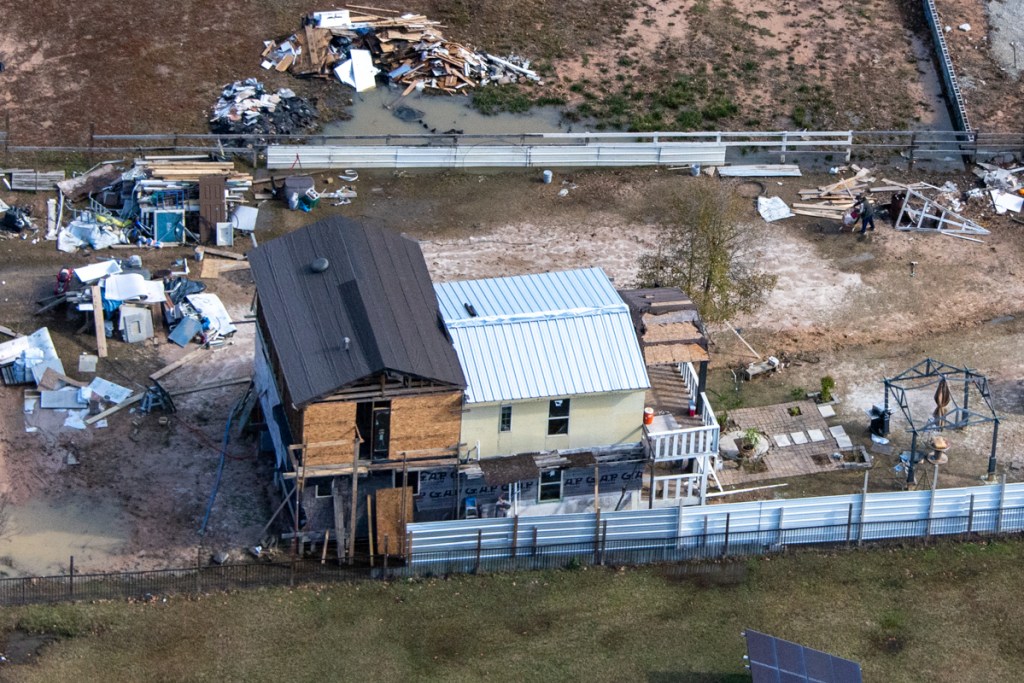
We recently visited a Harris County home buy out focus site in Saracen Park on Cypress Creek.  There were several vacant lots where residents had sold out to FEMA to escape repeated flooding.  Immediately adjacent to these properties, which were purchased with federal tax dollars, was a new home being constructed.  It was a spec home being erected by a builder – “for sale by owner”.  The County verified that the builder had the proper permits to build in the floodway.  Not flood plain, floodway – the stream channel.  

Is There No Other Land?

Harris County allows building in the stream channel.  Why?  Is there no other land?  Or is this land just really cheap because it’s in the floodway?  Why spend tax dollars to buy out properties and, in turn, allow more properties to be built there?  What sense does this make?  Who are the stewards of our tax money?  

Harris County is one of the few places in the country which allows building in the floodway.  As one of our state representatives told us, it is difficult to obtain state funding for flood mitigation in Harris County when other representatives from around the state ask: “Well, why ya’ll allow building in the flood plain, anyhow?”  How does one answer that?

Fill Without Permit and Slap-on-Wrist Fine

At the corner of Cypresswood Drive and Champions Forest Drive a developer, Don Hand, recently brought in 5-6 feet of fill to build up his lot for a construction project.  

He didn’t bother to obtain a permit.  There was no detention built and no consideration for his neighbors.  

If a tropical storm had arrived, the water would have cascaded off that lot into the Chase branch bank, crossed the street into the Mormon Temple, flooded the Conservatory parking lot, inundated Cypresswood Drive and perhaps entered the Kroger, again.  Citizen outrage caused the County to ‘red flag’ his construction.  

The County was required to go to court to obtain an injunction to stop this developer and require the fill to be removed.  It was a pyritic victory.  The penalty assessed under the law against this type of dangerous develop is $100/day.  Little wonder the dirt is still there – it’s cheaper to pay the fine than remove it.  

3600 Building Permits Issued Along Cypress Creek Since 1997

Development continues apace along Cypress Creek.  Community Impact’s investigation into development along the creek indicates that since the 1997 county standards were adopted, there have been over 3,600 new building permits issued along the creek.  More impervious surface, less room for the water.  

Subsidizing Developers with Taxpayer Dollars

The Greater Houston Flood Consortium’s 2017 report on flooding and building standards recited that “…not requiring new development to fully mitigate its impacts would essentially be a subsidy for that development, reducing the cost of building but ultimately requiring taxpayers to pay for more new flood mitigation infrastructure and saddling downstream residents with flood-related property damages.”

The Politics of Development

How did we get so far out of balance?  For a century builders & developers have had a powerful hold on Houston and Harris County.  Recall the 1960s mayor of Houston, Louie Welch, and his statement: “The business of Houston is business”.  No zoning, weak regulation.  

Another reason is money.  County regulations are approved by Commissioner’s Court.  In 2018 a Houston Chronicle investigative report indicated that all four commissioners received at least 80% of their re-election funds from builders/developers/engineering firms.  While all the commissioners deny that these election contributions have any impact on their decisions, you can bet the donors get their phone calls returned.  

Luck Not a Strategy

Thus far in this very active hurricane season we have been lucky and dodged all the storms.  In flood mitigation, luck is not a strategy.  We must have flood infrastructure.  Three years after Harvey, four years after Tax Day, not a shovel of dirt has turned on Cypress Creek.  But we must also have reasonable rules which look after not only developer profits, but public safety and security.  Tell your friends, tell you neighbors, tell your elected representatives.  Let’s start that conversation.

By Paul Eschenfelder and George Peckham of cycreekstoptheflooding.com

1105 Days after Hurricane Harvey

Texas Water Development Board Wants Input on Their New TexasFlood.org

Hurry. TexasFlood.org Survey Closes September 8

Texas Water Development Board (TWDB) is trying to make flood-related information more accessible and user friendly via an update of their website,  TexasFlood.org. The refreshed website will become a one-stop shop for flood-related data and information throughout the state. Please review it and then give TWDB your input via this short survey. Make sure they’re providing the kind of information YOU want.

Home page of TexasFlood.org

Background

In 2019, the Texas Legislature and Governor Abbott greatly expanded the Texas Water Development Board’s (TWDB) role in flood mapping, planning, and financing.

In addition to existing flood programs, TWDB will administer a new state and regional flood planning process, increase flood-related financial assistance, and advance flood modeling and mapping capacities. 

As the agency expands data, information, and resources related to flooding in Texas, a key priority is to ensure that flood-related information is timely, user friendly, and easy to find.

TWDB

So judge the new website against those goals.


Purpose of Survey

The purpose of the survey is to understand:

  • What flood-related information you find most valuable
  • How best to present that information on the new version of the site.

Less Than Ten Minutes Will Help Texans Better Prepare for Next Flood

Until now, the TWDB web presence has largely been geared toward water professionals. This site however, targets ordinary citizens. It’s a fresh approach for the Board. The home page for instance, starts with a discussion of what to do before, during and after a flood. You can drill down from there.

The survey should only require 5 to 10 minutes. Hurry. The last day is September 8. So please take the survey today. Your help will benefit Texans for years to come.

If you are trying to find this website in the future, check out the Links page of this website.

Posted by Bob Rehak on 9/7/2020

1105 Days since Hurricane Harvey

City of Houston Map Shows Extent of Water Flood Hazards for Many Smaller Ditches, Streams

If you fear flooding from a small stream and you live inside the Houston City limits, this is THE resource for you. It’s the City’s Water Flood Hazards Viewer. And it’s incredibly detailed. It even shows the extent of flood hazards around many unnamed temporary streams and man-made ditches.

Water/Flood Hazards within the City of Houston

The image above shows Ben’s Branch where it cuts across the Harris/Montgomery County Line. Many homes and businesses in this area flooded during Harvey and Imelda despite being three miles from the nearest river.

The different shadings and cross-hatchings represent floodways, 100-year and 500-year floodplains. I checked around neighborhoods near me where I was familiar with the extent of flooding. The map seems to be very accurate. I only found one or two properties that I would have reclassified.

Impressive Gallery of Base Maps and Other Features

The City’s Water Flood Hazards site contains an impressive gallery of 25 different base map options. They range from customary street maps and satellite views to topographic maps and more.

You can also measure distance and direction with the built in tools. And unlike many such maps, this one contains built in drawing tools that let you make notations and share them with your friends or associates.

Of course, it includes information on flood zones near major rivers, too. It even includes information on hurricane evacuation zones near the coast.

You can see the outlines of Harris County in the extent of the waterways. The bright areas near the coast represent hurricane evacuation zones and zip codes.

Incredible Flexibility

Because the system is built on a geographic information system database, you can even add data from other databases. That makes the map reflect additional types of information. But warning: this can get very technical.

Great Tool for Research

If you’re considering buying a property or flood insurance, and you live in the City or Harris County, this is definitely a map you should bookmark. The Water Flood Hazards Map is an incredible research tool. For ease of future reference, I have listed the map on the Links page of this website under Floodplain Maps and Elevation.

Posted by Bob Rehak on 9/6/2020

1104 Days after Hurricane Harvey

Tetra Tech Study Provides Clues To Possible Mouth Bar Dredging Strategies

FEMA has agreed to dredge another million cubic yards from the the area near the San Jacinto West Fork Mouth Bar. A report produced for the City of Houston by Tetra Tech helped convince FEMA. The report relied on sonar, LIDAR, and core sample data to estimate the total volume of sand deposited by Hurricane Harvey in that area: approximately 1.4 million cubic yards.

Need for Ruthless Efficiency

While another million cubic yards may sound like a lot, the area is huge. Dredging the whole 4.3 million square yard area would add only about 8 inches of water depth and leave an underwater mesa between the West Fork and the Lake. According to local geologists Tim Garfield and RD Kissling, who have studied the problem extensively, that would create a sediment trap that accelerates accumulation of sand from future storms.

So, what to do?

Three Strategies Discussed to Date

Those close to the project have discussed several strategies to date.

  • The Corps’ initial strategy: Dredge upstream from the mouth bar. They said 1D modeling showed that would accelerate water flowing into mouth bar and give it the velocity needed to push sand from the mouth bar farther out into the lake.
  • Another strategy: dredge downstream from the mouth bar and let the river push the mouth bar into the dredged area.
  • A third strategy: reconnect the river and the lake with a narrow channel that accelerated the flow of water and carried suspended sediment out into the broader lake south of the 1960 bridge.

2019 Tetra Tech Report

Stephen Costello, the City’s flood czar, says that new survey and modeling work has yet to be completed. That will ultimately determine where new dredging happens. However, he also added that consulting Tetra Tech’s exhibits would help provide clues as to where dredging might be most effective, based on knowledge accumulated to date.

The first chart in Appendix A showed the coring locations and transects (survey lines) of the lake’s bottom profile.
The second chart shows what they found in various coring locations. The feet indicate the thickness of the top layer.

Composition of the core samples provides clues as to what was laid down when. Sand (the yellow dots) is generally laid down during floods which have the energy to transport the heavy particles. However, clay and silt (the green and blue dots) are smaller. So they tend to drop out of suspension when water is calmer.

Finding sand above silt in a core sample indicates that a storm like Harvey likely laid down the sand.

The third chart is the most crucial. It’s a difference map that shows areas of deposition and scour pre- and post-Harvey. This shows two things: where most sediment fell out of suspension and where the main flow of the river tried to churn a path through the mounting muck.

From the difference map above, you can see that the river tried to scour its way through the sediment along a path from LH-16 to LH-21 to LH-23. You can see another area of scour to the far right from LH-15 to LH-25 to LH-26.

Where River Flowed Before Lake Was Impounded

Interestingly, the area of scour to the left follows the river’s relic channel.

San Jacinto River map before Lake Houston was impounded

Note how the West Fork hugged what is now Atascocita Point – the thumb of high land that sticks up in the Tetra Tech illustrations.

Harnessing Natural Energy of the River

From the third and fourth illustrations above, one might conclude that excavating a channel near Atascocita Point represents the best way to harness the natural energy of the river. That’s the shortest channel where scour is deepest.

Given the million cubic yard limit, that path also represents a chance to dig the deepest, widest channel possible within the budget. When technicians compiled the difference map above, most of that path was already at or below its 2011 level.

500,000 square-yard path outlined in yellow would let dredgers excavate six feet. Average bottom depth is already 5.5 feet in that area.

Following that path also lets you funnel future sediment through the FM1960 causeway and disperse it out into the wider, deeper lake.

Next Steps and Timing

At this point, we don’t know what Imelda did to this area. Imelda struck shortly after the Army Corps completed its post-dredging survey in this area last year.

Before the additional dredging can begin, several things must happen.

  • Completion of a new survey
  • Model different scenarios
  • Identify best strategy
  • Locate suitable placement area
  • Compile scope of work
  • Bid job
  • Mobilize

Based on past experience, that could take months to a year or more. It took 13 months after Harvey for the Corps to put equipment in the water for its Emergency West Fork Dredging Project. However, we don’t have as many unknowns this time.

Posted by Bob Rehak on 9/5/2020

1103 Days since Hurricane Harvey

HCFCD to Begin Next Phase of Ben’s Branch Clean Out in October

Harris County Flood Control District (HCFCD) and its contractors met today with representatives of Kings Forest, the Bear Branch Trail Association and Kingwood Service Association to discuss the next phase of the Ben’s Branch clean out. On the south, the project lies entirely within the Creekwood Nature Area between Kingwood High School and the old H-E-B shopping center. Rocky Woods Drive forms the northern extent of the project. This will extend northward the work already completed south of Kingwood Drive.

Project extent outlined in red. Kingwood High School is at bottom center; Town Center on right; Kings Forest on left and Bear Branch at top of frame.

Maintenance Objective: Restore Conveyance

The objective: to restore conveyance of Ben’s Branch and reduce potential for flooding in Kings Forest, Bear Branch, the Kingwood High School, and Kingwood Town Center.

The ground these men are standing on is all deposited sediment that needs removal to restore conveyance. The original channel bank is the higher slope behind them. The other side has a similar problem.

Sediment has restricted the flow of the channel gradually during the last three decades. It now contributes to flooding.

Tucked into the tree line on either side of Bens Branch, you can see the maintenance roads that formed the top of the original banks.

During Harvey, many homes on both sides of the stream flooded. Many also flooded again during Imelda.

Walking along the creek today, the first thing one notices is a craggy channel with sides that seem to have slumped into the stream. Flood control surveys, however, show that is not the case. The channel filled with sediment. Then the stream eroded down again through the accumulated sediment.

Continual cycles of deposition and erosion have clogged, deformed and narrowed the creek.

Approximately 15,000 Cubic Yards of Sediment To Be Removed

Getting the channel back to its original state will require removal of approximately 15,000 cubic yards of sediment. However, engineers have not yet determined the exact number.

The scope of work will include replacement of damaged drain pipes that carry water to the ditch.

The job is still in its planning stages. Actual dirt work should begin sometime in October.

Funded with Help from USDA NRCS

A grant from the USDA Natural Resources Conservation Service (NRCS) will help HCFCD fund the project. Contractors will haul the excavated dirt to nearby TCEQ-approved landfill sites outside of the .02% annual chance (500-year) flood plain.

Looking north. The project will NOT extend into the natural portion of Ben’s Branch at the top of the frame, near Rocky Woods Drive. It will affect only the man-made portion of the channel.

Downstream, the project will stop at Kingwood Drive. Note below how the channel under the Kingwood Drive bridge is virtually twice as large as the channel in the foreground.

Looking south over Ben’s Branch toward Kingwood Drive and the portion of Ben’s Branch restored earlier this year. Note how constricted the channel in the foreground is.

When complete, this project should make the channel north of Kingwood Drive as wide as it is south of Kingwood Drive. It’s all about getting the channel back to its designed carrying capacity.

An exact timetable for the project is not yet available, but it will take several months.

Posted by Bob Rehak on 9/4/2020

1102 Days after Hurricane Harvey

Why Buyouts Take So Long

In the private sector, it can take just days to buy a home. In the public sector, it can take years. Here’s why buyouts take so long.

Major Steps in Process

Graphic provided by Harris County Flood Control District (HCFCD). For specific information about the Buyout Process for Eligible Qualified Buyers, see this video.

The graphic above outlines the major steps in the buyout process. The linked video provides more detail.

The Forest Cove Townhomes illustrate some of the problems encountered along that timeline.

Exceptional Sense of Community Makes People Want to Stay

According to Jennifer Parks who lived on Timberline, her townhome flooded eight times in five years. Despite that, she, like most who lived there, loved the secluded neighborhood. It was close to nature, beautiful and quiet. Neighbors looked out for each other. They bonded over backyard barbecues. They enjoyed an exceptional sense of “community.” Then came Harvey. It made the homes uninhabitable. People immediately scattered to find new housing.

Dealing with Chaos and Confusion

When the initial shock wore off, they began exploring options. Could the homes be repaired? Would CenterPoint restore power? Could the sand-filled storm drains and streets be cleared? Which way was the herd moving? One family could fix its home; but if the other neighbors in a building didn’t, their investment would be ruined. This is important because in Harris County, buyouts are voluntary. One holdout in a building with a dozen units could undermine others.

Meanwhile, HCFCD assessed damage county wide to identify eligible properties. Harvey damaged so many, that it took nine months for the flood control district to even issue its final report on the storm.

Assessment Necessary; Not All Properties Eligible

Identifying eligible properties requires looking at them from several different perspectives. For instance:

  • Have people requested the buyouts?
  • Are properties subject to repeat flooding? Is it life threatening?
  • Will buyouts serve a larger strategic purpose that reduces flooding? For instance, restoring green space near a river. Or creating community parks.
  • Who will maintain the property long term?
  • Are interest and community support high?
  • Will buyouts create a checkerboard pattern that creates maintenance issues or will there be full public ownership of an area?
  • Can HCFCD secure grants to fund all interested sellers?

Of the 154,170 homes flooded in the county during Harvey, only 4,000 property owners volunteered for buyouts and of those, only 1,100 were eligible (0.71% of all flooded homes).

Qualifying for Buyout

To learn more about the HCFCD buyout process, see this document: Voluntary Buyout Guidance.

Buyouts reduce flood damages in areas where structural projects (i.e. channel modifications or stormwater detention basins) are not cost-effective and/or beneficial. 

Harris County FLOOD CONTROL DISTRICT

Buyout candidates were simply built in the wrong place, prior to the knowledge we have today

HCFCD’s Home Buyout Program does not provide immediate flood recovery assistance – its primary function is to help prevent future flood damages. 

To see where HCFCD is interested in buyouts, check this map of Buyout Areas, last updated in July.

Funding and Closing

After identifying and qualifying candidates comes the difficult process of securing grant funding. That usually takes about 8-18 months. It’s a multi-tiered process. Austin collects and screens grant applications for Washington. Assuming Washington approves, money then flows back through Austin.

Finally, with money in hand, HCFCD must appraise property to confirm its value (which can be pre-flood). HCFCD must then reach an agreement to buy the property and determine relocation benefits. Of the initial 1,100, 349 are in the closing phase now and 560 have already closed.

A little fixer-upper

HCFCD says that roughly a half dozen homes remain to be bought out. Those remain “problem” cases. In one, an out-of-state investor bought property at auction AFTER Harvey. But terms of HCFCD’s Harzard Mitigation Grant specify that the grant cannot be used in cases like that. Otherwise people would buy up flooded properties and resell them to FEMA at pre-flood valuations.

In other cases, sometimes people have walked away from flooded properties leaving lenders holding the bag. That puts property in legal limbo. No one has authority to sell without going through a foreclosure process.

Such problem properties can delay demolition.

Public-Policy Concern

In multi-family housing (such as the Forest Cove Townhomes), EVERY family in a building must have completed a buyout before the building can be demolished.

The last point raises a public-policy concern. We are now starting YEAR FOUR AFTER HARVEY! Units in six Forest Cove Townhome Buildings still need to be purchased. Those buildings look like the one above and drag down property values in an entire community.

So, should construction of new multifamily units be allowed in such flood-prone areas?

It’s one thing to repair properties built BEFORE flood problems became apparent; another to permit new construction AFTER. And developers keep throwing up new units faster than flooded ones can be bought out.

For More Information

For general information about HCFCD’s buyout program, see this video.

For the portal to the buyout section of HCFCD’s website, click here.

Posted by Bob Rehak on 9/3/2020

1101 Days after Hurricane Harvey

The thoughts expressed in this post represent opinions on matters of public concern and safety. They are protected by the First Amendment of the US Constitution and the Anti-SLAPP Statute of the Great State of Texas.

Going Up the Down Escalator – As HCFCD Demolishes West Fork Townhomes, Developer Builds More

Have you ever walked up a down escalator? I’m sure that’s what it must feel like to work for the Harris County Flood Control District at times. As you work to improve public safety, you sometimes fight others eroding it in the process of making a buck. Consider this comparison.

Forest Cove Buyouts V. Wanbridge New Construction

Flood Control just bought out and demolished a six-townhome complex on Timberline Drive in Forest Cove. It was the culmination of a three-year process.

Meanwhile, a short distance downstream, Wanbridge is building 14 more – even closer to the same river that destroyed the Forest Cove Townhomes. Wanbridge even designed its townhomes on the same principles used in Forest Cove (garage and storage on ground floor/living space two stories up). Let’s see how that worked out for Forest Cove property owners.

Forest Cove Complex Torn Down after Floods and Fire

Here’s what the Forest Cove complex looked like before being demolished recently.

Part of six-unit Forest Cove Townhome flooded by Harvey and then burned on July 4th, 2019. Photo taken July 11, 2020.
Here’s what that site looks like today, 1100 days after Harvey FIRST destroyed the complex.

Finally, a vacant lot that can return to nature!

Six Down, But Fourteen Up

Meanwhile Wanbridge is building six new units in Kings Harbor even closer to the river. That is in addition to three units just completed in the upper left, and five just completed in the lower left (some of which are out of frame).

Forest Cove Townhome Buyouts Part of a Much Larger Project

The six-unit building recently demolished in Forest Cove is part of much larger buyout project. It comprises approximately 80 homes. So far, HCFCD has demolished the following Forest Cove townhome buildings:

  • 1030 Marina Dr.
  • 1040 Marina Dr.
  • 1050 Marina Dr.
  • 1060 Marina Dr.
  • 1102 Marina Dr.
  • 803/805 Timberline Ct.
  • 707 Timberline
  • 930 Aqua Vista  

However, the following buildings still have privately-owned units that HCFCD is trying to purchase ASAP:

  • 1106 Marina Dr.
  • 1110 Marina Dr.
  • 1020 Marina Dr.
  • 960 Marina Dr.
  • 980 Aqua Vista (mostly destroyed)

HCFCD has now bought out and demolished eight out of 14 buildings (see map below).

Map to Forest Cove Townhome buyouts. This once-thriving complex housed approximately 80 families before Harvey.

Five Buildings Still Left Standing…Kinda

Building sheared in half by 240,000 cubic feet per second at peak of Harvey. Residents reported feeling lucky to escape with their lives.
How Harvey chewed up the inside of Forest Cove Townhomes
Floodwaters reached well into the second stories of these units.
Note how the water pressure destroyed garage doors. Also note abandoned scooter.

As I edited pictures from this morning’s photoshoot, I noticed the little girl’s scooter perched precariously on the collapsing porch. A child lived here! It was her family’s home. Their dream. And I’m sure the scooter was the girl’s cherished possession. Perhaps a birthday or Christmas present.

For whatever reason, that scooter got to me. It made me realize the futility and danger of going up the down escalator.

Public Policy Implications

From a public policy point of view, it seems like it would be safer and cheaper to buy up properties near rivers and turn them into parkland – before people build on them.

Parks generally improve the value of surrounding properties. In contrast, the inevitable eyesores created by repeat flooding cost us all. Consider:

  • Taxpayer subsidies for flood insurance.
  • Multiple payouts on insurance claims, also subsidized by taxpayers.
  • Eventual buyouts, paid for by taxpayers.
  • Demolition, paid for by taxpayers.
  • Eventual restoration of the green space, at taxpayer expense.
  • Salaries of public employees to manage this process in Washington, Austin and Houston.

Leaving these spaces green would have cost little compared to the ultimate financial and emotional costs of repeat flooding. But some people like going up that down escalator.

Posted by Bob Rehak on 9/2/2020

1100 Days since Hurricane Harvey

The thoughts expressed in this post represent opinions on matters of public concern and safety. They are protected by the First Amendment of the US Constitution and the Anti-SLAPP Statute of the Great State of Texas.

Three Years Later, Pretending Harvey Never Happened

Now that we’re past the third anniversary of Hurricane Harvey, some developers would like to pretend the storm never happened. Where money can be made, they have memory loss in abundance and common sense in short supply.

New Townhomes Feet from West Fork in Kings Harbor

I previously blogged about new townhomes under construction in Kingwood’s Kings Harbor. Technically, these townhomes may meet most of the requirements of the City of Houston. They have garages and the equivalent of indoor/outdoor living spaces on the ground floor (which are already walled off from garages). The main “living floor” starts about ten to twelve feet up. (See below and Chapter 19 of the City’s Floodplain Ordinances.)

These new townhomes are just feet from the floodway of the West Fork in the background.

Detention Pond Just Feet From the Water

The barren area to the left of the six-unit complex is a detention pond. Only problem: it’s virtually in the floodway. See additional shots below.
A retaining wall separating this property from water cuts in from the left edge of the picture (see shot below also). Flood experts advise against putting detention ponds so close to a river because they fill up quickly in a flood and fail to hold water back, which is their purpose.
The retaining wall mentioned above.

Currently In 1% Annual-Chance Floodplain

The new construction currently lies within the 1% annual chance (100-year) floodplain. When the new flood maps are updated based on Atlas-14, both the floodway and floodplains will likely expand.

Source: FEMA National Flood Hazard Layer Viewer. Aqua color equals 1% Annual Chance Flood Zone (aka 100-year flood plain). Red circle indicates location of new townhomes.

Are 164 More Units On the Way?

The developer, Wanbridge, claims to have purchased the grassy area in the middle of the photo below as a “land bank” for 164 condos. A previous iteration of the developer’s website claimed it would be a multistory complex.

But why does Wanbridge claim to own that 2.2 acre grassy patch, when Harris County Appraisal District says it belongs to Rocky Lai’s Sunrise Kings Harbor LP? And if Wanbridge had a contract to purchase the land, why did Lai recently put it up for sale and post a sign on the property?

Other Problems

  • How will you evacuate people in the middle of the night if the next flood comes without warning like Harvey did?
  • How do you reconcile building just feet from a river that flooded homes and businesses more than two miles inland?
  • Why is there no building permit displayed at this site?
  • Why is there no stormwater pollution prevention permit displayed at this site?
  • Why are there no silt fences around the dirt work?

Posted by Bob Rehak on 9/1/2020

1099 Days since Hurricane Harvey

The thoughts expressed in this post represent opinions on matters of public concern and safety. They are protected by the First Amendment of the US Constitution and the Anti-SLAPP Statute of the Great State of Texas.

How Much Will Dredging Another Million Cubic Yards Reduce the West Fork Mouth Bar Area?

Earlier this month, the City of Houston announced that FEMA would pay to dredge another million cubic yards of sediment from the West Fork Mouth Bar. What does that mean in practical terms? What are the objectives of the program? How wide and deep will they go? Neither the objectives, nor a dredging plan, have yet been released.

The official plan will hopefully rely on new survey work and hydraulic modeling. A survey boat has been seen on the lake for several weeks now.

Since January of this year, the City of Houston has been trying to reduce the above water portion of the mouth bar with mechanical dredging, a much slower process than hydraulic dredging. Note how shallow the water is in the foreground.

How to Play Armchair Engineer

In the meantime, since fall football is in doubt due to COVID, here’s a simple way to keep your armchair quarterbacking skills finely honed. What would you do if you were the project engineer or manager? Play what if and experiment with different scenarios.

  • Download and open Google Earth Pro. It’s free.
  • Zoom in on the West Fork Mouth Bar.
  • Select the measuring tool.
  • Click on the polygon tab.
  • Select square yards for the unit measurement for the areas you will define.
  • Now start second guessing the project engineers. Play “what if” by defining an area that you would like to see dredged.
  • Readjust the points that define the area by dragging them in, out, up or down.
  • Watch the total square yards recalculate as you move the points.

Examples of Different Scenarios

Here are some examples to show you what I’m talking about.

4.3 Million Square Yard Area, Roughly 8 inches Deep
Largest area. This scenario takes in everything between where the Corps stopped dredging in its Emergency West Fork Program and the FM1960 Bridge.

The scenario above takes in the mouth of Ben’s Branch, plus all the other drainage ditches that empty Fosters Mill, Kings Point, and Atascocita north of the FM1960 Bridge.

The scenario above covers 4.3 million square yards. But with a budget to dredge only 1 million cubic yards, you would divide 1/4.3 = 0.23 yards of depth. That’s less than a third of a yard. It works out to about 8 inches.

3 Million Square Yard Area, 1 Foot Deep
In the next scenario, I pulled the boundaries in so that the area equaled 3 million square yards.

This scenario is a little more intuitive. You’re dredging 1 million cubic yards across an area of 3 million square yards. Within this bounding box, you could reduce the level of sediment roughly a foot.

2 Million Square Yard Area, 18 inches Deep
If you reduced the area to be dredged to 2 million square yards, you could reduce the level of sediment by half a yard or 18 inches.
1 Million Square Yards, 3 Feet Deep
Path followed by the relict channel before Lake Houston was built.

If you reduced the area further, to 1 million square yards, you could dredge to 3 feet. With the five feet of depth already there, you could have an eight foot channel connecting the river and the lake. Make it narrower and you could even go deeper. And perhaps, just perhaps, keep sediment from accumulating so rapidly upstream of the FM1960 bridge.

Difficult Choices Ahead

As you can see, engineers have some difficult choices ahead. They must chose between unblocking channels and streams, or dredging a channel roughly the size of the upstream west fork all the way to the 1960 bridge.

Last year, the Corps reduced the 600-acre area between the mouth bar and Atascocita Point to an average depth of 5.5 feet. So we have a good head start. But there are other considerations:

The West Fork was roughly 22 feet deep where the Corps stopped dredging just west of the mouth bar. Because of scouring, it’s at least that deep where the west fork passes under FM1960.

As a result, water coming down the west fork hits an underwater mesa that still blocks off three quarters of the conveyance.

Prominent area geologists, such as Tim Garfield and RD Kissling, theorize that that wall traps sediment and is rapidly diminishing the value of previous dredging programs. They believe that the most important objective for this phase of dredging should be to “reconnect the West Fork with the Lake.”

But Advancing Delta Now Blocks Major Streams, Channels

Meanwhile, consider this, too. In 2014, Bens Branch and the drainage ditch that empties large parts of Fosters Mill and Kings Point had a clear path to the river. Today, both are blocked by the mouth bar and an advancing delta within the lake. Compare the two images below.

Google Earth view from 2014 shows steams could still easily connect with relict channel.
Today, however, an advancing delta within the lake blocks them.

These are some of the real world trade offs that engineers and project managers must deal with every day.

So to return to the football analogy, do you send your receivers wide or deep? Do you have them hug the sidelines or cut for the goal post?

Understand that this isn’t a game, however. It’s a struggle to return a community to prosperity.

What would you do? And why?

Posted by Bob Rehak on 8/31/2020

1098 Days since Hurricane Harvey

HCFCD Flood Education Mapping Tool Contains Features Found Nowhere Else, Plus Basic Flood Education on One Page

Developed after Tropical Storm Allison in 2001, the Harris County Flood Control District Flood Education Mapping Tool’s purpose was to help Harris County residents learn the location of their properties in relation to mapped 1-percent (100-year), 0.2-percent (500-year) and coastal floodplains. The Flood Education Mapping Tool includes regularly-updated floodplain information from the Flood Insurance Rate Maps (FIRMs) for Harris County, interactive legend options, a simple map display and easy map navigation.

Easy to Use

The tool itself is easy to use and navigate. Click on Floodplains; it will show you the extent of various floodplains. Click on Backgrounds; choose the one you want. And click on Channels; it will highlight all channels in Harris County and show you their numeric IDs. The last is very useful in helping the District locate a problem you’re reporting.

Unique Ponding Feature

But the Flood Education Mapping Tool contains another feature I have found nowhere else: the Ponding button. Click on it; low areas susceptible to ponding during heavy rains will highlight in shades of reddish brown.

HCFCD’s Mapping Tool contains “ponding” feature that that shows low areas that collect water during heavy rains. Shown above, the Deerbrook Mall area in Humble.

Ponding is the collection of stormwater on streets or on undeveloped land that typically forms when rainfall exceeds the design capacity of a street’s drainage system or the land’s ability to drain. The shade of red indicates the depth of the water. Dark red indicates deep ponding and light red indicates shallow ponding – very helpful when evaluating a home purchase.

Basic Flood Education All on One Page of FAQs

The Flood Education Mapping Tool also contains a treasure trove of useful FAQs. The Flood Control District has broken them down into four main categories:

  1. Flood Insurance Rate Map (FIRM or floodplain map)
  2. Floodplains and Floodways
  3. Floodplain Status/Floodplain Determination
  4. Flood Insurance

If you want a basic flood education on a page, this is the page for you. It will help you converse knowledgeably with a flood-insurance or real-estate agent.

Flood Insurance Rate Maps

• What is a Flood Insurance Rate Map and how do I use it?

Floodplains and Floodways:

• What is a floodplain? / What is a floodway?
• What is a 1 percent (100-year) flood/floodplain? / What are my chances of flooding in a 1 percent (100-year) floodplain?
• What is a 0.2 percent (500-year) flood/floodplain? / What are my chances of flooding in a 0.2 percent (500-year) floodplain?
• What is a coastal floodplain?
• What is a Special Flood Hazard Area?
• What is meant by Base Flood Elevation?
• Who determines the boundaries of a floodplain? / What data is used to create a Flood Insurance Rate Map?

Floodplain Status/Floodplain Determination:

• Is my home located in a mapped floodplain? / Which mapped floodplain is my home in? / How do I get an official floodplain determination?
• What is an Elevation Certificate? / What is a Letter of Map Amendment? / What is a Letter of Map Revision?
• The Flood Insurance Rate Map shows that my lot is in a mapped 1 percent (100-year) floodplain, but my house sits on higher ground/is raised on pier and beam construction/is elevated. Do I still need flood insurance? / Can I obtain cheaper flood insurance?
• My home is not in a mapped 1 percent (100-year), 0.2 percent (500-year) or coastal floodplain. Does this mean I am not at risk for flooding?
• The Harris County Flood Control District is constructing a project on a bayou in my neighborhood. Will my home be out of the floodplain when it’s complete?

Flood Insurance

• Does standard homeowners insurance cover losses and damages from flooding?
• Am I required to have flood insurance? / Do I still need flood insurance if I live outside a mapped 1 percent (100-year) floodplain?
• If my home floods, will federal disaster assistance pay for all of my damages?
• Is damage from wind-driven rain or rain that comes through my roof covered by my flood insurance policy?
• How can I obtain flood insurance?
• How much does flood insurance cost? / Why is my flood insurance so expensive?
• Can I get flood insurance if I rent?

This page of FAQs is extremely well written, concise, and easy to understand. Most answers also contain links to other helpful, related sites. So you can drill down into most topics as deeply as you wish.

I’ve listed Harris County Flood Control District’s Flood Education Mapping Tool on the Links page of this web site under Floodplain Maps and Elevation, so you can find it easily in the future.

Posted by Bob Rehak on 8/30/2020

1097 Days since Hurricane Harvey