Forest Cove Townhome Complex Ready for Demolition

Harris County Flood Control District (HCFCD) has completed condemnation proceedings on the last unit in another townhome complex on Marina Drive in Forest Cove. They will schedule the units for demolition as early as next week.

Hurricane Harvey destroyed the units so completely that FEMA made them the centerpiece of a video after Harvey. Since then, they have become magnets for looters, arsonists, drug dealers and illegal dumping.

Forest Cove Townhomes Censored
Forest Cove Townhomes destroyed by Harvey on Marina Drive could soon be demolished. Red rectangle contains censored graffiti.

Amy Stone, a spokesperson for HCFCD said, “There were nearly 90 units in that community! All required appraisals, offers, negotiations, closings and demolitions.”

Reasons for Slow Pace of Buyouts

Demolition of the first units began on Timberline Court in March 2019. But HCFCD has had to navigate rough waters since then.

I previously reported that some owners abandoned their properties and that HCFCD could not locate them. Those units had to go through condemnation proceedings before demolition could begin.

Stone reports that two complexes remain. HCFCD closed on the last unit in one last month and completed the site inspection last Thursday. “We are waiting for the asbestos survey report to come back. We should have a demolition date by next week,” said Stone.

Asked about the other complex, Stone reported, “1020 Marina Dr. will be demolished once the last unit is purchased. This unit is currently in condemnation.”

HCFCD and FEMA like buyouts to be voluntary wherever possible. But in the case of missing owners, condemnation may be necessary. This is a big reason why buyouts take so long. HCFCD cannot demolish a building until they own all units within it.

Some Investors Never Learn

So here we are…1744 days since Harvey made the buildings structurally unsound.

Multi-family housing represents a poor choice for homes in such high risk neighborhoods. But before these units are even demolished, Chinese investors seek to build more, even closer to the river, about a mile downstream. Residents who bought condos in this area before Harvey tell me that they have spotted developers pitching this idyllic location to busloads of Chinese tourists in the area below.

I’m guessing Forest Cove is not on the tour.

Condos under construction in Kings Harbor last year. San Jacinto West Fork is just feet away.

Posted by Bob Rehak on June 8, 2022

1744 Days since Hurricane Harvey

The thoughts expressed in this post represent opinions on matters of public concern and safety. They are protected by the First Amendment of the US Constitution and the Anti-SLAPP Statute of the Great State of Texas.

Triple PG Wastewater Apparently Killing Trees on Neighboring Property

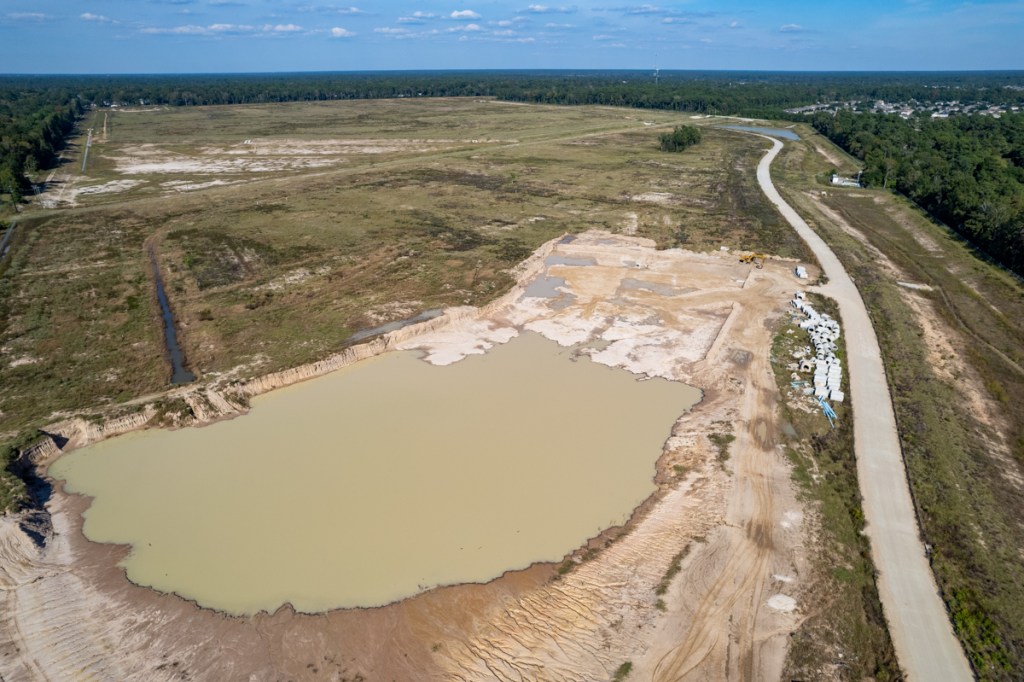
Despite multiple reprimands from the TCEQ and a lawsuit by the Texas Attorney General, the Triple PG mine apparently continues to discharge process wastewater onto neighboring properties. Photos taken on 5/4/22 show those neighboring properties under water despite unusually dry weather and record heat recently. Those same properties were not flooded just days after Tropical Storm Imelda, which dumped more than 25 inches of rain on the area.

However, Triple PG denies allegations of unauthorized discharges.

Location of Isolated Neighboring Properties

Let’s first look at the location of the neighboring properties. Triple PG owns most of the property west of the mine with one notable exception – a strip of 20 properties isolated near the mine’s stockpile. See the map from the Montgomery County Appraisal District below.

Properties in question are inside the red oval. MCAD shows that Guniganti sold the Royal Pines land to TC LB ROYAL PINES LP on 12/9/21.

History of Unauthorized Discharges

Back in March 2020, I observed that the Triple PG sand mine in Porter was discharging process wastewater onto adjoining property that the mine did not own. The Texas Attorney General had already sued Triple PG on behalf of the Texas Commission on Environmental Quality (TCEQ) for previous unauthorized discharges.

I filed a complaint with the TCEQ about the March 2020 discharge. TCEQ immediately sent an investigator to the mine. The investigator documented wastewater on the adjoining property. It was the fourth such alleged incident at the Triple PG mine in 10 months. Outcome? The TCEQ issued yet another “Notice of Enforcement” in April 2020 for the “unauthorized discharge of wastewater.”

But two months later, in May 2020, the wastewater on the adjoining property was higher than in the mine’s settling pond.

Dr. Prabhakar R. Guniganti, who owns the mine, didn’t seem to get the message. And pictures taken two days ago suggest he still doesn’t – despite the threat of a million dollar fine.

Compare Before/After Aerial Images

The image below, taken before discharges into this area started, shows the neighboring properties in question. They are the strip of trees between the foreground and background. Note how the land is not flooded, despite the fact that I took this picture just days after Tropical Storm Imelda, which dumped more than 25 inches of rain on this area. Also note the dense forest canopy.

Looking south toward stockpile in background. Properties in the forested strip do not belong to Guniganti. I took this picture on 9/27/2019, ten days after Imelda.
Reverse shot looking N from over stockpile. Taken in March 2020. Other shots taken in this series show water on neighbors’ property higher than inside the mine.

Now, fast forward two years. Aerial pictures below taken on 5/4/22 show the same property – under water – despite only 4 inches of rain in the last month!

The new images also show most of the once-lush vegetation has died. All trees on the neighboring property adjacent to the mine are dead with the exception of one small copse on higher ground. And the water is blackish.

dead trees on property adjoining Triple PG mine
Dead trees on property adjoining Triple PG mine immediately north of the mine’s stockpile in foreground. 5/4/22.
Looking NE. The dead trees on neighbor’s property adjoin the mine’s wastewater pit. 5/4/22.

Hmmmm. Let’s see. Not flooded days after 25 inches of rain during Imelda. Flooded after 4 inches in the last month. Once healthy trees now dead. How curious! I wonder how that works. Judging from the healthy trees in the background, I’m guessing the mine’s wastewater may have had something to do with their demise.

Status of Legal Case

According to the TCEQ, the Attorney General’s case against the mine is finally moving forward after two years. Legal maneuvering delayed it when Guniganti tried to transfer ownership of the mine in an apparent attempt to shield assets from prosecutors. As a result, the Attorney General wound up bringing Prabhakar R. Guniganti (individually) into the lawsuit, as well as:

  • Guniganti Family Property Holdings, L.L.C.
  • Prabhakar R. Guniganti, as Director of Triple P.G. Sand Development, L.L.C. 
  • Prabhakar R. Guniganti, as sole manager of Guniganti Family Property Holdings, L.L.C.
  • Guniganti Children’s 1999 Trust.

The AG contends that regardless of which legal entity owns the mine, they all lead back to the same man and they all had an obligation to ensure that process wastewater was not discharged into waters of the State.

The AG believes all entities above are liable for unauthorized discharges pursuant to Texas Water Code 26.121(c), which makes it unlawful to “cause, suffer, allow, or permit the discharge of any waste” in violation of the Texas Water Code.

…Into the Drinking Water for 2 Million People

During the next big rain, at least some of this will flush down White Oak Creek, which joins Caney Creek and the East Fork San Jacinto. Then, it will enter Lake Houston a little more than 2 miles downstream.

Close up cropped from image above.This used to be high, dry and covered with green. Compare with first image at top of post.

Lake Houston supplies drinking water for two million people. I’m not sure what’s in this water. But if it kills trees, it can’t be healthy for humans. It also can’t be healthy for neighboring property values.

Posted by Bob Rehak on 6/7/2021

1743 Days since Hurricane Harvey

The thoughts expressed in this post represent opinions on matters of public concern and safety. They are protected by the First Amendment of the US Constitution and the Anti-SLAPP Statute of the Great State of Texas.

Another 600 Acres of Forest Cleared in Splendora

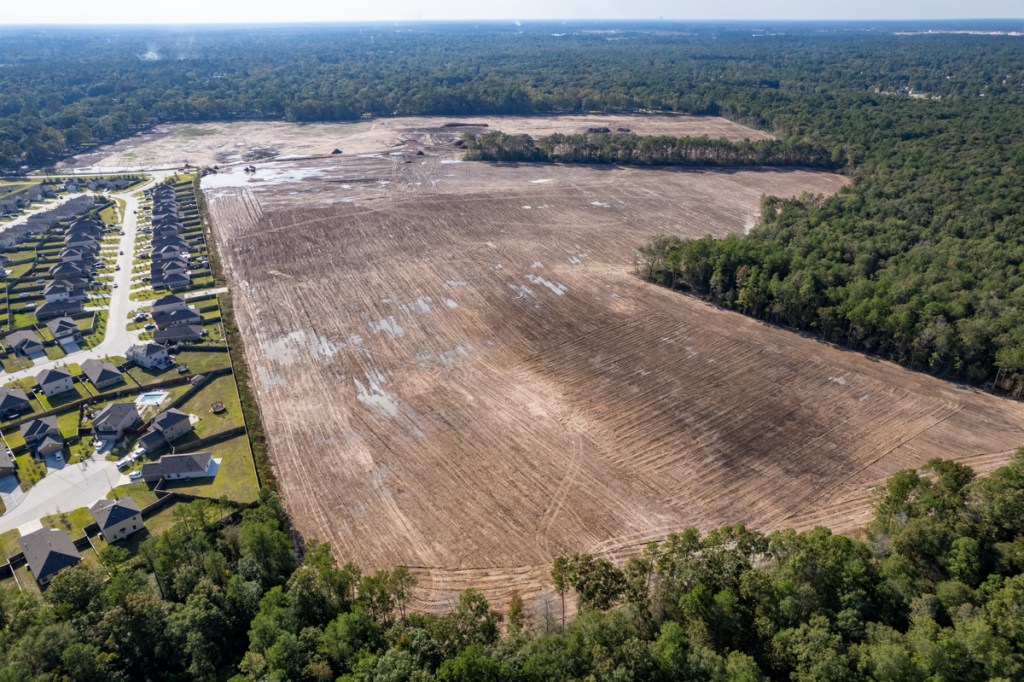
Back in January of this year, I posted about two new developments on Gully Branch south of Splendora Junior High School on FM2090. At the time, two companies (Townsend Reserve, Ltd. and Forestar USA had begun to clear approximately 600 acres. Six months later, the trees are gone and the companies are installing infrastructure, such as roads and drainage. This area eventually drains into the the East Fork San Jacinto and Lake Houston.

Map of New Developments

Splendora Developments on 2090
Parcel owners and sizes. Green = land being cleared. Red = not yet clearing land. From: Montgomery County Appraisal District.

Ultimately, the cleared area shown in the pictures below will almost double. The two companies combined own 1209 acres.

Photos Taken on 6/4/2022 Show Extent of Construction

The first three shots below form a series as I panned right from east to west while looking south.

Looking southeast from Splendora Junior High Parking Lot across FM2090 at eastern section of Forestar USA property. Note Gully Branch bisecting property and large detention pond.
Looking directly south at Forestar property which will become Splendora Crossing. Parcel in upper right belongs to Townsend Reserve.
Looking southwest along FM2090. Townsend Reserve property at top of frame. Last week, Signorelli announced plans for a 3,000-acre development in the upper right corner of this photo.

The next two shots look west from farther west. The first shows Gully Branch (center) as it moves from Townsend property (top of frame) to Forestar property (bottom).

Gully Branch as it crosses the main entry to the two sites.
Main detention pond in Townsend Reserve (center). Two additional detention ponds will be built in the distance.

If you look closely at the photo above, you can see excavators and dump trucks already working on additional detention ponds near the top of the frame. See map below.

Townsend reserve and floodplain
Diagram of detention pond layouts from Townsend Reserve’s Drainage Impact Analysis.

Drainage Analysis Does Not Show Maps Based on Atlas-14 Data

To see construction plans and drainage impact analyses for these two sites, see my January 15th post on these developments.

WGA developed the drainage impact analyses for both developments using 2014 flood maps (see Townsend’s below). In fairness, WGA did attempt to calculate new flood elevations using its own measurements. But illustrations showing the old floodplain outlines, without mention of coming map changes, may mislead potential buyers.

Old 100-year floodplain superimposed on new Townsend Reserve development

Elevation Land Solutions developed the construction plans for Townsend. It disclosed flood risk more fully.

disclaimer for Townsend reserve in Elevation Land Solutions Plans
Disclaimer for Townsend Reserve in Elevation Land Solutions Plans found on virtually every page.

In fairness to developers, they can’t put their plans on hold indefinitely while new flood maps are drawn and approved. However, in fairness to buyers, you would think the engineering documents would at least disclose the potential of new maps based on Atlas-14 data. I’ve read fuller disclosures on an aspirin bottle.

Posted by Bob Rehak on 6/6/2022

1742 Days since Hurricane Harvey

Signorelli Developing Another 3,000 Acres Near Splendora

The Signorelli Company (TSC) of The Woodlands, which developed Valley Ranch, has purchased another 3,000 acres of land near Splendora. The tract will become a master-planned community with more than 7,000 single-family homes in East Montgomery County. Located north of FM 2090 and west of Daw Collins Rd., the new development will be 15 minutes from Valley Ranch and five minutes west of Interstate 69. 

Senior VP Mike Miller said, “We planned the community to provide a unique lifestyle for residents – outside with nature. We are confident the amenities will attract a variety of homebuyers.” 

Amenities will include hundreds of acres of open space, numerous parks, miles of meandering trails, and various recreation areas.

TSC will break ground this fall, with the first phase of single-family homesites delivered by the end of 2023. Upon completion, the community will also have one million square feet of multi-family, office, medical, retail and hospitality space.

Maps of Area

According to Signorelli, new homes will range from the $250s to $700s. Signorelli did not announce a name for the development. Planning is still underway.

Location of new Signorelli development in SE Montgomery County. Map from Houston Business Journal.
Approximate area of Signorelli Development from Google Earth.

The Texas Parks and Wildlife Watershed Viewer indicates that the West Fork of Spring Branch and Gully Branch drain most of this area.

Google Earth (above) shows that dense forests cover most of the area, with a few small, scattered farms and ranches. I drove there today to get a closer look. My initial impressions were correct. Gorgeous, secluded country homes on large acreage dot the areas surrounding Signorelli’s land. See below.

Looking west from Daw Collins Road and pipeline corridor. Until now, the area has been home to scattered small ranches and farms, secluded in the forest. Photo taken 6/4/2022.
Looking north from same location. Daw Collins Road on right. Sam Houston National Forest in distance. Photo taken 6/4/2022.

Virtually all of this forest is in some kind of floodplain. See FEMA map below.

Much of Land in Floodplains

FEMA’s National Flood Hazard Layer View shows that large parts of the Signorelli site are in the floodway (striped), 100-year floodplain (aqua) or 500-year floodplain (brown). Photo above this map was taken looking north from red dotted circle.

Keep in mind that the flood map above is based on 2014, pre-Atlas 14 data. The floodplains will expand even further when FEMA updates the flood map.

Current Residents Worry About Development’s Impact on Flooding

I talked to one lady today who lived near the clearing (shown in the first drone photo above) for 55 years. She said she never flooded in all that time. But she worries that she will now. She understood intuitively how the acceleration of runoff from developments, if not properly mitigated, can result in higher flood peaks. She also worried that changes to the slope of the land around her might funnel water toward her property, just as Valley Ranch did to some surrounding homes and businesses.

Only time will tell if her fears are founded. Based on the FEMA flood map above, it appears that Signorelli will need to move a significant amount of earth to elevate homes above floodplains. Signorelli will also likely need to create many detention ponds for an area this large.

Say Goodbye to the Era of Country Retreats

One thing is certain, however. The era of country retreats in this area is history.

The Houston Business Journal published an article on the Signorelli development last week. It listed seven new master-planned developments going in nearby. But the list didn’t even include the closest two, Townsend Reserve and Splendora Crossing on FM2090, about a mile to the southeast and immediately south of Splendora High School. Those have already consumed at least another thousand acres of forest. More on those tomorrow.

Posted by Bob Rehak on 6/5/2022

1741 Days since Hurricane Harvey

TWDB Provides Flood-Resource Guide and More

The Texas Water Development Board (TWDB) has compiled an amazing list of resources for those concerned about flooding. Among them: a new Community Official Flood-Resource Guide.

New Community Official Flood-Resource Guide

The Flood-Resource Guide contains information to aid community officials such as floodplain managers, city officials, emergency personnel, and others. While TWDB is targeting community leaders with this particular information, it can benefit anyone concerned about flooding. This guide also makes a great resource for teachers. So why wait for third-parties to convey information to you?

The information includes best-practice guides, links to beneficial websites, videos, and toolkits.

Among the eye-openers for me were results of a statewide survey conducted by TWDB in 2020. One of the questions was, “What are your primary concerns related to flooding?” Amazingly, financial damages fell near the bottom the list. Insufficient infrastructure, preparedness, and poor policy and management topped the list…even above human life!

From page 62 of the 68-page Community Official Flood Resource Guide: Volume One. Based on 300 respondents.

This 68-page Community Official Flood-Resource Guide is packed with useful information that will help you reduce flood risk and talk about it with your relatives, neighbors and friends.

Other Useful Links

The TWDB page where you can download the new Flood-Resource Guide also provides dozens of other links with information that directly targets residents as well as flood professionals.

Start at the TWDB’s Community Assistance Program webpage. Or go directly to topics that interest you. Whether you’re trying to learn how to read a flood map or comply with flood insurance standards, this is one page that has virtually everything you’ll need. I’ve reproduced the links below for your convenience.

Hand-outs and Brochures

Helpful Floodplain Management Links, Resources

FEMA Technical Bulletins

Flood Insurance

  • NFIP Watermark: This is an electronic publication providing articles and information on flood insurance and mitigation activities.
  • FloodSmart: This is the official website of the NFIP offering extensive information on flood insurance and flood risks for communities, agents and homeowners.

Professional Associations

  • Texas Floodplain Management Association: The Texas Floodplain Management Association (TFMA) is an organization of professionals involved in floodplain management, flood hazard mitigation, the National Flood Insurance Program (NFIP), flood preparedness, warning and disaster recovery. TFMA also offers floodplain management training opportunities in Texas.
  • Association of State Floodplain Managers at www.Floods.org. The Association of State Floodplain Managers is an organization of professionals involved in floodplain management, flood hazard mitigation, the National Flood Insurance Program, and flood preparedness, warning and recovery. ASFPM has become a respected voice in floodplain management practice and policy in the United States because it represents the flood hazard specialists of local, state and federal government, the research community, the insurance industry, and the fields of engineering, hydrologic forecasting, emergency response, water resources, and others.

For more information, please contact flood@twdb.texas.gov

To make this post easy to find in the future, I’ll add it to the Links page of ReduceFlooding.com.

Posted by Bob Rehak on 6/4/2022

1740 Days since Hurricane Harvey

Appeals Court Revives Addicks-Barker Downstream Takings Cases

After Hurricane Harvey, people downstream of the Addicks and Barkers Reservoirs on the west side sued the Army Corps for “taking” their property. On February 19, 2020, Judge Loren A. Smith dismissed the takings cases. According to the Houston Chronicle, he said that property owners had no right to sue the government for inundating their land in what he called a “2000-year storm.”

However, today a Federal Appeals Court reversed Judge Smith’s dismissal of the takings cases. A lawyer following the issue described today’s ruling as “a victory for the downstream homeowners. This revives their claims – at least for now.” The appeals court ruled that the lower court incorrectly denied appellants takings claims when it ruled that “Hurricane Harvey was an Act of God.”

This ruling may affect similar cases in the Lake Houston area against the SJRA, also based on takings claims. The Fifth Amendment forbids the government from taking private property “for public use, without just compensation.”

The Lake Houston Area cases are in discovery and working toward a trial date, according to Kimberley Spurlock, an attorney for many of the plaintiffs.

Addicks reservoir
File photo. Looking upstream (NW) at Addicks Reservoir on May 20, 2021.

Summary of Appeal

Hundreds of individuals and companies that owned property downstream from the Addicks and Barker Dams alleged that the Army Corps of Engineers flooded their properties when it opened the dams’ floodgates during Hurricane Harvey.

The U.S. Court of Federal Claims (the lower court) held that plaintiffs did not have “a cognizable property interest in perfect flood control.” Thus, they could not claim “takings” against the United States. The appeals court disagreed. It sent the case back to the lower court for further proceedings.

Today’s ruling describes the history of the dams, the operating procedures for the gates, and analyzes the claims and precedents cited.

Lower Court Erred on “Property Interest,” Governmental Immunity

Basically, the lower court concluded that, “…because there was no cognizable property interest under either state or federal law, Appellants had failed to state a claim upon which relief could be granted.”

As you would expect, much of the appeal discusses whether a property interest does, in fact, exist.

The appellate decision also discusses whether the Army Corps had governmental immunity from takings claims that stem from Government attempts at flood control. The appeals court ruled that the government does NOT enjoy such immunity.

The appellate judges then turned their attention to property interests. They found that the precedents cited by the trial court were either not on point or stretched their points.

In short, the appeals court ruled that the “Court of Federal Claims erred in concluding that Appellants failed to assert a cognizable property interest.”

Summary Judgment Denied, Case Remanded

Both appellants and the government urged the appeals court to order a summary judgment in their favor. The appeals court declined. It noted that “due to the fact-intensive nature of takings cases, summary judgment should not be granted precipitously.” Thus, they remanded the cases back to the lower court. “Remand” in this context means “return a case for reconsideration.”

The appeals court judges asked the lower court to rule on three specific things. Whether:

  • Appellants have shown that a temporary taking occurred under the test applicable to flooding cases.
  • Appellants established causation considering the impact of government actions.
  • The Government can invoke the “necessity doctrine” as a defense.

The last point refers to a Supreme Court ruling. It recognizes that a taking claim may be non-compensable if there is “the destruction of ‘real and personal property, in cases of actual necessity…” Example: to prevent the spread of a fire.

For those reasons, the appeals court reversed the original decision of the Court of Federal Claims. It remanded the case back to the original court for further proceedings “consistent with this opinion.”

For the full text of the appeal, click here.

Posted by Bob Rehak on 6/3/2022

1739 Days since Hurricane Harvey

Rogers Gully Mouth Bar Gone!

Almost three months to the day since dredgers moved from the East Fork San Jacinto to Rogers Gully, dredgers have totally removed the above-water portion of the stream’s mouth bar. Aerial photos taken on 6/2/22 show dredgers now deepening the channel up to the limit of the HCFCD’s excavation of Rogers Gully in 2020.

Geologists use the term “mouth bar” to describe a sand bar that forms at the mouth of a stream. Where moving water meets standing water, the velocity slows and sediment drops out of suspension, forming a mouth bar. Mouth bars reduce the conveyance of a stream, forcing water up and out during floods. Removal of mouth bars reduces flood risk.

After Harvey, Rogers Gully had the largest mouth bar on the perimeter of Lake Houston with the exception of the West and East Forks of the San Jacinto. Jessica Beemer with Mayor Pro Tem Dave Martin’s office said they do not yet know where the dredgers will go next.

Before Picture

Mouth bar in February of 2020. Note HCFCD excavating channel further upstream in upper left of photo. The City of Houston owns the portion of the channel in foreground.

It didn’t really take three months to dredge this blockage. Dredgers literally had to dredge their way to the channel, according to State Representative Dan Huberty, who secured funding for additional dredging. The dredging started more than 1,000 feet out into the lake.

Today

Looking west, upstream on mRogers Gully. 6/2/22. No more mouth bar!
Wider shot from farther back, looking upstream from over Lake Houston. 6/2/22.
Shot taken looking east on 6/2/22.
Hauling the spoils to the east side of the Lake. 6/2/22.

A marina on the east side of the lake has been converted to a temporary placement area. From there, truckers haul the dirt out of the floodplain to areas where it’s needed to elevate homes or roadways.

New site for transferring spoils.
Deposit site for dredging spoils. 2/27/22. Previous site was opposite River Grove Park on West Fork, almost 5 miles farther.

Put another one in the win column. Many people who flooded near Rogers Gully will face less risk this hurricane season as a result of this project.

Posted by Bob Rehak on 6/2/22

1738 Days since Hurricane Harvey

Hurricane Season Starts Today, Plan Now

The 2022 Hurricane Season begins today – June 1. And as if on cue, the National Hurricane Center has already highlighted two areas to monitor.

Five day outlook from National Hurricane Center as of 8am 6/1/22.

Neither storm will threaten the Houston area. But this should serve as a wake up call. If you haven’t already done so, now is the time to prepare your family and home for hurricanes and their impacts. 

Above Average Hurricane Season Predicted

If you’ve lived in the Houston area for a while, you know how devastating the effects of just one hurricane can be. And NOAA predicts this will be an above average season.

It’s not just the rain that threatens us as it did in Harvey. Wind can knock down trees on houses and power lines. Power outages can last weeks, as they did during Hurricane Ike in 2008.

The eye of Ike passed right over the Lake Houston Area and knocked down so many trees that my business lost power for 19 days. At the start of that hurricane season, Butch Standerfer, a State Farm insurance agent in Kingwood, had alerted me to something called “Business Interruption Insurance.” We purchased it and thank God we did. Had it not been for that, the loss of income would have forced my company out of business.

Ike taught me many valuable lessons about planning before the storm, maintaining situational awareness during the storm, and recovery after the storm. Please share this post with your people and those new to the area.

Preparedness Is Key

“Hurricanes are one of nature’s most powerful and destructive natural disasters that we face. It only takes one to change your life,” said Tina Petersen, Harris County Flood Control District Executive Director. 

Preparedness can help minimize damages if a hurricane threatens the area. Here are some tips I’ve gathered from interviewing hundreds of storm victims.

Purchase Flood Insurance:

Harris County Flood Control District recommends that all Harris County residents become informed about their flood risk and have flood insurance no matter where they reside in the county.  Flood insurance accelerates the rebuilding and replacement of personal property and fosters community resiliency as a whole. 

For information on flood insurance, call your agent, visit the National Flood Insurance Program website, or call 1-888-379-9531.   

If you need help finding an insurance provider go to FloodSmart.gov/flood-insurance-provider or call the NFIP at 877-336-2627.

If you’re counting on FEMA or HUD disaster relief aid after a storm to repair your home, don’t.

Insurance is the only thing you can count on. I know people who lived or worked so far from flood threats that they didn’t think they needed insurance. Almost five years after Harvey, they bitterly regret that decision.

Sign Up for Flood Warning System Alerts:

The Harris County Flood Warning System offers an alert feature that lets you subscribe to email and/or text alerts that report near real-time rainfall and water levels. Customize alerts and notifications for bayous and tributaries in your area. The Alert Notification System will tell you how much water is headed your way and when/if flooding is likely.

Know Your Flood Risk:

View Flood Insurance Rate Maps and floodplain maps at FEMA’s National Flood Hazard Layer Viewer.  

You can also learn more about different types of flooding (street, coastal, riverine, flash, etc.) with Harris County Flood Control’s Flood Education Mapping Tool. This site has interactive features that let you view different types of flood threats in your neighborhood. For instance, clicking on the “ponding” button shows you where streets are likely to flood. It’s useful for planning evacuation routes and also when buying homes.

Locations susceptible to ponding near the center of Kingwood from Harris County’s Flood Education Mapping Tool. See reddish brown areas.
Study the Advice of Experts

Visit the Harris County Flood Control District Storm Center webpage or Resource Page to view the District Hurricane Guide, information on Flood Insurance and more.  

Bookmark Trusted Weather Pages:

Bookmark trusted sources of weather information. In addition to the sources above, bookmark the National Hurricane Center and National Weather Service. Traffic to these sites is likely to be so heavy during a hurricane that they will bog down. So know the exact pages you want.

Make Your Plan:

USAA maintains a Natural Disaster Preparation Site for hurricane preparedness checklists. They advise:

  • Have an evacuation plan.
  • Create an emergency kit.
  • Keep your documents safe.
  • Review your health plan.
  • Inventory your belongings.

ReduceFlooding.com has dozens of links that can help you prepare for hurricanes, including special checklists for senior citizens and pets.

Count on Life Without Electricity for Awhile

Even if you don’t flood, the likely loss of electricity for an extended period will create hardships. Imagine not being able to store food, cook, watch TV, recharge your cell phone, access your Internet service, fill your vehicle with gasoline, use air conditioning, take a hot shower, turn on the lights, or use power tools to make repairs.

Plan for all those contingencies now and you should survive.

Posted by Bob Rehak on June 1, 2022

1737 Days after Hurricane Harvey

RV Resort Detention Pond Should Remain “Completely Dry Between Storms”

The controversial Laurel Springs RV Resort appears to have another problem with permit violations. The resort’s detention pond falls within the FAA regulatory limit and should remain “completely dry between storms.” But it’s not.

How Building Permit Reads

This notation is clearly marked on the resort’s detention and mitigation plan approved by the City of Houston on 12/2/2020.

Screen Capture from C3.4 – Detention and Mitigation Plan – approved by City of Houston.

While FAA regulations give owners two days to drain ponds after storms, the Laurel Springs RV Resort pond has remained wet for more than two months. See a sampling of pictures below.

March 23, 2022
March 28, 2022
April 30, 2022
Photo from May 3, 2022
May 15, 2022
May 25, 2022
Photo taken on May 30, 2022. Two months later, still not completely dry.
Purpose of FAA Regulation

I looked up the FAA Advisory above to see exactly what it said. To summarize the relevant portions of the 28-page document, they prohibit the construction of wet-bottom, stormwater-retention ponds within a certain range of airports. The concern: the water could attract ducks and geese that create a hazard for aircraft taking off, landing or circling. The detention pond for the Laurel Springs RV Resort falls within the regulated range of Houston’s Bush Intercontinental Airport.

Note the regulation above was revised about the time that the City of Houston approved the Laurel Springs RV Resort plans. While the wording in the replacement varies somewhat, the key point remains.

The FAA discourages land uses that attract or sustain hazardous wildlife within five (5) miles of airports to protect aircraft.

The updated report also states that 90% of bird strikes on aircraft happen under 3,000 feet.

History of Troubles

At first, contractors seemed to be doing everything they could to keep the Laurel Springs RV Resort pond dry. In January, they even opened up a trench in the southern wall of the pond to drain it into Harris County’s Edgewater Park, violating their TCEQ Construction General Permit. After they finally installed the permanent drainage, mysterious black spots started appearing on the floor of the pond.

Now it appears they’re just letting the water evaporate and leak out through the wall of the pond, running afoul of the FAA regulations.

Posted by Bob Rehak on 5/31/2022

1736 Days since Hurricane Harvey

The thoughts expressed in this post represent opinions on matters of public concern and safety. They are protected by the First Amendment of the US Constitution and the Anti-SLAPP Statute of the Great State of Texas.

Editorial: Contrived Ignorance in Flood Mitigation

Last week, one of the biggest issues in Harris County flood mitigation came into sharp focus for me: contrived ignorance regarding flood-bond spending. Three things brought it into focus:

  • The completion of the $480 million Project Brays, the largest in Harris County Flood Control District’s (HCFCD) history. The Brays watershed has 58% low-to-moderate income (LMI) residents.
  • Commissioner Rodney Ellis’ repeated assertions that FEMA discriminates against projects in LMI neighborhoods, and that “all the funding” is going to affluent neighborhoods.
  • HCFCD’s release of the May update on flood-bond spending. It showed that less than one one-thousandth of one percent of active flood-bond construction dollars are going to the entire northeastern part of the county (Kingwood, Huffman, Humble, Atascocita, and Crosby).

Ellis keeps rubbing me the wrong way. Why inflame racial distrust, Rodney, with statements so far from the truth?

Ignorantia Affectata

I’ve always had trouble understanding politicians who deny reality. But it turns out Thomas Aquinas, the great Catholic theologian and philosopher from the Middle Ages, described the phenomenon 800 years ago. He called it ignorantia affectata, a Latin phrase meaning “affected or cultivated ignorance.”

I found a great description of it on this blog. “The deniers first deceive themselves that they are sincere in their adherence to falsehoods. Thus they cannot be faulted for acting on genuinely held views. But in truth, they have cultivated an ignorance of the facts, an ignorance so useful that one protects it at all costs … in order to continue using it in one’s own self interest.”

David Luban, a professor at Georgetown Law, wrote a brilliant essay on the ethics of “Contrived Ignorance” (a related concept) and the law. It begins with a poignant description of how criminal defense attorneys discourage defendants from telling them everything they know. Admitting guilt could limit their defense of the client, because the law forbids lawyers from lying or knowingly putting on perjured testimony. Luban also touches on another related concept, plausible deniability, so common in politics and business.

Plausible Deniability No Longer Plausible

After Ellis spoke at the ribbon cutting ceremony – for the largest project in flood control history – he can no longer plausibly deny that poor neighborhoods can’t get flood-mitigation funding. They do!

But he tried. He trotted out his tired distortion about higher value homes in affluent neighborhoods skewing benefit/cost ratios. The problem: it ignores density. Higher density more than compensates for higher value homes. And in fact, from the ribbon cutting ceremony one could see apartments several stories high, stretching blocks in all directions.

While Ellis leads people to believe that projects in LMI areas struggle to achieve Benefit/Cost Ratios above 1.0, Project Brays had a 7.0 ratio. That’s extremely high. See this 2019 Federal Briefing. It will return $7 for every $1 invested!

Rodney Ellis at ribbon cutting ceremony for the $480 million Project Brays. The project helps reduce flood risk in neighborhoods where Ellis grew up and also where he now lives.
Brays Bayou, looking west toward medical center from Almeda Drive.

Contrived Ignorance Vs. Informed Debate

The problem with contrived ignorance is that it prevents informed debate. Why would you look for evidence that undermined your world view? That prevented you from reducing flood risk in your neighborhood even further?

Why use the commonly accepted dictionary definition of “equitable” when you can redefine the word to serve your self interest?

I find it incredible that in 18 months, a majority of the Community Flood Resilience Task Force:

  • Has failed to define “worst first.”
  • Refuses to discuss what percentage of flood-mitigation funding affluent neighborhoods should get.
  • Won’t admit that flood-mitigation projects have already been built in their neighborhoods.
  • Is arguing about how to float another flood bond for $60 billion when we’re only 20% complete with the first $5 billion.
  • Won’t discuss whether 2-year flooding in affluent neighborhoods should be fixed before 500-year flooding in LMI neighborhoods.
  • Attributes past flooding to racially motivated neglect without examining the role of development practices
  • Recommended that HUD pay people only from poor neighborhoods to protest the unfair distribution of flood-mitigation funds.

When you try to discuss actual facts in Task Force meetings, shocked silence often greets you. Members keep talking about how they want facts. But a full year after requesting flood-risk data, no one seems concerned about the fact that they haven’t gotten it yet. Could this be what Thomas Aquinas meant?

Posted by Bob Rehak on 5/30/22

1735 Days since Hurricane Harvey

The thoughts expressed in this post represent opinions on matters of public concern and safety. They are protected by the First Amendment of the US Constitution and the Anti-SLAPP Statute of the Great State of Texas.