On January 9, 2023, FEMA released a Simplified Procedures policy for Public Assistance grants to speed up recovery for applicants. Small projects are now defined as those up to $1 million.
The new policy should reduce administrative burdens and enable communities to recover more quickly after presidentially declared events by streamlining documentation requirements.
FEMA will accept estimates with summary information and the applicant’s certifications for damage and work, instead of requiring applicants to provide full or detailed documentation.
FEMA Press Release
FEMA conducted a review in 2020. It showed that if a $1 million threshold were applied, 94 percent of projects would be considered small and help put additional recovery dollars in the hands of applicants faster and accelerate closure of projects.
FEMA intends to continue adjusting the threshold annually to reflect changes in the Consumer Price Index. It also intends to review the base threshold every three years.
The new policy is not directly aimed at individuals, but at state and local governments and certain types of private nonprofit organizations. Public Assistance grants cover such things as:
Disaster-related debris removal
Emergency protective measures
Repairs to damaged or destroyed infrastructure (i.e., roads).
FM1010 Washout during Harvey at Rocky Branch in Plum Grove near the East Fork. Still not repaired after 5.5 years.
Depending on repair cost and other factors, the road washout above is an example of the type of project that might benefit from the new policy. However, it’s not clear whether the simplified procedures apply retroactively to damage from past disasters or only future disasters. More details will follow.
Applicant has legal responsibility to perform the work
Cost is reasonable.
Once FEMA and the state review and approve the government agencies’ or nonprofits’ RPAs, applicants work with their FEMA representative to develop a damage inventory.
FEMA obligates funds to the state once a project meets Stafford Act eligibility requirements. The state is the official recipient of FEMA federal assistance. The state is then responsible for disbursing the money to applicants.
FEMA will hold a series of webinars in coming weeks to explain more about the simplified policy. Additional details are not yet available.
Getting aid to people faster after a disaster is necessary. This is a very complex subject. I wish all forms of disaster relief, including hazard mitigation, could be simplified. We’re still waiting on the Harris County, the GLO and HUD to agree on a plan for spending $750 million in mitigation funds related to Hurricane Harvey – 5.5 years after the event!
Posted by Bob Rehak on 1/12/23 based on a FEMA Press Release
1962 Days after Hurricane Harvey
https://i0.wp.com/reduceflooding.com/wp-content/uploads/2020/10/20201025-DJI_0919.jpg?fit=1200%2C900&ssl=19001200adminadmin2023-01-12 13:04:432023-01-12 13:20:54FEMA Simplifying Procedures for Small Public Assistance Grants
Precinct 1 Commissioner Rodney Ellis has placed an item on the Commissioners Court agenda for 1/10/23 with far reaching ramifications for flood control in Harris County. It would change the way every future project is prioritized using a formula that gives almost half the weight to population and building density. Meanwhile, it ignores the amount of damage, severity of flooding, danger to infrastructure, historical underinvestment, and the difficulty of accurately estimating population in flood zones. Ellis’ recommendation could be used to permanently deny projects to heavily flood-damaged areas like Lake Houston.
Text of Motion
In Agenda Item #250, Ellis seeks: “Request for approval to direct the Harris County Flood Control District (“District”) to assign prioritization scores using the adopted 2022 Prioritization Framework for the Allocation of Funds from the Harris County Flood Resilience Trust to all new flood risk reduction projects funded by the District when requesting Commissioners Court approval to initiate the project, and to transmit those scores as quartiles to Commissioners Court.”
So what is that framework and why do we need it?
History of Recent Efforts to Prioritize Projects
Before the 2018 flood bond, Harris County flood control looked primarily at clusters of repeat damage to define and prioritize projects. That damage also formed the basis for obtaining partner funding in many cases.
However, when the perpetually underfunded Flood Control District received the huge infusion of cash from the 2018 flood bond, a problem arose. Which of the many worthy projects would be launched first? There simply weren’t enough qualified contractors to handle all needs simultaneously.
The text of the 2018 flood bond approved by voters contained a sentence that said, “…Commissioners Court shall provide a process for the equitable distribution of funds…” (See Paragraph 14-G). That became the key to the answer…with some verbal legerdemain by Ellis that turned “distribution” into “prioritization” and “equitable” into “equity.”
20% Existing Conditions (Drainage Level of Service)
20% Social Vulnerability
10% Project Efficiency
10% Partnership Funding
5% Long Term Maintenance Costs
5% Minimizes Environmental Impacts
5% Potential for Multiple Benefits
Total 100%
Commissioners, including Ellis, repeatedly affirmed their intent to complete all projects originally identified as part of the bond. The framework simply prioritized their start dates.
Commissioners also talked a lot about prioritizing “the worst first.” It was a nice sound bite, but never defined. Were the worst areas those with the most damage, deepest flooding, poorest residents, highest risk, or some combination of the above? Notice that the formula above omits flood damage, the traditional way of prioritizing funds and “ground-truthing” flood-risk estimates.
At this point, all of the projects in the bond have started. Their natural lifecycles and complexity will determine their order of completion. So, the debate has shifted from the flood bond to other sources of funding and future projects.
2021 Changes Applied to Flood Resilience Trust
In 2021, Commissioners created a Flood Resilience Trust using Toll-Road funds to backstop potential shortfalls in flood-bond partner contributions. The weighting used to allocate funds from the Trust changed significantly.
25% Structures Benefitted
20% Flooding Frequency
20% Social Vulnerability
10% Cost Per Structure
10% Partnership Funding
5% Maintenance Cost
5% Environmental Impact
5% Secondary Benefits
Total 100%
Flood Control used this formula only to prioritize the use of backstop funds in the Trust. Note this version of the formula eliminated both damage and risk reduction from consideration.
2022 Changes
In April, 2022, Commissioners modified the 2021 weights within the Prioritization Framework – still only for Flood Resilience Trust Funds – as follows:
45% Project Efficiency
15% Resident Benefits
30% Structure Benefits
20% Existing Conditions
20% Social Vulnerability Index
5% Long Term Maintenance Costs
5% Minimizes Environmental Impacts
5% Potential for Multiple Benefits
This 2022 formula omits consideration of damage, risk reduction and partnership funding. But it gives weight to population density (project cost divided by # residents benefitted). This 15-page PDF explains how projects are scored within each category above.
2023 Proposal
Commissioner Ellis now proposes applying the 2022 Resilience Trust formula to ALL FUTURE HCFCD PROJECTS.
Problems with Proposal
Flood Control would now use Ellis’ formula to decide which projects make the list, not just which go first.
Thus, the so-called “equity” formula once used to schedule projects could now be used to eliminate projects altogether.
Two thirds of the weight goes to density and social vulnerability. Only 20% relates to flooding.
The projects most likely to be eliminated would be outside the Beltway – in less dense areas that have traditionally received the least funding. In a post-bond, financially constrained environment, the weight given to density will put every project outside the Beltway at a disadvantage.
But the Ellis formula has many other problems, too. It:
Does not differentiate between types of structures while giving them almost a third of the weight. Thus, a mobile home counts for as much as a hospital or college.
Gives no weight to protecting critical infrastructure such as bridges, hospitals, grocery stores, wastewater treatment plants, etc.
Gives 20% weight to social vulnerability, but ignores the severity of flooding. Thus a low-income home with one inch of flooding counts as much as an entire condo complex swept away by 22-foot deep floodwaters.
Makes awards more subjective because HCFCD has no way of estimating how many people live in apartment buildings or homes. HCFCD can count buildings in satellite photos, but the number of residents benefitted will always be a guess. Census tracts do not follow floodplain boundaries.
Undermines efforts to prevent flooding, as opposed to correcting it after people are damaged. Prevention, such as HCFCD’s Frontier Program, is always more cost effective in the long run.
Forces Flood Control to judge projects before the District has engineering and cost data in hand that would help determine whether the projects are worth pursuing. That’s because “ALL FUTURE PROJECTS” include preliminary engineering projects.
Suggestions For Improvement
Below are several suggestions to improve the formula.
Define “worst first.” While the sentiment is noble, in practice, the term has no practical definition. (Ditto for equity.)
Incorporate measurements for severity of flooding and amount of damage. These really define worst.
Prioritize critical infrastructure such as bridges whose loss can jeopardize the economic vitality of the region.
Include partnership funds. They help stretch flood-mitigation tax dollars by almost a third. Even if people sometimes must wait longer to line up partner funding, partner funding helps more people in the long run.
Publish level-of-service data, used in the “existing conditions” calculation, for all streams in the county. It seems to be secret. I’ve been trying to get it for a year. Keeping it secret undermines trust in government. How do we know money is really going to the areas with the greatest risk?
Publish a 5-year Capital Improvement Plan similar to the City of Houston. Let people see what is coming, when, and for how much. That way we can hold HCFCD and Commissioners accountable. Plus, we can see their “formula” in action.
Be fair to all. The proposed formula is like playing cards with a stacked deck.
Posted by Bob Rehak on 1/7/23
1957 Days since Hurricane Harvey
The thoughts expressed in this post represent opinions on matters of public concern and safety. They are protected by the First Amendment of the US Constitution and the Anti-SLAPP Statute of the Great State of Texas.
https://i0.wp.com/reduceflooding.com/wp-content/uploads/2020/08/Ellis.jpg?fit=1200%2C809&ssl=18091200adminadmin2023-01-07 19:13:032023-01-08 10:27:15Ellis Trying to Change How All Flood-Control Projects Prioritized
Harris County Flood Control District (HCFCD) released its November report on Flood-Bond progress to Commissioners Court yesterday. The report covered through October 2022. I had two major take-aways:
The slowdown in bond spending continues. HCFCD initiated no new construction projects during the month of October.
HCFCD spent more money on buyouts than flood reduction.
The major announcement: the District advertised bids for the construction of a stormwater detention basin in Inwood Forest. The project encompasses property owned by the City of Houston located both east and west of Antoine where Vogel Creek outfalls into White Oak Bayou (the old Inwood Forest Golf Course). It will eventually have a total of 12 interconnected compartments.
Funding of this project comes from the 2018 Bond, FEMA and the Texas Division of Emergency Management (TDEM). HCFCD hopes construction will begin in winter 2022-23. But let’s look at what has happened, instead of what will.
Overview
Since the last update, HCFCD:
Awarded NO construction projects
Awarded 9 non-construction agreements totaling $33 million
Paid $1.2 million for professional services.
Completed 28 home buyouts valued at approximately $5 million
Spent a total of $9.9 million since the last update.
Those last two bullet points mean…
HCFCD spent more on buyouts than flood reduction in the month of October.
HCFCD uses some buyouts for right-of-way (ROW) acquisition to build detention ponds or widen channels. But many buyouts simply avoid repetitive losses. The latest update does not specify which category October buyouts fell into.
Schedule performance indicators (the SPI index) for the month remained at .95 – behind schedule. HCFCD says the bond program is 23.8% completed – an increase of 0.3% from the previous month. That’s at 50 months out of a planned 120 month program or 41.6% of the way into the bond program.
Where the Money Has Gone
Only three projects out of 181 in the Bond changed stages. One went into preliminary engineering and two went from preliminary engineering into right-of-way acquisition. All are in the Cedar Bayou watershed.
The map below shows where $1.14 billion spent to date has gone.
In table form, that looks like this. I provided three months of data so you can see whether the needle is moving in your watershed. Five watersheds received no money in October.
Spending changes by watershed for the last three months.
October’s $9.9 million was only slightly better than September.
Project Phasing Influences Spending Rates
Projects typically go through phases that comprise different percentages of the total budget. In flood control, upfront spending on studies typically comprises only 13% of the total. The big spending – 79% – happens for right-of-way acquisition and construction. Looking back at all phases of all projects since 2000…
Right-of-Way Acquisition and Construction account for almost four out of every five dollars spent by HCFCD.
Here’s how the breakdown looks:
Data compiled from FOIA Request
HCFCD typically spends six times more on Rights-of-Way and Construction, than upfront Feasibility Studies, Preliminary Engineering Reviews and Design.
More than four years into the bond, many projects should be entering the more expensive phases. So you would expect spending to increase. And July totals reflected that. But then a precipitous decline set in.
At the current spend rate, it would take 32 years to complete the bond, not 6.
Why the Slowdown?
HCFCD has not yet explained the slowdown except to say that, during the course of major programs like the Flood Bond, sometimes you hit lulls between major projects. But this slowdown has persisted for three months. No construction projects started last month. And Inwood-Forest stormwater-detention-basin construction likely won’t start for several more months.
Management Turnover – HCFCD recently lost its top three leaders who architected the Flood Bond: Russ Poppe, Matt Zeve, and Alan Black.
Less Experienced Management – Poppe was replaced by an academic who formerly managed the Subsidence District which has a budget one-thousandth the size of the 2018 flood bond.
More Layers of Management – There’s now a whole new department – County Administration – between Flood Control and Commissioners Court.
Bottom line: County Judge Lina Hidalgo needs to provide an explanation for the slowdown. This affects all Harris County residents, not just those in particular watersheds.
Posted by Bob Rehak on 11/30/2022
1919 Days since Hurricane Harvey
The thoughts expressed in this post represent opinions on matters of public concern and safety. They are protected by the First Amendment of the US Constitution and the Anti-SLAPP Statute of the Great State of Texas.
https://i0.wp.com/reduceflooding.com/wp-content/uploads/2022/11/Screenshot-2022-11-30-at-12.42.00-PM.png?fit=1270%2C954&ssl=19541270adminadmin2022-11-30 12:54:322022-11-30 13:06:15HCFCD Spending Slows; More Went to Buyouts than Flood Reduction
During Lina Hidalgo’s first term, hundreds of millions of dollars in flood-mitigation projects went to low-income watersheds while the Lake Houston Area went begging. So what does the recent election mean for the area’s flood-mitigation goals and strategies? What can we do to reduce flood risk with the deck stacked even further against us? It’s time to hit the flood-mitigation reset button.
Before the election, Democrats insisted that they still intended to complete all the projects in the 2018 Flood Bond. But now with a super-majority on Commissioner’s Court, they have the power to spend that money wherever they want with impunity.
We need to regroup and develop new strategies to attain our goals. We can no longer afford to rely so much on Harris County.
Understanding the Process
Flood mitigation has political, technical and financial aspects. They all demand coordination. After Harvey, Guy Sconzo, former superintendent of Humble ISD, and the Lake Houston Area Chamber formed a task force with area leaders to identify the causes of flooding and work toward solutions.
After initial successes, sadly, Sconzo died. It happened shortly after the passage of the 2018 Harris County Flood Bond and the State’s Flood Infrastructure Fund. Not long thereafter, the task force disbanded. People assumed that projects would just happen. They didn’t.
Roadblocks since Harvey
No one fully understood how long the process would take, all the steps that were involved, how much projects could ultimately cost, the intense competition for funding, and how projects could languish without a coordinated effort to remove roadblocks as they arose.
We must overcome our addiction to expectations of fair treatment and learn that we must fight for our homes and safety. We must become masters of our own fate and hit the flood-mitigation reset button now. So, what to do?
These are my personal recommendations.
Re-constitute the Lake Houston Area Task Force
Educate people about the risk they still face.
Acknowledge that most of our problems originate outside the county.
Update and prioritize our goals.
Acknowledge we can’t achieve them alone and work to build bridges to those who can help.
Coordinate with them and Harris County Flood Control.
Don’t count on Harris County for much help.
Finish studies already started (i.e., Taylor Gully, Atascocita).
Check on progress of all projects monthly to ensure next steps (i.e., construction bidding) happen promptly.
Identify roadblocks and work to overcome them.
Search for alternative funding and partners if necessary. UPFRONT!
Stop assuming projects will manage themselves. Hire a project manager to report monthly to the reconstituted task force.
Starting Points
Harris County Flood Control District began engineering studies long before Harvey for the projects you now see in construction. Then, when Harvey hit and voters passed the 2018 flood bond, they were ready to go.
Other areas had to start from scratch and are still running the gauntlet of feasibility, preliminary engineering, final engineering, and environmental studies.
In the the Lake Houston Area:
HCFCD started four drainage studies and finished three (Kingwood, Huffman, Cosby). Atascocita is still underway.
San Jacinto Regional Flood Planning Group finished its preliminary report.
Who is ensuring that engineering studies consider realistic funding alternatives? How much time, effort and money have we wasted by working in silos? Maybe a renewed Lake Houston Area Flood Task Force could help with those issues.
We need earmarks for funding at the state level. But who will fight for them? How will our representatives and senators know what to fight for? And how much the projects cost?
Any area with a completed study should have a project moving forward and be looking for funding. If it doesn’t, then someone is messing up the process.
It will only be Lake Houston’s turn if someone or some group advocates for the area as they did after Harvey.
The good news in all this is that a preliminary meeting of area leaders on the City, County, State and Federal levels was held on November 8th at Congressman Dan Crenshaw’s office. Everyone attending agreed on the need to reconstitute the Task Force and hit the flood-mitigation reset button. The group also examined a number of possible issues to focus on. More news on the new Task Force as it begins to set priorities.
Posted by Bob Rehak on 11/22/2022with thanks to Dr. Charles Campbell for the post’s photo.
1911 Days since Hurricane Harvey
The thoughts expressed in this post represent opinions on matters of public concern and safety. They are protected by the First Amendment of the US Constitution and the Anti-SLAPP Statute of the Great State of Texas.
https://i0.wp.com/reduceflooding.com/wp-content/uploads/2018/12/Campbell-sunrise-12_3_18-small.jpg?fit=1500%2C1114&ssl=111141500adminadmin2022-11-22 18:52:202022-11-22 21:24:31Time for Lake Houston Area to Hit Flood-Mitigation Reset Button
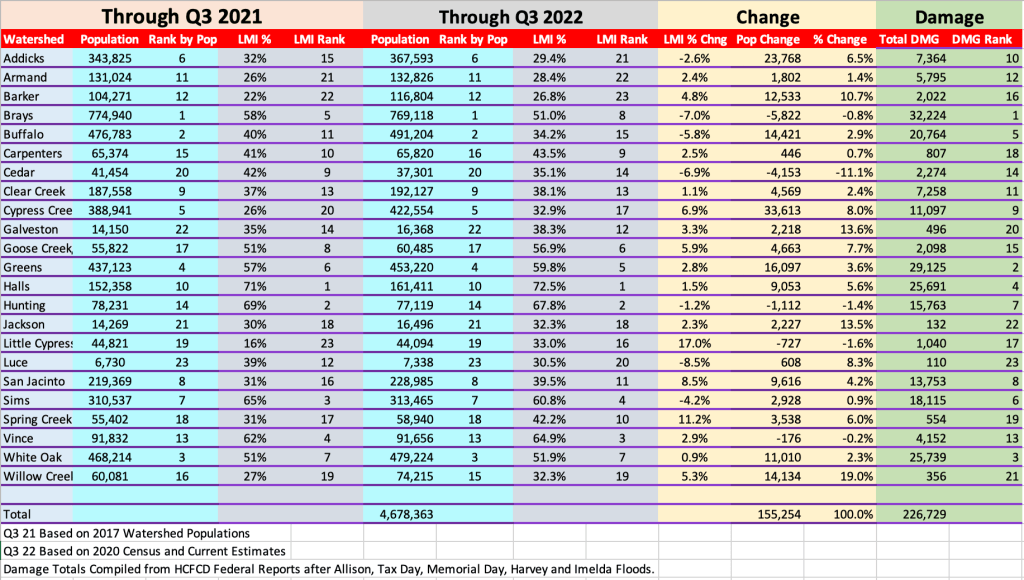
Like damage, population is one of the “weighting factors” considered in the distribution of flood-mitigation dollars. Compared to 2017 estimates of watershed populations in Harris County, 2022 estimates show that five watersheds have lost population. But overall, the county has gained 155,254 people.
The map below shows the location of each of these watersheds.
Harris County Watersheds by Harris County Flood Control District
Reasons for Shifts Unclear
I had wondered whether the five major floods in Harris County between 2000 and 2020 (Allison, Tax Day, Memorial Day, Harvey and Imelda) would cause the most heavily flood-damaged areas to lose population. But that seems not to be the case.
The most heavily damaged watershed (Brays) lost the most population (in raw numbers). But the second most heavily damaged watershed (Greens) gained more than 16,000 people, the second largest gain.
I found no meaningful correlation between flood damage and population loss or growth. Nor do data suggest that flood-mitigationspending has much influence either. Contradictory examples abound. And statistical correlations rate as negligible to weak.
Five Watersheds Lost Population
Compared to the previous Census estimates from 2017:
Brays lost 5,822 people (0.8%)
Cedar lost 4,153 people (11.1%)
Hunting lost 1,112 people (1.4%)
Little Cypress lost 727 people (1.6%)
Vince lost 176 people (0.2%).
In percentages, Cedar Bayou lost the most population. Cedar was the sight of the Arkema disaster which blocked evacuation routes along Highway 90 during Harvey. The watershed currently has only about 37,000 people, ranking it 20th among the 23 watersheds in Harris County.
In five major storms between 2000 and today (Allison, Tax Day, Memorial Day, Harvey and Imelda), flood damage varied widely within those five watersheds:
Brays flooded 32,240 structures, the most of any watershed.
Cedar flooded 2,274.
Hunting flooded 15,763.
Little Cypress flooded 1,040.
Vince flooded 4,152.
18 Watersheds Gained Population
Eighteen other watersheds gained population and also had widely varying degrees of flood damage. These, too, showed little correlation.
Altogether, the county’s watersheds gained 155,254 people, despite 226,729 damaged structures during the five major storms.
Negligible Correlation of Flooding and Population Gain/Loss
The “population flees flooding” hypothesis didn’t hold much water.
Flood damage and “number of residents lost” correlated at only a 0.16 level – insignificant. Flood damage and “percent of residents lost” correlated at only 0.28, extremely weak.
A perfect correlation is 1.0. It indicates that for every unit of change in one variable, there is a corresponding unit of change in another variable. However, that was far from the case here. Variations seemed random.
The County has a strong draw: jobs. Also, family, friends, neighbors and support networks remain powerful attractions that keep most people anchored.
The new HCFCD data do not suggest why gains and losses occurred.
Top reasons for relocation typically include: greater safety, better schools, better housing, new jobs, and upgrading from apartments to homes.
LMI Population Trends
HCFCD also measures “LMI population.” LMI stands for Low-to-Moderate Income. The Census Bureau defines LMI as “families making less than the average for the region.”
Harris County has 42.6 % LMI residents. So 57.4% of residents make above the average for the region.
This is important because the LMI percentage plays a huge role in partnership grants from the US Department of Housing and Urban Development (HUD). Most, but not all, HUD grants go to areas with LMI populations higher than 70%. A notable exception is the pending $750 million HUD Harvey flood-mitigation grant. It only requires that 50% of the money benefits LMI households.
The latest HCFCD data shows that watersheds at bothends of the income spectrum lost LMI population. We still have the same eight LMI-majority watersheds we had in 2017. However, one deserves special mention.
Brays’ LMI population declined so significantly that it almost flipped from the “majority LMI” category to “majority upper income.” It went from 58% to 51% LMI.
Sixteen other watersheds gained LMI population. Some had huge flood losses; others had few.
The correlation between total flood damage and LMI Population Gain/Loss is .34, slightly higher than for the entire population but still considered “weak.”
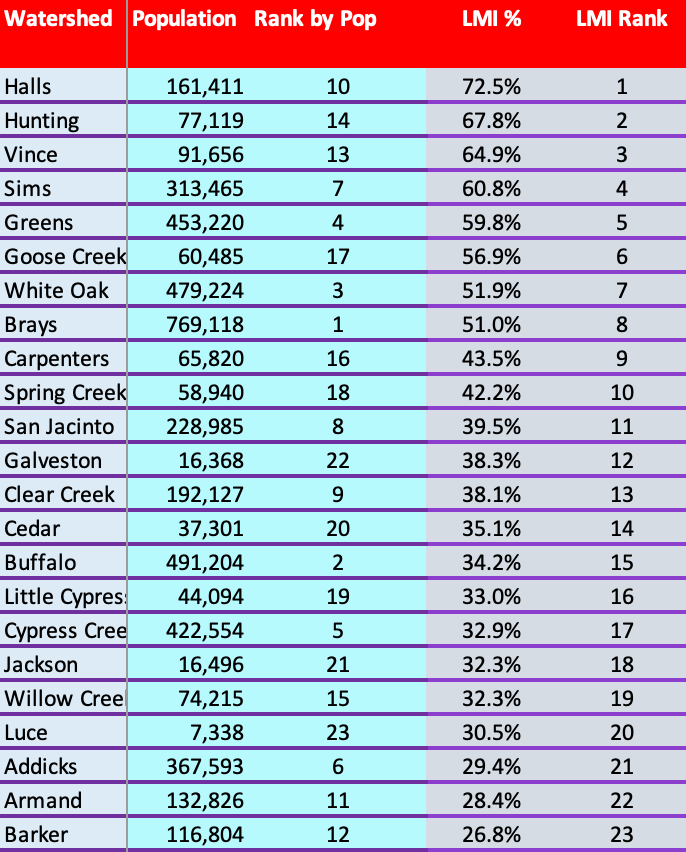
Here are Harris County’s watersheds ranked in order of LMI population percentage.
As of 11/21/2022
My next post will discuss how the distribution of flood-mitigation funds relates to population changes and other factors. I will also discuss what the prospects for flood mitigation in the Lake Houston Area are during Lina Hidalgo’s second administration. Don’t miss it.
Posted by Bob Rehak on 11/21/22, based on data provided by HCFCD in response to a FOIA Request
1910 Days since Hurricane Harvey
The thoughts expressed in this post represent opinions on matters of public concern and safety. They are protected by the First Amendment of the US Constitution and the Anti-SLAPP Statute of the Great State of Texas.
https://i0.wp.com/reduceflooding.com/wp-content/uploads/2018/10/HarrisCountyWatersheds.jpg?fit=1500%2C972&ssl=19721500adminadmin2022-11-21 11:40:152022-11-21 12:46:59Five Watersheds Lose Population While Harris County Gains Slightly
This follows an approval on June 28 to spend $85 million on 16 projects. Two thirds of the benefit for those also went to Precincts 1 and 2.
Not one of the 20 projects approved to date is in the San Jacinto Watershed.
Where the Money Went
Of the four flood-mitigation projects approved for trust funding in October, three were in the Halls Bayou Watershed and one was in Sims.
In June, commissioners approved 16 other projects:
One in the Armand Bayou watershed
One in Brays
Two in White Oak
Three in Halls
Four in Greens
Four in Cypress and Little Cypress Creeks
One in Buffalo Bayou
Of the 16 projects, 14 benefited Precincts 1 and 2, but only 7 benefited Precincts 3 or 4. The totals for “projects” and “areas benefited” do not equal because sometimes benefits cross precinct boundaries.
Looking at both groups of expenditures, 20 benefited Precincts 1 and 2, while only 7 benefited Precincts 3 or 4. So about one quarter of the flood mitigation benefit has gone to the Republican-leaning half of the county.
Purpose of the Trust
The Flood Resilience Trust Fund was originally conceived to facilitate:
Acceptance of a grant that requires a local match exceeding secured local funds
Awarding construction projects that exceed the amount of secured funds
A change in contract for a construction project underway that exceeds the amount of secured funds
In all of the most recent cases, the expenditures avoided delays for projects already underway. In each, partnership funds did not materialize as expected. See below.
Polls are open from 7 A.M. to 7 P.M. Monday through Friday this week for early voting. Election Day is on November 8. It’s a long ballot. Make sure you vote all the way to the end, because several key races/proposals are hidden in the middle of all the judicial races. For instance, the race between Lina Hidalgo and Alexandra Mealer for County Judge comes after family court judges on the ballot.
All registered voters in Harris County may vote for County Judge. A heavy turnout in this area could swing the election. It’s close. As of this morning, however, fewer than 10,000 people in Kingwood have voted.
Also, Precincts 2 and 4 will elect Commissioners this year. (The Lake Houston Area is now in Precinct 3 and won’t vote for commissioner until 2024.)
There are also three county bond proposals on the ballot totaling $1.2 billion being pushed by Precinct 2 Commissioner Adrian Garcia. Despite promises made by the County Administrator months ago, none has a defined project yet, so if you approve the Garcia Bonds, you’re writing a blank check.
That echoes lopsided Flood Resilience Trust and 2018 Flood Bond spending to date. Don’t miss your chance to bring fiscal control and balance back to Commissioners Court. And some flood-mitigation benefits to the Lake Houston Area.
Posted by Bob Rehak on 10/31/22
1889 Days since Hurricane Harvey
https://i0.wp.com/reduceflooding.com/wp-content/uploads/2022/10/20221031-Screenshot-2022-10-31-at-11.07.25-AM.jpg?fit=1200%2C616&ssl=16161200adminadmin2022-10-31 11:42:432022-10-31 12:47:25County Approves Another $15 Million for Flood Mitigation in Precincts 1, 2
Data obtained via a FOIA Request shows that the watersheds where three top Harris County Democrats live are consuming 25% of flood-bond funding. Meanwhile, those Democrats are starving their Republican opponents and supportersalike of flood-mitigation money.
Harris County Flood Control’s website also shows there are currently no active capital-improvement construction projects in Kingwood, Humble, Huffman, Spring, Atascocita or Crosby. Yet half of all active construction project dollars are going to just three watersheds where the three top Democrat leaders live.
Largest Watershed Among Least Funded
Harris County’s largest watershed – the 215-square-mile San Jacinto – ranks #18 out of 23 watersheds in flood-mitigation funding per square mile under Lina Hidalgo’s administration. That’s according to data obtained from Harris County via a FOIA Request that shows funding through the third quarter of 2022. Neighboring watersheds in the Republican-leaning far northeast part of the county are similarly starved for funding.
Watershed Map of Harris County
Consistent Funding Bias
San Jacinto-watershed residents are not alone. Spring, Jackson and Luce watersheds comprise most of the rest of the northeast portion of the county. They are among the least funded watersheds under Hidalgo whether you measure “total flood-mitigation funding” or “funding per square mile.”
The San Jacinto received only $37 million during Hidalgo’s administration. Spring received $10.1 million. Jackson received just $2.7 million. And Luce received a minuscule $1 million.
These watersheds respectively rank:
#12, #18, #20 and #23 in total flood-mitigation funding
#18, #19, #21 and #23 in funding per square mile.
Backyard Fringe Benefits
Contrast that with the following totals under Hidalgo in three other watersheds:
Buffalo Bayou (91.7 square miles) is less than half the size of the San Jacinto Watershed. It received more – $39.5 million. That’s where County Judge Lina Hidalgo lives. It ranks #12 in total post-Harvey funding.
White Oak Bayou ranks #6 in total post-Harvey funding at $94 million. It’s half the size of the San Jacinto (111 sq. mi), but received 2.5X more flood-mitigation funding. Precinct 2 Commissioner Adrian Garcia lives there.
Brays Bayou ranks #1 in total post-Harvey funding at $171 million – more than 8 times as much as the San Jacinto. Yet it’s only a little more than half the size (114.2 square miles). That’s where Precinct 1 Commissioner Rodney Ellis lives.
Hidalgo, Garcia and Ellis spent $305 million in the three watersheds where they live. That’s six times more than the $51 million spent for the San Jacinto, Spring, Jackson and Luce Watersheds.
Now, let’s compare what the watersheds above have received in fundingper square mile under Hidalgo:
Brays = $1.5 million
White Oak = $845 thousand
Buffalo = $431 thousand
San Jacinto = $172 thousand
Spring = $169 thousand
Jackson = $104 thousand
Luce = $45 thousand
The first three above comprise 246 square miles and received $305 million under Hidalgo to date. The bottom four comprise 323 square miles and received $51 million.
So under Hidalgo, Brays, White Oak and Buffalo averaged $1.2 million per square mile. Meanwhile, the Republican-leaning San Jacinto, Spring, Jackson and Luce watersheds averaged only $158 thousand per square mile! That’s about one eighth as much.
Notice a trend? I thought the three Democrats were trying to help the poor with their equity plan. Were they really just trying to punish political opponents through funding inequities? Looking out for themselves all along? Or both?
Parts of the San Jacinto and Spring Creek watersheds experienced water more than 20 feet above flood stage during Harvey while parts of Brays and White Oak didn’t even come out of their banks.
No Active Capital Improvement Projects in Lake Houston Area
And to think! Hidalgo, Ellis and Garcia conned dozens of members of the Northeast Action Collective into requesting Commissioners Court to shift money from Kingwood to Halls Bayou. They said Kingwood was getting all the money! It hasn’t and isn’t.
At the moment, Harris County Flood Control shows NO active capital improvement construction projects in Kingwood, Huffman, Crosby, Humble, Atascocita or Spring.
Yet HCFCD is spending $224 million elsewhere in the county on active construction. That includes another $71 million in Brays and $36 million in White Oak for another $107 million total. Almost HALF of the active construction projects in the entire county are going to the watersheds where Ellis and Garcia live!
And that’s in addition to the $305 million that White Oak, Brays and Buffalo already received under Hidalgo.
We have a chance to do something about these inequities starting in a few days. Early voting starts on October 24. You can find polling places here.
Posted by Bob Rehak on October 20, 2022and updated 10/21 to include spreadsheets and improve clarity.
1878 Days since Hurricane Harvey
The thoughts expressed in this post represent opinions on matters of public concern and safety. They are protected by the First Amendment of the US Constitution and the Anti-SLAPP Statute of the Great State of Texas.
https://i0.wp.com/reduceflooding.com/wp-content/uploads/2022/10/20210613-Screen-Shot-2021-06-13-at-3.48.47-PM-2.jpg?fit=1200%2C927&ssl=19271200adminadmin2022-10-20 22:26:462022-10-21 15:06:54The Real Inequities in Flood-Mitigation Funding
The Houston Chronicle has endorsed Republican Alexandra del Moral Mealer for County Judge over incumbent Democrat Lina Hidalgo. I won’t recap the lengthy Chronicle article here; you should read it firsthand. But I will expand on it, especially vis-a-vis flood control, which the Chronicle touched only lightly.
Let me start by saying that after watching four year’s of Hidalgo’s missteps in flood mitigation, I support Mealer, too. It comes down to concerns about Hidalgo and the promise I see in Mealer. Let’s discuss Hidalgo first.
Hidalgo Slights Area With Worst Flooding
The person in the driver’s seat has a huge influence on where flood-mitigation money goes. And more than half of all flood-bond money spent to date has gone to Brays, Greens, White Oak, Halls, and Hunting Bayous. Those five have received more than $550 million from the flood bond through May. That’s more than half of all bond money. See below.
Flood Bond Spending through May 2022. Data obtained from HCFCD via a FOIA Request.
Here’s how that looks in a graph. Keep in mind that the San Jacinto watershed is the largest in the county.
The San Jacinto also had the highest flooding in the county during Harvey – more than 20 feet above flood stage.
Chart showing feet above flood stage at 33 gages on misc. bayous in Harris County during Harvey, including the 5 LMI watersheds listed above.
And as a result, the San Jacinto was among the most heavily damaged.
So, you would think this would get Judge Hidalgo’s attention. Instead, she brags about her equity prioritization framework. She claims it gives preference to the “worst first.” The only thing is, she doesn’t define “worst” the way most people would. She ignores severity of flooding and damaged structures.
Hidalgo’s Definition of Worst
Hidalgo’s formula measures Low-to-Moderate Income (LMI) residents, the CDC’s Social Vulnerability Index, and population in an area. But many of those densely populated neighborhoods are crowded with apartments. So …
People who live above ground level and don’t flood get prioritized over people who live at ground level and do flood.
But Hidalgo can’t even tell how many residents in a watershed live with different degrees of flood risk. So, Hidalgo’s “worst first” mantra is clever but misleading. It intends to deceive.
While rewarding her core constituents with mitigation projects worth hundreds of millions of dollars, the entire Lake Houston Area has only $2,000 of capital-improvement flood-bond construction projects underway.
Flood-control spending is just one of the county’s “disaster areas.” Consider the County’s IT department, Universal Services, which is in meltdown. The reason you see five-month-old data above is that the county has gone through a disastrous change in its IT systems.
The department has been dogged by incompetence since Hidalgo appointed Rick Noriega to take over. He has no IT background and has pushed out people who do. The managers of every group beneath him have turned over.
Employees complain Universal Services now hires new people for their political affiliation, not professional qualifications.
The incompetence is widespread, according to multiple sources. Things have gotten so bad that many qualified staff are burning out from having to shoulder more and more of the workload. And they are quitting.
As a result, accurate, timely information is rare. And yet, Hidalgo keeps bragging about “transparency.”
Lacking Leadership, Direction on $750 Million Flood-Mitigation Allocation
Universal Services is not alone. See the org chart below.
Changes under Hidalgo. Red X’s represent changes in leadership. Green boxes represent new departments.
So whom did she choose to develop a plan for spending $750 million in Harvey flood-mitigation funds? Community Services, not Flood Control!
Community Services may be knowledgeable about disaster relief. That’s about helping individuals recover from past floods. But flood mitigation is about lessening the severity of future floods. One requires social workers; the other requires engineers, like they have in Harris County Flood Control.
The Texas General Land Office (GLO) administers those flood-mitigation funds for the US Department of Housing and Urban Development (HUD).
The GLO signaled its intention to allocate $750 million to Harris County on August 23, 2021, but Community Services hasn’t even started compiling a list of potential projects yet.
They are still waiting on “direction from leadership,” according to an internal memo obtained by ReduceFlooding. In 14 months, Community Services has only defined a “process” for determining the list.
Community Services has, however, determined that it wants to spend almost a hundred million of the $750 million on planning and administrative costs.
Meanwhile, H-GAC which covers a much larger area and includes many more governmental entities received notification of a $488 million allocation – also on 8/23/21. Yet H-GAC has already submitted its project list, received approval, and is working with sub-recipients to secure and validate bids.
Also, their “Fix Flooding First” program lost its leader and has reported no progress in months. Fix Flooding First was especially important to people on the periphery of the county. Its objective was to get neighboring areas that drain into Harris County to adopt minimum drainage standards.
In my opinion, Hidalgo’s biggest problem is that she’s just a bad manager. She:
Doesn’t attract and retain top talent
Pushes out those who disagree
Hires people based on political affiliation, not qualifications
Doesn’t value experience and institutional knowledge
Blatantly discriminates against Republican-leaning precincts.
Hidalgo repeatedly says that she’s proud of what most would consider screw-ups.
Hidalgo never “owns” her problems. She just waves them away. In my opinion, another four years of Hidalgo would leave the county in disastrous and unrecoverable shape.
County spending is up. Crime is up. Taxes are up. And virtually all the flood-mitigation money promised to the Lake Houston Area has so far gone elsewhere.
About Alexandra del Moral Mealer
Mealer comes to the job with much more life and leadership experience than Hidalgo did. She has a way of confronting the truth head on.
You would expect that from a West-Point-educated Army Captain who commanded a bomb squad in Afghanistan. Mealer understands:
The necessity of accurate intel
That peoples’ lives and livelihoods depend on the decisions she makes.
Alex Mealer spent days touring the Lake Houston area to understand local flooding issues first hand. Hidalgo has not.
Mealer also has MBA and JD degrees from Harvard. She was a VP at Wells Fargo where she helped put together billion-dollar oil-and-gas deals before deciding to run for County Judge. In flooding as with law enforcement…
Mealer’s focus is making sure the county spends money wisely.
Straight Talk Vs. the Flood-Control Fairy Tale
Before this campaign, Mealer acquired a wealth of knowledge about how the county works. And she has surrounded herself with experts on various subjects.
The Chronicle described her as a data wonk. In my opinion, that’s what the county needs: someone grounded in reality. In one commissioner’s court meeting after another, Hidalgo, Garcia and Ellis, have spun a flood-control fairly tale.
It goes something like this. “Flood control has ignored poor neighborhoods. Rich ones like Kingwood get all the flood-mitigation money.” Why? They point to institutional racism!
If we had a judge who knew where her money was actually going, she could have challenged this myth. The reality is that LMI neighborhoods have consistently received the lion’s share of flood-mitigation funding going back decades.
I have discussed flooding issues with Mealer a dozen times since the primary last spring. In my opinion, she is laser focused on accurately diagnosing problems. National and state issues over which she has no control do not distract Mealer.
Mealer is determined to provide a safe and secure community with well-maintained public infrastructure that support growth and opportunity for all.
Accurately diagnosing problems is the key to fixing them quickly and cost effectively.
I, for one, don’t plan to support Hidalgo. She continually says she needs more money when she doesn’t know where billions of flood-mitigation dollars have gone. Nor does she seem eager to deploy another $750 million already in her hip pocket. I’m voting for Mealer.
Posted by Bob Rehak on 10/16/22
1874 Days since Hurricane Harvey
The thoughts expressed in this post represent opinions on matters of public concern and safety. They are protected by the First Amendment of the US Constitution and the Anti-SLAPP Statute of the Great State of Texas.
https://i0.wp.com/reduceflooding.com/wp-content/uploads/2022/10/20220314-RJR_9297.jpg?fit=1200%2C800&ssl=18001200adminadmin2022-10-16 19:08:532022-10-18 22:33:46Chronicle, ReduceFlooding endorse Mealer over Hidalgo
Harris County Flood Control District (HCFCD) transmitted an update to Commissioners Court today that shows the progress of the flood bond through September 2022. The report shows slowing activity. Specifically:
No new construction contracts or other agreements were awarded in the last month.
Total spending increased only $21 million – from $1.104 billion to $1.125 billion.
Overall progress remained unchanged from August. It’s holding at 23.5% complete.
The amount of “Professional Services Invoices Paid” declined from $4.8 million to $1.7 million.
Home buyouts “in progress” declined from 331 to 305 (-26).
Improvements Since Harvey
The update also included a list of accomplishments since Harvey. HCFCD has:
Completed 229 project components, reducing the risk of flooding for more than 14,000 homes and businesses
Removed an estimated 4.7 million cubic yards of sediment from channels across Harris County through maintenance efforts – the equivalent of approximately 335,000 dump truck loads – to ensure stormwater can move through channels efficiently
Acquired more than 21,500 acres of land for projects, floodplain preservation and buyouts to ensure floodwaters can spread out safely without structures that can flood
Secured more than $1.35 billion in partnership funding while pursuing more funding opportunities at the federal, state and local levels.
Started the third batch of major maintenance activities along Cypress Creek.
Where Money Has Gone
Note that the September update (reported in October) actually contains figures compiled through the end of August. The map below shows where more than $1.1 billion has gone.
From Page 9 of September HCFCD Flood-Bond Update
Budget Priorities
Here’s how that spending looks in table form arranged in order from highest to lowest based on spending through the end of August (column 3).
This spending shows a huge disparity among watersheds. The ratio between Brays and Vince is 335 to 1.
The table also shows the effect of “equity prioritization” – concentrating on watersheds with a high percentage of low-to-moderate income (LMI) residents.
Eight LMI watersheds have received a total of $447.5 million for an average of $55.9 million each.
Yet the 15 otherwatersheds have received a total of $460.2 million for an average of $30.7 million each – roughly half as much.
The entire Lake Houston Area still has only two active capital improvement construction projects – valued at $1,000 each. Both are Excavation and Removal Contracts – one in Woodridge Village and the other in the Cedar Bayou Watershed.
Slowdown in Spending Bears More Investigation
The most worrisome aspect of this update is a continued slowdown in activity. At the current rate of spending, HCFCD would spend less than half the money in the bond in the next six years. Remember, we’re four years into a ten-year, $5 billion program. At $20 million per month for the next 60 months, HCFCD would spend only another $1.2 billion. That would cover only about half the projects in the bond.
However, note that in project management, sometimes pauses are built into projects for things such as approvals, right-of-way acquisition, etc. The real question is whether such pauses can explain the current slowdown. HCFCD is investigating to see how much, if any of the slowdown, is planned. More on that next month.
The thoughts expressed in this post represent opinions on matters of public concern and safety. They are protected by the First Amendment of the US Constitution and the Anti-SLAPP Statute of the Great State of Texas.
https://i0.wp.com/reduceflooding.com/wp-content/uploads/2022/10/20221011-Screen-Shot-2022-10-11-at-10.50.19-AM.jpg?fit=1200%2C913&ssl=19131200adminadmin2022-10-11 15:05:592022-10-11 15:32:06September 2022 Flood Bond Update
Amendment 11 from the Texas Hurricane Harvey Action plan will let the Texas General Land Office (GLO) take over unused money from seven Houston disaster relief funds. The money will be reallocated to a state-run Homeowner Assistance Program (HAP) currently administered by the GLO on behalf of Houston residents.
On 10/7/22, GLO posted Amendment 11 to the State’s Action Plan for $5.676 billion in Community Development Block Grants for Disaster Recovery (CDBG-DR) related to Hurricane Harvey. View the entire 461-page Action Plan Amendment 11 at https://recovery.texas.gov/public-notices/index.html. Or see the major changes below.
File photo from June 2021.Flood damaged home on Houston’s NE side, still needing repair.
Reallocation of $141 Million
Amendment 11 deals with the $1.2 billion in CDBG-DR funds previously allocated to and administered by the City of Houston. The amendment reallocates $140,930,253 in unused funds from seven City of Houston disaster relief programs. The money will be reallocated to a state-run Homeowner Assistance Program (HAP) administered by the GLO on behalf of Houston residents.
Reason for the reallocation? The City programs repeatedly failed to meet contract benchmarks and deadlines.
The GLO acted after the City missed contractual benchmarks designed to ensure that funds for City of Houston residents are expended before HUD’s final program deadlines.
GLOcurrently administersthe “City of Houston Homeowner Assistance Program,” nicknamed HAP, the acronym used by the state as opposed to HoAP, which the City used.
Latest City Pipeline Report
The City doesn’t publish statistics for all of its programs in its monthly “Pipeline Reports.” However, the most recent, dated 9/6/2022 shows the following:
This whole issue came to a head several years ago when the GLO attempted to step in once before as programs were expiring. The City sued the GLO to keep the programs. A settlement let the GLO keep some and the City others. But it also stipulated that the City had to meet strict deadlines and quotas.
The City had to clear a certain percentage of its backlogs each month. The City missed those contractual deadlines repeatedly according to the GLO. And now the GLO is stepping in to help as many people as it can with the unused funds.
The GLO will only reallocate funds not already obligated to a project by the City. All funds will stay in Houston to benefit the residents of Houston. Funds should now get to residents in a faster and more efficient manner.
GLO has helped thousands of homeowners statewide in less time than the City has helped several hundred.
Reasons Cited for Delays, Slowness
The City blames the GLO for delays. However, many of the applications submitted by the City to the GLO early on were incomplete, lacked required documentation, or didn’t meet program requirements. Reasons cited for the Houston Housing and Community Development Department problems included bad hiring decisions, poor record keeping, training failures, refusal to accept help, political interference, unwillingness to follow GLO recommendations, making programs overly complicated, late starts, and procedural violations.
The GLO maintains it has not slowed the City of Houston from using disaster recovery funds – only prevented the City from using them improperly. “Any delays are a result of the City of Houston’s misplaced focus on circumventing rules and requirements,” said a GLO spokesperson.
Attempting to Help Those in Need Faster
Caught in the middle are the most vulnerable among us.
According to U.S. Department of Housing and Urban Development (HUD) statistics, nearly 90% of the homeowners served by the affected programs have incomes less than 80% of the area’s median income (AMI).
Nearly two thirds of the Houston homeowners served by the GLO’s program make less than 30% of the AMI. In Houston, this would include families of four living on $26,600 or less.
Also, 64% of the homeowners identify as Black/African American and 25% identify as Hispanic/Latino.
Finally, about 87% of approved homeowners are female heads of households and at least 72% are aged 65 or older.
The GLO’s Houston HAP demographics are updated monthly and available online.
Main Changes in Amendment 11
City of Houston Impacts
The amendment includes the following changes. Funds remaining with the City of Houston for all disaster recovery programs would be reduced to $694,157,590 from $835 million.
The difference – $140,930,253 in uncommitted funds – would be taken from the following City programs, which would be reduced to:
Homeowner Assistance Program (HoAP) – $69,188,511.
Multifamily Rental Program – $400,855,752.
Small Rental Program – $12,943,423.
Homebuyer Assistance Program – $18,381,000.
Public Service – $20,000,000.
Economic Revitalization Program – $18,888,904.
State of Texas Impacts
State administered disaster recovery programs increase to $4,064,897,426.
The State-administered City of Houston Homeowner Assistance Program increases to $565,601,475.
The last total exceeds the $141 million because the State had previously taken over several programs that the City relinquished.
To Comment on Amendment 11…
The amendment triggers a federally required 30-day public comment period.
Submit all comments to cdr@recovery.texas.gov by 5:00 p.m. on Monday, Nov. 7, 2022, to be considered. Per federal requirements, the GLO must respond to public comments before the amendment can be sent to HUD for its 45-day final approval.
Posted by Bob Rehak on 10/8/22
1866 Days since Hurricane Harvey
The thoughts expressed in this post represent opinions on matters of public concern and safety. They are protected by the First Amendment of the US Constitution and the Anti-SLAPP Statute of the Great State of Texas.
https://i0.wp.com/reduceflooding.com/wp-content/uploads/2022/10/20210626-RJR_8685.jpg?fit=1200%2C800&ssl=18001200adminadmin2022-10-08 19:43:482022-10-10 14:13:00GLO Posts Amendment 11 to Harvey Plan Affecting Houston Flood Victims