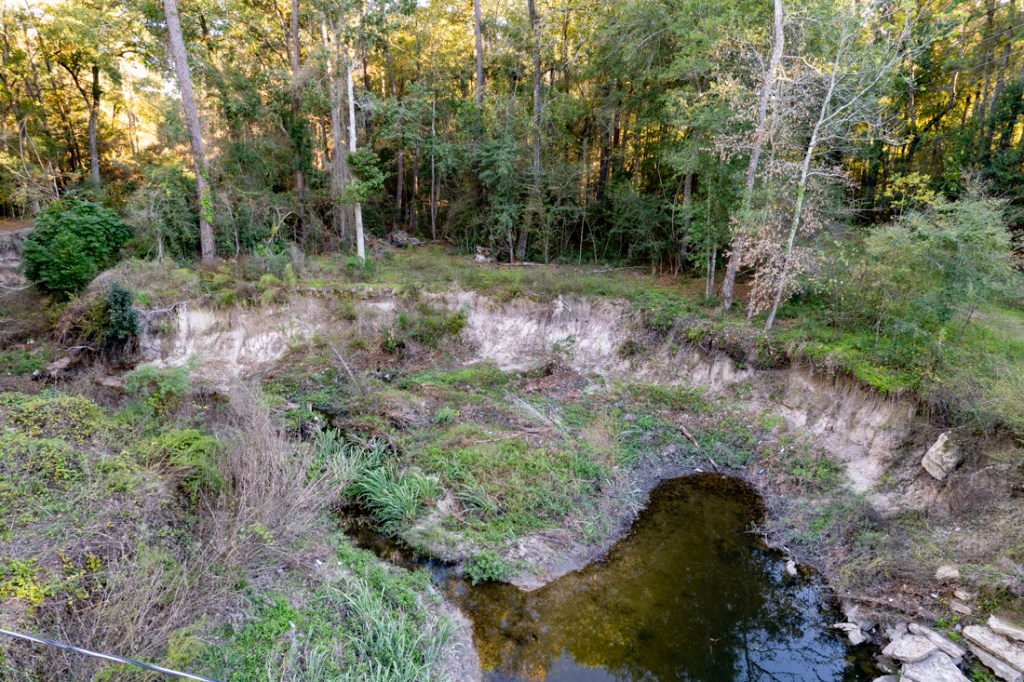
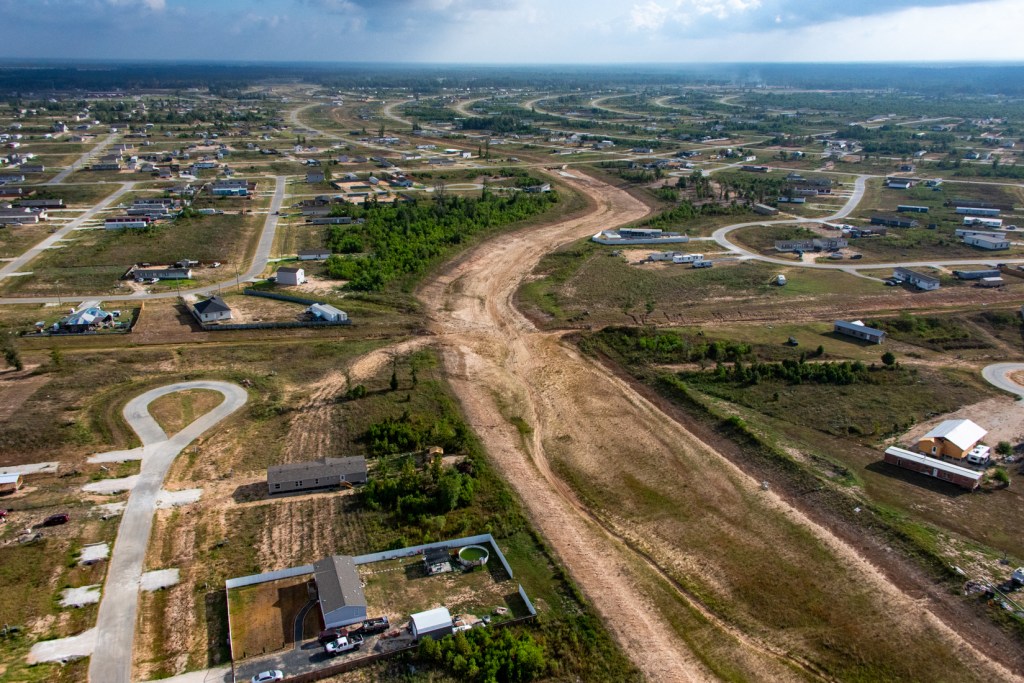
9/7/2026 – A fisherman out on the San Jacinto West Fork during the Labor Day weekend reports that the river depth is a mere 2.4 feet adjacent to the giant Hallett Mine in Porter. Normally, he says, the river is 8-10 feet deep at that location. However, that’s not the only problem.
Area where river depth has been reduced. See pics below.
Hundreds of nearby trees are dying where Hallett’s settling pond leaked pollution for more than a year before the TCEQ investigated the problem. Ultimately, TCEQ issued no fines but required Hallett to fix leakage around the perimeter of its settling pond.
River One-Quarter Its Normal Depth
The pictures below show the loose sediment that Hallett used to build up the dike around the western portion of its settling pond in March of this year.
Dirt dumped into river from Hallett Mine in March 2026More dirt spilling into river slightly upstream at same dike in same mine.
The result?
The river that was 8-10 feet deep before the repairs is now 2.4 feet deep.
Local fisherman
The dirt has eroded into the river. See depth-finder screen below.
Fisherman’s depth finder adjacent to dirt shown aboveTheHallett sediment extended approximately 50 feet into the river back in March of 2026.
Rains since March have eroded some of the dirt shown above down into the river, decreasing the river’s depth. However, additional sediment may have also come from other sources. For instance, just upstream, the West Fork has migrated through a Hallett pit and flowed through it since at least April of 2024.
Trees Dying by Year-Long Hallett Leak
At the eastern edge of the same settling pond, sediment was escaping across a perimeter road for more than full year.
Route of leaking sludge carried it through trees between homeowners and Hallett’s settling pond.
For a better view, see this YouTube video linked below.
According to a nearby resident, hundreds of the trees shown above are now dying. “Waste water from the settling pond is killing all the pine trees,” he said. “Over half are dead already and the other half are dying. It’s killing them all.
Contributing to Problem but Not Solution
As the Lake Houston Dredging and Maintenance District begins its planning, the board may want to work with Montgomery County Authorities and the State to closely monitor mines such as Hallett. As photos above show, they certainly contribute to the problem, but they pay nothing to help clean it up.
Why is this important? When rivers become clogged with sediment, they lose their conveyance capacity. Then, when floods come along, stormwater winds up in living rooms instead of staying where it should.
At the very least, the State should require larger setbacks from rivers for sand mines. Other states require setbacks ranging from 100 feet to more than a 1000. But not Texas. We let miners operate right up to the edge of rivers and streams…so they can profit and you can pay for the cleanup.
Posted by Bob Rehak on 9/7/26
3296 Days since Hurricane Harvey
The thoughts expressed in this post represent opinions on matters of public concern and safety. They are protected by the First Amendment of the US Constitution and the Anti-SLAPP Statute of the Great State of Texas.
https://i0.wp.com/reduceflooding.com/wp-content/uploads/2026/09/IMG_8814.jpg?fit=1100%2C882&ssl=18821100adminadmin2026-09-07 16:33:172026-09-08 08:37:28West Fork Only 2.4 Feet Deep at Hallett Mine, Nearby Trees Dying From Pollution
Kelly Callahan is a retired widow who loves fishing, kayaking and living near nature. That’s why she bought a home near the San Jacinto West Fork. Callahan accepted the flood risk. However, she didn’t expect that the man who bought the sand mine behind her wooded lot would partially drain the dredge pond into the river. Where a small creek flows across part of her property, the sudden drop in the pond’s elevation triggered what geomorphologists call “headcut erosion.”
About Headcut Erosion
Headcut erosion happens where flowing water reaches an abrupt, near-vertical drop. The falling water scours the base, causing the overhanging soil and plant roots to collapse. That forces the “waterfall” to rapidly migrate upstream. In Kelly’s case, it could soon threaten her home. Instead of fixing the sand-pit dike, the mine’s new owner has offered to buy the widow’s land for below-market value. I talked with her at length about her situation and options. But first, some pictures that illustrate what happened.
#1: Satellite image as of 12/23with full sand-pit pondbehind Callahan’s home.#2: January 2026. The breach is now real and level of pond has dropped precipitously.#3 Breach is virtually twice as tall as man.Note excavator that created breach in upper left.#4: Meanwhile, the ephemeral creek flowing across Callahan’s land has downcut to the new level of the pond.
#5: 12-second video from inside the treeline shows attempt to slow erosion by owner of former mine. Recent heavy rains blew out the tarp and erosion continues.
Impact on Widow
Rehak: You investigated this property pretty thoroughly before buying it.
Callahan: Yes, I even talked to the sand-mine foreman. Never on God’s green earth did I think that somebody would purchase it and then lower the pond and cause all of this damage.
Rehak: What did the new owner do?
Callahan: He hired someone to cut through the dike surrounding the mine. He said it was to prevent flooding the homeowners on our street. But the dike completely blew out and 10-20 feet of water from the pond went downstream with a tremendous amount of sand.
Breach still not repaired as of 6/20/26
Rehak: You were dealing with some medical issues at the time?
Callahan: I had horrible sciatica and could barely walk. So, I couldn’t see what was going on back there until recently.
Rehak: What happened when he saw all the damage he caused?
Callahan: He started coming to me and saying “It’s eroding back there. You need to get some fill and fix it.
Rehak: Did you?
Callahan: No. He caused the problem.
Rehak: What happened the other day when you got 4.5 inches of rain in a few hours?
Callahan’s home in foreground. Note creek, bottom left, flowing toward pond near top.
Callahan: He showed up unannounced and trudged back to his pond. When he came back, he said, “Kelly, we got a $100,000 problem now. You didn’t put any fill back there.” I said, “That’s a band-aid and I’m not going to do it. It’s just going to erode again.”
Rehak: What did he say to that?
Kelly Callahan looking wistfully toward erosion on back of her property.
Callahan: He said, “As far as I can tell, in two and a half years, it’s going to be all the way up to your house.” (At this point, Callahan breaks down into tears.) “It’s already travelled over a hundred feet. My guess is that it’s already 20% of the way to your house.” And again he asked, “Did you ever get someone with heavy equipment to come out and give you a quote?”
Note how far erosion has cut into her back yard.
Rehak: You talked to Montgomery County Engineering instead.
Callahan: Right. Every department I talked to advised me why I shouldn’t. Had I been band-aiding this, I would have been fined by the MoCo permitting office. They were requiring me to hire an engineer and get a permit. The new owner of the former mine has the same problems.
Rehak: It doesn’t sound like you’re responsible for this. Headcut erosion happens when there’s an abrupt drop in a stream bed. That happened when the mine owner cut through the berm and lowered his pond. He created a miniature waterfall migrating upstream. That’s why they call it headcut.
Callahan: My son thinks he’s just trying to get my property on the cheap.
Despite the erosion and permitting issues, Callahan tries to keep smiling and enjoying the beauty that remains around her.
Rehak: Where do you go from here?
Callahan: I don’t want to move back to the suburbs. After being out here, you can’t really go back to that. I cry every day. It breaks my heart.
Callahan kayaking on the creek in her own backyard during happier times.
Posted By Bob Rehak on 6/21/26
3218 Days since Hurricane Harvey
The thoughts expressed in this post represent opinions on matters of public concern and safety. They are protected by the First Amendment of the US Constitution and the Anti-SLAPP Statute of the Great State of Texas.
https://i0.wp.com/reduceflooding.com/wp-content/uploads/2026/06/DSC_5438.jpg?fit=1100%2C733&ssl=17331100adminadmin2026-06-21 14:38:132026-06-21 15:21:32Sand-Mine Breach Triggers Erosion Threatening Widow’s Home
3/1/26 – Travis County District Clerk records show that the state’s case against the Triple PG sand mine in Porter is now dragging into Year 8.
Meanwhile, breaches in the mine’s dikes remain open, allowing sediment-laden wastewater and stormwater to escape into the headwaters of Lake Houston, the source of water for more than two million people. The State of Texas originally sued the owners of the mine precisely because of such breaches.
The land on which the mine operates is under owned by Prabhakar R. Guniganti or one of several corporate entities that trace back to him. Guniganti is a cardiologist from Nacogdoches. The case began in 2019. And for a period, Guniganti kept shifting ownership of the mine through various shell companies and trusts to delay a trial. Finally, the state sued him as an individual.
Next came other delays related to discovery. Jury trials were cancelled in 2023 and 2024. In May 2025, a fourth amended scheduling order showed the discovery period should have ended in November 2025 and the trial should have started by February 9, 2026.
However, court records show that in December 2025, the court issued a FIFTH amended scheduling order. Ken Paxton’s office has stopped responding to emails regarding this case.
Meanwhile, erosion has created a breach into Caney Creek. It was caused by mining too close to a utility easement and now threatens pipelines carrying highly volatile liquids (HVL). It also threatens an electrical transmission tower.
Photos of Mine from 2/28/26
That particular breach has remained open at least since August 14, 2025. Here’s how it looked yesterday from several angles.
Guniganti’s mine stretches 2.5 miles from north to south. Montgomery County Appraisal District records show that he or one of his corporate entities still owns the property, despite name changes at the mine entrance on Hueni Road in Porter.
The southern part of Guniganti’s mine. Caney Creek in foreground. Note breach through utility corridor.Reverse angle shows breach more clearly. Note pipelines still exposed.Looking E. Another breach at far south end of mine. Lake Houston Park at top of frame.Farther NW, mining next to utility corridor now threatens long-distance electrical transmission towers.Breach in upper left. Caney Creek in middle. Note difference in water color in Peach Creek which joins Caney Creek in bottom right.Farther to the NW, note another breach in the northern portion of Guniganti’s mine.Closer shot of same breach shown in photo above.Caney Creek on bottom.
Guniganti doesn’t own the only mine on Caney Creek. Another exists upstream from his. But I didn’t see any breaches in that particular mine.
So, this may be a case of multiple mines or construction sites even farther upstream spoiling the water quality. Yesterday, I wasn’t able to work my way far enough upstream to see where the water color changed definitively.
Said another way, it’s not clear whether Guniganti’s mine 1) caused, 2) contributed to, or 3) played no role in this particular episode of Caney Creek sludge. However…
Impact on People and Fish
Two things are certain though. 1) The breaches let exposed sediment escape during storms. 2) The pollution is not good for people or fish.
For humans, sediment pollution increases filtration costs that show up in water bills. But for fish, sediment pollution can be fatal.
Yesterday, several fishermen told me that the white bass which usually spawn in this area are gone this year. So I asked ChatGPT how sediment pollution from sand mining and construction affect the spawning grounds for bass.
White bass, it seems, depend heavily on clean, course river substrates – typically gravel or cobble – for successful reproduction. Sediment pollution from sand mining operations and construction runoff can significantly degrade those spawning grounds through several mechanisms.
Egg suffocation by fine sediment
Filling the void spaces between stones. For many river fish, including white bass, >25–30% fine sediment content in spawning gravel begins to significantly reduce survival.
Increased turbidity disrupts spawning runs through reduced visibility and clogged gills. White bass often migrate upstream tens of miles from reservoirs or large rivers to spawn; sediment plumes can disrupt these movements.
Channel changes including bank collapse, loss of shallow riffles and channel downcutting
Burial of eggs during storm pulses. Even a few centimeters of sand can eliminate a spawning bed.
Impact on food chain. Even if eggs hatch, juveniles have a lower survival rate because sediment pollution also kills aquatic insects on which they feed.
For a deeper dive into the sediment pollution impacts from construction and sand mining on fish spawning, click here.
Volume of Sediment
Most sediment moves during storms. Scientists call these “sediment pulses.” And the bigger the storm, the bigger the pulses. One study suggests that Harvey moved 7.5 million metric tons of sediment in the San Jacinto watershed.
Loose sand in mines can dramatically increase sediment mobility.
Based on flood-damage studies and sediment-transport modeling, breaches of dikes around one large, sand pit can release 50-200 tons of sediment in a single storm.
Erosion happens naturally, even in heavily forested areas. But sand mines amplify sediment release because they:
Store unconsolidated sand directly next to the river
Remove vegetation and soil structure
Use levees that can breach during floods
Create pits that connect to the river during high water.
Relative Impact of Sediment Sources
ChatGPT compared the relative sediment contributions of several sources including:
Source
Sediment Yield
Undisturbed forest
Very low
Agriculture
Moderate
Urban construction
High
Sand mining near rivers
Very high (episodic)
Sand mines near rivers are especially problematic because:
Exposed sand is easily mobilized
Pit captures can deliver large slugs of sediment during floods
Stockpiles and haul roads contribute chronic runoff.
Posted by Bob Rehak on 3/1/26
3106 Days since Hurricane Harvey
The thoughts expressed in this post represent opinions on matters of public concern and safety. They are protected by the First Amendment of the US Constitution and the Anti-SLAPP Statute of the Great State of Texas.
https://i0.wp.com/reduceflooding.com/wp-content/uploads/2026/03/DJI_20260228111717_0353_D.jpg?fit=1100%2C619&ssl=16191100adminadmin2026-03-01 13:34:262026-03-01 13:53:08Breaches in Triple PG Sand-Mine Dikes Remain Open as Trial Drags into Year 8
2/9/2026 – The Harris County Infrastructure Resilience Team wants public input on ideas to make the area more resilient to flooding. As someone who believes that all of us are smarter than one of us, I’m passing the request on to ReduceFlooding.com readers.
Do you see a situation that could lead to flooding? On your street? In your neighborhood? In your city or county?
What would reduce the potential for flooding in your opinion?
What would help us recover from flooding faster?
Please email your thoughts to the contact page on this website and I will forward them to the people who can do something about them.
As thought starters, here are several ideas I see that could make living here safer.
Create a River-Basin-Wide Flood Control District
Much flooding originates in cities and counties that let development happen in floodplains. Sometimes they let development happen with insufficient mitigation. This problem is exacerbated by the dozens of municipalities, counties, MUDs, PUDs, and drainage districts each of which have their own regulations and few of which of effective enforcement.
Entire San Jacinto River Basin by SJRA. Note: the area draining past Kingwood is larger than all of Harris County.
A flood control district that covers the entire river basin could solve flooding due to this fragmentation and a patchwork quilt of regulations across the region. There is no central coordinating body.
In the last legislation, Rep. Dennis Paul introduced HB204. It would have let other counties join Harris County to create an expanded flood control district. However, the bill never made it out of committee.
Senator Bettancourt and Representative Paul introduced similar bills in the previous legislative session. Perhaps next year, they will succeed with your support.
Control Erosion Better
Erosion can reduce the carrying capacity of our rivers and streams. It displaces water that may end up in your living room during a flood event because the stream can no longer hold it. Fighting erosion is two-front war. We need to reduce it at its source. And we need to remove sediment that makes its way downstream, blocking our rivers and channels.
This means addressing the main sources of sediment, such as sand mining and insufficiently mitigated upstream development. It also means removing any sediment that makes its way downstream by scrupulous adherence to maintenance intervals.
Subsidence, caused by excessive groundwater withdrawals, can alter the gradient of rivers and create bowls in the landscape. The Harris Galveston Subsidence District has put regulations in place to reduce it. And they’ve worked where they have been in effect the longest.
The way to solve this problem is to get rapidly subsiding areas on surface water. But that’s more expensive. So, we also need educational campaigns that explain the benefits of surface water. People may not argue about paying a few dollars more each month if they know it could save them hundreds of thousands in a high water event.
Locate Assisted-Living Centers Outside of Floodplains
Twelve people, aged 75-95, died at Kingwood Village Estates as a result of Harvey. That’s one third of all the people who died in Harris County. Evacuating them by life boats put their lives and the lives of first responders at risk. They weren’t warned in time to make a safe, orderly evacuation by cars or buses.
Residents trying to escape Kingwood Village Estates as Harvey’s floodwaters rose
Warning Sirens
Install warning sirens in areas that flood frequently to give people time to evacuate. Floods frequently knock out communications or happen in the middle of the night. The chain of communication can be disrupted. But wailing sirens can wake up even the soundest sleepers in the middle of the night.
With sirens, many lives could have been saved in Kingwood and along the Guadalupe last July.
Flood Education in High Schools
We have drivers’ ed. Why not flood ed? Greater awareness of the causes and dangers of flooding could eventually shift housing demand to safer locations.
Perhaps the State Board of Education could create course materials that they distribute to school districts. They might educate young people how to research flood risk before buying a home. Or where to find information about projected flood crests in an emergency.
Better to learn before you buy a home than after!
Create County/City Parks in Flood-Prone Areas
It’s hard to tell people that they can’t build on their land. So why not buy dangerous flood-prone land and convert it into parks or recreational space?
Please send me your thoughts on how to make your community more resilient to flooding. Just write a paragraph or two. It doesn’t have to be elaborate. Then email your thoughts through the contact page of this website.
I’ll make sure the Harris County Infrastructure Resilience Team sees them.
The deadline for submissions is February 12, 2026. Thanks in advance for your help!
Posted by Bob Rehak on 2/9/26
3086 Days since Hurricane Harvey
https://i0.wp.com/reduceflooding.com/wp-content/uploads/2020/01/KVE-2017-Flood.jpg?fit=1500%2C968&ssl=19681500adminadmin2026-02-09 18:37:112026-02-09 18:50:00Easy Way to Make Your Community More Resilient to Flooding
1/9/25 – The widening of Bens Branch caused by ever-increasing amounts of water coming downstream from new upstream developments has forced the Bear Branch Trail Association to replace an aging wooden bridge with a new $300,000 steel truss bridge.
Old Bridge Between Cedar Knolls and Park Royal in Bear Branch Trail Association. Photo by Chris Bloch.New steel-truss bridge in same area being hoisted into place today.Photo by Chris Bloch.
The creek has widened from 32 to 50 feet since Tropical Storm Imelda in 2019. The new steel-truss bridge became necessary to accommodate the wider span.
Upstream Growth and Importance of Bridge
Contractors installed the new bridge about a hundred yards south of the Pines Montessori School on Cedar Knolls. It connects Park Royal in Bear Branch Village to Cedar Knolls in Kings Forest Village.
It is also a major connector for foot and bicycle traffic between the western and eastern halves of the 100+ mile Kingwood trail system.
Thousands of residents use it, including students going to/from Bear Branch Elementary, Kingwood High School and Pines Montessori.
The Bens Branch watershed extends northwest all the way up into fast-growing Valley Ranch area in Montgomery County. Over the years, ever-increasing amounts of runoff have widened the watercourse, undermining the supports of pedestrian and street bridges alike.
The pedestrian bridge also was pummeled by the power of moving water.
Eroded support for old bridge. Photo by Chris Bloch.
Erosion Also Undercut Trees
During floods in January, May and July last year, erosion also claimed hundreds of trees that fell into the creek, backing water up and contributing to flooding.
Example of erosion just a few feet downstream from new bridge.Trees hauled out of Bens Branch after Beryl remain stacked on Tree Lane waiting to be hauled away.
Pictures of New Bridge Installation on 1/9/25
The next group of pictures shows the new bridge and its placement today.
Before installation. The new 5,000 pound steel bridge will have concretepoured in the tray surrounding the deck.The concrete abutments are sunk deep into the ground.Overhead shot shows riprap stacked on both sides. It will protect the edges of the embankment next to the bridge from erosion.Wooden “matts” had to be placed under the crane to stabilize it for the heavy lift in rain-soaked soil.Then a forklift and a backhoe maneuvered the new bridge down the trail to the stream.As the crane slowly lifted the bridge into position, workers guided it with ropes from a safe distance.They guided the bridge by handfor the last foot or so to make sure it was squarely seated on steel posts embedded in the concrete.One whack from a sledgehammer and everything locked into place.
More to Come
Workers still have to:
Pour the concrete deck
Place the riprap
Finish the approaches to the bridge
Replant trees destroyed by heavy equipment.
The new bridge should help reduce erosion. The cross section under the bridge increased from 120 square feet before Imelda to 420 square feet with the new design – a 3.5X or 250% increase. That will make it easier for water to flow under the bridge without backing up, causing jetting, or flooding the nearby Montessori school.
The project should be complete by the end of January 2025.
Thanks go to more than 2,800 members of the Bear Branch Trail Association who paid for the new bridge and its engineering. And a special “thank you” goes out to three volunteer members of the BBTA board – Lee Danner, Chris Bloch and Chris Arceneaux. They supervised the installation today in driving rain and near-freezing temperatures. They exemplify a dedication to excellence and community service that makes Kingwood such a wonderful place to live.
Posted by Bob Rehak on 1/9/25 with help from Chris Bloch
2690 Days since Hurricane Harvey
https://i0.wp.com/reduceflooding.com/wp-content/uploads/2025/01/20250109-DSC_1486.jpg?fit=1100%2C733&ssl=17331100adminadmin2025-01-09 19:59:162025-01-09 22:44:14Bens Branch Erosion Forces Installation of New Bridge
1/4/25 – In a Houston-area-flooding context, we usually consider erosion as a negative. It reduces the capacity of streams, channels and Lake Houston. It can also form sediment dams like mouth bars that back water up.
But elsewhere, many consider erosion a tourist attraction. And I’m not just talking about the Grand Canyon.
Welcome to Sedona
During the holidays, I took a break from blogging about flooding to join a family reunion near colorful Sedona, Arizona. We actually stayed in the Village of Oak Creek, an unincorporated area about five miles south of the main part of Sedona.
Always alert for photo ops, I launched my drone from the back porch of our rented home and captured some photos of red rock, blue sky and spectacular erosion.
Looking NWSame angle but closer. Notice different color in uppermost strata.Looking NE. Closer shot, still looking NE. Again, notice different colors in upper layers.
The rocks around Sedona are famously red due to their high concentration of iron oxide. Millions of years ago, the Sedona region was covered by a vast shallow sea that deposited layers of sediments rich in iron minerals.
Over time, these iron-rich layers were uplifted due to tectonic activity. The iron in the rocks reacted with oxygen, resulting in oxidation – the same chemical reaction that gives rust its red color.
Then, erosion sculpted the landscape – over millions of years. It exposed these oxidized rock layers, which now dominate the area and give Sedona its iconic red hue. But why did the land erode in some areas and not others?
Caprock Protects Some Areas from Erosion
The spectacularly steep cliffs around Sedona can be attributed to the uneven distribution of what geologists call “caprock.” The term refers to the hard, erosion-resistant rock layers that sit atop mesas, buttes, and cliffs. These layers protect the softer rock below from erosion, helping to shape the striking red rock formations that make Sedona famous.
The caprock was formed from ancient sand dunes and marine deposits about 250–275 million years ago during the Permian period. Over time, these deposits solidified into dense rock layers responsible for Sedona’s intricate geological artistry.
The Value of Rust and Erosion
Sedona reportedly received approximately 4 million visitors last year, rivaling the Grand Canyon. That’s more people than live in Houston and almost as many as live in Harris County. Sedona’s stunning red rock formations and outdoor recreational opportunities make it a major attraction for both domestic and international travelers.
Rainfall and Flooding
Sedona receives an average of 19 inches of rainfall per year – less than 40% of Houston’s average rainfall. However, Sedona still experiences three types of flooding:
Flash Flooding:
Sudden, intense thunderstorms during the monsoon can cause flash floods. The steep terrain and rocky surfaces around Sedona lead to rapid runoff, overwhelming dry washes and creek beds.
Flash floods are particularly hazardous in areas like Oak Creek Canyon, where narrow canyons can funnel water quickly.
River Flooding:
Sedona’s primary waterway, Oak Creek, can flood after prolonged rainfall or snowmelt from higher elevations. Heavy storms, particularly in winter, can cause the creek to rise significantly, affecting nearby properties and recreational areas.
Urban Flooding:
Heavy rain can overwhelm local drainage systems, leading to localized flooding in lower-lying areas.
Oak Creek flooded badly from severe winter storms in 2005. One of the most significant floods in recent memory, it damaged homes, businesses and bridges.
In 2023, heavy rains led to flash floods that temporarily closed hiking trails and roads.
Such floods sculpted the landscape you see in the photos above.
More About Sedona
Spanish explorers first passed through the area as early as the 1500s.
Homesteading began in the late 1800s.
Sedona became a popular filming location for Western movies due to its dramatic landscapes. Films like “Stagecoach” (1939) and “Broken Arrow” (1950) were shot in the area, bringing international attention to Sedona.
Improved roads and infrastructure led to a tourism boom beginning in the 1950s.
Today, Sedona is known for its outdoor activities (hiking, mountain biking, and jeep tours), yoga retreats, art galleries, and night skies. Re: the last point, Sedona is designated as an International Dark Sky Community. Star gazers enjoy freedom from “light pollution” – there were no streetlights where we stayed!
Posted by Bob Rehak on 1/4/2025
2685 Days since Hurricane Harvey
https://i0.wp.com/reduceflooding.com/wp-content/uploads/2025/01/20241227-DJI_20241227172839_0609_D.jpg?fit=1100%2C619&ssl=16191100adminadmin2025-01-04 11:08:102025-01-04 19:30:44Sedona: Erosion on a Spectacular Scale
On Tuesday, 1/9/24, Harris County Commissioners court will consider a motion by Precinct 3 Commissioner Tom Ramsey, P.E. to monitor the potential flooding, housing, and environmental impacts of Colony Ridge on Harris County. (See Item 282 on the Agenda.)
Ramsey submitted a similar item for the 10/10/23 session of Commissioners Court. The Court took no action at that time, but agreed to revisit the issue. Now is that time. And the political landscape has changed.
How Tuesday’s Discussion Will Differ from October’s
The discussion on Tuesday will probably differ radically from October’s.
First, Tuesday’s agenda item is broader; it includes housing and environmental impacts, not just flooding.
Second, in October, the discussion quickly devolved into an argument about the credibility of media allegations that triggered a special session of the State Legislature. Among other things, the media allegations concerned illegal immigration. At the time, County Judge Lina Hidalgo characterized them as “conspiracy theories.” Things went downhill from there.
Ultimately, the State Legislature decided not to do anything about Colony Ridge except build a DPS substation there to beef up law enforcement.
But since then, things have changed.
DOJ/CFPB Lawsuit Changes Political Landscape
The U.S. Department of Justice and the Consumer Financial Protection Bureau have filed a lawsuit against the developer for predatory lending practices targeted mainly at Hispanics.
The 45-page lawsuit alleges that the developer violated the:
Fair Housing Act
Consumer Financial Protection Act
Interstate Land Sales Full Disclosure Act
Equal Credit Opportunity Act
It also offers specific examples of alleged abuses, including:
Sky-high interest rates
Untrue statements in marketing materials
Omitting material facts
Failing to provide required accurate translations
Failing to report and disclose other required information
Marketing in Spanish but providing legal documents that buyers couldn’t understand in English
Foreclosing on properties multiple times
The inclusion of housing issues in Tuesday’s agenda may broaden the base of support for action re: Colony Ridge. Suddenly, we’re talking about people allegedly abusing Lina Hidalgo’s, Lesley Briones’ and Adrian Garcia’s core constituents. All three are Hispanic.
The lawsuit has already motivated LULAC (the League of United Latin American Citizens) to join the fight. The headline of this press release on their website says, “LULAC SUPPORTS FEDERAL ACTION IN MASSIVE REAL ESTATE FRAUD CASE THAT TARGETED LATINOS IN TEXAS.” As a result…
Commissioners may now see Colony Ridge as abusing immigrants, not helping them achieve the American Dream.
Plus, Colony Ridge is expanding into Harris County. That brings the issue much closer to home for Commissioners. We could soon be talking about how the Colony Ridge developer affects voters in Harris County, not voters in Liberty county.
Putting a Finer Point on Upstream Flooding Study
Even though Commissioner’s Court did not approve Ramsey’s Colony Ridge motion last October, the other commissioners didn’t totally ignore him. Commissioner Rodney Ellis also expressed concern about flooding issues originating outside Harris County.
On December 5, 2023, Commissioners Court approved a study of several watersheds including the East Fork San Jacinto River, which drains Colony Ridge. The purpose: to identify potential flood impacts due to unmitigated flows coming into Harris County from upstream counties and to evaluate the impacts of the increased flows on erosion and sedimentation issues.
If approved, Ramsey’s agenda item for next Tuesday, could put a much finer point on that. Instead of looking at flooding issues that originate in surrounding counties in general, it would specifically look at erosion issues originating in Colony Ridge. That could potentially lead to more legal action against Colony Ridge depending on what they find.
At a minimum, I hope it stimulates a discussion about two things:
The image on the right was taken over Colony Ridge. Such erosion contributes to the buildup of sediment that reduces the conveyance of rivers and streams, contributing to flooding.
For more information and issues relating to Colony Ridge, see this post.
Posted by Bob Rehak on 1/5/2024
2320 Days since Hurricane Harvey
The thoughts expressed in this post represent opinions on matters of public concern and safety. They are protected by the First Amendment of the US Constitution and the Anti-SLAPP Statute of the Great State of Texas.
https://i0.wp.com/reduceflooding.com/wp-content/uploads/2024/01/SameRegs-DiffResults.jpg?fit=1100%2C701&ssl=17011100adminadmin2024-01-05 15:04:222024-01-05 22:23:22Harris County To Reconsider Colony Ridge Impacts
The recent drought has reduced the rate of erosion under the Tree Lane/Bens Branch Bridge for now. But with wetter weather expected, we need to accelerate the repair effort. Recent pictures show the desperate need for repairs to the bridge. It’s next to Bear Branch Elementary School where more than 600 students attend grades K-5.
Power of Moving Water
The current state of this bridge and the area around it is a testament to the power of moving water … more than engineers designed the bridge to handle.
Water jetting under the bridge during storms has ripped away great slabs of concrete, eroded side walls, and partially blocked a storm drain outfall.
Condition of Tree Lane Bridge over Bens Branchon 11/24/23
It has also eroded the channel. Rip rap has done little to halt the erosion.
11/24/23. Condition of Tree Lane Bridge over Bens Branch.
Downcutting has exposed utility lines. And stormwater has carried chunks of concrete downstream like toothpicks.
11/24/23. Bens Branch downstream of Tree Lane Bridge.
Before Hurricane Harvey, the tree canopy in this area was so dense, one could barely see Bens Branch from the air. Now, there’s a gaping hole in the landscape caused by the “jetting.”
11/24/23. Downstream erosion of greenbelt caused by jetting water from under bridge.
As more and more water builds up behind the bridge during storms, it causes water to shoot under the bridge with greater pressure and accelerate erosion.
One can’t help but wonder whether the random and cumulative impact of several large storms caused this damage. Whether insufficiently mitigated upstream development helped nature along. Or whether the bridge simply reached the end of its normal life.
But a prolonged, intense drought last summer put an end to the acceleration. A close comparison of recent photos with those taken six months ago shows that the bridge now looks much like it did last June.
When Will Bridge Be Fixed?
I have learned that both the City of Houston and Harris County Flood Control District (HCFCD) are studying the bridge. In August, the City even allocated money to fix it. However, HCFCD worried about the impact to its Bens Branch channel. The two entities are now trying to reach a mutually agreeable solution.
Having lived near here for 40 years, one thing is clear to me. We can’t count on drought to prevent more erosion forever.
During El Niño years (like now), much of Texas is cooler and wetter than average. Northern storms generally track farther south, producing more clouds, rain and severe weather, according to the NWS.
Perhaps we’ll get some good news on Tree Lane bridge repairs or replacement by Christmas. I’ll let you know when we get the engineering report.
Posted by Bob Rehak on 11/28/23
2282 Days since Hurricane Harvey
https://i0.wp.com/reduceflooding.com/wp-content/uploads/2023/11/20231124-DJI_0174.jpg?fit=1100%2C733&ssl=17331100adminadmin2023-11-28 07:16:142024-08-11 18:22:43Tree Lane Bridge over Bens Branch Still Standing
Harris County Flood Control, SJRA, and the Cities of Humble and Houston using funding provided in part by the Texas Water Development Board are searching for sediment solutions in the Upper San Jacinto River Basin. Their major scientific study includes all or parts of seven counties: Harris, Montgomery, Waller, Grimes, Walker, San Jacinto and Liberty – all land draining into Lake Houston.
From Technical Memorandum 1 of the Upper San Jacinto River Basin Regional Sedimentation Study.
The high-level goal: to better manage sediment in the river basin. Sediment reduces both floodway conveyance and the storage capacity of Lake Houston. Both contribute to the frequency and severity of flooding.
Among other things, the study partners hope to prioritize sediment hot spots so they can develop sediment solutions and recommendations.
I hope they look at Colony Ridge. It exemplifies a major hot spot and points the way to an obvious sediment solution – better enforcement of existing regulations.
Scope and Status of Sediment Study
The study is now about half complete. With much of the fieldwork complete, the partners will next focus on modeling, hotspot identification, area prioritization and sediment solutions, according to Matt Barrett, Water Resources and Flood Management Division Manager atSJRA.
To date, the study has examined a variety of factors:
Sediment Solutions Must Address Development Practices
Erosion occurs naturally. But poor development practices can accelerate the rate of erosion unnaturally.
Regulations in Liberty County call for backslope interceptor swales to prevent sheet flow over the sides of ditches. I have yet to see one such system anywhere in the 30+ square miles of Colony Ridge. What you typically see is this.
All that sediment washes downstream where it reduces the carrying capacity of rivers and the storage capacity of Lake Houston.
Liberty County regulations also call for planting grass on the side slopes of ditches and detention basins. The grass reduces erosion, too. But you don’t see much grass on those side slopes either.
Compare the ditch above with the ditch below in Harris County to see how grass and backslope interceptor swales can reduce erosion.
Small swales behind main slopes capture sheet flow heading toward the ditch. Pipes then take runoff to the bottom of ditch, thus reducing erosion on side slopes.
Here’s Colony Ridge again.
Three-mile-long Colony Ridge drainage ditch has no grass or backslope interceptor swales.
Address the Elephant in the Room Before the Next Disaster
Ironically, both Liberty and Harris County have almost identical regulations for erosion control. Harris County enforces them; Liberty County doesn’t.
Enforcement of development regulations is the elephant in the room.
So, as the SJRA and its partners search for sediment solutions, here’s one simple recommendation. Enforce regulations already on the books.
Colony Ridge and other developments that skirt regulations represent a disaster waiting to happen. Unfortunately, it will probably take a disaster, such as Harvey, to cause leaders to take action. But by then, it will be too late.
Posted by Bob Rehak on 10/20/23
2242 Days since Hurricane Harvey
The thoughts expressed in this post represent opinions on matters of public concern and safety. They are protected by the First Amendment of the US Constitution and the Anti-SLAPP Statute of the Great State of Texas.
https://i0.wp.com/reduceflooding.com/wp-content/uploads/2023/10/20231006-RJR_6038-1.jpg?fit=1100%2C733&ssl=17331100adminadmin2023-10-20 14:08:222023-10-20 17:39:42Search For Sediment Solutions Should Lead Straight to Colony Ridge
Colony Ridge, the world’s largest trailer park, fails to meet Liberty County regulations for the construction of stormwater detention basins and ditches. The development’s basins and ditches routinely lack erosion controls such as grass and backslope interceptor swales. The resulting erosion can reduce the conveyance of streams, increase flood risk and threaten property both inside the development and downstream. The failure to follow those regulations imposes a hidden tax on residents of Liberty and surrounding counties.
Pages 152 and 153 of the regulations also require backslope drain systems to “intercept sheet flow which otherwise would flow over the banks of drainage channels leading to erosion of the side slopes.” Swales behind the edges of basins and channels trap stormwater. Pipes then carry it to the bottom of the ditch or basin so that it won’t erode side slopes.
What Ditches/Detention Basins Should Look Like
The photo below shows a Harris County ditch with grass on the side slopes and pipes that lead from backslope swales to the bottom of the channel. Note how they reduce erosion and sedimentation.
Harris County ditch which follows regulations similar to Liberty County’s. Compare the Colony Ridge ditches below.
Compare Requirements to Photos
I took the pictures below on 8/12/23 from a helicopter while flying over Colony Ridge in Liberty County. Note the lack of grass and interceptor inlets/outlets. Also note the severe erosion that results.
Note severe erosion on banks of pond. Also note lack of backslope swales, inlets, and outlets in base of pond.No backslope interceptor system. No grass.No backslope interceptor system. No grass.No backslope interceptor system. No grasson sides of ditch.Ditto.Ditto
In some cases, the ditches and detention basins don’t even have perimeter maintenance roads and the erosion is cutting into people’s back yards.
Colony Ridge resident losing back of property due to ditch erosion.
The Largest Development Few Know About
Colony Ridge is large and growing rapidly. The satellite image below shows how it has virtually doubled in size within the last two years as it has grown from left to right and bottom to top. The large area in the lower left began developing around 2011. Those lines that look like hashmarks are thousands of mobile homes.
This satellite image taken in July 2023 does not even show the development’s current extent. Much of the area in the upper right below the clouds was cleared since then.See below.Portion of Colony Ridge in upper right of satellite photo has now been cleared.
Colony Ridge already comprises more than 30 square miles. That makes it approximately one third the size of the area inside Houston’s 610 loop.
Mostly mobile homes and rivers of mud as far as the eye can see.
Erosion a Major Issue
Colony Ridge drains into three watersheds: the East Fork San Jacinto, Luce Bayou and Tarkington Bayou. And all of them drain into Lake Houston. That will make erosion from Colony Ridge Harris and Liberty County’s problem forever.
“Erosion and sedimentation can have very serious effects on storm water drainage.”
“Erosion can cause slope failures, increase roughness coefficients, and generally reduce the efficiency of drainage channels. However, sediment deposition can clog drainage culverts and reduce the available conveyance in open channels.”
“Erosion can significantly reduce the maintainability of drainage facilities and increase the cost of maintenance by increasing the frequency with which repairs are required.”
LJA engineering wrote a letter to the Liberty County Engineer that underscores the need to plan ahead as the county transitions from rural to urban. “While limited regulation of development in a rural area may not significantly impact drainage issues, Liberty County is now challenged with explosive population growth and a particularly high percentage of socially vulnerable residents…” said the letter.
Hidden Cost to Downstream Residents
Most people in Harris County don’t even know that Colony Ridge exists. Yet the drainage practices there affect dredging costs downstream. The City of Houston, Harris County and Army Corps spent almost a quarter billion dollars dredging the headwaters of Lake Houston between Harvey and mid-2021.
Clearly, not all of that sediment came from Colony Ridge. However, the development practices in Colony Ridge and other developments like it will set the pattern for the future.
Developments are virtually impossible to change after people start building next to undersized basins and ditches that erode more with every substantial rain.
What You See Makes You Question What You Don’t See
Substandard construction practices make you wonder about engineering practices. Did Colony Ridge engineers produce reliable, accurate estimates of drainage needs? Are those ditches and detention basins sized properly? Will they hold enough runoff to protect residents?
Probably not. Even assuming engineers and contractors did their jobs properly (a big assumption), Liberty County still defines a 100 year/24 hour rainfall as 13.5 inches (see page 108), a rate associated with pre-Atlas 14 days.
Atlas 14 catalogs the current national precipitation frequency standards for every community in the U.S.
However, the phrase “Atlas 14” appears nowhere in the 2019 Liberty County Subdivision and Development Regulations.
But NOAA now defines a 100 year/24 hour rainfall for nearby Cleveland, TX, as 17.1 inches – a 27% increase above the current Liberty County standard. So in a hundred-year rainfall, everything you see in Colony Ridge will be 27% short of capacity. Few people likely understand this.
Consider also that NOAA is already working on replacing Atlas 14 with Atlas 15!
Posted by Bob Rehak on 8/16/23
2178 Days since Hurricane Harvey
The thoughts expressed in this post represent opinions on matters of public concern and safety. They are protected by the First Amendment of the US Constitution and the Anti-SLAPP Statute of the Great State of Texas.
https://i0.wp.com/reduceflooding.com/wp-content/uploads/2023/08/20230812-RJR_5768-e1692197968560.jpg?fit=1100%2C733&ssl=17331100adminadmin2023-08-16 11:46:552023-08-16 23:01:40Colony Ridge Stormwater Detention Basins, Ditches Fail to Meet Liberty County Standards