Tag Archive for: sand mining

How Vegetative Controls Can Help Sand Mines Reduce Erosion and Flooding

During Harvey, millions of cubic yards of sediment moved downstream. Some came from river bank erosion. But some also came from exposed sediment in sand mines that flank both sides of the West Fork like the one below.

West Fork Sand Mine photographed May 5, 2021. Such mines occupy 20 square miles in a 20 mile stretch between I-45 and I-69.

It’s exceedingly difficult to determine the percentages that came from various sources. Regardless, sediment built up at key places, blocking both the West Fork and its tributaries. Those blockages backed water up into thousands of homes and businesses.

The mouth bar of the West Fork (photographed after Harvey) is now gone thanks to three years and more than $100 million of dredging. Ten feet of sediment was deposited in this area during Harvey, severely restricting the conveyance of the river and contributing to the flooding of thousands of homes and businesses.

Ever since then, the Lake Houston Area Flood Prevention Initiative has lobbied the Texas Commission on Environmental Quality and the Texas Aggregate and Concrete Association to adopt a comprehensive and improved set of best management practices (BMPs).

In yesterday’s post, I discussed setbacks from rivers, a major improvement in the new BMPs now being considered. Today, I will discuss vegetative controls in the Draft of Proposed BMPs, now in the public comment period. If observed, they could reduce sedimentation and flooding. If not, we could have more problems right here in River City. So please get involved.

Section 2.1 Vegetative Controls

Vegetative controls play a major role in minimizing soil exposure, erosion and runoff.

A large part of the new BMPs, Section 2.1, deals with vegetative controls. I summarize and liberally quote from that section below so that boaters, neighbors and community officials will know what the TCEQ expects mines to do. Also, the wording in one section should be strengthened to eliminate ambiguity. I will call it out below for readers so you can request the TCEQ to improve the language.

How Vegetation Helps Reduce Erosion

According to the TCEQ, “Vegetation is an inexpensive and effective way to protect soil from erosion. It also decreases erosion from flowing water by reducing its velocity. Roots hold soil and increase infiltration. In areas that are outside the active sand mining operation and not expected to handle vehicle traffic, vegetative stabilization of disturbed soil is required using the BMPs described below.”

Only Plants Appropriate for Region

“Vegetative controls must consist of plants appropriate for the ecoregion where the site is located and must not include any noxious or invasive species.” They then provide links to several acceptable lists.

Weekly Inspection Required

“Site operators must inspect and document disturbed areas of the site where vegetative controls have been implemented once every seven (7) calendar days. Operators must inspect all vegetative controls to ensure that they are installed properly, appear to be operational, and minimizing pollutants in discharges, as intended.”

A sentence farther down can be improved. “Operators must replace or modify controls [that have failed] in a timely manner, but no later than the next anticipated storm event.”


Opportunity for Improvement:

TCEQ never defines the “next anticipated storm event.” For the last month, widely scattered thunderstorms have caused street flooding in parts of Houston will leaving others untouched. No one can predict with certainty whether one of those storms will park over a sand mine. This gives the sand miners an opportunity to delay repairs almost indefinitely.

See suggested change at end of post.


2.1.1  Vegetative Buffer Zones

“Vegetative buffer zones are continuous undisturbed or planted vegetated areas that surround a development, land disturbance activity or that border an intermittent stream or permanent water body. Buffer zones aid in sediment filtration and removal by blowing surface water flow through these areas. Construction site runoff must be dispersed over the entire buffer zone if possible. A minimum 100-foot buffer zone is required adjacent to perennial streams greater than 20 feet in width, 50 feet for perennial streams less than 20 feet in width, and 35 feet for intermittent streams.”

Lack of a vegetated buffer zone allows sand from this stockpile to erode into White Oak Creek. Notice large swirls of sand cascading down the slopes into the creek.

2.1.2  Sod Stabilization

Sod stabilization involves establishing long-term stands of grass with sod on exposed surfaces. When installed and maintained properly, sodding can be more than 99 percent effective in reducing erosion.

During May 2021 floods, the East Fork San Jacinto swept through the abandoned Texas Concrete Sand & Gravel Plum Grove Mine. The area circled in red was exposed to floodwaters. See below.
Close up of area above taken two months earlier, but still after site was abandoned. No sod.

Protection of Trees

“Protection of trees involves preserving and protecting selected trees that exist on the site prior to development. Mature trees provide extensive canopy and root systems that hold soil in place. Shade trees also keep soils from drying rapidly and becomingsusceptible to erosion, as well as increasing property value. Consideration must be given to the tree root structure.”

“If trees die or are no longer viable for soil stabilization for any reason, then they must be replaced within 30 days with any equivalent or better soil-stabilizing tree.” 

2.1.3  Temporary Seeding

“Temporary seeding is the planting of fast-growing annual grasses to hold the soil in areas that will not be disturbed again for 30 or more days. For long-term protection (greater than one year), permanent seeding must be initiated. Mulching helps ensure seed growth and maintains soil moisture and helps prevent erosion. It is essential when slopes are steep, the weather is hot or dry, and soil conditions are not favorable.”

Ooops. Note steep, unvegetated banks on this West Fork dike in foreground which breached multiple times.

“Tillage, with lime and fertilizer, to maintain adequate soil pH and nutrient content, may be important before seeding.”

2.1.4  Permanent Seeding

“Permanent seeding is the use of perennial grass (with trees and shrubs) to stabilize the soil. Vegetation is often not fully established until one year from planting. Inspect, repair and re-seed as needed, evaluating choice of seed and quantities of lime and fertilizer. Use temporary seeding if the time of year is not appropriate for permanent seeding.”

2.1.6  Mulching

“Mulching is the placement of hay, grass, wood chips, straw, or synthetic material on the soil. Mulch holds moisture, lessens temperature extremes, and retards erosion on steep slopes during seed establishment. Soils that cannot be seeded due to the season must be mulched to provide temporary protection. Operators must apply the mulch in an appropriate manner that prevents the mulch from leaving the site during heavy rain events.”

2.1.7  Erosion and Sediment Control Blankets

“Erosion and Sediment Control Blankets are machine-produced mats of straw or other fibers held together with netting that provide temporary or permanent stabilization in critical areas, such as slopes or channels, so that vegetation may be established. These blankets often contain seeds to help establish vegetation.”

The Artavia Development in Montgomery County appears to be routing its main drainage ditch through this old sand mine. This area perpetually eroded. This swale covered by what appears to be an erosion blanket may help reduce that in the future. Note erosion already existing to left of blanket.

2.1.8  Surface Roughening

“Surface roughening, using heavy equipment, creates horizontal grooves across the slope which reduces runoff velocity/erosion and aid the growth of seed. Roughened slopes must be immediately seeded and mulched.”

To make this work, the slopes would need to be gentle enough to catch rainwater on its way to the pond or river. Unfortunately, you don’t often see gentle slopes in San Jacinto mines, if at all.

Summary and Call to Action

Virtually all of these BMPs call for regular inspections and maintenance. The most troubling part of them is the sentence highlighted above about the next “anticipated storm.” A sand miner could build a case for ignoring virtually all of these by claiming he didn’t anticipate storms anytime soon. But by the time a storm like Harvey or Imelda approaches, or even one of the May storms that dumped 7 inches of rain on Kingwood in three hours, it would be too late to replant vegetation. It needs time to regrow.

I suggest replacing “next anticipated storm” with “must repair or replace controls immediately when damage is noted during weekly inspections.”

Please submit your thoughts on this and other BMPs to the TCEQ by emailing Macayla.Coleman@Tceq.Texas.gov with the subject line “BMPs Guidance Document” before August 19, 2021.

Posted by Bob Rehak on 8/12/2021

1444 Days since Hurricane Harvey

The thoughts expressed in this post represent opinions on matters of public concern and safety. They are protected by the First Amendment of the US Constitution and the Anti-SLAPP Statute of the Great State of Texas.

We Must Strengthen Sand-Mining BMPs: Minimum Setbacks Just Part of Solution

At long last, the State of Texas could soon adopt minimum setbacks from rivers for sand mining.

The Lake Houston Area Flood Prevention Initiative has been working with the Texas Aggregate and Concrete Association (TACA) and the Texas Commission on Environmental Quality (TCEQ) for two years to create a set of Best Management Practices (BMPs). The BMPs would apply only to sand-mining operations in the San Jacinto River Watershed.

The TCEQ has published a draft of proposed regulations and is now seeking public comment. Comments are due by August 19.

The proposed regulations are a great step forward in one sense. They plug some gaping holes that Texas has compared to other states. However, I believe they can and should be stronger.

Texas Currently Has No Minimum Setbacks

For instance, take minimum setbacks from rivers. Right now, Texas has no minimum setback. Some mines can and do mine right up to the edge of rivers, leaving only the width of a flimsy dike made out of sand between them and a raging river when floodwaters rise.

  • Most states define 100 feet as the minimum setback.
  • Alaska sets the minimum from a public water supply at 1,000 feet.
  • But other states, such as Arizona, take another approach altogether. Instead of specifying fixed widths, they define “erosion hazard zones.”

Erosion Hazard Zones Substituted for Defined Distances in Some States

Erosion hazard zones would take into account factors such as whether mining occurred on the eroding side of a river or on the side where sand is building up. An erosion hazard zone might also take into account the steepness of the surrounding slopes. Such zones are based on site assessments by engineers and may even take into account rates of river migration.

An erosion hazard zone might also take into account being downstream from the Lake Conroe Dam which released 80,000 CFS on top of Harvey’s already prodigious floodwaters. By itself, 80,000 CFS would have been the ninth largest flood in West Fork history.

The draft regulations currently under consideration specify a minimum 100-foot buffer zone adjacent to perennial streams wider than 20 feet, 50 feet for perennial streams less than 20 feet wide, and 35 feet for intermittent streams.

To learn more about how other states and countries handle setbacks, see the links on the Sand Mining page.

Minimum Setbacks By Themselves Are Only Part of Solution

Since Harvey, I have flown up and down the East and West Forks of the San Jacinto dozens of times and taken more than 27,000 photographs.

I have witnessed many dike breaches. Sometimes they are intentional.

Sometimes a large storm causes rivers to erode into pits – a phenomenon called pit capture.

Here, one mine leaks into a second mine (abandoned in lower right), which in turn leaks into West Fork 1200 feet away.
Breach in 400-foot wide buffer zone that happened sometime after Harvey. Exact date unknown.
This mine along Caney Creek had a 150-foot-wide vegetated buffer, that held just fine through Harvey, but miraculously couldn’t survive the unnamed flood of May 2019.
Stream level photo of breach above. Note the trackhoe marks on the side of the breach.

The point is this. Even with 100 foot setbacks, many breaches still occur. If a mine wants to get rid of wastewater, it will find a way.

It can always just pump water over the side of a dike.

One of many pumping operations I have documented.

Some put pipes through dikes to ensure wastewater never exceeds a certain level.

One of many pipes I have documented.

Or they can build dikes out of materials designed to fail under pressure.

Former dike at Triple PG mine being sued by Texas Attorney General

The hundred foot setbacks would, however, make many of these practices more difficult by making them more conspicuous.

And the requirement to have the buffer zone vegetated (another BMP), would eliminate situations like the narrow strip below.

Easily erodible, unvegetated buffer strip with steep sides at mine on West Fork (foreground).

My Take

All things considered, when the penalty for non-compliance averages $800 per incident, some will continue to ignore BMPs. Not all. But some.

As of August 2018, TCEQ had raised a half-million dollars in fines for more than 13,000 incidents statewide during the previous five years. If you look just at the last half of 2017 (after Harvey), the TCEQ levied about $140,000 in fines STATEWIDE – far less than it cost to repair ONE average home in Kingwood as a result of Harvey.

That’s why I say that by itself, the width of a buffer strip will help, but not solve the problem.

How do you feel? $220 million of your tax dollars are going toward dredging. Please share your feelings with the TCEQ.

How to Make a Public Comment

Submit written comments on BMPs to Macayla.Coleman@Tceq.Texas.gov with the subject line “BMPs Guidance Document” before August 19, 2021.

Posted by Bob Rehak on 8/11/2021

1443 Days since Hurricane Harvey

The thoughts expressed in this post represent opinions on matters of public concern and safety. They are protected by the First Amendment of the US Constitution and the Anti-SLAPP Statute of the Great State of Texas.

Comments Due to TCEQ on Sand-Mining BMPs by August 19

A couple weeks ago, I posted about rules governing the application of sand mining best management practices (BMPs). Now the Texas Commission on Environmental Quality (TCEQ) is accepting public comments on the BMPs themselves. Think of the difference this way: how/when to enforce guidelines vs the guidelines themselves.

More than 90 people responded to the enforcement question. Thank you. The TCEQ left so many “outs,” it was doubtful whether sand mines would ever have had to follow any of the BMPs.

Comments Coming Due on BMPs, Not Just Rules Governing Them

Now it’s time to consider the content of the BMPs themselves and provide public comment.

We have more time this time – until August 19. So I will publish a series of posts about different aspects of the BMPs that I believe could be improved.

Here is a draft of the 24-page document listing all BMPs that the TCEQ is considering.

Today, I will simply give you an overview of the major categories of recommendations. In coming days, I will discuss major areas of concern. These will be things where, in my opinion, the sand mines in the San Jacinto watershed fall short of ideal practices in ways that directly contribute to flooding.

Some Caveats

Having said that, let me also qualify that last statement three ways:

  1. Not all sand mines are bad actors, but some are.
  2. We need sand to make concrete.
  3. Sediment comes from both man-made and natural sources. While massive amounts of sand clogged our river after Harvey, it’s unclear what proportion of that came from sand mines.

It’s easy to see that floodwaters eroded stockpiles, breached levees, and swept sediment downstream. It’s also easy to see how suboptimal sand mining practices contributed to those issues.

Sand mining increased the width of the exposed sediment adjacent to the river by an average of 33X.

USGS calculations, photographs, and first responder reports during Harvey also indicate that the velocity of the river was sufficient to transport not just sand, but large chunks of gravel.

However, it’s not clear how much suboptimal sand mining practices contributed to blockages, such as the East and West Fork Mouth Bars, Sand Island, and the giant side bar that blocked the Kingwood Diversion Ditch. Some likely also came from erosion of the river bed itself as well as upstream developers with suboptimal practices of their own.

It will take someone smarter than me to figure that how much came from where.

The Public Policy Question

It is clear, however, that we’re investing $222 million in dredging to eliminate sediment blockages that contribute to flooding. And many sand mines have shown, in my opinion, a callous disregard for the cleanup costs they externalize to the public sector. One is even currently being sued by the Texas Attorney General.

Scope of BMPs Being Proposed

The BMPs being considered by the TCEQ have to do with:

  • Vegetative and Structural Controls to help reduce erosion
  • Pre-Mining site evaluation, drainage studies and site preparation
  • Mining activities, such as dredging, processing, maintenance, and the handling of petroleum products
  • Post-Mining site stabilization, debris removal, and property grading
  • Requirements for a final stabilization report.

I will discuss each of these in coming days before the deadline. I will also show photos that illustrate how current practices fall short of BMPs and contribute to sedimentation.

Sand mine pumping wastewater directly into San Jacinto West Fork
Another sand mine discharging wastewater directly into the West Fork.

Two things ARE clear, however. We can and must do better if we want to reduce:

  • Financial hemorrhaging
  • Flooding from man-made blockages that clog our rivers.

How to Make a Public Comment

Submit written comments on BMPs to Macayla.Coleman@Tceq.Texas.gov with the subject line “BMPs Guidance Document” before August 19, 2021.

More details to follow in the coming days.

Posted By Bob Rehak on 7/8/2021

1440 Days since Hurricane Harvey

The thoughts expressed in this post represent opinions on matters of public concern and safety. They are protected by the First Amendment of the US Constitution and the Anti-SLAPP Statute of the Great State of Texas.

Take Two Minutes To Help Reduce Flooding in San Jacinto Watershed

The Lake Houston Area Grassroots Flood Prevention Initiative needs your help. The group’s four-year effort to establish best management practices (BMPs) for sand mines in the San Jacinto River basin is drawing to a close. But one of the rules needs strengthening. Leave a public comment to that effect on the TCEQ website. It should only take two minutes.

Background: Proposed Rule is No Rule At All

Here’s the concern:

311.103 General Requirements (c) Pre-mining, Mining, and Post-Mining states: “If a BMP is infeasible, the operator shall use an alternative equivalent BMP and maintain documentation of the reason onsite.  The following considerations may be used to determine if a BMP is infeasible (financial considerations; health and safety concerns; local restrictions or codes; site soils; slope; available area; precipitation pattern; site geometry; site vegetation; infiltration capacity; geotechnical factors; depth to groundwater; and other similar considerations).

Allowing twelve (+ an infinite) number of reasons to avoid implementation of BMPs provides so much latitude as to make this rule useless for community protection.

Operators need only retain documentation of their “reason” onsite for not complying, without first getting approval for substituting BMPs.

The Lake Houston Area Grassroots Flood Prevention Initiative recommends that this rule be changed to include mandatory approval by the TCEQ for any variance from standard BMPs. The group also recommends the TCEQ make approved changes available for public inspection on its website.

Leave Public Comment Before Midnight Tuesday

If you agree, please go to the following link:  https://www6.tceq.texas.gov/rules/ecomments/ and register your concern. Use your own words or feel free to cut and paste the information in red below – before Tuesday, July 27th at midnight.


I am concerned about 311.103 General Requirements (c) Pre-Mining, Mining and Post-Mining. It gives sand mine operators free license to ignore BMPs for a virtually infinite number of reasons. No approval by the TCEQ is necessary. All operators need to do is keep a note in a file onsite.

There are always those who will bend the rules for their convenience or financial gain at the expense of protecting the community.

Therefore, I urge you to change the wording in this rule so that variation from the BMPs requires approval by the TCEQ. I also urge you to publish any variations on your website for public inspection.


Hurricane Harvey showed us the dangers of sediment blockages in the San Jacinto River. Federal, State and Local Governments are spending $222 million to remove them.

Sand Island was deposited during Harvey. It is gone now…but at great expense. The Army Corps said it blocked the San Jacinto West Fork by 90%.

To reduce such blockages in the future – and their associated risk of flooding – the Lake Houston Area Grassroots Flood Prevention Initiative has been working on your behalf since Harvey to get to this point. Please take two minutes to protect four years worth of effort. Take action now.

You can read the complete text of proposed BMPs here.

And you can read all of the proposed rules governing their implementation here.

Posted by Bob Rehak on 7/25/21

1426 Days after Hurricane Harvey

The thoughts expressed in this post represent opinions on matters of public concern and safety. They are protected by the First Amendment of the US Constitution and the Anti-SLAPP Statute of the Great State of Texas.

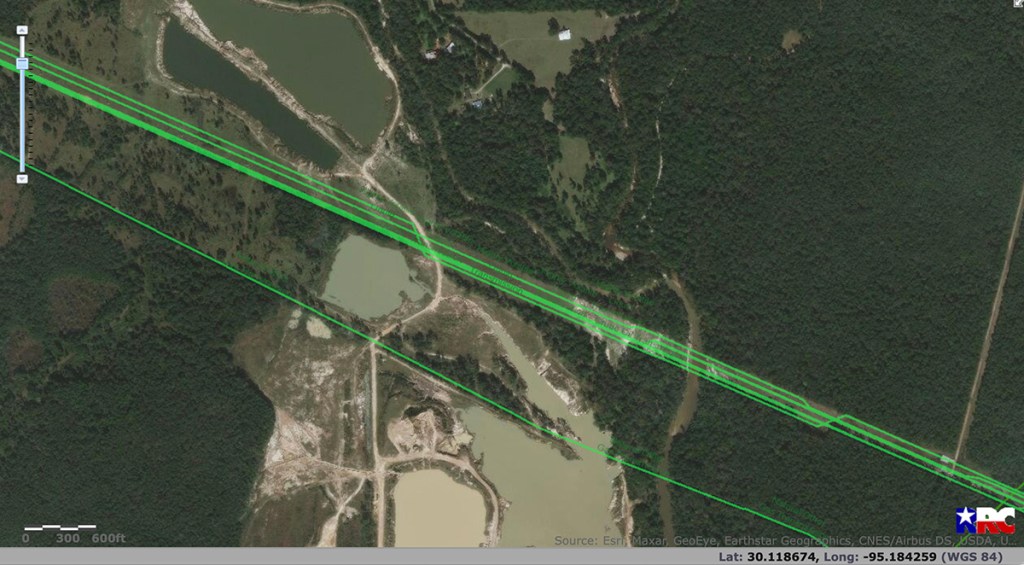
Triple PG Mines Ever Closer to HVL Pipelines

A flyover of the Triple PG mine in Porter revealed that the operator started mining right next to five pipelines carrying highly-volatile liquids (HVL). Previously, Triple PG mined next to a Kinder Morgan natural gas pipeline. Headward erosion subsequently exposed the pipeline during Hurricane Harvey and Tropical Storm Imelda. Another storm could do to the HVL pipelines what those did to Kinder Morgan’s.

December 2019 photos shows Kinder Morgan Natural Gas pipeline exposed by erosion.

Now, the Triple PG mine is mining next to the five pipelines carrying highly volatile liquids. They include pipelines operated by Plains, Enterprise and Mustang.

Railroad Commission Map Shows Location of Pipelines

Screen capture from Texas Railroad Commission website shows location of natural gas pipeline (bottom) and HVL pipelines (top) in grassy utility corridor. Background satellite photo shows where headward erosion exposed NG pipeline after miners mined right up to it.

Note Caney Creek meandering to the right of the mine in the satellite image above. When the creek came out of its banks during Harvey and Imelda, it eroded that huge gash you see between the pipelines.

Recent Photo Shows Proximity of Mining to Pipelines

As you can see in the photo below, Triple PG is now mining that same area. It is excavating sand less than a tree’s width from the HVL pipelines. In the next big flood, that will make them susceptible to the same kind of erosion that exposed the natural gas pipeline in the last floods.

Looking south across the utility corridor with five HVL pipelines. Photo taken on May 26, 2021.

Similar Problems Further Up the Pipeline at Another Mine Show Danger

Further up this same pipeline corridor toward Conroe, here’s what happened at the LMI River Bend mine.

Exposed HVL pipelines at LMI River Bend Mine, photographed in January of 2020. This area has since been stabilized before any of the lines ruptured.

If a similar disaster happened at the Triple PG mine and the pipelines ruptured, there would be little to keep the liquids in them from contaminating Lake Houston, the source of drinking water for 2 million people.

The Triple PG mine has a long history of questionable environmental practices. The Texas Commission on Environmental Quality has repeatedly cited the company for illegal discharges of industrial waste water. In 2019, the TCEQ referred the case to the Texas Attorney General for prosecution.

AG Lawsuit Stuck in Slow-Motion COVID Mode

Not much has happened in the lawsuit since then. Shortly after the AG filed the lawsuit, the Guniganti family, which owns the mine, tried to play a shell game with ownership, causing the AG to file an amended petition. Then the Gunigantis hired a new operator which also has a dubious history of compliance with the environmental regulations. The operator is Sumaiah Kurre, of Texas Frac Sand Materials Inc. at 1367 Woodcrest Drive, Houston, TX 77018.

The Texas Secretary of State lists Kurre’s name 47 times in the Texas SOS-Direct database. His name is associated with sixteen different entities in multiple capacities. Many of the entities have lost their right to do business in Texas.

Craig Pritzlaff, TCEQ’s director of Compliance and Enforcement, says the COVID crisis delayed an already complicated case, but neither the Commission, nor the AG have abandoned it. In fact, he said, the TCEQ flew over the mine today. Hopefully, a judge will hear the case soon. This case dramatizes the need for the legislature to adopt best practices for sand mining that provide better protection to the public.

Posted by Bob Rehak on 7/19/2021

1420 Days since Hurricane Harvey and 669 since Imelda

The thoughts expressed in this post represent opinions on matters of public concern and safety. They are protected by the First Amendment of the US Constitution and the Anti-SLAPP Statute of the Great State of Texas.

Where Will Tomorrow’s Sand Come From?

Even though sand can be found in nearly every single country on Earth, the world could soon face a shortage. Usage around the world has tripled in the last twenty years, according to the United Nations Environment Program. That’s far greater than the rate at which sand is being replenished.

After water, sand is the second most used commodity on earth. It’s used in concrete, glass, computer chips, computer screens, tile, and more. When you look at deserts and oceans, you may think we have an infinite supply. But we don’t. According to this ten-minute video produced by CNBC, we’re using it faster than Mother Nature is creating it.

Seems Infinite But Isn’t

And not all types of sand are suited for all uses. Desert sand, for instance, is windblown and round. That makes it unsuitable for concrete. For strength, concrete requires the more angular type found near and in rivers.

One small part of the massive Hallett sand mine on the San Jacinto West Fork

A Short Course on Sand

If you want to understand more, I highly recommend this video produced by CNBC. It’s short – only about 10 minutes. But it’s packed with information that puts production, consumption, and environmental tradeoffs in perspective.

To see this video, click here or on the image above.

For instance, do you know how the “tragedy of the commons” can ultimately lead to the collapse of environments?

The video is filled with facts and answers that you can use to amaze friends and family.

  • Did you know that China used more sand in the last three years than the US did in the last century?
  • How much sand does it take to produce concrete?
  • Where will it come from in the future?
  • What impact will the massive infrastructure bill now pending in Congress have on sand production and therefore the environment?

This video will answer all those questions and more. I highly recommend it.

Posted by Bob Rehak on 5/14/2021 based on a tip from Chris Manthei

1354 Days after Hurricane Harvey

Eight Bills Introduced in Texas Legislature This Year Affect Sand Mines

Yesterday was the last day for lawmakers to file bills for the 87th Texas legislative session. Eight bills have been introduced to curb abuses of aggregate production operations, which include sand mines. Five address reclamation of mines in various ways.

Huberty’s HB4478: Reclamation and Performance Bonds

Dan Huberty from the Lake Houston Area introduced HB4478 which addresses abandonment of sand mines. Many miners simply walk away from mines leaving abandoned, rusting equipment in place and dangerous conditions. Huberty’s bill would require mines to file a reclamation plan before they start mining and also post a bond ensuring they actually execute the plan. Currently, mines are required to file a plan, but there is no requirement in Texas to execute it. Miners can simply walk away from mines after they extract the last ounce of sand. That can leave scars on the landscape, degrade water quality, and threaten public safety.

Huberty’s HB767: Best Practices

Huberty also introduced HB767, a bill that would require the Texas Commission on Environmental Quality to establish and publish best management practices for sand mining. However, it does not require sand mines to follow the practices. While that’s disappointing, it could bring heat to operations that don’t follow the guidelines.

Biederman’s HB4341: Changes Responsibility for Oversight

Representative Kyle Biederman from Fredericksburg introduced HB4341, a bill that would transfer regulation of aggregate production operations from the Texas Commission on Environmental Quality (TCEQ) to the Texas Railroad Commission (TRRC). The bill gives the Railroad Commission the right to conduct unannounced inspections to ensure compliance with water and air quality regulations. Biederman’s bill also mandates reclamation of mines, but includes more specifics than Huberty’s. Finally, it provides criminal penalties for people who knowingly and willfully violate conditions of their permits. The big news: transfer of oversight responsibility from the TCEQ to TRRC. If it passes, it will be a resounding vote of “no confidence” in the job that the TCEQ has been doing in regulating sand mines.

Zwiener’s HB2422: Limiting Location of Mines

Representative Erin Zwiener from Kyle introduced HB2422. Her bill applies to counties with a population of 500,000 or more. It would allow county commissioners to prohibit the construction or expansion of an aggregate production operation at a location less than one mile from a residence, school, place of worship, hospital, or land platted for residential development. The bill would also allow commissioners to establish conditions for the construction or expansion of mines elsewhere in the county.

Murr’s HB291: Reclamation and Performance Bonds

Representative Andrew Murr from Kerrville introduced HB291. It also focuses on reclamation of mines. It would require the grading of banks, revegetation, and removal of equipment upon completion of mining. The bill would also require operators to reclaim mines in stages as extraction activities on different parts cease. It would give miners a deadline for reclamation, too: six months. Finally, it would require a performance bond equal to $2,500 for each acre affected by extraction activities. Upon completion of reclamation activities, the TCEQ would release the performance bond. Cities and counties would have the right to waive the reclamation requirement if reclamation conflicts with proposed future uses of the land.

Abandoned dredge left at abandoned Texas Concrete Sand & Gravel Mine in Plum Grove on San Jacinto East Fork. Photographed 3/3/2021

Guillen’s HB1544: APO Taxation

Representative Ryan Guillen from Rio Grande City introduced HB1544. It addresses the tax classification of land used for sand mining. The language is confusing and an analysis of the bill has not yet been submitted. However, it appears to state that sand mine, once it meets requirements for reclamation, may revert to a property tax rate associated with open space, such as agriculture. The bill lays out some unique requirements for reclamation not discussed in the other bills here. While this seems to give sand miners a positive incentive to restore land, I’m not sure how much. In Montgomery County, the tax appraiser routinely grants ag exemptions to land used for sand mining.

Wilson/Schwertner’s HB1912/SB1209: Permit Requirements

HB1912 filed by Representative Terry Wilson of Georgetown establishes additional permit requirements for aggregate production operations. They affect air quality, light pollution, noise, blasting, dust, and other operational issues identified by the House Interim Committee on APOs back in January.

State Senator Charles Schwertner from Bryan introduced SB1209. It is an identical companion bill to HB1912. Companion bills increase the chance of passage by broadening the base of support in both houses.

During the 86th Legislature in 2019, TACA beat back all reasonable attempts to regulate sand mining. Let’s hope for the sake of everyone’s health and property values that this session has more success. I will keep you posted.

Posted by Bob Rehak on 3/13/2021

1292 Days since Hurricane Harvey

House Committee Releases Report on Sand Mining

A House Interim Committee on Aggregate Production Operations (APOs, which include sand mining) just released a 77-page report focusing on the Hill Country and San Jacinto River Basin. The report validates many of the concerns ReduceFlooding.com has raised about sand mining for years.

One of multiple breaches at the Triple PG mine in Porter left open for months until the Attorney General sued the mine.

Purpose: To Balance Priorities While Addressing Concerns

Texas House Speaker Dennis Bonnen created the committee to help balance public protection, regulation and economic growth. Bonnen tasked the Committee with reviewing complaints about APOs and making recommendations to the 87th Texas Legislature. Issues include:

  1. Nuisance issues relating to noise and light
  2. Transportation safety and road repairs
  3. Air quality
  4. Blasting
  5. Reclamation
  6. Distance from adjoining properties
  7. Disruption of groundwater
  8. Water quality
  9. Sedimentation and flooding
  10. Municipal ordinances.

The report begins with a description of the balancing act regulators face. Sand and gravel used in concrete support economic growth. But they also impact surrounding property values, impact the health of neighbors, and lower quality of life when they cut corners and operate outside of industry best practices to lower production costs.

A number of bills in the last legislative session sought to resolve these conflicts and many, such as “best practices” will be reintroduced during the session which started this month. Pages 7-10 describe the legislation attempted in the last session.

Below, I summarize each issue listed above in order.

Noise Pollution

The main sources of noise from APOs come from the machinery used to move earth, process raw material and move product. Blasting is also a major consideration in the Hill Country.

The U.S. Mining Health and Safety Administration (MSHA) characterizes noise and one of the most pervasive health hazards in mining. Prolonged exposure to hazardous sound levels over a period of years can cause permanent, irreversible damage to hearing. Hearing loss may occur rapidly under prolonged exposure to high sound levels, or gradually when levels are lower and exposures less frequent.

Ways to reduce noise from moving equipment include use of strobes, alarms, camera systems and motion sensors that can trigger backup beepers as needed.

To mitigate noise from processing equipment, the report suggests chute liners and screens made of rubber or urethane to dampen the sound of the rock hitting the sides of the conveyors. Acoustical enclosures such as walls, berms and natural vegetation can also help protect neighbors.

APOs should monitor the noise exposure at their property line, keeping the noise level at their property line below 65 dB if the property line is within 880 yards of a residential area, school, or house of worship, and 70 dB if not.

Report Recommendation

Light Pollution

APOs create light pollution when the dust they generate scatters light and creates haze. Those that operate at night may require light for safety that keeps neighbors up.

APOs should be held to IDA and IES standards for outdoor industrial lighting, and fined when they don’t.

Report Recommendation

These standards provide operator safety yet shield neighbors from the most annoying effects of light pollution.

Transportation

The high volume of heavy trucks used to move product creates traffic safety issues near APOs and damages roads. TxDOT allows APOs to build 90-degree driveways. These are less expensive, but more dangerous than acceleration and deceleration lanes which provide massive safety benefits.

Dust and small rocks coming off of trucks cause windshield damage and obscure vision of nearby drivers. Placement of roadway bumps leading up to acceleration lanes would help shake off the dust and smaller rocks from the trucks before they make their way onto the highway.

Studies have also shown that the level of damage to the integrity of roads by heavy commercial vehicles far outpaces the funding they contribute through gas taxes. Such vehicles pay $.03 per mile, but cost $.26 per mile.

Recommendations:

  • Change TxDOT protocols to allow for an agreed upon change to a driveway should traffic conditions change.
  • Require that new APOs have enough right of way purchased to construct acceleration or decelerations lanes.
  • Commission a study to establish a Pricing Model for Pavement

Air Quality

Suffice it to say that the health risks of breathing APO dust are voluminous.

Short-term exposure can result in coughing, shortness of breath, tightness in the chest and irritation of the eyes.

Long-term exposure can result in reduced lung function, and respiratory diseases such as asthma, chronic obstructive pulmonary disease (COPD), diabetes, emphysema, impairment of brain development, low birth weight, lung cancer, stroke, aggravation of existing lung disease, and death.

OSHA, MSHA and other agencies responsible for worker health continue to reduce allowable exposure levels for labor; these same reduced exposure levels should be applied to the general population as well, says the report.

Testimony from those living near APOs who have been affected by the decline in air quality demonstrates that regular regional air-quality monitoring is insufficient. So, TCEQ does not know what the actual, real-time particulate concentrations are in the air near APOs.

Recommendations:
  • Require APOs to set up onsite monitoring.
  • Commission a study to determine cumulative effects of adjacent mines, each outputting a compliant level.
  • Modify the TCEQ permitting process to include county commissioners, municipal authorities and others.

Blasting

This is a bigger problem in the Hill County than Houston. So I will skip it here.

Reclamation

APO’s can suddenly cease operation for a number of reasons: bankruptcy, depleted assets, decline in demand, etc. While sites can never be returned to their original condition, they CAN be restored for safe, alternative uses.

At a minimum, this means removing hazardous materials and industrial equipment, and sloping walls to avoid leaving dangerous collapses.

Recommendations:
  • Require APO to file a reclamation/restoration plan.
  • Require operators to post a Surety Bond to cover all reclamation costs in the event the operator fails to reclaim disturbed lands.
  • Address all potential future safety and environmental problems (fugitive dust, erosion, etc.) in reclamation plans.

Distance from Adjoining Property

Current regulations depend on the type of facility and the type of equipment in use. This makes regulations complex and difficult to interpret.

Recommendations:
  • Revise permits to define setbacks by the distance from the APO property line rather than the specific piece of equipment.
  • Require a setback of 880 yards for concrete batch plants.
  • Establish setback rules for all APOs that treat platted subdivisions as residential areas.

Groundwater Disruption

The committee found inconsistent groundwater conservation rules around the state. Many counties did not even have Groundwater Conservation Districts, or if they did, they could not assess the cumulative regional impact of APOs on water supply. Historic APO water use data is not readily available to the public.

Recommendations:
  • The Texas Water Development Board should complete an in-depth assessment of APO water use.
  • Study future water supply, especially for the Houston area, where sedimentation threatens Lake Houston.
  • Require APOs to recirculate groundwater to conserve groundwater resources.

Water Quality

The committee found that TCEQ regulations for APOs are less rigorous than for other types of surface mining enforced by the Railroad Commission.

APOs construct ponds based on their preferred ‘best management practice,’ often without rigorous engineering or regulatory inspection. Testimony from neighbors indicated sediment-laden discharge damaged property. TCEQ found that nearly half (42%) of APO enforcement actions (not related to registration) were due to noncompliance with water-quality rules.

Groundwater pollution by APOs is also a legitimate concern.

Recommendations:
  • Require Texas APOs to comply with requirements for Texas coal and uranium mines.
  • Improve rules and regulatory processes to provide a higher level of protection from pollution by APOs.
  • Provide more robust and frequent groundwater inspections.
  • Perform dye-trace studies to determine groundwater flow-paths in areas close to major water wells.

Sedimentation and Flooding

The committee found sand mining along the San Jacinto River to be one of the contributors of excess sedimentation. It also aggravated flooding issues in Montgomery and Harris Counties during and after Hurricane Harvey.

Also, “The result of partitioning large areas of the floodway from rising floodwaters by levees and dikes can result in increased flooding of adjacent areas. Flood-induced breaches in levees can also add to the problems of flooding and sedimentation downstream.”

Unfortunately, breaches and unauthorized discharges are sometimes left unreported and unrepaired unless citizens file reports to the TCEQ. Even when violations have been documented by the TCEQ, fines have been minimal, averaging ~$800/violation from 2013-2017. Worse, the TCEQ inspects mines only once every two years for the first six years, and then once every three years thereafter.

The committee also found that in-river mining has continued along the West Fork of the San Jacinto even though no permits have been granted by TPWD. TPWD enforcement appears to be lax. “Thus, it is likely regulations will have little or no effect on in-river mining.”

Recommendations:

Municipal Ordinances

The report found that municipalities (as opposed to counties) already have the power to require minimum buffers in Public Health and Safety requirements and nuisance abatement ordinances. The committee specifically cited the City of Houston. But much mining remains outside of municipalities. So it recommended granting authority to counties to establish setbacks between incompatible land uses and to regulate water wells to avoid possible groundwater contamination.

Lack of Industry Cooperation

This report began by acknowledging the need for balance. However, it ended by complaining about the lack of industry cooperation.

For instance, TACA claimed that pushing facilities father from where products are needed will “add a tremendous amount of cost.” When the committee tried to investigate such economic claims, TACA refused to document them. The committee then reached out to trade groups in other states to substantiate TACA’s claims. However, all those groups refused to respond or simply ignored the requests.

That led to one final recommendation. Should concerns about the potential economic consequences become substantiated by reputable data, the legislature should institute a “Best Practices Compliance Incentive Program.”

It would require TCEQ to certify that all APOs trying to do business with the state comply with industry best practices.

To read the entire report, click here.

Posted by Bob Rehak on 1/26/2021

1246 Days since Hurricane Harvey

The thoughts expressed in this post represent opinions on matters of public concern and safety. They are protected by the First Amendment of the US Constitution and the Anti-SLAPP Statute of the Great State of Texas.

UH Geology Professor Weighs in with TCEQ on BMPs Related to Sand Mining

Professor Emeritus William Dupré, Ph.D., of the University of Houston’s Department of Earth and Atmospheric Sciences filed a 36-page report with the TCEQ on sand mining in the San Jacinto River Basin. Dupré has broard experience with geologic hazards and risk assessment. He submitted his report in support of the petition filed with the TCEQ by the Lake Houston Area Grassroots Flood Prevention Initiative to establish best management practices (BMPs) for sand mining.

The first issue that Dupré identified is flooding. “With one exception, all sand mines in the San Jacinto River Watershed are located partially or completely within the regulatory floodway, an area delineated by FEMA as having the highest potential for flooding (and erosion) along major waterways. “[T]he floodway is an extremely hazardous area due to the velocity of flood waters which carry debris, potential projectiles and erosion potential…”. (Montgomery County Flood Plain Management Regulations, 2014, p.25)

Floodway Constriction

Dupré notes that partitioning large areas of the floodway from rising floodwaters by levees and dikes can result in increased flooding of adjacent areas.

A good example: sand mines on the north side the San Jacinto West Fork and I-45 have walled off half the floodplain, forcing floodwaters onto neighboring property on the south side.

Sand mines have walled off more than 200 acres west of I-45 and north of the San Jacinto West Fork. See below.
The high dikes force floodwater to the other side of the river rather than allowing it to spread out on both sides. The concentration of water in a smaller area also increases the velocity and erosion. For close-up of area inside red circle, see image below.
This shows how high the dike around the sand mine is.

Levee Failure Can Flush Pollutants into Waterways

“Flood-induced breaches in levees can also add to the problems of flooding, erosion, and sedimentation downstream,” Dupré says, flushing sediment and other pollutants into adjacent land, wetlands, and waterways. See two examples below.

In the top row, river migration eroded the pit wall which allowed the contents to drain into the West Fork near North Park Drive. In the bottom row, the entire contents of a mine pit drained into the West Fork near Bennett Estates.

In-Stream Mining Disrupts River Habitat

A. Google Earth image of point bar on the west Fork of the San Jacinto River; B. Same bar 5 months later showing un-permitted (i.e. illegal) In-stream “bar-scalping.”

“Since the passage of Section 404 of the Clean Water Act Amendments of 1977, some states have heavily restricted or banned in-stream mining, as have many countries,” writes Dupré. “These restrictions are mainly based on the significant environmental problems associated with this type of mining.”

Such mining can create major disruptions of riparian habitats by increasing the amount of sediment put into suspension. “Major channel modifications can also occur, including upstream incision (headcutting) and downstream erosion and deposition.”

BMPs Can Make Compliance with Regulations More Efficient

In his paper, Dupré next examines applicable regulations and suggests several BMPs to supplement them. He recommends that:

  • All APO’s should develop and make available to regulators and the public a Comprehensive Mine Plan and an Environmental Assessment Report on potential impacts before permits are issued.
  • Likewise, all APO’s should develop and make available to regulators and the public a Reclamation Plan before permits are issued and file a performance bond ensuring reclamation before a production permit is granted. Such permits should have significant civil and criminal penalties for non-compliance.
  • New mining should be minimized or restricted in delineated floodplains and floodways and channel migration zones (areas most like to be eroded by lateral migration and river avulsion).
  • Mines should be “prohibited within the adopted regulatory floodway unless it has been demonstrated through hydrologic and hydraulic analyses that the proposed encroachment would not result in any increase in flood levels…. A development permit must be secured from the Flood Plain Administrator prior to the placement of fill or other encroachment in the floodway….” (Montgomery County Flood Plain Management Regulations, 2014).
  • Stockpiles should be located outside the floodway, because of the high potential for erosion (and resultant sediment pollution) during frequent flooding.

Conclusion

Dupré acknowledges that aggregate mining clearly provides valuable material and employment to the state and nation.

Nonetheless, Texas is one of the few states where sand and gravel mines remain largely unregulated. Issues related to flooding, erosion, and sedimentation create many unintended (and undesirable) environmental and economic impacts associated with sand and gravel mines – especially in the San Jacinto River watershed. “I believe there is a clear need for the requirement for BMP’s to better protect the public and the environment,” says Dupré.

TCEQ Public Comment Period Rapidly Coming to a Close For Sand Mining BMPs

On November 11, the TCEQ held a public hearing on a joint proposal between TACA and the Lake Houston Area Grassroots Flood Prevention Initiative to establish best management practices for sand mining in the San Jacinto watershed. The public comment period closes on December 11, 2020 – in just 12 days.

If you want to weigh in on the subject, you can review presentations from the hearing here. TACA and the Lake Houston Area people are in substantial agreement on most points. However, they still differ on four key issues.

  • Where should the BMPs be enforced? On the main stems of the East and West Forks or on the smaller tributaries, too?
  • Should there be performance bonds for reclamation?
  • How far from rivers should the sand mines be set back for safety reasons?
  • Should compliance with best practices should be voluntary or mandatory?

If you have comments or questions for the TCEQ, please e-mail Outreach@tceq.texas.gov. Make sure to include “Sand Mining Rulemaking” in the subject line of your e-mail.

Posted by Bob Rehak on 11/29/2020

1188 Days since Hurricane Harvey

The thoughts expressed in this post represent opinions on matters of public concern and safety. They are protected by the First Amendment of the US Constitution and the Anti-SLAPP Statute of the Great State of Texas.

Submitted Your Sand Mine Testimony Yet?

Today, October 30, 5:00 p.m. is the deadline to send testimony to the Texas House of Representatives Interim Committee on Aggregate Production Operations (APOs). The committee is looking into production practices of sand mines and other types of APOs across Texas.

Write About Your Experience

Written comments will be evaluated and considered by the committee when they make their decisions.

If you haven’t yet submitted comments, please take time to put something together—even if it’s just a few paragraphs!

Write about how YOU personally have been or will be impacted by sand mines. Pick one or two of these key issues that will most affect you personally:

???? Air quality
???? Water quality, use and availability
???? Surface and ground water contamination and flooding
???? Rapid development of APOs without adequate regulatory oversight, mine planning, or reclamation
???? Truck traffic
???? Nuisance issues: blasting, noise, odor, visible blight
???? Economic impacts, devaluation of property

How to Submit Comments

When you are ready to submit your testimony, email it to jeff.frazier_hc@house.texas.gov (jeff DOT frazier UNDERSCORE hc) or press the link below. Make sure to include:

  • Your name
  • Address
  • Phone number
  • Testimony in attachment (PDF preferred, Word Document OK, preferably five pages or less)

Deadline is 5:00 p.m., Friday, October 30, 2020.

EMAIL YOUR TESTIMONY

Not Choice Between Growth and Safety

Sand mining is necessary to make concrete and support growth. No one wants to put sand miners out of business. People do, however, have legitimate issues with egregious sand-mining practices.

They want sand produced in a manner that respects public safety, health, homes, and the environment.

Since starting this website I have created more than 200 posts about problems with the way sand mining is actually practiced in the Houston Area, and how dangerous practices contribute to flooding. To learn more, use the search phrase “sand mines” or see the index page. Here are some examples.

Sand mining in floodways on West Fork
Discharging industrial waste water into the public drinking water supply
Another discharge of industrial wastewater into the headwaters of Lake Houston
Failure to stabilize soil or restore land to alternative us after abandonment of mine.
Mining too close to natural gas pipeline and exposing it
Endangering five pipelines carrying highly volatile liquids near the West Fork San Jacinto
West Fork sand dune deposited during Harvey downstream from 20-square miles of mines in floodway. It contributed to the flooding of more than 7,000 structures.
River mining without a permit
Flooding adjacent property with floodwater
Barely plugged breach near LMI mine on West Fork
Pumping wastewater into wetlands

Don’t tolerate sand-mining practices that jeopardize your home, family and community. Write today.

Posted by Bob Rehak on 10/30/2020

1158 Days since Hurricane Harvey

The thoughts expressed in this post represent opinions on matters of public concern and safety. They are protected by the First Amendment of the US Constitution and the Anti-SLAPP Statute of the Great State of Texas.