Tag Archive for: sand mining

2019 Legislative Scorecard: Flood Mitigation a Win, Sand Mining a Loss

Looking back at the 2019 Texas Legislature, we have cause for both celebration and soul searching. The good news: A multi-billion-dollar flood-mitigation bill that will do a lot of good for a lot of people. The bad news: death in various committees of any serious legislation to reign in the out-of-control abuses of sand miners. They openly flaunt environmental laws and resist every attempt at reasonable regulation while pretending to be the good guys who fuel growth.

TACA even managed to kill a bill that would have defined best practices for sand mining (HB 909), without even creating any penalties for violation. You can read the entire rundown on the Legislation page of this site. Below is a brief summary of the bills I followed closely.

Flood Mitigation Scorecard

HB 13 would have created a flood infrastructure fund of $3.26 billion taken from the Economic Stabilization (Rainy Day) fund for flood planning, mitigation, and infrastructure projects. This bill had many of the same objectives as SB 7, but also contained some differences. SB 7 survived. HB13 didn’t.

SB7 could help pay for additional flood gates on Lake Houston and speed up the process of designing, permitting, and constructing them.

SB 7 created a dedicated Texas Infrastructure Fund for flood control planning and the funding of flood planning, mitigation, and infrastructure projects. It Passed both houses and is on the Governor’s desk, awaiting his signature. You can read more detail about SB7 and how it will enable and accelerate flood mitigation in this post.

SB500 is an omnibus appropriations bill that includes funding for SB7. It also dedicates $30 million for dredging of the West Fork Mouth Bar in Lake Houston. It passed both Houses and is also on the Governor’s desk, awaiting his signature.

HB 911 would have created a Lake Houston Watershed Commission. Its purpose: to provide the public with streamlined communication and cooperation in flood control planning. It passed the House, but died in the Senate Water and Rural Affairs committee.

Sand Mining Scorecard

People all over the state rose up against the aggregate industry during this legislature, but legislation the industry opposed made it out of committee. Suddenly, TACA’s reason for making large donations to every committee chair in both the House and Senate became clear. There was one small win.

A Small Win

HB 907 Doubled the penalties for not registering a sand mining operation. New penalties can range from $10,000 to $20,000 per year with the total not to exceed $50,000. It passed both Houses and went to the Governor on 5/29. TACA backed this bill because the openly illegal sand mining is bad for their business. It creates low-priced competition.

Bigger Losses

Below is a short list of other sand-mining bills I followed:

HB509 would have allowed the Texas Railroad Commission to regulate APOs with TCEQ. It would have required a hydrologic impact study especially for large clusters of mines in a small area. It also would have required public notice, public hearings, and provided fines up to $10,000 and 1-year in jail for false statements made on permits. It died in committee.

HB 908 would have provided penalties up to $50,000 for water code violations and every-other-year inspections. Died in Committee. No testimony even heard.

HB 909 would have directed the TCEQ to adopt and publish best management practices for sand mines (aggregate production operations).  Testimony was taken on 5/1, but no further action was taken. The bill died in committee.

HB 1671 would have extended water quality protections to the West Fork of the San Jacinto currently enjoyed by the John Graves District on the Brazos as part of a pilot program. It would have attached penalties for non-compliance with best practices defined under HB909. It died in the House Natural Resources Committee.

HB 2871 would required sand mines and other aggregate production operations to acquire a reclamation permit and to file a performance bond ensuring reclamation. Significantly, they would have had to do both of these things before they could have acquired a production permit. It also attached civil and criminal penalties for non-compliance. This bill died in the Energy Resources committee.

SB2123. Companion bill identical to HB907. Died in committee.

SB2124. Companion bill, identical to HB909. Died in committee.

SB2125. Companion bill, identical to HB908. Died in committee.

Sand Mine leaking silt into the West Fork on 2/23/19. Note the difference in color in the river water above the leak and also in Spring Creek, which joins the West Fork from the west (left) near US69. Ten other sand mines on the San Jacinto had breaches the day this satellite photo was taken. A canoeist spotted three breaches in this same mine in one week in December.

Wolf in Sheep’s Clothing?

The most potentially dangerous bill of 2019 was CSSB2126. It was pitched under the guise of creating sand traps in the San Jacinto. The theory: keep sand from migrating downstream where it creates sediment dams, such as the mouth bar. Proponents (including TACA) pitched it as a way to get free dredging.

It would have allowed the SJRA and Harris County Flood Control District to dredge the San Jacinto River to restore conveyance without a permit – if they place the spoils on private land. It died in the House, but was reincarnated as HB1824. That bill passed both houses and is on the Governor’s desk.

I feared that this bill would have opened the door to river mining in the San Jacinto. The reason I feared this? Proponents of the bill said they wanted to create “sand traps.” But no one could agree on what they were or where they would be. Language in the bill was EXTREMELY vague and open ended, a practice that can lead to abuses. It doesn’t even mention sand traps. Meanwhile…

River mining is outlawed in many countries because it is so environmentally destructive.

Environmental groups, such as the Bayou Land Conservancy, tried to add language that would have called for independent studies, before allowing miners in the river.

Time Will Tell: Vigilance Required

A major focus of my efforts since Harvey was to increase setbacks from the river for mines. This bill went in the other direction. It allows miners in the river under the guise of “helping” reduce the sedimentation that they “helped” create.

In reality it also reduces their costs by giving them access to land (the river) without paying leasehold fees or taxes. It also gives developers a way to get free fill that can be dumped in the floodplain without permits. And that could put powerful pressure on politically sensitive, appointed boards, such the SJRA’s.

Only time will tell whether the intentions of the drafters of this legislation were pure, or whether this is yet another sly and crafty grab by TACA. One thing is certain: it will require constant vigilance on the part of residents and environmental groups.

Posted by Bob Rehak on 5/30/2019

639 Days since Hurricane Harvey

All thoughts expressed in this post are my opinions on matters of public policy. They are protected by the First Amendment of the U.S. Constitution and the Anti-SLAPP Statute of the Great State of Texas.

New Google Earth Image Shows Multiple West Fork Sand Mines Mixing Their Wastewater with Your Drinking Water

On its way to Lake Houston, your drinking water runs through a gauntlet of sand mines – some old, some new. Many discharge industrial process water directly into the San Jacinto River and its tributaries. The latest Google Earth LandSat images show a total of 11 between I-45 and US 59 on the West Fork doing just that. In addition, photos taken from a boat show another breach in a sand mine dike that happened more recently on Caney Creek, a tributary of the East Fork. Together, these images make a powerful case for moving mines out of the floodway and establishing best management practices for sand mines. The industry has fought both measures.

Dangers of Mining in Floodways

For miners in the Houston area, locating mines in floodways is a dangerous, but lucrative practice. Lucrative because there is less overburden for miners to move. Dangerous because rivers frequently sweep through mines during floods. The floods can then carry sediment downstream, which creates blockages that contribute to flooding.

Floods can also flush chloride-laden process water out of the mines and into your drinking water. That makes City of Houston water treatment costs more expensive. A former high level manager in the City’s water treatment department told me that he saw huge spikes in chlorides after every flood and tracked it to sand mines.

Pictures Aren’t Pretty

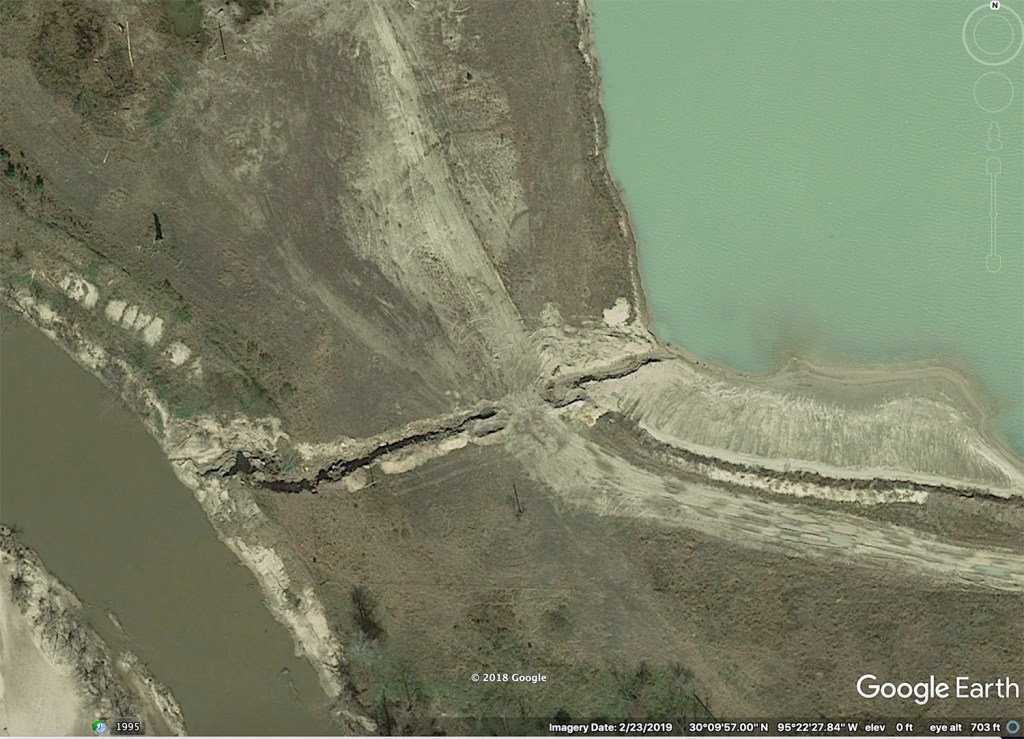
Massive breach in Triple-P mine on Caney Creek allows process water to mix with water in tributary for Lake Houston, source of drinking water for two million people.

After discovering the breach above, Josh Alberson whose boat we were in, spent an evening pouring over satellite images. Last week, he sent me a list of GPS coordinates to review additional suspected breaches or discharges. See the images below, all from the West Fork.

First mine north of confluence with Spring Creek. A local canoeist found three breaches in this mine last December.
Breach on right open since 2015. Breach on top left was closed after 2015. Harvey swept through all these mines in 2017.
Note the stream at about two o’clock that is carrying sediment and process water to the river.
Small pit in middle drains into West Fork.
Overflow from mine contaminating West Fork.
This pit has remained open for years at a time. Sometimes the water flows in, other times it flows out.
Follow the stream from the pit on the right to the river on the left.
It looks like someone actually installed two culverts and built a road over this breach.
Note several small breaches in the bottom of this image and how the river is about to invade the major pit in the upper right,
See the line of sediment in the clearcut area between the large green pond and the river. Discharges date back to 2006.
West Fork San Jacinto just east of I-45.

Rule Rather than Exception

I could go on. But you get the idea. The TCEQ has said 15 sand mines are currently active on the West Fork between I-45 and US59. You just looked at a dozen breaches. Historical images in Google Earth show dozens of additional breaches in this same area. This is the rule rather than the exception.

Legislative Session Ends Hope for Improvement

Meanwhile, TACA, the Texas Aggregate and Concrete association, lobbied against establishing and publishing best practices for the industry including setbacks from rivers that could prevent this type of danger.

As we went into this Texas legislative session, I had high hopes. Representative Dan Huberty introduced HB 909, a bill that would have required the TCEQ to adopt and publish a set of best management practices for sand mines.

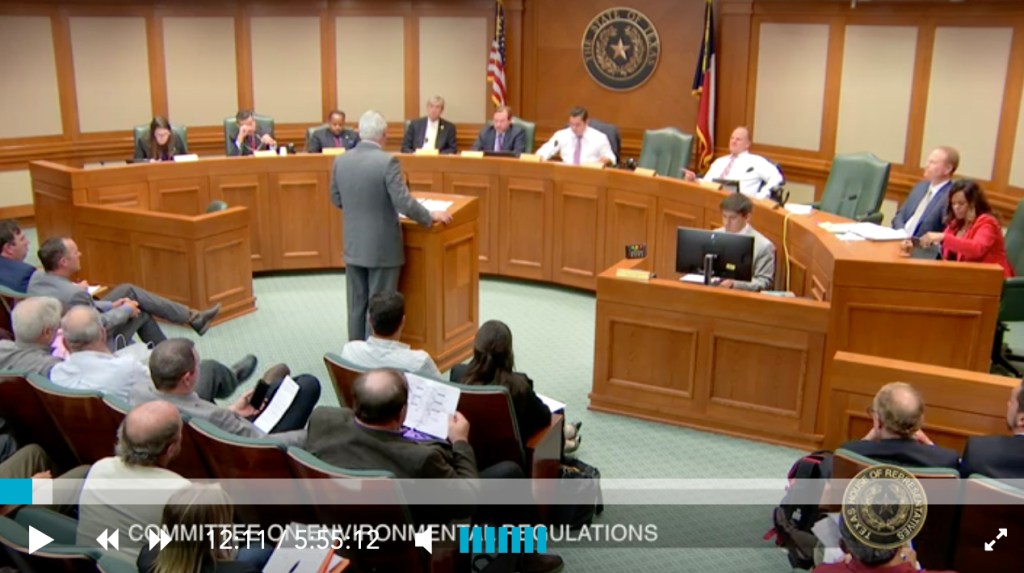
I drove up to Austin to speak for the bill. Rob Van Til, a sand miner representing TACA, spoke against it. Watch the testimony online at this link for the Committee Broadcast Archives. Make sure you scroll down to 5/1/19 and click on the link for Environmental Regulation. It lasts about 20 minutes. Here’s a guide for those short on time. At:

  • 4:30 Huberty introduces the legislation to the committee.
  • 6:45 Adrian Shelley, representing an environmental group, speaks for the bill.
  • 8:45 Rob Van Til, representing TACA speaks against.
  • 10:45 Representative Erin Zwiener questions Van Til
  • 16.25 Bob Rehak speaks for HB 909
  • 20:00 Huberty asks for committee support

The images above show why we need to move mines out of the floodway. But sadly, HB 909 never made it out of committee. The 86th Legislature ends this week. It’s time to start gearing up for 2021.

The thoughts expressed in this post represent my opinions on matters of public policy. They are protected by the First Amendment of the U.S. Constitution and the Anti-SLAPP statute of the Great State of Texas.

Posted by Bob Rehak on May 27, 2019 with help from Josh Alberson

636 Days after Hurricane Harvey

Nailed: Triple-P Sand Mine Photographed Discharging Wastewater Directly into Lake Houston Tributary

Since Harvey, I’ve been talking about the dangers of sand mining too close to the river. Texas is the only state I can find that has no minimum setback for mines. Tony Buzbee, candidate for Mayor of Houston, asked to see what I was talking about. So a friend, Josh Alberson, took us on out his jet boat this afternoon.

Massive Breach in Mine Dike

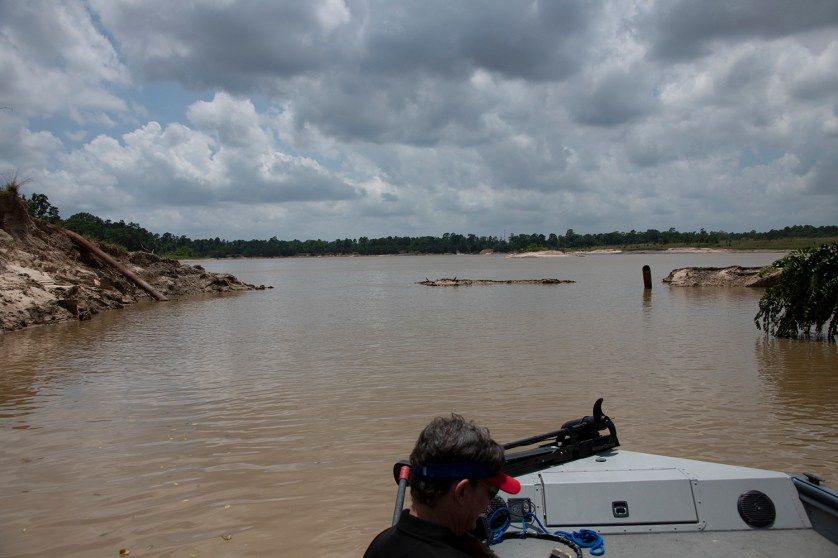
As luck would have it, we went up Caney Creek. Just above where it enters the East Fork, we spotted a massive new breach in the dike of the Triple-P mine. Here’s what we saw.

Looking into the Triple-P Mine through a breach in its dike on Caney Creek
Note the exposed shoreline in the background indicating how much water the mine lost to the river.
Looking 180 degrees from the shots above. The tree leaning over at a ten degree angle from the river is on the far bank of Caney Creek.
This shows how wide the breach is in relation to the boat. The boat is 22 feet long.
This shot taken from the boat shows the mine’s cleaning, sorting and transportation equipment in the background. I could not see the dredge operating in the mine’s pit from this angle.
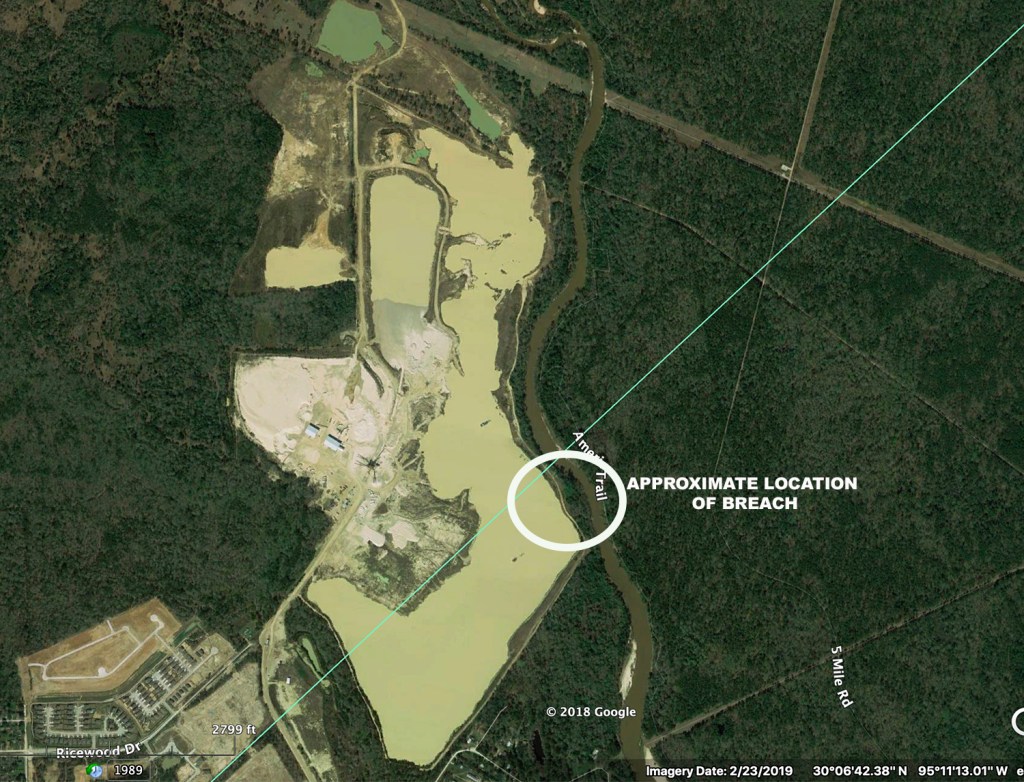
This Google Earth image shows the approximate location of the breach. The blue diagonal line is the Harris/Montgomery County Line. Caney Creek connects up with Lake Houston to the south (bottom part) of this image. Mmmmmmm. That water looks delicious, doesn’t it. If you get your water from Lake Houston, you’re drinking it!
Tony Buzbee, examining the sand bar at the bottom of the shot above (below the mine). The bar has grown in size, according to Alberson, a regular East Fork boater. This illustrates the danger of sand mining so close to the river. Buzbee also visited the mouth bar on the West Fork during his river tour today.

Mine Has History of Problems

I previously posted about breaches in this mine’s dikes and the loss of a major portion of its stockpile during Harvey. The stockpile is located in the confluence of two floodways (Caney Creek and White Oak Creek). Partially as a result of this mine, Kingwood’s East End Park just downstream was inundated with sand and gravel up to 15 feet deep after Harvey. Repairing damage to the trails in the park cost Kingwood residents almost $200,000. The wetlands have been lost forever.

Wetlands no more. Eagle Point in East End Park is drowned in sand from the Triple-P mine. It washed downstream during Harvey. Massive sediment deposits in the San Jacinto have also been linked to flooding by the Army Corps of Engineers.

The Triple-P mine also receives very favorable treatment from the Montgomery County appraisal district. They tax most of it as though it were timberland.

Buzbee as Witness

If you are a sand miner, having Tony Buzbee witness this breach and the massive sedimentation it caused downstream is a nightmare scenario. Not only is Buzbee running for Mayor of Houston, he’s self-funding his campaign. That means he does not depend on TACA contributions. And worse (or better if you are a resident), he’s one of the top litigators in the world. In 2015, he was named Texas lawyer of the year. Kingwood residents can only hope he takes up this cause.

TCEQ Already Investigating

Upon returning home from the boat trip, I immediately notified Ramiro Garcia, head of Compliance and Enforcement for the TCEQ (Texas Commission on Environmental Quality) about the breach in the dike. Garcia says they have people already on the case. I hope they choose to yank this mine’s license and make it an example. At a minimum, I believe they should give the mine the maximum fine. My understanding is that the fine can run up to $25,000 per day. This kind of flagrant violation endangers the health of millions of people and deserves no less.

A water quality expert I talked to about breaches like this told me they spike chloride levels in Lake Houston. Chlorides, you may remember, caused the pipe corrosion in Flint, Michigan, that contributed to pipe corrosion, lead poisoning, a public health crisis and an erosion of trust in local government.

Revive Best Practices Legislation for Sand Mines

As a result of the problems created by sand mining in the San Jacinto River watershed, State Representative Dan Huberty sponsored a bill this year to establish best practices for the mines. HB 909 was referred to the Environmental Regulation Committee on 2/25. The committee heard testimony on 5/1. TACA testified AGAINST establishing and publishing best practices. HB909 has been bottled up in committee ever since.

Please use this breach to try to get the legislation out of committee. This is major. It affects the drinking water supply for 2 million people. I talked about the dangers of mining too close to rivers when I testified for HB909. These miners just don’t care. They think that their ability to make a profit is more important that your health. Please send a message to Austin. Refer the members of the Environmental Regulation Committee to this post and tell them this is what Rehak testified about on 5/1. Have them vote it out of committee. Let’s establish best practices for sand mining in Texas. While we still can.

Here are the members of the Environmental Regulation Committee.

  • J.M. Lozano (Chairman) (512) 463-0463
  • Ed Thompson (Vice Chair) (512) 463-0707
  • Cesar Blanco (512) 463-0622
  • Kyle Kacal (512) 463-0412
  • John Kuempel (512) 463-0602
  • Geanie Morrison (512) 463-0456
  • Ron Reynolds (512) 463-0494
  • John Turner (512) 463-0576
  • Erin Zwiener (512) 463-0647

Please call their office and ask them to vote HB 909 out of committee. Tell them this breach is the great example of why we need this bill. Breaches like this happen far too often. There are only ten days left in this session.

Posted by Bob Rehak on 5/18/19, with a big thank you to Josh Alberson and Tony Buzbee

627 Days since Hurricane Harvey

All thoughts expressed in this post represent my opinions on matters of public policy and are protected by the First Amendment of the US Constitution and the Anti-SLAPP statute of the Great State of Texas.

Bayou Land Conservancy Supports HB 909, Publishing Best Practices for Sand Mining

The Bayou Land Conservancy sent this letter today to the Committee Clerk of the House Environmental Regulation Committee. The Conservancy has allowed me to publish it:

On behalf of Bayou Land Conservancy, I urge you to vote FOR HB 909 when the Environmental Regulation Committee meets to consider this bill. Bayou Land Conservancy is a non-profit, community-supported land conservation organization that preserves land along streams for flood control, clean water, and wildlife. We preserve 14,000 acres in the Houston region, focused on the Lake Houston watershed. This includes the San Jacinto River, cited in 2006 as one of America’s most endangered rivers due to a number of threats, including the high intensity of local aggregate mining. 

HB 909 would require the Texas Commission for Environmental Quality (TCEQ) to adopt and make accessible best management practices for aggregate producers to comply with applicable environmental laws and rules. 

This adoption of best management practices would be an important, and needed, step to ensure that aggregate production in Texas is done with sensitivity to the environment and to community standards. As the population of Texas continues to grow, with the corresponding increase in construction of buildings, roads, and bridges, there is greater risk to the quality of life and safety for many communities located near mining operations. 

As one of the nation’s leading aggregate producing states, we know Texas can lead in developing higher standards. We recommend best management practices that consider community values, such as: 

  • Employ public notice and stakeholder process guidelines to ensure mining operations are in step with local priorities and concerns 
  • Maintain setbacks or standards for siting operations away from sensitive areas or those with the highest likelihood to cause impacts 
  • Develop environmental impact statements for proposed mining operations 
  • Enact mitigation standards to reclaim the project area after facility closure 
  • Utilize progressive reclamation with a step-be-step restoration of the site over time rather than waiting for final closure 
  • Require the submission of an approved reclamation plan prior to permit approval 
  • Require the certification of financial security to perform reclamation activities before permit approval 
  • Require post-use conservation easements to ensure that the floodplain is left undeveloped and can provide a community amenity opportunity. 

There is urgency for Texas to lead by enacting commonsense solutions that protect the community. 

Without development and implementation of best management practices, such as those outlined above that would keep sediment in place through floodplain preservation and mine reclamation, downstream communities will continue to be at risk of water quality degradation and flooding. 

Please vote YES on HB 909. 

(Signed) Jill Boullion 
Executive Director 

Please Support HB 909; Here’s How

Call. Write. Or testify in person TODAY. The committee meets to consider this bill tomorrow. The following representatives comprise the Environmental Regulation committee.

  • Rep. J. M. Lozano (512) 463-0463 
  • Rep. Ed Thompson (512) 463-0707
  • Rep. César Blanco (512) 463-0622
  • Rep. Kyle J. Kacal (512) 463-0412
  • Rep. John Kuempel (512) 463-0602
  • Rep. Geanie W. Morrison (512) 463-0456
  • Rep. Ron Reynolds (512) 463-0494
  • Rep. John Turner (512) 463-0576
  • Rep. Erin Zwiener (512) 463-0647
  • Committee Clerk: Scott Crownover. (512) 463-0776

If you can come to Austin to testify, please do. The meeting will be held Wednesday, May 1, in room  E1.026 of the Capitol Building. Most likely hearing time is in the evening around 8 p.m., but get I plan to get there early. Hope to see you there.

Posted by Bob Rehak on April 30, 2019

609 Days since Hurricane Harvey

SJRA Responds to Post about SB 2126 Opening Door to River Mining

Letter to the Editor

RE: “Caution: SB 2126 Opens Door to Sand Mining in Rivers”

Bob,

Thank you for your work with Reduce Flooding to raise awareness about flooding and flood-related issues since Hurricane Harvey.  You have done a tremendous job of helping to educate the public on the causes of flooding and providing status updates on current and future flood-related projects and initiatives. Regarding your April 25 post titled ““Caution: SB 2126 Opens Door to Sand Mining in Rivers,” I want to clarify what SB 2126 is and what it is not.  

Chuck Gilman, the author of this post, is
Director of Water Resources and Flood Management for the
San Jacinto River Authority

The concept behind SB 2126 is to create a proactive approach toward removing sediment from the river before it is deposited in Lake Houston.  If you’ll recall the KBR report from 2000 noted “For long-term sediment management consideration, sedimentation basins, either on-channel or off-channel, are the most effective approach to minimizing sediment buildups and maintain the life of the channel conveyance.”  That is what we are attempting to accomplish with this program. 

The strategies and programs that could be implemented if SB 2126 is approved would not be river mining or dredging.  Any kind of dredging (either hydraulic or mechanic) would be very limited in scope, allowing conservation and reclamation districts to restore conveyance in the rivers in a strategic location through small-scale, periodic, targeted removal of sediment in the river.  This could be as large-scale as the current dredging project currently in progress, or as simple as the construction of sand traps that are dredged annually.  Regardless, your point about oversight and management is well noted, and is a requirement for this program to be a success.  

The San Jacinto River Authority has secured the support from the sand mining industry through the Texas Aggregates and Concrete Association to explore options to remove sand, gravel, shell, and other aggregates from the river—all without a cost to taxpayers.  Ideally, the SJRA would be the public agency overseeing and managing the program, conducting the necessary studies, and coordinating with the appropriate state and federal agencies to determine where and how much material should be removed. Partners from the private sector could then remove the material as directed by SJRA.  

After Hurricane Harvey, Governor Abbott tasked all of us with flood control and flood management. SB 2126 creates opportunities for public-private partnerships to help preserve the channel conveyance capacity of the San Jacinto River.  As we know in the Lake Houston area, this sediment impedes the flow of storm water where the West Fork converges with Lake Houston.  

Senator Creighton has led the effort to develop a flood resiliency funding bill in the Senate this legislative session (SB 7), and continues to seek other options to help create a regional flood management effort in the San Jacinto Basin.  This bill would simply create another tool in our toolbox to help reduce potential flooding in the future.  

As stewards of the San Jacinto River and its water supply, the SJRA supports Senator Creighton’s proactive approach to managing sediment in the river. We are trusted partners with the State of Texas, Harris County Flood Control District, and FEMA to execute $2.5B in flood control bond projects like the comprehensive San Jacinto Watershed Master Drainage Plan.  We value our role as a community partner and appreciate the opportunity to further reduce the risk of flooding by providing oversight and management of this plan.

Chuck Gilman
Director of Water Resources and Flood Management
San Jacinto River Authority

For additional information on SJRA visit our website at www.sjra.netor like SJRA on Facebook 
@SanJacintoRiverAuthority

Posted verbatim from SJRA letter by Chuck Gilman on 4/23/2019

602 Days since Hurricane Harvey

Earth Week Part 2: Clearing Land for Sand Mining

Best management practices for sand mining in many states say that miners should avoid clearing land until they’re ready to mine it. The roots of trees and grasses help stabilize soil during floods.

Barren land exposed to three 500-year storms. Vegetation not only binds the soil, it reduces the velocity of floodwaters, reducing the potential for erosion. Picture taken on 9/14/2017 two weeks after Hurricane Harvey.

Land Cleared, Then Three 500-Year Storms

However, on Caney Creek in Porter, a sand miner cleared 60 acres right before three 500-year storms in 2015, 2016 and 2017.

Except for a tiny pond at the far end of this cleared area, no mining had occurred here when I took this photo shortly after Harvey.

With little vegetation to reduce the velocity of floodwaters, the miner lost sand from this area and a significant portion of his stockpile. Below is a closer shot of the stockpile.

34-acre stockpile suffered severe erosion during Harvey.

Sand Damage Downstream from Mine

Meanwhile, downstream from the mine, when Harvey’s floodwaters subsided, Kingwood residents found 30 acres of East End Park covered with sand, including this area that was once wetlands.

Eagle Point section of Kingwood’s East End Park. After Harvey, sand dunes replaced wetlands.

Extreme events like Harvey reveal the need for regulations that protect both miners and the public.

Restoring the trails in the park cost residents hundreds of thousands of dollars. Several months after the storm, trees covered by sand started dying and continue dying to this day. Eagles, other birds, and residents have lost valuable wetlands.

Bills to Regulate Sitting Idle

State Representative Dan Huberty introduced a bill that would establish best management practices for sand miners and another bill that would require miners in the San Jacinto watershed to follow them.

  • HB 909 calls for the TCEQ to adopt and publish best management practices for sand mines.
  • HB 1671 creates penalties for non-compliance with best practices defined under HB 909.

The legislature has taken no action on either bill since:

  • The Environmental Regulation Committee received HB 909 on 2/25/19.
  • The Natural Resources committee received HB 1671 on 3/4/19.

Time Running Out

With only 37 days left in this legislative session, hopes for both bills are quickly fading. If you would like to see them enacted, please email committee members:

House Environmental Regulation Committee

House Natural Resources Committee

Click here to see my top ten recommendations for sand mining practices that could reduce erosion. Each represents an opportunity for improvement relative to other states.

Posted by Bob Rehak on 4/23/2019

602 Days since Hurricane Harvey with 37 Days Left in the Legislative Session

Outlook Good for Bill That Would Double Fines for Illegal Sand Mining

On April 17th, the Texas House of Representatives Environmental Regulations committee heard testimony on a bill that would double fines for illegal sand mining, HB907. No illegal sand miners spoke against the bill, so this one has a pretty good chance of passing.

Click here to view testimony.

Key Points in Huberty’s Testimony

The bill’s author, State Representative Dan Huberty laid out the case for the bill starting at 9:29 into this recording. His main points: this bill does not penalize miners who have registered with the TCEQ, only those who have not. He reminded committee members how bad the problem of illegal sand mining was when his first sand mining bill was passed in 2011. Huberty said that he believes the problem of unregistered sand mining continues to this day. However, he said, the fines set in 2011, no longer make the same deterrent they did then. He said the increased fines would enable the TCEQ to increase oversight efforts.

Why This is Important

Illegal sand mining contributes disproportionately to the problem of sedimentation in the river. That’s because it often takes place in or on the banks of the river. The illegal miners make no attempt to control erosion or sediment. And the scars can last for decades.

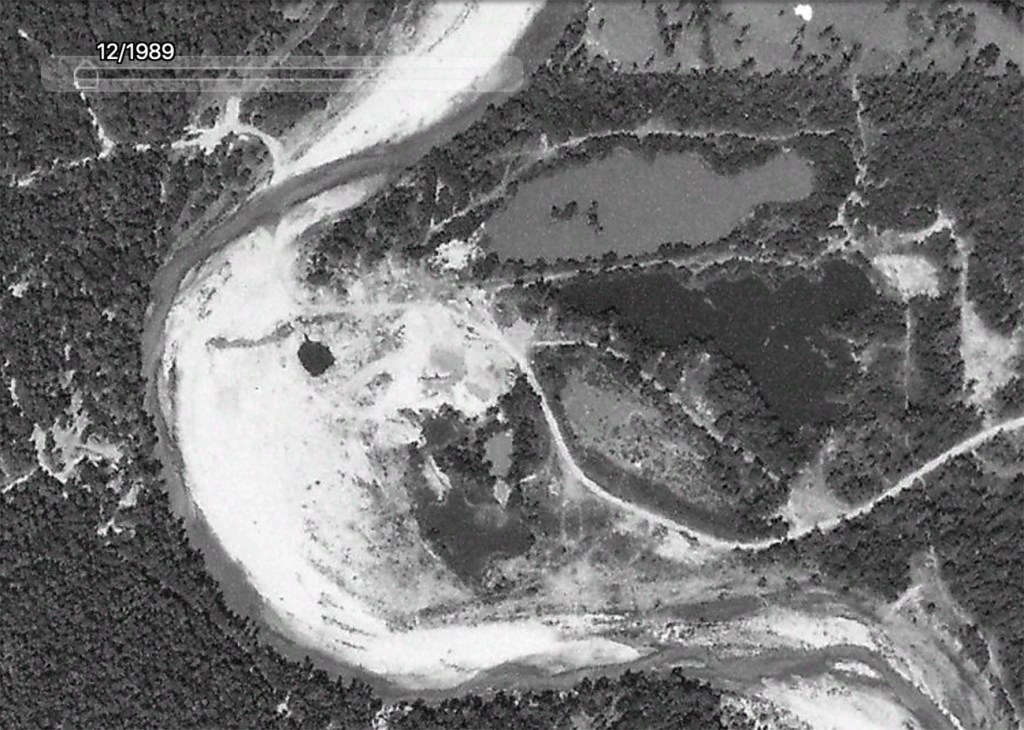
Here is a satellite image from 1989 on the West Fork of a mining operation near a point bar. At this point in time, sand miners were not forced to register with the TCEQ.
The same area almost 30 years later still bears the scars. Both photos courtesy of Google Earth.

Supported by Both TACA and Environmental Groups

At about 18 minutes into the recording, Rob Van Til, owner of River Aggregates, a registered sand mining company, spoke in favor of the bill. Speaking for himself as well as TACA, he said it would help deter “bad actors.”

Grant Dean, representing the Texas Environmental Coalition, from Marble Falls, also rose to speak in favor of the bill.

Not a “Christmas Tree”

Given the lack of opposition, Huberty then wrapped up testimony by moving for passage of he bill. He said that he would not allow the bill to become a “Christmas Tree” when it went to the House floor. A Christmas tree bill is a political term referring to a bill that attracts many, often unrelated, floor amendments that provide special benefits to various groups or interests.

The testimony with questions from the committee members took about 15 minutes. In response to one of the questions, Huberty details all of the other flood mitigation legislation moving through the Legislature at this time. It’s definitely worth watching if you want a preview of how the political landscape could change for sand mining in coming years.

Revenue Neutral

While this is certainly not the most important piece of sand mining legislation, it will help in a limited way by plugging a legislative and enforcement gap. And because the extra revenue generated will pay for the enforcement, it is revenue neutral.

Status: Pending in Committee

To read the text of HB907, click here. Senator Brandon Creighton has introduced a companion bill in the Senate, SB2123. Both are still pending in committee.

Creighton’s SB2123 was referred to the Natural Resources & Economic Development Committee on March 21. The committee has not yet held hearings on it.

Reasoning Behind Companion Bills

A companion bill is a bill filed in one chamber that is identical or very similar to a bill filed in the opposite chamber. Companion bills are used to expedite passage as they provide a means for committee consideration of a measure to occur in both houses simultaneously. A companion bill that has passed one house can then be substituted for the companion bill in the second house.

How You Can Help

Both of these bills deserve the support of Lake Houston Area residents. To urge action, call or email the committee members. Here is contact info for:

Said Huberty at the end of the day, “It was quick, but we feel good about this!”

Posted by Bob Rehak on 4/20/2019

599 Days since Hurricane Harvey

Texas Parks and Wildlife Sand and Gravel Permitting Program: History, Scope and Protections

As I’ve been posting a lot about sand mining legislation, a friend sent me this doc today about the reasons for Texas Parks & Wildlife Department’s (TPWD) permitting program. TPWD regulates mining in rivers; TCEQ regulates mining in flood plains.

Photo by Jim & Melissa Balcom of their son playing on the West Fork of the San Jacinto after Harvey.

Difference in Tax Rates Between Rivers and Flood Plains

Flood plain mining has a 2% tax rate; in-river mining 8%. This doc explains what the department does with that 8%. TPWD’s authority to regulate mining in rivers goes back more than 100 years.

TPWD says that:

Dredging of sand, gravel, and shell from rivers and bays can negatively impact fish and wildlife habitats. Habitat alteration is the primary cause of population declines, loss, and extinction of freshwater fishes, mussels, and other aquatic organisms. Habitat alteration is also one of the primary contributors to listing of fish and wildlife as threatened or endangered under the Federal Endangered Species Act. 

Evolution of Mining Influenced

Because of the 4X difference in tax rates, and the fact that sand is a highly competitive undifferentiated commodity, sand from flood plains enjoys a huge cost advantage: 6%. As a result, comparatively little sand is taken from rivers today. In an average year, TPWD department says it brings in only $200,000 to $400,000 statewide. It comes mostly from small scale mining (less than 1000 cubic yards) by people who want to build roads or pipelines across streams.

Goals of Regulations

As the number of applications for permits has increased, TPWD has established project guidelines such as seasonal restrictions that avoid or minimize impacts to recreational users; site-specific provisions to ensure channel stability; and best management practices to control bank erosion, avoid land loss, and reduce downstream impacts. 

Read Over Your Morning Cup

The entire document is 2-pages, well-written, and well-illustrated. It will give you a good understanding of why the state started regulating sand mining in rivers long ago…all during your morning cup of coffee or tea. Highly recommended easy reading!

Posted by Bob Rehak on 4/19/2019

598 Days since Hurricane Harvey

Bill that Could Open Door to River Mining Modified and Heading to Full Senate

Senate Bill 2126, which allows sand mining in rivers – without permits or royalties – was voted out of the Senate Water and Rural Affairs committee last night. The committee left the bill pending during the previous day’s testimony after four of the seven members expressed concerns about it.

Changes in Committee Substitute SB 2126

However, when the bill’s author, Senator Brandon Creighton, created a “committee substitute” bill, four senators voted FOR it.

The substitute bill contains two major changes:

  • It limits the bill’s geographic scope to the San Jacinto River and its tributaries.
  • It gives the Harris County Flood Control District the same powers that it gives the San Jacinto River Authority.

Local bills rarely encounter serious opposition. So this may guarantee the bill’s passage.

Issues with Revisions

Unfortunately, the language is still so sweeping, that I fear it could open the door to abuses.

Someone reading this for the first time, without the benefit of all the senate testimony, could draw the conclusion that the San Jacinto and its tributaries are wide open to sand mining – 24/7/365 – as long you justify it by saying you will improve the river’s conveyance.

Vague Language Opens Door to Abuses

For instance, after reading this bill, unless you watched the testimony, how would you know that it’s supposedly:

  • For the purpose of building sand traps that are maintained once or twice a year?
  • Limited to “strategic locations”?
  • Based on scientific studies?

Several years down the road, when the players change, all the verbal promises made during testimony will be long forgotten. It’s easy to see how people could get the wrong impression of the bill’s original intent.

Nightmare Scenario

At that time, I can see developer’s coming to sand miners and the SJRA (or Harris County Flood Control) saying, “I need more fill to elevate my property. Can you take it out of the river for me?”

The only problem is this. While it may reduce the risk of flooding on the developers’ property, without proper safeguards, it will likely increase flooding for surrounding and downstream properties.

It could even increase sedimentation downstream as many academic studies have shown.

Example 1: Loss of riparian vegetation along the banks increases erosion. So even though you take sand out of the river, you put more back in.

Example 2: Imagine a flood moving slowly through a widened area. Now imagine those same floodwaters moving downstream through a narrower area. As the water hits the constriction, it starts churning at and eroding the river banks.

Example 3: Lack of permitting or engineering studies means that developers could put fill anywhere. Even in streams. They could divert flows onto neighboring properties. They could put fill in wetlands and pave it over. This would accelerate flooding downstream.

Proponents of the bill argue that removing deposits like this one near a mine could keep the sand from migrating downriver. Opponents argue that it could destabilize river banks and worsen sedimentation. The vagueness of the language in the bill would also make it easy to widen the river anywhere developers wanted to build in floodplains.

Better Ways to Reduce Sedimentation

Creighton’s original stated intent was to eliminate disincentives for public/private partnerships that could help address excess sedimentation. A noble intention.

But if he really wants to stop sediment from coming downstream, he might be better off partnering with groups like the Bayou Land Conservancy that protect and restore floodplains. Or accelerating bills like his own SB2124, which creates best management practices for sand mining. Texas is the only state that I could find that doesn’t require minimum setbacks from rivers for sand mines. That contributes to repeated flooding of mines. We sure could use some help in that department. Frankly, so could the miners.

This session ends on May 27th. Tick Tock.

Posted by Bob Rehak on 4/18/2019

597 Days since Hurricane Harvey and 39 days until the end of this legislative session

SB 2126 Stalls in Committee

Senate Bill 2126 could open the door to in-river sand mining, but was left pending in the Water & Rural Affairs Committee late last night.

Senator Brandon Creighton, author of SB 2126 and Senator Charles Perry, Vice Chair and Chair respectively of the Senate Water and Rural Affairs Committee.

Uncontested but Not Unquestioned Testimony

Testimony started at about 8 pm. Chuck Gilman from the San Jacinto River Authority (SJRA) and David Perkins from Texas Aggregate & Concrete Association (TACA) spoke FOR the bill. Craig Bonds from Texas Parks and Wildlife Division acted as a “resource” for the committee.

Senator Brandon Creighton, the bill’s author is vice chairman of the committee. Senator Charles Perry is chairman. Only Perry and Senators Lois Kolkhorst, Jose Rodriguez, and Carol Alvarado offered questions or comments. Creighton defended the bill vigorously at every turn.

  • Senator Perry questioned whether the SJRA was the appropriate entity, given its history, to tackle a project like this.
  • Senator Kohlkorst raised questions about how this would impact the Lower Colorado River Authority. She also raised concerns brought to her by the Katy Prairie Conservancy about the lack of permitting and possible erosion issues.
  • Senator Alvarado questioned the impact on water quality and increased treatment costs.
  • Senator Rodriquez questioned why the State was giving away a profitable, salable resource.

Bill Left Pending in Committee

After almost half an hour of testimony and discussion, Chairman Perry left the bill pending in committee. No action was taken on it. At several points during the discussion, members talked about amending the language. Unless it changes substantially, Senator Creighton may not have the votes to get it out of the seven-person committee.

I will continue to monitor this bill as will most citizen groups in Texas. It’s not dead until the session is over.

Watch Testimony

You can watch testimony and committee discussion for yourself at this link. Discussion of SB 2126 begins at 49:50 into the meeting and runs 27 minutes. Here are highlights and time codes for people who want to fast forward to certain parts.

49:50 to 53:00 Senator Brandon Creighton lays out the case for the bill.

53:30 to 54:30 Chuck Gilman, Director of Water Resources and Flood Management with the SJRA emphasizes that the bill will use private contractors to remove the sediment rather than paying a public entity like the Army Corps to do it.

55:00 – 55:30 Senator Perry asks whether the SJRA is the appropriate entity to tackle a project like this.

55:30 – 56:00 Gilman responds by talking about “Building places along the lake” (sand traps) where they could capture materials with beneficial market value.

56:00 – 56:35 Perry asks why the bill, which was once limited to the SJRA, now applies to every river authority in the state. “What’s changed?”

56:35 – 57:20. Senator Creighton interjects and asks Gilman to explain his role in flood mitigation.

57:20 – 58:10. Gilman gives his history. Perry’s question about change is never answered.

58:10 – 59:00 David Perkins speaks for the bill. He claims it would improve water quality without creating excessive cost. And says TACA wants to “Participate where we can.”

59:00 – 1:00:00 Senator Creighton asks Perkins to explain how sand miners wanted to be part of the current dredging effort, but were discouraged and why that policy needs to change.

1:00:00 – 1:02:30 Perkins implies that TACA volunteered to help the Army Corps dispose of material, but was rebuffed. Blames Corps for inertia. Implies storage was a major part of the $70 million project cost. Talks about TPWD’s 8% royalty fee for removing sand from river as a disincentive for private companies to take sand out of the river.

1:02:30 – 1:03:00. Senator Kolkhorst expresses concerns about lack of permitting in the bill’s language.

1:03:00- 1:04:34. Senator Creighton volunteers to work with her on wording and exclude other river authorities like the Lower Colorado River Authority, if that makes it more palatable.

1:04:35 – 1:05:50 Senator Kolkhorst says she will work with Creighton.

1:06:00 – 1:06:45 Senator Carol Avarado worries about decrease in water quality and an increase in treatment costs. Her concerns are never really addressed.

1:06:45 – 1:07:00 Craig Bonds introduces himself as a resource witness from TPWD.

1:07:00 – 1:07:30 Senator Perry asks what should be put in the bill to protect the environment.

1:07:30 – 1:09:00 Bonds replied that he would bypass permitting where dredging was needed but not bypass permitting statewide. He said he wanted to require permitting for the Hill Country but was OK to bypass permitting on the San Jacinto. Said other areas of the state were “highly sensitive.” He also stated that he saw impacts from both regulated and illicit sand mining in the Hill Country. However, he claimed “sideboards” could be put on activities to protect the San Jacinto. He never explains what those are.

1:09:00-1:09:30 Senator Creighton asks Perkins to describe what a sand trap is and where it would be located.

1:09:30 – 1:10:30 Perkins talked about the need to assess the river first. He said sand needs to be removed on a regular basis and that it could be used for construction. He never did explain what “sand traps” were. Instead he suggested they would undertake “Excavation activities once a year or once every six months” depending on the rate of sedimentation.

1:10:30 – 1:11:25. Creighton emphasized “no free reign.” Said all stakeholders would have to agree where problems exist and that removal would be science-based.

1:11:30 – 1:14:12. Senator Rodriguez expresses concern about the fiscal impact of giving away sand which would otherwise be sold. Craig Bonds explains that TPWD charges an 8% royalty for sand taken out of a river. But he also admits that this bill would do away with that royalty, resulting in a fiscal impact on the state.

1:14:12 Creighton explains that 8% is such a disincentive that practically no river mining exists and the state is not receiving much in royalties.

1:17:00. Testimony ends. No one spoke against the bill. Chairman Perry closed testimony and announced that the bill would be left pending.

Questions Still Remain

  1. Why do Hill Country rivers deserve protection but not the San Jacinto?
  2. Who will conduct the scientific studies? An independent entity? If so, how would that affect cost?
  3. Senator Creighton keeps emphasizing that the LAKE needs to be dredged to improve conveyance and capacity. But TACA talks about doing it “where it makes sense.” From separate discussions, I’ve concluded that TACA means “next to their mines, on the RIVER.” Those are FAR upriver. Does this seem like a disconnect?
  4. Creighton and Gilman talk repeatedly about “sand traps”, but when Perkins is probed on that issue, he talks about excavating the river. Is that another disconnect? What do they really have in mind?
  5. They never acknowledge that these activities could increase sedimentation. Why?
  6. What is the basis for Perkin’s claim that this program will “improve water quality and reduce costs”?

So many questions. So little time. In exactly three weeks, final deadlines start kicking in for this legislative session.

Posted by Bob Rehak on 4/16/2019

595 Days since Hurricane Harvey