Tag Archive for: NHC

NHC Predicts Above-Normal 2022 Atlantic Hurricane Season

On May 24, the National Hurricane Center (NHC) issued its forecast for the 2022 Atlantic hurricane season. NHC expects an above-average hurricane season for the seventh year in a row. They say an ongoing La Niña and above-average sea surface temperatures set the stage for a busy season. NHC’s predictions reinforce the forecast issued last month by Colorado State University.

From the National Hurricane Center

In case you missed that post, CSU predicted:

  • Named Storms: 19
  • Hurricanes: 9
  • Major Hurricanes: 4

Each of those numbers falls within the ranges shown above by NHC.

Seventh Consecutive Above-Average Season

Heat Map showing variation from normal for May 24, 2022. Source: NOAA. Note higher than normal temps in Gulf, Atlantic and most of Caribbean.

If NOAA predictions prove true, 2022 would make the seventh consecutive above-average hurricane season.

NOAA’s outlook for the 2022 Atlantic hurricane season, which extends from June 1 to November 30, predicts a:

  • 65% chance of an above-normal season
  • 25% chance of a near-normal season
  • 10% chance of a below-normal season.

For the 2022 hurricane season, NOAA is forecasting a likely range of 14 to 21 named storms (winds of 39 mph or higher), of which 6 to 10 could become hurricanes (winds of 74 mph or higher), including 3 to 6 major hurricanes (category 3, 4 or 5; with winds of 111 mph or higher). NOAA provides these ranges with a 70% confidence.

NOAA’s Climate Prediction Center will update the 2022 Atlantic seasonal outlook in early August, just prior to the historical peak of the season. 

The 2022 hurricane outlook is not a “landfall forecast.”

NOAA Enhances Products and Services

NOAA Administrator Rick Spinrad, Ph.D. emphasized that NOAA’s forecasting accuracy continues to improve. The agency has enhanced the following products and services this hurricane season:

Start Preparing Now

FEMA Administrator Deanne Criswell said, “It’s important for everyone to understand their risk and take proactive steps to get ready now.” Some tips:

  • Visit Ready.gov for preparedness tips on what to do before, during and after a flood.
  • Have several ways to receive alerts.
  • Download the FEMA app and receive real-time alerts from the National Weather Service for up to five locations nationwide. 
  • Sign up for community alerts in your area and be aware of the Emergency Alert System (EAS) and Wireless Emergency Alert (WEA), which require no sign up.

Posted by Bob Rehak on 5/25/22 based on information from the National Hurricane Center and Ready.Gov

1730 Days since Hurricane Harvey

Cone of Nicholas Shifts East, Now Includes Houston, Hurricane Watch Expanded

The 10 AM update from the National Hurricane Center shows that the eye of Nicholas is reforming yet again – further east from where it first reformed earlier today near Brownsville. This means that the cone of uncertainty for Nicholas has expanded. It now includes the entire Houston Area. And although chances of a hurricane are low, the hurricane watch has been extended northward to San Luis Pass.

Nicholas’ Cone Now Includes All of Houston

Remember that every place within the cone has an equal change of having the storm pass over it.

Main Threats from Tonight to Tomorrow Night

Bands of heavy rainfall and gusty winds continue to spread inland from the coast and will increase in frequency and intensity this afternoon into tonight. Core of Nicholas will move across southeast Texas….especially areas south of I-10 overnight into Tuesday with significant rainfall likely. 

Harris County Meteorologist Jeff Lindner warns that while Nicholas is not forecasted to become a hurricane, it is possible that it could landfall as a minimal hurricane….but this does NOT change the impacts.

Impact Predictions Remain Unchanged Since Last Update

Rainfall, wind, and storm surge impacts remain unchanged from my post earlier this morning.

Significant rains will begin early this evening and likely continue into Tuesday morning.

Rainfall rates of 2-4 inches per hour will be possible yielding rapid street flooding and significant rises on bayous and creeks.

Lindner’s main concern is watersheds south of I-10 (Clear Creek, Armand Bayou, Vince and Little Vince Bayous, Keegans Bayou, and possibly Brays Bayou). However, Lindner still sees risk north I-10.

Some bayous and creeks may overflow their banks. Structure flooding is possible tonight. The majority of the rainfall is going to be tonight into Tuesday morning. 

Residents should stay where they are after 6:00 PM this evening and remain there through the duration of Nicholas.

Jeff Lindner, Harris County Meteorologist

Best Ways to Monitor Nicholas

Closely monitor bayou and creek conditions and rainfall trends. The best way to do that is through the Harris County Flood Warning System.

Also, closely monitor the National Hurricane Center website. This page contains their latest satellite image updates. During storms like this, they update them hourly. Here’s one from 11:46 AM Houston time.

Nicholas as of 11:46 AM on Monday, 9/13/2021.

Posted by Bob Rehak on 9/13/2021 at 10:30 AM and again at Noon

1476 Days since Hurricane Harvey

Ida Now Hurricane, Predicted to Intensify to Category 4, Take Aim at New Orleans

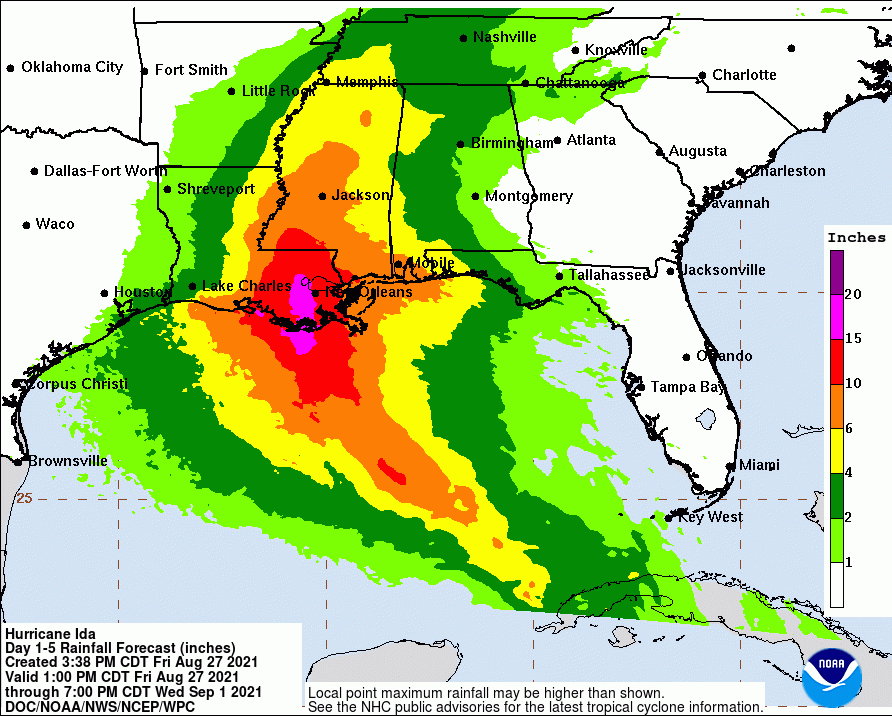
As of 3 p.m. CDT, the National Hurricane Center indicated Tropical Storm Ida had intensified into a hurricane about to cross over the western tip of Cuba. They warn that it could turn into a category 4 hurricane. It is currently predicted to cross over Louisiana, dump up to 20 inches of rain, and produce 15 feet of storm surge on Sunday.

Warnings Now In Effect

The NHC has also posted several warnings. They include:

  • Storm Surge Warning from Rockefeller Wildlife Refuge in Louisiana to the Mississippi/Alabama border.
  • Hurricane Warning for the coast of Louisiana including Lake Pontchartrain and Metropolitan New Orleans.
  • Tropical Storm Warning from the mouth of the Pearl River to the Mississippi/Alabama border.
  • Tropical Storm Warning for the coast of Louisiana from west of Intracoastal City to Cameron.
Hurricane Ida over the western tip of Cuba as of 3PM Houston time on 8/27/2021

Rapid Intensification

According to the National Hurricane Center, radar indicated a closed eye 24 nautical miles wide. Recon aircraft measured winds at 70 knots – hurricane intensity – at 3 PM Houston time.

Once Ida moves past western Cuba and into the southeastern Gulf of Mexico, it will be moving through very warm waters, low wind shear, and a moist low- to mid-level atmosphere. These conditions should result in rapid strengthening during the next 24 to 36 hours.

In fact, with the higher initial wind speed, the intensity guidance has significantly increased.

Models now predict Ida will reach category 4 intensity. The NHC forecast explicitly calls for rapid intensification during the next 24 to 36 hours.

National Hurricane Center

Some fluctuations in intensity are possible as Ida nears the northern Gulf coast due to possible eyewall replacement cycles. Models also call for Ida’s wind field to expand while it moves over the Gulf of Mexico. As a result, there is higher-than-normal confidence that a large and powerful hurricane will impact portions of the northern Gulf coast by late this weekend and early next week.

Ida has wobbled a little right of the previous track, but the longer term motion continues to be northwestward at about 14 mph.

Tracking Quickly Toward Louisiana Then Slowing

Steering currents push Ida northwestward across the Gulf this weekend. But Ida after landfall they will also slow northward motion and cause the system to turn northeastward.

Key Messages

However, remember not to focus on the exact details of the track. Storm surge, wind, and rainfall impacts will extend far from the center, says the NHC.

1. Life-threatening storm surge and hurricane conditions will continue through tonight in portions of western Cuba. Life-threatening heavy rains, flash flooding and mudslides are expected across Jamaica, the Cayman Islands, and western Cuba, including the Isle of Youth.

2. There is a danger of life-threatening storm surge inundation Sunday along the coasts of Louisiana and Mississippi within the Storm Surge Warning area. Extremely life-threatening inundation of 10 to 15 feet above ground level is possible within the area from Morgan City, Louisiana, to the Mouth of the Mississippi River. Interests throughout the warning area should follow any advice given by local officials.

3. Ida is expected to be an extremely dangerous major hurricane when it reaches the coast of Louisiana. Hurricane-force winds are expected Sunday along the Louisiana coast, including metropolitan New Orleans, with potentially catastrophic wind damage possible where the core of Ida moves onshore. Actions to protect life and property should be rushed to completion in the warning area.

4. Ida is likely to produce heavy rainfall later Sunday into Monday across the central Gulf Coast from southeast Louisiana to coastal Mississippi and Alabama, resulting in considerable flash, urban, small stream, and riverine flooding impacts. As Ida moves inland, flooding impacts are possible across portions of the Lower Mississippi and Tennessee Valleys.

Story of the Storm in Picture

Confidence in track is increasing. Ida should reach the Louisiana and Mississippi coasts by Sunday afternoon.
…but tropical-storm-force winds should arrive by Sunday morning.
Most of the Houston area only has about a 10-30% chance of experience tropical-storm-force winds.
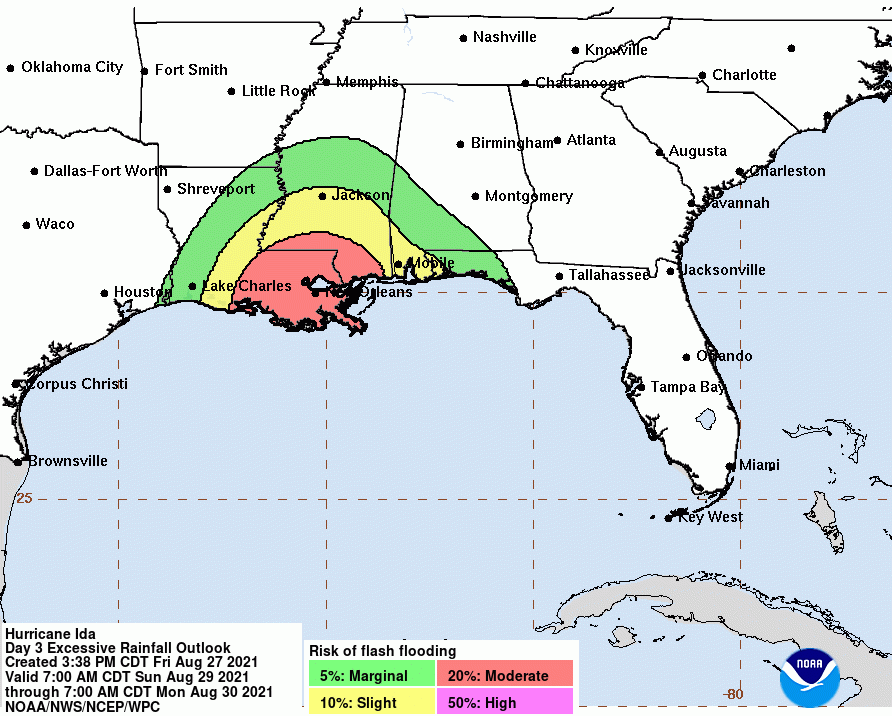
And we have practically no chance of excessive rainfall that could create flash flooding.
Portions of Louisiana, however, will like see 15-20 inches of rain.
But the biggest threat by far to our neighbors will come from storm surge. Portions of the delta could see as much as 15 feet above ground level.

Prays for our neighbors. And thank God that we’re on the dry side of this storm. It should hit on August 29th, the fourth anniversary of when Hurricane Harvey triggered massive evacuations in the Lake Houston Area.

Posted by Bob Rehak on 8/27/2021

1459 Days since Hurricane Harvey

Atlantic Basin Heating Up with Potential Tropical Activity

As we approach the 4th anniversary of Hurricane Harvey, the Atlantic basin is currently heating up with tropical activity. As remnants of one hurricane washing across New England, two more areas of concern move toward the Northeast. A third is heading toward the northwest Caribbean. It’s still too early to tell exactly where these storms will make landfall. But the presence of so many tropical disturbances signals the need to stay alert to daily weather forecasts.

Each of these storms has a 40-60% chance of tropical formation.

Five Day Outlook for Tropical Activity

8 PM outlook on 8/23/2021 indicates the storms heading toward the NW Caribbean have a 50% chance of tropical formation in the next five days. That’s up from 30% this morning.

Retreat of High-Pressure System Over Texas

National Hurricane Center (NHC) forecasts a tropical wave over the eastern Caribbean Sea will form a broad area of low pressure over the southwestern Caribbean Sea by late week. Thereafter, environmental conditions favor gradual development while the system moves west-northwestward to northwestward over the northwestern Caribbean Sea.

In addition to that, another major low pressure area over Mexico and the Bay of Campeche could move into the Gulf by this weekend though no tropical activity is forecast at this time.

Note massive low pressure system moving into Gulf.

Jeff Lindner, Harris County meteorologist, warns that as the high pressure ridge currently sitting over Houston begins to retreat north by Wednesday, “A series of tropical waves and disturbances will move from east to west across the US Gulf coast and into coastal TX from mid week onward. With a significant influx of Gulf moisture, showers and thunderstorms will return as early as Wednesday across much of the area and last likely into next week. Locally heavy rainfall will become an increasing threat by late week and this weekend with tropical moisture firmly in place over the region.”

Historical Norms for Late August

NOAA’s Climate Center shows that the projected path of the current areas of concern should follow historical norms for this time of the year.

This diagram shows the most likely areas for formation for hurricanes in August and their prevailing tracks. Source: NOAA’s Climate Center.

This is one of the reasons why.

Current sea surface temperatures in the Gulf are running 1.5 to 2+ degrees degrees above normal for the next seven days, with the warmer areas nearer the Texas Coast.

Historical Intervals Between Major Hurricanes

NOAA’s Climate Center shows the average interval for major hurricanes striking the Houston area is about every 25 years.

NOAA’s Climate Center also tracks the average return period for MAJOR hurricanes at various points along the coastline. They show that the Houston area can expect on average one major hurricane about every 25 years.

Of course, a hurricane doesn’t have to be major to cause major damage. Allison and Imelda were just tropical storms. And averages are just that – averages. Ike in 2008 and Harvey in 2017 each attained major hurricane status and hit Houston within 9 years of each other.

Posted by Bob Rehak on 8/23/2021 based on information from NHC and HCFCD

1455 Days since Hurricane Harvey
Digest: Updates on Six Lake Houston Area Flood-Related Stories

Below is a quick digest of six flood-related stories affecting the Lake Houston Area.

Dredging is a Slow Go

Mechanical dredgers are slowly working their way through the channel south of Royal Shores. It connects the East and West Forks of the San Jacinto. Without dredging, the dredging equipment itself would not be able to make it through the channel.

However, the pace of the dredging is painfully slow. You can see the progress by comparing the two pictures below. I took them 22 days apart.

Taken on July 11, 2021
Taken on August 2, 2021.
Google Earth shows they went a little more than 600 feet in a little more than three weeks.

At about 200 feet per week with about 2,000 more feet to go, they should reach the East Fork in about another ten weeks.

Several boaters have commented on how the dredges can wait hours for a pontoon to ferry dirt back to the placement site. Their net takeaway: very inefficient. During a July 8 meeting at the Kingwood Community Center, Stephen Costello called this method of dredging “unsustainable.” He’s sooooo right. We will run out of luck long before we run out of places to dredge.

Mechanical dredging (shown in the photos above) is far slower and less efficient than hydraulic. Great Lakes hydraulic dredges removed 500,000 cubic yards of sediment from the mouth bar area in just two months – July and August of 2019. DRC’s mechanical dredges removed another 600,000+ cubic yards in the 19 months between January 2020 and July 2021.

Interestingly, Google Earth shows that when the dredgers reach the East Fork, they will be closer to the Triple PG Sand Mine in Porter than the current placement area south of River Grove Park. The Triple PG mine will also be less than half the distance of a mine that the Army Corps previously pumped spoils to from the mouth bar– the Eagle Sorters Mine on the West Fork.

Hmmmm. Triple PG. A placement area for East Fork spoils? A return to hydraulic dredging? Interesting thoughts.

Seasonal Lowering of Lake Conroe

Seasonal lowering of Lake Conroe has started as planned. SJRA is releasing 75 cubic feet per second, according to their dashboard.

Seasonal release is shown as a City of Houston (COH) Diversion.

When the lowering started on August 2, a day late, the lake was at 200.87. So releasing 75 CFS has brought the lake down .19 feet, a little more than 2 inches. Barring large rainfalls, this rate should reach the objective of 200 feet by September 1.

The Lake Conroe Association is still fighting the lowering in Montgomery County District Court. Judge Mike Mays set a hearing date for Tuesday, August 24, 2021 at 2PM.

Tropics Heating Up

Five Day Tropical Weather Outlook from National Hurricane Center

The National Hurricane Center shows two areas of concern in the Atlantic as of 2PM, Friday August 6th.

A few hundred miles south of the Cabo Verde Islands, a tropical wave (orange area) and a broad area of low pressure could turn into a tropical depression by late this weekend or early next week. Formation chance through 5 days…medium…60 percent.

Another tropical wave approaching the Lesser Antilles is a lower threat. NHC predicts development, if any, of this system will be slow and occur early next week. Formation chance through 5 days…low…20 percent.

NOAA Issues Mid-Season Hurricane Outlook

Another forecast released two days ago by NOAA says that atmospheric conditions are still conducive for an above-average hurricane season. See their predictions in the right hand column below. These numbers include the five named storms so far this season.

Attorney General Lawsuit Against Triple PG Mine Still Active

Craig Pritzlaff of the TCEQ assures me that despite visible lack of progress in the Attorney General’s lawsuit against the Triple PG mine for illegal discharges, the AG has not dropped the case. “Indeed, very few, if any, cases referred to the AG for civil prosecution are ever dropped,” he says. “Litigation, particularly environmental litigation, is a complicated and lengthy process. That process was further complicated by the COVID-19 pandemic, which halted court dockets across the State throughout 2020 and into 2021.”

Condos 250 Feet from 250,000 CFS

A Chinese developer is building yet more condos even closer to the West Fork in the Kings Harbor neighborhood.

See new construction bottom center. Lai finished the units at the right earlier this year.
The nearest unit above will be about 250 feet from the San Jacinto West Fork.

During Harvey, more than 250,000 cubic feet per second came through this area. It flooded homes and businesses more than 10,000 feet from the river.

The developer is also hoping to sell/develop that grassy area in the bottom center of the photo for $1.45 million.

I guess money has a short memory.

That concludes this month’s digest.

Posted by Bob Rehak on 8/6/2021

1438 Days since Hurricane Harvey
The thoughts expressed in this post represent opinions on matters of public concern and safety. They are protected by the First Amendment of the US Constitution and the Anti-SLAPP Statute of the Great State of Texas.

Lake Lowering to Start as Peak of Hurricane Season Nears

According to its lake lowering policy adopted last year, the San Jacinto River Authority (SJRA) should start to drop the level of Lake Conroe this weekend.

Text of Lake-Lowering Policy

The lake-lowering policy states:

“Beginning August 1, release only an amount of water from Lake Conroe to create a one foot capacity to catch rainfall and storm runoff (from 201’ msl to 200’ msl). After September 1, increase capacity an additional six inches (from 200’ msl to 199.5’ msl). If a named storm is predicted to impact our region, the COH may initiate an additional release of six inches (to 199’ msl) by notifying SJRA in writing of their call for release. Recapture beginning October 1.”

As of 5PM Friday, 7/30/21, Lake Conroe stood at 200.87 feet. The only release from the lake was the water feeding the SJRA water treatment plant to supply drinking water to area customers (GRP Diversion).

Before the SJRA can lower the lake, however, the City of Houston (COH) must call for the lowering to start. And according to a spokesman in Mayor Pro Tem Dave Martin’s office, the City has called for the release to start.

The City owns two thirds of the water in the Lake and the release will come out of the City’s portion. When the numbers in the box labeled “COH diversion” on the SJRA’s dashboard increase, you’ll know the seasonal release has started.

Lake Conroe Association Still Fighting

In the past, releases have been hotly debated. The Lake Conroe Association has sued the City and SJRA in Montgomery County District Court. The litigants have filed 80 documents totaling more than 2800 pages in the last 121 days. That’s more than 23 pages per day! Some of the plaintiff’s arguments border on ridiculous in my opinion.

  • LCA claimed the tax base and property values in Montgomery County would collapse because of the lake lowering. But they’ve gone up.
  • LCA also claimed that Lake Conroe could not refill itself in the summer months. But it has.
  • Finally, LCA alleges fraud when the City calls for the release of its own property.

Isn’t that kind of like a neighbor of a bank alleging fraud when a depositor makes a withdrawal?

To read all the documents yourself, go to the Montgomery County District Clerk’s website.

Judge Mike Mays set a hearing date for Tuesday, August 24, 2021 at 2PM.

Approaching Peak of Hurricane Season

So how is this hurricane season going so far?

The National Hurricane Center (NHC) predicts no tropical activity anywhere in the Atlantic basin for the next five days. That includes the Gulf of Mexico.

However, we’ve already had five named storms this year. And NHC observes…

“In terms of Accumulated Cyclone Energy (ACE), which measures the strength and duration of tropical storms and hurricanes, activity in the basin so far in 2021 is well above average at more than twice the climatological value.”

National Hurricane Center

If history is a guide, the four charts below from the NHC Climatology Page hint at what we can likely expect in the coming months.

We’re about to enter the month where the number of named storms starts to climb most rapidly. Remember, Harvey was an August storm. Source: NHC.

The fact that we only had one named storm in July (Elsa) is not unusual; it’s average. But keep in mind that Elsa was the earliest named “E” storm on record.

This chart shows the distribution of storms throughout the season. The peak happens from mid-August to late October.
Galveston, Harris, Brazoria, and Chambers Counties get the most hurricane strikes in Texas.
Hurricane Strikes in Continental US by State and By Year since 1950

All in all, the Atlantic this time of year is like a casino. You have to play the odds. And that’s what the temporary seasonal lake lowering policy is designed to do – reduce the risk of huge property losses by creating extra capacity in Lake Conroe to help offset heavy rainfall and the need for large releases.

Posted by Bob Rehak on 7/30/21

1431 Days since Hurricane Harvey

The thoughts expressed in this post represent opinions on matters of public concern and safety. They are protected by the First Amendment of the US Constitution and the Anti-SLAPP Statute of the Great State of Texas.

Two Systems Approaching Caribbean

A strong tropical wave located midday between Africa and the eastern Caribbean Sea continues to show increasing signs of organization. The red area below has an 80% chance of tropical formation in the next five days, according to the National Hurricane Center (NHC) as of 8 a.m. this morning.

Red storm has 80% chance of tropical formation as of 8 am, June 30, 2021 according to National Hurricane Center.

Storm Farthest East Represents Biggest Threat

Convection has increased near a developing low-level, low-pressure system designated 97L for the moment. 97L has a large moisture envelop and conditions generally favor development as it moves westward.

According to Jeff Lindner, Harris County meteorologist and the National Hurricane Center, a tropical depression will likely form in the next few days. It may also turn into a tropical storm as it approaches the Windward Islands. They expect continued W to WNW motion bringing the system into and through the eastern Caribbean Sea by the weekend.

Models Diverge on Direction After Storm Enters Caribbean

It’s too early to tell where it goes after that. Some models suggest the system will turn WNW and NW while others maintain a more westward track. “There is reasonable support for both,” says Lindner.

Lindner emphasizes that it is early for tropical cyclones to form in this region of the Atlantic. While 97L may become a tropical storm as it approaches the Windward Islands, once it gets past them, it may encounter slightly less favorable conditions over the eastern Caribbean Sea.

While there is no significant threat to SE TX at this time, you should monitor 97L daily.

Nearest Storm Poses Less Threat

The yellow area is a second, separate area being monitored by the NHC. It is moving quickly WNW at 20 to 25 mph and will enter the Caribbean later today. However, it is producing only disorganized showers and thunderstorms so far and diverging trade winds may tear it apart. The NHC only gives it a 10% chance of tropical formation. So while it will bring heavy rainfall to the Lesser Antilles, it poses little danger to Houston.

For the latest information, the NHC updates storm tracks every 12 hours during the hurricane season and even more frequently if storms approach the U.S. mainland.

Posted by Bob Rehak based on information from HCFCD and the National Hurricane Center

1401 Days after Hurricane Harvey

NHC Upgrades Formation Chance of Gulf Disturbance Again

At 2 pm this afternoon, the National Hurricane Center (NHC) upgraded the chances of tropical formation for a Gulf disturbance for the third time in 24 hours. Last night, the formation chance was 20%. This morning, it was 40%. This afternoon, NHC says 60%.

Jeff Lindner, Harris County’s meteorologist expects the storm to make landfall sometime tomorrow morning near Matagorda Bay. That would put the Houston region on the dirty part of the storm. However, Lindner believes a tropical storm, if it forms, will be weak. Neither the wind, nor the rain, will likely cause much damage; sustained intensification is unlikely.

Another 1-3 Inches of Rain Likely

Main impact of this Gulf disturbance: rainfall with amounts of 1-3 inches and a few higher isolated totals. “Overall, the dry air wrapping into the system and the overall lack of organization should keep rainfall totals in the manageable range,” said Lindner. “With that said, much of the area will fall on the east side of the center track and we will have to be watchful for any sort of sustained bands that may attempt to setup and train for a period of time which would locally increase the rainfall totals. Creeks and bayous should be able to handle the forecasted rainfall.”

Tides are elevated and will remain elevated into the weekend with water levels near 3-4 feet above normal. At times of high tide, minor coastal flooding will be possible along the Gulf beaches and in the inland bays, but significant coastal flooding is not expected.

Satellite image of Gulf taken at 5:36 Houston time today.

NHC Forecast More Aggressive

According to the NHC, surface observations and recent satellite wind data indicate that a well-defined low-pressure system over the western Gulf of Mexico has winds of 30-35 mph near and east of the center. The associated shower and thunderstorm activity of this Gulf disturbance remains limited, but any increase in this activity may result in the formation of a short-lived tropical depression or storm.

Regardless of development, the system could produce heavy rainfall over portions of southeastern Texas and southwestern Louisiana through Saturday. Given the complete saturation of soils with ongoing river flooding along the Texas and Louisiana coastal areas, heavy rain could lead to flash, urban, and additional riverine flooding across this region, warns the NHC.

Posted by Bob Rehak on 5/21/2021 at 6PM based on information from NASA, NHC, and HCFCD

1361 Days since Hurricane Harvey

More Rain on Way, but Flood Threat Minimal for Most

According to the National Hurricane Center (NHC), recent satellite imagery suggests that a low-level circulation is forming associated with the disturbance over the Gulf of Mexico. The NHC has upgraded the chances of tropical formation from 20 percent to 40 percent overnight. However, shower and thunderstorm activity remains disorganized and the flood threat from the storm is minimal.

Overnight, NHC upgraded the chances for tropical development of the disturbance along the Texas Coast from 20% to 40%.

Conditions Marginally Conducive to Tropical Development

NHC says conditions are marginally conducive for development. A short-lived tropical depression or storm could form before the disturbance moves inland over the northwestern Gulf coast tonight.

NOAA predicts three day rainfall totals for the Houston area to range from 1-3 inches. Note the circular formation in the system.

Regardless of development, the system could produce heavy rainfall over portions of southeastern Texas and southwestern Louisiana during the next few days.

Jeff Lindner, Harris County’s meteorologist says, “There has been very little thunderstorm activity near the feature overnight with dry air wrapping in from the west.”

Lindner cites two forecast models that continue to attempt to close off the system nears the coast. “However, given the appearance this morning, this potential continues to be modest.”

Regardless of any development…impacts will be minimal, says Lindner. High rain chances in the forecast are a function of moisture levels over the central Gulf of Mexico which will be pushed westward over the next 24-36 hours and into southeast Texas.

Scattered showers and thunderstorms will develop with heating today and progress NW/WNW across the area.

Jeff Lindner, Harris County Meteorologist

Expect heavy rainfall under any areas of training cells. The National Weather Service has the eastern portions of the area under a slight risk for flash flooding today. 

However, the scattered nature of the showers and thunderstorms should keep rainfall amounts manageable for most – generally in the 1-3 inch range today into Saturday.

If the system over the Gulf develops into a tropical storm or depression near the coast later today or tonight, expect an increase in the potential for thunderstorm training, especially in areas east of Houston.

River and Lake Report

The break most of us had from heavy rains yesterday let many rivers and streams recover. Lake Conroe remains a little more than a half foot above normal and continues releasing water at the rate of 2,665 cubic feet per second.

Lake Conroe level as of 7:30 am on Friday, May 21, 2021

And Lake Houston remains a little more than a foot above normal.

From Coastal Water Authority as of 5/21/2021 at 7:30 am.

Rivers and streams have largely recovered from heavy rains earlier this week. Harris County’s Flood Warning System shows that the San Jacinto West Fork at 59 is falling and within its banks.

Peach Creek at FM2090 is out of its banks but falling.

However, the East Fork at FM2090 and FM1485 is in danger of coming out of its banks.

Overall, the flood threat remains low for most of us with these few exceptions.

Posted by Bob Rehak on 5/21/2021, ten days from the official start of hurricane season, based on information from NHC, NWS, and HCFCD

1361 Days since Hurricane Harvey

Could This Be the Start of Hurricane Season?

After four days of heavy rains, today looked like a respite. This morning’s predictions mentioned another inch or two on Friday and Saturday. But then this the National Hurricane Center posted this within the last few minutes: a warning about what could turn into the season’s first tropical depression. And hurricane season doesn’t officially start for another ten days.

20% chance of formation for yellow area in next two to five days

20% Chance Before Official Start of Season

According to Jeff Lindner, Harris County Meteorologist, “The old complex of thunderstorms that moved off the Texas coast yesterday has festered over the west-central Gulf of Mexico today. While the satellite images look impressive, there appears to be no closed low pressure system at the surface and instead a surface trough extending across the region. Thunderstorms have been weakening this afternoon and there is no new development.”

Radar this morning showed storm festering in Gulf with a stationary trough drawing moisture up through Texas and Lousiana.

“So far this evening,” continued Lindner, “there is a large area of dry air to the west of the feature in the Gulf. The dry air will likely become entrained over time. However, some models show additional development for this feature as it moves generally toward the NW or NNW in the general direction of the Texas and Louisiana coastlines.” 

NHC suggests the yellow feature has a 20% chance of developing into a tropical cyclone over the next 2 days.

National Hurricane Center

This feature could help to enhance rainfall amounts over SE Texas this weekend, but any additional impacts beyond that at this time appear to be minimal, according to Lindner.

Preparedness

This should serve to all that hurricane season begins in ten days. Don’t be caught unprepared. My Links page has many sites with helpful tips. You may also want to take this opportunity to bookmark the National Weather Service, National Hurricane Center, and Harris County Flood Warning System. They offer round the clock updates.

Take some time getting to know them know. During an actual storm, power outages and crowded bandwidth may make leisurely learning difficult.

Two other important sites for this area are the San Jacinto River Authority for Lake Conroe releases/levels and the Coastal Water Authority for Lake Houston levels. At this hour, the Lake Conroe is holding steady while releasing 2665 cubic feet per second. Lake Houston is still rising slightly with the flood gates wide open.

Lake Conroe Dashboard as of 7:30 PM on 5/20/21
Lake Houston as of 7:30PM , 5/20/21.

Posted By Bob Rehak on 5/20/21 Based on Information by NWS, NHC, HCFCD, SJRA, and Coast Water Authority

1360 Days since Hurricane Harvey