Tag Archive for: Buyouts

January Digest of Flood-Related News in Lake Houston Area

From construction developments to political developments, here’s your January digest of ten stories that could affect flooding or flood mitigation in the Lake Houston Area.

1. New Caney ISD High School #3

This site is located between Sorters-McClellan Road and US59 south of the HCA Kingwood Medical Center. New Caney ISD is building a new high school on the site of the old par 3 golf course behind the car dealerships that front US59. Construction crews are still pouring concrete for foundations and parking lots. Not much happened between flyovers on December 7 and January 1. But then, not much happens anywhere during the holidays. The two photos below show the progress. Construction of the detention pond is nearing completion. However, contractors still need to plant grass to reduce erosion before spring rains arrive.

New Caney ISD High School #3 site as of December 7, 2020
As of January 1, 2021.

New Caney ISD has not posted a project update since last September. Projected occupancy for the building is still Fall 2022.

2. Kingwood Cove Golf Course Redevelopment

I first talked about Ron Holley’s redevelopment of the Kingwood Cove (formerly Forest Cove) Golf Course in April last year. Since then Holley says he has been working with engineers, community groups and regulators to accommodate different interests.

Now, the development is back on the planning commission agenda for this Thursday. Holley is seeking approval of his latest General Plan and Plat. Neither show any detention ponds. The only place they could go would be in “Reserve C.” The General Plan shows that to be in the floodway and 100-year floodplain. Both could soon expand.

The West Fork floodway cuts through the southern part of Holley’s property.

The City raised an issue regarding compliance with regulations governing the re-plat of golf courses at the 12/17/2020 Planning Commission meeting. The City requested information relating to Local Government Code 212.0155.

That regulation requires, among other things, that:

  • Public notice of the re-plat be printed in newspapers
  • The Forest Cove Property Owners Association is notified
  • Residents have an opportunity to voice their opinions at public hearings
  • Owners of all properties within 200 feet of the new plat be notified in writing via US Mail.
  • If 20% of the owners object, the re-plat must win the approval of 3/5ths of the planning commission.
  • The developer proves there is adequate existing or planned infrastructure to support the new development.
  • The new subdivision will not adversely affect health, safety traffic, parking, drainage, water, sewer, or other utilities
  • The development will not have a materially adverse effect on existing single-family property values.
  • The new plat complies with all applicable land-use regulations and restrictive covenants and the City’s land-use policies.

That’s a lot to do over the holidays. So the general plan may need to be withdrawn and resubmitted after all the information has been produced. We should know more by Wednesday afternoon.

3. Dredging

Mayor Pro Tem Dave Martin’s January newsletter stated that Disaster Recover Corporation has removed 385,000 cubic yards from the West Fork Mouth Bar out of an estimated total of 400,000 cubic yards.

Then he alluded to dredging another 260,000 cubic yards from the area north of the mouth bar.

He also alluded to a Second Phase: dredging the San Jacinto East Fork and other locations in Lake Houston.

Finally, Martin discussed maintenance dredging. “Additionally,” he says, “during Phase Two of the project, City of Houston, Harris County, HCFCD, SJRA, and Coastal Water Authority (CWA) will develop and execute a plan for the City of Houston or CWA to assume long-term dredging operations on Lake Houston. This effort will include determining funding for dredging operations in perpetuity.”

4. Appointments to SJRA Board

Governor Greg Abbott has appointed Wil Faubel and Rick Mora, M.D. and reappointed Kaaren Cambio to the San Jacinto River Authority Board of Directors. Their terms will expire on October 16, 2025. 

Kaaren Cambio of Kingwood is a field representative for United States Congressman Dan Crenshaw. She is a former member of Women’s Business Enterprise National Investment Recovery Association, Pipeline Contractors Association, and the Houston Pipeliners Association. Cambio received a Bachelor of Business Administration from San Diego State University.

Wil Faubel of Montgomery is President of Borets US Inc. He is a veteran and senior executive in the Oilfield Services industry with more than forty years of service. He has both domestic and international experience and is a lifelong member of the Society of Petroleum Engineers and a former board member of the Petroleum Equipment Suppliers Association. Faubel received a Bachelor of Science in Mechanical Engineering from Southern Methodist University.

Rick Mora, M.D. of The Woodlands is a partner at US Anesthesia Partners and Chief of Anesthesiology for Memorial Hermann Pinecoft Surgery Center. He has served as chair of the Montgomery County Hispanic Chamber of Commerce and is a founding Board member of the non-profit, Los Doctores de The Woodlands. Mora received his MD from the University Of Illinois College Of Medicine.

5. Forest Cove Townhome Buyouts

Harris County Commissioner’s Court will vote today on an item to exercise eminent domain on seven townhomes in the Forest Cove complex. The entire complex was destroyed after Harvey and many owners simply walked away from their properties without leaving forwarding addresses. Flood Control has been unable to find the owners after years of trying. Several may have moved out of the country. Eminent domain on these last few properties will clear the way for demolition of the entire complex and restoration of the area to nature or park land.

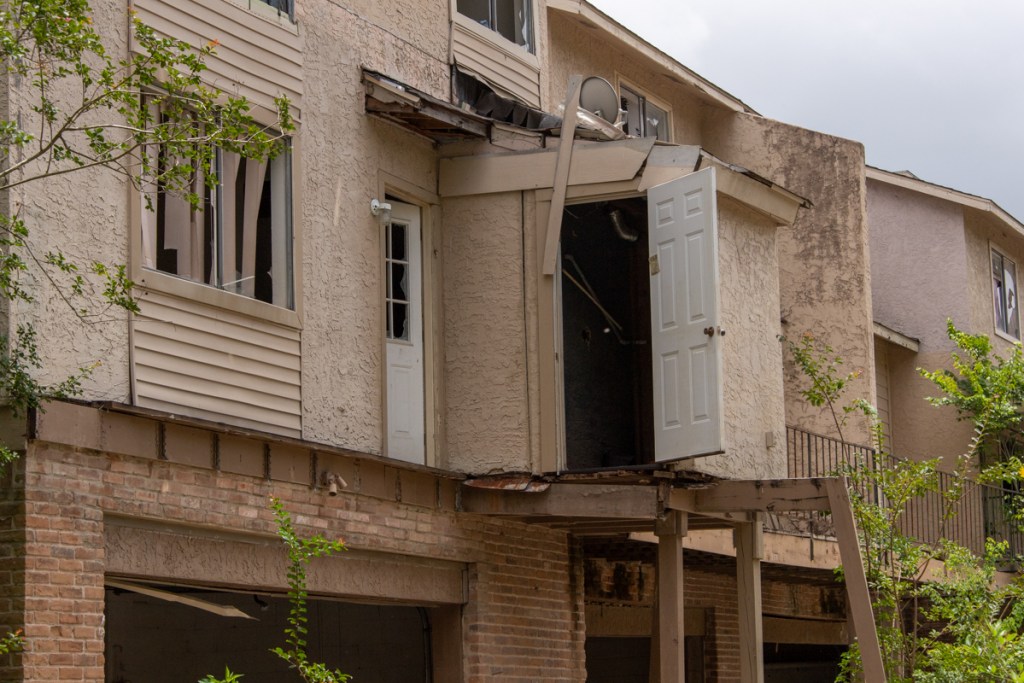
The once proud and idyllic townhomes in Forest Cove next to West Fork.

6. Woodridge Village

The purchase of Woodridge Village from Perry Homes is not on today’s Commissioner’s Court Agenda. However, all energies are reportedly still positive. It’s just taking time to work out the complex three-way purchase arrangements.

7. Romerica

Houston PlatTracker shows that the Romerica people may have acquired more land. But so far, they have not returned to the planning commission for approval on the latest iteration of the developer’s plans. No news is good news in this case.

8. Lake Houston Spillway Improvement Project

The City is close to finalizing the Preliminary Engineering Plan. Sources say the benefit/cost ratio looks very positive. We may see the final recommendations this month.

Engineers have examined several alternatives to add more gates to the Lake Houston dam or to increase its spillway capacity.

9. Noxxe Cleanup

The Railroad Commission could start plugging wells, removing storage tanks, and cleaning up the abandoned Noxxe lease in Forest Cove soon. The project manager has submitted work orders for final approval.

Small part of Noxxe lease next to Forest Cove baseball fields.

10. Kings Harbor New Construction

New condos are going up in Kings Harbor faster than Flood Control can tear down the ones in Forest Cove down. And they’re even closer to the river!

See new concrete pads (left center) and new construction (right foreground).

Posted by Bob Rehak on 1/5/2020

1125 Days after Hurricane Harvey

The thoughts expressed in this post represent opinions on matters of public concern and safety. They are protected by the First Amendment of the US Constitution and the Anti-SLAPP Statute of the Great State of Texas.

Why Buyouts Take So Long

In the private sector, it can take just days to buy a home. In the public sector, it can take years. Here’s why buyouts take so long.

Major Steps in Process

Graphic provided by Harris County Flood Control District (HCFCD). For specific information about the Buyout Process for Eligible Qualified Buyers, see this video.

The graphic above outlines the major steps in the buyout process. The linked video provides more detail.

The Forest Cove Townhomes illustrate some of the problems encountered along that timeline.

Exceptional Sense of Community Makes People Want to Stay

According to Jennifer Parks who lived on Timberline, her townhome flooded eight times in five years. Despite that, she, like most who lived there, loved the secluded neighborhood. It was close to nature, beautiful and quiet. Neighbors looked out for each other. They bonded over backyard barbecues. They enjoyed an exceptional sense of “community.” Then came Harvey. It made the homes uninhabitable. People immediately scattered to find new housing.

Dealing with Chaos and Confusion

When the initial shock wore off, they began exploring options. Could the homes be repaired? Would CenterPoint restore power? Could the sand-filled storm drains and streets be cleared? Which way was the herd moving? One family could fix its home; but if the other neighbors in a building didn’t, their investment would be ruined. This is important because in Harris County, buyouts are voluntary. One holdout in a building with a dozen units could undermine others.

Meanwhile, HCFCD assessed damage county wide to identify eligible properties. Harvey damaged so many, that it took nine months for the flood control district to even issue its final report on the storm.

Assessment Necessary; Not All Properties Eligible

Identifying eligible properties requires looking at them from several different perspectives. For instance:

  • Have people requested the buyouts?
  • Are properties subject to repeat flooding? Is it life threatening?
  • Will buyouts serve a larger strategic purpose that reduces flooding? For instance, restoring green space near a river. Or creating community parks.
  • Who will maintain the property long term?
  • Are interest and community support high?
  • Will buyouts create a checkerboard pattern that creates maintenance issues or will there be full public ownership of an area?
  • Can HCFCD secure grants to fund all interested sellers?

Of the 154,170 homes flooded in the county during Harvey, only 4,000 property owners volunteered for buyouts and of those, only 1,100 were eligible (0.71% of all flooded homes).

Qualifying for Buyout

To learn more about the HCFCD buyout process, see this document: Voluntary Buyout Guidance.

Buyouts reduce flood damages in areas where structural projects (i.e. channel modifications or stormwater detention basins) are not cost-effective and/or beneficial. 

Harris County FLOOD CONTROL DISTRICT

Buyout candidates were simply built in the wrong place, prior to the knowledge we have today

HCFCD’s Home Buyout Program does not provide immediate flood recovery assistance – its primary function is to help prevent future flood damages. 

To see where HCFCD is interested in buyouts, check this map of Buyout Areas, last updated in July.

Funding and Closing

After identifying and qualifying candidates comes the difficult process of securing grant funding. That usually takes about 8-18 months. It’s a multi-tiered process. Austin collects and screens grant applications for Washington. Assuming Washington approves, money then flows back through Austin.

Finally, with money in hand, HCFCD must appraise property to confirm its value (which can be pre-flood). HCFCD must then reach an agreement to buy the property and determine relocation benefits. Of the initial 1,100, 349 are in the closing phase now and 560 have already closed.

A little fixer-upper

HCFCD says that roughly a half dozen homes remain to be bought out. Those remain “problem” cases. In one, an out-of-state investor bought property at auction AFTER Harvey. But terms of HCFCD’s Harzard Mitigation Grant specify that the grant cannot be used in cases like that. Otherwise people would buy up flooded properties and resell them to FEMA at pre-flood valuations.

In other cases, sometimes people have walked away from flooded properties leaving lenders holding the bag. That puts property in legal limbo. No one has authority to sell without going through a foreclosure process.

Such problem properties can delay demolition.

Public-Policy Concern

In multi-family housing (such as the Forest Cove Townhomes), EVERY family in a building must have completed a buyout before the building can be demolished.

The last point raises a public-policy concern. We are now starting YEAR FOUR AFTER HARVEY! Units in six Forest Cove Townhome Buildings still need to be purchased. Those buildings look like the one above and drag down property values in an entire community.

So, should construction of new multifamily units be allowed in such flood-prone areas?

It’s one thing to repair properties built BEFORE flood problems became apparent; another to permit new construction AFTER. And developers keep throwing up new units faster than flooded ones can be bought out.

For More Information

For general information about HCFCD’s buyout program, see this video.

For the portal to the buyout section of HCFCD’s website, click here.

Posted by Bob Rehak on 9/3/2020

1101 Days after Hurricane Harvey

The thoughts expressed in this post represent opinions on matters of public concern and safety. They are protected by the First Amendment of the US Constitution and the Anti-SLAPP Statute of the Great State of Texas.

Going Up the Down Escalator – As HCFCD Demolishes West Fork Townhomes, Developer Builds More

Have you ever walked up a down escalator? I’m sure that’s what it must feel like to work for the Harris County Flood Control District at times. As you work to improve public safety, you sometimes fight others eroding it in the process of making a buck. Consider this comparison.

Forest Cove Buyouts V. Wanbridge New Construction

Flood Control just bought out and demolished a six-townhome complex on Timberline Drive in Forest Cove. It was the culmination of a three-year process.

Meanwhile, a short distance downstream, Wanbridge is building 14 more – even closer to the same river that destroyed the Forest Cove Townhomes. Wanbridge even designed its townhomes on the same principles used in Forest Cove (garage and storage on ground floor/living space two stories up). Let’s see how that worked out for Forest Cove property owners.

Forest Cove Complex Torn Down after Floods and Fire

Here’s what the Forest Cove complex looked like before being demolished recently.

Part of six-unit Forest Cove Townhome flooded by Harvey and then burned on July 4th, 2019. Photo taken July 11, 2020.
Here’s what that site looks like today, 1100 days after Harvey FIRST destroyed the complex.

Finally, a vacant lot that can return to nature!

Six Down, But Fourteen Up

Meanwhile Wanbridge is building six new units in Kings Harbor even closer to the river. That is in addition to three units just completed in the upper left, and five just completed in the lower left (some of which are out of frame).

Forest Cove Townhome Buyouts Part of a Much Larger Project

The six-unit building recently demolished in Forest Cove is part of much larger buyout project. It comprises approximately 80 homes. So far, HCFCD has demolished the following Forest Cove townhome buildings:

  • 1030 Marina Dr.
  • 1040 Marina Dr.
  • 1050 Marina Dr.
  • 1060 Marina Dr.
  • 1102 Marina Dr.
  • 803/805 Timberline Ct.
  • 707 Timberline
  • 930 Aqua Vista  

However, the following buildings still have privately-owned units that HCFCD is trying to purchase ASAP:

  • 1106 Marina Dr.
  • 1110 Marina Dr.
  • 1020 Marina Dr.
  • 960 Marina Dr.
  • 980 Aqua Vista (mostly destroyed)

HCFCD has now bought out and demolished eight out of 14 buildings (see map below).

Map to Forest Cove Townhome buyouts. This once-thriving complex housed approximately 80 families before Harvey.

Five Buildings Still Left Standing…Kinda

Building sheared in half by 240,000 cubic feet per second at peak of Harvey. Residents reported feeling lucky to escape with their lives.
How Harvey chewed up the inside of Forest Cove Townhomes
Floodwaters reached well into the second stories of these units.
Note how the water pressure destroyed garage doors. Also note abandoned scooter.

As I edited pictures from this morning’s photoshoot, I noticed the little girl’s scooter perched precariously on the collapsing porch. A child lived here! It was her family’s home. Their dream. And I’m sure the scooter was the girl’s cherished possession. Perhaps a birthday or Christmas present.

For whatever reason, that scooter got to me. It made me realize the futility and danger of going up the down escalator.

Public Policy Implications

From a public policy point of view, it seems like it would be safer and cheaper to buy up properties near rivers and turn them into parkland – before people build on them.

Parks generally improve the value of surrounding properties. In contrast, the inevitable eyesores created by repeat flooding cost us all. Consider:

  • Taxpayer subsidies for flood insurance.
  • Multiple payouts on insurance claims, also subsidized by taxpayers.
  • Eventual buyouts, paid for by taxpayers.
  • Demolition, paid for by taxpayers.
  • Eventual restoration of the green space, at taxpayer expense.
  • Salaries of public employees to manage this process in Washington, Austin and Houston.

Leaving these spaces green would have cost little compared to the ultimate financial and emotional costs of repeat flooding. But some people like going up that down escalator.

Posted by Bob Rehak on 9/2/2020

1100 Days since Hurricane Harvey

The thoughts expressed in this post represent opinions on matters of public concern and safety. They are protected by the First Amendment of the US Constitution and the Anti-SLAPP Statute of the Great State of Texas.

HCFCD Data Shows Socially Vulnerable Zip Codes Receive 80% of Buyouts

Harris County Judge Lina Hidalgo, Precinct 1 Commissioner Rodney Ellis, and Precinct 2 Commissioner Adrian Garcia are pushing the idea of a Community Resilience Task Force focused on helping socially vulnerable neighborhoods receive a higher percentage of the $2.5 billion flood bond.

However, zip codes that rank in the top 50% of the CDC’s Social Vulnerability Index (SVI) already receive 80% of Harris County Flood Control District buyouts and 79% of the District’s active mitigation projects.

FOIA Request Reveals Emphasis on SVI Index

Data obtained from HCFCD via the Freedom of Information Act shows that in Harris County…

…the two most socially vulnerable quartiles are FOUR TIMES more likely to receive a buyout.

HCFCD Buyouts Favor Socially Vulnerable Population 4:1

As of 7/28/2020. Source: Data obtained from HCFCD via FOIA request. Quartiles 3 and 4 are the most vulnerable on the CDC’s Social Vulnerability Index.

Here’s how that looks as a pie chart.

HCFCD Buyouts by SVI Quartile. The two most socially vulnerable quartiles receive 80% of all buyouts.

This is not surprising. For months, Hidalgo, Ellis and Garcia have pushed the District to incorporate the Social Vulnerability Index into its priorities. It has worked.

Do We Need More Balance?

Socially vulnerable neighborhoods get 80% of HCFCD buyouts and 79% of flood bond projects. Do those seem like fair percentages to you?

Tell the County Judge Your Opinion

The County Judge’s office is inviting the public to share their thoughts and ideas on the proposed draft bylaws of the Community Resilience Task Force that encourages even more spending by social vulnerability guidelines. 

You can register your opinion from now until July 30th, 2020, via one of the following methods:

  • Email CRTF@cjo.hctx.net and submit comments digitally, beginning July 21
  • Join a virtual focus group via Zoom. After registering, participants will receive a confirmation email containing information about joining the meeting.

For More Information

For more information on the “equity bias,” see this series on “Where Flood Mitigation Dollars Have Really Gone.” It was developed a year ago so the focus is on historical spending.

Or this series:

Posted by Bob Rehak on 7/29/2020

1065 Days since Hurricane Harvey

New Harvard Study Examines Barriers to Buyouts; Will Process Improvements Be Enough?

How do we break the process of building in floodways and then repairing flooded homes with taxpayer-subsidized flood insurance as many as forty times?

A 66-page study by Erica Vilay and Phil Pollman, two candidates for Masters Degrees in Public Policy from Harvard, examines the broken buyout process for flooded homes in Houston floodways. The study also makes recommendations to improve the process. But they won’t revolutionize it. And that may be what this process needs.

Study Expressly Prepared for City of Houston

Prepared for the City of Houston’s Offices of Recovery and Resilience, the paper is titled “Floodway Buyout Strategy for a Resilient Houston: A Systems Approach for Breaking the Dangerous and Expensive Cycle of Rebuilding in the Floodway.”

The merit in this study is that it takes a holistic view of buyouts and examines them as one of many alternatives available to flood victims living in floodways. From the public’s perspective, buyouts have unquestionable and compelling safety and financial benefits.

Buyouts produce $7 in benefits for every $1 invested. And they take people out of harm’s way.

Speedier Options Available to People In Time of Need

But the process is slow. People have options. And, according to the study, they almost always prefer those other options. In fact, the rate of buyouts is so slow that it will take the City 60 years to meet its 10-year objective, claim the authors.

The paper cited one property that had been repaired a record 40 times. So why is it so difficult to get people to move out of a floodway into housing that won’t jeopardize their lives or lungs?

Only 80% of the buyouts of these uninhabitable townhomes in Forest Cove are complete 3 years after Harvey.

Incentives Favor Rebuilding, Not Buyouts

Vilay and Pollman examine the reasons. The incentives, they say, all favor rebuilding or selling to developers rather than accepting government buyouts.

  • Tax-subsidized National Flood Insurance Policy premiums remain affordable, offset risk, and usually reimburse homeowners within 60 days after a storm.
  • Selling to a developer/investor can happen within days or weeks.
  • Consummating a buyout through the maze of Federal, State, County and Local government agencies can take years.
  • Federal funding is slow, inflexible, and extremely complex to manage effectively and efficiently.
  • At the current closing rate, it would take nearly 60 years to buy out the 7,000 habitable structures in Houston floodways, says the study. But Houston-area realtors sell that many homes in a typical MONTH, according to the Greater Houston Partnership! Even in the middle of a pandemic.

“This is a No Brainer”

So one of the big reasons people are reluctant to be bought out is speed. Their lives have just been destroyed in a flood. They need a place to live. Then along comes the government saying, “Let me buy you out. I’ll get you your money in 2-3 years. Or you can just repair your home for the fortieth time and we’ll pay for it immediately.” This is a no-brainer, say the authors.

How hard are buyouts? The authors claim that “As of January 2020, HCFCD has used $3 million out of a $10 million bucket of federal funding allocated to the City for flood events that occurred in 2015.”

Barriers Beyond Slowness

But degree of difficulty and process slowness aren’t the only reasons people shun buyouts.

  • People get attached to neighbors and neighborhoods.
  • They may have family living nearby.
  • There may be a shortage of affordable housing elsewhere.
  • Alternative housing may be farther from their work.
  • They may want to stay within a school system.

Goals: Slow Inflow, Speed Outflow

The authors define two goals. They say we need to:

  • Slow or stop the inflow of residents to floodways
  • Increase the outflow of residents from floodways
While County is buying and tearing down townhomes in Forest Cove, City is permitting new townhomes in Kings Harbor, less than 200 feet from the West Fork.

Process Improvement Recommendations

They then turn their attention to solving these problems and present 13 “sequenced” recommendations. See below.

From Floodway Buyout Strategy for a Resilient Houston by Erica Vilay and Phil Pollman

All of these recommendations are solid and, to a large degree, self-explanatory. They are hard to quibble with if you are trying to improve a process.

Incremental Improvements vs. New Concept

The authors never really address, however, whether incremental improvements will achieve the stated goals. Or whether we need to nuke the process and start over with a revolutionary, new concept.

As I read this study, I kept wondering what Steve Jobs, Jeff Bezos, or Elon Musk would recommend. That’s a pretty steep burden to impose on grad students. But we shouldn’t forget that Fred Smith had the idea for Fedex while still a student at Yale.

Each of those people made the world a better place by designing new products or services that leapfrogged incremental improvements in existing systems and made the old way obsolete.

Inside-the-Box Thinking for an Outside-the-Box Problem

Insi-e the-box thinking will certainly produce incremental improvements. But in the estimated time it will take government to buy out 7,000 homes, Houston realtors will sell more than 5 million. That’s 70,000% better. Which would you rather have in your employ?

So I would ask these questions. What if you:

  • Privatized this process?
  • Offered flood victims an “instantaneous home SWAP” as they were ripping out sheetrock?
  • Made flood insurance reflect its true cost?

If ever there was a need for “business process re-engineering,” this is it.

To read the complete Harvard study, click here.

Posted by Bob Rehak on 7/14/2020 with appreciation and admiration for Erica Vilay and Phil Pollman

1050 Days since Hurricane Harvey

One Year Ago Tonight, Flooded Townhomes Burned for Third Time Since Harvey

On July 4, 2019, 10 pieces of fire equipment responded to a fire at the Forest Cove Townhomes on Timberline Drive. It was the second fire that week and the third that year. Unfortunately, the townhomes that burned that night still stand.

Remnants of fire one year ago still stand today.

The once-beautiful townhomes, in the floodway of the West Fork, were designed to have first floors that flooded. But Harvey’s raging floodwaters reached well into the second floors. 240,000 cubic feet per second raging down the West Fork didn’t leave much. After Harvey, structural instability made these townhomes unsafe and uninhabitable.

Townhomes on Aqua Vista in Forest Cove that were demolished by Harvey and then HCFCD.

Then came the squatters, looters, illegal dumpers and graffiti artists. FEMA made these townhomes the centerpiece of a 2018 video. Little has changed since then, a stain on the Agency’s reputation.

Almost three years after Harvey, little has changed except for the accumulation of discarded mattresses and couches that grows larger every week.

Buyout of Townhomes Slow and Cumbersome

Today, Harris County Flood Control (HCFCD) has bought out and torn down several of the buildings within this complex. But the process is slow and cumbersome. HCFCD can tear nothing down until all units in a building have been bought.

Without pointing a finger at anyone, the entire process, which stretches from Marina Drive to Pennsylvania Avenue is a logistical nightmare. Such eyesores lower property values and drag down communities.

In some communities, burned homes can be condemned and torn down within 30 days. But the eyesore below has stood for a full year. It has attracted illegal dumping and and anti-social graffiti.

After viewing the image above, HCFCD said it would accelerate these buyouts. Resolution can’t come too soon for my taste. They serve only one purpose at this point – as a stark reminder not to build near a river.

Posted by Bob Rehak on July 4, 2020

1040 Days after Hurricane Harvey

Buyouts of Forest Cove Townhomes Progressing, But Slowly

One thousand and twelve days ago, Hurricane Harvey destroyed the Forest Cove townhomes between Hamblen and the West Fork San Jacinto. Yet most still stand – mute reminders of Harvey’s fury and mankind’s folly. They illustrate: a) the need to re-engineer business processes surrounding buyouts and b) rethink multi-family housing in flood-prone areas.

The Love It/Leave It Relationship With Rivers

Jennifer Parks, who lived there for five years and had her wedding ceremony by the river. She and her neighbors loved the area for its quiet, natural beauty and the tightly knit community. People cared for each other. But her family flooded eight times in five years.

During Harvey, her 4-story townhome took on 20 feet of water, a measurement documented by FEMA.

The Parks’ townhome is the 4-story unit behind the one in the foreground.

Three other units in this same building were totally lost to the flood. They extended south (toward the right) in the photo above.

Since the flood, the units have become a magnet for arsonists, looters, squatters, drug dealers, illegal dumpers, and graffiti artists. An arsonist torched the building next to Parks’ last July. See below.

Arson damage last July to a six-unit building on Timberline Drive.
Illegal dumping near another unit
More illegal dumping.

Current Status of Buyouts and Demos

So where do buyouts stand? Harris County Flood Control provided the slightly dated map below.

  • Xs represent buildings that have already been torn down.
  • Green rectangles represent units that have already been purchased.
  • Purple rectangles represent units that are in the process of being purchased.

Four white rectangles with red arrows pointing to them are in a special category. They appear to be units that were swept away in the flood. HCFCD says, “We’re working with the State on approval for these 4 in the first alternate request we submitted in our HMGP grant. (Hazard Mitigation Grant Program).”

A Flood Control spokesperson said, “As soon as entire buildings are purchased, we’re requesting demolition. We’ve demolished six (red x’s) already.”

The two (red circles) are scheduled for demolition. The district says it is still working on five remaining buildings (numbered). However, Building Number Five appears to be torn down already. (That’s why I say the map is slightly dated. See below.) The flood swept away many of those units. At this point, they may be just land purchases.

Usually, until every unit in a building is purchased, nothing can be torn down.

It’s a complex process made more complex by the facts that owners have all moved and Harvey swept away some units.

Picture of building #5 (nearest river) taken two weeks after Harvey shows only two of seven units left standing. The rest were in pieces and mostly downstream. Residents say they were lucky to escape with their lives when the massive SJRA release arrived in the middle of the night without warning.
By March of this year, the rest of Building #5 was just a pile of rubble waiting for a dump truck.

Is It Wise To Build Multi-Family Homes in Floodway?

The length of time it has taken to negotiate these buyouts and the blight that looters have created during the process raise a question.

Should construction of multi-family housing be allowed in a floodway? Or even a floodplain?

It’s difficult enough to buy out single-family homes. The process stretches through three levels of government. From Houston to Austin to Washington D.C. One of these buildings had twelve units. Aligning all those dominos takes time. And as we have seen, during that time, criminals have turned this neighborhood into a cancer infecting surrounding areas. In fact, the twelve unit building was burned to the ground. And that was just one of three fires.

Unfortunately, developers like the cheap land in floodways. And young people with little life experience like the romantic views. It’s a marriage made in hell and a recipe for disaster. Greedy sellers meet eager, unknowledgeable buyers.

I raise this question because last year, about a mile downriver from these townhomes, Romerica applied for permits to build 5,000 condos and 50-story high-rises in an equally flood-prone area.

Nationalized, taxpayer-subsidized flood insurance which is losing billions of dollars would have created the illusion of safety for buyers of those units.

My opinion: The best, cheapest way to avoid these subsidized cycles of building, destruction, buyouts and decay is to avoid building in flood-prone areas in the first place.

Posted by Bob Rehak on 6/6/2020

1012 Days since Hurricane Harvey

The thoughts expressed in this post represent opinions on matters of public concern and safety. They are protected by the First Amendment of the US Constitution and the Anti-SLAPP Statute of the Great State of Texas.

Forest Cove Townhome Buyouts 80% Complete, But Area Now Magnet For Illegal Dumping

Eighty percent of the Forest Cove townhomes south of Hamblen on Marina and Timberline Drives have been bought out so far. But while HCFCD scrambles to complete the remainder of the buyouts, the area has become a magnet for illegal dumpers.

Vacant Since Harvey

Ever since Hurricane Harvey when 15-20 feet of water swept through the riverfront townhomes, they have been abandoned. Then they were looted, burned, covered with graffiti, and dumped on. No one lives there anymore. They can’t. The Harvey flood destroyed them beyond repair.

The absence of residents has now made the once-proud townhomes a favorite destination for illegal dumpers.

Pictures from February 13 Flyover

Below are some pictures I took from a helicopter on 2/13/2020. Believe me, it looks and smells much worse from the ground. People have dumped old furniture, electronics, a boat, tires, landscaping debris, mattresses and more.

The City can’t keep up with it.

Fire from last July.

Status of Buyouts

The City of Houston is responsible for keeping the area clean. But Harris County Flood Control District HCFCD is buying these properties out.

Matt Zeve, Deputy Executive Director of HCFCD, says HCFCD has purchased 80% of the townhomes since Harvey. Fourteen units remain un-purchased. 

HCFCD has already demolished eight of the buildings. Seven remain. The 14 units are scattered among those seven buildings. That’s why they haven’t been demolished yet.

Of the 14 units, five are in the acquisition process. The nine remaining owners have all volunteered to be bought out. “We’re in the approval process of adding them to our Hazard Mitigation Grant Program (HMGP) buyout grant,” said James Wade of HCFCD. So all the pieces of this puzzle are falling into place.

A FEMA Hazard Mitigation Grant Program (HMGP) resulting from Hurricane Harvey is partially funding this acquisition. Seventy-five percent of the cost is from a federal HMGP grant and 25% (plus some relocation costs) will be funded by HCFCD. The total estimated costs of the townhomes once complete: approximately $5 million. 

HCFCD hopes to complete all acquisition and demolition by the end of 2020.

When buyouts are complete, this area will revert to nature. It could also become part of a linear park. The Houston Parks Board was considering building a hike and bike trail south of Hamblen between the County’s planned Edgewater Park and River Grove Park.

Posted by Bob Rehak on 2/25/2020

910 Days after Hurricane Harvey

HCFCD Demolishes More Townhomes in Forest Cove

Harris County Flood Control District (HCFCD) has demolished more bought-out townhome complexes in Forest Cove in the last few weeks. Contractors leveled the areas circled in white below and carried away the debris.

HCFCD has already demolished the complexes circled in white. Part of the complex on Timberline burned during the week of July 4th earlier this year.

That means HCFCD has removed approximately 40% of the total units already.

According to Flood Control, buyouts in a situation like Forest Cove are complex. They can take longer than normal because HCFCD must close on EACH unit in a complex before they can demolish ANY.

Going, Going, Gone

Architects designed the lower floors of these units to flood. But during Harvey, water reached well into the second floors.

Residents once labored over homes now reduced to rubble.
They could soon make way for a linear park, being proposed by the City of Houston Parks Board.

Future Plans for Area

When HCFCD completes the buyouts and demolition process for each complex, the area will revert to some kind of green space. It could return to nature or it could turn into a park. The Houston Parks Board has made several presentations to KSA and the Forest Cove Property Owners Association about building a linear park. The park would connect the Kingwood Trail Network to the Spring Creek Greenway via the Bevil Jarrell Memorial pedestrian bridge over the San Jacinto River.

From Buyouts to Beautiful

If the Parks Board, City and Harris County can pull this off, it would turn a negative into a positive. I don’t mean to disrespect the memories of the proud people who once carved out beautiful lifestyles near the river. But since Harvey, the flood-ravaged townhomes became a haven for looters, squatters, graffiti artists and illegal dumpers. It’s best to let go of the memories and move on at this point. HCFCD has a process for turning areas like this into recreational amenities.

Posted by Bob Rehak on 11/16/2016

809 Days since Hurricane Harvey

AP Story Highlights Efforts to Streamline Buyout Process

According to an Associated Press (AP) story published this weekend, “A recent study for the National Institute of Building Sciences found that society as a whole saves $7 in avoided costs for every $1 spent through federally funded grants to acquire or demolish flood-prone buildings.” 

Idea Behind Buyouts

Buyouts are a strategy used by FEMA to avoid multiple payouts from the National Flood Insurance Program for properties that flood over and over again. At some point, it becomes cheaper to buy the home and tear it down than to fix it repeatedly. However, buyouts can take years to process and they are always voluntary. Moreover, even if a homeowner decides not to sell, the government continues to underwrite his/her insurance.

The AP story by David A. Lieb cited the case of Mosby, Mo. Residents there flooded three times in six weeks in 2015. Many quickly signed up for buyouts, but are still waiting for offers years later.

With 7/1 savings, one wonders why it takes government so long to acquire these homes? Buyout experts that I talked to say that one of the keys to successfully negotiating a buyout is making people offers BEFORE they rebuild their homes. That observation argues for the need to streamline the buyout process, not drag it out for years.

Attempt to Streamline Buyouts

The AP story quotes U.S. Rep. Peter DeFazio of Oregon, chairman of the House Transportation and Infrastructure Committee. His committee has jurisdiction over FEMA. He questions why “….[we] keep selling them (flooded homeowners) insurance and building in the same place?”

The article continues: “DeFazio wants to expand and revamp a buyout process that he describes as inefficient and irrational. He’s backing a proposed pilot project that would give homeowners a break on their flood insurance premiums, as long as they agree in advance to a buyout that would turn their property into green space if their homes are substantially damaged by a flood.”

What 240,000 cubic feet of water per second does to a dream home with a river view. Next building is scheduled for demolition on June 3.

Status of Forest Cove Townhome Buyouts on Marina Drive

The buyout process from Harvey is just getting started in some parts of Texas. Harris County Flood Control has already bought out many homes in the Forest Cove area. “We’ve purchased three entire buildings. One has been demolished and two more are in process,” said James Wade of the Flood Control District.  “We have about 65% of the units along Marina Drive purchased and are working through the remaining units.”

But over in Liberty County, officials have just started the buyout process. Buyouts require cooperation between the federal government which funds them, and city or county officials which negotiate them. Therefore, the success of buyout programs often depends on the interest level of cities and counties.

Buyout Success Often Depends on City or County

Counties that aggressively pursue buyout dollars from the federal government can offer residents an option that other counties can’t or don’t.

While most of the Marina Drive townhomes in Forest Cove are structurally unsound and therefore uninhabitable, residents elsewhere, such as Tammy Gunnels in unincorporated Montgomery County, have clamored for buyouts with no luck for years. With the May 7th rains, her home has flooded now 11 times in 10 years.

I applaud Representative DeFazio’s attempt to reform the buyout system. It seems like one of those rare instances when the humane thing to do is also the most cost-effective thing to do.

Turning Problems into Natural Retention and Recreation

A more efficient buyout process will also help rejuvenate and beautify neighborhoods. In the case of Forest Cove, the City of Houston Parks Board and Harris County Precinct Four are already working together to build a greenbelt trail. The trail would connect the County’s new Edgewater Park, under development at Hamblen and US59 with Kingwood’s trail system. That could also open up the entire Spring Creek greenbelt system to Kingwood and Forest Cove hikers and bikers. I can’t wait!

Posted by Bob Rehak on 5/28/19

638 days since Hurricane Harvey