High-Rise Permit Application Withdrawn by Corps

The U.S. Army Corps of Engineers Galveston District announced today that it has withdrawn Romerica’s permit application. Romerica had applied to deposit fill in the floodplain of the San Jacinto River for their proposed high-rise development in Kingwood.

Artists rendering of several towers near the proposed marina with the Barrington in the background.

Romerica Could Not Meet Deadline

In a letter dated April 24, SWCA, Romerica’s environmental consultant, requested a “suspension” of the permit application. They said they needed more time to answer issues raised in 727 letters of protest. SWCA also said they would have to conduct additional surveys and field work requiring more than the 30 days allowed for them to respond. The official deadline for filing responses was April 27.

Withdrawal “Without Prejudice”

Instead of suspending the permit, the Corps “withdrew it without prejudice.” The Corps invited SWCA and Romerica to reapply at some future time when they had completed answers to the issues raised by concerned residents and environmental groups.

The Corps’ letter is dated today, April 30. For the full text, click here.

Romerica Not Available for Comment

Leah Howard of Manlove Marketing and Communications, Romerica’s official point of contact for the application, was not available for comment at press time. However, a third party who talked to her earlier in the day said that their team wanted “to do a good and complete job with citizens’ questions, and that 30 days just wasn’t enough time.”

Another third party source quoted her as saying, “Due to Harvey, Romerica will complete several new studies and surveys for due diligence which will shed more light on the larger issue Lake Houston faces. After completion of the necessary work, Romerica and the USACE will reactivate the permit and more information will be provided at that time.”

Issues Still to Be Clarified

It is unclear at this time whether a new application would obligate Romerica to go through an additional public comment period. However the letter sent from the Corps to the developer states, “Resultant project modifications may require additional coordination.”

While many questions remain, today’s letter DOES answer one. Romerica did NOT meet the Corps’ deadline for filing responses to citizen complaints. For a history of the controversy surrounding this development, see the High Rises page.

Posted by Bob Rehak on 4/30/2019

609 Days since Hurricane Harvey

Bayou Land Conservancy Supports HB 909, Publishing Best Practices for Sand Mining

The Bayou Land Conservancy sent this letter today to the Committee Clerk of the House Environmental Regulation Committee. The Conservancy has allowed me to publish it:

On behalf of Bayou Land Conservancy, I urge you to vote FOR HB 909 when the Environmental Regulation Committee meets to consider this bill. Bayou Land Conservancy is a non-profit, community-supported land conservation organization that preserves land along streams for flood control, clean water, and wildlife. We preserve 14,000 acres in the Houston region, focused on the Lake Houston watershed. This includes the San Jacinto River, cited in 2006 as one of America’s most endangered rivers due to a number of threats, including the high intensity of local aggregate mining. 

HB 909 would require the Texas Commission for Environmental Quality (TCEQ) to adopt and make accessible best management practices for aggregate producers to comply with applicable environmental laws and rules. 

This adoption of best management practices would be an important, and needed, step to ensure that aggregate production in Texas is done with sensitivity to the environment and to community standards. As the population of Texas continues to grow, with the corresponding increase in construction of buildings, roads, and bridges, there is greater risk to the quality of life and safety for many communities located near mining operations. 

As one of the nation’s leading aggregate producing states, we know Texas can lead in developing higher standards. We recommend best management practices that consider community values, such as: 

  • Employ public notice and stakeholder process guidelines to ensure mining operations are in step with local priorities and concerns 
  • Maintain setbacks or standards for siting operations away from sensitive areas or those with the highest likelihood to cause impacts 
  • Develop environmental impact statements for proposed mining operations 
  • Enact mitigation standards to reclaim the project area after facility closure 
  • Utilize progressive reclamation with a step-be-step restoration of the site over time rather than waiting for final closure 
  • Require the submission of an approved reclamation plan prior to permit approval 
  • Require the certification of financial security to perform reclamation activities before permit approval 
  • Require post-use conservation easements to ensure that the floodplain is left undeveloped and can provide a community amenity opportunity. 

There is urgency for Texas to lead by enacting commonsense solutions that protect the community. 

Without development and implementation of best management practices, such as those outlined above that would keep sediment in place through floodplain preservation and mine reclamation, downstream communities will continue to be at risk of water quality degradation and flooding. 

Please vote YES on HB 909. 

(Signed) Jill Boullion 
Executive Director 

Please Support HB 909; Here’s How

Call. Write. Or testify in person TODAY. The committee meets to consider this bill tomorrow. The following representatives comprise the Environmental Regulation committee.

  • Rep. J. M. Lozano (512) 463-0463 
  • Rep. Ed Thompson (512) 463-0707
  • Rep. César Blanco (512) 463-0622
  • Rep. Kyle J. Kacal (512) 463-0412
  • Rep. John Kuempel (512) 463-0602
  • Rep. Geanie W. Morrison (512) 463-0456
  • Rep. Ron Reynolds (512) 463-0494
  • Rep. John Turner (512) 463-0576
  • Rep. Erin Zwiener (512) 463-0647
  • Committee Clerk: Scott Crownover. (512) 463-0776

If you can come to Austin to testify, please do. The meeting will be held Wednesday, May 1, in room  E1.026 of the Capitol Building. Most likely hearing time is in the evening around 8 p.m., but get I plan to get there early. Hope to see you there.

Posted by Bob Rehak on April 30, 2019

609 Days since Hurricane Harvey

House Environmental Regulation Committee to Hear Testimony on Sand Mining Best Practices

Wednesday, May 1, 2019, the Texas House of Representatives Environmental Affairs Committee will hear testimony on HB 909. It would require the TCEQ to establish and publish best management practices for sand mining.

Why We Need HB 909

After Harvey, I discovered bright white trails of sand leading from sand mines upstream to massive sediment buildups in the Humble/Kingwood area. The Army Corps later acknowledged that some of our flooding was likely attributable to these massive sediment dams. No doubt some of the sand came from channel erosion, too. But we can’t do much to control that. We can, however, help reduce sediment from man-made sources with sensible regulations found in many other states, including those growing faster than Texas.

Improving Sand-Mining Best Management Practices

Texas sand mines do not follow many best management practices (BMPs) common in other parts of the country and the world. If practiced, they could help increase margins of safety, reduce risks associated with future flooding, and reduce the costs associated with cleanup. Below: the biggest opportunities for improvement.

Recommendations

Locate mines outside of floodways

Texas is the only state that does not mandate minimum setbacks from rivers for sand mines. As a result, virtually all mines in this area are built inside floodways of major rivers where floods can wash sediment downstream.

Establish performance bonds to cover the cost of cleanup

Giant sand dunes deposited during Harvey exacerbate flooding by constraining the conveyance of downstream drainage ditches and the San Jacinto river. Mining exposes downstream populations to heightened flood risk and reduces their property values. Performance bonds could ensure cleanup and repairs after floods in a timely way and force those who caused damage to bear the cost of remediation. 

Increase the width of dikes

Texas has no minimum setbacks from rivers and does not recognize erosion hazard zones. Some mines operate so close to the river that floodwaters breach their dikes repeatedly. Wider dikes:

  • Make stronger dikes that are less likely to fail and that improve safety.  
  • If forested, can slow currents as they enter and leave mines.
  • Reduce the amount of sediment picked up and carried downstream. 
  • Reduce the danger of river capture due to river migration.
River is migrating toward pit in background at the rate of 12 feet per year, in part, due to lack of vegetation protecting banks.
Decrease the slope of dikes

Other states and countries recommend gently sloping dikes to help grow vegetation, which reduces erosion. The near-vertical slope of many dikes on the San Jacinto can’t sustain vegetation.

Steep, loose dikes with no vegetation breach easily during floods.
Reduce erosion with vegetation

Planting dikes and unmined surfaces with grass and/or native trees can bind the soil, slow floodwater, reduce erosion, trap sand, and help retain sand within mine boundaries. 

Virtually all states and countries recommend planting native grasses and trees to help bind soil. Revegetating after plants have been removed can take years. Therefore, the best, cheapest and simplest practice is to leave native vegetation in place when constructing mines.

Replant areas not actively being mined 

Loose sand, exposed to floodwaters, exposes downstream communities to unnecessary risk. Replanting with native grasses and trees can bind soil, reduce water velocity during floods and reduce erosion. TCEQ reports that native grasses are 98% effective in reducing erosion. Keeping soil in place is the best way to keep it out of rivers.

Avoid clearing areas that will not soon be mined.

Delay clearing land until the last possible moment to reduce erosion risk from floodwaters. A large part of a sand mine on the East Fork was cleared, then went through three so-called “500-year storms” in the next three years – before any mining took place

This land was cleared just before consecutive 500-year floods in 2015, 2016 and 2017. Downstream communities like Kingwood paid the price. It still has not been mined.
30 acres of wetlands downstream from the mine above were covered by sand dunes up to 10 feet tall.

Protect stockpiles from flooding.

Loose sand in stockpiles is especially vulnerable during floods. During Harvey, sand mines adjacent to Kingwood lost four of six stockpiles completely. Another eroded severely. Only one escaped with little loss, the one on the highest ground, protected by a large swath of trees. 

Before Harvey, this stockpile covered 34 acres and was up to 100 feet tall. It is located at the confluence of not one, but two floodways, just upstream from the wetlands shown above.
Establish performance bonds to guarantee remediation of breaches and repurposing of mined areas once mining is complete.

Satellite images show dike breaches that have remained open 3 to 6 years. Even worse, obtaining a permit to mine in Texas requires a remediation plan, but it does not obligate mines to act on that plan when mining is complete. That creates safety hazards, eyesores, and economic development headaches for communities. 

Gaping Holes in Regs Exposed by Harvey

Harvey exposed gaping holes in Texas regulations. It underscored the importance of adopting better practices to help improve public safety, reduce damage to infrastructure, and avoid widespread flood damage to homes and businesses. Consequences of ignoring these recommendations potentially include:

  • Destruction of downstream communities through increased flooding
  • Illegal “taking” of private property
  • More loss of life
  • Unfair imposition of remediation costs on taxpayers
  • Hidden “subsidies” that distort the true cost of cement and its usage
  • Loss of faith in the ethical standards of businesses and the free enterprise system
  • Loss of faith in government institutions to protect people and property
  • Loss of home and business values
  • Reduction of property tax income to city and county governments
  • Making Texas a less desirable place to live.

Destruction like we experienced during Harvey is rarely caused by one thing. Multiple failures on multiple levels compounded each other. To the extent that sand mines contributed to the problem, they can help solve it by modifying business practices as described above.

Please Help

Texas has no simple, easy-to-read recommendations like Louisiana and other states. The few references to best management practices currently on the TCEQ web site have to do with a water-quality district on the Brazos. They do not apply to the San Jacinto.

Please support this legislation. Phone members of the House Environmental Regulation Committee.

  • Rep. J. M. Lozano (512) 463-0463
  • Rep. Ed Thompson (512) 463-0707
  • Rep. César Blanco (512) 463-0622
  • Rep. Kyle J. Kacal (512) 463-0412
  • Rep. John Kuempel (512) 463-0602
  • Rep. Geanie W. Morrison (512) 463-0456
  • Rep. Ron Reynolds (512) 463-0494
  • Rep. John Turner (512) 463-0576
  • Rep. Erin Zwiener (512) 463-0647

If you can come to Austin to testify, please do. The meeting will be in room  E1.026 of the Capitol Building. Most likely hearing time is in the evening around 8 p.m., but I plan to get there early. Hope to see you there.

Posted by Bob Rehak on April 29, 2019

608 Days since Hurricane Harvey

Zura Productions Posts Interview with High-Rise Developer and Q&A From Public Meeting

Jim Zura has posted three videos he shot at Romerica’s public meeting in the Kingwood Community Center on March 18, 2019. The first covers questions I asked Gabriel Haddad, one of Romerica’s two principles, before the meeting officially started. The next two cover questions and answers asked by community members after the formal presentations by Romerica and its suppliers.

Additional Videos to Follow

Zura says additional video will follow. He does national quality work from his base right here in Kingwood. Zura volunteered his services to the community on this project out of concern for the impact the development could have on the community. Please note: Zura fought a high level of ambient crowd noise to obtain these videos. While they won’t win an Emmy for sound quality, they very adequately capture the responses and promises made to the community regarding this controversial development.

The first video is me going one-on-one with Romerica developer Gabriel Haddad.

Rehak (left) interviewing Haddad (right) at the Kingwood Community Center Public Meeting. That’s Dianne Lansden of the Lake Houston Area Grass Roots Flood Prevention Initiative in the background.

Click here to see the Rehak-Haddad discussion on vimeo.com. It should open up in a new tab.

After presentations by Romerica and its associates, the audience got a chance to ask questions from the floor. Below is the first thirty minutes of the Q&A session.

See the Herons Meeting Kingwood Q&A Part 1 of 2 on vimeo.com.

The last part of the Q&A session runs for another 20 minutes.

See the Herons Meeting Kingwood Q&A Part 2 of 2 on vimeo.com.

Summary: Rehak Interview with Haddad

I ask Mr. Haddad how his development will generate $135 million in tax revenues and point out that that’s more than the rest of Kingwood combined contributes to the City of Houston or Harris County. He responds that that’s only if it’s all built out. I ask, “How likely is that?” He responds: “Not very.” Mr. Haddad then goes on to describe why and blames sedimentation in the river.

Other topics we discussed included:

  • How he plans to get around the deed restrictions by Friendswood
  • Long-range plans if he can’t get a permit
  • Evacuation in the event of a flood
  • Noise
  • School district overcrowding
  • His maze of companies
  • Changing architectural firms in mid-stream, no pun intended

Mr. Haddad answers one or two questions somewhat directly, pivots on others, and claims they’re still working out details on the rest.

Audience Q&A: Part 1

Audience Q&A went for a total of 50 minutes. Unfortunately, some people turned questions into rants. Other people shouted questions from the floor that were not picked up by the microphone. So I’m not going to attempt to transcribe the entire session, but will provide time codes for the questions I could understand. That way you can fast forward to specific segments that may interest you. All time codes are approximate:

  • 0:00 Concern about impact on land adjacent to the Romerica development
  • 2:00 Concern about flooding and how it will be mitigated
  • 3:15 Statement by lady who says she wants “Livable Forest,” not high-rises.
  • 3:45 Are you not worried about building high-rises at ground zero for the worst natural disaster in U.S. history?
  • 6:45 How are you getting around single-family residential deed restrictions?
  • 8:45 Who do you expect to invest and what kind of businesses do you expect to attract? Concerned about inaccessibility of location. Says they will find other locations more attractive. (No response from developer.)
  • 10:20. Gentleman asks for vote from floor about who approves/disapproves of development.
  • 13:50 Lady observes that every home that flooded had surveys done assuring the owners that it would not. What makes your development different?
  • 15:00 Have you engaged hydrologists and do you have money set aside to restore the property if the development fails.
  • 17:30 Lady doesn’t like comparison to Woodlands. Says she moved here because it wasn’t so commercial.
  • 18:20 Concern about lack of plans for traffic and noise mitigation.
  • 22:20 Are you willing to pay for dredging?
  • 24:15 How are you going to evacuate people from a dead-end road? Are you going to elevate Woodland Hills Drive?

Audience Q&A: Part 2

The same caveats apply here:

  • 0:00 Concerns about loss of view and quiet?
  • 2:50 Will you listen to and respect the will of the community?
  • 3:30 Will ALL construction be postponed until solution is found for flooding? How will new flood maps and watershed study affect your plans? What’s the time frame for your development? (Hint: Answer: We will not do anything until there is a flooding solution.)
  • 9:10 What is the source of your funding?
  • 12:15 Do you have backup and failsafe plans?
  • 13:15 How will you address flood levels that get worse with time?

Next Steps

As in my interview questions, sometimes the answers were direct and sometimes they weren’t. Sometimes, they just let people rant and didn’t answer at all. By the time Romerica wrapped everything up, most of the audience had left and they were turning out the lights.

Since the meeting, they have had more than a month to address the concerns that more than 700 people and groups submitted in protest letters to the Army Corps.

Now the Corps needs to sift through all their responses and make sure they addressed valid concerns. You can expect plans to change. Romerica has already posted online that they are planning to elevate the entire development another six to ten feet. That will likely involve more fill and stimulate more concerns about flooding.

Thoughts expressed in this post represent my opinions on matters of public interest. They are protected by the First Amendment of the U.S. Constitution and the Anti-SLAPP statute of the great State of Texas.

Posted by Bob Rehak on April 28, 2019

607 Days since Hurricane Harvey

Answer Day for High-Rise Developer

A reminder. Today, Romerica Investments, LLC. owes the Army Corps of Engineers answers to all of the questions, comments and concerns raised during the public comment period for its proposed high-rise development and marina resort.

More than 700 Protest Letters Filed

The Corps is ruling on a permit application for a 3.2 million square foot development near the floodway of the San Jacinto West Fork. The proposed development would surround the Barrington, and be adjacent to Kingwood Lakes, Trailwood, King’s Cove Deer Ridge Estates, Deer Ridge Park and River Grove Park.

According to the Corps, Kingwood residents raised a record number of concerns. More than 700 people and groups submitted letters of protest. Let’s look at just a few of the concerns; read some of the letters that include impacts on:

  • Water quality
  • Wetlands
  • Streams
  • Erosion
  • Flooding
  • Traffic congestion of local thoroughfares
  • River navigation/congestion
  • Air traffic interference
  • Education
  • Environment
  • Wildlife
  • Noise levels
  • School overcrowding
  • Neighborhood aesthetics
  • Conservation easements
  • Water supply
  • Subsidence
  • Safety
  • Surrounding communities

Additional Concerns

People and groups also raised concerns about:

And That Was Just for Starters

It will be interesting to see how Romerica responds to all these concerns. They can change their plans for the future. But they can’t change their past.

At a public meeting held AFTER the public comment period, Gabriel M. Haddad, co-owner, of a maze of related companies, partnerships, LLPs and LLCs in different countries and states, said it could take up to two years for the Corps to rule on his permit application.

The Corporate Maze Related to Romerica

I have a call in to the Corps to discuss next steps and how long they will take. Stay tuned.

Note: Ideas expressed in the post represent my opinions on matters of public interest. They are protected by the first amendment of the U.S. Constitution and the Anti-SLAPP Statute of the Great State of Texas.
Posted by Bob Rehak on 4/27/2019

606 Days since Hurricane Harvey


Earth Week Part 4: Slope of Sand Mine Dikes, Riparian Vegetation and Cost Offsets

Yesterday, I posted about how greater setbacks from rivers could improve safety for sand mines and downstream residents. Setbacks reduce the potential for erosion, sedimentation and consequent flooding. Here’s a related post that shows what happens when you try to build too close to rivers.

Note repairs to dike. I took this photo two weeks after Harvey.

First, understand that the closer you mine to the river, the steeper the slope of dikes must be. At a certain point, the slope becomes so steep that:

  • Grasses and trees can’t take root in it.
  • The loose soil becomes prone to erosion.
  • During floods, water in the river rises faster than in the pit.
  • It exerts pressure on the dike.
  • The dike can collapse through one of more of several mechanisms (piping, erosion, overtopping, sloughing, etc.)
  • The river invades the pit.
  • Depending on the depth of the pit, the volume of sediment in it, and the force of the flood, sediment could be carried downstream.

Another factor leading to dike collapse in the photo above is the road built on top of it. Running heavy equipment over the sandy soil causes it to compact and push outward. Vehicle traffic also keeps vegetation that could bind the soil from growing.

Accidents Waiting to Happen

It doesn’t take a Harvey-scale flood to breach these loose dikes. The unmemorable July 4th flood of last year breached the dike shown above.

Another flood on December 7th last year breached a dike in another sand mine downstream from the first one in three places!

Repairs to one of three dike breaches at a sand mine in Dec. 7 flood last year. Photo by Don Harbour Jr.

Here’s another breach at the same mine that hadn’t yet healed when I photographed it on September 28th last year.

Site of a breach in the dike of a sand mine. Note how the loss of vegetation has led to erosion and sloughing in the sandy soil.

When such breaches happen on both sides of a point bar, the river will “capture” the pit by rerouting through it – the shortest distance between two points.

West Fork sand mines on 8/30/17, one day after the peak from from Harvey

West Fork vs. East Fork and Value of Riparian Vegetation

Almost all of these problems could be solved by greater setbacks from rivers. That would retain more natural riparian vegetation and allow lower, more gradual slopes on dikes. It would also allow additional re-vegetation to take hold.

Shooting across the West Fork from on top of the dike shown in the first photo above. Note how loose the soil was in the foreground and how difficult it is to establish vegetation on the opposite shore in the middleground. Floods have torn away the erosion blankets trying to establish grass on the steep slopes.

Imagine 131,000 cubic feet per second ripping through a channel like this. That’s how much came down this portion of the West Fork at the peak of Harvey. It’s easy to see how the river could erode these dikes and invade the mines.

That’s why we need greater setbacks. It will allow more conveyance through the normal channel. And if we just leave native negation in place, it should help hold the dikes in place.

Now contrast the images above with this one taken on a portion of the East Fork where there are no sand mines.

Lush riparian vegetation and trees held the banks in place during Harvey.

Here’s another.

Offsetting Opportunity Costs with Conservation Easements

Mother Nature’s solution to sedimentation is free. If we could only just learn to respect the river and its flood plains. Yes, there would still be some sedimentation to deal with, but not nearly as much.

The loss of sand close to the river is an opportunity cost, not an out-of-pocket cost. Groups like the Bayou Land Conservancy can help offset some of that opportunity cost by providing income in exchange for conservation easements. I wish miners would explore this option more…for everyone’s benefit including theirs. It certainly might reduce their legal costs.

Posted by Bob Rehak on April 27, 2019

606 Days after Hurricane Harvey

Houston Council Member Dave Martin Issues Mouth Bar Update

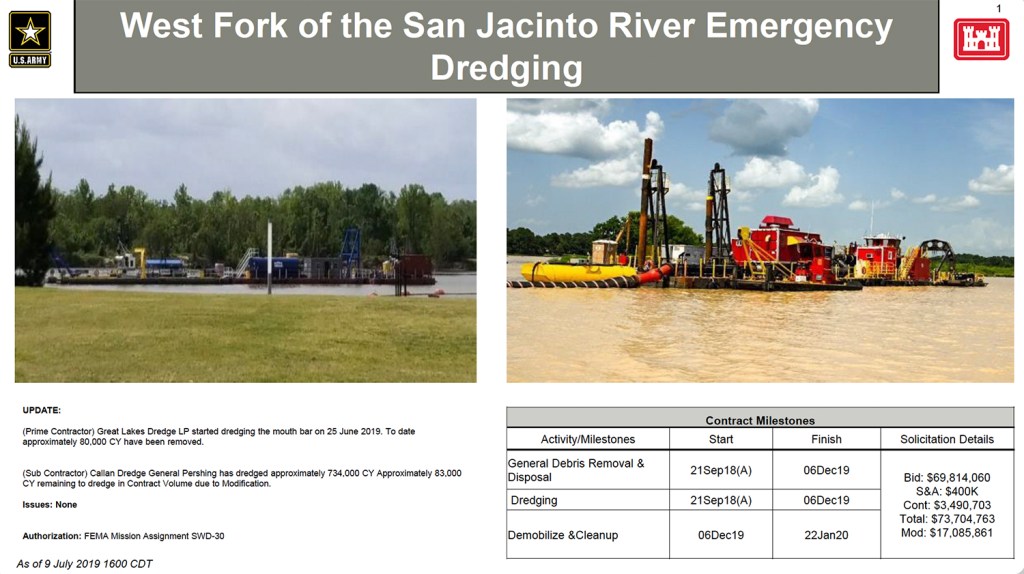
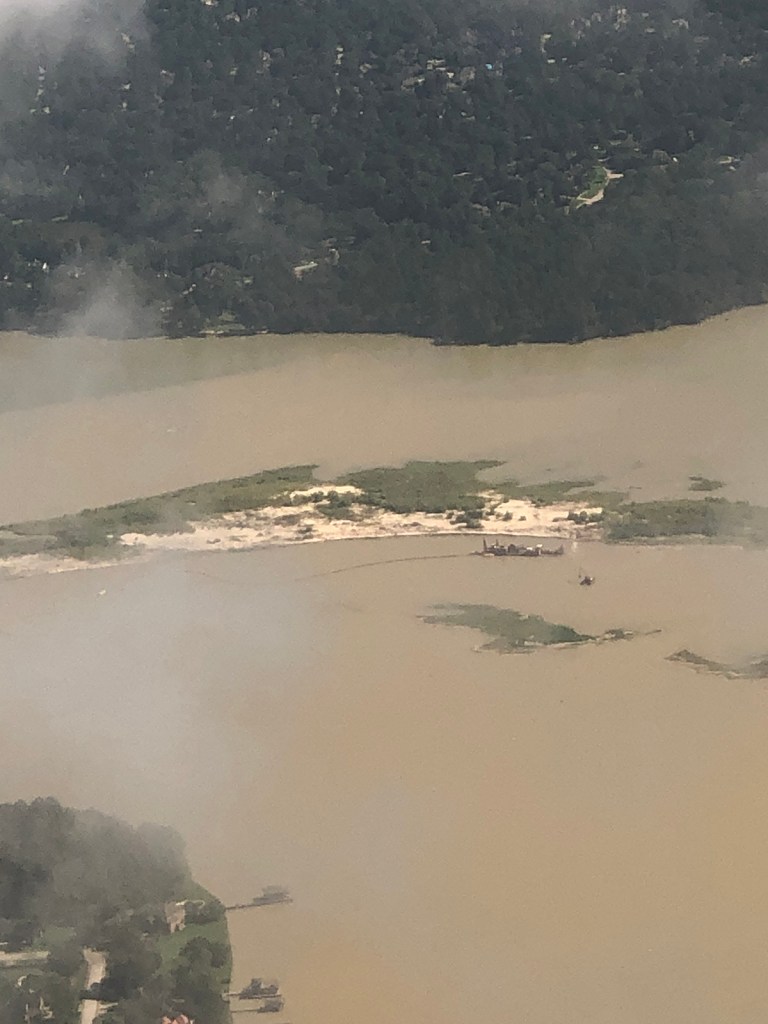
Houston City Council Member Dave Martin announced today that the Federal Emergency Management Administration (FEMA) has authorized the United States Army Corps of Engineers (USACE) to remove sand and siltation from the Lake Houston mouth bar.  

History of Project

In 2018, USACE first began removing debris deposited during Hurricane Harvey from the San Jacinto River under FEMA Mission Assignment (DR 4332). The assignment directed USACE to restore the river to pre-Harvey conditions.

DR 4332 has removed debris from three out of four identified sections of the San Jacinto River. Contractors should finish the last segment (shown in blue below) in May.

Original segments identified by USACE. The orange and green segments are complete. The blue segment should be finished with another week or so. And the purple segment is the one yet to be done – including the mouth bar.

FEMA did not approve the fourth section, in the original scope of work for DR 4332.  Last month, the City of Houston filed an application for mouth bar removal as well as an additional dredge material disposal site. FEMA and USACE have been reviewing it since then, according to Council Member Martin.

The State of Texas, the City of Houston, as well as multiple stakeholders from the Lake Houston area, requested FEMA to expedite authorization of a Mission Assignment for debris removal and dredging of the mouth bar while the equipment is still in the river. The hope: to save taxpayers the cost of a second mobilization effort. Mobilization for the first assignment cost approximately $18 million.

FEMA Issues Directive of Mission Assignment

At a meeting last week in Austin, FEMA issued a directive of Mission Assignment to USACE for dredging of the mouth bar at the confluence of the San Jacinto River and Lake Houston.

The City requested removal of 1.4 million cubic yards of sediment. It is unclear at this time how much FEMA will fund, exactly where it will be stored, and whether matching funds will come from other sources. FEMA, TDEM, City of Houston, and USACE are still working to determine the amount of silt deposited by Hurricane Harvey.

Dredging of Final Segment To Begin Within 30 Days

 Martin hopes the calculation will be finalized next week, and expects dredging to begin within 30 days. 

The Great Lakes Dredge is still docked at the USACE Command Post while it awaits FEMA and USACE to finalize mouth bar dredging details with the City and State.

Kudos to Mission Team

In his press release, Martin issued “a huge thank you to our federal partners Congressman Dan Crenshaw, Field Representative for Congressman Crenshaw, Kaaren Cambio, Congressman Kevin Brady, Senator Ted Cruz, and Senator John Cornyn for their support as they have all been meeting regularly with FEMA and discussing this project.”

“This is a huge project for our area,” said Martin, “and it would not be possible without the on-going support and push from Governor Greg Abbott and Chief Nim Kidd, Texas Department of Emergency Management (TDEM), as well as Mayor Sylvester Turner and Stephen Costello, Chief Recovery Officer – City of Houston.” 

Martin also gave additional thanks to Jenna Armstrong and Mark Mitchell from the Lake Houston Area Chamber of Commerce for coordinating a letter writing campaign.

Breathing a Bit Easier Tonight

During floods earlier this year, I noticed a ten foot difference at times at gauges on either side of the mouth bar. It is acting like a dam behind the dam.

With the start of Hurricane season on June 1, residents of Kingwood and Humble will breathe a little easier tonight. Hopefully, the Corps and its contractors will be able to at least dredge a channel through the mouth bar area before the peak of the Atlantic season from mid-August through September.

The SJRA has agreed to continue lowering Lake Conroe during that period by 2 feet versus its normal level as an additional buffer against flooding.

My thanks to Council Member Dave Martin for pushing this project so tirelessly, and to Kaaren Cambio and Mark Micheletti for leading to effort to lower Lake Conroe again this year. Neither effort has been easy. Finally, kudos also to Tim Garfield and R.D. Kissling, two local retired geologists for their efforts in helping people understand the dangers posed by the mouth bar.

Posted by Bob Rehak on April 26, 2019

605 Days since Hurricane Harvey

Earth Week Part 3: Sand Mine Setbacks from Rivers

After a year and a half of investigating sand mining best practices around the US and the world, I concluded that Texas falls short of other states and countries on several measures. The single biggest opportunity for improvement: greater setbacks from rivers.

River is migrating toward pit in background at the rate of 12 feet per year. When this picture was taken after Harvey, dike was only 38 feet wide.

Other states recommend from 100- to 1000-foot setbacks. Some prohibit building in floodways and flood plains. All but one sand mine on the San Jacinto lie at least partially in floodways. This leads to frequent dike breaches which, I believe, contribute to downstream sedimentation and flooding. Yet legislation that could increase setbacks and safety remains bottled up in committees.

Benefits of Setbacks

Greater setbacks would remove mines from the fiercest currents during floods. Leaving vegetation in place between the mine and the river would also help bind soil, reduce erosion, protect mines stockpiles, slow currents entering mines, help trap any sand leaving mines, and improve public safety.

Memorial Day Flood in 2015 ruptured the dikes on these sand mines on both sides of the West Fork.

Miners’ Objections to Setbacks

I queried several miners and the Texas Aggregate and Concrete Association (TACA) about why they felt compelled to mine so close to rivers. The answer (I’m paraphrasing now): because there’s less overburden, they have greater efficiencies that are important in a low margin business.

That makes sense until you realize that some of these mines are more than two miles wide. That’s wide enough so that parts didn’t even flood during Harvey. And I have to believe that:

  • …if sand on the perimeter was unprofitable, they wouldn’t mine it.
  • …if mining in the floodway were prohibited, no one would be at a competitive disadvantage.

Dubious Relationship Between Growth and Mining Near River

For generations, the mining industry has positioned itself as “the driver of growth.” And it has sought concessions from state legislators to perpetuate growth. Like all myths, there’s some truth to this one. But when you look closely, any argument for lax regulation rapidly disappears.

While over-regulation can certainly hurt an economy, sensible regulation can help it. If aircraft manufacturers tolerated crashes, people would not fly.

So why is leaving a floodway-wide buffer such a hardship? I’m still scratching my head. According to USA Today, three states have higher growth rates than Texas AND require minimum setbacks (Idaho, Washington and Arizona). So setbacks are not anti-business or a growth killer. Idaho is growing at 2.20%, Washington at 1.71% and Arizona at 1.56% according to USA Today. Texas is growing at 1.43%.

When you look at the opposite end of the spectrum, the two states LOSING the most population are West Virginia and Wyoming – both big mining states with lax regulations.

So clearly, lax regulation is not creating growth and tougher regulation is not stifling it. So why is it so hard to get mining regulation that protects citizens, property and the environment?

Status of Mining Legislation

Here is where Texas stands on proposed sand mining legislation.

No bill opposed by TACA has made it out of committee so far this year.

Two bills supported by TACA have reached the floors of the Senate and the House:

  • SB 2126 which could actually allow mining IN rivers, not just their floodplains.
  • HB 907 which doubles fines against unregistered miners (not TACA’s problem).

All the rest are still bottled up in committee tonight with only 34 more days remaining in the session:

  • HB509 which requires a hydrologic impact study, public notice, and public hearings before permitting
  • HB908 which strengthens fines for water code violations and increases inspection rates
  • HB909 which calls for the TCEQ to adopt and publish best management practices for mining
  • HB1671 which would enforce those best practices on the San Jacinto and require minimum setbacks
  • HB2871 which would require miners to post performance bonds, ensuring reclamation when they finish mining.

Seat Belt and Blowout Analogies

I am not against mining; I am FOR more responsible mining that protects citizens, property, the environment, and the image of Texas as a great place to live. Growth is far more complicated than the sand mining industry would have us believe.

Minimum setbacks will not destroy the state’s formula for growth. They’re a safety measure, like seat belts for Mother Earth against speeding, out-of-control floodwaters.

Arguing against them is reminiscent of the argument against putting seat belts and other safety features in cars 50 years ago. Remember Unsafe at Any Speed? At the time, some in industry claimed the extra cost would drive Detroit out of business. Those of us old enough to remember might say it was the beginning of Detroit’s rebirth.

Another more direct analogy: a hundred years ago, people drilled oils wells that routinely blew out. Erle P. Halliburton changed the industry with new cementing techniques that prevented blowouts and improved well control. In 1957, Oklahoma inducted Halliburton into its Hall of Fame. The world is a much safer place because of him.

Hurricane Harvey exposed the safety flaws in the assumptions underlying sand mining regulations. We have 34 days left in this legislative session. Let’s use them to enact some common sense legislation that improves the safety of mining and preserves the environment for our children.

Posted by Bob Rehak on 4/25/2019

604 Days since Hurricane Harvey

Quick, Inexpensive, New Idea for Hurricane Storm-Surge Protection

Jim Blackburn

Jim Blackburn, the noted environmental lawyer and Rice professor, will hold a meeting to review new ideas on storm surge protection in and around Galveston Bay. If you or one of your loved ones works at one of the petrochemical plants or refineries near the Bay or Ship Channel – or if you use the Bay for recreation – you may be interested in this.

Quick, Inexpensive, Storm-Surge Solution

Says Blackburn, “No issue is more serious to the future of our region than is hurricane surge flooding, and we have a unique, once-in-a-lifetime chance to solve it relatively cheaply and relatively quickly. There are 800,000 people, 2.2 million barrels per day of refining capacity and over 200 chemical plants in harm’s way. 

Piggybacking on Ship-Channel Widening

At the current time, the Port of Houston is trying hard to find a way to widen the Houston Ship Channel to allow two-way traffic.  The SSPEED Center at Rice University has developed a hurricane flood protection plan that would utilize the dredged material created by the Port’s proposed widening project. The plan calls for building a 25-foot bay barrier system that would extend from Houston Point in Chambers County down the ship channel to a terminus at the Texas City hurricane protection levee system. It would combine flood protection with navigation enhancement along with recreational access to Galveston Bay, says Blackburn. 

Storm Surge Meeting Details

Speakers at the meeting will explain this new opportunity. They will also provide an update on the Corps of Engineers planning process and an update from Texas A&M.

Time: 6:30 – 8 PM
Date: Wednesday, May 15, 2019
Place: San Jacinto College Central Campus
Music Building: Corbin Hall
Address: 8060 Spencer Highway, Pasadena, TX 77505

Important, but Not Covered by Flood Bond

“We in Harris County need protection from flooding coming in from Galveston Bay, just as we need protection from rainfall flooding,” says Blackburn. “The 2018 bond issue did not provide funding for surge protection.  We must find concepts that work and ways to fund these concepts sooner rather than later or else we risk significant loss of life and homes, loss of our regional economic engine and the worst environmental disaster in U.S. history.”

Mark Calendar and Invite Friends

So mark your calendars for May 15. This public meeting is sponsored by Harris County Precinct 2 Commissioner Adrian Garcia. This should be of particular interest/concern to anyone who works near the Houston Ship Channel or the eastern sections of the City of Houston.  If you are concerned about this issue or the alternatives that might be chosen to address it, please come.  And please let your friends know about the meeting too.

About Jim Blackburn

Jim Blackburn is a professor in the practice of environmental law in the Civil and Environmental Engineering Department at Rice University. He teaches courses in sustainable development and environmental law. He is also a practicing environmental lawyer with the Blackburn & Carter law firm in Houston and a Rice faculty scholar at the Baker Institute. At Rice, he serves as the co-director of the Severe Storm Prediction, Education and Evacuation from Disaster (SSPEED) Center.

Posted by Bob Rehak on April 24, 2019

603 Days since Hurricane Harvey

SJRA Responds to Post about SB 2126 Opening Door to River Mining

Letter to the Editor

RE: “Caution: SB 2126 Opens Door to Sand Mining in Rivers”

Bob,

Thank you for your work with Reduce Flooding to raise awareness about flooding and flood-related issues since Hurricane Harvey.  You have done a tremendous job of helping to educate the public on the causes of flooding and providing status updates on current and future flood-related projects and initiatives. Regarding your April 25 post titled ““Caution: SB 2126 Opens Door to Sand Mining in Rivers,” I want to clarify what SB 2126 is and what it is not.  

Chuck Gilman, the author of this post, is
Director of Water Resources and Flood Management for the
San Jacinto River Authority

The concept behind SB 2126 is to create a proactive approach toward removing sediment from the river before it is deposited in Lake Houston.  If you’ll recall the KBR report from 2000 noted “For long-term sediment management consideration, sedimentation basins, either on-channel or off-channel, are the most effective approach to minimizing sediment buildups and maintain the life of the channel conveyance.”  That is what we are attempting to accomplish with this program. 

The strategies and programs that could be implemented if SB 2126 is approved would not be river mining or dredging.  Any kind of dredging (either hydraulic or mechanic) would be very limited in scope, allowing conservation and reclamation districts to restore conveyance in the rivers in a strategic location through small-scale, periodic, targeted removal of sediment in the river.  This could be as large-scale as the current dredging project currently in progress, or as simple as the construction of sand traps that are dredged annually.  Regardless, your point about oversight and management is well noted, and is a requirement for this program to be a success.  

The San Jacinto River Authority has secured the support from the sand mining industry through the Texas Aggregates and Concrete Association to explore options to remove sand, gravel, shell, and other aggregates from the river—all without a cost to taxpayers.  Ideally, the SJRA would be the public agency overseeing and managing the program, conducting the necessary studies, and coordinating with the appropriate state and federal agencies to determine where and how much material should be removed. Partners from the private sector could then remove the material as directed by SJRA.  

After Hurricane Harvey, Governor Abbott tasked all of us with flood control and flood management. SB 2126 creates opportunities for public-private partnerships to help preserve the channel conveyance capacity of the San Jacinto River.  As we know in the Lake Houston area, this sediment impedes the flow of storm water where the West Fork converges with Lake Houston.  

Senator Creighton has led the effort to develop a flood resiliency funding bill in the Senate this legislative session (SB 7), and continues to seek other options to help create a regional flood management effort in the San Jacinto Basin.  This bill would simply create another tool in our toolbox to help reduce potential flooding in the future.  

As stewards of the San Jacinto River and its water supply, the SJRA supports Senator Creighton’s proactive approach to managing sediment in the river. We are trusted partners with the State of Texas, Harris County Flood Control District, and FEMA to execute $2.5B in flood control bond projects like the comprehensive San Jacinto Watershed Master Drainage Plan.  We value our role as a community partner and appreciate the opportunity to further reduce the risk of flooding by providing oversight and management of this plan.

Chuck Gilman
Director of Water Resources and Flood Management
San Jacinto River Authority

For additional information on SJRA visit our website at www.sjra.netor like SJRA on Facebook 
@SanJacintoRiverAuthority

Posted verbatim from SJRA letter by Chuck Gilman on 4/23/2019

602 Days since Hurricane Harvey