Last Phase-1 Dredge Gone; Phase 2 Will Be Announced Next Week

The last dredge from the Army Corps’ Emergency West Fork Emergency Dredging Program has left the river. State Representative Dan Huberty says plans for Phase 2 of dredging will be announced next week.

Great Lakes Dismantles Dredge

The last remaining dredge, operated by Great Lakes Dredge and Dock, finished dredging a 500,000 cubic yard contract extension in the area of the West Fork mouth bar around Labor Day. That brought the total amount of sand and sediment removed from the West Fork to about 2.3 million cubic yards.

The Great Lakes Dredge waited near the mouth bar for six more weeks, as the owners hoped for yet another contract extension that didn’t come. Finally, in mid-October, Great Lakes started removing its dredge, booster pumps, pipe and other support equipment. That was about the time the City applied for another FEMA grant to help with more dredging.

Now You See It

On November 4th, the dock at the Army Corps Command Post opposite Forest Cove was bustling with activity, as workers dismantled the Great Lakes Dredge. Note all the pipe in the background. Each 40 food section weighs 4,000 pounds.

Now You Don’t

Photo taken on Tuesday, 11/12/19. Dredge is gone.

With Great Lakes and Callan Marine gone, any additional dredging efforts will start from scratch. And we need a Phase 2.

Millions of cubic yards remain in the West Fork Mouth Bar alone. And Imelda deposited immense of amounts of sediment in a growing East Fork Mouth Bar. And let’s not forget upstream dredging near US59 and the County’s planned Edgewater Park, which will have a public boat launch.

Phase 2 Options Moving Forward

Long-Shot Option: On October 15 or thereabouts, City of Houston Flood Czar Stephen Costello submitted another grant request to FEMA for additional money to dredge the mouth bar. That request is still pending. But it isn’t our only hope.

Sure-Thing Option: Luckily, thanks to State Representative Dan Huberty’s Amendment to SB-500, earlier this year, the State Legislature earmarked $30 million for dredging Lake Houston. Let’s call that Phase 2.

The crucial text of the Huberty Amendment reads, “… $30 million is dedicated to the Texas Water Development Board to provide a grant to Harris County for the purchase and operation of equipment to remove accumulated siltation and sediment deposits located at the confluence of the San Jacinto River and Lake Houston.”

According to Huberty, the County, City and State have been examining alternative plans and evaluating their cost-effectiveness. Huberty expects to hold a press conference next week to announce next steps. Stay tuned.

Please note that the two options are not mutually exclusive. The FEMA Grant could still come though and be used to extend Phase 2 dredging.

Posted by Bob Rehak on 11/15/2019

808 Days after Hurricane Harvey

Triple PG Sand Mine Denies Attorney General Claims

Surprise. Surprise. The Triple PG Sand Mine has denied all of the claims by the Texas Attorney General in the state’s lawsuit. The attorney general alleged that breaches in the mine’s dikes allowed wastewater to escape into tributaries of Lake Houston, the source of drinking water for two million people.

One Sentence Denial

When I first read the denial, its brevity shocked me – one sentence. It basically says to the attorney general “prove your case.”

I quote: “…Triple PG generally denies each and every allegation contained in Plaintiff’s Original Petition, and all amendments and supplements thereto, and demands strict proof thereof by a preponderance of the evidence.”

I called a lawyer to ask whether such brief denials were common. The answer: yes. My next question: Why?

Why the Brief Denial?

Basically, had the defendant made no reply to the claims within 20 days, it could have had a default judgement entered against it. So this blocks a default judgment. This also stops the clock, forces the Attorney General to reveal more of its case, and gives the defendant more time to develop an affirmative defense … if it has one. Triple PG can always amend its reply later.

AG Already Laid Out Evidence

The TCEQ has performed onsite inspections and overflights. The TCEQ report was made public with the AG filing. But the TCEQ isn’t the only entity investigating. So by delaying a settlement, the mine could be opening itself to additional fines. And the discovery of additional evidence.

The Mine Safety and Health Administration is also investigating the mine thanks to complaints from dozens of residents around the mine.

The AG could also amend its suit if new evidence becomes available.

In addition, numerous residents, including Tony Buzbee, candidate for the Mayor of Houston, have photographed the breaches in this mine’s dikes.

The longer they wait to settle this case, the higher per-day fines could go.

Hearing Delayed Again

The hearing scheduled for November 12 on a permanent injunction against the mine has now been rescheduled for November 25th.

Deny This

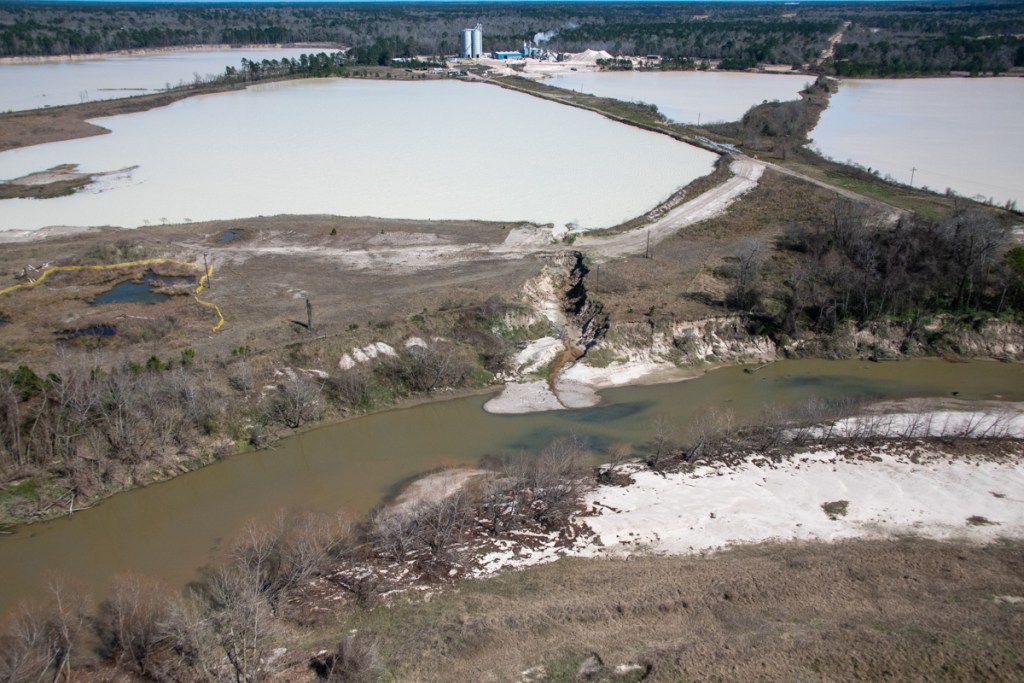
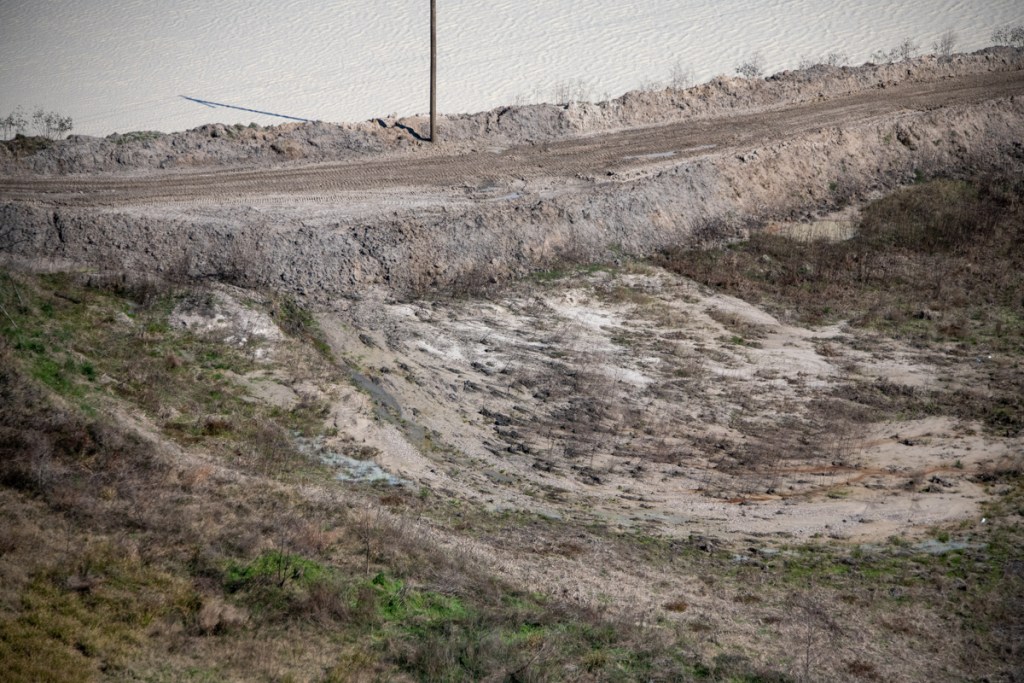
When I flew over the mine on November 4, 46 days after Imelda, Triple PG was only starting to fix the second of eight breaches. The TCEQ did not even find all of those breaches because many roads within the mine had washed out when they paid their surprise visit. So delays could add to Triple PG’s woes as they also run up legal fees.

Here’s what breach #2 looked like on 11/4/2019.

Breach between Triple PG sand mine pit (upper left) and White Oak Creek lower right, photographed on 11/4/2019.
Same breach photographed from reverse angle over pit. Note the white scum floating out of the mine.
Third angle shows more scum and trees blown inward toward the mine during the breach.

The Defendant’s response also included a one sentence prayer. They prayed that all charges would be dismissed and that they would be entitled to further relief, which they did not specify. The only other thing the AG sought was a permanent injunction barring the mine from discharging wastewater. But they might seek to recover court costs if found no guilty.

Posted by Bob Rehak on 11/14/2019

807 Days after Hurricane Harvey and 56 after Imelda

The thoughts expressed in this post represent my opinions on matters of public policy and safety. They are protected by the First Amendment of the US Constitution and the Anti-SLAPP Statute of the Great State of Texas.

Aerial Photos of Lake Houston Dam Dramatize Need for More Gates

Before Harvey hit, we knew tremendous rains were coming. But we could do little to prepare Lake Houston for the onslaught. The small gates you see in the photo below release a combined 10,000 cubic feet per second (CFS). That’s nothing compared to the 150,000 from the gates at the Lake Conroe Dam.

Lake Houston’s gates release a maximum of 10,000 CFS.
The gates at Lake Conroe can release water at up too 150,000 CFS...15X faster.

We Were Sunk

When Lake Conroe had to open its gates during Harvey, we were sunk. Literally. Had we had bigger, more modern gates on Lake Houston, we might have been able to lower the lake fast enough to avoid flooding thousands of homes.

11-Foot High Wall of Water Cascaded Over Spillway

Of course, Lake Houston also has a spillway. In fact, the spillway represents the primary way to shed water from the lake. The top of that spillway is at 42.38 feet.

The primary overflow mechanism on the Lake Houston Dam: a 3,160-foot long spillway.

But Harris County Flood Control District’s (HCFCD) final report on Hurricane Harvey stated that a record pool elevation of 53.1 ft was recorded at the Lake Houston Spillway.

Thus, at the peak of Harvey, a wall of water 11 feet high was flowing over that spillway.

HCFCD estimated that’s 5 times the average flow of Niagara Falls and that the flow rate would fill NRG Stadium in 3.5 minutes.

Ten More Gates Could Have Lowered Harvey Flood by 1.9 Feet

HCFCD commissioned a study by Frees & Nichols about what effect additional gates would have in the event of another Harvey. The study found that ten more gates could have lowered the level of the flood by up to 1.9 feet (about 23 inches). That would have saved thousands of homes from flooding in the Lake Houston Area.

Interestingly, the WAY more gates would prevent flooding was not through pre-release; Harvey would have refilled the lake in a matter of hours and the storm lasted days. Rather, additional gates would have widened the spillway area so more water could move over the dam every second. Think of it in these terms: twice the width, half the height. (That’s an over-simplified example of how the principle works; ten more gates would not actually double the width.)

Is Pre-Release Practical?

The Frees & Nichols study only considered one case – Harvey. For lesser floods, the gates could help make pre-release a viable strategy for the Lake Houston Area. At least in my opinion.

Here’s how.

  • More gate capacity could help offset the volume of water released from Lake Conroe, to reduce the risk of Conroe flooding Houston again.
  • More gate capacity could release more water in less time, thus reducing uncertainty when pre-releasing before a storm. That would allow officials to delay releasing water until they were sure they needed to. And that could save precious water in the event that a storm veers off in another direction at the last minute. We may know that a storm will cross the area. But it’s much harder to tell where the heaviest rainfall will occur. For instance, during Imelda, parts of the East Fork received more than 20 inches of rain while Lake Conroe received only two.

In the last year, the City prevented homes from flooding several times by pre-lowering the lake. But the small gate capacity meant that we had to start releasing water DAYS beforehand to make an appreciable difference in the lake level. That has to be nerve wracking for Public Works.

Where the Gate Project Stands

Earlier this year, the City of Houston secured a FEMA grant to design and construct more gates for the Lake Houston Dam. The two-phase grant covers design and construction. Each phase must be completed within 18 months, though extensions are possible. Currently, we are four months into the 18-month design phase. That means we should see more gates by mid-2022.

In the meantime, the photos below give you a feeling for the immensity of the project.

The height of the trees on the San Jacinto River below the dam gives you a feeling for the height of the dam.
Looking SE. Repairs are underway to the structures below the Lake Houston dam. Note the trees caught on top of it.
Looking west over the Lake Houston Dam which dates back to 1953.

Posted by Bob Rehak on 11/14/2019

807 Days since Hurricane Harvey

Provisions for Off-Site Overland Sheet Flow in Montgomery County Drainage Criteria Manual Warned Perry Homes of Dangers to Elm Grove

Section 5.3.5 of the Montgomery County Drainage Criteria Manual (Pages 83-84) specifically address flooding of established subdivisions by land under development. For example when Elm Grove was flooded from clearcut land in Woodridge Village. Had Perry Homes, its subsidiaries and contractors followed the requirements in the Manual, Elm Grove might not have flooded.

Provisions Adequate for Ultimate Development Can Be Severely Deficient for Intermediate Stages

The section on Offsite Overland Flow starts out by saying, “Sheet flow from undeveloped areas into an existing or a proposed subdivision can create a localized flood hazard by overloading street inlets and/or flooding individual lots.” This is exactly what happened to Elm Grove Village and North Kingwood Forest in May and September of this year. City of Houston storm drains already taxed to the max became overloaded when water broke out of Woodridge Village and started flowing down the streets of Elm Grove and North Kingwood Forest.

Streets of Elm Grove during May 7th Flood show danger of not planning for runoff during intermediate stages of development.

The text in the Drainage Manual then continues. “Any drainage plan for a proposed subdlvision submitted for review and approval by the Montgomery County Drainage Administrator must address the drainage of all adjacent lands. Both under undeveloped and fully developed conditions. A plan which may be adequate under conditions of ultimate development can be severely deficient during intermediate conditions of development due to sheet flow from adjacent undeveloped land. Provisions must be made to divert 100-year sheet flows to a channel system or to the secondary street and storm sewer system.” [Emphasis added.]

The LJA Drainage Analysis claimed Woodridge would create “No adverse impacts to neighboring developments or Taylor Gully.” However, the LJA analysis did not:

  • Discuss the drainage of adjacent lands, such as Elm Grove.
  • Discuss intermediate conditions of development; they focus only on fully developed Phase 1 and Phase 2 Conditions.
  • Mention the phrase “sheet flow” once.
  • Make provisions to divert 100-year sheet flows.

No Swales to Redirect Sheet Flow

The next paragraph of the Montgomery County Drainage Criteria Manual starts, “Redirection of the sheet flow can usually be achieved through the use of drainage swales located in temporary drainage easements along the periphery of the subdivision.” Perry Homes built no such swales … at least not adequate ones.

No Berms to Block Sheet Flow

Later in that same paragraph, the Manual talks about building berms between the swales and adjoining neighborhoods to prevent the flow from overrunning the swale. Unfortunately, on May 7th, no such berms existed. They did for Imelda, but they proved inadequate to divert the sheet flow and they had gaps in them.

No Additional Storm Sewer Capacity

The next paragraph talks about building “additional inlet and storm sewer capacity … to prevent prolonged street ponding in the (neighboring) subdivision resulting from flow from the undeveloped area.” That didn’t happen either.

No Planning for Rain Before Detention Ponds Fully Built

Perry Homes took none of these precautions. LJA never planned for them (as far as I can see from publicly available documents). Reading LJA’s drainage analysis, one gets the impression that no one ever even conceived of rainfall before they could build all the detention ponds for Woodridge Village. That turned out to be yet another fatal assumption. Despite all the warnings and mitigation advice in Montgomery County’s Drainage Criteria Manual.

Add this to a long and growing list of other things they ignored, underestimated, or mischaracterized.

Stay Tuned for More

The list goes on and on. I have barely started. This series could last for weeks. The MoCo Drainage Manual goes on for almost 200 pages. And Woodridge Village is far from the only Perry Homes Development.

Perhaps the biggest question in all of this is for the Montgomery County Judge and Commissioners. How do plans like this get approved?

Posted by Bob Rehak on 11/12/2019 with thanks to Jeff Miller

806 Days since Hurricane Harvey and 55 since Imelda

The thoughts expressed in this post represent opinions on matters of public concern and safety. They are protected by the First Amendment of the US Constitution and the Anti-SLAPP Statute of the Great State of Texas.


For those who are interested, I have reprinted verbatim the full text of Section 5.3.5 from the Montgomery County Drainage Criteria Manual below.


Section 5.3.5 Off-Site Overland Flow from the Montgomery County Drainage Criteria Manual (See Pages 83 and 84)

Sheet flow from undeveloped areas into an existing or a proposed subdivision can create a locallzed flood hazard by overloading street inlets and/or flooding individual lots. Any drainage plan for a proposed subdlviston submitted for review and approval by the Montgomery County Drainage Administrator must address the drainage of all adjacent lands. Both under undeveloped and fully developed conditions. A plan which may be adequate under conditions of ultimate development can be severely deficient during intermediate conditions of development due to sheet flow from adjacent undeveloped land. Provisions must be made to divert 100-year sheet flows to a channel system or to the secondary street and storm sewer system.

Redirection of the sheet flow can usually be achieved through the use of drainage swales located in temporary drainage easements along the periphery of the subdivision. As the adjacent area develops to the point at which the street system can effectlvely handle the sheet flow condition, the temporary drainage swales and easements may be abandoned.. The drainage swales should be relatively shallow, with the excavation spoiled continuously along the subdivision side of the swale to prevent flow from overrunnmg the swale. The swale should have sufficient grade to avoid standing water, but not enough to create erosion problems. Generally, a minimum. grade of 0.1% should be maintained with the maximum grade strongly dependent on local soil conditions.

Such temporary drainage swales may be directed to inlets in the storm sewer system or, preferably, to the appropriate primary outfall channel. lf an undeveloped area is to be drained to a storm sewer, additional inlet and storm sewer capacity must be provided to prevent prolonged street ponding In the subdivision resulting from flow from the undeveloped area. Provisions for this flow must also be included in the design of the street drainage overflow system. The design of temporary drainage swales directed to Montgomery County drainage channels must include adequate pro­visions to drop the flow into the channel through an approved structure in order to avoid excessive erosion of the channel banks.

Outfalling the temporary swale into the backslope drainage system for the channel is unacceptable because the backslope drainage interceptor structures are not adequate to convey flow from an off-site swale. A typical approved structure is shown in Figure 6.3, With the exception of the pipe dimension. The pipe must be sized to handle the 100-year flow from the off-site area.


Perry Homes Apparently Violating Montgomery County Development Regulations, Too

On September 26th, the City of Houston fired off a Cease-and-Desist Letter to Perry Homes regarding its Woodridge Village development just north of Elm Grove. The letter warned Perry and its subsidiaries to stop sending sediment into Houston storm drains. Now it appears the Perry gang is violating Montgomery County regulations, too. Let me call your attention to page 28 of the Montgomery County Subdivision Rules and Regulations. The sediment section reads (and I quote verbatim):


“IV. SEDIMENT CONTROL AND SEDIMENTATION PONDS. The subdivider shall provide effective sediment control measures in the planning and construction of subdivisions. Practical combinations of the following technical principles should be applied: 

  1. No more than ten acres of land in road right-of-way shall be exposed at any one time during development, without prior approval of the County Engineer. 
  2. When land is exposed during development, the exposure shall be kept to the shortest practical period of time. 
  3. Temporary vegetation and/or mulching shall be used to protect critical area exposed during development. 
  4. Sediment basins and traps shall be installed and maintained in properly designated places to remove sediment from runoff waters on land undergoing development. 
  5. Provisions shall be made to accommodate the increased runoff caused by changed soil and surface conditions during and after development. 
  6. The permanent final vegetation and structures shall be installed as soon as practical in the development. 
  7. The development plat shall be fitted to the topography and soils so as to create the least erosion potential.”

Let’s compare these principles with Perry’s practices.

Strike One

Shall provide effective sediment control measures in construction?

Photo taken shortly after May 7th flood on southern section of Woodridge Village.

Strike Two

No more than 10 acres of land shall be exposed at any one time?

How about 268 acres?

Strike Three

Land exposed for shortest practical period of time?

Drone footage of Woodridge Village southern section from May 9.
Shot of same area (from different angle) six months later.

Strike Four

Temporary vegetation?

Photo taken 11/4/2019, months after land was clearcut AND after two major floods.

Strike Five

Provisions to accommodate increased runoff?

Block after block of Elm Grove residents dragged their lives to the curb after being inundated by increased runoff from May 7th and Imelda.

Strike 6

Final structures installed as soon as practical? Let’s look at detention ponds…that aren’t there…despite months of ideal construction weather.

The N1 Detention pond should have been installed in the foreground months ago.
The N2 Detention Area (green triangle excavated by MoCo in 2006) was supposed to be expanded, but was not.
The N3 detention pond was to stretch from Taylor Gully in the bottom of the frame, almost to the tree line at the top. But nothing has been done.

Strike 7

Plat fitted to soils to create the least erosion possible?

Wetlands abounded on this property.
But Perry contractors filled in natural wetlands and streams.

Seven Strikes and You’re Out?

Not if you’re Perry Homes. Because when I first complained to the TCEQ about sediment flowing from the site in May, the TCEQ referred the investigation to Montgomery County. Then Montgomery County referred it to LJA Engineering. Perry Homes, of course, hired LJA to do the engineering on this site. So LJA was investigating itself and its client. Surprise, surprise, everyone called the problem fixed after installing some silt fencing in May. But it wasn’t fixed. Five months later, even more people flooded during Imelda than on May 7.

With the exception of some work on detention pond S2 last summer, Perry has not bothered to:

  • Expand detention capacity
  • Plant vegetation
  • Install sediment basins
  • Reduce runoff
  • Compensate for the wetlands and streams they filled in

Perry has done nothing in SEVEN months that reduced flood risk to Elm Grove. The work they did last summer didn’t prevent flooding in September. And they haven’t done anything since.

Yet Kathy Perry Britton, Perry Homes CEO, talks about the value of character, integrity and decisive action. The value of practicing good corporate responsibility. And Perry Homes’ commitment to excellence and distinguished reputation.

News flash, Ms. Britton. Going 0-7 doesn’t show a commitment to excellence. And suing flood victims certainly won’t establish a distinguished reputation. Although it may put you in the Hall of Shame with Montgomery County Commissioners who refuse to enforce their own regulations.

Posted by Bob Rehak on 11/12/2019, with thanks to Jeff Miller

805 Days since Hurricane Harvey and 54 since Imelda

The thoughts expressed in this post represent my opinions on matters of public policy and safety. They are protected by the First Amendment of the US Constitution and the Anti-SLAPP Statute of the Great State of Texas.

Final Report on Imelda Says 62% of Flooding Outside of 100-Year Floodplain

Harris County Flood Control District released its final report on Tropical Storm Imelda this morning. It’s a work of incredible scholarship. If you really want to know what made this storm different, this is a must read.

While Imelda was the fourth wettest storm in Texas history when measured by total rainfall, Imelda produced incredible short duration rainfall rates that exceeded Harvey in the 5-, 15-, and 30-minute time periods. And that is the key to understanding why more homes flooded in the 500-year floodplain than the 100-year floodplain.

Few Structures In Lake Houston Area Flooded from River

Says Jeff Lindner, Harris County meteorologist, “Much of the structure flooding that occurred in the Kingwood area was not a result of flooding from the river, but instead flooding of local drainage systems that were overwhelmed from the intense short duration rainfall rates. Harvey remains the flood of record along the West Fork of the San Jacinto River.”

Almost Two-Thirds of Flooded Homes Outside 100-year Floodplain

Similar to other recent flooding events in Harris County a large number of flooded homes were located outside the 1% (100-yr) floodplain. Of the 3,990 homes flooded from Imelda, 2,479 (62%) were outside the 1% (100-yr) floodplain. 1,511 (38%) of the flooded homes were located inside the 1% (100-yr) floodplain.

“While house flooding did occur from creeks and bayous overflowing their banks, a large majority of the house flooding was a result of intense short duration rainfall rates overwhelming the internal drainage capacities and this is shown by the large number of homes that flooded outside the 1% (100-yr) floodplain,” says Lindner.

Rainfall Totals Throughout San Jacinto Watershed

See the actual rainfall measurements for gages throughout the San Jacinto Watershed below. All characterizations of floods (i.e., 100-year) are based on NOAA’s new Atlas 14 data.

San Jacinto River and Lake Houston
Cypress Creek
Spring Creek
Luce Bayou
Flooding of Local Tributaries: Green = 10-50 yr flood, Yellow = 50-100 yr, Red = 100-500 yr, based on high water marks.
1-Hour Peaks throughout county. Note blue bullseye over US59 and Beltway 8. That’s a 500-year intensity rate.
48 Hour Peaks throughout county. Notice extreme gradient from east to west. 28″ in northeast part of county and less than 2″ in the west.
Regional map. Parts of Liberty, Chambers and Jefferson Counties received a 1000-year rain. As bad as Imelda was, Harris County escaped the worst part of the storm.

Details Provide Clues to Reasons for Flooding

The final Imelda report has thousands of statistics for just about every location in the county and every time period between 5 minutes and 48 hours. Scanning it may give you a feeling for why you flooded or why you did not.

Increasing Frequency of Extreme Storms

The report also contains a discussion the number of extreme storms that have hit this area recently. Some key stats:

  • Three of five wettest tropical cyclones in Texas history occurred in the last 20 years (Imelda, Harvey, Allison)
  • Among Texas storms, four of the top five occurred in southeast Texas (Imelda, Harvey, Allison, and Claudette).
  • Imelda is also the 5th wettest tropical cyclone ever in the 48 contiguous United States.
  • Six of the wettest tropical cyclones in US history have occurred in Texas.
  • Six of the 10 wettest occurred in the last 22 years.
  • Three of the 10 wettest occurred in the last three years (Imelda, Florence, Harvey).

The table below shows the top ten wettest tropical cyclones by location and year in the 48 contiguous states.

Source: Harris County Flood Control final report on Imelda.

For the full report, click here.

Implications of Report Speak to Need for Change

Yesterday, I posted about an engineering company that made conservative and questionable assumptions about rainfall totals and more in their drainage analysis for Woodridge Village.

When far more homes flood in the 500 year flood plain than the 100, it’s clear that our infrastructure is not equipped to handle the kind of storms we’re now getting.

We can no longer allow developers and engineering companies to bet on the best case scenarios when the worst case scenarios are becoming the norm. We must start building infrastructure to handle bigger storms. The old norms are failing us.

For starters, we need Montgomery County to:

Posted by Bob Rehak on 11/11/2019

804 Days since Hurricane Harvey and 55 since Imelda

The conclusions expressed in this post represent my opinions on matters of public policy and safety. They are protected by the First Amendment of the US Constitution and the Anti-SLAPP Statute of the great State of Texas.

Questionable Assumptions by LJA Engineering May Have Compounded Elm Grove Flooding

Questionable assumptions about soil composition, rainfall patterns, wetlands and floodplain status for Perry Homes’ troubled Woodridge Village development may have compounded flooding in Elm Grove and North Kingwood Forest. Previously, I have focused on other more obvious issues, such as missing detention ponds and expected rainfall totals. However, Elm Grove resident Jeff Miller who has been studying the LJA Drainage Report, urged me to explore these additional issues.

Soil Type Closer to Clay than Sandy Loam

The LJA engineers doing the drainage analysis for Perry based their runoff calculations on a soil type called “sandy loam.” Different soil types absorb rainfall at radically different rates. According to 2011 data from Texas A & M Agrilife Extension, water infiltration rates for:

  • Sand = 2″ – 6″ per hour
  • Loam = .6″ – 2″ per hour
  • Clay = .2″ – .6″ per hour

Clay absorbs water very slowly, so rain turns into runoff quickly. Two photos below show what the Woodridge Village construction site looked like ONE WEEK AFTER a 2″ rain. It still had ponding water that did not soak in.

The northeastern portion of Woodridge Village looking southwest. Photo taken on 11/4/2019 one week after a 2″ rain. Note the ponding water that has not yet infiltrated.
A closer shot of the main portion of the north side of the site, also taken on 11/4/2019. Note the ponding water here, too. USGS characterized parts of this portion of the site as WETLANDS.
From the USGS National Wetlands Inventory. Note how the ponding water in the photo aligns with where the wetlands were.
Drone footage of southern section taken two days after May 7th flood. Courtesy of Jim Zura, Zura Productions.

In May, a retired local geologist from a major oil company estimated that the clay content in Woodridge soil was at least 50%, and could be as high as 80%. However, he could not commit to an exact figure.

Going by the A&M infiltration figures above and assuming an infiltration rate of 2″ per hour for a mixture of sand and loam, and contrasting that with the minimum infiltration rate for clay, .2″ per hour, you get a difference of 10X.

What does all this mean?

Based solely on soil type, the LJA Engineering report could err in its runoff calculations by as much as 10X.

Sections 1.1 and 2.1.3 of the LJA report discuss the runoff based on soil type. No matter how sophisticated the calculations, if you base them on the wrong soil type, the result will be inaccurate. “Garbage in, garbage out” as they say in the computer business.

Before clearcutting, there may have been more sandy loam in a thin surface layer. But contractors likely disturbed or buried that when they removed vegetation from the site and regraded the area.

If LJA wishes to challenge this, I will be happy to reprint their response verbatim. I would love to see their soil report.

But I would like to know how they explain the presence of ponding water throughout the entire northern section of Woodridge Village a full week after a two-inch rain. (Note that the northern section is the steepest and largest. It comprises 2/3rds of the Woodridge Village’s acreage.)

I took the aerial shots above at around 2PM on 11/4/2019. Here are the rainfall totals for the previous 7 days. Graph courtesy of Harris County Flood Warning System.

The Presence of Wetlands Should Have Been a Signal

The presence of wetlands should have been a signal to the developer, but the LJA report does not mention the word “wetlands” once.

Many residents who used to hike and bike this area before it was clearcut have told me that they could always find standing water there even in summer. Here’s an interesting article that explains why wetlands stay wet. The authors says, “Wetlands typically form in gently sloping or topographically convergent portions of a landscape, where surface and ground waters meet.” That certainly fits Woodridge Village.

As Miller says, “Drone footage; many photos; and the constant presence of water in the S-2 detention pond and the rectangular pond where N3 should be confirm that the ground is saturated. When the soil is totally wet, water will move over the surface.” And as LJA says in the intro to its report, “The project site naturally drains to Taylor Gully.”

And that’s exactly where so many people flooded when contractors accelerated the runoff through clearcutting and by not providing adequate detention.

Balanced Storm Assumption Rarely Accurate

Section 2.1 of the LJA report says that LJA models assumed a “balanced storm.” “This distribution is constructed such that the depth specified for any duration occurs during the central part of the storm (intensity position = 50%).” [Emphasis added.]

But as Jeff Johnson, the Montgomery County engineer, pointed out, using a “balanced storm” bases calculations on ideal assumptions. He also pointed out that only a small percentage of storms conform with ideal conditions. (Johnson made these remarks at a Montgomery County Commissioners Court meeting at which they discussed closing a loophole in flood regulations.)

According to the US Geological Survey, this graph represents a balanced storm.

In the ideal balanced storm, most of the accumulation happens in the middle of the storm.


But the May 7th and Imelda storms did not follow this pattern. The heavy rainfall was front-loaded in both.

More than half of the total rainfall during the May 7th event fell at the outset, not in the middle of the storm. Thus, it did not conform to the balanced storm model upon which LJA based its calculations.
During the 11 hours of rainfall from Imelda, more than 50% fell in the first three hours, and almost 80% in the first 4 hours. Thus, Imelda was also “front-heavy”.

LJA Assumed Woodridge Was Outside of 100-Year Floodplain

LJA also assumed (see section 1.5 of its report) that Woodridge Village was “outside of the 100-year floodplain.” For permitting purposes, that is technically true. LJA was going by accepted maps. But that area is not shown as flood plain only because FEMA did not model it. Note in the Montgomery County Flood Plain Map shown below how ALL FLOODPLAIN MAPPING STOPS AT THE COUNTY LINE.

That straight diagonal line you see is the Harris-Montgomery County Line.

Any engineer experienced in working with flood plains should know that physical boundaries do not stop abruptly at political boundaries. Any competent engineer should have questioned this.

Engineering Codes of Ethics Discourage Such Conduct

While LJA did what regulations required, they had a higher ethical obligation to protect people as licensed engineers. See the Code of Ethics of the NSPE – the National Society of Professional Engineers. It states:

“…engineers are expected to exhibit the highest standards of honesty and integrity. Engineering has a direct and vital impact on the quality of life for all people. Accordingly, the services provided by engineers require honesty, impartiality, fairness, and equity, and must be dedicated to the protection of the public health, safety, and welfare. Engineers must perform under a standard of professional behavior that requires adherence to the highest principles of ethical conduct.”

Under Fundamental Canons, the Society’s Code of Ethics also requires engineers to “Hold paramount the safety, health, and welfare of the public.”

Also see Professional Conduct and Ethics for Texas Engineers.

The latter states “In order to safeguard, life, health and property, to promote the public welfare, and to establish and maintain a high standard of integrity and practice, the rules relating to professional conduct in this title shall be binding on every person holding a license and on all firms authorized to offer or perform engineering services in Texas.” In this regard, LJA failed the people of Elm Grove and North Kingwood Forest dismally.

Overlooked Ethical Obligations Contribute to Dramatic Miscalculations

Ignoring the missing flood plain information, not mentioning wetlands, and mischaracterizing soil composition all contributed to dramatic miscalculations. Add those problems to ignoring new statistics that showed flood plain maps would need to be redrawn based on NOAA’s new Atlas 14, and that a 100-year storm would include 40% more rainfall.

Sometimes when you’re eager to make a project happen, optimism leads one to make “best-case” assumptions. But in my opinion, engineers should act on “worst-case” assumptions” to product public safety.

Sometimes, the cost of failure is simply unthinkable. This is one of them. Elm Grove flooding wasn’t as spectacular as a dam or a bridge failing, but it likely affected far more people.=

Webster and Spurlock law firms are currently trying to subpoena correspondence between LJA and Perry Homes and its subsidiaries. The Perry Homes gang is trying just as hard to stonewall production. It will be interesting to see what pressure, if any, they put on LJA to ignore these obvious problems…if the documents ever become public.

An even bigger ethical question: With such obvious problems, why did Montgomery County Commissioners and the City of Houston approve permits for this development?

Posted by Bob Rehak on 11/10/2019 with help from Jeff Miller and video from Jim Zura

803 Days after Hurricane Harvey and 51 after Imelda

The thoughts in this post represent my opinions on matters of public concern and safety. They are protected by the First Amendment of the US Constitution and the Anti-SLAPP Statute of the Great State of Texas.

Woodridge Village Update: More Dirt, Denials, Delays

Twenty-three days ago, Houston Mayor Sylvester Turner read a letter to a packed town hall meeting at the Kingwood Community Center. The letter was from a lawyer named J. Carey Gray. Mr. Gray laid out a timetable for accelerating completion of the detention ponds on the troubled Perry Homes’ development, Woodridge Village, just north of Elm Grove. The first deliverable: completing the S2 pond in 30-45 days – even though it was already largely completed.

As of early this week, contractors have performed no new excavation work on the site since early August. See pictures below.

One Piece of Equipment Moves Closer to S2 Pond

This piece of Rebel Construction equipment moved from the site entrance to north of the S2 pond last Thursday. It looks as though its in danger of actually doing some work. Photo by Jeff Miller on 11/7/2019.

Dirt Continues to Flow From Construction Site

Construction has slowed to a virtual standstill for three months. Between that time and the time the photos below were taken, we had Imelda and a 2.12-inch rain on October 29.

On the 29th, yet more mud washed out of the development into the City’s storm drains, despite the City’s Cease and Desist Letter.

This and photos immediately below were taken on 10/29/2019 near Woodridge Village Construction entrance on Fair Grove Drive and Creek Manor Drive in Kingwood.
Dropping back a little farther, you can see the silty runoff from the construction site. Notice the contrast between that and the clear water coming from a resident’s lawn through the curb break.
Contrast appears a little clearer in this closeup.
You can see the contrast even better where the water enters this storm drain. Muddy water is coming from the construction site. Clear water from the neighborhood to the south.
These sand waves covered Fair Grove Drive just outside the construction site entrance...despite silt fencing.
Here’s a picture of water going into the S2 Detention pond at the north end of Village Springs Drive.
And here it is coming out of S2 into Taylor Gully. S2 is behind the trees on the left. This shot is looking north.

Of course, flooding, not sediment is the real issue in Elm Grove. However, sediment can block storm drains and contribute to flooding. That’s why the City has an ordinance prohibiting discharges of sediment into the City’s sewer system. It’s one area where the City has real leverage with the Perry gang. That’s why so much emphasis has been placed on sediment in this controversy.

City Inspectors Visit Site

Thursday and again Friday, City inspectors checked the construction site for discharges. We dodged a huge bullet Thursday. Parts of Houston received five inches of rain. But the Lake Houston Area received less than one inch.

Photo taken 11/7/2019 by Jeff Miller of a City Inspector photographing Woodridge S2 detention pond.
Photo taken 11/7/2019 by Jeff Miller shows same City Inspector walking along Taylor Gully just south of Woodridge.

Denials, Finger Pointing, Objections on Legal Front

Webster and Spurlock, lawyers for hundreds of Elm Grove flood victims, have brought another defendant into the suit. It is Texasite LLC of Montgomery, Texas. Legal filings do not describe exactly what the new defendant did on site. The company has no web site that I can find. Even the Texas Secretary of State can’t shed much light on the matter; the company’s Certificate of Formation simply says it is organized to “conduct lawful business.”

That said, whatever they allegedly did, they aren’t accepting responsibility for it. Texasite:

  • Denies they harmed anyone
  • Asserts that plaintiffs caused their own injuries through negligence
  • Asserts that third parties caused the damage. Those third parties include God.

In other legal news, Webster and Spurlock filed a notice of intent to take a deposition by written questions from LJA Engineering. The list of information they seek is two pages long.

PSWA and Figure Four Partners, two Perry Homes subsidiaries being sued, objected to items #2 and #3 on the list. They included “letters, emails, and other correspondence/communications between LJA Engineering & Surveying” and the defendants “with regard to the Woodridge Village Development.” The defendants argued in their objection that the request was overly broad because it didn’t limit the time period or subject matter. So sayeth Counselor J. Carey Gray, who wrote the overly vague letter to the City of Houston re: completion of the detention ponds. According to documents on file with the Harris County District Clerk, the judge has not yet ruled on Perry’s objection to production of the evidence.

Delays Also Continue on Construction of More Detention

I flew over the Woodridge Village construction site on Monday, 11/4 and saw no evidence of construction activity, despite the assurances made by Counselor Gray. The images below show the lack of activity from several different angles.

Looking N at the extreme western tail of the construction site that borders Woodland Hills Drive (left). This and all photos below taken on 11/4/2019.
Looking NE across the north and south sections of the site. Detention pond S1 runs along the diagonal tree line from the lower left. Detention Pond N2 is in the upper right. These two ponds comprise 23% of the total detention capacity by volume.
Detention pond N3 is supposed to go along the trees in the background to the left of the S2 pond. It has not been started yet. Notice the one piece of yellow equipment at work clearcutting more land on the middle left.
Close up of where the N3 pond will eventually go. It will start in the bottom left and curl around the upper right.
Looking west. No construction activity on the northeast corner of the site in the foreground.
From this angle, looking SW, it’s easy to see all the standing water on the site. We received two inches of rain SIX days before. So much for LJA’s assumption that this site contained sandy loam. The ponding water after such a long period suggests a high clay content. That in turn explains the rapid and huge runoff rates that flooded Elm Grove.
More ponding water indicating high clay content.
Looking west at the NW corner of the site. This is where the non-existent N1 pond should be.
Looking North. The largest detention pond on the site, N2, will go in that triangular green area (center). Contractors were supposed to deepen and enlarge it. The partial detention capacity you see here now was developed by Montgomery County in 2006 as mitigation for another site. So the detention capacity you see in this image, by itself, would not reduce Elm Grove flooding potential. Saying it did would be like trying to sell a ticket that someone else already bought.

I’m Shocked, Shocked I Tell You

So what are we to make of the continued lack of construction activity? To paraphrase the exchange between Strasser and Renault in the movie Casablanca, I am shocked – SHOCKED – Perry would promise the Mayor of Houston that it would accelerate construction of new detention ponds and then not do it.

Posted by Bob Rehak on 11/9/2019, with photos an updates from Jeff Miller.

802 Days since Hurricane Harvey and 50 Days since Imelda

The thoughts expressed in this post represent my opinions on matters of public policy and safety. They are protected by the First Amendment of the US Constitution and the Anti-SLAPP Statute of the Great State of Texas.

Fox 26 Finds San Jacinto West Fork Still Flowing White; Source of Pollution Still Not Identified

Last Monday I photographed white water in the West Fork. Alarmed by what I saw, I sent photos to the TCEQ and SJRA. Then I posted about it last night. Fox 26 saw the post and decided to do some of its own investigating.

San Jacinto River running white has the Hallett sand mine on the West Fork. Photo taken on 11/4/2019.

Fox News Investigates Further

Today, Fox called for an interview. The reporter, Ivory Hecker, also called the TCEQ, the San Jacinto River Authority and Houston Public Works Department. Everybody, it seems is now investigating. Chuck Gilman of the SJRA says he has never seen anything like it.

Meanwhile, the river is still running white. Not AS white, but nothing like its normal color. Fox sent its own helicopter up today and documented a definite discoloration.

Here’s a link to Ms. Hecker’s segment on Fox. I include it here not because it contains an interview with me, but because it contains the results of her own investigation and interviews with others. It also has helicopter footage taken this afternoon showing that the river is still running white, albeit a dirtier white.

So far this week, the TCEQ, SJRA, and City of Houston have all launched investigations. None has reported results yet.

What Causes Color in Water

China has a Yellow River. Wyoming and Utah have a Green River. Colorado has a Blue River. And of course, Texas and Oklahoma share a Red River. Here’s an article about what makes water different colors. They include runoff, chemical spills, reflected light, color temperature, suspended particles, dissolved minerals, you name it. But the article never once mentions WHITE.

In happier times – Pre-Harvey – I drove to the Arctic Circle and photographed spectacular scenery along the way. In Alberta, Canada, I photographed some of the most intensely blue water I have ever seen anywhere. Given the pristine alpine location, you might think the lake in the photo below was naturally blue.

It’s not. Water is a clear colorless liquid. Things IN it give it color. The intense blue in the water below comes from the way suspended “rock flour” from the glaciers refracts light. Still, I’ll take it over San Jacinto white water any day.

In the mountains above Canmore, Alberta.

Best Theory so Far

According to Fox, Houston Public Works suspects the color is caused by suspended sediment from a sand mine. Although both of the mines I flew by on Monday were discharging water from their pits directly into the river, we just need to wait and see what water tests show and whether the discharges I witnessed had been permitted by the TCEQ.

The water was also white upstream from the two mines I photographed – just not as white. So it’s possible those two mines were not even involved. We should not jump to conclusions.

Better Ways to Monitor

Several things are certain at this point, however. Flyovers once every two years by the TCEQ are insufficient to catch issues like this. LandSat flies over Houston 18 times a day. It’s hard for taxpayers to understand why the TCEQ doesn’t use the satellite imagery that the federal government is already collecting anyway. It could provide a higher level of protection at a lower cost. I posed the same question last November to the TCEQ and never received a satisfactory answer.

Second, I have been told that there are ways to monitor the Total Suspended Solid (TSS) concentration in water above and below sand mines. Such gages would make a great way to narrow down the source of pollution and stop it quickly. The SJRA could and should demand such monitoring as part of the price of mining sand near its river banks.

Parting Thought

It’s also hard for people who pay sky-high, City-of-Houston water bills to understand why we allow people to dump things in the drinking water of two million people that raise our treatment costs. It just doesn’t seem right regardless of your politics.

Posted by Bob Rehak on 11.8.19

801 Days since Hurricane Harvey

The thoughts expressed in this post are my opinions on matters of public concern and safety. They are protected by the First Amendment of the US Constitution and the Anti-SLAPP Statute of the Great State of Texas.

The Day That the San Jacinto West Fork Turned White

On Monday, November 4, I flew up the San Jacinto West Fork in a helicopter and was shocked by what I saw. The West Fork had turned milky white. Here are a series of shots starting at the confluence of the West Fork and Spring Creek and heading upstream. Spring Creek angles off to the top of the frame; the West Fork goes right.

Starting at the 59 Bridge…

Note the difference in color between Spring Creek and the West Fork, angling off the right side of the frame. Also note for contrast the normal looking browning water going into the West Fork from the woods at the bottom.
As we turned up the West Fork, I took this shot. Note the color of the pond at the top of the frame for comparison.
This is the first sand mine going upstream. Note the difference in the water heights between the pit (top) and the river bottom. Also note the pipe sending mine wastewater into the West Fork.

Moving North Past the First Mine

A little farther upstream, though, the water was still white.
I debated on adjectives: chalky or milky?

At the Hallett Mine North of Northpark Drive

The Hallett pond on the west side of the river was emptying into the West Fork. Hallett is north of Northpark Road off Sorters.
On the northern side of the Hallett Mine, we spotted this giant breach that had also been open in October. Notice the eroded shoreline opposite the breach. Water must have shot out of that pit with some force.
This was as far north as we went: the northernmost part of the Hallett Mine. Note the color of the pond on the right for contrast. The water looked less white than farther downstream, but still far from its normal brownish color that you see in the pond.

TCEQ Investigating White West Fork

I don’t think we ever found the source of the whitish discoloration although we found several mines contributing to it. When we got to the northern part of the Hallett Mine, time, fuel and air traffic restrictions dictated that we break off the exploration. So…

These photos were sent to the TCEQ and SJRA for investigation. This is the major source of Houston’s drinking water, folks!

Posted by Bob Rehak on 11/7/2019

800 Days since Hurricane Harvey

The thoughts expressed in this post represent my opinions on matters of public policy and safety. They are protected by the First Amendment of the US Constitution and the Anti-SLAPP Statute of the Great State of Texas.