National Hurricane Center Starting Tropical Weather Outlooks Two Weeks Earlier

Even if you don’t believe in climate change, the way the National Hurricane Center (NHC) covers tropical weather will change this year. Until now, NHC began issuing regular tropical weather outlooks on June 1st. Now they will start two weeks earlier.

The National Hurricane Center will begin regular tropical weather outlooks starting on May 15 this year. This change has been made due to the increased number late May tropical and sub-tropical systems in the last several years.

The actual start date of the Atlantic basin hurricane season will remain June 1, but this is also being looked at for changes to an earlier start date in future years.

Hurricane Harvey at its peak intensity in August of 2017 as it came ashore in Texas. Photo courtesy of NOAA.

Text of NHC Press Release

“In order to provide more frequent information on the potential for tropical cyclone formation as the official June 1 start of the Atlantic hurricane season approaches, the National Hurricane Center will begin routine issuance of the Atlantic Tropical Weather Outlook (TWO) and the Graphical TWO at 800 AM EDT (1200 UTC) May 15, 2021.”

“Given recent increased tropical cyclone activity in the Atlantic basin in late May, routine issuance of the Atlantic TWO starting on May 15 offers a service improvement over unscheduled Special TWOs that are issued to discuss the possibility of tropical cyclone formation prior to the official start of hurricane season on June 1.”

Posted by Bob Rehak on 3/23/21 based on information from the National Hurricane Center

1302 Days after Hurricane Harvey

Construction Update: Steel Going up for New Kingwood Middle School

In 2018, Humble ISD voters approved a $575 million bond referendum. One of the projects involves a complete rebuild of Kingwood Middle School with an open, airy feeling; much larger classrooms; and unlike the old school, a large detention pond. Three years later, it’s starting to look real. I took all photos below on March 21, 2021.

Framing of a new building with steel. This is when you can see plans on paper start to come to life for the first time. Looking west toward Woodland Hills Drive.
Looking north toward the middle part of the new site. Construction is moving in this direction. Those green boxes are where concrete piers will eventually support steel columns that, in turn, support the weight of the building.
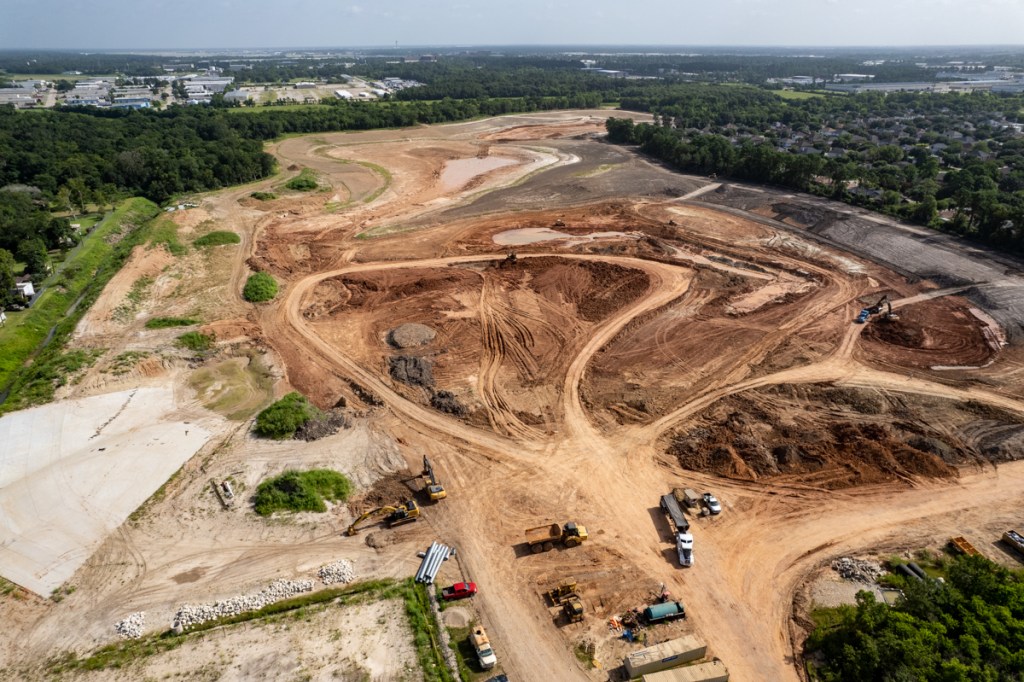
At the southeast end of the site, a temporary detention pond holds runoff from the construction site. Eventually, contractors will replace it with a permanent detention pond farther to the west.
This Google Earth photo taken months ago, shows the new middle school going in where the playing fields used to be north of the existing school. When the new building is complete, it will be torn down and the playing fields will be relocated where the existing building is now.

The new middle school’s design incorporates the concept of Kingwood’s “Livable Forest,” using ample amounts of natural light to combine interior and exterior spaces into a cohesive learning environment. There will be more space for collaboration, integrated physical activity and movement. Classrooms will be about 200 square feet larger. Car and bus drop-off and pick-up have also been optimized to relieve traffic on the neighboring streets.

Computer rendering of new school.

Target opening: start of the 2022 school year. So we still have another year of construction. But I’m sure the result will be well worth any inconvenience.

Posted by Bob Rehak on 3/22/2021

1301 Days since Hurricane Harvey

Sunset Commission Recommends SJRA Improvements, But Tiptoes Around Key Issues

On January 21, 2021, the Texas Sunset Commission released its “Staff Report with Commission Decisions” on the San Jacinto River Authority (SJRA). The 53-page report generally gave the SJRA a good review, but recommended that it:

  • Improve trust through better communications, public outreach, openness and transparency
  • Receive better value by improving contracting processes

The Commission also recommends that the Texas Legislative Council update and consolidate the SJRA’s governing law and processes.

The Sunset Act never subjected the SJRA to abolishment. However, it put its governance, management, operating structure, and compliance with legislative requirements under a microscope.

This post was based on public information taken from the Sunset Commission website.

Litigation Issues Deliberately Not Addressed

The report alluded to issues surrounding flooding and groundwater. However, Sunset Commission does not comment on issues in litigation as a matter of policy, so as not to influence the outcome. And although the Commission received extensive public input, it did not address comments directly for the same reason.

Those who take the time to read the entire report will be rewarded with a thorough, yet concise and illuminating summary of the SJRA’s business and the challenges it faces. The SJRA has adopted most, if not all, of the recommendations made by the Commission to some degree. Adopting the recommendations should not have any adverse fiscal impact on the SJRA or cause it financial strain.

Need for Better Communication and Engagement to Improve Trust

The Commission found that SJRA needs an effective communications strategy to advance projects. Especially if the projects could result in increased costs to the general public years before the public sees benefits.

Criticism: SJRA has not developed a formal strategy for engaging the general public in its activities, struggles to provide clear explanations of its wholesale water rates, and does not maintain important information on its website.

The Commission recommended a more proactive and strategic approach to communicating with and engaging the public. That, it felt, would help SJRA earn the trust of and get buy-in from the communities it ultimately serves.

Key recommendations included:

  • Require SJRA to adopt a public engagement policy that guides and encourages public involvement on key decisions.
  • Direct SJRA to develop a strategic communications plan.
  • Direct SJRA to provide clear, understandable information on its rates and fees prominently on its website.

Improve Contracting Function to Receive Best Value

The Commission also found that the SJRA guidance to staff fell short in important areas. Those areas included justifying the need to outsource services and maximizing open competition for contracts. In addition, the commission also felt SJRA lacks consistent documentation for monitoring the performance of its vendors.

Key recommendations included directing the SJRA to:

  • Establish additional guidance for contracting needs and procurement methods, and use open solicitations except in documented exceptions.
  • Consistently monitor, document, and evaluate vendor performance.
  • Improve the transparency, fairness, and effectiveness of its contracting process.

Update Governing Law and Processes

Over the years, Sunset reviews have included a number of standard elements designed to ensure open, responsive, and effective government. SJRA’s governing law does not contain several standard provisions, including those related to the governor’s appointment of the board president, grounds for removal of a board member, board member training, separation of duties of board members from those of staff, public testimony at board meetings, and maintaining a system for receiving and acting on complaints.

SJRA’s governing law is also uncodified and difficult for the public to find and understand. Finally, SJRA lacks goals and a plan to increase its workforce diversity.

Key recommendations:

  • Apply the standard across-the-board requirements regarding governor appointment of the board’s presiding officer, grounds for removal of a board member, board member training, separation of duties of board members from those of staff, public testimony at board meetings, and maintaining a system for receiving and acting on complaints.
  • Direct the Texas Legislative Council to update SJRA’s governing law.
  • Direct SJRA to plan and monitor its efforts to increase workforce diversity.

Other Findings

Strained Relationships with Stakeholders

Sunset Commission staff observed how protracted legal disputes and other controversies have strained SJRA’s relationship with some stakeholders and communities. That eroded trust in its decision making and jeopardized its ability to conduct the long-term planning and construction for which the Legislature created it.

The general public was highly critical of SJRA’s efforts, in contrast to SJRA’s direct customers who were generally satisfied with the authority’s performance.

No Formal Strategy for Public Engagement

SJRA’s own recent public opinion poll revealed most respondents had a negative opinion of the authority, no opinion of it, or had not heard of it, highlighting the need for direct outreach to the public rather than relying on others to speak on its behalf.

Lack of Clear Communication about Rates and Fees

A frequent complaint during the Sunset review was that consumers often see an “SJRA fee” or “surface water conversion fee” listed on their monthly bill with little to no explanation. SJRA’s public opinion poll confirms many consumers do not know what the fee is for. Only about half of respondents correctly identified the fee is used for maintaining a water treatment plant and pipeline.

Several other wholesale water providers in the region explain their rates and fees, which are higher than SJRA’s, on the front page of their website and clearly describe how some retail utility providers modify the fees when passing them on to consumers to cover other costs.

Governing Law Outdated, Difficult for Public to Find and Understand

While some water districts and river authorities are governed by laws that are fully compiled in a specific Texas code or statute, SJRA’s governing law exists solely in “session law.” That means changes are scattered in various statutes and amendments dating back to 1937. In the absence of ONE codified statute, members of the public and even the river authority itself struggle to correctly compile all of the changes to its laws and understand their cumulative impact.

For example, SJRA’s governing law stipulates the board has six members, even though the Texas Constitution now requires all boards and commissions to have an odd number of members. Even Rep. Will Metcalf’s recently introduced bill, HB3116 – recommending changes in how the governor makes SJRA board appointments – still refers to six positions.

Although general law adds a seventh member to preserve the board’s constitutionality, this outdated provision in SJRA’s governing law misrepresents the board’s actual makeup.

SJRA’s governing law contains many more out-of-date references to defunct state agencies and code sections that have been amended, renamed, or no longer exist, further complicating full understanding of the authority’s powers and duties.

Revenues and Expenses

The SJRA had approximately $112 million in revenues in Fiscal Year 2019 with $115 in expenses. The difference had to do with some reserve-fund expenditures for specific projects.

Litigation Summary

For an excellent summary of SJRA litigation over groundwater issues and Harvey flooding, see Appendix B on Page 37. Even as someone who follows these cases closely, there were several aspects that I simply did not know about.

For More Information

Read the entire Sunset Commission report and visit their website. One thing I discovered: the SJRA was apparently the only agency/authority reviewed last year for which the Sunset Commission did not request legislative changes.

For the Sunset Commission Report to the Legislature on all agencies, click here.

For the State Auditors Report on recommendations that were self-implemented, click here.

Posted by Bob Rehak on 3/21/2021

1300 Days since Hurricane Harvey

Rep. Metcalf Introduces Bills to Deny Downstream Representation on SJRA Board

Texas State Representative Will Metcalf from Conroe has introduced two bills in the 87th Legislature that would affect the composition of the San Jacinto River Authority (SJRA) Board. The two bills have major differences. One calls for the election of Board members. In case that fails, the other recommends how the Governor should appoint directors. Both bills, however, introduce an upstream bias in the selection of board members at the expense of downstream residents.

Excluding Harris County Voters

HB4575 would create a Board of seven directors who must be legal voters in the State of Texas. It does not specify who gets to vote in the election. It simply says voters in the District will elect Board members at large. But the boundaries of “the District” are not defined in HB4575. They are, however, defined in Section 5 of the SJRA enabling legislation to EXCLUDE Harris County. So far, no other sponsors have signed onto the bill.

Stacking Deck in Favor of MoCo

HB3116 relates to recommendations for the appointment of SJRA directors. It calls for the Governor to appoint six directors, all of whom must be Texas voters and property owners. Four of the six must reside in Montgomery County, the only county wholly encompassed by the District defined in the SJRA boundaries.

The Commissioners Court of Montgomery County would get to recommend two directors to the governor. Other counties in the watershed could each recommend one. But, again, four – a two-thirds majority – would have to reside in Montgomery County.

The SJRA board currently has seven members, so this bill would reduce that number by one and also increase the possibility of tie votes. That could help stymie approval of policies, such as lowering Lake Conroe seasonally or fighting subsidence. As of this date, no other sponsors have signed onto this bill either. It was referred to the Natural Resources committee yesterday.

Could Impact Lake-Lowering Policy

Metcalf’s filing of these bills comes hot on the heels of a contentious debate last year about seasonal lowering of Lake Conroe to provide a buffer against flooding in downstream communities. The hotly contested issue drew hundreds of Lake Conroe residents to a board meeting that had to be held in the Montgomery County Convention Center to accommodate the crowd. Protestors complained that it would ruin recreation and the tax base of Montgomery County.

In the end, the appointed board voted to continue its lake lowering policy. The policy calls for lowering the lake from 201 feet to 200 during April and May, then again in August. During September, the peak of hurricane season, the SJRA would lower Lake Conroe an additional half foot to 199.5. The City of Houston owns two-thirds of the water in the lake, and all releases come from the City’s share, and only at the City’s request. SJRA staff coordinate with City staff on the details and timing of all releases. And if the level of Lake Conroe has already dropped to the target elevation due to natural evaporation, no additional releases are called for.

The SJRA board first adopted this policy after Governor Gregg Abbott visited the flood-ravaged Lake Houston Area in 2018. That year, he also appointed two downstream residents who flooded during Harvey, Kaaren Cambio and Mark Micheletti, to the SJRA board.

Kingwood Greens Evacuation During Harvey by Jay Muscat
Photo by Jay Muscat of the Kingwood Greens Evacuation during Harvey after the SJRA release from Lake Conroe.

If Metcalf’s bills gain traction, the bills could potentially undermine the lake-lowering policy. The SJRA Board extended it for three years starting last year. That would give the City of Houston time to add more gates to the Lake Houston dam. FEMA gave the City three years to complete the gates when the project clock started ticking on April 8th of last year. The City is still in the preliminary engineering phase of that project, and trying to prove up the benefit/cost ratio for FEMA.

Could Also Impact Groundwater and Subsidence Debates

Metcalf’s bills could also affect the subsidence debate between upstream and downstream interests.

Shortly after the Lone Star Groundwater Conservation District (LSGCD) first elected its board in 2018, the LSGCD board began advocating for higher groundwater pumping. It has also stonewalled any mention of subsidence in the desired future conditions for Montgomery County in Groundwater Management Area 14.

Private groundwater providers, such as Quadvest, heavily backed a slate of candidates for the LSGCD Board in 2018. Their candidates won based on the promise to “restore affordable water,” but residents report that water rates have not gone down.

The SJRA has opposed the unlimited pumping of groundwater. Electing the SJRA board, too, opens it up to the same kind of shadowy influence exerted by Quadvest prior to the 2018 election. If Quadvest is successful again, Quadvest could eliminate its primary opposition on the subsidence issue. The residents of northern Harris and southern Montgomery Counties would then potentially face increased subsidence. And subsidence can damage foundations, walls, ceilings, cabinets, doors, driveways, streets, pipelines, and more.

As the map below shows, subsidence could also tilt Lake Houston toward the Harris/Montgomery County line by two feet relative to the amount of subsidence at the Lake Houston Dam. That could increase flood risk for people living in the upstream reaches of the lake.

Drawing down aquifers in MoCo by 30% (leaving 70%) was supposed to have produced no more than 1 foot of subsidence, but models showed it could produce 3 feet in the Kingwood and Huffman areas of Harris County.
The same amount of pumping produced 3.25 feet of subsidence in southern MoCo.

Neither Elections, Nor Appointments, Should Exclude Affected Residents

I normally don’t oppose elected boards. But I also don’t want to return to the days just before Harvey when the SJRA board represented only upstream interests and downstream areas flooded disastrously.

If the SJRA board is elected, downstream residents in Harris County should be able to vote on the board members. Metcalf’s bills have the appearance of populism, but they strive to stack the deck against downstream residents. Both are wrong.

Everyone who lives and works along the San Jacinto should get to vote on the composition of the SJRA Board if board members will be elected.

Posted by Bob Rehak on 3/20/2021

1299 Days since Hurricane Harvey

The thoughts expressed in this post represent opinions on matters of public concern and safety. They are protected by the First Amendment of the US Constitution and the Anti-SLAPP Statute of the Great State of Texas.

New Bayou Greenway Now Connects Kingwood, Forest Cove

The Houston Parks Board’s newest leg of the San Jacinto Bayou Greenway is nearing completion. Construction started near River Grove Park in Kingwood and is working its way west toward Harris County Precinct 4’s new Edgewater Park at US59.

First Leg Now Concreted, Others Under Construction

The first leg of the concrete trail connects River Grove Park and the Kingwood Trail Network to Hamblen Road in Forest Cove. From there, the trail snakes through streets in the Northshore neighborhood, such as Northshore Drive and Sunrise Trail. It currently stops just north of the Forest Cove little league fields on Forest Cove Drive. However, the trail will continue west; that’s just the extent of current construction. At the ends of streets that don’t connect, the Parks Board is building connector trails for hikers and bikers.

The only portion of the San Jacinto Bayou Greenway completely concreted to date links Woodland Hills Drive and Hamblen. Other portions of the trail are partially concreted, and some are still being cleared. Construction fences are still up, even in the areas with concrete, as crews have not yet finished installing benches and planting grass.

Not Yet Quite Bike Ready

Net: Don’t take your bike through there yet. These pictures taken this afternoon show the current state of construction.

Looking west from the entrance to River Grove Park in Kingwood toward Hamblen Road in Forest Cove at the new San Jacinto Bayou Greenway trail.
Closer view of same trail in same direction. Note the limited landscaping to date.
Reverse angle looking east toward River Grove from the end of Hamblen Road in Forest Cove.
Another leg of trail, not yet complete, connecting Northshore Drive and Sunrise Trail. Looking SW from Northshore.
Where second leg of trail exits onto Sunrise Trail.
Current end of construction activity at Forest Cove Drive just north of Little League Fields.

Trail is actively being cleared farther to the east, but it’s not yet passable. The cleared portion currently terminates at Marina Drive near the Forest Cove Pool, behind the townhomes destroyed by Harvey.

Map courtesy of Houston Parks Board.

While th San Jacinto Bayou Greenway project will help to revitalize the area, some residents who survived the storm and rebuilt their homes lament the loss of seclusion. However, avid hikers and bikers will no doubt will love the trail which will connect to the Spring Creek Greenway and take people up to the Woodlands. It represents a vast expansion of connected trails in the area and will rival the largest urban trail networks in the countryif it won’t be the largest.

That will put Kingwood and Forest Cove back in the news again in an immensely positive way. It will also create a magnet that improves home values again and attracts younger couples with children trying take advantage of Humble ISD schools.

This project has been in the planning stages since shortly after Harvey. It was just last month that the first leg of the trail connecting River Grove and Hamblen was cleared. Crews have made considerable progress since then.

Posted by Bob Rehak on 3/19/2021

1298 Days since Hurricane Harvey

Flood Notes: Quick Updates on Multiple Flood Related Topics

Below are updates on seven flood-related topics from around the Lake Houston Area and Texas.

Plugging of Noxxe Wells in Forest Cove Delayed

Peter Fisher of the Texas Railroad Commission reports that its Oil & Gas Division is about eight to 10 weeks away from plugging the NOXXE wells in Forest Cove. Noxxe abandoned the lease when Harvey cleanup costs forced the company into bankruptcy. The Commission’s General Counsel notified Fisher on March 4th that another operator is attempting to take over the NOXXE leases.  “At this time we do not know for sure which wells they are interested in.  Therefore, we are currently in a holding pattern on plugging the NOXXE wells,” said Fisher. TRRC has already finished cleanup of the rusting tanks in Forest Cove, but several wells still appear to be leaking based on aerial photos that show oil on ponds and in the public water supply.

Black substance in West Fork/Lake Houston stretched for about a half mile on December 7, 2020, next to one of many abandoned Noxxe wells.

Texas GLO and Houston Declare Truce for Time Being

Last year, the Texas General Land Office (GLO) tried to claw back funds allocated to the City of Houston for several Harvey-related disaster assistance programs. Why? The City fell seriously behind deadlines, even as the reimbursement program was expiring. Then the two sides reached a settlement and the City took back some programs. Houston will continue to administer $835 million in programs – Homeowner Assistance (reimbursement program), Single Family Development, Multifamily Rental, Small Rental, Homebuyer Assistance, Buyout, Public Services and Economic Revitalization Programs.

However, the GLO included strict program benchmarks with language that includes: “Program Benchmarks: Subrecipient’s failure to achieve a Program Benchmark in the Subrecipient Agreement may result in the termination of the Program and/or funds being removed from the Contract, at the GLO’s sole discretion.” HUD’s rules include that funds be expended – not allocated – by August 2024, plus one more year for close out, or else HUD will retain the funds.

City’s Homeowner Assistance Applications

In the meantime, the GLO is keeping the City’s Homeowner Assistance Program. Many who first applied through the City have been caught in limbo due to missing, incomplete and poorly formatted documents.

On December 30, 2020, the GLO received 48,000 documents that had no discernable naming conventions, were not grouped by applicant, and were mostly unsearchable. The GLO had to open each document to determine which applicant it belongs to and file accordingly. On January 27, 2021, the GLO received a transfer of additional files that appear to be mostly environmental assessments, but once again, were not organized. The GLO has sorted the files from the City of Houston and the GLO team is contacting applicants to request missing or outdated documentation to move them towards construction.

We received data for 7,176 files, but nearly half had none or only one of the documents needed for a complete application to achieve HUD eligibility. “We are in the process of contacting all applicants to determine which ones still wish to participate and request the documents we need to complete their files,” said a GLO spokesperson.

Court Reverses Air Quality Permit for APO

Texans for Responsible Aggregate Mining announced that on March 5, a district court in Austin struck down an air-quality permit for a quarry. Alabama-based Vulcan Construction Materials needed the permit to proceed with a controversial project.

Texas Commission on Environmental Quality (TCEQ) had initially granted the permit in 2019 after two years of heated legal wrangling between Vulcan, the nation’s largest producer of construction aggregates, and an alliance of Comal County citizens, community groups and Comal ISD.

459th Civil District Court Judge Maya Guerra Gamble ruled that:

  • TCEQ’s assertion that the quarry would not harm human health or welfare was not supported by evidence.
  • Vulcan’s emissions calculations were not representative and not supported by substantial evidence.
  • Vulcan’s air quality analysis did not account for cumulative impacts or emissions from the quarry and roads.
  • Vulcan’s choice of background concentration was arbitrary or capricious.
  • In the contested case hearing, the State Office of Administrative Hearings (SOAH) judge erred in allowing Vulcan to hide behind “trade secret” claims.
  • Plaintiffs were denied due process when the SOAH judge allowed Vulcan to conceal data using the “trade secret” excuse and did not allow plaintiffs to cross-examine Vulcan.

Vulcan’s proposed mining operation in the Texas Hill Country would stretch across nearly three miles of the environmentally sensitive Edwards Aquifer Recharge Zone, the primary water supply for over two million people in New Braunfels and San Antonio.

Lone Star Groundwater Conservation District Punts on Subsidence Again

After several filibusters, the Lone Star Groundwater Conservation District Board again deferred publicly adopting a position on subsidence or approving the second half of its subsidence study in a mercifully brief March 9th meeting. The District’s general manager and counsel are reportedly querying stakeholders on the subject. But time is running out before GMA-14 meeting. The LSGCD may have to call a special meeting before the next GMA-14 meeting on April 9th to resolve those issues. It will be interesting to see what they come back with. Simon Sequeira, of Quadvest, one of the largest independent water pumpers in the county is a stakeholder.

Kerr County Commissioners Support Best Management Practices for Local APOs

The adoption of best management practices by sand mines in the San Jacinto watershed has been a legislative goal of area groups since Harvey. It was during Harvey that floodwaters swept through mines and flushed sand downstream where it contributed to the flooding of thousands of homes and businesses. Now the Hill-Country group, Texans for Responsible Aggregate Management reports they have achieved a victory of sorts.

On March 1st, 2021 the Kerr County Commissioners’ Court unanimously passed a resolution supporting TRAM’s legislative goals, as well as a resolution encouraging Kerr County APOs to adopt Best Management Practices (BMPs) in order to minimize adverse health effects and nuisance issues. The resolution was sparked by concerns over West Texas Aggregate LLC’s desire for a permanent rock and concrete crusher facility near the airport east of Kerrville.

LCRA Adopts Commercial Dredging Moratorium on Highland Lakes

On February 24, 2021, The Lower Colorado River Authority Board of Directors adopted a one-year moratorium prohibiting commercial dredging on the Highland Lakes until new rules are established. This action states that LCRA will not review pending permit applications such as the Collier Materials Inc. permit application for commercial dredging on the Llano River and cancelled the public meeting scheduled for March 10, 2021.

The Board determined that new rules are necessary to address commercial dredging projects and their potential impact on water quality, aquatic life and public safety on the lakes. Over the next year, LCRA will review potential water quality impacts of commercial dredging, coordinate with other entities, and conduct a robust public and stakeholder input process.

Posted by Bob Rehak on 3/18/2021

1297 Days since Hurricane Harvey

The thoughts expressed in this post represent opinions on matters of public concern and safety. They are protected by the First Amendment of the US Constitution and the Anti-SLAPP Statute of the Great State of Texas.

Easy Way to Track New Developments Near You

If you live in the City of Houston or within its extra-territorial jurisdiction (ETJ), the City provides an easy way for you to track the progress of new developments near you.

Step One: Go To the Plat-Tracker Map

The City provides an interactive map based on geographic information system (GIS) technology. In your browser, go to a website called Houston Plat Tracker Plats. GIS maps translate database information into a familiar map format.

Houston Plat Tracker Map as of 3/17/2021. Look at the size of those two proposed subdivisions northeast of Lake Houston!
  1. After navigating to the site, scroll and zoom to your area of interest.
  2. Select a base map to suit your taste. Choose from satellite views, street maps, topographic maps and more. Do this by clicking on the four squares in the upper left hand corner.
  3. Turn on the layers that interest you. Choose from City Limits, Council Districts, Management Districts, TIRZs (tax increment reinvestment zones), ETJ, historical districts, and more. Do this by clicking on the layers icon next to the base map icon.
  4. With the tools in the upper right corner, you can draw on the map, measure distance and direction, print, bookmark and share.
  5. By now, the map should be populated with a mass of color-coded outlines.
  6. Click on any colored area to find background information about it, such as the developer and the application number. At the bottom of the informational pop-up box, there’s an interactive link to the City’s Planning Department website where you can learn more about the project.

Step Two: Look Up More on the City Planning Department Website

The City Planning Department website offers much more information about projects that may concern you, especially if they are coming up for a vote in the Planning Commission. Here you’ll find interactive and PDF spreadsheets that list which projects will be considered in the next meeting of the Planning Commission. The site also lists the:

  • Subdivision plat name
  • Application Number
  • When the developer submitted files
  • Subdivision Plat type
  • Whether a variance request exists
  • The location of the issue on the agenda
  • County, City, Council District, Precinct
  • Key Map code
  • Census Tract
  • Zip Code
  • School District
  • Address of the development.
  • TIRZ, Management District, Historic Districts if applicable
  • Super Neighborhood Council
  • Park Sector
  • Proposed Land Use
  • Property Size
  • Number of Lots
  • Appraisal District ID
  • Developer
  • Applicant Company
  • Applicant’s Name
  • Applicants Phone
  • Subdivision Plat with flood zones, if any, superimposed

The Houston Plat Tracker Plats website contains future and past agendas, the planning commission calendar, and development regulations. It also contains a design manual and a host of other tools in case you feel something is amiss.

Finally, it lets you set up an account so you can get notifications of what future meetings will consider.

Possible Step 3

If you find something disturbing, sign up to express your concerns at the Planning Commission, or call your city council person’s office.

You can also request copies of the drainage analysis and construction plans at a certain point in the project.

Informed citizens keep everyone conscientious. No one cares about your home like you! So keep your eyes open for new projects in your neighborhood or upstream.

To learn more about 15 other GIS maps that the City makes available online, visit this start page. You can find fascinating information about land use, demographics, flood hazards and more. Good luck.

Posted by Bob Rehak on 3/17/2021

1296 Days since Hurricane Harvey

Harvey Repair, Rebuild Assistance Still Available for Harris County Residents

Assistance is still available for those who live in Harris County if you have not yet repaired or rebuilt your home damaged in Hurricane Harvey. Applications are NOT for reimbursement.

They are for repairs and rehab handled through U.S. Department of Housing and Urban Development (HUD) contractors, that meet HUD specs. So forget about marble floors and countertops, adding garages or extra bedrooms, or upgrading to top-of-the-line appliances.

As long as you live in Harris County and you meet the requirements, you can still submit an application. However, understand that Harris County (compared to the City) has far more funding available than applications in its pipeline. Also understand that you can apply through the Texas General Land Office (GLO), which now handles applications for HUD; you don’t need to go through the City or County directly.

Lloyd Nelms and family receive the keys to a rebuilt home.

Types of Help Available

The GLO can provide homeowner assistance through:

  • Repairing and rehabilitating homes
  • Reconstruction
  • Improving a damaged home so that it is more resilient against natural disasters
  • Elevating homes above flood level

How to Apply

How and where to apply depends on whether you live inside the City of Houston or out.

If you live in Harris County but OUTSIDE the City of Houston:
  1. Apply online here.
  2. Download and complete a paper application below. Applications can be submitted by email at harriscounty.glo@recovery.texas.gov or mail to Homeowner Assistance Program 2100 Space Park Drive, Suite 104, Houston, TX 77058. 
  3. Call 346-222-4686 or 1-866-317-1998 (toll free) and a regional office team member will assist with the application process.
If you live in Harris and are INSIDE the City of Houston:

This page explains all the necessary steps and documents: https://recovery.texas.gov/hap/houston. You also have three easy options.

  1. Apply online here.
  2. Download and complete a paper application below. Applications can be submitted by email at houston.glo@recovery.texas.gov or mail to Homeowner Assistance Program 2100 Space Park Drive, Suite 104, Houston, TX 77058. 
  3. Call 346-222-4686 or 1-866-317-1998 (toll free) and a regional office team member will assist with the application process.

All Documents Necessary Before Apps Will Be Processed

Applications, including all necessary documentation, must be completed and submitted BEFORE the GLO and its partners will begin processing it for eligibility. Each application submitted must be individually evaluated to determine eligibility. Please use this checklist for reference whether you live inside or outside of the City.

Without enough qualified applicants, GLO will be forced to send the money back to Washington. So hurry, before the money goes away or runs out.

What to Expect

Potential applicants can watch this video about What to Expect.

The GLO created this video about homeowners who received assistance through this program. Here’s another showing a homeowner who just received keys to a rebuilt home.

Posted by Bob Rehak on 3/15/2021

1295 Days since Hurricane Harvey

Bens Branch Clean-out North of Kingwood Drive Already 40% Complete

As of this morning, Stuart Consulting Group (a project manager for Harris County Flood Control) estimates that clean-out of Bens Branch between Kingwood Drive and Rocky Woods Drive is 40% complete.

1500 Feet Complete from Upstream Starting Point

According to Jose Pedraza who works for Stuart Consulting, the contractor began work at the upstream/Rocky Woods Drive end of the site and is moving downstream. So far, they have completed about 1500 linear feet of work on both sides of the stream.

At the start of the project, surveyors found that accumulated sediment had severely constricted the conveyance of the channel.

Ben’s Branch at start of project in January. The area between the red lines filled with sediment since Friendswood first constructed the ditch in the 1970s.
Looking south from between Rocky Woods and Valley Way Drive. This is how the section above looks today from a drone. Photo taken 3/13/2021. Note Kingwood High School in upper right.
Farther downstream, looking east toward Kingwood Town Center in background. Contractors have just started working on this reach of the stream.
Looking back upstream toward the west and Kingwood High School, you can see same reach from the opposite direction.

Work to Date Has Included…

So far, the contractor has:

  • Conducted excavation and off-site disposal
  • Installed import fill, 3×5 granular fill, and grade 1 riprap
  • Graded channel side slopes on both sides of the channel for 1500 linear feet.

Expected Completion by July 4 or Earlier

Due to weather and other small delays, projected duration of the job increased from 150 to 168 days. Expected completion was extended to July 4, 2021. However, based on recent on-site inspection reports, work is now moving faster. So, with luck, the finish date may be pushed forward into June once more.

Preserving Property, Tax Dollars

Homes on both sides of this stream flooded during Harvey. So did Kingwood High School. The building flooded to the second floor. It suffered $67 million dollars in damages and lost another $10 million in contents.

Hopefully, this project will reduce flood risk. Conveyance of the channel had been reduced from a 100-year level of service to a 2-year level in some places. A 2-year level of service means that the creek will flood in a 2-year rain. The goal of this project is to restore the channel to its original conveyance capacity. That includes straightening, widening and deepening clogged parts of the channel.

Posted by Bob Rehak on 3/15/2021

1294 Days after Hurricane Harvey

NWS Says Chance of San Jacinto River Flooding in Next Three Months is Minor

The National Weather Service (NWS) predicts only minor flood risk for both the West and East Forks of the San Jacinto through the end of May. That’s the good news.

NWS predicts only minor long range flood risk for the East (38.85%) and West Forks (26.22%) of the San Jacinto.

Drought Conditions Expanding Across Texas

But there is a downside: potential drought.

The reason for the low risk has to do with a below-average rainfall pattern across much of Texas. The Texas Water Development board posted two stories in the Texas Water Newsroom last week about the potential for drought. Large parts of the state are already severely behind on rainfall for the year and the pattern is expected to continue through May when weakening La Niña conditions could return us to normal.

Source: Texas Water Development Board as of end of February 2021.

The map above shows that most of the Houston area has received about 90% of expected rainfall year to date. But large parts of the state have received less than 20%. TWDB predicts those dark areas on the map will expand at least through May. At that point, TWDB predicts only the extreme eastern part of the state will not be in some kind of drought condition.

At the end of February, drought covered just over half the state, according to the TWDB. Statewide storage in our water-supply reservoirs is at 82 percent of capacity, about three and a half percentage points less than normal for this time of year. 

Drought Relief Could Come as La Niña Fades

Says Dr. Mark Wentzel, Texas Water Development Board Hydrologist, “The National Weather Service anticipates drought expansion across all but the eastern edge of the state by the end of May. Looking a little farther out there is some good news. La Niña conditions, that are at least partially responsible for drought in Texas, are expected to dissipate after April.”

So, the river flooding outlook could be very different by Hurricane season this year.

Did snow in February not help? Not really. Wentzel points out that snow is mostly air. It takes up to a foot of snow to equal and inch of rain.

Posted by Bob Rehak on 3/14/2021

1293 Days since Hurricane Harvey