On Eve of Hurricane Season, NOAA, NWS, NHC, FEMA Struggle with Cuts

5/31/25 – The 2025 Hurricane Season starts tomorrow, 6/1/25. But ironically, despite predictions of an above-average season, the federal agencies that help forecast hurricanes, issue warnings, and provide disaster relief are struggling with significant funding, staff and program cuts.

Poignant Letter in New York Times

Michael Lowry, who served as a senior scientist at the National Hurricane Center (NHC), a planning chief at FEMA, and a hurricane expert at the Weather Channel, wrote a poignant letter published in the New York Times today under the headline “A Hurricane Season Like No Other.”

The letter began with an anecdote about data collection from inside Hurricane Milton last year by a Hurricane Hunter crew. The data they collected about “vortex alignment” heralded rapid intensification of the storm. Within 24 hours, it had become the strongest hurricane in 20 years with 180 MPH winds.

Milton satellite
Milton as it began intensifying and heading toward the Florida Coast

But there was no surprise on the Florida coast. The forecasts gave “enough time for people in the highest-risk areas to safely evacuate and businesses to prepare for the worst.”

Lowry then segues to budget, staff and program cuts at FEMA, NOAA, NHC, the National Weather Service (NWS), Hurricane Hunters, and more. Some examples:

  • NWS offices that have lost 60 percent of their staff members, including entire management teams.
  • Nearly half of NWS local forecast offices are understaffed, with vacancy rates of 20 percent or higher.
  • Weather balloon launches are down 15 to 20 percent nationwide. The balloons increase forecast confidence and let evacuation orders be made sooner. 
  • New budget documents released Friday propose eliminating NOAA’s research wing, the Office of Oceanic and Atmospheric Research, which lends mission-critical support to the hurricane hunters.

Along the way, Lowry points out that “The National Weather Service costs the average American $4 per year in today’s inflated dollars — about the same as a gallon of milk — and offers an 8,000 percent annual return on investment, according to 2024 estimates.”

“Without the arsenal of tools from NOAA and its 6.3 billion observations sourced each day, the routinely detected hurricanes of today could become the deadly surprise hurricanes of tomorrow,” he says.

Bottom line: Lowry says we’re jeopardizing decades of progress that have increased forecast accuracy and warning times. And that will put more people at risk.

Dizzying Days for FEMA: Cuts and More Cuts

Andrew Rumbach, a Senior Fellow with the Urban Land Institute writes about policies for disaster risk reduction. He wrote a Substack post in early May called “100 Dizzying Days for FEMA.” It details the dismantling of disaster-relief and flood-mitigation capabilities including:

Could States Do What FEMA Does?

An article in the June 9 issue of Time Magazine addresses whether states could do what FEMA does. The consensus: it makes more sense to manage disaster response at the federal level. Why? It’s more efficient. If you spread disaster responsibilities among 50 states, you will have a lot of people sitting around a long time between disasters. FEMA can shift people from state to state, disaster to disaster, and keep them busier.

Experts cite the need for reform. But getting rid of the system without a meaningful replacement is likely to cause harm.

My takeaway from the article: Surgeons experience better outcomes with scalpels than cannons.

Erosion of Safety Margins

We live in a time of uncertainty. I’m not sure which is scarier: major hurricanes, a reduction in forecasting capabilities, or the loss of disaster-relief and flood-mitigation assistance.

These cuts will erode safety margins. Sixty million Americans reportedly live in areas regularly impacted by hurricanes.

If you haven’t already completed preparations for hurricane season, check out this NWS page on Hurricane Safety Tips and Preparations. Before someone takes it down to save a buck.

Posted by Bob Rehak on 5/31/25

2832 Days since Hurricane Harvey

Where Texas Gets Its Money and Why It Matters

4/26/25 – Where does Texas get its money and why does it matter?

According to data from the U.S. Census Bureau analyzed by the Pew Foundation, the State of Texas received almost as much revenue from the Federal Government as it did from taxes in 2022.

That means that cutbacks in federal spending could affect disaster preparedness, flood mitigation, and recovery efforts in the Lone Star State at a time when more and more hurricanes are rapidly intensifying.

Texas Gets 38% of Its Money From Federal Government

In 2022, the last full year for which the Census Bureau has published data, Texas received 38% of its revenue from the federal government.

Data Source: U.S. Census Bureau’s 2022 Annual Survey of State Government Finances

Texas receives more than the national average in terms of the percentage of its funds received from the federal government.

From Pew based on data above.

Over time, the percentage has trended up.

Data downloaded from Pew, Where States Get their Money

The percentage peaked in Texas during the Pandemic, but otherwise has hovered in the 30-40% range for the last quarter century.

How States Use Federal Money

According to Pew, the funding states receive from the U.S. government helps pay for public services, such as health care; education and training; public safety and justice; housing and community development; child care; transportation; and infrastructure.

In Texas, billions also help mitigate flooding in the form of buyouts; grants for studies; and design and construction of flood-reduction projects.

Budget Cuts Could Impact Disaster Spending

Recent budget cuts driven by the Department of Government Efficiency (DOGE) under the Trump administration have significantly impacted both the Federal Emergency Management Agency (FEMA) and the Department of Housing and Urban Development (HUD), affecting disaster preparedness.

The cuts come in the form of program terminations, staff reductions, and shifts in responsibilities. The administration has signaled intentions to drastically reduce or even eliminate FEMA’s role in disaster response, shifting responsibilities to states. 

The reductions not only diminish the federal government’s capacity to respond to emergencies, but also place additional burdens on state and local governments to fill the gaps left by these federal withdrawals.​

Axios published a story on 4/25/25 about the effects of staff and budget cuts on FEMA headlined “FEMA staff fear they aren’t ready for 2025 hurricane season.”

More Hurricanes Rapidly Intensifying

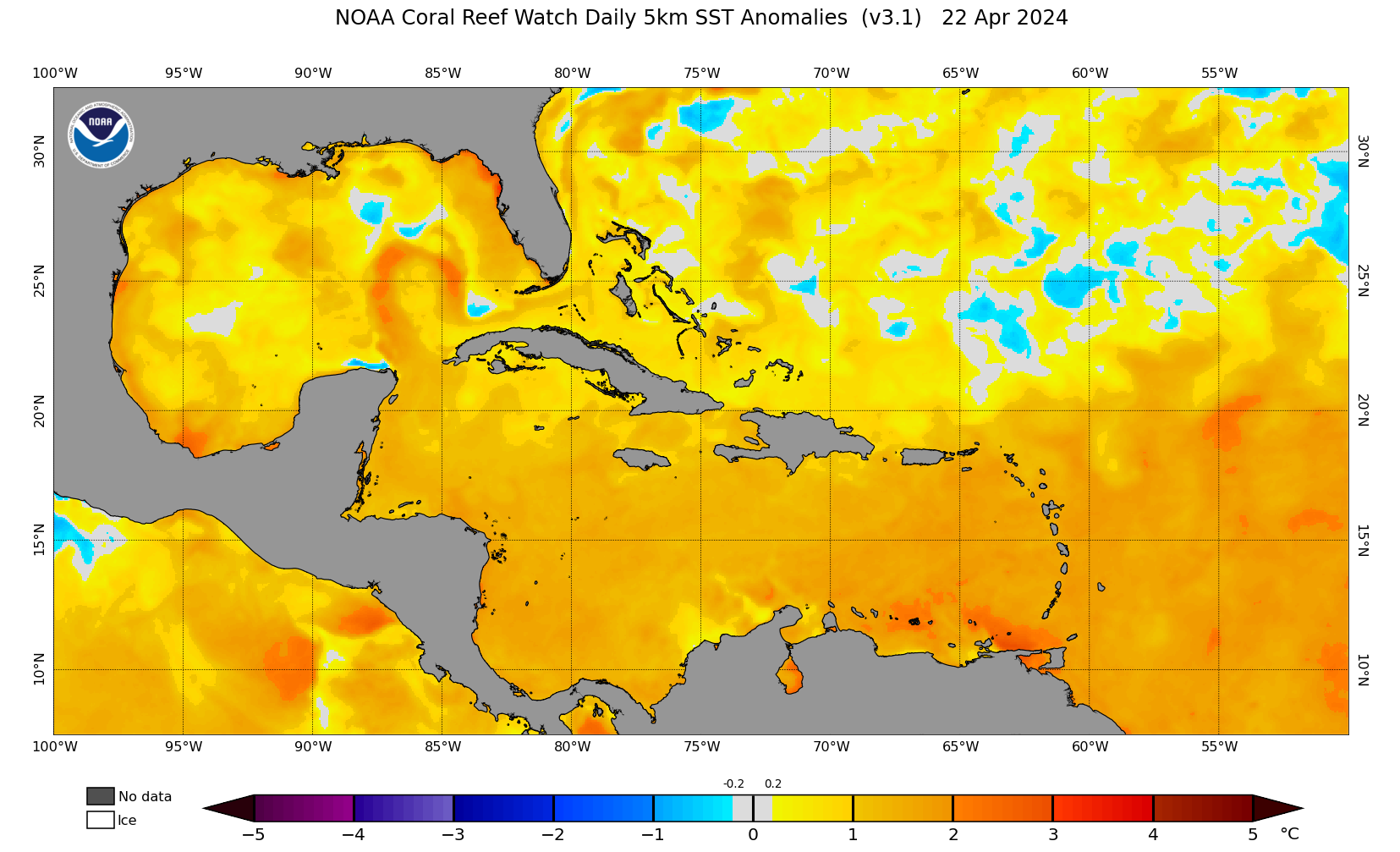
Sea surface temperatures in the Gulf are already raising concerns.

Yesterday’s Sea Surface Temperature Anomalies from NOAA

Recent studies indicate a notable increase in the frequency and magnitude of rapid intensification events:​

  • Increased Frequency Near Coastlines: The frequency of rapidly intensifying storms within 240 miles of coastlines has significantly increased over the past 40 years. ​National Geographic
  • Higher Intensification Rates: Between 1971 and 2020, mean maximum intensification rates for Atlantic tropical cyclones increased by up to 28.7% compared to earlier decades. ​Nature
  • Global Trends: The occurrence of rapid intensification events has tripled in global coastal regions from 1980 to 2020, highlighting a worldwide trend. ​

These changes are largely attributed to warmer ocean temperatures, which provide more energy for storms, and a more humid atmosphere. ​Wikipedia+1The Atlantic+1

Recent Examples of Rapid Intensification

Several recent hurricanes exemplify this alarming trend:​

  • Hurricane Otis (2023): Transformed from a tropical storm to a Category 5 hurricane with 165 mph winds in less than 24 hours before striking Acapulco, Mexico. ​
  • Hurricane Milton (2024): Rapidly intensified from a Category 1 to a Category 5 hurricane within 12 hours over the Gulf of Mexico, fueled by exceptionally warm sea surface temperatures. ​The Atlantic
  • Hurricane Beryl (2024): Became the earliest Category 5 hurricane on record in the Atlantic, intensifying rapidly due to unusually warm ocean waters. ​

Implications for Coastal Communities

The increasing frequency of rapid intensification events poses significant risks, including:

  • Reduced Preparation Time: Communities have less time to prepare and evacuate, increasing the potential for loss of life and property.​
  • Forecasting Challenges: Rapid changes in storm intensity complicate forecasting efforts, making it harder to provide accurate warnings.​
  • Increased Damage Potential: Stronger storms can lead to more severe flooding, higher storm surges, and greater overall destruction.​

Given these trends, it’s crucial for coastal regions, including Texas, to enhance their disaster preparedness plans and capabilities.

Tax-Free Emergency Supplies Through 28th

And that reminds me, emergency supplies such as batteries, flashlights and generators, are tax free this weekend. So stock up now. Here’s a list of tax free items from April 26-28.

Posted by Bob Rehak on 4/26/25

2797 Days since Hurricane Harvey

Why Flood Mitigation Needs Steady Funding Source

4/15/25 – At a flood resilience workshop yesterday in Houston, the importance of a steady funding source for flood-mitigation projects became abundantly clear.

The Biannual Resiliency Workshop of the Society of American Military Engineers (S.A.M.E.) drew a star-studded lineup of speakers for the hundreds of engineers, lawyers and business people in attendance.

Alia Vinson, a partner at the law firm of Allen Boone Humphries Robinson LLP, made steady funding for flood mitigation the focus of her entire talk. She even wore green to underscore her theme. (“The color of money,” she said.)

Alia Vinson, partner at Allen Boone Humphries Robinson LLP, speaking at S.A.M.E. workshop.

After Vinson, the keynote speaker, Congressman Wesley Hunt, talked about “unsustainable federal spending.” The Federal government provides most of the flood-mitigation financial assistance in the country through FEMA and HUD. But both agencies have come under fire by President Trump and Elon Musk lately. That creates uncertainty for Texas where more people live in floodplains than the entire populations of 30 other states.

Competition for Flood Mitigation Funding Getting Stronger

Vinson’s talk focused primarily on the vigorous competition for funds in this Texas Legislature and the previous session. She began with the creation of the Texas Water Fund (Proposition 6) in 2023, which triggered a $1 billion investment in new water infrastructure needed to support a growing population.

The Texas Water Development Board administers the Texas Water Fund. It has the authority to shift money as needed between at least eight different programs. They award loans and grants to political subdivisions for local water and wastewater infrastructure projects. They include:

  • New Water Supply Fund
  • SWIFT
  • State Revolving Funds
  • Rural Water Assistance Fund
  • DFund
  • State Participation Fund
  • Water Awareness Fund
  • Water Assistance Fund

At least 25% of the $1 billion must go to the New Water Supply Fund, which supports projects such as:

  • Desalination
  • Aquifer storage and retrieval
  • Use of produced water
  • Transport of water

The point:

None of these has to do with flooding or flood mitigation.

This year, “new water” again is high on the Legislature’s agenda. Although nothing is final yet, base budgets have set aside $2.5 billion for the Texas Water Fund.

Pending Legislation Could Help Address Mitigation Needs

Vinson then shifted focus to this year’s SB7 by Senator Charles Perry and HB16 by Rep. Cody Harris.

The Senate has already approved SB7 and sent it to the House Natural Resources Committee. A key provision makes the Flood Infrastructure Fund eligible for money from the Texas Water Fund.

HB16 does the same thing, but hasn’t made it out of the Natural Resources Committee yet for a vote by the House.

Two other bills pending this year would create a dedicated revenue stream of $1 billion per year for the Texas Water Fund. They are SJR 66 and HJR 7. The big difference between them: the Senate Bill requires at least 80% to be used ONLY for New Water Supply. That would limit flood mitigation funding to only 20% of $1 billion.

Still No Dedicated Funding Stream

I took away two main things from Vinson’s speech:

  • Texas doesn’t yet have a dedicated funding source for water OR flood mitigation projects.
  • The money available for flood mitigation is being fragmented among competing needs.

That dedicated funding source could quickly become increasingly important. Uncertainty continues to swirl around financial support from the federal government, which has the deepest pockets when it comes to flood mitigation and disaster relief.

This morning, Politico ran a story with the headline, “FEMA denies Washington state disaster relief from bomb cyclone, governor says.” FEMA denied the State’s request for $34 million for disaster relief even though it reportedly met all the criteria for assistance. According to the State’s governor, FEMA provided no explanation for the denial, but said “assistance was not warranted.”

Federal Support Uncertain

Another speaker yesterday at the S.A.M.E. workshop, U.S. Congressman Wesley Hunt, said he had talked directly with President Trump and Elon Musk at length about the Federal budget.

Congressman Hunt addresses S.A.M.E. workshop about ballooning federal deficit and need to cut spending.

Hunt said the U.S. has a $2 trillion annual deficit and that we are $36 trillion in debt. He characterized both as “unsustainable.”

However, a group called “Truth in Accounting” that monitors government finances reported this morning that the situation is even more dire. The group applies generally accepted accounting principles from the private sector to government spending reports.

According to Truth in Accounting, the government’s financial position worsened by $4.7 trillion last year, not $2 trillion.

Truth in Accounting also says the government needs $158.6 trillion to pay its bills, not $36 trillion. And that each taxpayer’s share of the burden is $974,000.

The ominous warnings from Hunt and Truth in Accounting come as President Trump has questioned whether to disband FEMA entirely and give money directly to states to handle disasters. According to Politico, Trump has created “a council to study what to do with FEMA and whether to get rid of it.”

The uncertainty surrounding future availability of Federal aid makes it all the more important for Texas to provide a dedicated, steady funding stream for flood mitigation.

Posted by Bob Rehak on 4/15/2025

2786 Days since Hurricane Harvey

FEMA Eliminating Important BRIC Grants

4/5/2025 – On 4/4/25, the Federal Emergency Management Agency (FEMA) announced the termination of BRIC grants.

The Building Resilient Infrastructure and Communities (BRIC) Grant Program encouraged better building practices. The grants also funded mitigation projects that reduced future flood damage.

Through its project scoring matrix, BRIC grants incentivized the adoption of building codes that strengthened infrastructure and buildings against natural disasters. The codes address issues, such as elevation above floodplains and types of foundations, that help improve safety and prevent future damage.

Photo Courtesy of Denise Faulkner

Program Linked to Building Codes that Reduced Future Damage

To maximize a project’s “score” during competitive evaluation, states had to adopt, at a minimum, the International Building Code (IBC) and International Residential Code (IRC) as published by the International Code Council (ICC). ICC updates the codes annually.

According to Alan Black, vice president of Quiddity Engineering in Houston, “BRIC applications receive 20 points (out of a possible 100) if the State has adopted the 2018 version (or later) of both IBC and IRC.”

However, Black also points out that Texas currently only mandates the 2012 codes as a minimum, even though municipalities may adopt higher standards. The 2012 code put many Texas applications at a competitive disadvantage.

Black says, “Unincorporated areas by state law are prohibited from adopting their own building codes, and as such, applications from these areas receive 0 out of 20 points.”

Positive Payback for Higher Building Codes

Regardless, encouraging adoption of higher building standards in densely populated flood-prone areas is positive.

John Blount, a former Harris County Engineer, studied how areas in Harris County that had and hadn’t adopted a 2009 building code update handled Hurricane Harvey.

The study found 20 times less damage in subdivisions using the newer, more stringent building codes.

Even more impressive, Blount found that not one home built to the higher standards suffered substantial damage during Harvey.

A national study published by FEMA in 2020 demonstrated the value of adopting hazard-resistant building codes. They can provide an 11-to-1 return by reducing losses and helping communities get back on their feet faster after disasters.

That’s right. Every $1 spent on mitigation in new-building-code construction saves $11 in disaster repair and recovery costs.

Black, also a former acting director of Harris County Flood Control, said that 11:1 sounded a bit high in his experience. He used a rule of thumb of 4:1 for this area.

Easily Correctable Rules May Have Doomed Entire Program

Regardless, yesterday, Kristi Noem, Secretary of Homeland Security (FEMA’s parent department), announced she was “eliminating the wasteful, politicized grant program” started during President Trump’s first term.

A FEMA spokesperson said, “The BRIC Program was yet another example of a wasteful and ineffective FEMA program. It was more concerned with political agendas than helping Americans affected by natural disasters.”

Noem is canceling all BRIC applications from 2020 to 2023 and clawing back any unspent money, according to her press release. It said, “Approximately $882 million of funding from the Infrastructure Investment and Jobs Act will be returned to the U.S. Treasury or reapportioned by Congress in the next fiscal year.”

Noem said she is doing this to “return FEMA to its core mission of helping Americans recover from natural disasters.”

An analogy: It feels as if she would rather reconstruct a plane after it crashed than help land it safely.

Third-party press reports shed a bit more light. Grist reported a FEMA spokesperson as saying that FEMA “was more concerned with climate change than helping Americans affected by natural disasters.” Grist also pointed out that BRIC generally shouldered 75 percent of the cost of a given resilience project, and up to 90 percent of the cost of projects in disadvantaged communities.

Scientific American reported that “President Joe Biden ordered the program to address climate change and spend 40 percent of its grant money on projects that help communities with high rates of poverty, unemployment and environmental exposure.”

“The program’s emphasis on equity is what may have marked it for demolition,” concluded Grist.

Local Impact

The cancellation of BRIC grants will reportedly crush projects underway, but not yet completed. FEMA says it is clawing back all unspent money, even if a project has already started.

The House Committee on Transportation and Infrastructure released a report yesterday detailing how much each state would be affected by the loss of BRIC funding. Texas will lose $510,667,172, second only to California.

A FEMA spreadsheet shows that Harris County and the Harris County Flood Control District had applied for 10 BRIC grants:

Forest Shadows Subdivision Flood Mitigation BRIC
Bear Creek Village Subdivision Flood Mitigation BRIC
Project Scoping for Cypress Creek Watershed Study – Harris County Flood Control District, TX
Harris County TX Greens Bayou Mid-Reach Channel Conveyance Improvements – Segment 1 FY2022 BRIC
BRIC 2020 Buyout
Project Scoping for Cole Creek Stormwater Detention Basin Preliminary Engineering Report “ HCFCD, TX
South Post Oak Detention Basin C547-00-00 & Channel Improvement C147-00-00 in Harris Co, TX BRIC
Little Cedar Bayou Flood Risk Reduction Project Scoping – Harris County Flood Control District, TX
Cloverleaf Area Drainage Improvements – Phase 2 – Harris County Flood Control District, TX
Cypress Trace Stormwater Detention Basin C&CB Project Scoping“ Harris County Flood Control District

It’s not immediately clear how the BRIC decision will affect the fate of those projects. FEMA may have rejected some projects previously. And some, if cancelled, may have alternative sources of funding available.

Editorial Comment

If Noem felt BRIC did not meet the Administration’s objectives, it seems she could have easily modified the program rather than killing it.

Posted by Bob Rehak on 4/5/25

2776 Days since Hurricane Harvey

The thoughts expressed in this post represent opinions on matters of public concern and safety. They are protected by the First Amendment of the US Constitution and the Anti-SLAPP Statute of the Great State of Texas.

MoCo Receives Approval from GLO for 3 De-snagging Projects Totaling $60 Million

3/21/25 – Montgomery County has received approval from the Texas General Land Office (GLO) for three “de-snagging” projects totaling $60,374,999.66. The grant, first reported in 2022, stems from money allocated to Texas by the U.S. Department of Housing and Urban Development (HUD) after Hurricane Harvey.

I’ll discuss the complex, lengthy process involved in awarding these grants below, but first let me outline the projects and who will benefit.

De-snagging Projects Will Benefit 185,000 People

The $60 million will enable three “de-snagging” projects. They include:

  • East County – $36.4 million
  • Lake Creek – $9 million
  • Stewart Creek – $15 million (also includes bank stabilization).

All three projects involve removing trees and loose debris that have fallen into streams or rivers.

Obstructions on San Jacinto East Fork after May 2024 flood…
…backed water up, threatening homes and businesses.

In many cases, log jams have formed around bridges, also threatening roadways. In addition, other debris – such as old cars, tires, and appliances – also hinders conveyance and streamflow.

The three projects also involve stream bank protection, i.e., with riprap or revegetation. But the Stewart Creek project also involves bank stabilization to help restore and harden the bank that has been lost.

The projects will help protect more than 185,000 people. Specifically, East County will help protect an estimated 115,439 people. Stewart Creek will help 42,560 people. And Lake Creek will benefit 28,325 people.

Mitigation Funds Not Limited to Just Harvey Debris

According to the GLO, all three areas qualify as HUD Most Impacted and Distressed (HMID). And even though the money comes out of an allocation made to the state after Hurricane Harvey, debris that has fallen into streams after Harvey still qualifies for removal.

That’s because of a distinction between disaster-relief and flood-mitigation funds. Disaster relief funds can only be used to help repair damage directly resulting from a storm. However, flood mitigation funds can also be used to help prevent future damage. Disaster relief looks back; flood mitigation looks forward.

So, anything in the streams today qualifies for removal because it would help prevent future flooding. That includes, but is not limited to debris deposited by Imelda in 2019 and three storms in 2024.

In 2024, we had a derecho that downed many trees. Then we had floods in May that swept them into streams and against bridges. Finally, we had Hurricane Beryl that downed even more trees. We experienced one wave of destruction after another.

More trees blocking San Jacinto East Fork after Beryl.

There is no doubt that people are suffering and will continue to suffer if the log jams are not removed.

According to Morgan Lumbley with the Montgomery County Office of Emergency Management, trees aren’t the only problem. The streams also contain debris such as cars, tires, refrigerators and trash that can back water up and flood people.

Multi-Step Funding Process Finally Near End

These funds come from HUD via the GLO and the Houston-Galveston Area Council (HGAC). This complex process involves multiple levels of government.

In 2018, Congress voted $28 billion for mitigation money throughout the U.S. Then HUD allocated $4.3 billion overall to the state of Texas for disasters in 2015 through 2018. That included Hurricane Harvey.

The Federal register for the HUD allocation was not even published until August 2019, two years after Harvey, and 1.5 years after the appropriation.

After Texas received its allocation, GLO had to devise a state action plan and go through a public comment period and approval processes.

At the state level, a large portion of the Texas’ allocation went to local Councils of Governments, such as the HGAC. After HGAC finally knew how much it had to work with, it had to devise a plan for distributing the money locally.

HGAC then had to develop and negotiate a plan called a MOD (Method of Distribution) based on all the requests for assistance from its competing members. A MOD basically is a list of sub-recipients stating how much each gets for what. That involved lengthy submission and project-ranking processes.

Once finalized, the GLO approved HGAC’s MOD in principle. Then entities like Montgomery County actually started developing highly detailed applications involving demographic data, engineering reports, surveys, maps and more. That step is very expensive, which explains why projects are conditionally approved at a high level first.

Where We Stand Now and Next Steps

The GLO just approved three of those applications for MoCo. This page on the GLO site outlines a six-step approval process for Council-of Government projects.

Now that the GLO has approved the MoCo project applications, only one more step remains before work can start. The GLO and MoCo must sign contracts formalizing their agreements. Then work can begin toward construction. That involves bids, procurement of vendors, obtaining any necessary permits, etc.

Whew! And after all that…the actual de-snagging can begin – hopefully before hurricane season…next year.

One observer noted that while upfront processes take years, the actual work might take only months. That makes a great case for de-snagging the business processes around flood mitigation. Perhaps we can get DOGE working on that.

Posted by Bob Rehak on 3/21/25

2761 Days since Hurricane Harvey

Harris County Commissioners Demand Flood-Bond Project Update

3/1/25 – At the 2/27/25 Harris County Special Commissioners Court meeting, commissioners spent more than an hour discussing the need for a 2018 Flood-Bond update to help deal with a potential billion-dollar funding shortfall.

Previous Flood Control District department heads published a flood-bond update monthly. But the frequency has fallen to annually under the current department head as activity slowed and inflation soared.

Harris County Commissioners Court 69 minute discussion on need for bond update.

Commissioners Openly Concede Funding Shortfall

Against that backdrop, Commissioners and the County Judge openly conceded that all promised bond projects will not get done because of a lack of money. That’s despite assurances on the Flood Control District website that all will get done.

Screen capture on 3/2/25

However, discussion made it clear that commissioners worry whether projects in their precincts will end up on the chopping block. They also worry whether the Flood Control District has followed the Equity Prioritization Frameworks adopted by Commissioners Court.

Reasons for Concerns

The request for an update came as commissioners fretted about the potential cancellation of projects associated with $1.1 billion allocated to Harris County from the U.S. Department of Housing and Urban Development (HUD) via the Texas General Land Office.

Earlier in the meeting , Commissioners had voted on financial strategies designed to limit the County’s financial exposure in case HUD funding fell through. (See previous post about Item 11),

Thirty-five percent inflation in the non-residential construction sector since the beginning of the bond has also affected the Flood Control District’s purchasing power.

Finally, an unexplained four-year slowdown in activity at the Flood Control District also has commissioners concerned. The slowdown continually decreases purchasing power over time by delaying projects as inflation builds.

Already, the current activity level in dollars adjusted for inflation is lower than before voters passed the 2018 bond.

Analysis of data from HCFCD and U.S. Bureau of Labor Statistics

See below.

Flood Control annual spending since 2017.
HCFCD spending in 2024 roughly equaled 2017 spending after adjustment for inflation.

To complicate matters, the Flood Control District’s website “Active Projects” Page no longer works and hasn’t for months. The District blames it on a problem with their geographic information systems. That affects an interactive map.

But the page also featured a text-based list of active projects and their locations. That has also disappeared with no explanation. And a Harris County source, speaking on condition of anonymity, told me Flood Control has not made an effort to fix the page/map.

Getting up-to-date information out of the Flood Control District has definitely become more difficult. And not just for journalists. Clearly that has commissioners worried, too.

Commissioners Grill HCFCD Head for More Than Hour

Commissioners could have conveyed the update request in a simple memo. Instead they vented their frustrations for one hour and nine minutes. At one point, Adrian Garcia even accused fellow Democrat Rodney Ellis of filibustering!

See the Commissioner’s Court Video from the 2/28/25 meeting. Click on Departments 2 or 2 and scroll to the discussion of Item 164 at 3:33. Commissioner Ellis kicks off the discussion.

Commissioners feared many projects would not be completed. Each explained why he/she wasn’t getting a fair share.

Ellis Request

Rodney Ellis worried whether the District was following his Equity Prioritization Framework. He requested that the update include:

  • Prioritization scores for each project.
  • A clear demonstration of how the bond prioritization framework is being implemented and tracked
  • An explanation of the prioritization of planning, design, constructing and funding of flood-bond projects.
  • Financial analysis showing all completed projects and sub-projects.
  • Lists of all:
    • Projects and sub-projects under construction and awaiting funding.
    • Committed partnership agreements.
    • Signed Inter-local Agreements (ILAs).
    • ILA commitments still in discussion.
  • Remaining available funds.

He emphasized that he “didn’t want to wait until all the money is gone.” He added…

“I know there’s not enough money to do all the projects we talked about and everybody else knows it. I’m just crazy enough to say it in public.”

Harris County Precinct 1 Commissioner Rodney Ellis
Ramsey Concerns

Tom Ramsey worried about $257 million in subdivision drainage projects taken out of his budget. He pointed out that he has 2-3X the number of road miles to maintain compared to other precincts. Yet he has the smallest percentage of the total budget.

Ramsey concluded, “Come back in a way that we can live up to the commitment that we made to the voters in 2018. Right now, we’re struggling to make that happen.”

Garcia Concerns

Adrian Garcia complained about heavy trucks tearing up the roads in his highly industrialized precinct. He also worried about getting enough dollars to complete projects in his precinct.

Briones Concerns

Lesley Briones also worried about getting a fair share of dollars for projects in her precinct. Most of it leaned Republican before redistricting. Without saying it, she implied that the area had been penalized for the way it leaned politicly. She added, “I personally will not feel comfortable going out for a future bond if we haven’t delivered on the 2018 bond.”

Hidalgo: “Is There a Billion Dollars Sitting Somewhere?”

Judge Lina Hidalgo said she remained committed to “lifting up folks that had historically been left behind.” Then she asked, “Has that been achieved to any degree? To what extent have we achieved that?”

“We know we don’t have enough money. What are we going to do, folks?”

Lina Hidalgo, Harris County Judge, during discussion of Item 164 on 2/27/25.

She then discussed pausing non-equity projects and redirecting money to equity projects.

“The other option … go to the voters. I’m not hearing an appetite for that, so I just don’t understand how we solve this without additional money. So my final question, ‘Is there $1 billion sitting somewhere?'”

“It would just be sad to find out that the [projects] not completed rank higher on prioritization.” 

Equity Wins Again

In the end, Commissioners Court requested a recommendation from the Director of Flood Control that would maximize the goal of finishing projects according to the equity prioritization framework, with highest scoring projects finishing first.

Flood Control agreed to present the analysis on May 22. This has the potential to slow Flood Control’s work even more.

Posted by Bob Rehak on 3/2/25

2742 Days since Hurricane Harvey

We Won World War II in Half the Time That It’s Taking to Start Harvey Flood-Mitigation Projects

3/1/25 – More than 60 flood-mitigation and disaster-relief projects identified after Hurricane Harvey have yet to begin. We won World War II in half that time.

Between Pearl Harbor and the surrender of Japan, 1349 days elapsed. But more than twice that number of days have elapsed since Hurricane Harvey in 2017.

Battleship Arizona
Battleship Arizona, December 7, 1941. Photo courtesy of National Park Service.

At 1349 Days after Harvey, I wrote a post entitled “It’s Official: Harvey Flood Mitigation Is Taking Longer than World War II.” The bittersweet post expressed disappointment about the lack of progress … tempered with hope for the future. But sadly, many of the observations I made then are true today. We still:

Around the time of my first World War II post, I also tried to understand why mitigation took so long. See these posts:

Bush provided numerous recommendations to cut red tape. But sadly, few, if any, have been implemented.

Failure to Prepare is Preparing to Fail

During the last Harris County Commissioner’s Court Meeting, we witnessed Commissioners struggling with this slow-motion disaster that has become a second disaster in itself.

They even spent a full hour requesting an update from HCFCD on the status of bond projects. Those updates used to be a regular monthly report.

Failure to prepare for flooding that you know will come is an invitation to heartbreak and misery. When the next flood happens, the damage will be self-inflicted.

Posted by Bob Rehak on 3/1/25

2741 Days since Hurricane Harvey

GLO Releases Status of Disaster-Relief, Flood-Mitigation Applications

2/28/25 – Today, the Texas General Land Office (GLO) released the status of Community Development Block Grant (CDBG) disaster-relief and flood-mitigation applications from Harris County’s Flood Control District and Housing & Community Development Department.

The grant applications cover almost $1.1 billion dollars in aid for Harris County relating to Hurricane Harvey alone, which the GLO manages for the U.S. Department of Housing and Urban Development.

Today’s updates cover the status of more than 60 projects. A little more than half have already been approved. Twenty-one are still in review. And eight still have not been submitted yet.

Separately, yesterday Harris County Commissioners adopted three resolutions to limit financial exposure during the Federal grant funding freeze.

Let’s look at the disaster-relief and flood-mitigation applications first, then the issue of financial exposure.

HCFCD Disaster Relief Projects

Of the 11 disaster relief projects published by Flood Control, the GLO has already approved 10. Flood Control has not yet submitted the application for the Genoa Red Bluff Regional Stormwater Detention Basin.

All projects in this list total approximately $269 million.

Provided by GLO on 2/28/25

For descriptions of each project above, click here.

HCFCD Flood-Mitigation Projects

HCFCD is submitting 18 projects in the flood-mitigation category. Of those, the GLO has started reviewing 16. HCFCD has yet to submit two.

The 16 projects submitted to date total approximately $510 million out of $541,847,826 allocated for this category.

Only one project below – Taylor Gully/Woodridge – is in the Kingwood Area.

Provided by GLO on 2/28/25.

For descriptions of each project, click here.

For a printable PDF of these two lists, click here.

Housing and Community Development Mitigation and Planning

Harris County’s Housing & Community Development Department also has projects in two categories: mitigation and planning.

Mitigation includes nine projects totaling approximately $150 million. GLO has already approved all except for two still in review.

HC H&CD has already issued notices of intent to release funds for approved projects above.

Housing & Community Development has also requested money for 23 planning studies. The 18 approved or still in review total $10.775 million.

For a printable PDF of these two lists, click here.

County Making Contingency Plans for Federal Grant Funding Freeze

A large portion of the Special Harris County Commissioners Court Meeting yesterday concerned planning for uncertainties regarding the federal grant funding freeze. Specifically on the agenda:

  • Item 11 tried to limit the County’s financial exposure in case projects were started, but promised funding did not come through on the back end.
  • Item 164 requested HCFCD to provide an update on every 2018 flood-bond project (completed, in progress, and not yet started). Commissioners requested dollars expended to date by life cycle stages, locations and subprojects. They also requested a listing of how all projects scored and ranked on the County’s Equity Prioritization Framework.

Those two items alone consumed two hours.

Re: Item 11, Commissioners adopted three motions unanimously:

  • Motion 1 directed OMB to maintain a maximum monthly average of $100 million in outstanding receivables relating to federal grants and to update commissioners court monthly on balances.
  • Motion 2 directed OCA, OMB, the County’s Strategic Planning Committee, and impacted departments to make recommendations for dealing with at-risk, federally funded programs.
  • Motion 3 allowed payment of grant-funded invoices if federal funding is available.

The motions govern management of invoice payments related to grants and establish protocols for prioritizing grant programs.

Rationale Behind Motions in Item 11

Watch the discussion of Item 11 in this video of yesterday’s Special Commissioners Court Meeting. Make sure you click on the segment labeled “Departments 2 of 2.” The discussion starts at 11:02 A.M.

The commissioners want to prevent a significant impact on cash flow and future budget cycles. Their plan includes setting aside general funds and cooperating with the Strategic Planning Committee to identify priority grants.

Additionally, there are strategies to identify at-risk grants, limit financial exposure, and ensure that ongoing expenditures are more closely aligned with the likelihood of reimbursement.

Motion 3 would only allow payment of project/program related invoices if reimbursement seems likely.

The measures apply to all federal grants, not just those listed above. For instance, ARPA funding expires next year and will affect many county employees.

The county averages about $70 million in liabilities every month related to payment of grant invoices (for which the Federal government later reimburses the county). The $100 million limit in Motion 1 reflects an amount that the county cannot afford if the Feds withhold payment.

For the time being, everyone is proceeding as though the funding appropriated by Congress will come through.

Most of those I interviewed for this article believe the President does not have the authority to override laws passed by Congress with executive orders. However, Department of Government Efficiency (DOGE) budget cuts could have the impact of hamstringing other departments, such as HUD.

For instance, I talked to two government officials on the condition of anonymity who discussed rumors of staffing cuts greater than 80% at HUD. That could affect reimbursement for tens of billion of dollars in CDBG funds nationwide, because the Department might not have the personnel to process reimbursements.

That could affect most of the disaster-relief and flood-mitigation applications above. But more on that at a future date when and if the rumors become real.

Posted by Bob Rehak on 2/28/25

2740 Days since Hurricane Harvey

8 Harris County Department Heads Make More Than U.S. President

2/19/25 – Eight Harris County department heads make more in salary than the President of the United States. All are women or minorities. The mega salaries go to the heads of the:

  • Institute of Forensic Sciences
  • Toll Road Authority
  • Engineering Department
  • Universal Services
  • Public Health Services
  • Flood Control District
  • Office of County Administrator
  • Office of Management and Budget

Moreover, 17 Harris County department heads make more than U.S. cabinet-level officials such as the Secretaries of Defense, State, Homeland Security, Commerce, etc., in the U.S. Government.

The President of the United States makes $400,000 per year. Members of the President’s Cabinet make close to $250,000 per year.

The salaries of the Harris County department heads vary. See below.

Harris County Department Head Salaries
For a printable, high-resolution PDF, click here. Data obtained via Public Information Request.

Harris County “Going for Broke”

The U.S. President supervises roughly 3 million employees (as of January 2025, according to the U.S. Bureau of Labor Statistics). Yet the head of Harris County Flood Control has roughly 300 and makes more money.

Her $434,137 salary is also $185,000 more than the U.S. Secretary of Defense makes. The Secretary of Defense oversees the nation’s largest department. He coordinates the national defense with more than 1.4 million active-duty service members and 800,000 reserve personnel.

In contrast, the head of the Flood Control District coordinates the design, construction and maintenance of infrastructure projects in Harris County. That’s certainly no small job. But it’s not nearly as large as the national defense.

The head of the Flood Control District got a raise this year of almost $90,000 – approximately one third of the total salary made by the Secretary of Defense. And far larger than what the average Houstonian makes in an entire year.

Is Harris County the land of opportunity or what!!!

The heads of six other Harris County departments received even bigger raises. Several received those raises despite severe, withering criticism of their performance in open Commissioners Court. For example…

Billions of Dollars Being Eroded by Inflation

The latest head of the Flood Control District has roughly $3 billion of 2018 flood-bond/matching-grant dollars at her disposal. Yet Flood Control spending has seen its fourth straight year of decline.

And if adjusted for construction-industry inflation, the spending rate shows she’s producing projects at a slower rate now than the Flood Control District did before flood-bond passage in 2018. Reportedly, her predecessors initiated virtually all of the HCFCD projects now entering the construction phase.

Discounting the $234.6 million that HCFCD spent in 2024 by cumulative 35% inflation since 2018 roughly equals pre-bond spending in 2017.

The loss of purchasing power to inflation means that many Flood Bond projects may never get built. And that will most affect people at the bottom of the county’s priority list, such as residents of the San Jacinto River watershed.

Pay More, Get Less

Overall, Harris County has increased taxes (rates x appraisals) 30% in the last two years. That’s 4-5X greater than the rate of inflation. And that included a 63% Flood Control tax increase last year.

So, how does the leader of an organization with plummeting performance get a salary increase for almost $90,000?

It’s all Monopoly money to the Democrats who control Commissioner’s Court. It’s not coming out of their pockets. It’s coming out of yours.

And they’re probably betting on the fact that you won’t realize you’re paying one of their political pals more money than the President of the United States to manage 10,000 times fewer employees.

But hey. We keep re-electing them. Maybe it’s time to get loud.

Posted by Bob Rehak on 2/19/2025

2731 Days since Hurricane Harvey

The thoughts expressed in this post represent opinions on matters of public concern and safety. They are protected by the First Amendment of the US Constitution and the Anti-SLAPP Statute of the Great State of Texas.

HCFCD Spending Declines for Fourth Straight Year, San Jacinto Watershed Still Slighted

1/26/25 – According to data provided in response to a FOIA request, Harris County Flood Control District (HCFCD) spending has now declined for the fourth straight year, despite $3 billion left in the flood bond (including committed partnership funding).

HCFCD spending more than doubled after passage of flood bond in 2018, but is now less than in 2019. $2.1 billion of the $5 billion in the bond has now been spent.

High Cost of Slowing Down

HCFCD spending picked up slightly last quarter compared to the previous quarter. But overall, the trend is still down compared to the years following passage of the flood bond in 2018.

A quarter-by-quarter analysis shows the decline has not been perfectly smooth. Dips and bumps have occurred with changes in management, direction, organization, and processes imposed by Commissioners Court. But overall the slowdown has been unmistakeable and costly.

Between 2018 and January 2025, the United States experienced a cumulative inflation rate of approximately 25.62%. Thus, the $3 billion remainder of the $5 billion flood bond has lost approximately a quarter of its purchasing power. And that means some planned projects may not get done.

Equity Prioritization Index Ignores Flood Damage

One of the biggest changes: the county’s focus on equity in prioritizing bond projects. On the left of the graph above, money was allocated to mitigation projects in areas with the most flood damage.

But starting in August 2019, that changed. Commissioners started ranking projects using a multi-factor index that omitted damage while emphasizing the average income in an area. Then, they kept tweaking the formula for the next three years.

The constant changes let Democratic commissioners direct money to pet projects in their precincts. But it also has reportedly slowed down HCFCD, and delayed or denied flood-mitigation assistance to areas that desperately need it.

San Jacinto Watershed: Worst Flooding, Modest Mitigation Investment

For instance, in five major storms since 2000 (Allison, Tax Day, Memorial Day, Harvey and Imelda), the San Jacinto watershed ranked 8th among Harris County’s 23 watersheds in terms of damaged structures.

Based on HCFCD Federal Reports. Total number of damaged structures in five major storms between 2000 and 2020 shown on right.

The San Jacinto also ranked 4th in the percentage of its population that experienced flood damage in those storms. That indicates how disruptive flooding has been to a watershed.

Based on 2022 population estimates by HCFCD in each watershed.

The San Jacinto had almost half the flood-related deaths in Harris County during Harvey – 15 out of 36.

And we also had the deepest flooding in the county during Harvey – more than 20 feet above flood stage!

worst first
Chart showing feet above flood stage of 33 gages on misc. bayous in Harris County during Harvey. San Jacinto is at far left.

However, since Harvey, the San Jacinto watershed ranks 14th in terms of HCFCD spending.

Hopeful Comparisons Between Short- and Long-Term Trends

The San Jacinto watershed’s ranking increased from 8th place last quarter compared to 14th “since Harvey”. That’s a hopeful sign. Work in some other watersheds, such as Brays, finally appears to be winding down. Compare the relative positions of Brays and San Jacinto above and below.

Here are the actual spending totals during the two time periods. They vary by more than a 1000 to 1. Political priorities have skewed the numbers.

As of end of 2024

The lifecycle stages of projects have also skewed the numbers. For instance, within a project’s lifecycle, construction usually ranks as the most expensive stage by far. Looking at the percent of construction dollars within the “Total Since Harvey” column on the right above, yields the table below.

From Harvey through end of 2024

Watersheds near the bottom of the list may have had upfront studies completed, but little more. The San Jacinto’s low ranking (#17) indicates that commissioners have prioritized mitigation work in other watersheds higher.

Remember that studies don’t mitigate flooding. Construction does.

Another hopeful comparison shows how the percentage of HCFCD spending in watersheds with a majority of low-to-moderate income (LMI) residents decreased last quarter compared to the longer-term trend.

Harris County has eight watersheds with majority LMI populations. LMI means residents earn less than the median income for the region.

Since Harvey, LMI watersheds have received more than half of all funding from HCFCD, despite the fact that there are only eight such watersheds vs. 15 others.

On a per watershed basis, the LMI watersheds received twice the money on average. But last quarter, the percentages were much closer to equal.

Of course, the imminent kickoff of $863 million worth of projects funded by HUD – with a 70% cumulative LMI percentage – could skew these percentages back in the other direction faster than you can say Rodney Ellis.

I have two big worries at this point:

  • Inflation’s Toll – Will there be enough money left in the flood bond to complete all the projects in it – especially if we have to wait years more to finish the HUD projects?
  • HCFCD Spending Slowdown – Will HCFCD be able to complete almost a billion dollars worth of flood-mitigation projects before HUD deadlines?

If either worry comes to pass, projects that benefit higher income neighborhoods may not get done.

Posted by Bob Rehak on 1/26/25

2707 Days since Hurricane Harvey

The thoughts expressed in this post represent opinions on matters of public concern and safety. They are protected by the First Amendment of the US Constitution and the Anti-SLAPP Statute of the Great State of Texas.