Tag Archive for: Sorters-McClellan Road

City Fines Property Owner Filling West Fork Floodplain, Floodway

1/13/25 – The City of Houston is fining a property owner caught bringing massive amounts of fill into the floodway and floodplain of the San Jacinto West Fork. The fines will signal others that the City is serious about enforcing its floodplain regulations.

Raid in Response to Dumping Caught on Camera

On 12/11/25, Houston Public Works raided a property at 21915 Savell Road, Kingwood, Texas 77339. The main entrance to the property lies at the corner of Savelle and Sorters-McClellan Roads.

The owner of the largely vacant property was bringing in dozens of giant dump trucks filled with dirt. The trucks dumped the dirt in the floodplain and floodway of the San Jacinto West Fork.

City inspectors, District E City Councilman Fred Flickinger’s Chief of Staff Dustin Hodges and HPD caught a dump truck pulling away with its bed still up as they entered the site. The raid was caught on camera.

Photo captured minutes before raid.

City ordinances adopted after Harvey prohibit bringing fill into the floodways or 100-year floodplains. Property owners can move dirt within them. For instance, they can excavate detention basins and use the dirt to elevate homes elsewhere on the site above the floodplain. But they cannot add fill and constrict the conveyance of streams, rivers, or bayous. That pushes water onto adjoining property owners and increases their flood risk.

Multiple Violations Found

According to the City, inspectors found multiple egregious violations at the site. Despite that, the property owner appeared defiant rather than contrite in a followup meeting.

On December 19, the inspector met with the property owner. The meeting reportedly began innocently enough. The owner identified himself and the inspector confirmed his ownership of the property through Harris County Appraisal District records.

They then discussed multiple violations observed on the property within the Special Hazard Flood Area (SHFA) and the Floodway. The violations included:

  • CC460 – No Development Permit: Two un-permitted structures were observed within the SHFA.
  • BD44 – Performing Grading Without First Obtaining a Permit: Inspectors observed introduction of excessive fill material (dirt) within the SHFA and the Floodway without an approved permit.
  • BD55 – Failure to Employ Silt Fencing: They also found no erosion-control measures in place. Worse, they observed fill material runoff entering the West Fork of the San Jacinto River and a nearby tributary.

The inspector next explained the applicable Federal Emergency Management Agency (FEMA)/Chapter 19 Floodplain Ordinance, including City of Houston amendments.

Then, he reportedly told the property owner that an “as-is topographic survey” would be required to proceed. The survey would need to include spot elevations of current site conditions, delineation of the SHFA and Floodway, and the legal property boundaries.

He said this information was necessary because a neighboring property is also believed to be in violation.

Owner Pushes Back

According to the inspector, the owner then asked who would be responsible for paying for the survey. The inspector advised him that the cost would be the responsibility of the property owner in violation.

The owner then responded that he was not in violation and that if a survey were needed, the City of Houston would have to pay for it.

City Inspector

The inspector then explained that “Without the required survey information, I could not assist him in bringing the property into compliance.” Further, the inspector advised the owner that, based on his position, there was nothing further to discuss and that citations would be issued that day and weekly thereafter until compliance was achieved.

Owner Refuses to Sign Citation

Next, the inspector asked the owner if he would sign the citation, but the owner declined. The inspector then informed him of the violations being cited and his arraignment date, time, and location. Finally, the inspector advised him that the citation—and any subsequent citations—would be mailed to the address listed on his state-issued identification.

Since that meeting, the inspector has issued citations on a weekly basis. Arraignment dates for these citations are scheduled as follows: January 27, 2026; February 3, 2026; and February 10, 2026.

“Beginning January 27, 2026,” said the inspector, “the owner’s required appearance for arraignments will be scheduled every Tuesday thereafter until compliance is achieved or until otherwise directed by leadership.”

What City Regulations Say

City of Houston regulations prohibit bringing fill dirt into floodways and floodplains. Chapter 19 Div. 2 Sec. 19.34 states:

  • No fill may be added to a 100-year floodplain.
  • Any loss of floodplain-storage volume must be mitigated onsite.

Floodways enjoy even more protection. Chapter 19 Div. 3 Sec. 19.43(a-b3) states:

  • “No floodplain development permit shall be issued for a development to be located in any floodway…” 
  • “The development will not impede the flow of floodwaters.”
  • “The development will not result in an adverse effect on the conveyance capacity during the occurrence of the base flood.”

Removal of Fill Demanded

According to City Council Member Flickinger’s Chief of Staff Dustin Hodges, nothing new has happened on the case since the 12/19/26 meeting.

“The City is still pushing for removal of all the fill brought into the floodplain and floodway.”

Dusin Hodges, District E Chief of Staff

Hodges also says the fine for non-compliance ranges from a minimum $250 per day up to $2,000 per day.

This may make the perfect test case. The fill, in my opinion, is egregious; this is no small amount. The area where the fill was dumped had the highest flooding in Harris County during Harvey – 27 feet above normal, which caused hundreds of millions of dollars in damage and more than a dozen deaths.

Posted by Bob Rehak on 1/12/26

3059 Days since Hurricane Harvey

Northpark South Starts Clearing Wetlands, Floodplain

Colorado-based Century Land Holdings of Texas, LLC has started clearing land for Northpark South in Porter along the West Fork of the San Jacinto River at the west end of Northpark Drive.

Documents from the Houston Planning Commission, USGS, and FEMA; eyewitness accounts from nearby residents and flood professionals; and aerial photos indicate:

  • Most of the area is in floodplains defined decades ago and not updated since.
  • The entire area – and then some – went underwater during Harvey.
  • The entrance to the property near Northpark Drive and Sorters-McClellan Road sits in a bowl that rescue trucks could not get through during Harvey. That would make evacuation difficult in the event of another large flood.
  • Wetlands dot the property.
  • Abandoned sand mines may pose safety threats.

The same developer just completed a sister development called Northpark Woods across a drainage channel from this one. But so far, the gutsy developer has avoided any consequences for its risky gamble thanks in large part to a multi-year drought and interminable delays at FEMA releasing the new post-Harvey flood maps.

All Underwater During Harvey

Eyewitness accounts and damage reports indicate that Harvey floodwaters stretched about a third of a mile east of Sorters-McClellan to Northpark and Kingwood Place Drive. That’s on the high side of Sorters-McClellan; the new development will be on the low side.

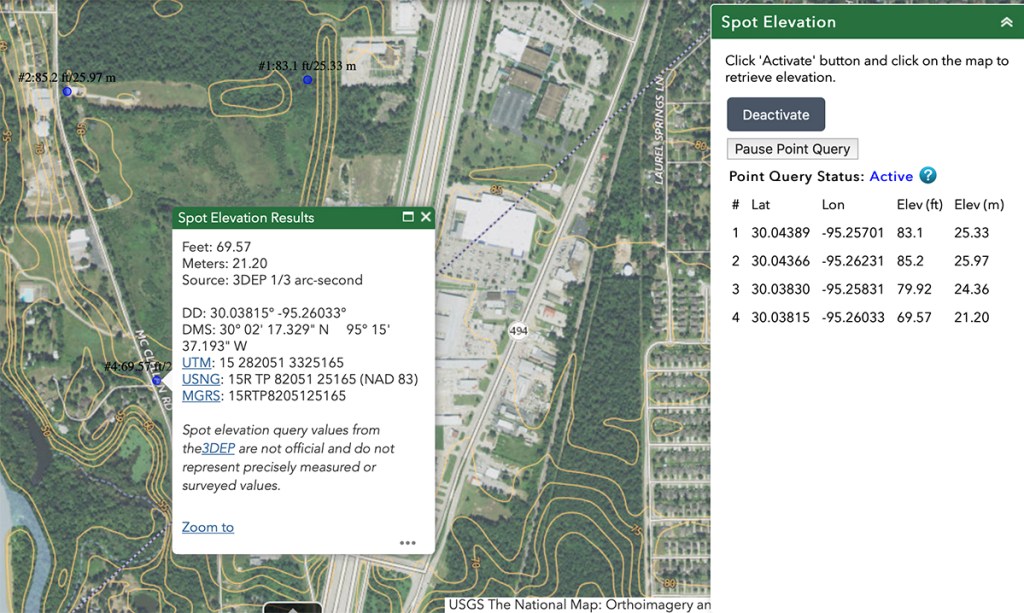
Floodwaters in this area stopped at about 83 feet above sea level. However, the entrance to the new subdivision is at 75 feet, according to the USGS National Map. That means the water was an estimated 8 feet deep at the entrance.

One long-time resident in the area said, “The intersection of Sorters and Northpark sits in a bowl. It was not passable by Montgomery County Precinct 4 constables in an Army deuce and a half [used for high-water rescue]. Water from the river came right up past that intersection and continued up Northpark to just past the intersection of Kingwood Place Dr.”

Also on the high side of Sorters-McClellan, six of nine buildings at nearby Kingwood College flooded during Harvey. Restoration cost: $60 million!

And then there’s Tammy Gunnels‘ former home a quarter mile south of the new development. It flooded 13 times in 11 years and had to be bought out by Montgomery County and FEMA.

Documents obtained from the Houston Planning Commission indicate that RG Miller is the engineer of record for Northpark South.

Bordering River and Sand Mines

During Harvey, 160,000 cubic feet per second rampaged down the West Fork behind this property.

Looking west past Sorters-McClellan Road toward what will become Northpark South. Note clearing starting in the middle in what used to be wetlands (see below).
From the National Wetlands Inventory. Dark green area on right corresponds to cleared area above.
Looking NW. Intersection of Northpark and Sorters-McClellan in lower left. Another subdivision called Northpark Woods by the same developer is in the upper right. West Fork San Jacinto and sand mines at top of frame.

Here’s what they hope to build on this property.

General plan submitted to Houston Planning Commission in 2021.

Current Floodplains Will Soon Expand

Most of the property already sits in floodway or floodplains. But the FEMA map below has not yet been updated to reflect new knowledge gained as a result of Memorial Day, Tax Day, Harvey and Imelda floods.

In fact, the 2014 date on the map below is misleading. It reflects an update of the base map, but the data that determines the extent of floodplains has not been updated since the 1980s, according to an expert familiar with Montgomery County flood maps.

From FEMA’s National Flood Hazard Layer Viewer.

FEMA and Harris County Flood Control have warned people that when new “post-Harvey” flood maps are released in the next year or two, floodplains will expand 50-100%. The floodway (striped area above) will likely expand into the 100-year floodplain (aqua). In turn, the 100-year will expand into the 500-year (tan). And the 500-year floodplain will extend past any of the colored areas.

That’s consistent with eyewitness accounts. And that could potentially put the entire property in floodplains.

Taking Advantage of Map-Update Window

The developer seems to be taking advantage of a window between post-Harvey flood surveys and release of the new maps.

I’m sure the developer’s lawyers would argue that they are complying with all current, applicable laws. But an ethical question arises. Will the new development expose unsuspecting homebuyers to greater-than-expected risk?

If so, why aren’t officials pushing to update maps and floodplain regs faster?

Could some officials be prioritizing economic development now over public safety later?

Certainly not all are. But many flood professionals worry about that.

Next to 5-Square Miles of Sand Mines

The new development sits next to the largest sand-mining complex on the San Jacinto West Fork. Sand mines in this area occupy almost five square miles. However, not all the mines are active. But they still show signs of heavy sediment pollution.

Looking E toward Sorters-McClellan from over West Fork. Northpark South is at top of frame beyond the sand pits.
The operator of this mine decided not to fish its equipment out when they abandoned the site.
More colors than Crayola. No telling what’s growing in these ponds.

Will routing drainage from Northpark South through these sand mines pose a safety risk for people downstream?

Will it be safe for kids to play or fish near these steep-sided pits?

Floodplain Development Called New Form of Redlining

This is an example of why the population of Texas floodplains is greater than the populations of 30 entire states. Yep. Thirty entire states have populations smaller than that of Texas floodplains.

One former floodplain administrator, who requested to remain anonymous, characterized these types of developments as a new form of redlining.

More than a few floodplain and wetland developers target minorities who may not fully understand the flood risk.

Owner financing often accompanies floodplain developments. Such financing can bypass many flood-risk detection procedures that accompany traditional bank financing.

Then, when floods come, the people who can least afford to repair homes suffer the most and longest. Neighborhoods decay faster. And that makes it harder for people to recover their investments.

Years later, the public is left holding the bag. We are asked to fund expensive flood-mitigation projects that would not be necessary had the developer built in a safer area.

Posted by Bob Rehak on 11/11/2023

2265 Days since Hurricane Harvey

The thoughts expressed in this post represent opinions on matters of public concern and safety. They are protected by the First Amendment of the US Constitution and the Anti-SLAPP Statute of the Great State of Texas.

New Caney ISD’s West Fork High School Blocked Out; Access Being Enhanced

Although much finish work remains, contractors have finished blocking out New Caney ISD’s new West Fork High School. Walls, structural steel and roofs are up. Some windows are in. Now they are widening Sorters-McClellan Road. They are also building another access route through woods that will connect to Kingwood Place Drive, the street immediately west of the HCA Kingwood Medical Center.

Photos Taken 11/6/2021

I took all of the shots below on November 6, 2021, with the exception of the last one from November a year ago.

New Caney ISD West Fork High School Construction as of 11/6/2021. Looking NE from over Sorters-McClellan Road toward HCA Kingwood Medical Center and Insperity in top center.
Looking south from over Sorters-McClellan Road, which is apparently being widened in front of the high school and then some. Note the wetlands and cypress trees in the upper right.
Looking north from over detention pond at south end of campus. I-69 in upper right.
Fieldhouse, track and football field.
New access road through woods will connect with Kingwood Place Drive
Looking south. Note windows being installed in center.
Looking SE. Much sitework remains.
From a higher altitude, you can see the proximity to the San Jacinto West Fork. From the upper left, it curves around the large pond then becomes visible again to the left of the sand mine in the upper right.

Wetlands Gone Forever

From US Fish and Wildlife Service Wetlands Mapper. Green areas are/were freshwater forested/shrub wetlands. Blue/gray areas are freshwater ponds. High school site is in center of frame. Image taken shortly after clearing. Note large area of former wetlands where athletic fields will be.

I’m sorry to see the wetlands go, but now that they’re gone, I want to see them complete the drainage for this campus ASAP to make sure everything gets channeled into the detention pond. That will minimize the chance of flooding neighbors.

Progress in One Year

New Caney ISD has posted an update on construction that indicates the percentage of completion for each of the project components as of October 29.

It was just a year ago, that this site was virtually nothing but dirt. Contractors had just started pouring concrete for the first parking pad.

From Nov. 13, 2020.

New Caney ISD expects to finish construction by the summer of 2022.

General plan for New Caney High School #3

Posted by Bob Rehak on November 8, 2021

1532 Days since Hurricane Harvey

New Caney ISD Clearcutting Site of High School #3 Before Installing Detention

The New Caney ISD has removed a long swath of trees that separated Sorters-McClellan Road from the site of its new high school south of the Kingwood Medical Center. Removal of the trees – before the construction of the detention pond for the site – removes the last barrier between sheet flow and residents downhill.

Similarities to Woodridge Village

Clearcutting creates a condition similar to that of Woodridge Village. Woodridge contributed to flooding Elm Grove and North Kingwood Forest twice last year after Perry Homes cleared the site before installing all the required detention. With nothing to retain runoff in a major storm, water could inundate Sorters Road and the homes on the opposite side of it in McClellan Circle.

This once again raises the question of whether contractors follow best practices for construction.

The site is in both Montgomery County and the City of Houston. But Montgomery County claims the City took the lead in permitting this site. MoCo claims it does not even have any drainage plans.

Looking south along Sorters Road at the site of New Caney ISD High School #3. Land slopes from left to right and foreground to background. Recently, contractors removed all trees next to the road. A large detention pond is supposed to be installed next to the tree line at the far end of the site. See below.

Building Pad Site Complete But No Detention Pond Yet

As of July 20, 2020, New Caney ISD had this to say about the project. “The site has been cleared and rough grading is at 90 percent completion.” Contractors have completed the building pad and will start installing the concrete piers concurrent with the underground storm and sanitary systems.

General plan for New Caney High School #3. North is left, east is up. Detention pond should be at far end of the photo above.

How Site Looked in June

Site of New Caney High School Number 3 as it existed in June, 17, 2020. Note the tree buffer between the site and Sorters McClellan road on the right that is now gone. So are all the trees within the site.

Steep Slope Accelerates Runoff

This approximately 50-60 acre site slopes toward the corner in the upper right by 10 to 15 feet depending on where you start. Sources: Google Earth Pro and USGS National Map Viewer.
USGS National Map Viewer still shows old par 3 golf course on which the new high school will be built.

This is a 5% slope compared to the 1.8% slope on Woodridge Village.

Comparing Google Earth Elevation Profiles

The steepness of the slope accelerates runoff in the absence of features to slow it down.

Current State of Site

Here are some more shots showing the current state of construction on the site.

Looking NW toward the Eagle Sorters Sand Mine in the top left.
Looking NE toward HCA Kingwood Medical Center and Insperity.
Looking SE toward retail establishments that front US59, barely visible in the top left of the frame.

There seem to be some berms in the corners of the property. They may slow down sheet flow in a large storm. But the berms are absent over the large area in the center where the high school building itself will go.

Peak of Hurricane Season 5 Weeks Away

Let’s hope they get the detention in before the next big storm. No one wants a repeat of Woodridge.

Posted by Bob Rehak on 8/4/2020

1071 Days since Hurricane Harvey

The thoughts expressed in this post represent opinions on matters of public concern and safety. They are protected by the First Amendment of the US Constitution and the Anti-SLAPP Statute of the Great State of Texas.