Tag Archive for: HCFCD

Why Buyouts Take So Long

In the private sector, it can take just days to buy a home. In the public sector, it can take years. Here’s why buyouts take so long.

Major Steps in Process

Graphic provided by Harris County Flood Control District (HCFCD). For specific information about the Buyout Process for Eligible Qualified Buyers, see this video.

The graphic above outlines the major steps in the buyout process. The linked video provides more detail.

The Forest Cove Townhomes illustrate some of the problems encountered along that timeline.

Exceptional Sense of Community Makes People Want to Stay

According to Jennifer Parks who lived on Timberline, her townhome flooded eight times in five years. Despite that, she, like most who lived there, loved the secluded neighborhood. It was close to nature, beautiful and quiet. Neighbors looked out for each other. They bonded over backyard barbecues. They enjoyed an exceptional sense of “community.” Then came Harvey. It made the homes uninhabitable. People immediately scattered to find new housing.

Dealing with Chaos and Confusion

When the initial shock wore off, they began exploring options. Could the homes be repaired? Would CenterPoint restore power? Could the sand-filled storm drains and streets be cleared? Which way was the herd moving? One family could fix its home; but if the other neighbors in a building didn’t, their investment would be ruined. This is important because in Harris County, buyouts are voluntary. One holdout in a building with a dozen units could undermine others.

Meanwhile, HCFCD assessed damage county wide to identify eligible properties. Harvey damaged so many, that it took nine months for the flood control district to even issue its final report on the storm.

Assessment Necessary; Not All Properties Eligible

Identifying eligible properties requires looking at them from several different perspectives. For instance:

  • Have people requested the buyouts?
  • Are properties subject to repeat flooding? Is it life threatening?
  • Will buyouts serve a larger strategic purpose that reduces flooding? For instance, restoring green space near a river. Or creating community parks.
  • Who will maintain the property long term?
  • Are interest and community support high?
  • Will buyouts create a checkerboard pattern that creates maintenance issues or will there be full public ownership of an area?
  • Can HCFCD secure grants to fund all interested sellers?

Of the 154,170 homes flooded in the county during Harvey, only 4,000 property owners volunteered for buyouts and of those, only 1,100 were eligible (0.71% of all flooded homes).

Qualifying for Buyout

To learn more about the HCFCD buyout process, see this document: Voluntary Buyout Guidance.

Buyouts reduce flood damages in areas where structural projects (i.e. channel modifications or stormwater detention basins) are not cost-effective and/or beneficial. 

Harris County FLOOD CONTROL DISTRICT

Buyout candidates were simply built in the wrong place, prior to the knowledge we have today

HCFCD’s Home Buyout Program does not provide immediate flood recovery assistance – its primary function is to help prevent future flood damages. 

To see where HCFCD is interested in buyouts, check this map of Buyout Areas, last updated in July.

Funding and Closing

After identifying and qualifying candidates comes the difficult process of securing grant funding. That usually takes about 8-18 months. It’s a multi-tiered process. Austin collects and screens grant applications for Washington. Assuming Washington approves, money then flows back through Austin.

Finally, with money in hand, HCFCD must appraise property to confirm its value (which can be pre-flood). HCFCD must then reach an agreement to buy the property and determine relocation benefits. Of the initial 1,100, 349 are in the closing phase now and 560 have already closed.

A little fixer-upper

HCFCD says that roughly a half dozen homes remain to be bought out. Those remain “problem” cases. In one, an out-of-state investor bought property at auction AFTER Harvey. But terms of HCFCD’s Harzard Mitigation Grant specify that the grant cannot be used in cases like that. Otherwise people would buy up flooded properties and resell them to FEMA at pre-flood valuations.

In other cases, sometimes people have walked away from flooded properties leaving lenders holding the bag. That puts property in legal limbo. No one has authority to sell without going through a foreclosure process.

Such problem properties can delay demolition.

Public-Policy Concern

In multi-family housing (such as the Forest Cove Townhomes), EVERY family in a building must have completed a buyout before the building can be demolished.

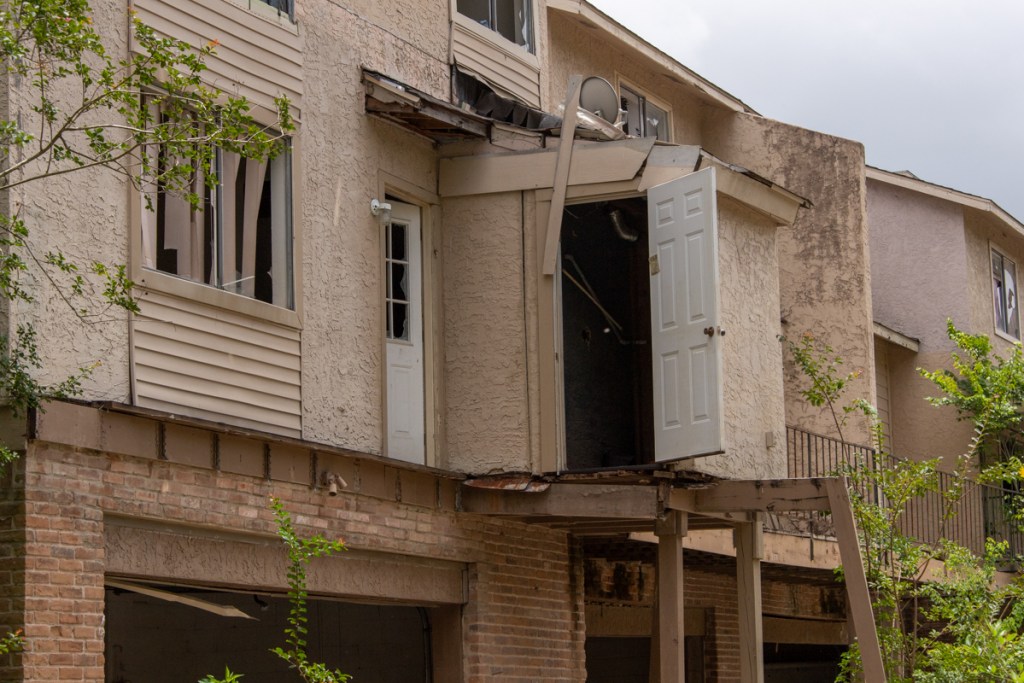
The last point raises a public-policy concern. We are now starting YEAR FOUR AFTER HARVEY! Units in six Forest Cove Townhome Buildings still need to be purchased. Those buildings look like the one above and drag down property values in an entire community.

So, should construction of new multifamily units be allowed in such flood-prone areas?

It’s one thing to repair properties built BEFORE flood problems became apparent; another to permit new construction AFTER. And developers keep throwing up new units faster than flooded ones can be bought out.

For More Information

For general information about HCFCD’s buyout program, see this video.

For the portal to the buyout section of HCFCD’s website, click here.

Posted by Bob Rehak on 9/3/2020

1101 Days after Hurricane Harvey

The thoughts expressed in this post represent opinions on matters of public concern and safety. They are protected by the First Amendment of the US Constitution and the Anti-SLAPP Statute of the Great State of Texas.

Going Up the Down Escalator – As HCFCD Demolishes West Fork Townhomes, Developer Builds More

Have you ever walked up a down escalator? I’m sure that’s what it must feel like to work for the Harris County Flood Control District at times. As you work to improve public safety, you sometimes fight others eroding it in the process of making a buck. Consider this comparison.

Forest Cove Buyouts V. Wanbridge New Construction

Flood Control just bought out and demolished a six-townhome complex on Timberline Drive in Forest Cove. It was the culmination of a three-year process.

Meanwhile, a short distance downstream, Wanbridge is building 14 more – even closer to the same river that destroyed the Forest Cove Townhomes. Wanbridge even designed its townhomes on the same principles used in Forest Cove (garage and storage on ground floor/living space two stories up). Let’s see how that worked out for Forest Cove property owners.

Forest Cove Complex Torn Down after Floods and Fire

Here’s what the Forest Cove complex looked like before being demolished recently.

Part of six-unit Forest Cove Townhome flooded by Harvey and then burned on July 4th, 2019. Photo taken July 11, 2020.
Here’s what that site looks like today, 1100 days after Harvey FIRST destroyed the complex.

Finally, a vacant lot that can return to nature!

Six Down, But Fourteen Up

Meanwhile Wanbridge is building six new units in Kings Harbor even closer to the river. That is in addition to three units just completed in the upper left, and five just completed in the lower left (some of which are out of frame).

Forest Cove Townhome Buyouts Part of a Much Larger Project

The six-unit building recently demolished in Forest Cove is part of much larger buyout project. It comprises approximately 80 homes. So far, HCFCD has demolished the following Forest Cove townhome buildings:

  • 1030 Marina Dr.
  • 1040 Marina Dr.
  • 1050 Marina Dr.
  • 1060 Marina Dr.
  • 1102 Marina Dr.
  • 803/805 Timberline Ct.
  • 707 Timberline
  • 930 Aqua Vista  

However, the following buildings still have privately-owned units that HCFCD is trying to purchase ASAP:

  • 1106 Marina Dr.
  • 1110 Marina Dr.
  • 1020 Marina Dr.
  • 960 Marina Dr.
  • 980 Aqua Vista (mostly destroyed)

HCFCD has now bought out and demolished eight out of 14 buildings (see map below).

Map to Forest Cove Townhome buyouts. This once-thriving complex housed approximately 80 families before Harvey.

Five Buildings Still Left Standing…Kinda

Building sheared in half by 240,000 cubic feet per second at peak of Harvey. Residents reported feeling lucky to escape with their lives.
How Harvey chewed up the inside of Forest Cove Townhomes
Floodwaters reached well into the second stories of these units.
Note how the water pressure destroyed garage doors. Also note abandoned scooter.

As I edited pictures from this morning’s photoshoot, I noticed the little girl’s scooter perched precariously on the collapsing porch. A child lived here! It was her family’s home. Their dream. And I’m sure the scooter was the girl’s cherished possession. Perhaps a birthday or Christmas present.

For whatever reason, that scooter got to me. It made me realize the futility and danger of going up the down escalator.

Public Policy Implications

From a public policy point of view, it seems like it would be safer and cheaper to buy up properties near rivers and turn them into parkland – before people build on them.

Parks generally improve the value of surrounding properties. In contrast, the inevitable eyesores created by repeat flooding cost us all. Consider:

  • Taxpayer subsidies for flood insurance.
  • Multiple payouts on insurance claims, also subsidized by taxpayers.
  • Eventual buyouts, paid for by taxpayers.
  • Demolition, paid for by taxpayers.
  • Eventual restoration of the green space, at taxpayer expense.
  • Salaries of public employees to manage this process in Washington, Austin and Houston.

Leaving these spaces green would have cost little compared to the ultimate financial and emotional costs of repeat flooding. But some people like going up that down escalator.

Posted by Bob Rehak on 9/2/2020

1100 Days since Hurricane Harvey

The thoughts expressed in this post represent opinions on matters of public concern and safety. They are protected by the First Amendment of the US Constitution and the Anti-SLAPP Statute of the Great State of Texas.

San Jacinto River Watershed Virtual Meeting Tonight Will Unveil Specific Recommendations to Reduce Flooding

I can’t urge you enough to watch the San Jacinto Watershed Master Drainage Plan Meeting tonight at 6:30.

Flooded Street by Julie Yandell. During Harvey.
Flooded Street during Harvey. Photo by Julie Yandell.

Updating of River Models Leads to New Insights

I previewed the presentation this morning and was extremely impressed. The study partners have updated or created hydraulic and hydrologic models for 535 miles of major streams in the river basin. They’ve also integrated the models and accounted for new developments across 3000 square miles in seven counties.

As a result, we now have a much better understanding of:

  • Where water comes from
  • Which areas have the highest potential for flooding
  • Where large regional detention basins can be placed to reduce flooding.
  • Other strategies to reduce flooding.

New Flood Maps, Sedimentation, Better Warning Systems

You don’t want to hear about this stuff second hand. The presentation also includes discussions of:

  • How much flood plains have really expanded compared to current FEMA maps.
  • Sedimentation and strategies to reduce it
  • Improving flood warning systems

If you’re flooded, or are concerned that you might, don’t miss this. This study will be the cornerstone of grants applications to mitigate flooding in the region.

Cornerstone of Lake Houston Area Mitigation Efforts

Two years ago, before the flood bond vote, community opinion coalesced around a three-part solution to flooding in the Lake Houston Area.

  • Reduce/delay the input by increasing upstream detention
  • Increase the throughput by dredging blockages
  • Speed up the output with additional gates on the Lake Houston Dam.

Tonight, you will get a chance ask questions of the people who have been studying those options and others for 18 months. Here’s how to log in:

Thursday, August 13, 2020

6:30 p.m. to 7:30 p.m. 

Join online at PublicInput.com/SanJacMasterPlan

Or by phone at 855-925-2801 with Meeting Code: 9742 

Order the pizza now.

This study is a cooperative venture of FEMA, Harris County Flood Control, SJRA, City of Houston and Montgomery County.

Posted by Bob Rehak on August 13, 2020

1080 Days after Hurricane Harvey

Your Chance to Ask Questions About the San Jacinto Watershed Master Drainage Plan

The San Jacinto Regional Watershed Master Drainage Plan (SJMDP) partners will host a virtual public meeting on August 13, 2020. The purpose: to provide information about study’s progress, and encourage public participation and input. 

Heat map in draft shows where most flood damage has occurred historically by sub-watershed.

Goals of Project

The SJMDP study began in April 2019 to identify flood mitigation projects that can be implemented in the near- and long-term. Their purpose: to reduce flood risks to people and property throughout the San Jacinto River watershed.

The study area includes nearly 3,000 square miles in seven different counties and approximately 535 miles of stream. Overall, the study aims to:

  • Provide an up-to-date technical basis to identify flooding vulnerabilities
  • Understand impacts of future growth
  • Improve flood resiliency within the watershed.

The SJMDP is scheduled for completion in fall 2020. 

Community engagement is an important component of the Harris County Bond Program. The partners want your participation as the program is implemented. 

Details of Virtual Meeting

The virtual community engagement meeting will be held on:

Thursday, August 13, 2020

6:30 p.m. to 7:30 p.m. 

Join online at PublicInput.com/SanJacMasterPlan 

Or by phone at 855-925-2801 with Meeting Code: 9742 

Note: HCFCD says that the “Join Online” link above will convert from a registration to a presentation link on the day of the webinar.

The meeting will begin with a brief presentation to share project updates, followed by a moderated Q&A session with Flood Control District team members.

Residents will be able to submit questions and comments throughout the presentation. Any comments not addressed during the Q&A session will receive a response after the event. 

For Those Who Cannot Attend…

The study partners will post a recorded version of the meeting on the Flood Control District’s website and YouTube channel after the event.

For questions, please contact the Flood Control District at 346-286-4152, or complete the online comment form.

You can also mail comments to:

  • Harris County Flood Control District
  • 9900 Northwest Freeway
  • Houston, Texas 77092
  • Attn: San Jacinto Regional Watershed Master Drainage Plan

For more information about the San Jacinto Regional Watershed Master Drainage Plan, visit www.sanjacstudy.org

For Those with Disabilities

Those with disabilities can make special meeting accommodations. If needed, please contact 346-286-4152 at least 48 hours prior to the meeting. 

Project Funding

The SJMDP is jointly funded with 75 percent from the Federal Emergency Management Agency (FEMA) Hazard Mitigation Planning Program and 25 percent from the four local partners: Harris County Flood Control, Montgomery County, City of Houston and the SJRA.

Posted by Bob Rehak on July 30, 2020

1037 Days after Hurricane Harvey

HCFCD Data Shows Socially Vulnerable Zip Codes Receive 80% of Buyouts

Harris County Judge Lina Hidalgo, Precinct 1 Commissioner Rodney Ellis, and Precinct 2 Commissioner Adrian Garcia are pushing the idea of a Community Resilience Task Force focused on helping socially vulnerable neighborhoods receive a higher percentage of the $2.5 billion flood bond.

However, zip codes that rank in the top 50% of the CDC’s Social Vulnerability Index (SVI) already receive 80% of Harris County Flood Control District buyouts and 79% of the District’s active mitigation projects.

FOIA Request Reveals Emphasis on SVI Index

Data obtained from HCFCD via the Freedom of Information Act shows that in Harris County…

…the two most socially vulnerable quartiles are FOUR TIMES more likely to receive a buyout.

HCFCD Buyouts Favor Socially Vulnerable Population 4:1

As of 7/28/2020. Source: Data obtained from HCFCD via FOIA request. Quartiles 3 and 4 are the most vulnerable on the CDC’s Social Vulnerability Index.

Here’s how that looks as a pie chart.

HCFCD Buyouts by SVI Quartile. The two most socially vulnerable quartiles receive 80% of all buyouts.

This is not surprising. For months, Hidalgo, Ellis and Garcia have pushed the District to incorporate the Social Vulnerability Index into its priorities. It has worked.

Do We Need More Balance?

Socially vulnerable neighborhoods get 80% of HCFCD buyouts and 79% of flood bond projects. Do those seem like fair percentages to you?

Tell the County Judge Your Opinion

The County Judge’s office is inviting the public to share their thoughts and ideas on the proposed draft bylaws of the Community Resilience Task Force that encourages even more spending by social vulnerability guidelines. 

You can register your opinion from now until July 30th, 2020, via one of the following methods:

  • Email CRTF@cjo.hctx.net and submit comments digitally, beginning July 21
  • Join a virtual focus group via Zoom. After registering, participants will receive a confirmation email containing information about joining the meeting.

For More Information

For more information on the “equity bias,” see this series on “Where Flood Mitigation Dollars Have Really Gone.” It was developed a year ago so the focus is on historical spending.

Or this series:

Posted by Bob Rehak on 7/29/2020

1065 Days since Hurricane Harvey

NY Times Covers Harris County Flood-Bond Spending, but Omits Spending Data

The New York Times ran a story on flood-bond spending, but forgot to look at where the budget to date has gone.

The story by Christopher Flavelle was titled, “A Climate Plan in Texas Focuses on Minorities. Not Everyone Likes It.” It outlined arguments on each side of the equity debate in flood-bond spending. From a balance point of view, it did a great job. However, it came up short in two areas.

Problems with Article

First, the headline misleads. This isn’t about climate. The story is about how to distribute flood-bond dollars equitably.

Second, it makes no mention of where flood-bond dollars to date have actually gone. Nor does it mention historical spending except in a generalized way. It implies poor people got none; rich people got it all. By avoiding research into actual current and historical spending, it perpetuated myths that do little to protect people from flooding.

Had the author checked, he would have found that those “underfunded,” disadvantaged neighborhoods have actually received 79% of the flood-bond projects to date.

Had he bothered to check historical or federal spending, he might have found an even more exaggerated pattern.

Trap Laid by Ellis

Mr. Clavelle fell into the trap that Commissioner Ellis laid. In effect, the argument goes like this. “Because homes in poor neighborhoods cost less than those in rich neighborhoods, it brings down the benefit/cost ratio for poor neighborhoods. FEMA considers that ratio in grant requests. That disadvantages grants for poor neighborhoods and perpetuates a downward cycle.”

That’s literally true – if you look only at FEMA grants. But it’s the exact opposite for HUD grants which heavily favor disadvantaged neighborhoods. Mr. Clavelle fails to mention that. As do Mr. Ellis and his surrogates whenever they talk on this subject.

Approximately 70% of those HUD grants MUST go to disadvantaged neighborhoods. The actual percentage varies by storm and type of grant. After Harvey, Harris County received a billion dollars. And the City of Houston received $1.1 billion. Together, that’s almost as much money as in the $2.5-billion flood bond. And there are still billions of additional dollars available from HUD through the General Land Office.

Preserve Your Community

If more of this money continues to go south, the Lake Houston Area is sunk in the next big storm.

But the County is considering a Community Resilience Task Force that would institutionalize this spending bias for the next 30 years.

The County Judge’s office is inviting the public to share their thoughts and ideas on the proposed draft bylaws of the Community Resilience Task Force. You can register your opinion from now until July 30th, 2020, via one of the following methods:

  • Email CRTF@cjo.hctx.net and submit comments digitally, beginning July 21
  • Join a virtual focus group via Zoom. After registering, participants will receive a confirmation email containing information about joining the meeting.
  • Offer input during the July 28th Commissioner’s Court

Please express your opinions to the county judge. Nothing is more important to the future of the Lake Houston Area than achieving more balance in flood-bond spending.

Some Key Facts to Consider

Some key points I intend to make:

  • 79% of flood bond projects to date have gone to neighborhoods that rate high on the social vulnerability index leaving only 21% to everyone else. We need to tweak the formula to achieve greater balance.
  • The argument that FEMA’s emphasis on Benefit/Cost Ratios disadvantages minority neighborhoods ignores the fact that billions of dollars in HUD grants advantage minority neighborhoods. Focusing only on one without acknowledging the other is intellectually dishonest.
  • HCFCD and USACE have historically underfunded flood mitigation projects in the Lake Houston Area. In the history of HCFCD, the District has not developed ONE USACE-funded project in this area.

For More Information

For more information on the “equity bias,” see this series on “Where Flood Mitigation Dollars Have Really Gone.” It was developed a year ago so the focus is on historical spending.

Or this series on “Equity”:

Posted by Bob Rehak on 7/25/2020

1061 Days after Hurricane Harvey

New Harvard Study Examines Barriers to Buyouts; Will Process Improvements Be Enough?

How do we break the process of building in floodways and then repairing flooded homes with taxpayer-subsidized flood insurance as many as forty times?

A 66-page study by Erica Vilay and Phil Pollman, two candidates for Masters Degrees in Public Policy from Harvard, examines the broken buyout process for flooded homes in Houston floodways. The study also makes recommendations to improve the process. But they won’t revolutionize it. And that may be what this process needs.

Study Expressly Prepared for City of Houston

Prepared for the City of Houston’s Offices of Recovery and Resilience, the paper is titled “Floodway Buyout Strategy for a Resilient Houston: A Systems Approach for Breaking the Dangerous and Expensive Cycle of Rebuilding in the Floodway.”

The merit in this study is that it takes a holistic view of buyouts and examines them as one of many alternatives available to flood victims living in floodways. From the public’s perspective, buyouts have unquestionable and compelling safety and financial benefits.

Buyouts produce $7 in benefits for every $1 invested. And they take people out of harm’s way.

Speedier Options Available to People In Time of Need

But the process is slow. People have options. And, according to the study, they almost always prefer those other options. In fact, the rate of buyouts is so slow that it will take the City 60 years to meet its 10-year objective, claim the authors.

The paper cited one property that had been repaired a record 40 times. So why is it so difficult to get people to move out of a floodway into housing that won’t jeopardize their lives or lungs?

Only 80% of the buyouts of these uninhabitable townhomes in Forest Cove are complete 3 years after Harvey.

Incentives Favor Rebuilding, Not Buyouts

Vilay and Pollman examine the reasons. The incentives, they say, all favor rebuilding or selling to developers rather than accepting government buyouts.

  • Tax-subsidized National Flood Insurance Policy premiums remain affordable, offset risk, and usually reimburse homeowners within 60 days after a storm.
  • Selling to a developer/investor can happen within days or weeks.
  • Consummating a buyout through the maze of Federal, State, County and Local government agencies can take years.
  • Federal funding is slow, inflexible, and extremely complex to manage effectively and efficiently.
  • At the current closing rate, it would take nearly 60 years to buy out the 7,000 habitable structures in Houston floodways, says the study. But Houston-area realtors sell that many homes in a typical MONTH, according to the Greater Houston Partnership! Even in the middle of a pandemic.

“This is a No Brainer”

So one of the big reasons people are reluctant to be bought out is speed. Their lives have just been destroyed in a flood. They need a place to live. Then along comes the government saying, “Let me buy you out. I’ll get you your money in 2-3 years. Or you can just repair your home for the fortieth time and we’ll pay for it immediately.” This is a no-brainer, say the authors.

How hard are buyouts? The authors claim that “As of January 2020, HCFCD has used $3 million out of a $10 million bucket of federal funding allocated to the City for flood events that occurred in 2015.”

Barriers Beyond Slowness

But degree of difficulty and process slowness aren’t the only reasons people shun buyouts.

  • People get attached to neighbors and neighborhoods.
  • They may have family living nearby.
  • There may be a shortage of affordable housing elsewhere.
  • Alternative housing may be farther from their work.
  • They may want to stay within a school system.

Goals: Slow Inflow, Speed Outflow

The authors define two goals. They say we need to:

  • Slow or stop the inflow of residents to floodways
  • Increase the outflow of residents from floodways
While County is buying and tearing down townhomes in Forest Cove, City is permitting new townhomes in Kings Harbor, less than 200 feet from the West Fork.

Process Improvement Recommendations

They then turn their attention to solving these problems and present 13 “sequenced” recommendations. See below.

From Floodway Buyout Strategy for a Resilient Houston by Erica Vilay and Phil Pollman

All of these recommendations are solid and, to a large degree, self-explanatory. They are hard to quibble with if you are trying to improve a process.

Incremental Improvements vs. New Concept

The authors never really address, however, whether incremental improvements will achieve the stated goals. Or whether we need to nuke the process and start over with a revolutionary, new concept.

As I read this study, I kept wondering what Steve Jobs, Jeff Bezos, or Elon Musk would recommend. That’s a pretty steep burden to impose on grad students. But we shouldn’t forget that Fred Smith had the idea for Fedex while still a student at Yale.

Each of those people made the world a better place by designing new products or services that leapfrogged incremental improvements in existing systems and made the old way obsolete.

Inside-the-Box Thinking for an Outside-the-Box Problem

Insi-e the-box thinking will certainly produce incremental improvements. But in the estimated time it will take government to buy out 7,000 homes, Houston realtors will sell more than 5 million. That’s 70,000% better. Which would you rather have in your employ?

So I would ask these questions. What if you:

  • Privatized this process?
  • Offered flood victims an “instantaneous home SWAP” as they were ripping out sheetrock?
  • Made flood insurance reflect its true cost?

If ever there was a need for “business process re-engineering,” this is it.

To read the complete Harvard study, click here.

Posted by Bob Rehak on 7/14/2020 with appreciation and admiration for Erica Vilay and Phil Pollman

1050 Days since Hurricane Harvey

Details of SJRA Application to TWDB for Grant to Develop Sand Traps

In March, the San Jacinto River Authority (SJRA) awarded engineering firm Freese & Nichols a $250,000 work order for “Conceptual Design” of sand traps. Then in June, SJRA applied for a $200,000 grant from the Texas Water Development Board (TWDB) for “Preliminary Design” of sand traps on the West Fork. What’s this all about? How do the projects relate? Are they worthwhile?

West Fork 90% Blocked After Harvey

After Harvey, the Army Corps documented that the West Fork had become 90% blocked by sediment in places. That contributed to the flooding of thousands of homes and businesses. It also triggered a massive dredging program that is still ongoing. Finally, it launched a search for solutions that stretched all the way to Austin (plus, interestingly, Kerrville and San Antonio). See more below.

SB1824 Opens Door for Sand Traps

House Bill 1824 was introduced by State Rep. Murr from Kerrville and sponsored by Senator Flores from San Antonio. Approved last year, it allows SJRA and Harris County Flood Control District (HCFCD) to remove material from the San Jacinto River and its tributaries to restore, maintain, or expand storm flow capacity without the need for “state permitting” or royalty payments to the state.

SJRA and HCFCD hope to mitigate flooding by constructing one or more “sand traps.” Their plan calls for partnering with Aggregate Production Operations (APOs) in the vicinity of the sand trap(s) to clean them out periodically. It’s not yet clear whether APO’s would do this for a fee, or do it for the sand. One thing is clear, at this point, however. APO’s don’t want to go far. All the locations under consideration are next to sand mines.

Freese & Nichols Already Underway with Phase 1

The first phase of the project, Freese & Nichols’ conceptual design, is currently underway. It includes:

  • Evaluating potential sand trap locations and trapping effectiveness
  • Developing conceptual sand trap designs
  • Determining downstream benefits of potential sand trap solutions
  • Recommending which site(s) to carry forward into preliminary engineering.

Phase 2 of Pilot Goes Further

The goal: to move forward with preliminary engineering on two sites, with the likely construction of at least one. This small scale effort, involving only one or two sand traps, is intended to act as a “pilot” before a more costly, full-scale program.

Preliminary results in the first phase indicate that the sand traps will likely be located along the West Fork.

However, to move beyond conceptual design, even on the pilot, SJRA needs more money to supplement local match resources.

If successful, the TWDB grant application for preliminary design will cover:

  • Environmental permitting investigation
  • Preliminary land acquisition efforts
  • Survey
  • Geotechnical investigation
  • 30% design efforts.

Need for Sediment Control of Some Sort

To date, more than 2.3 million cubic yards of material have been removed from the West Fork, at a cost of more than $90 million. An additional $30 million has been dedicated to continue these efforts. SJRA hopes sand traps will help protect that investment.

It seems, though, that reducing sediment coming out of sand mines might be a simpler, less-risky, more cost-effective solution.

Benefits

Long-term benefits beyond the initial sand trap development “pilot” project are anticipated to potentially extend beyond the immediate benefit area.

Benefits include potential reduction of sediment load entering Lake Houston.

Primary benefit area is in purple along West Fork. Secondary benefit area is in green (Lake Houston).

SJRA can not yet quantify the level of flood mitigation provided by the sand trap(s). However, restoring or expanding storm flow capacity could potentially remove structures from the floodplain, they say. The conceptual design phase currently underway will attempt to evaluate downstream hydraulic benefits.

Timing

If this abridged application succeeds, SJRA will need to submit a more detailed application. TWDB won’t report results on that until late this year.

Freese & Nichols should report the results of their conceptual study this September.

SJRA anticipates it can complete the preliminary engineering study in 18 months. However, construction will take longer – up to 36 months.

Next Steps

If results of this pilot project indicate that sand traps are a feasible and effective solution, a larger program in various locations throughout the basin could be implemented.

Preliminary cost estimates will be developed as part of the conceptual design phase currently underway. So SJRA has not yet determined a benefit/cost ratio.

However, the cost of dredging has proved substantial. And the cost of flooding during Harvey proved astronomical. Reducing those costs just 1% could easily justify the cost of this project.

We have too many unknowns at this point to pass judgment.

  • How much will the project cost?
  • Will sand traps be effective?
  • Who will maintain a trap when a sand mine goes out of business?
  • What will the environmental impact be?
  • Will the traps accelerate erosion and jeopardize infrastructure such as pipelines and bridges?
  • Is this the opening volley in an effort to begin large-scale river mining?

Scientific literature and news reports on sand traps generally indicate mixed results.

I will withhold judgement until I learn more.

To review the abridged application, click here.

Posted by Bob Rehak on 7/9/2020

1045 Days after Hurricane Harvey

Details of SJRA Grant Application for Flood Early Warning System in San Jacinto county

The San Jacinto River Authority (SJRA) has applied for a Flood Infrastructure Fund Grant from the Texas Water Development Board (TWDB) to extend its Flood Early Warning System in San Jacinto county. The abridged grant application covers the cost of three new gages that would measure rainfall and flood height (but not flow rates). SJRA would install the gages on:

  • Winters Bayou at SH150
  • San Jacinto East Fork at FM945
  • Peach Creek at FM3081

Complement to Potential HCFCD

These gages would complement four others that Harris County Flood Control District is considering for San Jacinto county.

  • Winters Bayou at FM2693
  • East Fork at SH150
  • Winters Bayou at Tony Tap Road
  • East Fork at SH105
Locations of potential SJRA and HCFCD gages in San Jacinto county

HCFCD could display the information from both its own gages and SJRA gages on its Flood Warning System (FWS) website. The FWS site lets residents view data from all gages throughout the region in one location.

Gage Components and Communications Infrastructure

Equipment installed at each location would include break-away mounting pole, box enclosure with antenna mast, rain gage, river/stream stage sensor, and alert transmitter/sensors.

Components of the system susceptible to water damage would be installed above at least the 0.2% annual chance inundation level, based on Atlas 14 data.

SJRA would transmit data obtained from the gages to its ALERT2 network and display it on its Contrail system. This would let San Jacinto County staff and residents easily access and view the data at any time. These gages would become part of a growing regional network of gages.

Extent of Application

The grant application includes:

  • Verifying that signals can reach SJRA’s repeater tower in Montgomery County.
  • Site survey work at the proposed gage locations
  • Installation of the gages

San Jacinto county would provide ongoing maintenance after training by SJRA staff. That would include including twice-per-year inspection, periodic cleaning, and any required repairs or corrective maintenance.

Project Benefits

The intent of the Flood Early Warning System: to provide early warning to downstream residents, businesses, and property owners. The gages will also help county emergency personnel and responders protect life and personal property which can be moved to a safe location with adequate warning (vehicles, valuables, etc.).

The grant, says the SJRA, would benefit the entire population of San Jacinto County (27,819 in 2018). San Jacinto county lies between Cleveland and Lake Livingston.

Properties downstream of the gages would directly benefit by the proposed flood early warning system (FEWS). But other benefits would extend to the rest of the county. For example:

  • More time to evacuate in advance of a storm could reduce the burden on county-wide emergency services.
  • It could also give the county more time to close roads and tend to other needs during the event.

The gages could also benefit areas downstream of San Jacinto County. For instance, they could provide advance streamflow data to HCFCD.

Gages Located Near Habitual Road Closures

San Jacinto County says multiple major storms have impacted the areas downstream of the proposed gages, including Hurricanes Harvey, Rita, and Ike, as well as storms in 1994, 1998, 2015, and 2016. All caused road closures, high water rescues, etc. These have historically been low population areas, but are growing rapidly.

Additionally, the proposed gage at Peach Creek and FM 3081 could provide some benefits to a small area of Montgomery County, as Peach Creek runs along the county line between San Jacinto and Montgomery Counties. It is possible that some or all of the gaging equipment may be installed on the Montgomery County side of the county line, depending on site conditions.

Cost and Timing

SJRA anticipates the extension of its Flood Early Warning System can be completed in 18 months.

San Jacinto County participated in the process of developing this project. SJRA anticipates the total project will cost $65,000.

All applications for the TWDB Flood Infrastructure Fund Grants go through a two stage process. This abridged application is step one. If TDWB deems the project valuable enough, and if it has enough money, TDWB would invite SJRA to submit a more detailed application for step two.

Posted by Bob Rehak on 7/8/2020

1044 Days since Hurricane Harvey

HCFCD About to Start Next Phase of Kingwood Diversion Ditch Repairs

On Monday, July 13, Harris County Flood Control District (HCFCD) plans to begin more repairs to the Kingwood Diversion Ditch. In June, HCFCD repaired severe erosion near Walnut Lane between Trailwood and Forest Cove. The new repairs will begin farther down the ditch between Forest Cove and Deer Ridge Estates, just north of Deer Springs Drive. See map below.

Area of new repairs outlined in red. For reference, Kingwood’s Deer Ridge Park is in upper right. The outlined area shows where trees will be removed and is approximate.

Ditch To Be Straightened, Erosion Repaired

HCFCD plans to straighten the ditch and repair erosion. That will require the removal of trees which have grown up in the ditch and along its banks. See below.

In the area to be repaired, erosion and vegetation have made the ditch deviate from its normal course over time. The red line indicates the original path. The purple line indicates the current patch. Source: HCFCD.
Severe erosion threatens trails, safety and homes on both sides of the ditch.
Trees have grown up in the ditch, reducing its conveyance and blocking floodwaters.
To repair erosion and restore ditch, trees will need to be removed.

Bird Survey Finds No Nests Impacted

HCFCD has not specified the number of trees it will remove. However, the District has conducted a Bird Survey to ensure repairs will not impact any active nests near the portion of the Kingwood Diversion Ditch undergoing repair.

Protecting Homes from Future Erosion

“We will work to minimize the impacts to trees and nature, but we need to be able to get our equipment in to make repairs,” said Beth Walters, a spokesperson for HCFCD. “We do not know exactly how many trees will need to be removed. Unfortunately, it will be noticeable, but the repair will protect fences and homes from future erosion.”

Property threatened by diversion ditch erosion. Photo from January 2019.

Posted by Bob Rehak on 7/8/2020

1044 Days since Hurricane Harvey