Tag Archive for: HCFCD

3738-Acre Property Developing Near Huffman

On 7/22/22, I photographed two new developments at different stages of completion east of Huffman-Cleveland Road and south of the Grand Parkway. Both are being carved out of a 3,738-ac tract owned by LH Ranch LTD.

A third part of that tract, west of Huffman-Cleveland Road, is in the planning stages and submitting plats for approval.

General Location

The first two developments are immediately east of Huffman-Cleveland Road and south of Meyer Road. See red area below.

Red outlined area contains the two new developments. The third area is to the west (left) of the red box.

One of the new developments will become a “lagoon community” called Saint Tropez. Another will become a residential community called Los Pinos. The third will also become a residential community.

Saint Tropez

Megatel Homes has begun clearing land for what it says will become a $2 billion lagoon community spanning 1,000 acres.

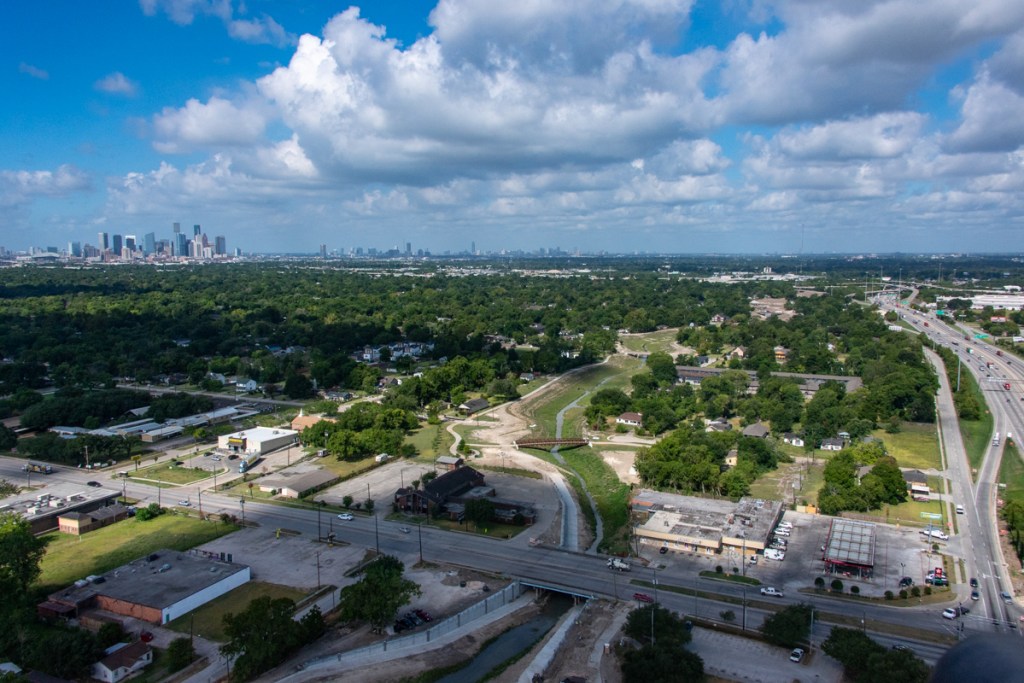
Looking SW from over Meyer Road at the first part of what will become Saint Tropez.

According to Megatel, the development will eventually feature 4,500 homes, an enormous manmade lagoon with white sand beaches, paddle-boarding, kayaking, a swim-up bar, surf simulator, a water slide tower, a playground, cabanas, soundstage, splash park, and more.

An entertainment district will offer a restaurant, bar, teen arcade, bowling alley, and a children’s immersive indoor play area. That will certainly change the character of the rural Huffman area.

The development will feature both single and multi-family housing. Single-family homes will range in size from 1,500 square feet to 4,000 square feet and sell for between $350,000 to $700,000 each.

Full construction plans and a drainage analysis are not yet available. At this time, the Harris County Engineering Department has only issued a permit for clearing the land, but it shows a general layout.

Plan submitted to Harris County Engineering to obtain clearing permit. Intersection of Meyer Rd. and FM2100 in upper left.

Los Pinos

South of Saint Tropez, the second development is much further along. For it, I have obtained both construction plans and a drainage analysis via a FOIA Request.

Looking SE from over FM 2100. Note the large, linear detention basin in the foreground running diagonally through the frame.
Drainage Features

Phase One of the 130-acre Los Pinos Project will have approximately 250 single-family residential lots. The 1/3rd-acre lots will have about 30% impervious cover.

Plans claim that the total detention storage will exceed Harris County Flood Control District’s (HCFCD) minimum storage requirements. They require 270.4 acre feet, but the developer will provide 366.3 – 26% more.

Phase One sits in the FEMA’s unshaded X zone (higher than the 500-year flood plain). So there is no requirement for floodplain mitigation.

Preston Hydrologic, Inc., which conducted the drainage analysis, says, “The proposed detention basin will reduce the maximum sheet flow depths downstream of the development, for storm events up to and including the 1% AEP storm.” AEP means annual exceedance probability. And 1% refers to a 100-year storm.

The tract drains to Key Gully and two unnamed tributaries within the Luce Bayou watershed. This development falls outside Houston’s city limits in unincorporated Harris County.

Looking east from over FM 2100. Note a second large linear detention pond on the right bracketing the development.

Water in this area naturally flows toward the southeast where it enters Luce Bayou. The detention ponds that bracket the development are designed to contain rain falling on the development and water trying to flow across it.

Map from Preston Hydrologic’s drainage analysis shows layout of detention basins.

Six interconnected, dry-bottom detention basins will mitigate the impacts of development, according to hydrologists. The lots in proposed Phase 1 will drain into Ponds 2 and 6. Ponds 1, 3, 4, and 5 will intercept runoff from undeveloped land.

Peak flow estimate indicates ponds should hold a 100-year rainfall and cut peak outflow roughly in half (red vs. blue curve)
Claims No Adverse Impact

Hydrologists claim the development will cause “no adverse impacts” compared to the pre-project drainage conditions of the receiving streams in the Luce Bayou watershed. That includes downstream properties within the City of Houston.

They also estimate that overland sheet flow will not cause any adverse impacts downstream of the project site. In fact, the hydrologists claim that the proposed project will reduce peak flow rates and runoff volumes to areas downstream. That, they say, will result in reduced ponding depths in the Huffman Hills subdivision and adjacent properties.

Small Part of Future Development

The 130-acre Los Pinos Phase One tract represents only 0.34% of the larger LH Ranch Tract from which it is carved. The hydrologists caution that future phases will require future studies of their own. They indicate that future uses of the LH Ranch tract may include additional single-family residential development, commercial development, and a wetlands mitigation bank.

Wetlands Mitigation

Plans considered by the Army Corps in January of 2021 show wetland mitigation areas on both the west and east.

The mitigation bank proposal showed that 25% of the LH Ranch tract would be set aside for mitigation.

The LH Ranch tract bridges two watersheds. The western portion drains to the East Fork. The eastern portion drains to Luce Bayou. Both eventually drain into Lake Houston. Much of the land was originally wetlands.

Image from same general area taken on January 2021 when tree canopy did not obscure ground. Note standing water.
Will Increased Runoff Increase Erosion?

The side slopes of the ponds will be grass lined and have backslope interceptor swales to reduce erosion.

Preston Hydrologic believes that the increased runoff from Los Pinos Phase One will not increase erosion in Key Gully. They base that opinion on three factors: a USGS estimate of soil-erosion potential in the area, reduced peak flow, and slower water velocity at the peak.

Potential Problems

Section 5.3 of the drainage analysis cites an inventory of potential problems. Among them: Colony Ridge. Preston’s report says, “Currently, a large developing area adjacent to the Harris-Liberty County line may create problems for water quantity and quality. This development is large-lot rural and uses underground septic systems located in the effective floodplain area of Luce Bayou. Additionally, it is possible that inadequate drainage infrastructure is being provided in the area, which could lead to a possible increase of floodwater peak flow rates downstream in Harris County.”

For the complete drainage analysis, click here.

Other LH Ranch Property West of FM 2100

West of FM 2100, LH Ranch LTD and Friendswood Development applied to the Houston Planning Commission for plat approval of a 927-acre parcel on 8/4/22. This parcel is immediately west of the two projects discussed above. It drains into the East Fork on the left edge of the map below.

No further details are available at this time. I will watch it closely in the future months. One thing is clear: Huffman will never be the same.

Posted by Bob Rehak on 8/9/22

1806 Days since Hurricane Harvey

The thoughts expressed in this post represent opinions on matters of public concern and safety. They are protected by the First Amendment of the US Constitution and the Anti-SLAPP Statute of the Great State of Texas.

Flood Bond, MAAPnext Updates Show Projects Slowing

Two new updates provided to Harris County Commissioners on Tuesday 8/2/22 show progress on the 2018-flood-bond and MAAPnext slowing compared to previous estimates.

Flood-Bond Progress

In many ways, the Harris County Flood Control District (HCFCD) Flood-Bond Progress Reports are a model of government transparency. They provide detailed information, even when the news is not all good. The most recent flood-bond update showed that HCFCD:

  • Awarded one more construction contract during July. The count increased from 46 to 47.
  • Awarded 5 new agreements, down from 11 the previous month.
  • Spent only $8 million on bond projects including:
    • $1 million dollars in grant money – $368 million total up from $367 million the previous month.
    • $6 million in bond funds – $551 million total up from $545 the previous month.
    • $1 million in local funds – $141 million total up from $140 million the previous month.
  • Completed 0.2% more of the projects in the bond – 22% up from 21.8%.
  • Finished 21 more buyouts – 802 up from 781.
  • Stayed at .97 on the Key Performance Indicator Scale – slightly behind schedule.
Step by Step, Project by Project

Updates also show the progress of each bond project in the form of detailed GANNT charts. Check pages 4-9 to see projects in your watershed.

For full report in high-resolution PDF format, click here.
Watershed by Watershed

The next two pages show the amounts spent and funded to date in each watershed. These maps give readers a good idea of where the money goes. Draw your own conclusions and remember the map below when certain politicians tell you some watersheds don’t get anything.

Screen Capture from Page 10 of Full Report
Active Construction

The last two pages describe updates on active maintenance and construction projects with spending on each. They show that – five years after Harvey – the Lake Houston Area still has only two active capital projects in construction. Both are excavation and removal contracts for $1000 each.

Pace of Projects Slowing

From looking at these reports month after month, it feels as though the pace of activity has slowed. We’re 40% of the way through the 10-year flood bond in terms of time, but only 22% complete. The gap is getting wider. Worse…

At the rate of $8 million per month, it would take 500 months to spend the next $4 billion in the bond.

That’s more than 40 years, not the 10 originally planned. We need explanation. But HCFCD executives were not immediately available to provide it due to travel schedules. I will follow up.

MAAPnext Progress

MAAPnext is the county’s effort to update flood-risk maps in the wake of Harvey. There’s not much new to report.

The timeline has slipped three months. In earlier updates, HCFCD indicated new maps would be released in spring/summer this year. Now, the target has slipped to summer/fall. A large portion of the update consisted of trying to explain why. In a sentence, “We’re waiting on FEMA.”

So I tried contacting FEMA. But FEMA could not provide a more precise estimate.

Harris County followed standard practice by submitting its findings to FEMA prior to public release. FEMA is currently reviewing all data and models. It is also producing preliminary Flood Insurance Rate Maps (FIRMS) based on those models. The data will help determine flood insurance premiums as FEMA moves to an actuarial-based system called Risk Rating 2.0.

Next Steps

When FEMA is ready, it will first brief community officials and floodplain administrators, and give them access to preliminary data. Shortly thereafter, FEMA and HCFCD will hold a series of open houses to brief the public. Public comment periods and appeals follow.

So, at best, the new maps will be released in 2024, seven years after Harvey. That’s fairly consistent with the length of time it took to finalize new flood maps after Tropical Storm Allison in 2001. Those maps became official on 6/17/2007.

But this process is far more complex because of Risk Rating 2.0. It includes individual flood-risk assessments for millions of homes. And that risk assessment will now also include street flooding, not just coastal and riverine flooding.

Posted by Bob Rehak on 8/5/2022

1802 Days since Hurricane Harvey

July Update: Woodridge Village Excavation Rate Slows Slightly

The pace of excavation and removal of up to 500,000 cubic yards of soil from Woodridge Village has slowed slightly in recent months. That may be due to rising interest rates, which have slowed housing starts. Contractors use excavated dirt to elevate homesites in new developments. But the Census Bureau says housing starts in June 2022 fell 6.3% below the June 2021 rate.

Woodridge Village Background

Woodridge Village was the failed 670-acre Perry Homes development that twice contributed to flooding hundreds of homes in Kingwood’s Elm Grove and North Kingwood Forest Villages in 2019. Harris County and the City of Houston bought the property in 2021 to help reduce flood risk. They plan to do this by building another detention basin.

Perry left the site about 40% short of the floodwater detention capacity needed to meet current Atlas-14 requirements. Since then, Harris County Flood Control District (HCFCD) entered into an “Excavation and Removal” contract (E&R) with Sprint Sand and Clay to begin removing additional soil. The goal: to get a head start on building an additional detention basin that would meet OR exceed Atlas-14 requirements.

Harris County Commissioners Court approved the contract with Sprint Sand and Clay on July 20, 2021. It obligates Sprint to remove at least 5000 cubic yards per month. Excavation started on January 27, 2022. 

During July, Sprint removed approximately 6,400 cubic yards of dirt.

HCFCD spokesperson Amy Stone

To date, Sprint has removed 48,860 yards of material. That’s 18,860 cubic yards more than the contract minimum for six months. And 1,400 cubic yards more than the minimum for July. So you can see that the rate of removal is dipping slightly.

At almost 50,000 cubic yards for 6 months (or 100,000 yards per year), it would take 5 years for Sprint to reach the maximum. However, by contract, Sprint has 36 months. If Sprint continues to average 6,000 cubic yards per month for another 30 months, it would remove a total of 229,000 cubic yards before the end of the contract term ([30×6000]+ 49,000). 

So at some point, Sprint will have to sprint to catch up if they want to remove all 500,00 cubic yards.

Recent Photos Show Growth of Basin

Here’s what the site looked like before and after July’s excavation activity.

End of June
Woodridge Village E&R as of 6/30/22
Excavation at end of June 2022. Note where the upper right boundary of the pit stops relative to the storm-sewer pipes at far right.

End of July

End of July 2022.
Looking south over eastern edge of pond. Newly excavated area is at left (darker dirt).

About E&R Contracts

E&R contracts provide a head start on construction of detention basins before completion of their final design. 

Sprint has agreed to remove up to half a million cubic yards of soil for only $1000. But it makes its money back by selling the soil for a profit on the open market. This provides virtually free excavation to taxpayers and virtually free raw material to Sprint. HCFCD has spent only $230 on the project so far. But the tradeoffs are speed and certainty.

The property above forms the headwaters of Taylor Gully. When HCFCD finishes its Taylor Gully study, things may change.

Final Needs Contingent on Outcome of Taylor Gully Study

HCFCD hired Idcus, Inc. in mid-2021 to develop up to five conceptual alternatives for modifying Taylor Gully. Scenarios may include:

  • Expanding Detention On Woodridge Village so that no channel improvements are necessary.
  • Determining amount of detention and channel improvements necessary to ensure no adverse impact all the way to Lake Houston.
  • Finding the optimum balance between maximum flood protection and minimum construction costs.
Deliverables include:
  • Channel and basin layouts
  • Estimates of benefits for various levels of storms (100-year, etc.)
  • Right-of-way requirements
  • Cost estimates for right-of-way acquisition, engineering and construction management.
  • Performance metrics, i.e., estimated acreage of land inundation, number of structures in floodplain, number of structures flooded and miles of inundated roadway.
  • A scoring matrix to rank alternatives.
The red dots show location of current excavation relative to entire scope of Idcus project, from yellow polygon on left to end of red line in forest on right.

Idcus should be done with the study soon. In the meantime, residents will have to settle for the virtually free head start we get.

Posted by Bob Rehak on 7/31/2022

1797 Days since Hurricane Harvey

1182 Days since May 7, 2019

1049 Days since TS Imelda

Kingland West Clearing 1,123 Acres at FM1010 and Grand Parkway, Using Old Flood Maps

Contractors have begun clearing more than 1,100 acres owned by CH-B Kingland, LLC, north of the newly opened Grand Parkway. Construction plans obtained from Harris County Flood Control District via a FOIA request indicate the developer will build single-family residences. But the documents also indicate that engineers are using pre- not post-Harvey floodplain maps and data. That could be tragic news for unknowledgeable home buyers as well as homeowners already in the area. I have interviewed people near here whose homes flooded twice in the last five years.

While the current maps date back to Tropical Storm Allison, they are still official. But why?

Background on Land and Developer

To date, the plans include four sections of a subdivision called “The Trails.” According to a drainage impact analysis submitted to obtain permits, The Trails will be part of a larger development called Kingland West.

Kingland West clearing
Land being cleared for The Trails, part of Kingland West.

Kingland West was once part of 8,000 acres owned by CH-B Kingland along the then-undeveloped northeastern section of the Grand Parkway. But CH-B Kingland sold 4,000 acres to neighboring Colony Ridge in 2016.

The remaining 4,000 acres span three counties: Montgomery, Harris and Liberty. According to Appraisal District maps in the three counties, CH-B Kingland still owns acreage on both sides of the Grand Parkway. The opening of Segment H of the Grand Parkway will likely help the value of CH-B’s remaining land skyrocket – despite the fact that wetlands pockmark the land.

Looking east along the Grand Parkway at additional land owned by CH-B Kingland not yet being developed. This is immediately east of Kingland West in Liberty County and not part of Kingland West construction plans.

A group called Castle Hill Partners appears on construction plans. Castle Hill Partners (CHP) is a private investment firm specializing in commercial development. The company provides turnkey investment, construction, loan servicing and property management services.

Effect on Flooding

Of Montgomery, Harris, and Liberty counties, Harris has the most stringent flood regulations. And according to a source close to the engineering company (Jones & Carter), Harris refused to permit the plans unless the engineering company followed Harris’ standards in all three counties. That part is good. The summary of floodwater detention below shows that the developer meets Harris County standards.

Screen capture from Kingland West construction plans.

The bad news: based on the engineer’s assurances, HCFCD did not check and verify all the engineer’s calculations.

Stormwater Pollution Prevention Plan

Here is a summary of their Stormwater Pollution Prevention Plan. It declares, in writing, that all outfall structures will be constructed in accordance with Harris County standards. The Plan also describes measures contractors should use to prevent sediment from escaping the site.

Using Old Sand Pit for Detention Basin

The developer apparently plans to use an old sand pit for floodwater detention. Compare the location on the map in the previous link with the satellite image below.

Location of sand pits matches location of detention pond in Kingland plans. Satellite photo from 12/21.

When I last photographed these pits in June 2020, they had mostly dry bottoms. But the image above shows they now have wet bottoms. I hope there’s enough room in the ponds to hold the required amount of floodwater.

Helicopter photo from 6/20, eighteen months ago. Note small ponds already holding water in pits. Water table is high because of proximity to San Jacinto East Fork.

Contractors will make more room for floodwater with additional excavation adjacent to the ponds. Here’s where the engineers plan to move fill from and to in Phase 1. But there’s still a big problem – the size of floodplains on the maps being used.

Built to Pre-Harvey, Pre-Colony-Ridge Floodplain Standards

As regular readers know, NOAA developed new rainfall probability statistics after Harvey. In the northern part of Harris County, they’re about 40% higher than pre-Harvey.

Unfortunately, the developer is using old flood maps and data developed after Tropical Storm Allison, not after Harvey.

See the disclaimer in the screen capture below. It appears in small type on virtually every page of the construction plans.

Screen capture from The Trails construction documents explains all calculations are based on old flood maps and pre-Harvey data.

Rosemary Fain and her husband who live just blocks south and east of Kingland West might disagree with that statement about “rare occasions.” Despite being farther from the East Fork than every Kingland West home will be, the Fains flooded twice recently from the East Fork, once during Harvey and again during Imelda. Water rose so high that it bridged out of the East Fork Watershed and started flowing into Luce Bayou – miles to the east!

I saw no reference to current floodplains or recent floods in the plans.

However, more than outdated rainfall-probability statistics affect flooding in this area. Just ask the people of Plum Grove, many of whom never flooded before Colony Ridge.

The sad fact is that the massive 20,000-acre Colony Ridge development in Liberty County, immediately east and north of Kingland, has increased and accelerated drainage. Colony Ridge has ALSO made the 2007 flood maps woefully out of date; the development started after the the old maps’ release – around 2012. Their out-of-control drainage blew out FM1010 less than 2 miles north of Kingland.

So why hasn’t MAAPnext released the new maps yet? They’re reportedly complete. More on that in a future post.

Posted by Bob Rehak on July 29, 2022

1795 Days since Hurricane Harvey

The thoughts expressed in this post represent opinions on matters of public concern and safety. They are protected by the First Amendment of the US Constitution and the Anti-SLAPP Statute of the Great State of Texas.

Forest Cove Townhomes: One More Gone, One to Go

Earlier this week, I photographed the collapse of one of the two last townhome complexes in Forest Cove on Marina Drive. Today, I flew over the demolition site and photographed contractors removing the last of the debris and cleaning up the site.

The images also show the extent of buyouts in the area as well as the last remaining townhome complex opposite the Forest Cove pool. One down. One to go!

Photos Taken on 7/22/22

Looking south toward San Jacinto West Fork. Site of recently demolished complex in foreground. Last complex at top of frame, left of pool.
The demolition contractor has removed everything, including foundations and driveways – down to the dirt.
This entire area was once filled with townhome complexes, owned or rented by people who loved the river lifestyle.
Now only one remains. Harris County Flood Control has bought out the last owner and is doing final inspections before scheduling demolition sometime in August.
From dust to dust. All that remains of this address is memories. The excavator is using an I-Beam to level the dirt.

Vast Improvement

Compare the image below with the one above.

forest cove townhomes
After Harvey. Before demolition. This picture was taken in April, 2022.

Harvey was the final insult to these townhomes. These and neighboring properties became uninhabitable because of flooding. 240,000 cubic feet per second made them structurally unsound.

Since Harvey, all the derelict buildings drew drug dealers, graffiti artists and illegal dumpers. Now, the area will revert to nature and become, once again, a haven for eagles and other wildlife that still roam this area.

One down. One to go.

No More Insurable Structures

Many people have asked about the long range plans for this area. Harris County Flood Control now owns the property. It will never be developed. Under the terms of the FEMA grant used to finance the buyouts, “no insurable structures” can ever be placed on this land again. That severely limits possibilities.

So What Comes Next?

However, the land could still be used for parks and trails. Beth Walters, a spokesperson for HCFCD confirmed this afternoon that Harris County and the Houston Parks Board have been in talks about this property. However, she was not aware of any decisions that have been made at this point. Creating something beautiful on this property will likely take fund raising, long-term budgeting, and the cooperation of multiple entities.

The Value of Park Land

In my humble opinion, a long linear park stretching from here to US 59 might be the highest and best use for this land. It would turn a negative into a positive. If a deal can be worked out, it would help restore nearby property values in Forest Cove. These derelict townhomes certainly did not help them.

Many studies point to an increase in home values near parks. This one suggests an 8% to 20% bump. I hope the community can come together around the idea of turning this area into a park.

Meanwhile…a couple miles downstream, developers are busy building even more condos and apartments…even closer to the river. And they say that one of the hallmarks of human intelligence is that we can learn from each other’s mistakesI

Posted by Bob Rehak on 7/22/2022

1788 Days since Hurricane Harvey

Hunting Flood-Mitigation Project Nearing Completion

When Harris County Flood Control District (HCFCD) and the Army Corps began Project Hunting (the Hunting Bayou Federal Flood Risk Management Project) in 2014, they estimated it would cost $100 million and take until late this year.

A flyover of the construction along Hunting Bayou looks like it is nearing completion…right on schedule. It will soon be done, except for the backslapping. Compare the shots below to those I took last year.

Hunting Bayou runs just inside North Loop 610 most of the way from US59 to Wayside. However, starting at Wayside, it dips outside the Loop, then goes back inside again, and finally outside a second time. Eventually, the Bayou works its way to the Houston Ship Channel near the City of Galena Park.

Scope of Project

Project elements include:

  • Excavating a stormwater detention basin on a 75-acre site near the northeast corner of Homestead Road and Loop 610
  • Widening and deepening about 4 miles of Hunting Bayou
  • 9 bridge replacements / 8 modifications and channel conveyance improvements under bridges

Project Benefits

HCFCD says that most neighborhoods near the bayou will see water surface elevation reductions of 3-4 feet for the 1 percent annual chance (100-year) flooding event. The number of homes and businesses subject to the 1 percent (100-year) flooding event would drop from 5,100 to 650. And all homes and businesses will benefit from the reduced frequency and depth of flooding.

Need for Project

The Hunting Bayou watershed has Harris County’s second highest percentage of Low-to-Moderate Income (LMI) residents – 69%. That means more than two out of every three people earn less than the average income for the region.

Hunting is a small watershed. It comprises only 31 square miles. Its size ranks 19th out of 23 watersheds in the county.

Population grew only by 2,323 residents between 2010 and 2020. It went from 75,908 to 78,231. That now ranks it 14th in population among all watersheds, and 8th highest in people per square mile.

In five major storms between 2000 and today (Allison, Tax Day, Memorial Day, Harvey and Imelda), floods damaged 15,763 structures in the watershed. But virtually all of that damage came from Allison (8,270) and Harvey (7,419). The other three storms combined damaged only 74 structures, according to statistics compiled from HCFCD Federal Reports.

Thus, Hunting ranked 7th in total damage out of 23 watersheds, but because of its small size and high density, it had 508.5 structures per square mile damaged by floods since 2000. That means…

Hunting ranked #2 out of 23 watersheds in damage per square mile.

Data Obtained from HCFCD Via foia request

The watershed is highly urbanized with a mixture of residential, commercial and industrial developments. It’s home to one of the largest rail yards in the Houston area.

Union Pacific Englewood Yard in NE Houston along Liberty Road (right). HCFCD had to replace three railroad bridges over Hunting Bayou as part of the project.

Aerial Survey Shows Mitigation Construction Almost Complete

On Tuesday this week, I flew over Hunting Bayou with Ken Williams and Bill Callegari. Both are fellow members of the Harris County Community Flood Resilience Task Force. The pictures below show highlights of the construction.

Looking west at Hunting Bayou while hovering over US59 North. The widening of Hunting stretches downstream for about 4 miles to where Loop 610 North (on the left) turns right and heads south.
Same area. Looking SW toward 59 and downtown. Notice the rip rap (irregular chunks of broken concrete or rock) below storm sewer outlets. It disperses the force of rushing water and slows it down to reduce erosion.
Work continues around two neighborhood bridges at Falls St. and Leffingwell St.
Likewise, widening continues at Hirsch Road.
Looking back upstream at all three bridges, plus a pedestrian bridge over a small tributary in the distance.
Wider shot, looking upstream over Wayne Street.
Previously finished section around Wipprecht bridge.
Note how bayou narrows under Lockwood Bridge due to commercial development on either side.
Looking back upstream (west) from over Kelly St. at linear park that parallels another large detention basin. Note the new pedestrian bridges.They have been widened to accommodate the wider bayou.
Rotating 180 degrees from shot above, we can see downstream to rest of park and where the Bayou threads its way under Loop 610N. Also note large detention basin in distance.
Looking back SW from over Kelley Street. Note concrete lining that now protects narrow section under 610 bridge.
Looking SW toward Homestead Road (with the bridge) across the new 75 acre stormwater detention basin.

The Curtis M. Graves Detention Basin shown above provides approximately 1,000 acre-feet of stormwater storage capacity. That’s almost 10 inches of rain falling over a square mile. Construction of the basin began in 2020.

Looking west along 610 N at the section of Hunting that briefly dips outside of the Loop.
Looking NW. Note again the new concrete lining where the channel narrows to go under the Loop 610 N bridge. Water flows toward the camera.

Compare Bayou Downstream From Project

Where the bayou narrows to go under a bridge, the increased water pressure during a flood can cause a “jetting” phenomenon that rapidly erodes banks and undermines bridge supports. Hence, the need for concrete reinforcement.

Looking S along East Loop 610 beyond the eastern end of the project. The Bayou loops around storage tanks (lower right) and heads south toward Wallisville Road, before heading east again. This shows what the bayou looked like before widening. Compare width to previous shots.

The tank farm is the approximate eastern limit of Project Hunting.

Project History

This project began on December 16, 2014, long before Harris County’s Flood Bond in 2018. It was a key project of County Commissioner El Franco Lee (who lived in the area) and Congressman Gene Green. Despite a low benefit/cost ratio, they called in favors and got the project started.

The agreement between the Army Corps and HCFCD lets HCFCD qualify for reimbursement from the Federal government for work completed.

Between the channel widening and detention basin, HCFCD has removed almost a million cubic yards of soil to create more room for floodwaters. Width of the Bayou now varies from about 30 to more than 500 feet between the project limits.

According to data obtained via a FOIA Request, HCFCD and its partners spent $96 million on Hunting Bayou between 2000 and the end of last year. Some of that money has been spent on other projects. To see a complete list of HCFCD projects in Hunting Bayou, visit the District’s Hunting page.

Posted by Bob Rehak on 7/21/2022

1787 Days since Hurricane Harvey

White Oak Bayou: What A Half Billion Dollars Looks Like

Since 2000, Harris County Flood Control District (HCFCD) and its partners have spent more than a half billion dollars to reduce flooding in the White Oak Bayou watershed. And they aren’t done yet. Before the flood bond is complete, they will have spent at least $575 million to create detention basins, widen channels and make other improvements.

On 7/19/2022, I flew up White Oak Bayou in a helicopter with Bill Calligari and Ken Williams, two fellow members from the Harris County Community Flood Resilience Task Force. Our goal: to learn what the money bought.

This is the second of four posts. The first covered Greens Bayou. The next two will cover Hunting and Halls Bayous.

White Oak Bayou by the Numbers

White Oak Bayou is Harris County’s sixth largest watershed but its third most populous. 51% of its residents qualify as Low-to-Moderate Income (LMI). It’s our fourth most densely populated watershed (people/square mile). Not surprisingly it had the third most damage in 5 major storms since 2000 (Allison, Tax Day, Memorial Day, Harvey, Imelda). The storms damaged 25,739 structures. Look at some of the photos below of structures crowding the bayou and you will understand why.

White Oak Bayou from the Air

White Oak Bayou flows southeast from its headwaters northwest of FM 1960 to its confluence with Buffalo Bayou near downtown Houston. The watershed comprises 111 square miles, with 146 miles of open streams. They include:

  • White Oak Bayou
  • Little White Oak Bayou
  • Brickhouse Gully
  • Cole Creek
  • Vogel Creek

Our helicopter started the White Oak leg of our flight near the Heights north of downtown. From there, we flew upstream. This is what the Heights looks like from the air – a study in population density which correlates highly with flood damage.

White Oak drains most of the Heights. Note the density of development. In 2010, the watershed census was 433,250. But by 2020, it had increased to 464,933.

The lower section of the bayou needs repairs according to HCFCD. The Army Corps straightened, widened and partially concreted lower White Oak upstream approximately to West Tidwell Road between 1964 and 1971. See below.

Looking south toward downtown from over Ella and TC Jester. Most of this segment of the bayou was finished years ago and requires only repairs now.
Looking W, upstream from over West 34th and TC Jester.

HCFCD now maintains White Oak and has observed a number of locations where concrete is approaching the end of its useful life.

Looking upstream from over Garapan Street just north of Tidwell at bank and concrete repairs. (Arbor Oaks buyout area is in upper right. See end of post.)

16 Other Projects in Works

HCFCD currently lists 16 other projects in the White Oak watershed.

Some projects are still being studied. Some are complete or nearly so. As of June 8, 2022, HCFCD was working out a contractor issue on the largest project, which will delay the originally scheduled completion this summer.

Federal Flood Damage Reduction Project

The largest project is the White Oak Bayou Federal Flood Damage Reduction Project. This $124 million project will substantially reduce flooding risks along White Oak Bayou. It started in 1998 in partnership with the U.S. Army Corps of Engineers, with the Flood Control District designated as the lead. The two segments of the project are fully funded to completion.

Upstream segment of Federal Project.

Limits of downstream segment of Federal Project

They include:

  • Construction of approximately 15.4 miles of channel conveyance improvements along the bayou from FM 1960 to Cole Creek near West Tidwell in the two segments above.
  • Excavation of six stormwater detention basins to hold almost one billion gallons of stormwater. That’s enough to hold a foot of rain falling across almost 5 square miles.
  • Construction of the Jersey Village Bypass Channel
Stretch of improvements upstream from Alabonson Road.

Upon completion, HCFCD estimates that most parts of the project area will see water surface elevation reductions of 0.1 to 1.8 feet for a 1 percent annual chance (100-year) flooding event.

HCFCD
Looking S. White Oak Bayou Detention Basin near West Little York and Hollister.
.
Looking S toward White Oak Bayou near Fairbanks North Houston Rd. Basin completed in 2021
A smaller detention basin opposite the one above skirts the south side of White Oak at Fairbanks North Houston (bottom right).
Channel improvements and greenbelt trail still under construction.
Looking west at White Oak where it crosses under Beltway 8. Note bridge improvements and vegetated detention ponds on left on both sides of bayou.

Many smaller detention ponds like those above now line both sides of the bayou and its tributaries from upstream to down.

Arbor Oaks Subdivision Buyout

Since 2003, HCFCD has bought out more than 200 homes in the Arbor Oaks subdivision. It is still buying more on either side of Vogel Creek to build a 431 acre-foot stormwater detention basin and restore the floodplain. That would hold a foot of rain falling over 2/3rds of a square mile.

Acquisition costs in such densely populated neighborhoods can easily exceed construction costs.

This part of the White Oak story dramatizes how costly, difficult and time-consuming it can be to buy out and mitigate areas built in floodplains.

Note the large areas with streets marked, but few or no homes on them. They were bought out and this area will become another large detention basin. Image courtesy of Apple Maps.

Here’s what part of it looks like from a few hundred feet up.

Lower part of Arbor Oaks area on bottom left. Bridge is on West Little York. Looking SE toward downtown.
Looking SE at floodplain south of Little York near Arbor Oaks. Note aging concrete along White Oak Bayou on right.

Many Other Projects

There are so many other projects underway on White Oak that I scarcely have room to mention them. See my previous post that discusses conversion of the Inwood Golf Course to a series of 12 connected detention ponds. It will hold 1200 acre feet. That’s a foot of rain falling over 2 square miles.

Then there’s the Woodland Trails Detention project downstream from Fairbanks N. Houston Road. It’s budgeted at $63.5 million. But it’s still in right-of-way acquisition.

And then there’s the North Canal near downtown. HCFCD and the City of Houston are working to finalize an interlocal agreement. Grant funding calls for completion of the first phase of the project by May 2023.

Finally, don’t forget the detention basins and channel conveyance improvements on tributaries, such as Little White Oak Bayou and Brickhouse Gully.

They all add up to more than a half billion dollars…and counting! Water needs somewhere to go during a storm. If we don’t leave a floodplain for floodwaters to safely expand, they will wind up in peoples’ living rooms.

Posted by Bob Rehak on 7/20/2022

1786 Days since Hurricane Harvey

Caught on Camera: Moment Forest Cove Townhome Toppled

This morning at 10:34 AM, the last remains of another Forest Cove townhome complex toppled to the ground. The HCFCD demolition contractor nibbled away at it last week and earlier this morning. Eventually, all but a narrow strip of the last townhome in the complex had turned into a pile of rubble.

That strip started to lean. Then, suddenly, one more touch from the excavator, and the building collapsed on itself with a billowing cloud of dust and a thunderous boom. When the dust cleared, only one last complex remained standing.

We are nearing the end of a process that started in 2018.

Sequence of Photos

As of Saturday, 7/16/22, one of the last three buildings was completely gone along with half of the second.
Early Monday, 7/18/22, demolition of the remaining portion of the second building started again.
As the excavator clawed away at the building, it started to lean.
Periodically, the excavator would pile more rubble under itself so it could then reach higher. Note falling doors, walls and floors, frozen in space by the camera’s fast shutter speed.
What took months to build came down in seconds. Note the severe bowing of the wall on the right.

Final Collapse Caught on Camera

At this point, I sensed the building would soon collapse. So, I switched from the drone to my Nikon which can shoot many more frames per second. And then it started…

With parts of the second and third floors removed, along with most of the truss structure in the attic, the remainder of the building started to collapse in on itself.
A chimney came tumbling forward.
The final collapse took less than 10 seconds.
Three minutes later, the dust had cleared.

Next Steps

Contractors will extract any recyclable waste from the rubble. Then, they will crush what remains so that it takes less space in a landfill. Finally, they will remove the concrete from the foundation and likely recycle that, too.

Eventually, this area will return to nature. However, what form that takes has not yet been determined. Typically, HCFCD partners with other organizations such as the Houston Parks Board to create and maintain improvements such as trails, parks or recreational space. In fact, the Houston Parks Board West Fork Trail currently ends behind the rubble in the photo above. The Parks Board plans to extend it to Edgewater Park at US59, so hikers and bikers can connect from the Kingwood Trail System to the Spring Creek Greenway.

Demo Date for Last Building

After this morning, only one Forest Cove townhome complex remains standing. That’s at 1020 Marina Drive near the community swimming pool. According to Amy Stone, a Flood Control District spokesperson, HCFCD will demolish that building starting August 1, 2022. More news to follow.

Posted by Bob Rehak on 7/18/2022

1784 Days since Hurricane Harvey

Forest Cove Townhomes: One Down, Two to Go

On 7/5/2022, demolition began on the first of three townhome complexes remaining on Marina Drive in Forest Cove. The complexes had been damaged beyond repair when 240,000 cubic feet per second of stormwater roared through them during Hurricane Harvey.

Since then, the abandoned properties had become magnets for drug dealing, arsonists, and illegal dumping. But the buyout process stalled when owners of some of the units could not be found. The county had to exercise its powers of eminent domain on those by declaring the purchase of several units a “public necessity.”

Now, with legalities out of the way, demolition began at 4:45 Tuesday afternoon. You could almost hear a collective sigh of relief from Forest Cove residents. Removal of the eyesores will restore the community’s image while eliminating a public safety hazard.

Photos of Demolition

Here are some pictures taken between 7/5 and 7/9/22. All that’s left of the first complex is a shrinking pile of rubble, some twisted girders, and some driveway.

Forest Cove Townhome Demolition
Beginning of Forest Cove Townhome Demolition on 7/5/22
By end of second day, 7/6/2022, half of first complex was down, but most of rubble remained.
By end of third day, 7/7/2022, entire first complex was down. Contractors compacted rubble to make it easier to haul it away.
They also separated girders from the rubble. This EPA article describes recycling opportunities for demolition waste.
End of fourth day, 7/9/22. Most of waste was hauled away. Practically nothing remains of first building. Second complex in background will come down next week.
Pile of twisted girders. Remnants of a once proud townhome complex and a laid-back river lifestyle. Next up for demo: the building in background.

Next Steps

The next steps:

  • Demolish building in photo above 7/14/22.
  • Schedule demo of third building as soon as last buyout is completed.

Kudos to Harris County Flood Control and its contractors. This is not easy work when the temperature soars into triple digits. Their efforts will make a huge difference to the community.

Posted by Bob Rehak on 7/10/2022

1776 Days since Hurricane Harvey

HCFCD Asks for Army Corps Help with Tunnels, Halls Bayou, Addicks/Barker

In June 2022, Harris County Flood Control District (HCFCD) pitched the Army Corps (actually the Assistant Secretary of the Army for Civil Works, referred to as ASA(CW)) for help with three large projects. They included Flood Tunnels; Halls Bayou; and the Addicks and Barker Reservoirs. This leave-behind summarizes the presentation.

Setting the Stage

The presentation begins with a history of the relationship between the Army Corps and HCFCD dating back to 1937. It references past joint projects such as work on the Addicks and Barker Reservoirs; and Brays, White Oak, Little Vince, Cypress, Greens and Sims Bayous.

It also references projects not yet completed such as work on White Oak and Hunting Bayous, and Clear Creek. Finally, it looks forward to future collaboration on Buffalo Bayou, Halls Bayou and a County Wide-Study that “lifts up and empowers our diverse communities to thrive.”

The intro contains graphics that summarize:

  • Damage during Hurricane Harvey
  • Atlas-14 rainfall vs previous estimates
  • Current and Active Army Corps projects
  • A county-wide map of “Recently flooded” (from Harvey) structures overlaid on a social-vulnerability map

The leave-behind then makes three “asks” corresponding with each of the three major projects.

Buffalo Bayou and Tributaries Resiliency Study

The first ask is for help “finding the right solution for Addicks and Barker Reservoirs.” It talks about managing residual risk and liability. Specifically, it asks for support through the completion of the Corps’ Buffalo Bayou and Tributaries Resiliency Study.

It alludes to policies and processes impeding needed progress. Then it says, we must blaze a trail for a new equitable flood risk management paradigm.

An engineer familiar with Buffalo Bayou told me that the study had been cancelled at one time because of a poor Benefit/Cost Ratio. It wasn’t because, as you often hear, that home values were low. It was because land acquisition costs were so high. Possible workarounds: several proposed “innovations” including:

  • Flood tunnels
  • A comprehensive benefits framework that includes more than a strict benefit/cost ratio.
  • “Emphasis on community resiliency, environmental justice, and climate change adaptation.”

The last update of this study on the Corps’ website is from late 2020. The final report has not yet been released. This post from 2020 summarizes the findings of the interim report.

County-Wide Section 203 Study

Section 203 of the Water Resources Development Act was amended to let non-Federal sponsors conduct feasibility studies that serve as the basis for authorization of new water resources projects, such as flood tunnels. But acceptance of the results is at the discretion of the ASA (CW). One objective of the presentation: to get the ASA(CW) to partner Harris County on a County-wide flood risk study.

The county pitched the partnership as:

  • A potential “pilot study for Justice40”
  • Climate change preparedness
  • Empowering vulnerable communities to withstand and recover from flood events.

Justice40 is a Biden initiative, announced within his first few weeks in office. It uses every lever at his disposal “to advance environmental justice and spur economic opportunity for disadvantaged communities. The “40” refers to Biden’s promise to deliver at least 40 percent of the overall benefits from Federal investments in climate and clean energy to disadvantaged communities. One of the priorities: mitigation initiatives that reduce or eliminate the risk of repetitive flooding.

Halls Bayou Section 118 Study

According to the presentation, the Federal government had a project to study flood-risk management on Halls Bayou from 1990 to 2016 when it was “de-authorized.” The county wants to restart it. Section 118 refers to “Pilot programs on the formulation of Corps of Engineers’ projects in … economically disadvantaged communities.”

Harris County wants the Corps to include Halls on its list of ten nationwide pilot studies for such communities. HCFCD points out that Halls has the highest percentage of Low-to-Moderate Income residents of any watershed in the county (71%). Halls has a poverty rate of 28% and a social vulnerability index of 0.85 out of 1.00. Halls also has frequent, severe, repetitive flooding.

At one time, HCFCD cancelled Halls’ Bayou studies because they all came back with Benefit/Cost Ratios below 1.0. That means costs exceeded benefits. HCFCD hopes to restart those in 2022. Section 118 gives the ASA (CW) a way to apply other criteria that compensate for a low BCR in disadvantaged areas.

Posted by Bob Rehak on 7/7/22

1773 Days since Hurricane Harvey