Hurricane Lee, Climatology, Data Truncation and the News

Noon, September 16, 2023 – An Associated Press headline this morning trumpeted “Climate change could bring more monster storms like Hurricane Lee to New England.” I immediately went to the National Hurricane Center (NHC) website to see the most current conditions. Lee had been downgraded to a post-tropical cyclone with 75 mph winds.

But it still covers a lot of territory. As of noon, Lee is producing 1-2 foot storm surge and tropical-storm-force winds in portions of Maine. NHC gave the northeastern tip of Maine a 5-15% chance of flash flooding. They predict 1-4 inches of rain over portions of the state that receive rain, though the extreme eastern tip may get up to 6 inches.

Satellite image shows Lee’s influence stretching from maritime Canada to New Jersey.

Does Climate Data Support AP Claim?

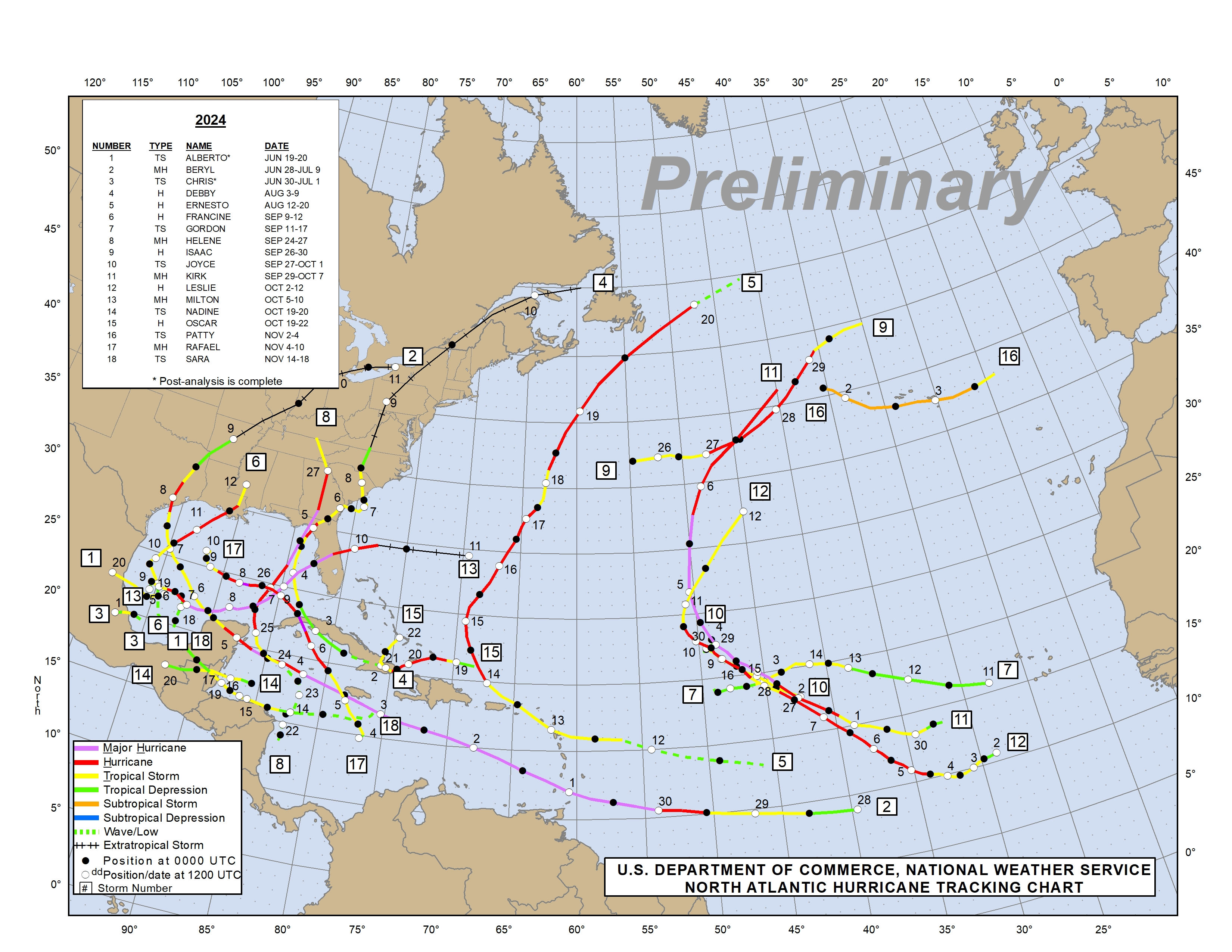
Next, I went to NHC’s Climatology page to see how unusual hurricanes are in New England. Because of the colder waters, they’re certainly not as frequent as hurricanes in the Gulf of Mexico. But they’re also not unusual as you can clearly see from the image below. It shows hurricane tracks going back to 1851.

Red lines show hurricanes with the winds from 64-90 mph.

Next, I looked at the points of origin for Atlantic storms in the 10-day period each season from Sept. 11 – 20.

Going back to 1851, we can see that dozens of storms have followed Lee’s path .

In fact, during September, there’s at least a 70% annual chance that a hurricane will affect this region (see below).

Lee’s track is THE most common for named storms in the Atlantic during September (red area).

Data goes from 1944 to 2020, but is normalized for 100 years. 1944 was the year NOAA started tracking hurricanes with aircraft.

The AP article related higher than normal sea surface temperatures to BOTH climate change and the risk of being affected by a hurricane in New England. It’s true that temperatures ARE above average off the New England coast this year. But it’s also true that temperatures cycle above and below an “average.” You can’t assume that sea surface temperatures ALWAYS increase.

This 28-second animation of sea surface temperature (SST) anomalies from 2002-2011 shows how temperatures vary monthly and annually around the world as well as off the coast of New England.

Starting point of animation is August 2002. Note below-normal sea-surface temps off New England coast.

During the decade covered by the animation, SSTs varied from above to below average five times by my count.

It’s fair to relate one stronger than normal hurricane to higher than normal sea surface temperatures. But it’s not valid to assume that hurricanes will continue to get stronger when sea surface temperatures decrease.

The Curse of Data Truncation

And that brings me to my gripe – data truncation in reporting. “Truncation” means “cutting short,” for instance, when you pick start or stop points in an analysis to prove the trend you allege.

Example: you point to above-normal SSTs (this year) and one waning post-tropical storm. Then you conclude that “climate change could bring more monster storms like Lee.”

The implication: climate change is linear and temperatures are going straight up. Therefore, we can expect more monster storms in New England – where Lee will not even make landfall.

Reporting Turned into Advocacy

AP is a great news organization. But on the issue of climate uncertainty, they have crossed the line between reporting and advocacy. AP even admits it.

To their credit, in 2022, AP announced “a sweeping climate change initiative.” They hired 20 additional journalists to supplement existing staff already dedicated to covering climate change. Their mission: “to infuse climate coverage in all aspects of the news…”

To help finance its climate coverage, AP accepts backing from several foundations, including the Rockefeller Foundation, which admits, “Our focus is on scaling renewable energy.”

I’m not saying that AP or the Rockefeller Foundation deliberately misled people to further an agenda.

However, I can promise you that writers write about what clients want them to write about. And if they don’t, well, hundreds of other writers are lined up ready to take their jobs.

This isn’t a conspiracy. It’s just the way the world works.

Other News Sources Delivered Different Interpretation

Everyone should read critically and consult multiple sources. Triangulate on the truth. Had you read someone else’s coverage, you would have reached totally different conclusions. In that regard, I note several stories posted AFTER AP’s story on Lee that did not even mention climate change once. See CNN, CBS, New York Times, NBC, Reuters, USA Today, or Fox, for instance.

Posted by Bob Rehak on 9/16/2023

2209 Days since Hurricane Harvey

The thoughts expressed in this post represent opinions on matters of public concern and safety. They are protected by the First Amendment of the US Constitution and the Anti-SLAPP Statute of the Great State of Texas.

Spring Creek Dams Facing Hurdles

The San Jacinto River Authority (SJRA), which is managing a feasibility study on two Spring Creek dams, has run into some unexpected hurdles. They involve the benefit-cost ratio and competing uses for the land. Matt Barrett, PE, the SJRA’s Water Resources and Flood Management Division Manager, updated ReduceFlooding on the status of the project.

Project Location Near Montgomery

Harris County Flood Control District, five municipal utility districts, the City of Humble, and the Texas Water Development board are also involved in this project. The dams could reportedly reduce flood levels up to half a foot for 40 miles downstream.

The proposed Spring Creek Flood Control Dams would lie in far northeastern Waller County, a few miles west of Magnolia in Montgomery County.

Second Time Around for Spring Creek Dams

The SJRA first recognized the flood mitigation benefits of dams in the Spring Creek watershed back in 1985. But ironically, while the land could have been bought for a song back then, the projects failed to achieve favorable benefit-cost ratios because so few people lived in the then-rural area.

Fast forward 32 years to Hurricane Harvey when more than 10,000 structures downstream flooded. Experts identified more upstream stormwater-detention as one of the top three priorities for flood mitigation.

When I asked Matt Barrett, PE, the SJRA’s Water Resources and Flood Management Division Manager about the status of the dams, he had this to say. “We’re still working on the feasibility study. We ran into a couple hurdles when we started digging further into the proposed reservoirs.”

Benefit-Cost Ratio

What kind of hurdles? “First, after modeling was updated as part of the study, the benefit/cost ratios came out lower than was previously estimated as part of the San Jacinto Regional Watershed Master Drainage Plan,” said Barrett.

“I think we have a solution for this issue,” he said. “Once we optimized dam sizes and incorporated ‘social benefits’ (which the Federal Government now will consider) into the calculations, the BCRs came out at 1.88 and 2.03 for the two reservoirs.” That means the benefits exceed the costs, a crucial hurdle.

“Because of their costs, the reservoirs would almost certainly rely on some level of Federal participation for construction.”

Matt Barrett, PE


Competing Uses for Land

“The other issue,” Barrett continued, “is that each planned reservoir site is also the site of another planned development, which was not identified until we got into the feasibility study.”

A residential/commercial development is planned for the Birch Creek reservoir site, and a large solar farm for the Walnut Creek site.

Barrett said, “No ground has been broken on the former, and I would like to work with the developers to see if we can come up with a scenario where both projects could exist. Construction HAS begun at the solar farm site, and we are coordinating to determine what options there might be for future coexistence at the site.” 

Funding Partners Will Determine Path Forward, Timetable

“We are currently scheduling meetings with elected officials to present the project and its challenges,” said Barrett. “We want to get their input. Our goal is to get back together with our funding partners likely early next month to determine our path forward.

“The draft report should be completed by April next year, but that is subject to change.  We are behind schedule due to the challenges experienced.”

Project Will Ultimately Depend on Several Factors


Barrett concluded, “Whether the reservoirs ultimately get built will be based on the results of the study and whether there is an entity willing to champion the project through design and construction and ultimately own and take responsibility for operations and maintenance of one or both reservoirs.”

Alternative Possibilities

The SJRA is not actively looking at alternative reservoir sites. However, SJRA and its partners have discussed it. “If we determine the hurdles at the two proposed sites make those sites infeasible, we could consider other sites,” said Barrett. “That said, we selected those two sites because they seemed the most promising. Other sites may not pan out for other reasons. One potential alternative is to look at several smaller detention sites.”

For More Information

See these previous posts on the projects:

Posted by Bob Rehak on 9/15/2023

2208 Days since Hurricane Harvey

Harris County Proposes 11.5% Budget Increase

Harris County’s Office of Management and Budget proposed an 11.5% budget increase during the Commissioners Court special meeting held on September 12, 2023. See below.

Proposed on 9/12/2023, but not yet approved.

Flood Control Maintenance Increase

If adopted, Harris County Flood Control District (HCFCD) would receive an $11.8 million increase from tax revenue for Maintenance and Operations spending – up 10.4% from FY2022.

Given the number of new capital projects, such as stormwater detention basins that Flood Control has created in the last year, that increase seems reasonable. The number of acres that HCFCD needs to maintain steadily increases as it builds new assets.

Acres of infrastructure needing maintenance has almost doubled since 2000. Source: HCFCD Asset Management Presentation

HCFCD now manages 2,500 miles of channels, more than 260 detention basins, 2 levee systems, 3 mitigation banks, and more than 3,200 buyout lots.

Two-thirds of Flood Control’s infrastructure was constructed before 1984 and much of it needs rehabilitation. The District has identified 160 assets with defects, 117 with blockages or conveyance issues, and 215 where vegetation requires serious attention.

As with anything, deferring maintenance too long can lead to failure. Then reconstruction costs can greatly exceed repair costs.

Flood Control Debt-Service Increase

Flood Control also shows an increase in its proposed tax rate to handle debt service – 8.2%. This makes sense as we keep borrowing more and more money against the $2.5 billion bond that voters authorized in 2018.

It could take decades to pay off the interest on money borrowed this year. And next year, we’ll borrow more. The total interest payments increase over time as borrowing accumulates. High interest rates like we have now can increase the total need even more.

Partner Contributions Help Offset Debt-Service, But Are Dropping

The $2.5 billion bond actually identified $5 billion worth of projects. A portion of the original $2.5 B was designated as local-match money to attract partner funding. So for every project, roughly half of the total cost was supposed to be local dollars (tax revenue and/or borrowing). The other half was supposed to have come from partners, such as FEMA, HUD, and the State.

That said, partner funding never has come close to 50%. Q2 of 2020 came the closest at 41%. But the percentage has also dipped as low as 14% recently. Since the start of the bond, partner dollars have comprised 30% of all spending.

Partner spending in recent quarters has declined significantly. Through 22Q1, partner spending averaged $28.4 million per quarter. Since then, the quarterly total has averaged only $11.5 million. That’s a 59% decrease.

Through 22Q1, partner funding ranged between $20-45 million. Since then it hasn’t exceeded $20 million.

To make up for the lack of projected partner funds, HCFCD has had to spend more County/Bond dollars to keep projects moving. And it has done so in a period of high interest rates.

Note how drops in partner spending often trigger spikes in County spending.

As partner funds have fallen off in recent months, so has the overall level of HCFCD spending.

Data for this and all tables/graphs obtained from HCFCD via multiple FOIA requests.

Here’s the data which these graphs reflect. This particular series starts with the approval of the flood bond in late 2018.

Is It a Fair Budget Increase?

That depends on whether you see any flood-mitigation efforts that benefit you. If your area is getting projects, the answer is yes. But if not, you probably wouldn’t be happy with a 1% increase. And out of the $1.5 billion spent to date, precious little has been spent in the San Jacinto watershed.

Regardless, when setting budgets, we must consider dozens of different factors, not the least of which is partner funding. It can extend bond dollars. And consider this.

The $750 million in HUD funds recently received by the County come with “use-it-or-lose-it” deadlines attached. HCFCD had a giant meeting with contractors last week to discuss such issues.

If we can use the HUD money to accelerate construction and preserve bond dollars, we might have enough money to complete all the projects in the bond.

Conversely, with a shortfall in the partnership percentage, more county dollars will go toward projects in low income neighborhoods. That may leave no money for projects in affluent neighborhoods before we burn through the bond funds.

At the very least, I say we need to beef up the HCFCD staff applying for grants. I’ll bet we can all agree on that.

Posted by Bob Rehak on 9/14/2023

2207 Days since Hurricane Harvey.

TWDB Wants Your Input on Nature-Based Flood-Mitigation Solutions

Reprinted with minor edits from an article posted by the Texas Water Development Board (TWDB) on 9/11/2023 – Flooding is the most common and deadly disaster in the state. It has plagued Texans for generations, costing billions in property damage—and worse, loss of lives. So, flood mitigation is at the top of the list when it comes to addressing the most challenging water issues across the 269,000 square miles of Texas.

2018 NOAA Study Revealed Rainfall Assumptions Inadequate

The National Oceanic and Atmospheric Administration published a study in 2018 revealing that rainfall values in some parts of Texas previously classified as 100-year events are now categorized as much more frequent 25-year events.

Varied topography and proximity to the Gulf of Mexico have always played a significant role in the state’s flood events. So has the population in Texas; it surpassed 30 million last year. according to estimates from the U.S. Census Bureau.

Recent exponential growth, coupled with the already complex landscape, necessitates more forward-thinking flood planning and coordination. For instance…

We need to consider how natural features in new developments and infrastructure projects can work to our benefit to reduce flood risks.

TWDB

Participate in Online Survey

To help address flood issues across the state, TWDB is conducting an online survey now through September 29. Purpose: to collect input on the use of nature-based solutions to mitigate flood risk. Responses will help develop a guidance manual for communities seeking to implement these projects.

Nature-based solutions are broad, ranging from detention and retention ponds to preservation of natural features, such as floodplains and wetlands, or may even include roadside ditches with nature-based components. Sometimes, projects designed to improve water quality or intended to provide other environmental benefits can also work to mitigate flooding.

“The work that we’re doing is from a lens of flood mitigation. But really, there are likely greater benefits for water quality, environmental enhancement, and even for public recreation and enjoyment,” said Saul Nuccitelli, the TWDB’s Director of Flood Science and Community Assistance. “We’re looking to try to integrate and connect those project benefits and encourage folks who are doing flood work to seek out ways to incorporate nature-based components into their projects.”

Examples of Nature-Based Solutions

Nature-based solutions often include community benefits:

Nature-based solutions can often provide benefits to the community while serving as flood-mitigation strategies. The Humble-Kingwood area has numerous examples of flood-mitigation solutions that improve quality of life. For example, the 100+ mile Kingwood trail network, East End Park, Creekwood Nature Preserve, River Grove Park, and the Spring Creek Nature Trail are hugely popular community amenities that reduce flood risk.

188-acre East End Park attracts more than 100,000 visitors per year. It contains 5 miles of trails weaving through meadows, forests and wetlands that reduce flood risk while enhancing quality of life for people and animals.

Goal of Survey: ID Sustainable Building Blocks for Growth

The TWDB’s survey will capture examples of projects and programs using nature-based solutions with flood mitigation benefits. TWDB wants to learn about solutions in the varying ecoregions across Texas.

The goal of the guidance manual is to make practical case studies of projects, incentive program concepts, and regulatory templates available to community officials, decision-makers, and other practitioners. Many are interested in nature-based solutions as value-added alternatives to traditional flood infrastructure.  

“If you find ways to incorporate nature-based solutions, it doesn’t mean people need to stay out of it all the time,” said Nuccitelli. “For example, you may have an area that’s wetland mitigation or wetland banking, so you may want to minimize how much traffic goes through it or what goes on there, but to the extent that you can include recreational activities associated with a project, urban economic benefit and utilizing nature can be somewhat synergistic.”

Reducing Runoff up to 5X

According to the Environmental Protection Agency, when 10 to 20 percent of a watershed is covered by impervious surfaces like roads or parking lots, runoff doubles. If impervious surfaces cover 100 percent of a watershed, the runoff is five times that of a forested area, which significantly increases the potential for flooding.

Incorporating nature-based solutions into a new project could potentially help manage runoff from future growth. For example, identifying and preserving healthy stands of trees or wetlands to utilize those existing natural features as amenities, such as a pocket park or an area of trees next to homes.

Data Will Ultimately Help Build/Fund Community Resources

By developing a guidance manual, the TWDB aims to

1) Share data and information about the benefits of nature-based solutions that could then empower communities to adopt them

2) Provide tools, research, case studies, incentive program concepts, and example ordinances—anything that a community may use as a resource if it’s interested in pursuing these solutions

3) Share details about funding opportunities and grant applications for these types of projects.

“That would be a big success if communities could take what we’re developing within the guidance manual to further encourage or enhance nature-based solutions,” said Nuccitelli.

Once the survey responses are compiled and the guidance manual is developed, the TWDB plans to release the draft in the summer of 2024 for public input.

For More Information

To learn more about nature-based solutions for flood mitigation in Texas, visit the TWDB website. To take the survey, click here. It takes about 15 minutes, but is a very thought-provoking.

See more TWDB articles about flood mitigation posted in  Flood.

Posted by Bob Rehak on 9/13/2023 based on a TWDB article

2206 Days since Hurricane Harvey

Worse than Harvey, Libyan Flood Kills Thousands

4PM Tuesday 9/12/2023 – A Libyan flood in Derna (also spelled Darnah) killed thousands and authorities say more than 10,000 are missing.

At this hour, exact numbers are hard to come by as large areas are still cut off from rescue workers and reporters. But to put those estimates in perspective, Harvey killed 36 in Harris County.

The Cause: Months of Rain Fall in Day

Torrential rains from Mediterranean storm Daniel burst two dams, wiped out four bridges and flooded large areas of Derna. The flash floods swept homes, bodies and vehicles into the sea while knocking out communications in large parts of the area.

Daniel dumped months of rain in one day on a large swath of northern Libya.

Libya is normally one of the driest countries in the world. The Sahara dominates most of the country’s climate. But the Mediterranean also influences rainfall along the northern coast.

Wikipedia says the annual rainfall in Derna is around 11 inches. But CNN reported that in Derna, eight months worth of rain fell in one day.

In Al Bayda, about 50 miles west, Libya’s National Meteorological Centre said that 16 inches of rain fell between 10 Sep 8am and 11 Sep 8am, a new rainfall record.

Weather Spark shows that average precipitation in Derna during September amounts to less than an inch. And even in the wettest years, Derna receives at most 4 inches per month.

Average September Rainfall in Darnah equals .2 inches, Courtesy of Weather Spark.

Weather Spark also indicates that Derna receives rainfall on less than one day in an average September.

Terrain Funneled Floodwater Toward City

Derna lies along the coast of the Mediterranean Sea, at the end of a long, narrow, natural valley, called a wadi, which is dry for much of the year.

New York Times image compiled from Google Earth

As the city was inundated by Daniel, which made landfall in Libya on Sunday night, the wadi funneled rushing water into the center of the city. Riverbanks swelled, bridges were washed out and two dams farther up the wadi burst, adding their waters to the deluge.

Tropical-like storms rarely happen in the Mediterranean, but they do happen occasionally. And when they do, meteorologists call them “Medicanes,” short for Mediterranean hurricanes.

World and Social Media Focus on Flood

YouTube is awash in videos from the Derna flood.

NBC reported that a quarter of the city of 125,000 people was destroyed.

This CBS story shows pictures of the incredible destruction. This flood didn’t invade homes slowly, but leave them standing. It pummeled homes and whole neighborhoods.

Google “flood Derna Libya” to find hundreds of links and the latest news. Stories are being updated almost hourly.

Parallels With Harvey

Perusing many of those stories revealed several parallels with Hurricane Harvey which struck the Houston area in 2017.

Rainfall Records

Both areas encountered record rainfalls. Harvey dumped far more rain than Daniel. But then Daniel’s rainfall fell over a much drier area where infrastructure was designed to handle smaller amounts. Still, both were records, and both overwhelmed local infrastructure with unexpectedly high volumes.

Dam Concerns

Both Houston and Derna lay downstream from dams. During Harvey, the SJRA cited fear of failure of the Lake Conroe Dam as the reason for its massive release. In Derna, the dams just failed.

Lack of Warning

During Harvey, downstream residents received no warning that Lake Conroe would open its massive floodgates. Many stepped out of bed in the middle of the night to find themselves in knee deep water. CNN reported that there was no warning that the Derna dams could fail and no order to evacuate. Many who tried to evacuate found themselves cut off by collapsed bridges, washed out roads, and rising water, just as in Houston.

Lack of Maintenance

Aljazeera indicated that lack of maintenance may have played a role in the Derna disaster. The dams that failed hadn’t been maintained for years, even though severe erosion had been reported in scientific journals for more than a decade. Likewise, deferred maintenance played a role in flooding the Lake Houston Area during Harvey. During the drought in 2011, the water level in Lake Houston fell so low that the City of Houston could have removed sediment with dump trucks instead of dredges. But Mayor Anise Parker refused to do so. The accumulated sediment later wound up blocking the San Jacinto West Fork and contributing to the flooding of thousands of homes in the Humble/Kingwood area.

Enforcement of Building Codes

In Libya, political turmoil since 2011 reportedly distracted government from the mundane task of enforcing building codes. As a consequence, many hastily constructed buildings went up without adequate safeguards or supervision, and were swept away during the flood. Sound familiar?

Learning from Disasters

We should learn from the past and others’ mistakes. I wonder how many other communities have been surprised by:

  • Record rainfalls
  • Dam failures or unexpectedly high dam releases
  • Warning systems that failed and left people with no time or way to evacuate
  • Impacts of deferred maintenance
  • Lax enforcement of building codes

I hope the world learns the lessons of the Derna disaster so that we can compare them to other floods and get smarter about mitigation measures that make a difference.

Posted by Bob Rehak on 9/12/2023

2205 Days since Hurricane Harvey

Earth Grows Eyeballs

We have two tropical systems in the Atlantic this morning – Hurricane Lee and Tropical Storm Margo which is projected to intensify into a hurricane by tomorrow.

I love looking at the satellite imagery of earth on the National Hurricane Center website. It lets you verify all the complex descriptions of weather developments. And this morning when I went to look at the satellite imagery of the full Atlantic, I was startled by what appeared to be a pair of eyeballs staring back at me, perfectly centered in the sunrise.

And the cloud formations below them loosely resembled a nose and a frown.

Frankly, it looked a bit spooky to me. A cosmic coincidence? But one that triggered thoughts of Halloween a little more than a month away.

Please share with your kids and grandkids. This could be an interesting way to teach them to keep their eyes on the weather.

Posted by Bob Rehak on 9/11/2023

2204 Days since Hurricane Harvey

Peak of Hurricane Season is Today!

Today, September 10 is the statistical peak of hurricane season.

NOAA calculates the peak by looking at the number of storms per day in the last hundred years. And September 10th takes the prize with approximately 95 named storms. That’s almost one per year on this date. You would have about a 5% chance of NOT having a named storm in the Atlantic Basin on September 10th, according to this data.

peak of hurricane season

And true to form, today, the Atlantic has two named storms, Lee and Margot, as I write this. However, neither is anywhere near the Caribbean or Gulf of Mexico.

NOAA hasn’t really been collecting hurricane data back 100 years. The chart above is based on 77 years of data, but “normalized” to 100 years to make the frame of reference more intuitive.

The 77-year period extends from 1944 to 2020, starting at the beginning of the aircraft reconnaissance era.

So Far This Year Vs. Average Season

Usually, by September 9, we’ve had eight named storms in the Atlantic Basin. That would be the H storm. However, this year, we’re already on the M storm. That puts us five storms ahead of the average year.

But wait! This year we also had a bonus storm in January. Only after re-analysis did the National Hurricane Center realize that it should have named the storm. But it didn’t. So, we’re really six storms ahead of the average season so far. And that’s far above the average.

Only two named storms in the Gulf so far this year. Neither has come close to Houston.

The chart above is updated monthly and does not include the two named storms now in the Atlantic.

Forecast vs. Actual to Date

So, at the mid-point, how does this season compare to predictions? If the second half of the season is anything like the first, we could easily have more named storms and more major hurricanes than predicted by NOAA in its August 10 seasonal update.

Earlier this year, forecasters increased their predictions from a normal season to an above normal season. They predicted 14-21 named storms (winds of 39 mph or greater). We’ve already had 14.

Of those, NOAA said 6-11 could become hurricanes (winds of 74 mph or greater). We’ve had 4 so far (Don, Franklin, Idalia and Lee).

And of those, forecasters said 2-5 could become major hurricanes (winds of 111 mph or greater). We’ve had 3 of those so far (Franklin, Idalia and Lee). Franklin and Idalia reached Category 4 strength. Lee briefly exploded into a Cat 5.

Forecasters have linked storm intensity to sea surface temperatures. When average storms hit very warm waters, they can intensify quickly. And that is exactly what has happened this year.

Here’s a look at sea surface temperature anomalies (departure from normal) around the world.

Virtually everything between Africa and Houston is 1-3 degrees Celsius above normal (1.8 to 5.4 degrees Fahrenheit). Sea surface temperature data is current as of Sept. 9, 2023…just one day before the peak of hurricane season.

Posted by Bob Rehak on September 10, 2023 based on information from NHC.

2203 Days since Hurricane Harvey

Damn the Downstream Consequences, Colony Ridge Expansion Continues Relentlessly

Damn the downstream consequences, including sediment pollution, increased flood risk and monstrous dredging costs. Colony Ridge, the controversial 30+ square-mile, Liberty County development that markets to Hispanics – while flaunting drainage, environmental and fire regulations – is clearing and paving thousands of additional acres.

Not even Google Earth can keep up with the developer’s relentless expansion. On 8/12/23, I flew over Colony Ridge in a helicopter and found huge areas where 3-week-old satellite imagery was already hopelessly out of date.

Google Earth image from 7/18/23. Red/yellow highlighted areas changed radically within three weeks.


With the exception of areas protected by the Houston-Conroe and Tarkington Bayou Mitigation Banks, the highlighted areas above have largely been cleared and/or paved.

The RED area now has paving not visible in the satellite image. The YELLOW area was being cleared and paving was just starting even though the image shows none of that. So what do these areas look like from a few hundred feet?

Pictures Taken 8/12/23 over Red Area

I shot the four pictures below on 8/12/23. They represent dozens of others. The red area already has most streets, but no fire hydrants.

Pictures Taken over Yellow Area

The two pictures below show some of the development activity taking pace in the yellow area.

Looking west across newly cleared area.
Looking N at part of Colony Ridge expansion.

What kind of homes will go here? To predict the future, look to the past.

Homes on Parade

Colony Ridge is the world’s largest trailer park. One Plum Grove resident who lives near a northern entrance to Colony Ridge says she routinely sees up to seven mobile homes per day going into the development – seven days per week.

It’s hard to know exactly how many new homes arrive each day, because there are other entrances. But if you assume the max for this one entrance, 50 homes a week times 52 weeks makes up to 2600 homes per year.

Colony Ridge Expansion
Manufactured home making its way through the main commercial area of Colony Ridge.
Room with a viewof severe erosion.

Note the erosion in photos above and below. It will make its way downstream into the East Fork San Jacinto. These ditches are typical of Colony Ridge. The eroded sediment will reduce conveyance of the river and contribute to flooding.

Poverty: The Mother of Pollution

Ghandi once said, “Poverty is the mother of pollution.” That’s certainly the case here. But I would modify the saying. While poverty may be the mother of pollution; greed is the father.

The poverty of the residents doesn’t cause sediment pollution. But a business plan built on high-interest-rate, owner financing that targets impoverished people with few options does.

The developer seems to have found a target market that is less concerned with their environment than survival.

It’s a market ripe for exploitation where corners can be cut. Residents have few options and can’t complain.

And the developer shows little interest in changing a business model that fuels relentless expansion and growth. Damn the downstream consequences.

In virtually every area I have photographed, he has not planted vegetation on the banks of the channels. Nor has he used silt fences or installed backslope interceptor swales to reduce erosion as Liberty County regulations require.

Instead of the developer bearing those costs, downstream residents in the Lake Houston Area do. Since Harvey, the Army Corps, Harris County and City of Houston have spent more than $220 million of your tax dollars to dredge excess sediment shed from rivers of mud like this.

Colony Ridge drainage ditch.
Working drainage is a luxury.

The poverty in Colony Ridge is crushing. I’ve seen people sleeping in tents trying to save enough money to buy a camper to live in.

No bathroom in sight. Do Liberty County health codes really allow this?
Christmas dinner. Enlargement of this photo from Christmas 2020 shows food on the table in the foreground.
One small part of Colony Ridge. The market for a piece of the American dream stretches endlessly in Liberty County.

The estimated population of Colony Ridge is now greater than the three largest cities in Liberty County (Cleveland, Dayton, and Liberty) put together. No one knows what the population is with certainty because of the large number of undocumented aliens who did not participate in the last census.

And the Colony Ridge developer is expanding into Harris and Montgomery Counties. ReduceFlooding will monitor progress of those areas to see if they, too, contribute to sediment accumulation, dredging costs, and flooding.

Posted by Bob Rehak on 9/9/23

Posted by Bob Rehak 2202 Days since Hurricane Harvey

The thoughts expressed in this post represent opinions on matters of public concern and safety. They are protected by the First Amendment of the US Constitution and the Anti-SLAPP Statute of the Great State of Texas.

Woodridge Village Excavation Activity Almost Doubles

Compared to July, Woodridge Village excavation activity almost doubled in August.

As of close of business on September 6, 2023, Harris County Flood Control District (HCFCD) contractor Sprint Sand and Clay has excavated 146,104 cubic yards of material to expand the stormwater detention basin capacity on Woodridge Village.

At the end of July, Sprint had excavated 135, 751 cubic yards. That means the company excavated another 10, 353 cubic yards in August, or 6.4 acre feet.

And that brought the total excavated to date up to 361.6 acre feet, or 94% of the Atlas 14 requirement.

Stepping Up Stormwater Detention Capacity

When Perry Homes sold the site to HCFCD and City of Houston, the site had five detention basins totaling 271 acre feet. The new basin has the potential to more than double that volume.

Think of the expansion of Woodridge Village stormwater-detention-basin capacity in four stages:

  • The starting point, i.e., what the site had when purchased from Perry Homes.
  • An additional amount that Sprint has excavated to date.
  • The Atlas-14 requirement.
  • The contract max (500,000 cubic yards).

Here’s how the various stages look in a table.

Acre Feet of Stormwater Detention% of Atlas-14 Requirement% of Ultimate
Site Had When Purchased from Perry Homes27170%47%
Has as of 9/6/23361.694%62.3%
Atlas 14 Requires385100%66%
If Sprint Excavates All 500K Cubic Feet580150%100%
As of 9/6/23.

I based all calculations on original construction plans, HCFCD monthly reports, Atlas-14 Requirements and Sprint’s contract.

Photos Taken 9/7/2023

Here’s how Woodridge Village excavation activity looks on the ground.

The site was busier today last month. Trucks constantly shuttled in and out.
Looking NE across the new basin and the main part of Woodridge Village
Looking SW toward site entrance, Kingwood Park HS and Woodland Hills Drive
Main thrust of work during August appears to be toward the east.
An excavator loaded several trucks while I watched.

Outline of Excavation

Harris County Commissioners Court approved the contract with Sprint Sand and Clay on July 20, 2021. It obligates Sprint to remove at least 5,000 cubic yards per month. Excavation started on January 27, 2022. 

Woodridge Village Excavation and Removal
Sprint can take material wherever it wants, but must excavate from within the red boundary line.

Sprint will make only $1,000 from its Woodridge Village excavation contract with HCFCD, but will make its profit by selling the dirt at market rates. An engineer familiar with HCFCD operations estimates that if HCFCD had to pay market rates to have that 146,000 cubic yards moved, it would have cost taxpayers between $1.46 million and $2.9 million. He based those numbers on recent bids.

So, the Sprint contract is a good deal for taxpayers, but it carries some uncertainty with it.

If the demand for dirt dries up, excavation could slow or stop.

Next Steps

But simply excavating the dirt isn’t the end of the job. Harris County still needs to slope the sides, plant grass, and tie the new basin into the site’s existing stormwater-detention-basin network. 

HCFCD awarded the engineering project for all that to Halff, based on the company’s qualifications. HCFCD is currently negotiating the scope of the project with Halff.

At the current rate of excavation, Sprint could reach Atlas 14 requirements by the end of the year. But the contractor is still less than a third of the way through its contract maximum of 500,000 cubic yards.

Construction of Taylor Gully conveyance improvements cannot move forward until the appropriate stormwater mitigation on Woodridge Village is in place first. Only one thing is certain at this point. That could still be awhile.

But there is good news. In the meantime, the extra Woodridge Village detention basin capacity will go a long way toward reducing flood risk for people downstream.

Posted by Bob Rehak on 9/7/23

2200 Days since Hurricane Harvey

Upcoming HCFCD Projects Scarce in Precinct 3

On August 28, 2023, Harris County Flood Control District (HCFCD) published two lists of projects that it will advertise in the next year. The first contains upcoming HCFCD projects going out for construction bids. The second contains requests for qualifications and proposals (RFQs and RFPs) for engineering designs and studies.

Of the 50 total projects on the two lists, only one pertains to the Lake Houston Area, a request for qualifications (RFQ) on the Kingwood Diversion Ditch design.

Another is for Barrett Station Drainage Improvements, but Barrett Station is about 5 miles south of the Lake Houston dam near Highway 90 and FM2100.

There were no upcoming construction projects listed anywhere in the Kingwood/Lake Houston area.

In fact, only one construction project out of 24 even pertains to Precinct 3, a TC Jester stormwater detention basin.

Construction Projects Going Out for Bid

Virtually all projects on both lists pertain to precincts led by Democratic commissioners. Given how long it takes to get projects into construction, it could take years before the Kingwood Diversion Ditch project moves into construction.

Upcoming construction projects going out for bids in the next year.

It normally takes 3-4 months from the time HCFCD advertises a construction project before a shovel goes in the ground.

Engineering/Design Studies Being Advertised

From the time an engineering study goes out for bid, it normally takes 12-18 months until shovels turn, but the time can vary widely depending on the nature of the project. Here’s the most recent list of engineering jobs being advertised.

Upcoming engineering design projects, studies/surveys.

For printable lists of both types of projects in PDF format, click here.

Precinct 3 Commissioner Tom Ramsey also pointed out that he hopes to move forward with several Lake Houston Area drainage projects using his own budget, not HCFCD’s. So the picture isn’t quite as bleak as the lists above make it look. However, his team is not yet ready to talk about those projects.

What About Taylor Gully/Woodridge Village?

Enquiring minds will ask, “What happened to Taylor Gully, Woodridge Village and the Lake Houston Gates projects?”

The Taylor Gully and Woodridge Village engineering project(s) were previously advertised. “HCFCD awarded design to Halff based on qualifications,” said HCFCD spokesperson Beth Walters. “This effort will include both Taylor Gully and Woodridge, as the channel conveyance improvements on Taylor Gully cannot be constructed without having the appropriate stormwater mitigation in place first.”

Walters added, “We are currently negotiating scope items with Halff (the normal first step of the process once the consultant has been selected).”

After design completion, HCFCD will advertise for construction. Construction does not show up on these lists because it will be more than 12 months out.

Lake Houston Gates Being Handled by City of Houston

The City of Houston is handling the Lake Houston Gates project. So, it wouldn’t show up on the HCFCD lists either.

Mayor Pro Tem Dave Martin had this to say about the status of the gates project. “We are presently in ‘final design’ on the eleven gate structure, in the earthen embankment area, east of the existing Lake Houston Spillway Dam.”

New gates will go to the right of the existing gates in the earthen portion of the dam.

“Estimated start of construction, pending permits, environmental studies, etc. will be 2025 Q1 or Q2,” said Martin. “Our money from the 2023 State legislative session should arrive by December 2023. We also have money from the 2021 state legislature which they will allow us to reappropriate from dredging to the gates if necessary.”

Martin also pointed to two dredging projects handled by the City. Canal dredging in Huffman is already underway. And “Within the next 2-3 weeks, we will start a FEMA funded project, south of the West Fork mouth bar, near Atascocita Shores,”said Martin. “This will remove approximately one million additional yards of sediment.”

Posted by Bob Rehak on 9/6/2023

2199 Days since Hurricane Harvey