Another benefit of the FEMA site is that it spans county boundaries, i.e., if you live on the Harris/Montgomery County Line.
FEMA’s National Flood Hazard Layer Viewer can track creeks, etc. across county lines. Please note the big green space in the center of the frame. This is the new Perry Homes development, Woodridge Forest. Neither the FEMA map, nor the MoCo map below contain flood zone information for this area although much of it was wetlands before Perry clear cut it.
Harris County
Harris County operates a site called “Flood Education Mapping Tool.” The Harris County site superimposes drainage ditches, streams, creeks, bayous and rivers and even gives you their names and numbers. Very helpful if you want to report a problem some day, or track up or downstream to see where drainage issues may be originating.
Detail from Harris County map showing only drainage features and major streets in the Lake Houston Area.
People on Killerbee Lane will be pleased to know that they are not in any mapped floodplain.
Benefits of County Sites
According to Diane Cooper, a hydrologist with more than 20 years of experience in forecasting floods, both of the County sites have better imagery and more layers than the FEMA site.
Layers comprise one of the key features of both county sites. Experiment with them. I’m especially fond of the background layers.
They let you see the flood zones superimposed over simple maps, satellite images, historical satellite images, and more. The Montgomery County site even lets you click on streets and information about them pops up. I learned, for instance, that one subdivision in MoCo has a street named Paper Wasp Lane. You really don’t want to mess with the people on that street! It’s not far from Killerbee Lane. Let’s get up a football game between those two streets! I’d pay to see that.
Posted by Bob Rehak on October 10, 2019, with help from Diane Cooper
771 Days since Hurricane Harvey and 20 since Imelda
https://i0.wp.com/reduceflooding.com/wp-content/uploads/2019/10/MoCo-Map.jpg?fit=1500%2C1117&ssl=111171500adminadmin2019-10-08 20:35:402019-10-08 20:41:56Three Ways to Find Out If You Are In a Floodplain
Houston City Council Member Dave Martin announced today that the Federal Emergency Management Agency (FEMA) is now offering assistance to Houston residents affected by Tropical Storm Imelda.
Several homes that flooded in Woodstream subdivision. Imelda affected at least 49 homes in this one subdivision.
Applications for FEMA Individual Assistance for Imelda recovery will be open through Tuesday, December 3, 2019. FEMA may provide Houston home owners, certain types of renters, and businesses with the following types of assistance:
Home/Primary Residence: FEMA provides assistance to individuals and families who have lost their homes as a result of a presidentially-declared disaster. If you are a renter or homeowner you may qualify for assistance. By law, FEMA assistance cannot duplicate the assistance you receive from your insurance company, but you may receive assistance for items not covered by insurance. If your home was impacted by a major disaster, FEMA recommends that you apply for assistance by clicking here.
NOTE: FEMA does not offer assistance for a secondary home. Federal guidelines only allows FEMA to provide housing assistance when your primary residence is impacted by a presidentially-declared disaster.
Business: FEMA does not offer assistance for small businesses impacted by a presidentially-declared disaster. However, FEMA partners with the Small Business Administration (SBA), which offers low interest loans for business damages. Learn more about the business loan application process by clicking here.
Other Needs Assistance: FEMA offers disaster assistance for some of your other disaster-caused expenses including, medical and dental, child care, funeral and burial, essential household items, moving and storage, vehicle, and some clean-up items.
Click here or call 1-800-621-FEMA for more information. Residents can visit www.houstonrecovers.org for additional recovery information.
For questions regarding the FEMA application process, please contact your Federal Representative as FEMA is a federal agency. To find out who represents you at a federal level, please click here.
Posted by Bob Rehak on 10/8/2019
770 Days after Hurricane Harvey and 19 after Imelda
https://i0.wp.com/reduceflooding.com/wp-content/uploads/2019/10/ImeldaWoodstream_001.jpg?fit=1500%2C717&ssl=17171500adminadmin2019-10-08 14:20:442019-10-08 14:22:42FEMA Individual Assistance Now Available For People, Businesses Flooded by Imelda
Note: If you have pictures of Imelda that you would like to share, please send them in via the Submissions page on this web site.Remember to identify time, date, location and describe what’s happening in the photo.
Where Shady Maple intersects Rustling Elms in Elm Grove, Melanie Bankston and her husband captured some stunning images on the morning of September 19th as Imelda raged across the area. The images show a distinct zebra pattern in the water rushing down the street. Taken as a series, they indicate that:
Shady Maple (the street) initially flooded from pure rainwater, not Taylor Gully or Woodridge Village
Later, murky brown, sediment-laden water, streamed down the street
Woodridge Village did not contain its stormwater as the law mandates.
Because of the way Shady Maple curves, I’ve included this satellite image for orientation purposes. The red arrow indicates the angle of view in the photos. Bankston shot across Shady Maple toward the bridge on Rustling Elms and Taylor Gully.
At 9:37 a.m.
“At 9:37am that we couldn’t clearly see brown water,” said Blankston.
Video at 9:52
At 9:52 a.m. most of the water in the street is still running clear. Note the speed of the trash can as it floats by. Taylor Gully is in the background. You can see it under the crepe myrtle. Also note how the water in the street is rushing toward Taylor Gully, an indication that the water in the gully was lower than in the street.
By 10:37 a.m.
By 10:37 a.m., murky brown water was coming down Shady Maple from the direction of Woodridge Village, where Perry Homes had clearcut 268 acres without installing detention to hold a hundred year storm. Regulations and permits obligated them to do so.Note the distinct color difference between the rainwater that had been rising in the street and the new invading water.This closer shot was taken seconds later. In it, you can see how the color of muddy water invading the street matches the color of muddy water in Taylor Gully behind the crepe myrtle.At this point in Taylor Gully, the water came almost exclusively from Woodridge Village.
By 11:25
By 11:25 a.m., Taylor Gully had overflowed. The two streams of muddy water merged and started to displace the clearer rainwater in the street.
In North Kingwood Forest, the same types of evidence suggest that muddy water entered Right Way, then River Rose Court, turned the corner on Creek Manor toward Taylor Gully then turned again down Shady Maple toward Rustling Elms. There it turned another corner toward Taylor Gully, until the Gully came out of its banks.
Path of muddy water through the streets of North Kingwood Forest and Elm Grove toward the Bankston Home, Rustling Elms and Taylor Gully.
Emergency Evacuation for Second Time in Four Months
Keith Stewart who lives on the corner of Shady Maple and Creek Manor evacuated his family in a canoe toward Ford Road in Porter. He says the current coming down River Rose was so fast, he struggled against it.
Keith Stewart family evacuating Elm Grove on 9.19.19. Stewart had just made the turn from Creek Manor, north onto River Rose. He was struggling against the current while taking this shot. Shown in the picture are his wife Jennifer, son Gabriel, and brother-in-law Ambrose Johnson.
Aside from the stunning and unusual amateur photography, the content of these images represents yet more evidence that Perry Homes, its subsidiaries and contractors failed to contain stormwater runoff as they were obligated to do by law. Hundreds of families in Elm Grove and North Kingwood Forest paid for that failure.
The Perry gang had only installed about a quarter of the detention on their site before Imelda. The other three quarters of the rain had to go somewhere else and it did.
Posted by Bob Rehak on 10/7/2019
769 Days after Harvey and 18 after Imelda
The thoughts expressed in this post represent my opinions on matters of public interest and safety. They are protected by the First Amendment of the US Constitution and the Anti-SLAPP Statute of the Great State of Texas.
https://i0.wp.com/reduceflooding.com/wp-content/uploads/2019/10/Stewart-Evac-9.19.19-e1619020734162.jpg?fit=999%2C739&ssl=1739999adminadmin2019-10-07 21:31:102019-10-07 21:44:53Stunning New Imelda Images Show Stream of Muck Coming Down Shady Maple From Direction of Woodridge Village
Below: the approximate locations of breaches for orientation purposes. All aerial photos taken on 10/2/19.
Approximate locations of eight breaches in the Porter Triple PG mine during Imelda.
Breach #1
Partial breach along Caney Creek in the northern section of the mine, looking south toward the mine’s ponds.
Breach #2
Another pond in the far northern area shows evidence of a breach and severe erosion. This shot looks northwest.
Breach #3
Looking NW from over the main dike that separates the main part of the mine from the northern area. The dike cuts from the upper left toward lower right and has a massive breach. The angle of the downed trees suggests that Caney Creek overflowed on the north, swept through all the ponds to the north and then broke into the mine through this breach.
Breach #4
Partial breach. Hovering over Caney Creek in the foreground, looking west into the pit.
Breach #5
Hovering over Caney Creek in the foreground, looking west into the pit.This breach was opened in May and never closed properly.Same breach, but photographed from the reverse angle. Hovering over the pit, looking east toward Caney Creek.
Breach #6
The southern dike of the mine is behind these trees. It obviously didn’t hold back water sweeping through the mine. It pushed these fences in from the north toward the south.Photo taken 10/6/19.Many homes immediately below the mine flooded also. The so-called dike that runs along the southern edge of the mine is really flush with the ground level in this area.Photo taken 10/6/19.
Breach #7
Hovering over the pit looking toward the west dike of the mine and White Oak Creek, which breached into the mine.Reverse shot. Looking east into the mine from over White Oak Creek.
Breach #8
The mine’s main stockpile sits on the western side of the mine. Rain seems to have washed much of it into the creek below the dike.
Direction of Flow
Note additional erosion to main stockpile. It sits at the confluence of two floodways: Caney Creek’s and White Oak Creek’s. You can see the influence of those two creeks in the erosion. This shot faces west. Caney Creek came in from the north (right to left). White Oak Creek came in from the west (top middle to left middle). Note the sand pushed up against the building.See close up below.Sand pushed up against northern edge of building indicates the main flow came from the north…Caney Creek.
Sand Clogging River
Much sand now clogs the river that wasn’t there before Imelda. No doubt, some sand came from river bed and bank erosion. But it’s hard to believe that none of it came from the Triple PG Sand Mine, which sits in two floodways and whose dikes breached in at least eight places.
The shot below looks across the northeastern section of Riverchase. Many homes flooded in this area. When you look at the river, you can see a possible contributing factor: giant sand bars that consume two-thirds of the width of the river.
The breaches, the sand clogging the river, and the flooded homes all argue for moving mines back farther from rivers. Texas is the only state that has no minimum setbacks for mines. During Imelda, the East Fork and its residents paid the price for that policy.
Northeastern Riverchase, where several homes flooded near the river. Note giant sand bars just beyond the trees.Residents have commented on all the sand in streets. East End Park lies to the right of the giant bar. It also suffered from massive sanding during Imelda, in the area immediately opposite the bar.A reverse shot of this bar shows that it is not only wide and long but tall. It reaches into treetops.The helicopter was hovering over East End Park for this shot and the camera is looking north.
Altogether, I took almost a thousand shots from the air last Wednesday along the East Fork between 99 and Lake Houston and from Lake Houston up the West Fork to the Woodlands. More findings in future posts.
Posted by Bob Rehak on 10/6/2019 with help from Josh Alberson and Charlie Fahrmeier
768 Days since Hurricane Harvey and 17 since Imelda.
All thoughts in this post represent my opinions on matters of public interest and safety. They are protected by the First Amendment of the US Constitution and the Anti-SLAPP statute of the Great State of Texas.
https://i0.wp.com/reduceflooding.com/wp-content/uploads/2019/10/Homes_001.jpg?fit=1500%2C1000&ssl=110001500adminadmin2019-10-06 22:45:532019-10-06 22:48:34More Breaches Discovered at Triple PG Sand Mine; Implications for East Fork Flooding
Ken Matthews lives in a one-story house on Shady Maple Drive in Elm Grove about a block below the troubled Woodridge Village development in Montgomery County. Homes on Shady Maple Drive experienced severe damage during both the May 7th and September 19th storms. That damage has been linked to this development.
“Had I Waited One More Minute…”
Between 8 and 9 o’clock a.m. on September 19th, Matthews saw water rising quickly in front of his home. He made a split-second decision to evacuate his wife and child. By the time he packed them in his car, they barely escaped. Water filled the street that quickly. He said, “Had I waited one more minute, we would not have gotten out.”
Matthews had just moved back into his house days before. They had lived with a friend for months while finishing repairs from the May 7th flood. He and his family went to the same friend’s house to wait out the September 19th storm.
Video from Jeff Miller’s security camera several blocks east shows his street filling up with clear water at the same time Matthews evacuated. However, a short while later, at exactly 10:10 a.m., a wave of chocolate brown muddy water came cascading down the street in a sudden surge. That much muck could only have come from one place: Woodridge Village. With only 25% of the detention installed, 75% of the runoff had to go somewhere else. It went into the streets of Elm Grove and North Kingwood Forest.
When Matthews returned home, he found a thick layer of silt in his mailbox of all places. Perry Homes’ check wasn’t in the mail, but apparently their dirt was.
Matthews said he did not join the lawsuit against Perry Homes subsidiaries and contractors after May 7th. However, he does plan to join the suit now. His home has just been wiped out for the second time in four months.
Even More Dirt
If you want to find more dirt on Perry Homes, its subsidiaries and contractors, just go to the north end of Village Springs Drive next to Woodridge.
Significantly, Perry Homes has not lifted a finger to help the residents of Elm Grove. Instead it is suing them. This ranks as a new low in the annals of American corporate history.
Harris County Stormwater Rules Discourage Clearcutting Giant Sites All at Once
What do best practices in the development industry have to say about clearing such large sites all at once?
Harris County Stormwater Quality Management regulations discourage clearcutting giant sites like Woodridge Village all at once. See section 4.2.3.1, Stormwater Pollution Prevention (SWPPP) During Construction. The text states, “The clearing, grubbing and scalping (mass clearing or grading) of excessively large areas of land at one time promotes erosion and sedimentation problems. On the areas where disturbance takes place the site designer should consider staging construction [emphasis added], temporary seeding and/or temporary mulching as a technique to reduce erosion. Staging construction involves stabilizing one part of the site before disturbing another [emphasis added].“
Of course, these are Harris County regulations and Woodridge Village sits in Montgomery County. Montgomery County has no comparable regulations posted on its website as far as I can tell.
Construction Sequencing Not Addressed In Construction Plans
Section 4.2.5 of the same Harris County document addresses Construction Sequencing. This section states, “The construction drawings should clearly state the designer’s intentions and an appropriate sequence of construction should be shown on the plans. This sequence should then be the topic of a detailed discussion at the pre-construction meeting (that must include the on-site responsible construction personnel) and then enforced by an appropriate inspection program throughout the construction period.”
Perry Homes Gang Still Stalling Lawsuit, But Some Hope
Meanwhile, the Perry Homes gang is still stalling the Webster-Spurlock law suit against them. Two weeks after the judge in the case heard arguments in the motion to compel discovery, she still has not made a ruling.
However, there was some movement in the case last week. Lawyers for both sides agreed to keep all documents and depositions obtained during discovery confidential. Perry’s subsidiaries and contractors may have material that would embarrass the parent company if it became public. The court documents refer to “protecting trade secrets.” That sounds like convenient cover to me. How many trade secrets can there be about bulldozing dirt?
The intent of the order seems to be to keep documents away from the watchful eyes of the media, such as ReduceFlooding.com. On the plus side, though, lawyers tell me that sometimes such agreements may be a prelude to settlement talks. If this moves the case forward, I’m all for it. The flood victims desperately need help.
Posted by Bob Rehak on October 5, 2019
767 Days since Hurricane Harvey and 16 since Imelda
The thoughts expressed in this post represent my opinions on matters of public interest and safety. They are protected by the First Amendment of the US Constitution and the Anti-SLAPP statute of the Great State of Texas.
https://i0.wp.com/reduceflooding.com/wp-content/uploads/2019/10/Ken-Matthews-Mailbox.jpg?fit=1500%2C2000&ssl=120001500adminadmin2019-10-05 21:27:282019-10-05 21:27:39More Dirt on Perry Homes
On October 1st, Governor Greg Abbott sent a disaster-request letter to President Trump in response to the damage caused by Tropical Storm Imelda. The 31-page letter to President Trump lays out the case for Federal aid. It also includes an impressive catalog of storm-related damages.
The thirteen counties impacted by Tropical Storm Imelda (Imelda) are still recovering from previous disasters, including Hurricane Harvey. The population of the counties affected by Imelda exceeds 7.59 million people. That represents more than a quarter of the state’s population.
Six Counties Declared Disaster Area
Abbott requested a Presidential Disaster Declaration for the six counties in the Gulf Coast region that sustained severe flooding. Today, the President granted Governor Abbott’s request.
That means Individual Assistance for those in Chambers, Harris, Jefferson, Liberty, Montgomery, and Orange counties will now become available. The Governor’s press release states that “Individual Assistance includes up to $35,500 per household for damages sustained during the severe weather.”
“This means that even if people did not have flood insurance, they may receive financial aid and low-cost SBA loans,” said Kaaren Cambio, staff assistant for Congressman Dan Crenshaw.
GLO Designated to Lead Disaster Mitigation Efforts
In a separate statement, the Governor announced that Commissioner George P. Bush and the Texas General Land Office will lead the State’s comprehensive disaster mitigation program. Bush will direct more than $4 billion in U.S. Department of Housing and Urban Development (HUD) Community Development Block Grant for Mitigation (CDBG-MIT).
The program will prioritize large-scale, regional projects that increase the state’s resilience to disasters statewide, protect lives and mitigate against future hurricanes and other natural disasters. Bush says he will focus on projects that benefit the most Texans. That means “prioritizing regional partnerships to protect Texans from future storms.”
On August 23, 2019, HUD released mandatory rules for the use of more than $4.3 billion in funding for mitigation projects. They covered money appropriated by Congress on February 9, 2018. Before the GLO could begin drafting a state action plan, those rules had to be published in the Federal Register. The GLO has already begun drafting the plan. It should take approximately nine months or more to complete, at which time, the GLO can send it to HUD for approval.
In total, HUD allocated $4,383,085,000 in CDBG-MIT funds to Texas. Altogether, 140 Texas counties are eligible for some part of this allocation of funding for 2015, 2016, and 2017 (Hurricane Harvey) disasters.
ABC13 Says Choice of GLO Was Response to Slow Pace of Recovery
Ted Oberg of ABC13 News reported today that Abbott tapped the GLO because the City of Houston and Harris County were not moving fast enough with their flood mitigation efforts. The article’s headline says, “Slow pace costs Houston, Harris County control of flood money.” It begins, “Texas Gov. Greg Abbott has taken notice of Houston’s slow-moving progress with its Harvey recovery program.”
“Houston and Harris County’s lack of movement on Harvey housing recovery is the reason the city and county will not get a direct allocation. Victims need this money. That’s why this will go through GLO,” Abbott spokesman John Wittman told 13 Investigates’ Ted Oberg.
In the Mayoral Debate on Wednesday, Houston Mayor Sylvester Turner said that the city had received $1.3 billion for home repair and recovery.
Oberg reported in June, 2019, that only four people received housing aid as of that date, despite private companies being paid millions to operate the program. Oberg says that the City’s latest figures show that since then, only an additional 11 people have received financial assistance, despite more than 16,400 homeowners expressing interest in it.
As of August 1, of the 4,900 people that the City invited to apply for its federally-funded Homeowner Assistance Programs, less than half submitted an application.
Reaction from Local Officials
According to Oberg, Mayor Sylvester Turner said, “It’s on them now.”
Judge Lina Hidalgo said in a statement to 13 Investigates. “While we’re disappointed in Governor Abbott’s decision to run this program out of Austin instead of providing us local control, we’ll continue to work as a team to make sure we apply every single federal dollar available towards building a stronger, safer Harris County.”
Questions Still Remain
It’s still unclear to me at this hour how the GLO’s focus on large scale mitigation projects affects individual homeowners seeking financial assistance. They seem to tap two different pots of money. But they also seem to have been conflated by the reporting on this issue. Let’s hope that the state can speed things up on both fronts. Flooded homeowners need help immediately, not three years after the disaster.
More than a dozen homes on Dunnam Road near Tailor Gulley flooded for the second time in four months during Imelda.The owner of the home on the left told me he did not apply for federal assistance.
Need to Re-engineer Disaster Mitigation is NOT in Question
Harris County’s Final Harvey report stated: “Based on house flooding assessments, the estimated total number of homes flooded within Harris County is 154,170.” That only 15 homeowners have received HUD financial assistance more than two years after Harvey is an indictment of the whole crazy system that has evolved.
Posted by Bob Rehak on 10/3/2019
766 Days after Hurricane Harvey and 15 since Imelda
https://i0.wp.com/reduceflooding.com/wp-content/uploads/2019/10/EEP_001.jpg?fit=1500%2C1000&ssl=110001500adminadmin2019-10-04 20:46:532019-10-04 21:57:48Harris County Declared Federal Disaster Area in Wake of Imelda; State Taking Control of Disaster Mitigation Funding
At its monthly meeting, members of the KSA Parks Committee voted unanimously to approve $60,000 to begin emergency repairs to East End Park immediately. The vote followed a presentation by Bob Rehak (me), Park Steward; Dee Price, KSA President; and Maryanne Fortson, KSA Secretary and President of Fosters Mill.
Safety Concerns Jumpstart Repairs
The presentation detailed damage by Imelda and historic East Fork flooding that put most of the park under water during the tropical storm. Much of the discussion focused on safety concerns following a review of photos taken from land, boat and helicopter, including those below.
Pelican Overlook Trail consumed by erosion from river during Imelda.Same scene from river shows undercut banks. People standing near river could trigger dangerous cave ins.More trail erosion in East End Park. The river migrated approximately 50 feet south consuming large parts of two trails.
The photos (including those above) showed significant bank erosion to the northern shoreline of the park. The river undercut two trails as it migrated south about fifty feet during the storm. Parts of two trails fell into the river: the Pelican Overlook and Eagle Point Trails.
Photos (above) taken from Josh Alberson’s boat show significant undercutting of the shoreline in those areas. That means, someone standing on the edge could trigger a cave in.
KSA has tried to close the park three times, but people keep tearing down the warning signs.
Options Discussed but NOT Included in Emergency Repairs
As part of the discussion on the motion, the Committee examined several alternative solutions to restoring the park to full functionality.
A short new trail (further inland) will reconnect the two parts of the severed Pelican Overlook Trail.
Fallen logs will block off the parts of the existing trail in danger of caving into the river. Metal signs will be screwed into the logs warning people of dangers ahead.
KSA will abandon the Eagle Point Trail and rename it the “Dunes Area” of the park. Residents can still access the Dunes Area, but no trails will run through it. This will reduce current and future repair and maintenance costs; repairing that area consumed a large portion of the budget after Harvey. The dunes should offer a new experience for park-goers, especially those who like climbing or hiking in sand for cardio workouts.
As a separate project (not included in the $60,000), KSA will explore the cost of building a new trail that connects the South Loop and Pelican Overlook trails without going all the way back to the main entry trail. It would go to the south of the “overflow channel” that carries floodwater through that section of the park and would not require bridges.
Also as a separate project, KSA would compare two options for replacing a portion of the South Loop trail. The portion – between Heron’s Rest and the turn-off to the main boardwalk – turns into mud after every flood. The mud comes from several inches of silt deposited on TOP of the crushed granite trail. The first option: relocating the trail atop a berm that parallels the current trail about 50 feet further inland. The second option: replacing the current trail with a low boardwalk, like the ones near Alligator Alley.
Dunes Area Will Revert to Nature
This birds’ nest used to be the height of a basketball hoop. After Imelda, it’s ankle high.Photo by John Knoezer.
Emergency Repairs Will Include…
The Parks Committee appointed Rehak, Fortson and Price as a subcommittee to approve emergency repair costs, rather than wait another month for the Parks Committee to meet again. Included in the emergency repairs:
Tree removal, where necessary
Patching trails scoured by the flood to create a stable hiking and jogging surface
Resurfacing most muddy areas with crushed granite
Boardwalk repairs
Restoring the telephone poles in the parking lot to their original positions
Replacing trail underliner on hills with gravel to create a more stable base for crushed granite. The latter will form the top finished surface.
Erecting barricades and signs warning of hazardous conditions where the river undercut existing trails
Cleaning all boardwalks and benches
Removing all flood debris from trails.
Restoring An Ecological Gem
An estimated 70,000 to 80,000 visitors per year use East End Park. It is an ecological gem, valued as much for the 150 bird species that migrate through the park and a herd of deer that lives in the park year round, as for the quiet, restorative atmosphere that bonds families together on nature walks.
Five area cross country teams also use the park for practice. Joggers value the soft surface of crushed granite. It’s much easier on knees and backs than concrete.
East End Park is also one of the few dog-friendly parks in the City of Houston. Different people like the park for different reasons. It has so much to offer.
I remember one time, seeing a man sitting at a new bench in a particularly beautiful part of the park. He came day after day to walk in beauty and meditate on nature. One day, I asked him what he got out of it. It gave him the motivation, he said, to cope with chemo.
The poster below shows how the park looked then and how it will soon look again.
What East End Park looked like BEFORE Imelda.
Posted by Bob Rehak on 10/3/2019 with gratitude to Josh Alberson, John Knoezer, Dee Price, Maryanne Fortson, National Helicopter Service and the entire KSA Parks Committee
765 Days since Hurricane Harvey and 14 since Imelda
https://i0.wp.com/reduceflooding.com/wp-content/uploads/2019/10/EEP_001_23.jpg?fit=1500%2C1000&ssl=110001500adminadmin2019-10-03 23:50:352019-10-03 23:50:44KSA Approves $60,000 to Begin Emergency Repairs to East End Park Immediately
Houston City Council Member Dave Martin would like for Kingwood residents to know that the City of Houston has filed cease-and-desist orders against Perry Homes, Double Oak Construction, Inc., and Figure Four Partners, Ltd. for the discharge of stormwater from the Woodridge Village development site.
Erosion within Woodridge Forest. Photo taken two days after Imelda on 9/21/2019How the streets looked in Elm Grove on 9/20/2019.
Basis of Cease-and-Desist Order
These cease-and-desist orders were issued in response to the discharge of sand, silt, sediment, and debris from the development site into the Municipal Storm Sewer System (MS4) on September 19, 2019.
This discharge is in direct violation of City of Houston Ordinance: ARTICLE XII. – STORM WATER DISCHARGES, DIVISION 5 – ILLICIT DISCHARGES AND CONNECTIONS, Section 47-741 – Discharge to MS4 prohibited (a) A person commits an offense if the person threatens to introduce, introduces or causes to be introduced into the MS4 any discharge that is not composed entirely of storm water.
Severe Damage to COH Property and Citizens
This discharge has caused severe damage to the City of Houston’s MS4 and to the property of the citizens of the City of Houston.
As a result of this discharge, the City of Houston started last week a 12-week extensive investigation of the stormwater system located within Elm Grove and other effected communities within the far northeast section of Kingwood. This investigation is currently 10 percent complete.
Another Update Coming on October 17
Another update on this investigation will be provided during the Council Member Martin’s Kingwood Town Hall Meeting to be held on Thursday, October 17, 2019 at 6:30 p.m. located at the Kingwood Community Center (4102 Rustic Woods, Kingwood, TX 77345).
Council Member Martin is actively pursuing additional measures to be taken to further protect the residents of Kingwood. Although he has not yet specified what those are, members of his staff implied that they may be seeking to throw executives for the defendants into jail until the situation is remedied.
Posted by Bob Rehak on 10/2/2019
764 Days After Hurricane Harvey and 13 after Imelda
https://i0.wp.com/reduceflooding.com/wp-content/uploads/2019/10/Helicopter_144.jpg?fit=1500%2C1000&ssl=110001500adminadmin2019-10-02 17:13:052019-10-02 17:13:16City of Houston Files Cease-and-Desist Order Against Perry Homes, Double Oak, and Figure Four Partners
In the 2+ years since Hurricane Harvey, many East Fork residents complained that the West Fork was getting all the media attention and remediation dollars. Imelda may have just changed that narrative. An East Fork Mouth Bar rapidly increased in size during the storm.
Rapid Increase in Sedimentation Between Royal Shores and Luce Bayou
Between Luce Bayou and Royal Shores, Josh Alberson, an East Fork resident and boater says the channel recently measured as much as 18 feet deep. Last weekend, when checking cross-sections on the depth finder of his jet boat, the deepest part of the channel measured three to four feet in that same area. Here’s what it looks like from a helicopter pointing south toward Lake Houston and the FM1960 Bridge.
East Fork Mouth Bar. Photo taken one week after Imelda on 9/27/19.
It’s clear that portions of these bars preceded Imelda, just as portions of the West Fork Mouth Bar preceded Harvey. You can tell that by the vegetation. However, you can also see the immense recent growth of these bars in the areas without vegetation.
Shots taken from the boat show vast expanses of sand now clogging the East Fork.
Looking south toward the entrance to Lake Houston.Photo taken on 9/29/19.Channel between here and Luce Bayou (out of frame on the left) averaged 3-4 feet deep.Looking west toward Royal Shores from same location. Photo taken 9/29/19.Looking east toward Luce Bayou, I captured this shot of a dead tree on 9/29/19. It underscores how shallow the river is at this location. More than half the root ball sits above water.
Hundreds, Possibly Thousands of Trees Down
Upstream, hundreds, if not thousands of trees were uprooted by Imelda. The City and DRC had just completed removing such hazards. They did a thorough and beautiful job. However, Imelda will mean starting over…at least on the East Fork.
Giant Sand Bars Now Filling More than Half of River
The sand bar opposite East End Park migrated downstream. It also expanded outward and may have contributed to significant erosion on the parks northern shore. It now cuts off more than half the river. Not surprisingly The river appears to have migrated south in this area by at least 50 feet.Opposite the massive sand bar above, entire trails have been washed away in East End Park. Beware of possible bank collapse. Very dangerous conditions exist on trails. Do not use the park until repairs have been completed.The storm deposited other sand bars father upstream, like this one in the approximate area of Woodstream. It was just below where Taylor Gully enters the river at Dunham Road.
Fourth Breach Discovered at Sand Mine
Still unknown: how much of a role multiple breaches at the Triple PG mine played in sedimentation.
View of partial breach near north end of Triple PG mine from Caney Creek. Photo by Charlie Fahrmeier. Taken on 9/30/19. Above the partial breach shown in the photo above. Fahrmeier says he found the grass all laying down in one direction indicating rushing water inundated it recently. Photo taken on 9/30/19.
Role of Sand Mine Under Investigation
Dan Huberty today announced that Ken Paxton, the state attorney general, has agreed to investigate the Triple PG mine. A spokesman for the federal Mine Safety and Health Administration said investigators were headed to the site today. The TCEQ has also launched an investigation.
Clearly, the mine is not responsible for all of the sand in the river. But its location in TWO floodways, four possible breaches, and loss of a major portion of its stockpile indicate it played some role in the massive sedimentation.
Looking south across the Triple PG Mine’s main stockpile. White Oak Creek swept in from the right and Caney Creek from the left. The stockpile measures approximately 20 acres and has risen to an estimated 90-100 feet at times. On this day, 9/27/19, it was much smaller. Whether that was due to erosion or sales is unknown.Notice all the equipment laying on its side to the right of the metal buildings.
Substantial Repairs?
After a breach in May, the mine simply dumped sand in the hole which quickly eroded again. Photo taken 9/29/19.
I doubt this meets the TCEQ requirements for substantial repairs.
Close up of breach repair. It appears to be nothing but sand.Photo 9/29/19.
Whether these repairs were intended to fail or whether the operator didn’t care if they failed, the result was the same. More sand in the river. And more gunk in your drinking water supply.
Posted by Bob Rehak on 10/2/2019with thanks to Josh Alberson and Charlie Fahrmeier.
764 Days after Hurricane Harvey and 13 since Imelda
All thoughts expressed in this post represent my opinions on matters of public policy and safety. They are protected by the First Amendment of the US Constitution and the Anti-SLAPP statute of the Great State of Texas.
https://i0.wp.com/reduceflooding.com/wp-content/uploads/2019/10/MouthBar9.27.19_1500dpi.jpg?fit=1500%2C1000&ssl=110001500adminadmin2019-10-01 21:38:002019-10-01 22:06:53East Fork Mouth Bar Rapidly Developing
Disclaimer: I spent the better part of a day driving down every street that borders Ben’s Branch. I saw damage clustered in three areas. It’s possible other areas were affected but the City had removed trash before I got there.
At least two schools, 7 homes, and one business flooded along Ben’s Branch in Kingwood during Imelda. All were located near choke points along the creek. And massive recent upstream development likely played a role in each case. That new development also played a role in eroding the margin of safety between floodwaters and foundations all along the creek – even for homes and businesses that did not flood. Total damages will likely exceed $3 million along Ben’s Branch in Kingwood.
Three circles represent choke points where virtually all structural flooding happened on Ben’s Branch during Imelda.See discussion below.
Ben’s Branch Now and 10 Years Ago: Influence of Upstream Development
Area in white box is roughly 800 acres. Three quarters of it was not developed ten years ago (see below). Red line marks the course of Ben’s Branch through a series of retention ponds and new ditches that now contribute more water faster during heavy rains.Same area in 2009, only ten years ago.. Neither Woodridge Forest, Woodridge Village, nor the Kroger Center at 59 had started development yet, though some areas had been cleared.
Imelda Tested Design Limits of Drainage Systems
Most drainage systems are designed to protect homes and businesses from a hundred-year flood. Imelda was a hundred year flood. The storm tested the design limits of flood infrastructure everywhere along Ben’s Branch in Kingwood.
Based on its peak intensity of 4.56 inches in one hour (as measured at the US59/West Fork gage), Imelda qualified as a 100-year storm. Streets, storm drains and ditches are designed to handle that much as an upper limit. And for the most part they did. Especially because builders usually elevate most structures at least two feet above the hundred-year flood plain.
Those extra two feet act as a margin of safety and as a hedge against future upstream development.
Limits Exceeded in Several Places During Imelda
In each case where homes, businesses or schools flooded along Ben’s Branch, unique circumstances eliminated that margin of error and resulted in flooded structures.
With the exception of one low-lying home I found in Hunter’s Ridge very close to the creek, all of the structural damage took place at three choke points along the creek.
Choke Point #1: Northpark and Ben’s Branch
Where Ben’s Branch crosses under Northpark Drive, two things happen. A ditch from the new Woodridge Forest subdivision joins it. And then all that water is forced into a culvert that crosses under Northpark Drive.
These two culverts constrained water flowing under Northpark Drive and backed it up past Hidden Pines at the stoplight in the background. When water started flowing over the road for approximately two blocks, this part of Kingwood was cut off.
To my knowledge, no one has ever upgraded that culvert despite significant upstream development. It backs water up for several blocks during heavy rains and forces water OVER Northpark Drive. This caused at least six homes near Aspen Glade west of Hidden Pines to flood.
When water backed up and flowed over Northpark, it cut off both inbound and outbound traffic. It also broke through the fences of homes that back up to Northpark.
East-West fences were pushed in from the north by water overflowing across Northpark Drive. This location is a block west of the culverts.Looking north toward Northpark Drive at Hidden Pines. North-South Fences were pushed out to the East by water trying to return to Ben’s Branch across Hidden Pines to the right.Note the new fence. It had just been replaced after the May 7th flood.The scene on Aspen Glade Drive in North Woodland Hills. These homes are west of Hidden Pines and back up to Northpark Drive. A resident of Aspen Glade shows how high the water got in front of his house during Imelda.A worried Lela Yorba wonders how her family will ever recover from the second flood in four months, and whether she should even try.Despite living on Aspen Glade for decades, her home had never flooded before May of this year.The interior of Yorba’s flooded home during Imelda.Image courtesy of Lela Yorba.Yorba’s garage during the peak of Imelda.Image courtesy of Lela Yorba.Floodwaters crept up to the foundations on the far side of the street but did not enter homes according to Yorba. Image courtesy of Lela Yorba.One week after Imelda, Yorba tries to turn wet walls back into dry walls.
Impact of New Development
Net: the flooding of homes on Aspen Glade was likely caused by an undersized culvert at North Park that could not convey all the water coming from hundreds of acres of new development. When the water backed up, it rushed over North Park for approximately two blocks. Eyewitness reports and FaceBook videos peg the height at a foot above the roadway.
In the last 10 years, more than 600 acres have been developed north of North Park between 59 and Woodland Hills. More new homes are being built every day.
Much of the drainage from the new development joined Ben’s Branch just before it reached the culverts.
This drainage ditch from many of those new homes in Woodridge Forest joins Ben’s Branch east of Hidden Pines in the background where multiple homes flooded.This is additional drainage coming into the creek at a point where part of it can not be siphoned off into the diversion ditch that runs down the west side of the villages of North and South Woodland Hills.
Choke Point #2: Woodland Hills Drive and Ben’s Branch
About two or three blocks east of the culverts under Northpark, between St. Martha Catholic School and Kids in Action, Ben’s Branch narrows down again. It quickly funnels from a wide, excavated ditch to a narrow stream cutting through dense forest. See photo below.
Hovering over Woodland Hills Drive in a helicopter looking east. Ben’s Branch narrows between Kids in Action on the left and St. Martha’s school (out of frame on the right). Both flooded. Note how the fence was pushed in by the force of the water.
At this choke point, both the school and Kids in Action, flooded. Repairing the school after the May flood cost St. Martha $900,000. Repairing Kids in Action cost $500,000. This time it will cost each even more.
Behind St. Martha’s, Ben’s Branch becomes a narrow creek filled with trees. This further slows water down and backs it up. It remains like this most of the way to Kingwood Drive.Image courtesy of Father TJ Dolce.
The natural creek also makes many tight turns. Here, it makes a 150 degree turn followed by a 90 degree turn.Image courtesy of Father TJ Dolce.
The results were costly. St. Martha’s lost two classroom buildings plus its playground.
One of the two St. Martha School buildings flooded by Imelda.Flooded corridor.Flooded classroom.
Until the school buildings can be dried, disinfected and rebuilt, classes are being held on upper floors and in other parish buildings. No children were ever endangered by the flood. Parish personnel started evacuations to higher buildings as soon was water started coming into the parking lot, the lowest point on the campus.
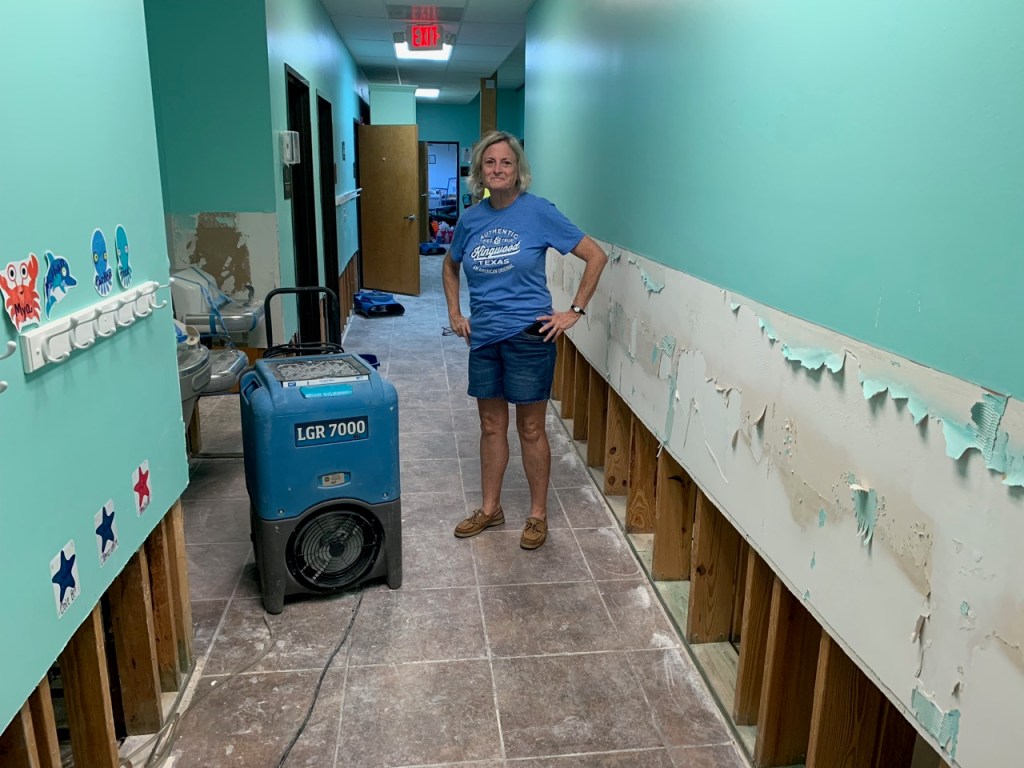
Across the creek, Kids in Action, one of Kingwood’s most popular day care and after school facilities, had its own problems.
A distraught Diane Havens, owner of Kids in Action, tries to keep a brave face after she loses the use of her beautiful facilities for the second time in four months.Hand sanitizer is the second thing you see in the reception area now.Havens is bringing in four of these mobile units to hold classes until the first floor of Kids in Action can be restored again.
Haven’s spent $500,000 repairing her facilities after the May 7th flood. That’s a lot for a small business. She’s determined to weather this storm, too. But she worries that some of her clients may grow impatient in the inconvenience during repairs.
Choke Point #3: Kingwood Drive and Ben’s Branch
As Ben’s Branch approaches Kingwood Drive from the northwest, it spreads out into a 100+ acre forested area that includes the Creekwood Nature Center. But just before it crosses under Kingwood Drive, Ben’s Branch’s flood plain funnels down between Kingwood High School and the old H-E-B shopping center. At that point, a second branch of the stream joins it from the north. After crossing under Kingwood Drive, it is further constricted on the east side by commercial development. This represents another choke point.
The Kingwood High School Gym and Natatorium (bottom left) took on floodwater during Imelda.
The Kingwood High School gym and natatorium took on several inches of water during Imelda when drains and/or Ben’s Branch backed up. Merchants in the old H-E-B shopping center also report being stranded in their stores for two hours at the peak of Imelda as water from Ben’s Branch raced through the parking lot. Merchants said the water was inches from coming in their stores.
While many of the businesses south of Kingwood Drive in Town Center and Kings Harbor reported having water lapping at their foundations, I found none that reported flood damage.
No Simple Fix
I can’t think of a simple fix to all of three of these problems. Fixing one could compound the others. For instance, it would be simple to replace the culverts under Northpark with a bridge when the street is widened. However, that would just increase the volume of water backing up where the creek narrows between St. Martha’s School and Kids in Action. That would likely flood them even worse.
Channelizing the creek all the way to Kingwood Drive would likely be unpalatable from a political point of view. Four reasons: Few people in that area were affected. They all love their greenbelts. And the costs would be high. That would make the Benefit/Cost ratio of the project a non-starter.
One Possible Solution
One possible solution: convert the unused land around St. Martha’s new church north of Northpark Drive to additional detention. That’s valuable land and detention is expensive, but it may be a better alternative than losing the school which was just expanded in 2008. Father TJ Dolce is pitching that idea and hopes the Archdiocese would approve the use of their vacant land for detention. The big question: Would it be enough to make a difference.
Drainage Study Already Under Way
Thankfully, Harris County Flood Control is conducting a Kingwood-wide drainage study right now. They are studying Ben’s Branch. Hopefully, their talented engineers will be able to find the optimum solution that protects everyone. I sure hope they find it soon because these people are every bit as desperate as the people who flooded twice in Elm Grove and North Kingwood Forest.
Ben’s Branch may affect fewer structures. But it probably affects more people when you add up enrolled students and their families.
Posted by Bob Rehak on 10/1/2019with help from Father TJ Dolce, Diane Havens, Lela Yorba, Daryl Palmer and National Helicopter Service.
763 Days since Hurricane Harvey and 12 since Imelda
https://i0.wp.com/reduceflooding.com/wp-content/uploads/2019/09/Flooded-Building.jpg?fit=1024%2C768&ssl=17681024adminadmin2019-09-30 22:48:212019-10-01 22:33:30Imelda Floods Ben’s Branch Schools, Homes at Three Choke Points