Dave Martin, City Council Member, asks residents to follow these special procedures to help ensure prompt pickup of Imelda-related flood debris.
Step 1
Please encourage friends, neighbors and community associations to report structural flooding, drainage concerns, and debris removal requests to Houston 3-1-1 by calling (713) 837-0311.
For the second time in four months, residents are piling storm debris at their curbs.
To bypass the beginning message, press 1 for English, then press 0 to speak with an operator.
The operators job is to simply log the request and provide a service request number.
Step 2
Once the operator provides the service request number, contact Martin’s office by emailing districte@houstontx.gov. In that email, provide any supplemental information (pictures, descriptions, etc.) relevant to your situation.
If you have specific questions, please email Martin’s office at districte@gmail.com. They don’t want anyone to get overlooked. Following these procedures will help them track your request, so his staff can help ensure prompt followup.
Starts Monday, 9/23
Solid Waste Department will begin storm debris pickup on Monday, September 23.
Residents may begin placing storm debris at the curb. Make sure it is not blocked by any vehicles or nearby mailboxes.
Keep Streets Clear for Heavy Trash Vehicles
Keep roadways clear to ensure trash vehicles can pass through. Please avoid street parking if possible.
Starting Monday 9/23, park off street if possible to allow heavy trash vehicles to help you.
Summary
Again…
Report all Houston storm debris by calling (713-837-0311).
Following the report, please email districte@houstontx.gov with the service request number and your address.
Martin’s staff will compile this information to provide to Solid Waste to expedite debris cleanup as much as possible.
Please let them know if there is anything they can do to help.
Posted by Bob Rehak on 9/20/2019
752 Days since Hurricane Harvey
https://i0.wp.com/reduceflooding.com/wp-content/uploads/2019/09/Elm-Grove-9.19_68.jpg?fit=1500%2C1000&ssl=110001500adminadmin2019-09-20 15:56:352019-09-20 15:56:44Special City of Houston Procedures for Flood Debris Pickup and Drainage Concerns
(Updated at 2 p.m.) Jeff Lindner, Harris County Flood Control Meteorologist, reported that life threatening flash flooding is underway from Conroe to Porter to Winnie.
8.36 inches of rain has fallen in 1.5 hours at Caney Creek and FM 2090. Two day storm totals now are 20-22 inches over SE Montgomery County and 15-20 inches over NE Harris County.
The gage at US 59 and the West Fork reported 4.56 INCHES IN ONE HOUR and more than 9 inches in three hours this morning.
As a consequence, the West Fork has now risen 6 feet since this morning. As a consequence, the National Weather Service has issued a Flood Warning for the West Fork of the San Jacinto River, near Humble, until late Friday night, or until the warning is cancelled. West Fork Flooding is now likely.
Unlike last night, major flooding is now expected on the West Fork.
As of 11 a.m. forecasters expected the West Fork to crest at 53 feet. It is already to the major flood stage.
Other Bayous
Harris County’s bayous, creeks and tributaries are continuing to respond to the runoff from heavy rainfall. The following are out of banks:
Widespread deep flooding is in progress. Intense rainfall rates of 3-5 inches per hour can be expected in the Kingwood, Humble, Huffman, and Crosby areas. This will result in rapid onset flash flooding.
Kingwood Drive Closed By Wendy’s
Early this morning, I received a report that Kingwood Drive was cut off near the Randall’s shopping center near the front of Kingwood by the railroad tracks. Water was over the bumper of a fire truck.
Kingwood Drive is under water near Riverwood Middle School. Alberson can’t get to Town Center to see what is happening there. He can’t get through the Fosters Mill intersection.
Image courtesy of Josh Alberson. Kingwood Drive near Riverwood Middle School.HEB shopping center on Kingwood Drive at West Lake Houston Parkway. Water may or may not be in the store. Great enlargement shows people scratching their heads by the door. Photo by Josh Alberson.Memorial Hermann’s Convenient Care Center at Kingwood Town Center also appears to be flooded. Photo by Josh Alberson..The area next to the new retail development known as the Kingwood Docks. Photo from Kingwood Drive looking north by Josh Alberson.
Northpark Cut Off, Too
Northpark Drive appears to be flooded at numerous places between 59 and Mills Branch Road.
I received a report from a resident stating that a high water rescue attempt is in progress near the Northpark HEB shopping center. I’m not exactly sure where.
Daryl Palmer reports that Northpark is underwater near West Lake Houston Parkway also. It is impassable.
The St. Martha School near Northpark and Woodland Hills is reportedly flooded.
Mills Branch and Northpark. Photo by Josh Alberson. Alberson says that he saw an F250 get through, but other cars are flooding.
Cable Outages
I have also received reports of numerous cable outages which have hampered communication.
Other Street Flooding
Hunter’s Ridge and Bear Branch are experiencing street flooding similar to May 7th levels.
South Woodland Hills is flooding. A reader reports of one rescue that is currently underway of an elderly person.
Water is up to slabs in South Woodland Hills. Image Courtesy of Barbara Hillburn.
Jim Zura reports from South Woodland Hills that, “My properly-placed rain gauge filled up three times from yesterday through 10 AM. That’s 5 inches times 3. Just checked an hour later, and there was another 3 inches. So that’s 18+ inches in 24 hours. Flooding on my street is worse than the May flood, which was worse than Harvey, which was worse than Allison, etc.”
Josh Alberson in Kings Point said he almost flooded from water coming from his neighbor’s property, but was able to divert it.
Water is creeping up on several homes in Kings Forest, according to Jennifer Coulter. The Kings Forest Pool is in danger of flooding again.
Kings Forest Pool as of 11:40 am on 9/19/19. The pool house has 2-3 inches of water in it.
Flooding in Elm Grove a Foot Higher than May
Dianne Lansden reported that Elm Grove Elementary flooded.
Daryl Palmer reports that the flooding in Elm Grove is at least one foot higher than in May. Multiple homes have flooded again.
Jeff Miller, another Elm Grove resident, reports that streets that flooded in Elm Grove during the May 7th flood are filling up again.
Nancy Vera, who lives on the Harris/Montgomery County Line right next to Woodridge Village, says her and her neighbor’s homes are flooded again with brown water from the development. Vera says her backyard which borders Taylor Gully was dry when her home flooded. (Note: according to reports during the lunch hour, Taylor Gully is now out of its banks in this reach of the ditch.)
Nancy Vera’s home on Village Springs in Elm Grove on the morning of 9/19/19.Nancy Vera’s front yard, looking toward Village Springs. Woodridge development is to the right, out of frame. Submerged car at the end of Village Springs in Elm Grove. Photo courtesy of Allyssa Harris.Cogdill home at the end of Village Springs adjacent to new development.Photo courtesy of Allyssa Harris.Village Springs in Elm Grove. Photo courtesy of Allyssa Harris.Looking toward Woodridge Village, you can see a lake in the background. Video courtesy of Allyssa Harris. The detention ponds are totally overwhelmed.Close up cropped and enlarged from the shot above, better showing the water level coming from Woodridge. Photo courtesy of Allyssa Harris.
Below is video shot by Allyssa Harris showing water flowing OUT of Woodridge Village INTO Elm Grove. This leaves no doubt where the water is coming from.
Photo courtesy of Allyssa Harris.Taken at end of Village Springs looking toward Woodridge Village.
According to Allyssa who took the shots above, a kayaker just came by and said that Taylor Gully is now underwater.
Porter Flooding
Gretchen Dunlap-Smith in Porter immediately west of Woodridge Village who flooded on May 7th is flooding again. She reports that her house which never flooded before May 7th is filling up rapidly again.
Please check on vulnerable neighbors to make sure they are OK.
The City of Houston warns that multiple roads and highways are impassable. Water may rise into some residential buildings in Kingwood. Additional heavy rainfall is expected.
Lake Houston
As of 1:30 p.m, Lake Houston was up significantly, according to the Coastal Water Authority.
Lake Level
45.96 ft.
Normal Pool
42.38 ft.
Update Time
13:30 PM
Here’s what Karen Pickle’s Boat House looked like at 10:30 this morning.
By 12:30, it looked like this.
Stay tuned to Mother Nature.
3-hr rainfall rates range from 6-10 inches
Significant flash flooding is in progress. Water is entering homes in Huffman and water rescues are ongoing.
If you feel your life is in danger, call 911.
Other Affected Areas
It appears this line of thunderstorms will move south into the Spring, Sheldon, Highlands, and Baytown areas over the next hour. Flash flooding is likely along with rises on the West Fork of the San Jacinto River, Gum Gully, and Carpenters Bayou.
Intense rainfall band sagging southwest toward Houston at 9am CT Thursday. (kktv.com/Space City Weather)
Posted by Bob Rehak at 8:30 a.m. on 9/19/19, updated at 2 p.m.
751 Days after Hurricane Harvey
https://i0.wp.com/reduceflooding.com/wp-content/uploads/2019/09/IMG_1938.jpg?fit=1008%2C756&ssl=17561008adminadmin2019-09-19 08:42:042019-09-19 14:07:16Life Threatening Flash Flooding Underway From Conroe to Porter to Winnie
The National Weather Service just issued a FLASH FLOOD WARNING FOR OUR AREA. Extreme rainfall rates of 3-6 inches per hour could lead to extensive and rapid onset flash flooding. This flash flooding will be possible over the Humble, Kingwood, Huffman, Crosby areas if a line of thunderstorms progresses slightly more to the SSE over the next few hours.
Given saturated grounds and already high water levels in E/NE Harris County these sort of rainfall totals would result in significant run-off and flash flooding.
Travel is strongly discouraged in the Flash Flood Warning and Flash Flood Emergency areas.
Overnight, the remnants of TS Imelda continued to shift north. The heaviest rainfall occurred north and east of Houston. The East Fork of the San Jacinto is at flood stage at Splendora and New Caney. The NWS has issued multiple flood warnings for that area.
A band of intense rainfall with rates of 3-5 inches per hour continues from Conroe to Porter to Liberty to Winnie.
Conroe Airport recorded 5.16 inches of rain in the last hour.
This band of intense rainfall will move into the NE portions of Harris County over the next hour impacting areas around Kingwood, Humble, Huffman, and Crosby.
Flash flood warnings for much of the NE Houston, SE Montgomery County and W Liberty County that had been due to expire this morning have been extended to this evening.
Intense rainfall rates will result in rapid onset urban flash flooding. It is already in progress in SE Montgomery County.
Source: National Weather Service via SJRA.net
West Fork and Lake Conroe Well Within Banks
Overnight, the West Fork of the San Jacinto at the SH99 (Grand Parkway) received another three inches of rain.
Lewis Creek on Lake Conroe received two inches in the last couple of hours.
Lake Conroe is now at its seasonal lowering target of 199 feet (actual reading is 198.88). Until now, the lake had been about a half a foot lower than its target due to evaporation. Despite the rain, Lake Conroe is still two feet below its normal level of 201 feet. That means an additional two feet of buffer remains before the lake reaches its normal level. Another two feet remains beyond that before the lake would have to open its gates.
The West Fork at US59 is at 43.5 feet, a little up, but still six feet from coming out of its banks.
Source: Harris County Flood Warning System
Currently Lake Conroe is still releasing 0 cubic feet per second. I.e., NOTHING.
East Fork Getting Hammered
Over on the East Fork, it’s a much different story. The storm has hammered that area all night.
Caney Creek at FM2090 received 12 inches in the last 24 hours and almost 6 inches in the last six hours. And 4.5 inches between 6 and 7 am.
The East Fork at New Caney has risen 18 feet since yesterday and will continue rising. It is currently at 62.78 feet.
FM1485 is now under water and closed.
Peach Creek at Splendora rose 10 feet since yesterday.
The East Fork at 2090 received more than 14 inches of rain in the last 24 hours, more than 8 of those inches falling overnight. As a result, the stream rose another six feet since 2 a.m. Flooding is now likely.
Source: Harris County Flood Warning System
Source: Harris County Flood Warning System
Lake Houston Up Slightly
Lake Houston is at 42.78 feet. Normal is 42.38. As East Fork rains descend into the lake, we can expect a rise. How much depends on the amount of rain this morning across the region.
The remnants of Tropical Depression Imelda should continue to drift slowly north today as extremely warm and moist air flows into Southeast Texas.
This moisture will feed the development of slow moving and training thunderstorms with rainfall rates of 3 to 5 inches per hour.
A persistent swath of storms across Eastern Montgomery, Liberty and Chambers county should wobble north then south early this morning.
Storms should continue to expand and develop further to the west as far out as the College Station by mid to late morning. Eventually a band of rainfall should develop and amounts across the band of 3-5 inches should be common with isolated amounts near 10 inches while outside of the band heavy rainfall may be more scattered in nature with amounts of only 1 to 2 inches.
The heavy rains will not only cause street flooding but with the elevated river and bayou levels more river flooding is likely to occur. The flash flood watch may need to be extended this evening. The flood threat may begin to shift further north tonight toward the Madisonville and Huntsville and Crockett areas.
Worst to East; Consider Yourself Lucky
As bad as this sounds, it could be worse. Areas east of us received an incredible 17.24 inches of rainfall in 6 hours near HWY 124 with a storm total nearing 28 inches. Catastrophic flooding is in progress along I-10 between Winnie and Beaumont.
Protective Actions
DO NOT Travel. Wait until the threat of high water has passed.
Turn Around, Don’t Drown®: Do not drive through flooded areas. If you see water covering the road, do not attempt to cross it. Only a few inches of water can float a vehicle . If you find yourself in a dangerous situation where your vehicle is taking on water, get out of the vehicle, get to a higher position, and call 911.
Monitor Official Sources for Current Information: Harris County Flood Warning System (harriscountyfws.org), Houston TranStar (houstontranstar.org), and the National Weather Service Houston/Galveston Forecast Office (weather.gov/hgx).
Monitor Stream, Bayou, and Creek Conditions: Rain may move repeatedly across the same area, causing creeks and bayous to rise and possibly exceed their banks. Stay informed of current conditions and avoid traveling near creeks and bayous.
Avoid Traveling during Periods of Heavy Rain: Rain can reduce visibility and prevent you from seeing the road ahead, which could lead to accidents.
Posted by Bob Rehak at 7:30 a.m. on 9/19/2019
751 Days after Hurricane Harvey
https://i0.wp.com/reduceflooding.com/wp-content/uploads/2019/09/HGX_loop-1.gif?fit=600%2C550&ssl=1550600adminadmin2019-09-19 07:36:162019-09-19 08:08:21Thursday AM River, Lake Report for Lake Houston Area; Flash Flood Warning In Effect
Click on the Rainfall and/or Stream Elevation tabs to see graphic representations like those above.
Better yet, establish an account and sign up for automated alerts. You can customize your preferences or accept defaults for as many gages as you wish.
The ground is already saturated. So any additional rainfall will result in rapid runoff So good luck to East Fork residents tonight and tomorrow.
Jeff Lindner, Harris County Meteorologist says “Additional rainfall amounts of 2-4 inches with isolated amounts up to 6 inches will be possible in this area with totals west of I-45 generally less than 2 inches.”
Posted by Bob Rehak on 9/18/2019 at 6pm
750 Days since Hurricane Harvey
https://i0.wp.com/reduceflooding.com/wp-content/uploads/2019/09/790-1.png?fit=540%2C400&ssl=1400540adminadmin2019-09-18 18:17:542019-09-18 18:18:02East Fork Rose 11 Feet Today; Almost Out of Banks at FM1485
The National Weather Service has issued an urban and small stream advisory for the northern Lake Houston Area. It extends across north Houston up to Conroe. Expect street flooding.
According to Harris County meteorologist Jeff Lindner, the center of Imelda is drifting over southwest Montgomery County as of late Wednesday morning. Lindner adds that “lull” in heavy rainfall over Harris County should last until early afternoon. Expect rain to pick up significantly between mid afternoon and evening.
Flash Flooding Possible
The National Weather Service cautions that heavy downpours with rainfall rates between 2-4 inches per hour are possible. That’s enough to cause street flooding.
The National Weather Service in League City has issued a

* Urban and Small Stream Flood Advisory for...
  Southwestern San Jacinto County in southeastern Texas...
  Southeastern Montgomery County in southeastern Texas...
  West central Liberty County in southeastern Texas...
  Northeastern Harris County in southeastern Texas...

* Until 1245 PM CDT.

* At 949 AM CDT, Doppler radar indicated heavy rain that will cause
  urban and small stream flooding in the advisory area. 3 to 6
  inches of rain have already fallen across portions of these areas
  and additional rain is expected during the next several hours.

* Some locations that will experience flooding include...
  Conroe, Humble, Jersey Village, Willis, Aldine, Northside /
  Northline, Kingwood, The Woodlands, Greater Greenspoint, Spring,
  Spring Branch North, northeastern Addicks Park Ten, Oak Ridge
  North, Panorama Village, Shenandoah, Splendora, Patton Village,
  Roman Forest, Woodbranch and Cut And Shoot.
Incredible Rainfall Rates South of Houston
Incredible rainfall rates of 3-4 inches per hour have resulted in a 24 hour storm total of 21.34 inches at Sargent with 7.56 inches falling in 1.5 hours and 10.72 inches in 3 hours this morning. This shows the potential of this air mass to produce excessive rainfall in a short period of time.
Heaviest Rainfall Expected Along US59
As the air mass heats late this morning, expect renewed development along/near the US 59 corridor.
Where exactly this band develops and how defined it becomes remains in question. But higher intensity rainfall rates will be possible in the afternoon and evening hours.
Rainfall Total Forecast
Expect an additional 2-4 inches with isolated amounts of 6 inches this afternoon through Thursday morning. Remember, 2 inches per hour can cause street flooding. Don’t drive through high water. Park your car on high ground.
To check the rainfall rate per hour, go to http://harriscountyfws.org, click on the a gage near you, then click the “for more information” link that pops up.
Posted by Bob Rehak on 9/18/19 at 10:45 am
750 Days since Hurricane Harvey
https://i0.wp.com/reduceflooding.com/wp-content/uploads/2019/09/image8-1.png?fit=725%2C408&ssl=1408725adminadmin2019-09-18 11:02:262019-09-18 11:08:16Center of Imelda Drifting Over SW Montgomery County as of Late Morning Wednesday
Here’s a river/lake report as of 7a.m. Wednesday, 9/18/19. During the early morning hours, TS Imelda was downgraded to a depression. The center of the storm moved north and is now over northern Harris County. Parts of the Lake Houston area received 4-5 inches of rain. Regardless, thanks to aggressive action by the City and luck in rainfall patterns, at this hour, no flood threat exists in our area from rivers or Lake Houston.
Little Rain So Far Upstream on West Fork
Rainfall around Lake Conroe overnight. Source: Harris County Flood Warning System
Luckily, very little rain fell upstream from us on the West Fork. In fact, the Lake Conroe area generally received less than a quarter inch of rain. Lake Conroe is releasing NO water at this hour. It’s level has not changed appreciably over night. It remains about 2.5 feet below normal.
West Fork and Lake Houston Still Below Normal Levels
Rainfall in Lake Houston Area. Source: Harris County Flood Warning SystemWest Fork status at Lake Houston Parkway. Source: Harris County Flood Warning System.
The West Lake Houston Parkway gage at the West Fork received a little more than four inches of rain in the last 24 hours. But the river is still within 6 feet of overflowing and the Lake itself is still about a foot below normal.
Source: USGS as reported by Coastal Water Authority.
Openning Gates Reduced Flood Threat
Source: Coastal Water Authority
Looking at the right of the graph above, you can see how yesterday’s decision to open the gates on Lake Houston lowered the level by an addition 1.3 feet. This helped offset the heavy rains that fell directly over the lake an in nearby tributaries.
The heaviest rain in the Lake Houston area appears to be 5.72 inches in Liberty County on the East Fork northeast of Lake Houston Park.
Overbank Flooding Limited to Southern Harris County So Far
The only flooding in Harris County from the heavy rains yesterday occurred in the extreme southern part of the county where the heaviest rains fell.
Flash Flood Watch Remains In Effect
Remain alert throughout today. A flash flood watch remains in effect for our area through tomorrow morning and will likely be extended.
Forecasters expect the heaviest rains with daytime heating. They predict that a band of rain will set up east of US59 this afternoon.
Conditions could change rapidly, especially now that the ground is fully saturated.
In the meantime, remain alert for street flooding and avoid travel if possible.
Posted by Bob Rehak on 9/18/2019 at 7 a.m.
750 Days since Hurricane Harvey
https://i0.wp.com/reduceflooding.com/wp-content/uploads/2019/09/Screen-Shot-2019-09-18-at-5.54.43-AM.png?fit=1870%2C1370&ssl=113701870adminadmin2019-09-18 06:45:182019-09-18 06:48:00Wednesday AM River, Lake Report: No Problems Yet
Overnight, the offshore low that had only a 10% chance of developing into a tropical system, turned into a tropical depression and then a tropical storm called Imelda.
Houston Under Flash Flood Watch
As of 6 p.m. Monday evening, Harris County and the entire Houston area is under a flash flood watch.
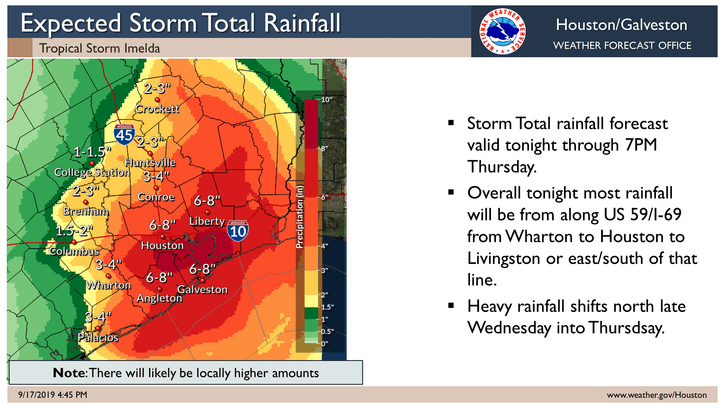
If the storm stays on its present trajectory, the center should go right through the Lake Houston area. Note in the graphic above that the heaviest rainfall will be east of US59 along a line between Houston and Livingston.
Rainfall Totals
The NWS predicts the three-day total rainfall for the storm could reach 6-8 inches, though professionals caution that much higher amounts are possible. For instance, if you live east of US59 and the track of Imelda, according to Harris County meteorologist Jeff Lindner, you might get up to 10-15 inches.
As the storm approaches from the southwest, the Lake Houston area will be on the dirty side, meaning we will get higher rainfall amounts than further west.
Lake Levels Down To Create Extra Buffer Against Flooding
However, effective immediately, the Lake level will be lowered to 40.9 feet, 2.6 feet below normal. This will create an extra buffer against flooding.
Houston City Council Member Dave Martin says, “All gates will remain open until the inclement weather threat leaves the area. After the weather threat has passed, gates will stay open until a level of 41.5 feet is reached allowing for the planned maintenance project to resume.”
Dry Ground Will Absorb Initial Rainfall, Then Look Out
Because of extremely dry weather during July, August and early September, the ground should absorb much of the initial rain. However, because the rate could exceed 1-2 inches per hour at times, runoff will rapidly increase.
The first threat from this storm will be street flooding. Secondarily, it will be bayou and river flooding. You can track the latter at Harris County Flood Warning System and make sure you check out their near-real-time inundation feature.
Protective Actions
Be Prepared. People should bring their pets inside and delay travel or outdoor activities during periods of heavy rainfall. If travel is unavoidable, reduce your speed to avoid hydroplaning.
If a Flash Flood Warning is issued for your area, DO NOT travel.
Property owners should ensure that street drains and ditches are clear of debris, so storm water can flow without obstructions. Blockages of drains, ditches, and culverts are the most frequent cause of flooding in neighborhoods.
Clear Street Drains
Secure items that might float away in heavy rain and become lodged in drains or culverts. Avoid street parking to protect your vehicle and allow clear passage for response vehicles.
Turn Around, Don’t Drown®
Do not drive through flooded areas. If you see water covering the road, do not attempt to cross it. Only a few inches of water can float a vehicle . If you find yourself in a dangerous situation where your vehicle is taking on water, get out of the vehicle, get to a higher position, and call 911.
Rain may move repeatedly across the same area, causing creeks and bayous to rise and possibly exceed their banks. Stay informed of current conditions and avoid traveling near creeks and bayous.
Avoid Traveling during Periods of Heavy Rain
Rain can reduce visibility and prevent you from seeing the road ahead, which could lead to accidents.
Posted by Bob Rehak at 6 pm Tuesday, 9/17/19
749 Days since Hurricane Harvey
https://i0.wp.com/reduceflooding.com/wp-content/uploads/2019/09/HGX_loop.gif?fit=600%2C550&ssl=1550600adminadmin2019-09-17 18:31:272019-09-17 18:39:42Lake Level Reports in Advance of TS Imelda; Where to Find Up-to-Minute Info During Storm
Lake Charles and Houston radars show numerous clusters and bands of heavy rainfall across Gulf waters associated with deep tropical moisture. These bands will soon begin to move onshore.
Lake Charles radar shows numerous bands of heavy showers just offshore headed this way.
Houston Hobby radar shows similar banding.
Cumulative Rainfall Potential Through Friday
Excessive Rainfall Outlook on Wednesday this Week.
According to Jeff Lindner, Harris County meteorologist, the National Weather Service and National Hurricane Center, models have come into agreement. They predict a surface-low pressure system may form just offshore on Tuesday and drift inland over southeast Texas Tuesday night into Wednesday. The National Hurricane Center currently gives the system only a 10% chance of tropical formation…
…BUT regardless heavy rainfall should result.
Ingredients appear to be coming together late Tuesday through Thursday for a heavy rainfall event over the region.
Endless Supply of Tropical Moisture
According to Jeff Lindner, Harris County meteorologist, “An endless supply of moisture will pump into the region. Formation of slow-moving, training rain bands appears likely over portions of the area.”
This weather system could produce excessive rainfall, enough to saturate dry ground in a short period of time. Rains today and Tuesday especially south of I-10 will saturate dry ground. Conditions by Wednesday should support much more run-off, over a wider area.
10-15 Inches Possible
Widespread rainfall amounts of 3-6 inches will be likely over much of the area with isolated totals of 10-15 inches possible.
Hourly rainfall rates of 3-4 inches will be possible under any training bands and any slow-moving clusters resulting in rapid-onset urban flash flooding. The threat for creek, bayou, and river flooding will increase by mid-week as grounds become increasingly saturated and run-off increases.
Flash flooding will be possible.
Posted by Bob Rehak on 9/16/2019as of 9 a.m.
748 Days since Hurricane Harvey
https://i0.wp.com/reduceflooding.com/wp-content/uploads/2019/09/image001.gif?fit=748%2C562&ssl=1562748adminadmin2019-09-16 12:03:152019-09-16 12:03:26Potential for Heavy Rainfall, Flash Flooding Increasing This Week
Mark your calendar. On Wednesday, October 2, 2019, from 4:30 to 6:00pm, Tim Garfield, a Kingwood resident and one of the world’s leading geoscientists, will deliver a talk at the University of Houston. The subject: how the mouth bar of the San Jacinto West Fork contributed to flooding during Hurricane Harvey and what its continued presence means for the future of residents in the Lake Houston Area.
About the Speaker and Sponsor
Garfield has been one of the leaders in the grassroots movement to mitigate the influence of the mouth bar on flooding. The University of Houston History Department and Houston History Magazine have also led the movement to document the impacts of flooding on the development of Houston.
Event Details
The flier below gives more specifics about the talk.
Driving and Parking Instruction for the University of Houston Honors Commons
The event is free and open to the public. It will be held at the University of Houston Honors Commons. To learn how to get there, where to park and how to navigate from parking to the event, see below.
Debbie Z. Harwell, Ph.D., Assistant Professor of History at UH and the Editor of Houston History Magazine, arranged this event. Kudos to Garfield and Harwell for documenting the impacts of Harvey and geomorphic processes on the history of Houston.
This is one of those rare times when human history and geologic history intersect. Don’t miss it!
Posted by Bob Rehak on 9/14/2019
746 Days since Hurricane Harvey
https://i0.wp.com/reduceflooding.com/wp-content/uploads/2019/09/San-Jacinto-River-Mouth-Bar-Tim-Garflied-flyer-1.jpg?fit=1500%2C989&ssl=19891500adminadmin2019-09-14 19:37:482019-09-14 19:37:56UH Center for Public History Sponsors Talk by Tim Garfield on Influence of Mouth Bar on Harvey Flooding
City, county and state leaders will discuss their priorities for the distribution of FEMA money. Will they match your priorities?The Lake Houston Area should turn out in force for this meeting.
Houston Stronger Speakers
Chief speakers include:
Stephen Costello, City of Houston Chief Resiliency Officer
W. Nim Kidd, Chief, Texas Division of Emergency Management
Russ Poppe, Executive Director, Harris County Flood Control District
Steve Costello, Chief Recovery Officer, City of Houston ‘
Player yet-to-be-named from the Texas General Land Office
Time, Date, Place
Houston Stronger will host the meeting from 10-11-30 at:
HCC West Houston Institute
2811 Hayes Road
Houston, TX
Tickets are free but only 300 seats exis,t so sign up quickly. Only registered people may attend.
One Meeting that Matters
Meeting details are sketchy at this time. But organizers tell me the forum will focus on how to spend FEMA money coming to Texas.
A large part of that decision depends on advocacy. So a large turnout from the Lake Houston Area will raise our visibility and help our cause. This meeting matters! Let’s fill the room and make our voices heard. If you click on the link to Houston Stronger priorities, you will immediately see the importance of a strong turnout.
I will post more details on this Houston Stronger meeting as they become available.
Posted by Bob Rehak on 9/13/2019
745 Days since Hurricane Harvey
https://i0.wp.com/reduceflooding.com/wp-content/uploads/2019/09/Houston-Stronger.jpg?fit=1500%2C831&ssl=18311500adminadmin2019-09-13 15:28:272019-09-13 15:28:35Mark Your Calendar: Houston Stronger to Host Public Forum About Flood Risk Reduction Strategies and Action