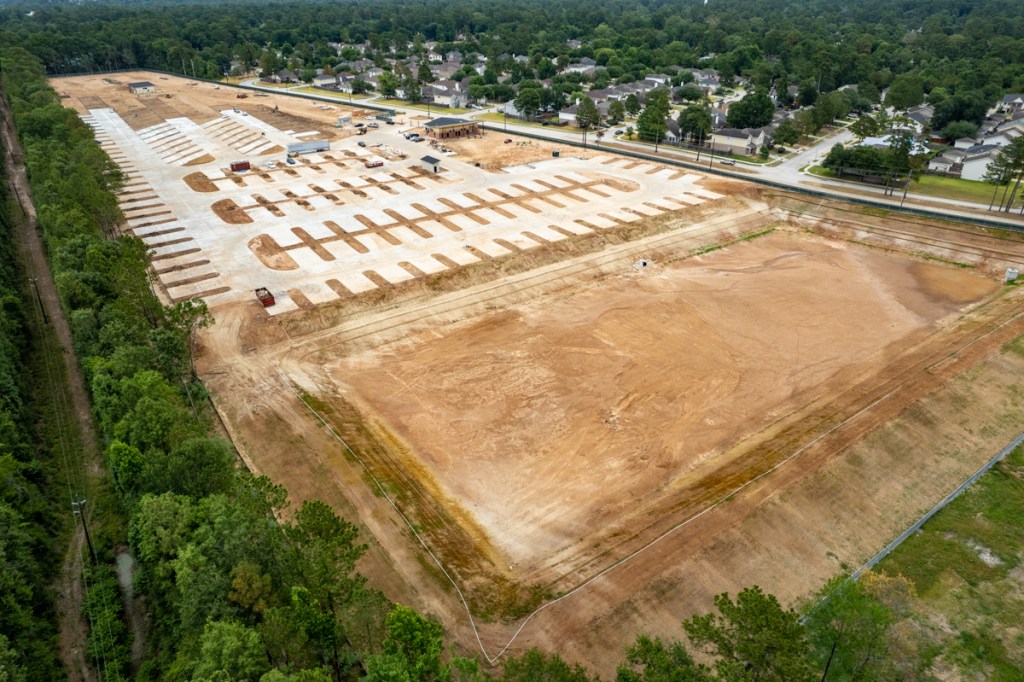
Today, 7/5/22, marked the beginning of the end for the last of the three remaining townhome complexes on Marina Drive in Forest Cove. Demolition began at 4:45 this afternoon on the complex nearest the Forest Cove community center. The job foreman estimates that removal of the two complexes shown below could take a week or more. By then, the third complex nearest the Forest Cove swimming pool should also be ready for demolition. Back in mid-June, Harris County Flood Control scheduled it for demolition on 7/14/22. So by the end of this month, Forest Cove could look very different.
Pictures Taken 7/5/22
The two complexes that started undergoing demolition today. These back up to the new Houston Parks Board Trail that will connect Kingwood with Precinct 3’s Edgewater Park at the NE corner of 59 and the West Fork.
Hurricane Harvey destroyed the townhomes almost five years ago, when approximately 240,000 cubic feet per second of stormwater inundated the homes to the third floors.
The homes became structurally unsound as you can see below.
Destruction wrought by Harvey.
HCFCD began buyouts of the 14 townhome complexes in this area back in 2019. The District completed 80% of the buyouts by February 2020. They expected to complete the remainder by the end of that year. But completing the buyouts took much longer than expected. This story explains why. Basically, HCFCD cannot tear town a complex until it has bought out all units within the complex. And some owners had left the area without forwarding addresses.
First bite into the first of three remaining complexes late this afternoon.The second bite took out the corner of the structure.Demolition will resume in the morning.
Once prized for their river views, seclusion, and laid-back lifestyle, the remaining townhomes will come down this month and then HCFCD will let the area return to nature. It’s not clear at this time whether the county has plans to extend Edgewater Park this far.
More pictures and news to follow as the project progresses.
Posted by Bob Rehak on 7/5/22
1771 Days since Hurricane Harvey
https://i0.wp.com/reduceflooding.com/wp-content/uploads/2022/07/20220705-DJI_0071.jpg?fit=1200%2C799&ssl=17991200adminadmin2022-07-05 18:46:042022-07-05 18:50:14Beginning of End for Last of Forest Cove Townhomes
Coastal Water Authority (CWA) recently posted minutes from its May 11th board meeting that reveal a possible new direction for adding more flood gates to the Lake Houston Dam. After months of discussing various crest gate alternatives to increase the release capacity of the dam, engineers will now focus on examining two tainter gate alternatives. One would add six tainter gates, the other twelve.
Neither alternative would modify the concrete portion of the spillway, as crest gates would. Black & Veatch, the engineering firm in charge of the project, will explore adding the tainter gates in the earthen embankment to the east of the existing spillway. See below, upper right.
Looking ENE at Lake Houston Dam. Black and Veatch is now exploring adding tainter gates to the earthen portion of the dam in the upper right.
The eastern embankment is a solid earthen area 2800 feet long east of the spillway and existing gates (see upper right of photo above). Water cannot get over it in a storm because it is so much higher than the spillway. By adding various structures in this area, engineers could widen the current spillway capacity, allowing release of more stormwater.
Tainter gates rotate up from a central pivot point. Crest gates rotate down from a bottom hinge, like a piano lid.
Minutes from May CWA Board Meeting
Item IV(B) on Page 3 of the May 11, 2022, minutes states, “…CWA, City of Houston (COH), and Black and Veatch (B&V) met on April 14, 2022. During that meeting the COH requested that an alternate gate location to the east of the existing gate structure be further [emphasis added] evaluated.”
Following the meeting, B&V developed a scope of work to update the gate concepts and construction costs for this area. The COH provided comments and B&V modified its proposal. B&V reportedly began work on the new direction by June 1.
Additional Funding Needed
Each of the new alternatives would require additional funding; neither fit within the existing budget, according to the CWA staff. COH Public Works will pay for the new evaluation.
Wayne Klotz, P.E. and President of the CWA Board, reminded everyone present that COH owns the dam and is the FEMA grantee for this project, while CWA works for and takes direction from COH.
Minutes from the June CWA meeting have not yet been posted. The last post about gates on the COH District E website was almost a year ago on July 8, 2021.
7/4/22 Screen Capture from District E Website.
However, City Council member and Mayor Pro Tem Dave Martin did take questions on the project at an April 2022 community meeting. At the time, Martin expected to have a final answer on gates in a “September-ish” time frame.
Currently, the release capacity of tainter gates on the Lake Conroe Dam is 15X greater than those on the Lake Houston Dam (150,000 cubic feet per second (CFS) vs. 10,000 CFS.)
Concept Studied and Rejected Once Already
Adding gates to the eastern embankment was one of the original concepts evaluated. (See Column 5, Offsite Alternative #2, Column 5, Page 4.) But engineers focused on adding crest gates instead, largely because the total estimated costs for adding tainter gates at that time exceeded $90 million for a $50 million budget. However, the Army Corps also had environmental concerns about adding gates to the eastern embankment.
FEMA initially gave the City three years to complete the project (18 months for engineering and 18 for construction). Engineering began in April 2020.
No other details about May’s change in direction have been released to my knowledge.
Posted by Bob Rehak on 7/4/2022 based on minutes from the May CWA Board meeting
1770 Days since Hurricane Harvey
https://i0.wp.com/reduceflooding.com/wp-content/uploads/2022/07/20200911-RJR_1521-2.jpg?fit=1200%2C800&ssl=18001200adminadmin2022-07-04 15:33:252022-07-04 16:13:48CWA Exploring Alternate Plan for Adding Lake Houston Dam Gates
The results of an apparently invalid flood-mitigation equity formula could be used to steer billions of dollars in future flood-mitigation funding. Multiple data quality and collection issues may compound errors and the formula itself sometimes renders inconsistent, counter-intuitive results.
The attempt to create objective comparisons between investments in different areas is well intentioned. However, I fear the proposed formula will create the appearance of objectivity while skewing data and producing misleading results. Here’s why.
The Formula
The formula is…
Flood Mitigation Benefits Index = Total Cost to Date/(Population Density X Risk)
…where…
Population Density is the number of people per square mile, calculated at the US Census Tract level.
Flood Risk is the current annual chance of inundation. For instance, a 1% chance = 1. Or a 10% chance = 10, etc.
Total Cost to Date shows cumulative dollars spent on flood-risk-reduction projects (construction only, adjusted for inflation) over the longest time period for which records are available, calculated at the US Census Tract level.
The report claims that a higher index means people have received more investment and therefore have less flood risk (i.e., more benefit). Conversely, a low index indicates less investment, more risk and less benefit.
The focus on census tracts is designed to make the data more granular than watersheds. Flood risk estimates will be averaged across the census tract and updated after MAAPnext data becomes available.
Here are several issues I have articulated to the Task Force.
Data Collection and Quality Issues
Calculating only construction costs excludes other capital improvement costs such as engineering, design and right-of-way acquisition. Since 2000, construction costs have comprised only 40% of capital improvement costs. See below. And those costs don’t even reflect maintenance and repairs, which are crucial in reducing flooding.
All Flood Control and partner spending on all capital improvement projects from 1/1/2000 through the end of Q3 2021.Data obtained via FOIA Request from HCFCD.
2. According to the report, costs factored into the formula will include those from City of Houston projects and Harris County Flood Control projects. But they don’t include other municipalities’. There are at least 33 other cities in the County. The formula will reflect street-flooding risk, but not all spending to reduce that risk.
3. Likewise, it’s not clear whether the risk reflects pre- or post-mitigation spending, or both. Every time I ask about that, I get silence not an answer. Flood Control has spent more than $1.5 billion on flood mitigation since Harvey, while simultaneously developing new flood maps. Will the numerator of the formula sometimes reflect that investment but not the denominator?
4. Readily available digital spending data goes back only to 2000. But the Task Force committee chairman insists on getting data going back to the start of the Flood Control District – in 1937. If those records still exist, they will radically skew historical comparisons between watersheds, many of which were farms or forests until much more recently.
5. Flood risk depends on more than just mitigation investments. It’s a shifting target that has changed multiple times since 1937 as our understanding of rainfall probabilities has improved, and as different jurisdictions recognize that risk at different times. Flood risk also depends on upstream growth. That has been exponential. In the 2020 Census, Harris County had 4.7 million people. But in the 1930 Census, Harris County had only 359,328 – one thirteenth of today’s population, and presumably one thirteenth of the census tracts. So, attributing all change in risk to investment is fallacious.
6. Many of the census tracts have changed since the 1930s. Census tract boundaries are only “relatively” permanent. They often change based on Census results. For instance, when a census tract’s internal population grows over 8,000 persons, it may split into two or more smaller census tracts. Also, census tract boundaries may cross watershed boundaries. Major thoroughfares usually define census tract boundaries, not the direction of flowing water.
7. HCFCD has said they do not collect spending data by census tract. They calculate how much it costs to remove structures from the floodplain. So census tract data will have to be estimated manually – something that makes data-quality experts nervous.
8. Many neighborhoods outside Beltway 8 didn’t exist back in the 1930s. Beltway 8 didn’t even exist then. Nor did Lake Houston; the City began impounding water only in 1954.
9. The formula – designed to reduce flood damage – doesn’t measure flood damage.
10. So much data in this study won’t be directly comparable that I worry the authors won’t be able to highlight areas worthy of future investment. Final results will include compounded error on multiple levels. It doesn’t compare apples to apples; it compares apples to oranges, bananas, blueberries, cherries, strawberries, coconuts, Monty Python’s elderberries and more.
Questionable Validity
In fairness, I’m sure the final report, when it becomes available, would disclose these problems in an appendix or footnotes. But how many people dig into those? And who will “peer review” this study?
I have worked with market research my entire career and know the painstaking extents to which researchers go to ensure validity of their studies.
Validity has to do with accuracy. Are you really measuring what you purport to measure? For instance, is flood risk influenced ONLY by mitigation investment? Or is it ALSO influenced by other factors, such as:
Amount of insufficiently mitigated development upstream?
The answer is a resounding YES to all those questions and more.
Good research studies typically measure the impact of one variable on another variable. For instance, in Harris County, what was the death rate last year among adults over 50 who contracted Covid among vaccinated and unvaccinated groups? Researchers carefully match the two groups being studied for factors such as randomness of subject recruitment, age, living situation, and history of other diseases. There is only one variable: vaccination. That way, they can tell whether the death rate varies among vaccinated people.
But the Flood Mitigation Benefit Index wasn’t designed with that kind of rigor. For example:
While purporting to compare ‘benefits’ of flood-mitigation to different areas, it doesn’t even employ pre- or post-measurements.
Further reducing comparability of results during the period studied:
Census tracts changed.
Population density changed.
Building codes changed.
Channels filled up with sediment, but maintenance won’t be measured.
AND the data does not measure street-flooding mitigation investments in almost HALF the county.
Because the flood-equity formula doesn’t control for such factors, we won’t know what caused variation in the results.
Formula Produces Inconsistent Results
The flood-equity formula does not even yield results that vary intuitively. For instance, when you hold population density and flood risk constant, but increase investment, the benefit goes up.
Example A: If Density = 5000, Risk = 10 and Investment = $100,000, then Benefit Index = 2
Example B: If Density = 5000, Risk = 10, and Investment = $1 million, then Benefit Index = 20
So, spending more money to get the same results increases benefits? Shouldn’t it be the opposite?
That’s both depressing and confusing. You spend 10X the money; flood risk remains the same; and the “benefit” increases!!!???
You would think spending less money to achieve identical results would be more beneficial. It certainly is for taxpayers.
Although the Task Force won’t admit it, the formula is really trying to prove “historical disinvestment,” a claim tossed around frequently in Task-Force and Commissioners Court meetings without data to back it up.
But if the goal is to protect the most people from future flooding, why not just invest in projects where the highest risk remains for the greatest numberof people? Both of those are simple, unambiguous direct measurements. But those might not produce the results that the authors of this formula hope to get.
I believe we should look forward, not back, with our flood-mitigation dollars. We can’t change the past…whatever it was. We can only affect the future by what we do today.
Posted by Bob Rehak on 7/3/2022
1769 Days since Hurricane Harvey
The thoughts expressed in this post represent opinions on matters of public concern and safety. They are protected by the First Amendment of the US Constitution and the Anti-SLAPP Statute of the Great State of Texas.
https://i0.wp.com/reduceflooding.com/wp-content/uploads/2021/12/20211201-DJI_0913.jpg?fit=1200%2C799&ssl=17991200adminadmin2022-07-02 22:13:192022-07-03 12:18:05Questionable Validity of Flood-Mitigation Equity Formula
As of the end of June 2022, Harris County Flood Control District (HCFCD) had removed 42,483 cubic yards of dirt from the Woodridge Village property in Montgomery County. The dirt is part of an excavation and removal (E&R) contract that allows removal of up to 500,000 cubic yards. That amount would double the floodwater detention capacity on the site and help reduce the risk of flooding in Elm Grove and North Kingwood Forest along Taylor Gully. Heavy rains in May and September of 2019 flooded approximately 600 homes in the area.
History of Project
Harris County purchased Woodridge with the City of Houston from Perry Homes in February 2021. At the time of purchase, the site had enough detention capacity to meet pre-Atlas 14 requirements in Montgomery County. But Atlas-14 requirements call for about 40% more. Hence the need to increase floodwater detention capacity.
Looking NE at Woodridge Village before start.Start of E&R Contract on January 27, 2022. Tree Line on right is the Montgomery/Harris County Line. Harris is on right.January 29, 2022February 27, 2022March 28, 2022April 30, 2022May 22, 2022June 13, 2022, 41,174 cubic yards of material removed from the siteJune 30, 2022, 42,483 cubic yards of material removed
Excavation & Removal Contract
E&R contracts provide a head start on construction of detention basins before completion of their final design.
Sprint has agreed to remove up to half a million cubic yards of soil for only $1000. But it gets to sell the soil for a profit on the open market. This provides significant savings to taxpayers by minimizing trucking and disposal fees.
By contract, Sprint has up to 36 months. If Sprint continues removing dirt at the rate of about 8,000 cubic yards per month, they should remove another 248,000 cubic yards before the end of the contract term.
With the dirt already removed, that would only put them at 290,00 cubic yards at the end of three years. So at some point, Sprint will have to sprint to catch up if they want to remove all 500,00 cubic yards.
An engineering study currently underway includes the Woodridge property. HCFCD has the flexibility to change the E&R contract if necessary to accommodate any design requirements that emerge from the study.
Community engagement should be scheduled soon to gather input from area residents on the proposed project and to present project alternatives.
Posted by Bob Rehak on 7/1/2022
1767 Days since Hurricane Harvey
https://i0.wp.com/reduceflooding.com/wp-content/uploads/2022/07/20220630-DJI_0989.jpg?fit=1200%2C799&ssl=17991200adminadmin2022-07-01 11:37:202022-07-01 11:59:26Progress Report: Woodridge Village Excavation and Removal Contract
Here’s a construction update on six large Lake-Houston-Area construction projects, told in aerial photos and captions. All photos were taken on the last day of June, 2022. Dry weather created almost ideal conditions for construction with little risk of sediment-laden runoff. But as the tropics heat up, that could soon change.
High Street Residential
At West Lake Houston Parkway between Upper Lake Drive and Kings Park Way, High Street Residential has finished clearing 19.7 acres for an apartment complex. Now the company is constructing drainage and detention ponds. After that come utility installation; concrete for building pads and streets; and finally construction of the apartments.
High Street is a subsidiary of Trammell Crow, the Dallas-based developer with billions in assets. They are known for high-end work.
High Street Residential Property.Looking S across Upper Lake. West Lake Houston Parkway on right.Looking S across middle of property. Could that be a detention pond in the middle?
Kingwood Middle School
As the new Kingwood Middle School nears completion, contractors have ripped up the parking lots and driveways of the old school in the foreground. During last week, contractors excavated a new detention pond (foreground below).
New detention pond in front of old school.
They moved the dirt to the old, temporary detention pond…and filled it in.
Old temporary detention pond adjacent to Cedar Knolls now filled and compacted.
Meanwhile, an army of contractors prepare the new school for its grand opening later this year.
Louvers on the south-facing, two-story window wall of the new school will help keep students from broiling in the Texas sun.
The developer of the Preserve At Woodridge is beginning to lay rebar before pouring concrete for more roads and the last rows of houses. Contractors are also busy building a retaining wall around the detention pond. Since a TCEQ investigation, I have not caught them pumping any more silty water into Bens Branch. The developer also finally posted his permits, but still has not posted the stormwater pollution prevention plan (SWPPP).
Contractors have approximately two thirds of the homes in various stages of completion.They’re also starting to lay rebar for the remaining streets and homeson the last third of the site.
New Caney ISD West Fork High School Construction Update
South of Kingwood Medical Center on Sorters-McClellan Road, New Caney ISD’s West Fork High School is nearing completion.
Entrance and courtyard of new three-story high school.Looking south toward 59 bridge over West Fork.Contractors widening Sorters-McClellan Road to accommodate high school traffic.Note new landscaping bordering road.First things first. This IS Texas after all.
In a way, I envy these students starting out on their journey with a chance to start their own traditions.
Let’s hope this hurricane season doesn’t spoil the party. We’ll have another construction update next month, featuring other projects.
Posted by Bob Rehak on 6/30/2022
1766 Days since Hurricane Harvey
The thoughts expressed in this post represent opinions on matters of public concern and safety. They are protected by the First Amendment of the US Constitution and the Anti-SLAPP Statute of the Great State of Texas.
https://i0.wp.com/reduceflooding.com/wp-content/uploads/2022/06/20220630-DJI_0939.jpg?fit=1200%2C799&ssl=17991200adminadmin2022-06-30 21:41:152022-06-30 21:41:18June Construction Update: Six Lake-Houston-Area Projects
On 6/29/22, Harris County Commissioners Court discussed a billion-dollar-plus bond package presented by County Administrator Dave Berry, Budget Director Daniel Ramos and Engineering Department Head Dr. Milton Rahman, P.E. The presentation talks about a $1 billion package. But during discussion, commissioners asked to look at several higher options – $1.1 billion, $1.2 billion and $1.5 billion. The discussion, which you can see posted on the Harris County Commissioners Court website, starts at 3:32 (timecode) and goes to 4:20. Since that’s almost 50 minutes, let me try to summarize it below using some of the slides presented by Rahman.
Proposed Uses for Money
In fairness, understand upfront that Rahman presented an introductory outline, not a detailed plan. With that in mind, he pitched a $1 billion plan broken down as follows.
The package includes $200 million to improve neighborhood drainage. That’s over and above the $600 million in the current budget.
Rahman focused on both the number of people (20,000) and structures (4,000) benefitted with the $600 million. That averages to $30,000 per person or $150,000 per structure. That also works out to 5 people per structure. But the Harris County average per household, according to the US Census Bureau, is 2.84 people for the five years ending in 2020.
That made me question where Rahman obtained his numbers. He never says. Does he base his estimate on a combination of apartments and single-family households? Who will benefit from another $200 million? If that $200 million works as efficiently as the $600 million, it should help another 1,333 homes (4000/3). Where are they? Which precinct? Which neighborhoods?
I get the need for rounding at this early stage. But they’re talking about going to voters in four months. 4.2% of the $5 billion flood bond is more than $200 million dollars of rounding error! That made me wonder about the accuracy of the numbers in the slides above.
The fact that the total “ask” varied by 50% during the discussion also made me wonder about how much research and planning went into these numbers.
Yet Commissioners Ellis and Garcia are eager to put it on the agenda for a vote during the next commissioners court meeting – without any public input. That raised more red flags, because the Community Flood Resilience Task Force has demanded public input on future bond programs. In multiple languages. A majority of the task force felt so strongly about public input, that they even asked HUD to fund it!
Other Highlights from Discussion
Commissioner Ellis wants to review a tighter proposal and put it to a vote at the next commissioners court meeting on July 19, 2022.
Garcia wants it on the ballot in 2022, not 2023.
Ramsey wants to slow it down. He wants to listen to voters, develop a tight plan, communicate the elements to the public, and advocate for it. He stated that it would take a long time to recover from a bond proposal that failed. Ramsey would prefer a vote in 2023.
Commissioners Court spent considerable time discussing whether the proposal should have a list of specific projects or just generic categories of spending. But the commissioners made no decision on that point.
Milton Rahman stated, “The wish list is bigger than we can afford.” That raised another red flag for me. It means someone will have to make hard decisions about where the money goes and who benefits. Who will make those decisions? On what basis? When? After the election?
Commissioner Cagle suggested voting on this proposal with additional requests to fund flood tunnels and the coastal spine project. That could delay this bond proposal until we knew how much federal funding we could get for those projects. And that could take two years. Congress will vote on the next Water Resources Development Act in 2024.
Withholding Judgment for Now
Until I see more detail, I will withhold judgement on this bond proposal. I can see how there may be a need. But I’m not going to vote for a billion dollars of vague generalities. I want to see where the money goes and I want to have time to study the bond language. I was fooled once by a non-standard definition of “equitable” applied to the 2018 flood bond. What other surprises lurk in the wings?
One reader who prefers to remain anonymous said, “We should trust this Court with a blank check for projects that are not defined??? NO DAMN WAY!!! What is the formula to determine which Precincts get how much money? What is the prioritization framework to select projects? How will equity considerations affect funding? How will the public know where this money goes? We have NO IDEA where previous bond funding went!!! This Court has not earned our trust. Some members just cannot be trusted. NO BOND!”
Frankly, that’s a fairly typical attitude outside the Beltway from comments i get.
Yet Rahman, Berry and Ramos, in their last slide, suggest this proposal – with a barely defined project list – is a foregone conclusion. See below. They want to identify only a few flagship projects to complement other unspecified projects in the bond. And they want to start drafting bond orders now.
Let’s see if Berry, Ramos and Rahman can advertise and conduct dozens of precinct meetings; solicit public input; and define a plan responsive to community needs before the next commissioners court meeting. If not, perhaps Ellis, Garcia, Hidalgo and the Community Flood Resilience Task Force should demand their resignations.
Posted by Bob Rehak on 6/29/2022
1765 Days since Hurricane Harvey
The thoughts expressed in this post represent opinions on matters of public concern and safety. They are protected by the First Amendment of the US Constitution and the Anti-SLAPP Statute of the Great State of Texas.
https://i0.wp.com/reduceflooding.com/wp-content/uploads/2022/06/17-Bond-Presentation_Page_06.jpg?fit=2000%2C1125&ssl=111252000adminadmin2022-06-29 20:35:112022-06-30 00:14:18County Discussing Another Billion-Dollar-Plus Bond
The introduction to the request states, “Although the Harris County Flood Control District (HCFCD) continues to aggressively pursue partnership dollars … substantial amounts of anticipated partner funding remain unrealized.”
Of the roughly $5 billion in 2018 Flood-Bond Projects, officials hoped that Federal, State and local partners would supply roughly half the money. But it hasn’t all materialized yet. So last year, Commissioners created a flood-resilience trust fund to create backstop funding. Until now, the county has not needed it. But now the county does…for the sixteen projects listed below.
Projects recommended for first round of backstop funding. Some of these projects started before the flood bond, were later included in it, and ran over budget.
To date, Harris County has secured $1.275 billion in partnership funding for 2018 Bond Program projects from Federal, State, and local partners. Of the $2.5 billion in partner funds originally anticipated, “the county has not yet identified $754.2 million. This gap includes projects for which grant applications were submitted to various Federal and State programs such as CDBG-MIT, FEMA-BRIC, and others but not awarded,” says HCFCD.
Ironically, the backup documentation provided to commissioners by HCFCD makes no mention of the $750 million allocated by the U.S. Department of Housing and Urban Development (HUD) and the Texas General Land Office (GLO) to Harris County. More on that below.
Ranking Methodology
The document provided to commissioners by HCFCD contains information about the Trust, its history and intent, projects that need funding help now, and a methodology for ranking projects.
After ranking all flood-bond projects that are short of funding using the proposed matrix below (Appendix B), the county began whittling away from Trust funds. HCFCD started with the top-ranked project and proceeded to the lowest until the money ran out, i.e., the balance in the trust fund went negative. Only two projects from the entire San Jacinto Watershed made the “eligible” list: one near the ship channel and another below Highway 90. But neither of those is part of the group of 16 above.
Weighting Factors in Proposed Matrix
The scoring matrix used by the County includes evaluations of:
Cost per person (15%)
Cost per structure (30%)
Non-structural benefits (45%)
Existing conditions (20%)
Social Vulnerability Index (20%)
Long-term maintenance (5%)
Minimizing environmental impacts (5%)
Ability to deliver multiple benefits, i.e., flood mitigation, social and environmental (5%)
As additional partnership funding sources are identified, money remaining in the Trust may cover additional projects…assuming inflation doesn’t eat it all up.
For this exercise, HCFCD analyzed all projects with partnership funding gaps. However, that doesn’t mean that those projects will necessarily receive Flood Resilience Trust funds. When and if HCFCD identifies funding partners, some projects could drop off the list of those needing help. That could make funds available for lower ranking projects. See Appendix B, last page.
Future Plans
If approved, HCFCD will return to Commissioners Court twice each year with additional requests from the Flood Resilience Trust. Each of those requests will include an updated analysis of partnership and contingency funding needs, Trust funds remaining, and eligible projects.
HCFCD will request money from the Trust only when projects cannot move forward without it.
$750 Million HUD Allocation Not Discussed
The County’s Community Services Department is currently developing a Method of Distribution (MOD) for the $750 million designated earlier this year for Harris County by HUD. A MOD is a plan for distributing the $750 million. Where and how will the county use the money? Who will benefit?
HUD and the GLO require that at least 50% of the money benefits Low-to-Moderate Income neighborhoods.
At the time the GLO and HUD dedicated $750 million to Harris County, they also dedicated $488 million to the Houston Galveston Area Council (HGAC).
Verification that all recipients are still interested in participating.
According to a GLO spokesperson, HGAC began developing its MOD when the GLO submitted its action plan to HUD. However, Harris County reportedly delayed planning until AFTER HUD approved the GLO’s recommendations.
That delay could mean spending more local money. And that could penalize Harris County watersheds farther down on the Trust Fund priority list that don’t currently meet SVI and other requirements. Will there be money left for the Lake Houston Area by the time we work our way further down this list? Only time will tell.
Posted by Bob Rehak on 6/28/2022
1764 Days since Hurricane Harvey
https://i0.wp.com/reduceflooding.com/wp-content/uploads/2022/06/Screen-Shot-2022-06-27-at-10.09.28-AM.png?fit=546%2C578&ssl=1578546adminadmin2022-06-27 22:50:062022-06-28 13:35:45HCFCD Asking to Tap Flood Resilience Trust for Bond Projects
The Harris County Flood Control District (HCFCD) posted the June 2022 status of 2018 flood-bond expenditures for Commissioners Court last Friday. Among the report’s highlights: the spending drought continues in the Lake Houston Area where only two capital improvement construction projects are active. Their total reported value: $2 thousand. That’s out of more than $235 million in active construction projects during the month of June.
Said another way, the Lake Houston Area is getting less than one-thousandth of 1% of the construction budget (0.000851%). March and April updates show that no new capital improvement construction projects have started in the Lake Houston Area in months.
Finished detention Basins near Little York and Hopper in the Halls Bayou Watershed, with combined 200 acre-feet of storage.
Wrapped up Halls Bayou conveyance improvements
Began demolition of the old Raveneaux Country Club on Cypress Creek
Started drainage repairs in the Carpenters Bayou watershed
Issued a purchase order for the Atascocita Area Drainage Study, which had been approved on February 8.
Released the Phase II, 1800-page report on flood tunnel feasibility
Spending Breakdowns by Watershed
Harris County contains 23 major watersheds shown below.
The 23 watersheds in Harris County and the amount spent to date from all sources under the 2018 flood bond.
The table and bar graph below make the rank-order and relative magnitude of spending in various watersheds more apparent.
Spending by watershed ranked from high to low.San Jacinto is middle of pack despite being largest watershed in county,Bar graph of table above.
Factors Affecting Watershed Spending
Several factors affect the magnitude of spending in each watershed. They include:
Equity Prioritization Framework – This scoring matrix gives higher priority to projects in low-to-moderate income watersheds that have a high social vulnerability index. Projects with high scores started sooner.
Project Lifecycle Stage – Generally speaking, the earlier a project kicked off, the further along it is in its lifecycle. Studies have completed and construction has started or even completed. Some areas that flood repetitively had engineering studies completed and were already shovel-ready after Harvey.
Buyouts/Right of Way Acquisition – Sometimes entire subdivisions must be bought out to make room for flood mitigation projects. This can delay construction for years.
Lobbying – Squeaky wheels play a role on multiple levels.
Usually, no one factor accounts for a project’s or an area’s ranking. But multiple factors – working together – can push an area up or down the list.
Certainly, some areas have suffered spending-wise because of political priorities.
Other Highlights
HCFCD spent a total of $1.05 billion through the end of May. That compares to $1.025 billion through the end of April. So HCFCD spent $25 million in May.
Of the $1.05 billion spent to date, bond funds comprised $545 million. Grants comprised $367 million. And $140 came from other local funds.
HCFCD reported a schedule performance index of .97. That means projects are running slightly behind schedule. On-schedule performance would have earned a 1.0.
Overall, HCFCD has completed 21.8% of the bond projects when we’re 37.5% of the way through the 10-year program (45 months out of 120).
For the complete June update on bond spending, click here. Remember to review the last page. It shows capital improvement construction projects throughout the county and the spending drought in the Lake Houston Area.
Posted by Bob Rehak on June 26, 2022
1762 Days since Hurricane Harvey
https://i0.wp.com/reduceflooding.com/wp-content/uploads/2022/06/20220626-Screen-Shot-2022-06-26-at-10.12.36-AM.jpg?fit=1200%2C912&ssl=19121200adminadmin2022-06-26 12:42:522022-06-26 16:04:30May Flood-Bond Update Shows Spending Drought in Lake Houston Area Continues
A weak surface low pressure system may develop into a tropical system over the northern Gulf of Mexico early to mid next week. The National Hurricane Center estimates the chance of development over the next 5 days at 20%. Chances of formation for another disturbance in the Atlantic remain at 60%.
What’s behind this prediction? A front will push through Houston Monday morning. It will move into the northern Gulf of Mexico early next week and then stall.
Location of front on Monday.
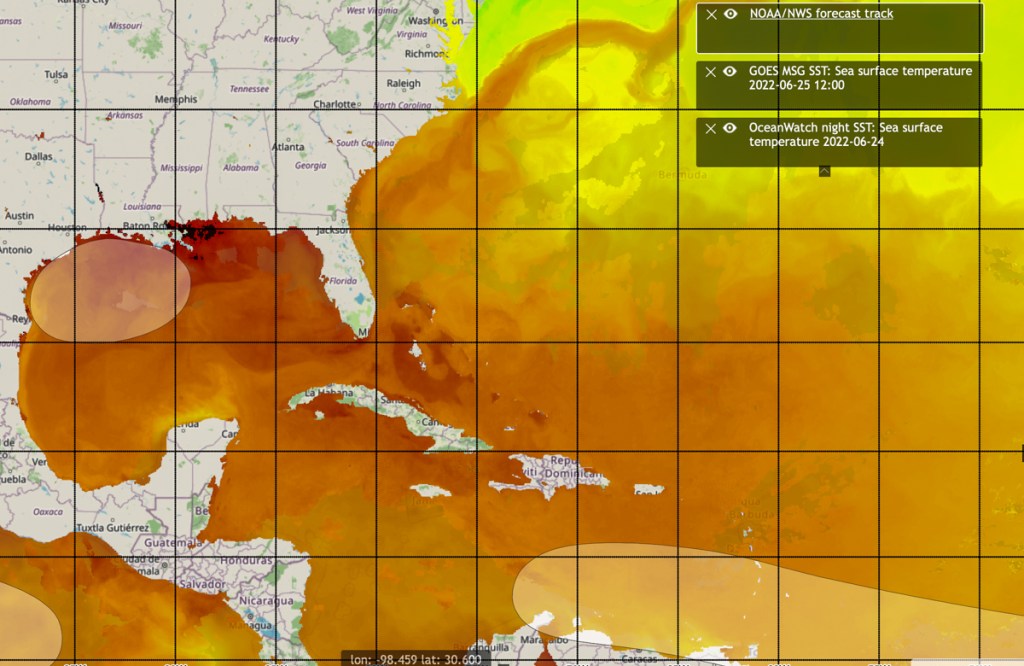
AND it will stall over warm waters.
Sea surface temperature anomalies as of 6/25/22. The darker the color, the more above average the temperatures.The whitish blob off the coast of Texas and Louisiana indicates the location of possible cyclone formation next week.Elongated blob at the bottom right indicates forecast track of disturbance in Atlantic.
The National Hurricane Center said that if the system does develop, “[It] would likely be slow to occur as it drifts westward toward the northwestern Gulf of Mexico.”
Rainfall Implications
According to Jeff Lindner, Harris County’s meteorologist, “Numerous showers and thunderstorms will accompany this frontal trough.”
This will bring increasing rain chances to Houston. And potentially alter rainfall accumulation forecasts. Depending on location, you could receive anywhere from a half inch to three inches, according to Space City Weather.
The National Weather Service (NWS) predicts the highest 7-day rainfall totals farther to the east. Our neighbors in Louisiana could see up to five inches.
NWS Weather Prediction Center 7-day rainfall forecast starting today shows highest rainfall totals around Mississippi delta.
At this time, NWS predicts NO flooding for next week. The drought has soil so dry that most rainfall should soak in. Our channels, creeks and bayous should handle any runoff.
Historical Curiosity
Here’s a historical curiosity. This morning, the NWS Houston/Galveston office noted some weather history on this day. “The first half of 1996 was extremely dry over all of Southeast Texas but heavy rains returned during the last week of June. On June 25th 1996, a swath of 2 to 4 inches of rain fell across the southern half of the region with Danevang recording 6.07 inches of rain and Houston Hobby Airport recording 3.30 inches of rain.”
Posted by Bob Rehak on 6/25/22
1761 Days after Hurricane Harvey
https://i0.wp.com/reduceflooding.com/wp-content/uploads/2022/06/image001-1.png?fit=900%2C665&ssl=1665900adminadmin2022-06-25 10:57:192022-06-25 11:03:33Slight Chance of Tropical Cyclone Formation in Gulf Next Week
Overnight, the National Hurricane Center (NHC) increased the chances of tropical cyclone formation for Invest 94L to 60% in the next five days. Yesterday, NHC estimated 20%. “Invest” stands for Area of Investigation.
Reasons for Increased Chance of Formation
According to Harris County Meteorologist Jeff Lindner, “The tropical wave located over the far eastern Atlantic is fairly disorganized this morning with scattered areas of deep convection. The wave is moving westward and this motion will continue for the next 5-7 days.”
If you looked only at climate history for this time of year, says Lindner, you would not give this disturbance much of a chance to intensify into a tropical cyclone.
However, low wind shear, modest forward motion, and available moisture in the wave all support some degree of development in the next few days.
Storm Track Forecasts
Most models show development as the wave nears or reaches the eastern Caribbean Islands. European and Global forecast models tightly align with a track through the extreme southern Caribbean Sea. Meanwhile, the Canadian model shows the storm tracking farther north at a higher intensity.
Virtually all models indicate similar tracks until the system reaches the central Caribbean Sea.
Lindner believes the southern track is most likely given the time of year. He also sees potential for intensification due to favorable atmospheric conditions along the path. The satellite photo below shows the current extent of the disturbance.
94L is in lower right.
The National Hurricane Center says, “A tropical depression could form during the early to middle part of next week while it moves westward at around 15 mph over the tropical Atlantic and approaches the Windward Islands.”
If you like viewing satellite images and animations from a wide variety of sources, I highly recommend the following sites:
https://i0.wp.com/reduceflooding.com/wp-content/uploads/2022/06/image003-e1656082390202.png?fit=1244%2C755&ssl=17551244adminadmin2022-06-24 10:33:452022-06-24 10:33:48Chances of Formation Increase to 60% for Invest 94L