Remember Uncertainty With Marco, Laura; It’s Why We Need More, Bigger Gates on Lake Houston

Many anxious flood victims worry openly on social media about about the possibility of flooding by back-to-back tropical events. Should we lower Lake Conroe? Is it too late? Will we flood again? Why aren’t they releasing water?

The novelty of having two tropical storms in the Gulf simultaneously has added a high degree of uncertainty to weather forecasting at the moment. The forecast tracks, intensities and dangers of Marco and Laura seem to change every few hours.

This is precisely why we need more and bigger flood gates on Lake Houston.

By the time we are certain what will happen with these storms, it will likely be too late to release water if we need to.

The bewildering multitude of competing weather forecast models complicates matters. They show landfall anywhere from Corpus Christi to the Mississippi just two days before the storms’ arrival. It reminds me of a fortune cookie I once got. It said, “A man with two clocks never knows what time it is.”

Marco Weakening Before Making Landfall

Since this morning, the cone of uncertainty for Marco has shifted inland again and the storm has been downgraded to a tropical depression. The only coastal watches or warnings remaining in effect have to do with Laura which will follow Marco later this week. (See more below.)

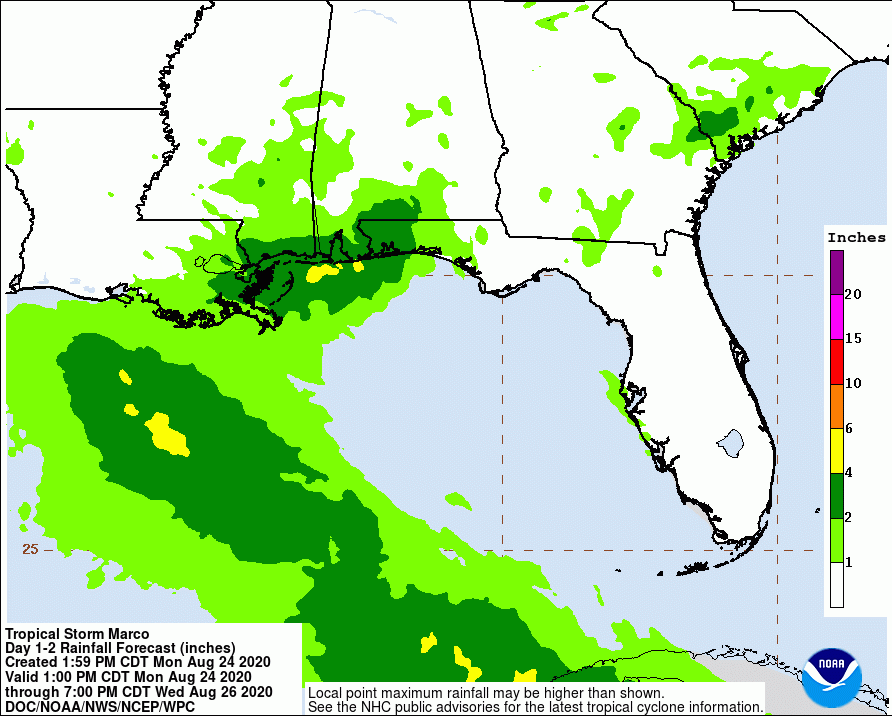
As of 4pm CDT on Monday 8/24/2020. Source for all graphics: National Hurricane Center.

The National Hurricane Center shows only a slight chance of flash flooding for the areas hit directly by Marco and those are far east of us. Rainfall potential from Marco through Wednesday evening for the Houston Area is less than an inch, according to the latest NHC predictions.

At 1 p.m. Monday, the NHC issued an advisory stating that, “It is reasonable to assume that sustained tropical storm force winds will no longer reach the northern Gulf coast. Therefore, all wind and surge warnings for the Gulf coast associated with Marco have been discontinued.”

Laura Remains Potent Threat

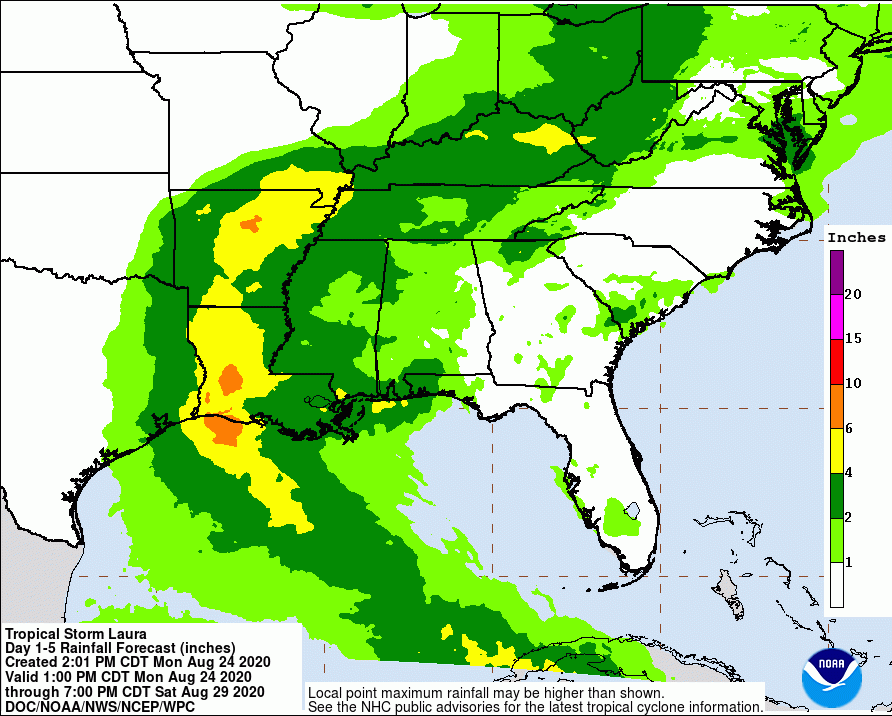
Even though Laura’s cone of uncertainty has shifted slightly east today, the Houston Area remains on the western edge of the cone.

At the moment, NHC predicts Laura will bring Houston 2-4 inches of rain, and the Lake Conroe area less than 2.

That’s enough to raise the chance of flash flooding to 5-10%.

Laura’s maximum sustained winds are near 60 mph with higher gusts. NHC predicts little change in Laura’s strength today, but predicts the storm will strengthen when it moves into the Gulf of Mexico. They foreast Laura will become a hurricane on Tuesday, with additional strengthening on Wednesday. Tropical-storm-force winds currently extend outward up to 175 miles, primarily to the northeast and east of the center. As Laura approaches the Gulf Coast, swells will cause life-threatening surf and rip-current conditions.

Tropical storm force winds should reach the Texas coast between 8 a.m. and p.m. on Wednesday. Most of the Houston Area will have a 40-50% chance of experiencing winds greater than 39 mph.

Alert Houston has just issued the following notice:

“The National Weather Service has issued a Tropical Storm Watch for Houston. Coastal portions of the city are also under a Storm Surge Watch. Although the exact track and intensity of Laura is still unknown, Houston residents should pay close attention and begin taking steps in the event an emergency situation develops.”

Jeff Lindner, Harris County Meteorologist, put a finer point on it. “Tropical storm force winds are likely along and east of I-45 with sustained winds of 35-45mph across portions of Galveston, Harris, Montgomery and Walker Counties. Strong winds of 45-55mph will be possible across Chambers, Liberty, San Jacinto, Polk, and Trinity Counties. It is possible that near hurricane conditions could scrape close to eastern Chambers and eastern Liberty counties.”

To Lower or Not to Lower, That is the Question

So with:

  • People panicking
  • Forecasts changing hourly
  • Lake Conroe Association restocking its war chest
  • Wildfires burning up the west
  • Drought spreading into parts of Texas
  • The Nation’s foremost hurricane experts predicting only 1-2 inches of rain for Lake Conroe and 2-4 for Lake Houston…

…what do you do? Order the lakes lowered or keep them where they are?

Source: https://www.drought.gov/drought/states/texas

The answer is obvious. You enlarge the discharge capacity of Lake Houston by adding more and bigger gates to the spillway.

Gates on Lake Houston have one-fifteenth the discharge capacity of those on Lake Conroe.

Lake Conroe can release water 15 times faster than Lake Houston. 150,000 cubic feet per second vs. 10,000. With that in mind, the likelihood, at this hour (5pm Monday), is that water released from Lake Conroe could not get into the Gulf before Wednesday when the storms arrive.

And that, in a sentence, is why we need more and bigger flood gates on the Lake Houston Dam. Remember Marco and Laura, and that knot in the pit of your stomach, the next time the subject of gates comes up.

By the way, neither Lake Conroe, nor Lake Houston, is releasing water at this time. Lake Conroe is at 199.76 feet above sea level and Lake Houston is at 41.6 feet. Both are already below their normal levels, though not as low as many would prefer. At 4:24 this afternoon, the SJRA issued a press release saying that, “We continue to watch Laura closely. Right now the projected totals of rainfall in the Lake Conroe watershed are very low.”

Posted by Bob Rehak on 8/24/2020 at 5 pm

1091 Days after Hurricane Harvey

Lake Conroe Association Complains to TCEQ about Seasonal Lake Lowering

In June, the Lake Conroe Association (LCA) filed a 102-page complaint to the Texas Commission on Environmental Quality (TCEQ) through Austin attorneys about the San Jacinto River Authority’s (SJRA) policy of seasonally lowering Lake Conroe. The SJRA’s purpose for the lowering: to lower flood risk for downstream residents.

To download the complete complaint by Birch, Becker & Moorman LLP, click here. Warning: 20-meg file size.

Complaint Based on Three Arguments

The attorneys make three arguments.

  • State law prohibits the wasting of water.
  • The policy will not prevent downstream flooding.
  • Also, the policy threatens the area’s water supply.

“In summary,” says the complaint, “SJRA and Houston are only authorized to divert or release and use water from Lake Conroe for municipal, industrial, mining, and agricultural purposes. Any other use of surface water from Lake Conroe is not authorized by the Amended Certificate, and thus, is a violation of the Amended Certificate and state law.”

The complaint fails to mention flood control in that last list (prominently mentioned in the SJRA’s enabling legislation). To follow the LCA’s arguments to their logical extreme, SJRA would not have been allowed to release water during Harvey. Every home on Lake Conroe would have flooded.

TCEQ Response to Complaints

On July 29, the TCEQ replied to the complaint. Toby Baker, TCEQ’s Executive Director, says that:

  • “TCEQ does not have jurisdiction over future water supply strategies or State and Regional Water Planning.”
  • “Both SJRA and the City have adopted Water Conservation Plans that comply with TCEQ’s Chapter 288 rules.”
  • “Therefore, these diversions, which are in compliance with the terms of the Certificate and the Conservation Plan, are not a waste of water under the law.”
  • The City and SJRA are within their rights.

LCA Lodges Supplemental Complaint

Just the day before, on July 28, 2020, the same law firm filed a 4-page supplemental complaint to halt the fall lowering. The second complaint and the TCEQ’s response to the first complaint may have crossed in the mail.

The law firm acknowledged in its supplemental complaint that the lowering would only amount to 2.75 inches. However, the firm also claimed the water would be needed in a drought. Then it showed a Texas Water Development Board Drought Map as evidence. But map showed that no drought near the San Jacinto watershed.

TCEQ Finds City and SJRA in Compliance

Mr. Baker of the TCEQ replied to the supplemental complaint on August 6. He concluded, “After review, the TCEQ determined that the San Jacinto River Authority and the City of Houston are in compliance with the terms and conditions of Certificate of Adjudication 10-4963.”

In the End, Mother Nature, Not SJRA, Lowers Lake This Year

After all of that, evaporation alone took Lake Conroe down to the SJRA’s seasonal lowering target of 200 feet. It took Mother Nature an extra week to get there, but…

SJRA RELEASED NO WATER from Lake Conroe to achieve its August target level.

SJRA still has not released any water since the early spring.

Lake Conroe dashboard as of 4pm Saturday, August 15, 2020. Source: SJRA.net.

LCA Pleads for More Money to Keep Fighting

Now the Lake Conroe Association is pleading with residents for donations to replenish its war chest. It will be interesting to see what they plan next.

Posted by Bob Rehak on August 15, 2020

1082 Days since Hurricane Harvey

Lake Conroe Lowered to Target Level for August; LCA May Be Gearing Up For Another Fight

Since August 1, the level of Lake Conroe has hovered around 200 feet. As of this writing, it stands at 199.95 feet, virtually at the target level of the seasonal lowering for the month. That’s three hundredths of a foot above its seasonal average for the last 46 years and five hundredths of a foot below the target level. Yet the Lake Conroe Association appears to be gearing up for another fight to end the program.

Lake Conroe level as of 8/10/20 at 4:30 pm. Source: SJRA.net.

Seasonal Averages

Lake Conroe seasonal levels by month. Source: SJRA

History of Strategy

The SJRA started seasonally lowering the level of Lake Conroe in 2018 after Governor Abbott directed the SJRA to develop strategies to help protect downstream communities from flooding. Due to a slight drought in late 2019, the lake level did not recover quickly. The Lake Conroe Association (LCA) then organized protests as the SJRA reconsidered the strategy for this year.

Seasonal Release from Lake Conroe, 529 cfs from one tainter gate open six inches.
SJRA Seasonal Release on 4/15/2020. One tainter gate open six inches releases a slow, steady stream of 529 cfs. No one flooded downstream last Spring during the release.

Ultimately, the strategy adopted by the SJRA represented a compromise. During September/October, the lake will remain a half foot higher than in previous years (200 vs 199.5).

Here’s how the current and previous targets compare to what Mother Nature provides through rainfall and evaporation.

In August, little manual lowering should be needed. In September and October, much less lowering will be needed compared to the previous plan adopted in 2018.

SJRA’s Plan for Fall Lowering

SJRA’s current official policy reads as follows.

Beginning August 1, release only an amount of water from Lake Conroe to create a one foot capacity to catch rainfall and storm runoff (from 201’ msl to 200’ msl). After September 1, increase capacity an additional six inches (from 200’ msl to 199.5’ msl). If a named storm is predicted to impact our region, the COH may initiate an additional release of six inches (to 199’ msl) by notifying SJRA in writing of their call for release. Recapture beginning October 1.”

Compared to the seasonal average, the plan really only amounts to lowering the lake 2 to 3 inches in September and October.

Lake Conroe Association Gearing Up for Another Fight?

Regardless, the Lake Conroe Association (LCA) is reportedly gearing up for another fight.

Community Impact newspaper reported in its August 2020 issue that LCA filed a complaint with the TCEQ on June 30 to end the seasonal lowering of Lake Conroe.

On August 7, they sent an email out to requesting Lake Conroe residents to donate money to the Lake Conroe Association so that it could “replenish the reserve funds spent to oppose the San Jacinto River Authority (SJRA) lake lowering program.”

In the next paragraph, they ask Lake Conroe residents to provide comments to the Sunset Commission reviewing the SJRA.

Screen Capture of LCA Communication on 9/7/2020. Links not active.

Neither of those two actions is a threat. But juxtaposing them like that is certainly walking up to the firing line … with the chamber loaded.

There sure is a lot of energy expended over two or three inches of water.

Lake Conroe people claimed last winter, when the SJRA was reconsidering the policy, that the lowering would not help Lake Houston Area residents. Lake Houston Area residents, still feeling the pain of Harvey, want all the help they can get.

Enough said.

Posted by Bob Rehak on 8/10/2020

1077 Days after Hurricane Harvey

SJRA Report on Spring Lowering of Lake Conroe

After three months of histrionic, apocalyptic debate about SJRA’s policy of seasonally lowering Lake Conroe, the lowering turned out to be neither the end of the world, nor the salvation of the Lake Houston Area. Simply put, no megastorms tested the policy. So there was no proof that it succeeded or failed.

Instead, regular smaller rains kept the lake close to its monthly averages. Neither drought nor excessive heat caused lake levels, property values, business or tax revenues to plummet. Everything functioned much as it normally has since Lake Conroe was built in 1973.

Lake Stayed Near Monthly Averages

In the two months between April 1 and May 31, the lake only dropped below 200 feet by an inch or two for three or four days and then promptly refilled. In fact, at the end of May, 2.5 inches of rain caused the lake to rise above its seasonal norm, prompting a second release.

Two releases and smaller, spread-out rains kept the Lake Houston Area safe and Lake Conroe close to its monthly averages (200.32 for April and 200.44 for May; see below). Source: SJRA Board Presentation 7/23/20.
Lake Conroe seasonal levels by month for 46 years. In April and May, Lake Conroe averages 200.32 and 200.44 respectively. Source SJRA Board Presentation.

During that time, the Lake Houston Area never flooded. Yet Lake Conroe was above its monthly average for the first three weeks of April. And it was only down about three inches for about three weeks in May.

The assertion that Lake Conroe is “normally” at 201 is a myth. That is the level at which the SJRA normally starts releases. Due to evaporation, which can take an inch a day, the lake is almost always well below that. A more accurate term for 201 would be “full pool.”

River Levels Up Slightly, but No Flooding

West Fork river levels rarely rose more than 2 or 3 feet even when rainfall was added to the release rate from Lake Conroe.

Release rates averaged about 600 cubic feet per second (cfs) and rarely exceeded 1000 cfs.

If the exercise proved anything, it was that releasing at those rates didn’t flood anyone.

River levels vs. rainfall for the last two weeks of the spring lowering. Source: SJRA Board Presentation 7/23/20.

Fall Lowering Starts This Saturday

The Houston Area lucked out with Hanna. Had the storm veered towards us, we would have received the torrential rains that swamped the Valley.

This fall, the lowering will be split into two phases: to 200 feet in August and 199.5 in September. The City of Houston has the right to call for an additional half foot in the event of a named storm.

Restatement of SJRA lake lowering policy for this year. Source: SJRA Board Presentation 7/23/20.

Even though Hanna missed us and Gonzalo fizzled, the next storm may not.

Near-Term Tropical Outlook

The NHC gives this disturbance an 80% chance of formation in the next five days. It’s moving west northwest at 15 to 20 mph and should impact the leeward islands late Wednesday.

The fact that Lake Conroe rebounded so quickly will likely calm debate in the future.

The Lake Conroe level at this instant stands at 200.22 feet. That’s less than half an inch below the July average for the last 46 years. Note that that’s also 3.5 inches above the August average.

Finally, note that the target level for August (200 feet) is about an inch ABOVE the normal monthly average. So if evaporation does its job, the SJRA will not have to lower the lake.

Posted by Bob Rehak on 7/27/2020

1063 Days after Hurricane Harvey

Lake Conroe Level Now Exceeds Average for April a Week Early

The rain earlier this week continues to filter into Lake
Conroe and raise the lake level. As of today at 3 p.m. today, the level reached 200.35 msl (mean feet above sea level).

Lake Conroe level as of 3pm on 3/24/2020

That means the lake level now exceeds the average for April – and there’s still a week left in March. With additional rain or inflow, the lake could soon reach its highest point in an average year.

Monthly variation in average levels of Lake Conroe dating back to 1973 when the dam was built.

The highest monthly average happens in May when the lake reaches 200.44 feet. That means the lake is now 0.09 feet (1.08 inches) from its average annual peak in May.

That also means that the SJRA will begin releasing water on April 1 as part of its seasonal lowering plan to reduce flood risk to downstream communities.

Posted by Bob Rehak on 3/24/2020

938 Days since Hurricane Harvey

Additional Rain Puts Lake Conroe Within 1 inch of April Average

Yesterday, I posted about rains that quickly brought Lake Conroe back up to its average for March. Additional rain last night and today brought the lake up another 3.24 inches to 200.23 as of 9pm on 3/22/2020. That means the lake is now within about 1 inch of its average level for April.

Source SJRA.net. Readings as of 9pm on Sunday, March 22, 2020.
46-year average levels for Lake Conroe. Variation due to rainfall, evaporation and releases. Source: SJRA.net. Chuck Gilman presentation and January 2020 board meeting.

This now means that SJRA would release enough water starting April 1 to reduce the level of the lake to 200 feet above sea level. If the lake remains at this level, that would mean lowering it about 3.24 inches starting April 1.

The purpose of the SJRA’s temporary seasonal lake lowering program: to provide a margin of safety against flooding until downstream mitigation measures can be put in place. Those include West Fork mouth bar dredging and additional floodgates on Lake Houston to lower the level of the lake faster during a flood.

Renewal of the policy was the subject of a bitter fight between Lake Conroe and Lake Houston between December 2019 and February 2020. It culminated in a board meeting attended by approximately 1500 residents from both communities.

Posted by Bob Rehak on 3/22/2020

936 Days since Hurricane Harvey

Lake Conroe Returns to Average Level for March

Lake Conroe area businesses, boaters, home values and tax rolls got a boost yesterday. Yes, despite the drought, Lake Conroe returned to its normal level for this time of year. The watershed received an average of 2 to 2.5 inches of rain in the last 36 hours. That’s all it took.

The March average for the last 47 years (since the lake was built) is 199.98. The current lake level as of 5pm on 3.21.2020 is 199.96. That virtually equals the March average.

The difference, 0.02 ft., is less than a quarter inch. That’s less that the thickness of a pencil.

36 hour rainfall totals for Lake Conroe area sensors. Source: SJRA.onerain.com.
SJRA Dashboard as of 5pm on 3.21.2020
47 year average for monthly Lake Conroe levels. Source: SJRA

One decent rain Stopped the Drop. If the lake remains at this level, there will be no seasonal lowering in the Spring. The policy adopted by the board calls for lowering it to 200 starting April 1.

Posted by Bob Rehak on 3/21/2020

935 Days after Hurricane Harvey

Exact Text of Lake Lowering Policy Adopted by SJRA

This morning, the San Jacinto River Authority put out a press release about the seasonal lowering of Lake Conroe. I reported the results of the board vote last Friday. The elements of the policy in this press release do not differ. Regardless, I’m printing this press release verbatim for two reasons: a) its the official version, and b) I want the historical record to be complete. I have four comments on the official wording below the release.

Kingwood Town Center Apartments after Lake Conroe release during Harvey. For reference, that’s the roof of an SUV in the foreground and the Town Center Apartments are more than a mile from the river.

SJRA Board of Directors Recommends Renewing Flood Mitigation Strategy

Conroe, Texas—San Jacinto River Authority (SJRA) Board of Directors last week approved a recommendation to the City of Houston (COH) to continue a temporary flood mitigation program at Lake Conroe. The board’s vote proposed extending the initiative through December 2022 and serves as a recommendation to the City of Houston who owns the majority of the water rights in Lake Conroe.

At the special board meeting, over 100 constituents voiced their opinions on the initiative to reduce water level in Lake Conroe on a seasonal basis to create extra capacity to catch rainfall and storm water runoff. During the meeting SJRA Director of Water Resources and Flood Management, Chuck Gilman, gave a presentation to the board that included 20 years of rainfall and lake level data for consideration. 

After approximately five hours of presentation, public comment, and board discussion, the SJRA Board of Directors approved the following recommendation to the COH regarding the operation of Lake Conroe:

  • Spring strategy: Beginning April 1, release only an amount of water from Lake Conroe to create a one foot capacity to catch rainfall and storm runoff (from 201’ mean sea level to 200’ msl). Recapture of lake level beginning June 1.
  • Fall strategy: Beginning August 1, release only an amount of water from Lake Conroe to create a one foot capacity to catch rainfall and storm runoff (from 201’ msl to 200’ msl). After September 1, increase capacity an additional six inches (from 200’ msl to 199.5’ msl). If a named storm is predicted to impact our region, the COH may initiate an additional release of six inches (to 199’ msl) by notifying SJRA in writing of their call for release. Recapture beginning October 1.
  • All releases come from the COH’s 2/3 share of permitted water supply in Lake Conroe at the city’s request. SJRA staff to coordinate with COH staff on the details and timing of any releases.
  • If the lake level of Lake Conroe has already dropped to the target elevation due to natural evaporation, no releases should be made. 

The strategy of temporarily creating capacity in Lake Conroe on a seasonal basis began in 2018 to provide flood mitigation benefits for regional downstream constituents in both Montgomery County and Harris County by catching rainfall and runoff in Lake Conroe. 

The COH supports the strategy. Mayor Sylvester Turner notified SJRA the day before the special board meeting that the city wished to extend the initiative until the completion of additional dredging and construction of flood gates on the Lake Houston Spillway.

Lake Conroe was built in the 1970s as a partnership between COH, SJRA, and the Texas Water Development Board as a water supply reservoir for the region. COH owns 2/3 of the water rights in Lake Conroe; SJRA owns 1/3. The City of Houston may call for the release of water from Lake Conroe for the city’s use at any time. Upon release, the city’s water flows down the west fork of the San Jacinto River eventually ending up in Lake Houston for use by Houston.

One of the major river authorities in Texas, SJRA’s mission is to develop, conserve, and protect the water resources of the San Jacinto River basin. Covering all or part of seven counties, the organization’s jurisdiction includes the entire San Jacinto River watershed, excluding Harris County. For additional information on SJRA visit our website at www.sjra.net, like SJRA on Facebook@SanJacintoRiverAuthority, follow us on Twitter @SJRA_1937, or find us on Instagram @sanjacintoriverauthoritysjra.


Observations about Curious Wording Within the Release

I found several things interesting about nuances of the language in this press release.

First, the headline talks about renewing the lake lowering policy, not modifying, tweaking, changing, or revising it.

Second, they characterize what they did as a recommendation to the City of Houston, as if it is not the policy that they officially adopted over the City of Houston’s recommendation.

Third, they omitted mention of the difference between the City’s recommendation and the SJRA’s.

Fourth, they omitted any mention of affected residents who live outside of the City, but inside the West Fork watershed. For instance, approximately a dozen residents testified from River Plantation on behalf of the hundreds who flooded there. Woodloch and other Montgomery County communities upstream from the Lake Houston area also experienced severe flooding. More than 1100 homes on the West Fork flooded during Harvey between Kingwood and Lake Conroe.

Fifth, in the last paragraph, the SJRA omitted flood prevention in the boilerplate about their mission! Their enabling legislation clearly included it. The governor recently reconfirmed it. And it was the reason for months of debate that consumed two communities. While the omission may seem trivial, it speaks of an entrenched attitude. I trust the State Sunset Commission will consider that during its review of the SJRA’s performance this year.

Posted By Bob Rehak on 2/26/2020

911 Days after Hurricane Harvey

SJRA Adopts Modified Lake Lowering Program

In a marathon meeting last night, the SJRA modified the seasonal lowering program for Lake Conroe. The adopted motion does not exactly follow the City of Houston’s last-minute compromise recommendation. It delays lowering the lake to 199.5 feet until after September 1 to accommodate boaters and businesses on Lake Conroe. The City had recommended lowering the lake to that level beginning August 1. The old policy called for lowering the lake all the way to 199 in both months.


Details of Plan

Minutes of the meeting have not yet been approved, but here is the preliminary summary:

Spring lowering:  

Lower to 200’ msl (mean feet above sea level) beginning April 1 through May 31.  Recapture begins June 1.

Fall lowering:
  • Beginning August 1, lower to 200’ msl.
  • Beginning September 1, lower to 199.5’ msl.
Tropical Storm Provision:

If a named storm enters the region, City of Houston may initiate an additional prerelease to 199’ msl by requesting the SJRA to do so in writing. SJRA staff will coordinate with COH staff on the details and timing of the lowering.

Duration of Program

The program will continue through December 2022, giving the City of Houston enough time to add additional gates to Lake Houston and complete West Fork dredging.


1400 Crowd Convention Hall for 5-Hour Meeting

More than 1400 people crammed into the meeting at the Lone Star Convention Center in Conroe. The meeting lasted more than five hours. Some people arrived hours earlier to make sure they got seats.

Estimated crowd of 1400. White shirts from Lake Houston, red from Lake Conroe.

Lake Conroe residents still outnumbered Lake Houston residents by 2 to 1, but it was far better than the 20 to 1 ratio in previous meetings on this topic.

Also present at last night’s meeting were people from between the two lakes in communities such as River Plantation. More than 1100 people between Lake Conroe and Lake Houston flooded during Harvey when the SJRA released 80,000 cubic feet per second.

Flooded Protester at February SJRA Board Meeting

Plea for Civility Starts Meeting

The meeting started with a plea by the chambers of commerce from the two areas for unity and civility. And the meeting was in fact far more civil than previous meetings on this topic. Gone was the bar room atmosphere of jeers, catcalls, name calling, interruptions, and physical threats.

Staff Presentation and Mayor’s Letter Change Debate

Before public comments began, two developments totally changed the debate. Most people expected the SJRA to decide between continuing or scrapping the existing plan. However, the evening before the meeting, Houston Mayor Sylvester Turner sent a letter to the SJRA suggesting a compromise proposal: 200 msl in the spring and 199.5 in the fall. Then Chuck Gilman, SJRA’s Director of Water Resources and Flood Management, kicked off the meeting with an alternate proposal: 200 msl in spring AND fall.

Gilman’s presentation to the board emphasized lowering the lake one foot could have prevented releases in all but three storms in the last twenty years. Gilman’s team correlated the average rise in lake level per inch of rainfall in dozens of events. See graph below.

SJRA data shows that 1-foot of extra lake level (yellow line) would handle all but three storms that occurred in last 20 years. Hurricane Harvey was excluded from graph because it was considered an anomaly.

“A review of historic rainfall data and corresponding lake rise suggests less than 2 feet of storage is adequate to catch most storm events at Lake Conroe that occur in the fall,” said Gilman.

“Only two rainfall events that occurred in the months of August and September since 1999 (excluding 2017) resulted in more than one-foot of rise in Lake Conroe. More than 90% of these events resulted in less than 3 inches of rise in Lake Conroe. Five named tropical storms in this same period resulted in less than 12 inches of rise,” he said.

Many residents in attendance questioned why the SJRA excluded 1994 and Harvey from examination in the chart above. The worst downstream damage occurred during those two events.

Both the City’s proposal and the SJRA’s came as surprises to many people. Instead of choosing between A and B, suddenly C and D became options, too.

Board Settles on Compromise to Mayor’s Compromise Proposal

In the end, the proposal adopted by the SJRA differed from the City’s in one key respect. The level of Lake Conroe remains a half foot higher in August to accommodate boaters during vacation season. SJRA Board President Lloyd Tisdale characterized August revenue as vital to the area’s economy. Tisdale said vacationing falls off significantly after Labor Day.

Board member Kaaren Cambio who represents the Lake Houston area preferred the Mayor’s proposal but acknowledged that the final plan “balances flood mitigation with water supply and recreation. The board heard businesses and delaying the fall release will extend the boating season.”

The approved plan still lets the City of Houston call for lowering to 199 msl if forecasters predict a named tropical storm will enter the region within five days.

The City owns two thirds of the water in the lake. City Council Member Dave Martin said in his remarks before the board voted that “The City could take the lake down to 180 msl if it wanted.”

In the end, it appeared that the Board punted any responsibility for painful reductions and put that onus on the City.

State Emphasizing Need for Cooperation within Watersheds

Much of the board’s debate focused whether to adopt the City’s proposal verbatim. Board President Tisdale’s opening remarks cited the importance of partnership with other entities in the region. Legislation adopted in 2019 places a premium on cooperation within a watershed. The Texas Water Development Board can financially penalize those that don’t cooperate. They now score grant requests based on how well all affected areas work together. “We have to look at this as a regional flooding issue,” said Tisdale.

Upstream/Downstream Split

Both Lake Houston area Board Members, Kaaren Cambio and Mark Micheletti, argued for adopting the City’s plan, but none of the other board members agreed. In the end, they voted to adopt a plan that delayed lowering the Lake to 199.5 until September 1.

Net Effect Vs. Historical Averages

After a debate going back to 2018, we now have a lake-lowering plan that closely mirrors Mother Nature’s. Unless we’re in a very wet or very dry year.

Compared to historical averages, the SJRA will lower Lake Conroe:

  • 4 to 5 inches in April and May
  • 0 inches in August
  • 3 inches in September
Historical monthly lake level averages since Lake Conroe was built. Variation due to evaporation and rainfall rates. Source: SJRA January 2020 Board Presentation by Chuck Gilman.

Of course, that assumes the City does NOT call for greater reductions. Also keep in mind that these are averages, not certainties. If the lake levels are higher or lower than the average in any given year, these reductions would vary.

The primary protection provided by the policy adopted by the SJRA would occur in a very wet year when the lake was full up to 201 msl. Then the reduction would be 12 inches in August and 18 in September.

State Representative Dan Huberty who gave a powerful speech before the board began deliberations, said, “I am proud of our community and how we came together, including the State (Especially Governor Abbott and Chief Nim Kidd), the City, the County, our Chamber and most importantly our citizens.”

Huberty continued, “Thank you for showing up and being respectful but forceful. We worked very hard, and in the end won a vote that achieves our goal of  lake lowering. Special thanks to Mark Micheletti and Kaaren Cambio for having the courage to stand up with and for the recommendation from Mayor Turner and Mayor Pro-Tem Martin.”

The City of Houston provided no comment.

Posted by Bob Rehak on 2/21/2020

906 Days after Hurricane Harvey

Editorial: Endorsing Turner Compromise on Lake Lowering, Adding One Thing

Tonight, the SJRA board will decide whether to continue the temporary seasonal lake lowering policy until other flood mitigation measures can be put in place. Last night, Houston Mayor Sylvester Turner proposed a compromise. Instead of lowering Lake Conroe to 199 feet in the fall, he suggests lowering it to 199.5, but would lower it the other half foot five days in advance of any predicted tropical storm.

Comparing Proposal to Historical Averages

SJRA data shows that 199.5 is within 1.5 to 4 inches of the historical averages for affected months.

From presentation by SJRA’s Chuck Gilman at last board meeting.

If Lake Conroe residents can’t live with that, then they should complain to Mother Nature. The difference will be barely perceptible.

But the ability to lower the lake further five days in advance of a tropical storm still provides downstream residents with safety. Five days should be enough time to get water into the Gulf of Mexico.

The extra storage capacity created in the lake should help protect Conroe residents as well as those downstream by:

  • Delaying the need to release floodwater
  • Giving peaks on other tributaries time to pass through the watershed
  • Reducing the width and peak of floodwaters downstream
  • Giving the SJRA more time to issue evacuation warnings if necessary
  • Giving downstream residents more time to evacuate and move cars and other valuables to higher ground

A few inches seems like a good compromise that may be best for everyone involved.

One Additional Recommendation

However, I would add one other thing to the request. During releases, I would urge the SJRA to hold back as much water as possible as long as possible.

Instead of returning the lake to normal as soon as possible, keep it as high as possible without jeopardizing safety. Make that a gate operation policy.

This should give peaks on other watersheds time to pass through Lake Houston before releases from Lake Conroe add to them.

Respectfully submitted by Bob Rehak on 2/20/2020

905 Days after Hurricane Harvey