.28 inches of rain in the last week swamped Woodridge Village. Woodridge contributed to the flooding of Elm Grove and North Kingwood Forest twice last year after contractors clearcut 268 acres.
Gage at West Lake Houston Parkway
Standing Water Over Half of Development
Looking southwest across Woodridge Village. Virtually half of subdivision is holding ponding water.This and all photos below taken on 1/20/2020.A closer shot.Looking southwest across Woodridge Village at land once classified as wetlands by USGS
Extremely Low Infiltration Rate
Now we know why the runoff rate was so high after Perry Homes clearcut the land. The soils may be sandy clays with very low infiltration rates. Alternatively, there may be clay close to the surface that prevents water from infiltrating.
If approximately 1/4 inch of rain in seven days does this, you can imagine how much would run off when you get 6 to 12 inches in a day.
Those wetland areas largely coincided with the areas now holding the ponding water.
USGS Wetlands Map. Background shows Woodridge Village BEFORE clearcutting.
So many questions and so little time.
Movement in Court Case and on Ground
The Harris County District Clerk’s office shows absolutely no movement in the court case between Perry subsidiaries, their contractors and flood victims. The last motion on file: December 27.
January 20, 2020. Contractors continue to elevate the southern and eastern edges of Woodridge Village’s S2 detention pond. The same berm from ground level. Elevated several feet above Elm Grove. Backslope interceptor swale mysteriously eliminated.Ground now sloped to funnel runoff from slope directly into Elm Grove (left). Photo courtesy of Jeff Miller.Where this pipe sticks up, there used to be a swale designed to keep water from flowing into Elm Grove and funnel it into the pond. See swale in background next to fence that contractors have not yet filled in. Photo courtesy of Jeff Miller.
This whole sad, sorry development reminds me of one of those Hollywood horror flicks in which the teenagers do everything wrong, oblivious to the danger that lurks beneath them. I expect to see Dracula’s hand poking up out of the clay any second.
Posted by Bob Rehak on 1/20/2020 with photos from Jeff Miller
874 Days since Hurricane Harvey and 123 since Imelda
The thoughts expressed in this post represent opinions on matters of public concern and safety. They are protected by the First Amendment of the US Constitution and the Anti-SLAPP Statute of the Great State of Texas.
https://i0.wp.com/reduceflooding.com/wp-content/uploads/2020/01/20200120-RJR_7194.jpg?fit=1200%2C800&ssl=18001200adminadmin2020-01-20 22:25:422020-01-21 09:09:23Woodridge Village Swamped by 1/4 Inch of Rain in 7 Days
Woodridge Still Far Short of Promised Detention Capacity
After about 15 months of working on the Woodridge Village site, Perry Homes still has only 23% of the detention capacity installed. And even that does not yet meet Montgomery County regulations (see below). None of the work this week focused on new detention ponds that would reduce flood risk for Elm Grove residents.
Perry Homes had promised to build three ponds on the northern section. But they have not started any of those yet.
And Far Behind Schedule
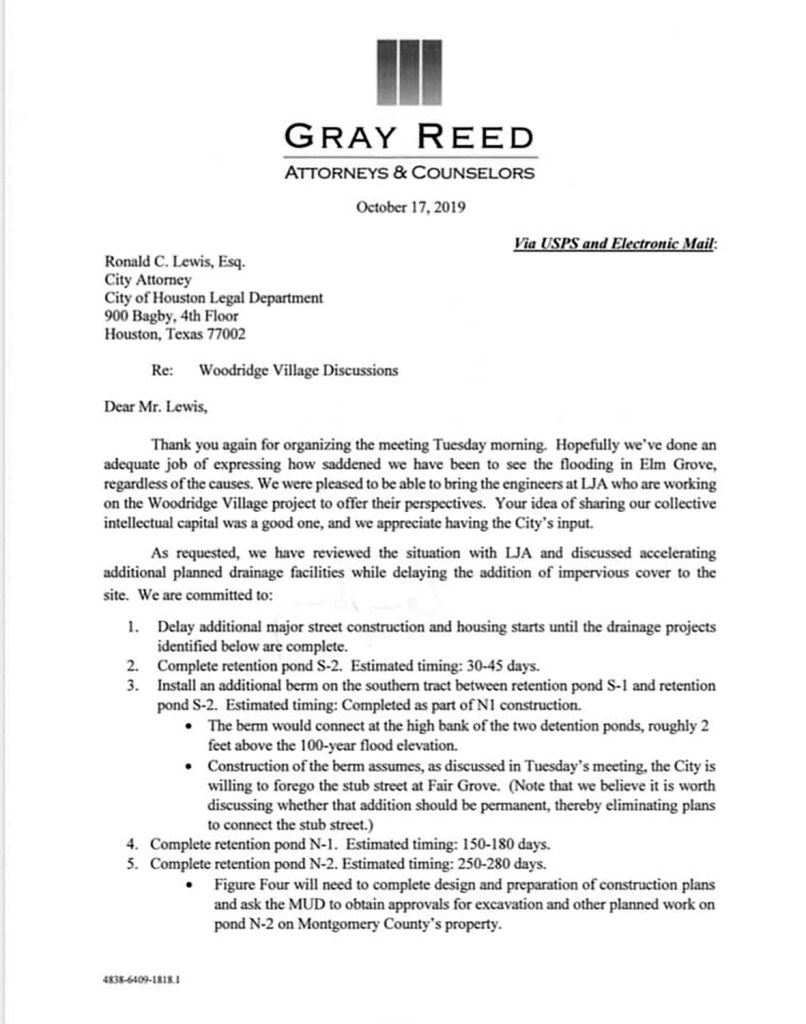
On October 17th last year, an attorney for Perry Homes, J. Carey Gray, promised the Houston City attorney that Perry would have S2 completed in no more than 45 days. It has now been 86 days since Mr. Gray sent his letter and the work is still far from complete. I’m sure this creates an embarrassment to the Mayor of Houston, especially considering that Perry Homes gave $5000 to his re-election campaign. It creates the appearance of trying to buy favors.
Put 30-foot wide maintenance roads around the ponds.
Place backslope interceptor swales around the ponds.
Have effective erosion control measures in place.
Implement protective measures for their overflow spillway.
Prevent increases in downstream flood levels.
Prepare a geotechnical report (that they shared with Montgomery County) showing groundwater levels at detention pond sites.
Ensure complete drainage of the detention pond.
Detention Pond Falls Short of Promised Capacity
Calculations for the capacity of the detention ponds begin from the bottom of the pond – when empty. When partially filled with water, the calculation begins from the top of the water. The bottom 2-3 feet of S2 has retained water for months, indicating that part of the pond is below the water table. So you can subtract about 20% of capacity that LJA Engineering promised and that Rebel Contractors initially built.
The flurry of work this week centered around creating the maintenance road that regulations demand. Or perhaps Perry is just building up the lip of S2 to compensate for the water it holds. Both are potentially good things.
However, workers also started filling the backslope interceptor swales they previously built. This created a sharp slope next to neighboring residents’ property and increased runoff toward the residents during last night’s rain.
Contractors placing dirt along the southern edge of the S1 pond to build a roadearlier in the week.
Elm Grove Trail on left. Woodridge Village on right of silt fence. Note how land is being sloped toward Elm Grove.
An interceptorswale collects water above slopes and diverts it to the bottom of a detention pond through pipes so runoff does not create erosion on the slopes that lead to the pond.
Perry Homes has given no reason why they started filling in the swale they previously built that complied with MoCo regulations.
Looking west from Village Springs Drive. In the foreground, you can see how workers built a road and filled in the interceptor swale between it and Elm Grove on the left.Still looking west. From this drain pipe, you can better see the grassy swale previously created to drain water into the detention pond (right) and to keep it out of Elm Grove (left).Reverse shot, looking east. Here you can see how workers filled in the swale and created a road three to four feet high. Residents worry about the effect.Looking east near the entrance to Taylor Gully from the road, the change in drainage toward Elm Grove (right) becomes very apparent. Picture taken Friday afternoon before rain. Road was uncompacted except for the weight of the small bulldozer spreading dirt (see first picture above).
Same Changes Between S1 and Sherwood Trails
The same changes appear along the southern edge of S1, north of Sherwood Trails, though the road does not appear as high and there also appears to be a shallow swale.
Looking west along the southern edge of Woodridge Village S1 detention pond, toward Woodland Hills from Fair Grove.
No Effective Erosion Control Yet
Perry Homes has also failed to put effective erosion control measures in place in Woodridge Village. For instance, most pond banks do not yet have grass planted on them.
The new road covered up what little grass had grown around the ponds. And raw dirt now fills the former interceptor swale.
A one-inch rain last night swept sediment into the pond, which emptied into Taylor Gully and Caney Creek before joining the East Fork of the San Jacinto.
Massive Pollution
Boater Josh Alberson took the dramatic picture below this afternoon where Caney Creek joins the East Fork. The East Fork water looks natural, but the water coming from Caney Creek via Taylor Gully is clouded with sediment. Woodridge Village is the only large source of exposed earth up Taylor Gully at this time. (Alberson verified that this sediment-laden runoff was NOT coming from the Triple PG mine up White Oak Creek.)
Water from Taylor Gully (right) merging with East Fork water (left) on Saturday afternoon, 1/11/2020, after a 1-inch rain last night.
Posted by Bob Rehak with images from Josh Alberson, Edythe Cogdill and Nancy Vera
865 Days since Hurricane Harvey and 114 since Imelda
The thoughts expressed in this post represent opinions on matters of public concern and safety. They are protected by the First Amendment of the US Constitution and the Anti-SLAPP Statute of the Great State of Texas.
https://i0.wp.com/reduceflooding.com/wp-content/uploads/2020/01/RoadNoSwale.jpg?fit=1200%2C900&ssl=19001200adminadmin2020-01-11 22:51:072020-01-11 22:55:48Perry Homes’ Contractors Return to Woodridge Village, But Undo Some Previous Work, Add to Sediment-Laden Runoff
After stonewalling discovery in the Elm Grove lawsuits, on December 27th, defendant Double Oak Construction objected to use of the documents in court that the judge forced it to produce. I don’t know what’s in those documents, but I plan to camp out at the courthouse when this case goes to trial. The documents must be juicier than Juicyfruit gum.
Double Oak appears to be a Perry Homes’ contractor working primarily on the northern portion of the Woodridge Village site, where downed trees are now being turned into mulch.
Summary of Objections
After producing documents, Double Oak now objects to their use in court.
The plaintiffs filed notice that they intended to use, in court, all documents and items produced by Double Oak during discovery.
Double Oak claims that this notice is insufficient and contradicts the Texas Rules of Civil Procedure.
The Plaintiff’s Notice leaves them, they say, without knowledge of the specific documents plaintiffs intend to use. That, claims Double Oak, handicaps the company in its ability to defend itself. It must prepare to object to every single document, they say.
But the objections don’t stop there. Double Oak reserves its right to make further objections when the company becomes aware of specific documents being used by the plaintiffs.
And if that isn’t enough, Double Oak reserves the right to object to all documents on all grounds, including documents produced by third parties.
Playing the delay game is a high risk strategy for companies already facing obscenely high risk due to previous delays.
Posted by Bob Rehak on 1/5/2020
859 Days after Hurricane Harvey and 108 after Imelda
The thoughts expressed in this post represent opinions on matters of public concern and safety. They are protected by the First Amendment of the US Constitution and the Anti-SLAPP Statute of the Great State of Texas.
https://i0.wp.com/reduceflooding.com/wp-content/uploads/2020/01/20191030-RJR_3830.jpg?fit=1200%2C800&ssl=18001200adminadmin2020-01-05 21:29:572020-01-05 21:32:38Double Oak Construction Causes Yet Another Delay in Elm Grove Lawsuits
Perry Homes left the future of a popular Kingwood trail in doubt when it abruptly removed its excavation equipment from Woodridge Village before Christmas. The trail, owned by the Sherwood/Elm Grove Trail Association (SEGTA) runs along the northern border of Kingwood, parallel to Woodridge Village. Hundreds of students used it to get to Kingwood Park High School via foot and bicycle. And residents used it to get to shopping in the Northpark Place Commercial District. But not now. Perry Home’s contractors destroyed a section about 500 feet long. And with their construction equipment now gone, only warning signs remain.
Approximate Location of Destroyed Trail
The map below shows the approximate location of the portion of the trail that Perry Homes destroyed. Hikers and bikers must now detour through streets – none of which have sidewalks. That poses a safety hazard.
How Could This Happen?
According to Ethel McCormick of Kingwood Association Management, Friendswood initially built the trail then gave it to SEGTA. However, part of it wandered onto property that Friendswood also owned but did not give to SEGTA. They later sold that adjacent property to Lennar. No one developed the property through seven changes of ownership. Then in 2018, it became Woodridge Village.
Friendswood sold the parcel of land to Lennar in 1994. 24 years later, the wandering trail finally got in the way of Perry Homes/Figure Four Partners plans..
When Perry Home started the new development, surveyors found that the part of the trail was not on SEGTA land but belonged to Perry Homes’ subsidiary, Figure Four Partners. The developer destroyed that part.
However, they intended to reconnect it later when they became part of the Kingwood network. But with Perry Homes apparently abandoning plans to finish the development, the trail’s fate is now in limbo.
The SEGTA Board does not have any information about what will happen at this time, according to McCormick. But it was a major topic of discussion at SEGTA’s last board meeting.
Perry Homes left abruptly before Christmas without restoring the missing part, removing warning signs or taking down construction fencing.
In the meantime, residents and their children do not have use of the remaining trail on Association property. And they must detour several blocks on streets around the interruption below.
Looking west from a point about a hundred feet west of Fair Grove.Looking east from a point several hundred feet east of Friarwood Trail toward Fair Grove.
Options for Association
At this point, it appears the Sherwood-Elm Grove Trail association has three options.
Move the trail back onto its own property.
Abandon it.
Hope that Perry Homes or whoever buys this property reconnects it to an expanded trail network.
As of this morning, Perry Homes still had no construction equipment on either the southern or northern sections of Woodridge Village. They only had tree mulching equipment working on the northern portion of the site. With Perry Homes’ intentions unclear, option three could take years.
Posted by Bob Rehak on 12/27/2019
850 Days after Hurricane Harvey and 89 after Imelda
https://i0.wp.com/reduceflooding.com/wp-content/uploads/2019/12/20191227-RJR_6255.jpg?fit=1200%2C800&ssl=18001200adminadmin2019-12-27 14:02:432019-12-27 14:04:32Perry Homes’ Departure Leaves Future of Sherwood-Elm Grove Trail in Doubt
Instead of accelerating completion of detention ponds on Woodridge Village as Perry Homes promised, the company appears to have pulled all excavation equipment from the site. Contractors who were supposed to have been working on detention pond N-1 have gone…BEFORE they finished S2 and BEFORE they finished a berm sealing off the southern portion of the site at Fair Grove Drive.
Equipment Left Site Instead of Beginning On Next Pond
Perry Homes had promised in its letter to accelerate construction, but this will slow it down – if they ever return. The only work being done Friday? Removal of some dead tree piles on the northern portion of the site.
Jeff Miller took all the pictures and videos below on Friday and Saturday. He also monitored work on the site and provided this scouting report.
Looking south toward Taylor Gully and the Harris County Line along the eastern embankment of the S2 detention pond.The channel along the eastern portion of Taylor Gully is now lined with concrete. The spillway into the S2 detention pond has been widened and smoothed. The S2 detention pond is behind the camera position. Looking East.Looking west across S2 detention pond. The dirt that eroded into the pond has been scooped back up onto the banks and compacted.Still no grass on the banks, however, so it could all wash back in with the next big rain.Looking north. The grassy area in the background was supposed to have contained the N3 detention pond. However, contractors have simply excavated a channel from the northern section directly into Taylor Gully so now runoff can accumulate even more quickly.Contractors widened and concreted the Taylor Gully channel along the eastern side of Woodridge Village. But they left the most vulnerable part of the channel without concrete. At the end corner by the telephone poles, water comes from the left. But no concrete protects the area where the water makes a sharp 120 degree turn. Expect water to erode behind the concrete and peel it away in the next big rain.
Woodridge Village Section One Now a Virtual “Ghost Town”
This weekend, Woodridge Village Section One looked like a ghost town, not a bustling construction site with people working against a deadline.
Heavy construction equipment used to be parked by dumpster in the background. Now it’s nowhere on the property. Looking south. Another view of the same area that held construction equipment. It’s all gone and the berm sealing the site off from Fair Grove Drive is missing.
Still Removing Dead Trees/Mulch on Northern Section
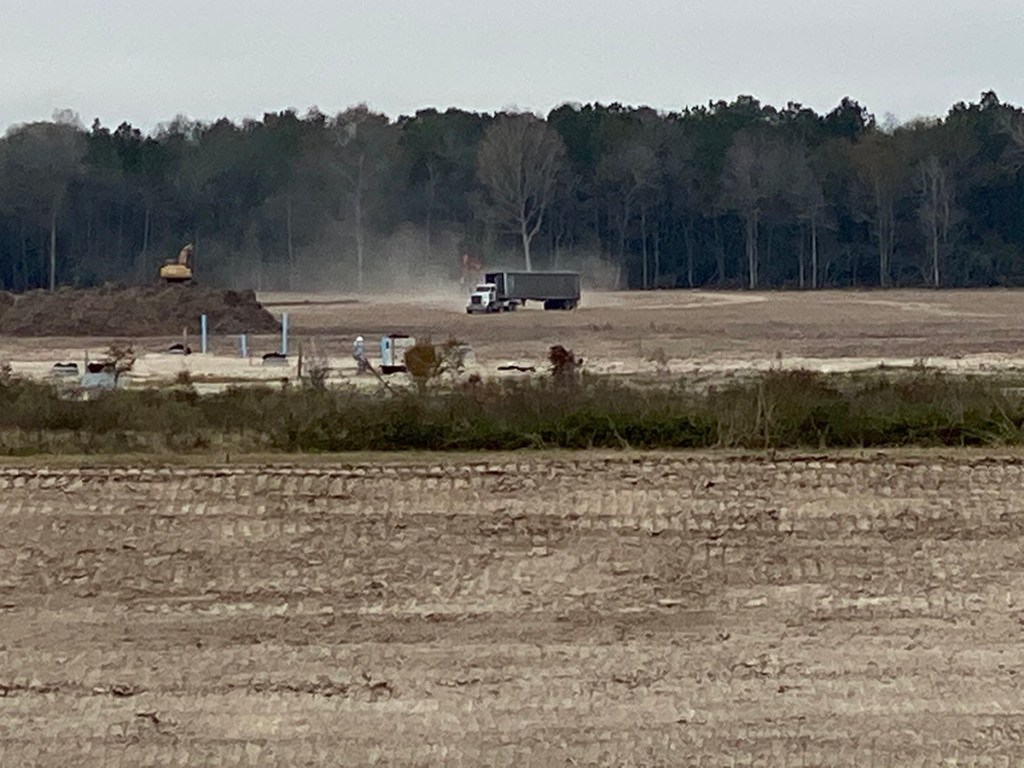
On Friday, only smaller equipment turning tree piles into mulch remained.
Perry Homes Intentions Now a Mystery
As of Sunday morning 12/22/2019, no equipment actually working on construction could be seen on the site. The excavators and dump trucks parked at Fair Grove for months have been removed.
Perry Homes is NOT accelerating completion of detention ponds as it promised the City of Houston.
Instead, Perry Homes has thrown a curtain of silence around this job. It’s hard to know what their intentions are. At this point, Perry Homes’ lawyer J. Carey Gray has as much mud on his face as Elm Grove residents had in their homes.
The only thing we can say with certainty: Lowering flood risk for the people of Elm Grove does not seem high on Perry Homes’ priority list.
For Sale And For Lease Signs Serve as Christmas Yard Decorations
Meanwhile, a drive down Shady Maple or Village Springs, the two streets that border Taylor Gully, revealed residents’ attempts to salvage Christmas from the chaos of floodwaters. Dumpsters and debris still line the streets. Some people still live in trailers in their driveways. No apple cider around the hearth for them. They’ll be lucky to find space for a table top Christmas tree. For Sale and For Lease signs outnumber Christmas yard decorations ten to one.
On a street called Right Way in North Kingwood Forest, I found nine For Lease signs in a row. Sad reminders of Imelda and Perry Homes.Only three months ago, these homes were filled with families who flooded for the second time.
Kathy Perry Britton just added another credit to her resume, “The CEO Who Stole Christmas.”
Posted by Bob Rehak on 12/22/2019with reporting and images by Jeff Miller
845 Days since Hurricane Harvey and 94 since Imelda
The thoughts expressed in this post represent opinions on matters of public concern and safety. They are protected by the First Amendment of the US Constitution and the Anti-SLAPP Statute of the Great State of Texas.
https://i0.wp.com/reduceflooding.com/wp-content/uploads/2019/12/IMG_0679.jpg?fit=1200%2C900&ssl=19001200adminadmin2019-12-22 12:09:152019-12-22 12:58:38Perry Homes Pulls Excavation Equipment From Woodridge Village Before Finishing Detention Ponds
The pictures below show why you should never, ever buy a home built over wetlands.
Standing water after one month with only an inch of rain. Perry Homes’ Woodridge Village in Montgomery County, Texas.
Standing Water One Inch of Rain A Month Before
I took these shots while circling Perry Homes’ Woodridge Village construction site in Montgomery County, Texas, on 12/3/2019. At that point, the nearest USGS rain gage (at US59 and the San Jacinto West Fork) indicated we had only had one inch of rain in the previous month. The most recent rain at the time was a quarter inch three weeks prior!
That’s far below the normal 4.3 inches of rainfall for November in Houston. So it was less than one quarter of the normal rainfall. Still, the land held standing water in numerous places, despite having been cleared and graded for months.
Soupy soil on the northeast portion of Perry Homes Woodridge Village.
Standing water should have soaked in long before I took these shots. But when you build a development on wetlands, that’s not always true.
These pictures vividly illustrate how unstable wetlands soil can be.
Looking west over the northern portion of Perry Homes’ Woodridge VillageSouthwestern portion of Perry Homes’ Woodridge Village fronting Woodland Hills Drive.
They remind me of the famous saying the Bible.
Matthew 7:24-27: Build Your House on the Rock
24 “Everyone then who hears these words of mine and does them will be like a wise man who built his house on the rock. 25 And the rain fell, and the floods came, and the winds blew and beat on that house, but it did not fall, because it had been founded on the rock. 26 And everyone who hears these words of mine and does not do them will be like a foolish man who built his house on the sand.27 And the rain fell, and the floods came, and the winds blew and beat against that house, and it fell, and great was the fall of it.”
Area classified as wetlands in the USGS National Wetlands Inventory within Perry Homes’ Woodridge Village.Perry Homes’ contractors mired in more muck on the northern portion of Woodridge Village where wetlands once stood.
That sinking feeling you get when you try to build over wetlands
Environmental Survey Not on File with Montgomery County
Perry Homes claims to have done an environmental survey. But if they did, they did not file it with Montgomery County. A FOIA request with the county turned up no such document. A survey, performed by a private consultant, cleared the way for developing this property.
Normally, the Army Corps would investigate wetlands and determine whether they fell under their jurisdiction. If so, developing them would have required permitting and possible mitigation.
That process would have taken much longer and Perry Homes was trying to beat the clock. They were trying to start development before new, stricter Atlas-14 regulations took effect that would have required 40% more detention.
USGS National Wetlands Inventory showing Perry Homes Woodridge Village
Be a wise man or woman. Consult these databases before you buy a home to determine whether your property was once wetlands.
Posted by Bob Rehak on 12/15/2019
838 Days since Hurricane Harvey and 87 since Imelda
The thoughts expressed in this post represent opinions on matters of public concern and safety. They are protected by the First Amendment of the US Constitution and the Anti-SLAPP Statute of the Great State of Texas.
https://i0.wp.com/reduceflooding.com/wp-content/uploads/2019/12/20191203-RJR_5520.jpg?fit=1200%2C800&ssl=18001200adminadmin2019-12-15 14:40:362019-12-15 14:40:48Why You Never Want to Buy a Home Built Over Wetlands
At the current rate of work, Perry Homes could easily take 3-4 years to complete the detention ponds on its Woodridge Village development. The chances of getting another rain event like May 7th during that period? 27.1% if it takes Perry 3 years and 34.4% if it takes 4.
This significantly raises Perry Homes’ legal liability if Elm Grove floods again.
How to Determine Cumulative Probabilities
How do you compile those statistics? Start by classifying the storm. The May 7th storm that flooded approximately 200 homes was a 10-year event, according to USGS, NOAA and National Weather Service statistics below.
Hourly rainfall totals for the USGS gage at US59 and the West Fork. Whether you consider six inches in six hours or 3.6 inches in one hour, May 7th storm still classifies as a 10-year event.
Next, figure the cumulative probability of it happening again during a given time period. If you ask, “What are the chances of another May 7th happening in any year,” the answer is always 10%. But if you ask, “What are the chances of another May 7th happening in the next three-years,” the answer is different.
You calculate the cumulative probability using the following formula:
Probability of at least one 10-year storm in next 3 years = 1 – (9/10)3rd = 27.1%. Four years equals 34.4%.
The possibility exists that the rainfall rate may have been slightly higher in Elm Grove on May 7th. But these are official statistics and conservative for the purposes of estimating risk. They don’t even include the chances of getting hit by even larger storms in the same year (as we did with Imelda).
Legal Risk of Not Mitigating Flood Risk
Perry Homes has shown little desire to mitigate flood risk by expanding detention capacity at Woodridge – even after promising the City of Houston it would do so.
After clearcutting virtually the entire site, Perry had installed only 7% of the required detention ponds when the May 7th flood hit and only 23% by the time Imelda hit on September 19. Since then? Virtually nothing!
Where three detention ponds should be on the northern portion of Woodridge Village. 77% of detention capacity is still missing after four months of inactivity.
What Perry Homes Has and Hasn’t Done
Since the October 17th letter laying out a 26-month timetable for completing work on Woodridge detention ponds, Perry Homes HAS:
Removed several brush piles from their northern property (shown above)
Slightly widened 300 feet of Taylor Gully
Concreted a portion of the 300 feet (see below).
Moved a small amount of dirt from the S2 pond that eroded into it back up onto the banks (see below).
Spread some grass seed on the northern portion of the development (see two photos below)
Perry Homes moves eroded dirt from S2 detention pond back onto banks on 12/3/2019. The area where the N3 detention pond should be now has a small amount of grass.Photo by Jeff Miller.
Perry Homes has NOT:
Finished work on the S2 detention pond.
Started work on other detention ponds.
Managed to keep ponding water from reducing the volume of S2.
Established grass on pond banks to reduce erosion as regulations require.
Finished the spillway into S2 from Taylor Gully.
Fenced in their detention ponds as regulations require.
Installed maintenance roads around the ponds as regulations require.
Released its internal investigation into the causes of Elm Grove flooding as it promised Channel 2 news.
Section 7 of Montgomery County Drainage Criteria Manual shows many items still missing from Perry Homes’ existing detention ponds.Close up of spillway into S2 pond and its north bank as of 12/5/2019. Photo courtesy of Jeff Miller.
Perry Homes Increases Risk to Residents and Itself
Since August when Perry Homes virtually stopped working on Woodridge, the company has done nothing to allay the major causes of flooding: clearcutting and lack of detention. It has slow-walked this project. Whatever its motivation, Perry Homes has significantly increased the risk of flooding Elm Grove residents again. In doing so, it also increases its own risks.
If Perry Homes does flood Elm Grove again, its slowdown and disregard for the promises it made to the City in its October 17th letter could prove the difference between negligence, gross negligence and punitive damages.
According to the Sawaya Law Firm, “Gross negligence is the extreme indifference to or reckless disregard for the safety of others. Gross negligence is more than simple carelessness or failure to act. It is willful behavior done with extreme disregard for the health and safety of others. It is conduct likely to cause foreseeable harm.”
Kathy Perry Britton knows that slow-walking the expansion of detention capacity will increase the risk of another major storm hitting Elm Grove before she finishes. But I doubt her lawyers are telling her that risk could be as high as 34%.
Posted by Bob Rehak on 12/15/2019with help from Jeff Miller
838 Days since Hurricane Harvey and 87 since Imelda
The thoughts expressed in this post represent opinions on matters of public concern and safety. They are protected by the First Amendment of the US Constitution and the Anti-SLAPP Statute of the Great State of Texas.
https://i0.wp.com/reduceflooding.com/wp-content/uploads/2019/12/Missing-Detention.jpg?fit=1200%2C800&ssl=18001200adminadmin2019-12-15 00:19:172019-12-15 08:39:56More Delays on Fixing Perry Homes’ Drainage Debacle Increases Risk of Yet More Elm Grove Flooding
The taxpayer-funded Grand Parkway (State Highway 99) extension will make many people happy. Proximity to transportation drives home-buying decisions. People eager to “get away from it all” will find the lure of saving 10 minutes on a longer commute irresistible. They will marvel at all the trees around them and speak with pride about their growing community in the forest.
Eastward expansion of SH99 from I-69.
It will also make the sand miners happy. It takes lots of sand to make concrete.
West Fork San Jacinto mine
Developers and homebuilders will take advantage of lax regulations in Montgomery County to boost their profitability.
Perry Homes’ Woodridge Village
And the flooding, caused by all the environmental destruction, means that downstream residents get to remodel their homes. Or move farther out to avoid future flooding. At which point the cycle will repeat itself in a few years.
Elm Grove Home below Perry’s Woodridge
From a marketing point of view, it’s a perfect, perpetual production-consumption cycle. How could you possibly improve it?
Posted by Bob Rehak on 12/8/2019
831 Days after Hurricane Harvey and 79 Days after Imelda
The thoughts expressed in this post represent opinions on matters of public concern and safety. They are protected by the First Amendment of the US Constitution and the Anti-SLAPP Statute of the Great State of Texas.
Chapter 9 of the Montgomery County Drainage Criteria Manual discusses development in flood plains. Perry Homes and LJA Engineering somehow “overlooked” many of the points in this chapter. A flood plain ran through the property, but FEMA had not yet mapped it. LJA used that as an excuse to claim none existed.
Notice how flood plain mapping stops at county line. Perry Homes has the undeveloped property along and above the county line.Color code: Cross-hatched = floodway; aqua = hundred year flood plain; brown = 500-year flood plain.Source: MoCo Maps
Unfortunately, physical boundaries of flood plains do not observe political boundaries. Taylor Gully bisects this property, if you look at the flood maps, it magically defies flooding on the MoCo side of the county line.
Montgomery County Regulations Affecting Flood Plains
Below are guidelines from the Montgomery County Drainage Criteria Manual that Perry Homes would have had to follow had the property been mapped.
From Section 9.1.1 Floodplain Regulations:
“No fill or encroachment is permitted within the 100-year floodway which will impair its ability to discharge the 100-year peak flow rate except where the effect on flood heights has been fully offset by stream improvements.” [Emphasis added.]
“Placement of fill material within the floodplain requires a permit from the County Drainage Administrator. Appropriate fill compaction data and hydrologic and hydraulic data are required before a permit will be issued.”
From Section 9.1.2 Floodplain Development Guidelines and Procedures
“Construction within the floodway is limited to structures which will not obstruct the 100-year flood flow unless fully offsetting conveyance capacity is provided.”
“The existing designated 100-year floodplain and floodway should be plotted on a map of the proposed development.”
“The effect of the proposed development and the encroachment into the flood plain area should be incorporated into the hydraulic model and the resulting flood plain determined.”
“Careful consideration should be given to providing an accurate modeling of effective flow areas taking into account the expansion and contraction of the flow.”
“Once it has been determined that the proposed improvements adequately offset the encroachment, a revised floodway for the stream must be computed and delineated.”
From Section 9.2 Downstream Impact Analysis
“Pursuant to the official policy for Montgomery County, development will not be allowed in a manner which will increase the frequency or severity of flooding in areas that are currently subject to flooding or which will cause areas to flood which were not previously subject to flooding.”
What LJA Said About Perry Homes’ Project
On Page 1-2 of its Drainage Analysis, LJA Engineering explicitly states, “As shown on Exhibit 3, the proposed development is outside the 100-year floodplain.”
LJA Exhibit 3 shows the floodplain stopping at the county line. LJA also did its best to make the .2 percent risk area blend into the area of minimal flood risk. This visually minimizes the amount of floodplain bordering MoCo, so the abrupt stoppage at the county line becomes less visible.Source: LJA.
Ms. Mbewe then states in her conclusion, “Based on these findings, the proposed development of the 268-acre tract creates no adverse drainage impacts for events up to and including the 100-year event.” [Emphasis added.]
What Does “No Adverse Impact” Really Mean?
People often twist the definition of terms you think are self evident. Especially in legal, technical, and political contexts.
To me, “No Adverse Impact” should mean, “Downstream people who didn’t flood before won’t flood after development.” That’s what section 9.2 states explicitly.
But when I talked to a flood professional, I got a different answer. To that person, “no adverse impact” meant, “the amount of water flowing across the property did not increase after development.” Much narrower! And seemingly contradictory to the spirit of 9.2.
“Floodplain” Definition Shocked Me
But that person’s definition of floodplain really shocked me. To me, floodplain means “the area adjacent to a stream that fills with floodwater after a very heavy rain.” But the professional told me I was WRONG. To the professional, a floodplain was “an area on a map that FEMA designated a floodplain for insurance purposes.”
In that person’s mind, because FEMA had never mapped the area in question, a floodplain did NOT EXIST. Whether or not the area flooded!
To me, that’s like saying an apple is something you see in a Kroger’s flyer, not something you eat. We’re talking about the difference between a symbol of something and the reality of it.
This discussion proved once again that words and phrases have different meanings that depend on the social context of usage.
In the minimum compliance environment of Montgomery County, LJA and Perry Homes argued that there was no floodplain. They found someone in the county engineer’s office who agreed with them…or was told to agree with them.
FYI, the official FEMA definition says, “Any land area susceptible to being inundated by floodwaters from any source.”
Consequences of Overly Narrow Definition
So did Elm Grove flood because Perry Homes, LJA and Montgomery County did not enforce the floodplain regs in section 9.2 of the Drainage Criteria Manual?
They did not plot the REAL-WORLD floodway and floodplain on a map of the proposed development (see above).
LJA did not incorporate encroachment into the floodplain in its hydraulic modeling, because they denied a floodplain existed.
Neither did LJA provide “an accurate modeling of effective flow areas taking into account the expansion and contraction of the flow.”
Finally, LJA did not compute, revise and delineate the floodway for the stream.
Had they done all these things, perhaps people would have seen that downstream homes that had never flooded were now subject to greater flood risk. But that’s really something for the jury to decide. And it would require FEMA to model the floodplain after the fact.
But like the narrow definition of floodplain, this whole discussion symbolizes a bigger problem.
How Do You Fix a Permissive, Minimum-Compliance Environment?
Perry Homes could have demanded honest answers from its engineers, not the ones they wanted to hear.
FEMA could label areas like Woodridge Village “UNMAPPED”. This would send a signal to potential home buyers if sellers tell them they’re NOT in a floodplain. That might make developers think twice.
Home buyers need to demand integrity in this process. They need to ask better questions. They need to learn more about flooding.
But at the end of the day, Montgomery County Commissioners must define the kind of future they want. Do they want constant flooding? Or not. Because right now, they’re competing with other areas for new development on the basis of willful blindness and self-serving definitions.
Thirty years down the road, when it’s too late to fix the infrastructure problems they ignore today, MOCO residents will be paying the price. Some, who have flooded repeatedly, might argue they already are.
Posted by Bob Rehak on 8/26/2019 with help from Jeff Miller
820 Days after Harvey and 69 since Imelda
The thoughts expressed in this post represent opinions on matters of public concern and safety. They are protected by the First Amendment of the US Constitution and the Anti-SLAPP Statute of the Great State of Texas.
https://i0.wp.com/reduceflooding.com/wp-content/uploads/2019/11/HarrisMocoCountyLineFloodPlain.jpg?fit=1500%2C883&ssl=18831500adminadmin2019-11-26 20:52:182019-11-26 21:42:44What Went Wrong, Part IV: Perry Homes Develops Flood Plain That Wasn’t
This morning, I was talking to a friend, John Knoezer, about flooding in Elm Grove when he suddenly blurted out, “You know, the National Flood Insurance people should sue Perry Homes and turn that Woodridge Village into a giant detention pond.”
I knew John had a genius for heating and air conditioning. But I had no idea he also had a genius for politics, too. Boom. There it was. One simple idea to fix multiple problems. The NFIP budget deficit. Flood mitigation. Mushrooming tax bills. And rogue developers who ignore flood regulations at others’ peril. And all it requires is getting NFIP to act like any other insurance company.
Get NFIP to Behave Like a Normal Insurance Company
If the National Flood Insurance Program (NFIP) sued the people responsible for flooding Elm Grove, North Kingwood Forest and Porter, it could likely recover enough payouts to fix the lack of detention in Woodridge Village, Perry Homes’ troubled development in Montgomery County.
All we’re really talking about is getting NFIP to behave like a normal commercial insurance company. For instance, if someone rear-ends your car, your insurance company sues the person who did it (or their insurance company) to recover the amount of your claim. But not NFIP, according to everyone I’ve talked to.
Elm Grove after the May 7th storm, where block after block, homes were being gutted. Several feet of water from Perry Homes Woodridge Village development inundated homes that had never flooded before.
That money could easily buy the Woodridge Village land and construct a massive detention pond that would prevent future flooding.
Such lawsuits, if won, could also help reduce future taxpayer-subsidized flood-mitigation expenditures, most of which the federal government helps underwrite in some manner. But that’s just for starters.
Get Developers to Stop Pushing the Flood-Risk Envelope
Going after flagrant developers might help in another way, too. It might change the economics of pushing the flood-risk envelope. Right now, the economics favor those who push it hardest and furthest.
Land costs are the largest component of development costs. They’re also the fastest rising component. So buying cheap, flood-prone land rewards developers.
According to residents, not one home flooded in this neighborhood west of Woodridge Village flooded before May 7, 2019. However, on May 7th, the vast majority of homes did flood…after Woodridge Village contractors altered the drainage going out of the subdivision. Flood data from Montgomery County. Flood Story Map hosted by ESRI.
If NFIP successfully sued the developer, the precedent might encourage all developers everywhere to follow the rules instead of bending them.
Save Tax Dollars
The precedent of NFIP suing a developer might also deter other developers in the future from pushing flood-prone projects or developing them in ways that contribute to flooding. So it could further reduce NFIP payouts and overhead. That could save even more dollars for this taxpayer subsidized program.
Bypass County Commissioners Who Refuse to Enforce Their Own Regulations
Another benefit of John’s brilliant suggestion: it eliminates a political battle with Montgomery County Judges and Commissioners – which may be unwindable for people in another county. Just get NFIP to make an example of a high-profile developer, such as Perry Homes. That might change some developers’ behavior who operate under the protective cover of local politicians. Those politicians compete for development dollars by not enforcing their own regulations. And that’s a huge part of the problem. Especially when a county line divides the perpetrators and victims as it does in this case.
Posted by Bob Rehak on 11/26/2019, with inspiration from John Knoezer
819 Days since Hurricane Harvey and 68 since Imelda
The thoughts expressed in this post represent opinions on matters of public concern and safety. They are protected by the First Amendment of the US Constitution and the Anti-SLAPP Statute of the Great State of Texas.
https://i0.wp.com/reduceflooding.com/wp-content/uploads/2019/11/Elm-Grove-Flood_67.jpg?fit=1500%2C1000&ssl=110001500adminadmin2019-11-25 19:29:122019-11-25 19:58:58A Simple Proposal to Fix NFIP, Reduce Elm Grove’s Flood Risk, Save Taxpayer Dollars, and Force Perry Homes to Follow Rules