Tag Archive for: SJRA

Sunset Commission Recommends SJRA Improvements, But Tiptoes Around Key Issues

On January 21, 2021, the Texas Sunset Commission released its “Staff Report with Commission Decisions” on the San Jacinto River Authority (SJRA). The 53-page report generally gave the SJRA a good review, but recommended that it:

  • Improve trust through better communications, public outreach, openness and transparency
  • Receive better value by improving contracting processes

The Commission also recommends that the Texas Legislative Council update and consolidate the SJRA’s governing law and processes.

The Sunset Act never subjected the SJRA to abolishment. However, it put its governance, management, operating structure, and compliance with legislative requirements under a microscope.

This post was based on public information taken from the Sunset Commission website.

Litigation Issues Deliberately Not Addressed

The report alluded to issues surrounding flooding and groundwater. However, Sunset Commission does not comment on issues in litigation as a matter of policy, so as not to influence the outcome. And although the Commission received extensive public input, it did not address comments directly for the same reason.

Those who take the time to read the entire report will be rewarded with a thorough, yet concise and illuminating summary of the SJRA’s business and the challenges it faces. The SJRA has adopted most, if not all, of the recommendations made by the Commission to some degree. Adopting the recommendations should not have any adverse fiscal impact on the SJRA or cause it financial strain.

Need for Better Communication and Engagement to Improve Trust

The Commission found that SJRA needs an effective communications strategy to advance projects. Especially if the projects could result in increased costs to the general public years before the public sees benefits.

Criticism: SJRA has not developed a formal strategy for engaging the general public in its activities, struggles to provide clear explanations of its wholesale water rates, and does not maintain important information on its website.

The Commission recommended a more proactive and strategic approach to communicating with and engaging the public. That, it felt, would help SJRA earn the trust of and get buy-in from the communities it ultimately serves.

Key recommendations included:

  • Require SJRA to adopt a public engagement policy that guides and encourages public involvement on key decisions.
  • Direct SJRA to develop a strategic communications plan.
  • Direct SJRA to provide clear, understandable information on its rates and fees prominently on its website.

Improve Contracting Function to Receive Best Value

The Commission also found that the SJRA guidance to staff fell short in important areas. Those areas included justifying the need to outsource services and maximizing open competition for contracts. In addition, the commission also felt SJRA lacks consistent documentation for monitoring the performance of its vendors.

Key recommendations included directing the SJRA to:

  • Establish additional guidance for contracting needs and procurement methods, and use open solicitations except in documented exceptions.
  • Consistently monitor, document, and evaluate vendor performance.
  • Improve the transparency, fairness, and effectiveness of its contracting process.

Update Governing Law and Processes

Over the years, Sunset reviews have included a number of standard elements designed to ensure open, responsive, and effective government. SJRA’s governing law does not contain several standard provisions, including those related to the governor’s appointment of the board president, grounds for removal of a board member, board member training, separation of duties of board members from those of staff, public testimony at board meetings, and maintaining a system for receiving and acting on complaints.

SJRA’s governing law is also uncodified and difficult for the public to find and understand. Finally, SJRA lacks goals and a plan to increase its workforce diversity.

Key recommendations:

  • Apply the standard across-the-board requirements regarding governor appointment of the board’s presiding officer, grounds for removal of a board member, board member training, separation of duties of board members from those of staff, public testimony at board meetings, and maintaining a system for receiving and acting on complaints.
  • Direct the Texas Legislative Council to update SJRA’s governing law.
  • Direct SJRA to plan and monitor its efforts to increase workforce diversity.

Other Findings

Strained Relationships with Stakeholders

Sunset Commission staff observed how protracted legal disputes and other controversies have strained SJRA’s relationship with some stakeholders and communities. That eroded trust in its decision making and jeopardized its ability to conduct the long-term planning and construction for which the Legislature created it.

The general public was highly critical of SJRA’s efforts, in contrast to SJRA’s direct customers who were generally satisfied with the authority’s performance.

No Formal Strategy for Public Engagement

SJRA’s own recent public opinion poll revealed most respondents had a negative opinion of the authority, no opinion of it, or had not heard of it, highlighting the need for direct outreach to the public rather than relying on others to speak on its behalf.

Lack of Clear Communication about Rates and Fees

A frequent complaint during the Sunset review was that consumers often see an “SJRA fee” or “surface water conversion fee” listed on their monthly bill with little to no explanation. SJRA’s public opinion poll confirms many consumers do not know what the fee is for. Only about half of respondents correctly identified the fee is used for maintaining a water treatment plant and pipeline.

Several other wholesale water providers in the region explain their rates and fees, which are higher than SJRA’s, on the front page of their website and clearly describe how some retail utility providers modify the fees when passing them on to consumers to cover other costs.

Governing Law Outdated, Difficult for Public to Find and Understand

While some water districts and river authorities are governed by laws that are fully compiled in a specific Texas code or statute, SJRA’s governing law exists solely in “session law.” That means changes are scattered in various statutes and amendments dating back to 1937. In the absence of ONE codified statute, members of the public and even the river authority itself struggle to correctly compile all of the changes to its laws and understand their cumulative impact.

For example, SJRA’s governing law stipulates the board has six members, even though the Texas Constitution now requires all boards and commissions to have an odd number of members. Even Rep. Will Metcalf’s recently introduced bill, HB3116 – recommending changes in how the governor makes SJRA board appointments – still refers to six positions.

Although general law adds a seventh member to preserve the board’s constitutionality, this outdated provision in SJRA’s governing law misrepresents the board’s actual makeup.

SJRA’s governing law contains many more out-of-date references to defunct state agencies and code sections that have been amended, renamed, or no longer exist, further complicating full understanding of the authority’s powers and duties.

Revenues and Expenses

The SJRA had approximately $112 million in revenues in Fiscal Year 2019 with $115 in expenses. The difference had to do with some reserve-fund expenditures for specific projects.

Litigation Summary

For an excellent summary of SJRA litigation over groundwater issues and Harvey flooding, see Appendix B on Page 37. Even as someone who follows these cases closely, there were several aspects that I simply did not know about.

For More Information

Read the entire Sunset Commission report and visit their website. One thing I discovered: the SJRA was apparently the only agency/authority reviewed last year for which the Sunset Commission did not request legislative changes.

For the Sunset Commission Report to the Legislature on all agencies, click here.

For the State Auditors Report on recommendations that were self-implemented, click here.

Posted by Bob Rehak on 3/21/2021

1300 Days since Hurricane Harvey

Three Meetings This Week Will Affect Future of Water in Lake Houston Area

Three meetings this week will affect water issues in the Lake Houston Area. Here’s a brief rundown on each and how you can participate.

Below: a little more about each meeting.

NE Water Purification Plant Update

This is an update on construction progress of the Northeast Water Purification Plant. The massive multi-billion project stretches from Lake Houston to the northeast corner of Beltway 8. Water was in the news last week when half the state was forced to boil water because of power outages at treatment plants. I sure hope the City plans to build a massive power-generation backup facility as part of this plant. If the presentation doesn’t address the subject, I hope someone asks.

The sprawling NE Water Purification Plant Expansion. Photographed Jan. 1, 2021

The new treatment facility is being constructed next to the current plant. When complete in 2024, it will provide 320 million gallons per day of treated water capacity in addition to the current 80 million gallons per day treated water capacity. It will help sustain growth by providing enough surface water to meet 80% of the region’s needs in 2035.

Register for the online meeting at: www.bit.ly/NEWPPFeb23.

Lone Star Groundwater/GMA-14 Meeting

At its last meeting, the LSGWCD board’s legal counsel spent 90 minutes trying to explain that they were indeed concerned about subsidence. But she failed to address the fact that one of their consultants told GMA-14 that LSGWCD would not consider subsidence in their desired future conditions (DFCs). Then the board deferred any decisions on subsidence and DFCs or even initiating the second phase of its subsidence study. At this month’s GMA 14 meeting, items 7, 8 and 10 all address DFCs.

The amount of groundwater that LSGWD would like to pump would create approximately 3 feet of subsidence near the Harris/Montgomery County line but only one foot at the Lake Houston Dam. This would essentially “tilt” the lake upstream and reduce the gradient of the East and West Forks. That could contribute to increased flooding between Conroe, The Woodlands, and the Lake Houston Area.

What will LSGWCD’s position be on subsidence this week? This is getting better than a soap opera.

Register for the GMA-14 Planning Committee meeting at https://attendee.gotowebinar.com/register/8339631182398941456.

The virtual platform for the meeting is Go To Webinar.

SJRA Board Agenda

Two unusual items on the SJRA agenda this month caught my eye:

6A) Election of officers to the board of directors. The governor recently appointed two new board members to the SJRA and reappointed Kaaren Cambio. And the term of board president Lloyd Tisdale expired. The reshuffling will require the board to select new officers. Who the board members elect among themselves to replace Tisdale could have long-term consequences for board priorities, such downstream flood mitigation.

6B) Consideration of a “public engagement policy.” This comes out of SJRA’s growing regional role and a Texas Sunset Advisory Commission requirement to improve public engagement efforts. Key components of the resolution:

  • Seeking general public input in advance of major actions and projects.
  • Proactively anticipating and interacting with those ultimately affected by SJRA decisions.

Register for the SJRA Go To Webinar meeting at: https://attendee.gotowebinar.com/register/2515623643758462479. Use meeting ID 958-527467.

Posted by Bob Rehak on 2/23/2021 and updated at 4:08 PM to clarify Item 6A on SJRA Agenda

1274 Days after Hurricane Harvey

January Digest of Flood-Related News in Lake Houston Area

From construction developments to political developments, here’s your January digest of ten stories that could affect flooding or flood mitigation in the Lake Houston Area.

1. New Caney ISD High School #3

This site is located between Sorters-McClellan Road and US59 south of the HCA Kingwood Medical Center. New Caney ISD is building a new high school on the site of the old par 3 golf course behind the car dealerships that front US59. Construction crews are still pouring concrete for foundations and parking lots. Not much happened between flyovers on December 7 and January 1. But then, not much happens anywhere during the holidays. The two photos below show the progress. Construction of the detention pond is nearing completion. However, contractors still need to plant grass to reduce erosion before spring rains arrive.

New Caney ISD High School #3 site as of December 7, 2020
As of January 1, 2021.

New Caney ISD has not posted a project update since last September. Projected occupancy for the building is still Fall 2022.

2. Kingwood Cove Golf Course Redevelopment

I first talked about Ron Holley’s redevelopment of the Kingwood Cove (formerly Forest Cove) Golf Course in April last year. Since then Holley says he has been working with engineers, community groups and regulators to accommodate different interests.

Now, the development is back on the planning commission agenda for this Thursday. Holley is seeking approval of his latest General Plan and Plat. Neither show any detention ponds. The only place they could go would be in “Reserve C.” The General Plan shows that to be in the floodway and 100-year floodplain. Both could soon expand.

The West Fork floodway cuts through the southern part of Holley’s property.

The City raised an issue regarding compliance with regulations governing the re-plat of golf courses at the 12/17/2020 Planning Commission meeting. The City requested information relating to Local Government Code 212.0155.

That regulation requires, among other things, that:

  • Public notice of the re-plat be printed in newspapers
  • The Forest Cove Property Owners Association is notified
  • Residents have an opportunity to voice their opinions at public hearings
  • Owners of all properties within 200 feet of the new plat be notified in writing via US Mail.
  • If 20% of the owners object, the re-plat must win the approval of 3/5ths of the planning commission.
  • The developer proves there is adequate existing or planned infrastructure to support the new development.
  • The new subdivision will not adversely affect health, safety traffic, parking, drainage, water, sewer, or other utilities
  • The development will not have a materially adverse effect on existing single-family property values.
  • The new plat complies with all applicable land-use regulations and restrictive covenants and the City’s land-use policies.

That’s a lot to do over the holidays. So the general plan may need to be withdrawn and resubmitted after all the information has been produced. We should know more by Wednesday afternoon.

3. Dredging

Mayor Pro Tem Dave Martin’s January newsletter stated that Disaster Recover Corporation has removed 385,000 cubic yards from the West Fork Mouth Bar out of an estimated total of 400,000 cubic yards.

Then he alluded to dredging another 260,000 cubic yards from the area north of the mouth bar.

He also alluded to a Second Phase: dredging the San Jacinto East Fork and other locations in Lake Houston.

Finally, Martin discussed maintenance dredging. “Additionally,” he says, “during Phase Two of the project, City of Houston, Harris County, HCFCD, SJRA, and Coastal Water Authority (CWA) will develop and execute a plan for the City of Houston or CWA to assume long-term dredging operations on Lake Houston. This effort will include determining funding for dredging operations in perpetuity.”

4. Appointments to SJRA Board

Governor Greg Abbott has appointed Wil Faubel and Rick Mora, M.D. and reappointed Kaaren Cambio to the San Jacinto River Authority Board of Directors. Their terms will expire on October 16, 2025. 

Kaaren Cambio of Kingwood is a field representative for United States Congressman Dan Crenshaw. She is a former member of Women’s Business Enterprise National Investment Recovery Association, Pipeline Contractors Association, and the Houston Pipeliners Association. Cambio received a Bachelor of Business Administration from San Diego State University.

Wil Faubel of Montgomery is President of Borets US Inc. He is a veteran and senior executive in the Oilfield Services industry with more than forty years of service. He has both domestic and international experience and is a lifelong member of the Society of Petroleum Engineers and a former board member of the Petroleum Equipment Suppliers Association. Faubel received a Bachelor of Science in Mechanical Engineering from Southern Methodist University.

Rick Mora, M.D. of The Woodlands is a partner at US Anesthesia Partners and Chief of Anesthesiology for Memorial Hermann Pinecoft Surgery Center. He has served as chair of the Montgomery County Hispanic Chamber of Commerce and is a founding Board member of the non-profit, Los Doctores de The Woodlands. Mora received his MD from the University Of Illinois College Of Medicine.

5. Forest Cove Townhome Buyouts

Harris County Commissioner’s Court will vote today on an item to exercise eminent domain on seven townhomes in the Forest Cove complex. The entire complex was destroyed after Harvey and many owners simply walked away from their properties without leaving forwarding addresses. Flood Control has been unable to find the owners after years of trying. Several may have moved out of the country. Eminent domain on these last few properties will clear the way for demolition of the entire complex and restoration of the area to nature or park land.

The once proud and idyllic townhomes in Forest Cove next to West Fork.

6. Woodridge Village

The purchase of Woodridge Village from Perry Homes is not on today’s Commissioner’s Court Agenda. However, all energies are reportedly still positive. It’s just taking time to work out the complex three-way purchase arrangements.

7. Romerica

Houston PlatTracker shows that the Romerica people may have acquired more land. But so far, they have not returned to the planning commission for approval on the latest iteration of the developer’s plans. No news is good news in this case.

8. Lake Houston Spillway Improvement Project

The City is close to finalizing the Preliminary Engineering Plan. Sources say the benefit/cost ratio looks very positive. We may see the final recommendations this month.

Engineers have examined several alternatives to add more gates to the Lake Houston dam or to increase its spillway capacity.

9. Noxxe Cleanup

The Railroad Commission could start plugging wells, removing storage tanks, and cleaning up the abandoned Noxxe lease in Forest Cove soon. The project manager has submitted work orders for final approval.

Small part of Noxxe lease next to Forest Cove baseball fields.

10. Kings Harbor New Construction

New condos are going up in Kings Harbor faster than Flood Control can tear down the ones in Forest Cove down. And they’re even closer to the river!

See new concrete pads (left center) and new construction (right foreground).

Posted by Bob Rehak on 1/5/2020

1125 Days after Hurricane Harvey

The thoughts expressed in this post represent opinions on matters of public concern and safety. They are protected by the First Amendment of the US Constitution and the Anti-SLAPP Statute of the Great State of Texas.

Final San Jacinto River Basin Master Drainage Study Released Today, Recommendations Revealed

This afternoon, Harris County Flood Control District (HCFCD), San Jacinto River Authority (SJRA), Montgomery County, and City of Houston released final results of the massive San Jacinto River Master Drainage Plan (SJMDP) study which began in April 2019.

It will take weeks to digest all this information. It consists of:

That’s more than 3,600 pages, EXCLUDING the zipped materials.

Executive Summary Summarized

The executive summary includes a heat map of historically flooded areas, estimated structural damage costs in the next 50 years, and projected population growth during the same period. Not surprisingly, the three fasted growing areas (West Fork, Spring Creek and Cypress Creek) also show the most projected damage.

The summary then proceeds to flood-damage-reduction strategies. They include:

  • Detention Basins
  • Channel Improvements
  • Floodplain Preservation
  • Buyouts
  • Flood Warning Improvements
  • Floodplain Re-mapping
  • Policy updates
  • Formation of a vision group
  • Flood Response Improvements (Evacuation planning, protection of critical facilities such as hospitals, etc.)

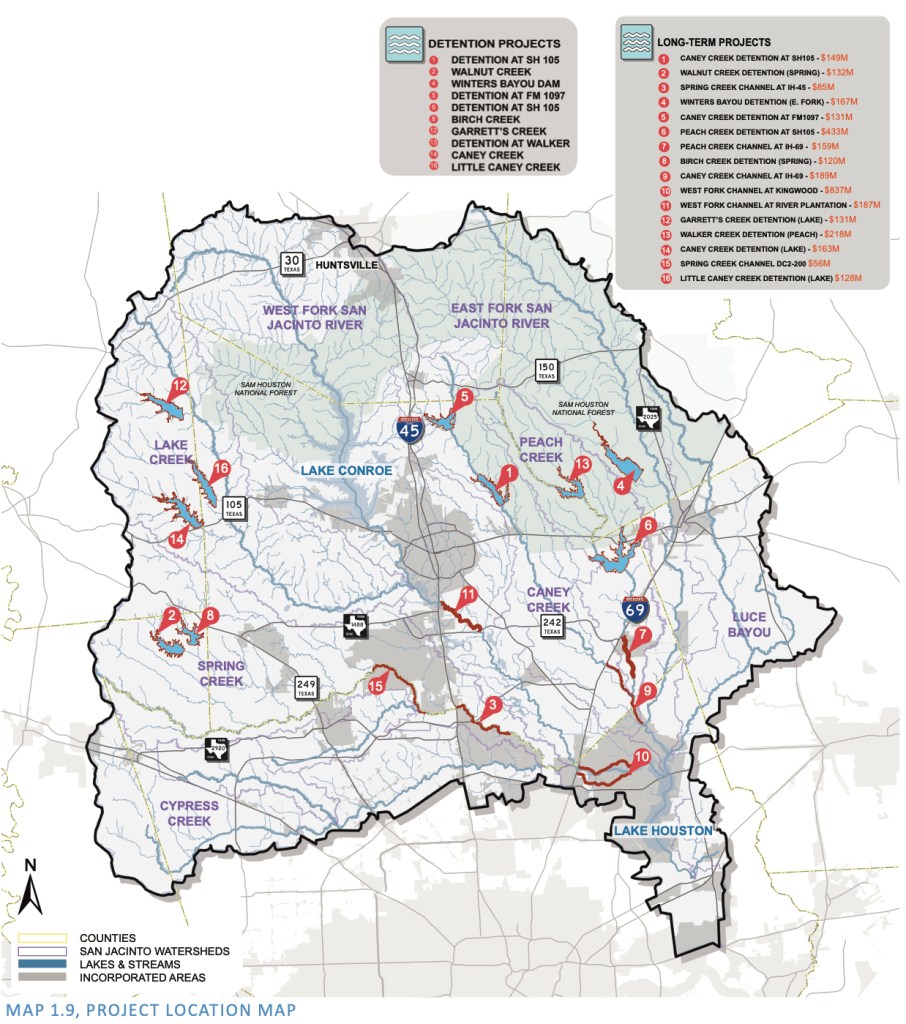
The exec summary also lists the top sixteen project priorities, estimates their costs, outlines possible sources of funding, and lays out next steps.

Project Location Map
Project rankings. Note: Rankings do not necessarily coincide with numbers on map above.

“Benching” in reference to the Kingwood Area involves lowering the floodplain near the West Fork to increase flood capacity. This link shows how a similar project in California worked.

The proposed projects will provide tangible benefits, including reduction in the number of at-risk structures for a range of storms as shown in Figure 1.10 below.

With these projects in place, the level of a 100-year flood at I-69 and the West Fork could be reduced by 5.94 feet, Likewise, where Caney Creek meets the East Fork, the 100-year flood would be reduced by 2.82 feet.

Next Steps

That’s good news indeed for everyone who lives in the San Jacinto Watershed. With this information now in hand, we now can quantify the benefits of projects, priorities them, and get on with the hard work of actual mitigation.

More news to follow.

Posted by Bob Rehak on 12/30/2020

1219 Days since Hurricane Harvey

Beta Downgraded to Tropical Depression

At 10 a.m. CDT, the National Hurricane Center (NHC) downgraded Tropical Storm Beta to a tropical depression. The NHC also cancelled the tropical storm and storm surge warnings that were in effect. However, flash flood warnings remain in effect for large parts of the seven-county Houston region, especially the southern part. A flash flood watch remains in effect for the entire region.

RadarScope split image. Left half shows track of active storms as of 9:06AM CDT. Right half shows total rainfall accumulation for Beta. Note band of extreme rainfall near Sugar Land and sharp drop-off near Kingwood.

Flash Flood Warnings and Watches

A flash flood warning means that flooding is in progress. A Flash Flood Watch means that conditions may develop that lead to Flash Flooding.

Source: National Weather Service. Updated at 10:29 a.m. 9/22/2020. Reddish area = Flash flood warning. Green = Flash flood watch.

Lake Conroe/Lake Houston Within Banks

Neither Lake Conroe, nor Lake Houston have yet been adversely affected by Beta.

The level of Lake Conroe stands at 199.63 feet. Normal conservation pool equals 201.

According to the Coastal Water Authority, Lake Houston is at:

Lake Level41.41 ft.
Normal Pool42.4 ft.
Source: Coastal Water Authority

USGS shows that even though the lake has received about 1.75 inches of rainfall to date…

…the lake level has been dropping, no doubt due to a preemptive release.

Posted by Bob Rehak at 10:50 on 9/22/2020 based on NHC, NWS, and RadarScope data

1120 Days since Hurricane Harvey and 369 since Imelda

SJRA Considering Input on Lake Conroe Reservoir Forecasting Tool Thursday, 6PM

San Jacinto River Authority (SJRA) will hold public meeting on Thursday, September 10, 2020, at 6:00 p.m., via webinar and telephone conference, to discuss its ongoing Lake Conroe Reservoir Forecasting Tool Project.

Accurately determining inflow during a flood theoretically lets dam operators determine how much water to release and when. That, in turn, helps protect properties both upstream and downstream to the extent possible.

During Harvey, many felt that the SJRA released too much water too quickly – 79,000 cubic feet per second at one point. That, they say, flooded homes downstream unnecessarily when capacity still existed in the reservoir. Lawsuits are still working their way through the courts.

Many also complained about the lack of warning for the massive release which inundated homes as people slept.

Residents trying to escape as Harvey's floodwaters rose
Senior residents of Kingwood Village Estates trying to escape as Harvey’s floodwaters rose.

Additional Information

The Lake Conroe Reservoir Forecasting Tool Project addresses flood protection in the San Jacinto River Watershed.

One goal: to anticipate peak water level in Lake Conroe during rainfall events based on:

  • Weather forecasts
  • Observed rainfall
  • Lake levels
  • Other data. 

A second goal: to predict peak release rates of stormwater from Lake Conroe.

The SJRA says this will help improve communication with Offices of Emergency Management and the general public during rainfall events. 

SJRA expects completion of the project by early spring 2021. The Texas Water Development Board (TWDB) and SJRA have funded the project.

Ask Questions, Express Views

You can view and participate in the meeting remotely via the webinar link below to express your views of the Project.

Questions or requests for additional information about the SJRA Reservoir Forecasting Tool may be directed to Mr. Matt Barrett, P.E., Division Engineer, SJRA, 1577 Dam Site Road, Conroe, Montgomery County, Texas 77304, Tel. (936) 588-3111. 

SJRA requests those who intend to express their views to contact Mr. Barrett either in writing or by telephone in advance of the meeting. 

To Participate Via Webinar and/or Comment

Only those participating via Webinar using the GoToWebinar App will be able to provide comments during the meeting.

Webinar Link: https://attendee.gotowebinar.com/register/5029250157384078351
After registering, you will receive a confirmation email containing information about joining the webinar.

Please use Webinar ID: 372-655-099

To Participate Via Phone and Listen

If you choose to participate via conference call using the number below, you will NOT have the opportunity to provide comments during the designated portion of the meeting. The conference call phone number is provided for LISTENING PURPOSES ONLY.  

Telephone conference call phone number: (562) 247-8321 and the audio access code is 150-445-802

Editorial Comment

I, for one, hope they use their new Reservoir Forecasting Tool to release floodwater at safe rates, although that was not explicitly stated in the SJRA press release on the meeting. Releasing at safer rates may mean releasing water earlier or holding it longer to flatten peaks. In my opinion, SJRA should hold floodwater as high as they safely can…as long as they safely can. I hope this new tool helps SJRA do that.

I’d rather see floodwater in Lake Conroe than in Kingwood’s Town Center.

Kingwood Town Center Apartments after Lake Conroe Release. Yes, that’s the top of an SUV that failed to evacuate in time.

Posted by Bob Rehak on September 9th, 2020

1107 Days since Hurricane Harvey

Lake Conroe Association Complains to TCEQ about Seasonal Lake Lowering

In June, the Lake Conroe Association (LCA) filed a 102-page complaint to the Texas Commission on Environmental Quality (TCEQ) through Austin attorneys about the San Jacinto River Authority’s (SJRA) policy of seasonally lowering Lake Conroe. The SJRA’s purpose for the lowering: to lower flood risk for downstream residents.

To download the complete complaint by Birch, Becker & Moorman LLP, click here. Warning: 20-meg file size.

Complaint Based on Three Arguments

The attorneys make three arguments.

  • State law prohibits the wasting of water.
  • The policy will not prevent downstream flooding.
  • Also, the policy threatens the area’s water supply.

“In summary,” says the complaint, “SJRA and Houston are only authorized to divert or release and use water from Lake Conroe for municipal, industrial, mining, and agricultural purposes. Any other use of surface water from Lake Conroe is not authorized by the Amended Certificate, and thus, is a violation of the Amended Certificate and state law.”

The complaint fails to mention flood control in that last list (prominently mentioned in the SJRA’s enabling legislation). To follow the LCA’s arguments to their logical extreme, SJRA would not have been allowed to release water during Harvey. Every home on Lake Conroe would have flooded.

TCEQ Response to Complaints

On July 29, the TCEQ replied to the complaint. Toby Baker, TCEQ’s Executive Director, says that:

  • “TCEQ does not have jurisdiction over future water supply strategies or State and Regional Water Planning.”
  • “Both SJRA and the City have adopted Water Conservation Plans that comply with TCEQ’s Chapter 288 rules.”
  • “Therefore, these diversions, which are in compliance with the terms of the Certificate and the Conservation Plan, are not a waste of water under the law.”
  • The City and SJRA are within their rights.

LCA Lodges Supplemental Complaint

Just the day before, on July 28, 2020, the same law firm filed a 4-page supplemental complaint to halt the fall lowering. The second complaint and the TCEQ’s response to the first complaint may have crossed in the mail.

The law firm acknowledged in its supplemental complaint that the lowering would only amount to 2.75 inches. However, the firm also claimed the water would be needed in a drought. Then it showed a Texas Water Development Board Drought Map as evidence. But map showed that no drought near the San Jacinto watershed.

TCEQ Finds City and SJRA in Compliance

Mr. Baker of the TCEQ replied to the supplemental complaint on August 6. He concluded, “After review, the TCEQ determined that the San Jacinto River Authority and the City of Houston are in compliance with the terms and conditions of Certificate of Adjudication 10-4963.”

In the End, Mother Nature, Not SJRA, Lowers Lake This Year

After all of that, evaporation alone took Lake Conroe down to the SJRA’s seasonal lowering target of 200 feet. It took Mother Nature an extra week to get there, but…

SJRA RELEASED NO WATER from Lake Conroe to achieve its August target level.

SJRA still has not released any water since the early spring.

Lake Conroe dashboard as of 4pm Saturday, August 15, 2020. Source: SJRA.net.

LCA Pleads for More Money to Keep Fighting

Now the Lake Conroe Association is pleading with residents for donations to replenish its war chest. It will be interesting to see what they plan next.

Posted by Bob Rehak on August 15, 2020

1082 Days since Hurricane Harvey

San Jacinto River Watershed Virtual Meeting Tonight Will Unveil Specific Recommendations to Reduce Flooding

I can’t urge you enough to watch the San Jacinto Watershed Master Drainage Plan Meeting tonight at 6:30.

Flooded Street by Julie Yandell. During Harvey.
Flooded Street during Harvey. Photo by Julie Yandell.

Updating of River Models Leads to New Insights

I previewed the presentation this morning and was extremely impressed. The study partners have updated or created hydraulic and hydrologic models for 535 miles of major streams in the river basin. They’ve also integrated the models and accounted for new developments across 3000 square miles in seven counties.

As a result, we now have a much better understanding of:

  • Where water comes from
  • Which areas have the highest potential for flooding
  • Where large regional detention basins can be placed to reduce flooding.
  • Other strategies to reduce flooding.

New Flood Maps, Sedimentation, Better Warning Systems

You don’t want to hear about this stuff second hand. The presentation also includes discussions of:

  • How much flood plains have really expanded compared to current FEMA maps.
  • Sedimentation and strategies to reduce it
  • Improving flood warning systems

If you’re flooded, or are concerned that you might, don’t miss this. This study will be the cornerstone of grants applications to mitigate flooding in the region.

Cornerstone of Lake Houston Area Mitigation Efforts

Two years ago, before the flood bond vote, community opinion coalesced around a three-part solution to flooding in the Lake Houston Area.

  • Reduce/delay the input by increasing upstream detention
  • Increase the throughput by dredging blockages
  • Speed up the output with additional gates on the Lake Houston Dam.

Tonight, you will get a chance ask questions of the people who have been studying those options and others for 18 months. Here’s how to log in:

Thursday, August 13, 2020

6:30 p.m. to 7:30 p.m. 

Join online at PublicInput.com/SanJacMasterPlan

Or by phone at 855-925-2801 with Meeting Code: 9742 

Order the pizza now.

This study is a cooperative venture of FEMA, Harris County Flood Control, SJRA, City of Houston and Montgomery County.

Posted by Bob Rehak on August 13, 2020

1080 Days after Hurricane Harvey
Lake Conroe Lowered to Target Level for August; LCA May Be Gearing Up For Another Fight

Since August 1, the level of Lake Conroe has hovered around 200 feet. As of this writing, it stands at 199.95 feet, virtually at the target level of the seasonal lowering for the month. That’s three hundredths of a foot above its seasonal average for the last 46 years and five hundredths of a foot below the target level. Yet the Lake Conroe Association appears to be gearing up for another fight to end the program.

Lake Conroe level as of 8/10/20 at 4:30 pm. Source: SJRA.net.

Seasonal Averages

Lake Conroe seasonal levels by month. Source: SJRA

History of Strategy

The SJRA started seasonally lowering the level of Lake Conroe in 2018 after Governor Abbott directed the SJRA to develop strategies to help protect downstream communities from flooding. Due to a slight drought in late 2019, the lake level did not recover quickly. The Lake Conroe Association (LCA) then organized protests as the SJRA reconsidered the strategy for this year.

Seasonal Release from Lake Conroe, 529 cfs from one tainter gate open six inches.
SJRA Seasonal Release on 4/15/2020. One tainter gate open six inches releases a slow, steady stream of 529 cfs. No one flooded downstream last Spring during the release.

Ultimately, the strategy adopted by the SJRA represented a compromise. During September/October, the lake will remain a half foot higher than in previous years (200 vs 199.5).

Here’s how the current and previous targets compare to what Mother Nature provides through rainfall and evaporation.

In August, little manual lowering should be needed. In September and October, much less lowering will be needed compared to the previous plan adopted in 2018.

SJRA’s Plan for Fall Lowering

SJRA’s current official policy reads as follows.

Beginning August 1, release only an amount of water from Lake Conroe to create a one foot capacity to catch rainfall and storm runoff (from 201’ msl to 200’ msl). After September 1, increase capacity an additional six inches (from 200’ msl to 199.5’ msl). If a named storm is predicted to impact our region, the COH may initiate an additional release of six inches (to 199’ msl) by notifying SJRA in writing of their call for release. Recapture beginning October 1.”

Compared to the seasonal average, the plan really only amounts to lowering the lake 2 to 3 inches in September and October.

Lake Conroe Association Gearing Up for Another Fight?

Regardless, the Lake Conroe Association (LCA) is reportedly gearing up for another fight.

Community Impact newspaper reported in its August 2020 issue that LCA filed a complaint with the TCEQ on June 30 to end the seasonal lowering of Lake Conroe.

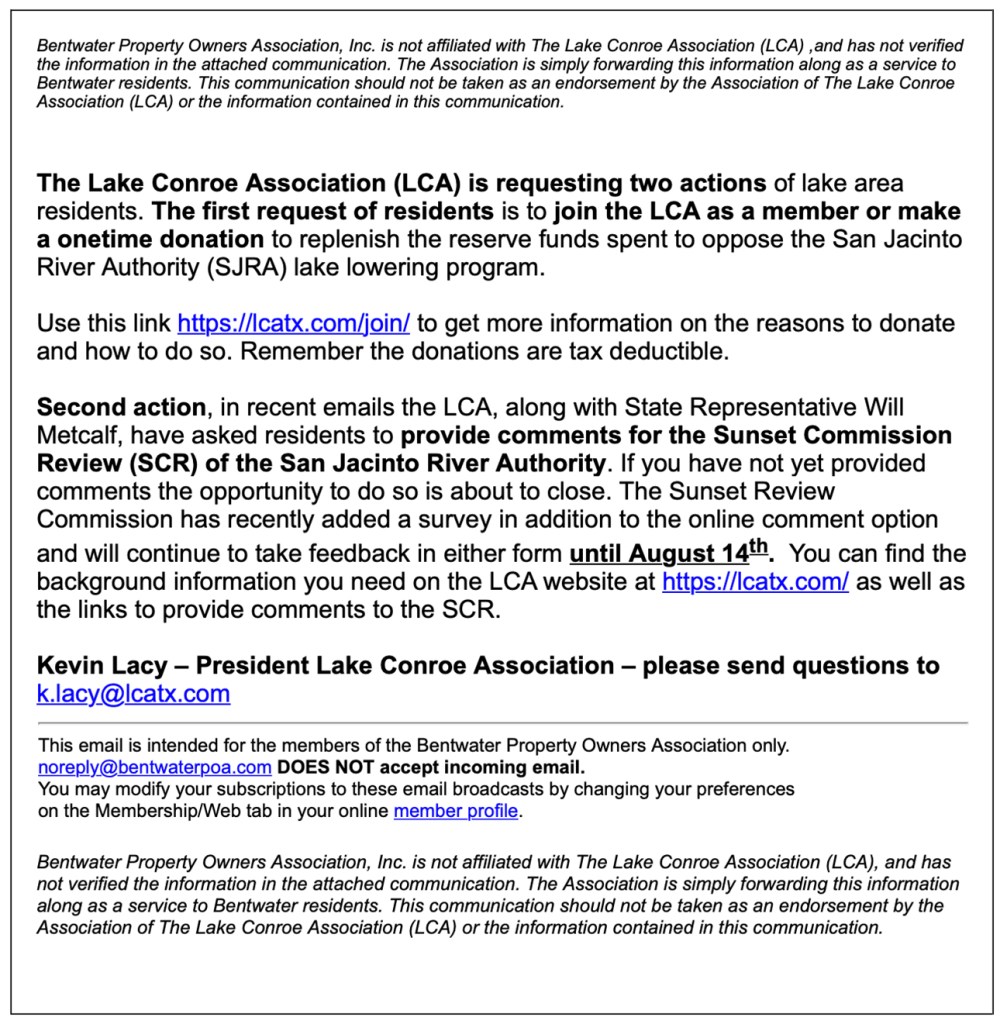
On August 7, they sent an email out to requesting Lake Conroe residents to donate money to the Lake Conroe Association so that it could “replenish the reserve funds spent to oppose the San Jacinto River Authority (SJRA) lake lowering program.”

In the next paragraph, they ask Lake Conroe residents to provide comments to the Sunset Commission reviewing the SJRA.

Screen Capture of LCA Communication on 9/7/2020. Links not active.

Neither of those two actions is a threat. But juxtaposing them like that is certainly walking up to the firing line … with the chamber loaded.

There sure is a lot of energy expended over two or three inches of water.

Lake Conroe people claimed last winter, when the SJRA was reconsidering the policy, that the lowering would not help Lake Houston Area residents. Lake Houston Area residents, still feeling the pain of Harvey, want all the help they can get.

Enough said.

Posted by Bob Rehak on 8/10/2020

1077 Days after Hurricane Harvey

Your Chance to Ask Questions About the San Jacinto Watershed Master Drainage Plan

The San Jacinto Regional Watershed Master Drainage Plan (SJMDP) partners will host a virtual public meeting on August 13, 2020. The purpose: to provide information about study’s progress, and encourage public participation and input. 

Heat map in draft shows where most flood damage has occurred historically by sub-watershed.

Goals of Project

The SJMDP study began in April 2019 to identify flood mitigation projects that can be implemented in the near- and long-term. Their purpose: to reduce flood risks to people and property throughout the San Jacinto River watershed.

The study area includes nearly 3,000 square miles in seven different counties and approximately 535 miles of stream. Overall, the study aims to:

  • Provide an up-to-date technical basis to identify flooding vulnerabilities
  • Understand impacts of future growth
  • Improve flood resiliency within the watershed.

The SJMDP is scheduled for completion in fall 2020. 

Community engagement is an important component of the Harris County Bond Program. The partners want your participation as the program is implemented. 

Details of Virtual Meeting

The virtual community engagement meeting will be held on:

Thursday, August 13, 2020

6:30 p.m. to 7:30 p.m. 

Join online at PublicInput.com/SanJacMasterPlan 

Or by phone at 855-925-2801 with Meeting Code: 9742 

Note: HCFCD says that the “Join Online” link above will convert from a registration to a presentation link on the day of the webinar.

The meeting will begin with a brief presentation to share project updates, followed by a moderated Q&A session with Flood Control District team members.

Residents will be able to submit questions and comments throughout the presentation. Any comments not addressed during the Q&A session will receive a response after the event. 

For Those Who Cannot Attend…

The study partners will post a recorded version of the meeting on the Flood Control District’s website and YouTube channel after the event.

For questions, please contact the Flood Control District at 346-286-4152, or complete the online comment form.

You can also mail comments to:

  • Harris County Flood Control District
  • 9900 Northwest Freeway
  • Houston, Texas 77092
  • Attn: San Jacinto Regional Watershed Master Drainage Plan

For more information about the San Jacinto Regional Watershed Master Drainage Plan, visit www.sanjacstudy.org

For Those with Disabilities

Those with disabilities can make special meeting accommodations. If needed, please contact 346-286-4152 at least 48 hours prior to the meeting. 

Project Funding

The SJMDP is jointly funded with 75 percent from the Federal Emergency Management Agency (FEMA) Hazard Mitigation Planning Program and 25 percent from the four local partners: Harris County Flood Control, Montgomery County, City of Houston and the SJRA.

Posted by Bob Rehak on July 30, 2020

1037 Days after Hurricane Harvey