Harris County Precinct 4 Commissioner Jack Cagle has placed an item on next Tuesday’s Commissioners’ Court Meeting that will affect the future of Kingwood. It’s to discuss the possibility of Harris County Flood Control spending $10 million to buy the Perry Home’s Woodridge Village property. It contributed to flooding hundreds of homes in Elm Grove and North Kingwood Forest TWICE last year.
Where Will Two More Votes Come From?
Cagle needs at least two more votes on Commissioners Court in addition to his own to approve the effort. Reportedly, Judge Lina Hidalgo, Commissioner Adrian Garcia in Precinct 2 and Commissioner Steve Radack in Precinct 3 are the most “gettable.”
Here’s how you can help. Email or call these officials today. Urge them to support Cagle’s motion. Do it NOW. I’ve listed their contact info below.
At Stake: The Future of Kingwood
Ten flooded homes in a row, all vacated. Photo taken in North Kingwood Forest in December 2019. All homes back up to Woodridge Village.
Without help, Elm Grove and North Kingwood Forest could drag down the reputation of the entire Kingwood community.
Additional flooding could devastate remaining homeowners. Many were already struggling to pay repair bills from two floods. Now corona-virus layoffs make that even more difficult.
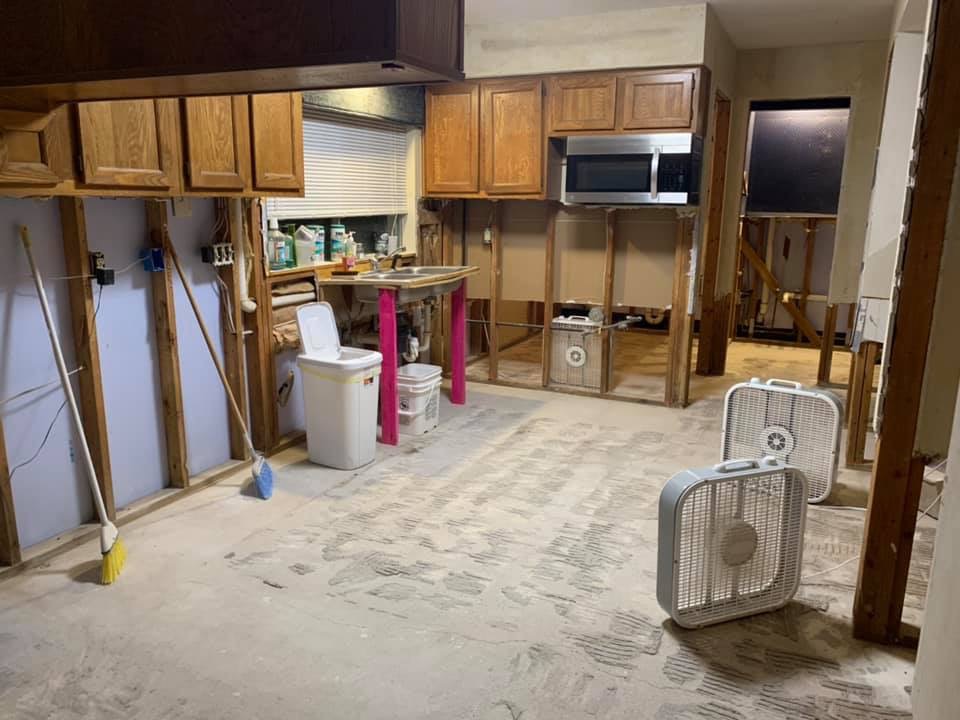
Elm Grove kitchen home five months after being flooded a second time.
These are working class neighborhoods. As much so as any in Harris County. People simply can’t afford to flood again.
Language in last year’s flood bond allows Harris County Flood Control District to buy property in neighboring counties for the purpose of building upstream detention. The lack of detention on Perry Homes’ property is the primary reason hundreds of homes in Kingwood flooded. Two years after clearing the property, Perry Homes still has constructed only 23% of the needed detention.
No Other Good Alternatives At This Time
Harris County Flood Control reportedly can start work on expanding detention capacity as soon as Commissioners reach a deal.
If they can’t, Perry has said it will sell Woodridge Village to another developer or continue to develop the property itself. However, if that happens, the detention ponds on the property would still likely be undersized by 40%. That’s because Perry Homes rushed to get their plans approved before the new, higher Atlas-14 rainfall standards went into effect.
Help Now! Here’s How
To contact Judge Hidalgo, Commissioner Garcia or Commissioner Radack:
Remind them that Harris County receives drainage from at least FIVE surrounding counties. This problem is a county-wide problem, not just a Precinct 4 problem.
Please call or write now if you live in the Kingwood, Huffman, Humble or Atascocita areas. Even if you did not flood, flooding from Woodridge Village affects you and your home value. No one in this area can afford to let this sore fester any longer.
Posted by Bob Rehak on 4/1/2020
946 Days after Hurricane Harveyand 195 since Imelda
https://i0.wp.com/reduceflooding.com/wp-content/uploads/2019/09/Elm-Grove-9.19_68.jpg?fit=1500%2C1000&ssl=110001500adminadmin2020-04-01 16:09:432020-04-01 18:46:07What You Can Do Right Now to Encourage HCFCD to Buy Woodridge Village Property
LJA’s drainage design forces floodwater to make six turns within the space of about 200 yards. The areas at the left and top of the frame flooded during May and September last year when water overflowed.
Hints of Defense Strategy
However, in answering the allegations, LJA’s lawyers did hint at their defense strategy. In addition to their general denial, they claim that:
Plaintiffs’ damages were solely caused by the negligence of third parties over whom LJA has no control.
Plaintiffs did not hire LJA and therefore LJA owed no duty to the plaintiffs.
Intervening and superseding conduct on the part of third parties or other parties, persons or entities, acts as a total bar to plaintiffs’ claims.
The incident in question was an Act of God.
Here is their entire answer to the plaintiffs’ claims. LJA’s lawyers filed it with the Harris County District Clerk on 3/16/2020.
Opinions of Claims
Third parties in the case include several contractors, AND Figure Four Partners, a Perry Homes’ subsidiary of another subsidiary. Engineers, in my experience, often blame problems on contractors that didn’t follow plans. In this case, according to the drainage impact analysis submitted by LJA to Montgomery County, contractor(s) should have cleared only 30 acres on the northern portion of the site and 58 acres on the southern portion during Phase 1. See page 1, paragraph 2 of LJA’s Drainage Impact Analysis. However, Google Earth shows that about half of the 182-acre northern section and all of the 86-acre southern section were cleared by February 23, 2019. That was six weeks before the May 7th flood. Images taken of the northern portion of the site shortly after the May 7th flood show it was virtually clear except for piles of uprooted trees. Helicopter images show that substantially all of the northern section was cleared about the time of the Imelda flood. Construction documents also show that an engineer should have been supervising construction.
I’m not sure what they mean by “intervening” conduct. It sounds like interference from above. Hmmmm. Could they be pointing a finger at Perry Homes’ Figure Four Partners or Perry Homes itself? It will be interesting to see what happens with this one.
The District Clerk’s website shows no other activity on the case since LJA filed this document. Harris County Civil Courts will operate on a restricted schedule until further notice due to the corona virus. Hours of operation are from 7 a.m. to 6 p.m. Monday through Thursday. They are closed Friday through Sunday.
Judge Lauren Reeder months ago set a trial date of 7/13/2020, at 08:30 a.m. However, the corona virus could delay the start of any trial in this case.
New Discovery in MoCo Drainage Criteria Manual
In the meantime, I discovered one other interesting potential violation of the Montgomery County Drainage Criteria Manual. Section 9.1.2 Flood Plain Development Guidelines and Procedures says that when planning a development within the 100-year flood plain, construction within the floodway is limited to structures which will not obstruct the 100-year flood flowunless fully offsetting conveyance capacity is provided.
“Where such a potential exists, offsetting conveyance capacity must be provided to eliminate the increased potential for flood damage.”
The potential violation? The twin culverts shown in the photo above. They were built when only one of five detention ponds was even partially complete. And they’re right at the county line. LJA’s own maps show these culverts to be within feet of the Taylor Gully floodway and floodplain on the Harris County side of the county line.
If LJA intends to argue that May 7th or September 19th were greater-than-100-year rains, it then seems to me that they should have halted construction of the culverts until fully offsetting detention was in place. To this date, only 23% of the intended detention capacity has been constructed.
Posted by Bob Rehak on 3/28/2020
942 Days since Hurricane Harvey and 191 since Imelda
The thoughts expressed in this post represent opinions on matters of public concern and safety. They are protected by the First Amendment of the US Constitution and the Anti-SLAPP Statute of the Great State of Texas.
https://i0.wp.com/reduceflooding.com/wp-content/uploads/2020/03/20200306-RJR_0183.jpg?fit=1200%2C800&ssl=18001200adminadmin2020-03-28 20:14:022020-03-28 21:41:46LJA Denies Responsibility for Elm Grove Flooding; Says They Owed No Duty to Victims
Those same sources also told me that Perry Homes started out asking for their purchase price of the land PLUS the money they spent partially developing it. However, as I reported last week, based on the newspaper articles, that appears to have changed at this point.
Woodridge Village after the May 7, 2019, flood
Full Text of Perry Homes’ Fact Sheet about Land Sale
Below is the full text of a “fact sheet” along with a link to the original PDF Perry Homes PR people allegedly sent out about the sale of their Woodridge Village Property in Montgomery County. I say allegedly because I have never known a public-relations person to put out information that is not on a letterhead and without contact information.
“FACT SHEET ON WOODRIDGE VILLAGE”
“For several months, we have been in discussions with Harris County to sell the +/- 268-acre Woodridge Village site in Montgomery County so that it can be used for regional detention. Our offer price is our original acquisition cost of $14,019,316.85. This sale would represent a loss of the development costs we have already spent, which are over $9 million to date. We would also be foregoing the future profits we would earn from building and selling homes.”
“The draft study performed by LJA Engineering advised this regional detention concept would remove more than 800 homes from the 500-year floodplain and provide additional flood mitigation for hundreds of other area homes. We are willing to absorb the losses referenced in the paragraph above because of the enormous benefit it will offer to downstream residents in Houston and Harris County.”
“If the property is not going to be used for regional detention, we plan to either develop it for Perry Homes or sell it. Work is ready to start on the remaining detention facilities. We have also listed it for sale to other developers at an initial asking price of $23 million, which will increase as additional funds are expended.”
“We first requested to meet with Harris County back in October 2019, and our first face to face meeting occurred on November 8th. At the request of Harris County officials, we even delayed the construction bid process so the commissioners could consider our proposal in executive session. After the executive session, we were informed that Harris County needed the City of Houston to partner with them to make the project occur. However, we have been informed the city is not looking to partner with the county on this project. In any event, we are concerned about delaying improvements any longer. If, by March 31st, we do not have reason to believe a definitive agreement for regional detention is likely, we will move forward with the remaining infrastructure and continue to entertain private market interest in the property.”
In my opinion, there were four key pieces of new news in this when its was released.
First, Perry Homes has dropped its asking price by no longer demanding to recoup its development costs.
Second, Perry Homes’ supplier, LJA Engineering, has determined that turning the property into regional detention could mitigate flooding.
Third, Perry Homes is already trying to sell the property on the open market.
Fourth, Perry Homes has given Harris County a deadline to make a decision – March 31, 2020.
Reaction to the News
Dropping the asking price shows that Kathy Perry Britton has not become totally untethered from reality. However, it still seems high for someone trying to sell the Titanic with an iceberg sticking out of the side of it.
I wish LJA had told Perry Homes the property needed to become regional detention BEFORE Perry Homes bought the property. Duh!
Good luck, Kathy Perry Britton, with trying to sell this property on the open market. With oil prices below $30, the stock market gyrating wildly, 401K’s losing value, and businesses laying off employees, not many people will rush out to buy homes in the immediate future. Lest we forget, in 1985 when oil prices dropped to $35, housing values in Houston collapsed 50%.
Definition of Chutzpah: Perry Homes
Threatening the one potential buyer with a deadline shows, in my opinion, an incredible amount of chutzpah, as my Jewish friends say. Chutzpah (ho͝otspə) in the original Yiddish sense has a strongly negative connotation. It means “insolence,” “cheek,” “incredible gall” or “audacity.” However, since entering English, the word has taken on a broader, more positive meaning. Today, in the business world it usually means the amount of courage that a person has.
Leo Rosten in The Joys of Yiddish defines the term as “that quality enshrined in a man who, having killed his mother and father, throws himself on the mercy of the court because he is an orphan.”
For Perry Homes to put a deadline on this deal shows incredible chutzpah – especially when the world has become focused on the corona pandemic. It shows a similar and scary disconnectedness.
However, I must admit that everyone wants Perry Homes to do something with this property quickly. And it hardly seems fair to make them invest more money in it if Flood Control is going to buy it tomorrow.
An Offer to Perry Homes
So Kathy, I will make you a deal. I’ll buy Woodridge Village for a dollar. Then you can save face and say you dumped the property for 100 times what it was worth … before it flooded again in the spring rains. But the best part … you can take a $23 million tax deduction and make almost as much money as you would have if you had sold it in the first place. Boom! Done. You ditched that dog! You’re a hero again.
Woodridge Village after May flood.Saving money on earth moving by letting nature do it for you.
If they sell it to me, maybe I will get into the mud spa business.
Posted by Bob Rehak with Jeff Miller’s Titanic line
930 Days since Hurricane Harvey and 179 since Imelda
The thoughts expressed in this post represent opinions on matters of public concern and safety. They are protected by the First Amendment of the US Constitution and the Anti-SLAPP Statute of the Great State of Texas.
https://i0.wp.com/reduceflooding.com/wp-content/uploads/2019/05/DirtyPipe_01.jpg?fit=1500%2C1024&ssl=110241500adminadmin2020-03-16 12:34:012020-03-16 16:08:27Perry Homes Says “Now or Never”: Selling the Titanic With an Iceberg Sticking Out of the Hull
Today, the U.S. Army Corps of Engineers released the findings of its investigation into the wetlands on Perry Homes’ Woodridge Village property. The Corps said that the wetlands do NOT fall under its jurisdiction. Therefore, there was no violation of Section 404 of the Clean Water Act when Perry wiped out wetlands without first seeking the Corps’ permission.
Congressman Dan Crenshaw’s office released this text of an email the Corps sent to them today.
Text of Corps Email to Congressman Crenshaw
“This e-mail is in response to your request (on the behalf of Congressman Crenshaw) to be updated on our investigation into activities on the Figure Four properties located in Porter, Montgomery County, Texas. (Investigation file SWG-2019-00745).” [Editor’s note: Figure Four is the development arm of Perry Homes.]
“As discussed on the phone earlier today, the Corps of Engineers has finalized our investigation into this matter and did NOT find a violation of Section 404 of the Clean Water Act (Section 404).”
“We did confirm the presence of uplands and wetlands on the tract. Some of the wetlands had fill material placed into them. Based on the facts associated with this specific location and per federal regulation these wetlands were determined to “isolated.” They lacked any known nexus to interstate commerce. As such, they are not “waters of the United States” and are not subject to federal jurisdiction under Section 404. In accordance with federal regulation the jurisdictional status (determination) of these wetlands was coordinated with the Environmental Protection Agency prior to finalizing.”
“The property owner has been notified of the federal government’s findings and the investigation closed.”
Wetlands Question Now Moot from Legal Point of View
Normally, in cases where a question exists, developers consult the Corps before destroying the wetlands. When I asked the Corps last August whether Perry had sought a “jurisdictional determination,” the Corps answered that Perry had not.
Perry later claimed that it had hired a private consultant to determine whether the wetlands were jurisdictional. However, to my knowledge, Perry never publicly released the results of the survey. Today’s ruling by the Corps makes that whole controversy moot.
Regardless of the Corps’ rulings on the jurisdictional question, the fact remains that the Corps found wetlands on the property and they found Perry Homes had attempted to fill them in.
Wetlands Question Still Explosive from Business Point of View
Let’s see how well that worked out for Perry and its subsidiaries.
The land has become a toxic asset that will scare potential buyers.
If Perry Homes tries to build on the land after all the publicity surrounding this case, any homeowner whose foundation cracks would have a ready-made court case.
Woodridge Village “wetlands” on March 6, 2020. Water has ponded there for months.
This land appears to be unsafe, unstable, unbuildable, unsaleable, and a menace to downstream homeowners in its current state.
Plaintiff’s Engineer Points to High Hurdles for Perry to Clear
Seriously underestimated the amount of runoff from this property.
Used outdated rainfall statistics that led to underestimating the amount of detention capacity needed.
Constructed the overflow spillway between Taylor Gulley and detention pond S2 at a height that would cause North Kingwood Forest to flood.
When You’re In a Hole, Stop Digging. Literally.
It may be possible to fix some of these problems. But at what cost? Will the development ultimately be economic when residential lots are used to increase the size of detention ponds?
How Perry Could Exit Without a Loss, Mitigate Flooding, Limit Long-Term Liability
A Houston Chronicle article quotes Houston Mayor Pro Tem Dave Martin as saying that Perry quoted a price for the land that covered their acquisition cost PLUS the labor they have into it. That led Harris County to ask CoH to share the cost.
When CoH refused, Perry dropped the price to $14 million (the alleged purchase price) from $23 million, according to Community Impact newspaper. The Montgomery County Appraisal District values the land at only a little more than $1 million.
It will be very hard for Perry to sell the land and even harder to develop it. So why doesn’t Perry just donate the land to Harris County Flood Control to help them mitigate flooding?
According to a national real estate tax expert that I talked to, Perry could then write off the value of the land PLUS the value of the labor they have in it. For a billion dollar company, the tax deduction could easily EQUAL or come close to the price they are currently asking for the land.
It would also:
Give Perry a chance to recoup some shred of its once proud image.
Let Harris County Flood Control move forward quickly with a detention project that could truly mitigate flooding.
Help protect Perry from additional future flooding claims.
Posted by Bob Rehak on 5/10/2020
924 Days since Hurricane Harvey and 173 since Imelda
The thoughts expressed in this post represent opinions on matters of public concern and safety. They are protected by the First Amendment of the US Constitution and the Anti-SLAPP Statute of the Great State of Texas.
https://i0.wp.com/reduceflooding.com/wp-content/uploads/2020/03/20200306-RJR_0101.jpg?fit=1200%2C592&ssl=15921200adminadmin2020-03-10 17:59:432020-03-11 06:45:57Army Corps Finds Wetlands on Perry Homes Woodridge Village Property Did Not Fall Under Corps’ Jurisdiction; What Next?
Court documents filed with the Harris County District Clerk show that the tempo of the Elm Grove lawsuits against Perry Homes, its subsidiaries and contractors is increasing. Litigants have filed 20 new documents in the last three weeks. The judge has set a trial date for July 13, 2020. That’s about three months from now.
Plaintiffs allege that LJA, when designing the drainage for Woodridge Village, used an outdated Montgomery County Drainage Criteria Manual. LJA went by the 1989 version when an updated 2014 version existed. Since then, MoCo has revised the documents yet again. A 2019 version now exists that took effect before Imelda last year. (Note: the link above leads to the updated manual, however, MoCo did not update the date on the cover page. So this gets very confusing.)
List of Charges Expands
Plaintiffs’ lawyers have added negligent retention and negligent supervision to the list of charges. They now accuse defendants of:
a. Removing drainage from the Development;
b. Removing a levee from the Development site;
c. Blocking the drainage channels;
d. Filling in existing drainage channels;
e. Failing to properly install box culverts;
f. Failing to create temporary drainage channels;
g. Failing to allow adequate drainage after construction;
h. Failing to install silt barriers;
i. Allowing the Development to force rainfall toward Plaintiffs’ homes;
j. Failing to pay proper attention
Plaintiffs argue that “the Contractor Defendants had actual, subjective awareness of the risk involved, but nevertheless proceeded with conscious indifference to the rights, safety, or welfare of others.”
The streets of Elm Grove are still littered with trash from reconstruction of their homes after Imelda – the second flood in 2019.This image was taken on Village Springs in Februaryof 2020.
Accusations Specific to LJA
The amended petition also lists charges specific to LJA.
a. Failing to follow the correct drainage guidelines in Montgomery County;
b. Failing to provide adequate drainage in the Development;
c. Failing to adequately model the Development;
d. Failing to adequately report the modeling;
e. Removing drainage channels;
f. Causing post-development discharges and water surface elevation to increase downstream of the Development;
g. Failing to design detention ponds with adequate capabilities for rain events;
h. Failing to use the correct hydrology method;
i. Failing to design emergency overflows for the detention ponds;
j. Failing to notify the Developer Defendants and Contractor Defendants of the importance of the existing levee; and,
k. Other ways described the consulting engineer’s report.
Plaintiffs Seek Exemplary Damages and Mandatory Injunction
The plaintiffs now seek exemplary damages and a mandatory injunction that forces defendants to return the property to its prior condition, wherein the surface water runoff properly flows into the drainage ditch.
Defendants also filed the reports of two expert witnesses: an engineer from Pennsylvania, who examined LJA’s performance, and another expert, who will testify about the magnitude of rainfalls on May 7th and September 19th. More on those in a future post.
No Response Yet from Defendants to Specific Charges
We still have yet to see the defendants’ specific responses to any of these charges except for the general denials they made last year.
Posted by Bob Rehak on 3/6/2020
920 Days after Hurricane Harvey and 169 since Imelda
https://i0.wp.com/reduceflooding.com/wp-content/uploads/2020/02/20200125-RJR_7513.jpg?fit=1200%2C800&ssl=18001200adminadmin2020-03-06 17:46:012020-03-08 09:39:48Elm Grove Lawsuits: New Defendant, New Charges, Amended Petition and More
Note: This post has been modified to delete the mention of storm drains. On closer examination of older photos, it appears that the storm drains were installed before January 20th.
As of last Thursday, they were still doing touch-up work on detention pond S1. Specifically, they were removing soil that had eroded into the pond since last May.
Woodridge Village S1 Pond still has no grass on shoulders almost a year after substantial completion.Last week, workers were trying to repair sidewall erosion and remove sand from pilot channel.
Woodridge Village S1 detention pond still has no grass despite substantial completion before the May storms last year. Photo taken 2/13/2020.Woodridge Village S2 pond as of 2/13/2020 still shows little grass.
Perry’s letter to the City promised construction of a berm between S1 and S2. Work on the berm connecting S1 and S2 looked like it had not begun yet as of last week.
Area between S1 and S2 where berm should be. Photo taken 2/13/2020. I can’t see it in this photo, but in fairness, resident Jeff Miller feels Perry is building this area up slightly.
Work on Three Northern Ponds Still Not Started
Perry still has less than 25% of the promised detention capacity constructed. Work on the three northern detention ponds has definitely not begun yet as you can see from the photos below. I took all of them on 2/13/2020.
The N1 detention pond should go in the foreground in the northwest corner of the site.Montgomery County partially excavated this pond decades ago to count as detention for other development. Perry Homes must deepen it to create additional detention for this site.This is the N2 pond in the middle of the western side.The N3 Pond will go above the S2 pond shown in the foreground here.It should stretch almost all the way back to the far tree line.
How Long Will It Take to Build Ponds?
Neither Perry Homes, nor LJA engineering has published bid requirements for the ponds. The only thing we currently have to go on for a construction timetable is J. Carey Gray’s letter to the City.
In it, Perry committed to developing each of those ponds within 250-280 days. Assuming construction remains on schedule and that the deadlines are sequential, not concurrent, Perry should complete the remainder of the ponds in 2.3 years.
If the work on S2 is any indication, consider this. Perry had substantially completed the S2 pond before Imelda. As of today, they have gone 109 days past a 45-day self-imposed deadline. They still don’t have a maintenance road around it. Nor do they have grass established on the sides of it. Both are Montgomery County requirements.
Implications for Future
The end of Perry’s letter says, “…we will continue to consider alternatives that provide more robust mitigation.” Presumably that was a veiled reference to a potential buyout by the City of Houston or Harris County Flood Control. No one is talking about that alternative at the moment…if it exists. A spokesperson for the City this afternoon said only, “We support any alternative that reduces flooding.”
On one hand, it’s exciting that Perry is finally moving forward with work that should have been completed long ago. But on the other…
… the additions to infrastructure signal that hopes for a buyout by the City of Houston and/or Harris County Flood Control – to provide more robust mitigation – have vanished or are fading quickly.
We should not forget that even if Perry succeeds in building additional ponds, they are based on old rainfall statistics. The NOAA Atlas 14 rainfall statistics – on which new flood maps are being redrawn – require about 40% more detention capacity.
Posted by Bob Rehak on 2/18/2020
903 Days after Hurricane Harvey and 151 since Imelda
The thoughts expressed in this post represent opinions on matters of public concern and safety. They are protected by the First Amendment of the US Constitution and the Anti-SLAPP Statute of the Great State of Texas.
https://i0.wp.com/reduceflooding.com/wp-content/uploads/2020/02/20200213-RJR_8421.jpg?fit=1200%2C800&ssl=18001200adminadmin2020-02-17 20:32:472020-02-18 12:06:25Perry Homes Taking Bids on More Detention Ponds for Woodridge Village
Here’s a construction update for Perry Homes’ Woodridge Village, the stalled development implicated in flooding Elm Grove and North Kingwood Forest twice last year.
On January 25, 2020, I flew over Woodridge Village. Not much had changed since my December flyover. However, Perry Homes, had concreted about 280 feet of Taylor Gully on the east side of the development facing North Kingwood Forest. And they started to build a berm between Woodridge Village and Elm Grove. Finally, they have started prep work for building more streets. See images below.
Overview of Construction Activity
Homes in North Kingwood Forest (bottom right) flooded twice in 2019 when water from the Taylor Gulley channel behind them overflowed.In December and January, Perry Homes, the ultimate developer of clearcut area called Woodridge Village, lined a portion of that channel with concrete.Closer View: Perry Homes also erected a berm along the southern edge of the kite-shaped S2 detention pond. Note the lack of activity above the pond.
Slanting Berm Between Elm Grove and Woodridge
Since the January flyover, Perry Homes has continued to build up a berm south of the S2 detention pond. The height of the berm is about 3-4 feet immediately west of Taylor Gulley (grassy channel in lower right). It tapers down to nothing before you get to Fair Grove Drive, one long block to the west (out of frame to the left in picture above).
Note height of berm at end of Village Springs Drive, adjacent to Taylor Gulley.Erosion from berm is already starting to collapse silt fence in numerous areas.Photo taken 2/8/2020.Looking east from opposite end of pond. At Fair Grove Drive, the berm is below the level of Elm Grove homes behind the tree line on the right.Photo taken 2/8/2020.
Whether Perry intends to build up the western portion of the berm is unclear. If they intend to go west beyond the point above and continue the berm south of the S1 pond, they have not yet done so.
The Strange Case of the Elevated Swale
Perry Homes has now dug a ditch at the peak of the berm to act as a backslope interceptor swale. Such a swale is designed to reduce erosion on the slopes of a detention pond by channeling water through pipes instead (note concrete opening of one such pipe in distance).Photo taken 2/8/2020.
Originally, I thought the berm might be the missing maintenance road that Montgomery County regulations specify around detention ponds. However, yesterday, Perry Homes’ contractor etched a ditch in the middle of the berm. I guess this ditch will act as the backslope interceptor swale, another requirement of detention ponds in Montgomery County.
Such swales channel water into ponds through pipes installed at low points. Their purpose: to prevent runoff from surrounding areas from flowing over the edge of ditches and causing erosion.
Except in this case, water from the surrounding areas would have to flow uphill several feet to get to the swale. So the swale will only channel water that falls directly on it.
No New Detention Ponds
No new detention ponds have been created since last August.
Prep Work for New Streets
However, Perry Homes is starting to add new storm drains to areas where roads have not yet reached on the north side of the S2 detention pond.
Storm drains being added to the north side of the S2 detention pond. Photo taken 2/8/2020.Note rilling (erosion) along side of pond.
Perry Had Promised No New Streets Until All Detention Ponds In
Point #1 in Perry Homes’ letter to the City Attorney about remediation efforts promised that Perry would delay additional street construction until three detention ponds on the northern part of Woodridge Village were complete. But as you can see from the first photo above, no additional detention ponds have even been started on the northern portion of the site.
Possible Impact of Changes on Flooding
The concrete channel will reduce erosion, but will do nothing to reduce flooding. As you can see from the video below, taken by Jeff Miller after a minor rain, Perry Homes needs the three additional detention ponds they promised in 2017, two and a half years ago, to reduce flooding.
The berm may redirect flooding. The berm has the potential to change the location of flooding. As floodwaters build up in the S2 pond shown above, they will eventually rise above the overflow channel between the concrete portion of Taylor Gulley and the pond. When that happens, the water will go around the berm. It could happen on two sides. On the west at Fair Grove (above) and on the east at Taylor Gulley (below).
Video by Jeff Miller after light rain on Jan. 28th shows flow from north side of Woodridge Village into Taylor Gulley. There should be a massive detention pond beyond the black fence.Taylor Gully concrete channel is approximately one-third fullon about a third of an inch of rain before this point in the day.See graph below. Photo taken around 5pm.The closest official gage at West Lake Houston Parkway showed 0.32 inches of rain before Miller took the photo above.
On the east side of the concrete portion of Taylor Gulley, notice how the edge slants down toward North Kingwood Forest (out of frame on the right).
Note levels on either side of the concrete culvert shown in aerial photos above. S2 detention pond is out of frame to left and North Kingwood Forest to right.Photo taken 2/8/2020.
Once floodwater gets into North Kingwood Forest, experience has shown that it will flow through streets into Elm Grove, bypassing Taylor Gulley.
Storm sewers, once connected to the detention ponds, will simply shorten the time of accumulation after heavy rains and fill the ponds even faster. That usually results in higher peaks. Again, without additional detention, there is no flood-reduction benefit for downstream residents.
Posted by Bob Rehak with help from Jeff Miller on 2/9/2020
894 Days after Hurricane Harvey and 143 after Imelda
The thoughts expressed in this post represent opinions on matters of public concern and safety. They are protected by the First Amendment of the US Constitution and the Anti-SLAPP Statute of the Great State of Texas.
https://i0.wp.com/reduceflooding.com/wp-content/uploads/2020/02/20200208-RJR_7558.jpg?fit=1200%2C800&ssl=18001200adminadmin2020-02-09 14:30:152020-02-10 06:47:08Construction Update: Perry Homes Adding Storm Sewers, Berm to Woodridge Village
Three generations of the Giles family live together under the same roof in Elm Grove. Jerry Happ, Catrina Giles father, and Evonne Happ, plus Catrina’s children CJ, Dallas and Maverick. They had never flooded, not even in Harvey, until Perry Homes clear-cut 268 acres a block north of them without installing promised detention ponds. Then on May 7th and September 19th of 2019, they flooded twice. This is the story of how those floods affected a family and tore a neighborhood apart. As I drive up to their home on Shady Garden Drive for the interview, the first thing I noticed is that the foundation of their home is raised well above street level. In fact, it appears to be level with the top of my Chevy Tahoe. This is not an isolated case of a low-lying home.
Water Flows Down Street from Direction of Woodridge Village
Rehak: You said you wanted to make sure that Perry Homes knew about the damage that they inflicted on your community. Tell me what happened on May 7. Let’s start there. Where was the water coming from?
View from Giles front porch during Imelda
CJ (Catrina’s Oldest Son): It started off in the garage and my grandparents’ bedroom, which are on the north side of the house. Then it came in the back door and under the kitchen cabinets. And then it was just everywhere.
Rehak: It came in from the north? (The direction of Perry Homes’ development)
CJ: Yes.
Rehak: How high did it eventually get?
C. Giles: (Pointing to an electrical plug) Just under the outlets.
Gasoline, Paint, Paint Thinner Mixed with Floodwaters
Rehak: Tell me about the damage it caused.
CJ: We had a lot of personal items in boxes in the garage. It completely destroyed everything under two feet. All our tools got really messed up. There were a lot of things floating around in the garage. Paint. Gasoline. Paint thinner was mixed in with the water. So, it was a pretty big mess.
J. Happ: It came in, like CJ said, from the north. We had a bedroom set downstairs here…
E. Happ: My sister gave it to us before she passed away. Now it’s gone.
Current Felt Inside the House
J. Happ: The water was so powerful! The pressure of the water was so intense that it caused boxes underneath the bed to move around.
E. Happ: It broke my grandmother’s dishes that we stored under there!
CJ: We had an entire tote filled with family pictures. The lid popped off from hitting the sides so hard. The pictures are all gone now.
Family Heirlooms Destroyed
Rehak: You talked about your grandmother’s china. How old would that have been?
E. Happ: I’m 62. (pausing to calculate then giving up) It was old. They don’t make that kind of crystal anymore.
J. Happ: It was very old. Maybe late 1800’s.
E. Happ: And my bedroom furniture. I mean, no amount of money could ever replace that.
J. Happ: So, it was very devastating. A lot of personal items were in that room, and in the garage being stored at the time. They’re all gone now.
Rehak: I’m curious. You say the water pressure moved things around. It almost sounds like there was a current.
J. Happ: Oh, absolutely. Yes.
C. Giles: Everything in the lower cabinets was all destroyed.
It wasn’t, you know, water just coming in and oozing up. There was a current. Stuff was moving, even inside the cabinets.
Catrina Giles
Swing Set Picked Up by Flood and Moved
E. Happ: See that swing set back there by the big tree? The current picked it up and moved it against the shed.
Force of flood moved swing set and slide against shed (right)
J. Happ: When that water started coming in, we did the best we could. But we couldn’t move things fast enough. All of the furniture and appliances downstairs got damaged and had to be thrown out.
May flood took entire kitchen including appliances, plus washer/drier in utility room.
Refuse to Evacuate to Save Seven Animals
C. Giles: They asked us if we wanted to evacuate. Thank God we had the upstairs. Because they would only allow us to take one animal. And at the time we had seven.
We all have post traumatic stress now.
Evonne Happ
C. Giles: Yeah, It even affected our animals. They all lost weight. And two of them have died. One died shortly after the first flood from a snake bite. And the other just died from the stress. She had undergone her annual checkup, but her body just gave up at Christmas. We had to put her to sleep.
E. Happ: My dog’s scared to go out when it’s raining, even on the front porch. He used to sit on the front porch all the time with me. He won’t do it now if it’s raining, even if it’s just drizzling. He hides under the table. He’s scared of the rain because he KNOWS we’ll flood again. We. Could. Not. Control. Anything. And we got double the water the second time.
Second Flood Twice as Worse as First
J. Happ: Twenty-seven inches in the garage.
Rehak: You got about a foot of water in the May flood and double that in the second?
CJ: Twenty-two inches IN the house.
Rehak: Tell me about life BETWEEN the two floods.
C. Giles: It was very stressful because my husband was working in Pittsburgh for the first flood and Finland for the second. We are just trying to manage. Although we did have insurance for the house, we didn’t have it for the contents.
CJ: And we’re one of the few here with flood insurance to begin with.
“Just Not Comfortable Living Here Anymore”
C. Giles: Eventually we are going to hopefully try to sell. We’re just not comfortable living here anymore.
Rehak: And you had to pull out tile, cabinets?
J. Happ: Yes. We had to get two new sets of the cabinets, appliances, furniture, everythng. We were still paying on the first ones that were in the trash. When “Oh my God.” Yeah. “The second ones are apparently flooding.”
Effects on Family
Rehak: How did the rebuild affect you as a family?
J. Happ: We all lived upstairs in cramped quarters for the better part of a year. All our appliances were gone. We had no way to cook. So, we either had to eat out or bring it in.
We struggled as a family. It was a real hardship.
Jerry Happ, Catrina Giles father
All day long you have to listen to them hammer and saw. We had to go through all kinds of inspections for mildew. And before we could even get that, we had to get the driers, dehumidifiers and fans in here. We had that loud noise for, well, a month, before we could finally shut them down. There were a lot of different things going on at the time that caused a lot of real hardship.
C. Giles: That said, we basically have a brand-new home. We even have a new roof.
Rehak: How did the roof get involved?
C. Giles: In May, we had hail damage.
Rehak: Was Imelda just a repeat in September? Were you all still living upstairs and going through all the noise, construction and havoc?
Group: Yeah. Uh-huh.
Finished First Rebuild Two Weeks Before Second Flood
C. Giles: We had just finished our rebuild two weeks before Imelda.
Floodwater in Giles living room during Imelda. When family saw water coming up during second flood, they immediately started moving furniture upstairs.
Rehak: And you’re done now with the second rebuild?
C. Giles: We have the windows and doors that need to be replaced. The front door and the sliding glass doors must be taken out. And these windows, because the muddy water came through them.
When water receded, a thick layer of mud covered everything. So much sediment could only have come from one place: Woodridge Village.
Rehak: You’re considering selling the house?
Impact of Floods on Neighborhood
C. Giles: We know it’s NOT going to be a fast turnaround. Realtors said that we have to have several big storms and NOT flood for people to have confidence that this is going to be a safe neighborhood again. Meanwhile, the majority of our neighbors have already left.
Rehak: How many people on the block?
C. Giles: On our corner, we’ve lost all four families. It’s like a ghost town here. In the cul de sac, they’re all gone, too.
Picture of neighbors house. Water still had not receded well after dark
E. Happ: At least 20 families here are gone. I sit on the porch all day because I smoke, so I see things and keep count.
Rehak: How far down the block did homes flood?
C. Giles: On our street, only two or three houses didn’t get affected by the first flood, but everybody got affected in the second. It was more…devastating.
Home Values Under Water
J. Happ: The house across the street, around the corner, they finished remodeling the whole inside just before the May flood. And they were getting ready to sell it. The day before the flood, their realtor was going to put up a sign, but he decided to hold off. Then we had the flood. Well, they had the house up for $220,000. They only sold it for $115,000. They lost $100,000.
E. Happ: People in here had to just walk away from their homes.
Rehak: Really?
Group: Yeah. Yes.
E. Happ: Houses are still sitting there.
CJ: There’s a house…they never gutted it from the first flood. They just up and left.
Rehak: How is that affecting you? Are there squatters or animals moving in?
Crime Up
C. Giles: Well, crime has picked up. We have all kinds of homes being broken into now. I mean, people are still living in campers and stuff and their houses are getting broken into. It’s just sad.
E. Happ: Contractors have left their vehicles in the neighborhood overnight. They’ve got broken into and all their equipment stolen. Luckily, that has not happened to our contractors.
C. Giles: The thieves don’t realize or care that people still live here. They think we’re all gone.
Rehak: Where do you go from here?
Post Traumatic Stress and Spinning in Circles
C. Giles: We are just taking it one day at a time and finally finding some normalcy. But then, the other night when it rained, I just sat there, you know, praying, “Please watch over my house.” Even my little autistic one, Maverick, who drew the picture of the house crying, could not go to sleep till like midnight.
Picture of house crying, by seven-year-old autistic Maverick Giles. The black part is tears, says Maverick. He says it represents him missing his home.
CJ: None of us sleep.
E. Happ: Maverick was so nervous. All he could do when he came in the house was spin in circles.
That’s how Maverick dealt with the house being all topsy-turvy. He’d just spin in circles.
Evonne Happ
C. Giles: It would be hard to move now. People are losing money on their houses and we’re just not in a place where we can afford that. So, we’re just trying to hang in there.
From Left to Right: Jerry Happ, Evonne Happ, CJ and Catrina Giles in front of their home on Shady Gardens in Elm Grove, now almost restored a second time.
E. Happ: We’ve been living here for the past five years. We’re gonna be leaving in the summertime, probably by August. I’ll go back to South Carolina. I can deal with those damn hurricanes; you can get out of their way. This! It just happened so fast. Each time.
Long-Distance Help
Rehak (to Catrina): What does your husband do?
C. Giles: He’s a quality manager working on a large project in Finland now.
Rehak: So, you’re restoring all this by yourself without your husband’s help?
C. Giles: He helped coordinate the insurance, inspections and contractors, but for the rip-out and rebuilding of our home…he hasn’t been able to be a part of that because of his work.
Two Wrongs Don’t Make a Right
Rehak: What do you feel about Perry Homes at this point?
C. Giles: Well…there’s anger. They just really need to be held accountable for what happened.
J. Happ: These houses were built more than 35 years ago. They’ve gone through hurricanes. You know, large rainstorms, whatever. NEVER been flooded. All of this happened since they started building that development.
C. Giles: Right. Our street flooded during Harvey. But the water never came up in the yard even. Perry just needs to know that they not only affected adults. They affected animals. They affected children.
Some children have a Ziploc bag of their clothes right beside their bed. That’s so if they flood again, they have a change of clothes.
Catrina Giles
Rehak: If you had Kathy Perry Britton sitting right here across the table from you, what would you say to her?
C. Giles: Well. (long pause) I’d be nice. Two wrongs don’t make a right. So, we would pray for her and hope that she made the right decision and fixed that (pointing to development). Because too many people have been affected by this. Our community has been tarnished.
https://i0.wp.com/reduceflooding.com/wp-content/uploads/2020/02/Catrina-Giles6.jpeg?fit=960%2C720&ssl=1720960adminadmin2020-02-08 12:50:452020-02-08 12:56:56Giles Family Struggles to Overcome Two Floods; Prays for Perry Homes to Do Right Thing
Nancy Vera and Edythe Cogdill live across the street from each other at the northern end of Village Springs. They moved to Elm Grove to build an idyllic life for themselves and their families. For years, it was a quiet, peaceful neighborhood filled with friends and block parties. Kids played in the streets and rode their bikes to schools on greenbelts. From their front porches, they could look north across the Montgomery County line and see forest laced with streams and trails. Then the bulldozers came. And spring rains. Suddenly, they found themselves at ground zero in a battle with Mother Nature, corporate giants, and a neighboring county that cared more about development than protecting downstream residents from flooding. Each woman flooded twice last year. As I interviewed them together, they shared their thoughts on every aspect of the experience.
Cogdill and Vera live at the tip of this 268-acre clear-cut funnel created by Perry Homes. See white dot for approximate location. Perry still has yet to install 75% of the promised detention.
Rehak: How badly did you flood in May and September?
Cogdill: We had about nine, 10 inches, in May. And 22 inches outside the fence during Imelda, but only 12 or 13 inches in the house. Our fence deflected a lot of water.
Edythe Cogdill looks with worry at Perry Homes’ Woodridge Village. Her home and camper are behind her. Her home flooded twice last year from Woodridge. She captured the harrowing ordeals on video to share with the world.
Rehak: And Nancy, in May, how much did you get?
Vera: We got two feet.
Rehak: And in Imelda?
Vera: Three.
Impact of Flooding on Neighborhood and Home Values
Rehak: We walked your block and discussed each house. All but one flooded. And you are the only two original families left. It’s like you’re living at ground zero.
Vera (left) and Cogdill (right) fret about the impact of renters on their once idyllic neighborhood.
Cogdill: Yes.
Rehak: Most of these other houses have sold to investors?
Cogdill: All with the exception of the one that has a brother living in it now. That family has to keep the house because they just bought it last year; they can’t afford to sell.
Rehak: Talk to me about property values in the neighborhood.
Cogdill: The house next door sold for $93,000. Our appraisal last year was $214,000.
Rehak: So it went for about half?
Cogdill: Another sold for $105,000.
Vera: It was appraised before the floods at over $200,000.
Rehak: Again, about 50 percent. Would that be a fair estimate for these others up and down the block?
Vera: That’s what I’ve been hearing. My son’s friend’s house sold for eighty. That’s on the next street over.
Vera: Most people are getting $80,000 to $100,000 now.
Homes on their block seem to have been in a perpetual state of repair since last May.
Rehak: And what would that one have gone for before?
Vera: $160,000 to $200,000 depending on square footage.
Rehak: Still, about 50 percent.
Vera: Yes.
Remodeling Right Before Flood
Cogdill: We totally remodeled our house in March of 2018, a year before the flood. All new paint inside and out. Totally gutted the bathroom and redid it. Added a very expensive back porch. And then it flooded.
Rehak: Did you have flood insurance?
Cogdill: We did.
Rehak: You did, too? (To Vera)
Vera: We did not have flood insurance in May. But I got flood insurance within a week after the first flood.
Vera’s living room has been reduced to “life with lawn furniture.” She has lived this way for almost a year. She and her husband have so little faith in Perry’s promises to fix Woodridge that they postponed repairs until after hurricane season.
Flood Insurance Experiences in Back-to-Back Floods
Rehak: Talk to me about your flood insurance experiences. You said one of your neighbors had a problem. Even though most of the house was rebuilt after the first flood, they didn’t get credit for that?
Cogdill: The adjuster merged the claims because they did not have their inspection complete before the second flood. They were going to get something out of the second flood, but it didn’t nearly cover the loss. They had to redo everything. And they weren’t reimbursed for everything.
After the second flood in five months and hassles with insurance adjusters, Vera’s neighbors gave up. An investor bought their headaches for 50 cents on the dollar.
And then they took a $10,000 loss on their camper. They bought the camper to live in after the May flood. They were days away from moving back into their house. And then everything – house AND camper – flooded again in September. So they were upside down. Her insurance gave them $10,000 less than what they owed on it.
Never-ending Parade of Contractors
Vera: I just want to get everybody out of my house, because every day, every day, every day, somebody is there.
Rehak: You have no privacy anymore?
Cogdill: You have contractors that say, “We’ll be there at 7:00 a.m.” And then they don’t come. Or you might take off work to let someone in and they don’t show.
Vera: And I had to buy cameras to put in my house, so I can see them.
Cogdill: The lady with the camper worked from home. And they would pound on her door every time, “Well, we’re here.” And she would be on a conference call. She just said, “I can’t do this anymore.” They’re gone now.
Managing Repairs and Full-Time Jobs
Rehak: I hadn’t really considered the “time off from work” aspect of all this. Nancy, you and your husband both work.
Vera: He can’t really take off because he’s overseeing a massive construction project. So I’m doing all the taking off.
Rehak: Where do you work?
Vera: I work for an insurance company. We handle benefits for school systems that we sell insurance to.
Cogdill: I was the construction manager on our rebuild. We were completely done with the remodel from the first flood.
Rehak: How long did it take you?
Finishing First Repairs Then Flooding Again
Cogdill: We finished two weeks before the September flood.
Rehak: How did that feel?
Cogdill: I sat down and I cried. It was exactly like the May flood. I was home alone and calling my husband every ten minutes, and then … then when it came in the back door, I just started bawling. And nobody could get home until right before dark. It started like eight o’clock in the morning.
Home Alone in Rising Waters
Rehak: What does it feel like when the water is coming up?
Cogdill: Everybody’s telling me on the phone, “Do this and do that. Put this up and get the dogs. Be sure you get your medicines. And I’m just looking around like, wow, OK, the dogs are walking through puddles … in the house. We lost our car in the first flood. It was in the driveway.
Postponing Rebuild and Wondering
Rehak: Nancy, after the May flood, you were a little skeptical about what Perry was going to do. So, you didn’t rebuild immediately.
Vera: We lived in a house with no walls, nothing all summer. We put up that Tyvek paper on all the walls. So that kinda helped. My house never got too hot. We were lucky; our air conditioning was brand new. It held up when everybody else was losing theirs.
Rehak: So, when the second flood came, you didn’t have demo to worry about?
The Vera kitchen after two floods, the first without insurance.
Vera: Partially. We had more damage the second time. A lot more.
Rehak: That’s right. You said it went up another foot. When did you make the decision to renovate and why?
Vera: We waited until hurricane season was over. And we said we would try to get it done as soon as possible. I was my own project manager to save money. We’re still on the fence as to whether we should sell and walk out.
I Bought This To Be My LIFE
Rehak: Let’s talk about that. Do you think Perry will sort this out?
Vera: You want to have hope.
Cogdill: You hope that they’re human. You want to keep your home.
Vera: This is my home. It’s not an investment. I bought this to be my LIFE.
Cogdill: This is where I wanted to raise our kids. That’s the reason I live here.
Vera: I don’t want to give up hope because in my gut I don’t want to sell my house. But then do you trust that they can fix it after you flooded twice … and you see that they’re not actually out there doing ANYTHING to problem solve?
The Cogdill and Vera families fret over the Perry detention pond that seems to be under perpetual construction. Building additional detention capacity that might help prevent future flooding does not seem to be a high priority for Perry. Meanwhile, they live in a state of perpetual fear.
Cogdill: It’s fixin’ to be, you know, flood season and all that. Why have they not been doing anything?
Rehak: What would you like to see done out there now?
Cogdill: This is such a hard question because there have been so many things out there that people have said could happen, may happen. The most recent one is to make a 300-acre lake out of it if Harris County Flood Control takes over. But I have worries with that, too. Look at all the places that flood in Harris County.
Vera: Right now, we’re very gun shy about anything. We don’t have the correct answer either, because we’re not experts. All we know is that we don’t want to flood again.
Biggest Fear for Neighborhood
Rehak: Beyond flooding again, what’s your biggest fear for the neighborhood?
Cogdill: Renters won’t take care of property as much as homeowners. They’re not going to keep up their yards. They’re not going to care about landscaping.
Rehak: Beyond your block, how many homes in this area have flipped or are up for sale.
Vera: Close to a hundred.
Ten homes in a row for lease in North Kingwood Forest by the same company. These are directly across Taylor Gully from Vera and Cogdill.
Cogdill: I would say 40 percent.
Rehak: How many more homes do you think flooded the second time than the first?
Vera: About 200 flooded the first time. At least 400 the second.
Living in a State of High Alert
Rehak: What would make you happy at this point?
Cogdill: We just want things back to normal.
Rehak: What do you consider normal?
Cogdill: Not living with the fear. To have everybody’s homes that have been destroyed fixed, repaired, restored back to the original.
Cogdill can never escape the fear of living with the development in the background.She worries about flooding a third time before someone fixes the problem.
Vera: Not to worry every time there’s a storm coming. We were up all night last night, even though we were told we were not going to flood again. But everybody was still glued to the TV, because we’re always on high alert. We ARE going to flood again because nobody has solved this problem. What do I want? To NOT live with anxiety all the time. But it’s always there.
Cogdill: I want to get back to a place where everybody is not whining, complaining, or scared. I want everybody’s homes fixed and to say, “Hey, we’re having a block party this month.” I just want to live in a normal community that’s not consumed with fear.
Accountability and Oversight
Rehak: What role do you see Montgomery County Government playing in all of this?
Cogdill: Montgomery County should be liable. City of Houston should be liable. And once these people start being held liable over this stuff, maybe they’ll stop letting it slip through the cracks. You know, it’s just somebody somewhere along the way pushed a bunch of stuff under the rug. And all of them shut their eyes to it. They all should have been involved. But my understanding is that Montgomery County won’t come inspect it. They have a job. And they should do it.
Vera: My biggest concern is that I don’t know what we can do about it. And we get a lot of spring rain.
Running Out of Hope
Rehak: Have you considered raising your foundation?
Vera: It was going to be like close to a hundred thousand dollars to do it.
A never-ending story: Once immaculate lawns and proudly maintained homes have given way to trash piles.
Rehak: Last question. What do you feel about the way Perry Homes has handled this?
Vera: I think they’re sick.
Such is life at ground zero in the flood zone.
Posted by Bob Rehak on 2/4/2020 with thanks to Nancy Vera and Edythe Cogdillfor sharing their experience
890 Days since Hurricane Harvey and 139 since Imelda
The thoughts expressed in this post represent opinions on matters of public concern and safety. They are protected by the First Amendment of the US Constitution and the Anti-SLAPP Statute of the Great State of Texas.
https://i0.wp.com/reduceflooding.com/wp-content/uploads/2020/02/20200111-RJR_6372.jpg?fit=1200%2C800&ssl=18001200adminadmin2020-02-04 19:48:332020-02-05 05:38:00Life at Ground Zero in Elm Grove
Last week, according to the Houston Chronicle, Harris County Commissioners discussed in executive session a deal to purchase the Woodridge Village development in Montgomery County. Woodridge Village has contributed to repeated flooding of Elm Grove and North Kingwood Forest. At issue: the possibility of turning the land into a regional detention facility that could help the affected communities and others on the East Fork of the San Jacinto.
Bizarrely, the article implied that Harris County Commissioners would be letting developers “off the hook.” What hook? Yes, Perry Homes is being sued by hundreds of homeowners. But Commissioners have nothing to do with the lawsuits and can’t influence them. The lawsuits are moving forward independently, as the article points out later.
The article claimed the parcel being considered for purchase is inside city limits. It is NOT. It is, however, within the City of Houston’s extra-territorial jurisdiction.
Another inaccuracy: The article said “Elm Grove” sits inside the 100- and 500-year flood plains. Only a portion of it does.
Getting to the Heart of the Mystery
The article claims that the new development also sits in floodplains. I agree. But now we’re getting to the crux of the flooding issue and the mystery surrounding these floods. This is where the Chronicle could have won a Pulitzer.
More than a year and a half after Perry Homes clear-cut this land and Elm Grove flooded twice, Perry Homes still has not even completed a quarter of the required detention pond capacity.
A glance at the construction plans and drainage analysis would have shown that Perry Homes did not build what was on paper. They failed to follow the permitted plans.
Perry obtained permits by saying it intended to develop only 30 of approximately 188 acreson the northern portion of the site in Phase 1. They then cleared the entire site, including the “non-existent” wetlands.
To add insult to inaccuracy, the article then goes on to claim that portions of Kingwood have flooded repeatedly in the last five years, as if that explains Perry’s problems. But those areas are not even in the same watershed as Elm Grove! They have separate issues; those other areas were built in the floodway of the San Jacinto river. Elm Grove, on the other hand, never flooded before Perry clear-cut 268 acres immediately upstream from them and then filled existing streams.
Dubious Slant Could Rile Up Voters, Torpedo Deal
Whether intentional, unintentional or both, the article’s omissions, inaccuracies, and mischaracterizations could rile up voters who may fear their tax dollars are being wasted by the “bailout” of a billion-dollar company that they don’t especially like. That kind of publicity often scares authorities who fear blowback. And that, in turn, could torpedo any land purchase and doom desperate people to more flooding. I sincerely hope not.
Advice for Houston Chronicle
If the Chronicle wants to write about this issue, I suggest they research it. Don’t just call both sides and think you have done a good job of balanced reporting. Get to the damn truth. Then maybe more people would buy subscriptions. Why:
People’s lives, homes, lifesavings, and sanity are at stake. I sincerely hope the Houston Chronicle starts digging for answers, instead of shoveling bull.
Posted by Bob Rehak on 2/4/2020
889 Days since Hurricane Harvey
The thoughts expressed in this post represent opinions on matters of public concern and safety. They are protected by the First Amendment of the US Constitution and the Anti-SLAPP Statute of the Great State of Texas.
https://i0.wp.com/reduceflooding.com/wp-content/uploads/2020/02/20200125-RJR_7493-2.jpg?fit=1200%2C800&ssl=18001200adminadmin2020-02-04 15:55:172020-02-05 10:09:46Would Purchase of Perry Homes’ Woodridge Village by HCFCD be a “Bailout”?