Tag Archive for: Perry homes

Elm Grove Lawsuit Names Perry, Concourse Development As New Defendants; Trial Delayed

Attorneys for owners of 304 flooded homes in Elm Grove have named Perry Homes, LLC and Concourse Development, LLC as additional defendants in their lawsuit. Plaintiff’s lawyers filed their 287-page, sixth amended petition on 6/16/2020. Today, they also filed a request for a new trial date of 3/1/2021.

For the complete 287-page filing, click here. For a summary, read below.

New Information May Tie Perry, Concourse Directly to Floods

Based on allegations made in the lawsuit, it appears that attorneys may now have evidence that Concourse (the developer of Woodridge Forest) was also part owner of Woodridge Village. Wording within the allegations also suggests that Perry Homes was directly involved in the actions of its subsidiaries PSWA and Figure Four Partners, which in turn were telling contractors what to do and not to do.

This is potentially good news for plaintiffs because companies, such as PSWA and Figure Four are only subsidiaries of Perry. Such subsidiaries often act as shell companies that shield the parent company from liability. With few assets, the subsidiaries simply declare bankruptcy if they lose a large lawsuit. Then, life goes on as normal for the parent company. However…

Both Perry Homes and Concourse Development have substantial assets. Perry claims to be close to a billion dollar company.

Concourse developed the adjacent Woodridge Forest, where Perry also built homes. It bought Woodridge Village land and then held it for six days before selling it to Perry. Evidently, they didn’t sell their entire interest. Before the May 7th flood, Concourse bragged about its role in Woodridge Village. But after the flood, the company removed all mentions of Woodridge from its web site.

Screen Capture from Concourse Development website before lawsuits filed.

Allegations in Sixth Amended Petition

The big news: The plaintiff’s sixth amended petition now names Perry and Concourse as additional defendants. Previous petitions named only Perry subsidiaries, contractors and LJA Engineering.

In the new petition, defendants allege that:

  • LJA used an outdated version of Montgomery County’s Drainage Criteria manual when it designed drainage for Woodridge Village.
  • Figure Four failed to properly review the plans, catch the error, oversee LJA, or make construction decisions.
  • As a group, Figure Four, PSWA, Perry Homes and Concourse (referred to as “Developer Defendants” in the amended petition) hired contractors and directed them to fill in existing creeks and drainage channels, and to remove a levee or berm on the south side of Taylor Gully that had previously protected Elm Grove. The existence of this berm was not mentioned in LJA’s engineering plans, they say.
  • Even after the first flood on May 7th, when developers were aware of the danger, they failed to take corrective actions that would have prevented the September 19th flood.
  • As a direct consequence of their actions and inactions, the developers flooded hundreds of homes in Elm Grove.
  • The inactions of Perry and Concourse following the May 7th flood justify punitive damages.

Key Elements of Agreement Between Developers

The petition also claims that the four developer defendants entered into an agreement that called for them to:

  • Make exhaustive or continuous on-site inspections to check the quality and quantity of work
  • Be responsible for the techniques and sequences of construction, and safety precautions
  • Take responsibility AND liability for the contractors’ failure to construct the project in accordance with the contract documents.

However, the plaintiffs also accuse the developer defendants (through negligence or omissions) of:

  1. Failing to make exhaustive or continuous on-site inspections to check the quality or quantity of the work
  2. Failing to properly monitor the techniques and sequences of construction or the safety precautions to ensure Elm Grove would not flood during construction
  3. Failing to ensure the contractors performed the construction work in accordance with the contract documents
  4. Failing to incorporate drainage studies prior to initiating construction on the Development
  5. Failing to properly direct and supervise the means, methods, and techniques of the sequence in which the contractors performed the work on the Development
  6. Removing drainage from the Development
  7. Removing a levee and/or berm from the Development
  8. Failing to implement a proper construction schedule
  9. Failing to follow the construction schedule
  10. Blocking the drainage channels
  11. Filling in existing drainage channels
  12. Failing to properly install box culverts
  13. Failing to create temporary drainage channels
  14. Failing to allow adequate drainage after construction
  15. Failing to install silt barriers
  16. Allowing the Development to force rainfall toward Plaintiffs’ homes’
  17. Diverting surface water towards Plaintiffs’ homes
  18. Failing to pay proper attention
  19. Failing to provide notice or warning
  20. Failing to have a proper rain event action plan
  21. Failing to have a proper storm water pollution prevention plan
  22. Failing to follow a proper storm water pollution prevention plan
  23. Failing to coordinate activities and/or conduct
  24. Failing to supervise the activities of the Development and engineering
  25. Failing to instruct in proper construction and/or drainage requirements
  26. Failing to train in proper construction and/or drainage requirements
  27. Failure to review engineering plans
  28. Failing to comply with the Terracon Consultants, Inc. geotechnical report
  29. Failing to construct the emergency release channel
  30. Failing to timely implement the detention ponds
  31. Allowing inadequate construction to take place
  32. Failing to hire an adequate engineer to implement the project plan
  33. Failing to protect runoff from flooding homes
  34. Failing to protect Elm Grove from flooding during construction.

Basis for Exemplary Damage Claim

Paragraph 42 contains some of the strongest language in the complaint. It alleges that the Developer Defendants knew of the risks, and both the probability and magnitude of the potential harm to others. The complaint asserts, “These acts and omissions were more than momentary thoughtlessness, inadvertence, or error of judgment. Rather, the Developer Defendants had actual, subjective awareness of the risk involved, but nevertheless proceeded with conscious indifference to the rights, safety, or welfare of others.”

“Such acts and/or omissions,” the paragraph continues, “were a proximate cause of the flooding and the resulting injuries and damages sustained by Plaintiffs. Accordingly, Plaintiffs hereby seek an award of exemplary damages.”

Having said all that, the plaintiffs seek BOTH ordinary and exemplary damages (defined below).

Location of plaintiffs’ flooded homes in relation to Perry/Concourse property.

8 Defendants, 9 Counts, 2 Floods, 3 Degrees of Negligence

Altogether, the petition alleges nine counts against eight defendants in two floods. Spelling out who is being sued for what and why involves a lot of overlap and redundancy. But some of the Counts specify subsets of defendants, floods, allegations and degrees of negligence. So you may want to read the entire document.

The petition splits the defendants into three groups: Contractors, Developers, and LJA Engineering, with specific charges against each. The basis for charges sometimes varies also. For instance, charges against LJA include (in addition to many of those above) failure to:

  • Adequately report the modeling
  • Use the correct hydrology method
  • Adequately model the development
  • Notify the developers and contractors of the importance of the existing berm.

Plaintiffs say LJA was aware of the risks, but nevertheless proceeded with willful and conscious indifference to the rights safety and welfare of the victims.

As a result, plaintiffs are suing LJA for negligence, negligence per se and gross negligence for BOTH floods.

Differences Between Degrees of Negligence

Black’s Law Dictionary describes the differences:

  • Negligence is the failure to do something which a reasonable and prudent man would do, or doing something which a reasonable and prudent man would not do.
  • Negligence Per Se is the form of negligence that results from violation of a statute. The violation of a public duty enjoined by law for the protection of people and property. So palpably opposed to the dictates of common prudence that no careful person would be guilty of it.
  • Gross Negligence is the intentional failure to perform a manifest duty in reckless disregard of the consequences as affecting the life or property of another. It is a conscious and voluntary act of omission which is likely to result in grave injury when in the face of clear and present danger of which the defendant is aware.

Nuisance Claim

In addition to negligence, plaintiffs also claim nuisance…”When Defendants unlawfully diverted … water onto Plaintiffs’ homes.”

Black’s Law Dictionary defines nuisance as “…that activity which arises from unreasonable, unwarranted or unlawful use by a person of his own property, working obstruction or injury to right of another…and producing such material annoyance, inconvenience and discomfort that law will presume resulting damage.”

Seeking Damages, Exemplary/Punitive Damages

The ordinary damages, plaintiffs claim, consist of one or more of the following:

  1. Cost of repairs to real property;
  2. Cost of replacement or fair market value of personal property lost, damaged, or destroyed during such event;
  3. Loss of use of real and personal property;
  4. Diminution of market value of Plaintiffs’ properties;
  5. Loss of income and business income;
  6. Consequential costs incurred, inclusive of but not limited to alternative living conditions or accommodations and replacement costs;
  7. Mental anguish and/or emotional distress;
  8. Prejudgment interest;
  9. Post judgment interest;
  10. Attorneys’ fees
  11. Costs of Court.

However, as a result of alleged gross negligence, plaintiffs also seek exemplary damages as punishment. Black’s Law Dictionary defines exemplary damages as “Damages on an increased scale awarded to a plaintiff over and above actual or ordinary damages, where wrong done to a plaintiff was aggravated by circumstances of violence, oppression, malice, fraud, or wanton and wicked conduct.”

Defendants’ Responses Not Yet Filed

As of this writing, the Harris County District Clerk’s website does not show responses filed by either Perry or Concourse to new allegations.

March 1 Preferential Trial Date Requested

Because of the number of plaintiffs, expert witnesses, defendants and law firms involved in this case, the plaintiffs have requested a “preferential trial setting” of March 1, 2021. A preferential trial setting eliminates the possibility of numerous continuances due to scheduling conflicts between the court, parties, attorneys and witnesses.

The plaintiffs have also requested a proposed Amended Docket Control Order that shows alternative dispute resolution (mediation) happening on 1/29/2021.

Net: If the judge accepts the new timetable, it will likely be another 7 to 8 months before this case sees any resolution.

As new developments happen, read about them here.

Posted by Bob Rehak on 6/19/2020

1025 Days since Hurricane Harvey and 274 since Imelda

Contractors Now Working Seven Days Per Week, Dawn to Dusk, on Woodridge Village Detention Ponds

Sunday morning at 8 a.m., Perry contractors we’re busy working on Woodridge Village detention ponds. This came after a Saturday when they stopped working after 6 p.m. Surprisingly, this came even as the threat from Tropical Storm Cristobal moved farther east.

Woodridge Village was implicated in flooding Elm Grove and North Kingwood Forest twice last year. Lack of functional detention ponds was one of the key contributors.

Before/After Shots of N2 Channel

After months of relative inactivity, construction has kicked into high gear. Elm Grove resident Jeff Miller took the two shots below from near Mace Street in Porter.

N2 Channel as of 6/4/2020 in afternoon around 5 p.m.
Same channel on 6/6 around 10 a.m.

That’s a lot of dirt to move in a little more than a day! Below is how the same channel looked from the air on Sunday morning.

Looking north along western perimeter of Woodridge Village at channel that connects detention pond N1 with N2.

Below, you can see the general layout of Woodridge Village detention ponds.

Other Sunday Morning Photos

Since the last update, the focus of most construction activity seems to be on two detention ponds along the development’s western border – N1 and N2. As the photos below show, contractors have expanded both ponds as well as the ditches connecting them.

Expansion of the Woodridge Village N1 Pond
Workers are also deepening and widening N2 toward the left above.

Contractors use dirt from the ponds to raise the areas where homes may be built some day.

Dirt from N1 is moving east toward the new Ford Road entrance.

See new Ford Road Entrance through trees at upper right.
Dirt excavated from N2 in the background is also moving east toward the foreground, which is the base of N3. Note also how the grass planted last winter in the souther section (upper left) has all turned brown. This could present an erosion problem in the future.
Grass in the overflow spillway between the concrete-lined portion of Taylor Gully (left) and detention pond S2 has also died.
Looking NE from over S2. Taylor Gully cuts diagonally through the frame from upper left to lower right. Note the vast expanse of treeless, grassless development on the southwest half of the northern section.

End Game Still Not Settled

The fate of Woodridge Village, which is still mired in lawsuits, has not been settled. Practically speaking, Perry Homes has said it could/would:

  1. Sell the land to Harris County Flood Control District to create a regional floodwater detention facility
  2. Develop the property itself
  3. Sell the property to another developer
Regarding Option 1

At the last Harris County Commissioner’s Court meeting, commissioners heaped new demands on the City of Houston. They want the City to actually implement a series of changes related to Atlas-14 in its building codes and ETJ (extra territorial jurisdiction. A mere promise to implement them via an inter-local agreement seems insufficient for the commissioners.

The City must also come up with cash (or land in lieu of cash) to cover half of the construction costs of developing the regional detention basin (not just half of the purchase price of the land). Russ Poppe, Director of Harris County Flood Control estimated the construction costs could total $20 to $30 million, although flood control has reportedly not yet started planning the project.

Regarding Option 2

A web search this morning turned up no new bidding documents for any construction beyond the detention ponds. Previously, Perry Homes and LJA have advertised bid opportunities.

Regarding Option 3

Perry still has a for-sale sign at the Woodland Hills entrance to the property. However, the chances of a third party purchase while lawsuits are pending is remote. Still, the completion of detention ponds makes the property more attractive to another developer with an appetite for risk.

The big problem with Options 2 and 3: Perry Homes rushed to get the plans permitted before Atlas-14. That means, even with detention ponds completed, the detention may not be adequate. Estimates of the shortfall range from 30% to 40%.

As a result, Option 1 provides, by far, the highest margin of safety for flood-weary residents.

Unfortunately, the wheels of government move slowly. Neither the County, nor the City has made a public comment about a possible purchase deal since the last commissioner’s court meeting on May 19. The purchase is not listed on the agenda for the June 9, 2020, meeting.

Posted by Bob Rehak with with thanks to Jeff Miller for photos

1013 Days after Hurricane Harvey and 262 since Imelda

Woodridge Village Pre-Cristobal Detention Pond Update

Perry Home’s new contractors have excavated the vast majority of virtually all three detention ponds on the north section of Woodridge Village. That means they have almost completed 77% of the detention pond capacity for the whole site in two months. The previous contractors completed only 23% in approximately twenty months.

That represents approximately a 30x increase in productivity.

Overview of Woodridge Village Detention Pond Capacity

The pie chart below shows how that capacity breaks down. And the map shows where it is.

Percentage of detention pond capacity in acre feet for each of the five Woodridge Village ponds. Source: LJA Drainage Addendum.
General layout of detention ponds on Perry Homes’ property.

Contractors Scurry as Cristobal Churns in Gulf

Tropical Storm Cristobal could be a game changer next week if it hits Houston. It’s track is far from certain at this point, but the National Hurricane Center still puts Houston within the cone of uncertainty.

Cristobal has the potential to create massive erosion and set the work schedule back. The aerial photos below taken on 6/2/2020 show the current “pre-storm” status of construction for the three northern detention ponds. The two southern detention ponds were completed earlier this year.

N1 Nearing Completion of Excavation

N1 Starts at the northern boundary of the site and runs halfway down the western edge to Mace Street.

Looking north at N1 from Mace Street in Porter to the northern boundary.
The area between the culverts will eventually become an extension of Mace Street (top of photo) which will traverse the entire subdivision to Ford Road on the eastern side.
While some contractors continue excavating, others work on installing concrete pilot channels. Shown here, the pilot channel near Ivy Ridge in Porter.
The northern part of N1 is not yet complete. Contractors still use the Webb Street entrance (upper left as their main access point to the site. Note how height of road dwarfs excavator in pit.

Still Widening and Deepening N2 Pond

The area left of the diagonal road is the expansion of N2. The area near the diagonal embankment is deep enough to conceal trucks and excavators. However, the grassy triangle in the middle left was a previous detention pond constructed my Montgomery County in the early 2000s.
Contractors are deepening the MoCo pond a small amount to create additional storage capacity. The dirt is being used to build up other portions of the site.
Looking north along the western boundary from the southern part of the grassy triangle. Much work remains to extend the N1 channel south to N2. Jeff Miller reported today that contractors started working on this this morning.
On 6.3.20, contractors were removing dirt from the northward extention of N2 with three dump trucks running in a relay fashion. Photo courtesy of Jeff Miller.
Twin culverts installed in Taylor Gully will control outflow rates from N1 and N2.

N3 All Excavated

N3 cuts down the eastern side of Woodridge Village and joins Taylor Gully right above S2.

Looking north. Excavation of N3 appears complete although few of the finishing touches have yet been installed.
Looking south at the main body of N3.
N3 widens out about halfway down the eastern border.
Then it narrows down again to help control outflow speed as it approaches the junction with Taylor Gully.
Water from the entire site converges here. Erosion patterns, fence damage and grass matting show this is where the overflow started that contributed to the flooding of Elm Grove (right) and North Kingwood Forest (left) twice last year.

The pile of dirt in the picture above could be shoved into the connecting channel in the event that Cristobal should strike Houston. That would then help retain water in N3 until after the storm.

All the runoff from the approximately 200-acre northern portion of the site converges here and tries to make its way through a 3-foot culvert at the end of the concrete channel.

Uncertain Still Surrounds Corner of Chaos

Some Elm Grove and North Kingwood Forest residents have called the complex flow patterns in the photo above “The Corner of Chaos.”

Overflow from the concrete lined channel is supposed to go into the kite-shaped S2 pond, and then through the twin culverts into Taylor Gully. However, a hydrology consultant for the plaintiffs in flooding lawsuits contends that floodwaters went the other way. They escaped out of the inflow channel, he says. He further claims that LJA Engineering failed to model the performance of that connecting channel.

Diagram from consultant’s report.

If the design of the flow at this “Corner of Chaos” is flawed, there’s little contractors can do to fix that at this point without some major re-engineering.

In that regard, we should also remember that LJA designed these ponds before Atlas 14, so they will only hold approximately 60% of a 100-year rainfall as defined by Atlas 14 standards adopted in Harris County.

How Contractors are Temporarily Funneling Water into Ponds

Because storm drains are not yet installed, contractors are relying on temporary channels to intercept runoff and direct it to detention ponds.

Small ditches like one on right catch runoff and direct it to ponds for the time being.

Next Steps in Completing Detention Ponds

A modest amount of excavation remains to complete the full detention pond capacity.

But the capacity already in place should reduce flood risk compared to last year by more than 3X for storms equivalent to May 7 and September 19, 2019.

As some crews focus on completing excavation, others are putting the finishing touches on ponds. Those include concrete pilot channels, backslope interceptor swales, drain pipes, and culverts to control the rate of outflow.

Racing Against Hurricane Season

At this point, contractors are racing against time and the hurricane season. Cristobal underscores the risk of having waited for months to begin the three northern detention ponds in April. Had they begun them immediately after J. Carey Gray’s letter to Mayor Turn in October, they could easily have finished by now.

Posted by Bob Rehak on 6/4/2020 with thanks to Jeff Miller

1010 Days after Hurricane Harvey and 258 since Imelda

The thoughts expressed in this post represent opinions on matters of public concern and safety. They are protected by the First Amendment of the US Constitution and the Anti-SLAPP Statute of the Great State of Texas.

Update on Woodridge Village Detention Ponds After Recent Heavy Rains

After six months of virtual inactivity, Perry Homes’ new Woodridge Village contractors have significantly stepped up work on three detention ponds. All detention ponds are on the northern section of the development. However, recent heavy rains have saturated the soil. The rain also filled two of the three ponds one-third to one-half full. The result: a big muddy mess.

Tuesday, according to Elm Grove resident Jeff Miller, only one excavator was moving. It was trying to let water out of the N1 pond so that work could continue.

Twelve Aerial Photos Taken on Memorial Day

Below are 12 aerial photos of the site taken on Memorial Day, 5/25/2020.

Looking north along the western boundary of Woodridge at the tail of the N1 Pond.
Further north, you can see where work has stopped on the tail of N1 (foreground), the Webb Street Entrance in Porter (left), and the N1 pond itself are at the top.

The N1 pond has the least development. Most work to date has focused on the tail. That’s presumably so contractors can keep the entrance to the site open. N1 will probably be the last pond they finish. And they will probably complete it only after they develop a second entrance to the site off Ford Road (see below).

Only Work Tuesday Was Trying To Drain N1

Looking south along the western boundary from over N1, you can see where the tail ends. The tiny trench letting water out of the tail slows down water. It will eventually be replaced by the four-foot culverts you see on the left.

That tiny trench is where the excavator was working today.

Site Holds More Water than N2 Detention Pond

Still looking south, but further down the western boundary, we can see the old and new portions of the N2 detention pond. It is not currently holding much water because contractors have already opened up the sides. That allows water to escape into Taylor Gully (top center).

Note how there’s more water on the site than in N2.
Closer shot shows how workers opened up N2 to Taylor Gully (left of top center). They also continue to widen and deepen the pond toward the upper right corner.
Rotating about 90 degrees, we can see how saturated the soil is. The northern portion of the site contains an amazing amount of standing water that isn’t yet able to reach the detention ponds.

The northern portion of the site is roughly 200 acres. Assuming an average of three inches of standing water (one quarter foot), that means the northern portion may contain 50 acre-feet of standing water!

Taylor Gully Did Not Appear to Overflow

Looking southeast at North Kingwood Forest (left) and Elm Grove Village (right), areas where hundreds of homes flooded twice last year.
A closer shot shows where water in Taylor Gully, when high, is forced to make multiple turns within a few hundred yards to bypass a 3 foot pipe that connects the channel on either side of the county line. Luckily, water did not reach the overflow spillway from the concrete-lined channel during recent heavy rains, according to Jeff Miller.

N3 Pond Greatly Reduced Flow in Taylor Gully

The pond below (N3) sits directly above the portion of Taylor Gully that flooded Elm Grove and North Kingwood Forest twice last year. The vast majority of this excavation took place earlier this month.

Rotating to the northeast, you can see the N3 detention pond, now mostly excavated. Miller estimates it’s still one half to one third full.
Traveling up the eastern side of Woodridge, we can see tremendous erosion along the banks of N3. Those parallel stripes running down the sides of the pond are called rilling, shallow channels cut in the surface of soil by running water.

Simply Excavating Ponds Does Not Mean They Are Complete

Above, you can see that contractors did not yet have backslope interceptor swales in place. Nor did they have the pipes installed to channel intercepted runoff to the detention pond. Accordingly, runoff went over the edges of the pond and washed sediment into it.

The ponds will not be complete until backslope interceptor swales and pipes have been installed and grass planted along the edges of the ponds to prevent future rilling. The ponds also need concrete pilot channels to prevent erosion in the areas of constant use.

New Entrance on East

The new entrance to the subdivision (background below) will be an extension of Mace Street in Porter on the West. It will connect to Ford Road on the East.

Looking straight east from the top of N3. Note two things: a channel designed to funnel standing water to N3 and the new entrance to the subdivision cut into the woods in the distance.

Mace enters the western side of the subdivision just to the left of that silver roof in the distance of the shot below.

Looking directly west across Woodridge Village while hovering over N3 on the eastern border.

Why You Don’t Build On Wetlands

The last image above shows why you don’t buy homes built over wetlands, even if the Army Corps ruled that the wetlands weren’t jurisdictional. Any homes built here would likely have foundation problems from shifting soils. Of course, by then, the builder would be long gone.

In reviewing the complaints lodged with the Better Business Bureau against Perry Homes, most of them had to do with failure to honor warranties. Digging deeper, you can see many of the underlying complaints had to do with drainage, flooding, mold, and mildew.

There may be a connection between the type of property Perry develops and the problems that customers later develop. If Perry builds on this property, I pity any poor unsuspecting customers who fail to research its history.

No New Statements on Potential County Buyout

To my knowledge, neither Harris County, the City of Houston, nor Perry Homes have issued any public statements about the status of a buyout of this property. Harris County Flood Control District was considering using it to build a regional flood-detention facility. But County Commissioners added new conditions on any buyout in their last meeting.

Twice-flooded residents in Elm Grove and North Kingwood Forest eagerly await new details on the deal. Even if Perry completes work on all the ponds, it will likely not be enough to handle a true hundred-year rainfall event.

Ponds Still Would Not Likely Detain Hundred-Year Rain

Perry rushed to get plans permitted before new Atlas-14 rainfall standards went into effect. They would have required 30% to 40% more detention than the plans that the City and Montgomery County approved.

In the meantime, though, the new detention ponds will greatly reduce the risk of flooding from lesser storms. Also, the National Weather Service has reduced the risk of rain in the next several days. That may give Woodridge Village time to dry out and downstream residents time to catch up on their sleep.

Posted by Bob Rehak on 5/27/2020 with reporting from Jeff Miller

1002 Days after Hurricane Harvey

The thoughts expressed in this post represent opinions on matters of public concern and safety. They are protected by the First Amendment of the US Constitution and the Anti-SLAPP Statute of the Great State of Texas.

Detention Pond Work Continues at Woodridge Village Despite Change in County Purchase Offer

Two days ago, Harris County Commissioner’s voted to heap another demand on the Perry Homes’ Woodridge Village purchase offer. Even though they had already sent a formal offer to Perry last week! Now, before Commissioners cut a check for $14 million to Perry Homes, they want the City of Houston to contribute up to half the construction costs of a regional detention basin, not just half the purchase price of the land. So the City’s costs went from half of $14 million to half of (potentially) $44 million. In other words, they tripled.

Despite the hiccup, however, construction crews at Woodridge Village are back in high gear. After a short rain delay, they continue to excavate all three detention ponds on the northern section.

Martin Provides Text of County’s Original Offer to Perry

Separately, City of Houston Mayor Pro Tem Dave Martin sent ReduceFlooding.com the County’s original offer letter on the property dated 5/14/2020. Even though the letter has been superseded by changes made in Commissioner’s Court last Tuesday, it’s interesting to note two provisions in the original purchase offer.

  • “If the parties are unable to execute a mutually agreeable earnest money contract within 75 days after the date of this letter then this offer will be considered withdrawn and void.”
  • “If this proposed transaction is successful, the City and District (HCFCD) will work together to secure partnership funding from others to include, but not be limited to, the state and federal government in order to build the maximum flood risk reduction benefits at this site.”

The 75-day limit may be ambitious now that the City has to come up with more land (in lieu of cash) – and transfer it to the county before the deal becomes effective. (See below.)

And if other levels of government get involved, such as the State and Federal governments, that could create more delays. It took approximately 950 days to get all levels of government to the point where preliminary engineering could begin on more gates for the Lake Houston Dam. And it will take at least another three years to complete the project, assuming FEMA approves construction.

Conditions Must be Met Before Deal

Time is crucial because Commissioners made it clear Tuesday night that they want to see the City meet conditions on the sale before writing a check. They are not taking the City’s word that the City will fulfill its end of the bargain at some unspecified point in the future. They worry that could take 20 years. This was yet another crucial change in the offer that will require more time.

The County wants the money or land upfront so that it can begin work immediately and limit its potential liability.

Martin Insists Conditions are “No Problem”

Mayor Pro Tem Dave Martin insists that the City has no problem with updating drainage and floodplain regulations related to Atlas 14. Nor, he insists, will the City have a problem coming up with land in lieu of cash. However, the City Council has not yet approved either.

“It’s not necessary to take up any issue with this through a City Council vote as there is no Interlocal Agreement to vote on,” says Martin. “Until Harris County Flood Control sends us an Interlocal Agreement to vote on, we don’t take action. We understand HCFC is working on this document as we have daily communication with them.”

Perry Plows Ahead

Meanwhile, Perry contractors continue to excavate detention ponds. Here’s where things stand as of this afternoon.

  • N1 Pond – Contractors are excavating in a northerly direction to connect the tail of N1 to the main body of the pond.
  • N2 Pond – Contractors continue to expand and deepen it.
  • N3 Pond – Contractors are extending it south to where it connects to Taylor Gully. They’re also sloping edges.
Contractors excavating the N3 pond on the northeastern border of Woodridge. Photo taken 4/21/2020 by Jeff Miller. Miller estimates that, weather permitting, they may finish excavating N3 early next month. Of course, it will take longer than that to make the pond fully functional.
Contractors excavating the N1 pond in the northwestern corner of Woodridge Village.
General layout of detention ponds on Perry Homes’ property.

In addition, contractors are:

  • Lining more of Taylor Gully with concrete
  • Getting ready to connect N1 and N2
  • Using dirt excavated from ponds to raise other areas.

This afternoon, Perry had approximately two dozen pieces of earth-moving equipment hard at work on the site. Perry has said that if the County and City couldn’t come up with a deal by its May 15th deadline, they would continue to try to sell the property on the private market or finish developing it themselves.

Posted by Bob Rehak on 5/21/2020 with thanks to Jeff Miller for reporting and photography

996 Days since Hurricane Harvey

County Posts Video of Meeting in Which Conditions Were Added to Purchase of Perry Property

Yesterday’s Harris County Commissioners Court meeting contained two separate discussions of vital interest for those worried about flooding in Elm Grove. Thankfully, the Commissioners post video of their meetings online so you can hear exactly what they had to say as well as how they said it.

The meeting went from 10am well into the evening hours. So you can go directly to the relevant portions, I’ve provided the timing code below. All are approximate. Here’s the link: https://harriscountytx.new.swagit.com/videos/62513. Make sure you go to Section V of the video.

County Discusses City’s Partial Adoption of Atlas-14 Standards

The first discussion lasts approximately 10 minutes from 5:20 to 5:30 into the video. It related to Item 1V on the agenda, the adoption of Atlas 14 standards by municipalities within Harris County.

At 5:20:07 John Blount, the county engineer, talks about adoption of Atlas 14. That was one of the original conditions that Commissioners placed on the purchase of the Perry property, i.e., that the City adopt a series of changes to floodplain and drainage regulations related to Atlas 14.

Precinct One Commissioner Rodney Ellis uses that opening to introduce Elm Grove as a topic that wasn’t on the agenda. See Ellis at 5:21:25. He asks how we can get neighboring counties to participate.

Rodney Ellis
Harris County Commissioner Rodney Ellis speaking on Woodridge Village buyout

At 5:22:29, Blount clarifies that the proposed rule changes would apply to the City’s ETJ (extra territorial jurisdiction. That includes most of southern Montgomery county. Blount explains why that’s important. “It’s about protecting our investment in projects so their benefits are not eroded.” He then clarifies that what the county proposes the City adopt is really “Best practices.”

Then, at 5:23:20, Ellis asks whether adoption of Atlas 14 will affect the prioritization of bond projects. Blount confirms it will.

At 5:24:50, Ellis asks whether City has already adopted Atlas 14. Blount explains the City adopted part but not all of the County’s recommendations. “They say they’re going to but they haven’t,” says Blount. “Adopting halfway isn’t helpful,” he says. “They need to adopt the whole thing…both storm-sewer sizing and detention-pond sizing.”

5:27:50 Hidalgo says “It’s about sustainable growth. We want to make sure we’re not flooding people downstream as we grow.”

5:29:50 Hidalgo transitions the discussion to buyouts and land conservation.

Intro to Discussion of Bond Costs and Elm Grove

The second important part for Elm Grove residents runs 42 mins. In this portion of the meeting, Ellis craftily draws Russ Poppe, executive director of Harris County Flood Control, into a discussion of cost escalation relating to flood bond projects. It later becomes clear when the discussion shifts to Elm Grove that Ellis worries the Perry purchase could consume so much money that it would delay or cancel Precinct One projects. This section runs roughly from 7:53 to 8:35.

If the narrative below sounds disjointed, that’s because it was. People kept interrupting each other. The discussion becomes heated. Ellis keeps repeating the same points over and over again as though his fellow commissioners are dullards and don’t get it.

Price Increases and Status of Bond Budget

At 7:53, Ellis queries Poppe about price increases for mitigation projects. Poppe explains that because of increase demand, the price of riprap is up 3X. Poppe also explains that “haul rates” have increased because they are now hauling dirt farther, i.e., beyond the 500-year flood plain. He says, “The biggest component of our costs is the excavation and hauling of dirt.”

7:56 Poppe talks about buyouts (Item 1B on the supplemental agenda). He talks about available funds, the process, number of homes bought out to date, and 400 applications “in process.”

Ellis Shifts Discussion to Perry Buyout

7:58:10 Ellis raises issue of Perry Homes’ Woodridge Village buyout in Montgomery County.

7:58:30 Ellis talks about original conditions for purchase: City would adopt Atlas 14 including inside its ETJ, that Montgomery County would also adopt Atlas 14, and that the City would contribute assets equal to half of the purchase price. He then estimates that the cost of additional detention ponds on the property could range from $20 – 30 million. Poppe confirms that as accurate. 

7:59:30 Ellis adds up component costs: $14 million to acquire, possibly $30 million to develop. “That’s $44 million,” he almost shouts as he leans into the camera.

Ellis Proposes New Condition to Purchase

At 7:59:51 Ellis proposes a new condition to the sale. He wants the county’s offer to Perry to now say that half of development costs must also be covered by the City…not just the half of the purchase price. He also says that the City must actually adopt the Atlas 14 requirements in their entirety, not just “promise to adopt them” at some point in the future. Finally, he wants the Atlas 14 requirements to apply to the City’s extra territorial jurisdiction.

He wants a 50:50 split of ALL costs and wants the City to put up assets to purchase and develop the land.

He wants City assets put up before the purchase so that development of the land won’t be in limbo.

He makes a motion clarify the offer. Garcia seconds the motion.

8:06:48 Cagle reminds people that the offer has already been sent to Perry. He says the letter went out without any requirement about the City’s participation in future development of the property.

Argument Over Past/Future Tense in Wording of ILA

8:07:20 Ellis shifts the discussion. He reads the original letter proposing an interlocal agreement (ILA) with the City. He complains about use of the word “executed”  in regard to the ILA. It says the Atlas 14 requirements “will be” executed when the ILA is signed. He worries about the future tense. He wants the letter to say “Once Atlas 14 regulations have been adopted” (past tense). By that, he means the deal will become effective once the City has adopted the regulations, not when they promise to adopt them at some unspecified point in the future.

It’s clear that he is wary of City promises. He worries about how long it might take to actually adopt Atlas 14. “They could adopt them 20 years from now.”

8:08:40 Ellis clarifies wording of his motion.

8:09:30 Ellis explains why he’s raising this subject outside of executive session: “to put the light of day on the deal.”

8:09:40 Ellis repeats: “My position is all three. Atlas 14. Half of purchase. Half of construction.”

8:10:20 Ellis paints the downside of investing in Montgomery County. “They could put another development up next door and benefit from $30 million worth of detention ponds we built without putting a dime up and doing nothing to stop flooding.”

8:10:35 Garcia interjects. He wants a policy about how Harris County spends dollars in another county.

8:12:10 Cagle agrees that he wants the City to adopt the Atlas 14 provisions before a purchase. Simply signing an interlocal agreement is not enough, he says.

Radack Proposes Deadline for City Adoption of Atlas 14

8:13:42 Radack says, “The City won’t adopt Atlas 14, so we might as well cut to the chase and adopt a deadline. That gives you a clear path.”

8:15:00 Ellis talks about how the project was “heavily lobbied.” “There’s a lawsuit on it,” he adds. He predicts people will say, “So when are you going to do it.” He implies, “Now, we’re liable” for anything that happens.

8:17:10 Hidalgo asks Poppe: How would you clarify the letter so the City knows Atlas 14 must be adopted (past tense), not just that they will adopt it (future tense).

8:17:20 Poppe reads the letter. It says, “Upon execution of the ILA, City of Houston will adopt by default…” Poppe thinks that language covers the problem.

“County Has Made No Commitment to Do a Project Out There”

8:18:00 Poppe says “We’ve made no commitment to do a project out there.”

8:18:30 Ellis goes rogue-elephant negative. “What are you going to do? Turn it into a birding park? You gonna pay for half of that?”

Hidalgo asks whether the language is clear. Poppe says “I will be happy to share the language tomorrow.”

Ellis says, “I want to make a motion so it will be clear.”

8:20 Ellis again makes the motion that includes the same three conditions: City contributes half of purchase and half of construction. City also adopts all Atlas 14 provisions.

8:21:30 Poppe reminds commissioners that the offer letter was already sent on the 14th of May, the day before the 15th deadline.

8:22:00 Hidalgo restates the motion.

Possibility of State or Federal Participation

8:22:15 At this point the discussion shifts a bit. They examine the possibility of 3rd party participation.

8:22:27 Ellis offhandedly reveals his motives at this point. He doesn’t want others taking money from his projects. “I know how this game works,” he says.

8:23:42 Cagle summarizes changes. “We want the City to ADOPT the standards.” “I’m fine with that,” he says. But then he adds that the second change, about construction costs, “hasn’t been in any of our discussions.”

8:23:55 Ellis asks, “Commissioner, what are we going to do with it?”

Cagle Reminds Commissioners of Two Key Elements

8:24:25 Cagle says, “There are two aspects to this development. One of them is that the developer is already putting in some detention ponds in advance and they did not go up on their price because of that work.” Cagle adds that he wants to build a plan before the purchase. He thinks they may be able to sell the extra dirt that needs to be removed. “Problem is though that that’s slower; it will depend on other projects that are going on in region.” By that he means there needs to be a market for the dirt.

Ellis Again Repeats Concerns

8:27:15 Ellis repeats his concerns yet again. “Houston should put up half of the price.” “Why is Harris County doing it all?” Then he goes back to his demands and says, “The current letter does not reflect all three of those conditions.”

8:29:30 Hidalgo clarifies motion. 

Radack Reminds Commission that No Estimates Yet Exist

8:30:40 Radack breaks in and asks how long will it take to come up with an estimate of costs. “It will be very difficult to do anything unless the City and State know how much it will cost.”

8:31:43 A very frustrated and exasperated Jack Cagle says “I feel slapped around.”

8:32:45 Cagle says, “If the second part of the motion is that our partners have to put in as much as we do, I’m fine with that.”

Cagle Makes Motion Reflecting Ellis’ Concerns

8:33:25 Cagle finally makes a motion that includes all three conditions, after Ellis defers to him.

8:33:30 The motion passes unanimously.

8:33:38 Ellis asks for yet another restatement of the motion.

8:34:00 Hidalgo reads the motion into the record.

8:34:44 End of Elm Grove discussion.

Posted by Bob Rehak on 5/20/2020

995 Days after Hurricane Harvey

County Commissioners Add New Condition to Purchase of Perry Homes’ Woodridge Village

In Tuesday’s Harris County Commissioners Court meeting, while HCFCD Executive Director Russ Poppe was talking about buyouts, Precinct One Commissioner Rodney Ellis used the opportunity to go off on a rant about the County’s proposal to buy Woodridge Village from Perry Homes. The result: yet another condition added to the purchase.

City Must Now Cover Portion of Construction Cost, Too

The City of Houston now must come up with land or cash for part of the construction costs for any additional detention ponds built on Perry Homes’ property – not just the purchase price.

The actual amount would equal whatever the County contributes. For instance, if developing the property into a regional detention basin costs $20 million, and the county puts in $10 million, the City would need to put in $10 million also. But if either partner can find Federal or State funding to pay for part of the project, that amount would go down. For instance, if the the Feds or State put in 80% then the City and County would each pay 10%.

Other Conditions Remain the Same

The first two conditions remain the same:

  1. City must contribute land or cash worth half the purchase price.
  2. City must adopt County’s Atlas-14 provisions. Those would apply to the City’s Extra Territorial Jurisdiction (ETJ) as well as the City itself.

Raddick Predicts City Won’t Meet Conditions

Commissioner Raddick predicted there was no way the City would adopt the Atlas-14 requirements.

He also observed that the County would be forcing the City to commit to an expenditure of an unknown size. And that the City wouldn’t know the size for several months because the County has not yet drawn up plans for improvements.

For Elm Grove residents, this is especially worrisome. That’s because, by law, the City Council must approve every City expenditure over $50,000.

So basically, the County is asking for an unknown commitment. Meanwhile, the City cannot make such a commitment until it knows the exact amount. However, Commissioners did not discuss this dilemma in their debate.

Unanimous Vote to Add Extra Condition

The vote by commissioners on the three conditions was unanimous. The motion carried 5-0.

This hill becomes steeper to climb every week.

Perry Site Quiet for Last Two Days

Meanwhile, Jeff Miller reported today that no dump trucks were moving on the Perry Homes’ site. That may have been due to the rains last weekend that are still filling at least the one detention pond and likely filling the others too.

Video of the Commissioners Court meeting won’t be posted until tomorrow. I will link the relevant sections when video becomes available.

Posted by Bob Rehak on 5/20/2020

995 Days since Hurricane Harvey and 244 since Imelda

Flood Regs: What County Wants City to Do as Part of Woodridge Village Purchase Deal

Through a Freedom of Information Act (FOIA) request, ReduceFlooding.com has obtained details of Harris County’s request to the City of Houston to revise its flood regs. Complying with the request is one of two conditions the City must meet before the County will purchase Perry Homes’ Woodridge Village.

Background

Woodridge Village twice contributed to flooding in Elm Grove and North Kingwood Forest last year. Ever since, flood-weary residents have pled with Harris County and City of Houston officials to buy the property and build regional floodwater-detention facilities there that would protect them. The City initially declined. The County agreed, but with two conditions.

  • First, the County wanted the cash-poor City to pay for half the purchase through the donation of land that the County could then use to help offset costs for other HCFCD projects.
  • Second, the County wanted the City update to its stormwater and floodplain ordinances to make them consistent with the County’s.

Harmonizing the regulations would provide consistency between the three largest governmental agencies tasked with drainage projects in the our area: Harris County Engineering Department, Harris County Flood Control, and the City of Houston. 

This is the first step in getting all municipalities and County governments that drain to Harris County to adopt similar standards to help reduce flooding risks and protect the billions of dollars of drainage infrastructure investments currently being made in the area.

A Houston Chronicle article (that didn’t even mention Elm Grove) said, that in the future, the county would not share flood bond money with any of 34 different municipalities within its jurisdiction that have not updated and harmonized their regulations with Harris County’s.

So what were the requested changes?

Below are revisions needed for the City of Houston to comply with Harris County Infrastructure Regulations (2019 version) and the HCFCD Policy, Criteria and Procedures Manual.

In all cases cited below, Harris County flood regulations exceed the City of Houston’s. The County does not ask the City to relax any guidelines.

Houston Chapter 9 (Stormwater Design Requirements – July 2019)

General Note – The City updated this Chapter in late 2019 to add Atlas 14 rainfall information for use in storm sewer design. The County also added Atlas 14 to its regulations.

However, the County requests that the City make additional changes as follows:

Section 9.2 Design Requirements:

  • 9.2.01(B)(3)(a)(1) Table of Rational Method Runoff Coefficients – Must be updated for lots greater than ¼ acre to be consistent with Harris County requirements. 
  • 9.2.01(C)(7)(d) Table 9-2 – Revise inlet capacities for Type A, D, D-1, C-2, C-2A, D, D-1, and E inlets to be consistent with Harris County requirements. 
  • 9.2.01(D)(3)(c) Relationship of Structures to Street – Revise finished slab elevation criteria to be consistent with Harris County requirements of 18” above the 100-year floodplain, one foot above the maximum ponding depth within a 10’ radius of the structure or at or above the 500-year floodplain, whichever is higher.
  • 9.2.01(H)(2)(d) Waiver of Detention Requirements – Remove this section; it would allow developments to be constructed without detention. 
  • 9.2.01(H)(3)(a-e) Calculation of Detention Volume – Revise to remove detention rates based on tract size, revise detention rates to be consistent with Harris County requirements of 0.75 acre-feet/acre for storm sewer outfalls and 1.0 acre-feet/acre for roadside ditch outfalls, or HCFCD requirements if outfalling to HCFCD facility.
  • 9.2.01(H)(3)(a-e) Tracts >50 acres – Refer to HCFCD requirements if outfalling to HCFCD facility, otherwise refer to Harris County requirements if outfalling to storm sewer or roadside ditch. 
  • 9.2.01(H)(4) Calculation of Outlet Size – Revise to be consistent with Harris County requirements,  remove minimum restrictor size, remove allowable discharge rates of 0.5 cfs and 2.0 cfs per acre and include calculated allowable rates.  
  • 9.2.01(H)(5)(a) Private Facilities – Include Harris County pumped detention information including detention rate, allowable drain times, and percentage that must be drained by gravity.  Add minimum bottom slopes and pilot channel slopes from Harris County requirements. 

Houston Code of Ordinances, Chapter 19 Floodplain (September 2018)

Under Article III: Standards for Flood Hazard Reduction:

  • 19-33(a) Base Flood Elevation Requirements Must also include a provision that no fill will be allowed to elevate structures proposed for the 100-year floodplain.  These structures must be on open foundations designed by a structural engineer.
  • 19-33(c) AO Zones Revise to require finish floor elevation of three feet above the depth number noted in the specific zone, or 6 feet if no depth number is specified.   
  • 19-34(a)(4)  – Remove this item that allows fill to be placed in the 0.2% floodplain without mitigating excavation. 
  • 19-34(d) Critical Facilities Add requirement for these facilities to have the lowest floor elevated 24” above the crown of the adjacent street if that is higher than 3’ above the 0.2% elevation. 
  • 19-43 (c)&(d) Floodways – Require an engineering report for the foundation in addition to the “no-rise” analysis and mitigation requirements. Add Harris County requirements for foundation design.
  • 19-43(e) Bridges – Add requirement that all bridge construction that modifies the base flood elevation or that modifies the geometry of the bridge or channel must submit a CLOMR and LOMR.
  • 19-75 Manufactured home placement in a floodway or coastal high hazard area – Remove this section that allows for manufactured homes to be placed in these areas.

The County also recommends that the Harris County Floodplain Administrator should review Chapter 19 for additional changes to ensure consistency with Harris County floodplain regulations.

Negotiations Still Reportedly Ongoing

City of Houston did not discuss conditions of the Perry purchase in last week’s City Council session. Neither are County Commissioners scheduled to discuss them this week. However, negotiations with Perry are reportedly continuing despite the passage of Perry’s extended deadline.

Meanwhile, with hurricane season less than two weeks away, Perry Homes’ new contractors continue to put the full-court press on construction of detention ponds. They have made more progress in two months than the previous contractors did in two years.

Posted by Bob Rehak on 5/19/2020 with keyframe from Jim Zura, Zura Productions

994 Days after Hurricane Harvey and 243 after Imelda

New Perry Detention Ponds Held Surprising Amount of Rain Last Weekend

The northern section of Perry Homes’ Woodridge Village now has three detention ponds in various stages of completion. As of a week ago, on May 11, 2020, all three were capable of holding water and did during last weekend’s rains. That meant much rainfall that previously might have overwhelmed the two southern detention ponds had places to hold up instead of overflowing into Elm Grove and flooding residents.

No Record Rainfall, But No Flooding Either

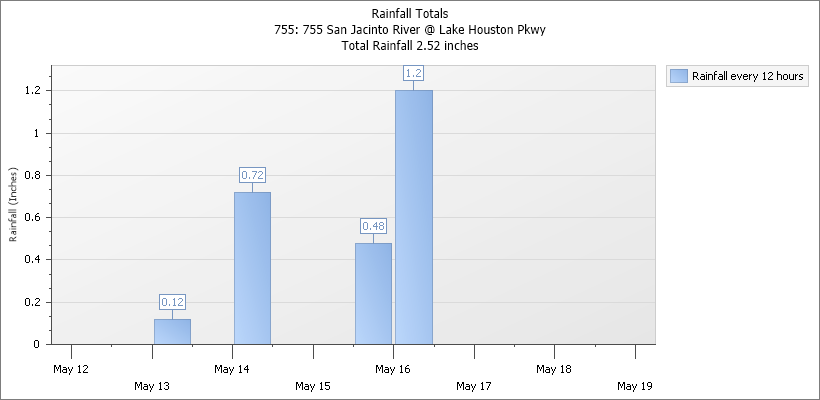
Harris County’s Flood Warning System shows that the area received about two and a half inches of rain last weekend. A 2.5 inch rain is far from a record. But forecasters predicted much more. And some areas to the south and east of Lake Houston got more than 10 inches! So Elm Grove residents lucked out, but they were rightly worried.

In the end, whether it was the additional detention capacity or the lighter rain, no one flooded. And that’s what counts.

The Harris County Flood Warning System shows that the nearest official rain gage to Elm Grove is at West Lake Houston Parkway. It registered 2.52 inches of rain in 3 DAYS.
2.52 inches would have to fall in 3 HOURS to even make this chart, and then it would be something we could expect every year. Source: NOAA

Status of Detention Pond Construction

So what is the current status of construction? As of last Monday, the two ponds on the southern section (S1 and S2) were complete.

Of the three ponds on the northern section:

  • N1 was partially excavated, with most of the capacity in the “tail” leading south toward N2.
  • N2 was about 80% excavated. Workers were expanding the new section and deepening the old section, developed by Montgomery County many years ago.
  • N3 was approximately half complete.
Part of N1 Excavation as of May 11, 2020
Massive N2 pond in southwest corner of northern section. Grassy portion was previously excavated by MoCo, but contractors are deepening it. Photo taken May 11, 2020.
Looking south at Woodridge Village N3 detention pond photo from week ago, May 11, 2020. Elm Grove is out of sight beyond top of frame.

As last week wore on, each pond expanded compared to the three images you see above. Jeff Miller, an Elm Grove resident who lives near Woodridge Village, estimates that all three detention ponds on the northern section were about 80% excavated by the end of last week. However, he also noted that much work remains in terms of sloping the sides, stabilizing soil, building pilot channels and connecting ponds.

Barring further major rains and at the current rate, Miller estimates contractors could finish all three ponds in June.

How They Performed Last Weekend

N1

The first shot below shows the tail of N1. It was not yet connected to N2 so water could not drain out of it.

Photo of N1, looking north, by Jeff Miller on Saturday after rains stopped.
N2

I have no pictures showing how well N2 did at holding back rain, but neither Taylor Gully nor the southern detention ponds overflowed.

N3
Prior to the rain, this portion of N3 was deep enough to conceal all but the top of a large dump truck. N3 might have held approximately 5 feet of water according to Miller.
Additional Culverts for Connecting N1 and N3

Jeff Miller also photographed these 4×4 box culverts stacked up north of N3.

Note the concrete box culverts stacked up north of N3. Plans call for connecting N1 and N2 with such culverts. Also notice how land has been sloped from left to right to flow into N3. See water draining into N3 from a temporary ditch that cuts through the bottom of the image.

Layout and Capacity of All Ditches

Layout of detention ponds on Perry Homes’ Woodridge Village.
This pie chart shows the relative capacity of Woodridge Village detention ponds. In the May flood last year, only the blue pond was complete. By the September flood, Perry had also completed the green pond. The three northern detention ponds hold 77% of planned storage capacity. None of those had even started.

Conclusion

Last week’s rains were a small test. But results showed the work already done has added to to detention capacity.

Miller says that water from the northern section did not appear to spill over into S2. His pictures also showed that S2 was only half full.

That meant the entire rain, with the help of new detention ponds, was able to drain out through a 3 foot corrugated pipe that connects Taylor Gully on either side of the county line, just like it used to.

This is welcome news for flood-weary Elm Grove and North Kingwood Forest residents who feared the worst.

No Progress to Report on the Political or Purchase Fronts

Even though the deadline for a Harris County purchase of Woodridge Village from Perry has passed, and even though Commissioners are not supposed to discuss the buyout in tomorrow’s Commissioner’s Court meeting, Precinct 4 Commissioner Jack Cagle says negotiations are ongoing.

The County made an offer to buy the land in order to build a regional flood detention facility. But the offer was contingent on the City of Houston donating $7 million worth of other property to the Flood Control District to help offset costs. The City also had to adopt County drainage criteria. It reportedly is more conservative than current City standards.

Posted by Bob Rehak on 5/18/2020 with photos and reporting from Jeff Miller

993 days since Hurricane Harvey and 242 since Imelda

The thoughts expressed in this post represent opinions on matters of public concern and safety. They are protected by the First Amendment of the US Constitution and the Anti-SLAPP Statute of the Great State of Texas.

Perry Contractors Encroaching on Porter Drainage Ditch West of Woodridge Village

Aerial photos taken Monday this week (5/11/2020) show that Perry Homes’ contractors appear to be partially blocking drainage that serves dozens of homes on the western side of Woodridge Village in Porter. With heavy rain expected this weekend, residents like Gretchen Dunlap Smith are nervous.

Homes Flooded Twice Last Year by Water that Could Not Get Out of Neighborhood

Many of those homes flooded twice last year, in May and September, just as homes in Elm Grove did.

Looking south toward Kingwood along the western edge of Woodridge Village in Montgomery County.

The issue with these homes, however, was that water could not get out of the neighborhood because of altered drainage.

Water drains to the east (left) into the drainage ditch along the perimeter of Woodridge, and then south toward the top of the photo to Taylor Gully.

This enlargement, cropped from the photo above, shows how the perimeter road is pushing into the drainage ditch for homes in the older Adams Oaks subdivision to the right.
Hovering over Flower Ridge in Porter and looking southeast. Note how workers have pushed past Perry’s own silt fence (upper right) that marked the old edge of the ditch and how dirt from construction is now collapsing into the ditch.

Heavy Rainfall Forecast for Saturday

After months of inactivity, it’s gratifying to see workers hustling again. But as the old saying goes, “Haste makes waste.” Forecasters are predicting widespread heavy rains this weekend. Predictions range from 2 to 4 inches, with pockets up to 6 inches.

Jeff Lindner, Harris County meteorologist said this afternoon, “Expect a line or complex of slow-moving thunderstorms to move across SE TX Saturday starting out west in the morning and spreading across the area throughout the day. There will be a low severe threat with this activity, but the main threat will be heavy rainfall. 

As of Thursday, NOAA and the National Weather Service predict heavy rains and possible flash flooding across all of SE Texas.

That gives contractors one day, Friday, to clean out that ditch to avoid another possible flood and more possible lawsuits.

Posted by Bob Rehak on 5/14/2020

989 Days since Hurricane Harvey and 238 since Imelda

The thoughts expressed in this post represent opinions on matters of public concern and safety. They are protected by the First Amendment of the US Constitution and the Anti-SLAPP Statute of the Great State of Texas.